the
ISSUE 10 THE MUSE AUTUMN ~ 2014
MUSE
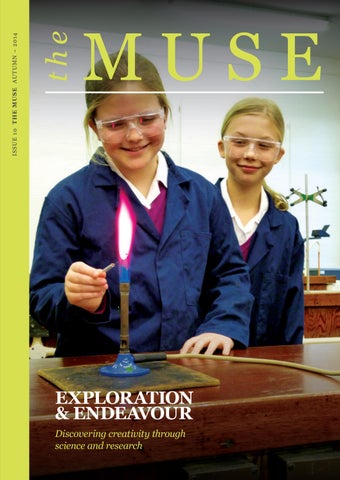
EXPLORATION & ENDEAVOUR Discovering creativity through science and research
Visits & Voyages
This list is by no means exhaustive, but offers a flavour of guests in and visits out during the Autumn Term.
Visitors In Activity mornings with MK Prep School, Broughton Manor, Polam School and Pilgrims Pre-Preparatory School Amy Bond, Alumna, Maths Talk, Year 11 and Sixth Form Catriona Townley, Slavery and Sex Trafficking Talk, Upper Sixth Drama students Charlie Gardner, Alumna, Drama Talk, Sixth Form Classics Quiz with Bedford Modern School, Years 10 - Upper Sixth Commedia dell’Arte Drama Workshop with Cheryl Parmenter, Professional Performer and Director, Year 11 and Sixth Form Community Dance Workshop with Roxton Lower School, Year 4 DAHSA Reunion Franklin House Assembly with Jenifer Glynn, Years 7 - Upper Sixth
Greek Day, Year 5 Harpur Trust Religious Studies Debate, Years 10 - Sixth Form Jessica Riley, Alumna, Textiles Talk, Lower Sixth Lunch Club, LRC Compass Room Major Corrigan MBE, World War One Talk, Year 11, Sixth Form and CCF Cadets Mr Owen’s Pocket Book, World War One Theatre Performance by Redheart Theatre Old Girls v First Team Lacrosse Match, Sixth Form Professor A.C. Grayling, Philosophy Talk, Year 11 Richard Fuller MP, Politics Society Talk, Years 9 - Upper Sixth students Roman Day, Year 3
Voyages Out Art Trip, The Higgins, Bedford, Year 10 Art Trip, St Paul’s Church, Bedford, Year 10
General Knowledge Quiz, Bedford School, Years 3 - 8
Music Trip, Bedford Cineworld, BBC Ten Pieces, Year 3
Geography Field Trip, Castleton, Peak District, Year 9
National Space Centre Trip, Leicester, Year 5
Cartoon Museum Trip, London, Years 7 and 8
German Christmas Markets Trip, Aachen and Cologne, Years 7 - Upper Sixth
Baptist Church, London, Sixth Form
CCF First Parade, Bedford School
German Trip, Berlin, Years 10 - Sixth Form
CCF Field Weekend, Chicksands, Years 10 - Sixth Form
Geography and Biology Trip, Costa Rica, Year 11
Bedford Castle Mound History Trip, Year 7 British Museum Trip, Year 11 and Sixth Form
CCF Field Weekend, Norfolk, Years 10 - Sixth Form CCF Activities Week, Isle of Wight, Years 10 - Sixth Form
Geography Trip, Cranedale Centre, Yorkshire, Lower Sixth Girls Go Gold Conference, St Catherine’s School, Guildford, Years 10 - Sixth Form
Philosophy and Religion Conference, Bloomsbury Puzzle Day, Bedford Prep School, Year 5 Open Mic Night, Bedford School, Years 9 - Sixth Form Royal Northern Sinfonia Concert, The Barbican, London, Years 10 - Upper Sixth
Sleepover, ZSL London Zoo, Year 6
Henry Moore Arts Foundation Trip, Lower Sixth
Spanish Trip, Valencia, Years 8 and 9
Chemistry in Action Trip, London, Lower Sixth
Hispanic Theatre Festival Visit, Sixth Form
Swan Lake Theatre Trip, Milton Keynes Theatre,
Descartes Loire Valley Trip, Years 9 and 10
Institute of Education, London Trip, The Creative Process for Lower Sixth IB Art Students
Years 6 - Upper Sixth
Languages Live Show, Olympia Central, London, Sixth Form
School, Cambridge, Years 9 - 11
Love’s Labour Won Trip, Royal Shakespeare Company Theatre, Stratford-upon-Avon, Upper Sixth, English Literature students
and Homebrook House Residential Homes, Year 6
Maths Roadshow, Cople Lower School and Houghton Conquest Lower School, Year 10
Victorian British Museum Trip, Year 4
Edale Trip, Peak District, Year 10 English Conference Love Through The Ages, the University of London, Sixth Form
Maths Team Challenge, University of Northampton, Sixth Form
the Dog in the Night-Time, Gielgud Theatre, London,
Physics Trip, the A14/M1 Engineering Works, Upper Sixth
Maths Christmas Lecture, Open University, Sixth Form
Xplore SORTED Trip, Westminster Chapel,
Diana Award Anti-Bullying Ambassadors Conference, Years 9 - Sixth Form DofE, Moroccan Expedition, Year 11 and Sixth Form Drama Trip to see One Man, Two Guv’nors, the Royal & Derngate Theatre, Northampton, Year 11 and Sixth Form
Top of the Bench Chemistry Competition, The Perse Transition Choir Singing, Centre MK, Lilibet Manor Verulamium Museum Trip, St Albans, Year 3
West End Theatre Group Trip, Curious Incident of Years 7 - Upper Sixth Years 9 - Sixth Form
Editor’s Insight
A
s the Autumn Term comes to a close, I find myself reflecting on what has been created and achieved in the first 12 short weeks of the school year. It seems to just rush by. The rate of momentum at which the girls grasp each project, quickly understand it and explore new subjects continues to amaze me. I delight at the level of creativity I see in the classrooms and the independent manner in which our students approach their work. Whether it is the Junior School pupils tackling their QED (Question, Explore, Discover) homework projects or our talented Sixth Form students creating beautiful textiles and artwork inspired by science, I never cease to be impressed by the effort and determination shown all around the school. I often wonder why they commit so intently. I have concluded it is because of the way in which these young enquiring minds are inspired both inside and outside the classroom - we are developing pupils who have a thirst for knowledge. They want to discover and find out more; they want to try harder, take risks, question the traditional orthodox answers and most importantly, they want to succeed. Earlier in the Autumn Term I travelled to Rome to attend an IB conference for European head teachers. During a number of inspiring talks, we heard about the importance of making sure that the education we are delivering is fit for purpose, that we are truly developing the right skills for our pupils as they enter a world very different from the one that I saw as a fresh graduate. It is vital that we teach in such a way as to explore the interdisciplinary nature of the subjects. We can no longer afford to educate pupils to write and repeat, today’s students need to have the ability to think independently, to challenge, to be creative and persevere in order to problem solve. These are the skills which universities and employers are looking for and which we must help to develop in order for our students to flourish. At BGS we continue to deliver a modern, relevant education, and I am excited by the new possibilities that technology brings us to enhance this experience. At Bedford Girls’ School, trips and excursions play a vital role in this wider view of education
and are integrated into our curriculum and our approach to learning. How better to understand the links between Science and Geography than by standing on the edge of a volcano in Costa Rica? Equally, a re-enactment of the First World War Christmas Day Truce with a Year 8 Football competition is a poignant way for the girls to reflect and to understand the significance that this event had, when played out against the backdrop of the horrors of the First World War. This is also why sport plays such an integral part in all of the girls’ school lives. It is not only about keeping fit and healthy, but about helping the girls develop a wider set of life skills, those of commitment, team play, resilience, and leadership. The sports pitch can teach in ways that a classroom cannot, and here they develop vital skills which they will need in order to navigate their way through both school and the post-school world. I am extremely proud that at Bedford Girls’ School we have such a strong tradition of students studying STEM subjects, and yet I continue to be dismayed that nationally there are still too few girls going on to study these subjects at university. That is why we place a strong emphasis on the wider view of science and actively work to open the minds of our students to the plethora of opportunities beyond the traditional STEM careers options. Whether it is through guest speakers, trips to science events, workshops, careers advice, course or internship opportunities - the girls need to be exposed to the possibilities in order to understand the connections that pure science has to the wider world and to see how they can forge interesting, innovative and rewarding careers in a whole host of sectors. In our feature The Future is STEM we explore what we do as a school to encourage our students in these fields.
“ I delight at the level of creativity I see in
the classrooms and the independent manner in which our students
”
approach their work.
Jo MacKenzie Headmistress
I hope you enjoy this issue of the Muse. I wish you and your families a healthy and happy 2015. I am looking forward to another year of creative discoveries, seeing those enquiring minds expand their horizons and exceeding their own expectations. I know you will all share some of these moments with me and are equally as proud of the achievements of our girls, your daughters, as I am. The Muse | 02
Inspired by
Anna Hunt Year 11
Katie Parrish Year 11
Costa Rica
L
earning is so much wider than sitting in a classroom, and in today’s world more than ever it is vital that students are able to make the connections between what they are studying and the real world. Equally as important is understanding the interdisciplinary nature of the subjects they study, and how the links and relationships between different themes sit together. Bedford Girls’ School believes that school trips can truly open the senses and the mind. An adventure across the globe not only brings the classroom to life, but inspires a sense of discovery whilst allowing existing knowledge to be used in a real life context. It also allows the girls to grow as independent thinkers and travellers. They are introduced to new histories and cultures and are able to re-evaluate preconceptions. Such trips really can be life changing experiences and play an important part in every student’s educational journey. A trip to Costa Rica to study the geographical formations, flora and fauna of this beautiful country was certainly no exception. On the first day of the Autumn half term holidays, 15 excited girls arrived at school to meet Mrs Whiteley, Head of Geography, and Mrs Lockren, Head of Science, to begin their journey to Costa Rica. This was the first time that Bedford Girls’ School had ventured to this magical country and there was an air of great anticipation. After a long journey, the party arrived and from the moment they stepped off the plane they were awakened to the special nature of this land. 03 | The Muse
Year 11 students Anna Hunt and Katie Parrish reflect on the trip and share their experiences of how it has opened their eyes and minds to the close links between Biology and Geography, and how learning in natural environments has inspired them to look closer into these two subjects and to study them in the Sixth Form. Anna said: “When asked to summarise my most memorable moment of the trip, I was tempted to say ‘everything’. There were so many awe inspiring moments, it is hard to pick out a single highlight. From the second we stepped off the plane and were hit by the warm climate and different smells, our minds and eyes were buzzing with what we would see and experience, it certainly didn’t disappoint at any level. “I loved walking through the rainforest and learning about all the plant and animal adaptations; it was fascinating to understand all these processes and how they all link into each other.” Starting in the capital of San Jose, the group travelled west to the Pacific Ocean and then to the north of the country before travelling back across the volcanic spine, visiting internationally renowned sites of natural beauty and significant geographical importance. Anna added: “When we visited La Paz Waterfall Gardens, I was taken aback by watching large tropical butterflies come out of their cocoons and drying their wings off before they could fly. It was one of the wonders of nature that I feel I will never forget. It was so helpful to be able to see these things in the flesh, and is so different to learning from a textbook. It was an absolutely amazing experience.” Katie continued: “I don’t have any one best moment of the trip because every moment was
amazing, from swimming in Las Chorreras Waterfall to seeing sloths in the wild on the Rio Fria on the Nicaraguan border, it was all incredible. I think that everything we have seen has helped us to understand what we have learnt in lessons more clearly, and it has inspired me to take both Biology and Geography at A Level.” The trip included visiting the Poás, Irazu and Arenal volcanoes, where the girls studied volcanic formation and activity including boiling mud pools and steam geysers. The party visited the stunning Rincon de la Vieja National Park, to appreciate the geothermal wonders and to explore tropical rainforest. In addition to observing tectonics at close range, the girls also experienced natural hot pools on the banks of the river rapids, as well as spending time taking in the beautiful scenery and watching an incredible range of wildlife in their natural habitats. Sightings included sloths, iguanas, monkeys and tropical birds. Looking back on the whole trip, both girls added that an additional bonus was how they came together as a group. “One of the most personal moments for me was when I realised that we had become great friends through the experiences we had shared together. Whilst learning we were allowed to bond as a group and because of this we enjoyed the trip as much as was possible. I think this will really help our learning and collaboration back in the classroom.” added Katie. Anna concluded: “We speak for everyone in the group when we say this was a trip of a lifetime. We thank Mrs Whiteley and Mrs Lockren for taking us to such a fascinating country and for giving us the opportunity to enjoy such a range of activities. It was life changing.”
Your School, My School Bedford Girls’ School and both of the heritage schools have always had thriving Science, Maths and Technology departments with large numbers of students studying STEM subjects at A Level and IB. Current Upper Sixth science student Chantal Duchenne and Bedford High School alumna, Emma Wong, who is in her final year of medical school, look back on their school careers and what inspired them to study the sciences.
Do you remember your first day at school? CD: Not as such. I remember feeling nervous but excited for a long time beforehand. However the actual day is, sadly, a bit of a blur! EW: I don’t remember my first day as much as the first day I came to look around the School. I was eight, and I remember sitting in on some lessons, and in particular finding the library at lunchtime. I found a really good book, and I remember Mrs Boulting, the then Headmistress of the Junior School at BHS, saying I could borrow it to finish reading and bring it back later. What was your favourite subject and why? CD: Difficult and time consuming though it is, I’d say Chemistry is the subject I’m enjoying the most, especially since starting the A2 course. I really enjoy linking one topic with another and there really is a sense of understanding why everything we learned previously at GCSE happens. EW: Probably English or History - English because I have always loved reading, and it gave me a chance to explore books I’d never have thought of. Pride and Prejudice, my favourite book, was one I first read in Mrs Clifton’s GCSE English class. I also really enjoyed History, as I think it’s important to have an understanding of how the world got to where it is today.
If you had your time at school again would you have done anything differently? CD: Apart from the generic ‘work harder when I was younger’ I don’t think I’d change anything. I’m happy with all the choices I have made along the way and would probably keep everything the same. EW: Looking back now, I think I would have appreciated my time at school more - sometimes, with all the work for GCSEs, A Levels, IB etc, you forget to enjoy what you’re doing. Sometimes, it helps just to slow down and appreciate the moment!
What/who inspired you to study the sciences?
How has school shaped your values and aspirations?
CD: I wouldn’t say I was inspired from a young age - if anything,
CD: Being in an environment that is so accepting of everyone has
when I was younger, I was swaying towards the languages. However, during Year 11 I started reading more around my subjects and found that the sciences and Maths really leapt out at me, so I guess that was the driving force. EW: This is always a good question, because at school I always thought science was interesting, but it was never my favourite subject. In this respect, Medicine is an excellent career, as it’s not all about the science - it’s also about the people - so you don’t have to be excellent at science to do it, although a basic understanding definitely helps! I’ve wanted to be a doctor for as long as I can remember, and so I knew that Science was something I had to do to get into that profession. Funnily enough, when you start applying science to Medicine all those Physics and Chemistry lessons suddenly start to make sense.
certainly made me a more tolerant individual, and taught me to value all talents and strengths. As all of my classes are with girls of such high abilities, school has helped me aspire to do my best at all times and has helped me achieve these goals. EW: I’d say BHS was important in helping with my aspirations - all the teachers knew I wanted to do Medicine, and were always willing to help or lend advice - I knew I had plenty of support behind me. If you could sum up your time at school in three words what would they be? CD: Motivating, dynamic, rewarding. EW: Challenging, exciting, rewarding. The Muse | 04
THE FUTURE IS STEM Whilst women currently make up 45% of the workforce, less than 15.5% go into STEM related fields. Semta - the sector skills council for science, engineering and manufacturing technologies, recently warned that we are facing a shortfall of 80,000 workers in the next two years. These are fast moving, high income earning industries and yet there is a dearth of women in the ranks. Nationally, despite recent reports suggesting a gradual increase in the number of students studying the sciences at A Level, these are still too low and not translating into undergraduates.
“ I want to make sure we use all our talent, not just 25 percent. ” Mae Jemison
The first African American woman in space
05 | The Muse
B
edford Girls’ School recognises that this is of huge concern to the economic welfare of the country and that it is our responsibility as educators to address how we teach, assess and inspire girls to continue studying STEM subjects postschool and to forge interesting careers in these sectors. We are proud to buck the national trends with over 38% of our Sixth Formers studying Biology and 34% studying Mathematics as part of their A Level or IB courses. However, there is a huge leap from studying STEM subjects in the confines of the school laboratories to aspiring to build careers in these areas. It is vital that STEM subjects are made interesting, challenging and engaging in order for the girls to consider studying these at university. Mrs Vicky Lockren, Head of Science, explained: “It is well known that some of the fastest growing industries today didn’t exist a decade ago. Many of these sit in the STEM field. Women in science related careers tend to earn 15 per cent more than other sectors. We need to open our girls’ minds to the huge range of possibilities and ensure that they understand the significance of what they are studying, and are able to make the connections between the classroom and the working world.”
Mrs Lockren added: “We work holistically across the STEM departments to ensure that our curriculums provide a rich mix of theory and practical experience. Research shows that girls are most engaged when learning is geared towards practical applications, and we strive to ensure that the work we do is inspiring and relevant to the students. We aim to create a passion for the subject and to develop investigative research and analytical skills, as these are the attributes valued by employers.” Each year the school incorporates an extensive range of trips and excursions into all aspects of the curriculum, with visits to science related fairs such as ScienceLive!, Royal Institution Christmas Lectures and the UK’s biggest STEM fair, Big Bang. At these events the girls have the chance to hear from world experts on topics such as the Large Hadron Collider, development in cancer therapy, Astrobiology and Forensic Science. Further afield the girls join national and international expeditions to study science in action, whether it be a Physics trip to the M1/A14 to look at huge engineering projects, a visit to CERN, Geneva, or a joint Biology and Geography trip to Costa Rica. These all add huge value in terms of seeing the subject coming alive. Mathematics and science competitions are encouraged with all girls and they often go on to perform exceptionally well. Competitions such as Go4Set, Schools’ Analyst Competition, and Science and Maths Oympiad provide useful platforms to increase students’ confidence and to encourage them to strive to achieve more. In the Lower and Upper Sixth the girls are able to extend their academic studies beyond the classroom through participation in YASS projects, where they can complete programmes accredited by the Open University and the CREST Award Scheme, where students participate in extended projects, supported by an experienced scientist. Students also apply for internships and courses, including Headstart, aimed at engineering and science students. All of these opportunities help increase their knowledge and add great value to their CVs. Sixth Form girls alongside Bedford School students run the Harpur Trust Science Forum, the Veterinary Medicine Society and the Medical Society, which all provide marvellous platforms for a whole host of lectures to enthuse the students. Over the past year they have welcomed many
experts in the field, including the geneticist Steve Jones, to the stage. Not only do these experts open their eyes to new and exciting ideas, but they also enable the students to come together as a group, sharing likeminded discussions and a mutual love of science. Creating this joint sense of community is an important motivator for young people when it comes to choosing university and careers options.
diabetics. Jonathan Ellis, a parent, has also given a thought provoking talk about being a doctor and the career opportunities available in the NHS.”
Mrs Lockren continued: “Collaboration and role models play an important part in decision making and we are incredibly lucky to have access to some world leading scientists. Last year some of our GCSE students met Dr Lucie Green, an alumna of Dame Alice Harpur School and world renowned space scientist. In the summer we were honoured to welcome Val Gibson, Professor of High Energy Physics at the University of Cambridge, as our Prize Giving speaker. Her speech focusing on managing a work life balance in a very senior role in science, gave the girls a real sense that anything is possible and even the highest aspirations are achievable.
Bedford Girls’ School works to ensure that our students leave school not only with academic knowledge but with the selfconfidence and life skills they will require in the wider world. Each year the Careers Department arranges dedicated STEM careers evenings with speakers from both universities and the commercial sector, as well as setting up mock interview training with STEM specialists for those girls thinking of the sector. In addition, all Lower Sixth students are invited to attend a networking skills event called Work the Room, where they are introduced to the skills needed to network effectively and then put them into action in a room full of guests. Not only is this great practice but the girls also get to meet a number of professionals from the STEM field, enabling them to start building vital links.
“We also maintain strong links with our governors, parents and local businesses, many of whom have successful careers in STEM related sectors and are willing to share their experiences with our students. Recently one of our governors, Professor Seamus Higson, from Cranfield University, gave students in the Sixth Form a most insightful presentation into working in the biotechnology field and the development of biosensors used in the treatment of
Many of the school’s younger alumnae who are currently studying STEM subjects at university, also come back to talk to the current Sixth Form. Our current students find it easy to relate to them, and the guidance and mentorship invaluable.
Mrs Lockren concluded: “Industries involved in STEM are looking for bright, enquiring minds to help answer the world’s most challenging questions which need science and technology-based solutions. At Bedford Girls’ School we have that pool of talent, and we look forward to many of our girls being at the forefront of women in science.” The Muse | 06
Biology is everywhere, including in the landscapes and natural form in the world around us. The study into natural forms such as fungi and flowers, inspired me to look at the nature of surface and form. Influenced by the patterns, and structure of the orchid and fungi, I then moved towards encapsulating this surface texture and pattern of the natural forms with the use of acid dyeing, which will create lines that can be used to shape the form. Therefore each form is created to be unique. However, when placed with multiples they all have similar qualities. Harriet Lusty
THE ART OF SCIENCE Bursting With Knowledge represents my visual exploration into the wisdom mankind has obtained from scientific research, and how this has been preserved through the writing of analytical papers and scientific books. Inspired by the work of Cara Barer, Klari Reis and Charlotte Hupfield, I have incorporated a ceramic influence from Hupfield, a sculptural element inspired by Barer and the theme of scientific objects such as petri dishes from Reis. My final piece consists of a background of circular shapes in keeping with the spherical nature of petri dishes. Mounted on this background are three book sculptures manipulated by rolling, curling and securing the pages to end up with another spherical element akin to petri dishes - which represent the scientific books that mankind have compiled from our discoveries. Test tubes filled with bright paint are hung from the pages of the books and my original ceramic circles imitating bacteria growing in petri dishes are mounted on the wall, representing the ‘knowledge’ literally cascading from the page. Emily Tapp
07 | The Muse
My work explores natural form together with the patterns and textures within nature, and as such, science has become a key source of inspiration for me. I focus on one aspect of nature, whether that is flora or fauna, and explore it through stitch and mixed media. I have taken inspiration from a range of scientific occurrences, from the effects of the changing seasons, to the natural patterns and structures of butterflies and insects. Living in the countryside enables me to be constantly immersed in nature, providing endless inspiration and a natural starting point for my projects. It also influences the media that I work with and my colour palette. I like to work in mixed media, often combining organic materials, such as hessian and cloth with more industrial materials including metal and wire, to reflect the contrast between the natural world and the increasingly man-made environment. Hannah Beazley
Sixth Form students explore nature and science as inspiration for artwork and textiles.
In my work I have explored the structure and anatomy of the body. Combining the similarities of the skeleton functioning as a supportive structure similar to the framework of a building, I wanted to examine imagery of architectural and sculptural forms that can be found in the human structure. Using the processes of monoprinting, collage and tensile sculpture, I wanted to investigate how rarely viewed negative spaces in the skeleton were occupied and interpreted. Veronica Jones
The Muse | 08
QUESTIONING HOMEWORK
T
he advantages and disadvantages of homework have been debated in education circles for many years. Supporters believe it is important to reinforce learning and create good work habits and student responsibility whereas others question the educational value if the homework doesn’t directly link to what the students are learning in the classroom. At Bedford Girls’ School we believe there is great value in homework but recognise it needs to be relevant and engaging, and we now believe we may just have found a model that suits all pupils. Brand new to the Junior School this academic year, a homework method Question, Explore, Discover (QED) - has been adopted by all years (3-6). To supplement the enhanced curriculum, QED homework allows the girls to link the ideas they have begun to explore in class, and challenges them to develop and extend their understanding through individual personalised tasks. The Junior School introduced its enhanced creative curriculum in September 2014 and the need to look again at the homework model came from a desire to engage the pupils in their homework in a meaningful and enjoyable way. The new enhanced curriculum was born from a 2007 report by the National College for School Leadership which looked at the use of 09 | The Muse
a creative curriculum in four separate
termly theme and encourages research, understanding and reflection.
The report proposed that creativity should
The format of the homework is underpinned by a fortnightly task menu. Consisting of a starter, main (longer activity) and dessert, the menu sees pupils choose a course to complete over a two-week period, with all three courses having to be finished by the end of each half term.
primary schools.
be seen as central to the curriculum, and to the process of delivering and absorbing the curriculum, rather than as a bolt-on. This
“ With QED homework prompting the girls to tap into their creative resources, Mrs Howe believes the model complements the curriculum well. ”
report reinforced current pedagogical thinking that through a focus on creativity, students also learn the important skills of problem
solving; risk-taking and independent learning. Key attributes that all students will need as they move through life in the 21st century.
Encouraging individualism, creativity and the freedom of choice in what they’re learning,
the QED homework model reinforces the key
skills the pupils are learning in the classroom. It extends their knowledge of the current
In order to complete every course, the pupil decides the type of learning they enjoy, undertaking relevant tasks in five different areas - Knowing, Understanding, Applying, Evaluating and Creating. For a starter, a Year 4 girl, who learnt about the Victorians in the Autumn Term, could state that they enjoy reading, writing and speaking and decide to write a diary as a Victorian housemaid (Knowing) and read a book set in the Victorian era (Applying). For the main course, they may select hands on activities and make a Victorian recipe (Understanding) or decide to design a game that a Victorian child would play (Creating). Each year group has adopted their own approach to QED tasks to suit the specific needs of their age group. In Year 3, where girls are developing independent learning, too much choice could be overwhelming so instead the element of choice is slimmed down for them. In Year 6, the expectation is for the girls to embark on their QED tasks
through the planning and time management of tasks. However, the common thread is about every girl having choice and being empowered to make decisions for herself about her learning. “We’ve adopted QED homework because we wanted to challenge and stretch the girls,” said Carolyn Howe, Head of the Junior School. “We wanted them to have a choice and develop independent learning skills. The most recent research into learning tells us that meta-cognition (learning how to learn) feedback and peer tutoring have the greatest impact on achievement in school. We see QED homework as being able to address all three of these elements. What has truly staggered all of us is how well it has been adopted and the incredible sense of responsibility and ownership that we are now seeing, as the girls have the freedom to choose their own method of working. Part of the reason for giving the girls that element of choice was not only to benefit them but also their parents. Our existing homework method had become quite intensive, so by allowing a certain amount of flexibility, it allows families to plan homework around their busy lives and encourages the girls to take responsibility for scheduling their time. By giving parents and girls the choice, they feel empowered. “Every time a girl shows me a piece of homework, they say they most enjoyed being given the choice to undertake that piece of work.” With QED homework prompting the girls to tap into their creative resources, Mrs Howe believes the model compliments the curriculum well. She added: “QED homework very much fits in with the creative curriculum. It allows pupils to find out about something specific to their curriculum. For instance, one Year 4 girl chose the task of making a collage of a Victorian building. She’s produced a beautiful collage of Bedford School, having studied the architecture and then using her creative skills. They’re allowed to develop the type of learning skills they want to use, whether that is art, literacy or something else.” Emily Atherton (Year 6) continued: “I’m quite a creative person and I like how, with some QED homework tasks, I’m given just one page to express as many different thoughts as possible.”
In addition to pupils having more of a say in the work they do, they’re also encouraged to share their experiences of how they fared on each task.
takes the pressure away, with pupils often
Once their teacher has marked the work with stamps, stickers and appropriate comments, the girls then present their work in class to fellow pupils and receive valuable feedback from pupils and teachers alike.
She concluded: “The girls don’t come to
The girls also fill in an evaluation form after each piece of QED homework is finished, with questions ranging from ‘what inspired them’ to ‘how they found the process of completing each task’.
that security of knowing that they don’t have
Mrs Howe explained: “Some primary schools have learning logs but for us we see QED homework as an extension of our curriculum. We wanted to do something that ties in with our enhanced curriculum and one of the really exciting things about it is that we wanted to give the girls the chance to steer the learning themselves. We wanted to give them the opportunity to follow an independent line of enquiry so we felt we had to support that through the homework as well.”
pupils decided they wanted to incorporate
Whether it be activities in the classroom or the playground, there’s naturally a competitive edge between girls. But what comes with this is the pressure of being judged by fellow peers on the standard of work produced, even if that topic isn’t their strongest. Mrs Howe is pleased to see that QED homework
not that comparison with each others’ work.”
choosing varying methods to complete pieces of work, as one could design and the other produce a poem.
school worried that they haven’t done as well as their friends, because they have the choice to learn something different. For girls who we know don’t like taking risks, we give them the pressure of studying a topic at which their peers are stronger. “For example, Year 5 have recently made models of space stations - and a lot of those that task as part of their QED menu. Previously, when teachers said ‘Make a model of a space station’ there would have been some pupils who would have loved the project and others who would have been worried about not producing something that they felt was up to scratch. But if you’re not great at designing then you can now choose another subject and produce a piece of work work of which you’re just as proud. There’s
The evaluation by politicians, teachers and parents of the pros and cons of homework will no doubt continue for many years to come, but Bedford Girls’ School is on the road to a successful formula. The Muse | 10
Educating through Sport
T
he value women place on sport was underlined by a recent Sport England survey showing nearly seven million females playing sport at least once a week for 30 minutes. The most popular female sport is swimming with a little under two million participants, while a further 400,000 play team sports regularly. At Bedford Girls’ School we appreciate the impact sport has on one’s physical and mental wellbeing and the different skills, from teamwork to leadership, girls learn. Whether it be an individual or team discipline, the school is committed to providing girls throughout the Junior and Senior Schools (Years 3-11) with at least four hours of physical education every fortnight. Jane Axford, Head of Physical Education, said: “In addition to fitness and stamina, sport develops many other skills including teamwork, commitment, discipline - and of course leadership. “Right from the first PE lessons in Year 3, girls are learning how to work in a team and how to support each other. Helping girls to be assertive and competitive with their peers is encouraged whilst learning to be magnanimous in victory and gracious in defeat in small sided competitive situations is also given emphasis. “The focus in PE lessons is about making sure girls are having fun whilst being 11 | The Muse
physically active and challenged to perform to the very best of their ability.” She added: “One of the most important contributions of school sport is how it can build girls’ resilience. “Helping girls to understand that improving one’s performance is all about making and learning from mistakes and that it is fine to try and to fail. The selection process for teams can lead to disappointment but the earlier this is experienced the quicker girls realise that they can bounce back; that playing for the B team might be just as fun as playing for the A team and that it is not the end of the world to be moved. “When the penalty stroke is missed, or the final hurdle causes an athlete to stumble and potential victories are snatched away, the individual girls will find support from their team-mates around them and these defeats make lifting the trophies aloft all the more fulfilling when that time comes. Perseverance is definitely the name of the game.” Nationally for a number of years, barriers, including facilities and funding, have dissuaded women from playing sport, as revealed by Sport England. Recognising the importance of the girls having access to state-of-the-art facilities, the school has set about rectifying this as part of an ambitious multi-year redevelopment project. Boasting a modern, fit for purpose environment, the PE Department is now
home to a refurbished gym, dance studio and fitness suite along with new changing rooms, showers and lockers area, all of which back on to the lacrosse and astro pitches. Mrs Axford added: “The new facilities look fantastic and the girls were so excited when they came back to school in September. The new changing rooms alone have made a huge difference, allowing the girls to feel more positive about their body image, which in turn encourages them to partake in sport.” She continued: “The refurbished dance studio has really caught the girls’ imagination, as it is now a vibrant room in the centre of the sporting hub. “The development has also encouraged the Sixth Formers to get themselves into the fitness suite before school, at lunchtimes, during free periods and after school, while the Year 11s can use it under supervision during lunchtime. Girls now want to be fit and physically active and it is important we provide them with the opportunity to achieve their goals.” Furthermore, over the summer the school was granted planning permission to build on Cople Fields, with work beginning soon to develop lacrosse pitches and a pavilion that will be ready for the girls to use in September 2016. Mrs Axford said: “What really excites me about Cople is that we will now be able to host regional and national tournaments, as
“ The strength of the school’s sporting facilities and coaching staff
allows the girls to enjoy more than 1,000 annual fixtures over 12 disciplines against some of the best independent and state schools in the country.
there will be plenty of parking space and we will be right by the A421 which feeds to the A1 and M1. These transport links will allow schools across the country to reach us easily.”
(Year 11) was a member of the U19B England Lacrosse Squad on their 10-day tour to America in July, and is currently training with the U16 England hockey squad.
Not only does the school possess the latest facilities, but they also employ over 20 specialist teachers and coaches who have represented their countries in sports ranging from lacrosse to swimming. These coaches also lead national and regional teams, including swimming specialist Ed Castro, responsible for managing the school’s elite swimming teams and delivering lessons during term-time and the school holidays. A keen triathlete, Mr Castro won the 25-29 World Age Group Sprint Triathlon title in Canada in August.
Mrs Axford concluded: “The quality of coaching is absolutely critical in making sure our girls enjoy and achieve their potential in their sport. Mutual respect and trust between the sports staff and the girls ensures that girls across the ability range feel valued.
The strength of the school’s sporting facilities and coaching staff allows the girls to enjoy more than 1,000 annual fixtures over 12 disciplines against some of the best independent and state schools in the country, while equestrian, football, running and skiing are also run as co-curricular clubs. This formula has led the school to an array of national and regional titles, ranging from rowing to netball, and produced elite sportswomen. Current Sixth Former Robyn Armstrong rowed for England in the Home International Regatta in the summer, Anna Hunt (Year 11) is training with and playing netball for the U19 Hertfordshire Mavericks, whose senior side compete in the FIAT Netball Superleague, while Kate Axford
“Our pupils really enjoy their PE lessons and that is why we have got huge numbers coming to co-curricular practice sessions. Everyone wants to be involved. It does not matter whether they are the most gifted or a complete beginner because there is something for everyone. State-of-the-art facilities are one thing, but nothing is more important than having a team of teachers and coaches who are knowledgeable and passionate about their sport and who are prepared to go the extra mile to give the girls the very best possible sporting experience.’’
”
Miss MacKenzie said: “We are working closely with UKActive who are trying to get more people, more active, more often. “Physical inactivity associated with a sedentary lifestyle has been described as the ‘biggest public health problem of the 21st century’. The Lancet recently described it as a public health pandemic and is now the fourth leading risk factor for global mortality. “UKActive is linking with major sporting organisations, health centres and schools to ensure that every child leaves school physically literate. At Bedford Girls’ School we are ahead of most schools; all our girls continue with physical education lessons until they leave school at 18 and the majority of our girls take part in competitive sport but there is always more we can do.
Mrs Axford and her team can also count on the full support of Bedford Girls’ School Headmistress, Jo MacKenzie, who is the Chair of the Girls’ Schools Association Sports Committee.
“UKActive are working closely with local health centres to link them with schools encouraging girls to use their local gym, take part in fitness classes and form a union that continues long after they have left school. We recognise how lucky our girls are with their facilities and access to excellent coaching. It is important to me that we form links with our local community so that other young people can also benefit.”
The Committee meets termly and discusses a variety of sporting issues, but it is primarily focused on raising awareness of women’s sport and encouraging girls to continue with sport once they reach their teenage years.
With Sport England’s Habit for Life report suggesting that 12 million females would like to do more in sport and physical activity, Bedford Girls’ School is certainly well placed to offer pupils the opportunities to do so. The Muse | 12
The Muse Interviews
Dr Jennifer Walters
At the end of a busy first term we catch up with the new Director of Sixth Form. Why are you so passionate about the International Baccalaureate? The IB Diploma prepares its students for lifelong learning in a global context, and has at its heart a vision for a peaceful world. Everything else that is unique about its programmes, assessment and treatment of knowledge is dedicated to this end and as such, it is unique and promises longevity. The experience of an IB student is simply excellent. What are your first impressions of Bedford Girls’ School?
Tell us a little bit about your background? Born in Bristol, I attended the University of Wales, Aberystwyth where I gained a BA (Hons). I went on to study at the University of Stirling for my MPhil in Gothic Imagination and then achieved my PhD Magical Revival: Occultism and the Culture of Regeneration in Britain c. 1880-1929. I have lived and worked in Scotland (Glasgow, Stirling and Edinburgh) and the country holds a special place in my heart. Before joining Bedford Girls’ School I was based in Edinburgh teaching at Fettes College, prior to which I taught at Malvern College. Why did you go into teaching? I am an English specialist and spending one’s time reading literature and talking about literature with young people, seems to me to be just about one of the most splendid things to which to dedicate a working life. Do you have a mentor/role model? I am endlessly inspired by the lives of others and have too many well-known role models to list. Recently, though, a former teacher and colleague (poacher-turned-gamekeeper, I began my teaching life at the school I attended as a girl) gives me much inspiration. Her name was Alyson Higgins and she sadly died this year. We all loved her. She knew that what is important above all is rapport; everything she did educationally began with understanding the individual, and this is something I try to emulate. 13 | The Muse
Warm, industrious and dynamic. It was a fast-moving ship that I jumped onto in August and I am everyday staggered by the variety of the place. A saying has it that ‘you overestimate what you can achieve in a day, but underestimate what you can achieve in a lifetime’, but at Bedford Girls’ School I am struck by just how much the girls pack into their days. On one day, I had the pleasure of teaching a Sixth Form student who offered insightful and penetrating ideas in a lesson, then shortly afterwards I watched her remarkable examinerassessed performance of her musical repertoire, and after that she went off to head up the Navy section of the CCF. All in a day’s work! What is your vision for the Sixth Form? A Sixth Form is the jewel in the crown of a school. We already have a wonderful Sixth Form but I want to build on this to ensure we offer excellent continuity and a supported transition from the Senior School, and yet ensure that our Sixth Form has a very distinct character too. I’d like to create opportunities to develop intellectual character and opportunities for girls to establish themselves. What three top pieces of advice would you give a student when they are considering post-16 education? When choosing your subjects take care to reflect upon your strengths: if you are good at practical work and investigation, for instance, consider the subjects with these components. It is wrong to suppose that the IB is the preserve of only the highest achiever. If you have an affinity with its aims and ideals you are halfway there!
When deciding where to study, teaching and learning is hugely important, of course, but so is the intellectual life you’ll enjoy beyond the lesson. Choose a Sixth Form that you expect to challenge you and develop you as a whole individual. Can I share a fourth? The Headman at the school at which I first taught gave a talk at the Leavers’ Chapel Service each year to congratulate the students on all they had achieved, and to wish them well. In offering his advice for the future he said: ‘Don’t just do what you love; love what you do’. And this is my advice: having a single goal - a single love - will work out for some, but not all, but by investing time in what you do, whatever it may be, you will love it. And it also reminds us to enjoy the process. How would you spend your ideal day out? With The New Yorker magazine. I collect it every Friday from the newsagent and carry it with me throughout the weekend. Its reportage, comment and reviews are superb and the famous cartoons are brilliantly observed. I find a long restaurant lunch at the weekend is the perfect companion for reading. When I have finished The New Yorker I enjoy the Review section of The Guardian, The Spectator, Intelligent Life, Private Eye and I always have a book on the go. So, in my ideal day out I would set off into town or city on foot (I am a bit of a flâneur), New Yorker in my bag, cinema, theatre or exhibition tickets in my pocket and a wellresearched restaurant reservation awaiting. Who is your favourite fictional character? William Stoner (Stoner by John Williams) moved me (and pained me) greatly recently. My eyes were streaming when my acquaintance with Owen Meany (A Prayer for Owen Meany by John Irving) came to an end on a beach in Greece. The characters who people Robert Browning’s dramatic monologues are favourites for all their flaws and virtuosity. Johnny ‘Rooster’ Byron (Jerusalem by Jez Butterworth) is somehow ancient and modern. I love to hate Richard III. I admire Olivia of Twelfth Night. I thought of Darrell Rivers from Malory Towers as a friend when I was a child. I have a crush on Jackson Brodie (Jackson Brodie, by Kate Atkinson).
A CHRISTMAS TRUCE “ I wanted the girls to
feel the sense of fun that the soldiers would have experienced during the football match and for them to then put this into the context of the horrors of life in the trenches.
L
”
ast Christmas saw the centenary of the 1914 Truce in the First World War - a unique occurrence where both sides on the Western Front agreed to put down their weapons. Despite no agreement from the British High Command and a stern warning not to go ahead with the truce, British soldiers ignored their commands, the battle fields were silenced and no guns were fired on Christmas Day 1914. On Christmas Eve, soldiers from both sides met in No Man’s Land and sang Christmas carols, held a burial service for dead soldiers, where they laid the bodies of British and German soldiers next to each other, and exchanged gifts, mostly food. Then on Christmas Day, a football match broke out between British and German soldiers after a British solder kicked a football out of his trench.
“I want the girls to understand the human nature of the men in the trenches on Christmas Day, who wanted to celebrate Christmas but actually realised their enemies desired the same thing. For soldiers from both sides, and the families they had left behind, Christmas Day a hundred years ago was far from the joyful, carefree Christmas Day we celebrate now.” Mrs Cruse continued: “The girls are more likely to understand the essence of historical events - and different subjects across the curriculum in general - if they’re learning in an interactive, interdisciplinary manner. And to that end we have developed a programme across the school which teaches the pupils about this incredibly significant event, and also allows them time to reflect on the impact that these events have had on our lives and our communities.” On Tuesday 2nd December the Senior School assembly was dedicated to the Christmas Truce, where girls learnt about the event and read out recollections from men who fought during the war. Later that day the Green Kitchen served a trench-themed lunch. A Year 8 inter-form Football competition was held on Thursday 4th and Monday 8th December so the girls could come together and remember the Christmas Truce in a more light-hearted manner. Mrs Cruse added: “I wanted the girls to feel the sense of fun that the soldiers would have experienced during the football match and for them to then put this into the context of the horrors of life in the trenches.” Year 7 were also taken off timetable on 2nd December to participate in a series of cross curricular activities.
The initiative involved Year 7 participating in a variety of sessions including Geography, Modern Foreign Languages, Art, Drama and English - all aimed at teaching the girls about the First World War and the impact it had on our world today. Parents were then invited at the end of the day to see the work the girls had produced, ranging from drawings of the Christmas Truce to pieces of drama re-enacting that moment in history. Mrs Cruse concluded: “The Year 7 day was a great way to introduce this year group to the First World War. It is on the History curriculum in Year 9 and again on the GCSE syllabus. However, we believe it is such a significant period of history that by focusing on different events during the four-year Centenary programme, we are able to introduce girls to different aspects of the war at appropriate times. “We intend to cover the Battle of the Somme in 2016 and the end of the war in 2018. It enables us to select different year groups and undertake days of activities examining in detail a certain stage of the war. This way, girls from across the school can learn about the Great War.”
The truce ended on midnight in one part of the trenches, but in other parts of the Western Front it lasted until the new year. To mark the centenary of the First World War, including the Christmas Truce, in a respectful and thought provoking way, Bedford Girls’ School has launched a programme of activity which will run for four years, recognising the impact that the war had on our wider community. “It’s of major importance for the girls to learn about the significance of the Christmas Truce, especially as such an event wouldn’t have happened if the promise of the war being over by Christmas 1914 hadn’t been broken,” said Kathy Cruse, Head of History and Politics. The Muse | 14
Legend in their Lifetime
Dr Helen Gates Chemistry Teacher
ROSALIND FRANKLIN, Scientist Photo by Vittorio Luzzati. Special thanks to Rosalind’s sister, Jenifer Glynn, for her permission to publish the picture.
DNA strands in order to take a diffraction picture. These qualities, Franklin had in abundance. Can you imagine the patience needed to obtain a photograph which takes nearly four days to take? Franklin worked methodically on both forms of DNA. One of her pictures of the B form, which has become famous as ‘photo 51’, was acquired through 100 hours of X-ray exposure from a machine Franklin herself had made.
B
Without permission, a colleague by the name of Maurice Wilkins showed photo 51 to Francis Crick and James Watson
ritish chemist Rosalind Franklin is best known for her role in the discovery of the structure of DNA, and for her pioneering use of X-ray diffraction.
The 1950s in post-war London was an
(two scientists working on a model of
exciting time for scientific research, yet
DNA at Cambridge University). They used
women remained under suspicion, and
the photograph, which showed evidence
there was a race to be the first scientist to
for the helical nature of DNA, as a basis
come up with the structure of DNA, the structure of ‘the secret of life’.
for their model.
I first heard about Rosalind Franklin when I was studying Chemistry at university. I had taken an option during my second year which was entitled: Proteins, Form and Function. Having not studied Biology at A Level, I was introduced to the idea of a ‘set of instructions’ in every cell in our bodies. And that the ‘set of instructions’ is simply based on four molecules wrapped inside a double helix. When I first saw a model of the double helix I was struck by its beauty and simplicity. Everything fitted neatly into place. I wondered how on earth the structure was ever discovered. The literature soon led me into the lives of Crick, Watson, Wilkins, and of course, Franklin herself. Born in 1920 to an affluent family in London, Franklin by the age of 15 was already determined to become a scientist. She applied to Cambridge and was accepted in 1938 to study at Newham College. She stayed at Cambridge during the war, studying for her doctorate and then proceeded to spend three years enjoying life working in France, before realising that to further her career she needed to be back in London.
Crick and Watson had pipped her to the post. They created a model of the DNA double helix and received a Nobel
“ Extreme care, skill,
patience and perseverance were needed to prepare the DNA strands in order to take a diffraction picture. These qualities, Franklin had in abundance.”
Prize in 1962 for their work. Despite the frustration and betrayal she must have felt, Franklin showed incredible humility and unwaveringly carried on with her work which would eventually give the scientific evidence for both forms of DNA, and the double helix model that Crick and Watson had made. She turned her attention to the structure of viruses and laid the foundations of study of structural virology. She wasn’t given credit for this until 25 years later. Too late for her, by the age of
In January 1951, at King’s College
37, sadly she had died of ovarian cancer.
London, Franklin began a postgraduate
I feel incensed by her story. In her
position to look at DNA fibres using a
lifetime, her work was overlooked and
technique called X-ray diffraction, which
its significance misunderstood. Yet, her
she had learnt in France. At the time, this
resolve and resilience to carry on despite
was a very new, cutting edge technique.
all of this, is inspirational to me. To
A technique which allowed the scientists
keep methodically working away on her
to see how atoms were arranged in a
research, unfalteringly, to the end, shows
material. Extreme care, skill, patience and
enormous dedication. Her devotion to her
perseverance were needed to prepare the
work and to science was unwavering.