the
AUTUMN ~ 2011 THE MUSE ISSUE 1
MUSE
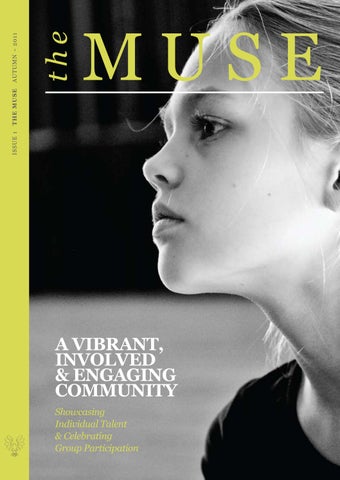
A VIBRANT, INVOLVED & ENGAGING COMMUNITY Showcasing Individual Talent & Celebrating Group Participation
Visits & Voyages This list is by no means
Trips Out
Visitors In
a flavour of guests in
Bath, Jane Austen A2 English Field Trip
and visits out during the
BBC Media Village, “Off by Heart” Shakespeare Competition
Anne Atkins, Author & Broadcaster, English Society Shakespeare Workshop
Autumn Term.
Bedford, Government’s National Citizen Service Prince’s Trust project
exhaustive, but offers
Bedford Corn Exchange, Christmas Concert Bedford School Observatory Visit Bedford Geographical Association Lectures
Alana Livesey, England Lacrosse International Amanda Brookes, Gamma Plus Appeal Barbara Spencer, Author, Lunchtime Talk Charlotte Jacovou, Fashion Designer on Being a Trend Forecaster
Bel Canto Anglo Italian Service
David Shepherd, Antarctica Explorer, Talk to Y6 Pupils
Bishop Stortford High School, Model United Nations Assembly
Dawn Fitt and Gerry Heather, Bloodhound SSC, Science Lectures
Cambridge Union Schools Sixth Form Debating Competition
Dr R Wilkins, Oxford University, Science Lectures
Castleton, Y9 Geography Field Trip
Future Fortunes, Y12 Careers Advice
Chemistry in Action Conference for A Level and IB Students
Happy Puzzle Company, Y7 & 8 Maths Puzzle Day
Coventry University, The Smallpeice Trust Structural Engineering Course
Homebrook House Residents for Y6 Dominoes
Cranedale, Y12 Geography Field Trip
Jane and Sam Roberts, Shine Academy, Y11 Work Experience
Edale, Y10 Adventure Weekend France, CCF Ski Expedition GSA “Go for Gold” Conference Howarth, AS English Field Trip Isle of Wight, CCF Coastal Endurance Loire Valley, Y13 French Work Experience National Space Centre, Y5 Science and Technology Field Trip Peak District, Duke of Edinburgh Expedition
Ian Facer, Brass Workshop
Jo Thurman, FreshMinds Group, Y13 Interview Techniques Ken Burton, International Performing Artist and Composer, Opening of Trinity House Mike Shevdon, Author, Lunchtime Talk Mr Mark Hempsell, Reaction Engines Limited, Science Lectures Mrs Kendall WW2 Survivor, Y5 History talk
RAF Cranwell, CCF Competition
Professor Nick Rawlins, Physiological Psychologist Oxford University, Science Lectures
RAF Henlow, CCF Gliding Training
Reverend Royden, Harvest Festival Celebrations
Rotary Club’s Swimathon
Richard Gill, Lecturer, Jane Austen Master Class
St. Paul’s Church, Christmas Tree Festival Opening, Y 5 & 6 Choir,
Roman Governor of Britain, Gaius Paulinus Suetonius, Y3 Roman Day
Perth, Australia, Hockey Tour
Russell Prue, Y10 School Radio Training Ryan Flecknell, Manager of the Prebend Centre for Bedford Concern for the Homeless and Rootless The Young Shakespeare Company, Y6 The Tempest Visually Impaired Society Christmas Party
Bedford Girls’ School | www.bedfordgirlsschool.co.uk
Editor’s Insight
B
edford Girls’ School is
I hope The Muse further demonstrates
an exceptional place where
our commitment to ensuring every girl
remarkable things happen
feels valued in every aspect of her life at
and everyone plays a part
the school and helps to convey the care,
in bringing excellence and innovation
dedication and imagination that goes into
together. Our new magazine, The Muse,
giving everyone as many opportunities as
has been created to share with you some
possible to flourish and shine with our rich
some of the many
of the many forward thinking, outward
co-curriculum provision. Variety, inclusion
looking and imaginative activities and
and participation lie at the heart of this
forward thinking,
practices that help shape the perfect
philosophy and are at the core of the
environment where girls learn and
stories you can enjoy here.
imaginative activities
When we invited performer and songwriter
and practices that
As the year unfolds, each termly edition of
Ken Burton to open our new music school,
help shape the perfect
The Muse will offer further insight into what
Trinity House, on Saturday 12th November
we do and how we strive to develop the
2011 we did so safe in the knowledge
environment where
whole child and all of her key intelligences
that, as well as providing facilities for
rather than just the logical and linguistic.
those who are gifted technical musicians,
A good school must provide an education
it will nurture and encourage new talent,
in all integral aspects of humanity. In striving
enthusiasm, passion and skills.
grow holistically.
for excellence, we support and challenge every pupil to achieve her personal best not just academically but also culturally, socially, physically, personally and morally.
“ The Muse
has been created to share with you
outward looking and
girls learn and grow holistically.
”
Such versatility and fresh thinking is integral to our vision and I hope The Muse continues to offer you an insight into this as well as sharing with you a snapshot
By showcasing a diverse array of some of
of the increasingly vibrant, involved and
the many highlights of the Autumn Term,
engaging education and activities we offer.
Jo MacKenzie Head
The Muse | 02
Inspired by
A Journey with Austen
N
early 200 years after its initial publication, Jane Austen’s Pride and Prejudice continues to top most popular book polls the world over and has been adapted for television, film and radio countless times. Part of the A Level syllabus, the novel continues to inspire and delight new readers with its insightful observations of character which still hold relevance today. During the Autumn Half Term, a group of Sixth Form English students visited Bath, where Austen lived between 1801 and 1806, before moving on to Chawton House where the author lived in a cottage in the grounds of her brother’s Regency estate. Year 13 student Helen Morse explains how the trip informed her understanding of Pride and Prejudice and inspired her to take a different view of the world around her. “We began the trip at the Austen Centre in Bath where we attended a series of lectures and seminars about the cultural, social and historical significance of her work.
03 | The Muse
It became apparent that Austen’s life was one dominated by the company of women and was largely spent in enclosed environments where men seldom entered and Austen seldom left. I began to think how it must have been for her to live such a sheltered existence but was struck by how, after moving to Chawton, Austen appeared happy within the confines of her family’s home. It was here she produced much of her best-known work, including Pride and Prejudice, and a visit to
Austen repeatedly uses time and “ place together to create situations where her characters can subtly show the best and worst qualities of their personalities.
”
the library in the Manor House highlighted the importance of physical places and social context to truly understanding the novel. Throughout the book, Austen repeatedly uses time and place together to create situations where her characters can subtly show the best and worst qualities of their personalities. As well as communicating
these characteristics in conversations, between characters who are brought together within a particular place, she also uses people’s belongings, clothes and houses to let slip details of their thoughts, nature, opinion and temperament. We also attended a workshop on the language of fans where we learnt to communicate silently phrases such as “I want to speak with you”, “We are being watched”, and “My heart aches for you”. This further highlighted Austen’s use of objects as descriptors of people which she deploys so effectively throughout the book; she does not need a narrator to guide readers through the text. Re-reading Pride and Prejudice after we returned home via Jane Austen’s grave in Winchester Cathedral, I felt a sense of affection for both author and novel which was previously lacking. Despite her relatively sheltered existence, Austen succeeded in weaving beautiful, witty and entertaining tales that rely on subtlety and environment to tell tales of their characters. In my own work, I am inspired to think in greater detail about the role the physical environment plays in a strong narrative and also to consider swapping significant action with more subtle, prosaic devices when informing the reader of people’s natures.”
The House System:
BUILDING A STRONGER COMMUNITY
A
s part of our commitment
forged links with the wider community
to create an environment
and encouraged everyone to think more
where pupils can flourish,
altruistically about the world around them.
grow and excel, Bedford Girls’ School provides more than the ideal springboard to continued academic success. Through its holistic approach and dedication to helping girls develop well-rounded values, ethics and attitudes, the school also delivers preparation for life and an opportunity for everyone to assume their place in society with dignity, compassion and an awareness of the needs of others.
Kate Jones, Assistant Head with responsibility for Co-curriculum and the House System, explained: “Girls are assigned to a House as soon as they join the school in Year 3 and are immediately welcomed into a community where they can feel a sense of identity and belonging. With so many House activities and events being led by and for students, they also become part of a family where they are supported, encouraged and nurtured by
Mindful of the intrinsic correlation between
older girls as well as finding their own
personal happiness and achievement, as
voice and becoming involved in cultivating
well as the vital role social cohesion plays
their House aims and ethos. Each House
in both, the school has recently introduced
brings together pupils with a wide variety
a peer-led House System which has
of skills, competencies and specialisms
already impacted positively on interactions
and is a tremendous boost to learning as
between pupils across all year groups,
well as to personal confidence.
The Muse | 04
The House System Continued
“School is perhaps the only environment
Each House is home to 200 girls and a
secondary school, the Bedford Girls’ School
where the majority of people’s days
representative from every year is elected
House System is an admiral benchmark
are spent solely among people of
to sit alongside five Sixth Form House
by which other schools can measure their
commensurate ages. Unlike the workplace,
Officials during meetings and forums.
progress and a prime example of the
this can prove restrictive because cultural
Two representatives per House are also
accumulated high-standards born of the
references, opinions and ways of being,
appointed to work closely with a nominated
merger between Dame Alice Harpur School
no matter how personally diverse, are still
charity organisation to ensure pupils are able
and Bedford High School for Girls.
informed by the commonality of time. In
to learn more about their services and the
providing the opportunity for girls from Years
wider issues associated with their work.
3 to 13 to co-operate, socialise and achieve goals together, the House System enables everyone to learn and encourage each other as part of a team giving them a realistic experience of a very positive, if sometimes challenging, aspect of adult working life.”
schools had historic House Systems and
of House and helps direct, encourage and
building upon their good work was an
support the girls in the planning and delivery
exciting prospect as well as the perfect
of engaging, innovative and purposeful
opportunity to unite pupils as part of a new
events that meet the system’s inclusive
venture of which they can be proud.
and proactive objectives and challenge each individual to use their resourcefulness,
system is comprised of six Houses, each
imagination and abilities for the betterment
named after an inspirational and visionary
of others as well as themselves.
notable impact on the lives of others. The names: Austen, Chanel, Franklin, Hepburn, Parks and Nightingale were voted for by the Student Council in the Senior School, the winning names aptly convey our values, including originality, creativity, invention, boldness, integrity and care, which, in turn,
Kate Jones said: “Both of our composite
A member of teaching staff acts as Head
Launched on September 7th 2011, the
woman who has, in her own right, made a
Speaking at the end of the Autumn Term,
“In combining the excellence of our predecessors with a contemporary look at the far-reaching social and academic benefits of a successful House System
In 2008, the Specialist Schools and
we are able to offer a revitalised approach
Academies Trust (SSAT), which represents
to a fine tradition that offers everyone
most of the state secondary schools in
the opportunity to meet and exceed their
England, strongly endorsed the House
potential and gain valuable insights
system as a way of preventing pupils from
into the rewards and challenges of the
regressing academically after finishing
real world.”
primary school.
are central to the vision and character of
With Government research estimating that
Bedford Girls’ School. The six House colours
the progress of as many as one in three state
were chosen by girls in the Junior School.
school pupils suffers when they move up to
The House System enables everyone to learn and “encourage each other as part of a team giving them a realistic experience of a very positive, if sometimes challenging, aspect of adult working life.
”
05 | The Muse
Connected Community
Learning through giving A sense of care is central to the ethos
Bedfordshire Refugee & Asylum Seeker Support
of Bedford Girls’ School. Together with
Bedfordshire Refugee & Asylum Seeker Support (BRASS) works to empower, inform and support refugees and asylum seekers as they try and develop their place in UK society.
respect, it plays a vital role in ensuring all pupils feel a sense of familial belonging throughout their lives at the school. It helps connect us to communities different to ours, enabling us to reflect on what we have and what we can offer to others.
A
Established in 1999 in response to large numbers of refugees coming to Bedford in need of protection and support, the charity has specialist knowledge and understanding of the specific needs of refugees and asylum seekers and offers services such as housing, money and legal advice at the point of need. Refugees are often vulnerable and afraid when they arrive in the town and their situations can be further complicated by language problems and the shock of entering an unknown and alien culture.
s well as treating their peers with consideration and kindness, we encourage girls to think about their place in the community and the wider world.
In reflecting on the needs of others, everyone can learn much about themselves, challenge preconceptions and prejudice and take positive steps towards addressing inequalities. By learning about the services and work of charities, as well as taking part in fundraising activities, girls readily develop a compassionate worldview as well as gaining a sense of dignified purpose from meeting social responsibilities and impacting positively on the lives of others. In addition to supporting national and international organisations, the school also supports six local charities every year. Assigned to each of the Houses and chosen in conjunction with the Harpur Trust, these organisations work closely with the school to ensure girls understand why their help and support are needed and how important it is. Each issue, The Muse profiles two of the local House charities to explain more about their work and objectives. Here we look at Bedfordshire Refugee & Asylum Seeker Support (Chanel House) and Bedford Concern for the Homeless and Rootless (Parks House).
BRASS works with people to help them both with immediate issues as well as providing long-term support with the aim of achieving complete integration. There are nine million refugees around the world, the majority of who are living in the less developed countries (providing asylum to 74.3% of the global refugee population, leaving the wealthier countries to help just 25.7%).
Bedford Concern for the Homeless and Rootless Bedford Concern for the Homeless and Rootless (BeCHaR) works with vulnerable people aged 16 and over, helping them to take the next step towards reintegration into the local community irrespective of why they might be homeless. Through its drop-in facility, the Prebend Centre, BeCHaR provides hot meals, clothing, help with receiving healthcare and multi-agency support. It also undertakes a range of outreach work including holistic rehabilitation work and on-going advice and assistance even after people find suitable accommodation. Ryan Flecknell, Manager of the Prebend Centre, explained: “Our principle aim is to improve the quality of life for those least cared for and most vulnerable in the community of Bedford. The town’s homeless and rootless population exceeds the national average and the support of Bedford Girls’ School is vital to our work in helping to change this. Every donation given by pupils, parents and staff goes directly towards helping someone living in Bedford move a step closer to re-entering the local community and rebuilding a safe, fulfilling and valued life.”
The Muse | 06
A LEAGUE OF THEIR OWN As an academically selective school one of our four key objectives at Bedford Girls’ School is striving for excellence. We have set ourselves an ambitious target for academic achievement and are committed to seeing continuous improvement in examination results over the next five years.
07 | The Muse
T
here are a number of critical steps to be taken to ensure this objective is met. The first of these measures, implemented by new Head Jo MacKenzie this term, has been pupil performance monitoring. Here The Muse talks to Susie Mason Patel, Assistant Head, responsible for Performance Monitoring about the new measures. “Performance monitoring in schools may sound daunting but it is a key component in ensuring each and every pupil is on track to reach or exceed their academic potential. A key tool in assessing whether pupils are realising their potential is standardised testing. At Bedford Girls’ School, the starting point for these assessments is Year 7 when girls sit tests as part of the Middle Years Information System (MidYIS), developed by the Centre for Evaluation and Monitoring at Durham University. Comprised of Vocabulary, Mathematics, Non-verbal Reasoning and Skills sections, the tests act as a measure of predicted ability at GCSE. The prediction is based on mathematical probability and indicates the probable grade a student will achieve. The prediction is designed to help set realistic expectations for pupil and parents to understand exactly how much hard work, effort and discipline will be required to improve their performance over this benchmark. And critically for staff too, a tool to identify those who need additional support to achieve their benchmark and those that need extension to move beyond it; so that all pupils make sustained improvements and remain challenged and engaged at an appropriate academic level. Susie is quick to point out that the benchmark grade is neither a floor nor a ceiling. “The probability is based on the assumption that all variables stay the same. If a variable is changed, so will the grade. Those who take their grade as given and do little to achieve it are likely to be disappointed. Equally those that rise to the occasion will be rewarded. It is a powerful tool for managing standards and helping pupils and staff set realistic targets for achievement, but it is the difference the pupils and staff make to the learning
journey from Year 7 to Year 11 that ultimately determines the final GCSE grade.”
Underpinning
The difference between a pupil’s predicted grades based on MidYIS and their actual GCSE results is calculated to give an added value score. This score is a measure of the additional achievement a pupil in partnership with their teacher has made. It is an equation that demonstrates the power of confident, motivated pupils and inspiring, high quality teaching.
what we aim to
The combined influence of a pupil’s hard work and a teacher’s stimulating delivery of their subject is a potent formula. The monitoring and focus on achievement can also have the added benefit of creating a virtuous circle whereby all involved are encouraged and rewarded with raised standards.
developing in every aspect.
When asked if this means we are expecting the girls to get a straight set of A* Grades at GCSE, Susie responds with a resolute “No, certainly not”. She goes on to explain, “Many girls are by their nature, natural worriers and keen to please. For some this means they are fearful of failure and work tirelessly to achieve more, always striving for perfection. Often this can be at the expense of their wider wellbeing and happiness. We are not here to see girls push themselves relentlessly. We want them to appreciate and value their individuality and be proud of their achievements. That is why we are also monitoring their level of engagement within the co-curriculum. We have set standards that we expect every girl to meet in terms of the wider activities they are undertaking away from their academic studies.
Post GCSE, performance monitoring continues into the Sixth Form using the Advanced Level Information System (ALIS). Also run by Durham University’s Centre for Evaluation and Monitoring, the ALIS project is a national system designed to predict how students are likely to perform at A Level and in the International Baccalaureate.
“One of the benefits of the benchmarking process is that it gives the girls a realistic target. For some this might mean they should recognise their achievement and take pride in achieving a B grade, rather than being disappointed that they didn’t get an A. The girls also take comfort and confidence from being able to visualise the path ahead; for many it is reassuring to know the level of work required of them and what they need to do to achieve their ambitions.”
provide at Bedford Girls’ School is an education that doesn’t just provide academic excellence, but sees the girls We want to ensure that every girl feels valued and enjoys a holistic and happy education.
“The ALIS system works in the same manner as the MidYIS and again an added-value score is calculated from predicted to actual grades. The greater debate at this stage is the level of added value that can be achieved. If the value has been maximised between Year 7 and GCSE it will be very difficult to add even more value between GCSE and A Level or IB. What is critical here is that the girls’ performance is monitored and their momentum continues to ensure they maintain the level achieved. “Girls can and do exceed their predicted grades, levels and points and are encouraged, nurtured and supported to do so. In allowing us to monitor performance so effectively, MidYIS and ALIS play a vital role in our delivery of a specialist education for all girls as well as demonstrating continual value-added achievements for each pupil and the school as a whole.”
The Muse | 08
THE BEAUTY OF NUMBERS National numeracy consultants have identified that some girls who appear to achieve well at Mathematics in primary schools might actually be struggling to understand the underlying methods, causing them to lag behind boys by the time they reach Year 7.
W
ith a much higher than
“From their first Year in the Junior School,
By creatively engaging girls at an early
average proportion of
our girls are encouraged to think creatively
stage and ensuring a smooth transition to
students studying the
in Mathematics and are engaged in
Year 7, the Junior School instills a genuine
subject at A Level,
activities and events that build confidence
passion for Mathematics in girls who
Bedford Girls’ School is both bucking a
and enthusiasm. By keeping the subject
might gradually lose confidence in a mixed
national trend and engendering a life-long
fun, varied and relevant to life outside the
school environment.
appreciation of the beauty of Mathematics.
immediate confines of academia, we are
Karen Potter, Junior School Mathematics
With research demonstrating that the
able to offer the perfect environment for
Co-ordinator, is keenly aware of how a
sexes comprehend Mathematics in vastly
girls to achieve groundbreaking results
varied and fresh approach to teaching
different ways, the school has structured
and to go on to successful careers in
helps girls maintain their interest and
an engaging, exciting and challenging
sectors such as engineering and computer
enjoyment of the subject through to the
programme of learning especially tailored
sciences which might traditionally be
Senior School and beyond.
to girls. It also offers extremely flexible
regarded as male dominated”.
and adaptive teaching methods, helping to ensure individual pupils benefit from bespoke learning and are able to absorb and fully comprehend the subject at each level of their education.
“We are committed to delivering
In the Junior School classrooms are filled
excellence in our field and understand
with practical resources and girls soon
that happiness, self-belief and a holistic
begin to gain confidence through hands
approach to teaching is the absolute
on experience and tangible learning tools
bedrock of this,” she said.
including puzzles and games. A team of
“By utilising diverse and stimulating
Head of Mathematics, Geraldine Hubbard,
Learning Support Assistants is also on
explained: “As a team of highly-qualified
teaching methods and ensuring the
hand to provide individual encouragement
girls have a rich understanding of the
and to allow girls to take the time they
underlying complexities of the subject, we
need as individuals to process fully
can ensure they enter Year 7 as continual
information. Extra support and tuition
improvers and do not begin to fall behind.
and experienced educators of girls we aim to ensure that Mathematics challenges and inspires pupils from Years 3 to 13. Whereas boys tend to master the intricacies of the subject quite quickly and are often very competitive, girls tend to evaluate and consider more complex
is also available to pupils in the Junior School before school as well as during one assembly time each week.
“In the Junior School our creative approach to Mathematics during the Autumn Term saw pupils making mini-
aspects for longer and prefer to master
Girls are streamed into sets when they join
video documentaries about properties
one problem at a time before moving on to
the school in Year 3. These sets are not
of 2D shapes and decomposition of
the next challenge.
tied and girls move freely between them.
numbers. Some of the younger girls
09 | The Muse
Bedford Girls’ School also offers the Linked Pair GCSE: Methods in Mathematics and Applications of Mathematics which provides extra topics such as financial mathematics and is highly relevant to their use of their learning in the wider world. Stronger mathematicians are offered the opportunity to sit the Free Standing Mathematics Qualification which includes a number of AS topics and is an excellent preparation for the challenges of A Level Mathematics. The school also offers Further
“ We want everyone
Years 6 and 7 team up for a joint Maths
Mathematics A Level which gives girls
treasure hunt.
the chance to study the subject at
“Together with ongoing liaison between
to appreciate the
staff in both schools, as well as continuity
very beautiful web
girls for the next stage of learning in the
of work schemes, this all helps prepare the
of Mathematical
Senior School”.
relationships which
Similar activities and challenges are
underpin the natural
alongside annual team challenges for girls
greater depth. Further Mathematics or Mathematics at Higher Level, as part of the International Baccalaureate, provide an excellent foundation for girls who want to go on to study Mathematics, Engineering, Economics and the Sciences as well as
available throughout the Senior School
demonstrating a high level of logic and reasoning to future employers.
world as well as
in Years 8, 9, 12 and 13. The MathMagic
Themselves both highly qualified
man-made systems
league for Years 6 to 8 provides a fun
Mathematicians, Geraldine and Karen each
way to practise mental arithmetic and
”
and inventions.
involvement in age-appropriate UK Maths Challenges is enjoyed by girls in most years of the Junior School.
completed a practical investigation using pumpkins that involved estimating and
have a tremendous desire to demonstrate how pertinent, interesting and elegant their subject is and, with the rest of the Mathematics Department, relish helping
Girls design posters to aid their classes
girls to not only meet their academic
with revision and some have created
potential in the subject but to enjoy
PowerPoints that can be accessed and
ordering their weights. Years 5 and 6 also
shared with their peers using the pupil
enjoyed participating in the UK Junior
shared network StudyWiz.
Maths Challenge. A group of Year 9 students recently
Mathematics throughout their lives. Geraldine said: “As well as aiming to ensure girls are confident in persevering with challenging tasks at the highest level
“Year 6 girls have opportunities to meet
attended a series of enrichment
the Mathematics staff at the Senior School
workshops hosted by the Open University
at a variety of clubs including Domino
and Mathematics students in the Sixth
the very beautiful web of Mathematical
Club, Chess Club and MathMagic League.
Form regularly attend similar events and
relationships which underpin the natural
Many will have a Mathematics lesson on
are encouraged to see how Maths is used
world as well as man-made systems
induction day and, in the Summer Term,
in nearly every aspect of life.
and inventions.”
we also want everyone to appreciate
The Muse | 10
Arts
Teamwork takes centre stage
Junior School Headmistress, Corinne Royden, explained: “When girls first join the school in Year Three they are ushered into an environment that promotes rapid growth, development and hard work within a caring atmosphere where co-operation and respect between peers is highly valued. It is a positive setting in which we have high expectations of the girls.
A talking dog, fairies in wellies and a gaggle of snapping paparazzi were among the cast of characters showcasing their singing, dancing and acting talents as part of the Junior School’s Year Three production at the end of the Autumn Term.
D
uring three remarkable performances of the musical pantomime Cinderella and Rockerfella, the girls not only demonstrated a wealth of ability in Performing Arts but also displayed confidence, maturity and teamwork skills as they brought a tangible sense of ownership and pride to the stage. Despite being part of Bedford Girls’ School for just three months, their polished performances were a wonderful showcase for the progress they have made since September and an excellent advertisement for the participation, collaboration and 11 | The Muse
cohesion that enabled them to prepare and deliver three flawless 90 minute productions in the last week of term.
“ In the weeks leading up
to Cinderella and Rockerfella everyone pulled together incredibly well and supported one another to ensure they delivered a phenomenal performance.
”
As with all successful theatre, work in the weeks building up to the show was an integral part of Year Three’s achievements under the spotlight in the last week of term. What might not be immediately obvious is how much of that preparation takes place not just in Dance and Drama lessons but across the whole curriculum. A further interesting aspect is how vital a role the production continues to play in the academic lives of the girls long after the final curtain falls.
“The end of year production provides a perfect focus for the girls as they work together to learn parts, rehearse and plan and make scenery. In the weeks leading up to Cinderella and Rockerfella everyone pulled together incredibly well and supported one another to ensure they delivered a phenomenal performance. “In subjects including Art and Maths, they discussed making scenery and even designed and constructed a large clock for the set. Equipped with moving hands, the clock was used during a crucial scene where Cinderella flees the ball at midnight. Seeing their own work in a performance setting helps the girls think about the practical applications of learning and helps them to bond over a shared sense of pride in shared creations. “Perhaps most importantly, teamwork surrounding an event of this scale really helps to build self-confidence with everyone playing a valued part in the production’s success. It brings with it a feeling of friendship and belonging that will impact positively upon their aspirations and achievements in all subject areas as well as instilling a sense of identity and well being they can carry through their entire time at Bedford Girls’ School and beyond.”
Sports Report: Lacrosse
Lacrosse
One of the fastest growing sports in the UK played by 22% of English Schools, lacrosse is a firm favourite at Bedford Girls’ School. The game is fast-paced, exciting yet inclusive and accessible for all abilities.
I
n the past four years, the number of players in university clubs has increased from 1,700 to 5,000 as enthusiasts flock to Facebook to arrange impromptu fixtures and tournaments. Internationally, England’s Elite Lacrosse players are achieving increasing success and the sport offers excellent opportunities for global travel as well as local competition. Played with twelve players on two opposing teams, lacrosse is Native American in origin and the women’s game has been played in the UK since 1890. The object of the game is to use a long handled racket with a net in its triangular head (known as a lacrosse stick or a crosse) to catch, carry, and pass a solid rubber ball in an effort to score by hurling the ball into the opposition’s goal; with games lasting 30 minutes each way.
Because it’s played on grass, numerous teams are able to take to the field simultaneously and, at Bedford Girls’ School, we have 10 A, B and C teams playing regularly in fixtures from under 12s upwards. There are tournaments for every age group at County and Regional level and the highlight of the season is the National Schools Tournament where more than 50 schools compete over two exhilarating days. Having so many schools competing on 12 or more pitches makes an amazing atmosphere and a memory-making experience for our girls. We also play inter-school matches against teams from Hertfordshire, Buckinghamshire and Middlesex on Saturdays. Regular opponents include Stowe School, Wycombe Abbey, Berkhamstead and Haberdashers. Players at Bedford Girls’ School benefit
Head of Physical Education and double silver medalist in two Lacrosse World Cup Finals, Jane Axford explains more about the game’s appeal.
from the teaching and coaching expertise of
“Often described as ‘the fastest game on two legs’, lacrosse is physical and exciting but graceful and aesthetic to watch at the same time.
programmes. This term they also enjoyed
Claudia Barker and Isobel Pugh, in Year 13, recently represented the Midlands in the U19 Tournament and Anna Monk, in Year 12, captained the Midlands U19 B team which also included, fellow Year 12 student, Hannah Short. A number of girls in the Senior School are involved in a regional and national performance programme operated by the English Lacrosse Association. Called CENTEX, this programme is only open to players who have the potential to represent England at U19 level or above. As a very inclusive game, other girls focus on the exhilaration and excitement of taking part. The game also offers excellent touring opportunities in America, Canada and Japan as well as across Europe and the high standard of play at Bedford Girls’ School could well see our girls become world-beaters and globetrotters as they make their mark in the international game.”
Rachael Pickin and Allie Amala who joined the PE Department fresh from lacrosse scholarships in top University lacrosse training with elite England lacrosse player, Alana Livesy, who spent an afternoon at the school. The Muse | 12
Contextual Lives
James Potter Director of ICT
Paperback, hardback, eReader or audio book? eReader every time. Its flexibility is amazing as you can get your books on phone, tablet, or computer. Also who wouldn’t want a way of reading in bed in the dark!? Great for scary novels like Dracula (free on eReaders!)… A book that made me cry A book that Mrs Potter wrote for me called The Great Jewels of Brom. She spent a long time writing it as a surprise for my 30th Birthday. As I was reading it, I couldn’t believe that she had put so much effort and thought into writing a whole story - just for me!
A book every ICT student should read I couldn’t recommend just one. Anything good in the Sci-fi genre would be a sensible choice. If you read a classic like Arthur C. Clarke’s 2001 A Space Odyssey (1968), or William Gibson’s Neuromancer (1984) these were written before much of the technology in it existed. This for me is the essence of technology: if you can imagine it, technology can make it happen.
A desert island book
A book I wish I had written The Art of Captaincy by Mike Brearley. Mike was a fairly ordinary cricketer, but had an excellent brain for captaincy. As a result of this, he became one of England’s most successful cricket captains. If I had written this book, then that would have meant I would have been England cricket captain, which was one of my dream jobs when I was younger!
you each time you read a chapter of it.
A book to give This is difficult to recommend as I think it should be a personal choice. I recently bought a book for a nine month old as I’m going to be his Godfather. The book is called ‘My Life Story’ and is completely empty! I’d love him to be able to fill it up with all of his thoughts and feelings as he grows up so he could look back on his life as he gets older.
I found lots of books there that ended up
A Place of My Own The Great Ouse
Like the flow of the river, life for its users is
Jade Wright, Upper Sixth pupil, reflects upon
change from green to brown.
a Bedford landmark that has inspired and informed her approach to life and studies. As well as being a keen oarswoman, Jade is President of the Sixth Form Medical Society and co-founder of its flagship publication: Medicine and More. “When I think about how many times I have rowed up and down The Great Ouse, the
constantly moving. Each year the strength and technique of the rowers develop, the life cycle of the swans continues and the trees
And most recently, the rowing blades have changed from the separate green of BHS and blue of DAHS to a new vibrant damson. When I see the bright colour reflecting through the water, I am reminded of the strength and triumph that can be achieved when two, originally separate, teams work together to achieve their goals.
number is unimaginable. The landscape of
The Great Ouse will always be cemented in my
the river; its bridges, bends and turns have
thoughts as a place of friendship, dedication
become known to me, like a map carved
and hard-work, yet empirically: beauty. It is not
into my memories. Yet each time I pass the
only home to birds, ducks and fish; it is also a
familiar surroundings, I see something new.
place in which I found home.
13 | The Muse
Diplomacy by the legendry American diplomat, Henry Kissinger. I have actually read this book on a desert island in Malaysia. Strangely, I took it backpacking around the world with me. Apart from doubling up as a pillow (as it is so thick), it is an exhaustive study of politics through the ages. I find there is always something to dip into and a small nugget of wisdom you can take with
My favourite bookshop Galloway and Porter, 30 Sidney Street, Cambridge. This bookshop used to specialise in slightly spoiled books (read: cheaper!), and books seemed to be on the shelves in a random order. It was a haven for me as a bargain hunting under and post graduate. being vital for my studies.
Dates for your Diary
This term saw the official formation of Bedford Girls’ School Parent Association: The Association. Here we share its aims and ambitions. What is The Association? The Association is the collective of every
More details will follow via email, letter or on the parent portal. We look forward to seeing you there!
‘House’ Quiz Saturday 25th February 2012 Who will win the battle for supremacy at this competitive
parent, guardian or carer of current pupils and current staff of Bedford Girls’ School. It exists to advance the education of our pupils in two key ways. First, by developing the relationship between parents and the School and secondly by supporting activities or providing facilities which enhance the pupils’ education.
How do I get involved?
Why do we need a Parent Teacher Association? What role does it play? One of our objectives at Bedford Girls’ School is to build a connected community. We want to create a community that has a sense of
family event? Help support your
belonging and involvement and we see our
daughter’s House by winning
parents and The Association at the heart of
points that go towards the House
it. We want to give parents opportunities to
Champion Trophy.
meet each other and members of the school in a relaxed atmosphere at a number of formal
Inaugural May Ball
and informal social occasions. We hope
Saturday 5th May 2012
accompanied by grandparents, aunts and
In conjunction with the official opening of Bedford Girls’ School
that The Association will be where parents, uncles come together with staff, alumnae and other friends of the School to foster a wider sense of community; help support the
we will be holding a black tie May
education of our pupils and have a lot of fun
Ball. Tickets will go on sale early
in the process.
in the new year, so start planning your tables, and of course your outfits now! This will be an over 18s event only.
Who is a member of The Association? Every parent automatically becomes a
We would love as many parents as possible to be involved in The Association. We have a few, high quality events planned for this year and we hope that each one will be well attended. Your support is welcome in whatever capacity you can provide it, ultimately The Association is there to benefit you and your daughters. For those of you that might be able to lend a hand at events The Association are developing a ‘Helpers’ List’ - a (hopefully!) long list of parents who are willing to volunteer a few hours of their time to help with event planning or running. Signing-up does not commit you to helping! Before any event the Helpers’ List will be contacted to see who is available, if you can’t make it there isn’t an obligation to do so. In addition, if you think you might have some useful contacts, please do get in touch. We are always keen to find marquee hire, caterers, entertainers, wine merchants, donations for raffle prizes etc.
member of The Association when their daughter joins the school; and every member
Junior School Music on the Lawn
of staff is routinely given membership. We
Sunday 23rd September 2012
so that every current parent has a readily
A Junior School only event.
group of enthusiastic and committed elected individuals who help the Chair with the day to day running of The Association. The Committee meets once each term and consists of parents from different year groups and representatives from the School. If you have any questions or would like to join the Committee please do get in touch.
are hoping over the coming year to develop a network of parents from every year group accessible point of contact. At the centre of this network is The Association Committee, a
Is The Association just about raising money? No. Whilst we will run some events to raise funds for specific educational items, we hope that the main purpose of any event will be to have fun and provide an opportunity for the whole school community to come together.
A lovely way to mark the start of the new school year and
The Committee
an opportunity for all the new
President: Jo MacKenzie Chair: Karen Cotton Treasurer: Tina Beddoes Secretary: Juliet Jones Vice Chair: Andrea Spicer Committee Members 2011 to 2013: Clare Eagles, Helen Fisher, Amanda Fishwick, Amanda Goodman, Alexis Hayward Old, Richard Hibbert, Kate Jones, Yvonne Pemberton, Joanna Quantril, Cathy Rogers, Corinne Royden, Sharon Spong, Jane Stewart.
girls and parents to meet in an informal setting.
theassociation@bedfordgirlsschool.co.uk
The Muse | 14
LEGENDS IN THEIR LIFETIME Ron Rivest, Adi Shamir, and Leonard Adleman: Inventors of RSA Algorithm, a method of public key cryptography. the users of such systems want to
“ For those not of a
know that the transactions went as planned and were not ‘hijacked’.
mathematical background the relevance of mathematics in life beyond financial requirements can seem quite limited and its purity obscure. For me, Ron Rivest (1947), Adi Shamir (1952), and Leonard Adleman (1945) are Living Legends not just in the mathematical world, but kings of the security of the online world; and I hope they will demonstrate how mathematics has practical outcomes for everyone.”
Mathematics is at the foundation of
Geraldine Hubbard, Head of Mathematics
publicly available. The second key,
F
rom the earliest spies and military leaders people have tried to find ways of sending messages securely by turning
the message into a code that only the intended recipient would have the knowledge to decipher. This coding of messages is known as cryptography. With the advancements in technology, the birth of the personal computer and the internet, cryptography has become an essential feature of modern living.
making on-line transactions secure and the RSA algorithm, as described in 1977 by Ron Rivest, Adi Shamir and Leonard Adleman whilst working at Massachusetts Institute of Technology (MIT), is the cornerstone of this. In traditional cryptography two parties that wanted to share secret information arranged a system, which typically required a ‘key exchange,’ of a single key. The key is a way to ‘lock’ a message that is being sent in secret.
needs to know it. Using the RSA system, the private key never needs to be sent across the Internet. A quarter-century later the RSA algorithm is the most widely used method of public key cryptography and has been deployed by more than one billion applications worldwide including the web browsers from Microsoft and Netscape. Rivers’, Shamir’s and Adleman’s innovation solved a daunting challenge in network security: how to enable secure yet transparent exchange of encrypted communications between users and enterprises and strangers to each other.
If the receiver has an identical key to the sender, then the message can be unlocked. The development of Public Key Cryptology is based on having two keys. One key, used to send a secret
P & Q PRIME
message to a particular person X, is
N = PQ
which is not made public, is held by
ED = MOD (P-1) (Q-1)
X to be used in conjunction with the
C = M E MODN
public key.
M = C D MODN
The algorithm that Rivers, Shamir and Adleman developed is the method by which the two keys are generated and is based on the presumed difficulty of factoring large integers. The RSA algorithm involves multiplying two large prime numbers and through additional operations deriving a set of two numbers that constitutes the public key and another set that is the private key. The private key is used to decrypt text that has been encrypted with the public key.
When money is transferred
Both the public and the private keys are
electronically, when an email is sent,
needed for encryption / decryption but
when a purchase is made online,
only the owner of a private key ever
As new techniques are being found for manufacturing faster and smaller chips, the mathematical teams today are considering if breaking the RSA encryption is as hard as factoring into prime numbers and so the cat and mouse games between those who try to create a secure internet environment and those who want to steal money without standing in a long line in a bank continue!