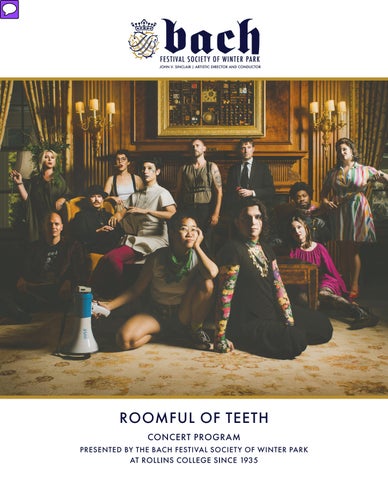
ROOMFUL OF TEETH CONCERT PROGRAM PRESENTED BY THE BACH FESTIVAL SOCIETY OF WINTER PARK AT ROLLINS COLLEGE SINCE 1935
International Recognition | Rigorous Rehearsals Challenging Repertoire Since 1935, the Bach Festival Choir has been recognized by audiences and critics alike for its exceptional musicianship, national and international collaborations, and musical versatility within the classical genre. A cornerstone of the classical music tradition in the United States, the Winter Park Bach Choir is the longest continuously performing chorus in Central Florida and the third longest-running Bach Choir in the country.
LEARN MORE
BachFestivalFlorida.org/join-the-choir Photo credit: Scott Cook
2
BachFestivalFlorida.org
Bach Festival Society of Winter Park Presents
ROOMFUL OF TEETH Sunday, October 3, 2026 | 3:00pm | Knowles Memorial Chapel
PROGRAM The Isle On Stochastic Wave Behavior
Caroline Shaw Leilehua Lanzilotti
Bits Torn from Words, Mvt. 4
Peter S. Shin
Math the one which is sweet
Angélica Negrón
Earths to Come
inti figgis-vizueta
Please turn off cell phone and electronic devices prior to the start of this performance. The Bach Festival Society’s policies strictly prohibit photography, filming, or recording of any kind during performances without the express written permission of the Society.
Photo credit: Courtesy of the Artist BachFestivalFlorida.org
3
ARTIST BIOGRAPHY ROOMFUL OF TEETH BIOGRAPHY Roomful of Teeth is a Grammy Award-winning, genre-defying vocal group that explores and celebrates the potential of the human voice through adventurous music creation, performance, recording and education. By engaging collaboratively with artists, thinkers, and community leaders from around the world, the group seeks to uplift and amplify all voices by creating and performing meaningful and adventurous music using a continuously expanding vocabulary of singing techniques. Roomful of Teeth has collaborated with today’s most compelling music makers to create an ever-growing catalogue of over 100 new works composed for the group. Recent performances include appearances at Carnegie Hall, 92NY, Paris Philharmonie, Melbourne Recital Centre, New York’s Metropolitan Museum of Art, Walt Disney Concert Hall, Prague Sounds, Los Angeles Philharmonic and The Barbican. Roomful of Teeth has won two GRAMMY Awards in the Best Chamber Music/Small Ensemble Performance category for their eponymous first album released in 2012, and their 2023 album Rough Magic. Caroline Shaw’s Partita for 8 Voices, which was featured on the group’s first album, was also awarded the Pulitzer Prize. In 2026, Roomful of Teeth and Gabriel Kahane released the album Elevator Songs, about which NPR’s Tom Huezinga raved, “The album offers poignant depictions of our emotionally messy lives in arresting, bespoke performances by Roomful of Teeth, a group that proves it can wrap its individual and collective voices around any music and any concept.” Teeth's recordings have been featured on television and in film, including Josephine Decker’s Madeline’s Madeline, Netflix’s Dark, Jeen-Yuhs: A Kanye Trilogy, and Homecoming: A Film by Beyoncé. The group performed the original film score by Carter Burwell for the film Catherine called Birdy, as well as Caroline Shaw’s original score for Ken Burn’s 2024 documentary Leonardo da Vinci with the Attacca Quartet and So Percussion.
FEATURED ARTISTS ROOMFUL OF TEETH PERFORMERS Eliza Bagg
Mingjia Chen
Esteli Gomez
Cameron Beauchamp
Martha Cluver
Jodie Landau
Christopher Botta
Haley Freedlund
Thann Scoggin
Steven Bradshaw
4
BachFestivalFlorida.org
PROGRAM NOTES THE ISLE BY CAROLINE SHAW The Isle begins with a cloud of murmuring voices — a musical imagining of something hinted at in Shakespeare’s stage directions in The Tempest. The calls for “a burden, dispersedly” and “solemn music” suggest an off-stage refrain and/or perhaps something even more otherworldly. In Shakespearean Metaphysics, Michael Witmore writes: “Like the island itself, which seems to be the ultimate environment in which the play’s action takes place, music is a medium that flows from, within, and around that imaginary place into the ambient space of performance proper. If some of the courtiers from Naples and Milan are lulled to sleep by the island’s ‘solemn music’, the audience can hear this music in a way that it cannot feel the hardness of the boards that the sleeping players lie on.” In taking cues from this reading of the play, I’ve constructed my own musical reading of the island of The Tempest. Three monologues, by Ariel, Caliban, and Prospero, are set in three distinct ways. Ariel’s initial song of welcome appears, for the most part, homophonically, although its break from the quasi-robotic delivery (into the “burden, dispersedly”) points to the character’s vaporous & ethereal nature. Caliban’s famous description of the island as “full of noises” finds its home in a distraught and lonely monodic song, ornamented and driven by extraneous sounds. Prospero’s evocation of the various features and inhabitants of the island (from the final act) breaks apart into spoken voices that eventually dissolve into the wordless voices of the beginning, mirroring his pledge to throw his book of spells into the sea (and possibly to return to the island’s pre-lingual state). The harmonic material of the beginning and the end of the piece (the murmuring voices) is a 24-chord progression that includes all major and minor triads of the Western 12-note system (for fun). As Prospero says: “But this rough magic I here abjure, and when I have required some heavenly music, which even now I do, to work mine end upon their senses that this airy charm is for, I’ll break my staff, bury it certain fathoms in the earth, and deeper than did ever plummet sound I’ll drown my book. (Solemn music)”
Libretto ARIEL: Come unto these yellow sands, And then take hands: Curtsied when you have, and kissed The wild waves whist, Foot it featly here, and there, and sweet sprites bear the burden. [Burden dispersedly, within] Hark, hark, bow wow: the watchdogs bark, bow wow. [Burden dispersedly, within] Hark, hark, I hear, the strain of strutting Chanticleer Cry cock-a-diddle-dow. Full fathom five thy father lies, Of his bones are coral made: Those are pearls that were his eyes, Nothing of him that doth fade, But doth suffer a sea change Into something rich and strange: BachFestivalFlorida.org
5
PROGRAM NOTES Sea nymphs hourly ring his knell. [Burden: ding dong.] Hark now I hear them, ding dong bell. CALIBAN: Be not afeard. The isle is full of noises, Sounds and sweet airs that give delight and hurt not. Sometimes a thousand twangling instruments Will hum about mine ears, and sometimes voices That, if I then had waked after long sleep, Will make me sleep again; and then, in dreaming, The clouds methought would open, and show riches Ready to drop upon me, that when I waked I cried to dream again. PROSPERO: You elves of hills, brooks, standing lakes, and groves, And you that on the sands with printless foot Do chase the ebbing Neptune, and do fly him When he comes back; you demi-puppets that By moonshine do the green sour ringlets make, Whereof the ewe not bites; and you whose pastime Is to make midnight mushrumps, that rejoice To hear the solemn curfew; by whose aid, Weak masters though you be, I have bedimmed The noontide sun, called forth the mutinous winds, And ’twixt the green sea and the azured vault Set roaring war; to the dread rattling thunder Have I given fire, and rifted Jove’s stout oak With his own bolt; the strong-based promontory Have I made shake, and by the spurs plucked up The pine and cedar; graves at my command Have waked their sleepers, oped, and let ’em forth By my so potent art. But this rough magic I here abjure, and when I have required Some heavenly music, which even now I do, To work mine end upon their senses that This airy charm is for, I’ll break my staff, Bury it certain fathoms in the earth, And deeper than did ever plummet sound I’ll drown my book. (Solemn music)
PROGRAM NOTES ON STOCHASTIC WAVE BEHAVIOR - BY LEILEHUA LANZILOTTI Wayfinding, observing nature, and respecting the ocean have been present and important to me since childhood. So, when Rónadh and Brad asked me to be part of the National Science Foundation-funded “A few waves do most of the work” project, I felt very connected to their ideas of integrating knowledge and research about the ocean into classrooms. Prof. Cox’s research inspires metaphor: a few waves can make a difference and have made our work as Kanaka Maoli artists relevant to today’s dynamic landscape where science and indigenous knowledge celebrate the power of nature. The work is sung completely in ‘Ōlelo Hawai'i. A language that is changing, that is evolving, that is new, is alive. Similarly, compositional practices that engage new sounds through an indigenous lens embrace native language and ways of knowing as an active, living parts of the creative process. Mahalo nui loa to Kumu Patrick Makuakane for his expertise on the game nā'ū (which I have taken great liberty with in this work).
BITS TORN FROM WORDS: IV. GANADARAMABASA AJACHAKATAPAHA (BRIDGE) by Peter S. Shin Bits torn from words examines the mental health condition of generalized anxiety disorder – how the dread of even the most inconsequential circumstances feels gargantuanly out of proportion to its relative impact. In expanded song form, voices traverse through wavering pitches, surrendered exclamations, and quivering breaths, all conveying the vivid manifestations of anxiety in the body and psyche. The title comes from the opening pages of Dictee (1982) by the pioneering Korean American conceptual artist Theresa Hak Kyung Cha (1951-82). Through intricate diagrams and vivid prose, Cha illustrates the visceral phenomenology of vocalization, and the yearning to say and be heard. The fourth movement, GaNaDaRaMaBaSa AJaChaKaTaPaHa (bridge), concentrates on the 14 consonants of the Korean alphabet, the very roots and building blocks of the language through aspirated articulations layered in chained suspensions.
MATH, THE ONE WHICH IS SWEET BY ANGÉLICA NEGRÓN “math, the one which is sweet” is the sound of getting lost in new love—of giving in to excitement, savoring anticipation, surrendering to daydreams. It’s the thrill of getting to know someone new, and the lens of tenderness through which everything about them is perceived. It dismantles and plays with the false dichotomies of love: logic & emotion, order & abandon, repression & disinhibition. It’s an invitation to these dualities, like two people falling in love, to coexist in the dazed delight of newfound connection. This piece speaks to the intimacy and vulnerability inherent in giving, receiving, and letting go of love.
BachFestivalFlorida.org
7
PROGRAM NOTES Text math, the one which is sweet Raquel Salas Rivera sand of each beach where i forgot i was a body sea of grape and dry algae packing material for last names coding for the time machine that between futures eclipses an underground the rain’s dirt which approximates the cave’s air the reef’s opening where i enter and leave my town like we do in a bottom where fins glow i suddenly cease we don’t need lungs the mouths that kiss the air the olas math the one which is sweet completely a language for when we are a hybrid of plane and gull your voice its convex exactitude the chunk of satellite that collapsed towards the water’s celestial cemetery like that
EARTHS TO COME BY INTI FIGGIS-VIZUETA Earths to Come is a journey into the profound depths of a love poem. figgis-vizueta's original music expertly voiced by the Grammy Award winning Roomful of Teeth conjures a sense of intimate presence and finds vastness and insularity in the simplicity of an 8-line poem by Emily Dickinson: I have no Life but this— To lead it here— Nor any Death—but lest Dispelled from there— Nor tie to Earths to come— Nor Action new— Except through this extent— The Realm of you— 8
BachFestivalFlorida.org