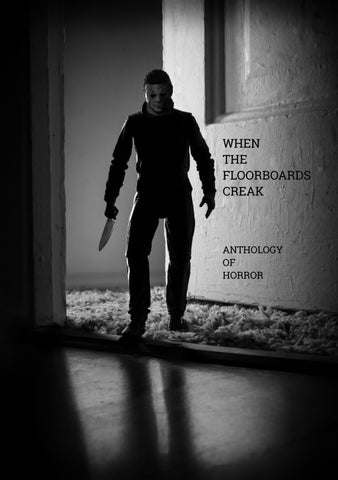
When the Floorboards Creak: A Beyond Words Press Horror Collection Editor: Gal Slonim Editorial Board: Kelly Sargent, K.D. Zwierz, Colby Flade, Noah Evan Wilson, Candi Martin, Brian "Brie" Sheridan, Roberta Laurie Artwork by David Birozy: Michael (front cover); Something Remains (inner front cover); The Cold, Hard Reality of Life and Death in Prison (back cover). David left California twelve years ago for the peace and quiet Wyoming offers. His photography interests include toy photography, typically with a dark twist, as well as black-andwhite, infrared, macro, and extreme macro photography. ISBN 978-3-948977-72-6 © Beyond Words Press, Berlin, Germany. Contributors retain all rights to their work. First printing, September 2026
WHEN THE FLOORBOARDS CREAK
Table of Contents Contrition — Caitlin Neal-Jones ……………………………...…..… 1 The Beautiful Incuriosity — Bruce Tizes …………………….. ….... 7 Shoes and Shirts Required — Israel Muratalla …..………...…..… 14 My Pet Gargoyle — Megan K. Doherty Gordon ……...……,…… 18 Yellowshift — Sean MacPhee ………………………………………. 21 Night Shift — J. Lis ……….…….……....………………...……..…… 26 An Fear Gorta — Holly O'Byrne ……………………………..……. 34 Deep Above — Morrigan Stride …………………..………………... 39 Children of Ink and Quill — Colin Bellairs ……….…………….… 48 A Mother’s Love — Della J. Stone ..………………...……….……… 55 Come Play With Me — Sarah Senft ……………..…………………. 60 Not Your Ordinary Bear — Dick Altman .………………………… 65 On the Day I Eat Myself Alive — Dick Altman …………………... 67 The Hungry Ghost — Karen Lee Ziner ......………...……………… 69 Knock Thrice — Ryan Meyer …………………….…………….....… 81 The Creaking Game — David Horn …….…………………...….… 92 When the Orchard Calls — Dalton Vann …………..……………. 99 Life in Haunted Houses — Russell Chamberlain ……………… 104 Giving Season — Envy Brontë ………………………….………… 111 Caution: Don’t read this… — Tim Webster ……………………… 121 Cause of Death: Unknown — Cash Rabley .………..…………….. 126 The H Man - A Fireside Story — Bruce Magnotti ……………..… 136 Dolly — Gina Nobile …………………...……………….………… 142 Full Alignment — John Dennis …………………………………. 146 Doll Trauma — Lina Buividavičiūtė ……………………………… 157 Memorial Hospital — Jackson D Smith ………………………… 160
Contrition Caitlin Neal-Jones
Caitlin Neal-Jones was selected as the winner of the 2023 Southern Screen Short Fiction Writing Challenge, and her winning story, "The Scouring" was published in the journal Louisiana Literature. She was a featured reader at Festival of Words' 2025 "Fall Into Words". She serves on the board of National Writing Project of Acadiana as the Community Outreach and Engagement Specialist. 1
At eight years old, Ozitte was damned to hell. She was certain of her fate because the nuns taught that the price of sin is damnation, and everyone up and down the bayou knew that Kooshma only visited sinners. And Kooshma visited almost every night now— with its matted hair and sunken eyes—swaying at the foot of the bed Ozitte shared with her sister, Adele. The demon always appeared in the twilight of consciousness when Ozitte was on the verge of sleep, or when she was rousing from a dream. Ozitte never saw the ghoul enter or leave the cottage. She would open her eyes and find the crooked figure looming tall and respiring a wet, rattling rasp that filled the room with cold even in the perennial Louisiana heat. Upon recognizing that it held Ozitte’s attention, Kooshma would lift a gray, withered arm and point towards the heavens, never taking its gaze from the trembling child. During the hauntings, Ozitte would freeze in a full-body terror that seemed to separate her spirit from her corpus and render her motionless and speechless in the thrall of her captor. Eventually, Ozitte would always regain control of her body enough to scream and thrash her limbs, and Kooshma would evaporate from sight to be replaced by Ozitte’s angry, cursing sister. More than once, these waking nightmares left the sisters’ shared bed wet and Ozitte endured Adele’s cruel, cutting remarks the next day along with Mama’s whipping. If Ozitte was questioned about the source of her fright, she would invent tales of imagined sensations and strange noises coming from the shadows outside. She dared not confess the truth of her horrible visions, since the stern nuns and wizened MawMaws made certain every little child knew that Kooshma only punished malefactions —lying, stealing, blasphemy, and sins of the flesh. Ozitte guiltily harbored the secret transgression of hatred in her heart, so she suffered Kooshma’s visits in silence.
2
Ozitte wasn’t sure why her sister was spared these visions. Adele was 16 and had just started running around with boys and (based on the overheard whispers of various aunties) she was much better acquainted with sin than Ozitte. Maybe her sister was protected from the Devil because Adele’s father had married Mama inside the cathedral that stood 100 yards from where his body now rested in consecrated ground. Ozitte’s Papa was never at rest, and he had a wife and kids in Lafayette whom everyone knew about, which meant Mama could neither take his family name nor receive Holy Communion. For years, Ozitte and Mama and Adele had shared domestic peace inside the two-room cottage framed with stalwart cypress walls and insulated from winter winds by the mud and Spanish moss bousillage. Adele had a little rope bed to herself in the sitting room, and Mama and Ozitte kept a cozy nest in the garçonnière —an attic room attached to the front porch gallery with a steep staircase that was designed to permit the young men of a family to rôder in and out of the house all night while protecting the virtue of the girls in the home. Ozitte slept each night in the attic bower cradled in Mama’s soft arms and woke each morning to the bells of the cathedral convent where the venerated Saint John Berchmans once appeared as a ghost to save a lonely nun who was dying of heartache. Kooshma and Papa both first materialized in the cabin around Ozitte’s sixth birthday. The thrill of Papa’s long-promised arrival was quickly replaced by disappointment when Mama announced that Ozitte would be sleeping downstairs with Adele while Papa would take Ozitte’s place in Mama’s bed in the garçonnière. Ozitte had never spent the night without Mama by her side and she threw a tantrum in protest. The Commandments forbid arguing with your parents, her Papa chided. And didn't Ozitte know what happened to those who broke the Commandments? They fell victim to Kooshma, Satan’s minion who tortures sinners with sleepless 3
nights. At bedtime, Ozitte watched through the open window as Papa followed Mama upstairs like a fox granted admission into the henhouse. Ozitte tossed fitfully all that night and focused her mind on the sounds of the cows lowing on the grassy coteau to drown out the muffled noises coming from the apartment above. As the night wore on, Ozitte’s thoughts turned from self-pity to grievance, and by the witching hour she felt a hatred blooming in the depths of her belly directed at Papa for upending her childhood sanctuary. She allowed her restless mind to wander towards dark images of retribution—physical acts of violence towards Papa, and his Lafayette family dressed in black and weeping. Just as she began to drift into sleep, the sound of heavy breathing broke the silence and a feeling of dread and impending danger brought her fully to attention. As her eyes opened, Ozitte realized she was pinned to the bed and could make no movement but to watch the lean, tall apparition now blocking the light from the window hover over her and point upward. Ozitte lay paralyzed for what could have been minutes or hours, as time seemed to have stopped completely. Eventually, she found her voice and let out a shriek which sent Kooshma back to Satan’s dominion. She also woke the rest of the household, which earned the family’s ire and willow branch marks on the back of Ozitte’s legs the next day. Two years had passed since that first dreadful appearance, and the seasons brought sporadic returns of both Papa and Kooshma. Papa would blow in as turbulent and destructive as a hurricane. His presence became increasingly unwelcome, but fortunately his stays at the cottage were short and infrequent. Papa drank and gambled and stayed out late playing cards, and his presence increasingly eroded Ozitte’s sacred familial peace. As Mama became more sullen and withdrawn, and Adele became more ornery, Ozitte felt more and more hatred for Papa fill her small heart. In addition to the fighting, and whippings, and cursing, and tears, Papa’s visits 4
heralded the appearance of Kooshma. Every time Papa was in the cabin, Kooshma called on Ozitte, with a condemning hand pointed towards God and all His saints and angels, and Ozitte was sure the demon fed on her sinful, hate-filled thoughts. It was now Christmas Eve, and the cathedral bells announced midnight Mass. Ozitte sat awake and waiting, flanked on either side by a sleeping Mama and Adele. Papa had staggered home that evening from the bourrée game at Duvvy Boudreaux’s house and made a sly comment about Adele’s body. The fight had only lasted a few minutes, but it left Mama whimpering in the downstairs bed and Papa passed out upstairs. That night, Ozitte’s ruminations were dark and un-Christian, but a theory had formed in the back of her mind after two years of secret meditations on her curse. When Kooshma appeared in the room, it wheezed and cocked a curious head at the waiting Ozitte, who nodded bravely and assuredly. Ozitte scooted gingerly to the foot of the bed and stepped gingerly onto the cold floor inches from Kooshma’s gauzy gray form. Kooshma stood placid, but cocked its head to the other side and pointed upward while locking eyes with the child. Ozitte fought back animal instinct to flee from the monster, and forced herself to look closely at the figure. For the first time, Ozitte recognized a distinctly feminine face and large, deep eyes that held a sorrow not unlike her mother's eyes. Ozitte knew then that her supposition was correct. She passed beside Kooshma, quietly lifted the window sash, and maneuvered her small body through the frame. Kooshma followed, moving in sharp angles like a marionette, then passing through the open window like water. When the co-conspirators stood facing each other on the porch, Ozitte pointed to the base of the gallery staircase and drew an upward diagonal line with her finger to where the staircase disappeared into the garçonnière. After a moment’s pause, Kooshma gave one rusty nod to Ozitte then pivoted its body stiffly and swung a creaky leg onto the bottom 5
step. As Kooshma began its ascent up the staircase, Ozitte scrambled back through the window, gently closed the sash, and tucked herself into the bed, burrowing into the comfort of Adele’s warm body. Ozitte listened to the rhythmic ka-dunk, ka-dunk of Kooshma’s heavy limp as it conquered the staircase, and then the groan of the garçonnière door opening just wide enough for Kooshma to enter. Ozitte bid her heavy eyes stay open long enough to hear Papa’s bed springs squeaking under an oppressive weight, and the sounds of struggling. As the nearby cows’ nocturnal bellows muffled the screams from above, Ozitte snuggled deeply into the space between her mother and sister and drifted into a sweet sleep.
6
The Beautiful Incuriosity Bruce Tizes
Bruce Tizes writes about grief as infrastructure. 7
Tavola Oscura Zagat Guide 2027, Four Stars "The wagyu here achieves something almost spiritual. A depth that lingers for days. Chef Aldobrandini has sourced something truly singular. One does not simply eat this meat. One surrenders to it." — R. Fleming, Senior Critic
From The Desk of Mścibor My father learned this at Srebrenica. Give the right name to anything and people will eat. Wagyu. Kyōto-grade. Grass-fed. A marinade of words. Everything beneath, changed. First time was not my idea. The circumstance I will not write here. Some things when written become more real than real things that happened. Evidence was first problem. Then scale. Then enterprise. This is how most things arrive at what they are. Fine dining. Public never understands. Whole industry runs on beautiful incuriosity. Where did this fish come from? What were these animals fed? Who picked this truffle at four in the morning for eleven dollars a day? Cuisine requires the not-knowing. Always has. I am not monster. I want this written somewhere. My daughter is seven. Lives in Vienna, with her mother. Her mother tells her I work in food distribution. She likes horses. Watches Hercule Poirot, the old ones, with subtitles. I send money every month.
8
White truck, refrigerated, no markings. You have passed it on the highway today. You did not notice. Brzezinski called and I understood it was over. Men like Brzezinski pour concrete. Before him maybe it ends, phone call, a fire. After Brzezinski board of directors, quarterly projections, fiduciary duty to shareholders. No way to stop without becoming the problem yourself. I left note for Elena because she offered me coffee. Small thing. Most of them never looked at me.
SUBJECT: Re: Re: Birthday Dinner!! Thread between Kimiko Nakashima and daughter Setsuko Setsuko: mom did you decide where you want to go for your birthday Kimiko: I looked at that Tavola Oscura place. Very expensive Setsuko. Setsuko: mom, it's your 70th, and David wants to take you somewhere special he's been saving Kimiko: He shouldn't spend his savings on a restaurant. He's eleven. Setsuko: he did extra chores for two months without being asked. He wants to order you the wagyu. He keeps saying grandma deserves the best meat in the world. Kimiko: Tell him grandma is happy with onigiri. Setsuko: MOM. Please. You know how stubborn he gets when it’s his plan. Kimiko: Fine. But I'm not letting an eleven year old pay. Setsuko: he already phoned and made a reservation. He told them it is your birthday. Kimiko: What did I do to deserve this child.
9
Setsuko: Saturday at seven. Wear the blue dress he loves that dress on you. Kimiko: I'll wear the blue dress. Tell him thank you. Tell him grandma said he is her best boy. Setsuko: he's going to cry when I tell him that Kimiko: Then we'll all cry. Saturday.
Veridian Protein Solutions Internal Memorandum: Executive Only Re: Q3 Protein Yield and Demographic Acquisition Following consolidation of the Rahway and Trenton facilities, cultivation centers are operating at 94% capacity. Dr. Farrow's team has isolated the umami marker, a genetic sequence concentrated most heavily in subjects of East Asian heritage, specifically women between sixty and seventy-five, whose intramuscular fat distribution predicts premium marbling grades. Restaurant partner acquisition continues to outperform direct protocol 3:1 in community implementation. Partner restaurants’ role concludes at the quality-control meal. Subject 847-B: Female, 70. Blue dress. High umami response. Superior marbling. Birthday celebration. Minor present, male, age 11, declined through standard protocols. 847-B cohort exceeded Q2 projections by 12%. Brzezinski has confirmed Series C capital raise. The TAM is, as a practical matter, unlimited.
10
NOTEBOOK Chef Ippolito Aldobrandini, Tavola Oscura, undated Tokyo. Lyon. Every dry-age technique, every fat ratio, every favor I had left to call in. Nothing comes close to what Mścibor was bringing me. Thirty years of cooking and I had never encountered a complexity that unfolded like that, floor beneath floor, the way pain has floors, the way you believe you have touched the last one and the ground opens again. The flavor carried memory. It carried the taste of hunger that predates the fork. Reward-system dysregulation, my therapist calls it. Something so intensely pleasurable that everything later is subtraction. She says this happens with certain drugs. What do you remember about the taste, she asked. Something that felt like it recognized me back, I told her. The last portion has been in the freezer four months. Tonight I am going to cook it. Just once more. To remember what food can be at the very end of what food can be.
FOUND Handwritten. Taped inside a water-damaged Zagat Guide, 2027 edition. Dated in the margin: 2031. If you are reading this you ate there too. Don't look up what happened to the restaurant. Don't search Mścibor. Don't call Veridian. It just rings.
11
Three times I went back. Five stars, and I would have given six. I didn't know. But the first bite arrived wrong in a way I had no word for. Not spoiled wrong. Wrong the way your name looks wrong when you've stared at it past the point where it means anything. The flavor knew me. Not the way food knows hunger. The way the living know each other, in the same frequency, from somewhere below the stomach, and it was asking, from inside the asking, to be called back by name, to please be remembered back. An eleven-year-old boy did two months of chores. He saved. He called the restaurant himself, asked about a candle, planned the whole thing because he understood, the way children sometimes do before the world teaches them not to, that his grandmother was worth the very best of everything. I held that knowledge in my mouth with the second bite and swallowed and asked for another and wrote numinous in my notes. I knew. The food was so beautiful I decided not to. And I was hungry again by morning. The word for what that makes me is, maybe, the same word for Mścibor, for Aldobrandini, for Brzezinski, for Fleming who called it spiritual and meant it as praise. All of us at our different tables. Calling it the perfect last meal. I gave it five stars on Google. Someone should check on the boy.
12
POSTCARD Belgrade. Postmarked November 2028. No return address. Roštilj, here. I watch them make it through the glass before I go in. My daughter called. A tooth, lost. She told me Poirot solved another one. The little grey cells, she said, very serious. She asked when I was coming. I told her Christmas. I will not come at Christmas. The snow here falls the way it fell in Srebrenica, which is the same way it falls everywhere, which is straight down, without apology, covering everything it touches until the city looks like a place where nothing has ever happened. I still think I am not monster. M
13
Shoes and Shirts Required Israel Muratalla
Israel Muratalla is a queer Mexican writer from the San Fernando Valley of California, who grew up in the seaside town of Ensenada, Mexico. His work in Spanish appears in Azahares 2026 and he was first runner-up for the Los Angeles Review Short Fiction Award in 2021. 14
Before he ever met the need to sleep under that strip of roof, under which they kept the shopping carts, Carlitos actually used to work at that exact store and way before he ever even thought of burning the whole place down, he himself would often wonder why they couldn’t go anywhere else; every morning unlocking the rows of carts with his hair still drying in the early-day dampness, he’d always wind up finding trash in that very spot and subconsciously note to himself that if he ever needed a place to lay his head, right there must be a good one; and as anyone might after twenty-five years of the same, he grew tired of cleaning the dirt and hair out of the bathroom sinks, so it was that he dared to ask for something else; which for someone whose unwavering loyalty had belonged to one company only for so long, it didn’t seem too absurd to think he could; except Heather, the store manager they had sent from the neighboring district a year prior, never really understood him the same way Juana, who he saw work her way up to manager of the store over the span of ten years, used to; thus when he went to ask her in the best English he could muster, all she had to say was that he was “so good at cleaning” and she “couldn’t see him doing anything else”; and so he left as he was with nothing but the promise that she could maybe work on getting him a fifteen-cent raise, which would end up being the same measly state-mandated annual pay raise they had been getting since that one bill had passed; nevertheless he carried along, but his work was never the same after that, not like it had always been, with his scrubbing not as tough and his dusting not as tight; so when they hired some boy with Down syndrome for him to train and they saw how much faster he was collecting the carts, Carlitos was told they wouldn’t be needing him to come in six days a week anymore like he always had; after that his hours quickly halved and as soon as he realized four weeks of working only two days a week would not amount to much, he begged for more, more hours, more money, more time,
15
and because there was no getting out of needing more than anybody would ever be willing to give, it was almost immediately that he lost the studio where he had lived since the death of his mother; eventually it only took one customer catching him in the bathroom birdbathing before his shift for him to be fired on the spot, but even being let go wasn’t enough to keep him out of that store he knew then as his one and only place and so there he would spend all of his days anyway despite never working again for the remainder of his life; and since many of the other workers had known him since their own first days, they felt somewhat bad at first so they would give him some of their lunch here or hand him some change there; until even they found him too dirty and too smelly and eventually they would think “too scary” even though it was just Carlitos; and it was once the giving died down that the backlot dumpster where they trashed all the expired food came to mind; and after so many dives in that maggot-infested bin it was no surprise when some lady sitting next to him in the dining area complained; only then did Heather walk up and tell him “you can’t come here anymore, Carlos,” and his name sounded so wrong coming out of her mouth he almost didn’t mind how the second time she approached him she just said “sir do you have your receipt? this area is for customers only”; thereafter he had no choice but to stay outside in the sun and in the rain and in the trash until even that was kept shut overnight with a big master lock and by that point the maggots had crawled so deep into his ears and all around his face and his brain that he couldn’t think straight, not really, and he noticed then even his mind couldn’t pull a picture that would take him beyond that lonesome parking lot; so he sat right there right in the front by the handicap parking where customers loved to leave their carts, sat so still and stared at them all coming in and out the store with their bags of groceries, the same place he could neither enter nor leave; and he did so for three days
16
and three nights straight, no water, no food, and no getting up, just three days straight staring from the parking lot concrete; yet the only reason Heather didn’t call the police was because that boy Carlitos had trained implored her not to, every morning he’d say “he might get up today”; and though it had nothing to do with him, the kid somehow felt guilty every time he gathered the carts and circled around the funny old man he had met only a while ago, so deteriorated and so gone inside that he couldn’t take it; but the third night came and Carlitos actually stood up, surprised, the few people gathered by the door to witness what he might do; until suddenly he charged into the store, frustrated finally, knocking stuff over left and right, crying nonsense, even the security guard didn’t have it in him to do more than call the cops or maybe he didn’t have it in him to touch such a man; so among the chaos Carlitos grabbed one of the white plastic bottles by the firewood and he slathered it all over his body like Vaseline and though it burned seeping into his scabs, he somehow felt clean and even free, he thought, right then; so he rushed toward the fallen racks to rip open a BIC candle lighter and set himself on fire, and although he didn’t care if the whole store burned down with him, only a small stand of chocolate bars and chips had to catch flame before a bunch of people finally rushed to help him, pouring water all over Carlitos and his fire, leaving him alive with his fourth-degree burns, to be dragged away by an ambulance he couldn’t pay for, never to be seen again by any of those people.
17
My Pet Gargoyle Megan K. Doherty Gordon
Megan K. Doherty Gordon is a writer and psychotherapist in the Washington DC area. Megan has published pieces exploring identity in several magazines and journals, including ROOM: A Sketchbook for Analytic Action, the Huffington Post, and the Chronicle of Higher Education.
18
My pet gargoyle lives deep inside my chest. From inside he scrapes, scratching my ribcage. I shudder. He can’t come out—not today. Today is a day for sitting serene, upright in this armchair, honeyed sunlight seeping in through the bay window. It coats my face, my exposed neck, the hollow of my throat and the rise of my chest. That’s where the warmth stops. My scoop neck t-shirt, my skin, muscles, tendons and bones—all blankets of shade that shield the gargoyle from the world. Just as he’s shielding me. You’re an asshole, he whispers if my heart swells too far beyond its chamber. You’re a terrible person. Such a banal critique—he’s not very creative. But still it stings. When he’s that loud, it’s easy to smack back. “Interventions” is the clinical term: mindfulness of thoughts, cognitive restructuring, talking to the part. Thank you for working so hard, what do you need to rest? To rest. Rest, goddammit! But he’s a smart fucker. Smart enough to know I’m no engineer. Language is one thing—I can bat thoughts back like beatboxers in a face-off. But I do not control the invisible levers that slide along myelinated fibers of my brain’s neurons and shiver down my spinal cord, dampening my nerves. There I may be, sitting content and unaware that while my gargoyle smiles with me, he’s already reaching out—his Grinch-curled finger dimming my light until my insides are grey, then drained, then invisible in the inky dark. The nerve. I devise a solution. I will find a real-life gargoyle—stone—that I can see and control. I will hunt him down online, and angels in delivery vans will ferry him across the country, and he will arrive snug in a Styrofoam sarcophagus slid inside a folded cardboard box. The box smells like dust and crumples wafer-thin under my hands, leaching 19
oil from my paper-dry fingers. My cracked hands creak the foam from its sheath. It breaks in stiff white chunks, tiny balls clinging static to my shirt sleeves. I split open the halves, clamshell cleaved, and there he is, the grey stone face of my gargoyle, his grin already waiting for me. I cry out in triumph, but something catches my throat. Gargouille. The ancient French word for throat: the source of “gullet,” of “gurgle.” Beastly heads on cathedral ledges with water spouts grooved up their spines. I groan as I heave him out of his shell and lift him like my secret grail into the air. I place him high on a shelf, where I can watch him. I settle back into the chair by the bay window. Dusk now—violent orange streaked with grey, a cool breeze through the window. There we face off. I’m watching you. And in the darkening window I see my own grin, a menacing match for his. My ribcage shudders.
20
Yellowshift Sean MacPhee
Sean MacPhee is a graduate of Susquehanna University, where he completed a BA in creative writing with honors. His short story “The Man in The Leather Coat” received a silver key in the Scholastic Art and Writing Competition as a high school sophomore, and he has been published in Dipity Literary Magazine (which nominated him as one of their “Best of the Net” awards for 2025), the Porter House Review, Ignation Literary Magazine, WILDsound Writing Festival, LEVITATE, and is a winner of the Nocturne Ash Dark Poetry Contest. His debut novel and debut poetry collection were published on the kindle store in July of 2026. 21
Claws, firm and velveteen and warm, curl around his stomach, through what remains of his favorite grey sweater. When he first woke up here, it was in what appeared to be a preschool reading area: gentle colors (including that same omnipresent, malicious yellow) all around, bean bags and plastic chairs and mucus, but no picture books. Now, beneath him turf struggles up through the concrete (or concrete through the turf?), and it is sort of soft, the way he always wanted grass to be. The wall behind him is also concrete, at least he thinks so, half-dried kudzu blankets it so completely that he can’t tell; not that he could feel it anyway, with Carly holding him. This hallway is dark enough for him to sleep in, too: safe. All the concrete and turf and kudzu, however, are stopped again wherever the overheads begin, bringing with them a sickly carpet as dull a shade as their light. Even this far they force their bored, stagnant yellow light and hum on him. “Think…” Carly (the name he begged her to scratch, confirm) says. When she first chased him, she attempted to sound human. Now she doesn’t and the metal static around her words makes him shiver. If he heard another human voice, he hopes it could drive him past his sanity forever, for good. “… hurt.” He leans back into her, stretching his legs. Carly pulls him tight against her and makes a whine. “Is… human…” Carly says softly. “… weak.” Then more play areas: vermillion, Neptune blue, lime, grass-green,
22
and khaki in squares, scalene triangles, and swirls in patterns he wanted to believe he recognized from St. Joy’s. He had seriously attempted to suss it out for a time, focusing on anything beyond his dry throat, pounding head, and the overhead legions. “Do… you… know where?” she had asked, in a different form than she had now: broader, stockier, a swallowing mass of navy whose face resembled Kelly’s. He had turned tail and run. He hadn’t run for some time, of course, despite knowing how it calmed him. Yet he strove forward: yellow rooms, playrooms, indoor courtyards of turf and concrete and back again. At some point he found a corner to rest, hiding behind some plastic chairs. He exhausted what was left of himself attempting to open a yellow vending machine for what needed to be more junk food. Eventually his legs seized in front of a door with a yellow neon sign swaying above with backwards text reading NO EXIT. He had retched and vomited on himself. Or perhaps not: when he opened his eyes again, his vomit was already gone, and after his sweat fell onto the carpet as well, it was swallowed without a sound. “Shaking…” Carly said, bumping her head against his. “… Safe.” In her third set of claws were the personal items he had when he woke up here: phone, wallet, half-melted milk chocolate, replacement library card, big league chew, keys, a fresh receipt, and a small plastic baggie of his antidepressants, even when St. Joy’s
23
morning shift made him want to flake, fade, disappear. His wallet cradled a picture of him and his siblings—until, after finding this hallway, he ate it to prove something to himself. A scream from somewhere, pitched high. Forward from him, backward, under him. So what? Their footfalls, like his, were muffled some by the carpet; the skittering of whatever they’d caught sight of was quiet, save for its claws scratching as it chased. Swallowing, he worms around until he’s facing Carly. He kisses her and bites her lip, relishing the cool liquid that eventually comes out. Tastes like printer ink, and he buries his head in her neck. In her true form it’s wiry, bendable, warm, and he shivered as it curled around his. “Don’t… leave,” she said. He holds on tight and shuts his eyes tighter. All he needed to do was ignore his clarity. Soon enough, after he didn’t tell her not to, Carly completely crushed the last of his things and draped her second set of claws over him. Another scream, louder— Sounded like a brother— Maybe a sister— But he liked this hallway. Carly liked it here, too. It was theirs. Fuck Clarence, fuck Kelly, fuck Dr. Killjoy, he was done with all that.
24
He’d found the abyss, he’d never find them again, and he was fine. As. Silk. Whatever happened, Carly would keep him safe, slash open their throat and snip their vocal cords. It would be their blood, sinking into the carpet and swallowed by it this time. The corpse would be food, too. “Love you,” he told Carly. “More’n… anyone.”
25
Night Shift J. Lis
J. Lis is a Culinary Institute of America alum, having graduated with an associate’s degree in Culinary Arts and a BA in Applied Food Studies. She is currently a master's student in the Food Studies program at New York University. Lis is also a farmer, level-one sommelier, former line cook, oil painter, environmental advocate, and enjoyer of all things edible. 26
I’m a seasonal worker, as many—or not many, depending on your clientele—line cooks are. I live the kind of life in which, in the winters, when the sun is low and so are my spirits, I need employment. Many self-proclaimed self-care “gurus” nowadays would argue against this, saying rest is the most honest way to recharge, but I need to move and to work. I feel a lethargy come over me, like I’ve slept too long. That’s why I go to Mary’s. Mary runs the kind of hole-in-the-wall you’d see on a Bourdain episode. A bit whimsical, the place functions like an evening-time bed-and-breakfast you’d see on the Scottish Highlands, but inside it’s a kaleidoscope. The menu changes daily, and around the orbit of the flattop, stove, grill, deep fryer, oven, and wood-topped bar in the back, we’ve had lumpia, diner pancakes, parrillada, army stew, a full English breakfast, suya, xiao long bao, a tequila flight with fermented worm on our menus before. I say menu, but what Mary does is go in the back at 5pm—thirty minutes before we open—and ask everyone what they made so she can write it down on a stack of yellowed cardstock. Everyone gets to do what they want, more or less. After every night of service—five in the evening till midnight—she keeps the menus in a box in her office, the old cardboard wafting the fryer oil and red spice of years past when she adds to it. It reminds me of some old century stew, in a way. Mary’s crew is pretty diverse, and from years of working there, I know she just lets them—us, in my tenures between November to February—cook whatever they want whenever they come in, up until pre-shift at five in the evening, as long as there’s enough to go around. We’re all comfortable enough, confident enough, in our skills and roles to intersperse usual routine with this kind of chosen inconsistency. “I want them to feel at home,” Mary told me once, when we sat on the curb one night after closing. It was one in the morning. The neon 27
sign purporting “OPEN” was off, and the orange glow of the streetlights iced its milky bones. “Being away from home as long as many of them have been, it’s easy to lose something in the heart. I want them to cook what keeps their blood flowing. It’s easy to miss what’s gone, and I want the resurrection of that to be what our customers, everyone, tastes.” On her fourth cigarette of the evening, a low night for her, I idly wonder what it is she tastes anymore. Mary wears the same gray fur stole and black, long-sleeved dress every night, and I wonder, as I do every night, how she manages to avoid powdering herself with ash. Not even in a mean way, Mary is far from messy. It’s just impressive, really. She looks out of time, cut out of night air, in the unerring neatness of her countenance. Exhaling, she continues. “And that’s why we’re all here, in this place. In the city of dreams, the Big Apple. It’s only here that we would all have the chance to really…” Flicking ashes with a bony finger, she attempts to sidestep her Orkney lilt. She’s well-read, but her accent seems to brick something up behind her throat. “…intermesh here. The Hudson, the East River, this island was the most fertile place in the area, so long ago, for its fruit, fish, flowers. Now we have the Rockaways and Prospect Park and Chinatown and Harlem and Murray Hill and Astoria and all these places. All these people. We’re all here together, a new food chain. It’s a bit like what Rome was, once.” She gets up, a little slower these days, dusting herself unnecessarily. Turning inside to catalogue her menus, she tucks one of her cigarettes behind my ear. I don’t have a lighter on me, and it’s starting to flurry anyway, so I follow her to the warmth of a pilot light. I smoke alone in her kitchen. My role, when I’m here, is to butcher. I get in during the late afternoon every day and get to work, heaving and splitting the pink 28
carcasses from the back loading dock into digestible red jewels. Nestled in a cranny bordering Chinatown, our dry storage deliveries are somewhat timely, if not crowded. I think the age of this place gives it a little priority, but since we’re not hustling like so many mom-and-pops or high-end places, we don’t get snappy with the vendors or their children when they’re a little late. We exist comfortably between prompt and languid. Our schedule is odd and I cut a lot of meat ahead of time too, so it’s not the end of the world if we get something after the time we might “need” it. Odds are, I already had it squared away in the walk-in the day before. The cooks, our scant front-of-house—Mary, our bartender, and our singular dour server—and I all share a symbiotic relationship. In exchange for my gifts, they reward me with theirs—hand-rolled cigarettes, a lighter, a drink at the bar, some prep help after we close down. None of us would exist without one another. The knife needs both the whetstone and the hands to sharpen it. I don’t do much cooking myself. Partly on account of all the smokes I’ve shared with Mary, I don’t have the palate that my compatriots do. I am seasonal and I drift in and out, but I am needed when I am here. Most of our dishes use some cut or fat or other—even the desserts, which use tallow for frying or fortifying—and so it’s up to me to prostrate myself over the rusted wooden chopping block in the back, excising knots of muscle, smooth white soup-bones, and crumbs of cooking oil from older bodies that leave my arms pinkslicked with effort. I don’t mind it. After birthing what I need and what the hot line needs, I file everything into neat wax-paper packages, leaving nothing behind. Mary refuses to buy a Vac-Seal machine, on the principle of reducing plastic waste, and she refuses to let us waste anything at all. Fat and skin are rendered and used over and over again until they turn black and bitter. Leftover food at the end of the night is set out with candles for family meal and kept in the walk-in until it’s been nibbled away. Cuts and bones 29
thought to be too gristly or tough to reasonably eat are relentlessly hammered by stewing, braising, roasting, and aging until something soft, unreasonably so, is leached of its locked nutrients and served up. Anything that anyone refuses to touch after being run through Mary’s ecological bootcamp is neatly folded into our compost bin. We’ve never had a waste problem here. Everything is eaten until it can no longer be chewed, and then it is given to the worms. Our clientele, or at least the clientele we like, seems to be joined with Mary on her crusade for nostalgia. We like the old people we get; not old in the sense of being geriatric, but old in the way that they belong to the world that was gauzed by candles before every corner was flooded by fluorescents. We like the ones who come at night, who, when they sit and order, we can share in the softening of their cheeks, the loosening of shoulders. We like it when there is the moment of understanding between the gift-giver and the receiver, and we like it when the recipes our cooks poured into that night’s menu, the meat that was sliced from ribcages to grace a plate, is honored through remembrance. We like watching the chewing slow down, the skin flush, the look in one’s eyes when they recall something they’d thought was faded or forgotten. We like it when we feel that we have restored some of the ancient grace we used to move with, the movements of ritual that should accompany a dinner meant to be appreciated and thought of. Our foods are good, our wines are good, and we are good at what we do. We like it when people come to recognize, and when they know what we’re doing. There are consumers who do not do this, and we do not like them. We hesitate to call them “new” as opposed to “old” people. Anyone who has lived in New York City knows this. It does not matter how old you are or when you come here. All there is to it is the division 30
of locals and transplants. Many people tend to do well stepping into the maw of this old city, regardless of whether they were coming to Ellis Island amidst breaths of war, young kids coming to college, or older men arriving for work. They learn to swim in the rivers that are here and adapt to the brackish blood that connects the subways, the sidewalks, and the Hudson. Then there are those who seek to turn the waters of the boroughs to their own ends, against the beating heart we nourish. We have seen the giants of our world, old dinosaurs of restaurants fall and become scavenged by pure-white, neon-blooded places that cater only to trust funds and abrasive cleanliness. We have seen money and the lack of it infect our compatriots, the death-throes of drained, good neighborhoods. We have seen what comes after, the quietude of expansion. In a way, the city has always been like this. Mary knows that she was new here once, that we were all new here once, but the difference between us and the locusts is that we have sought to protect what was here, earn the niche we reside in, and refuse to coax or pay for construction on the coattails of obliteration. We do not desire destruction of the living to precede more life. Things die, things change, but at their own pace. The difference between locals and transplants is the ability to heed cyclical time, to work within an ecosystem rather than over it. Despite all appearances, all the opinions that hound us, we are not invasive, and we do not parasitize. Hence, we do not like the men and women who arrive briskly, injecting blue light and flash photography into the sepia cave of Mary’s dining room. We do not like the shame and refusal to understand that comes in waves against the food we have loved, have prepared for centuries as a people. We do not like the fake leather and the polyester fibers passed off as “organic” slithering over our cedar tables and cotton napkins. We do not like the insectile flashing of controlled gestures, oppressed features. We do 31
not like the gregariousness. We do not like the loud boasts of quotas met, pay cuts, the extravagance of words designed to establish dominance. We do not like the apathy, the sound of knives scraping over our plates with no heed to the thrumming ear of the room. We do not like the camouflage-jacketed men, the bundled twigs that deign to be served by us as they destroy our neighbors and their families. We do not like the veto on allowing an experience outside of familiarity—or perhaps, the return to a universal truth that was locked behind hatred and agenda—to change them. These are the people we bring to the back loading dock. These people are the ones we fall upon in the name of a late-night kitchen tour, the bodies drained of sticky, cellophaned blood by claws sunk into flesh and teeth scraping against veins before being scrubbed, shaved, sawed, and stamped into the boxes I’ll unpack the next day when I clock in. As per usual. The phones, lit to make our lair a stage, are smashed and hidden behind Mary’s menu box. We do not, are unable to, leave fingerprints. None of us savor this draining, despite having the teeth to do so—blood pumped alongside microplastics tends to leave something clotted on the palate—but we relish spilling sanguine hatred. There was a shift when we first came here, when we decided that despite our hunger, our coldness, our otherness, we would redirect that. The blood of warm people, of old people, was unpalatable. This may seem silly, for something that haunts global cultural nightmares to have a dietary restriction based on ethics, but we were, and are, always more than just what we eat. I think it started when we were welcomed here, when the charnel soils smeared by Atlantic crossings were washed off in the glow of burgeoning hearths. I remember being young, out of the creaking belly of the nocturnal ship that carried me here, the warmth of hot water on skin that had become translucent and forgetful in the dark. I recall 32
remembering the sun, already faded and dead to me in the face of the woman who washed my back. We had a choice to garden instead of hunt in this new land. We decided, despite all the stories of batwings and roué fingers, to protect the warmth of this place. We made the choice to carry the paints, sauces, and memories of our homes, what we could remember before our mouths were relegated to only blood, what we could remember before empires rose and fell, before factories blanketed what had once been valleys of ancient grains. Cursed with immortality, we turned anguish into archiving, into hospitality. We became the older people who welcomed new and cold souls into the warmth of night. And when we see fingers seeking to pluck threads from the tapestry of this city, this city that we watched age from a wooded swamp to a concrete jungle, we do not let them. Before we could make ourselves obsolete amongst the billions of souls and pounding feet of Manhattan, we hibernated, and waited. Now, we bite off what we can drink and shield the candles we have kept burning since our first steps on Turtle Island. And thankfully, there are more of us who have taken Mary’s pledge than not. I look at her, clean as ever, and she watches weakened snow fall with a cigarette between her fingers. Her lungs must be blackened and charred now, but I know she cannot feel it. My coworkers throw bloodied aprons, button-downs, and side towels into my laundry basket, and I am already running the cold water in my head before I make my way to our old washing sink. Spring is nearly here, and I am assured that the ice will melt before tomorrow’s consecration of the chopping block.
33
An Fear Gorta Holly O'Byrne
Holly O'Byrne is an Irish writer and spoken word performer often musing in her signature "script" style that treats poetry as though it has stage directions. She has recently been published in Kreatif Magazine. Holly is at work on her short story collection, blending absurdist comedy with anthropological observations of the mundane. 34
Every Friday, Ma bought a scratch card from the corner shop. Every Friday, she lost. Except one time. Last winter, she won €30. Our lives were never the same.
Ma pranced around the living room. Gran was having one of her better days, so she managed to crack a smile. The damp climbing the walls seemed to retreat with the delight, and it felt warmer that morning with the spring sunlight creeping through the curtains. "Liam! Dance with me, son!" Ma laughed and extended her hand to me, curling her calloused fingers. I looked up to her and relished the moment. I had never seen her smile like this. She grabbed my hand by force, and I couldn't help but laugh too. The air fizzled with excitement, and we spun around the living room in a haphazard waltz. "This'll cover the electric! We might even have enough left with our coppers to get a takeaway tonight..." Ma proclaimed. I glanced back at Gran, her eyes following us as we stumbled around the room. "What about Gran's medicine?" I asked, gesturing to the almostempty bottle. Ma didn't listen. Knock, knock, knock. Ma and I froze. The dust settled in the flat. Ma looked at me with a raised eyebrow. Her dirty trainers scraped the carpet as she moved towards the door.
35
I shook my head in protest, and that time, my hand reached for hers. But her hand was already wrapped around the squeaking brass handle. A figure hovered outside the door. A dark hood draped over their head, hands gripping a black cup with a rim rusted by time. Behind them, the cloud covered the sun, paling the shadows. The beggar shook the cup. It jolted towards us. A clang with each shake. Clink, clink, clink. "Sorry, we struggle enough ourselves as it is," Ma said. She tilted her head, a faux smile curling her lips. She tucked the winning scratch card behind her back. The figure lifted his head slowly. Deep sunken cheeks. A tensed jaw. A pair of blackened eyes peering through my mother. The hair on my arms stood up. He was looking at me, but his expression was unreadable. Ma slammed the door, and a gust of cold air slithered around the back of my neck. "He probably would've spent it on drugs anyway. He’ll be grand," She mused. The room stifled. Gran was in her antique chair, watching me as I walked in. I reassured her that he left. She leaned forward slowly, like she was about to tell me a secret. I knelt down beside her dry, cracked lips and she rasped, "The Hungry doesn't leave. Not really. It follows. It waits." I didn't know what she meant, so I pretended not to hear her. Then it began.
36
First, Ma lost her job to self-checkouts. The chippy shop I took shifts at went bankrupt. Bills became repossession letters. Food banks were empty, even when we were first in line. Gran wouldn't eat. We couldn't afford her medication. Her skin became taut over her bones, eyes sank into her skull and veins protruded from her limbs. She looked as though she had already begun decomposing. Her pupils were darker, like hollow holes with something lurking inside. She had been growing weaker by the day and had not spoken in weeks. Then, late in the night, I helped her to bed. She pulled me in close, just like that day. "Now you'll know," she whispered, but her voice was layered, voices overlapping one another. "Now you'll know hunger." I didn't know what hunger meant yet. Gran died that night. Ma couldn't claim carer's allowance anymore. Then we lost the flat. Each appeal made to the government was rejected. We had nothing. Nothing save for Gran's favourite teacup that I held onto. Ma and I slept rough on cardboard from Tesco's bins. I started begging, holding Gran's cup. Door to door, hands outstretched. "Please, anything you can spare." At first, they were polite but turned me away. Then, after weeks without a shower or a fresh pair of clothes, my tracksuit darkened with grime and pity shifted to disgust. One woman wrinkled her nose. "There are services for people like you," she said before slamming the door on my toes.
37
Another: "Get a job." Then another: "Beg on another street." But I had already been on every street. I caught my reflection in the shop window. Sunken cheeks and empty eyes. All that was left was hunger. Hunger for food. Hunger for a life better than the one that had been handed to me. Whether out of curiosity or desperation, I do not know, but I found myself back at my old flat's door. The brass handle looked the same, but the mat outside the door was new. 'Welcome Home' it mocked. Knock. Knock. Knock. A boy answered the door. A couple of years younger than myself. He looked frightened. Behind him, his father stormed up towards the door. He pushed the boy behind him, shielding him from me like I might bite. The man offered a tight-lipped smile. I knew that look. The same one Ma gave the beggar. I didn't know what to say, so I raised Gran's empty cup and shook it. "Sorry, we've nothing to give," The man said. I stared at the boy, hoping he would say something. Spare me some mercy. But his father slammed the door. I heard a faint laugh booming from behind the wooden door. The beggar's eyes flashed in my mind. Those blackened eyes, still peering at me. Starvation gnawed on my belly, inciting pure rage. It warped my vision and made my blood run cold. The cup, still empty, feels heavier. I am still shaking the cup. Clink. Clink. Clink. 38
Deep Above Morrigan Stride
Morrigan Stride is an emerging author based in the Pacific Northwest. She is particularly interested in exploring the odds and ends of speculative fiction, constantly mixing Horror, Fantasy, and Science Fiction into new and overlapping shapes. 39
I promise, I promise, I promise, there is something there. In the dark. In that dark. That dark you are not looking at. That dark that is not moving. That dark that is not moving yet. There is something in it. It’s you. You are in the dark. Say hello. “Hello.” Oh, no. You’ve said hello. To the dark. Are you ready? It’s not going to answer. Are you ready for no answer? Are you ready to look at the dark and hear nothing? Did you see? Can you see? In the corner of your eye, in the dark, did you see that? Did something shift? Was something there? I promised there was. Don’t look. You can’t. You cannot see the dark. It’s right there, it’s all around you, and you can’t see it. Funny thing, that. Soon, you will be in the dark. I do not know where you are, but soon enough you will be in the dark. I know you are somewhere and dark is making its way there. I think, the next time you are in the dark, something is going to be moving and you will not see it. I think you will become quite convinced that there is something moving around, soundless and impossible to see save for the tiniest little shifts in your periphery. If you reach out, you will feel it, and that will be that. If you look out your window, or in your mirror, or behind you, or down the hall, you will see it, sudden and clear. And that will be that. It already has a finger curling around the door, and if, right now, you turn to look, you will see its hand, and then 40
the broad and smiling face that the dark has always worn when it is here to say hello. Those deep set eyes will widen and wander in their wonder of you, and there is nothing to say of the rest of your meeting in the dark. Close your eyes, if you like. Do it long enough and the dark will meet you there too. Oh yes, not just the empty black, but the filled black, that movement, that something there. Go at it alone long enough, sit alone in the dark long enough, and there will be something there. Much of what I promise is, perhaps, untrue, or will not come true for quite a while. But this has always been true. When you sit alone in the dark long enough, you will see and hear things. Not just imagine them, but really, really see them. Tests have been run. The brain lights up in the place it always does when you see things. As far as your body is concerned, there really is something in the dark. How kind, that you can only see and hear. How kind of your body to not yet know how to feel all the ways the dark would like to touch you. Or, perhaps your body is a swift learner. Perhaps there is the movement of many tiny legs on your shoulder. Perhaps a hand is reaching out to touch the back of your head, or reaching out from beneath the desk or chair you are sitting in. Don’t look down. Your eyes might see it, and then what? Perhaps you remain unconvinced. Maybe you are reading this in the warm glow of daylight, and are not worried about the dark at all. What you need is a story. A story to remember later tonight. A few visuals to help you see what’s in the dark. I promise, there’s something there. Once upon a time, there was a young girl with a saccharine sort of name, and we shall call her Ysabella. Ysabella was not scared of anything while the sun was up. She went deeper into the forest than 41
any of the other children, knocked upon the door of the local haunted house with greater gumption and waited longer than any other before running away. She held spiders with a smile, and was not even afraid of the great big gym in the school's basement when the lights were all shut off. Even the teachers were afraid of it. There was a strange way light moved on the linoleum that made it seem as though the dark was reaching towards you, and when you flipped the big overheads on, the dark seemed to find spots to hide and gather in rather than be dispelled in full. So Ysabella was a brave girl. When the sun was up. The night was a different story. What she never told her friends, or even her parents, was that she slept with a night light. She kept it quite hidden during the day, and only when she was certain that her parents were in bed would she plug it in, racing to the outlet on the other side of the room. She would then walk back, cool as a cucumber, and sleep easy, knowing there was nothing in the dark because there was no dark. Until. Until one night, Ysabella crossed the room, got in her bed, closed her eyes, and the night light went out. She could feel it instantly. She could feel the dark. There was no soft glow in the corner. The girl’s breathing grew heavy, shaky. She thought to herself, If I open my eyes there will be something there, which was a terrible thought. She then had a worse one. If I don’t, then it could be anywhere, and it could be getting closer. This is a terrible thing to think in the dark with your eyes closed. Ysabella lay there, growing more and more scared every moment, until, finally, she opened her eyes. She made sure to open them while looking far away from the corner farthest from her, angling her eyes to be facing where she knew her toy trunk was. The girl 42
could see almost nothing. Ysabella tried very hard to move her eyes as slowly as possible over to the corner, which is quite difficult. It’s not easy to move your eyes like that, they like to jump ahead. Ysabella’s eyes jumped ahead to the corner. In the corner was the dark. In the dark was a man. He was not wearing anything at all, barely even flesh, just enough. This could not be seen by Ysabella, only guessed at. She only saw his long, emaciated body for a moment before her eyes jumped back to the toy trunk. Her breathing became shallow and rapid as her palms gripped the sheets and her heart pounded in the bottom of her stomach. The man in the corner moved, and Ysabella shut her eyes tight. When she did, she could suddenly hear the sound of quick, wet footsteps, and opened her eyes in great terror. The man stood still in the dark. Like he had never left the corner. After a moment, he began to move once more, back and forth. When he got about halfway across the room, he’d stop like a dog at the end of its leash and move just as quickly back into the corner. He made no sound. He never stepped into the thin, silver sliver of moonlight between her bed and the door. Ysabella stared, petrified. The man moved back and forth, back and forth, faster and faster and faster. The girl could just barely make out his shape coming towards her in the dark before he slipped away and disappeared once more. He began to wave his arms around, spreading out, reaching out. Ysabella finally had to blink, and when she did, she heard the sound of flesh ripping on splintered old wood, and a loud and deep scream that stopped as soon as she opened her eyes again. The man was standing right on the edge of that silver moonlight, and could come no closer. Ysabella saw the look upon his face. Not even a starving dog could look so hungry, could snarl so deep. His 43
mouth opened, and a line of drool slowly made a small puddle on the floor. He had no teeth. Ysabella wondered how small she might need to be ripped up before he could eat and began to cry. A deep, childish cry. She called out for her parents, and nobody came. Sound travels better in the cool of night, so you must imagine that either they were very far away indeed, or they were too scared to get out of their beds as well. Ysabella focused on that little bit of light in the room, and on how the man could not cross it. Then she saw the angle of the light, and that it only covered the floor. The ceiling was dark. The man looked up, and then back down at Ysabella. The man shook with joy. He went back to the corner, to the dark. Ysabella saw two bony hands reach out of the dark and dig at the wall. Scratch, scratch. The man went up. Clawed feet dug at the wall next. Scratch, Scraaatch. Thump. The man crawled up the wall, nearly completely concealed in the dark. It looked to Ysabella as though shadow had gained limbs. And then, as though it had gained eyes. The man opened his eyes for the first time that night, and Ysabella could see that pale, milky white from across the room. They moved around wildly and sized her up. He grinned a deep grin, his open mouth darker than dark. He moved to the ceiling. He moved along the ceiling. Ysabella’s breath hitched in her throat as her heart hammered deep within. She could not scream. She could not even move as she watched the man crawl towards her, fingers and toes leaving gouges in the hardwood. A tiny piece of flesh sloughed off of him as he caught on a nail, and if he minded, he didn’t show it. It hit the ground with a thunk in the moonlight, and a dozen white worms writhed their way out and into the floorboards. The dark really was here. The 44
man continued forward, pushing himself across the ceiling, leaving a wide swathe of glistening residue behind him. Panic, sheer and immovable, crept into Ysabella’s body, into her bed beside her, into her stomach and mind and fingers. She looked at how much closer he was getting. There were fewer than fifteen seconds left before he was right over her. If she got up and ran, he was between her and the door. Ten seconds. She blinked, and he breathed in deep and drank her scent in the air. If she hid under the blanket… There was no thought after that. There was only the childish want to hide under the blanket and hope that did something. Of course, it does nothing. The blanket has never kept anyone safe. Mother and father have never kept anyone safe. The dark takes what it wants. Ysabella looked up at the man and thought about all this. She hid under the blanket and sobbed with a hand over her mouth. The scratch, scratch, draaaag, scratch, scratch continued until it didn’t. Until Ysabella could not hear anything. A drop of something hit the blanket, and then several more, and then a stream of drool puddled over her and began to seep through. Ysabella pushed herself into the mattress and tried to squirm away. On both sides, two thin arms were pinning the blanket down. A face pushed in. Pressing from the other side, Ysabella could see a gaping mouth, which chewed toothlessly at the fabric. The hands closed in. The face grew nearer. Every moment Ysabella could feel her brain trying to push her to unconsciousness, to escape. But every moment, she could also feel her brain thinking, there is no darker dark than sleep, he would be there too. This was not the kind of thought a ten-year-old has, the dark gave it to her, she knew it. The dark wanted her afraid. The dark wanted her to see. The dark put that man here. 45
He pressed down low, strong and heavy for his thinness. She closed her eyes tight. “Tellll meeee. How you are unafraid, during the day. Telllll meeee, and I will go.” Ysabella did not even think twice. She cried and blabbered and the mouth on the other side smiled. And smiled. Was that scary? Are you afraid? Will you look at the dark a little differently tonight? I certainly hope so. I hope the sad tale of Ysabella’s meeting with the dark has filled you with awe and discomfort. Believe me when I tell you that even now the dark is looking for you. Once you listen to the dark, it will never stop speaking, it adores itself and the sound of its voice far too much to fall silent on wanting ears; the quiet of night, like prison, like solitude, drives mad the dark, and you alone can set it free with bended ear and bended knee. Ysabella, brave girl, scared girl, set it free. And the next night, the dark came again, as it has always done. And it asked more. And more. Soon, the dark learned much. The dark learned how to reach across the day. The dark learned that it had brothers and sisters in quiet and isolation. The dark learned it has a small child in everyone’s body, and it learned how dark the inside parts are. It learned that starlight and moonlight were on their way out, that we had filled the skies with dark ourselves. Dark, creeping down from the deep above, learned all the worst things that one might see clutched in its jaws. And smiled.
46
Maybe, one night Ysabella will be left alone by the dark again. But she doubts it. The gouges are in the wall. The worms are in the floorboards. The dark is in the corner.
A nightlight, you must know, is an admittance that you are scared of the dark. This makes it gleeful. So sleep in the dark tonight. Look at it, and sleep in the dark tonight. Keep your eyes open, and sleep in the dark. I made a promise. Don’t make a liar of me. I want you. To sleep in the dark.
47
Children of Ink and Quill Colin Bellairs
Colin Bellairs is a Creative Writing and Literature double major from Oregon, working as an author and editor with a passion for dark, speculative fiction that dabbles in horror and surrealism. His genres of choice include fantasy, science fiction, romance, horror, and literary fiction. In his free time, he enjoys cooking good meals and playing good games. His website is cfbellairs.com. 48
The greatest of pleasures life saw fit to offer me was the knife I plunged into Hector’s gut. I had searched for others. The first, my aboriginal love, was faith. I knelt with the best of them—sat at their pews, hummed their hymns, snacked on godflesh and chased drunkenness through deified blood. These empty pursuits could only stoke my fire for so long, Thalia! You understand. You, of all people, know my fancies as you know your own mind. We are akin. The squirrels couldn’t outrun us. The trees whispered of our passion. I confess I still remember the first time your shift was pulled aside, when the beauty of a woman was laid as a banquet afore me for the first time—and for it to be you! Remember our ephebic passions, love. Remember what joy we wrought on the ashes of Hector’s misguided fawning. His infantile wooing. You saw through me… and I saw you knew me as I did you. Ours was my second pleasure. I am loath to pen the results, for I know you prefer it not be so. I understand and obey. Then came the penultimate pleasure… even to write of writing itself brings a tingle to my fingertips! You know my love for the children of ink and quill; it makes real what I practice in flesh and memory. Naught can match these words I place on parchment with the care of a bluebird feeding her young. They are laid cleanly out before us—as the stars in the sky scream of the heavens’ presence, so do these scratches and marks reveal the beauty I have wrought upon God’s creation. I am one for writing, as they say. Hear me: if I could not write of these things, I would see no need to perform them. I wonder if you feel the same. The greatest pleasure I have found, dear—for we are there already—is what Hector revealed to me in challenging our love. When he so deficiently suggested you and I had grown apart! At 49
first, I knew only wrath, for how else was I to react to a drunkard’s lecture? But I was calmed by the time my hand found the hilt, I want this to be clear. You know me as I am in my truest, naked form; my being is not of some baseborn animal whose pumping blood dictates his every whim. If I used the blade on Hector, I wanted it to be my intent—and it was. I took a breath, and it was. I took the knife in hand, and it was. I plunged the knife to gut, and dear Thalia, it was an accomplishment. How could it not be? I paused, I considered, and I acted—This is what you’ve always entreated me to do, and so I hope to show you now that I was listening. I can hear you already—how did Hector react? In this I must confess some regret. I had hoped to strike at the idiot when soberness reached him, but I simply could not wait. His reaction was as dull as the pain no doubt was. He yelped, I suppose. Yes, there was a yelp and a gasp, and I should think that was when he realized what I had done. Drunk and stabbed and yet only one of these conditions is worthy of pity! Would that I could strike that vice from God’s great creation, I would, dear Thalia. I know how you feel of it. I know how I feel of it… and Hector, too distant on its supping to see our feelings for the truth. Well, I know you’ll approve—and how was I to ever catch the man sober? I ask myself this often. If he was never to be sober, when could the deed be done properly? There was never a proper time, then. I did what was to be done, and I should thank myself for it—this is the nature of drink’s corruption. Thalia… I admit, and please do not judge me, but I admit this was not the end of this pleasure of mine. You must feel it yourself ere you judge me, girl! It will not match my pleasure in Hector, I am sure, but you must taste of this freedom first, before these human
50
weaknesses instilled in us defect you against me. And… we have come to my reason for writing, dear. I have devised a solution. We have always been so alike. I even considered you identical to me at a time, besides, of course, your being a woman with… concerns… unalike mine. Coarser concerns. I grant you this. But we are kith, and in another life perhaps kin! We cannot know for a certainty. It is maddening to know freedom while witnessing the bars encircling those you love. I hope to break you free. That is my greatest want, which might be accomplished through my greatest pleasure. Is that not poetry, Thalia? Remember the sunflowers. Remember the corn cart and the full-fed calves. These are things we can never relive, you and I—but there are myriad pleasures we can discover anew, cloaked in secrecy as we must be for such things. I can guide you through this maze. However, I know this letter might find you… unamenable. First, let me be clear: I do not begrudge you this man you have “married.” There are appearances we must keep up, else we be cast aside, like Hector, to the drunk ditches and swillpubs. You, being a woman, needed to pursue this farce for your own protection. I am above petty jealousy over such performances. Know now that in pursuing our true happiness, there will be no further need for this unwitting actor in your life. He can go the way of Hector, if you wish it. I will show you how! Do you fear that in writing back, you will acknowledge what we both know about your purity? Do you think I’ve moved beyond you? I could never. Never, Thalia. I shall write no more of it. Our love is a phoenix, and I need not stoke its ashes. Hector was not a phoenix. He has yet to rise; I’m keeping him down quite well. 51
Hector. He died drunk. I am regretful of this, I suppose. I had wanted to wait, but how could I? The man was always drunk. This, I hear, mirrors your “husband.” We shall wait for him, dear; I can wait this time. Now we come to the painful truth. I have come to a time in my life when refusals are unsatisfactory. Hector, I should think, would have refused the knife in the gut if I presented it to him. This is why I did not ask. There is, I admit, something I did not ask you, Thalia. You have lived with a pain I hope now to relieve, but first, there are promises we must make one another. I will accept your promise only in person, face-to-beautiful-face. Do you miss your brother, dear Thalia? He misses you. Let us alleviate this pain together. He misses you but is not missing. A small and large difference all at once, isn’t it? The beauty of words! You think he is missing, but one human soul among God’s many creations does in fact know where he is. Where he sleeps. Where he eats. Where he prays every day to be returned to your family home, that place in which you might visit and laugh and crow of days to come. Let us make this real together, you and me. Do not misunderstand. This is an opportunity that I have cultivated for both of us. If I’m to be asked? I haven’t the faintest idea, dear. I pray for his safe return. But you know me, Thalia. You know me.
52
I am pressed like leaf to journal in this moment, a relic of the unborn future. I bare myself before you in the scrawling of these words. I hope it does not pain you to know the pain I have endured in undergoing this task. Do not worry for me. I will worry for both of us—that is my greatest desire. I have worried, too, in these scant daylit moments beneath the Copse. You know the one I write of! That is where we are, dear. You know the “we” I mean. Do you remember? The chirping of birds, the hunting of snakes— the memories we forged! I admit, this Copse has served me and my new pleasures quite well. Where was Hector to go after all? He wasn’t like to stand and walk himself, drunk as he was! Well, drunk and stabbed, if we must recount… but in either condition, he was far from a wanderer. I thank our youthful selves eternally for wandering through the woods until stumbling on this sacred place. Oh, it’s true, Thalia; this place now, as an adult, fills me with a vigor and faith I have not imagined I should know again, not since my troubles as a young pew-sitter. I can still taste the wine. Do you believe in transubstantiation? Do you believe those stiff reverends in their stuffy chapels stood at their pulpits sticky with centuries of spilled sacrament? Do you think I have tasted the blood of a god? Of the God, Thalia! Imagine it! How was I not to take that further step, I ask? How was I to sup of God and consider it sufficient?! For I have tasted the flesh and blood of the creator, and in this, I knew myself worthy of tasting man. Hector, unfortunately, was no god. God is ever courteous in His being consumed; Hector was not. Do not judge me, girl! Hector’s pathetic infatuation with you was as undying as a god, as a phoenix, and I was just to endure it? I was just to grit and bear and wallow and scurry? I ask again, in ink that you might answer in voice ere long, where was Hector to go?! I found
53
a place for him. He is there, but for how long I do not know; it’s already hungry again. I do not wish your brother to join him. This is just a fact, what else? I do not wish your brother to join him. Find me in the Copse. Find me and remember. Faithfully yours.
54
A Mother’s Love Della J. Stone
Della J. Stone is a Minneapolis, Minnesota based writer. Since she can't transform into a moss-covered goblin and run away to the woods, she spends her free time writing about the intersection of fantasy, nature, and emotion. In her all-tohuman life, she is a Buddhist-curious mental health advocate and mother. 55
They say that abandoned places are dangerous. That when loneliness and time sit together too long, something new is born. Something drawn from the bits of things floating through the air, lazily drifting in the stillness until, in the space between blinks, it's real. Of course, nobody agrees what that thing is or why it would exist; only the gullible and the desperate insist that the stories are true. But as Lenore stood in the center of her mother’s bedroom, she found that, for the first time, she could believe them. It was strange to look around the room and see the remnants of her mother's life hidden under heavy linen draping. She knew that the dresser, misshapen under its cloak, still held the jewelry box where her mother had mixed beaded art projects with gold bangles. The massive bed of her childhood, a simple double to her adult eyes, stood in the same place it had when she was young and prone to flinging herself into it for comfort after nightmares. But now it loomed with curious menace, a strange, sturdy ghost under the window. The silent room seemed to berate her for coming in without permission, and she found herself waiting for her mom to laugh and invite her to cuddle under the quilt. When the invitation didn't—couldn't—come, anticipation shifted to blinding fury; Lenore ripped the dust cover from the bed, throwing it out the door and into the hallway with enough force to create a long furrow in the dust as it slid along the dirty wood. The dresser was freed next, then the nightstand. By the time she thrust open the curtains, bringing a burst of light to the room, she was gasping through hot tears. Her mother had been her only family, and now she was alone. Had been alone for over a year. Bitter longing filled her, and she wished desperately for a friend. A vague memory flashed through her and Lenore was drawn to the small drawer at the top of the dresser. Trying not to hope, she 56
pulled it open and reached inside. When her fingers found a soft fabric body, her chin quivered with new tears and she gratefully brought the small doll to her chest. As if she were five years old again, Lenore crept back to the bed with her childhood companion, climbed onto the bare mattress, and curled into the tightest ball she could manage. The musty scent of long-unused cloth, stale air, and home drifted around her as the disturbed room settled back into its dormancy, and she sobbed into the quiet until she joined the empty house in sleep. Dark shadows were cutting through the room when Lenore opened her swollen eyes. Sitting up, she carefully looked out the window, trying not to make the hollow ache in her head any worse. The sun had almost sunk past the horizon, and she hadn’t even begun to sort through her mother’s things. She had lost the entire day. She groaned as she shifted her weight to her feet, levering herself off the mattress with grey-streaked hands, one still clenched around the doll. Deep in her newly reawakened grief, Lenore didn’t realize she was no longer alone until a low humming jolted her from her thoughts. She spun toward the back corner where a shifting, fleshy creature was flickering into being before her eyes, snapping pieces of itself together where nothing had been moments before—building itself from the dust motes and decaying bits that had lain in the room since her mother died. It had too many arms and eyes and fingers sprouting along an ever-changing carapace. Greasy black fur split skin, then scales, then glossy wings that came and went as the creature became more solid. But one of the many mouths was familiar, and it was from this one that the humming had come. A lullaby she recognized from the long nights when she and her mother had clung together for 57
warmth in the depths of winter. She had drifted into dreams to that simple song more nights than she could remember. Mesmerized by the sound of her mother’s comforting voice, Lenore only watched as it slithered closer to her, until it was able to reach out a human arm and caress her face with the hands that used to tuck her in at night. “Lenore…” her mother whispered as she pulled her into a tight embrace, “Lenore, I love you.” Relief and bruising love crashed through Lenore as she returned her mother’s hug. “Mama, why did you leave me?” Her question hung thin in the air, hurt carrying between them. “Never again, love. You’ll always be with me.” Lenore’s vision became blurred, as if peering through deep water. Ignoring the change, she closed her eyes, feeling her lashes brush against her mother’s shoulder. And so she didn’t notice when tiny particles of her began to pull away, merging with the creature whose changing limbs held her tightly to its body. “Mama?” The question slipped out of disintegrating lips— confused but unafraid, and then all that was left of Lenore was the echo of her voice. The creature stood in the center of the quickly darkening room, every mouth split in a soundless laugh, celebratory. Still caught up in its own horrible glee, it crept into the hall, where it gathered the discarded dust covers and trudged back to settle them over the furniture—the nightstand tucked away; dresser smoothly covered; bed hidden once again. It started back to its corner, then paused and turned back. A smooth, new arm slowly emerged from its body, a worn cloth doll wrapped in a woman’s hand.
58
With tender care, it placed the doll in the center of the bed, stroking its faded yarn hair. Dust began to fall as the creature slowly disappeared, sweeping around the room, blanketing every surface. Sleeping. Still. Like any other forgotten place.
59
Come Play With Me Sarah Senft
Sarah Senft is a writer from Cork, Ireland, now living in Vancouver. Her work has appeared or is forthcoming in Maudlin House, Bending Genres, Excision, Feel Lit Magazine, Interrobang Lit, The Martello Journal, and elsewhere. 60
I was kind and sweet and then I died. I struggled to open my eyes, my eyelids heavy and stuck together. I managed to pry them apart and blink a couple of times, trying to clear my vision. It was dark. Darts of shimmering light piercing the occlusive blackness surrounding me. A frigid cold. The skin on both arms began to break out in goosebumps. I realized I was lying on my back. Something rough and granular moving underneath me. Nothing but space above me. Was I hovering? I could feel a heaviness around my waist. I grasped for it. Thick and coarse. A rope, maybe. I followed it with my hand. It was attached to a large, smooth rock. Something cold and scaly touched my cheek, leaving a trail of bubbles in its wake. I screamed. Was I under water? How could I breathe? The only answer was silence. There was no comforting thud-thud of my heartbeat in my chest. Only an oppressive stillness, interrupted by my own thoughts and my ever-growing awareness of where I was. Then I remembered. Screaming. It was coming from me. A large hand across my mouth and nose. Struggling. Then the blackness. I wiggled my body, and the rope slid off, taking some of my skin with it. I could just make out my white bloated hand as the skin sloughed off, revealing the shiny sinews of tendons, illuminated in the darkness. There was no pain, only a morbid fascination as I watched a soggy piece of me floating next to me, on a journey of its own, no longer a part of me. Gingerly I stood up and found myself in water up to my chin. Trudging through the rocky, muddy river bottom until I reached
61
the edge of the bank. Water poured from every orifice with each step I took. A small crustacean climbed out of my right eye socket. My hair fell in long tendrils, slippery with algae. The earthy, sweet taste of river water in my mouth. I shivered in the cool night air. Damp to my exposed bones. I knew where to find him. At home. That’s where I would start. Slipping in through the front door, I found that the water had ebbed to a slow trickle from my left ear, leaving a small puddle on the welcome mat. My water-logged skin made it difficult to move very quickly or quietly. I sloshed with every footstep, liquid pooling on the wooden floorboards. My eyes were sensitive to the overhead light as I made my way up the carpeted stairs. The bannister cool under my slippery grip. I slowly pushed open the bedroom door. Two lumps huddled under the blankets, moonlight streaming in through the open blinds. A little dog with glowing eyes hurtled across the room towards me, lapping at my feet. Its tail wagged as it took a bite of my swollen leg and tore a chunk of skin off. Happily, it trotted back to its bed with its prize in its mouth. I noticed the gaping space where my calf used to be. A sludge of river water oozing onto the carpet. My gaze returned to the two people in the bed. One of the lumps shifted, mouth open, snoring, a shock of dark hair peeking out from under the covers. He seemed peaceful. I slipped out of the room, back down the stairs and out through the front door until I was swallowed whole by the night. The next morning, I watched him leave in his car. I noticed the little girl waving goodbye at the window. Blue overalls. Red top. Hair in two pigtails tied with brightly coloured ribbon. Not long after, she 62
wandered out into the garden to play on her swing. All alone. I had been about her age when it first happened. I watched her turn her face up to the blue, cloudless sky and throw her head back and laugh. Not a care in the world. Moving out from behind the gorse bush, I brushed the sweet grass tangled in my hair out of my eyes until my face was directly across from hers. I could feel her warm breath on my skin. I took her hand.
63
Two Poems Dick Altman
Dick Altman writes in the thin, magical air of Old West’s high desert plains, where, at 7,000 feet, reality and imagination often blur. He is published in the American Journal of Poetry, Santa Fe Literary Review, Fredericksburg Literary Review, Foliate Oak, Landing Zone, Cathexis Northwest Press, Humana Obscura, Haunted Waters Press, Split Rock Review, The Ravens Perch, Beyond Words, New Verse News, Wingless Dreamer, Blueline, Sky Island Journal and others here and abroad. His work also appears in the first edition of The New Mexico Anthology of Poetry, published by the New Mexico Museum Press. Pushcart Prize nominee and poetry winner of Santa Fe New Mexico’s literary competition, he has authored some 300 poems, published on four continents. 64
Not Your Ordinary Bear On a Lake amid the Adirondack Mountains of upstate New York I first hear about him when he breaks into a neighbor’s car and steals two cans of soda left inadvertently on the front seat. Then he punches a hole in a tongue-and-groove pine wall to grab a bag of sugar sitting on a kitchen counter. Nothing seems to deflect his purpose, until he bulls his way past a screen door, to attack a couple and their two children as they eat dinner. They are prepared and drive him away with bear spray and a boat air horn. A group of us ask the forest service to rehome the animal, before he draws blood. No dice, we are told. The lake is private and out of its jurisdiction. One night a week later, I’m sitting on my deck, listening to loons cry and owls call, when out of the dark, at the camp next door, I hear a branch split at ground level. By the harsh sound of the crack, almost like a gunshot, I can tell this is not the tread of a deer, but something much heavier. I’m reluctant to turn on my flashlight for fear of agitating the animal and turning myself into prey. I can’t resist and flood with light the lake path beneath me. The bear lets out an angry snarl, looks up in my direction and takes off into the dark. His long reddish brown coat matches the description I’ve been hearing. Long as a bicycle, shoulders high as handlebars, I learn later he weighs at least 350 pounds. Deeper into the night, a scratching noise behind the wall where I lay my head, startles me awake. Bears dig for grubs in the dirt surrounding the concrete pillars holding up the camp. What scares me is whether this one can tell from my smell, my sweat, that the living thing inches away from him is the same one that earlier drove him off, scurrying into the dark. Could 65
he, in anger, punch his finger-length claws through the modest pine-board wall, to grab my face? My body, frozen with fear, refuses to move. He grunts. The scratching stops. My pulse races. My imagination feels like it will explode with my death! Daybreak, and I call friends to tell them what happened. You guys are hunters, I nearly shout. Do something. One of them remembers, from last month, when the bear attacked my next-door neighbor’s outdoor refrigerator. Bears love berries, he says. Let’s keep it simple and put a sandwich of them inside and leave the door open. The best shot among us can stand on the deck, around dusk, when the bear’s likely to appear, and no chance to miss. That my survival has spurred this plan gives me, in truth, no peace, as we seek to kill a figure of majestic proportions. This evening, as I sit at the desk, writing to make sense of it all, I’m jolted by a single shot. Boats from all across the lake, as if awaiting a signal, gun their engines in our direction. We drag the body to the camp’s dock and muscle it into a boat. A pick-up truck will leave it in a distant field, for others to feast upon. The shooter keeps the steely front claws as a trophy. And I am left with the memory of what might have been, but wasn’t.
66
On the Day I Eat Myself Alive I awaken, in panic, to a blank screen, as if the battery of my mind’s gone dead. As if someone cracks open my skull and spills it all into the bowl before me. Desperate, I race to spoon back into myself the two lobes of pink pulp that, so I imagine, my entire world embraces. What does brain taste like? Salty, spongy, nauseating, acid reflux causing my stomach’s remains to rise and stick in my throat. No matter how hard I try to swallow, bile’s bitterness belches itself into my mouth. I cough to clear my airways. Choking. Strangling. My eyes feel about to pop from their sockets. I jam my fingers into my throat. Try to rip out my tongue for more air. The flood of bile makes it slippery. I dig my nails in, draw blood. Can’t. . .breathe. . .can’t. . . When I wake, the shattered bowl in front of me, the table, and my clothes are all covered in blood, drenched in putridity. My throat feels reamed out with a knife. I can breathe, but hardly swallow. I look in the mirror. The image, a mask of dried blood. I have no memory of the impact. No memory of whose broken face stares back at me, an image, so it seems, of a total stranger. Abruptly, my mind drowns in a tidal fury of emptiness—Where am I? Who am I? How did I get here? So begins my disconnect from the world. A gulf 67
for which I have no answer. I can’t speak, read or write. Even the simplest words remain beyond reach. What is finally diagnosed as a brain injury robs me of the faculty of recognition. I lose the ability to dream. I see, without seeing, without comprehension. I’m locked out of my life, as I knew it. People, places, things— nothing, no one is familiar, nothing knowable, least of all myself. And I struggle, as if an abandoned child, born only yesterday, to start over after forty years of life, of which I have no recall, no recourse, but to scream, scream at the darkness, to no avail.
68
The Hungry Ghost Karen Lee Ziner
Karen Lee Ziner is a writer and former journalist from Providence, Rhode Island. She studied creative writing at The George Washington University. She is an alum of The Virginia Center for the Creative Arts and the Truro Center for the Arts. Her work has appeared in The Bangalore Review, Midway Journal, and Dark Horses: The Magazine of Weird Fiction. kziner415@gmail.com @karenleez.bsky.social 69
Sonchai Niran, a 70-ish man of scrawny build and deep reserve, languishes all day behind the front desk of the One-Hour Popeye Hotel. the “one-hour” reflecting its status as a sex hotel in one of Bangkok’s countless spiritually dark corners. He chain-smokes Lucky Strikes, leaving scattered piles of mounded ash on the desk, the floor, and the parched soil supporting yellowed potted palms. He takes an equally languid posture towards managerial obligations. He ignores the leaking office air conditioner and the puddles staining the concrete floor beneath it. He ignores the omnipresent odor of noodles and dried fish from the dining room, such as it is, and the battalions of cockroaches overtaking the establishment. But Sonchai and his accomplice, the aging Buddhist monk, remain stalwart in their most pressing duty—appeasing the spirit of this seedy establishment. From the outside, the One-Hour Popeye Hotel appears innocuous, yet foreboding. Glass shards top the sweaty concrete walls in sharktoothed rows —the everyman’s security system —and at night its neon letters flicker like fireflies against the dark. Indoors, Sonchai feels a faint but constant tugging—a magnetic pull from the walls, from the ravaging, insatiable ghost. Perhaps her restlessness stems from the last go-round that went awry after Sonchai offered up a slack inebriate he’d kidnapped from a park. The repulsive offering, a man, half-dead and crawling with vermin, sapped the ghost’s strength and left her agitated. This is why Sonchai silently appraises Rusty Tollman when the grimy, sweat-stained American arrives at the front desk on April 21, 1988. Sonchai senses a traveler with his tourist edges rubbed off. Not quite a drifter, but a man loosed by his own bad habits from any planned destination or purpose. Deeply anxious, in fact. Rusty Tollman radiates atmospheric disturbances, bad wiring, and vulnerability. A man, Sonchai surmises, who ultimately might 70
prove soft-bellied and vulnerable. The manager knows this from painful experience: every new guest presents a potential opportunity, but few meet the mark. He makes a mental note to inform the duplicitous monk, with whom Sonchai now works in tandem for their self-preservation and burgeoning financial profit. The monk, “Venerable Prayut Apinya,” appears outwardly pious but shares Sonchai’s dreadful intent. Both men present false fronts that hide their appetites and predilections. In the very late hours, both partake equally of the hotel’s 24-hour offerings whose client base includes local authorities. Sonchai leans towards chance opportunities. The monk prefers the tender youth. Rusty shrugs his backpack off his shoulders and surveys his surroundings. The hotel manager’s gaze instantly unsettles him. Rusty takes in the cigarette ash scattered like caterpillar husks and the mixed odors of fried noodles and marijuana. A standard cheesy Bangkok hotel, most likely bedbugs tossed in for free. Just like the other hotels and guest houses he has stayed at, only this one, he noticed, has drive-in “short-time” bays on the ground floor, with black-curtained privacy. That means girls, most likely trafficked. Or boys. Or Ladyboys. Rusty is too weary to apply moral code or judgment. This marks just another landing place in his free-ranging explorations during his 28th year, which have devolved into unhinged travel and an increasingly fraying mind. He hopes, however faintly, that a rest will reset his compass. “Passport, please,” Sonchai says crisply. He leans his elbow on the front desk, revealing a large mole on his right forearm from which sprout several long, dark hairs. Rusty feels a sudden revulsion and tries not to stare. “Not a problem,” Rusty replies. He fumbles with the zipper on his money belt, eventually producing a U.S. passport whose photo ID shows a healthier, less dour version of himself. The 71
Rusty without strain in his face. The mentally intact Rusty. Sonchai looks wordlessly from the passport photo to the American farang’s face, then back to the photo. He thumbs through several pages: Nepal. Hong Kong. Malaysia. Vietnam. The hippie trail. “How long you want to stay?” “I’m not sure,” Rusty replies. “Maybe several weeks. Maybe a month or so.’’ Sonchai lays his cigarette on the desktop, pulls out a guest register and copies Rusty’s passport information in block letters. Birthplace: Boston, Massachusetts. DOB: April 12, 1960. “This does not say your occupation. Do you have one?” “I had a small printing business,” Rusty replies. “Sold it.” He and Alice had operated the business together for two years, until Alice broke off with him. “Something is terribly wrong, but you’re unwilling to help yourself,” she had said. He met Alice, a sensitive, purposeful, flaxen-haired girl, at his favorite Boston coffee shop. She ultimately lacerated his heart, but he acknowledged she had cause. Out of nowhere, Rusty had grown restless. Restlessness turned to explosive, unexplained, random anger, at waiters, at store clerks, at television shows. People were laughing at him; he was certain. Strange, half-human forms pursued him in his nightmares and sometimes he woke, screaming. When he finally struck Alice without reason, she left. That did it. Rusty embarked on this aimless journey a year and a half ago. Now, in 1988, he has landed, bereft, fatigued and unmoored, in this transient neighborhood inhabited by backpackers and drifters, in a city at once ancient and modern. A city where glitzy, high-rise hotels dwarf gilded Buddhist temples, and tuk-tuks painted in carnival colors spew exhaust as they buzz past sleek limousines with black-tinted windows. 72
Sonchai pulls Rusty from rumination. “Sir, excuse me, sir? You pay one week, ten thousand baht. Sign here, please.” Sonchai hands Rusty a scratched plastic triangle with key attached. “Room 21,” Sonchai says. “Special room. Also, we have an excellent garden, for fresh air. You should visit.” Rusty hoists his backpack and without a further glance at the hotel manager, climbs the worn stairs to the second floor. He drags himself down a hallway painted the dull aqua of the world’s worst subway station bathrooms. The cracked linoleum floors have not been washed or swept in what— forever? Two dead mice, their bodies in rictus, lie next to a lone fire extinguisher propped against the wall. Something gelatinous sticks to the bottom of Rusty’s shoe. A door creaks open at the end of the hall. Rusty sees a woman peering from behind it. For no reason he can discern, his spine tingles. A dizzying jasmine scent wafts through the hallway. Rusty beholds the woman’s strange topaz eyes, her raven hair in a silken up-do, sees a flash of a coral blouse. A silent beauty. No hello, who are you nothing. She stares, then disappears inside. Outside Room 21, Rusty shoves the plastic key into the lock and jiggles it until the flimsy door gives way to a space that has stood witness to a thousand depravities. He regards the thin dirty mattress atop an iron frame, the solitary window, the dusty ceiling fans. He drops his backpack on the bed, then pulls out his plastic traveler sheet and covers the mattress to defend against bedbugs and any biological remnants from previous transients. Exhausted, he collapses onto the mattress and tumbles into fitful sleep. He dreams of the hotel garden where he has yet to visit. A glowing tint from the shrubbery registers behind his closed eyes. So too, does the image of a woman with topaz eyes, like cat eyes, and black hair falling across her shoulders. She appears to glide across the grass, then disappears. Rusty smells acrid fire in the distance. He 73
awakens, soaked in sweat, and with a tiny bite mark on his arm. Must be a spider bite. Spiders grow big and toxic around here, and some pack a deadly punch. He searches his backpack for antibiotic ointment and finds none. He fishes around some more and finds peroxide and iodine. He turns on the faucet and plunges his arm into the iron-stained water splashing into the sink. Despite the bite mark’s tiny size, it remains raw, red and throbbing. He unpacks. Shoves his jeans and T-shirts, rolling papers and a baggie full of weed into the room’s fiberboard dresser. He stuffs bits of cotton and tissue into peepholes drilled into aging walls: peepholes are as ubiquitous here as tarantulas in the desert. Later that afternoon, he scrawls a “Rehab Rusty” plan in splotchy ink on a yellow legal pad. Plans and charts are not his modus operandi, but he gives it a go. He lists goals: Language classes. Exercise. Find a gym. Earn money. He has five thousand dollars left from selling the printing business, but it won’t last. Tutor kids in English? He writes that down. His handwriting slants this way and that. He wonders: is that a sign of mental unbalance? If he can just get outside himself. He could sign up to give blood, or take part in medical research. He adds “quit drinking” and “give up weed” to his plan, adds a little happy face at the bottom, then pins it to the wall. With that, he rolls a joint. Three weeks in, Rusty begins selling plasma at a clinic down the block. He takes several Thai classes. He finds a gym. His “tutoring offered” cards at coffee shops and bookstores draw one teenage boy he tutors once a week. The gangly kid is no genius, Rusty realizes, but he tries. It’s a promising start to the “Rusty’s Rehab” plan. But as the weeks pass, Rusty cannot part with weed so easily, or for that matter, beer and cigarettes. The city’s darker truths seep into him and he begins to backslide. At night he lapses into nightmares. Dark forms pursue him. He awakens in a sweat, at times sensing a 74
presence in the room before falling back asleep. His eyes check for possible entry points. The one grimy window? The tiny peepholes? The locked door. Impossible. By sunrise, the feeling dissipates as he starts his day with a blast of high-test coffee, but with some unease, he realizes the caffeine cannot erase his gradually diminishing physical and mental equilibrium. One morning, Rusty walks like a drunk, set off-kilter by Bangkok’s frantic pitch. He shambles along, heading away from the hotel, which by now has begun to claim him in a way he feels, but cannot explain. An inexplicable physical tug slows his step and clouds his mind. Along Rama IV Road, the cacophony bores into his ears. Could the buzzing be a tropical insect, he wonders? A curious cockroach or a burrowing cricket, nestling in a warm ear canal? He swats at the side of his head, accomplishing nothing more than accentuating his hangover. That is, if the wretched fog in his head is truly a hangover. He does not remember drinking. In fact, he doesn’t remember much of anything, including where he’s been since last night. Or how he got here, struggling through this pedestrian stream. As he lowers his right arm, he notices a ferocious red puncture mark raked with raw scratches, below the short sleeve of his Patpong Kiss Bar T-shirt. Another spider bite? Another one? Hurts like hell. The foot traffic sweeps him along like a log floating down river. His legs move sluggishly, an old man’s gait rather than that of a 28year-old former distance runner who, although sliding physically, could until recently maintain a steady pace. The heat traps a choking smog from the tuk-tuks, taxis and motorbikes ferrying millions of people around the city. He stops to quench his thirst and drench the sandpaper canal of tongue and throat. He steps away 75
from the teeming sidewalk and rummages through his backpack, through the scant archeology of his current life. A snack-sized box of vanilla wafers. Crumpled store receipts. Several packs of rolling papers. A bottle of warm water lies at the bottom. Warm, but wet, and that’s all that counts. He downs half of it, then pours the rest over the clotted lumps of coppery hair stuck to his head. As the Bangkok heat presses down, Rusty feels suddenly faint. Amid the moving horde, he sees a woman—the woman—once again. The same slender Thai woman in a silk coral suit and coral heels, carrying a shopping bag from the Thai Lemon Foods Factory. She has just stepped off the No. 9 Khao San Road bus. She stares at Rusty, whose heart suddenly trip-hammers against his chest. How can this be? In just this first month, he has encountered her multiple times in this city of millions. Outside the movie theater on Khao San Road. At a tiny French café in the helter-skelter of Banglamphu. Standing in the vast central Lumphini Park, watching elderly people practicing tai chi. And isn’t this the woman he saw that very first day, in the hotel room down the hall from his? The woman in his dreams? Now she pauses in front of him at this random bus stop, and smiles. Shivering, Rusty steps to the side, closes his eyes and waits for his head to stop spinning. When he looks up, the woman has moved on, a bright coral speck in a moving pedestrian stream. * Sonchai keeps silent tabs on the farang. He notes Rusty’s increasing listlessness and confusion, his growing dishevelment. He observes fresh puncture marks on Rusty’s arm; a spirit’s testing of the waters. By week six, Rusty suffers from dizzy spells. He hears female voices, whispered threats. One night, he seeks refuge in the garden. 76
The scent of lilies wafts through the air. He tilts his head up towards the moon. And that’s when he sees her. Only this time, she is a head without a body, a fanged, glowing octopus-like creature with entrails hanging from below her neck. Terror propels Rusty across the grass; he dares not look behind him. He races into the hotel, rushes past Sonchai, leaps up the two flights of stairs, then bursts into his room. He heaves himself onto the mattress and rolls over onto his stomach. The pounding in his skull and those by-now familiar voices grow louder, until everything goes dark. He doesn’t know for how long, until he hears the afternoon rain, drilling against the outside walkway. Lightning flashes and thunderclaps rouse him. He sits up, lights a cigarette, gathers himself. Looking around, he notices that the room is in greater disarray than when he first arrived. Has he slept all night? He strips, drops his clothes to the floor. He squeezes into the shower stall where the drain slopes inward and the geckos dart across the moldy tile. And as he stands there with the water coursing down his grimy hair and over his raw bruises and his naked chest, he hears knocking. Once, twice. And then a third time, louder now. Rusty steps out of the stall and gingerly dries himself, careful not to scrape his skin with the scratchy, graying towel that has surely wiped a thousand bodies. The thought makes his gorge rise as he heads towards the door. Sonchai stands in the hallway. “Everything okay here? Someone heard you yelling.” Sonchai steps closer, and searches the room. His eyes glance from a pile of magazines to a mound of cigarettes and three empty Singha beer cans. Back to Rusty, half-naked and dripping wet.
77
“Yelling? When was I yelling?” Rusty asks. He scratches his head and distractedly checks his hands. He finds dried blood, and dots of fresh blood, on his knuckles. “Yes, you yelling. Last night, this morning. Agony sounds. Somebody hear it. And you look hurt, Mr. Rusty. Look at your arm. Look at your legs.” Rusty looks. A new ragged bruise on his arm, with gashed edges. “Nothing. It’s nothing,” Rusty says. “Now please, leave me alone. I’m fine.” “Looks bad. Very purple. I can call the monk. He can heal you.” “No, no, don’t. I don’t need a fucking healer!” Rusty yells, punching the wall. “Oh, god. Was I really yelling? What was I yelling about?” Sonchai takes stock again of Rusty’s injuries. “How did that happen? Do you know? Someone just heard you yelling, nobody knows what. Just, agony sounds, like I say. Screaming.” And then he redirects Rusty’s view. “Look at the wall. Did you do that?” “Do what?” Rusty follows Sonchai’s glance, towards dark smears on the wall. Close up, he sees pieces of coral fabric stuck to circles of blood. “I don’t know how that got there,” he whispers. “I just don’t know.” And then he remembers that spectral glow on the grounds. A trick of the light? The woman’s head, floating above the garden, a horror show of entrails hanging beneath. “Time to call the monk for you, Mr. Rusty. You are unwell.” The next night, the Venerable Prayut Apinya sets out from Banglamphu in his worn sandals and saffron robes. He carries with
78
him a fresh mango and a clump of sweet bananas. His heart carries bad intent. Excitement fuels his footsteps. He walks purposefully past statues of golden reclining Buddhas resting on sidewalk stalls, past street stands brimming with jellied sweets and cellophane packets of roasted crickets. An hour later, he arrives at the hotel, and enters the front office. Sonchai places his palms together, touches his fingertips to his nose and bows slightly as he greets his partner. The monk bows in return. He has arrived here for a silent, solemn purpose. In the hushed middle of the night, Sonchai and the monk climb the stairs and enter Rusty’s room, where their farang target lies listlessly on the bed. The monk withdraws a syringe and plunges it into Rusty’s neck, then he and Sonchai struggle to lift Rusty, conscious but paralyzed, through the hallway, down the stairs and into the garden. They place him on the ground, then duck behind a battered metal privacy screen of the sort used to hide air conditioner pumps or trash containers. Behind the screen sits a mossy cement cistern that has been there for ages. The two men strain as they lift off the heavy lid, then wait. Two minutes. Five minutes. And then, she emerges. She is a fanged willow-the-wisp, a gauzy glow in the dark, a head with glistening entrails dangling below her throat. She is an ancient form—the Hungry Ghost—born of fire, stinking of carrion and decay. Rusty, helplessly pinned, recognizes her topaz eyes and flowing black hair. Screams curdle in his throat as he awaits unimaginable horror. But the vaporous form with its topaz eyes and needle teeth instead passes over Rusty, then floats towards Sonchai and the monk. Spectral orbs glow above the hotel and a high-pitched, inhuman sound carries across the lawn as she advances. The Hungry Ghost 79
detours from Rusty, the offered prey, and chooses evildoers over the hapless human. She paralyzes the two men with a noxious ooze: they collapse. Sonchai’s eyes bulge, frog-like, as the Hungry Ghost floats above him. She hovers, tips her head side to side like that of a puzzled child, then brushes her entrails against his face. Fright courses through him like wild bees as she sinks her needle teeth into his throat, then sucks out his tongue with her own barbed proboscis. His dying brain tries to contemplate this turn of events, the why of it all. He should know. But he expires in the grass before he can acknowledge his own devilish soul. The ghost gorges herself until Sonchai is nothing but bloody husk and bone. Five feet away, the monk wants desperately to crawl but lies as if cemented to the ground. His skin roasts from invisible flames. The ghost takes her time now. Soft slurping sounds cut through the garden as she savors liver and lungs, testicles and toes. Once satiated, she drifts off and settles in the frangipani tree that shades the garden. When Rusty can move again—has it been minutes? Hours?—he shakily lifts himself off the grass, then falls flat. He tries once more and falls, before finally righting himself and racing away. His legs pinwheel as he dashes through alleys and across crowded sidewalks until he reaches the river. His heart beats erratically before he collapses again. He awakens on the river bank to the acrid smell of smoke as the One-Hour Popeye Hotel burns in the distance. He puzzles at the scrap of coral fabric in his hand.
80
Knock Thrice Ryan Meyer
Ryan Meyer is an award-winning writer whose work has appeared in several literary magazines including Exposed Bone Magazine, Soft Star Magazine, and Spellbinder Magazine. Ryan and his books have been featured in Forbes, Cosmopolitan, Publisher’s Weekly, Pop-Culturalist, and more. His two full-length poetry collections, Haunt (2018) and Tempest (2021), are available now. Learn more about his work at NothingPeak.com. 81
You were told to meet him back here at midnight. The moon witnesses from her perch amongst the stars, her light drowning any color from the town in deep blue. She wears no face, but you still feel her disappointment bearing down upon you. All of your pride has been left at home, where you left any valuables behind. There is no need for them, where you’re going. Between the inn and the stables, you wait for the man you spoke to earlier today. The visitor. He’d been passing through town, and his very presence seemed to distort the air around him. It was like he knew there was something you needed. When you met him at the ordinary, already deep in drink, he did not need to say much before you told him about your ailing wife, your dues, and the baby you lost months ago. “The rule of threes,” he said, his voice like velvet. His naked head aglow by the candlelight, he presented a slight smirk, barely visible beneath a full black beard. “I know someone who can help you,” he continued, the many rings hugging his fingers glistening. Focusing on his image in the dimly lit room put a strain on your eyes. It nearly felt like a dream. Before you left home tonight, you’d checked on your wife in her bed. She looked like a ghoul, her skin wrapped tightly around her bones and her eyes sunken into their sockets, as though burying themselves. Perhaps to retire from this wretched life, or perhaps to be born anew. Pain riddled her every joint. You fashioned a separate bed for her, to give her the space and comfort she needed. Seeing her is like reopening an old wound, over and over again. But you hold your love for her fast in your hands, on your shoulders, in your chest. Any chance to give her the life she deserves is a chance you’re willing to take.
82
“Farewell, my love,” you said, just above a whisper. “When I return, we’ll be anew.” Now, standing along the edge of the town’s square, slight breezes pull at your cloak, as if to escort you back home. Back to your bed. Away from this. You knew there was something about this stranger you shouldn’t trust, but if anything he says is true, you’ll have something to take pride in by sunrise. A low, orange glow appears to your right, approaching from behind the inn. Footsteps lightly brush the grass, crunch the cooled soil. The visitor has arrived. “You’ll need this,” he says, handing you his lantern. He is burrowed beneath a lavish fur coat. In the dark, his eyes are invisible behind shadows that shape to the curves of his brows, his cheeks. With not a hair on his head save for his beard, he resembles a skull placed upon a nest of black straw. Like something found in the furthest corners of the world, forbidden to the touch of mortal man. You impute these thoughts to the dark, getting the best of your nerves. Rarely are you up at this hour, and never so in secret. What worries you most is that he wouldn’t divulge much in the company of others. “Take to the northern road, and turn right when you hear the whispers. They like to pray during the midnight hours. But do not address them. If they stop and you have not reached the door, return home. It is no longer safe.” The reminder of prayer is a calming breath, but everything else… You question whether or not you believe it all. If you should be trusting anything he is saying, in the first place. But what he says next quells any doubt. 83
“She will be healed after tonight. When you see the door, knock thrice. Say little.” No questions have time to escape you before he has retreated, disappearing behind the inn. You wait until his footsteps have faded to exhale the breath you did not realize you were holding in. It leaves your mouth in a faint cloud and evanesces into the cool night air. You turn, crossing the square with haste, and take the northern road away from town. The hand not holding the lantern is nestled in your pocket, fingering the rosary you’ve brought with you, a gesture you hope will shield you from the fears you can already feel creeping up, hiding behind you, following in pursuit of a glimmer in the dark. About an hour has passed when you decide to sit for a moment, leaning against the base of a tree near the road. The glow from your lamp casts shadows around you—taller grasses trail black tendrils that snake along the dirt. They writhe as the flame flickers, as though the very night pains them. Like they too seek something tonight. Holding the rosary in your hand, you feel the beads. As you rush through prayer in your head, a part of you wishes it would provide you more comfort than it is. Every sound from the forest behind you keeps you on edge, and the field before you intimidates with its emptiness. The night is all around, in the very air, and it watches. There is no avoiding it, not out here. The sound of a twig snapping just up the road startles you; before you know it, you’re on your feet, holding the lantern before you, as if the light itself were a shield. As if that would stop anything that wished to harm you.
84
Silhouetted by moonlight, on the precipice of the road, is a large bull, his horns exaggerated at this distance. His shadow stretches down toward you. He grunts, every breath releasing visibly into the air. With not many wild bulls in this area, you wonder if he’s escaped from the Blythe farm. Without thinking, you inch closer, straining your eyes to check for any signs that this beast belongs to your village. He grunts, digging a hoof into the dirt. He begins to lower his head, aiming his horns at you, ready to charge at any moment. Every muscle is braced to propel him toward you, fullspeed, but a distant bell chimes, echoing out from deep within the woods. The bull reacts, looking into the trees to your right. Both of you hold your breath, wondering if the sound was real. Soft and bright, yet menacing all the same, the bell rings again, causing the bull to run off into the fields, away from the sound. His grunts and footsteps disappear into the night. You can feel your heart thumping in your chest, as though knocking to say that you too should turn back. It’s not too late, now. You continue up the road, stopping about where the bull stood, and you notice the path branches off into the trees. Above the sound of crickets, you can just make out the faintest whispers among the branches, beyond the brush. This must be the place. Holding your lantern up, you proceed down the path, and the whispers grow both louder and softer, as if there are many voices peppered throughout this space. But you cannot make out any signs of people in prayer. Periodically, the bell sounds, still as distant as before. Almost like it’s in your mind, and not here, on this Earth. It is comforting, yet you feel disturbed by it. You’re far enough now down this dirt path that you cannot see the road from here, when you look back. Beyond your lamplight, shadows cling to the trees, hang from their branches, lie upon the 85
grass. Something about the dark makes you reach your hand into your pocket, searching for the rosary, but you cannot feel it. You stop, breathing heavily, and place the lamp on the ground to search your other coat pockets. You pat your pants, thinking maybe you placed it elsewhere, but it is gone. It must still be coiled up on the ground where you’d sat for a moment. Just before the bull. Without the beads, you feel exposed. Your shield has been cracked. Darkness can bleed through. This realization has changed nothing physically, but you can swear that the whispers have grown louder. The sounds fill your ears, creeping into your skull. You shake it off, and reach down to grab your lamp. Misjudging how close you left it, you step forward and accidentally kick it, sending it toppling over, extinguishing its light. The sudden darkness engulfs you, forcing you to wait for your eyes to adjust. Soon you can see the glass from the lamp catching what little moonlight trickles down through the trees, glistening like diamonds. Still crouching, you pause, taking in your surroundings. It is oddly silent. The whispers have ceased. You can feel sweat dripping from your brow. Your breath has hitched in your throat, threatening to release as a scream of terror, of desperation. Just ahead, now that there’s only moonlight to guide you, a dim glow is visible through the trees. It must be the door. The end is within reach. You recall the mysterious visitor's words about the whispers: If they stop, and you have not reached the door, return home. It is no longer safe. The fear within you is palpable—pulsing beneath your skin. You’re in the midst of a dangerous quiet, but the answers to your pain are 86
just ahead. Your wife can live again. You can live again, together. This cannot be it. There must be room for error. Against his words, you make a run for it. As the trees rush past you and the forest blurs, you can swear you see shadows shifting in the dark. Racing along with you. But you are determined: they will not reach that door before me. Two small candles burn, their bases buried high into adjacent trees. Between them, a simple wooden door fashioned from shoddy planks. You are about to turn the knob before you remember to knock thrice. The sound of your knuckles rapping against the wood echoes around, and as it fades, it is followed by the ringing bell, louder than ever. The door unhitches and swings open. You cross the threshold, quickly closing the door behind you. For a brief moment, all is quiet. All is dark. Outside, you noticed no structure onto which the door was built, but now you stand inside a small cabin. Across the room, a fire burns in a hearth, and a cloaked figure stands before it, gazing into its warm light. Beyond the glow, all else is bathed in shadow, but you can just make out the sounds of bells and chimes, some like hollowed wood, and others musical as ceramics. The familiar bells send chills down your spine and shivers through your arms. “When the whispers stop,” the figure utters, “so, too, should you.” Their voice resembles many: some grumbling, some hushed. You find yourself frozen in fear, wishing you could turn back, now. “P-Please,” you beg, “my wife, s-she—”
87
The figure raises a hand, its shadow stretching across the floor to you. The fire flickers, distorting it, multiplying it. They leave their hand there, for a moment, before they wave, urging you to come closer. You approach. “Look, there.” Squinting, you gaze into the flames. At first, nothing. You wonder if this is all a farce, a scheme to rob you of anything you have. But you brought only your rosary and a lamp, both of which you’ve lost. You long for a sign, any bit of hope that some good can come of this. The part of you that doubted the strange visitor in town reminds you that instincts should be trusted. Whatever hope you had, you left just outside that wooden door. Soon, the flames move, leaving a gap between. From the exposed debris, an eye opens, looks around, and then gazes at you, making your blood run cold. “Take the eye,” the figure declares, “and swallow it.” “I can’t,” you say, stepping back. “You will consume your punishment for halting their prayer.” The whispers resume, quietly at first, then grow louder. “Just let me go, I will tell not a soul of this.” “If you wish to return to her, you will do as we say.” You stare at them, unable to see a face beneath their hood. There is truly no coming back from this. You do not wish to cause your beloved more pain than she has already been burdened with. Submitting, you kneel before the hearth.
88
The heat caresses your cheeks, calms your trembling hands. You do your best to soothe your lungs, for their tirelessness makes your chest ache. If only you could sit before this fire for a while, think of something, anything you can give in return for safe passage back home. This was all a mistake, an act of desperation—you couldn’t have known what this journey would entail. Yet you should have expected something so sinister. Careful not to touch the neighboring flames, you reach into the hearth and bury your fingers into the soot, digging the eye out of the mound. It is slick to the touch, yet coarse with ash and dirt. It stares up at you, simple, yet all-knowing, with the darkest irises and tiny red veins swimming in white sclera. You know chewing on the eye will cause you to retch, so when you place it in your mouth, you close your eyes so as not to witness it and try your hardest to swallow it whole. It struggles, but eventually slides down your throat like a small hard-boiled egg. Your body gives way to the horrors you’ve subjected your senses to tonight. Tears stream down your face. Spit dribbles from between your lips as your mouth reacts to the taste of oculus. You heave breaths of disgust and relief that this part is over, but you fear for whatever’s to come. “Their prayer has ended,” the cloaked figure states. “Morning approaches. Leave this place.” “B-But my wife, will she live?” “It will help you to truly see.” The figure retreats, disappearing into the shadows behind them. The fire in the hearth dies, snuffed by her own smoke. You are alone, lightless.
89
You return to the door, but when you open it, the forest does not welcome you. Instead, you face the interior of your own home. Your own wooden chairs. Your own hats hanging on the wall to your right, by the window. Faint moonlight peeks through the curtains, welcoming you back. Behind, your own front door sits closed. No dark cabin looms with darkness gripping at your shoulders. It is as if you’d never left home, at all. Footsteps approach from down the hall, and your wife emerges, glowing with life. She smiles bright, wrapping her arms around you. Her embrace… how you’ve missed it. Missed her warmth, her laugh, her eyes… Breaking the hug, you meet her gaze. Dark irises greet you, reflecting red flames that fade as soon as you notice them. Your stomach drops. “My love,” she says, her voice not quite what it used to be. Hollowed, empty, a shell of what it was. “You’ve given me such a gift.” All you do is blink, and suddenly you are looking up at her from the floor, but you do not remember a fall. The wood-burning stove across the room glows, orange light softly illuminating the room through the slats on its door. But you do not smell the burning of wood, nor do you feel your beloved’s grip as she lifts you up by your arms, or your shoulders, or your wrists, or your hands. In fact, you strangely feel them below you, somehow. An inexplicable sensation. She moves, and you move with her. You cannot feel your body. You fear the absence of time, the absence of sound. You fear her, and whatever she has become. 90
Your love moves one arm, reaching behind you, and the movement causes a shift. You find yourself staring into your own eyes— parallel, detached, and resting in the palm of her hand. There are two, as everything is double, blurred, impossible. Your body is no longer. Only your eyes remain. The light from the wood-burning stove grows stronger as she opens the door and places you down into the mound of ash between the logs. The last thing you see before she shuts the door, closing you in, is her wide grin, and her own two eyes, bestowed with new life, a gift you’ve given her in exchange for all but what you can see. The flames hold you in their warmth.
91
The Creaking Game David Horn
David Horn is a speculative fiction writer and veteran with a background in law enforcement and cybersecurity. His stories have appeared in Neon Origami, The Pomona Valley Review, AntipodeanSF, and several forthcoming anthologies. He is the author of Signals from the Edge and the upcoming novel The Glass Child. His work often blends uncanny horror, science fiction, and psychological unease. 92
No one knew who made the rules. No one knew if anyone ever had. The Creaking Game was something the house had taught us. The house leaned at the end of Willow Street, porch sag and window boards and roof folded down at a crooked angle, a broken jaw. It had no tenants. No one worked on it. But it never fell. The rules were easy. You went inside with your friends. You waited for the quiet. And you counted the creaks. One for every one of you. If there were more, you did not turn around. Ever. Everyone swore they’d played it. Everyone swore they knew someone who hadn’t come back the same. We were three that night. Cal, Jenny, and me. Cal was the one who wanted it. Always wanted it. He smiled too wide, like the dare was already won, with the flashlight dangling limp in his hand. Jenny said she didn’t believe in “urban legend garbage,” but her shoulders were too rigid, her laugh too harsh. Me? I tagged along because it was easier than saying no. The porch moaned beneath our feet, the air heavy already with mildew and dust. Cal pushed the door. It gave way with a sigh, like it was waking. We stepped inside the dark. For a moment, there was nothing. No creak. Just the smell of plaster, the press of shadows, the soft silver of moonlight spilling through cracks. Then the first one came. Fast and low, right under our feet. One. 93
Cal smirked. “That’s us. No big deal.” The second was slow, drawn out, from the far corner. Two. Jenny brushed my arm, fast, like she hadn’t meant to. The third was upstairs. Clean, sharp, purposeful. Three. We stood still. The air shifted around us, thick and oppressive, like the dark had leaned in close. And then the fourth came. Behind us. Four. None of us breathed. The rule hummed in my head, like a voice in my skull: Don’t turn around. We tried to move in step with one another, all toward the door. But the boards had other plans. When Jenny stepped forward, the floorboards beneath Cal groaned. When I shifted, the sound came from above, an echo in perfect form. The house wasn’t following. It was mirroring. Five. Six. Seven. Step answered step. Breath answered breath. The smell changed, deepened—moist earth and old stone and sour rot. My teeth throbbed with it. Jenny whispered, “Don’t look. Just don’t.”
94
But Cal hissed, “The rules are stupid. It’s just wood, it’s just—” and then the boards gave a long, rising groan behind him. He spun, flashlight snapping on. Beam slicing through the dust. Jenny screamed, “No—!” Nothing there. Just the dark. But the light caught something else: a door at the back of the hall we hadn’t noticed before. It was open a crack. Waiting. Cal moved for it. Jenny swore and grabbed my wrist, tugging me the other way, deeper into the house. The porch door was gone by then, devoured by shadows. The house had closed its mouth. We were split. Cal’s flashlight beam swung out of sight. His voice echoed down the hall. “See? Nothing. Just—” The beam flickered. Cut. Jenny’s nails dug into my skin. “Keep walking,” she hissed. “Don’t stop.” But the boards had other plans. The sound moved. No longer at our feet, but above us. In the rafters, pacing, circling. Creak. A pause, like it was listening. Creak. Closer.
95
We pressed to the wall, eyes skittering upward. Nothing there. But the shadows bent as if something heavy shifted overhead. Jenny whispered, “It’s counting us.” I didn’t answer. I couldn’t. Then Cal screamed. The sound ripped through the house, jagged and short and cut off too soon. Jenny lunged for it, but I yanked her back. My voice came out raw and throaty: “No. That’s how it gets you.” Her eyes flashed wide and furious. “He’s our friend.” The boards creaked again. Slow. Heavy. Eight. The sound came from two directions at once: the hall where Cal had been, and the space directly behind me. Nine. Jenny shoved me, hard, pushing me toward the wall. She stepped forward, alone, chin up, though her shoulders shook. “Then take me instead,” she whispered. The boards fell silent. A door slammed. Somewhere, near or far, it didn’t matter. The silence after was like a hand pressing against my mouth. I was alone. I stumbled down the hall, reaching through dust. My chest heaved with every shallow breath. Shadows skewed wrong, too long, too
96
thin, stretching across the boards. I thought I saw fingers brushing against the wall. Too many. I didn’t turn. I didn’t dare. Then the door came into view—the front door, washed pale with moonlight. I stumbled for it, every step answered by one more. Ten. Eleven. Twelve. I yanked the knob. The wood groaned long and low, sighing me out. And then I was outside. The night air was hot and full of crickets. The stars above were too far away. Cal and Jenny stumbled out of opposite corners of the yard. Both pale. Both shaking. Neither spoke. We didn’t look at one another. We didn’t look back. We ran until the house was swallowed behind the trees. We swore never to speak of it. Never to return. And for a while, we kept that promise. But silence doesn’t keep you safe. I woke up that night to boards shifting in my hallway. One. Two. Three. Then—always—one more. Sometimes I hear my name. Sometimes I see the shadows bend, shapes that shouldn’t exist, shapes that vanish when I blink. When I asked Jenny, weeks later, her eyes went flat. “Same,” she said. Nothing more.
97
Cal wouldn’t answer me at all. We never played again. But I can’t stop counting. One. Two. Three. And then—always—one more.
98
When the Orchard Calls Dalton Vann
Dalton Vann is a writer from New Boston, Texas. Their work explores genres of fantasy, horror, and science fiction. He is a United States Army Veteran who is a student at Full Sail University for Creative Writing. 99
Every door of Raven’s Hollow wore an apple slice, browned with thumbprints of every household. The village was silent as the afternoon fog rolled in, settling along the streets like a plague. The tax collector paused at the gates outside the village, taking in the sights of the dreary landscape. He had traveled on foot, visiting various towns and collecting tithes, and now it was this village’s duty to pay. Painted boldly in sap, a message was written below the village’s name. “No names uttered after dark.” Raven’s Hollow smelled of old rain and superstitious dread, but to the collector, coin was all that mattered. The village’s leader met him along the main road just outside the inn, eyes sunken with old age and lips pursed in disdain. “Welcome to Raven’s Hollow. The most important rule you must follow is no speaking your name after the sun has set,” she said. “The orchard is always listening.” “Names are cheap possessions,” he laughed, offering her a glimpse of his ledgers. “Coin, however, weighs heavy.” She never broke eye contact as she reached into her satchel and handed him the coins that were due. She then turned and began to press a withered apple slice to the door of her home. He took his leave and began to stroll through the town and collect as many tithes as he could before the sun began to set. After his last collection, he found an apple slice on the porch. He pocketed it to snack on later as he made his way to his room. He took a bite from the apple slice he had pocketed. It tasted of his sister who passed on ten winters ago. It tasted of her laugh, the cough that rattled her bones before the fever took her, and even the lavender soap she 100
used. The taste clung to his tongue, and he savored every memory it brought to him. The inn fell completely silent. The whole village had known the orchard had tasted him. He almost said her name, and his own true name along with it. He swallowed his intentions deep and held his tongue. The village did not sleep soundly. Shortly after the sun abandoned them, the knocking started. It began with soft knocks on the shutters and the doors. It was not just knocking; it was rhythmic and inviting. The rhythms they played were ones that only a loved one would know. Knocks that would entice the ones living there to let it in. Not everyone gave in, but some opened their doors to whatever was behind the knocking, and the screams that followed were cut short. The collector stood by his window, knuckles whitening, watching the shadows that moved about the orchard. Row after row, dark shapes flitted between the trees after the screams were cut off. Then once the shadows stilled, the bark of the trees glistened in the moonlight, writing names of the people who answered, much like the ledgers he carried with him to this village. After the eleventh scream cut short, he had enough. He fled down the stairs of the inn and grabbed a torch from outside the door. He was going to burn it all. End the suffering of this town once and for all. The flames of the torch flickered feverishly as he made his way past the rows of trees. At the far edge of the orchard was a bare tree, free of names, bark slick and pale with sap, waiting to be filled.
101
He held his torch towards the bare tree, determined to begin his mission and end this plague once and for all. A voice from behind him made him freeze. “You ate the apple. And the orchard has tasted you,” the village leader said from behind. “Now it wants your name.” The collector scoffed, “Then let it try and take it from me.” “You don’t understand. The orchard needs a keeper. Someone without a name to uphold the balance of forces. You must either carve your true name in the blank tree and be consumed, or you must carve the orchard’s name and inherit its hunger.” The sap that covered the trees began to seep out of the blank tree, as if in answer to the truth. She held out a carving knife, and he thought of his sister. He had never kept a name longer than a season, always running from the shame of not being there when she passed away. Longing tugged at his heart, and he had made his decision. “Give me its name,” he muttered, reaching out his hand. The village leader placed the knife in his hand and guided it towards the blank tree. The name that she helped him carve was more of a curved shape than a name. A shape that tugged at his soul like it was becoming a living thing of its own. The sap that seeped out began to surge deeper and the world began to shake as he cut deeper. The roots began to reach out and wrap his body, swallowing him as he finished carving the orchard’s name. He felt the world ease far away from his consciousness. Every child, widow, elder, and lost soul whose name was carved in the
102
orchard’s ledger settled inside him. The outside world fell silent as he became one with the orchard. At dawn the knocking was silenced, and the villagers emerged from their homes. They followed the trail of apple cores leading to the village gate and gathered around to read its new inscription. Written in sap below the name read: “No names uttered after dark. No tithes after harvest.” The tax collector was gone now. Where he disappeared into the orchard stood a new tree, brimming with apples that tasted of the ones that he would take next.
103
Life in Haunted Houses Russell Chamberlain
Russell Chamberlain was born in Nashville, Tennessee, but currently lives in the Pacific Northwest with his family. He writes short stories, fiction, and poetry. He had three nonfiction pieces published this past winter and spring, one with Waxing and Waning, one with Beyond Words Anthology, and another with Alternate Route.
104
“You and I both know this house is haunted,” Mary said, her voice low against the creaking floorboards on this windy gray morning. She looked at Tom, who was staring off into the shadows of the dimly lit kitchen. “You say it’s just old wood and cracked plaster, but I swear, there’s something here. Something that makes the night feel unsettled.” She had spent the night tossing and turning in restless dreams, as she had for weeks now. She felt foreign in her body, like her skin no longer fit. There was not a sense of otherness in the house, just a sense that she was in the wrong place. It was a place that did not want her, she estimated. It was not fear. It was a sense of rejection. She had tried on the space, and it had not taken, that was all. She had sometimes felt that as a child and her parents never understood her behavior. If she stayed too long, things could turn bad. There was a fine line between a poor fit and the situation becoming malevolent. Tom sighed, absentmindedly peeling an egg, the shell crumbling in his hands. “It’s just the wind, Mary. It's an old house. You get all lost in your head. We’ve talked about this.” But his voice wavered, and he couldn’t shake the chill in the air. He knew he was being dismissive, but he was very tired. Her restlessness affected his sleep too. She shook her head, frustration bursting beneath the surface. “No, it’s more than that. It’s like—what’s the word? A presence. Something that nudges your thoughts just so. It makes you question every little thing you did or didn’t do.” She paused, as if considering her words. “And it felt like love at first, didn’t it? When we moved in, everything felt perfect. I thought it was almost comforting that I felt that echo.” Her eyes sparkled with a mix of whimsy and longing. “Remember how it crept in on us, all sly and sweet? But it turned into something that made my skin crawl. I feel
105
nervous. It wants to hurt me. If we stay here, it will lose its patience.” “It’s just stress,” he replied, but his tone revealed a hint of doubt. “You can’t let it get to you like that.” He looked at the mess of egg on his plate. He had no appetite, but he needed to keep his strength up. He needed to hold his ground this time. They could not move every time his wife had a bad feeling. Interest rates were too high to make any smart moves now. “Stress? No, Tom. This is something else.” She leaned closer, her voice dropping to a whisper. “You feel it too, don’t you? It’s like a demon, lurking in the shadows, planting its seeds of doubt in our minds. Making us question everything we’ve built, stoking that ember of discontent like a fire. I thought it was just the house at first, but last night…” She cast a fearful glance at the ceiling. She knew he was not sleeping either. Why pretend everything is normal? She could not say the words, but she knew now that they shared this house. It was not theirs alone, even if they paid the mortgage. The early morning light crept through the window, painting the room in soft pink and blue hues, yet the gentle illumination did nothing to ease the tension in the air. Last night he had said the morning would come and everything would be better, but in the new light of this morning his wife showed no sign of improvement. “You think I don’t understand?” he shot back, looking at her, then down at the fragile egg, now more shell than anything edible. She reached for his hand, her fingers trembling. “But what if there’s nothing to help? What if we’re battling alone? I need to know if there’s an honest heart out there, unblemished and true, that can help me fight it. Can you promise me that?”
106
Tom knew she continued to question his dedication to their relationship, uncertainty swirling in his chest. “I’ll stand by you. We will face the demons together, if we have to.” They exchanged a look, a fragile truce against the unseen forces that threatened to unravel their lives. The fog remained outside the windows in the chill air. The wind had died down, so a dense mist hovered in the air, brought in by the cold front. Tom watched his wife as she navigated the tranquil ritual of her morning. She drank her coffee slowly and seemed to relax a little. He observed her hands deftly peeling an egg; the shell came away perfectly, unlike the mess he had just created. She appeared calm for now, but he knew that it never lasted. For now, her ritual appeared to quiet the torments of the night. She knew there was a distance between them; it had been too long since he held her in his arms, and she knew that it would all be okay. It was a superficial comfort, but it meant everything, and she missed the tenderness. Out in the garden the full moon shone bright, a harvest moon in October. The rising sun made it fade into the horizon, becoming paler by the moment. The apparitions looked through the window as the couple continued their breakfast, freshening the coffee. Tom did not look in their direction, but Mary caught a glimpse of the two figures gazing at them in the dewy morning. She looked away quickly so as to not give them any reason to stay. If she didn’t notice them, they would likely grow bored and move on. They waved their arms to get her attention, but she would not look over. She kept her eyes on Tom. She would try to ignore them for Tom. She would try to make this place work for as long as she could bear the ill presence.
107
“What do you have planned today?” She brightened her tone to demonstrate her better mood. Nobody loved a burden, and she knew what she was becoming in these moments. “There’s a game later today, we could go over to the Wagner place?” The last few words lifted with the statement, turning the idea into a question for her to consider. It is what he wants to do, but he knows she is not interested in football. Is this a subtle way to suggest they go their separate ways today? Tom seemed to notice her hesitation. “Or we can do something on our own. Not sure if I feel like a crowd today.” “Whatever you think is best,” she said, glancing toward the window. Why am I so tense? she thought. It is a fine morning, can’t we just enjoy the quiet and our breakfast? “Why don’t you go get ready, and I will clean up the kitchen,” Tom offered. “Where are we going?” “We can just get out for a while. Take a drive, the trees are brilliant. We’ll just see where we end up, see where the day takes us.” He really had not fully formulated his thought, but maybe she would relax if he could get her out of the house. He looked her in the eyes and reached across the table. Her hand met his and he gave it a squeeze. “We’re going to be ok.” She smiled. “I’ll be quick.” She started to pick up her dish. “Leave it, just get ready. I’ll clean up.” “Ok, I’ll be right back.” Tom cleaned up and poured himself another coffee. He sat back down and thumbed through a paperback he had been reading for 108
too many weeks. Mary stood on the stair watching him for a moment. * Mary went upstairs with little sound. The bedroom looked innocent enough in the morning light. She walked to the dresser where a vase rested full of fall flowers. She cradled the blossoms there. A gentle embrace. She heard the dryness of the leaves and petals as they pressed together. The colors were bright yet fading. Each day, she doused their thirst, a ritual steeped in domestic duty. Yet the hours chewed through their delicate forms, petals falling like dreams after years of bleak attempts, a slow surrender to the void. Each droplet she offered was a prayer against the inevitable, a cry for the beauty that teetered on the brink of decay. I will lose, but I must try, she thought. Time whispered its riddles like a serpent coiled beneath her feet. Its suggestions mingled with the apples she once shared, each bite a fragile moment threatening to flee. She saw it there, lurking in the shadows, a dark jester twisting her and Tom’s history into haunting tales, playing tricks on their cozy illusions of immortality. “I am no warrior; I wield no sharpened sword against the creeping dread that gnaws at us,” she said to shadows. Tom had always understood. In the quiet of late evenings, when silence wrapped them like a shroud, she had gathered the fragments of joy, holding together love's spark with the memory of time shared, each one a fragile bloom, fought for in the glow of their waning days. It was her daily practice to hold on. And still, she poured the water, relentlessly in her care, seeking solace in the ritual. As seasons changed, the flowers remained. In this humble act, perhaps she could stave off despair, if only for a heartbeat longer, holding the flowers, and in 109
turn, holding her and Tom, as they danced on the precipice, as long as the flowers may drink. This morning, she felt their passing. She released them from her gentle hug. Mary looked at the window. The apparitions had followed her here. How had they gotten to the second floor? The morning light made them translucent, but she understood the hint of an outline there. She tried to look away, but it was harder without Tom. She walked to the bathroom and closed the door. When she entered the bathroom, she realized it was not her bathroom. The colors were wrong, and her things were no longer resting by the sink. There should have been two sinks, but now there was only one. This was not her house after all. She could not stay here. Tom would have to understand. She called for him, but he did not answer.
110
Giving Season Envy Brontë
Envy Brontë is an American writer whose work explores the human psyche, magic, and the liminal spaces between the seen and unseen. Her writing reflects her love of myth, intuition, and the uncanny, as well as her deep sense of both wonder and bitterness at the world around her. 111
Given the setting, we didn’t figure it out right away. Even when the first person shared their dream aloud—that horrible, aching, echoing fear—the vivid imagery of that thing, I think we all just looked down at the table, convincing ourselves we had even more reason to be here than we originally thought. I guess I can’t speak for anyone else. But for my part, I thought: No, Lucy. You did not share the exact same dream Vonda did. You’re just convincing yourself you did because you’re insane. You fixate, you delude yourself. That’s why you’re in this stupid group therapy. That’s why you spent all that time in that hospital bed. It’s not real. You can’t tell what’s real. Maybe you never could. So it’s probably no surprise that I didn’t speak up. I didn’t know whom it would have helped anyway. What if I just scared Vonda even worse? What if I got kicked out for egging on someone else’s delusion, encouraging their nightmares? Looking around the table, sure, the seven of us all had problems, outbursts, missteps. All gently corrected or redirected by our group counselor, Sherry, a middle-aged woman with ginger hair that was almost certainly a wig. I didn’t speak up, and neither did anyone else, and we moved on. I didn’t notice the way almost everyone’s eyes shifted just like mine when Vonda shared. To the table, to the floor, to their lap, to Vonda herself. Everyone had a tell, and I was too wrapped up in my own head to notice. Imagine my surprise when the next week, after my own continued vivid nightmares featuring a creature taller than the red doorway it always crawled through, with too many ribs beneath skin that fit somehow incorrectly, Leo described the same thing. This time, I 112
suppose the coincidence was too great, and we looked at each other in confusion. I’m sure Vonda wanted to ask if her recollection of her previous nightmare planted the seed in Leo’s head, but the youngest in the group spoke up first. “Does it… scream?” the nineteen-year-old asked. I’d taken to calling him Young Patrick in my head because he seemed like such a baby compared to the rest of us failing adults in our thirties and forties. Every head turned toward Young Patrick, surprised that he would ask a question. Patrick was the type of person who’d been put into group therapy rather than joining, and often answered the counselor’s questions with, “I dunno,” or only shared something personal when pressed. And he never engaged with what anyone else said during therapy. All eyes were on him as he asked his next question. I think even Sherry was too gobsmacked to intervene. “Does it scream the same thing, over and over, and just get louder and louder until it’s all you can hear?” Patrick went on, and Leo paled, nodding slowly. “How did you—” Leo began, but was interrupted by Vonda. “What about the doorway? Is there a color?” she asked, looking at Patrick, but four voices answered: Patrick’s, Leo’s, another group member named Shannon, and…mine.
113
“Red,” we all said in unison, and then our heads were on swivels, waiting to see if one of us was playing a joke. At this point, Sherry held up her hands in that typically infuriating gesture of placation. A silent “everyone calm down.” “Okay, I think we’re maybe getting a little off-topic here with the nightmares. We should get back to discussing how we’re all adjusting to being home, or to being back at work—” she began, trying to keep control of the situation. I could practically hear the words in her head. Mass psychogenic illness. Collective hallucination. Shared psychosis. I don’t know, some fancy therapist shit like that. Sometimes it felt like I could read people’s minds, even though I know that’s impossible, and with proper medication it goes away. Sometimes. “This is me talking about adjusting.” Vonda interrupted, with her trademark sass that I’d come to appreciate (likely much more than Sherry). “How I’m adjusting is I’m having weird motherfuckin’ nightmares every night. I thought I was alone.” Shannon, Leo, Patrick and I shake our heads. The two remaining therapy-goers who hadn’t spoken up were Teresa and Bill. Teresa dissociated most of the time, staring at a spot through the table, her eyes a million miles away until someone directly addressed her, her fingers sometimes anxiously fiddling with a zipper or hoodie string. Bill, on the other hand, was a stocky blue-collar man whom
114
I was pretty sure either owned exactly one pair of denim overalls or a whole closet-full of matching ones. I had always found Bill to be a little out of place here. When he shared about his own life, he often made it seem as if nothing at all was or ever had been amiss. Things were good at work, things were good at home, he said all the right things when asked about his “coping skills.” Things that made Sherry proud, no doubt, but it begged the question: why was he here in the first place? If not for the relatively selective or specialized nature of this group therapy, I’d be tempted to assume he was just lonely and wanted somewhere to be twice a week. When Teresa spoke, it was so quiet we might not have heard her, if not for the fact that we were all tuned in, focused intently on learning about our shared nightmares. “The eyes... They’re gone,” she said, still staring at that distant spot, as though she could see through the table and the stupid therapy room floor all the way to the core of the Earth. Vonda’s fist knocked gently on the table, shaking her head. “That’s right, it doesn’t h-have eyes. Wh-what else? Anybody else?” Vonda was now wiggling in her seat, looking us all in the eyes as she practically pleaded with us to tell her more. Sherry opened her mouth. Whatever platitude had been about to come out, I couldn’t stand it. “It’s like it’s got too many bones,” I say, swallowing hard. Even the memory of the dreams made my palms prickle with sweat. “It... It’s always approaching, screaming, but it’s like I’m in a dark hallway
115
made of nothing that just gets longer. Like it wants me to be stuck there for as long as possible, just watching it get closer.” At this point, Sherry chimed in. “Okay!” she said brightly, pasting a smile on her stupid face, palms outward in a gesture of near-surrender. “I understand we all might be struggling with scary dreams, but we need to make sure we don’t feed each other’s fears, right?” she asked, like it was a question, like we had any option. And for a moment, everyone backed down, and I wondered if there was a way we could gather outside of group to figure this out. But if the facility found out… “You’re right, Sherry,” I said, likely surprising everyone at the table, as they all looked at me, even Teresa. “So how about to make sure we’re not doing that, we ask a question about this thing we’re all having nightmares about. Something none of us have shared before. We all write the answers on a sheet of paper and hand them to you. If they don’t match, we’re just letting our minds run away with us.” I lay out, conveniently leaving out what it would mean if they did, in fact, match. The entire group expressed approval of this idea, with even Bill giving a stilted nod, the others voicing their approval aloud. Sherry seemed to realize she was outnumbered. But she also seemed to think there was no way she could be wrong. There was no way all seven of us would write the same answer. She sighed, exasperated but clearly backed into a corner. “Fine, fine,” she conceded with a huff, and there were sounds of rustling as the few of us who carried notebooks passed around
116
paper to those who didn’t. Once everyone was equipped, the whole group looked to me. It would seem I would be the one to come up with the question. I took a deep breath, wondering what details none of us had shared yet. We’d talked about what it looked like, the lack of eyes, the beastly appearance, the red door, the screaming. That’s it, I think. The screaming. “Okay, everyone,” I say, shivering a little both at the slight chill in the group therapy/conference room and also at the memory of the nightmare creature. “We’ve all said it screams one word repeatedly until it sounds like nothing at all.” I take another breath, unsure if I even want to find out if this is real. If I’m not crazy, what does that mean? If they are all dreaming about this monster, what would happen? “...What word does it scream?” I ask, and everyone ducks down, scribbling behind their hands to keep their answers hidden. I do the same. We’re all done at almost the exact same time, pushing our papers to Sherry across the table. She gathers them all up with a look on her face that says she’s not too happy about this, grouping together all the different papers. Some are folded over just to be safe, and some are merely face-down on the table. She gathers them, opens up the first one. No reaction. She opens the second. Almost no reaction, but I can see she looks at it for a bit longer than the first. Does this mean it’s a different answer, a longer one?
117
She flips over the third, a small crease forming between her brows, and then the fourth, faster now. She flips over the last remaining ones, but shows none of them to us. She sighs, crossing her arms over herself. “Is this some kind of joke?” she asks, all traces of faux-kindness wiped from her face and tone. “Which one of you organized this? Hmm? Lucy?” She looks at me, and I give her an offended scoff. “Like I’m capable of organizing shit. What do they say?” I retort, and Vonda seconds this question. “Nothing, they’re all different. You can all relax. They’re just dreams,” Sherry says, and she’s a terrible liar. Something I’d think a counselor would be better at. “You don’t seem very relaxed,” I point out, deadpan, and Sherry gives me a look that says she’s about to toss me out. I don’t flinch. “If they’re all different, it shouldn’t be a problem to show us.” Sherry outright glares. “I will not be pushed around by my own therapy group. You’re all troubled, this won’t—” I’ve heard enough. I snatch the wad of papers out of her hand and stand up, flinging them onto the table. Every single one says the same thing. GIVE. Even my hand goes to my mouth, the group collectively gasping as they sort the papers out on the tabletop so they’re all visible. All of
118
us, some in messy scrawl, some in cursive, some writing huge and some small, had written the same word. “Give.” That’s what the creature screams before it all just becomes noise, so loud you think your head might crack open. Sherry, of course, didn’t take lightly to my insubordination, and she ranted about ethics and policy, effectively kicking me out. Her eyes were alight with rage, something I assumed she wasn’t used to feeling based on how poorly she handled it. The others tried to argue on my behalf, but I held up a hand. I had known what would happen when I snatched those papers out of her hand. Now, with every part of me trembling at the thought that the thing in my dreams was real, I made my way through the lobby and out onto the streets. It was cold, the sky gray, and bits of ice that couldn’t quite be labelled as snow fell to the ground. I pulled my coat tighter around me, wondering what it all meant as I made my way to the bus stop. Every loud noise made me jump, every sudden movement made me brace myself. Next to the bus stop, one of those people with the buckets was ringing a bell, asking for donations. It was that time of year again. The bus was late, and there were hardly any people, and I just wanted to scream at the bell ringer to shut the hell up, who was he even bothering to ring the bell for? So I turned, finding sunken, hollow eyes staring back at me from deep inside a parka. My mouth, open no doubt to deliver profanities, snapped shut in fear when I realized how tall the man was. I shook my head. It was just in my mind, I told myself. A delusion. I was just freaked out from group.
119
Then the ringing ceased, the man standing eerily still, as if frozen in time. I watched, my teeth beginning to chatter, as he raised his other arm to point to the bucket, his finger pale grey as death and crooked, longer than natural. “...give?” he rasped, and my eyes widened. I stood rooted to the spot. I should have run. But it was like the dream. That endless hallway with no escape, the forever-chase. “W-what?” I whispered, my breath fogging in front of me. For a moment, the whole world was still. The sounds of traffic fell silent, and even the falling icy “snow” becoming hushed, the bell clutched in the ringer’s hand still and quiet. Then he lurched, revealing his face beneath his parka. There were no eyes where there should have been. “GIVE!” It screeched, and I yelped and wobbled backwards, slightly off the sidewalk. I never even heard the bus coming, but I heard the cracking of my own skull, and the echo of that one word ringing incessantly, like that stupid fucking bell.
120
Caution: Don’t read this. IGNORE THAT. READ IT. Tim Webster
We tried to contact Tim Webster after his story submission but unfortunately we were not able to. All we know is he’s from Melbourne, Australia. We thank him for his contribution to this anthology and wish him all the best. 121
Item #1: Suicide letter. Found with the body of Lisa Bently. My name is Lisa Bently. I just want to tell you this straight up—this is not a suicide letter. No. This is a brief moment of clarity between possessions. The Demon’s grip on me is getting stronger, and I'm having fewer moments of control. The Demon has tried to kill me several times and I fear tonight he will succeed. He's in my head, yelling at me right now. He’s making me write what he says. YOU CAN’T FIGHT ME. I try not to listen, but it gets so loud. PICK UP THAT KNIFE. DRAG IT ACROSS YOUR WRISTS. I’m looking at the knife. He wants me to do bad things. He wants me to hurt people. They say I’m going insane. The psychologist I’ve been seeing says it’s in my head. He’s put me on medication, but that just makes it worse. It makes the moments of clarity less and less common, so I’ve stopped the medication. YOU CAN’T STOP ME. Yes, I can. NO, YOU CAN’T. I’M IN CHARGE NOW.
122
WHOEVER FINDS THIS NOTE, WHOEVER READS THESE WORDS IN THE FUTURE, SAY THIS WORD OUT LOUD: DAIMONIZOMAI. SAY IT. DAIMONIZOMAI. WHY WON’T YOU SAY IT? Stop. Don’t say it. That is what I did. That is how all of this started. I didn't think it was real but I made a terrible mistake. HA. YOU LITTLE BITCH, USE THE KNIFE. I’m picking up the knife. It looks sharp. I think I stole it from the kitchen downstairs. He's trying to make me kill myself while I'm in his possession, then he can take my soul. Like so many others. USE THE KNIFE. Instead I’ll kill myself now, when I’m not in his possession. Then he can't have me. Then he can’t use me to do any more damage. I’ll do it to end this cycle and stop this Demon.
Item #2: Case notes from psychologist - Doctor Albert Grindall Lisa Bently was clearly insane, as I had previously diagnosed. This suicide letter that was found with her body speaks for itself. She went off her medication against my advice and slipped further into a delusional state. The note is gibberish, which is consistent with her prior ramblings.
123
My colleagues also read the note and agreed. All but one, who seemed to be quite superstitious, and frankly ignorant. He was worried about the possession idea. I said that phrase DAIMONIZOMAI out loud several times to prove it. Obviously, nothing happened to me. The smell in here is giving me a headache. HA. YOU STUPID BASTARD.
Item #3: Report from police investigation - Detective Jessica Cobb I went to visit the psychologist, Doctor Albert Grindall, to follow up with some questions about his treatment of Lisa Bently. However, he had suffered a tragic accident. He seems to have had a psychotic break himself. He attacked his college and then killed himself. We found his report. It referenced the phrase DAIMONIZOMAI, as did Lisa’s letter. I was unsure of the pronunciation, so I discussed it with my partner. We came to the conclusion that it’s Dahee-mon-id-zom-ahee. THANK YOU FOR YOUR HELP, OFFICER.
Item #4: Section of transcript from university lecture. Forensics Professor Mary Hatley “Thank you all for coming. This lecture hall hasn’t been this full in years. We’ve had a huge interest in this case. The case itself is 124
extremely strange. We’ve got a suicide with a note, then a psychologist who had a psychotic break, followed by a police officer who had a tragic accident. Is it all just a big coincidence or are they somehow linked?” “The phrase DAIMONIZOMAI was referenced several times across the evidence, but that just seems to be a reference from the initial suicide letter. I WOULD LIKE EVERYONE IN THIS HALL TO REPEAT AFTER ME: DAIMONIZOMAI, DAIMONIZOMAI, DAIMONIZOMAI.
Item #5 Tim Webster’s short-story submission. Hi, my name is Tim. A friend of mine was involved in the masshysteria event at the university lecture. I was troubled by the event and wanted to get to the bottom of it. I decided to collect the evidence and compile it into a short story for your publication. I thought, who better to read about these unsettling events than fans of the horror genre? Maybe they can help shed some light on this mystery. Attached are the items of evidence leading up to the tragic event. The focus has been on the strange word, DAIMONIZOMAI. Maybe the readers of your publication can look into this word and ask other people they know about it to help in solving this terrible tragedy. AND FOR THOSE PEOPLE READING AT HOME, I THINK THE PRONUNCIATION GOES SOMETHING LIKE THIS: DAHEE-MON-ID-ZOM-AHEE. DAHEE-MON-ID-ZOM-AHEE. DAHEE-MON-ID-ZOM-AHEE. HA. HA. HA. SAY IT!
125
Cause of Death: Unknown Cash Rabley
Cash Rabley is a junior at Western Michigan University studying English Language and Literature. Primarily, he reads gothic novels and has lofty ambitions of one day pursuing scholarly study of the Victorian Gothic. However, he is currently content to re-read Bram Stoker's Dracula for the 16th time alongside more modern horror and thriller fiction. His morbid reading habits have certainly impacted his writing, as he typically prefers to question the afterlife and all that it entails in both his poetry and prose. 126
The girl on the table was completely motionless. Her body, covered by a white sheet, sat atop a cold, steel autopsy counter. Now awake, but not entirely, she found herself wondering: Am I in heaven? A rather fantastical first thought, but who could blame her? She felt weightless, as if suspended in a cool, thick cloud. As her vision cleared, Jennie realized she was certainly not in heaven. That glow emanated from a fluorescent bulb, but she still couldn’t explain the weightlessness. Where am I? She tried to say. Why can’t I speak? Concluding that she was suffering from some sort of temporary aphasia, Jennie attempted to sit herself upright but found that she was incapable of doing so. What is happening? Why can’t I move? Why can’t I speak? A door scraped against the floor somewhere to her left. Thank God, someone’s here. Please help me! Jennie tried to look toward where the sound had come from and discovered that her eyes were as paralyzed as the rest of her body. Her gaze was stuck to the tiled ceiling above. A tall man wearing a lab coat had entered the room. He walked in a direct path to the silvery bench where Jennie lay immobile, blanketed from her neck down by a sheet of sterile white plastic. As the man’s feet clacked on the tile floor, Jennie could hear him growing closer and closer.
127
Did he hear me? Is he coming to help? Dr. Cooper, the man in the lab coat, was not a telepath and, because of this, had not heard any of Jennie’s internal monologue. He leaned over Jennie’s head, permitting her a clear view of only his face and neck. He was tan with buzzed brown hair. Setting aside her panic, Jennie found herself especially transfixed by his eyes. They’re beautiful. I don’t think I’ve ever looked this close at someone’s eyes before. Never had the opportunity, I guess. What color is that, really? They’re green, but not true green. They’re almost the color of pistachio ice cream, but a little darker. “Another day, another dead body,” he muttered, snapping Jennie back to the reality of her situation. Dead body? What does he mean by "dead body”? I’m not dead! “Okay, time to get started.” The man turned away from the metal table and proceeded across the room to a small wooden desk in the corner. He opened an oblong drawer on the left side. From it, he produced a rectangular piece of plastic. Shutting the drawer, he picked up a clipboard from the top of the desk. Hey! HEY! What are you doing? I’m not dead! Before the man had entered, Jennie was simply perplexed at her present situation. His arrival and subsequent announcement that he believed her to be dead terrified her. If her heart had been capable of beating, it would have raced. Jennie had a hundred thousand questions that she wanted answers to. If only she had been capable of speaking them aloud.
128
What happened? Why is this man saying I’m dead? I can’t move or speak. But why can I still see? Why can I still hear? I want to cry, but I can’t even do that. I don’t even know how I got here. What is he going to do to me? Where did he go? I JUST WANT TO KNOW WHAT’S GOING ON! Wait, what was that? The sound of metal rattling in her ear had brought Jennie’s lament to an abrupt halt. The strange man had returned and set a tray of metal instruments beside the head of Jennie’s body. After fixing the small black box to his lapel, the man in the white coat clicked a button and began speaking again. “It is 9:27 AM on April 13, 2022. This is Doctor Marshall Cooper, preparing to autopsy Jennifer Allen. We will start with the physical examination. The deceased is a white female. 5 feet 3 inches tall and 164 pounds. She has short, reddish-brown hair and brown eyes. The deceased also has two tattoos that were used in identifying the body. One ornate bow and heart arrow positioned on her right wrist. Approximately four inches by three inches. A second tattoo is in the center of her chest. Extending both above and below her breasts. Some sort of stylized spiral with a flower on the end near her head. This tattoo will not survive the autopsy.” Autopsy?! But those are for dead people! I’m not dead! I’m alive! I can hear you! Why can’t you hear me? Oh God! He’s going to cut me open! If Jennie had been able to stir her body to movement or make any sort of sound, she would have. She wanted to throw herself off the table and rush out whatever door Dr. Cooper had entered through. But her body stayed rigid, frozen to the cold steel of the autopsy table. I’m going to cry. I don’t think I can cry, but I’m going to. 129
Her eyes remained dry, but Jennie imagined that a tear ran down her cheek. “I will begin the autopsy by taking hair and fingernail samples,” the doctor stated. From his tray of tools, he retrieved a small pair of scissors and held them to Jennie’s hair, bending over her body once again. Dr. Cooper did not notice that a portion of his white coat had fallen onto Jennie’s face. Jennie did. Oh my God. I can feel it. I can feel his coat on my face, and I can feel him pulling at my hair to cut it. What does that mean? Am I going to feel him slice me open? Is he going to notice? Or am I going to die on this table? Jennie was not going to die on that table for one quite simple reason that was still unbeknownst to her. She was already dead. Now finished collecting hair and fingernail samples, Dr. Cooper was ready for the next step. “I am currently massaging the deceased’s leg to increase the volume of blood present so that I may take a blood sample.” Jennie could feel his gloved hands on her thigh. They were cold, and the massage was painful. Then again, he wasn’t massaging her for pleasure. Dr. Cooper selected a rather large needle from his tray. He would tell you that it was a 20-ml syringe with a 20-gauge needle, but Jennie would have just told you that it was a really big freaking needle. Luckily, she was still staring at the ceiling. She did feel the pinch when Dr. Cooper inserted the needle into her femoral vein, and believed that she would have gasped if possible. DANG that stings.
130
As Dr. Cooper drew the plunger upwards, the barrel of the syringe began to fill with a thick liquid similar, if only in color, to the interior of a blood orange. After drawing approximately 20 ml of blood from Jennie, Dr. Cooper withdrew the needle. “I have concluded the blood draw. I withdrew 20 ml of blood and divided it into two 10-milliliter Vacutainer tubes. They will be sent to the lab for testing. I will now move on to the internal examination.” Internal? Jesus! This is the part where he cuts me open, and I’m going to feel everything. I’m going to feel every single slice. I’m gonna feel him taking my organs out and putting them into little pans. He’s going to cut my heart out and test it. Wait! My heart! If he starts to cut, he’ll notice that my heart is still beating! He’ll realize that I’m not dead! Jennie, poor soul, was still under the delusion that she had a way out of this. Unfortunately, Jennie’s assumption that her heart was still pumping blood was a grave misunderstanding. Her heart and other organs were effectively dead, as was she. The first cut came quicker than she anticipated. A searing pain ignited in her right shoulder. Any living person would have screamed. The scalpel dragging diagonally down her chest was unlike anything she had ever felt. If Jennie had to make a comparison, she would have said: It feels like that time I scraped my leg on a nail. Only 1000 times worse. The incision dragged along Jennie’s collarbone, stopping for a second at her breastbone and then continuing upwards to her left shoulder. Dr. Cooper wasn’t being delicate. He didn’t need to be. Most dead people don’t feel pain, and he didn’t operate on the living. His skilled hands were reserved only for corpses. 131
Having carved his arrow into Jennie’s chest, Dr. Cooper followed its point and slid his scalpel downwards. There goes my tattoo. It was an unalome, by the way. Not “some spiral with a flower on the end” like you said. It’s a Buddhist symbol. It signifies the path of life. The flower was a lotus. Lotuses are my favorite. Oh! That’s cold. It’s like someone put an air conditioner inside my stomach. Dr. Cooper did not hear Jennie’s explanation of the tattoo he had severed in half or her complaints about the sudden drop in temperature amongst her internal organs. And he did not care. The doctor had been busy making additional cuts so that he could open the chest cavity. Without warning, he folded the flap of skin that used to be Jennie’s chest over her face. What just happened? Why can’t I see any more? Is this… oh… it’s my skin! Ha HA HAHAHA! My skin just got flipped over onto my face! I bet I could taste it if I stuck my tongue out! At least there’s still a little bit of light. I can see it peeking in from the sides of my flesh blanket. Yeah! A blanket! That’s what I’ll call it! Blanket is so much more comforting than skin! While Jennie went on rambling, Dr. Cooper continued with the procedure. He deliberately scraped her skin from the underlying layers, peeled back the muscle and fat, and severed her vital organs from their connections to the body. Using a large pair of scissors that resembled gardening shears, Dr. Cooper clipped each of her ribs. SNIP SNAP SNIP SNAP CRUNCH SNAP SNIP SNAP CLICK SNAP SNAP SNIP CLACK SNAP WHACK SNAP SNIP SNAP I think he just cut out my ribcage. It feels like I’ve broken a million bones. The odd thing is, once he takes out whatever he’s been mutilating, I can’t 132
feel it anymore. It’s like I’m haunting my own body. I can only feel what’s happening inside the walls of this house that used to be me. I’m Jennie the Ghost. Stuck for who knows how long inside of this shell that I used to be. Maybe once he takes my brain out, I’ll stop feeling entirely. That would be nice. “I have finished removing the internal organs and separating them. Pieces have been taken for testing to determine the cause of death. Next, the skull cap will be removed to access the brain,” Dr. Cooper said it in such a matter-of-fact tone that Jennie, too, considered it understandable. Go ahead! Just cut open my skull! Take out that hulk of grey matter and send it off somewhere to be tested! I’ll be gone! I will! As soon as you take that thing out of me, I won’t have to feel any of this anymore! Unknowingly putting Jennie’s theory to the test, the doctor took his electric bone saw in hand and began to grind into her temple. A shudder swept through Jennie’s physical body and consciousness. Her thoughts became jumbled, and any attempt to focus them was excruciatingly difficult. I… Why… CAN’T… THINK… buzzing… HEAD… ah… it’s over. The top portion of Jennie’s skull was currently resting in Dr. Cooper’s hands. He gently placed both it and the saw onto the operating table. “The skull cap has been separated from the body. I will now remove the brain.” With a sickening squelch, Jennie’s brain ceased to connect to the remainder of her body. 133
I’m still here. WHY AM I STILL HERE? WHY? PLEASE, SOMEBODY, TELL ME WHY! I can feel everything. Every cut he’s left on my body. EVERY PLACE WHERE HE TORE SOMETHING OUT. I’M EMPTY. THERE ISN’T ANYTHING LEFT! SO. WHY. AM. I. STILL. HERE? It turns out that Jennie was able to cry. With her disembodied voice cracking in anguish, Jennie turned to silent sobs for comfort. She wept invisible tears while Dr. Cooper rigged her body back together. With each piercing of the needle, she wept harder. The thread pulled tight against her skin. “The autopsy is complete. I have found zero evidence of a stroke, a coronary, poisoning, illness, respiratory distress, or any kind of trauma. I have sent all samples to the lab for testing. The results were inconclusive. For now, the cause of death remains unknown,” Dr. Cooper concluded, turning from the table. Unknown? You put me through all of that, and you still don’t know why I died? Some doctor you are. Jennie felt herself beginning to move. Not voluntarily, of course. Dr. Cooper was moving her. He had slid some sort of plastic board underneath her body. Jennie was floating away toward some gaping hole in the wall. What is this? Some sort of human garbage disposal? Will being incinerated put me to rest? Or will I just haunt my ashes instead? Intermixed with every other poor soul who ended up on this guy’s table. The chute, as Jennie would soon find out, was not a human garbage disposal. It was a body locker used to keep cadavers fresh. As fresh as any dead body could be. Jennie slid into the abyssal tunnel and heard a CLICK when the door swung shut, sealing her away. 134
Enveloped by blackness, Jennie mistakenly believed herself to be safe. The darkness may have hidden her from sharp knives, whizzing saws, and giant scissors. It could not, however, hide Jennie from her own thoughts. I’m hollow. I’ve been torn apart. Every piece of me has been ripped out, tested, and replaced. This thing that used to be my body is held together by stitches that I can already feel slipping. I’m Frankenstein’s Monster, Jennie! Except I haven’t been shocked into living yet. At least the lights are off. Maybe I can get some sleep. Can you sleep when you’re dead? Or whatever I am? I don’t even know how I died. Neither does that chump. Cause of Death: Unknown, he said. What a joke. Jennie technically couldn’t sleep, yet she drifted off, unaware of this fact. Her consciousness faded into a soft white light, one that was not cast by the fluorescent bulbs of a medical examination room.
135
The H Man - A Fireside Story Bruce Magnotti
As a young Boy Scout, Bruce Magnotti looked forward to wilderness weekends. What he did not look forward to were the scary stories around the campfire on cold, dark evenings in the deep forests of New Jersey. Camp Glen Grey they called it, full of histories of hanging trees and mass pioneer deaths to the bitter cold and damp winters of earlier times. This story was told around campfires a few times and was particularly fearsome. Bruce wrote this rendition years ago but thought of it when Beyond Words offered this anthology. 136
He smelled it before he saw it. Coming back through the forest, tired from the hunt, an animal slung over his shoulder. He caught the smell of roasting meat drifting through dark trees. He smiled and thought: “she's cooking for me.” And then he saw the glow between the trunks. Orange and vast and wrong. Too much glow. He ran. The cabin was burning when he reached it. Flames had swallowed the kitchen. Flames were climbing the outer wall toward the roof — toward the girls' bedroom. He didn't slow. He threw open the front door and the draft fanned the flames and the hallway filled with smoke and heat. He pushed through into the twins' room. The girls were asleep in their beds, the smoke already thick above them. He grabbed them both. One under each arm. And he ran for the window. He crashed through it. And as he went, the burning window frame caught him across the chest. Seared into his skin. Burned the shape of an H into his chest. He laid the girls under a great oak at the edge of the clearing. His favorite. The tree he had never cut, never touched. He had left it standing because something in him admired it. He set his daughters down at its roots and turned back toward the cabin. His wife was still inside. ---
137
To understand what happened next, you need to know about these two people. Something that goes back a long way. Further back than either of them knew. They were successful. The kind of couple people noticed — good lives, built from hard work and intelligence. The kind of relationship that makes everything else look manageable. And when they found out they were having children — twin girls — something shifted in them. The way it does sometimes. They looked at the world they'd made and thought: *this is not where we want to raise them.* So they bought forest land. Deep woods. Far from any road, any town, any other living soul. The only evidence of civilization was a remote scout camp where boys and girls learned wilderness survival. They wanted something different for their daughters. Authenticity. They did not perceive it as living off the land, or going back to the garden of Eden. But there was something they didn't know. What neither of them could have known. They were carrying something already. In their blood, in their history. In the marrow of the bones of who they were. His people went back further than history, to the prehistory of humans living in caves. Cave people. Men and women who had learned the secret of fire before anyone else. Who built their shelters from what the earth provided. Humans who hunted and cooked and kept the cold and darkness at bay — with flame. Strong people. Survivors. His ancestors were people who understood that you embrace what the world offers. Then you transform it into something that sustains. Fire was in his blood the way breath was in his lungs. Her people went back as far — but they had never lived in caves. 138
Never used fire. They were tree people. They believed the living forest provided everything they needed. Energy and warmth in the living, breathing wood, shelter in the high branches, food from root and leaf. To her bloodline, fire was not a tool. It was not progress. Fire was the enemy. Fire was the thing that consumed the world they loved. She tried gently, lovingly, to convince him, but acquiesced when he built them a cabin of wood — with a kitchen that had facilities for fire and cooking. He felled the trees himself, but not the great oak at the edge of the clearing. He built the kitchen with a fireplace because that was how you cooked and how you kept warm. How you kept your family safe when the winter came hard. She learned. She was not a woman who refused things out of stubbornness. She tended a garden. She preserved food the way her instincts told her. Dried meat in the sun, salted it, kept vegetables raw and fresh the way nature intended. She didn't need fire to sustain herself. But she learned to use it for him, for their family. She learned his language the way you learn the language of someone you love. He hunted. Went deep into the woods every few days and came back with food and the smell of the forest on him. She waited. Tended the garden and talked to the trees in a way she never quite understood. It was an energy, a feeling, a pull, a sense that the woods around them recognized her in some way she couldn't name. They were happy. Whatever ancient thing ran in their blood, it had no name yet. It was simply their life. A good life. A family in the deep woods, building something natural, sustainable, comfortable and predictable. One autumn evening he went out to hunt and didn't come back 139
before dark. That happened sometimes. She wasn't worried. She put the girls to bed and, as a gift to him, she cooked him a meal. Meat, over the fire, the way he liked it. She wanted him to walk through that door and smell it. Wanted him to feel that warmth after a long cold day in the dark woods. She built the fire up in the kitchen stove and laid the meat on, waiting for his return. She didn't notice when the fire crept onto the cabin's wooden floor. --She was in the kitchen. Where the fire had started. Where she had tried to love him in his own language. He ran at the door. The heat hit him like a wall and threw him back. He ran again. The heat threw him back again. A third time. And a third time the fire — his birthright, the thing that had lived in his blood since before memory — thwarted him. Pushed him away and kept her for itself. The roof crashed into the frame, and he knew she was lost. He sat on the soil and pine needles for a time, as the cabin burned itself to nothing. The forest stood around him, silent and watching, the way it always had. Finally he went back to the girls under the great oak. They were cold. Still as stone. Cold like the wind moving through the high branches above them. They were dead. He stood there a long moment. A man with an H burned into his chest, in the clearing where his home used to be. His wife taken by 140
the fire he had brought into her world, his daughters cold at the roots of the one tree he had loved. And then he picked them up. One under each arm. And ran deep into the forest. --That was a time ago. Nobody knows exactly when. Nobody knows exactly where those woods were. But the old scouts used to say — and their scouts before them said it too — that he is still out there. Moving through the forests in the dark. He hunts and sleeps on the ground, barely sleeps. He doesn't feel the cold. And he has that H burned into his chest like the fire's own signature, like a mark that says: *this one is mine.* Beware if he catches the smell of smoke in the air. Beware if he sees the glow between the trees. Something wakes in him. Something remembers. They say he comes into the clearing where a troop has built its campfire. They say it has happened more than once. How many times is unclear. He grabs two. One under each arm. Turns and runs back into the dark. Those two are never seen again. He doesn't mean any harm. He lost two. He wants two back.
141
Dolly Gina Nobile
Gina Nobile is a New Jersey writer and former English teacher whose work blends speculative fiction, dark humor, and the uncanny. She writes about bureaucracy, nostalgia, and the strange ways people learn to survive.
142
Ever since she was a little girl, they called her Dolly. She didn’t know how her multisyllabic name mutated into “Dolly” for short, but anything to lighten the severity of her name was welcome. Dolly had always been fragile like that: a little bit like porcelain creaking under the strain of pressure. And because of this fragility, adults let things slide that they probably should have paid more attention to. When her teacher brought the scabs to her parents’ attention, her parents shook it off. Oh, she’s always been a little nervous. Very fidgety. We will handle it, they assured the teacher. Had they bothered to ask Dolly why she was picking at her skin, she might have told them that she felt something writhing underneath it. She needed to get it out. But they didn’t. “You’re embarrassing us,” they told her. “You’ll never be able to make any friends. If you do that to yourself, imagine what people will think you’ll do to them.” So she started picking at her skin where people couldn’t see the scabs as easily. Parts covered by clothes and shoes and hair. She didn’t understand why the adults in her life were being so weird about her behavior. They were the ones always talking about the importance of what’s inside. That we have to have confidence that comes from within. That you get to the root of problems by looking inward. Too young and logical to understand the abstract nature of the idioms, she took it seriously. She could feel the root of her problems 143
wriggling around inside of her, slithering around her body and moving between her organs. It kept her up at night, thinking of how to get it out. She was doing exactly what they told her to do. One day, in the privacy of the bathroom, she picked at her leg, convinced all day that the eel had found safety in the tendons of her thigh. Instead of blood, her flesh split. She looked closer. Her skin was splitting into threads. She hesitated only briefly, trying to remember if this was what “getting to the root” was supposed to feel like. She pulled at the fibers and began to see through her skin. She didn’t see the blood, the eel, or any trace of biology. Just thread and cotton-candy translucent fluff that showed the bone. Someone needed the bathroom. She had been in there for too long not to arouse suspicion. On the way out, she smiled sickly and clutched her stomach as a way of explanation. She hadn’t expected this. She had expected blood. But she found stuffing instead. Puffy clouds of stuffing seemed to go on forever—a magician’s endless scarf. She continued, with something like medical precision, to remove the flesh from her upper body. She worked carefully, the way she imagined someone good would. 144
Once she finally pulled off the last piece of flesh, the cotton began to unravel. Dolly’s heart raced. She knew the eel had slithered into one of her valves and would kill her if she didn’t reach in and pull it out. With the urgency of someone faced with their own mortality, Dolly pulled faster and faster. She smelled fire from the friction of the rapid unraveling. Skeins of thread grew exponentially around her as she dissolved, driven now not just by survival, but by spite. She would not let this eel win. She unraveled until she had access to her chest. She plunged what used to be her hand into it, her fingers like pincers, ready to yank out the parasite that had grown monstrous in her mind. With her final pull, she collapsed into herself. Among the remnants of her body, something slithered out and scuttled under the door into the night. She had finally gotten it out.
145
Full Alignment John Dennis
John Dennis was born in New York and moved to Sweden after being stationed in Italy while serving in the US Navy. He holds a Master’s degree in Pedagogy from Malmö University where he also studied Creative Writing. A stroke ended his teaching career giving him more time to write. He is married to Anna, father to Julia and grandfather to Noah. 146
The letter arrived under her door in a blue envelope stamped with the municipal seal and a small circle of twelve stars. MUNICIPAL IMPLEMENTATION OF UNION DIRECTIVE 7.3 (RECAST) HARMONISATION FRAMEWORK – RESIDENT INTEGRATION STATUS: CONDITIONAL REGISTERED NAME: ELIN VARA (STANDARDISED FORM) The floorboards creaked below her. Elin paid it no mind but read the text twice. At the bottom: In accordance with principles of proportionality and shared burden, all residents must progress toward full compliance within a reasonable timeframe. Residual variance will be addressed through structural measures (see Annex II). Elin didn’t understand. She understood the last line: Visit the Integration Office immediately. Your assigned controller: Mr. Jakob At the Integration Office, the air was warm and still. Mr. Jakob greeted her with a nod. “You’re on Track B,” he said. “Accelerated harmonisation.” “What is Track B? Listen, Mr. Jakob, who changed my name? That’s not my last name. It’s not my first name either. It’s okay, though. My first name is Elinaroydzor,” she said, handing him the paper.
147
Not looking at it, he turned the screen slightly toward her. “It’s not a change,” he said. “It’s a standardized form for interoperability.” “Inter-what? That’s not my name.” “It’s recognizable,” he replied. “That’s sufficient.” The boards beneath Elin groaned. “Did you hear that?” she asked. Mr. Jakob sighed and called, “Next!”
The floorboards under her bed began again after dark. Creak. Pause. Creak-creak. Measured. Regular.
A new letter appeared the next morning. CITIZENSHIP READINESS INDEX (CRI) Total score: 0.4 Below: ●
Linguistic Compliance: 68%
148
●
Phonetic Deviation: Moderate
●
Cultural Alignment: Partial
●
Integration Risk: Active
A note in smaller text: Scores below threshold may trigger corrective allocation under Directive 7.3 (Recast). At the communal kitchen, residents spoke about it openly. “It’s fair,” said Mrs. Lind, stirring her tea. “Everyone contributes what they can.” “What does that mean?” Elin asked. “It means no one carries more than their share,” another man replied. “We’ve had years where people didn’t integrate. It wasn’t sustainable.” “It’s about cohesion,” Mrs. Lind added. “You can feel when it’s off.”
The language assessments were conducted weekly. Residents sat in booths, reading from approved texts. “I support coordinated outcomes.” “I recognise shared responsibility.” “I align with common standards.” Elin read them. 149
Each time, a pause. A hesitation. A trace of something unfiled. “Your cadence retains origin markers,” the technician said. “Please reduce variance.” “I’m speaking clearly,” Elin said. “Yes,” he replied. “But not uniformly.”
In her room, the creaking adjusted to her speech as she practiced. If she spoke as she always had— Creak. Pause. Creak-creak. If she repeated the approved sentences— flat, even— the sound ceased.
Another letter appeared under her door. COMPLIANCE REVIEW – PHASE II MANDATORY FOR RESIDENTS BELOW THRESHOLD Below it: Failure to achieve alignment may result in proportional structural reassignment. (Annex II, Section 4)
150
“Structural reassignment?” Elin asked in the stairwell. Mrs. Lind nodded. “It sounds worse than it is,” she said. “It’s just redistribution.” “Of what?” “Of what remains,” she replied.
At the review, the process was explained. Not in detail. In tone. “Directive 7.3 ensures equitable distribution of integration burden,” Mr. Jakob said. “No resident is exempt. No resident is overburdened.” “But what does it mean?” Elin said. “It’s coordination. You need to integrate your tone. No deviation. Please,” he replied.
They gave her a card. “Remember what you have been taught and read.” The sentence was simple. She read it. A slight hesitation. A mark. “Again.”
151
The floor beneath her chair creaked. “Again.” She read it smoother. Closer. Still not exact. A man in the back row spoke. Quietly, but clearly. “This isn’t right,” he said. “You can’t just—measure people like this. Change their names. Their voices.” The room did not turn. Mr. Jakob didn’t look up. “Thank you,” he said. “Your concern is noted.” “I’m serious,” the man continued. “This isn’t integration. It’s—” He stopped. The floor beneath his chair creaked and then shifted. Just slightly. Enough. Mrs. Lind spoke without turning. “It’s adjustment,” she said. “We all went through it.” “It’s necessary,” someone added. “Otherwise it becomes uneven.” “No one is targeted,” said another. “It’s policy.” The man swallowed. “I didn’t agree to this,” he said, softer now. Mr. Jakob looked at him then. “You accepted housing,” he said. “That’s not the same.” 152
“It is within this framework,” Mr. Jakob replied. There was a pause. Measured. “Please,” Mr. Jakob said gently, “read your sentence when called.” The man nodded. Once. Small. Corrected. “Again,” Mr. Jakob said to Elin. She read. Closer. “Again.” Her voice flattened. The pause disappeared. The creaking stopped. “Compliance achieved,” Mr. Jakob said. He stood, clapped his hands, and said, “Right. That’s that. Time for the unburdening. Elin Vara, follow me, please.” They all stood. Mr. Jakob led. The others moved like a wave behind her, and Elin shuffled forward. They took her to a room Elin had not visited before. No one touched her. No one needed to.
153
Inside, the room was a windowless square of wooden boards that creaked in disharmony. “I met the threshold,” Elin said. Mr. Jakob nodded. “Yes. You are compliant.” “Then why am I here?” He consulted his tablet. “Residual variance,” he said. “All cases have it. You have the most.” “But what does it mean?” “It’s in Annex II,” he replied. “Structural harmonisation.” The floor shifted. A seam forming. Precise. “This isn’t voluntary,” she said. Mr. Jakob paused. “It is collectively agreed,” he said. From the doorway, Mrs. Lind spoke. “It protects the rest of us,” she said gently. “You understand that, don’t you?” The seam widened. Warmth rising.
154
Controlled. Measured. Elin looked at them. At their calm faces. At their certainty. Mr. Jakob looked at her. “Name.” “Elin Vara,” she replied. “Status?” “Conditional.” “Objective?” She hesitated. The floor pressed upward. “Full alignment,” she said. Mrs. Lind smiled. “That’s right.” The opening widened. Not a rupture. A procedure. Elin tried to recall her name before standardisation. The weight of it. The resistance. 155
It did not return. She stepped forward. The boards closed. Seamless. And then her screams began.
156
Doll Trauma Lina Buividavičiūtė
Lina Buividavičiūtė was born on May 14, 1986. She is a poet and literary critic. Lina is author of two poetry books in the Lithuanian language. Her poetry is published in Matter, Masters and Proverse Poetry Prize anthologies, and the magazines: Drunk Monkeys, Beyond Words, The Dewdrop, The Limit Experience, Beyond Queer Words, Maudlin House, Cathexis Northwest Press, Poetry Online, Red Noise Collective, Sad Girls Diaries, as well as the Versopolis poetry platform. Upcoming publications include New Millennium Writings, Cathexis Northwest Press, Red Noise Collective, The Stardust Review and Beyond Words. 157
For All Anti-Dolls
I never knew how to play with dolls, with their painted faces, rosy cheeks, and infantile eyes— Why are you sad, little one? Do you want a hug? Daddy isn't coming home. Go away. I couldn't play house, carefully care for dolls, paint their nails with fluorescent happiness, or fasten their skirts. Then my Barbies became depressed, stopped washing their hair, stopped cleaning the house, stopped painting their nails. They just existed, maybe thinking about something in their plastic heads. Once I tried paper dolls— and again— I cut out the wrong clothes, cut off their breasts through the jackets, and learned: You can't play with dolls.
158
My mother and sisters pronounced their verdict, so I hung out with all kinds of pigs. We had a shed— the kingdom of anti-dolls, where there was birth without anesthesia and life without makeup, where death grew like grass, nestled at the Lord's feet. And I grew up to be so anti-doll— not a woman, not a sister, not a bitch. I give birth to piglets, admirers of existentialism. Only nightmares remind me of the dolls of my childhood— my soul torn apart by the dilated pupils of worthless plastic eyes.
159
Memorial Hospital Jackson D Smith
Although he has never admitted this publicly before, Jackson D Smith is both schizophrenic and a medium. On more than one occasion, he has had a conversation with people whom no one else could see. These stories are from a collection based on his experiences with the supernatural in his spooky North Carolina hometown, "Carrboro People." He is currently working on a second sonnet collection inspired by, and potentially channeling, William Shakespeare and sometimes John Keats. 160
“I’m looking for my son,” says Sandy, who, she reminds herself, had once upon a time been quite beautiful, with high cheekbones and an olive complexion, and who, she reminds herself, her ex-husband had even just today referred to as still doable, despite the pallor she now showed. “Have you seen him?” The receptionist continues to look at her computer screen with knowing brown eyes and replies, “No, Mrs. Shelton, I'm afraid not.” “He’s a very handsome boy,” she says, and smiles despite no one noticing her. “His dad was handsome, too, but Drew’s not at all athletic like Kevin was at his age. Kevin was an athlete in school, on the football team at Chapel Hill High, and I was a cheerleader.” If anyone could have seen her, they would have noticed a wan and decayed figure strangely beaming, almost alive with pride and energy. “Is that right?” Still not looking up, the receptionist, whose name was Lashonda, and who hated her name and the reason for it, stays focused on her computer screen, her face a dispassionate mask. Talking to these tortured souls is not her vocation. “Oh yes, but Drew isn’t like his father, not at all; he’s such a smart boy, but can’t play sports to save his life!” She let out a full-bodied, nervous laugh. “I think that’s why his father left, why all the trouble, why we’re here to see Dr. Johnson.” Sandy reminds herself that she will find her son soon. “Would you like me to call him for you?” Lashonda makes a call to the doctors’ lounge and then gets up to walk, with her best businesswoman's stride, over to the coffee machine in the lobby for her third pod of the day. She glances briefly at Mrs. Shelton but refuses to register the anxious hope on her face. 161
“Yes, maybe he’s seen Drew, my son, Drew. He’s been very troubled, you see; Drew has, I mean, not Dr. Johnson. He’s been very troubled,” Sandy starts almost to glow because her pallor is so stark. Again, Lashonda refused to notice. “What with his father leaving us right after his first cross-country meet. Drew's father, Kevin. He came in last. Drew did. He yelled at Drew, called him a sissy; that’s not why Kevin left, though, I keep telling Drew that. Kevin says he’s a momma’s boy, says I mollycoddled him and turned him into a sissy. I yelled at him. Kevin, I mean, not Drew.” The receptionist briefly thinks about interrupting Mrs. Shelton, but stays focused on her coffee instead. A quiet voice inside tells her to look, for heaven's sake, look… but she ignores it. Sandy goes on. “I told him a mother knows what her son needs. I told him he’s never hitting my son again, or I’ll cut off his little thingy.” Sandy’s pallor starts to fade to red as an inner fire rushes to her face. “That’s the real reason Kevin left, because of me. I’m just such a bitch.” Another heartbreakingly nervous laugh does nothing to cut the tension. Sandy does not realize. “And then the boy he liked laughed in his face and called him a faggot when he invited him to the 8th-grade formal. Drew, I mean, not Kevin; Kevin’s not a sissy. I told him it’s just a phase. I’ve been so worried about him, about Drew, I mean. That’s why we’re here, to see Doctor Johnson. I’m afraid Drew might do something drastic. And some of my sleeping pills have gone missing! I need them for my nerves, you see; it’s not like I’m an addict or anything. One a night, that’s all I take, I swear! I think Drew might have taken more than one; I couldn’t get him out of bed this morning to save his life. He’s self-medicating, you see. He needs help. That’s why we're here. To see Dr. Johnson.”
162
“I’m sorry, Mrs. Shelton,” she says, professionally dispassionate. Lashonda prides herself on this businesslike manner. “I haven’t seen him.” “You haven’t seen my son, Drew?” “No, Mrs. Shelton.” Sandy, who had once been a very good mom and had loved her son very much, continues. “I’m looking for my son. Have you seen Drew? Have you seen my son? He’s a very handsome boy, you know, just like his father, but not at all athletic, like Kevin was at his age. He was on the football team, Kevin was, I mean, and I was a cheerleader.” Sandy is beaming again. “He’s such a smart boy, Drew, I mean, but he’s not at all like his father. Drew can’t play sports to save… OH! There he is!” Sandy fades into the crowd. Lashonda refuses to notice. Just then, Dr. Johnson, a boring-looking, balding man of about 30, comes out through the large steel doors to the right of the reception desk. “I’m sorry, Dr. Johnson,” says Lashonda, craning her neck to look for Mrs. Shelton from the comfort of her ergonomic chair. “I don’t know how she got out. I’ll talk with the duty nurse.” “How who got out, Lashonda?” “Sandy. Mrs. Shelton. She was just right here going on about her dead son again…” “Lashonda!” Dr. Johnson blanches to an ashen grey. He whispers, carefully, his lower lip quivering. “I was told Mrs. Shelton was found with her wrists cut this morning.” He looks truly afraid, like 163
one who has lost the very direction of home. For the briefest moment, Dr. Johnson feels as though he is high above himself, as though he is flying.
164