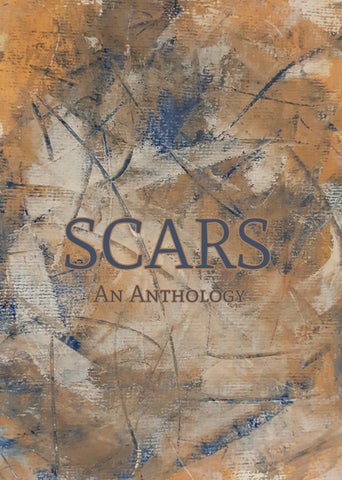
Scars: Poems, Short Stories, Essays A Beyond Words Anthology
Edited by Gal Slonim Editorial Board: Kelly Sargent, K.D. Zwierz, Colby Flade, Noah Evan Wilson, Candi Martin, Brian "Brie" Sheridan, Roberta Laurie Front Cover art: Ellen June Wright, Image #3930, watercolor on paper. Ellen June Wright’s work revolves around the power of color and the emotions and memories they evoke. She is inspired by the works of Stanley Whitney, Mary Lovelace O’Neal, Frank Bowling, Howardena Pindell, Jamaican Artist Cecil Cooper and others. Her art appears in LETTERS, Gulf Stream Magazine, Wild Roof Journal, Breakwater Review, Burningword Literary Journal, Hole In The Head Review, Oyster River Pages, Kitchen Table Quarterly, NOVUS Literary Journal and others. Back cover art: Derek Boswell, Missing2. Derek Boswell is a social documentary photographer from Southwestern Ontario, Canada.
ISBN 978-3-948977-96-2
First publication rights reserved © Beyond Words Press First printing / May 2025, Berlin, Germany
Table of Contents 01 I Love Bad Dogs by Leah Mockridge 05 Blood Moons by Ben Fogelberg 09 Red Wolf by Jeremy Giles 12 Slice by Julie Fitzpatrick 14 All My Oldest Friends Are Scars by Todd Williams 17 Heart Line by Zoe Woods 20 Cut Short by Linda Petrucelli 23 Silence by Francis Flavin 27 Dusk Love by Cindy Frenkel 30 Endless Day by Katherine Fishburn 33 Stories Untold by Shawna Marie Tavsky 37 You on the Moon by Elias Cooper 40 Existential Window Pain by A. Michael Schultz 42 Harry or Robert or Walter by Mary Thorson 44 Thunderstorm by Robin Gabbert 46 Shit Brick by Jack Barrie 49 Scars of the Heart by Justin Prine 51 Holy by t.m. thomson 53 I Was a Child Guinea Pig by Ernest Villarreal 58 The Quiet Unraveling by Amanda Kluveld 64 Soviet Legacy by Lina Buividavičiūtė 65 Hospitals by Lina Buividavičiūtė
66 Rescuing Me by Danila Botha 73 Momma's Branding by Cathy Gilbert 75 What the Body Remembers by Maria B. Olujic 80 Childfire/Wildfire by Dick Altman 82 Indians & Cowboys/The Wound Unheald by Dick Altman 85 Total Eclipse by Thomas L. Pate 87 Children’s Wounds are Not All Outward by Connie T Braun 89 Adagio by Amanda Draznin 91 Inside Out by slm 95 Mindfulness by Elizabeth Curley 97 Taking Out the Trash… by Carol Iaciofano Aucoin 99 You ask to see my scars in hopes we'll have sex by Indira Devos 101 Mother Tongue by Ruby Burgin 106 The small ones by Morgan Messing 108 For the Girl in the Waiting Room by Sarah Frost 111 Second Chance by David Stern 113 Molch by Nina Gibson 115 Sandwich Bag by Karin Henrikson 118 The Reaping of Lost Things by Emma-Jane Barlow 121 At The Old Man's Place by Benjamin Green 123 The Boat to Belfast by Penny Jackson 130 Marriage counseling with Kafka by Matthew Wunsch 133 The Wish by Laura Bota 137 Christmas Dog by Jenny Butler
141 A Scar, Visible Only to Me by Rotem Rozental 147 The Cellar by Barbara Reese Yager 150 Scar Tissue by Anna Lowe Weber 153 Ancestors Revisited by Susan Haifleigh 155 ICK by Kelsey L. Smoot 157 Audio Logs: Scars by Gordan Struić 161 Theatre by Sarah Dantas 163 Pain Before the Rainbow by Tom Marrotta (aka Jack Cooper) 168 Clyde by Sofia Salazar 171 The Ghost of Scars by Vince Puzick 178 Usher by Caleb Dobbratz 180 Granules by Bri Nerud 182 A Funeral for My Past by Elizabeth Ghoniem 186 Lines, and Why They Scare Me by Yin Cheng
I Love Bad Dogs Leah Mockridge
Leah Mockridge is an American poet and aspiring author. She graduated in 2021 with a degree in Communications and Creative Writing. Professionally, she works for the world’s largest pet memorial service. Her spare time is spent with her two dogs and two cats: Ellie, Ida, Toast, and Phil respectively. 1
I love bad dogs. The ones that jump and bite and run away. The ones that sit in a shelter for weeks or months or years. The ones whose kennels are flagged; anxious, aggressive, avoidant. The ones whose broken tails no longer wag as they stare endlessly through the cracks of their cage. Waiting for someone who will never come to take them back home. I hurt for them. I see myself in them. I want to save them. I tell myself they just need someone who sees the good. The affectionate, adaptable, appreciative creature that lives beneath the fear. They just need someone who understands. They just need someone to love them anyway. They just need someone to stay. So I scratch their name from the euthanasia list and I take that bad dog home. I take them home and I show them my gentle hands and I don’t cry when they bite me each time I feed them. My friends don’t understand. But still, I defend my bad dog. They don’t bite to be mean, or to hurt you, they bite because they’re afraid. Why don’t they get it? Why don’t they see the dog I see? The dog who curls up with me on the couch. Who covers me in sloppy kisses and brings me their favorite ball. The dog that sits with me while I cry in a quiet understanding. Why can’t they see past the stitches and the scars? 2
My bad dog doesn’t mean to be bad, so it’s ok. It’s just that no one’s cared enough. It’s just that no one’s gotten it right before. Misunderstood. Mishandled. Mistreated. They just need someone to love them. They just need someone to understand. They just need someone to stay. And so I stay. And I stay. And I stay. And I stay. Hoping that in time I can show them how to be more than a bad dog. How to sit, how to shake, how to stay, how to be gentle with their sharp, sharp teeth. Still, they bite. But I love bad dogs so I say it doesn’t hurt. I love bad dogs so I don’t beat them as they chew up everything I love. I love bad dogs so I don’t shush them as they howl sad songs in the night. I love bad dogs so I don’t scold them as they dig their way under the fence. I love bad dogs so I still cry when they run away. I wish my bad dogs could see they didn’t have to be bad. They don’t need to sink their teeth into something to stop it from leaving. They don’t need to leap and lunge at every pair of arms that open for them only to be pushed away. 3
But I didn’t push them away. I stayed. And I stayed. And I stayed. I let them wrap their jaws around my throat to prove I would not go. Still stroking their soft ears as my airway began to close. Still aching as I watch them slip beneath the broken fence. Because I told myself that bad dogs just need a little more love, a little more time, a little more of myself. And so I gave it. I gave them my bones and my breath and all the layers of flesh that stood between us. They were just afraid. It wasn’t their fault. All those years alone, left wanting. Left waiting in their kennel for someone that would never come back. But now it’s me that waits by the dog door, not moving, not breathing. Hoping my bad dog will still come home.
4
Blood Moons Ben Fogelberg
Ben Fogelberg is co-author of Walking Into Colorado's Past, winner of the 2006 Colorado Book Award. He lives in Fort Collins, Colorado, with his wife, Whitney. 5
Looking back on the incident almost fifty years later, I can recall only two things, neither of which happened that day. First: a praying mantis balancing on a chain-link fence bordering our garden. Second: a trash can tipped over on yellowed linoleum next to an open kitchen cabinet by the sink. I can’t help thinking about both as I type out the text, “Can I call you?” The question sits unsent under a stream of generic back-and-forth sentiments roughly aligning with my birthday, my sister’s birthday, and major holidays stretching back more than a decade. * Applied with force, fingernails leave welts that turn into crescent-moon scabs on your forearms as they heal. Blood moons, I suppose. Arranged in two sets of four, with outlier thumbprint bruises. It happened more than once. It happened enough times to require long sleeves in hot weather. But not often enough to leave permanent scars. Eventually, I forgot how those fights started. * The praying mantis swayed on needle-thin middle and back legs, tilting its triangular head in seeming contemplation between myself sitting in grass at the edge of the garden and my mother tending tomato plants. To my four-year-old eyes, it was enormous. Some people believe praying mantises bring you luck. Their eyes appear to have pupils, which for some, makes them seem less insectile. Like there might be more to them. * Our elementary school was less than a quarter mile down the street from the one-bedroom apartment we moved into two months after the divorce and four years after the incident. My sister and I shared the bedroom and our mother slept on a foam pad she stored in a closet during the day. We walked to and from school on our own and were expected to have our chores finished by the time she got home from work at the day care center. 6
I had been charged with walking our Irish Setter, so I was outside on the sidewalk when the tow truck passed by, carrying what looked like my mother’s lime-green Toyota Corolla if it had been hit head-on by a bigger car. When I got back to the apartment, the phone was ringing. “Your mother’s been in an accident and is at the hospital,” a police officer on the other end of the line told me. “She’s going to be okay.” I spent the night at a friend’s house. The next night I asked my mom if I could sleep on the foam pad. My sister slept in the bottom bunk in our room, as usual. * Praying mantises don’t have pupils. Instead, they have black spots that reflect all wavelengths of light. Like most other insects, they see with their whole eye. * Trash covered the kitchen floor. In the middle was my two-year-old sister, stuffing fistfuls of potato peelings into her mouth. It had been less than a year since she had been found in a dumpster in Seoul, South Korea, and less than six months since my parents adopted her. She had a remarkable ability to get into and out of things. One night around that time, I woke up to the sound of her screaming. I looked across the room from my bed and saw her hanging from her crib. She had managed to squeeze her entire body through two bars, but her head was too big to fit. I saw her feet kicking and started to scream too. * My mother bought lady bugs by the hundreds to keep her tomato plants pest-free. They came in the mail, and when freed from their container, the ones that hadn’t already starved to death during delivery devoured every aphid and spider mite they found. Some people think they’re good luck. *
7
After the incident, my sister wore bandages that looked like a baby mummy’s mittens. My parents had to strap her into a highchair to change them. Medical tape and gauze piled up on the floor as they unwound each hand. I had to turn away when they got down to bare skin, but I know she watched everything. With her whole eyes. * Later, doctors cut a piece of skin from her outer thigh and grafted it to the back of her right hand. They used a piece of it to re-create the webbing between her thumb and index finger, but it never healed properly. Her fingernails grew back just fine. * I type “I’m so sorry,” then delete it. * My mother used to boil tomatoes and then put the pot on the kitchen table. She scored each tomato with a knife beforehand so the skins would peel off naturally as the water cooled over the course of an hour. She never canned tomatoes again. * The praying mantis loved lady bugs. That’s why I tried not to look at its front legs. * I can’t see blood moons on my forearms anymore, but I remember my sister pleading with her whole heart as the nails dug in. She never said it then, but I can hear it now. A question. Maybe a prayer. “Why won’t you look at my hands?”
8
Red Wolf Jeremy Giles
Jeremy Giles (he/him) is queer multiracial author based in Asheville, North Carolina. He is a Creative Writing MFA candidate at California Institute of the Arts and graduated from Johns Hopkins with a degree in Creative Writing and International Studies. He is an environmental activist and has worked at multiple human rights organizations. His Instagram is @jeremy.giles1 and his website is jeremygileswrites.com. 9
My head is nailed to a wall in a basement in North Carolina; it is stuffed with straw and its eyes look glassy when light is shown on them, although that isn’t a too common occurrence. Normally, my head is kept in the dark.
My mate, my child, did not see my head being roughly cut off by an old rusty saw, teeth chomping through my tendons, they had run away, instincts flaring, and for that I am grateful.
they did see my body limply falling to the Earth, the remains of my headless corpse, left to rot, unused, sinking into the ground itself. 10
I am not against hunting, us red wolves love the taste of the exquisite flesh of white-tailed deer, and will eat it whenever we can.
But, I would never kill just to kill, to brag to monsters as twisted as I.
Humans are not uniquely cruel. Male Dolphins kill each other’s children, chimpanzees wage wars for territory that isn’t theirs, and cats as big as lions and as small as the human creations hunt for the thrill.
Why should humans be exterminated while these animals remain?
Chimpanzees cannot destroy the world. Humans can.
11
Slice Julie Fitzpatrick
Julie Fitzpatrick is a writer/actor/theater teacher whose poems have been published by Wingless Dreamer, Poets' Choice, Chariot Press, and Allegory Ridge. Her book "Church on the Screen: A Sunday Series of Pandemic Poetry" was released in 2023 and her one-woman play "77 U-Turn" was released in 2022 by Next Stage Press. More information can be found at juliefitzpatrick.com 12
Though he ravaged his skin with razors, It all unraveled in his mind. A vicious inner voice demanded favors. As a boy—I’m told—he shined.
13
All My Oldest Friends Are Scars Todd Williams
Todd Williams is a former South Dakota journalist now working in the Middle East. His poetry has been published in a number of print and online magazines, journals, and anthologies. His Objects in the Mirror Are Closer Than They Appear won the 2021 South Dakota State Poetry Society annual chapbook contest in 2021, and his first fulllength book, Dancing on the X, is scheduled for release late summer 2025 with Finishing Line Press. 14
I come to this world dressed in nothing but bruises, black, blue, and kiwi green, grasping and gasping for shallow breaths like rainbow trout taut to the tether. Nipped at by needles, punished for blood, slapped at and uncoddled by nurses, in those moments I'm met by the friends who’ll accompany me all my days. They're there when the dentist, with tired fingers shuddering with old age, sends a shiver of flame through every molecule of my being, curved tip of a steely sickle probe pinching the raw nerves from a tooth sheared in half. Then, he begins with the Novocain. They're there for my gridiron glory, arm bent back at the elbow ninety degrees, the brittle crack of young bone filling my ears with fear and tingling from fingertips to aching shoulder. Coach calls a timeout to ask what’s wrong, the dangle of my limb not enough to inform him of its condition, then asks if I’m ready to go back in. They're there again when my bride flies back to Phoenix to be with her family, then calls to say she’s not to return; that she’s already met someone new; that she’s not even certain our love was anything more than distraction. Kidney stones? There. 15
Migraines? There. Sciatica, sore knees, depression? There, there, and there. When cancer steals my mother’s last breath, they wrap thick fingers around my heart. When I listen to my daughter’s cry, they come close and whisper in worry. When I wake each night, every morning, they tug at my feet, weaken the knees, tickle the curve of my spine with knives sharpened by resolve and stubbornness. Only in dreams do their claws retract. They are my friends, my foes, my mentors, masters of destinies unfulfilled, mad inhibitors of childhood dreams. Sometimes I pray them away with words meant to comfort; other times I drink to drown out the sound of their thirst. And sometimes I wonder who’d I be without them, the weight of their bodies staggering my steps, their promises closing paths before me with briars and imagined beasts, growls becoming roars, roars turning to mere whimpers.
16
Heart Line Zoe Woods
Zoe Woods is a new poet, naturalist, and outdoor educator. Originally from Colorado, she is now based in Alaska. 17
Right about the time we ended things, I sliced open my hand In an ill-fated avocado incident.
Like you, the avocado slipped out of my grip Just as I brought down the knife. Shock held me in place, time slowed to the trickle of honey. It took a full minute, it felt, For copper syrup to bubble up. I stood there, just watching.
It wasn’t bad, only 4 stitches. I put on a brave face, Smiled at the cute nurse as she delicately sewed me up. I found myself wondering if she could fix me in other ways, But I got home and just cried, Emptied the pain and fear from the last hour Or was it the last week, Wished you were there to hold me and kiss it better
My skin turned ghostly and puffy under the smothering of neosporin, The crackle of black bubbly bread crust eventually, Gave way to invisible threads forming a tender red bridge, A fresh line on my palm,
18
I watched the miracle of my body Knitting itself together And wondered if my heart could do the same?
Would it be easier, Without the threat of vital blood loss, Without exhausting vigilance towards infection? Or would it be harder Without a visible wound, Without a sewing pattern as a guide?
I absentmindedly drag my thumb over this new scar, Feel the jumpy new nerves Fizzing like pop rocks with a light touch, And it reminds me, Come sharp pains of knives and loss Breaks of bones and hearts This body will mend
19
Cut Short Linda Petrucelli
Linda Petrucelli serves as CNF Reader for Minerva Rising Press. Her writing has appeared in numerous literary journals including Barren, Cagibi, The Twin Bill, Longridge Review, the Sun, and elsewhere. Linda’s essays have earned Pushcart and Best of the Net nominations. She is currently hard at work editing her memoir about learning to speak Taiwanese. 20
The plastic-handled scissors I keep in a jar on my desk are light in my hand, unlike the monstrous left-handed shears I remember from my childhood. That pair belonged to Mother, stored inside the 2nd floor bathroom cabinet and used to cut gauze and surgical tape and overgrown hair. When I insert my right thumb and fingers through the handles, my palm ignites a tremor. Closed tight, scissors make a perfect instrument to slash like a dagger. Pulled apart, the blades can slice and sever. The polished steel blades feel cold, even in August. That’s when it happened. As I attempt to snip a dangling thread from an old sweater I resist giving up, my fingers extend and curl, and the scissors propel me back fifty years. Upstairs, the landline’s extralong cord snakes from my bedroom and slithers beneath the bathroom door. Knees up, sitting on the closed toilet, my conspiracy unfurls into the Princess telephone cradled close to my mouth. Licorice whip hair, still damp from the shower, drapes over my pajama top and down my back. I cup the pink receiver with my hand and whisper to my best friend Judy under my breath. It’s a dangerous game of how far to go—which lines to cross. A part of me recognizes, in the faint click and soft sound of hissing air currents, that Mother has picked up the extension downstairs and is on the line, listening in. At fifteen, during the Summer of Love, I hear the intrusion for what it is—an attempt to clip the wings I am so desperate to try. But the hissing sound doesn’t fully register. That, or my denial hides a wish to get caught, because I fear I can’t stop myself from falling. Here’s the plan—two older guys will score the weed and Judy will tell her mother that she’s spending the night at my house and I will say that I’m staying at hers. Masking my hesitation, I only chuckle at the proposed deception. I don’t chuckle now, fifty years later, as I stare at the dangling thread, scissors poised in my hand. The frayed strand, curled and black as my hair used to be, needs only a quick snip, but my heart begins to race and I cannot stop its furious beating. 21
Feet suddenly pound up the carpeted stairs and Mother shouts my name. A snare drum beats inside my chest. She flings open the bathroom door, looms in her fuzzy pink nightgown, gray roots showing among her closecropped orange curls. “Get off the phone!” Her eyes bulge. Paralyzed on the seat, my body goes numb. “Don’t you ever lie to me!” She rips the phone out of my hand. What she doesnʻt know, only suspects, is that this is not my first lie. My brain weaves like a drunken driver careening between lanes. In desperation, I wail the truth. That I wouldn’t really go through with it. That it was just talk. But she doesn’t believe me. Her slap strikes my arm, knocks me to the floor. The phone skitters across the tile, sounding a maniacal busy tone. Plain Jane with Rapunzel hair, I cringe on the floor, cling to the toilet. My mother’s enraged face is so close I can see inside the inflamed pores on her Roman nose. Her arm reaches into the open cabinet. A gleam of silver, a blurred image caught in midair, blades arced open. Her big-jointed hand grabs a fistful of hair and black strands stream across the bathroom floor, jagged like scars. Collapsed on the floor, I gather the severed strands, touch the uneven zigzag near my chin. She roars her predictions for my future. I’m going to disgrace the family. I’m going to get myself into trouble. I’m going to turn out just like who? I can’t remember the relative’s name, only that she ended up committing suicide by gassing herself in an oven. Uglified, afraid to look in the mirror, I search my mother’s face instead. “Leave it that way for a while,” she says, “your sister will even it out. You’ll be fine,” and I watch her mouth open and shut, like the opposing silver blades of a scissor. Steadying my hand, I grip the blue-handled pair closed tight, and snip off the sweater’s dangling thread. The cast steel levers give off the faint smell of rust, like a scent of blood that has dried over time.
22
Silence Francis Flavin
Francis Flavin draws upon his experience as an educator, public interest lawyer and observer on four continents. His novel The Muse in a Time of Madness was released in July 2024. He was the Winner of the 2021 Poetry Quarterly Rebecca Lard Award. In the SoulMaking Keats Literary Competition, Flavin placed first in the Memoir/Vignette category (2022), and in prior years received recognition for humor and flash fiction (2), short story (2), novel excerpt (3), creative nonfiction and personal essay categories. 23
You have the right to remain silent. The Miranda warning is good counsel, but as a kid, in the presence of adults, we had the absolute duty to be silent. At times there was comfort and security in silence. Silence… Suddenly I was a kid again. Again, taking refuge in silence. My friend and colleague had left me in the wine bar with her three companions. These suburban women were discussing the topic of the day. Christine Blasey Ford alleged that then-U.S.-Supreme-Courtnominee Brett Kavanaugh, had sexually assaulted her when they were teenagers. “I’m not buying it!” “Me either.” “Why would she remain silent all these years?” As the only male present, I had kept to myself until they questioned Ford’s motivation. “I know,” I blurted out. “Really? And what would you know about that?” They looked away, not wanting an answer. It was a declaration, not a question. There was anger there. I didn’t know why. Still don’t. “Oh, I know.” I mumbled. That was all I had. I could go no further. There was a border there I could not breach – had never been able to breach. They excused themselves and fled out the side door, only to alight at an outside table. I sat alone. In silence. Silence isn’t deafening, it’s clouding. Would it be blinding. Alas, it is not. Somehow the incident is still emotionally wrenching despite the blurry details. “Incident,” a word to lend distance and lessen consequence. It’s been many years now – decades. Still, I know the “what” and some of the “who.” But the time, place, and participants exist in a mist of deflected pain and buried shame. Was I seven or eight? A little older? It was in the 24
woods, but where? Down from the old house near the brook? Somewhere there – I think. Was it sunny or cloudy? I still strain for the details. I know there was a log – rough and wet – and nettles. The physical sting would last for hours, the emotional sting would persist forever. My thoughts plunged into the toxic seep of half-remembered horror. The pain. The guilt. The eastern hardwood forest is beautiful, but resonates with repressed memories. Is that why I moved West? The vistas here are liberating yet melancholy. On occasion I still long for the eastern forest despite the phantoms. The scent of pine at the arboretum on a warm afternoon will always take me back to my youth. Not always to the incident, but sometimes it will, jolting me from the sublime to the horrific. Sometimes details come back without warning. I fled the movie Deliverance. That damn log! And the laughter. Ford mentioned the laughter. She knew. There was no river to sweep us away to a safe place. There would be no escape—only anguish. People stared at me as I bolted from the movie with bile rising in my throat. Did I squeal? I might have. They wanted me to. They. If you want retribution you have to name names. I can’t do that. Most of them are just blurred images. It is not just the age. I can remember my first communion with my cousin-in-law in detail. The smell of the algae in the frog pond. The feel of the muck between my toes, and the shocked look of my mother when she saw the slime green stain up to the knees of my immaculate white pants. The benign laughter of my father as he took it all in is still vivid in my mind decades later. But I can’t remember most of the assailants now. Perhaps a therapist could pull them out of the repressed recesses of my brain. I don’t want to. What is the sense now? A few of the assaulters I know well. I won’t name them. It would only hurt others. Their siblings. Their children. Too late for justice, but then it always has been. As soon as they were done, the zippers zipped, and they strolled away laughing, the burden was mine. Who would believe me? Their families had status, money, and fancy houses. We were poor, living in a shack. I would be the urchin with a dirty mind. They felt entitled. The wealthy always feel entitled. 25
Kavanaugh’s frat-boy’s sneer still darkly resonates in the depths of my own pit of bitterness. Who could I tell? My father would believe me. He always did when I needed him to. But he and my older brother had hot tempers. They were berserkers and would exact a physical retribution that would bring their ruin and mine. I can explain that now. I could sense that then. There were no other options then – no victim’s advocates or child protective services. Our priest scared the shit out of me – a severe man with intimidating vestments. Little did I know then, that many priests had buried guilt of their own. My parents used to tell me not to pick at my scabs. Good advice for wounds both physical and mental. People don’t want to know these things. Like the women in the wine bar, they prefer to look away or flee. It is hard enough to confront one’s own pain without taking on someone else’s. In dealing with sexual assault, like many other painful or complicated aspects of life, people are prone to pick a side, and a label – “gold-digger,” “toxic male,” “publicity slut.” Once you have your label, you can safely cut and run. I was fortunate to grow up Catholic and blue collar. Catholics are steeped in guilt from an early age. One incident just dissolves in the great miasma of shame and remorse that attends every life. Blue collar folk push through pain and guilt, and get on with their lives. Whatever weakness I felt because of this degradation I pushed it aside and punched my “man” card. I’ve boxed, wrestled, played hockey, survived a dunking in a glacial river, climbed to the top gallant of a sailing ship, and have broken my nose eleven times. Was I compensating? Does it matter? Perhaps it is true that whatever doesn’t kill you, makes you stronger. Even so, I fear there may be something beneath that scab that I never want to confront – something dark. To pull her own pain and demons into the glare of politics and publicity on behalf of the nation, Professor Ford was courageous beyond measure. I wanted, in some way, to support her and confront the women bashing her there at the wine bar. But I hid in silence. Mostly.
26
Dusk Love Cindy Frenkel
Cindy Frenkel’s poetry has appeared in publications ranging from The New Yorker to the international anthology Divining Dante. She has multiple scars, including a cross on her arm, which deserves a poem of its own. Dusk Love appeared in Cindy’s chapbook, The Plague of the Tender-Hearted (Finishing Line Press). 27
Sky darkens, night settles in, and I crave your soft skin, yeoman’s muscles, warmth of arms, biceps’ light hair, the rise and fall of your chest, its keloid scar-stripe down the center. This, Love, is the plague of the tender— hearted, the very limits of it all— I remember the surgeon saying men like you would be tender longer, barrel-chested, big guys. After they moved you from intensive care you began to relax, until your heart raced, the alarm sounded, a machine bleating Do Not Resuscitate repeating its death knell; the staff swarmed around you, and you spoke of your father’s death. They shooed me away. You wanted water.
28
Walking with the nurse to the kitchen, opening the freezer, I held my head in, fanned my watery eyes, filled your cup, returned with arms outstretched. The staff busy around you still, speaking in their foreign language. Later, when it was calm again, you moved into silence. I tried to read, but looked up, kept looking up, at your beautiful, flushed face, high cheekbones, small, straight nose, ombré gray goatee, wild Russian eyebrows, wires all in the right order, the whole of you, the absolute whole.
29
Endless Day Katherine Fishburn
Katherine Fishburn lives and works out of both sides of her brain, trained by her father (a physical chemist) to be analytical and rational, born with genes that demand creative expression. She is both poet and visual artist, with several publications to her name and many solo art shows (including “The Question Concerning Technology” and “Prison Nation”). In this, she would seem to exemplify Joan Miró’s claim that poetry and painting are the same, although her own experience convinces her that, in their execution, they are very different activities. She is a keen observer of nature and a student of the human body, especially the pain that embodiment requires to survive. A series of her poems about pain won the Editor’s Prize in Poetry at The Florida Review (2001). A different series on pain appeared in the Ginosko Literary (2017-2018). Her poems have also appeared in Snowy Egret, Horn & Ivory Zine, enizagam, Di-verse-city and others. Images of her paintings accompanied by personal essays regarding their content and execution can be found at fineartamerica.com. Three of her short shorts appear in the recently published anthology, Book of 422, in which she also writes as Cardigan Sweater and Samantha Spade. In addition to writing poetry, she is currently finishing a novel. 30
what unholy presence has thought to stop the sun at its meridian— as if channeled through a convex lens scorching light inflames my defenseless brain Oedipus would understand were I to scar myself into blindness that I might withstand this torment, in the soothing blank of darkness beside these hostile shores my head tips forward from its weight, jerks up— my hands, scarred but still translucent, afford no respite from Apollo’s golden chariot or the blood-soaked wreckage wrought by his brother delirious, I stumble on, detect a faint presence in my path —who goes there? is that a watchman who would lead me to the canopy of night, where I might shield my salt-rimmed eyes from the pulsing glare of atrocities committed in the name of righteousness or should I beware? • devils wearing tinted aviator glasses who line the dock sporting bespoke gray suits accessorized w/ Armani ties & attachés deploying counterfeit smiles baring regimented teeth 31
conspire to keep me awake fearing what further havoc they might wreak should I grow drowsy & yield to sleep— sweet cool sleep, how long have we been antagonists if not for dread of still more scars I’d lay down my arms— suffer nightmares overrun w/ wildebeest & crocodiles • in the heat, windfalls begin to weep, attracting narrow-waisted wasps who poke & snack on rotting flesh nimble fiddler crabs nibble lips green as algae snip my skin away bit by bit— soon, nothing left to eat smoldering fire pits overlook the carnival of decay Ares celebrates
32
Stories Untold Shawna Marie Tavsky
Based in Mexico City, Shawna Marie Tavsky tells silent stories through poetic photography and portraiture. She writes to shape felt experience into words. 33
She pressed play and set her music to repeat. As the warm resonance of a somber cello and a tender violin filled the air, she gently dimmed the light. Finally, she was alone in her private space. A small dusty theater studio where she could properly rehearse. She stepped carefully into her costume; a form-fitting vintage gown coated with white paint to add stiffness. It had a brittle antiquated feel. She centered herself in front of the mirrored wall, noting the company of a once vibrant ruby sofa behind her. It had been loved, and forgotten over the years. Guided by her slender reflection in the mirror, her bare feet firmly positioned on the cool wooden floor, she aimed her attention to the language of movement finding its way through her long arms, graceful hands, and delicately aging fingers. Although the song of the cello took residence in her core, the dance, she felt, was in her hands. Then, like ghosts, they appeared. She froze. The studio filled with the weight of their silence; the air stilled, the music fell away. It had been years since she saw them. They stood the same; unwavering, broken bodies tinged a faint red hue. Visiting. “I’m sorry. I’m sorry. I’m sorry. I’m sorry…”, she repeated softly, over and over. She sank to her knees and wept, her arms wrapped themselves tightly around her shoulders, and in the presence of the solemn souls, she rocked herself in circles, slow. “I’m sorry, I’m sorry…” *** There are stories in us, stories that cannot be told; not in words, not in pictures. Only, sometimes, they visit. *** The lights at the guest house were cut daily at about 6pm to save electricity. The sun had set. The gentle hills of Rwanda—its soft warm earth—rested under ever watchful stars. 34
She lay sleepless in a sparse pale green room, on a thin bed, under the veil of an old mosquito net; stale and frayed. A curtained window let in a mist of moonlight and a sliver of the evening’s chill. Her head was busy with voices and images of recent days… “God forgot about us. Like you forgot your pen.” Nsengi’s vacant eyes. Bella’s smile. “They piled the bodies in the streets. In that street right there.” The kids, playing. A familiar gecko on the far wall, and the solid feel of the well-read book in her hand, Shake Hands with the Devil by Romeo Dallaire, were comforting. Earlier that day, she had visited the Murambi Hill Technical School. Fifty thousand Tutsi taking refuge were massacred there. It became one of many genocide memorial sites in the country. For this memorial, exhumed corpses were treated with calcium oxide to dehydrate body tissue and preserve their remains, similar to mummification. Shreds of paled clothing clung to their antiquated bony flesh. Their brittle bodies were laid carefully on tables in classrooms, many in the same positions as they had been found; protecting a loved one, hands covering petrified eyes, mouths wide with terror. Limbs missing. Skulls crushed. The guards and the caretaker encouraged her to photograph, to tell the story. So people would know what happened. So that something like this would never happen again. She photographed with care. Her lens felt intrusive as she zoomed in on terrified faces, pleading arms, frantic hands… The sound of the camera’s shutter was loud and pierced the stagnant air. She shifted angles slightly, framing pictures. Faded red fabric shaded the classroom windows and 35
tinted the sunlight as it entered. Broken bodies tinged a faint red hue. She adjusted for light and color. She imagined their stories; each one. *** Exhausted and sleepless, her book in hand, she stared through the sheer frayed mosquito net and fell into the stillness of the sparse pale green room. There was something about the netting, its white tattered threads… Like ghosts, they appeared. Solemn souls in broken bodies filled the room, shadowless in the moonlight, tinged a faint red hue. Visiting. They couldn’t speak. They looked to her. *** There are stories in us, stories that cannot be told; not in words, not in pictures. Only, sometimes, they visit.
36
You on the Moon Elias Cooper
Elias Cooper is an emerging Canadian-American fiction writer based in Ottawa. He graduated from the University of North Carolina – Chapel Hill in 2011 with a BA in philosophy and a minor in physics. He writes flash fiction, short fiction, and full-length novels. 37
They never tell you that when you look through a telescope directly at the moon, someone else will be looking back. Yet there you were: I was looking right at you. It was late summer, and I was out on my back porch after two weeks straight of rain. The humidity was high, the grass still damp. But finally I could look through my new telescope and see the first full moon up close. It took me some time to focus the lens and get a clear view. Mom and dad had offered to help, but I’d insisted on doing it myself. I wanted to try and take a picture with my phone and show them what I could do, and so it was important that I do it alone. I knew all the parts of the moon’s rocky face, the Copernicus crater all cracked and pale, the Mare Frigoris like a bump on the forehead, the Oceanus Procellarum. You learn these sorts of things growing up, that’s what my dad had told me. I think he meant to comfort me because I was mostly alone. The first time I looked through I remember thinking that there was a smudge on the lens, that somehow, though my telescope was new, a piece of dirt or a part of the packaging had gotten stuck to the glass. I rubbed it carefully with the cloth my dad had showed me how to use. But when I looked back through, I realized that no, there was a spot on the face of the moon that I had never heard or read of before, and that spot was you. You were looking through your own telescope, looking back, looking at me. I remember distinctly how you waved first; the smile on your face, how warm and gentle it was. I say this now, remembering, because at the time I wouldn’t have had the words. Then it was mostly a thrill that I felt. You were a secret for me alone. I told no one about you. I waved in return, unsure if you could see me, but your smile told me you had. A whole world expanded in front of me. I can’t say how, but the signs we devised of hand signals and written symbols, mine on poster board, written in sharpie, yours toed into the moon’s dusty surface, seemed to emerge out of nowhere. First I’d point at a tree and make a pluming shape with my arms that tapered down towards my waist and you understood. Similarly, you’d point at yourself and make a distinct set of movements by which I understood you meant your name. How quickly we grew close. 38
I remember how I would tell you everything, and you me, and how I would start to bring you tokens of my affection, a bouquet of flowers in autumn shades, a project that I’d made for the science fair, a birdhouse I’d constructed at school. Because no matter what would happen in class or on the playground, no matter what bruises I’d bring home, I knew I could always come back and live a whole new day just talking to you, sharing things about my world. You of course had less to share, but it didn’t matter, you seemed endlessly interested in what was going on here. I knew that someday I would visit you. When the planes first came and the booms and the crashing, my dad said I couldn’t stay out as often. I tried to explain why the planes were coming, thinking I was old enough to understand, but I don’t think it made sense to either of us. You said it would be ok. I knew you were right. When it was over, I said, I would spend a whole month just talking to you. You smiled and signed me a ‘good idea.’ When dad left, I was sure it wouldn’t be for long. You were too. And it didn’t feel so long, even though mom told me at one point that it had been a year. She asked if I remembered hitting my head, but I didn’t. She smiled when I said this, but it wasn’t like she was smiling so much as her face was. I didn’t know what to say. When dad came home and he saw me, mom took him into the bedroom, and I could hear them speaking. She was crying. Then later he came out and gave me the same look that she had given. But I didn’t care. Things were back to normal. I am older now and still live with mom, though dad had to go away again. I don’t remember when he’ll be back. You and I still talk every day like before, and today I showed you a bouquet I found in my room. The flowers are funny and crumbling, and they aren’t as pretty as others I remember, but I still like them. They were hanging upside down from the wall. I think I’ll show you my school project next. There’s a blue ribbon on it, though I don’t remember why. Or maybe I’ll show you the bird house on the tree by the window. I still think of the names of the places on the moon almost every day, you know. Someday, I promise I’ll visit.
39
Existential Window Pain A. Michael Schultz
A. Michael Schultz is a writer and educator living in Northern Appalachia. His recent poetry appears or is forthcoming in Appalachian Journal, The Brussels Review, Delta Poetry Review, New Feathers, October Hill Magazine, Poor Yorick, and elsewhere. He is Assistant Professor of English at Belmont College. 40
As if I’m playing out abandoned scripts you left for me I keep forgetting to check the mail and sometimes these keys play hard to get retreating to corners of a house that once held our clothes and gatekept our secrets where we first stared out the window trying to catch the moon fleeing from the midnight sky each of us ashamed to show faces we could never hide Now, your ceramic owl sits still upon the windowsill, conceiving dreams of owls in dying elm trees wise enough to call them mirrors; to call them memories. It knows too well that nothing in this house will ever fly again or bare its naked wings as Forever’s breath bites into my skin the names of absent flowers aching to bloom again one day and if they do, I will finally clean the fridge
41
Harry or Robert or Walter Mary Thorson
Mary Thorson lives and writes in Milwaukee, Wisconsin. She received her BA in Creative Writing from the University of Wisconsin-Milwaukee and her MFA from Pacific University in Oregon. Her stories have appeared in the Los Angeles Review, Reckon Review, Cotton Xenomorph, Milwaukee Noir, Worcester Review, Rock and a Hard Place, Tough, among others. Her short story, "Book of Ruth," was included in Best American Mystery & Suspense '24, edited by Steph Cha and S.A. Cosby. Her work has been nominated for Best American Short Stories, A Derringer, and a Pushcart Prize. She hangs out with her two feisty daughters, the best husband, and a dog named Pam when she isn’t teaching high school English, reading, or writing ghost stories. She is represented by Lori Galvin at Aevitas Creative Management. Her debut short story collection will be released in 2026 with Rock and a Hard Place Press. She is currently working on a novel. 42
My stomach did the wrong thing. At 18 weeks, it started to shrink. The only son I will ever have died inside of me, quietly, so I do not have him. I had a dream about him last night, but it wasn’t how I thought it would be. In the dream, in my dream, I didn’t know him. He did not look like one of mine, and I don’t know what that means. It was as if someone had replaced him in my womb with a changeling. When I held him, he was born and he was smiling and babbling and he was wrong. I don’t know what to make of that feeling. I don’t believe in dreams. I don’t think they are special. Mine are shaded and mostly silent, with or without teeth. Not fully formed things. But I wanted to see his face. I wondered, months and months ago, when I saw him in sound waves, what he would look like. I heard his heartbeat on three separate occasions. Like the father, except his father wasn’t there, it was only me and our son–the son, and the holy ghost, which maybe he now is. Or maybe not. When I heard it, I did thank God. When I didn’t, I knew. There was so much I didn’t know. And will never know. How we would have managed. How he would have slept at night. When he would get his first tooth. How he would walk the same way his father walks. How the girls would have adored him. Made him their own. Or maybe not. I did not know his name. I did not know the sound of his babble. I will only always know that he was quiet. Not fully formed. In the dream, I did not want him, and this confirms my non-belief in dreams. Because that was not true. I knew I wanted him. I also know, now, that I cannot have him. I don’t know if I’ll have more dreams, but I know that I do not want them.
43
Thunderstorm Robin Gabbert
Robin Gabbert has poems in state, national, and international poetry anthologies. Her poem Invisible was a finalist in the 2024 San Francisco Writers Conference Competition. Her chapbook of ekphrastic poetry — The Clandestine Life of Paintings, in Poems was published in November 2022 and she has spoken to the California Writers Club and many other groups on Ekphrastic Poetry. She is currently working on her third book of poetry. www.robingabbert.com 44
It thunders like an angry stepfather when mother is out and you’re hiding under the bed, your knees clattering, your sister in the closet teeth chattering while old Jackson whimpers in his bed. It thunders like the crowd cheering a corrupt politician knowing he’s fondled the fourteen-year-old volunteer in his van. It thunders like a cat backed into a corner, a circus clown who snarls behind the smile. Like a head-on collision. It thunders like the slap to your face the first time you told him no, the first time the dog peed in the house, the first time he stubbed his toe and had no one else to blame. Like your stepfather’s prayer asking for forgiveness saying he knew not what he did.
45
Shit Brick Jack Barrie
Jack Barrie is from Leicestershire, England. Winner of two royal television society awards, his debut Novel 'Sundown: An Other World Fairytale' was published in 2023 with Ravenstone Press. Other work can be found in or upcoming in Split Lip Magazine, The New Flash Fiction Review, Blood Pudding Magazine and more. He currently lives on Vancouver Island, Canada. 46
Shit brick. That’s what my cousin Harry called it. He’s from Oxford. Nice down there. All the brick that way has a lovely gold-cream colour to it, but I like our shit brick better. It’s home. Endless labyrinths of it, and I know every winding street for miles. My school’s made of sharp orange brick. Once, Patrick Waite tripped and slammed into it on the playground, and where a brick wall will always hurt to collide with, even that smooth Oxford Cotswold stone, this brick was almost serrated. He has scars now on his chin and cheek from where he picked the scabs. We were careful after that, for about a week, then back to the usual sprinting with untied laces. I have one too on my right shoulder, where I came off my scooter outside my nan’s nursing home. Pebbledash wall – bloody cheese grater. In fact, we all have something. My mate Shoe (surname Trayner) has a black messy one on his elbow where he came off his mini moped in an oil puddle, leaving a dull, involuntary tattoo under raised scar tissue. He was fond of it. Harry stayed a while, and everyone in the labyrinth thought him soft. Couldn’t kick a ball, wore khaki corduroy trousers out and knitted jumpers with holes in that stank of ciggies from his dad, and his school shoes, even on weekends. Thought he’d be with us for half-term, then back down Oxford for school. But Easter came and went. Harry moved from sleeping on my floor to more cigarette-y clothes arriving from home and him unpacking in my older sister’s now-unused room. I was protective over her stuff and threatened Harry not to nick ‘ote or I’d know. Next term he was in my class at school ‘n’ all. Mum wouldn’t tell me why. I asked Harry why he was still here, but he said he didn’t know, but that he was fine with it. Weird. If I had to move from creamy Oxford to here, I’d be fuming. Break time. Nutri-grain, purple fruit shoot, pork chop for school dinner. Like chewing a wet bible. Shoe showed off his tattoo again, starting a pissing contest, and before long everyone was unbuttoning cuffs and rolling long sleeves up to the shoulder. Joe Coulson prodded Harry to do the same, and before I could stop him, Harry hoisted up his sky-blue button-up and navy jumper. 47
Little dots pattered across his back like the surface of the moon. Most small, some larger, most faded, some raw. “Fuckin’ ell. What’s them from?” Not soft anymore. One of us. He rolled his jumper down, his new jumper, no cigarette smell on this one. No little burn holes either, not like his others. And he was silent for just long enough for the boys to goldfish-brain their way onto the next person. We shared a long look, and I thought maybe my sister’s room ought to be his now. I leant back against the school’s serrated brick. It clung to my jumper like Velcro, its subtle stab making me wince. I like our shit brick. It’s home.
First published in New Flash Fiction Review (March 1st, 2025)
48
Scars of the Heart Justin Prine
Justin Prine is a passionate poet with a strong connection to his Texan roots. A proud member of the Army, his experiences have shaped his perspective, fueling his creativity and inspiring his work. Through his poetry, Justin weaves together themes of resilience, identity, and the essence of life in the modern dating age, creating a voice that is both authentic and profound. 49
Funny how not a single scar on my heart Came from an enemy, tearing me apart. Each wound tells a story, a truth that’s laid bare, From love’s gentle hands and the weight of despair. The sharpest of edges, they come from within, From those I once trusted, where shadows begin. With words that were sweet, but turned into knives, It’s the closest of ties that can cut deepest lives. I’ve learned that the battles can wear many faces, That pain often lingers in familiar places. Each scar is a lesson, a map of my soul, A reminder of moments that once made me whole. Yet I wear them with pride, these marks of my fight, For they show I’ve survived through the darkest of nights. In the tapestry woven of joy and of strife, I find strength in the scars that define my life. So here’s to the heart, with its stories untold, To the lessons of love that have shaped me bold. For it’s not the foes that have caused me to bleed, But the love I once cherished, the pain of a seed.
50
Holy t.m. thomson
t.m. thomson is co-author of Frame & Mount the Sky (2017), a chapbook of ekphrastic poetry, as well as the author of Strum and Lull (2019) and The Profusion (2019). She served as a guest judge for The Ekphrastic Review’s “Ekphrastic Cats” poetry contest in March of 2022, & she placed first in The Ekphrastic Review’s “Tickled Pink” poetry contest in August, 2024. Her first full-length collection of poems, Plunge, was published by Uncollected Press in 2023. 51
I do not believe cities are holy. Bodies are holy, bone, brow, paw, pinion, tined tongue, serrated fin cleaving ocean. Sky is holy as it tosses lightning & rolls thunder around the bowl of hills, when it sits empty, when sun perches in its blueness, sends beams out of nest, blond fledglings landing on scalps, sweeping sidewalks with heat’s glaze. Walls are not holy, tombs are not holy. Trees are holy, thirsty root, burled whorled trunk, rocky bark, upraised branch, downturned twig, crown a basin for gust-shivered leaves, lobe, mid-rib, bract, blade, bud, plum juice running sweetly down mouth even as October rushes past sunflowers. Breath is holy as it lifts sternum, stirs hair & fur & pebble, grants speech & howl, erects poetry, raises communion in profane cities.
52
I Was a Child Guinea Pig Ernest Villarreal
Ernest Villarreal is a retired News Corp. executive, living in Hawaii. Former Expressions with shows in New York and Philadelphia. Writing his memoir, Sci-fi trilogy, and various short stories. 53
My first vivid memories were of torture. I sat in Doctor Fishman’s office, my mother proudly near me, wearing her pointy sunglasses and white gloves. I knew why I was there—waiting to hear what was wrong with me this time. I sat next to a large window overlooking the street and facing an oversized desk. I clearly remember feeling uncomfortable sitting in that overstuffed leather chair surrounded by a wall of books and framed accomplishments. At that moment, I began to resent my mother and Dr. Fishman for what would occur. This wasn't the first time I sat in Doctor Fishman's office. A few weeks earlier, he witnessed me being ejected from my mother’s big black 1953 Cadillac. I found playing with the electric door locks fascinating—click, click, click, it went until my mother had had enough. “Stop playing with the damn door locks,” She demanded repeatedly. She eventually leaned over and smacked me across the back of my head. When my mother returned her eyes to the road, she abruptly stopped at a traffic signal. The sudden jerk caused me to inadvertently grab the door handle, triggering the door to swing open and ejecting me to the pavement. As I bounced off the blacktop, I let out an uncomfortable cry, prompting my mother to scream in panic. Our joint shriek drew the attention of Doctor Fishman, entering his office across the street. He was a man who lived up to his Hippocratic Oath and came running to my aid. He began asking me questions as he helped me to my feet and insisted that my mother and I accompany him to his office for an examination. With an impeccable bedside manner, the dashing and debonair doctor easily convinced my mother to follow him. Unlike my mother, I would come to despise him. While in Doctor Fishman's office, he completed a complete body examination accompanied by a consultation. He placed a Band-Aid over my scraped elbow, an everyday occurrence at home. My mother paid the charge cheerfully and without complaint. This is how I acquired my private pediatrician. How dreadful I found my association with Doctor Fishman, in time, I would have good reason to refer to him as Dr. Frankenstein, among other disrespectful references. 54
On our way home, Mommy dearest told me we were returning to Doctor Fishman’s office in two weeks for a simple procedure. Without asking, my mother stopped for ice cream. Ice cream was my mother's way of pacifying me with a sort of general anesthetic, which induced memory loss in me and a piece of solitude for her. I didn’t understand why I needed a private Doctor; I wasn’t a sickly kid. A stomachache occasionally and growing pains on occasion were my conditions. My brother, Daniel, had an emergency appendectomy at a young age. Consequently, each time I had a stomach ache, I found myself in the emergency room at Paradise Valley Hospital. This happened a few times, but after waiting an hour or more for a doctor, the pain always subsided. An odd incident occurred on a similar night while I lay on a gurney in the emergency room. My mother and I suddenly perked up at the sound of an approaching ambulance. The emergency room doors swung open while partitions were rolled up, separating the room. I sat up only to see the wheels of another gurney being pushed along. My mother and I returned to being bored, looking at the floor, the walls, and sometimes at each other. As she did on occasion, my mother let out a series of distinctive coughs. Suddenly, a voice from behind the partition rang out, “That's my mother's cough—that's my mother.” My mother leaped across the ER, pushing the partition aside. To our surprise, it was my brother Daniel suffering the consequence of an auto accident. She looked back at me, motioning me to stay put. My mother looked like a bobblehead doll turning back and forth while looking at two of her sons lying on hospital gurneys. Daniel was covered in blood; I was consumed with anxiety. He had a few lacerations and bruises. I was scared for life. Soon after, the three of us were on our way home, posthaste. On the day of my appointment for the “simple procedure,” I complained of an upset stomach—a big mistake. I was denied breakfast. Instead, my mother planned on giving me an enema and a bath. I've been given a few enemas, so I knew what to expect. Previously, it was dispensed due to a real stomach issue or constipation. My condition and diagnosis were determined by my “Doctor Mother”. She had “The Look,” steely dark 55
brown eyes that would penetrate my psyche. I imagine it's the type of control a vampire has over its victims. Eventually, I learned to keep my ailments to myself, disguised with a smile I perfected over time. Her intention was expressed in a series of gestures culminating with her sitting on the bathtub's rim and then the final hand signal. I asked my mother several times what the “Simple Procedure” was but to no avail. She kept telling me to be quiet. During our car ride, she finally announced that I would be circumcised. I knew the difference between shit and Shinola, but I didn’t know what circumcision was. I also knew what an enema was, I only hoped they weren't related. I asked my mother a few more times for an explanation. “For the last damn time, the Doctor will describe the procedure to you, don’t ask again!” she said in frustration. There I was, sitting in that overstuffed leather chair again, waiting to learn what the heck circumcision was. “You’re going to be circumcised,” Doctor Fishman said. I remember nodding my head with a confused look. “I’m going to numb and remove your foreskin, which is the excess skin around the head of your penis.” That moment created my stutter, sometimes called a stammer. I felt like I was choking on my words, as if they were stuck deep in my throat, and I had to cough them up. “Wa, wh wha,” my head jerked up and down while my jaw quivered. Doctor Frankenstein stared at me with a look that made me feel like a lab experiment. I finally spit up the words, “Wh, wh what’s a pe, pe, penis?” Dr. Fishman looked at my mother as if to give her permission to tell me. He must have thought I would take the news much better if it came from “Mommy Dearest.” “It’s your pee-pee, honey.” I screamed as loud as I could. “Yooouu ga, ga going to cut off my peepee?” 56
“No, no, just a little skin, it won’t hurt, I promise, I'll give you a little shot,” said the Butcher of Seville. That’s all I needed to hear. I hadn’t completely developed my running skills to avoid uncomfortable situations yet, so I sat there paralyzed. My lack of experience, however, didn’t keep me from planning a getaway. I decided to crawl out of my chair nonchalantly and high tail it for the door. I imagined I’d be out the door in a flash, down the stairs to the street. Then, jump into the back of the first pickup that drove by - to unknown points. I broke out of my paralyzed state and made a beeline for the door. A pudgy-faced nurse stood in my way. “Ok, no shot, no shot, come back and sit down,” my jailer sweetly ordered. “No shot, I promise, come sit down,” he politely asked again. “How about a glass of water? It will help calm you down,” he said with authority. “Nurse, bring Edmund a cup of water to calm him down,” he softly requested. ”Would you like a glass of orange Kool-Aid instead?” asked the nurse with big red lips. “Ye, ye, yes, please.” I quickly drank the Kool-Aid. The next thing I remember, I was given a bowl of ice cream. I knew I felt something different, but I couldn’t put my finger on it. I wanted to stick my pee-pee in the bowl of ice cream, but the nurse was standing there watching me. “It’s all over, and you’re fine,” said the nurse with the pudgy face and red lipstick on her teeth. I have never forgotten that day. I would come to learn a lot while sitting in that overstuffed leather chair, deep in its folds that engulfed me. During subsequent procedures, I learned what a tonsillectomy was, what scoliosis was, how to care for sprained fingers, and all about removing malignant growths and moles, just to name a few. At that point, I was premed at six years old and a living guinea pig who survived “The Pain Merchant.” 57
The Quiet Unraveling Amanda Kluveld
Amanda Kluveld is a Holocaust historian and an op-ed writer from Dutch Indies decent. She discovered a letter in the Arolsen Archives of Harpo Marx trying to save his aunt during the War and was interviewed about it in The Forward. She was the first to discover that the Amersfoort Police Camp in The Netherlands was a fullblown Holocaust camp. She is always searching online archives and thus she is considered a boring person by her peers, and somewhat proud of it. 58
Anna pulls me from my room, wrapping me in a red satin robe and sliding those blood-colored slippers onto my feet. The hallway stretches before us, dark and pulsing with memories of the women who came before me. My steps echo, swallowed by the oppressive silence of the house. We pass relics on the walls—crucifixes alongside Chagall prints, their colors bleeding together in the dim light. The house feels alive, each twist of the corridor leading deeper into its heart. Anna’s grip on my wrist is tight, dragging me into the laundry room, where the air is thick with soap, damp cotton, and the scent of confinement. The clothes hanging from sagging lines aren’t just garments—they’re skins shed by those who have passed through, ghosts of selves left behind. Anna moves among them like a judge, her words cutting through the air: “Drunk. Pig. Talking, talking, always talking. Stupid. Dirty.” Each word is a condemnation, a final verdict on lives reduced to fabric and thread. I nod along, though her words remind me of the labels I’ve carried—foreigner, exotic, other—as if my Asian features are all that define me. No matter how much I’ve tried to carve out an identity, the world insists on shaping me into something else. Ljena spins through the room, her small form a blur, her giggles a thin veil over the tension. She collides with Anna’s leg, and the atmosphere snaps. Anna’s retaliation is swift—kicks delivered with cold efficiency send Ljena sprawling. “Joopy, joopy,” the girl whispers, crawling to me, clutching my robe. “Don’t tell Mama I was the Lion King,” she pleads, her voice trembling. Anna’s gaze shifts to me, her eyes narrowing as if to measure how much of my will remains unbroken. “What should we do with you?” she asks, her voice dripping with mockery. The question isn’t hers alone—it’s the world’s, always demanding an answer from me, someone perpetually on the outside, expected to conform, to disappear. But I have no answer, only the sickening realization that whatever comes next, I’m bound to it. Anna lifts Ljena like a doll, her movements mechanical, before dropping her to the floor. The child’s quiet whimper is as meaningless as a whisper in a storm. “Let’s watch some television,” 59
Anna declares, dragging me from the laundry room into the living room as though I’m her prize. In the flickering light of the television, Jerry Springer’s distorted face looms. Anna watches with predatory focus. “Oh, girl, no wonder your husband cheats on you, look how fat you are!” she exclaims, laughing at the spectacle. “You shouldn’t take him back; he’s not man enough to pay the bills!” Her laughter is hollow, tinged with something darker. As she talks, her fingers twist through my hair, tugging at the strands as if testing their resilience. My hair, long and dark, is a connection to the identity I’ve fought to reclaim. But under her hands, it feels fragile, like something that could slip away with the slightest pressure. Anna murmurs stories of her past, weaving tales of a life far removed from this place, where every snip of her scissors transformed women into something more—something worthy. But these are lies. The truth is in the faltering edge of her voice, the dullness of her eyes. Neva enters, trailing her sons like shadows. She looks at me, her gaze hard. “Don’t believe her,” Neva warns, her voice bitter. “She wasn’t a hairdresser. She was nothing. Just a whore.” The word slices through the air, a blunt instrument designed to wound. Anna flinches, her grip on my hair tightening. I want to defend her, to say something that might diffuse the cruelty, but the words choke in my throat. “Anna was a great hairdresser,” I manage, my voice trembling. Neva sneers. “If you believe that,” she challenges, “then let her cut your hair.” Panic rises in my chest. My hair is more than just hair—it’s the last thread tying me to who I am. But there’s no escape from this challenge, no way to refuse without losing everything. “Of course,” I say, summoning a smile that feels brittle as glass. “I’d love for Anna to cut my hair.” Anna’s eyes widen, then narrow. “Of course, My-Lin,” she murmurs, her voice a lullaby. But Neva isn’t done. “Why not now?” she presses, as if she’s already won. “Yes, why not now?” Anna echoes, her voice unsettlingly sweet. 60
We move to the linen room, the air thick with the scent of old cotton and unspoken regrets. Anna positions me in front of the mirror, draping a sheet over my shoulders like a shroud. The others gather around, their faces pale and ghostly in the dim light. Ljena sits cross-legged on the floor, her wide eyes fixed on me. Anna picks up a pair of scissors, their blades glinting in the low light. The room falls silent, the only sound the soft snip of the blades as they slice through my hair. Strands of black fall to the floor, each one taking with it a piece of the person I’ve struggled to be. Anna works with precision, her focus unwavering. But as the hair falls, so too does something else—an illusion, a facade. In the mirror, I watch my reflection transform, becoming a stranger. When Anna finally steps back, the silence is thick with unspoken truths. The haircut is perfect, hiding the scars, the damage. But it’s a lie, a mask covering the reality beneath. I see the satisfaction in Anna’s eyes, the pride she takes in her work. But there’s no joy, only a deep, aching emptiness that mirrors my own. I rise from the chair, the sheet falling away like a discarded skin. The room feels colder now, the light dimmer. I turn to face the others, unsure of what to say, unsure of who I am now. Anna smiles at me, but it’s a smile tinged with something dark. “Beautiful,” she whispers, but the word feels hollow. Ljena claps softly, her eyes wide with a mixture of awe and confusion. Neva watches silently, her expression unreadable. Her sons stand beside her, shifting uncomfortably. I reach up to touch my hair, feeling the sharp edges where the scissors have cut, the new shape forced upon me. It feels foreign, like a costume I’ve been made to wear, but one that doesn’t fit. The reflection in the mirror blurs as tears well in my eyes, but I blink them back. I’ve lost something today, something intangible yet essential, and I’m not sure I’ll ever get it back. With a deep breath, I turn away from the mirror. The hallway stretches out before me, dark and winding. I don’t know what lies ahead, but I know that I can’t stay here. As I walk down the hallway, the sound of my footsteps echoes in the silence, a reminder that I am still here, still moving, still fighting to hold 61
onto the fragments of who I am. The house may have taken my hair, my sense of self, but it hasn’t taken everything. There’s still something left, something that belongs to me and me alone, my scars. And as long as I have them, I can keep going. The next morning, I left the House of Saint Catherine forever. I pulled the door shut behind me and felt the sunlight sting my eyes. On the stoop, Ljena played alone. Knee socks, a T-shirt, and a skirt. Hello Kitty! She mumbled and hummed to herself. When she saw me, she glanced around to see if her mother was nearby. Anna was nowhere in sight. Cautiously, the girl approached me and stood in front of me. “Do you know who I am?” she asked. “The Lion King,” I answered. She shook her head. “No, no, and you can’t guess again.” “Alright,” I said, starting to walk away, but the girl stopped me, grabbing my hand. “Do you really want to know?” she asked. I nodded. Yes, I did want to know. “Okay, then you can guess just one more time,” she decided. “Hmm, let me think... a cannibal?” I guessed. Ljena giggled, her chestnut hair falling over her shoulders. “No, no, not at all.” She began counting on her free hand. “Eenie meenie, ten pounds of grain, ten pounds of cheese, eenie meenie moo, you’re the boss, off, off. You’re out.” She let go of my hand, spun in a pirouette, fluttered her arms, and exclaimed, “I’m a little butterfly. You see that, don’t you?” “Oh yes,” I said. “Now I see it. You’re indeed a little butterfly.” The girl nodded approvingly and turned away. She danced in the street. The butterfly girl danced before my eyes, her hair gleaming in the sun. She danced and danced and danced. She danced away from me forever. 62
Two Poems Lina Buividavičiūtė
Lina Buividavičiūtė was born on May 14, 1986. She is a poet and literary critic. Lina is author of two poetry books in the Lithuanian language. Her poetry is published in Matter, Masters and Proverse Poetry Prize anthologies, and the magazines: Drunk Monkeys, Beyond Words, The Dewdrop, The Limit Experience, Beyond Queer Words, Maudlin House, Cathexis Northwest Press, Poetry Online, Red Noise Collective, Sad Girls Diaries, as well as the Versopolis poetry platform. Upcoming publications include New Millennium Writings, Cathexis Northwest Press, Red Noise Collective, The Stardust Review and Beyond Words. 63
Soviet Legacy I still act out of hunger, out of lack, I beat myself to death with a whip – there are journeys that never end – the wastelands conquered are too small. Moderation is the measure of all things – I try to teach a girl, one in whose blood the Soviet era's permilles still flow. I wish there was a sober house, the kind of Minnesota programs that would eliminate these intoxicants and cure my anxiety, and all the Siberian experiences of grandmothers, and all the deficits – the queues for meat and bananas where I still wait – despite the fact, the products are different, the hunger is the same. I tell myself that I want to act out of fullness, fullness, fullness. but in the new-age prophylactic I drink ineffective antidotes, I get another injection – even in language, even at home, I find my inherited being, I hear permanent voices that say that if I don't try harder, they'll throw me out— from home, from language, from the hearts of those I love. So, I must go on, because I need one more piece of Soviet era sausage.
64
Hospitals In war – just like in war. In a hospital – just like in a hospital. The lighter cases can stay in their jeans and their trainers. So I stayed. Everyone – incomprehensible. Neighbors – barefoot. The walls are not even white, they are painted a bright pink color, like xanax tablets – maybe so that everything is uniform, so that everything fits into the system, so that we’d live in a pink bubble – shhh, shhh, everything will be alright, but it won’t be. I used to spend days staring at the pinkness– Until the visitation of life, until the appearance of gods, it was good, no one spread shit all over the walls – there were no motes in our eyes nor logs in our brother’s – only silence, only inside sometimes someone shuddered with tiny wings, like tiny embryos first felt in a mother’s womb – but they died quickly, unable to survive the silence, the abstinence of existence, we had nothing to feed them, we didn’t have light, the walls didn’t help – not ours, still – not ours. Starvation – here. And we’re – Hunger Artists. And we’re – diagnoses. Translated from the Lithuanian: Ada Valaitis 65
Rescuing Me Danila Botha
Danila Botha is the author of three critically acclaimed short story collections, Got No Secrets and For All the Men (and Some of the Women I’ve Known) which was a finalist for the Trillium Book Award, The Vine Awards and the ReLit Award. It will be reissued by Guernica Editions. Her new collection, Things That Cause Inappropriate Happiness, was published in 2024 by Guernica Editions. The title story was nominated for a Pushcart Prize. It was also named a finalist for the Canadian Book Club Awards, in the Short Story category. She is also the author of the award-winning novel Too Much on the Inside which was optioned for film. Her new novel, A Place for People Like Us, will be published by Guernica Editions this fall. She is currently working on a new short story collection, Sleepwalking Too Close to the Fire, and just completed her first graphic novel. 66
The first time I met Evan, we were standing in the elevator of our thirtytwo storey condo building, and he was trying to use voice to text on his iPhone to send a work email. He had olive skin and dark hair and was wearing an expensive looking light blue shirt with jeans, his sleeves rolled up, a pair of scuffed black Blundstones on his feet. “We need to order fourteen units,” he repeated. “Pomegranates,” he said, staring at his screen, laughing dryly and shaking his head. “This thing is useless.” I thought about pomegranates, the juicy red seeds that looked like jewels, the overpriced bottled juice that somehow always tasted sharp and dusty. My in laws had lined their table with them for their Passover seders, the miracle fruit that somehow contained six hundred and thirteen seeds, as many as the commandments Jews had to keep. Some people believed in eating as many as they could, for wish fulfillment. There weren’t enough seeds in the world to save my marriage, and even if there were, I’m not sure I would have wanted to. “Wait, you look familiar,” he said, squinting at me as if he was only then registering my existence, as we both got out of the elevator. “Are you one of Michael’s daughters?” I shook my head, strands of peach and light pink bursting through my messy bun as I tried to tuck them behind my ear. I looked down at my ripped jeans, a small embarrassing chartreuse dragon tattoo peering out from a whole on my thigh. Instinctively, I put my hand in front of it. “Michael is my dad’s cousin.” He was one of the developers that owned the building. My dad worked for the company too. Evan smiled at me, a lightning flash of white light. “He’s a good guy, your uncle. He had me over for Shabbat when I first moved in and he rented me my corner unit at a great price.” I found myself smiling too. “I’m renting here too, family discount.” It had been impossible to imagine moving back in with either of my parents, with my dad, stepmom and stepsister in Thornhill, in their open concept, beige and grey brick new development house that had actually been the complex’s model home. Everything was bright and echoey, and too big, there were too many rooms, full of gift baskets with organic 67
Macintosh apples and mid-priced bottles of wine, bright red Gerber Daisies or roses and baby’s breath in thin, glass vases, balls of twine, metal scissors and red ribbons poking out of every drawer. My stepmother ran a successful corporate gift business called Rita’s Rewards. Staying at their house felt like waking up on the set of the most boring reality TV show of all time. I was always afraid to disturb something. I couldn’t imagine staying with my mom either, in the same stifling Harbord Village basement apartment that she’d been living in for years. Every square inch was covered in glue and mixing pastes, acrylic paint and newspapers, sponges and scissors and everything she needed to make the paper mâché puppets she sold at artist’s markets on the weekends. Most days, and some nights, she drove an Uber. Nothing I did pleased either of them, least of all my impending divorce. My mom was perpetually disappointed in me for failing to live a more interesting life, while my dad was disillusioned by my failure to want to be more successful. Evan and I lived on opposite ends of the same floor, but it was three weeks before we actually saw each other again. I was coming out of the elevator when I heard his voice. Apparently, he had a dog, and a neighbor was complaining that she barked too much. “You know I’m a nurse practitioner,” she was yelling, her voice growing louder with each word. “I’ve worked through the night three nights in a row, and I need to sleep during the day. We’ve discussed this, Evan, we share a wall.” “I mean, it’s ridiculous,” Evan started ranting, quietly, but I could feel his fury. “We’re allowed to have dogs. This building is full of them. Have you met Sam and his girlfriend, they live on the second floor? They have that Saint Bernard, Rosa Barks? She’s like ten times louder than Fiona.” He stopped to take a breath, his red flannel shirt hanging off his slight back like a flag. “You know those yappy Pomeranian’s, Courtney and Travis Barker, the owner is from California, Dahlia, I think her name is? Dogs bark. It’s how they communicate. You don’t own the fucking building.”
68
“If you don’t get a dog walker,” she warned him, “I’m going to complain. I own my unit, Evan, you’re just renting.” I still have no idea what came over me, it was this inexplicable urge to do something, like when you wake up from a nightmare and immediately want to put on your shoes, and go for a jog, or solve world hunger. I came up behind them and introduced myself as Fiona’s dog walker. The nurse introduced herself as Mary, then turned around and slammed the door behind her, and Evan looked at me, shrugged and put a harness and leash on Fiona, like that had been our plan all along. She’s big, with a square face, her splotchy black and tan merle fur as shiny and slick as a seal’s back. “At first, I told everyone she was a Catahoula Leopard Dog,” he said, “because she looks like one, right? Like one of those fancy breeds, but I did a couple of those dog DNA tests, and it turns out, she’s half Border Collie and half Staff or some kind of Bully mix.” I had no idea what any of that means, but I held my hand out, then walked up to her, babbling something about being happy to meet her and she tipped her head side to side like she’s listening or trying hard to understand me, She then wagged and licked my hand and Evan smiled and handed me the leash. He showed me how to wrap the thick black leash around my arm and then my hand, “like a pair of tefillin”, he joked, and I snorted and focused on Fiona, who was dragging us in the direction of the parkette across the street. He told me that she once, months earlier, found an almost whole roast chicken behind a bench and had never stopped searching for another one. “Fiona’s so smart,” he said, “and so persistent.” He took her to work once, and she noticed a laser pointer in their conference room. She chased and barked at the red dots, and every time she went in there after, she tried to find it. “I’m sorry about your neighbour,” I said, and he shrugged. “She works in ophthalmology. How do I know? Because she’s one of those assholes that says ‘let there be light’ every time she flips a light switch. I hear her do it like ten times a day.” I laughed and he nodded appreciatively. 69
Ever since I’d been on prednisone, and my body has stretched and expanded in size in every way imaginable, guys had stopped looking at me the same way, and every glance felt like a victory. Evan dates the kind of girls that are slimmer than my pinky finger has ever been, but sometimes he makes me feel seen. We walked back and I handed him the leash and shoved my frozen fingers in my jacket pocket. “I love the name Fiona,” I said. “Fiona Apple is one of my favourite singers.” He laughed. “I don’t know who that is, but I named her after Princess Fiona from the Shrek. I loved those movies when I was a kid.” I didn’t really want to get a job, but even if I did, I wasn’t qualified to do anything that paid well, and my health got in the way whenever I landed anything halfway decent. I was surprised by how much Evan was willing to pay me. It was easy; I had to spend all day in my apartment or his with Fiona, and I had to walk her three times. I had to feed her special raw food once a day, and steamed yam or liver treats in specific quantities. My mom is relieved that I can pay my rent. She used to be a small time weed dealer as a side hustle before it became legal. She had connections in small pharma, as she called it, and I knew she’d help me if I got desperate enough, if it came to that. I didn’t talk to her much when I was married but as soon as I left him, I called her first. Every day, when Fiona hears me opening her door, she whines like we haven’t seen each other for months. Her eyes glint. Her ears go back when she sees me. “Hi Fif,” I say quietly and she bounds over, her tail wagging like it’s spring loaded. I used to think she wagged like that for everyone, but Evan assured me that she didn’t. “She loves you,” he said, his voice losing its usual edge and hurriedness. I’d never known this kind of love. Growing up, before my parents got divorced, we never had any pets until a stray cat adopted my family. She was grey, with a faded orange spot on her back and one white paw, like she’d lost a mitten but was tough enough to live without it. She only had half a tail, so she waddled a little, 70
less graceful than the typical cat, but more swagger. My parents were too distracted by their own issues to get her spayed, so she had kittens twice a year, every year, and we gave them all away. Someone left us an anonymous note in our mailbox once, slut shaming her, and us, by extension. She’s like the neighbourhood bicycle, they wrote. You’re being irresponsible pet owners. Evan rolled his eyes when I told him that. “There’s always one of those,” he said. He pointed to Fiona’s back left leg, which was shorter than her other legs. It never quite touched the ground. She was a rescue so no one ever knew for sure what happened, but her vet thinks she probably broke it as a puppy, and it broke on the growth plate, and then set that way, so there was nothing they could do, except possibly amputate it one day, if it came to that. That was how he met Mary for the first time; they were both standing in the lobby, waiting for the concierge, and she tapped him on the shoulder and asked him if he knew his dog was limping. “I was tempted, for a second, to tell her I didn’t know,” he said, rolling his huge brown eyes. “And then if she kept going, I was going to say, maybe I should stop kicking her then.” I stared at him for a second, not knowing what to say, and he laughed, “But she’d probably think I was serious and call the Humane Society, never mind that Fiona is my best friend in the universe and I’d literally do anything for her.” * My hand reaches for her neck, and she stretches languidly, like a yoga teacher demonstrating a move for a particularly inexperienced student. I haven’t filed my nails on purpose, I reach for her chest with the best, most padded parts of my fingers, the parts that don’t balloon with synovial fluid, the parts that always still feel like me. After some time, I feel her paw scratching my bare knee. I don’t flinch. It’s the highest form of love, he told me once, when a dog tries to reciprocate. When I’m having a rheumatoid arthritis flare, Fiona can smell which joints in my hand are being affected. She always licks them, and I try not 71
to cry if it hurts. “My whole body feels like your back leg,” I tell her sometimes, my hips, my knees, my feet, my wrists, my fingers. She’s with me when I eat a granola bar so I can take my medication midmorning, when I’m too stiff to walk until I soak my hands and feet in hot water, when I’m too tired to do anything, when my brain is foggy, when my ex calls and still refuses to grant me a Get even though he doesn’t want me anymore because you marry someone you can have a future with, and if they change as much as I did, if they become less capable instead of more, if they become a child instead wanting to have one, there’s no future left. Fiona never judges me. She’s there and she’s loyal, she loves with everything she has, and she leaves traces of herself on me, tiny hairs that imbed themselves onto everything so I know what I’ve given, I can quantify how I’ve spent my day, and Evan tells me that her head smells like my perfume, like orange blossom and sandalwood. I know it’s not forever, because nothing is, because one of these days, Josh and I will go before a Jewish court, and the rabbis will tear up our ketubah and I might cry or I might feel nothing, and they’ll declare us both single, and I really will be, and I’ll have to get a real life, and Evan will need to get a real dogwalker, and we might get better, or our bodies might keep breaking down, but in the meantime, I have Fiona and she has me and she’s rescuing me one moment at a time.
72
Momma’s Branding Cathy Gilbert
Cathy Gilbert is a Professor of English at Heartland Community College. When she's not teaching, she's trying to find time to read and write poems and essays. Her work has previously appeared in Hobart, decomP, and Peoria Magazine. Her first poetry chapbook, My Limbs a Cradle, my Whisper a Song, was published in 2024 with Finishing Line Press. 73
She just wants to be held. Clinging to my pant legs, tears of abandonment streaming down baby cheeks. She gives up, sits, and her wails fill the kitchen as momma’s busy feet flit from counter to table. Dinner’s ready, but her world is still not right. She pulls at my shirt, refuses to sit alone in her chair. She throws back her head begins another tantrum. Her brother stares at her, not understanding. I don’t know either, little man. After, my pants are caked with remnants of dinner: smeared avocado, rice, beans, a squished banana. They’ll wash, be made clean again, but the image of her sitting on the floor, legs splayed, head hung low, shoulders shaking, is burned into my brain. The hurt of letting her feel so afraid if only for a moment, keeps coming back like how I imagine the scar on the steer’s rump throbs and aches again at the mere sight of the poker.
74
What the Body Remembers Maria B. Olujic
Maria B. Olujic, Ph.D., is an anthropologist and writer who served as the Deputy Minister of Science and Technology in wartime Croatia during the bloody dissolution of Yugoslavia. Her work focuses on memory, gendered violence, migration, and political upheaval. She is completing her memoir, Fields of Lavender, Rivers of Fire: A Memoir of War, Womanhood, and Bearing Witness. 75
People talk about scars that don’t heal. Or rather, about scabs—those temporary covers—getting peeled off by accident, by rubbing, by remembering. We speak in metaphors: old wounds, scar tissue, layers of damage beneath the skin. But those are the visible ones. What about the scars no one sees? The ones that leave imprints not on the flesh, but on the psyche, the heart, the soul. Those scars don’t pucker or fade. They settle inside us. We carry them in silence, in breath, in memory. I know I’m not the only one. The question is—how do we speak of them? How do we find the voice to express the ache that has no physical shape? How do we witness what happened to us when even we barely understand the outline of it? I think the real power lies in witnessing—not necessarily before another person, but in the presence of something deeper. Some inner spiral that pulls us outward when we’re ready. If we’re ready. What is memory, then? What is the body’s version of it? I remember the hospital in Zagreb. 1988. Petrova Teaching Hospital. The hallway with the bolted-down orange chairs. Women waiting—some in gowns, some with cigarette packs bulging from deep pockets. The air was thick with bleach and stale smoke. I remember the silence. The cold gel. The ultrasound screen blinking like a slow heartbeat. A doctor’s hand moving across my belly. His voice in English: “Without.” He didn’t know I spoke English. I wasn’t supposed to understand. But I did. Without what? Without neural tube, they told us later. At the base of the skull. A small absence. A fatal flaw. “Where is your husband?” they asked. “At the café across the street.” 76
We crossed the sun-bleached avenue. He folded his newspaper and rose quickly, sensing something was wrong. We returned together. In a small office, the professor explained: “It could be confirmed with bloodwork. But if the diagnosis holds, the pregnancy must be terminated.” I didn’t move. There are moments when the body stays completely still, while something deep inside it fractures. We left Zagreb for a few days to wait out the national holiday. Everything was closed for Dan Borca—Day of the Hero. We traveled to Brčko, a small town in northern Bosnia, where friends welcomed us with warmth, homemade food, and shots of šljivovica before every meal “to open the appetite.” The plum brandy seared my throat. I swallowed out of politeness, but I couldn’t taste a thing. That weekend, the Split Music Festival aired on the single Yugoslav channel. The winning song—Majko Stara—played in every household: Who decided to take away my dearest? No tears left to cry out my sorrow... The sea is breathing peacefully. Everything felt slowed down, unreal, like moving underwater. And yet, I remember the landscape. The gentle villages along the Sava River. The stillness in the corn fields. That part of the country would later become no-man’s land—disputed, broken. Even now, its future remains uncertain. Some scars belong to nations. Some belong to bodies. Some… to both. Back in Zagreb, the test confirmed the diagnosis. No need for more scans. I’d already sought second, third, fourth opinions. We knew. I was admitted that afternoon. My husband was told to wait at the café. No visitors were allowed in the ward. I lay in a room with three other women, all in their third trimester, resting to protect their pregnancies. Their eyes slid past me. I curled inward. A nurse handed me a small paper cup of pills. “Professor will stop by later,” she said gently. 77
Time unraveled. The narcotics blurred the ceiling, turned the room into water and shadow. At one point I was wheeled into the adjoining room. Through blurred vision, I saw the professor lift the lid of a steaming metal basin and pull out a pair of rubber gloves. The room smelled of disinfectant and heat. My eyes closed as he slipped the gloves on, and my body felt as though it had vanished. Later, I awoke to his voice. He was speaking to my husband. “It’s too bad. It was a boy.” When the nurse returned, I asked if I could see him. She hesitated. Then, with practiced detachment: “It’s best you don’t. He’s down in the basement. With the others. In formaldehyde.” I froze. She studied my face, puzzled. “But… he’s my son,” I whispered. She said nothing. Elaine Scarry writes that pain has no voice—that the body in pain resists language. But I wonder: what about the body that inflicts pain on itself? That blames itself for failing to fulfill some unspoken promise? In a culture that values sons, bloodlines, and names passed through male hands, what becomes of a woman who cannot give birth to one who lives? The scar is not just loss. It is shame. It is silence. It is the body remembering after the mind begs it to forget. Sometimes I think the only way to tell the story is to relive it. Again, and again. To confess it not once, but in fragments, in different lights, to different witnesses—until maybe, just maybe, something inside quiets. Even now, decades later, my body carries the memory—not of the place, but of what it endured. No ultrasound could find the scar it left. No blood test could prove it. But it’s there.
78
Two Poems Dick Altman
Dick Altman writes in the high, thin, magical air of Santa Fe, NM, where, at 7,000 feet, reality and imagination often blur. He is published in Santa Fe Literary Review, American Journal of Poetry, Fredericksburg Literary Review, Foliate Oak, Landing Zone, Cathexis Northwest Press, Humana Obscura, Haunted Waters Press, Split Rock Review, The Ravens Perch, Beyond Words, New Verse News, Wingless Dreamer, Blueline, Sky Island Journal and others here and abroad. His work also appears in the first edition of The New Mexico Anthology of Poetry, published by the New Mexico Museum Press. Pushcart Prize nominee and poetry winner of Santa Fe New Mexican’s annual literary competition, he has authored some 250 poems, published on four continents. 79
Childfire/Wildfire What did I connect with fire, as a child in southern California? On my parents’ lips, a cigarette, in their fingers, a lighter. On the porch, the grill. In the kitchen, the stove. But not so well known, our trash incinerator, belching ash, over fruit trees out back. Even more unknown, pink skies at dusk, of wildfires in the near hills, my parents never reveal until years later, for fear turning fire into lasting fright. Fright that never really reveals itself, until the Old West calls, and I find myself living in the parched tinderbox surrounding Rio Grande’s valley. 80
California’s burns roar here only in the raging ephemerality of their smoke, wildfire artifacture that sears the eyes, climbs the sinuses, as if seeking my brain. Nothing frightens more, though, than watching a blaze across the valley, claw its way to the edge of Los Alamos, birthplace of atom and H bombs, incubating yet in its labs, before the fates allow it to go out. But not its memory, nor the doominflected fright.
81
Indians & Cowboys/The Wound Unheald “It’s cheaper to educate Indians than to kill them,” Thomas J. Morgan, the commissioner of Indian affairs, says in a speech at the establishment of the Phoenix Indian School in 1891. --The New York Times How do I confront, atone for those words? If you live in America, do you ever think you live in Indian Country? I read as a child in New York of tribes Seneca, Iroquois and Mohawk, as if they belong to one Indian fable, one long Hollywood-born defeat. I grow up on American soil, red, white and blue. Yet never once meet, or shake hands with, a Native American. Until I move west to Cowboy Country— and learn the truth. I live on a ridge, see a hundred miles across high desert’s plain. Everywhere I look, Pueblos and their lands— 82
indelibly Indian Country— encircle me. Go back generations, and my home sits likely on ground once Navajo, or Jicarilla Apache. At what cost to First Nations comes my land? How price losing your culture, your water rights, the earth under foot— and beyond price, your children? It shames me now, thinking back a lifetime, to recall how few words my history books devoted to Indigenous spirit and presence, dissolved in context of America’s destiny. What do I see— now that I inhabit Indian Country— when I picture the stars and stripes? A flag of the missing. A flag only half true. A flag impoverished, pretending tribes 83
ranging mountain, valley, plain, breathing sea to sea, deserve no place in America’s fabric. And as I stare at high desert’s peaks, rising out of legend’s Rio Grande valley, I see Los Alamos’ atomic city. Sweeping down its canyons, slowly, inexorably, often underground, nuclear wastes, stalking lives of the Pueblos, wounds, we are told, likely forever beyond healing.
84
Total Eclipse Thomas L. Pate
Thomas L. Pate is a poet from Omaha, Nebraska. He likes to blend the line between visual art and poetry to create something new. Using concrete poetry as his base, he injects chaos into the worlds of his writing to bring new meaning to a lack of order. Thomas specializes in covering topics of domestic abuse and civil rights. 85
86
Children’s Wounds are Not All Outward Connie T Braun
Connie T Braun is a poet and author from Vancouver Canada. She has published two works of non-fiction, as well as literary and scholarly essays. Her poems are published internationally, and have been set to musical composition. Her new collection (2025) is titled Moonroads: Poems. 87
A wide, grey ribbon, or blue, in her dark hair, the old photograph is monochrome. The girl looks as if she could be my mother’s sister, except for those eyes, piercing steel, slivers of shrapnel in the girl’s brain. As the photographer shot their images in the home for children, girls and boys were asked “to jest dom” on the blackboard, to draw home. They drew garden, fence, and stick mother with curly hair, a triangle dress. The girl drew tangled lines, frantic chalk brambles, and for decades more no one would know Tereska’s name. LIFE’s caption, wounds made in the mind by sorrow neath the photo of the little girl. Thirteen million children survived the war. The yard, abandoned, wild grasses growing over the foundations, the mind, a well my mother falls into
88
Adagio Amanda Draznin
Amanda Draznin (she/her) is a second year at Elon University studying English and Creative Writing. Her work has been previously published in The Weight Journal, and she was a semifinalist in the Youth Be Heard 2021 Poetry Contest as well as a finalist in the 2022 Idyllwild Creative Writing Scholarship Contest. When she isn’t writing, you could find her playing the tenor saxophone or reading through her collection of books. 89
Heels push circles round and round slow and steady, perfection lands only a breath away while failure sits watching and waiting, neither is a viable option, one lands me among pit vipers while the other places me on a pedestal made of straw. Heavy strokes bleed revolutions raw, making girlhood a massacre, passive voices make malleable meals valuable, mushed and held above heads like royalty, blushed bright and optimistic, lending false hope to their sweet sticks tossed between beloved treasures. Success stabs like a betrayal, exchanged one for another quick as blinking, bleeding from heart to toe, it trickles down gradually pooling in a red puddle mixing with the unfinished dreams of a girl who wasn’t considered sufficient, hasn’t she given enough to this cause? This movement of beautification using women as soldiers when they were drafted to create strength not sacrifice body for elegance, required delicacy turns love stagnant, the self becomes secondary to vigilant precise perfection.
90
Inside Out slm
slm is a lifelong writer and educator. Starting in her own doghouse library of sorts, they have seemingly always attempted to make meaning through words. 91
Some bodies tell their stories in silence, internally. Other bodies tell their stories out loud. Either way, stories are told. It matters little if anyone, teller or otherwise, listens. Being heard is not the objective. The simple task of telling is. A human body is affected, good and bad, by what is happening environmentally and emotionally. It may hum in silent tune when one’s soul is peaceful. It may bark in the form of stomach upset or migraine in response to a host of factors. The body aches, the body sings, the body simply is, conveying some moment’s story. Life is written in large on my body. This has been true as far back as I can remember. There is nothing subtle to be found here. The story is somberly told in scars. The story reverberates in tattoo. As the youngest of five children, I longed to be able to keep up, to do what the others did, when they did. I tried things too soon. I was mostly successful in these endeavors. I never rode a bike with training wheels. I went from a trike to a two-wheeler, demanding that my parents “let me be.” It is part of family lore that I ran before I walked, walked before I crawled. I climbed any tree I could. I jumped from swings at the apex of their arc. I dove, joyously, for any ball within my imagination’s reach. I popped wheelies. I fell off skateboards. I flew like Icarus too many times to count, though some calculations might be made if one painstakingly counted the lingering nicks here and there. Along the way, my body spoke the story of challenges met. I was often bloodied. I was constantly scabbed. I was, and am, forever scarred. I am not ashamed of my scars and the tales they reveal. My soul is nestled by the stories sung in needle and ink. I want to be able to write that this sense of peace and pride is consistently present, but that would be misleading. My attitude toward my body’s visual narrative changes. I grow increasingly weary of concerning myself with what others think of the me I was, or the me I am becoming. The seven inch keloid that ribbons my Achilles tendon exposes the athletic young softball player trapped inside my aging skin. Two pin holes just below my knee and the cross-stitched suture marks on it disclose the adventuresome nature of my motorcycle riding self. Raised burn marks on my hand, wrist and shoulder echo internal wounds which found succor in flame and flesh. Then there is ink. Ink that marks. Ink that marks time, marks place, marks history, marks me. 92
Here is the story of my first tattoo I got a quarter century ago. It was my 21st birthday present to myself. It represents who I believed I was in the summer of 1987: vibrant, free, bright and brilliant. I walked into The Chicago Tattoo Company on an early August day, confident and bold. The artist, a man I recall as middle-aged, though he was probably only thirty or so, was covered in the most amazing images. Skulls punctured by snakes, snakes wrapped around limbs, limbs dangled from trees. He was gruff yet patient. He was quiet yet his face expressed so much. I left ecstatic with my sun, only to return two hours later seeking what felt like another hit/fix. The same artist gave me a small heart with wings on the outside of my left shoulder. It is symbolic of my flighty nature. That heart marks the difficulty I have always had with commitment. Here is the story of my last tattoo; there have been many others in between. The piece has grown from a single image to an ongoing sleeve. It began as an attempt to capture what had been lost. I intended it to be a single visual that would remind me of a life too soon gone. That first image and those that followed mark a story which my body, my soul, my spirit had to tell. It was either to be told through an act of creation with needles and ink or told through self-destruction. Little is to be gained in comparing the proverbial apple to an orange, one loss to another, or one grief to the next. However, there is a unique and exquisite kind of pain attendant to suicide. When my best friend took her life a year or so ago—one year, three months and twenty-eight days ago— time should have stopped. There should have been a hole blasted into the space/time continuum, but there wasn’t. Nevertheless, I needed to mark that moment. I needed to capture this chasm of grief. In her eulogy, I wrote that I didn’t have a clue how to do this. What words to combine, what images to create, what stories to tell, that would capture or frankly even hint at a life that was. I look back at that text now and the images that paint my arm; they are a hieroglyphic: A metal robot in the rain, with Buttercup, the most bad-ass of Power Puff Girls, as its beating heart A colorful owl perched in a dead tree A second robot, marked with the serial number 617, tossing a 93
marble in the air A falcon soaring overhead A Rene Magritte dove My own mechanical limb These images, the words of her eulogy, are incomprehensible symbols that can only nod toward the woman that was, a woman whose art and essence were sublime. Art on the most basic level is about creation, breathing life into blank space. The sublime is about that filled space’s capacity to produce transcendence. Transcendence is not neat. It isn’t easy. To very badly paraphrase a philosopher, perfect people perhaps produce perfect art. But sublime art, that art which moves us beyond the boundaries of our surroundings, comes out of imperfect people. My best friend was imperfect. I am as well. My ink and my scars tell that story. I often wonder if my friend had chosen to let her body speak her tale out loud things might have been different. I did not create the sleeve that graces my arm. The art that is there echoes the indelible scar of love, loss and longing. It tells this part of a lived life’s story from the inside out.
94
Mindfulness Elizabeth Curley
Elizabeth Curley lives a dual life as both a poet and a social work researcher. Elizabeth received a Silver Medal from the Scholastic Art and Writing Awards in 2012 and is still writing a decade later. Elizabeth’s pieces have recently been published in Beyond Queer Words, Etymology Press, The Wayne Literary Review, and Burningword Literary Journal, with the latter earning her a Best of The Net nomination. Elizabeth’s time is spent consuming, collecting, carrying, crafting, and quantifying the human experience. 95
Tonight I smell like magnolias and i have a paring knife pressed against my wrist. Only one of these things makes me feel beautiful, garnets beading bracelets around my wrist.
This morning I bought a yellow day-dress the color of sunflower paintings that my mother hung in the living room when my father would not give her a garden. I put it on and cry for both of us. If you convince yourself that you are always wrong then you can forgive anything. Even the hurt you harbor. the hurt you hide from.
96
Taking Out the Trash While You're in the Hospital Carol Iaciofano Aucoin
Carol Iaciofano Aucoin is a book critic for WBUR’s Arts & Culture (Boston NPR). Her op-ed columns, essays, book reviews, and poetry have appeared in publications including The Boston Globe, The Hartford Courant, Pangyrus, and Calyx. Carol is a coauthor of the personal computer anthology “Digital Deli.” 97
How satisfying right now, this mundane task – choosing what to keep and what to keep away from our home. I’m corralling bits of regular life until regular life returns in full, clicking payment dates for bills to tether us to the future. In our kitchen, the oven clock beams a soft blue hope on wakeful nights. In your hospital room, the large block calendar posts a daily devotion: Today is Now. Today is Here. Now I kiss your forehead. Here Our twined hands gather home.
98
You ask to see my scars in hopes we'll have sex Indira Devos
Indira Devos (she/they) is a Canadian poet and potter, practicing in the field of human rights from 9 to 5. While her ceramic art is known for playful and vibrant motifs, her poetry paints in darker themes, with grief, yearning, and nostalgia. A millennial emo through and through, their casual and melancholy prose is ripe with references, dripping with brain rot. You can follow their bargain bin hero's journey on insta @littledeathpoetry 99
There’s the crater on my nose from Christmas chickenpox. The puckered sheen of all the new shoes I shouldn’t have worn sockless. The kiss of a baking sheet full of nuggets. The pock of a pimple (compulsively picked to oblivion) The shooting star on my chin that’s always been there–no oral history of the fall. The places I was once conjoined–all the bridges burned off like malignant moles. that fill just
The joints
between fingertips two lungs. The frozen dinner that settles in one stomach.
The grasping breath running nails across initials carved– bronchitis, croup, pneumonia, Marlboro and all the people I planned to have in my life, longer than they were– each a vandal
to the walls of my chest.
And then there’s the space
you’ll take for a limited time– the mark yet to take shape.
100
Mother Tongue Ruby Burgin
Ruby Burgin lives in Bristol with her family. A graduate of Swansea University’s English Literature and Creative Writing program, she weaves quiet magic into her fiction and poetry. Her short story Kind Red Spirit was shortlisted for the 2023 Rhys Davis Short Story Competition and was published in the accompanying anthology. Her recent poem Wisteria appeared in print in 2025. 101
Little girls and boys often asked their parents about the strange hut at the edge of the village and the four patches of dirt where the grass refused to grow. None would tell these innocents the real secret; the tale had faded from their lips or minds or was swallowed down along with the vomit. It was a story that so many chose not to tell. Jemisha sat atop the grave where her words lay buried, leaning against the rock at the head of it. She spied between the palm trees and dust clouds, the village on the other side pulsing spiced smoke. The gap between the two huts revealed the sliver of Suravi’s home, a shadow-black thread stitched into a mud-brown cloth. Beyond was a larger hut for women to visit one week every month. There was singing; Jemisha only heard distorted echoes of it, as if there was a barrier between her area and the place where the sound belonged. The elevated pale dirt track separated the main village from Jemisha’s domain. It cut the land like a raised scar, a healed wound, the remaining stump of flesh torn from flesh. She had once lived beyond that border, avoiding the patch of barren land at the edge of the village, containing only orange rocks, spindly shrubbery, and the occasional little Indian field mouse. She had not known she would one day inhabit that place and build her hut out of the earthly scraps. Suravi rested her head on her mother’s legs as the orange sun ripened in the evening sky. Slipping her index finger under Suravi’s unbound hair, Jemisha lifted a chunk, twirling it around her finger. Her coalblack hair turned bronze and gold in the sunlight; Jemisha weaved the hair through her fingers, crafting bronze and golden rings for her hand. She brushed some dust off Suravi’s face, her skin brown as the dirt Dipankar had told Jemisha to bury their newborn in when she came out dark and smooth between the legs. Jemisha had stumbled to the border of the Malda district of West Bengal to dispose of Suravi but had returned with her baby still tucked inside her cow-skin sling. Her husband, Dipankar, spent that night sharpening his hunting knife. 102
Suravi tensed and clutched her stomach. “Come back home,” she moaned in her native tongue. Jemisha leant to the side and slipped her hand beneath Suravi’s top, placing her hot palm against the curve of her stomach. The muscles relaxed as Suravi let out a breath. “Can’t we go home just for tonight? The bed here is so hard.” She sniffed and wiped her nose with the back of her arm. Was she holding back tears, or was it the smoke that singed her nose with crackling spice? Jemisha stretched out her index finger and trailed two letters against the skin of Suravi’s hip. No. Suravi curled forward, escaping Jemisha’s arms to comfort her. Her daughter kept going until she was upright, spinning on crossed legs to face her mother. It was as if someone had just placed a mirror in front of Jemisha, only a more vibrant, less faded woman greeted her. Maybe Suravi saw a clouded mirror image of herself, a faded echo. “Baba is travelling. We can go home if he’s not there.” Suravi, Jemisha signed, punching her fist against her heart to get her attention. We are not allowed. “He won’t know,” Suravi protested. Think about clean, Jemisha signed, jumbling her words together to get her point across. In the transcript of the 2018 video on West Bengali Sign Language Dipankar had given her, there was no sign for hygiene. Suravi huffed and pulled her hair from the back of her neck, splitting it into three sections and weaving them into each other. “You’re not bleeding. You can go home. Get some rest on a bed for once.” Suravi glared at the hut behind her mother. Her blistered shoulders and sore muscles were reminders enough of the bed hidden in there. Jemisha twisted her body and followed the length of her shadow, which conjoined to the darkness within the hut. The sun never seemed to reach inside it, as if the darkness was a tangible thing that could not be destroyed or conquered by the glow. 103
You don’t have to visit every month, Jemisha signed. I don’t mind if you spend your time in the women’s hut with your friends. “One week a month is the only time I get to leave Baba and see you,” Suravi sighed. “Why do you have to stay here? Why does Baba never want to talk about you? Why do people call you cursed Khana?” What people? Jemisha signed methodically, taking her time to shape her words. “I didn’t see their faces,” Suravi said. “What does it mean?” Jemisha sighed at her daughter’s attempt to pull the secret buried deep in her throat. Wrapping her dull black hair around her fingers, each representing a specific letter, she weaved the story only she and Suravi could decipher. She was glad her daughter studied her eyes too much to notice the story being told in silence. If there were less tangible darkness in her void of a mouth, the secret could break free. If a tongue filled that cavity, there wouldn’t be space for such a secret to be kept. It is bad to talk like that. Don’t ask questions. “But why?” Suravi whined. Jemisha sucked in her cheeks, feeling each edge of the stumpy scar running through her mouth like an inner smile that no one knew about. Once a long, supple thing, the wound of what was left had closed in on itself, like much of her, like pursed lips. Stop, Jemisha jabbed. You should never know such a thing. You won’t hear it from me. *** Some years later, Jemisha sat in her usual spot looking out over the village, welcoming the silence that followed Suravi’s wails of pain as she delivered her baby to the world. The silence did not last. Suravi stumbled through dry shrubbery on shuddering legs, her skirts sodden with blood and other fluids. Her eyes locked onto Jemisha’s. She released another wail, spine bent as she fell onto her knees before her mother, clutching a rattle toy. 104
Jemisha punched her fist against her heart. Suravi, Suravi! Her daughter’s eyes rolled back to meet hers, but there were too many tears that they blocked out all of the colours in them. Jemisha looked into the pearly eyes of a ghost, a hollowed-out soul. Baba? she asked. Suravi wailed again, and Jemisha surged forward, gripping Suravi’s jaw and prying her mouth open, showing a twitching tongue that writhed just as Suravi did in pain. Jemisha released Suravi’s jaw and clawed wounds into the ground beside her until a small hole formed. At Jemisha’s silent request, Suravi placed the rattle toy in the shallow pit and filled it with the unturned soil that seemed more delicate than the packed earth around it, undisturbed. Jemisha wondered if her skin cells were conscious of the scar neighbouring them in her mouth. The two women sat side by side for a while until night fell, their troubles indistinguishable in the darkness. Over the days, they solidified like most wounds do: clotting, cracking, reforming, strengthening. Their only company was the occasional Indian field mouse nipping at their feet, heads resting on the stones at the end of the upturned soil. Even years after they had wasted away, no one dared walk the ground near the stones. The dirt, in the shape of two sleeping women, was left untouched, paler than the mud around it, like some long-forgotten wound, a scar the only indication of the pain, more telling than any word or story.
105
The Small Ones Morgan Messing
Morgan Messing has always been a big reader and writer. She is the founder of Logue Social, an author-exclusive marketing and events company. She graduated from Brown University with a degree in English and Philosophy in the spring of 2023 (@loguesocial @thepreoccupied @mo_messs). 106
The small ones who want to be taller than Crouch down so He can stand on their backs so that one day they can stand on His back and look down at the small people below. But when the day came they found themselves under His foot with all the Others, the tall ones and the small ones now scrunched all smaller than. The tall ones still taller than the small ones who want to be taller than Only now they all carry the weight of His foot
107
For the Girl in the Waiting Room Sarah Frost
Sarah Frost is a poet and wanderer who is constantly searching the world for bits of everyday magic. Her poems are often time capsules containing what she’s discovered. Previous work has been published by Corporeal and Lenticular literary magazines. You can find her poetry on Instagram at @fromthenotesapp. 108
I’ve had more years with these scars than without now, disrupted tissue buried deep into my abdomen and into my back. You and I were members of a club without meetings, a tire swing of childhood time transporting us between doctor’s offices instead of treehouses. We were strangers then, still strangers now forever bound by the experience of small bodies struggling, etched with lasting marks meant to restore something broken so early. When I explain their origin, I think of you: we hadn’t met when I heard your mother in the waiting room, sounding so much like my own– a tired voice tangled in telephone wires, dispensing details of medical procedures too significant for ten-year-olds to endure– a slow drip of details disclosed with accuracy as cloudy as my recent test results. We were both so pale then, arms dotted with evidence of missed veins totaling more than our birthday candles. I consumed myself with worry for you: a kidney transplant put prospective blindness into perspective. I wondered if you felt it, too–cautious hope for a return to daydreams out car windows, for make-believe worlds of hidden miracles, for possibility. When we met in the playroom, hours after surgery, moments after a nurse forced me to walk down an endless hallway where every inch of movement was an introduction to an unfamiliar body, after I vomited at such a rapid pace that it would’ve taken first place 109
in the gym class miles we didn’t run that year–even the video game fantasies felt far away. I think of you often, what it meant for both of us to be there watching a television spilling distractions like spoonfuls of sugar, sitting in front of puzzles with pieces so similar to our bodies– too worn for their young age. And I wonder if it happened to you then, too: If the moment the scalpel tore through flesh, when stitches sewed you back together, if your cells also shifted– no longer a child, in the name of healing.
110
Second Chance David Stern
Dave Stern is new to the community of writers after decades working as a physician scientist and health sciences administrator. He and his wife, Kathleen, live in Asheville, NC. He has placed pieces in The Writer Launch, Windmill, Free Spirit Publishing, 1922 Revival/VOICES, Citizen-Times (Gannett), and Personal Story Publishing Project. Dave grew up on the North Shore of Long Island where he spent summers sailing on Long Island Sound. 111
After checking into the hospital for a biopsy, handing over my wedding ring, wallet, and cell phone, shedding everything that makes me me, after hearing too many smooth reassurances Everything will be fine and abandoning myself to the hands of ghost-gowned zombies, after awakening to Everything went well and Biopsy results will follow, after leaving my bed in pain and slowly crawling back to myself, I wonder how to assemble a life where I can make a difference in the time I have left. After learning the preliminary diagnosis is lung cancer and playing out treatment scenarios, confirming my grim odds, after embracing my wife, gathering strength from her, I decide to fight for the privilege of holding her hand for the years I have left and resolve to push forward with all the courage I can muster. After my doctor calls with the final biopsy results and I learn it isn’t cancer but a manageable infection in disguise, after I’ve been given this unforeseen second chance, I return to the oncologist for a final appointment before resuming my old life doing exactly as I please. After finding myself in the same waiting room where a mother with end-stage cancer reads to her child from a book about animals the first time I had come, I am stunned to see them again, the mother looking weaker and her son brighter, more energetic. Then I want to tell her that now I understand there are worse things than cancer, that I will grasp this second chance for both of us, then I move closer, and the boy proudly shows me his stuffed animal. He’s an elephant and he lives a long time. Right Momma? and her face brightens, and she looks at her son with longing. Then I buy the book she was sharing with her son and read it aloud to my wife on quiet nights to remind me.
112
Molch (translation: newt) Nina Gibson
Nina Gibson is a mom, writer and business owner living on the coast of Maine. Her poetry explores the depths of grief, love, trauma and the human condition of being alive. 113
The first time my soul collapsed, it was 1986. Four years old and jet-lagged from Germany – Chubby thighs gripping a bar stool for dear life as I sat at the kitchen counter eating a banana so silently, that it must have been deafening for you as the force of your blow catapulted my skull into the corner of a wall – tiny, technicolor specks of soul the inky blue black splatter of my blood playing artist on the plaster
114
Sandwich Bag Karin Henrikson
Karin Henrikson is a writer, poet, and artist living in Northern NJ. Having recently recovered from chronic Lyme disease, she never takes for granted what it’s like to get out of bed in the morning and feel okay. After her father and best friend died during the COVID years, she wrote many poems and got a dog, who is quirky, fun, and loves deeply. He has turned out to be her next best friend. 115
I put my hand to the spot Just above my forehead Right where the part in my hair starts, Half expecting to feel it again. When it happened, everybody agreed I should be freaking out, But I just took care of business. “Excuse me a minute everyone, I’ll be right back to this meeting.” I turned the camera off, clicked mute, Pulled it off my hair, whew, it wasn’t locked in. I focused on keeping it in my sights, While I shoved it in a plastic sandwich bag, Sealed shut airtight. There, all done. No sweat. Right? What no one sees is what I do next, Put that sandwich bag inside another sandwich bag Inside another sandwich bag, Each one sealed like the last. I keep going back to make sure it hasn’t Miraculously escaped Before I can dispose of it. Every itch, every tingle, even the slightest notion That I feel something on my skin,
116
My hands go there to check, To confirm that it’s nothing. Once you’ve had chronic Lyme Disease, It isn’t just a tick. It’s the tiniest little creature That scares you deep down. I think about this as my hand Lightly touches my forehead once more, Gently fingering the line of my hair.
117
The Reaping of Lost Things Emma-Jane Barlow
Emma-Jane Barlow (EJ) is a neurodivergent poet, author, advocate and creative. She began her writing journey at seven. She weaves tales from her life experiences and explores themes such as autism, love and loss. Her works include "Darkness & Light" (2020) and "Sins & Sunflowers: Second Edition" (2023). She was longlisted for the Heroica Poetry Prize in 2024 and runner-up in the Happiful Poetry Prize in 2025. She has had her work featured in a variety of journals and magazines; on BBC Radio Manchester; and has performed her poetry live across the UK. 118
They say that life flashes before your eyes when you die — but what about the rest of the time? We don't talk about the hauntings that strike like fermented truth across our pillows as we sleep — keeping us awake for the sake of the reaping of lost things. Toss. Turn. tears crashing on childhood tarmac. Toss. Turn. wars and words echoing up the stairs. Emotions churn. flashes of heated abuse from a lover behind soundproof doors. Toss. Turn. beams of fluorescent lights and innocent green. Toss. Turn. an esoteric fog of black and white pubs in December mist. 119
Memories burn. flurries of red wine and the taste of retribution. Toss. Turn. cocktails of sex and empty promises. Toss. Turn. sirens of womanhood and girlhood colliding. Toss. Turn. I lose and learn — that no matter how hard I blink — push myself to the brink of moving forward, I'll always find myself in the shadows of yesterday.
120
At The Old Man's Place Benjamin Green
Benjamin Green is the author of eleven books including The Sound of Fish Dreaming (Bellowing Ark Press, 1996) and the upcoming Old Man Looking through a Window at Night (Main Street Rag) and His Only Merit (Finishing Line Press). At the age of sixty-eight, he hopes his new work articulates a mature vision of the world and does so with some integrity. He resides in Jemez Springs, New Mexico. 121
Dusk breathes in the junipers and cottonwoods. Windows reflect the first swirling bats, a few clouds, and the leaves from the fruit trees he planted around the house. When a small wind wakens, he smells wood smoke from the stove. Cold night coming. A few cars slap tires on the highway pavement. He closes his eyes and listens, hears the doves in the trees scolding him for being late with seed.
122
The Boat to Belfast Penny Jackson
Penny Jackson’s stories, essays, and poems have been published in many literary magazines around the world. Prizes for Penny’s writing include The Pushcart Prize and The Elizabeth Janeway Prize. 123
I had been warned it would be difficult. I had expected nothing less. My friend Sophie in London, where I had been visiting, told me not to go. She and her friends were terrified of the IRA and Sophie’s father and brothers had been at The West Ham Station when a bomb had exploded. “I’ll be fine,” I told her. I had just graduated college and decided before I went to graduate school to travel to challenging places. I had no interest in hanging out with my college friends in resorts in Mexico. College had only taught me a few things. Beyond the United States was a different type of education. “Be careful,” Sophie said as I left her at the train station that would take me to the ferry to Northern Ireland. “Belfast is dangerous. Remember, no questions.” It was 1980. The whole world was dangerous. And I wanted to ask questions. I was determined to discover something more than what I read in the newspaper or what I saw on television news. The Troubles. What did that mean exactly? During my senior year in Boston, I worked at Delany’s bar and saw the customers donating hundred dollar bills to help their brothers in “the North.” I had no Irish heritage, but I was drawn to Belfast as I was drawn to East Berlin and Israel, hoping that if I could discover the truth there, I could discover the truth within me. The ferry moved smoothly that night, for the water was calm. By the bar it was hot and stuffy. The cigarette smoke looked blue in the light. The couple beside me were drinking Guinness stout in a bottle, pouring the liquid slowly into their glass, testing the foam with their forefingers. “Not like the real stuff,” the man said to his companion, “not like they draw it at O’Neill’s.” They were a middle-aged couple, husband and wife, or sister and brother, sharing the same ashen complexion, tired eyes. The woman’s gloves were badly frayed. I could see the dirt on her nails. They stared back at me and I drew my coat close against me, as if I had something to hide. 124
At the end of the bar were several British soldiers, smoking cigarettes and playing cards. There was great laughter and exclamations that rang shrilly through the boat; “Bloody hell!” “Fuckin’ wanker!” They were all very young, some sixteen, nineteen, with acne and big ears and baggy trousers. I imagined them as circus clowns in khaki green. Their laughter was becoming unbearable; people were trying to sleep in their seats. Suddenly, I remembered the Constable who frisked me before I went on board. “And why are you going to Northern Ireland?” he had asked, his eyes steel grey behind his spectacles. “To travel,” I answered, and the Constable clucked his tongue. “There are nicer places to see for a young lass on her own.” I shrugged my shoulders and proceeded to step forward. The Constable grabbed my arm as I walked through the gate. Even though he was a policeman, I wrenched my arm away from his too firm grasp. “Just watch yourself girlie,” he told me in a voice that sounded more like a hiss. I could feel his eyes watching me as I boarded the ferry and I resisted the urge to turn around and stare back. The boat lurched forward. The sea had become rougher. I heard people moaning in their sleep. An old newspaper lay crumpled beneath my feet. I picked it up and unfolded the yellowing pages. The Derry Journal. (One thing you must always remember, a friend told me, never, never calls it Londonderry when you are in the presence of Catholics.) On the front page was an announcement concerning the fourth anniversary memorial service for Jonny Sullivan, shot dead, it read in italics, by the S.A.S. on the Fifth of September 1980. Proudly remembered by his mother Margaret, his wife Patricia, and his sons, Michael, Thomas and Brendan. Sacred Heart of Jesus, have mercy on him. In the lower column was a small article describing a bomb explosion outside Belfast town centre, two soldiers wounded, one blinded, and his eye literally blown out of the socket. The print was blurred at the bottom, the page smelled of beer. In the back corner of the bar three young girls played with a pinball machine. They were about twelve years old, long dark hair plaited in braids that swung low over their red school jackets. Their Ulster 125
accents were harsh, and sounded old; I was surprised that such young girls could sound like gossiping old ladies. When I approached the corner the girls quieted down until they were silent. Perhaps it was the way I was dressed, too American, denim jacket, sneakers, and a bandana around my neck. The girls focused their eyes intensely on the machine; the only sound a fist banging against the glass. “Let’s go,” one girl said, and they all left, arm in arm. One turned around and stared at me. She was maybe the most beautiful girl I had ever seen. Roses in her cheeks, hair so black it shone purple. I smiled at her but she stuck her tongue out and began to giggle. “Come on, Doreen,” one of her friends shouted, and the three girls ran away, their braids flying behind. Outside on the deck I could see the flickering lights of Larne. I had read that it never stops raining in Larne, and it was not a kind rain either. A cruel, biting, overwhelming rain, many people died from pneumonia in that county. The sea looked sluggish and green. Oddly enough, it smelled sweet, like molasses. “Take a gulp of that, and you’re as good as dead,” a voice said behind me. It was one of the British soldiers who had been playing cards at the bar. His rifle was hitched high on his shoulder. “Muck, that’s all that water is…” the soldier continued. “A great big septic tank. Can I buy you a beer?” He smiled. The soldier looked older than his companions, maybe even thirty. He was clean-shaven and had a handsome face even though his nose looked as if it had been broken at one point. I was thirsty and curious so I followed the soldier to the ferry’s bar. His friends winked at him, and started shuffling their cards. Over my shoulder I saw the couple, still drinking their Guinness. Were they still watching me? “What’ll you have?” the soldier asked. “I suppose a Carlsberg would do.” “A Carlsberg then it is.” 126
The soldier drank a tall glass of gin, with a twist of lime floating in the middle. He took out a package of rolling papers and rolled himself a cigarette from a bag of Dutch tobacco. Someone had turned the jukebox on; Yesterday by the Beatles played. “My favourite,” the solider said, humming alone. “Mine too,” I told him. “Even though my favourite song is my name.” The soldier grinned at me. “Let me guess. Michelle?” I nodded and smiled. “Now Michelle, what’s someone like you heading over North?” the soldier asked, inhaling deeply from his cigarette. “To travel,” I answered once again. “Ah, to travel.” He offered me one of his cigarettes which I refused. “You must see Scotland,” he said softly. “A lovely place. I’m from Glasgow, and I don’t bloody well care what they say. I live a bit outside the Gorbals, but the lads there never bother me none.” I didn’t know what the Gorbals were, and didn’t want to ask. The British soldier ran his fingers through his hair, pulling it as if that would help the hair to grow. It was cut very short; you could see the scalp in some places. His name was Alistair. He did not like people to call him Al. “No offense,” he told me, “but it sounds too American.” He ordered another beer for me, and a double gin for himself. I had not eaten all day and began to feel dizzy. The soldier’s face had grown hazy in the darkness. I was not listening to him, and suddenly, when I became aware of his words, it startled me like a shock of cold air. “My brother was the first one of us to head up North. Even though he was five years older, everyone thought we two were twins. Cary, that was his name, after Cary Grant. He was in Belfast for five months. One night his station got a phone call about a kidnapped little girl. They were holding her somewhere outside of Strangford. My brother went alone. Cary was told to wait outside the phone 127
box next to a pub. When my brother arrived, no one was there. He lifted the receiver to make a phone call…” The soldier stopped talking and walked closer to a lamp. I could tell that his shoulders were shaking. “Bloody hell, you don’t want to hear this, do you?” He moved to the outer deck and I followed. It was wet, the rain a fine spray, not as cold as I had imagined. Alistair hid his face in his hands. For a moment I thought he was crying. Yet when he looked up, his face was serene, a soft light within his eyes. “This is what I love best,” he whispered, “being here on the water. Just the moon, the stars and the night. You could be anywhere in the world. Just anywhere.” Then Alistair started kissing me. Gently at first, and then rough. He tasted of liquor and tobacco. I pulled away, but he held my arms down. A foghorn echoed in the distance. “Come on,” Alistair said, “You know why you’re here.” Finally I pushed him hard. He must have been drunker than I realized, because he easily fell on the deck floor. When he stood up, holding on the rail for support, he lit another cigarette. He leaned back, and then exhaled a ring of smoke. I realized we were alone. I could have run away then, but somehow, I wanted to stay. Here was the danger everyone had warned me. “What the fuck are you here for anyway?” Alistair said slowly. “I’m so sick of your lot. Why can’t you leave us alone? You don’t understand. You can’t ever. You got some bloody nerve.” Alistair started coughing, his body contorting into spasms until he was almost on his knees. “Get the fuck out of Northern Ireland. Did you hear me? Nobody needs you here, and there’s nothing for you to know.” Alistair looked like he was going to spit at me. His mouth was twisted, eyes glared in the dark. But he just turned around and threw his cigarette over the rail into the sea. 128
I returned to the bar and sat on a high stool that hurt my back. The soldiers were still there, playing cards, but they looked bored. There was something awful and menacing to their boredom, they played with their guns, winked at old ladies, spilled their beer until the liquid was running and dripping slowly off the table. I ordered a straight scotch to calm myself. It tasted warm and good down my throat. My eyes burned and then I felt tears. I didn’t know why I was on the ten-twenty-two boat to Ulster. Above the bar was a printed notice: “If you know anything about terrorist activities please speak now to the confidential telephone.” Someone had crossed out the number with a red pen. The jukebox was playing a Frank Sinatra hit. The middle-aged couple put down their bottles of Guinness and started dancing. I sat down, watching them sweeping across the floor, their arms embraced, staring deeply into each other’s eyes. I knew then I wasn’t going to Belfast. I would get off the ferry and wait at the dock until the next ferry back to England. I had enough money for a hotel overnight. I could still feel the grip of the constable’s hand on my arm. I remembered his words to “watch myself.” Well, he had been right. I hadn’t watched myself and now I was lost. The ferry’s horn honked three times, and I laid down on a bench, desperate to leave this boat to Belfast.
129
Marriage counseling with Kafka Matthew Wunsch
Matthew Wunsch lives and writes in Newport, RI. 130
i am a fell tree root fat and clumsy vines seeping through cracks in the floor of our home I am a rat in cement holes stealing space in the foundation i make white blue flames dance my shadow through the basement. Repeat. don’t come near me i am taunting lions to become lion feed i am swallowing salt to dry-out the meat i am decidedly unnerved after God said She didn’t love me like a man i couldn’t take it over ice i drink from the can instead get soft in the veins like a thawing spring lake— Lake Flaccid would be the silliest pun i can muster from my soft white face chewing existentialist salad days in the basement blood bruised blue fists in the cinder i only scorch the wound shut when you’re not listening. Repeat. don’t come near me less you are here to kill me please Oh the guillotine Oh the c-spine
131
disperse this sediment up and down the coast we are unboxing madness in the back of our throats my tongue comes out my nose i’ve got what i’ve got to say to you stuck beside a deviated septum my left your right. i only scorch the wound shut when you’re not listening.
132
The Wish Laura Bota
Laura Bota is a Romanian profoundly in love with travel and writing who has called The Netherlands home since 2017. Having been shortlisted for various writing contests, she has had poems and short stories published in multiple international journals and anthologies, such as Beyond Words, Grande Dame Literary, Half and One, Free Spirit, The Bangalore Review, Down in the Dirt, etc. She has also been nominated for the 2023 One Khasi Hills Creative prize. As a writer born in a communist country, Laura focuses primarily on existential crises and social injustices in a troubled (post-)communist Romania. Writing has been a very intimate way for her not only to process her past, but also to reflect on the complexity of our human nature and the world we live in. 133
My sweet hatchling, my little one, I wish I could have rocked you in my arms, and sung the softest song, a lullaby, to soothe your little heart aching for your mother’s soul. Instead, you rocked yourself to sleep, tears drying on your cheeks, every time she would thrust you in that cradle. I wish I could have squeezed you tight against my chest, and let you wrap your reaching little arms around me like lianas twining around a tree, every time adults would say you were a wimp, too old to be a crying child when you weren’t even three. My dear nestling, my little one, I wish I could have held you close onto a swing, and swayed your body melting into mine, your soul singing all along: youpieee!, higher, closer to the sky. Instead, you watched the others by the sandpit while the kids you wanted to befriend would say you’re just too fat to be a friend. I wish my body could have shielded yours when the neighbors’ older kids would chase and kick you in the back, every time you’d ride your bicycle with training wheels. I wish I could have planted angels in your dreams to replace the corpses and the demons that would haunt your sleep for years, when they buried your sweet friend deep inside an ice-cold grave. You were five and she was three. My little chick with golden wings, I wish I had a magic wand to rewind that bloody night when a pot of boiling milk melted down the skin along your left arm. I wish I could have healed your body shivering with gast when the doctors knocked you down to sleep like a lamb inside a slaughterhouse. Like the lamb you used to play with as a kid, the only friend who’d 134
love your cuddles. The one they skinned in front of you, the one your mother turned into your meal. I wish I could have grasped your father’s hand before he’d slapped it on your head or whenever he would use his stick to leash you to the path he had designed every time you’d dare to stray. When you’d crawl or jump, giggle or chuckle, unlike the little statue of a saint that he’d always boast he’d tame. My dear fledgling, my little one, I wish I could have wiped away your tears, when your mama, deafened by your cries, would shrug and tilt her head from side to side, trapped inside her mind to fight her past. I wish I could have kissed the scratches on your knees, every time you’d ride your bike along the dyke faster, farther from the house. No loving words your mother whispered. Instead she’d simply frown and shout you were just a careless brat. I wish I could have snatched you from your mother’s hands, or erase the blues her stubby fingers had imprinted on your forearms. I wish I’d kissed your pulsing wounds where she pulled your curls out of your scalp, every time her choking anger was impossible to bear. My dear juvenile, my little bird, I wish I could have put my palms over your ears to muffle down unloving words hollered by the ones you loved: a cow, a whore, a stupid bitch. I wish I could have poured sweet words into your ears, and laid a love-made blanket on your eyelids, when you were too paralyzed to move as you watched your grandma groan and grunt, suffocated by her husband’s beatings. I wish I could have filled your lungs with air, every time you felt like choking, counting every little step you’d take: one, two, three, 135
just to make it through your fear. That fear that they’ll see you through the cracks. I wish I’d waltzed away with you when barely any of your classmates came to celebrate your 18th birthday. My sweet bird, my younger soul, I wish I’d seen and heard you from within. So you wouldn’t trust the words your husband screeched and shrieked into your mind: a piece of junk, a whore that no one could have loved or wanted. I wish I’d built a shield around you, so your body crawling in a ball would have never known his blows or kicks or his Masai jumping on your chest that it’s learning to forget. Maybe if I’d hugged and kissed you all this time, I could now use the alphabet to celebrate the beauty of the world. But I’ve been blind and I’ve been deaf, while I learn the meaning of each letter one by one: ADHD-BPD-PTSD-OCD-GAD… If I’d learned to love you from the start, the anger, the legacy passed down to me, would not be gnawing at my insides. If my heart had never hardened to your cries, I may have even silenced that voice that called me to our grave. My dear Phoenix, my future soul, Your wings were clipped, but we will live and we will soar while my ear is learning to distinguish the meaning of each loving word, and my thickened skin is thinning up to feel the softness of the human touch. Come, my little birds, come and cuddle in my heart.
136
Christmas Dog Jenny Butler
Jenny Butler’s first published book was the short story collection, Limerence for Lost Souls (House of Pomegranates Press, 2021). She has had short stories published in numerous literary journals and magazines including Corvus Review, The Raven’s Perch Literary Magazine, Tales from the Forest Magazine, Flash Fiction Magazine, The Ginger Collect, Literary Orphans Literary Magazine, and Fictive Dream Magazine. She is on X DrJennyButler and Instagram @SpiralEyedGrrl 137
The geography isn’t Dublin city. The dream landscape is a different layout, but I know it’s Dublin. In the recurring dream, I’m running along the walkway beside the Liffey, running fast, and glancing behind me, heart racing. I’m searching for something I had but that is gone, like a gambler chasing his losses. A group that I recognise as friends are gaining on me, laughing and running. In the dream it’s important I outrun them. I see a new pathway off a known laneway and going toward it I suddenly jump up into the sky, kind of floating in the air. My friends, below me now, grabbing at my runners and pulling me back down. In the dream this is horrifying as I was almost free and something good was awaiting me skyward. I awake with my heart pounding out of my chest. I always need to take a few minutes until I’m calm and can get out of bed. In the real Dublin, I walk along beside the river frequently. It’s early so I walk toward the Samuel Beckett bridge so I can watch the morning sun shining on the nothing new. I get to thinking about rivers and oceans and how water never disappears. As an adult man, I’m about 60% water. I drink water, maybe not enough. Water I ingest gets pissed out, sweated out, evaporates into the air. At dew point, the water droplets turn to vapour, go up into the clouds. It all comes back down as rain, absorbed by the earth, falling into the sea and lakes. The cycle goes around. We have ancient water in us. Sometimes I go out to Dollymount Strand to walk around, paddle in the water, and look at the Poolbeg Stacks. Even here, we’re not free of industrialisation. The Irish Sea, linked to the Celtic Sea by St George’s Channel in the south and to the Inner Seas off western Scotland’s West by the North Channel, different manifestations of the same thing. My feet touch the same substance billionaires float around on in yachts. It’s the same water for wealthy or destitute. The rich buy a lifestyle, purchase a feeling of being better than the poor, mask their weak and puny selves. Everything must be easy 138
for them, no actual effort involved. Those assholes will never understand normal people, even if they lost all their money, because they never knew the feeling of having nothing to fall back on. That’s why true rags-to-riches stories are dangerous. That’s why they’ll always taint the character of someone who’s made a success of themselves who grew up in the inner city, say. They’ll unearth some secret from their past, from their family, make them all out to be deviants, cast aspersions. Your postcode or pocket will block those opportunities, prevent you from becoming one of them. I hate that “from a good family” shit, when a rich teenager has kicked someone’s head in, gets a good lawyer, gets away with it because of who he is and not what he’s done. Poverty is a toxic stress. When you’re in the literal daily grind, fucking calloused fingers and worry, your stress response is constantly activated. It’s like your mind is lit up all the time, a constant psychological trauma, neurons spiking and sparking until you just fizzle out. You see it all the time, the grey, strained faces of the poor, that permanent kind of pained expression. I never saw the sea as a child in Children’s Residential Services. I refuse to call that place a home. It was an institution for disturbed children. I wasn’t disturbed going in there, but I sure as hell was when they turfed me out at 18 with no life skills and no job skills. They say my five-year-old’s behaviour was unmanageable, as if I was the problem. Truth is I was given away like some kind of Christmas dog. My ma just couldn’t be bothered. I remember my mother’s house that was not my home, smell of puke, needles everywhere. My mother in my memory is a gaunt face in a nightdress, scraggly brown hair, two stick thin arms, usually puking. My toys were always dirty with greasy bits of food – possibly puke – on them. 139
Any time I think of that house—the not-home—or the abuse in the children’s-home, it’s like flashes behind my eyes, flashes of light in my brain. It’s a feeling like what you imagine touching a white-hot poker feels like. My mind doesn’t want to go there. The thoughts become razor-sharp darts in my brain. There are blurry images but when the thoughts connected to the images come, it’s like a cataclysmic white light inside my head, mind screaming “don’t look”. Quickly the thoughts dart to something else, something that is now, today. Memory lane is not an inviting one, it’s dark with broken glass bottles on the ground. Some memories are like shards that cut you in the past, mental scars and scabs that itch but you know not to pick at them, too much if they open up, reveal infections and disgusting things beneath. Better not to go there. I’ve never had a home, not really. I’ve just had places I was staying until I could no longer pay the rent. Everyone just wants to belong and feel wanted and have a purpose. These three things are unreachable for me. Getting stressed now thinking about things. I look down at the Liffey and, as usual, I think about jumping in but chicken out again. I wonder if reincarnation is real and if I could kill myself and go round again, like be born again somewhere else, a better place to people who love me. Lightning through my mind in blue jagged shapes. Getting too anxious now, too many thoughts, but I have a silver lining for this very dark cloud. I pop a Xanax. In less than an hour I will feel like a marshmallow.
140
A Scar, Visible Only to Me Rotem Rozental
Rotem Rozental, Ph.D., is the Executive Director and Chief Curator of the Los Angeles Center of Photography (LACP). Between 2016-2022, she served as Chief Curator at American Jewish University, where she was also Assistant Dean of the Whizin Center for Continuing Education and Senior Director of Arts and Creative Programming. Her book, Pre-State Photographic Archives and the Zionist Movement, was published in 2023 (Routledge), and was named recipient of the Jordan Schnitzer First Book Award by the Association for Jewish Studies. Also in 2023, Rotem edited and contributed a text to the artist book Itinerarium by photo-collage artist Shay Zilberman. Rotem has been researching the intersections of photo-based art, technology and visual culture for nearly two decades. She is a lecturer at USC Roski School of Art and Design Critical Studies Department and is currently working on a nonfiction memoir project, which originated from her work and research in photography, art, technology and visual culture. Her writings about contemporary art and imagebased media were published in Artforum, Photographies, Jewish Currents, Tablet and Forward, among other outlets. As a curator and an immigrant who became a mother at a distance from her home country, Rotem is interested in moments of rupture in communication, in personal and national histories, in the systems that shape individual and collective identities. 141
The handheld blender retaliated and held my finger hostage by its sharp, silvery blades as I was trying to clean it. I screamed. It was painful. I didn’t hear myself like that in a very long time. Perhaps ever. It was a primal scream, reverberating internally, traveling upward – from the guts to the lungs, the vocal chords, upper palate, tongue, and nostrils--infused by the rotary motion of the dual blades, as they were penetrating the outer casing of my skin. My consciousness divided itself to two parts: the first was calm and collected, waiting to see how the pain will develop, fascinated by this unforeseen occurrence; and the other was subdued by pain, functioning in syllables and fragments of voices, sentences and abrupt emotions. Primordial, impulsive howl. The first identified an immediate connection to the way the day progressed thus far, to minor and severe, silent and excruciating heartaches, while the second loudly expressed an inner turmoil. It was as though the first part of my brain hid from the second the fact that it was probably not a very wise idea to clean remnants of mashed beans while the blender was still plugged in, using one’s finger alone. I took a pregnancy test only moments before. In fact, it was still lying on the counter, not far from bowls of vegetables and soaked quinoa. I waited, two minutes, six, ten. It said not to wait over ten minutes. I gave it one more. I am not pregnant. Again. It has been four months since we started taking this next generation phase of our lives seriously. Since then, four of my friends announced they are expecting. I was left behind, losing in a race I orchestrated for my own miserable benefit, to wonder each month around my expected period time whether the welcomed cravings and cramping indicate I am finally on my way to becoming a mother. I had never spent so much time in blogs and online forums, reading through late night confessions of young soon-to-be mothers, outlining hardships, fears and hopes. I read words written by a twenty-year-old that noted she and her boyfriend were having sex almost every night in March, and that her period is now a few days late but the test came 142
out negative. She was confused. So was I. It seemed to me these blogs serve as a platform for self-display of private successes, masked by aliases and information that could never be corroborated. Like a social media platform for victories of the uterus, claimed under annoying usernames and taglines (“Tyler’s mommy!” “Proud mama,” or “Love my bump,” to name a few), as yet another contemporaneous mean for perpetuating the narcissistic existence of ourselves as masters of our own fate, present and past: a space with a hierarchy demarcated by the number of weeks, months and years of one’s being defined as a mommy, as bearer-of-the-bump. Here, any frightened first-time mama could easily become an admired, formidable consultant, and any tale concerning Tyler or his conception could be rewritten as an awesome triumph. “I got pregnant only after two months of trying,” “I wasn’t planning on getting pregnant and am so happy with our new family,” “I’m a 24 grad student, expecting for the 2nd time! Yay.” They all mocked me. Although some provided needed answers, as I remained anonymous, undeclared and disconnected, no one could give me a positive result after touching my urine with the white, brush-like tip of the pregnancy test. As I was screaming, crying and washing my bloody finger under cold water, the first part of my mind warned me: “the test was wrong. You are pregnant, and now your hysteria will make you lose any unborn possibility of a beautiful child, conceived out of the eternal love you and your devoted husband share. You’re old. Your eggs are even older. You will never have a second chance. And yes, all of your friends will have beautiful angelic babies before you will succeed in growing a plant. How are your chrysanthemums, by the way?” The second part was still trying to scream loud enough so that my husband would hear me. ***
143
A few months later, we were getting ready to leave for Israel for the summer, where we would spend time with family and friends, and work with a local arts and culture festival while I will conduct Dissertation research, meet with clients and collaborators, and give public talks. We had already left that kitchen, adding the handheld mixer to the boxes we packed as we left our upstate residence in favor of a more heart-gripping town in the Hudson Valley. A small reminder remained on my finger, a line, a scar, visible and felt only to me. I was given a phone number of a famous OBGYN in Tel Aviv, and called to schedule an appointment several weeks prior to our departure to the Middle East. We met him soon after we arrived, soon after our Connecticut based fertility consultant asked us to take the summer to relax. “Let’s see what happens during the next few months, and make decisions when you come back.” “You’re already here, let’s start with some mild treatments,” suggested the doctor in Tel Aviv. I knew he was right, it sounded pragmatic and practical, and, in an unexpected way, almost easy. It was late in the evening, and he kept receiving calls during our appointment. Women consulted him in regards to the best schedule of upcoming treatments (“no, no, I told you to go back there in two weeks!” he ordered softly, “yes, just tell the nurse I sent you there,” he reassured another). In the waiting room, the receptionist measured women with or without bumps. They seem to be coming in droves, and at a staggering pace, which refused to dwindle even although the outside world grew increasingly darker. The clinic was located at what was once an industrial area in Tel Aviv, which became a mecca for broadcasting companies, media start-ups, and private medical practices. It was a capitalist hellmouth, disconnected from the vibrancy that throttled throughout the city: a remote location where one arrives to relinquish their soul to air-conditioned, neon-lit spaces. There was also fantastic falafel downstairs, of course there was. Every hellmouth needs some fast and easy comfort food. The famous 144
doctor was kind and warm. As he gave me an Ultrasound, I thought he paused for a minute. I thought he was going to tell me something. He didn’t. He explained what will happen next: how I will shoot hormones to my belly on a daily basis, how I will take blood tests at a clinic on an almost daily basis, and how this will increase my chances of getting pregnant. The doctors in Connecticut have already determined my husband’s sperms were impressively active. It appears my follicle-stimulating hormone, or FSH, which triggers the growth of ovarian follicles before the release of an egg, is slightly overactive in my brains. My husband jokingly noted he is not surprised to learn that even my fertility systems are over thinking their existence. I laughed. The consultant calls me to discuss this. We are in the car, it’s cold, we are pulling up to the driveway in front of our building. I hear many words. I’m not sure I’m following, even though she speaks so very slowly. I see hormones running between my brain and a precious egg. I see sperms being denied entrance. I see my uterus remaining unfertilized. Before we met this consultant, a nurse in Upstate New York informed me they are convinced I have a fertility issue. No, she said “infertility.” “Why?” I asked, “I never tried getting pregnant.” “Well,” she replied with no hint of empathy, “You haven’t been taking pills for four years and did not get pregnant. That tells us there’s a problem.” I thought she was cruel. I couldn’t find the words to explain to her we absolutely did not try to get pregnant. I was silent. And convinced I failed. I hate failing. Tel Aviv is hot, and we are staying at my mother in law’s apartment. I tell Roy I am embarrassed to store syringes in her refrigerator. She will never notice, he says, I promise you. I buy everything, I get ready. I need to wait for the first day of my period. It’s my birthday and my period is late. My friend Tamar tries to convince me to get a pregnancy test, “aren’t you curious? It will be amazing!” “But what if I’m not pregnant again?” I reply. “I don’t want to ruin this day, I can get just as easily disappointed tomorrow.” “You’re 145
right,” she says, “let’s wait!” At night, we all meet for drinks at my favorite vegan bistro. Tel Aviv is so fantastic for vegans, for tourists, for passersby. I consume all the Campari. It’s summer. Tel Aviv is happy. We’re happy. I’m anxious. I wake up at 5am, as I used to do after Campari nights. I’m tingling. I go to the toilet and pull out a pregnancy test. It’s positive. I go back to our room and sit on the edge of the bed with my back facing Roy. I cry. “What happened?” He jumps up. “We’re pregnant,” I say, sobbing. He hugs me. We’re happy. I feel the edges of the scar on my finger. It’s summer. I take a picture of the test on my phone. I send it to Tamar, validating the result by the universe outside our bedroom. She’s ecstatic. It’s confirmed.
146
The Cellar Barbara Reese Yager
Barbara Reese Yager writes flash fiction with emotional resonance, bringing characters to life through their actions and responses to the world around them. Her work explores the powerful emotions we wish we never knew and life moments we can never forget. A winner of the Ruth Moose Flash Fiction Contest, Barbara's stories have appeared in nonfiction anthologies by the Personal Story Publishing Project. She is President of the Charlotte Writers Club, and her reflections on family, dogs, and horses can be found at waggintailfarm.com. 147
It’s dark. I wake with my forehead on a cold, hard surface. I’m tied to the cellar pole. Again. A chill seeps up from the dirt floor. I stretch my legs, making a miniature circle around the pole, and then tuck my feet against each other for warmth. I stretch my arms on the far side of the pole as far as the butcher’s twine will go, trying not to pull my nightgown from the dried blood on my back. My skin feels like it’s on fire. Hazel will come when she hears Vater snore. Wherever I am in the house, I do as I am told when he growls, “Get to the cellar.” I stand obediently while he ties my hands around the pole. He says, “I do this so I don’t punish you wrong.” When I was young, I moved too much. Now he tries not to hit my face. If the beating shows, I must stay home from school and work. I can’t take cash from customers at his butcher store. I hear Hazel’s first soundless steps on the long, walnut staircase in the center hall. We know which stairs creek and we avoid them so as not wake Vater. Mother listens too. If Hazel falls asleep, Mother wakes her to get me to bed. At the top of the cellar steps, Hazel grasps the big shears to cut the butcher’s twine from my wrists. I don’t like to look at the big spool on the work bench. There is plenty of twine, many more beatings to go. She lifts me gently by my armpits and folds my body into her arms. Luckily, Hazel is the tall one. I sit on the edge of the big laundry sink and open the taps for warm water. Since we are so close to the coal-fired furnace, it is immediate. I soap up. The bloody nightgown falls into the soapy suds; I squash it down with the soles of my feet to wring out the blood. Carefully, Hazel dabs the raw spots. Mother keeps the old cotton diapers above the sink with a jar of honey. Hazel coats my wounds, and then bandages me with strips of cloth from the diapers. I get a spoonful of honey, too. When cleaned and dried, I pull on a thin nightgown from the clothesline and hang the wet one. Then, we creep up two flights of stairs to our bedroom. 148
When we are safely in Hazel’s bed, she puts her arms around me and dreams of when we leave here. I sigh. “Not you, Rose, Ruth, Edward, or Fred. No one else goes to the cellar.” “Shhh, Liebchen. There is no good in wondering. He is an angry man. That is all.” She whispers, “I will be a nurse, marry a doctor. Even before I have children you will live with me and my husband. What color do you want your room to be?” she asks for the hundredth time. “Blue,” I answer back, as I always have. “Blue, like Aunt Lily’s painting of the Long Island Sound,” as if I’ve seen the ocean. When we are allowed in the dining room, I sneak a look at Mother’s most prized possession: a study of blues. “And I will take care of your children like I do for Mother,” I vow. “And your curtains, what color?” She asks the same questions over and over. “White with little, tiny, white dots.” I hesitate, then ask again, “When will we go?” “Two years more of high school. Then three years in nursing school. So not long now. Soon, Annie. Soon.” She exhales.
149
Scar Tissue Anna Lowe Weber
Originally from Louisiana, Anna Lowe Weber currently lives in Huntsville, Alabama, where she teaches creative writing at the University of Alabama in Huntsville. Her work has appeared or is forthcoming in Nimrod, Rattle, the Idaho Review, Cagibi, the Fiddlehead, Poet Lore, and Flock, among other journals. 150
To the boy who once called me boring: you were probably right. Sometimes
I listen to myself talk and my words rattle like useless change at the bottom
of a grimy handbag, pennies and nickels I’d rather just toss than take the time
to collect for spending. Sometimes I ring my mediocrity like a dinner bell.
I’m not smart enough to get away with not being pretty, and I’m not pretty enough
to get away with not being smart, and so I’m stuck in a kind of uninspired purgatory,
and you were probably right: I’m boring. And worse, I’m too lazy to fix it.
But you were mean, a razor dragging endless shallow nicks across a shin bone.
151
A cigarette stubbed out on the forearm, the dark meat of that pain. And I wonder
sometimes if you even remember saying it. Do you remember letting the words loose
from your mouth like gravel kicked by an angry child? Shocking how that debris
can lodge itself under the skin and become a part of the body, never working its way out.
Do you remember? Or did you utter the words and watch them float away, a balloon released
from fist to sky, disappearing to a red pinprick and then gone completely, petty little nothing
swallowed by atmosphere, and I’m the only one still gazing at the clouds, the fool still feeling
the hurt of it so many years later.
152
Ancestors Revisited Susan Haifleigh
Susan Haifleigh’s poetry explores what it is to be human and sacred. Her work has been published in the book Story Medicine, online and in print in The Closed Eye Open, Beyond Words Literary Magazine, Women Raise Our Voices, and Peninsula Poets. She won 2nd place in both The Chancellor’s Prize and in the The Faruq Z. Bey Award. Susan was selected for the first cohort of the Fahmindan Journal/UK writing mentorship program. She lives just outside Detroit, Michigan, USA. Instagram: @sacredarcpoetry 153
after Ada Limón I’ve come here from my Mother’s dreams ~ an artifact of a tragic life cut short and over too soon. I’ve come here from my Father’s dreams ~ an artifact of the generations of preachers before him tilling the fields each dawn and vulnerable souls each Sunday. I was born between these worlds. I don’t remember what I first saw his frown or her cower, the first hints of discontent a love abandoned. I don’t remember my reaction, how the knowledge seeped in like blood to a bruise you ignore. I remember wondering what more I could have done. They fought using silence as a weapon, no truce is ever written without words. I imagine they had to look away to keep from seeing the truth. I’ve come from their dreams I’ve watched them wither and die I chose words as a living, I have an inkling I know why. 154
ICK Kelsey L. Smoot
Kelsey L. Smoot (they/he/Kelz) is a gender theorist, an elective Southerner, a writer, and a poet. Their autoethnographic style has become the lens through which they understand and reflect on their experience navigating the US sociopolitical landscape. They are the winner of the 2021 Sad Girls Club Spring Literary Contest, the 2023 The Good Life Review Honeybee Prize, and the Grand Prize Winner of the 2024 Button Poetry Video Contest. He is a Tin House alum, a Pushcart Prize nominee, a Best of the Net nominee, and a Best New Poets nominee. Proudly, Kelz is the author of two chapbooks: we was bois together with CLASH! (An Imprint of Mouthfeel Press) and Muse, with Another New Calligraphy. 155
I spent the summer beachless pretending to like hoppy beers and sticky bars The stone fruits are shoring up and no one ever asked me to dance It’s true what they’re saying; the pool is yellowing, so I limit my swipes to counter-crumbs and marvel at my own body like a stained-glass mosaic Across the blanket, you look like a puppy with too-large paws You’ll grow into yourself someday, I know, but on our final date, I bask in the idea of your absence The chittering squawk of store-bought everything damning our potential You, smiling garishly, describing the trips we’ll never take, Me, still pretending to like Oreos—those crunchy disasters Ant-bites, I hardly register, tracing an archipelago down my spine
156
Audio Logs: Scars Gordan Struić
Gordan Struić is a Croatian poet and lawyer who writes about moments that often pass unnoticed, yet carry something that lingers. His poems have appeared in regional literary journals. He is currently working on his first poetry collection, where inner landscapes unfold through language and image. 157
[voice.log_001] > user: recovered emotion: resurfaced I pressed the spot where pain once lived. No reaction. Just a shift— like dust stirring in a locked room. You asked if it still hurts. I said, “No.” The scar, quietly, disagreed. [voice.log_007] > location: mirror light: harsh Steam blurred the glass. I wiped it, and there it was again— thin and pale, beneath my collarbone. I traced it like a forgotten sentence written in someone else’s language. It didn’t heal wrong. It just stayed too right. And I never asked 158
what it meant. Maybe because I knew. [voice.log_014] > user: fading system: low This one was quiet. No blood. No drama. Just a moment I swallowed instead of saying out loud. The silence grew roots. It sat in my chest like a sealed letter with no name on it. I tried to carry it carefully. But lately, it carries me. > recording paused no room left
[POST-SCRIPTUM] I thought leaving this would make it lighter. But maybe I didn’t need to be understood— just not erased. 159
If you're still listening, then I never really disappeared. And maybe that’s enough. Or maybe I’ve simply become one long scar. — end of archive —
160
Theatre Sarah Dantas
Sarah Dantas is a Brazilian woman, poet and neurodiversity researcher based in Stirling, Scotland. Sarah's academic work focuses on using art to facilitate mental health and wellbeing for autistic people. Her poetry is mostly inspired by a wild childhood in Brazil and by an intimate and spiritual connection to Nature and Place. Sarah has won local poetry competitions in Scotland and her poems have been published in Writerly Magazine and the Orbis international literary journal. 161
If I had gotten one more hour I would have asked you why you looked so sad at the theatre that day when your smile trembled as if unsure of itself as if trying to hide something more true an unwelcome memory escaping through the gaps of your lips like running water Your grief mirrored at the stage, your sadness served on the silver plate of that cheesy song I would have asked why you shed a tear during the happiest scene as if living through the characters what you were deprived of: breakfast in bed, sex, sunshine And why you flinched at the funny lines as if remembering suddenly that you could laugh, too I would have told you in silence with a tender touch to your clenched fist that you could sit back for a second spread your fingers wide spare a long exhale let your guard down Because I was also weary and I understood, too, the weight of the unspoken rage the feelings we cast away on an island only to become an island ourselves
162
Pain Before the Rainbow Tom Marrotta (aka Jack Cooper)
Tom Marrotta (aka Jack Cooper) writes biomythographical pieces. He has written about life’s painful experiences— intolerance, injustices, and the resulting tragedies. He has an MA from Union College in upstate NY, where he spends time with the love of his life and their Great Dane, Jack. His work has been published in the Flumes Literary Journal, Weasel Press, Limit Experience Journal, Coffee People Zine, Miracle Monocle, Plentitudes Journal, Prometheus Dreaming, Two Sisters Writing and Publishing, Pride and Presents, Red Noise Collective, Running Wild Press Short Story Anthology, Wingless Dreamers Publication, Wild Sounds Writing Festival, Beyond Words, Beyond Queer Words, Oddball Magazine, and RIZE Short Story Anthology. 163
I’m glad you made it. I’m glad many of us made it, as there was pain before the rainbow—deadly pain. Gay pride and the birth of the rainbow flag were a seventies phenomenon. Before the rainbow—the flag of identity, solidarity, and pride—there was the tragic loss of so many of us. I was a teenager when, in 1978, Gilbert Baker, an American artist and gay rights activist, gave us the rainbow only several years after the events of Stonewall and the liberation and social movements that followed—the birth of Pride. Pride is essential because someone today still believes they’re better off dead than being gay, especially in the South. I think of these things, and all the time, the astonishment of being a survivor weighs me down. So many of us, by our own hand, perished. Those I knew and those I did not know. I know perfectly well that to have reached the defining years of adulthood, given who and what we were, was a triumph. I have escaped death by my own hand on more than one occasion. I have escaped death, while there were those who, given who and what they were, did not escape and are absent from my life. To survive, I’ve had to create a family beyond the ties of flesh and blood, an ever-changing family of people, passing faces and smiles that have left their marks on my journey. Yes, there was pain, deadly pain, before the rainbow. When I write of the pain, I do not only write about my youth but also the bits and pieces of me since—who I am, what I’ve become, who I’m perceived to be—my identity. That painful part of my past has a great deal to do with who I am today. A memoir of my younger years would explain much of what has become my living history. This is how it felt to me, how I remember experiencing it emotionally, and how it has forever touched me. As much as I would like to say that I’m being faithful to how it was—those places, those people, the emotions, all the little details—this is the best I can do given the passage of time. This is a written re-creation, not precisely as it was, for that would not be possible. As a biomythography, I must fill in the blanks, and there are many. But filling in the blanks of my memory is necessary to help convey meaning, emotion, pain, and the scars I bear. I don’t say that to elicit sympathy or identify as a victim. This is as I felt it and lived it—my 164
experiences, emotions, and the wounds that were suffered. These memories are deeply rooted in the emotional, physical, and spiritual toll that has defined me. Experiences that couldn’t be expressed without writing about them. However, the words conveying these feelings are wholly inadequate, as they do not do justice to those emotions that they attempt to convey. But it is all I have to work with if I am to share them, and I must share them because this pain is like poison. It eats away at me from the inside. As a young child, I knew those feelings defining who I was, what I was, and what I was to become. I knew nothing of what those feelings meant. They just were. I did not think that they were anything but natural. I only knew they were necessary for me to feel whole. At the time, it was like having a sensation of yearning for something that defied articulation. To enjoy the emotional bond with another boy was something I was awakened to long before sexuality was a conscious awareness. I cultivated boy friendships easily as if it were the natural thing to do. Real fondness for another boy was as fulfilling as anything else I knew. As a child and over many years, I was inoculated with the belief that I was, and my feelings were, considered disturbed, immoral, a sin. That is what started the very bad days. Now, the questions were always there, and in unexpected moments, they would muscle their way into my consciousness, positioning stubbornly at the forefront of my mind. Was I what they said I was? Was I disturbed by having the feelings that were most natural for me? Am I condemned as a sinner for my thoughts, feelings, and desires? Yes, those were the bad days. Days when I was truly alone, struggling with those questions. Much of the pain of loneliness has to do with concealment, feeling compelled to hide vulnerability, tuck away, and cover up those natural feelings that others find ugly and repulsive. Pain gave me the right to be angry—that barbaric and undignified emotion that would mask my fear, hurt, and embarrassment. I would retreat to my alone place for hours, contemplating the aberration that possessed me. And in that place, and during those hours, life seemed hopeless, pointless. And then the black of the night would settle upon me. I had survived another 165
day without divulging any of my secrets. I placed another day between the person I knew I was and the person I was perceived to be. It always seemed an accomplishment worthy of sleep, so I would close my eyes and ready myself for another day in a world that would not accept me as I was. Yet I slept well, thanks to the emotional exhaustion that shrouded me. Despite my prayers, morning would come again—another disappointment from the God they often spoke of. The God who provided the rules. So, I would open my eyes to living another day in a world that was not mine. I did it when I felt so awful that sometimes the pain transported me to another state of mind where everything, even the feelings I worked so hard to ignore, seemed to fade into mind-numbing grief. I did it when my hopelessness crowded out all other thoughts. It took real effort and concentration to tether myself to this life I wanted to end, as many have, to keep myself from raging with despair and shame. I did it when I was so exhausted from feeling shame. It demanded such energy that I had to lie in bed thinking of reasons to get up and live another day when it would be much easier to go to my alone place and surrender. Yes, those were the very bad days. I was not living my life as much as I merely existed in it. But sometimes, that was okay, as simply living was difficult enough. Depressive episodes would close around me like a curtain and could hang on there for weeks, months, or years. The challenge was the need to live two lives. One was authentic and seldom lived; one was theater for those who needed me to perform in it. One was subversive, the real me, and one was dutiful, which was what was expected. One was emotional and passionate, and one was the expectations of others. The effort required to keep one from the other and yet keep both alive was exhausting. Every day would end with complete fatigue. Yes, I slept well. The only essential aspects of my identity were my sexual prowess in one life and professional accomplishments and money in the other life. And I was an achiever in all three of these aspects, and often without honor. Eventually, one life would have to give way 166
to the other. A fact that I often feared yet knew was inevitable. Ultimately, my carelessness and weakness brought about an unavoidable singular life. The transition was beyond horrible, a shift that took several years, if ever complete. I often believed that I would not come out of it in a healthy place, if I came out of it at all, as many did not. The immense harm done to others and me during the process was unfortunate. But it’s over, I believe, and I’ve made peace with it. There was a time when the soul’s endless yearnings had to be kept secret. The damage that has been done to the heart, the mind, and the spirit cannot be undone. The spirit can be wounded as physically as the body, and when these wounds do not heal, well… I cannot conceive of anyone who, at a young age, was not irreparably scarred knowing the conditions of this life. We were innocent bystanders, caught up in a society that dictated the who, what, and when of our young lives. The wonder is not that so many of us perished by our own hands but that so many of us survived at all. As I look back, surviving when so many others had surrendered, I question whether my coming through it should be considered a victory. The tragic loss of many like me often negates any satisfaction of attaining my true self. What of those who didn’t make it? Are they simply memories, if remembered at all? Are they remembered for who they were or who they were perceived to be, hoped to have been? Is that the real tragedy? I miss those who didn’t make the journey with me, even those I didn’t know. But those I knew certainly left scars upon me when they departed. And the emotional attachment still survives today. It always will. I should not forget them. I will not forget them. I cannot forget the pain before the rainbow. Yes, I am glad you made it. I am happy many of us made it.
167
Clyde Sofia Salazar
Sofia Salazar comes from a tradition of oral storytelling in northern New Mexico, USA where their family has lived for 6 generations. Unearthing, facing, and healing the painful history of generational trauma influences their writing. Sofia’s latest writing, a poem entitled Compost, was published in the zine Prairies Over Lawns, which was exhibited at CAKE (Chicago Alternative Comics Expo) in 2024. Sofia was selected as a PechaKucha storyteller in February, 2025 in Santa Fe, New Mexico where they reside. 168
I remember the day he came back. Gone after several months and no longer a daily fixture in our small town, Clyde walked up our sidewalk. He was shirtless. His rotting teeth showed through his smile as he perpetually laughed to himself. Instead of carrying a guitar he bore a new tattoo of La Guadalupana—the Virgin Mary— that covered the length of his back. Greens, reds, and blacks bled together into an inflamed, infected image of the deity. My mom demanded who had given it to him; he winced and laughed about how some guys told him they were giving him a tattoo. We stood there in the painful realization that grown men had permanently drawn on his body for fun. Clyde regularly wandered through our small town covered in soot and tattered clothing. His dark bushy eyebrows moved to the sounds of his guitar. My dad would offer him a sandwich or coffee in exchange for picking up soda cans around our yard. In between picking up crushed cans of RC Cola and Sunkist he would stop to yell and throw punches at the air. During cool summer nights, he played tag with my cousins and I. He would be “it”, laughing goofily through his dangly teeth as he ran after us; his hairy, gangly limbs reaching out for us. We’d run from him and scream. He talked to himself a lot and sang old New Mexican canciones, ballads, while the sound of his “¡Ay, ay, ay, ay!” echoed between villages. During the fall he went piñon picking with us, carefully placing the little nuts in our collective coffee tin to be washed, roasted, and saved for the colder months ahead. During the winter, he helped chop our firewood while I collected little palitos, stray sticks, next to him to refill our fire starting basket. He always showed up at our house unannounced like everyone else, but he was different in that sometimes he just watched us through the windows while drinking a soda. The first time I saw Clyde fall in love was when my aunt from the city visited us. He asked for her every time he saw me, singing the old Ritchie Valens song Donna at the memory of her. The second time, I spotted Clyde walking with someone toward my grandma’s 169
house while he sang his canciones. My cousins and I looked down the long dirt road and wondered who this new person was. They came and sat hand-in-hand on my grandma’s storefront bench, and we met her, Clyde’s new girlfriend. He sung and laughed with this woman by his side until one day I saw him walking in the distance without her. The one and only time I stepped inside Clyde’s house, my perception of who he was became clearer. The dark, one-room unfinished shed had a dirt floor and no plumbing. A fire pit sat in the corner, embers gone out, black and grey. The house sat toward the edge of an expansive plateau where both our families had settled generations prior. It overlooked the valley of my home town, Coyote, in northern New Mexico, and beyond to Cerro Perdenal—made famous by Georgia O’Keeffe—all the way to the Taos mountains near the Colorado border. As I stepped out of his casita, I found myself stumbling over what I thought was trash. Dozens of full, new cans of green beans, corn, baked beans, and peas lay scattered between his casita and his mom’s house. My heart ached at the distance between the two. In my 20s, after I had moved away from home, Clyde’s bad teeth had turned into a blood infection. My parents called me to let me know he had passed away in a rehab facility where he had a bed and people to feed him. I thought of him lying there in his final days, laughing at his visions, fighting the old demons, singing his canciones, La Guadalupana’s hands gathered in holy prayer on his scarred back, and I cried.
170
The Ghost of Scars Vince Puzick
Vince Puzick writes about family, work, recovery, and nature. He lives in Colorado with his wife, daughter, and stepdaughters. His memoir, In the Middle of Things, is an attempt to make meaning of his relationship with his absent father. When not found at his writing desk, Vince (@anaturaldrift on the 'Gram and Substack) is probably fly fishing on one of Colorado's rivers or streams. 171
My first scar, a ¼-inch long, scalpel-precise incision across the tip of my nose, remains 50 years after Dr. Bayers made the cut. Skin. A seamless garment. Our largest organ. So beautiful in its design. The hypodermis, the deepest and thickest layer, connects skin to bone and muscle. It insulates us, stores energy, protects us from bumps and falls. The dermis, from derma for “skin” or “hide,” is called the “true skin,” the vital layer. Hair follicles are rooted here. Sebaceous glands do their work. Connective tissue and blood vessels weave through this middle layer. Nerve endings, too, so the touch of a lover’s hand or the cut from the doctor’s knife pulse their signal from the dermis to the brain. Maybe to the heart. Our epidermis, from the Greek and then the Late Latin meaning “outer skin,” is the layer we present to the world. And even this is formed by layers and layers of cells. In less than a month, our skin replaces itself, rejuvenates, pushes new cells up from the bottom of the epidermis to the top to protect us from the harshness of the physical world. We shed our outer skin, nearly 40,000 cells every day. * The initial diagnosis was acne vulgaris. Acne meaning “facial eruption.” Vulgaris from the Latin for “common.” A common eruption of the skin. Research, reserved and uncompassionate, distant and so clinical in his starched white lab coat, says “Acne vulgaris is a common human skin disease.” then why do I feel so damn alone? “80-90% of adolescents in the Western world...” in my world of crowded high school hallways baseball locker rooms before games with skin bared as teammates stared questions never asked, never answered: (“do you want to go out this Friday?”) 172
questions whispered in supermarket checkout lines: (“momma, what happened to that boy’s face?”) “...will experience some form of acne.” Cystic acne, much more severe, tunneled through my dermis. Five or six lesions of various sizes undulated below the surface. With pressure, they forced their way up like a tectonic shift through the dermal layers, shaped the landscape of my face. A cyst over an inch long and half-inch wide, followed the contour of my jaw line. Another one, about the size of a jagged-edged nickel, pressed against my left cheekbone. Another one flamed between my right cheekbone and eye socket. The lesions interconnected in narrow channels and sinuses, wound through the dermis. Press on one, and half an inch over, a tiny amount of blood or pus might ooze through another. Vulgar. Rude. Likely to offend. I sat on the crinkling white paper of Dr. Bayers’ examination table once a month for years. Consumed prednisone and antibiotics by the handful. We added Retin-A to the regimen, which accelerated the skin cell turnover rate, exfoliated the skin, and decreased the build-up of dead skin cells. Nearly 40,000 skin cells shed every day. The more immediate treatment was to lance my taut, onion-paperthin skin. I felt his gloved hand under my chin, angling my face like a school photographer: “Look up. Good. Turn a little. Good.” I heard him pick up the sterile scalpel from the tray. The cool edge of the blade pressed against the cysts just enough to be uncomfortable but not painful. Then the first cut, and the released pressure as the fluid drained from the incised cyst. Only about 2/1000 people (.2%) experience cystic acne. I was 1/544 (.18%) in my graduating class. “Lesions are almost always painful to the touch, and even when not touched, often felt 173
beneath the skin before they are seen.” When they are deep
deep
deep in the dermis, interconnected, painful without touch felt before seen. In his monotone, sterile voice, Research continues, “Cystic acne is unsightly, but the degree of distress is sometimes disproportionate.” – Don’t make such a big deal – – Everybody has some pimples – – Don’t eat so much chocolate – – Don’t eat all that junk food – – Crater face – – Wash more – – Wash more – – Wash your face – The unwashed. “Acne’s main effects,” says Research with his cocky selfassuredness, “are psychological, such as reduced self-esteem...” (this reduced self-esteem is brought to you by 174
nodulocystic acne. Your
distress is disproportionate; in other words, you shouldn’t feel as fucked up about yourself as you actually feel) “... and in very extreme cases, depression or suicide. One study has estimated the incidence of suicidal ideation is 7.1% of those suffering from cystic acne.” 7/100. 70/1000 sufferers. * I became one of the final 120 field test patients for Accutane in the nation. Within the first weeks, the skin on my fingertips became so very thin. Soon, my eyes dried, my lips chapped. Then, the cysts began to clear. Research whispered that Accutane users were committing suicide at an increased rate. The manufacturer added a warning label that Accutane could cause psychiatric disorders. In fact, “from 1982 to May 2000, the FDA received hundreds of reports linking the active ingredient in Accutane [iso/trent/inoin] to depression, including 37 suicides, 110 hospitalizations for depression or suicidal behavior, and 284 cases of non-hospitalized depression.” Researchers dismissed this side effect due to the suicidal ideation of those 7.1% already suffering from cystic acne. The cause-effect relationship is hard to trace: did the Accutane produce the suicidal thinking or was the person already predisposed due to his skin condition? But who would say “I feel suicidal because of my skin”? They might say “I feel disconnected. Left out. Vulgar. Alone. Not 175
suitable. Disfigured.” (The distress is not disproportionate. Only the non-afflicted would think that.) Your skin is to insulate, regulate, protect. What happens when our own skin fails us? What a betrayal. Research says, matter-of-factly, “Cystic acne often leaves scars from damage that occurred under the skin with multiple bands of tissue in deeper structures of the skin’s surface that become more noticeable with age.” I study this deep rolling scar while shaving: smooth, whiskerless, shiny. It stretches nearly 2” along my jaw with sloping edges like a crater on the moon. One of many. With my finger, I can trace the landscape of my life on my face. But isn’t that the truth of scars? They leave a layered history regardless of the cause or the terrain, external or internal. Scar tissue is comprised of the same protein, the collagens, of the damaged skin it is replacing. The same DNA – we can trace our history here, right? – but structured differently. A Zen koan asks, “What is your original face before your father and mother were born?” I sometimes wish for my original face. The scar tissue’s DNA is not so strong as that of the skin it is replacing. The cells line up parallel to each other instead of the tight cross-weave pattern. Scar tissue doesn’t layer as nicely. But isn’t that what upheaval does? Isn’t that what happens when we are wounded, bruised, injured? We restructure ourselves. We 176
have to. Scar tissue is too deep to shed like the uninjured normal skin of the epidermis. Scar tissue is not as flexible. It has less blood flow. The color fades. Scars can have an increased sensitivity to pain. But scars won’t form until the harming ends; we survive (from the Latin, supervivere, to outlive). Maybe we are stronger because, although scarred, we live beyond the harm. My daughter and wife say they don’t really notice the scars unless I point them out. The ghosts of scars linger longer. They appear years later but disappear in the morning when I turn on the light, look in the mirror. The ghosts of scars exist in the mirror of memory, faded, but not quite gone.
177
Usher Caleb Dobbratz
Caleb Dobbratz lives in Neenah, Wisconsin, and teaches English Language Arts in the Fox Valley. Appropriately fitting the English teacher stereotype, reading and writing continue to be his greatest passions. His poetry seldom strays from portraying ordinary events and instead attempts to capture the often-forgotten emotions of everyday life. 178
If you had actually moved away, I believe I would drive past your house much more often.
I could remember days before the grass grew long enough to bloom— before the sprightful façade of tan brick dulled; stained by rain, dirt, and negligence. I would bring women that I met and grew close to, tell them this is where he used to live, the man who is a boy in all my stories. I could tell them I don’t know who lives there now, who doesn’t wash the windows and lets the weeds grow tall.
179
Granules Bri Nerud
Bri Nerud is a writer who lives and works in Brooklyn, NY with their rescue pup, Akira. They recently completed their MFA from Pratt Institute and now coach the track and field team there. They love animals, movement, place, memory, and iced oat lattes. 180
for morgan and dylan I wonder if I can feed my plant sparkling water whether there are places that don’t need a resolution where I could have known myself better or stayed taut with expectation. Instead I live in brooklyn, catching resolve when the dawn light makes halos on buildings while I sit at the edge of an unfinished roof. Father’s day is this weekend, but I don’t feel the need to make myself scarce because blurring the scenery does not make it more palatable. Last summer I drove until the oak turned to pine and the skies scarred the earth with rain drops. I did not stop crying until we hit a tornado in iowa. I had forgotten that the thunder could drown out my metaphors. That the wind could confirm such small bones.
181
A Funeral for My Past Elizabeth Ghoniem
Elizabeth Ghoniem holds a Master’s degree in Middle Eastern and North African Studies. When not writing, she consults on issues related to poverty, hunger, and education, and serves on several non-profit boards. Additionally, she is an active member of Grub Street, International Thriller Writers, and the Mystery Writers of America. She lives in Winchester with her husband and an occasional stray creature from the woods across the road. 182
I go to funerals. Not just for family—strangers, too. I’ve attended all types, from the very old to the tragically young, from the longexpected to the shockingly unexpected. I even have the perfect attire for each occasion. A traditional black dress: lightweight wool, modest neckline, hem just below the knee. A black pantsuit with a white silk camisole for a work-appropriate look. And a “celebration of life” dress, sleeveless, black and navy floral with a subtle flounce. Always black shoes: flats to one-inch heels. My jewelry is simple: a gold wedding band and a string of pearls. I pack for all seasons— black trench, wool coat, sweater, hat, scarf, veil. My funeral wardrobe is always ready—in the car, in my suitcase, and in my closet. Every week, I scour the newspapers and plan accordingly. One or two funerals a week are typical. Occasionally, it’s spontaneous. I spot a line of mourners outside a church and fall into step. Sometimes, someone asks how I knew the deceased. I explain how they offered me kindness during my own difficult time, or how I was there in their last moments—in the hospital, at the accident scene. People tend not to probe further. Grief doesn’t invite curiosity. But should they, I’m prepared. You might think I am disrespectful, an interloper intruding on a family’s private time with the deceased. I beg to differ. For centuries, families hired professional mourners to grieve alongside them. I just do it for free. You may also wonder why, or what my psychiatrist thinks, though you wrongly assume I still have one. He gave up on me long ago. To understand how this started, let me explain. A week before my ninth birthday, I sat at the dining room table, painstakingly writing eight invitations. They featured a chocolate fudge sundae topped with a cherry. The cherry’s stem touched the bottom of the first “I” in “YOU ARE INVITED,“ printed in multicolored letters. Inside: date, time, and place, along with, of course, my identity. My mom had rented the party room at Putnam Pantry, home of the legendary ice cream smorgasbord. Each guest 183
could pile their bowl high with as many scoops, sauces, and gooey toppings until overflowing. I was excited. Then I learned that Mary, a classmate, had scheduled her birthday party for the same day and time as mine, even though it wasn’t her official birthday. While we weren't close, we shared the same friends. She was an only child. I had five sisters and another on the way. You can guess whose party they chose. My mother, trying to console me, said my sisters would be there, assuming everyone else would go to Mary’s. She wasn’t wrong. Her intentions were good, but all I felt was my inadequacy, that I wasn’t good enough. I’ve never had another birthday party since. I wasn’t always drawn to funerals. My preoccupations evolved. There would be pauses, but then something would trigger a need, and I would look for answers. How or if I found the answers might be disputed. In high school, while classmates passed around yearbooks for messages and signatures, I circulated a piece of paper asking classmates to write how I measured up to their view of the ideal person. I still have that list. One entry is apropos: “Minds everyone else’s business. She’s so screwed up she can’t take care of her own.” Whoever wrote this—it was anonymous—wasn’t wrong. I took a break during college. I was too busy working, condensing four years of study into three to save money. But soon after, I received my first wedding invitation with a clipping from the New York Times announcing a friend’s engagement. I became obsessed with the Weddings section. I wondered if I would ever appear on one of its pages. Certainly not because of who I was, but perhaps because of who my future husband was. Back then, couples were heterosexual, typically white, descendants of the upper echelons of society, and graduates of Ivy League colleges. One or two of those traits didn’t apply to me. I stopped reading after my now-husband proposed. Although not Times worthy, he was far superior to any idealized spouse they featured. 184
There was a brief detour into store registries and bridal magazines, but our wedding took place within two months, and I quickly moved on to open houses. What began as a search for a needed place to live became an obsession. Even after buying our first house and then our second, I kept browsing. I even looked overseas, not that we would ever move there. Something about how others lived fascinated me, or, as some might say, consumed me. Eventually, I found my way to funerals. The catalyst was my mother’s death, followed shortly after by my cancer diagnosis. It does not take a rocket scientist to find a pattern in my proclivities. The shame and humiliation of my eight-going-on-nine-year-old self was not an isolated feeling, but was my earliest recollection that somehow I was lacking compared to others. Today is Sunday. I pick up the newspaper but quickly put it down. I go to my car and remove my funeral attire, stuffing it into a Goodwill bag. Despite my diagnosis, I do not plan on dying anytime soon, at least not from cancer. I have my doctors and other care team members to thank for that. Over the years, I have learned many things—wisdom comes with age. During every eulogy, people never speak about the deceased’s multitude of friends, wealth, size of their house(s), or prestige of their degrees. It is always about their kindness, joy, and love. It is about a life lived. So, I am moving on now. I found my answers. When you eventually read my obituary—I hope it’s decades from now—my eulogy will be brief. “Once she started living, she lived until she died.”
185
Lines, and Why They Scare Me Yin Cheng
Yin Cheng studies poetry as an MFA student at the University of Mississippi. She has published works in literary journals such as Harbinger and The Macguffin. She has also been awarded the Stephen Ross Huffman Memorial Poetry Award twice, made it as a finalist for the Atlanta Review, and made it as a semifinalist in Stories That Need to be Told. You can find her on Instagram as Pigi_Oink. 186
Temporary relief, It’s infinite, he says. An infinite collection of points. Spearheads gunning for the ghost of an unnamed game. Two directions. But I don’t see it, and I suppose that’s why anything STEM never pulled my heartstrings. Rather, the arrows and the line are lost in an ethereal snowstorm. They gesture at the perimeters of their world. A thin paper’s plea. Lines are stationary with their hands and feet hacked off. It’s infinite, the web says, the article says, the textbook says, my teacher says. But nothing is, don’t they know? All ends in an end-stop cliff, a short death and a short breath.
Permanently marked, I have lied, actually, as I often do; For instance, I have never seen the end of a horizon’s sides; For instance, I have never seen the end of a railroad; For instance, when I circle my room, it lives forever; For instance, I suicide at every semicolon; For instance, my attempts fail; Staff, in the notation of Western music, five parallel horizontal lines that, with a clef, indicate the pitch of musical notes. The invention of the staff is traditionally ascribed to Guido d’Arezzo in about the year 1000, 187
although there are earlier manuscripts in which neumes (signs from which musical notes evolved) are arranged around one or two lines in order to orient the singer. Guido used three or four lines of different colours. A four-line staff is still used to notate plainchant. The standard five-line staff appeared in about 1200 in polyphonic music. Some 16th-century keyboard music used staves of more lines. Modern keyboardists play from two combined staves: one for the right hand in treble clef, and one for the left in bass clef.i From A Poet’s Glossary by Edward Hirsch, A unit of meaning, a measure of attention. The line is a way of framing poetry. All verse is measured by lines. On its own, the poetic line immediately announces its difference from everyday speech and prose. I would call it “words isolated by blank space,” because the words can go beyond the idea, they can plunge deeper than thought.ii It would make me liverish, Intersecting lines are those lines that meet or cross each other in a plane. The point at which they cross each other is known as the point of intersection.iii
188
It would not make me liverish, Parallel lines are straight lines that never meet each other no matter how long we extend them. They are equidistant from each other and have the same slope.iv What they aren’t, Window blinds. Split oak clapboards. Ruled paper. Text alignment icon. Staff. What they are, Strawberry field. Beaded bracelet. Crows on utility poles. Vines. A score of quarter notes. What it makes me, A tattoo artist. A mathematician. A sculptor. A gardener. A musician. What it doesn’t make me, Capable of love. An ethereal snowstorm. 189
At the intersection, Take my finger. Trace out my outline; draw it. Take the ends; pull them apart. Let it flatten. We call that a map. We call that a vein. We call that a sigh. I am a line. I am stepping out of line. The misconception is that I love myself and the clothes I wear and how I wear them. The misconception to myself is that I don’t. I want it sharp, focal and local; stretch it—just how far can you go? Suppose I want to be infinite. Suppose that I know I can’t be. Suppose the only thing forever about me are lines. Doctor, doctor. I don’t know what to call it. Suppose I am both endpoints. Assailant. Victim. i The Editors of Encyclopedia Britannica. “Staff | Music.” Encyclopædia Britannica,
15 Feb. 2018, www.britannica.com/art/staff. ii Poets, Academy of American. “Line.” Poets.org, poets.org/glossary/line.
Accessed 11 Feb. 2024. iii “Intersecting Lines - Properties, Examples, Meaning.” Cuemath,
www.cuemath.com/geometry/intersecting-and-non-intersecting-lines/. iv “Parallel Lines - Definition, Properties, Symbol, Equation.” Cuemath,
www.cuemath.com/geometry/parallel-lines/.
190