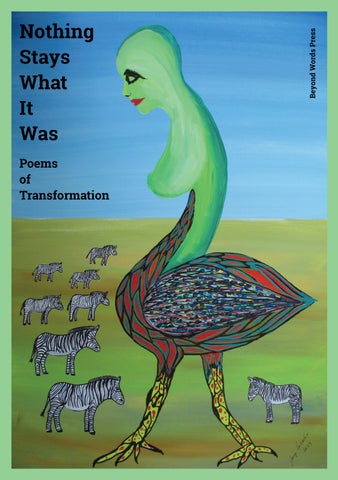
Nothing Stays What It Was A Beyond Words Press Poetry Anthology Editor: Gal Slonim Editorial Board: Kelly Sargent, K.D. Zwierz, Colby Flade, Noah Evan Wilson, Candi Martin, Brian "Brie" Sheridan, Roberta Laurie Cover art: Serge Lecomte, Trans-species. Serge was born in Belgium. He emigrated to Brooklyn in 1960. After graduating high school, he became a medic in the Air Force. He earned a Ph.D. from Vanderbilt University in Russian Literature, worked as a Green Beret language instructor and received a B.A. in Spanish Literature from the University of Alaska where he taught from 1978-1997. He built houses, worked as a pipefitter, orderly, landscaper, driller, bartender. He is also a published poet, novelist, playwright and artist. ISBN 978-3-948977-82-5 © Beyond Words Press, Berlin, Germany. Contributors retain all rights to their work. First printing, September 2026
Table of Contents White Mouse — Lina Buividavičiūtė ………………………..…...… 1 El Sueño de Bolívar — Gary Keenan …………………………….... 3 To Be Noticed (The Magnolia in May) — Patrick Trombly .….. 6 Evergreen — Sarwa Azeez …………...………………...……,…… 9 These Bones Will Share Their Riches — Dean K. Engel ………… 13 The Alchemy of Aging — Dean K. Engel …………………….…. 14 $6.57 for a dreamer’s dress — Divinity LaBelle ……..……..…… 15 Metamorphosis, After the tragedy of Karbala — Naqi Rizvi ……. 18 Metamorphosis Study #7 — Isabella Nesheiwat …………………. 21 Mane — E.G. Herbst ………………….…………..……………….… 25 Rolling, Upward — Elizabeth Seitel ……………...……….……… 27 Blood Angel — D. S. Chytiris …………………………………..… 29 Beyond Teeth — Michael F. Oliveros ………………………… 32 How to Carry Weight — Justin Delise …………………………….. 35 Little Match Girl — Ada Costea ………......………...……………… 37 The Touch Starved Girl — A. Benét ……….…………….....… 39 Pallor Mortis — Tommy Yao ……….…………………...….… 42 October, After — Ellis Ash ……………………………………..…. 45 Etch A Sketch at 65 — Lisa Delan ……………….……….………… 48 Rot Mother — Genevieve Beech .………….……………..………… 50 View From A Shelter — Karisma Rodriguez …………………….. 52
Pleroma — Bella Melardi ……………………………..…………….. 55 until the body finally needs them — Dustin Miller ……….……… 58 Sixty Seconds — Shannon Brady ……..………………….………… 61 Autopsy — John Harrison …………………………………………. 63 Poet and Wolf/Jiving in the Wild — Dick Altman ………………. 67 When Your Winter Eyes Turn from Mine — Dick Altman ……… 71 When Cow-Pen Daisies Escape Their Corral — Dick Altman … 75 After the Fall — Darien Daly ………………………………………. 77 Demolition — Teresa Boyer ………………………………………... 80 Antique Nervous System — KD Richardson ……………...……… 82 The Shed — Cameron Crews ……………………………………….. 84 Re-claiming — Alana Ezderman …………………………………… 89
White Mouse Lina Buividavičiūtė
Lina Buividavičiūtė was born on May 14, 1986. She is a poet and literary critic. Lina is author of two poetry books in the Lithuanian language. Her poetry is published in Matter, Masters and Proverse Poetry Prize anthologies, and the magazines: Drunk Monkeys, Beyond Words, The Dewdrop, The Limit Experience, Beyond Queer Words, Maudlin House, Cathexis Northwest Press, Poetry Online, Red Noise Collective, Sad Girls Diaries, as well as the Versopolis poetry platform. Upcoming publications include New Millennium Writings, Cathexis Northwest Press, Red Noise Collective, The Stardust Review and Beyond Words. An earlier version of White Mouse appeared in Beyond Words Magazine Issue 57. 1
At home, I am a white mouse—afraid of my own shadow, and that fear cuts through the main artery of my heart. But when I travel, I undergo a great transformation— my heart beats with courage, and the white mouse becomes a black cat. All my senses grow sharper and sharper—I discover curiosity and joy, playing with Ariadne's thread. I place my paws carefully and glide across the world, leaving my footprints behind: In Indonesia, while my husband and child cycle around, I decide to visit the magnificent temples of the Monkey Forest. Holding on to a local motorcyclist, I fly through the streets of Bali, drinking in everything around me: the scents of food markets and the panoramic views of rice terraces. I perform rituals in sacred springs— washing Western hair in Eastern waters, anointing a Western head with the most fragrant oils of the Orient. At home, I am burdened by other people's expectations— How should an ordinary Central European white mouse behave? When I travel, I become a black lucky cat, believing in a tenth life.
2
El Sueño de Bolívar Gary Keenan
Gary Keenan is a poet and musician living in Tunia, Cauca, a village of 1800 in the Colombian Andes. His poems have appeared in journals and anthologies in the US, Ireland, England, Denmark, Germany, India, and Australia since 1979. His book Rotary Devotion won the 2016 Poets Out Loud Award and is available from Fordham University Press. He has also composed and arranged music for 8 plays produced by Flux Theatre and On the Rocks Theater in New York City and Tunia Teatro in Colombia. 3
Un pueblo, un país One day, when no other stories are left to be told, Someone will ask about a dream grandmother had Or claimed to have heard from her grandmother, When the condor became a man for one year Serving the world by gathering the dead From their many sad plazas and bosques, From satin couches and dirt lanes, Moving through heaving choirs of soldiers, Families heaped on one another in vain, The wards of prayer and despair, waiting Patiently for the final gasp, never wanting it, Never fearing it because this was his chosen path To lift the body with such slow clarity And calm that sun and moon also slowed down As he carried each corpse to the mountains Where it could rest in clouds, on stone, And be the dream of another people. And of course, the man who was a condor Grew tired and sad. He was neither stone nor cloud. His heart was large and fierce, And his wings folded in deep reflection As if what he saw and felt were thought And thus part of him, a strife of spirit, a wound In the one, so full of the man he’d become That without pausing in his work he began to sing The folds his mind made, the little pleats In a dead girl’s skirt and capelet, a shock of black hair And a crow feather, the trout in the brook Where a man fell, a sky so blue that morning, 4
So unprepared for the descent into nothing The last of it made pure unpracticed grace, And the one who carries her to the mountain Is the mountain, just as she carries him Past the cloud cities to his own home, And he sang every hour and day on his path, A new song for each body, a new voice for each song, Bending to greet the dead with warm wings, And when his year of devotion ended The man became a condor once again and rose To airy vantage, leaving his beautiful voice And songs to the memory of the land, Because he was condor and knew death And hissing and squawking were song enough, And that is why the condor does not sing, While the forest and river and mountain sing always.
5
To Be Noticed (The Magnolia in May) Patrick Trombly
Patrick Trombly is a poet and fiction writer whose work has recently appeared in Connecticut River Review, 1922 Review, Relief, PHIL LIT Journal (contest shortlist), Four Tulips (contest finalist), Amethyst Review, The Argyle Literary Review, Die Leere Mitte and elsewhere. His latest short story is forthcoming in Résonance (U. Maine), and his latest poems are forthcoming in Roanoke Review and The Closed Eye Open. Patrick lives in New York City.
6
When I was born, I don’t exactly know. But I gained sight when the light went from white to yellow. And I was the center of it all. My radiant face was smooth as silk. My eyes were jewels. I had a scent, and it was sweet and spellbinding. But it was all replaced, unfairly, untimely, with this… thin, wrinkled skin. It came in ugly patches, all at once. I had not taken due notice of the small red spots that had appeared until they’d sprung to life – ugly life. Not that I could have stopped this. It’s just who I am: this ugliness. I tried to cling to the things that had made me beautiful. But they fell away so fast, and these… attributes of awkwardness took over. I cannot shake them. I wish the wind would take them. 7
After the rain, when I am black and bloated, I pretend that my patches are bats or birds of prey. But I can’t even scare people. I even envy the needled ones in their subtle-scented permanence. To think that they were once my background! I wait for the curtain of darkness to hide me, and them, and everything.
8
Evergreen Sarwa Azeez
Sarwa Azeez is a Kurdish poet, translator, and Fulbright scholar with an MA in English Literature from the University of Leicester and an MFA in Creative Writing from the University of Nebraska–Lincoln. She is a Pushcart Prize nominee whose debut poetry collection, Remote, was published in the UK by 4Word in 2019. Her work has appeared in Collateral Journal, the other side of hope, Genocide Studies and Prevention, Women Writing for a Change, and elsewhere, and is forthcoming in World Literature Today and ONE ART. Her writing seeks beauty in a war-torn world while exploring questions of identity and confronting gender inequality and violence in male-dominated communities.
9
There was something divine in the way the pine tree towered over our home, its tresses like a goddess of beauty cascading scent onto my metamorphosing body. On those summer days, I loved to disappear, overdose on the pinene haze and stacks of Dostoyevsky. I didn’t mind it— being invisible. Isn’t that what camouflage is for? To keep your freedom quiet until you’re ready to be? I would still sleep through terpenes and phenolics into dawn, when my father would call, Wake up—time for morning prayer. I’d pretend deaf until the fourth, the fifth call, then wake, murmuring to God in a language I didn’t know. I guess my father didn’t know it either. Maybe that’s why our prayers go unanswered, I complain to my mother.
10
Sometimes His answers arrive veiled, she responds. I look at my skin and read it as a sign, but of what? I would return to bed, try to explore my depths, beneath the evergreen canopy where dreams held their most beautiful secrets.
11
Two Poems Dean K. Engel
Dean K. Engel has written poetry, short stories, and a play that was staged by a small community theater group in Chicago. His writing has been selected for publishing by Secant Publishing, Oprelle Publications, Jade & Compass, Wingless Dreamer, Beyond Words Literary Magazine, and more. He’s an avid birder, gardener, and two-time cancer survivor whose writing often reflects his interest in the natural world, and our place in it.
12
These Bones Will Share Their Riches I sit outside the house where I dwell, an outsider looking in the sun warms my croaking throat like tea and honey cedar waxwings eat serviceberries rather than question their existence cardinals sing gospel chords of redemption, reverence and rain my marrow simmers in a cruciferous broth of corporeal wealth everything seems to fit but me, with nothing to do but wonder and later when the rains arrive upon the wings of giant crows the lichens luminesce brilliant jade and emerald all thirst quenched but mine that cannot be slaked something triggered the crocus bulbs to flower today never wondering the point of their own beauty, or limitations mycelium, moss, tree roots entwine by ancient rites their mystic green powers knitting energy to mass worms devoutly devour the land, improving it while robins and starlings pull them to feast upon someday I’ll join the complex and consecrated land and my bones will share their riches with the earth
13
The Alchemy of Aging the swallows return to Capistrano, I return to my bedroom, my parent’s house where I was born and resided but never truly lived. I dreamt of triumphs there, but the Rubicon I crossed was only the Tri-state tollway, endless false starts and dead-ends the front door still sticks, nothing was ever plumb or squared up there it seemed all mine now, familiar ghosts roaming the halls, I faintly hear them whisper things they never said when they were alive and would have made all the difference I grew there feeling unwelcome, like a weed in a slender crack in concrete stunted, but somehow growing, bending to the light, evolving prickly and impenetrable, solitary, certain of only my own woody strength. I kept safer from predation that way the shelf-load of books are there still, imaginary friends deftly deployed to populate my lonely island, while I longed to set sail, fulfill a destiny unknown but waited, and waited for a sign instead, until years were lost like water from a leaky hose now a sudden sensation that I may have (mis)played my part there, in this sour mash of hurt and history and perspective, slow-cooked now for years the relentless pressure and power seasoning and clarifying the potent reduction softening and seasoning me with powerful alchemy I am no longer the boy I was
14
$6.57 for a dreamer’s dress Divinity LaBelle
Divinity LaBelle is a fiery and intense writer with touches of air, water, and earth in her work. Taking inspiration from both the world around her as well as the whirlwind of emotions that resides within her, she includes glimpses of love, nature, nostalgia, and grief in each piece of work she creates. 15
Shedding my babydoll dress Hanging the floral linen out to sell I’m giving away old skin that scratches me in my sleep Old skin Written in flakes beneath loose stitches The skin was once smooth with talcum powder When she emptied her heart into another's cup Setting aside her own as she held out lean hands Offering whatever life she had left to grotesque figments of imagination They danced like angels in her diseased eyes They sipped the juice she fed them A taste of heaven with no barriers, they sucked her dry Leaving her shriveled as a prune Until the blue fabric pried around her wasted chest This is a dreamer’s dress It glides down my third rib so easily as she clutches on Am I desirable when I’m undressed? She begs… Take a mile of my minute gifts Tease me with inches of loneliness Torture me with asbestos cake, I inhale For I am quite afraid of being well You’ll never exhaust my ability to hibernate into a plum To bloom with a new silhouette sewn in to the vessels of my bitten skin I fold her into the dress for an ounce of spare change Sent off with a black kiss, a sacrifice of living Now I’m bare and divine
16
Now I’m bare and divine Now I’m bare and divine
17
Metamorphosis, After the tragedy of Karbala Naqi Rizvi
Naqi Rizvi is a Toronto-based poet whose writing often delves into topics such as faith, fatherhood, family, and identity. Being a software engineer by profession, Naqi writes poems for both humans and machines. More of his work can be found on his Instagram page @naqisqalam. 18
1 - Zainab Zainab saw nothing but closed lips cracked wide open, to smile, as the hooves of horses split open closed rib cages— these cocoons, crushed open. Each wound, each hoof paints a new colour of spring on these unfurling wings that split open and flutter to ascend towards the gardens of His grace. Glory be to God who makes nothing but beauty.
2 - Hurr How many cycles of stars and sun have spun for me to see that this skin— is not my skin. This clear mirror within his water, this reflection that reveals to me that nothing I see is me. Do I cross this river of indecision? On this side there is right and on this side, what is left—of me. I come to you with nothing—but repentance. Wrap me in the cocoon of your clemency and break open your embrace
19
only when you have fashioned me to be free.
3 - Zuhair The enchantment of this world came as soft threads of silk, so thin, so delicate that the illusion of breaking free kept the spinning unbroken until layer by layer this cocoon hardened, fossilizing what I could have been— in this amber of complacency. Now, the only way to be freed is for these swords, these spears to cut open what I have made of myself and break free what Hussain has made of me.
4 - Butterfly Effect Look how the rays of the sun lay their warm cheeks upon each wounded cocoon. Look how these wings of transformation flutter. Each wingbeat causes ripples across centuries; revolutions in the minds of man, storms in chests that never subside. Look how these plains of molten gold invite you to transform, to transcend yourself.
20
Metamorphosis Study #7 Isabella Nesheiwat
Isabella Nesheiwat (she/her) is a fiction and poetry writer based in Southern California. Her work has appeared in Seattle University’s Fragments, Fang & Flower, Rattle, Prosetrics, The Writing Fae, Carmina Magazine, and Beyond Words, with others forthcoming. Her debut, Turning & Turning, a hybrid collection of poetry and short/flash fiction Greek mythology retellings, was self-published in 2025. Isabella typically reimagines Greek mythology in her work, and writes about heartbreak, identity, and the strange work of being human.
21
[0] Baseline. Barometer steady. Subjects articulate a pressure behind the eyes: “like a horizon trying to stand up.”
[1] Observation: First transformation, Platform B. A commuter exhales. The cloud does not return. The train arrives carrying rain instead. We estimate her at 0.3 cumulus.
[2] Linguistic drift detected. Adjectives thin at high altitudes. Verbs take on moisture. to hold (v.): to condense around the smallest particle available. to love (v.): see: to hold.
[3] Control failure, shoreline. A man afraid of water steps into air and descends through it like a gull learning stairs. He does not drown. He redistributes.
22
[4] Side effects recorded: — pockets filled with wind. — the sound of thunder in bone. — new organs: a barometer cupped in the ribs; an isobar beneath the tongue. — calm that looks like absence and is not.
[5] A child asked if anyone has become a fog bank on purpose. No protocol exists for purpose. The fog itself replied, low: I did.
[6] Loss metrics invalid. When someone becomes weather, they do not go; they circulate. ( note: we keep misplacing the sky. )
[7] Intimacy study. Two subjects meet in a room without windows. They open their palms. Pressure changes. They step closer, not by distance but by humidity. 23
When their foreheads touch, the ceiling rains for hours.
[8] Ethical note. Umbrellas inadequate to the tenderness. Recommendation: roofs with deliberate holes.
[9] Terminal observation? There is no terminal. The storm is a family name. We adopt it. It adopts us.
[10] Final datum (entered incorrectly): “We were never solid.” Correction withheld. Accuracy achieved through error.
// End of Study.
24
Mane E.G. Herbst
E.G. Herbst is an abstract artist and writer that focuses on poetry and creative non-fiction. Her work has been published by Grande Dame Literary journal, Beyond Words, Humans of The World, Wingless Dreamer, Half and One, and Poet’s Choice. When not writing, E.G. enjoys illustration and painting in acrylic and watercolor. Herbst earned her Advanced Certificate in Creative Writing from University of Pennsylvania, M.S. at Northeastern University, M.P.S. at Pratt Institute, and B.S at Drexel University. E.G. lives in New Hope, Pennsylvania (U.S.) with her husband, two dogs, and one cat.
25
Four days left till lost.
Full, fine, wavy, wiry, thin, long, fair, dull, blue, reds, gray, tuft.
Lump. Cyst. Sick. Fret. Self. Loss.
Drug. Drip. Hair. Fuzz.
Gone. Mine.
26
Rolling, Upward Elizabeth Seitel
Elizabeth Seitel is an Emo mom in Philadelphia. 27
I screamed him out, tried to match the sound of pain with the force of my lungs. You grabbed me and I writhed, cow-eyed in the storm of my body. There remains some question on my mind, I’m asking it in telling this story, but no one eases it from me, says “Ok, ok, just put it down, nice and slow,” like I wish they would. The midwife paints the picture from the outside and places me in it, a sturdy study of a woman in labor. But you, you saw me rise and fall, crashing upward. More than anyone, you saw my pain and godlessly put on hands that de-electrified my limbs. Your stable eyes have seen me through, through my days, through every way I didn’t know how to be until I was. You say: it has happened. But my question has survived the violence of it all. I know that it is, and yet a persistent organ keeps churning inside: “Is this what it must take? How can this be how life begins? How can I tell myself this story?”
28
Blood Angel D. S. Chytiris
D. S. Chytiris is a Greek author based in the UK. His work explores intimacy, memory, and profound emotional truths, often using everyday objects and vivid imagery as anchors for his characters' experiences. 29
With your fluffy feathers soaked in blood, Scarlet colour glistening under the bright sun, Streams run carving your white mantle. You cannot fly, the cold blood a weight on your wings. You splashed the world red on your last attempt. Your muscles sore, exhausted, And you allow your wings to crawl upon the dirt road, As if two towering quills define the path with florid lines. You stumble over stones, scraping your palms and knees, Now where the earth feasted on your blood, Jasmines and gardenias and lilies sprout. The struggle of moving on tears down your garments, Each crawling step devours it. Your feet, my Angel, scarred like ploughed fields. You reach the village, and they find you blurry and almost naked. They take you in and wash you, Clean your wounds with olive oil and sweet wine. The village lords come to assist, Soak you in bleach and scrape you with brushes, But your wings fail the snow-white you once held. An aged woman combs your hair, Golden, and brown, and jet-black, and cinnamon red they seem, For everyone sees it differently. They bring two axes and mighty men to wield them. Four pull one wing, four the other, And two the axes hold. 30
They strike. A sound like iron on steel thundered. They strike again. They sever the wing from your shoulder and throw it into the fire to burn – fragrance fills the world. The second one follows. Weary, the men go to public houses for wine and appetizers. Women assume their work with files and scissors, Smooth down the roots of wings you once possessed. You hear them gossip of men and their big talents, and clothes and about those insufferable whores their mothers-in-law. They finish their task; now you're almost perfect. They finally decide you are a man, So, they dress you in the clothes for men, Right after greedily harassing your extraordinary body, all flushed and excited. They kick you out and exile you to the tavern, where you sit on a chair and down your first of many. It burns on the way down your throat, but you don’t know what it means to burn. Here men talk about women and the prostitute of the village whom everyone has tasted, and the slut of the town who eventually everyone will experience too. Welcome, gorgeous Angel – now you're human.
31
Beyond Teeth Michael F. Oliveros
Inspired by the ingenuity their ancestors exemplify, Michael Oliveros (they/them/theirs) roots themselves in the rich legacies of queer refusal and Philippine resilience. Having graduated from University of Illinois in Chicago in 2023, their love for their communities compelled them to obtain a bachelor’s degree in Global Asian Studies and Gender/ Women's Studies at UIC. As a storyteller, craftsman, and lover of myths, their work reckons with the apocalyptic, diving into the haunted trenches of memory to imagine alternative futures. Today, their work is expansive, interrogating subjects such as survivability, willpower, and community care. Their previous publications include The Revival 회복 Guidebook (KAN-WIN, 2024) and They, Singular (Amazon KDP, 2020). When not writing, you can find them running around Chicago, racing against the wind. 32
Bakunawa, the apocalyptic Bikolano dragon god of the eclipse, succeeds in his mission to swallow the moon. The moon has other plans. I HAD COME TO WAR WITH YOU. After all: They had killed all my lovers, Turned my family into smoke. What else could I do with my grief Except take away the thing they loved most in the world? But you were ready for me: Unarmed and outlined in the color of the sun. Smiling sweetly You crawled into my mouth, The corner of your crescent moon smile Giving way to mischief. You must have known That the cushion of my tongue was waiting for you Beyond my treacherous teeth. A secret: I would have done anything to keep you safe, Nestled beneath my hard palate. You could have lived there forever, Without lease or taxes or hail, But then you dared to explore further into the abyss of my esophagus, Stuck in my throat Like a vow. My stomach, A glowing lamp. The evidence of your trust, Emitting beyond the confines of my jaw, Mouth made beacon by the Light of the moon. 33
What a gift: To be transmuted By what I had wished to destroy I, god of endings, gave way to take the shape of a river bending beneath the gentle touch of your warm golden glow body breaking into particles reconciling as waves Every light, ceasing – shadows, remolding the world into a dark room where the memory of our love can develop. Picture this: the both of us, light-bodied and light-loved dancing atop the end of the world, cast in the color of dawn.
34
How to Carry Weight Justin Delise
Justin Delise is a writer based in Ohio whose work explores grief, memory, and the emotional structures that shape human experience. He lost his daughter, Ophelia, in 2025 after a long battle with congenital heart disease. His fiction and flash prose often engage with themes of loss, identity, and the tension between presence and absence. 35
Daddy, this is how you carry weight. It does not have to be loud, it can be silent. And it is never without pain. Even when I did not cry, I was afraid. The hardest part is allowing yourself to be seen. But when you saw me, You played with me, And you held me, And in return I held something. Not you. I held all of it. I carried it. And now that I am gone, You know how to carry weight too.
36
Little Match Girl Ada Costea
Ada Costea is a Romanian writer, 23, based in Amsterdam. Ada studied biomedical sciences, and her work combines body horror with vivid, anatomical imagery influenced by photography. 37
Crawl out of your skin, won’t you? Leave it dangling on a hanger, let it have the hollowness you crave. Then fold it into a little matchbox, won’t you? Sharp and slim to fit any pocket. Sit in the sun, won’t you? Let your meat parch, peel itself. Then lay it, strand after strand, into the box. Pinch a bone; ignite. Listen to the bone crack, won’t you? Watch its head turn black and bow. And when the flame is brightest, inhale its fume. Feel your parched tongue being swept away and into the hollow of your ribs to be cradled. Then blow out a ring of fume, just to leave something behind. Watch the flames feast on all that marrow, won’t you? Asphyxiate your unborn blood and drain the cremated cellular bodies into a blizzard crushing your ventricles of coal. At last, rip at the wiring of your sizzling eyeballs, won’t you? Let them burst into fireworks as you silently crawl into a pile of ash. You will ignite them all, rib by rib, tooth by tooth, empty yourself as they turn into burnt matches, for you to fill the paper-thin box that your body has finally become.
38
The Touch Starved Girl Goes to the Gynecologist A. Benét
A. Benét is a poet, educator, and MFA candidate at San Diego State University. Her poems have been nominated for the Best of the Net Anthology and have been published in Tahoma Literary Review, Foglifter Press, Honey Literary, and more. You can find her on social media @benetthewriter.
39
I’ve been thinking of old blood, the meaning of brown, what comes from the body. It’s been a month since I’ve bled. The nurse called before I thought the word repair. She said it has been too long since my last pap smear and my mom asks if I need her to come with me, but this is nothing new, I’m used to being full and rifled through, and because of this there are days I refuse to shower, opt instead, for digging myself into bed. It's easier to submit this way, but I wanted to make a good impression on the doctor. Shaved myself bald, lotioned and buttered my legs, wore all black. She smiled like she was happy to look inside me, and I was sure I had known her for years. She said it’s normal, brown spotting, probably stress, but to come see her again if one month turned into two. I’ve started drinking red raspberry tea to coat my uterus, chugging green detox powder every other day, my mouth filled with chalk, teeth-stained algae. At night, a meditation, some soft voice telling me to visualize myself filled with light, to overflow. I imagine, instead, my body an animal, greet myself with grunts and moans, proof I am still a beast—but her hand was so warm
40
on my thigh even though I braced for the chilled glove. I’m going to check for abnormalities. She parts my lips, her fingers searching but soft. Slight pressure and I became water pushing against glass, molding itself into a new shape. How you doing? and I remembered to breathe, swallow my sob. I wait for blood results and think the procedure a sort of intimacy, a tenderness I haven’t shown myself, one like a whisper you almost miss because it has already started walking away, sound blocked by mass, but somehow the breath tunnels through, a phantom you still feel years from now.
41
Pallor Mortis Tommy Yao
42
When I was five my mom lost her two front teeth on our marble floor, cackling away. Now she has two ivory veneers, big and white. I don't remember her losing them but I look for them still. When I was six my mom turned to snow. Her skin slid off on a coat rack and I saw the pale bones underneath. White bones, like marble. I didn't recognize her except for her veneers shining pale and white. On pale nights, white nights, I take an old rickety wind-up flashlight and walk down icy streets and paddle through frozen canals. I jog through creases in tombstones and crawl through stitches in coffins. I shine my frail light on those pale nights, those white nights; those frightful days and splintered nights. I hope I will see her teeth shining white next to her neatly folded skin, glowing with pale light. When I was seven I realized our house was made of brick. Pale bricks, hard brick, crumbling 43
bricks. I've never looked in there. I've lost the key and I don't know who to ask. It's hard to see anything now; but I'm certain I can see two white teeth smiling at me next to folded white skin.
44
October, After Ellis Ash
Ellis Ash is a musician and music educator in Connecticut, where she teaches in public schools and universities, and performs with regional theater and performance ensembles. Her creative work explores the intersections of music, poetry, and philosophical themes of gender and relationality.
45
The night was smooth as glass. We ate outdoors—new restaurant, string lights coiled above us, a drink that was fine but forgettable. Still, laughter came easily. Even the air felt generous, clear enough to believe I could be happy where I was. At the fair afterward, bodies moving like sparks in the dark, diesel, sugar, the sound of tin prizes. Then the bathroom— a slick white sink, the hum of generators outside. I pressed the pump: cheap, amber soap. Not thinking, just washing my hands. Then the smell hit— sharp and metallic, pennies and sunlight. Dial liquid gold. The same soap in the bathroom of my older cousin— the one who took what wasn’t his to take. Time folded; the fair dissolved. Hands under cold water, I tried to steady my breath, but you were already watching— tuned to the panic humming beneath my practiced calm. No one else ever heard it. Weeks later I tried to explain what it means to be seen that exactly. 46
I practiced confession, rehearsed calm, but the truth blurred on my tongue. I shouted, I’m not gay, I’m not in love with you. You—steady, unshaken— only said, Maybe you’re queer, and maybe that’s love. After that, everything tilted. At the brewery weeks later, your laugh cracked something open. Outside, night again— metal of the car door cold at my back, your mouth finding mine— a kiss like recognition, like breath after drowning. Desire finally belonging to me. Metamorphosis is never clean. Soap and fear. Touch and truth. The smell still lingers sometimes, but now it carries two meanings: what once undid me, and what remade me.
47
Etch A Sketch at 65 Lisa Delan
Lisa Delan’s poetry has received a Best of the Net and three Pushcart Prize nominations. Her work has been featured in Burningword Literary Journal, 3rd Wednesday Magazine, Milk Press, The Wild Umbrella, American Writers Review, Anthropocene Poetry Journal, Beyond Words Magazine, and Passengers Journal, among other publications. Lisa's poems have been set to music by noted composers, and she recently penned the libretto for a multi-media choral work which premiered in her adopted hometown of San Francisco, CA. When she is not writing you can find the soprano, an international performer who records for the Pentatone label, singing songs on texts by some of her favorite poets, and at lisadelan.com. 48
Permanence has never been my thing. Michelangelo could have roughed out his preliminary sketches for La Pietà on my skin and I’d have shaken them off. My first kid (it was always children in those days) was obsessed with shapes— triangles SHAKE circles SHAKE rectangles—and doodads wound like snakes in mazes. Some days her scribbling was so indecipherable I’d spend hours looking like a Rorschach test. Imagine my buzz when her big brother's buddy bagged me—slipped me into his backpack and right out of the house—and this kid had vision! I wore shadowy figures in capes SHAKE wizards with pointy hats SHAKE dragons with forked tongues SHAKE! Though we spent years together, to my dismay, we drifted apart. I’d spend all my time shelved like a goddam book while he got lost in endless D&D campaigns. Once in a while he'd pull me down to doodle—it was nice to be touched again—but the spark was gone. Finally, I was sprung from a cardboard box on some lady’s lawn and thrust into new hands for two dollars. I thought, well here we go again. But this time things were different. I was passed around at parties, had sleepovers at strangers’ houses, always moving on. In the early years I was a serial monogamist, but now I became a true relationship anarchist. I was in my glory. One day I was all shapes and alphabets. The next, Jackson Pollack. Pleinairism. Anatomically correct nudes. I balked at the stick figures of my past! But I wanted more. I began to ponder what it means to exist simultaneously outside and inside of the same form, to experience creation with no volition. I felt there was something else waiting just beyond my reach. With each SHAKE bringing me back to stasis, my longing grew. But for what? On some level I had always known—I was born of curiosity, and a desire hopelessly and helplessly imbedded in my blank slate—to be the artist, not the palette.
49
Rot Mother Genevieve Beech
Genevieve Beech edits Motherlore Magazine, a writing magazine on care, mothering, matrescence and mother nature, and works as a librarian and proofreader. She also runs the Motherlore remote writing residency for mother writers. Her poetry features in Mother Becoming (Demeter Press), Thicket Magazine (Fawn Press) and Literary Mama. She enjoys the many veins of bookmaking: designing, editing, writing, repairing, lending. IG: @genevieverosebeech @motherloremagazine 50
i am not a grave nor garden but compost: debris
curled moss
and dark
mist in mud
i am in slow death
many deaths wet rot
matter
cellular decay
shapeshifting
into something else before the light gets in
i wait
for the wind to winnow from me another
a curious
thing
grown from fertile
ground
i will be many
51
View from A Shelter Karisma Rodriguez
Karisma Rodriguez has been published in a New York Times bestselling anthology and a textbook on intercultural communication, as well as in various literary journals, and is the recipient of a poetry fellowship from the SF Writers Grotto. She holds a B.A. in English with a concentration in Creative Writing in Poetry from UCLA. Her website for poetry, modeling, and art is karismarodriguez.com. IG: @karisma.rodriguez, FB: @karismarodriguez21, TikTok: @Karisma_Rodriguez. 52
Packed with parts of families waiting For a space in communal showers, A mother speaks in fragments, Cursing the body of children clinging To her limbs, cradling only the baby. The curtains of falling water Do not hide our nakedness. I lather vigorously and contract My shoulders. My mother and brother absorb the water Slowly, unfazed, acting as if We were bathing at home. We walk to retrieve our towels, clothing, And the rest of our possessions We deemed valuable enough to save. A free meal awaits everyone In the dining hall where we will later Lay our heads down for the night. I take a tray of food and scrape the meat Off my plate. Circumstance will not Alter my right to choose What I eat. My mother rolls her eyes At me and divides it between My brother and herself. She looks smaller in this context, Inflection drained from her motherly orders. I am halfway through high school with a 4.0: My ticket to a future of glitter and gold, Or so she once told me.
53
Another girl my age sits a hundred feet away Looking down into her plate. Her mother Eats slowly, in silence. Broken promises Constricting both their throats. Gym cushions replace picnic tables And the auditorium is converted. We lie inches above the ground We would have averted earlier. Our blankets are illusions made of felt. The ceiling stands too far above To protect our collective warmth. My mother and brother move closer together. I walk towards the fogged window. Outside, a ragged man sleeps On heaving Hefty bags In the adjacent parking lot. He waited at the end of the line With the other men for hours. Tonight, we are lucky to be Women and children.
54
Pleroma Bella Melardi
Bella Melardi is a poet and author. She writes about the political and personal. She attends OCADU.
55
My heart is dwelling between the fullness of my hips. The sky swaddled the earth in gelatinous brutality. Something inside me is scraping the seams across my eye sockets. Shoving and pulling the curtain of bones veiling me in white satin. My bruised knees kissed by twilight. I kneel. I will die, face up to the sky, bare back, against fresh fertile soil. Let the air press its lips against the heat in me. Let the dirt taste my salty, sweaty back, the tears in my eyes, the rivers between my throat. Its teeth and tongue admiring everything human that is left of me.
56
I want to end where life begins.
57
until the body finally needs them Dustin Miller
Dustin Miller is a poet, fiction writer, essayist, and screenwriter based in Dallas. His work examines embodiment, memory, desire, and the systems that turn lived experience into evidence, property, or record. His writing appears or is forthcoming in Cathexis Northwest Press, Eunoia Review, Book of Matches, Audience Askew, The New Verse News, and Icebreakers Lit. 58
the signs were not signs at first—only annoyance, appetite arriving without permission, doors i kept noticing where there had been walls, the body making notes in a language i did not want to learn. i called it distraction, restlessness, bad timing, hunger. i called it anything but instruction, because instruction implies some part already knew where the exit was, and i was not ready to forgive the part that knew before me. so i ignored the door, then resented the door, then decorated around it—hung a picture nearby, placed a chair where no one could open anything without moving something important. still, the appetite kept returning: not command, not crisis, just pressure from a life trying to become livable. i wanted proof: a voice from elsewhere, a collapse large enough to make leaving look obedient. but the body does not always speak in ruin. sometimes it offers a handle and waits years for the hand to stop calling itself wrong. when i finally opened it, nothing thundered. no wall split. no one came down from the sky to say yes. only air, ordinary and waiting on the other side.
59
and the body stepped through without needing to prove it had been an exit all along.
60
Sixty Seconds Shannon Brady
Shannon Brady is a teacher and writer in California. She has written about dance, books, and observation. Some of her previous work was published in The New York Times Book Review and The Village Voice. One of her favorite things is walking with her sweet rescue pup Sage.
61
One morning I woke up clear, strong— a wife no longer waiting for the future to make sense of the present. How do I grieve what I no longer see? In its place, there is today. These 24 hours. Or less. Twelve. Two. Even one minute. This present minute. Sixty seconds never felt so luxurious, so full, like raindrops on a fallen leaf.
62
Autopsy John Harrison
John Harrison is a sixty-one-year-old writer of poetry who resides in the town of Hebden Bridge, England. He has just started creating and submitting work again after a forty-year gap. So far, he has had work accepted in the Pennsylvania Literary Journal. 63
The sudden arrhythmia, hot and sealed, its birthing pains Violent, murderous: a discord of impenetrable stutters The effect almost magical.
The bird-eyed surveyors of detachment – a sequence of incisions Under the polythene: looking for signs of fire in The cooling momentum.
A concise opera of glacial monologues: their source code Charting the distilled murk of emulsion And natural conspiracies.
A cascade of x-rays: filaments of bone and teeth interweave. The erratic trellis of blood; the peeled flesh with Its membranous facets.
The slow menace of the spilled brain, as spoors bloom - ambivalence becoming substance - transforming The shape of fear into a halo.
64
A cultivation of soups and roseate tissues - a feast for A tapestry of insects - swerving the illusion of Unexceptional domestic mythology.
65
Three Poems Dick Altman
Dick Altman writes in the high, thin, magical air of Santa Fe, NM, where, at 7,000 feet, reality and imagination often blur. He is published in Santa Fe Literary Review, American Journal of Poetry, riverSedge, Fredericksburg Literary Review, Foliate Oak, Blue Line, THE Magazine, Humana obscura, The Offbeat, Haunted Waters Press, Split Rock Review, The RavensPerch, Beyond Words, The New Verse News, Sky Island Journal, and others here and abroad. A poetry winner of Santa Fe New Mexico’s annual literary competition, he has in progress two collections of some 100 published poems. His work has been selected for the forthcoming first volume of The New Mexico Anthology of Poetry to be published by the New Mexico Museum Press. He has published over 300 poems across four continents.
66
Poet and Wolf/Jiving in the Wild Whenever I nuzzle your deep white and black fur, warm and beguiling, you, Montana, want only to nuzzle me back. For the next few moments, watching us play— as I try to mimic how you snap at butterfly wings of snowflakes— you’d think we both shared wolfen souls. Your eyes follow me, as I rise off one knee. What next, they seem to say. I raise my face to the sky. Ow—ouuuuu!, I sing, 67
in a voice that could be your twin. Not to be outdone, before I finish my first breath, you point your muzzle cloudward. And with eyes, sharp with glee, we launch into a two-part invention, worthy of Bach, rocking in the wild, neither of us will soon forget. I’m enchanted, as you, Montana, lead our chorus, redolent of a haunting cello, a long tremulous note, nature bequeathed, so it seems, to your breed
68
alone. My imagination lets go my human form. Our jam lofts me into realms of wolfdom. And I feel alchemized, however fleetingly, into one of your brethren. So strong the tonal magic emanating from our joyful instruments. A quick ruffle of fur, a kiss on face, and I leash you up, for a walk back to reality at forest’s edge, where your mistress, who raises a small tribe of you, awaits.
69
Though we won’t meet again, your wordless, indelible song into far corners of night, follows me yet.
70
When Your Winter Eyes Turn from Mine And prayer yields not a trace of pearlescence, nor a sip of cherished melt, nothing but vengeful turbulence, and nightmares of barren, clay-hard, dirt. Perhaps this is your answer to our fouling the heavens. Our Rocky Mountain summits, buried in thick icy gray haze, lost to sight, weeks on end. Ourselves, uncaring, corrupting, alone
71
to blame, so it seems, for your parched winter of spareness untamed. You, cloud angel of the Indian plains, your true self, responds, finally, to the reverential hearts of Puebloans, ancients here, who, for generations with chant and drum, worship at your timeless, sky bound altar of tears. Five mornings in a row, I rouse to your finger-light touch on my Anglo roof, arpeggios unheard for months.
72
Five nights in a row, you charm, with cyclonal fantasies, my sleep. The sixth morning, under luminous sun, what we call “a desert bloom” explodes into a concerto of purples, blues, and yellows. With these great waves of petalic brilliance comes another orchestral gift— the awakening, after a long winter’s night, of our beloved honey bearing instrumentalists, whose pollinating violins
73
serenade the countryside and flood my spirit with imaginings of spring’s long awaited song, whose blessed notes, thanks to your ageless forgiveness, to these ears, never ring dry.
74
When Cow-Pen Daisies Escape Their Corral Two years I wait for you to break out. Two years, as your seed hides from high desert’s flame. And then, as if the clouds finally yield to my pleadings, or so it seems, the monsoon strikes. Its intensity piercing earth’s barren crust, your sleeping heart. The shell that shielded your existence begins to soften. Your long dormant thirst awakens. The world of cells hums with life. Roots thread their way into soil’s moist riches. 75
I thrill to your exalted sunrise of bloom. As rivers of gold run rampant, across field and plain, mountain meadow, wooded lowlands.
Your long missed gold rush of flower, at summer’s end, seduces heart and eye. Autumn’s leaves, even their brilliance, pale before your petaled light.
76
After the Fall Darien Daly
Darien Daly is a California poet whose work explores memory, grief, survival, and the strange ways the natural world mirrors human experience. Birds, tides, illness, and inheritance frequently appear in her poetry. She is currently completing her first poetry manuscript. 77
Roots grounded firmly— a heart, a core, staying in place. Life bustling through its limbs. Seasons. Noon and night. Once green, now crisp orange to nothing— naked, vulnerable limbs left to shiver. Time picks and people peck. It does not have a preference. Skinned to the bone, the roots remain. Only then do they realize: 26 rings of life sit exposed in an open wound. Solitude husks over slowly.
78
Still, the stump remains.
79
Demolition Teresa Boyer
Teresa Boyer is the author of Burning, a poetry collection. She is currently working on both a memoir and a poetry collection. Teresa received her MFA from Hamline University and lives in Saint Paul, Minnesota. 80
I woke to the sounds of the old garage being ripped apart. I watched a section of wall be lifted, fall, layers uncovered—a shell constructed over the original. And I saw flaky green lead paint peel from the foundation, its shame exposed in the light of the current day. I felt relieved as my gullible error in judgement disappeared. I had chosen what appeared to be sound. I believed what I wanted it to be.
81
Antique Nervous System KD Richardson
KD Richardson is a writer and editor living in Chicago, Illinois. She writes about the changing digital landscape and the world, in pieces. 82
Original finish. Finish is yellowed like old packing tape left, but the system holds. Holds the flaw in the wrist: the blue vein wiggle like a hooked wire in a fish’s cheek. Cheek manufacturer is irrelevant, as this is the original wiring. Do not touch. Touch nothing. I am listing this early because the air has changed. Changed to fit their, but not my, liking. Liking an ice storm is a disgusting habit done by those whose shelves are stocked. Shelves in this place are empty. Empty, because the interior has been sold for parts. Parts is what they want, so when they open my chest they won’t steal what’s left of my lungs. Lungs breathe and my breath is long gone. Gone because they have fitted me with ethernet cables from 1995, made of the same material from which they used to make CDs, they become The Vena Cava, The Brachial, The Subclavian, surging with electrical charge. Electrical charges do not bite, they injure, because they transmit. Transmit a signal and wait. Wait for the consequences: I haven't brushed my hair in three days. Days lost. I have become a fire hazard.
83
The Shed Cameron Crews
Cameron Crews is a writer and producer based in New York City. She holds an MFA in Creative Writing from The New School, and her work explores memory, grief, and the strangeness of everyday life. By day she produces large-scale immersive exhibitions and museum experiences; by night she writes beside her cat.
84
Snake does not apologize for leaving what she wore. She splits along the tender mouth and presses toward the door Of stone and root and broken bark, the skull against the ground, Until the life it once contained goes thin without a sound. It is not pretty work to change. The skin must rip and strain. The body rubs itself half-raw To shed what can’t remain. The thought of this at thirty’s edge, The calendar loosens hold. The lunar animal shifting shape, The next decade unfolds. A quiet pull begins to move — A reckoning beneath The noise of meetings, subway stops, The rhythm of the teeth. No spectacle. No trumpets blown. No drama to be read. Just inventory taken up Between the quick and dead. The twenties were no meadowland Of idle bloom and sun. They were a field struck white with heat Where roots were cut and run. Death leaned close enough to see The color leave the skin.
85
Permanence, once taken whole, Turned provisional within. After enough successive storms The body does not sleep. It listens for the change in air Before the rafters creak. Early loss accelerates the clock. It sets the bones ahead. It gives a young girl gravity, Makes lightness something shed. One learns the weight of flowers. Learns the art of stance. How not to break in public view And the cruelty of chance. The selves who walked with open hands Thought life unrolled in arcs. They did not know how fault lines run Beneath the brightest parks. They thought they would just simply live, Fall hard and call it fate. They did not know how often love Would fall between two dates. Instead, they learned to smooth the face, To speak in measured breath, To pass the tissues, pour the wine, And joke about the death.
86
The woman forged in flame stands tall — Steady in her sight. What shaped her was not given small So neither is the life. Yet still, there is a wish for roots, That the burning ran less long. That those who stood inside that heat Had not been scorned so young. But snakes do not retrieve their skins From branches where they cling. That ghostly sheath of former shape Hangs light as anything. Snake leaves it to the air and wind. Snake lengthens. Snake proceeds. And now the horse stands waiting In a pasture rimmed with reeds. Not feral, but deliberate. Muscle under hide. Breath rising in the morning cold. A steadiness inside. The stable gate gives way with sound — A hinge, a measured groan. No audience. No anthem sung. Just field, immense, unknown.
87
Peace is not a life Unbruised by what is gone. It is continuity — The field still walked upon. Horse steps forward. Hoof to earth. The weight is cleanly borne. Not untouched But not undone. Not bitter But transformed. The field makes no assurances. No contract signed with sky. It offers distance. Offers air. Offers the chance to try. And though Horse knows how easily The world can split apart, Horse walks toward the open land With an undetachable heart.
88
Re-claiming Alana Ezderman
Alana Ezderman is a New York–based writer whose work explores healing, memory, and the transformation of generational trauma. After leaving a twenty-year corporate sales career, she reclaimed her voice through memoir, poetry, and playwriting. Drawing from the body as a site of wisdom and truth, her writing traces the ways we return to ourselves. She is completing her memoir, Sacred Addictions: From Inherited Grief to Authentic Light, and her play, Wait for Me, Darling, marks her debut in theatre.
89
Can you feel your body from the inside— the joy, the light, the pride? When I was a child, I had died— floating up, out of my body, hiding from life. Bumping the ceiling, watching my empty seashell below, left behind, dragged by undertow. No live wires moved through me, no excitement, no bees that sting— just an incomplete body. Until, at last, my seashell— stuck and cold— began to flutter and unfold. In its wake, my soul spooned me, coming home. I let it in to trace my skin
90
with feathers of light, dissolving dampness within. A single spark ignites— fingertips flare, fledgling embers recalling warmth once there. Sensations returning, a raucous beginning— the honor of feeling pain. Twisting it into aliveness. A breeze now walks the base of my spine, my heart dancing across my womb— and between body parts of re-membered time. Power surging, hydraulic flame, currents coursing through my veins, hands unfurling, arms raising… Re-claiming!
91