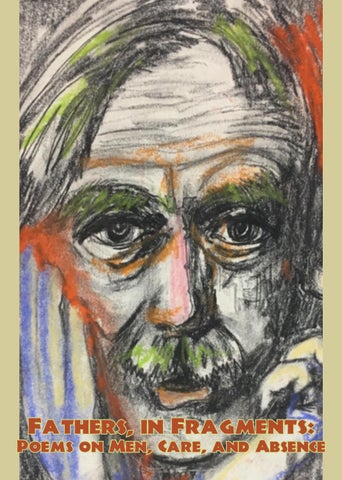
Fathers, in Fragments: Poems on Men, Care, and Absence A Beyond Words Anthology Editor: Gal Slonim Editorial Board: Kelly Sargent, K.D. Zwierz, Colby Flade, Noah Evan Wilson, Candi Martin, Brian "Brie" Sheridan, Roberta Laurie Cover art: Julie Christensen, Vieux Sage. Born and raised in Los Angeles, Julie attended Notre Dame Academy and Loyola Marymount University, majoring in French. Her studies in Paris at the Sorbonne were the foundation to her career of teaching the language and after a detour into interior design studies at UCLA, she returned to teaching with her focus on art, while working as a muralist and ceramic tile artist. Julie is married and currently lives in what she likes to think is the country (Thousand Oaks) with her devoted husband and two dogs. In her free time, Julie enjoys mindlessly scrolling through senseless reels online, reading French existential literature and napping. ISBN 978-3-948977-65-8
© Beyond Words Press, Berlin, Germany. Contributors retain all rights to their work. First printing, January 2026
Fathers, in Fragments
Table of Contents I. ORIGINS …….…………………………………………..……….… 1 Image — Lina Buividavičiūtė ………………………………...…...… 2 What Makes a Man — Livia Mangialardi ………..…………………4 My Father Never Said Too Much — Jane Saginaw ………...…...… 6 Fatherhood — Louise Ells ………………………………...……,…… 8 Mechanic — Jenna Rindo ………………………………...………… 10 Trains and Wagons — Lillie Morris …………………...……..…… 12 Sole to Soul — Sophie Richardson ………………..…………….… 17 Unnamed Moment — Thomas Williams ………..………………... 20 Roots — Joanne Harris Allred …………………..……………….… 22 Father — Jean Setrakian …...…...………………..……………….… 24 Genetics — Theta Pavis …………………………..…………...….… 27 Not a Hat Like That! — Carol Schoder ………..…….………….… 30 My Dad, the Rodeoist — Richard Stokes ……….……..……….… 34 A Lesson in Fractions — Yiskah Rosenfeld ……….……..………. 36 Sound Sleep — Nicola Geddes …………………………………….. 39 II. SHADOWS …………………..…………………..……….……… 41 Teach a Lesson — Deborah R. Majors ……...……………...……… 42 Portrait of a Tired Father — Lee Erickson ………...……………… 44 Father’s Day at the Dollar Tree — Kaycee Painter ………….....… 48 Boys Will Be Boys — Samantha Russell …………………...…...… 51 Visiting the Oracle at Palm Springs — Jessalyn Maguire ………. 54 Coinage — W. Tracy Dillon …...………………………...………… 56 How It Begins I — Kat Schmidt …….………………...…………… 58 Father Fled North — Nicholas Selig ……………………………… 60 The Last Time My Father Saw His Mother — Lores Denison ….. 62 My Dad Is Bald — Mingzi Yan …………………………….……… 64 Shorn and Prone — Valyntina Grenier …………………………… 68
Fatherless — Julia Gordon-Bramer …………………..…………… 70 Finding Orion — Hetta Jones ……………………………………… 72 Aspirin — Catherine Wald ………………………………………… 76 Snapshot — Abigail Diaz ……………...…………………………… 78 Murmuration — Brendan Straubel ………………………………… 80 The Day You Died — Anastasia DiFonzo ……………….………… 82 My Father’s Four Wives — Fran Abrams ………………….……… 84 My Dad Comes Back as a Sparrow — Jean C. Howard ……….… 87 III. GRACE ………………………………...………………………… 90 A Last Metamorphosis — Patrick ten Brink ………………………91 Epistle to a Dead Man — Gary Keenan ……………….…………… 94 My Father Lights a Candle… — Nate Hirschtick ………...… 96 A List of Things Passed On — Paloma Pierce …………………… 98 Father, Floating — Minghan Zou ………………………………….100 Of Modesty & Melody / The Reveal — Dick Altman …………. 103 My Father’s Light — Christine Rikkers ………………………… 108 Last Night My Father — Jeanne C Wilkinson …………………… 112 Father, I Dance Like You Renewed — George Naranjo ………… 114 A Visit to the Statue — Gloria Nixon-John ……………………..… 116 The Dead Bodies of 2012 — Tanya Moldovan …………………… 118 Melanzane — Elizabeth Walton ………………………………… 123 My dad’s dad regifted him…. — Kennedy Lorraine…………….. 125 Homecoming — Hayley Gronenthal …………………………… 128 When My Mood Deepens — Spencer Davis …………………...… 131 Thumbs Up — Marsha Howland …………………………………. 134 Seeing My Father After Three Years — Julia Smuts Louw ……. 137 The Lighthouse & The Rock — Michael Brain …………………. 140 Learning the Essentials — Yiskah Rosenfeld …………………..… 142 Copacetic — James Mulhern ……………………………………… 146
Introduction Fatherhood is at once intimate and distant, embodied and symbolic, deeply personal and culturally overdetermined. For some, a father is a daily presence. A voice in the next room, a steady hand, a model of care. For others, he exists as absence, silence, or memory. Even when fathers are loving and attentive, they are rarely simple. Even when they are gone, they remain. We learn early that a father is supposed to stand for something: protection, authority, provision, guidance. These expectations are often inherited rather than chosen, and shape how we see the men who raise us and how we understand ourselves in relation to them. When fathers meet these ideals, they may still feel unknowable. When they fall short, the disappointment can echo for years. Fatherhood, then, becomes less a role fulfilled than a tension lived with: between closeness and distance, strength and vulnerability, care and failure. This tension is why fathers so often appear in fragments. We remember them in gestures rather than speeches, in work rather than words, in moments that resist easy narration. A father may be recalled through the sound of keys at the door, the weight of a shared silence, the way love was shown indirectly or withheld. For many, the emotional vocabulary needed to speak of fathers arrives late, if at all. The poems in this collection approach fatherhood without sentimentality or judgment. They make room for fathers who stayed and fathers who left, for those who tried and those
who could not, for men who offered a stable emotional ground and those who did not know how. They also acknowledge that fatherhood is not only about fathers themselves, but about the lives shaped in relation to them. To write about fathers is to touch a sensitive place because it asks us to confront origin, authority, inheritance, and loss all at once. These poems do not seek to resolve those tensions. Instead, they dwell within them, listening closely, speaking carefully, and allowing complexity to remain intact. What emerges is not a single story of fatherhood, but many distinct voices, each offering a fragment toward understanding. Gal Slonim Editor
I. Origins
1
Image Lina Buividavičiūtė
Lina Buividavičiūtė was born on May 14, 1986. She is a poet and literary critic. Lina is author of two poetry books in the Lithuanian language. Her poetry is published in Matter, Masters and Proverse Poetry Prize anthologies, and the magazines: Drunk Monkeys, Beyond Words, The Dewdrop, The Limit Experience, Beyond Queer Words, Maudlin House, Cathexis Northwest Press, Poetry Online, Red Noise Collective, Sad Girls Diaries, as well as the Versopolis poetry platform. Upcoming publications include New Millennium Writings, Cathexis Northwest Press, Red Noise Collective, The Stardust Review and Beyond Words. 2
for my Father I am your image, the only one not deceived, though when we look in the mirrors, we see two tired people; identical smiles, identical curved feet and sometimes it seems we were equally wrong. How could it be otherwise, when, thanks to you, I was fed not only on mixtures — forest air, pine needle tea, snow sugar on my lips, and the celebration of the plum tree’s flowering. How could it be otherwise if I grew up with longing. Your imagination taught me to create the strangest creatures which welcomed me into a tribe of sad-faced forest people. It was my faith — our Kleboniškis forest, the wind and the smoke from the hare's huts, the sledge tracks, the summer heat, the softness of the moss. Hills as bald as your head. I am your image, the only one not fooled. My son is already looking in the mirror too — identical smiles, identical curved feet, the same forest — our only way to be reborn.
3
What Makes a Man Livia Mangialardi
Livia Mangialardi is a multimedia artist who lives and works in New Mexico. Her narratives somehow always link back to family. 4
Circa 1917
Circa 1974
Salvatore Fratesi was an alcoholic. In elementary school my father had a paper route. He made rounds before dawn, pedaling hard, leaving just enough time to shower before school. Every other Friday his wife, Mary, rode to town to pick up his check from the miller. On Saturdays he carried a small coin purse—those who couldn’t afford the paper traded household goods: a tin of biscuits, a worn out baseball mitt, a grocery sack of snap peas, a few spare tools. If she arrived after noon, Salvatore would cash the check at the bar. Once Mr. Harrison gave him a duck. Steering one-handed, bird tucked under his arm, he pedaled to the hardware store, spent all his money on chicken wire and zip ties. The Fratesi children wore holes in their Sunday shoes. With some spare wood and a kiddy pool, he erected an aviary in the front yard. He was so giddy watching the duck—didn’t hear the neighbor dog until it had already broken through the chicken wire. Mary saved up, paid the cobbler to mend their soles, shined the leather with bacon grease.
He beat the beast with a baseball bat, swinging with all his might. The dog didn’t let go until the bird’s neck went limp in its jaws.
5
My Father Never Said Too Much Jane Saginaw
Jane Saginaw earned a PhD in Literature from The University of Texas at Dallas in 2025. She is the author of a memoir, Because the World is Round (Deep Vellum Publications, 2022), that recounts a family trip around the world in 1970 with her mother who used a wheel-chair because of polio paralysis. Before returning to graduate school, Jane was a trial lawyer in Dallas with Baron & Budd. She served in the Clinton Administration as the Regional Administrator of the U.S. Environmental Protection Agency, Region Six. In 2006, she was awarded Trail Lawyer of the Year by Trial Lawyers for Public Justice for her environmental work. Jane’s undergraduate degree is in cultural geography from the University of California, Berkeley. Her law degree is from the University of Texas, Austin. In 2023 she earned a Masters in Humanities from the University of Texas, Dallas. Her essays and poetry have appeared in Athenaeum Review, Image Journal, D Magazine, and PB Daily.
6
His grin began in his blue eyes, delighting anyone who paid attention. But my father never said too much. He’d stand behind my mother and grip the handlebars, smiling as if her wheelchair were his crown and his words, superfluous. One time I almost asked him—outside the Blue Train’s window: a dazzle of zebras, some rare birds I couldn’t name. A landscape smooth and unobtrusive. But instead, I flipped open the paperback on my lap. I had not realized then, how like him I was: content to be contained.
7
Fatherhood Louise Ells
Louise Ells was born and raised in Northeastern Ontario, Canada, by parents who were both voracious readers. Two of her father’s cousins were writers, so she grew up believing “author” was an entirely reasonable career choice. Ha! After a circuitous path which included jobs as a Cordon Bleu chef and submarine co-pilot amongst others, she earned her PhD in Creative Writing and became a university teacher. Her short story collection, Notes Towards Recovery, was published in 2019, and her novel, Lies I Told My Sister, in 2024, both by Latitude 46 Publishing. She continues to be passionate about teaching, reading, writing, and travelling, and knows how very lucky she is to be able to call herself an author. 8
Mapped with thick blue rivers, and the contours of your life, your hands milked twelve cows twice daily and ploughed behind oxen. In winter you gave your gloves to your brother when he lost his. Did your lifeline predict survival? At seventeen, you left the farm for Imphal and Kohima. Eroded, you returned but shared few stories. (A single snapshot: holding rifle and cigarette in long, calloused fingers.) Then, with precise pencilled notes, you designed a fuel-channel, flawless still. Were your hands surprised at fifty to discover fatherhood? You taught me to hold a paddle, ski poles, and read my opponent’s cards. Together we navigated mountains, hand in hand. But you were alone that last day when, to save the fawn, you gripped the steering wheel, swerved.
9
Mechanic Jenna Rindo
Jenna Rindo worked for years as a pediatric RN at hospitals in Virginia, Florida and Wisconsin. She writes to better understand the complications of the human body, mind and spirit. A former ESL teacher, she now tutors and mentors refugee students. Her poems have been published in AJN, Calyx, Rhino, Tampa Review, JAMA, Third Wednesday, Natural Bridge and other journals. 10