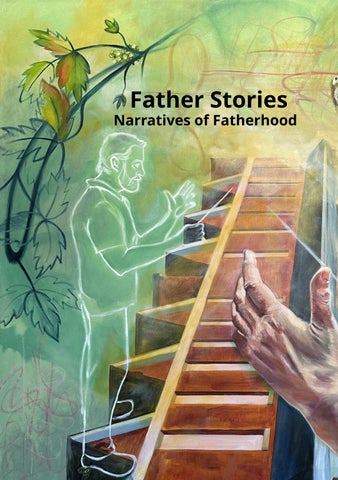
Father Stories: Narratives of Fatherhood A Beyond Words Anthology Editor: Gal Slonim Editorial Board: Kelly Sargent, K.D. Zwierz, Colby Flade, Noah Evan Wilson, Candi Martin, Brian "Brie" Sheridan, Roberta Laurie Cover art: Elizabeth Bizianes, Where Do We Go From Here. Elizabeth is a painter raised in Louisville, Kentucky, where she currently lives and works. Her work explores themes of time, family, and memory through figuration and the use of a high chroma color palette. She is an award-winning artist who has exhibited work in local and regional galleries and was awarded an Honorable Mention at the 2025 AXA Art Prize exhibition held at the New York Academy of Art in New York, NY. ISBN 978-3-948977-83-2 © Beyond Words Press, Berlin, Germany. Contributors retain all rights to their work. First printing, February 2026
Father Stories: Narratives of Fatherhood
Introduction Fatherhood is a story. We come to know our fathers not through a single moment, but through routines repeated across years, conversations well-remembered, and gestures whose meaning only becomes clear with time. Our relationships with father are shaped not only by what happens, but by what is remembered, misunderstood, or left unsaid. The works in this collection reflect the many ways fatherhood is lived. For some people, a father is a constant presence, a voice that shapes daily life. For others, a father exists in memory or in his absence. Even when fathers are attentive and loving, they can remain partially unknowable. Even when they are gone, their influence continues to shape the emotional landscape of those who remain. Fatherhood rarely exists as a fixed role. Instead, it unfolds across time, across shifting expectations, and across the distance between intention and impact. Cultural narratives often position fathers as providers, protectors, and authorities. They are perceived as figures meant to embody stability and certainty. Yet reality sometimes challenges these expectations. Many fathers move through the world carrying pressures they cannot articulate and vulnerabilities they were never taught to name. Fatherhood is many times an ongoing negotiation between strength and uncertainty, presence and emotional distance, love and limitation. Because of this complexity, fathers are often remembered through stories that begin in small, specific moments: a phrase repeated across decades, the sound of laughter from another room, the rituals that shaped ordinary days. The language needed to speak openly about fathers often arrives long after the relationships themselves have changed.
The pieces gathered here do not present a single version of fatherhood. They are about fathers who were present and fathers who were absent, those who tried and those who could not, relationships marked by stability, conflict, tenderness, or silence. Together, these narratives suggest that fatherhood is not only about fathers themselves, but about the lives shaped in response to them through imitation, resistance, longing, and memory. Gal Slonim Editor
Table of Contents I. PRESENCE .…………………………………………..……….… 1 West Texas Rain — J. D. Watson …………………………...…...… 2 Three Strangers to Thank as a Stay-Home Dad — Brian Goedde .. 6 Cinnarolls — John Dennis …………………………..………...…..… 11 The Honorable Dad — Steven Culhane ………………...……,…… 16 The Tape Recorder — Lynn Lipinski ..…………………...………… 20 First to Go — Brandon McNeice ……....………………...……..…… 27 Recital — Joseph Heiland …………………………..…………….… 31 The Gift of Time — Michele Colletti ….…………..………………... 33 Fragments — David Pizzurro …………………..……………….… 37 Breakfast Routine — J B Nicholson Hunt ………………….……… 43 II. STRAIN …………………..…………………..……….…………. 49 baba // father — Samira Ali ………….……...……………...……… 50 Disappearing — Eamon Murphy ………...………...……………… 53 The Bottom of the Escalator — Tim Sullivan ……………….....… 64 PlayPlaces — Sarah Padgett …………….…………………...…...… 70 Tyrants — Jonathan Daniel Gardner ………………………………. 75 Outside the Bar — Kimble Luu ...………………………...………… 86 Family Matters — Elizabeth Sundstrom ……………...…………… 90 What He Gave in Pieces — Sophie Baryalai ……………………… 94 The Hoarder — J.M.C. Kane …………………………………….. 102 Capital G — Drea Murphy …………………………….……… 105 III. RUPTURE ………………………………...…………………… 110 The Night Santa Killed My Father — Alex Flores …………… 111 Wretched Ecstasy — Jackson D. Smith ……………….………… 114 A Familiar Storm — Christine Nohealani Walsh ……………...… 116 Dad, After Death — Ivy Holgate Fife …………………………… 119 A Daughter’s Vigil — Isa A. Nyembo ….………………………… 124
One Final Pleasure — D’Anne Pientka …………………………. 129 After the Funeral — Maria Odessky Rosen ……………………… 134 IV. CONTINUANCE …………….…………...…………………… 138 Glass Alliums — Christine Choi ………………………………….. 139 The Weight of Quiet — Augustus Greenslade ………………….. 144 Memories of Wood and Stone — Bonnie Day ………………..….. 153 The Silent Compass — David Horn ………………..……………... 159 butter sugar toast (eulogy) — Christie Chiu ...………………..….. 165 Acceptance — Etya Vaserman Krichmar …...……..……………... 169 The Stranger in My Car — Lisa Braxton …....……..……………... 174 I Thought I Saw You Today — Robert Porter ………..…………... 178 Blue Exposure — Janine A. Willis …………...………..…………... 183 Is There Baseball in Heaven? — Susan P. Epstein ……………... 188 Glorious Mysteries — Edward Thomas-Herrera ………………... 193 Slingshot — Diane R. Wiener ……………………………………... 196 Ashes of the Big Man — Mari Prieto …………….………………... 203 Mutt — Candi Sary ……………………………….………………... 207
I. Presence
1
West Texas Rain J. D. Watson
J. D. Watson is an emerging author with a BS in Liberal Studies from Abilene Christian University. Watson was born in Charlotte, North Carolina and moved to Texas when he was eleven, but holds closely the wonder of tall trees and distant mountains and constantly features them in his writings. 2
James was driving slowly, carefully, not because of the heavy rain but because little Hope sat next to him. She was pushing herself up against the passenger door, trying to get a better view out the window. The view was obscured by a blur of water constantly moving across the glass; she turned to face the front and made a funny face at the wipers. They were making a strange, jumping rubber squawk with each movement. “Daddy, where do the birds go when it rains?” “Well, they have a few options. Some of them will go into birdhouses, like the ones that Mommy has at her house, sometimes they’ll hide under a car to stay dry, and sometimes they just have to hide in their trees.” “We should get a birdhouse. I want to help them stay safe.” “Yeah? Maybe we should build one when it stops raining.” “No! It’ll be too late, they won't need it then!” “Sweetie, it’s going to rain again, and besides, if we try to build it now, you’ll get soaked.” She scrunched her face up and looked up at the dark clouds, unsatisfied with that answer. James smiled and shook his head, “They’ll be okay, they’re used to the rain.” “That doesn’t mean they like it.” “What do you think birds like?” “Oh! They like big, green trees and bright, blue skies and fluffy, white clouds and gummy bears!” “Gummy bears!” “Of course, everyone likes gummy bears!” “Should we go get some gummy bears?” “Yeah!”
3
Convenience stores dotted the highway, lonely in the flat expanse. Rains like this were never good for them. The construction of the highway always elevated it above the surrounding land, and the rain poured off into whatever was below. The tiny store was built on an elevated concrete base, keeping it from the standing water, though a close look would reveal too many cracks for it to last much longer. James pulled into the empty parking lot and slowed the truck to a stop in half a foot of water. “You got your jacket on? Good, hang tight, I’ll come get you.” He opened the door and stepped down, feet immediately soaked, water pouring through the holes in his old boots. He moved around to the passenger side and opened the door. Hope laughed. “It’s so much rain!” James chuckled, reached up and took his cap off, setting it down on Hope’s head. She lifted her arms up and James picked her up and brought her close to his chest, protecting her from the sky. She was getting too big for this, but the water was cold and only one of them needed to get soaked. Inside was dry and warm and they were greeted by a kind-faced old man. He laughed as he rang up a bag of gummy bears, a bottle of apple juice, and a bottled coffee, “This is a dinner of champions.” James smiled, handed over a couple bills, and thanked him. He handed the items to Hope before picking her up again. When he sat her down in the passenger seat, she hugged the snacks with one arm and reached up with the other to hand the cap back. She tried to set it on his head as he had hers, but could not reach. James brought it the rest of the way and placed it over his dripping hair, “Thanks, honey.” When he got in on the other side, Hope had already set the bottles in the center cup holders and opened the bag of gummy bears. She handed a green one to James and he popped it in his mouth as he got back onto the highway. An hour later, they pulled onto their inclined driveway and Hope jumped out quickly, holding the half-full bag of gummy bears. Grabbing both 4
empty bottles in one hand, James got out as well and waited for Hope to come around the front before they headed inside. “I know it’s late, but I’m going to get dinner ready. Give me about thirty minutes.” Hope nodded and turned back towards the window in the front of the house, still holding the gummy bears. When James finished cooking, she was still watching intently through the window. “Dinner’s ready!” Hope turned excitedly and ran to wash her hands. James walked over to the window, curious what Hope had been so interested in. Underneath the truck, a bird was pecking at a small pile of colorful gummy bears. West Texas rain often turns into heavy storms. Pounding rain, bright lightning, and rolling thunder moved in with the darkness of the night. It was a night of flooding, cracking trees, and sudden fires. James was reading on the couch, under a blanket, when he heard light footsteps coming from Hope’s room. “The storm is really loud.” “It’s alright, come here.” Hope walked over quickly and climbed up into James’s lap; he wrapped the blanket around her and hugged her close. “Do you think the birds are scared, Dad?” “No, I think they are enjoying a feast of gummy bears.” Hope giggled at that.
5
Three Strangers to Thank as a Stay-Home Dad Brian Goedde
Brian Goedde has an MFA in Nonfiction Writing from the University of Iowa and is an Associate Professor of English at the Community College of Philadelphia. His personal essays have appeared in The New York Times, The Los Angeles Review of Books, and the Seattle Review, among other publications. 6
Our exchanges were so brief I can hardly recall their faces, but thinking of them is like re-opening the Father’s Day cards I have kept over the years: These moments nourished my stay-at-home fatherhood. I really should thank the strangers who made them. 1. That One Grocery Store Checkout Clerk “It’s nice to see the dad with the kids,” she said, handing me my sack of groceries. It was a weekday morning when my daughter was a few months old and my son had just turned three. Clearly, I was at home with them—or, more to the point, I was out with them, running errands for the home. “Oh,” I said. “Right.” I wasn’t sure how to respond. She didn’t say, “it’s nice to see that you are with your kids”—this wasn’t a personal comment. It was a social one. It’s true that there aren’t many fathers who, like me, spend most of their daytime hours with their children, though this is changing. A report from the Pew Research Center in 2023 shows that 18% of stay-at-home parents are dads—not a huge percentage, but up from 11% in 1989. We’re still far from gender equality when it comes to childcare, but it appears that we are moving in this direction. “I agree,” I should have said, as I hung my bag of groceries on the stroller handle. “And thanks. It’s nice to be the dad with the kids.” 2. The Mom with Sliced Red Peppers at the Playground It’s nice, but it hasn’t been easy—personally and socially. As an anomaly, I often feel isolated. One sunny day, for example, as I pushed my toddler son on the swings, I said something to the moms next to me about the weather, or naptime—some such topics of typical parenting conversation. They responded with polite affirmations, but the conversation stopped there. After I took my son over to the sandbox, however, another mom and child took our place at the swings, and soon they all erupted in joyous chatter.
7
I try to keep it in perspective: there is far worse exclusion in the world than what I’ve felt at the swings, especially exclusion of women by groups of men. That said, in my community of caregivers I find that I’m kept at a distance. Except on this one day: I was sitting on the bench at the sandbox, occasionally getting up at my son’s request to help load a dump truck, when a mom and her daughter sat down at the other end. I smiled at them—briefly. I wanted to convey friendliness without being forward. “Finally, a nice day.” She said it to her daughter, or to herself, but it was announced in my proximity in such a way that seemed to convey friendliness in return. It wasn’t said to me, exactly, so I only nodded—to myself, mostly. “Want a snack?” she continued. “Red peppers, your favorite. I think you like these because I ate them so much when you were in my tummy.” What’s this? I thought. Something about her pregnancy? Is this an invitation for mommy-small-talk? I tried to think of something to say in return. I could have mentioned my wife’s cravings when she was pregnant, but that’s a story about a vegetarian suddenly craving steak. Too weird? I could try to keep her comment going—oh really, what else did you eat?—but that seemed awkward. I thought of just saying, “I like red peppers too,” but I didn’t want her to feel like she should offer me some. By now I was overthinking it. I just gave them both another smile, and the smile was again returned. What I face as a male caregiver, I believe, is not a prejudice, nor is it an unwillingness. It’s a lack of protocol—on the part of both women and men. How do we joke around at the swings? How do we chit-chat at the sandbox? How do moms and dads who are strangers become friends? I want to thank this mom with the sliced red peppers for teaching me some protocol: talk to other parents by talking to your kids.
8
My misstep at the swings, in retrospect, was saying something directly to the moms next to me. Now, I don’t even look at the moms. I only talk to kids, and one day the unimaginable happened. My son and another boy in the YMCA Creative Movement class got along famously, we shared snack time in the lobby, and when it was time to go, his mom and I exchanged phone numbers. Our kids became fast friends, and so did we. 3. That One Dad in the Library Playroom I was in the kids’ room at the downtown public library, on another midmorning of staring blankly into the middle-distance with my daughter in view. She was about six months old and sitting up confidently. Another dad was with his son, who was a little older and crawling like a wind-up toy—in any direction, at top speed—and climbing whatever he crawled into. My daughter and I both watched in amazement. “He keeps you busy,” I said, as he pulled his son off of a chair. (I said it directly to him; with dads I don’t have to be so artful.) “All day long,” he said. He added that his wife worked full-time and he stayed at home. “It’s really isolating,” he said. “Let me give you my phone number,” I said. “That would be great,” he said. We got out our phones and the moment got awkward. I think we surprised each other—and ourselves—at being so forward in our first minute of conversation. We were still strangers. “OK,” he said, looking up, “What’s your name?” I gratefully hold this moment in my memory as an example of two things: 1) it is brave to admit isolation, struggle, and vulnerability, and 2) strangers offer a special opportunity to do so. A stranger can put you “on guard” because you don’t know whom you’re dealing with or what you’re getting yourself into. By virtue of this, however, you can also say what’s on your mind and in your heart; you can be unusually honest with strangers—and also tremendously kind, and expertly helpful. A stranger can also, instantly, become a friend and ally. 9
That One Dad in the Library Playroom, then—the stranger who decided not to be a stranger—is also me. It’s also brave to say, “You’re not alone.” So let me give myself a little pat on the back. Hey, I’m working hard here. I’m allowed.
10
Cinnarolls John Dennis
John Dennis, husband to Anna, father of Julia and grandfather of Noah, had a stroke ten years ago and lost the use of his right side. Once over the initial shock, he took writing courses at Malmö University. He was born in New York but has lived in Europe after being stationed there in the US Navy. 11
He took off the glasses so he could see. “I never learn,” he mumbled. The street was a river, a glassy black surface. Squinting out over the afternoon hustle and bustle, he thought, wet weather divides people. Drivers sprayed street-water on whatever got in the way and pedestrians avoided eye contact. The rain sounded like sizzling bacon despite the winter chill. That, and the steady stream of traffic, made it difficult to hear the voice coming from the left and three feet below. Not really listening, he heard, “...It ...cool …too.” Then, “Pappa!?” Looking down, he said, “Sorry, Pumpkin. What?” “Cursivey. It’s curvy. I learned to write my name… all curvy. Today.” She held out a paper with writing on it and then tilted her chin up while opening her mouth to catch raindrops. “Your name is Curvy? Show me at home. Let’s hurry. I’m about soaked.” “To the bone?” Grabbing her damp, mittened hand, he said, “Wet as a noodle, inside and out. I never learn. I keep my coat on while you get yours on and I start to sweat. Every time. Come on, Curvy!” They dashed along the sidewalk as quickly as her six-year-old legs allowed. The rain didn’t bother her. It never did. More than once, she and her BFF had taken street-showers in summer rain with shampoo. He thought about the ready-to-bake cinnamon-rolls in the oven. Her favorite. The apartment should already smell like a bakery.
12
Home: a first floor (bars on windows), one bedroom (hers), a kitchenette/ living room with a bed sofa. It wasn’t much. But, it was theirs. It was home. And, it was in the city plus close to her school. He drew a sigh of relief as they turned onto their street. Almost there. It felt a bit like an alley with only four buildings on either side. A dead end. He had left a lit candle in the window that faced the street. The CinnaSignal. He said, “Look up at the kitchen, Jules.” She stopped, looked across the street and shouted, “Cinnarolls!” She was a happy kid. He didn’t know why he’d gotten so lucky. He didn’t even like kids. He loved her. He had stopped missing her mother. She would never have let him leave a candle lit in the window like that or leave the oven on. He heard an echo of her voice, “Will you never learn? Grow up! Think. Think! Think of the consequences.” He then felt a hand launch towards the street. He held the empty mitten and then came a giggly, “Last one to the stoop is a rotten egg!” It happened so fast. She had been right there beside him. Then she was running across the street. There was a dull thud. The thud of a six-year-old’s body bouncing off the grille of a pickup. He saw her turn mid-air towards the asphalt. Her red and white, polka dot beanie flew off her dirty blonde curls. She made no sound when she landed face up. The back of her head bounced off the concrete, twice. He ran to her, slipped and fell, then scrambled to her side. The truck rolled a little closer, then stopped. Scared to move her, he desperately tried to find a pulse or breath. Anything. His own breathing was so heavy it formed a white cloud above her body. Then he saw a dark shadow spreading from under her head and heard wailing. It was loud and seemed distant. It wasn’t. In disbelief, he looked up at the grill of the car. Its lights blinded him. From his knees, he stared towards the dark windshield but could see no 13
driver. He did see a rusty hood and water being thrown from the passenger side wiper into the darkness. He cried, “Help! Help me!” The engine revved. Then he bent over and used his body to shield hers. The car lurched forward once, twice. Then stopped. He could have kissed the bumper. In frustration he urged his daughter, “Julia, honey, it’s OK. Julia, honey, wake up.” The headlights, like spotlights at the theater, bathed the two bodies creating long shadows. He didn’t see but felt the truck jerk back. He glanced up quickly, license plate, he thought, and before being blinded, his eyes fastened on a worn bumper sticker: We Aim to Please. Then, the light began to dissipate as the truck backed slowly away from the scene. Its speed increased. The faster it moved, the more it swerved. It scraped and tore at the sides of the parked cars in its way. Rolling back and into the T-shaped intersection and miraculously missed hitting any of the rush hour traffic. Fortunately, for an elderly woman with a toy poodle, the pick-up missed the pair when it rolled up onto the sidewalk. The tiny woman frowned and then comforted her frightened dog. All traffic stopped briefly. Then, the pick-up signaled right and disappeared into the oncoming night. He sat there, drenched in the street, rocking her small frame as if movement might undo something. Anything. A siren sounded faintly in the distance, not louder than his thought but softer than her silence. A man’s voice shouted, “Don’t move her! I called 911! I saw the whole thing”. But he didn’t hear the man, he heard that echoing voice, screaming now, “You never learn! You never learn! You never learn!” “I.. never…learn,” he whispered and pressed his forehead to hers. Time stood still. 14
The street filled with lights, the siren stopped, boots splashed. A paramedic knelt, gentle hands replacing his. When they lifted her, the paper she was holding slipped from her one mittened hand and landed in a puddle. Her name, written with careful loops, began to blur and run.
15
The Honorable Dad Steven Culhane
Steven Culhane is a freelance writer usually focusing on sports topics. Married with 3 kids. 16