Table of Contents Logan Anthony — Pronouns
1
Jessica Sampley — Realization After Watching Dirty Dancing…
4
Tim Gray — Woodland Drive
6
Oleg Olizev — The Night I Met Ingmar
8
G.M. Rowbotham — Chilli con Carne
16
Georgia Mitchell — Ladies' Luncheon
30
Aurélia Gervasoni — Growing Old Alone
34
Madeline Hawkins — Nana's Registry
38
C.P. Nield — Men's Changing Room, Friday Night
41
Shelley Ettinger — When I Say I Knew Marsha Johnson
43
J.M. Brandt — Ode to the Body
46
Callen S. Sor — The Latecomer
48
Jaden Hansen — Visceral
54
Riah — Bright Red Lipstick
59
Kev Perkins — Garage Space
62
Emily Pfoutz — slow dancing to hardcore music
68
Chris Carroll — My Twinkdeath
77
Sunny Lately —Queer Self Portrait
81
Emma Niro — J is for Judas with Jugs
83
Adena M’lynn Harmon — Support Person
88
sandee woodside — upon waking: a glosa
90
Antoni Josephine — Digestible Dichotomies
93
Kat Kline — It’s not you, it’s me
97
Achy Obejas — Garden
99
Clayton H Eccard — A Night With No Names
101
Rob Raisch — The Underway
114
Sarah Sorensen — Welcome Back to Demon Forest
120
E.A. Banks — Tidal
125
Kathleen Bednarek — Poem for Friend Request
132
Karisma Rodriguez — Aside From Hetero
134
Barb Passato — Pig/fig
137
Dean Farell Bruggeman — 65
139
Lucy Pierson — Home Is Not a Place
142
Gemma Flora Ortwerth — The Weather in Our House
144
Beau RaRa — The Carpenter's Child
148
Marsha Howland —I Fell in Love with You
150
Kevin Joseph Reigle — Orange Wine and Massilia
153
Jacqueline Tanzella — Bands of light across skin
160
Rebekah Tobin— Flare
163
Ari Cottingham — Binary
165
Jessica Udeh — Our Sickness
167
James Cook — On my Tiptoes
173
Anika Zaman — Orchids
175
Augustus Owlyce — Underneath It All
177
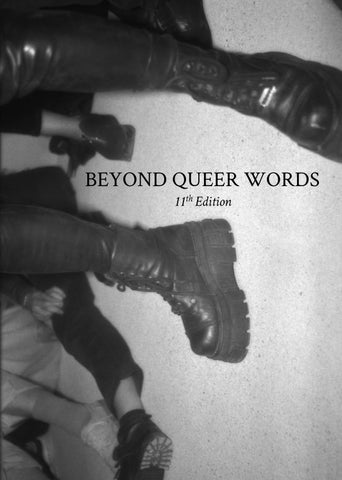
Introduction Welcome to the eleventh edition of Beyond Queer Words. The pieces gathered here resist easy summaries. Within these pages are stories of first love and lasting love, friendship and family, transition and self-discovery, grief and healing, longing and joy. Some contributors write about moments that changed their lives forever. Others focus on experiences so small they might otherwise pass unnoticed: a conversation, a memory, a glance, a touch, a name written on a form. Taken together, these works remind us that there is no singular queer experience. There never has been. What emerges from this collection is not a single narrative but a chorus of voices. Some speak with confidence, others with uncertainty. Some celebrate, some mourn, some question, and some remember. Yet each writer offers a perspective that expands our understanding of what it means to move through the world as ourselves. Again and again, these contributors return to the complicated terrain of identity, belonging, memory, desire, and transformation. They explore the ways we are shaped by family, friendship, community, and loss. They ask what we carry forward from earlier versions of ourselves and what we leave behind. They examine both the freedom and the vulnerability that come with being truly seen. The title Beyond Queer Words suggests that language is only part of the story. Words matter. They help us name ourselves, tell our stories, and find one another. Yet many of life's most significant experiences exist partly beyond language: the feeling of recognition, the ache of absence, the certainty of
love, the slow process of becoming. The works collected here inhabit that space between what can be said and what can only be felt. As editor, I have been struck not only by the quality of the writing but by its breadth. The contributors to this edition come from different backgrounds, generations, and experiences. Their voices are distinct, sometimes even contradictory, and that diversity is one of the anthology's greatest strengths. Thank you to every writer who entrusted us with their work, and to every reader who has chosen to spend time with these pages. We hope you encounter something here that resonates with your own experience, challenges your assumptions, or simply reminds you of the richness and complexity of human lives. Gal Slonim Editor
Pronouns Logan Anthony
Logan Anthony is a genderqueer writer and artist from Indiana with a BA in Creative Writing & English. They work as a greenhouse and grounds keeper—whether it’s words or plants, Anthony aims to bring things to life. You can read more in Thin Air Magazine, Hare’s Paw Literary Journal, The Madison Review, or at www.thewritinglog.com. 1
call me whatever makes me easiest to stomach. call me whatever makes you most comfortable. the words don’t matter to me when i know your language does nothing to change me, define me, or assign me a role. my gender is a stone i found while walking along the beach, a more weathered shape each time it finds land after riding in on a wave. shifting under scrutiny and held at each different angle in the sunlight. call me what you find familiar. what you were taught to recognize in and out of the light. perception is a lens twisted narrower and narrower until all that can be seen is what the viewer knows how to categorize. my gender is a jacket i shed after i’ve gotten comfortable in the party. it’s the pillar i step around to respond. the belt that holds my pants on my waist, the hand that shakes in mine, reluctant and clammy and not quite used to any kind of weather. an assumption is not a gender but most days it may as well be. the eyes that look are heavy with expectation. the voice that calls aims with definition. the finger that points and quakes in the face of the unknown, and i, the face of the unknown, offer only a sharp and gleaming smile that glints like a beacon out of shifting shadow. look to the light to see what’s there, or what isn’t. remember every definition built of what’s missing rattles with emptiness. in every pair of eyes i find a new way of being defined. it isn’t a matter of who or what or permanence or accuracy.
2
it’s a matter of vision and how quickly it blurs, how easily a speck of dust in the cornea can damage a full worldview. how fast the image of a dream disappears behind the view of what’s flesh and blood, warm and moving, just ahead and out of reach. unless.
3
Realization After Watching Dirty Dancing in Memory of… Jessica Sampley
Jessica Sampley is the author of Tuscaloosa to Tupelo (Main Street Rag Publishers, 2007), and her poems have also appeared in Birmingham Arts Journal, Kakalak, Oberon Poetry, The Dead Mule, and Saints and Sinners Poetry Anthology. Jessica grew up on the beautiful Smith Lake in Arley, Alabama, and she now lives in an awesome old boarding house built in 1937 in Bon Secour, Alabama, with her lovely wife, Malinda. Jessica currently serves as the Academies and Career Tech Director at Gulf Shores City Schools, and she has spent her career striving to create amazing opportunities and safe spaces for students in Alabama. 4
Patrick Swayze died today, and I finally stopped shaming that eleven-year-old girl inside of me. We watched Johnny dance dirty with Baby at Amy’s twelfth birthday, when someone pushed her off the rickety front porch, and I took the dare to flash my young C-cups at the passing cars. And hands soon began to roam over and under Guess t-shirts and tight-rolled jeans, but still I felt nothing, except the feeling I should feel something that would make me want to sway my hips and break out into I’ve had the time of my life and I owe it all to you-oo-oo. And I wrote poems of heartbreak and love and teenage desire because I thought I was born with a broken heart. Why didn’t it occur to me that when I watched Johnny running his fingers down Baby’s side, I wanted those fingers to be mine— fingertips that skim delicate flesh unabashedly, wielding the power to calm her nerves then bring everyone together for a rebellious, triumphant dance in the end?
5
Woodland Drive Tim Gray
Tim Gray explores missed connections via memoir, personal essay, short story forms, and verse. His fiction has appeared in Midwest Prairie Review and birdsthumb. Tim Gray, a manuscript editor, grew up in small-town Wisconsin and lives in Chicago with his same-sex spouse. 6
Two streets away, three brothers in the cramped bedroom of a crackerbox house. The youngest my host friends of convenience in the same grade for a board game on the corner bed. The oldest, a football player at the end of high school, a grownup in my eyes drove a red and white subcompact and called me young man. He walked into the room haloed by age and wisdom, interrupting a roll of the dice to change clothes near my right shoulder. As he stepped out of a pair of underwear, his plump stem fell into light brown tight curls. A glimpse of power, a nexus beyond name except don’t stare, don’t stare, don’t stare.
7
The Night I Met Ingmar Oleg Olizev
Oleg Olizev is a Manhattan-based writer, poet, and artist whose work explores the intersections of body, memory, and philosophy. His writing has appeared in Panorama: The Journal of Travel, Place, and Nature, BULL: Men’s Fiction, Beyond Queer Words, Cathexis Northwest Press, OFIC Magazine, Stone of Madness Press, Night Picnic, Audience Askew, The Argyle Literary Magazine, Untenured, Neon Origami, and Half and One, with forthcoming work in Fjords Review and Thirteen Bridges Review.
8
It was 1999. I met Ingmar in a gay bar. He couldn’t have been more than twenty-two. I’d first learned about the place by accident. One evening, walking down 47th Street with a friend, I noticed a sign with a soft glow and a tarnished brass frame. “Oh,” I said, “look—a bar. We could go in, have a drink or two.” My friend stopped short, and something in his face shifted. “Oh no. Absolutely not. It’s a terrible place. Don’t even think about going in. Full of dangerous, disgusting people.” It wasn’t just a warning; it was almost panic. We kept walking, but I remembered the way he said don’t even think about it, and the tremor in his fingers as he adjusted his scarf. A week later, I was already there. Curiosity is a slow poison, but it never fails. I stepped inside as if into someone else’s apartment and ordered an Old Fashioned for myself. I drank it slowly, taking in the room. I knew it was a hustler bar. The word “hustler” alone thrilled me. I imagined lean, confident men, polished like runway models. The reality was different. There were hardly any young men, and those who were didn’t look… appealing. Muffin tops spilling from too-short T-shirts, soft bellies, sloppy gaits. People actually pay for this? I thought. Old men lined the bar, speaking in low voices. One stared into his glass; another worried the edge of a paper napkin. But the bar surprised me in another way. There was no pounding, manic music driving you to the street after ten minutes, only soft classical pieces alternating with light jazz. 9
Lamps with frosted shades cast a gentle half-light; dark wood tabletops glowed amber. The air smelled of citrus, musk, cocktails, and old wood. It was a place you could sit for hours. You could talk—really talk—without shouting. I was glad I’d found it. And it was that evening, in that warm, slowed-down quiet, that I first saw Ingmar. The door swung open, letting in a rush of cold evening air. He moved as if walking into his own home. Medium height, lean, with handsome, boyish features, he drew the eye at once. Large blue eyes under sharp, predatory brows carried something lazy and dangerous. He stood out, not only for the youthful muscle of his torso and the pale clarity of his skin, but for that blend of brazen European elegance and faint, mocking arrogance that deepened the intrigue. In the half-light, he was a flash of brightness; everything around him kept moving, yet it all seemed to adjust to his presence. When we were introduced, he called himself Ingmar from Estonia, a name that stuck. Like many attractive Russian men, he knew exactly what he was worth but didn’t overestimate it. Back in Russia, he had a type: “gothic boys”—skinny, wide-eyed, no older than himself. In America, he added African Americans and Latinos, with whom he would do anything and anywhere, without hesitation. With his two-hundred-dollar clients, it was different. He’d simply undress and suck his own cock. That alone was a 10
sensation. Rarely, and only with the especially insistent, would he let them suck him, for an extra fee. But for most, it was enough: the height of the AIDS crisis made many avoid close contact. His greatest weapon was his exoticism. Soviet boys were rare in New York, young white hustlers rarer still, especially those willing to flaunt such a skill. Deals closed fast; he’d leave with a john for a hotel. The bar was always full of tourists and businessmen ready to pay for a rarity. I sat with the dregs of my drink, unable to look away. This wasn’t just a hustler—it was an event. I watched him walk to the bar, realizing I’d stopped blinking. Each step caught the light differently: the curve of a collarbone, the clean line of his jaw, the faint gleam of skin as if he’d just stepped from the shower. He glanced at the bottles and said something low to the bartender, his voice deep, almost lazy, with a faint rasp. All the while, he ignored the stares aimed at him. I felt like an audience member in a theater where the play was staged for one actor alone. Even the music seemed tuned to his tempo. I took a sip, but the whiskey tasted flat. I wanted something else, sharp as an electric jolt, something only he could give. He got his drink and scanned the room, as if judging people by something deeper than their faces. Then his gaze touched me for barely a fraction of a second, but it felt like a sharp hook. I couldn’t tell if he’d recognized me as Russian or just marked me as an option. 11
I pretended to be distracted, but kept him in the corner of my eye. After a couple of minutes, he headed to the far corner, walking with that exact rhythm that makes you wait for what comes next. He sat at a small table, an elbow over the chair back, legs stretched out. I realized I’d been watching him for half an hour. Inside me was a mix of curiosity, a flicker of fear, and that impatience you feel before diving into cold water. I got up and walked over. Halfway there, he looked straight at me and arched one brow. I took it as an invitation. “Mind if I?” I asked, reaching for the chair. “Sit,” he said, short, without a smile. I sat, trying to keep my back straight, though my head was buzzing from his nearness. “You come here often?” “Enough,” he said. “You?” “First time.” He narrowed his eyes, as if trying to figure out why I was really there. And that’s when I understood that in this game, words weren’t the point. The real conversation was in glances, pauses, and barely perceptible movements. Ingmar avoided New Yorkers. They rarely paid more than a hundred and, as he put it, “expected the whole fairy tale for their pennies.” Too much trouble. Better to steer clear.
12
In the late nineties, New York was awash with Japanese and Hong Kong businessmen. They came with thick wallets and tossed money like it burned their hands. Ingmar raised his rate for them—at least a hundred more. Some nights he’d clear a thousand, and if he got lucky with small-town tourists, fifteen hundred. “The less you share your body, the more you’re worth,” he liked to say. And it rang true. Once he told me, “When I left the Union, a Moscow acquaintance gave me this advice: Remember this for the rest of your life—you’re worth exactly what you think you’re worth. He meant it figuratively, but if he knew how literally I’d take his words…” “So you’re not a hustler, you’re an escort,” I said. “No,” he cut me off, “I’m a prostitute. A hustler. A whore. I like those ‘lofty’ titles. You know what an interesting profession this is? I get paid for something that always stays with me. Most of the time, I just suck my own cock. And if you only knew how much they value it when I let them touch me. Not everyone’s born beautiful. Look around—who would fall in love with these guys? Even in a famine year, nobody would want to touch them. But they’re still people, and they still want warmth. Every one of them needs an embrace, even if it’s paid for. Everyone needs the heat of another body. Everyone wants to be heard, to be understood. And who else will give them that? We work as psychologists here, too. There’s no more humane job than being a prostitute. Except maybe a nurse… or a male nurse.” “What about doctors?” I asked.
13
“Oh, God,” he rolled his eyes, “only in America are doctors put on a pedestal. Pure provincial naïveté. Here, people become doctors for the money. Back in the Union, a doctor’s salary was the same as a schoolteacher’s, and getting into medical school meant competing against twenty people for every spot. People went into it as a calling. Here? Here, every other doctor’s a grabber, counting dollars faster than they make a diagnosis. How can you trust someone who makes millions a year? You think they care about you, the patient? They don’t give a damn. And if there’s any profession crawling with psychopaths, it’s medicine. They work for their own ambitions, each with their own enormous cemetery. On that point, the Union and America are neck and neck.” “About the psychopaths—that’s a fact,” I said. He smirked and went on. “When I first came to the States, I needed a dentist. One of my johns recommended a guy on Park Avenue. Respectable neighborhood, respectable prices. I went to him faithfully, paid a fortune, thinking it was normal to replace fillings every three months. Then my current dentist in New Haven looked at what this so-called specialist had done to my front tooth… and laughed for a long time. Now you’d never guess it was ever chipped. That’s what I call work. But the first one, the Park Avenue guy—I still remember his name—Doctor Tisch. A moral bankrupt, not a doctor. The only real professional I’ve ever had in my life is my current dentist.” I quickly realized Ingmar wasn’t just another guy from the bar—he was a walking archive of stories, sharp observations, and paradoxical ideas. He spoke as if every word fell neatly into a place already prepared for it. His tone was measured but 14
alive, and even his harshest judgments didn’t come off as aggression, but as confident knowledge of his subject. I caught myself firing off questions one after another, like I wasn’t in a bar at all, but at an impromptu interview with a subject I had to capture before he vanished. He answered readily, sometimes even ahead of my questions, as if he could read my mind. His stories moved easily between memories of his Soviet childhood and reflections on the psychology of wealthy clients from Hong Kong and small-town America; between the minutiae of immigrant life and scathing portraits of American manners. He could jump without warning from Soviet medicine to how to choose a suit that makes you look more expensive than you are; from arguments about the nature of true friendship to the anatomical subtleties of autofellatio, saying the word as casually as “morning coffee.” It struck me that all of it was ready-made pages, living material for a novel. People like this you don’t invent; you meet them. And if you’re lucky, you manage to write them down. Ingmar was exactly that kind of find, a gift to a writer, tearing you between wanting to listen and wanting to watch. Of course, I wanted to see his “talents.” Curiosity and desire both had their say. But that night, my hunger for his stories won out. We talked for hours, and time in the bar didn’t move the way it usually did. It wasn’t a sticky drunken haze, but a clear day when you know every minute is worth its weight in gold.
15
Chilli Con Carne G.M. Rowbotham
G. M. Rowbotham is a writer of fiction and essays from the north-east of England. His work has featured in Blood + Honey and Beyond Queer Words. His debut novel Lover has been shortlisted for the Uncharted Novel Excerpt Prize. Alongside his writing, he lectures in fashion, has worked as a couturier, and is retraining as a psychotherapist. 16
Two hours until serving time. Balloon glass, fresh ice, the wedge of lemon you cut too thick because you never trust your knife skills. Gordon’s Original— because anything flavoured feels unserious, like a lie of fruit trying too hard. Twist the cap until it cracks like a knuckle. You’ll think about quitting, but the bottle always opens itself. Squeeze the lemon over the ice. Drop it in. Pour generously— not recklessly, just enough to feel like you’re taking the edge off the person you’re supposed to be. Power on the speaker. Choose something shimmering and synthetic, a track that moves like a memory you only halfbelieve. Add tonic. Watch the mixture fizz. Stir once— measured, controlled—as if someone is watching. The house is clean. You made sure of that: cushions plumped, floors wiped, tumble dryer humming with the load you promised yourself you’d finish. “Tidy house, tidy mind,” your mother used to say, which was really her way of saying: don’t give anyone a reason to think less of you. Take a gulp. Feel the cold hit your teeth before it slides warm into your chest. That warmth is the closest thing you have to permission. Showtime! Place a matchstick between your teeth (your father’s trick: “Keeps the tears away. No one likes a messy cook.”). Slice the onions. You normally hack them into uneven chunks— careless, he’d call it—so you try a new grip: one finger tucked in, two behind, like you’re anchoring yourself. Cut vertical strokes. Then horizontal. Let the knife do the work. Try not to overthink the fact that you are concentrating this hard on an onion. 17
Light the stove—the bottom-right burner, the one you’ve worn down to a sputtering, faithful hiss. Heat the pan just until it threatens smoke. Add onions. Listen to the sizzle. Relax; no one can accuse you of being in the way when your hands are busy. Press your palm onto the garlic bulb until it cracks under you. Dice quickly, efficiently. Sprinkle salt on the board for grip. Crush the garlic again, because crushing things feels safer than confronting them. The mince comes next. A full pound, though it’s only meant to feed two. He’ll appreciate that you’re thinking ahead, stretching things, being sensible. You buy 5% fat—“anything else is sloppy,” he once said, half-joking—but you remember comments like commandments. Add the meat in small handfuls. Too much at once and it’ll steam, turning grey. You’ve learned that lesson. You’ve learned many lessons. Avoid over-stirring. Let the mince brown properly. Lift the pan off the heat when it gets too fierce. Ignore the urge you’ll have to apologise to no one. Use a slotted spoon to move the meat into a bowl. You know you could deglaze the pan with stock, scrape up the flavour, but the crusted bits look like something burned and ugly tonight— better to rinse them away. Sink the pan into hot, soapy water. Clean as you go because you always have. Mess feels like evidence. Finish your gin. Let the burn smooth you. *** 18
One hour forty minutes to go. Transfer everything into the big stainless-steel stockpot—the cauldron, as he calls it when he’s trying to be funny. Pour in however-much-you-want of red wine. Consider pouring yourself a glass. Remember: don’t mix drinks. That rule has no author, but you follow it anyway. Make another gin and tonic. Switch up the music, something more upbeat. Something textured, propulsive. The pot will start to simmer, and the room will loosen around you. Mix stock, Worcestershire sauce, honey. Pour the mixture into the pot. Add chopped peppers. Stir. Take care with each motion, adjust your posture whenever you catch yourself slumping. Don’t look sloppy. Don’t look lazy. Don’t look like someone who forgets things. Add the tinned tomatoes—four of them—Cirio, because he believes in quantity. Add spices. The kitchen will fill with warmth. The music will shift abruptly. Synths will wobble, tender and strange, as if the air itself is bending. This is usually when he appears. Chef. Not loudly. Not fully formed. More like catching a reflection in a window at night, the shape of him leaning into the edge of your vision: clean lines, neat edges, the suggestion of certainty. He smells faintly of something warm—almonds, maybe; or the idea of almonds. 19
“Hey,” he says, not turning his head. “I was listening to that.” “But this one’s ours.” You stir faster than necessary. He steps closer, imaginary weight pressing softly into the room. “Smells good.” “It’s getting there.” He’ll rummage in the small packet of chillies you laid out, pick the reddest one—smooth, unblemished, perfect. “This one.” Chop it carefully, avoiding your eyes. He’ll hand you another. “And this.” “It’s not in the recipe.” He’ll look amused—gentle, indulgent. “What doesn’t kill you…” Swallow a mouthful of gin. Accept the chilli. Always accept his offerings. They’re easy, unlike the offerings you make in waking life. Season the pot with salt. Pepper. Your smile will rise without permission. It’ll feel too wide, like a mask you’re borrowing. He’ll stand closer now. “Need help?” You’ll hesitate, then nod. He is every kindness you wish you’d known how to receive. Add the tomato purée. He’ll steal the ketchup from your hands and squeeze too much into the pot. Laugh, because laughing will feel like approval, and you’ve always been good at that. Add the chipotle paste, obedient to his mischief.
20
He’ll reach around you, his arms settling over yours. His warmth surrounds like the promise of a life where nothing is held back. His scent—wood, heat, sweetness— will curl into your chest. Stir together, letting the mixture thicken, pulse. The music will swell into something breathless. He’ll touch his lips to your neck. The contact is light and precise, like a secret you’re afraid to keep but terrified to lose. Turn down the gas. Loosely cover the pot. Make another gin. Try to remember what else you meant to do. *** One hour twenty minutes left. Switch the music again. Something nostalgic—808s, drum machines, a beat that belongs to a world where you weren’t yet required to be responsible. Dance. Just a little. Enough to feel your body detach from the heaviness of expectation. Let Chef take your hand. The room will fold around you, making space. You’ll feel close to something—relief, maybe. Or the version of yourself who isn’t apologising. Lean into him, into the soft place between longing and disappearance. Tell him without saying: I could stay here forever, but I don’t know if I’m welcome anywhere. He’ll hold you tighter. And for a moment, you’ll believe him. Let the tear escape. *** 21
Twenty minutes until serving time. Add the kidney beans. Then the mixed beans. Stir gently, the way you wished someone had handled you when you were younger—carefully, without assuming you’d break. Break the dark chocolate into thirds. Drop one piece into the pot; keep one for later. Let it melt on your tongue. Rich, bitter, grounding. You’ll realise you haven’t eaten all day. You forget, sometimes, that you have a body. Open the Merlot and pour it into the decanter so it can breathe. Put the rice on. Move through the house quickly, automatically. Straighten cushions, align remotes, hide cables, close cabinet doors. These aren’t chores; they’re rehearsed acts of being. Evidence of goodness. Proof of effort. Always clean the microwave turntable. You once forgot, and he found it. Check your reflection. You’ll look tired—no, “drawn,” the word your mother used when you were too quiet as a child. Put on that nice mercerised cotton shirt to look pure and fluid, like you used to be. Fix your collar, apply the scent of a man who is primed to succeed—an elegant woody accord, competitive, driven and ambitious. Citrus balanced in the heart with warm spicy notes. Mouthwash. Thirty seconds. Spit. Rinse the sink. No streaks. Chop the coriander. Stir it into the chilli just before serving. Two glasses of wine. Set them on the counter like an offering. You’ll hear footsteps approaching the door—real ones this time. 22
Chef will evaporate like steam. The room will feel flat without him. Turn the music down, change the song. He hates the one you love—too sentimental, he once said, like a person begging to be understood. He’ll step through the back door, letting it slam shut behind him. Hair damp with sweat, shirt wrinkled, his whole body carrying the smell of train carriages and other people’s days. Feel your face pull into something shy, guilty—too revealing. A hot shame will spread under your skin. Try: “Hey. How was your day?” He’ll frown. Not hard—just enough to make you brace. “Who were you talking to?” You’ll need to think on your feet. That’s something you’re supposed to be good at – Your throat will tighten. “N-nobody. Just… singing.” He won’t respond. He’ll walk past you into the kitchen, his shoes leaving small marks you’ll wipe up later. You’ll turn toward the stove, remembering—too late—the tumble dryer. He’ll stop behind you. The sound of the dryer door will snap open. “You didn’t sort the washing?” “Oh—I’d forgotten.” Try to smile, small and soft, the way you were taught to soften edges. “Forgotten?” His voice will sharpen. “What do you do all day?” 23
Your back will straighten, an old instinct—like your body preparing an apology before your brain catches up. “Because I didn’t fold the washing?” “Don’t start.” “Sorry,” you’ll say immediately, reflexively, like a tick. Remember: he has a real job. He’s tired. You work from home. You get more “free time.” You should’ve been better. You should’ve remembered. You should’ve been someone easier to love. He’ll look at the pot on the stove. One quick glance. “I can’t eat that.” The words will land with a dull, familiar weight. Then he’ll be gone—out of the room, out of reach. The door will slam, rattling the frame. The house will exhale sharply, like it’s bracing with you. Breathe—slow, shallow. Reach for the green bottle. Pour without measuring. Forget the ice. Forget the lemon. Forget yourself, you nothingness piece of nothing. *** Serving time. Spoon the chilli into bowls. Try to be steady, but your hand will tremble. The sauce will spill over the edge, staining the white porcelain. Wipe it clean, erase the mistake.
24
Place a dollop of sour cream. Add coriander. Fresh chillies. Presentation matters—effort matters. If nothing else, you can be earnest. Let the bowls sit. Let the steam rise like a prayer you’re embarrassed to send. Gin in hand, stare into the glass. Try to catch Chef’s silhouette inside it; search for a world where love is uncomplicated and you aren’t always trying to earn your place in it. The moment will collapse quickly. Place his bowl on a tray with a neatly folded serviette. Open the living room door before knocking. Close it immediately behind you to contain the smell—you weren’t born in a barn. He’ll sit in his chair—the good one—wine glass in hand, tie loosened just enough to imply he’s had a long day. Wait for the cue. He won’t look at you. He rarely does when you’re standing. Finally, he’ll move his hands from his lap. A small, graceful nod. Step forward, lower the tray. He may push the plate off his lap and onto the carpet again. Or toss it at the wall. Try not to look so worried! You never could take a joke. “It’s all good stuff,” you’ll murmur, as if reassurance could soften him. “All the right ingredients. Still piping hot.” He’ll take the bowl without lifting his gaze. His fingers will brush yours—unintentional, cold. You’ll say: “Bon appétit,” because you’re a cliché. 25
Wait, just long enough to see if he’ll say thank you. He won’t. He never does unless someone else is around. Return to the kitchen. Sit at the table with your own portion. Add music, low. Open YouTube, scroll to Chef’s cooking channel. Watch him speak with ease—warm, charming, confident. Watch strangers thank him in the comments for recipes you’ve memorised by heart. Take a bite of your chilli. It’ll taste fine. It’ll taste like effort. Like hope stretched thin. After twenty minutes, wander back toward the living room. Don’t enter—just listen for the sound of contentment. You might catch a laugh—not at you, but at something on TV. He’ll seem relaxed. Fed. Gather your courage: “How was the chilli?” He won’t look up, just shrug. A period on the end of a day you gave entirely away. You’ll try again. “I tried something different today.” He won’t respond, so you’ll fill the silence—your lifelong reflex. “Honey instead of sugar. You said the sugar was too sweet last time.” He’ll pause the TV, lips pressed tight, like the taste in his mouth is a disappointment you created. “This isn’t right,” he’ll say. “It tastes like normal chilli. I can’t eat normal chilli.” You will now press for elaboration but remember not to sound too defensive. This is not a provocation; you're not 'starting' something. You simply want to not fuck up again. 26
You’ll nod quickly—too quickly. “The sugar’s no good for your diet, so I tried the honey. Everything else is perfect. What do you think would make it better?” He’ll scoff. “Jesus. I have to think of everything. Is it really that hard to get it right?” Nod again, smaller this time. Tell yourself you deserve the tone. Tell yourself it’s constructive. “Maybe we could cook together one night?” you’ll offer, your voice small. “Then I’ll know what you prefer.” The frown that will appear on his face is not anger—it’s exhaustion. The kind that says your presence has consequences. “Wouldn’t that be nice?” you’ll add, even though you shouldn’t. His hand will move before you can register it. A hit—quick, flat, practiced. You’ll be prepared for it. You always are. You didn’t think this happened to people like you. He’ll resume the TV. Stand there, try to steady your breathing, try not to feel the sting. Try not to take up space. *** Time to clear the table. Pinch the bridge of your nose with your right hand. With your left, take the half-finished bowl from the coffee table. Move 27
carefully—don’t drip, don’t mark the carpet, don’t give him another reason. Set the dish in the sink. Rinse it until the water runs clear. Scrub the pan, the bowls, the spoons. Wring the sponge in your hands until it squeals. For a moment, picture his neck beneath your grip—thin, vulnerable, undeserving of your gentleness. The thought will pass like a flicker of bad weather. The music from earlier still hums faintly from the speaker—its upbeat pulse now warped, thin, dog-tired. Turn it off. Switch off the kitchen light—this isn’t Blackpool illuminations. Close the door behind you—we don’t live in a field. Move quietly through the house. The gin in your blood will tap at the back of your skull like a child bouncing a ball against a wall: rhythmic, demanding, relentless. Press your palm to your forehead. Breathe. Head upstairs. There is nothing left to do but disappear for the night. Slip into the bedroom without disturbing the air. The mattress dips as you lie down, sinking into fabric that still smells faintly of him—train dust, alcohol, the metallic sharpness of impatience. Sometimes Chef appears again at this moment. The soft weight of an imagined presence, sliding into the space behind you. You can feel phantom arms fold around your waist, their heat steady and forgiving. “Come here,” he will whisper in a voice that’s only yours. 28
You will turn toward him. He’ll touch your cheek, your jaw, the side of your neck. He’ll treat your body like it isn’t something burdensome, or breakable, or easy to dismiss. But tonight, he doesn’t come. Tonight, you’ll lie awake, staring at the ceiling, replaying the day in loops—each moment flattening you a little more. Time will stretch. Then fray. The thought will come—quietly, habitually—that you could leave. Slip out before morning. But the thought is too bright, too sharp, and you turn away from it. To leave would mean accepting that you deserve better. And you were not raised to believe in your own deserving. You tell yourself you will try again tomorrow. Trying is what you’re good at. Chicken pie, perhaps?
29
Ladies' Luncheon Georgia Mitchell
Georgia Mitchell is an emerging poet based in Northeast Florida, whose work captures the essence of life along the St. Johns River and the complex social tapestry of the region. Mitchell's work is characterized by its rich sensory detail, exploring themes of memory, identity, and the intersection of personal and collective experiences. Her poems often delve into the complexities of relationships, gender roles, and social expectations in the American South. 30
Blush napkins and pastel smiles. The tablecloths are seafoam. The chandelier’s got more sparkle than any of these women have ever known in their marriages. The air hangs thick with perfume and unspoken rules. Heels click like typewriters as hands whirl, talk in cursive. I sit near the ferns in taupe slacks and a shirt I steamed twice— not for pride, but for camouflage. I count: four shades of coral lipstick, three white wine spritzers, two hats I’d call “Easter Sunday if you’re rich,” and me with knuckles tight around a linen napkin like it’s a steering wheel in a town that doesn’t take curves well. The woman next to me smiles, her pearls a creamy second smile— says, “So what does your husband do?” And there it is. That fork in the throat, sharp and cold. A choice: choke on the lie, float on the soft-pink gravy of Southern civility or speak the truth whole.
31
I say, “My wife teaches art.” And the silence is peach-colored. It is polite. It is room-temperature, and rapidly cooling. Someone coughs. Someone else offers a deviled egg like a peace treaty, but nobody really looks me in the eye except one woman across the table— pearl earrings, pale blue sweater, a silver ring on her thumb and a mouth that twitches like it remembers something wild. I think of the boots in my closet. The ones with scuff marks. The thrifted blazers with elbow patches. The way I don’t wear pastels because I was taught to hide before I was ever taught to fight. I am not wrong. I am a body that kept living. A dyke who showed up to a room full of soft pinks with her jaw set like a paring knife and a hunger 32
for something better than tolerance. I need one woman to say “Me too,” or at least “Welcome.” But if not— if I leave with nothing but lukewarm coffee and a whisper behind my back— then I’ll still walk out in gray and grit and know: I was here. I said it. I stayed.
33
Growing Old Alone Aurélia Gervasoni
Aurélia Gervasoni, born 2003, is a Belgian poet and multidisciplinary artist. In her work, she addresses questions of gender and intimate relationships. Unaltered yet always poetic, she exposes these subjects that concern us all but that we do not always dare to look at directly. Her art is intrinsically political and feminist. Her work also explores communication between individuals and the theme of autism, which affects her personally. In parallel, she is a researcher in law and literature at the University of Zurich. She currently lives somewhere between Brussels, New York, and Bogotá. 34
The tilted Tibetan bowl lets me glimpse the reflection of the veranda. The veranda adorned with those flags whose prayers are offered to the wind, to the breeze, to the storm, each one charged with carrying its words toward those who call for them. I am old now—so very old. You would have laughed at me, seeing me here with no one left to talk to. Not even the plants; they, too, have withered. I am an inconsolable warrior because I see you again, in spite of myself, in everything you never came to know. We were beautiful and arrogant, our pouts rehearsed and our habits shaped by whatever was in vogue at the time. In the spirit of the age, before it passed—before it tore me away and bound me to these questions. What could I have done? What should I have avoided? January 1980, Los Angeles. A divine era, a major historical event—that brief parenthesis of freedom before our final year at university. I didn’t know your parents; I only met them at the funeral. Far from anything suspected or hoped for. In my mind, even then, I had rehearsed what I planned to say: “Hello, pleased to meet you, Laurie, Margot’s girlfriend.” It would have shocked them, of course—these things weren’t so common yet. Proud, you said, we had to assert ourselves. I was the one who had organized our departure, our grand speeches and our modest promises. Because the vows that mattered to us were the ones spoken by and for those concerned, in the vast space of their shared intimacy. I wanted that, and perhaps you would have wanted it too. My family was not a family but a heap of ashen memories I wasn’t ready—not yet, not already—to share. Talking with you about it would no doubt have opened a few doors, built a few bridges, with your long hair dancing 35
whenever you smiled. That was a song that never ended: I stuttered, and you laughed. We had even planned to withdraw all your savings—fed by your relatives—to head for the opposite coast. The car we bought on a whim from a dealer near the beach: red and white. That evening, events followed one another like a series of mad tableaux from which one wishes to look away. Right of way missed—they were at fault, not us. And yet it was you, lying on the stretcher. I didn’t even know how to scream. Thanking the higher power one only believes in when facing a miracle—that was all I was capable of then. A spirit with a name so grand that speaking it is already a blasphemy, already enough to be struck down for one’s arrogance. Pretending to know its source is a sin in itself. I prayed, and I gave my blood, too. I gave you what “would save you.” How lucky, I told myself, that we had the same blood type. And now I grow old alone. A few months later, we were supposed to be on a road like the ones in the movies, stretching far, so far into the distance. I know the studies were not yet published, that the research had not yet borne fruit, that the world itself was unprepared for the epidemic looming ahead. Still, I feel like a murderer. Sometimes I even think I deserved to visit all the countries you would have adored, never once meeting someone who resembled you. Of course I would have married you, proclaimed loud and clear that I loved your body, your mind, for eternity. Of course your mother would have been furious, your father would have thundered with disappointment. And surely we would have lived, despite the cold objections.
36
Yet I know I am not alone in this tragic lucidity: how many young people like me saw their precious treasure wither inexorably, facing the doctors’ helplessness, the nurses’ disdain, the perversion of science? They all wondered why, in full bloom, the order of the world pulled them toward another dwelling. Far from us, far from everything we could imagine. A lover in search of redemption—this is what I am, my thoughts wandering somewhere between certain notes of tea. It’s past nine o’clock on your golden watch; I should wake you, but you seem too peaceful. Who am I to disturb such rest?
37
Nana's Registry Madeline Hawkins
Madeline Hawkins was born in Augusta, Georgia and raised between the urban sprawl and backroad wilderness on either side of the Savannah River. She lives in Japan with her wife and spends her weekends meeting friendly ancient spirits in rural mountain towns. She teaches English. 38
My grandmother—we call her Nana—is about as Southern as they come. Born and raised in Aiken, South Carolina, she tells me to “warsh” my hands and posts chain mail on Facebook about the rapture. Her house could grace the cover of Southern Living, and when she wants something done, she yodels “Joel!” across the house for her doting husband. She loves Jesus and casseroles with ritz crackers on top. I wouldn’t change a thing about her. When she found out I was getting married, she had no problem with the butch lesbian I picked out but was wholly unsatisfied with the wedding registry. She was certain it needed way more stuff, and as she started listing things, I saw her vision for my life slowly unfold. “Do you have a really big mixin’ bowl?” She asked as she wiped down the kitchen countertops. “No. I’ll add that.” I scrolled through the webpage on my laptop as she picked up my sweet tea to wipe underneath it. “You oughta get a pastry mat for making cookies and stuff.” “Okay…” I chuckled, knowing I would never use it. “You’ll need something to transport cakes and cupcakes.” “Where would I be bringing this stuff?” “When your kids have birthday parties.” “My kids?” I laughed in sheer bewilderment. “Do you and Hayley have a good clock radio for the bedroom? Oh, and you ought to get an electric knife for carving meat.” She moved on. 39
“We will never, ever use that.” I laughed. “Okay. Do you have a recipe box to keep all your recipes in?” “I don’t even have any paper recipes.” “Well, you’re gonna get some of my recipes when I die.” “You can give me the box, too.” “Oh, quit that.” She flicked her wrist. “Do you need any lamps?” We went on like this for a while, and I added a lot of stuff I didn’t want or need to make her feel better. Most of my family didn’t buy anything or show up to my wedding, but I had a robust registry and a full heart. It unironically feels like such a blessing to have a grandmother who implicitly pressures me into a life of domesticity and childrearing just like any other girl. It never even occurred to her to treat me differently. Things are strained now with my other grandparents, but I’ll always have Nana asking my wife if she sees UFOs in the Air Force and trying to feed her when she “looks too skinny.” I sometimes think she may like Hayley more than me. I miss my Nana all the time since we moved away, and I feel so lucky and warmed when I remember I have a grandmother who could have turned her back on me but instead pulls me in every time.
40
Men's Changing Room, Friday Night C.P. Nield
C.P. Nield's poetry has appeared in New Poetries IV (Carcanet), Footprints (Broken Sleep Books), Best Gay Poetry 2008 (Lethe) and The Poet's Quest for God (Eyewear), as well as journals such as PN Review, The London Magazine, The Spectator and Magma. 41
Pumped, shredded, and full of calm panache, the men pad naked up and down—disappearing into mirrors— clenching firm relentless restful muscle—slouch dripping heavy from the steam, then dab their bodies with the usual towel, as a sculptor brushes clean his earned perfection. There is a stern serenity edged with yearning, here, in this pause between the workout and the rest of life. There is a monkish discipline, as lockers open, lockers close, as white socks come dribbling down the feet and hands roll up long, soft black socks like black silk stockings.
42
When I Say I Knew Marsha Johnson Shelley Ettinger
Shelley Ettinger, a queer anti-racist social-justice activist for over 50 years, is the author of Vera’s Will. A Lambda Literary Foundation Writers Retreat fellow, her work has been in Mizna, Gaza Verse, Rabble Review, Louisville Review, Cream City Review, Allium, Radical Catalyst, Gertrude, Nimrod, and other lit mags. An earlier version of "When I Say I Knew Marsha Johnson" was published in Foglifter. 43
Don’t get me wrong. It’s not like we were besties or anything. I knew Marsha the way everyone knew Marsha in those days. In the running into her in the streets the joining her on a Sheridan Square bench for a quick clasp a nothing little chat the lounging a summer Sunday on the Christopher Street piers looking at the lovely glistening river listening to her laugh with her pals way. I remember the day they were jostling each other jokingly and someone, maybe Marsha maybe not, shrieked watch out girl or I’ll toss you into Miss Hudson and though I wasn’t sitting with them oh it tickled me and seeing my grin she waved me over, rings on her fingers reflecting the silvery sun, bangles on her wrists jangling and clanking against each other, Marsha smiling widely inviting me to hang with them and join the fun. Me the shy slightly butch unknown parking my tush next to Miss Marsha et al oh it was heaven reveling in their ribald repartee their wit louche and lusty oh the hilarity all of us just by existing lofting loud fuck you’s to the world at large. She ended up floating in the same rancid river near where we’d so often heartily frolicked. Killed by no one knows who because what did the cops care killed with no justice for her like so many murdered trans women of color before and since, yet Marsha lives on. Her name a call to action a benediction a grace a praise song not to a deity nor even a saint though oh if you ever saw her smile you’d swear there was something heavenly about her. My god her smile how it washed over you made you feel twice what you were oh it was wondrous when its beam wafted your way just ahead of her scent I never knew its name but it was light luscious it added to her luster and then the gentle touch of her hands and her loose embrace all of it is what I mean when I say I knew Marsha Johnson. Not that
44
we were close. I’m not sure she ever even knew my name mostly she just called me honey or babe. She knew me though and I knew her when so often we crossed paths at the river on the piers in the streets on a park bench outside the Stonewall including the years it was a bagel shop then when it was a queer dive bar again a hi a hug a smile so bright they can never dim its power. Now it shines from posters t-shirts Marsha your name on the tongues of young warriors a rallying cry Marsha your radical joy unquenchable and Marsha your smile oh your smile I remember Marsha I knew you oh Marsha I knew you by your smile
45
Ode to the Body J.M. Brandt
J.M. Brandt is a small, tightly-wound rubberband ball, sitting forgotten on someone's desk in Detroit. Under direct supervision of Jellybeans the cat, Brandt has been published previously in Opium, Barbaric Yawp, Santa Ana River Review; and in anthologies such as HauntedMTL's Bodies and Well Versed of the Columbia Chapter of the Missouri Writers Guild. They'd like to say, "Hi, mom." 46
It is not a property I own; alive in its own right and wild as any other animal. There is no temple, no monument, no walkway— everything I create is shaken and suffocated into sharp rubble. Eaten in parts, until all patches are consumed. I cannot map this place, the boundaries keep shifting. The landscape changes each night. I struggle to find a breath in the myriad of branches and thistles as they grow grow grow right through me. There aren’t any words that linger or leave here, no thoughts to be disposed of the way nature disposes of its unwanted and unneeded. We are separate entities and I respect it as much as I fear it.
47
The Latecomer Callen S. Sor
Callen S. Sor is an American-Canadian physician of Cambodian origin. He and his family had lived through the genocidal Khmer Rouge regime (1975-1979), after which they immigrated as refugees to the US and Canada. In general, his background as a refugee and in medicine informs his writing. His work has appeared in various literary publications, including RicePaper Magazine (Canada), Prairie Fire (Canada), Havik (US), RFD (US), Porch Litmag (Indonesia), and Panorama: The Journal of Travel, Place, and Nature (UK). He lives in Vancouver, Canada. 48
The clanging of cutlery against dishes punctuated the chatter and laughter of diners, numbering in the hundreds, at the cityrun soup kitchen in Philadelphia. Weekly volunteers like me added to the happy sounds as we caught up with one another while serving at the food counter. During the first month of my stint at the place, I had come to know many faces, learned some names, and shared snippets of life. That evening, our manager sighed in relief because we had prepared the right amount of food for the crowd as she went to shutter the front door for the day. While we cleaned, a man knocked on the door to see whether we had any leftovers. He must have guessed that workers were still around because the fluorescent lights continued to glare, flicker, and buzz. He appeared older than I was, gaunt, with long thinning hair and a scruffy graying beard. He apologized for showing up late. Our manager informed him about the center’s opening hours but asked me to fix something quickly for him to take away. I invited him to wait at a table, asked about food allergies, and offered him a few sandwich choices. He told me that he preferred anything easy to chew. It was then that I noticed his left eye had a keyhole-shaped pupil, a coloboma, affecting the bottom part of his hazel-colored iris. This surprised me only because once before had I known someone with that rare physical trait. Other than that, I had never seen the condition again, not even during my years of medical practice at a family clinic. After he saw me take notice of his eye, the latecomer kept his head down. ***
49
Decades ago, the young man with a coloboma I knew was in my life for only a brief time, barely a month. Our eyes first met then lingered at Giovanni’s Room, a cozy gay-friendly bookstore in center city that, in fact, catered to readers of all stripes. I was sure I saw promise in his glances. He moved closer to me. I was new at this game and nervous about what to do next in a brightly lit public place with the cashier overseeing all the action. My bashfulness stopped me from browsing the banned books section, and I left the store in a rush, with drops of sweat trickling down my back. He followed me outside and whistled to attract my attention. “Hey, you forgot your list of books!” he called out. “It’s not mine, thank you,” I responded. “Oh, I thought you might need help finding them. I’m a stocker at the store, and I haven’t seen you here before.” That was when I noticed the curious shape of his pupil. “Sorry, you chased after the wrong person.” I felt like a dimwit as soon as these words slipped out. “Wait, before you go, here’s a discount coupon for your next purchase. Let me know when you’ll be back here. I’m Rafi.” The store coupon had his phone number clearly written in pen. I was thrilled to have detected the right signal! He seemed to be a worthwhile catch, I thought — handsome, cheerful, eager to please, about my age, likely a reader, and so with the potential of having a working brain. At the time, I felt too jittery to be myself around him. But we chatted, made a date, and soon ended up in bed together. Whoever said, “Youth is wasted on the young,” was wrong about the two of us.
50
We grew closer over the weeks. We shared our pasts and our dreams — he was a Spanish major who wanted to become a translator, and I was determined to finish medical school, with the goal of scoring a competitive residency program afterward. We found time to hang out at my apartment because roommates cluttered his place. I felt flattered when Rafi revealed that he had made up the “forgotten list of books” as a ruse to talk to me. He said with a wink that he would try to limit his fibs in the future. In turn, I insisted that he would need to prove himself to me to regain my trust. Hearing that, he shucked my clothes to prove his worth and swore more improbable promises. But that was the last time I saw Rafi. Confused, I never found out the reason he ghosted me. He did not answer my calls, and soon afterward his line was disconnected. The bookstore said he had quit. His roommates said he had left, and they no longer knew his whereabouts. I wanted to ask his family but lacked their contact information. I was more concerned about Rafi’s well-being and curious about his disappearance than I was hurt. I could not help feeling that I had done something wrong, even though I racked my brain about what that could have been. Or had the fibber charmed his way elsewhere by now? Out of ideas, I had to move on. I realized then that choosing a path in life meant forgoing countless others, including one with Rafi. But he lingered in my mind, frozen in my recollection of the youth we did not waste. Only the passage of time and the busyness of living dimmed my thoughts of him. ***
51
The latecomer was quietly tracing his fingers over the meandering wood grains of the tabletop when I brought him a freshly made egg salad sandwich and a hot tea. Because it was cold and pitch-black outside, I told him he could stay to eat if he liked, while I continued to arrange the dining area for the next day. His loneliness was palpable, but I let him enjoy his food before I spoke. “What’s your name?” I asked. “Raf.” The name startled me. If he were the same person I had known, he had changed so much — unrecognizably so! Could it be? “I haven’t seen you here before. Are you new to the area?” “No, but I’ve been away…put away, that is, to pay my dues for things I did in my reckless youth. I’ve paid off that debt now and just returned to Philly.” “Well, you’re always welcome here.” I felt ashamed of my automatic, generic response, but I did not know what else to say. His spontaneous admission might be an invitation to speak further, but it would be wrong of me to pry into his misdeeds — he certainly deserved his privacy and dignity. Finished with his sandwich, he looked at me intently and asked, “Have you ever done something rash that you regretted?” Before I could answer, he added, “Never mind… it’s healthy to move on.” I wondered whether he knew who I was. I noticed he had not bothered to ask my name, and I had not volunteered it. I felt rattled by his revelation. 52
The random clangor of pots and pans reverberated from the kitchen. I struggled to regain my train of thought. The flickering of the discolored bulbs overhead dampened my sense of reality. My body pressed on with the chores like an automaton. Raf hunched over to sip his tea, savoring the remaining warmth. He raised his head to gaze into the distance, but outside was only night. I thought I caught him tracking my moving reflection in the windowpanes as I swept the floor of crumbs. I was struck by a sense of loss about our bygone time together cut short.
53
Visceral Jaden Hansen
Jaden Hansen (he/him/they) is a Queer Transgender (ftm) Twin Cities resident, social justice warrior, and a lifelong lover of word craft who began taking classes at the Loft Literary Center in Minneapolis, to get in touch with his voice as a transgender writer. Previous publications include “Persistence of Vision: the Art of Betty Olson;” with Afton Historical Society Press, and various contributions to archaeological journals and museum magazines. Jaden is happily moving away from technical writing and is pursuing a lifelong passion for creative nonfiction and poetry. Jaden enjoys travel, being in the woods with his dogs, and finds grounding in his family and spending time among trees. Originally an archaeologist, Jaden brings elements of that into his writing as well as trees and being in harmony with nature. 54
The things about me that changed were vital, visual, and visceral. Learning how to write about these changes…this transition and all that it gave me and all that it released me from, was a journey I am still on. It is one of those gorgeous afternoons and the sun would feel hot, but for the strength of the wind. The kind that moves through a blue summer sky and brings delight as if a chilled refreshment. There is no storm coming. “Write what you know,” one teacher tells me; “the most beautiful stories are the ones that we know how to tell,” another will say. “Show, don’t tell,” my mom always says. But how do you show aimlessness and the feeling of vastness and absence all at once? It wasn’t just the chemical transition, it was the divorce and the beginning that gave me a place to decide how I wanted to decorate my apartment by starting with the question, “should I ask someone else to do it?” I wanted an aesthetic that matched me and didn’t realize I had it in myself to create that. I don’t know that I lost my identity in any part of the relationship or parenting, and am even proud of how I modeled authenticity for my daughter. I lost my identity when I took a pair of metaphorical scissors and cut the cord connecting me to who I was… and the path to who I could someday be. A journeyer with no idea where they came from–a map that disappears as you walk. Amnesia on a shore. I thought finding my voice as a writer would be about conjuring stories into printed word through the lens of my unique perspective. I am learning that finding my voice as a writer is something spoken deep inside of me holding a through line to
55
connect me to her so that one day I can believe the truth that she is me. While I still hold breath in my lungs, I am not past tense. The throng of dialogue about pronouns and whether the law sees only two genders and which bathroom I can use has nothing to do with the human being inside that is me… I am near my home sitting in the woods with my legs crossed in front of me and back against a 100-some-year-old tree. I can feel the tree’s roots moving underneath me as the wind pulls her leafy tops to and fro. The tree is held firm by a root network running far underground and I am moved by all that I am connected to. Once upon a time that tree was small and because of that, the world around it looked different. As my head is back to feel the warmth of the sun and the cool of the wind, my eyes fix on a gash high up on the trunk. It is an arboreal injury that once cut fierce and deep though it is not remarkable at all now, having long since been covered over with calloused cells. If that gash almost ended this tree’s life, it was not clear now. As I lie there in my state, I am looking at this tree, but I am also pondering–practically in astonishment–that I let go of a connection to who I used to be because I had begun to believe that was never me in the first place. …this tree though…it fills me with a question: Did the tree grow stronger from that gash or is it just something in its past it can no longer claim? Could the tree point to some conscious inner space and speak words? Say, “I still remember how much that hurt and how I didn’t think I would survive.” And then much later say, “I am happy in the wind and confident in the strength of my roots.”
56
…How could something so big remember the agony of something that happened when it was so small? …The way my emotions rearranged themselves inside of me, the way my body changed, and the peace that emanated from me, was the breath I found that was more than a reason to be alive, but a reason to live. In many ways, I wrote about every step of my transition, the writer in me applied in the margins. My early prescription dosing notes were one-line jottings–“.25mg of T; right arm; Wednesday evening; 11/23/2017; light hair upper lip”--and were archaeological in their recording of each layer of masculinity…“Voice continues to deepen–cracks when I sing.” As I crossed event horizons and watched how time changed me, my transformation arched away from whatever timeline it had been on before. “.29mg of T; switched to butt cheek; left; Friday afternoon; 4/3/2018; stubble on chin needs shaving–not thick enough to let grow…yet.” Like an archaeologist making notes about ceramic jugs and ancient hearths, absent were the stories of hands molding clay and hands preparing food. My one-line jottings reveal dates and doses, but say nothing of the nine years it would take me to finally put a needle into my thigh–the recommended location–after the first try played out like an 80s game of Operation, a needle plunged in and a zing of pain alerting me to whatever mysterious wrong I had nicked. In fact, the buzz of pain brought about by a hand driving a needle unknowingly into vasculature, was so pronounced that it caused my hand to draw away from my thigh before I could work out what I saw. My inner narration provided me with only question marks for what appeared to be a long string of red thread 57
attached to the needle and arching magnificently as I pulled it away, simply a stitch missed on a Raggedy Andy Doll. The way it felt to transition though…that I wrote about away from journals that might be shared. On paper that was already used and creased, I wrote beautiful lines about the feeling of muscles finding new footing in sinews and the taste of copper on my tongue and waves of peace as my body and brain made reintroductions…then, I folded up these scraps of paper that had served as a place to scribble proof, and hid them away in unused dresser drawers, embarrassed by how juvenile it felt to be so enamored with the changes of puberty. To be 35 and experience puberty means being able to logically understand what's happening and at once separate what it feels like from what you know it to be. If ever a handbook was given out to a trans person before they begin their chemical transition from one dominant hormone to the other, it might be called, “Remember What You Know: Nothing You Feel Is Real.” If the two poles of earth should switch, the transition might seem as monumentally different as a gender change and having to reorient relationships, culture, and body. If those poles should switch and the birds migrate north instead of south. They will find the warmth of the sun, but will the ocean currents still bring them the fish that they eat and will the land be shaped with the familiar cliffs they once called home?
58
Bright Red Lipstick Riah
Riah (@riahxdesign) is a poet and multidisciplinary artist. Riah explains: “I use my poetry to tell my story and share about the queer and non-binary experience in relatable ways. I love focusing on the positive, the loving, and the most tender moments of life.” 59
Most days I didn't find her very attractive. But sometimes she'd wear bright red lipstick and I wouldn't be able to stop staring at her lips. I'd watch the way they parted when she talked, when she smiled, before she took a bite of spaghetti. She was always eating spaghetti. I’d notice the way she'd drip sauce on her comfy old t-shirts. I tried so hard not to notice the shape of her breasts beneath the stains. When she offered to do my makeup for a date, I let her, even though I knew I would've done a better job myself. I was just curious how it would feel to have her fingers so close to my lips. Her breath tingled on my cheeks, As she smudged purple eyeshadow around my eyelids. She smiled and called me beautiful, As she drew her hands back from my face. One night, a few drinks in, she admitted she had been staring at my lips too, With our first kiss I had never imagined wanting to tuck her in at night, Until I pushed her onto the bed and I saw all of her relax. Her arms out, asking me to be her blanket. Normally she was so guarded. Competitive, in the way women can only be with each other. (It is so much better when we collaborate.) 60
I remember sliding my hand into her panties, I remember her chin shaking, As she came too quickly around my fingers. She moaned my name in red lipstick, And I wished to never spell my name in any other color.
61
Garage Space Kev Perkins
Kev Perkins is a 35-year-old gay man in the Catskills (groundbreaking), but the past year has been... frenetic? He quit his cushy NYC tech job to attend a Swiss Pastry School before making the snap decision to move upstate NY and become a hermit. Identity-cringe aside, he is happy to report that blowing up your life and piecing together its rubble can be a fabulous move. Couldn't be happier! :) 62
Bare feet pittered across smooth, wet concrete. I spun with my arms wide, a slight crease in my elbows like the dancers on screen. The garage was musty and cold, stiflingly so, but I twirled to spite the winter, vehemently and spectacularly. Mom slapped a rubber button to shield us from the wintry night. A motor rumbled and the garage door descended with its familiar, metallic groan. Sitting on the wooden steps, Mom wrapped a fleece across her shoulders and pulled a long drag from her cigarette. Virginia Slim Super Slim Menthols (so fabulous to say). She watched her 10-year-old boy prance about the garage’s open space, a mere swath of oil-stained concrete. A steady stream of minty smoke swirled above her head, percolating from a puncture in her tired smile. This mother-son confluence in the dingy garage had been a ritual for some time now. It held some ancient magic, that room, another dimension sequestering us from the bullshit. Whenever I saw Mom grab her Slims, I followed to that space, heedlessly deaf to objection (“Secondhand smoking! Secondhand smoking!”). For there I was a dancer, poised and towering, long hair rivering the arch of my back. And yes, my feminine ‘hair’ was but a bath towel tied around my head. Absurd, sure, but did it feel grand and sensual against my decade of maturity? (Oh. Oh, yes). I’d demanded my ‘hair’ after seeing Mom in a robe and matching towel wrap. Such getup was akin to an evening gown in my little eyes. Both heads enveloped in terry cloth. The luxury, the fashion. Mom was exhausted, but contentedly so. The deep crease in her brow had vanished right as the Slim smoldered; her mouth, generally linear, was now full and curved. Her eyes looked 63
bluer, sharper, as she clapped for my signature piece of choreography: a twisting, gravity-flipping cartwheel. I stuck the dismount haphazardly and paused, chugging up air (and attention). SCRI-SCRIK CLANG. A sneaky squall rattled the garage door, mere aluminum foil against its might. Promptly, Mom shivered and pulled her fleece closer. “Hun, it’s cold. C’mon inside before those toes go blue.” “One more minute!” I sing-songed, windmilling my arms like the most elegant, spoked wagon-wheel (more like a deranged, torn pinwheel). Mom tittered and took one last puff, eyes closed, savoring the smoke within. I took my final leap into the air, hands raised to the ceiling and legs split across. I was Mary Lou Retton on the floor—Sandra Bullock after a congenial makeover—goddamn Britney in that music video. I suppose I was aware I was no grown woman, but here (right here!) was the irrefutable evidence that I was just as lithe, just as beautiful. I landed with necessary drama, front knee bent and arm straight to heaven. Mom had already turned away and opened the mudroom door. The cold air shifted, its crisp sorcery interrupted. Incandescent light rushed the concrete. Mom turned to me with a faintly discernible hardness. “Enough, you’re gonna catch something.” She was stern, not mean. My grin faded. And now, as I sit at the family table a decade later with Mom’s eyes on me, this memory darkens with my own commentary, relentless and cruel. What could she have thought of her youngest son? Was I nature’s condolences for a family of men? Did she suspect 64
I was a faggot? (Surely). Did she still love me? (Yes. Yes, I know it). So was I the faggot she adored within the confines of that garage, but outside, a burden? Such thoughts didn’t torment me quite yet then (the fodder of adults). But the concrete did develop a sudden chill that night. The walls and floors were no longer a fine patina, but instead looked splotched and ugly. My frail 10 year old body followed Mom into the mudroom and looked back at the garage, dimly lit by sepia auto-light. The mudroom door shut and its rubber lining hermetically sealed the cold. SHWOOMP. “Christ, didya get a girl pregnant?” Dad asks. My dissociation breaks, the old garage door blipping out of mind. I’m home from college for Thanksgiving and some absurd part of me decided this was as good a timing as any. I gathered the whole family, confident at first. But now seeing their awkward eyes on me, I regret making it so formal. Mom might be catching on, though her face is impassive as ever. My brother looks victorious, as he’s known all along. “Well no Dad, the opposite really.” I attempt a joke. No outward laughs, but my brother stifles a chuckle. I breathe and spit it out, needing it over. A rip of a bandaid from a particularly hairy patch of skin. “I’m gay.” Dad’s always had a soft heart. Promptly, he’s supportive and apologetic, as predicted. My brother howls an uninspired, “I knew it!” But Mom. Her face. Is that a tear? Her expression is removed, retreating. Fuck. One thing I hadn’t considered was Mom crying. A rare sight that zaps me like a taser, sudden and sharp. I made her cry. 65
Dad hasn’t noticed, he’s busy with proclamations of a better life for me, declarations of how he’ll also grow from this. I just stare at Mom, stupefied by a sappy amalgam of guilt and betrayal. “It’s just…” Mom sniffles and backs into silence. My brother steps out of the room to make his escape and I don’t blame him. Dad looks between me and Mom, visibly distressed. “It is big news.” He says and looks down to his lap. Tears flow faster, Mom’s eyes are ombréing red. Fucking hell. Did I expect too much? I can’t verbalize a kind of treachery, an emotion next to anger but more fierce and heartbreaking. A space in my abdomen ossifies into a sad stone. I physically cramp, so I briskly stand up and turn my back. But a thought comes to mind, one backed by memory and brimming with the senses. I consult the kitchen’s junk drawer. The clutter inside thunders about when I thrust it open. Pens, scotch tape, lighters, keychain rings, and rogue post-its are tossed aside with manic purpose. Aha. I whirl to Mom and hold out a crumpled, old cardboard box wrapped in a faded stripe of oceanic green. Virginia Slim Super Slim Menthols. Mom had been trying to quit over the years, but we all knew she’d sneak off to the garage to light up in privacy. Just sometimes. I shake the box. She opens her mouth with a guttural, “gah?”, staccatoed by a watery hiccup. Take one, I demand with a “hmph,” slits for eyes. She looks back with shiny cheeks. But, I notice with relief, her brow has relaxed. The crease looks shallow. Dad is staring, silent. I’m 66
relieved he has the wherewithal to keep his mouth shut as Mom slips a cigarette from the banged up box. “Lighter,” she croaks. I leap back to the junk drawer, fish out a small, red bic and toss it to her. Without another word we excuse ourselves from the table and head towards our great concrete equalizer, the relic of a better time when I was just a timid little boy, when we both knew deep down that I was a fag and allowed it. Celebrated it. The garage itself is perfect. The oil stains have deepened over the years, the tools hanging on the walls have rusted over, the must has matured into an earthy stench of mold. It’s hideous. I love it. I look back at Mom. There’s an understanding that speaking wouldn’t suffice. I softly descend the 3 steps and feel the cold on my feet. The garage is open to the dark night. I see the glow of suburban street lamps lining the road. It’s deathly quiet. The old steps squeak as Mom takes a seat behind me. Her lighter catches with a CLICK and the mudroom door shuts. SHWOOMP. I take a breath. I’m stage center, spotlight ablaze. Dance, little fag! I turn on the spot with gutsy flair and flail the limpest of wrists I can muster, hands so gay my arms may just snap. Behind her cigarette, Mom’s eyes are a glimmer, a secret glint evoking snowy days and the sweet smell of tar and nicotine. The garage is open to the night—it’s just warm enough. 67
slow dancing to hardcore music Emily Pfoutz
Emily Pfoutz is a healthcare worker, animal parent, aspiring death doula, and shy writer living on Lenni Lenape land. They write semi-autobiographical creative nonfiction with the belief that the personal is also the political, and that sharing our stories shapes the world around us. 68
(early spring; damp) april is the dyed flowers, dried up weeks ago, stuck in the dirt outside because my patient asked me four times to plant them even though I explained to her that they would not grow. I say “patient” but really she is just jane, no more and no less than I am just emily, two strangers meeting in sterile, trash and urine stained nursing home halls, to discuss vocal rehabilitation and stubbornly insist on creating life under conditions designed for decay. april is a minimum of one hundred and forty beds filled with deteriorating bodies to maintain the nursing home and rehabilitation center’s profit margins, days of walking in circles in and out of patient rooms, speeding past the doorways when the smell of two-hour-old feces in an adult diaper wafts over to me, it is asking people to state their name and birthday and repeat the words sock bed and blue in order to determine the functional limits of their cognition in order to prove a deficit in order to bill medicare so the rehabilitation center can collect a reimbursement. the doors to the therapy gym are light brown and heavy, with a silver lock you have to jiggle with just the right amount of force to get it to open. the key to the staff bathroom is gold with faded black, pink and white falling apart beaded fringe. peeling beige papers with flower graphics boast this Friday’s dinner menu: italian wedding soup, chicken parmesan, cajun style green beans, wheat roll; alternate, fish filet, creamed corn; dessert, vanilla cake. In the therapy gym I sit in silence while Samuel, who is fifty-six and had a stroke eighteen months ago and can only say the words “hey” and “oh shit,” sings every word to the song “Baby Hold On To Me” by Gerald and Eddie Levert, his eyes wet with tears.
69
april is listening to lento by julieta venegas and my finger soft around the collar of their shirt and they are not a boy and not a girl and I still have a hard time saying their name out loud and they kiss me with the quietest urgency, like they want to know my answer to a question, like the part of the song where the drums cut out and it’s just vocals and a few single strums of guitar and there is magic in the tension and the empty space between notes. *** Last week Greg died and Marietta died and I have no place to put their passing but when I let myself pay attention it makes my skin itch and I have to speed up my footsteps to distract myself otherwise my insides will start squirming and I will have very little left to give. Two weeks ago Marietta and I watched a video about pretzels, because almost every time I asked her a question about anything she answered “I’d like a pretzel.” Her thin bony hands perched on the wheels of her wheelchair, always ready to make her next move, and her bright blue eyes gleamed in mischief as she listened to the youtube vlogger explain solemnly how to knead soft pretzel dough. “That’s a delicious pretzel,” she said to no one in particular, and she kept asking for salt and then stole everything in the room that was yellow and tried to steal the fire extinguisher, she said “some people have big ones but not us” and was referring to the woman’s breasts in the video and she kept talking about how beautiful the tree outside was, and since her passing I keep hoping she is with that tree. Yesterday five people in wheelchairs boogied to Shake Your Groove Thing by Peaches and Herb and hollered and whooped.
70
Yesterday someone whose name I don’t know was snatched outside of his work, taken from his family, and sent to a country he is not from, after living here for eighteen years. Two days ago they looked at me with eyes that know of sun and loss and water, laughing and open and tangled up in sheets and late morning light, and then I listened to elders play son jarocho resistance music and biked past cherry blossoms with Astrotropical in my earbuds and allowed my toes naked in the grass as children giggled and jump roped by the river bank and strangers jogged and pushed strollers and cars zoomed by on kelly drive. I have no idea how to hold it all. My skin stretches and tears as it expands and I am full of caverns, cracks and edges. (spring, later. cool breezes. salt marsh air. sometimes sunlight) This morning I brought coffee to Ramon. He sat in his wheelchair at the sticky table, smiling pleasantly as I poured two Delight creamers and then four white Domino sugar packets into the hard plastic mug. Then he told me, in gravelly Cuban Spanish, that I was considerate and also the most famous singer, piano and composer in the world. You could call it fantasy or cognitive decline but as I spin on the hamster wheel of fifteen scheduled patients back to back in thirty minute intervals, this fantasy feels like the closest thing in my day to truth. I used to think making art meant constructing something that never existed before, but now I think it is less fabrication and more a process of making space for what is real. Storytelling is an interruption, a resistance to the forces that aim to mechanize and dehumanize. And who am I to police the validity of an idea? There is more truth here than much of what I see in the 71
“real” world, more sense than a budget bill that will remove healthcare for seventy million people and allocates one hundred and seventy billion dollars to the kidnapping and deportation of mothers, brothers, and sons, of neighbors. Creativity is an urgent, desperate need. I am so thirsty for it. Bed 109A tells me she loves cowboys. I ask her if she wants a peanut butter cracker and she says, “I want a cracker cracker.” She did not remember my name, but as we giggle together about the cracker cracker, there is no distance between us at all. *** Danielle was readmitted after going to the hospital for an infection and when I walked past her she shrieked, stood up from her wheelchair with knobbly knocking knees, and gave me a hug. She said, “Don’t you remember when we used to sing.” She was talking about forty years ago before I was alive, and I wish I knew what she was remembering. She will never know my name, but we sang Lauryn Hill together and her voice is deep and steady and beautiful and she said “Ain’t it something” over, and over, and over. *** I’m sitting in the back of the warehouse, behind a small wave of beanietopped, bleached and mulletted heads bobbing up and down to the sounds of heavy, percussive punk music. They walk over to me and their eyes are soft. Should we dance?, they ask. I stand up and put my arms around their neck; we start to sway. I haven’t slow danced like this since I was in high school and a boy was awkwardly holding my waist, tripping over his feet. The music is growling, fast, raw. We move slowly, our foreheads touching. It’s ferociously tender. These days, loud and unapologetic drum beats feel more lullaby than any 72
twinkly folk songs. We hold each other and rock gently, like we’re clinging to softness in the belly of the beast. *** Two days before he died, I told Greg’s cousin that he was doing better. He was swallowing ice chips. He was telling me about his day. We put a tiny camera down his nose and saw “premature spillage with deep penetration to the level of the vocal folds and eventual aspiration of thins, cough response unsuccessful at clearing” which is to say, he shouldn’t drink water yet, but he might be able to drink water again someday. I came back on Monday and his bed was stripped and his progress note said “CPR administered. EMS arrived at 04:02. Call placed to hospital. Resident expired at 05:16.” Bodies are removed as soon as possible after they expire, before they decompose. His eyes were warm and gray like the feathers of a mourning dove. *** I know I’m in love with them because of the way the orange traffic cone on the side of the road looks beautiful. The air is deep May dusk, landing cool on my sun-caked freshly showered face. I have new freckles from the weekend, and my mind is still swimming with their hands in the dark tent, hands strong and soft and warm and all over me. (almost summer) My throat hurts and I am working in a death machine. This phrase on loop in my brain as I watch the mallard duck swim upstream, bobbing his green head left to right. His feathers are shiny enough to look greasy, and I wonder briefly about which oils he floats through every day in the Schuylkill. 73
Today Isaiah told me I should go work somewhere “better than this place.” In his voice there is a half smile; resigned, not angry. He is fifty-something and paralyzed from the neck down, waiting every day in bed to be fed. He said, I never thought this would happen to me. He said, in my dreams, I get out of bed and walk. I walk everywhere. This morning the nurse on the cart on the east side of the building woke up late so twenty people waited as their blood sugar went up and did not get their insulin and it is not about the nurse who slept in in it is the fact that no one else stepped in to help because there are not enough nurses for every bed filled by someone waiting to die but if you don’t fill beds then how would the nursing home director make enough money to drive a Tesla how would the CEO of the company that owns the building makes thirteen million five hundred and twenty thousand dollars per year. There are six baby mallards in a line, wobbling sideways upstream. 130A says, I didn’t come here to die. Jerry Smithfield is going back to the shelter. I told him the ENTs will not take his insurance. I told him to keep singing because we all need music. I walked out of the room and shut the door like he asked and I walked back to the computer and I typed like I do for every patient and all afternoon I walked in and out of doorways. My dog is curled up on the rocks, watching the canada geese mournfully. Nina tells me she loves me, every time, and I tell her right back, and I mean it. Loving is the easy part. It’s easy like my dog licking my nose after I’ve been solemn for too long, like how my edges soften when they tell me to call if I want to talk about how work was, like how Harold Newman’s eyes lit up when he saw a toddler 74
being carried down the hall and said “it’s a beautiful girl” over and over with delight (despite the father’s insistence that it was, in fact, a little boy). The majority owner of the nursing home operating company lost a lawsuit for the human trafficking of 200 Filipino nurses in New York City after recruiting them from the Philippines, denying them the wages agreed upon in their contracts, and threatening to charge a $25,000 penalty and obtain indictments against them for “endangering patient welfare” if they quit. The majority owner of the nursing home operating company hosted a fundraiser in 2024 for a now-president who is escalating a more than two hundred year old imperialist agenda and setting a quota for immigration and customs enforcement to kidnap a minimum of 3000 migrants per day. The majority owner of the nursing home operating company’s net worth is three hundred eight point zero six million dollars. *** The produce market down the street from my house has bright green trim and large photographs of fruit covering all the windows. The owner unlocked the door for me five minutes after they closed so that I could buy a bag of potatoes. Seven blocks away my friend’s six month old baby squeezed out a giggle, pushed his butt into the air, gasped, and scooched his legs into their first backward crawl. (late august. overripe fruit, stale sweat, cold water) Resident was observed with no pulse, no respirations, carotid pulse are absent and pupils are dilated and fixed. Resident is full code. Death pronounced at 0550.
75
Resident was observed with no pulse, no respirations, carotid pulse are absent and pupils are dilated and fixed. Resident is full code. Death pronounced at 0550. there is no explanation for death and no explanation for life so last night I said a prayer for her, the woman I’ll never know, and then I told them I loved them in a cemetery, and held them until mosquitoes crawled up my legs and chased us into the dusk. sometimes there is an explanation for death. sometimes death is not inevitable. State law requires a minimum of one licensed practical nurse for every forty residents and a minimum of one certified nursing assistant for every twenty residents in nursing homes. I do not know if she died because no one was checking on her. I know she was weaned off mechanical ventilation days before she was admitted to the nursing facility. I know that she had a name. I know that her husband was a drummer. I know she was unattended on and off throughout the night. I know that the facility “cannot afford increased staffing” and “barely stayed open” during the early years of the covid-19 pandemic. I know that during the early years of the covid-19 pandemic, the majority owner of the nursing home operating company made almost one billion dollars per year. I know that the majority owner of the nursing home operating company is not held accountable because he is friends with the politicians who are friends of the owners of private prison companies who are protected by the financial interests of a cavernous, lecherous state. Death is not always inevitable. Grief lives in the same place as love lives in the same place as rage. Samuel’s tears, as he sings the words he cannot speak, sit inside my throat. Inside my throat there is a silent, hollow scream.
76
My Twinkdeath Chris Carroll
Chris Carroll is a queer Buddhist bookseller and homecare provider in Ottawa, Canada. He spends his spare time cataloguing old books and scribbling words in coffee-stained notebooks. 77
The score remains tied; and I, the same, the same. It was easier once when I was fearless: to speak my mind without worrying about the inevitable fist to the teeth. A devil in yoga pants and Doc Martens. Graced by the Twink Shield. There was a freedom then. Hated by all and wanted by the haters. The splash of pure coloured light in a dark room. Always underestimated. The shaded hood of the gland. Pull back for pleasure. When did the fall come? There had been eternity in my hands. There had been an immortality in me. When did I become / what I became? I've seen him in my dreams. The new one. Looking awkward in his robe. Does Death train it's rookies on the twinks? Before mortality, before the Big Show and the necessary magic pulling souls from the husks to the other side of the veil do they practice on the twinks? Do they pull the light from us? I have seen him in my dreams, the new one, pulling at me. He’s a cutie. He hasn’t lost is skin yet. There is a rainbow thong under those robes. I know it. He pulls at me. The yoga pants. The spiked hair. The piercings. The Doc Martens. The music thudding through plywood walls. The cheap string lights in each room. The hands upon me. The grunts. And the boy; looking so damn cute and awkward in his robe. When/ how? becomes Why/ now? because we had let ourselves enjoy the fucking moment. Scattered old polaroid photos held to the candle flame. Names, faces, moments. Disco Inferno. The twinks are tied to the stakes. Burn Baby Burn. We flare up wild and glorious; gloriously we die. The horror of continuing beyond reasonably being able to use the word DADDY to entice. Charred cynical husks in eccentric clothing. John Waters guests stars on the Simpsons. The rest of us hide in government cubicles at StatsCan and focus on our RRSPs. Twink death. Brightly coloured toenails hidden in sports socks. Twink death. Panties hidden by respectable 78
pants. Gone: The light in the room, the foreskin, the orgasm, the walk from the woods holding torn shorts closed at the zipper. It used to be easier when I was fearless. Hated by all. Wanted by the haters. The bear now; old, fat, loose teeth. Uncomfortable in our skin... daddies to the boys that we used to be. The faceless flesh without names we used. The lips that kissed at us and bit at us. The bellies we tolerated because of what lay beneath them. The skin we scratched to fuel our colored light in the darkened room. Forgotten. A number. An anecdote. A thing scrubbed clean in a shower and forgotten. Thus I sit; ice in a glass of rye; melting into someone else's moment. The cost of speaking my mind these days being the inevitable fist to the face; thousands of dollars of dental work or possibly never kissing anyone again. Silent. Wishing. Wanting. Seeing and unable to speak of the sight. Understanding why hands held so firmly or struck so hard. Understanding the sadness behind the violence. Understanding you, after all this time, apologizing so very, very hard and I sat there wide eyed trying to process why my face and ass hurt in equal degrees. Twinks, in death, trying to steal back some of our light. He is older now, and loves the way he looks in his robes. An old friend. He follows me everywhere. Kneeling by the squirrel dead in the road. In my father's hospital room. Attending the bedsides of so many fucksick friends. He blows me kisses every time. He aged into his role. I... have not. Thus madness; this madness that drives me to distraction; watching the same thing happen over and over and over again. Elton John wasn't singing about lions. I was. (Lions) I was. (and Tigers, and BEARS) The score remains tied. And I, the same. 79
The same. Mad in love. And all in decay.
80
Queer Self Portrait Sunny Lately
Sunshine “Sunny” Lately (she/they) is a queer Kentuckiana poet, artist, and community organizer. Whether presenting as a multi-media artist, writer, or clinician—Lately’s work is consistently dedicated to exploring the intricacies and healing powers of one’s relationship with self and others. 81
I am one of those trees felled from the middle: some casualty some act of god which inverts the head without touching the feet. I am a steel rod. I am a sour fruit. I am a cup with too many straws in it. I am a tuning fork. I am a receipt. I am a real person. I am all the proof you need. I am a fleck of ice that was born miles above the earth come only to disappear completely on the warmth of a lover's fingers. I am a hell fire. I am a kitchen knife. I am a willow's bower. I am a story you forgot. I am a cauldron. I am a ball of mirrors. I am everything you asked for. I am a ship named after a woman a vessel steered by a man an item of unthinkable weight tossed and slammed about yet somehow always managing to float.
82
J is for Judas with Jugs Emma Niro
Emma Niro is a pansexual, feminist writer who writes all things weird, queer, and magical. She has one flash fiction published by Other People literary magazine in 2022 titled "The Disappearing Act," and has her MFA in Creative Writing from Chapman University. When Emma is not writing or reading, she can be found running, screaming her head off at concerts, eating copious amounts of pasta, or drinking innumerable amounts of coffee. 83
I believe God is a woman. If not, a very gay man. When I asked God for boobs, God really took my wish into account. While I was praying for B-cups, I was given C-cups. When I begged God to give me my period so I could stop using red marker on my pads, I was hit with the Red Sea. God is a homie if I ever knew one. Currently, we are ex-homies. We’ve been in a stalemate for a few months now because when I get tingly feelings down in my nether regions, it is never when I am looking at Trevor or Jake, but Riley. And I can’t like Riley. Like I couldn’t like Jane. Or Fernanda. Or Mikayla. Like, no homo and shit. I’m not anti-gay, but my parents, Catherine and Steven, are. God bless them. If they had an inkling that their rainbow baby was more into vagina than penis, they would send me away until I came back with a fried brain and a dead clit. I used to be able to shake my crushes off like a bad cold. I could tell myself, “It was cuffing season, and Jane hand-knit her sweaters. Of course, you wanted to cuddle up with her.” It was easy when I wasn’t sure if Jane was a cottage-core lesbian or an eighty-year-old woman. The same could be said for Fernanda and her vegan lunches. Or Mikayla and her obsession with Platform Doc Martens. Yet I can’t shake Riley because I know that she knows that I know that she is incredibly gay. And I know that she knows that I know because she told me. *** It was this past Monday, September 15th to be exact, when Riley waltzed into homeroom with bright red hair and a slit in her eyebrow, which made my heart do funny things, and I think I forgot to breathe for a total of five minutes. 84
I’d been admiring her since last year, our sophomore year of high school. She always dyed her hair obscene colors that somehow made her hotter than she already was. It was always easy to spot her on the field at the school soccer games. Her nicknames would vary depending on the color of her hair. When her hair was bright orange, her team called her “Carrot.” When it was hot pink, she was called “Barbie.” Eventually, she began to respond to a slew of different nicknames: Sandy, Raven, Purp, Sky, Kelpie. She slid into the desk in front of me, and my limbs became stiff and unmovable. If I didn’t move, she couldn’t talk to me because I was clearly a statue and not a person. The problem was Riley, and I were homeroom friends—meaning we were only on speaking terms because of our assigned seats. Due to the hierarchy of Falcon High School, Riley was at the top with the jocks, and—although I was nowhere near the bottom—I was a theater kid. No matter how many lead roles I got and how much praise I received from my peers, Riley remained on a pedestal I had to jump up to touch. She whirled around and grinned. “What do you think, Jordan?” “Th-think about what?” I asked and clasped my hands together. Why the hell did I do that? God, help a girl out here. Riley gestured to her slit brow. “I’m trying something out. See if I’m that type of gay, yenno.” “That type of gay?” I repeated dumbly. “Yeah, dude. I thought I’d get experimental so I can figure out my style before college.” “You’re gay,” I blurted. 85
Riley gave me a quizzical look. “Wasn’t that obvious?” “N-no,” I stammered. “Oh.” Riley looked disappointed. “I mean, I don’t like to assume,” I added. “Yenno, trying not to judge people based on their appearance and shit.” I had no fucking clue what I was saying, but I couldn’t shut up. Riley held out her hand for a fist bump. I reciprocated. When our knuckles touched, I felt like I had been zapped by lightning. “That’s pretty dope. Respect. When I told my teammates last year, they all said they just assumed.” “Thanks,” I said. “So, you coming to the soccer game on Friday?” “I’m not sure.” “Well, if you do become sure, I’d love to hang with you at the after-party.” “With me?” I asked, unable to hide my puzzled expression. “Why?” “Because I think we could be really good friends.” “Thanks,” I said dumbly. Riley laughed and spun around to face our teacher as my cheeks turned red. *** Tonight, I stare at my ceiling and count the glow-in-the-dark star stickers that my parents gifted me when I told them I 86
wanted to be an astronaut when I was eleven. Most people count petals. “She loves me, she loves me not.” I stick with my stars because no matter how many times I do this with any one of my crushes, it always ends with, “She loves me,” even if she loves me not. So tonight, Riley loves me. It’s kinda funny that my parents love telling their religious-y friends about their daughter being a woman in STEM. Last I checked, my parents still don’t believe in evolution, but I guess if I can get into UCLA, they’ll try to wrap their heads around it. That’s my dream. Leaving conservative-ass New Jersey to go to Los Angeles, where I can cheer on drag queens, make out with girls in WeHo Chappell Roan-style, and proudly tell people that I’m a lipstick lesbian. That is, if I get in. I roll over to the right side of my bed and stare at my poster of the Hollywood sign. As I begin to drift, I think of avocado toast and weed and The Black Cat and kissing Riley at a Pride Parade. God, I’m so pathetic. I swear I can hear a chuckle from the Big Man/Woman/Being in the sky. They agree.
87
Support Person Adena M’lynn Harmon
Adena M’lynn Harmon is a poet and prose writer whose work explores queer intimacy, institutional language, and the quiet endurance of love. She is interested in what survives beyond documentation. She lives and writes in Texas. 88
On the admission form there is a line for Mother. There is a line for Father. There is a box marked Emergency Contact. Next to it, in smaller print: Relationship to Patient. Wife is not listed. The nurse pauses. “Friend?” she suggests, pen hovering. We nod. The wristband prints. One name. The other name is written in ink at the top of the page where it does not quite belong. In the waiting room they call for family. We both stand. Only one of us is expected. 89
upon waking: a glosa sandee woodside
Berlin-based sandee woodside (@sandee.woo) is a writer, editor, and voice talent by way of NYC/Saigon/Taipei. She's received an MA focused on trauma and cognitive poetics from the University of Nottingham, and for 17 years, she's created/nurtured literary art performance and workshop spaces. Her chapbook devis[h]er is from dancing girl press, and her poetry book tracing is forthcoming 2028 from Unsolicited Press. 90
skylines greeting each other and dancing the round of the verb cage all of you fall into the yawning mirror where all you see is sky - Alice Paalen Rahon, from an untitled poem in Shapeshifter one sleepy pupil sees red symbols & single numbers—the rush of the hit has gone, a thumb starts to caress a singular crack, a sheet of glass hovering above backdrop blackness // promises of pleasure in disparate plates, satiation from teal seaviews, completion in two gilded frames, exploration in sought nightscapes the clunky algorithmic links of tokyo to Taipei skylines greeting each other repurposed tweets, reels, memes—some with tiny gentle beings, sex toys, tarot stacks, carpeted cars, queer feminist quips, sold-out red lit sets & behind-the-scenes podcast peeks // we are all so aching, hunched uncomfortable you are all so thirsty, starving with a stuffed face we are all still clicking our sides to stop madness, playing at weird gods, wiping away time indefinite, setting alerts to disregard, we are snapping & dancing the round of the verb cage two lids pushed & pulled until darkness hints a sigh to signal existing, a filled kettle, ritualized voice-notes, cut lemon, a spoon for cayenne & ginger skinned then grated before the heat, a fistful 91
of capsules, drops of oil in used burnt water —a morning blend, a weighted root to simmer, a shaken powder to strengthen, still, ten cold toes, three strains of gratitude—all in present tense // feeling proficient, now have picked up your parts again, all of you fall into the yawning mirror if there was nothing to consider, would you go looking for the sleep you’ve lost beneath the plastic wrap playing at a soft flat cotton sheet? if there was only fleshed connection left, where would you go toe-off your faded slip-on shoes? if there was rain to drench your dreams in & promised sun to crisp them up again, would you go hide & with whom? sought softness inside from where all you see is sky
92
Digestible Dichotomies Antoni Josephine
Antoni Josephine is a poet whose work confronts a chaotic, confusing world with fierce tenderness, deliberately sitting in the tension between opposing ideas. Growing up Catholic, Queer, and neurodivergent, Josephine learned early that masking was survival and that the self was something to be hidden rather than known. Their poetry investigates how we unlearn the narratives we were given and choose instead to discover who we actually are. 93
It wasn't intentional—that phone call where it happened. My coming out as nonbinary to my parents. I'm on the phone with mom, and my partner Joe lets the pronouns slip—the ones I've been "just testing out" for a couple of years now. "Why does Joe keep saying they? Are those your pronouns?" "Uh… yeah. I guess." "Oh. Well… I don't care. Steve! Your daughter says her pronouns are they." Even through the phone I know he is sitting next to her halfasleep on the couch. He gives a half snore and says, "...okay?" Triumphantly, she declares, "Your dad doesn't care either!" She says this magnanimously, like she's given me a gift. And the truth is she has. It was better than I was expecting from my Catholic parents, my mom who spent weeks crying in church when my sister briefly dated a girl in high school, and my dad whose Twitter feed is full of GaysAgainstGroomers and LibsOfTikTok. Things could have gone much worse. I have seen things go much worse. Not caring is probably the best I can hope for. My parents seem to have settled on quiet tolerance that's predicated on me never pushing the issue, so I don't. Being seen as a woman isn't a lie. It just isn't a whole truth. There's enough overlap and the boundaries are fuzzy enough that I can exist in relative comfort… mostly. I understand the people who wish to simplify me—who would like the world flattened out into easily digestible dichotomies. 94
After all, here I am wondering how much the world where people love you and the world where those same people hate what you are can tolerate the strain of occupying the same space. It's hard to square that my dad, who thinks people like me shouldn't exist, is the same dad who still calls me pumpkin, who pretended to believe I was really asleep so he could carry me in from the car long past the point where it was reasonable, who hugs me like he is afraid he is going to lose me. Later, mom gives me Pride pins from Target, announcing she'd have gotten me pronoun pins but she couldn't remember my pronouns anyway.
It throws into stark contrast the day I'm skating with a group at Camp Jordan and by way of introduction, one of the younger skaters asks for my pronouns. I am so thrown that it doesn't even occur to me to lie. I let the truth slip past my lips, and suddenly, the first person I've ever told outside my closest friends is smiling with something like awe. The reaction makes a lot more sense when, months later, I read their coming out post on Facebook. If making space for myself means I am also making space for them, maybe I can tolerate the liminality of it all.
That's what I tell myself anyway, while I let my parents' true feelings go unobserved—an uncollapsed wave of love and fear, connection and alienation.
95
And then one day it happens so casual I almost miss it. We are playing cards with my sister's new girlfriend. My dad is ribbing me, telling a story about something stupid I did. "I thought we taught them better than that." My mom quirks a smile and says, "No, I know we didn't." And I know I will continue to leave space for things to be messy and complicated and ill-defined. Because you lose too much when you don't.
96
It’s not you, it’s me – Kat Kline
Kat Kline (they/he) is a full-time psychotherapist and parttime cryptid, but has collected and gotten decent at enough hobbies to qualify as a 'full-time dabbler' (i.e. knitting, foraging, fishing, film criticism of questionable merit). His work has been accepted for publication in Last Girls Club; The Healing Muse; and Genrepunk Magazine. If they're not collaging, writing, working, running, or making magic, you can likely find them frolicking outdoors or at the cineplex with friends - just look for the red cowboy boots. 97
no, really, I mean it. I feel guilty that it had to be this way and I cannot stress this enough: you did nothing wrong. It’s not your fault that all you want is all I fear, or that that cannot and will not change. There’s no negotiation tactic, no compromise that doesn’t end with me cleaning up a new mess from you each month, rancor building in my bones like hot lead — and unlike you, I cannot shed this refuse to start over, moon after moon. I can only evict you, knowing that trading resentment for relief carries a fee paid in blood — and for that, I am sorry. You are only what you were made to be, and as long as you’re here, I cannot be what I am meant to become — but dear womb, I wish I could have loved you better, before excising you like a cancer, as if you aren’t me and I’m not you.
98
Garden Achy Obejas
Achy’s last book was The Boy Kingdom/El reino de los varones, Beacon Press, 2025.
99
A moaning low in full moonlight. Howls in our beastliest garden. For now, I’ve gathered your tears, brushed your lids with kohl, undone your braids. For now, you show off your legs, strong and steady as pincers, place them on either side of me and press. We pick wild flowers, blue and orange, crush them and sprinkle them over each other, rub the colors into our skin.
100
A Night With No Names Clayton H Eccard
Clayton H Eccard is a New York–based writer exploring intimacy, perception, and the quiet structures that shape human connection. His work has appeared in OUT Magazine, Lavender Rising, The Journal of Compressed Creative Arts, Welter, and The Maine Review, with work forthcoming in the Southeast Review. This piece is part of the novel-in-progress Gravity. 101
He would remember the heat first. The way the night pressed in—blurring at the edges, pulsing, rimmed in sweat. The kind that never quite started and never fully ended, folding into memory like a dream he wasn’t sure he wanted to wake from. Theo didn’t go out anymore. Not to places like this. But something had dragged him—a friend from Brooklyn, a breakup he wasn’t talking about, a night he didn’t quite intend to enter. The music was low-end and primal, throbbing from beneath the floorboards like a second pulse. Bodies moved like water— slick, close, barely separate. Theo had always been cautious in spaces like this. He stayed near the bar at first, hands around a drink gone warm, letting the bass knock something loose in his ribs. The light was just bright enough for shadows to feel intentional. People wore masks—not literal ones, but the kind made of glitter, sweat, indifference. He noticed him before he saw him. A brush at the shoulder. A pause. A stillness in the movement around him. He didn’t push or crowd—he just existed there, like a fixed point in a turning world. Long limbs, bare chest under an open shirt, eyes like something carved out of light and shadow. They didn’t speak. Not at first. Theo turned slightly. Their eyes met. And held. 102
Not flirtation. Recognition. Something passed between them—nameless but electric. A thread neither pulled. Yani, though Theo wouldn’t know that name tonight, tilted his head slightly—an invitation not made with words. He moved through the crowd like gravity didn’t apply to him, and Theo followed without meaning to. Not through desire, but through inevitability. Theo didn’t know how long they stood like that—eyes locked, bodies barely leaning into the space between them. Long enough for the beat to change. Long enough for the room to blur around the edges. He could hear his breath again. Or maybe it was the other man’s. They were close now—not touching, but so close it felt like they breathed from the same hush. Yani’s presence wasn’t forceful. It was certain. He moved like someone who trusted the floor to hold him, like someone who’d been airborne before and decided to come back down only on his own terms. There was no need to perform. He wasn’t dancing to be watched. He was just being. And it pulled something out of Theo—something quieter than desire, but more urgent than curiosity. Theo didn’t speak because he didn’t want to break it. It was a spell, an unnamed pact. And it lived in silence. To speak it would be to name it—and to name it, to undo it. 103
Instead, he let his body answer. A slight tilt forward. An exhale. A surrender of weight, of need for narrative. Yani leaned in—not to whisper, but to listen—as if there might be something worth hearing in the rhythm of Theo’s breath. Their foreheads almost touched. And still, no words. They shifted together the way tides change—imperceptible until you realized the shoreline had moved. No words. No need. The dance floor faded behind them as the crowd did what crowds do, shifting without meaning to, until a seam of shadow opened and they slid into it. Yani moved first, walking backward, eyes still on Theo. His steps weren’t showy, just sure. He was leading without assumption, offering without insistence. Theo followed—not because he was being pulled, but because part of him long silenced was already stepping forward. Something that had waited too long to be seen without being asked. They found a sliver of darkness near the edge of the club, beneath a cracked window that leaked in a stripe of old sodium light, jaundiced and indifferent. There was just enough space for breath to thicken. Yani leaned against the wall, one boot grazing the floor like he might dance without ever moving—only remembering. His 104
gaze didn’t wander. He didn’t smile. He simply opened the air between them with his stillness. Theo moved in—cautiously, reverently—until there was barely an inch between them. No names. Just the quiet exchange of something unspoken—not claimed, not possessed, simply known. Two fingers settled briefly at the soft seam of Theo’s wrist— measuring, not taking. It was barely a touch, but it pulsed like a signal. An old language, remembered without ever being taught. Theo closed his eyes. He didn’t want to ask who this man was. He wanted to remember how this felt. Yani’s hand rose, not as a question but as a memory finding its shape. He traced the line of Theo’s collarbone through the thin fabric of his shirt, slow enough that it felt like the moment might tear if he moved any faster. Theo didn’t move away. He wasn’t sure he could. He felt his breath shift—shallower, warmer. Every inch of skin where Yani hovered felt lit from underneath, like it was waiting to be unwrapped. Their mouths didn’t crash. They pressed. Not with hunger, but with precision. Like a seal. Like something sacred, brief, and deliberately incomplete. 105
Yani tasted of salt and something citrus—like summer without sweetness. He deepened the kiss just enough to leave a shape in Theo’s spine, then pulled back. Eyes open. Watching. Theo’s fingers curled into Yani’s shirt without thinking. Not pulling—just holding, like proof. There was a corner of the club, half-curtained, where the speakers throbbed more gently. Yani glanced toward it, then toward Theo. No words. They simply moved. Yani’s back hit the wall again, and Theo stepped into him this time. Hands at his waist, then higher—reverent—as though Yani might vanish if touched too boldly. But Yani didn’t vanish. He leaned in harder. Thighs brushing. Hips syncing. A rhythm as old as breath and just as necessary. Theo kissed him again. This time longer. Slower. Like he was memorizing something he knew he’d never get to read twice. Yani made a sound—not quite a moan, more like an exhale that carried too much meaning to stay quiet. His head tilted, exposing his neck, and Theo answered instinctively. Lips against his neck, jaw, collarbone. Devotional in its slowness. Hands beneath shirt. 106
Chest against chest. Not frantic. Longing for permission. Bodies speaking a language they’d never written. Just sensation. Permission. The understanding that they’d found each other not to keep, but to touch—and to remember. Because even if they never spoke again, this would exist. Theo pressed closer, drawn by something older than intention. Their hips met, and the soft friction of breath between them turned sharp, like a line drawn too tight. Yani’s hands slipped beneath the back of Theo’s shirt—not hurried, but certain. Fingers warm, curious. They settled at his lower spine, holding him there, grounding the moment in something undeniably physical. Theo kissed him again, rougher this time—not from aggression, but from the ache of absence finally answered, having waited too long for something he hadn’t known he needed. Yani responded in kind, parting Theo’s lips with his own, their mouths colliding in rhythms that no longer asked for permission. It was hunger now—but refined, not reckless. The kind that didn’t demand more, but begged. Yani shifted his thigh, and Theo felt his balance falter, palms splayed now on bare skin, both of them half undone. One of Yani’s hands tangled in Theo’s hair, anchoring him in the kiss, while the other slid down—slow, sure—and came to rest just beneath the waistband of his jeans. 107
He didn’t push. He stayed. Theo’s mouth broke from his, just barely, but didn’t retreat. He whispered something wordless against Yani’s cheek—a breath, a name he didn’t know, a prayer meant only for skin. The music fell away. The crowd dissolved, like vapor in backlight. The heat between them was no longer metaphor, no longer tension. It was. Palpable. Present. Pressed into the damp hollow where collarbone met shoulder, where pulse met lips, where restraint broke and became rhythm. They didn’t undress. There was no need. The urgency wasn’t about being seen—it was about proximity. About being fully known through touch. Yani turned them, gently but firmly, until Theo was the one against the wall. Theo didn’t resist—he met it, hands rising, inviting the pressure closer. Yani pressed into him, breath catching as hips aligned again, hard now and unmistakable. Their bodies moved together—not frantic, not public—but real. Yani’s forehead dropped to Theo’s as they moved, and he smiled, wide and wicked and quietly reverent, like someone grateful to be recognized in a foreign language. Theo exhaled against that smile. 108
Their eyes met again. And for one long, tethered second, it was as if the club no longer existed. Just skin and sweat and this—this wordless claim written in motion. Still no names. Still no need. Only the echo of something that would return later in fragments—each of them certain, each of them a little wrong. Yani’s breath hitched—just once—as Theo’s hand slid down between them, finding him through fabric, through heat, through the thin space where breath became instinct. They moved in tandem now, hips grinding with silent rhythm, slow and relentless. Theo could feel the quiver of control in Yani’s thighs, could taste the tension at the corner of his mouth. There was no bravado. No performance. Only raw presence— two men folded into a corner of the world that had, for one impossible moment, bent to make room for them. Yani’s forehead pressed harder to Theo’s, and then his mouth found Theo’s ear, voice a breath. “Don’t stop.” It wasn’t a plea. It was a declaration—of need, of now, of something they would both carry without language. Theo didn’t stop. He couldn’t stop.
109
He moved with him, against him, into him—breath catching, body trembling—until Yani arched forward with a muffled groan, his head buried in Theo’s shoulder, fingers clutching at the waistband of his jeans. The pulse of it—of them—rolled through like a wave: heat, friction, surrender. Theo followed him there—silent, undone—breath open against skin, the moment cascading through him like light breaking on water. They stayed like that. Pressed close. Panting. Silent. Breathless. The music roared back into their ears slowly, like a tide returning. The crowd swelled around them again, unaware, uncaring. But neither man moved. Not yet. Yani was the first to speak—just one word, soft, almost a question: “Okay?” Theo nodded, eyes closed, heart still lurching against his ribs. And Yani kissed him—not hungrily this time, but gently, a hand resting at Theo’s jaw like something precious had just happened, and he wasn’t ready to let it go. Then, as if by some unspoken rule, they separated. No names. No numbers. 110
No promises. Only the echo. And the way their bodies still remembered. Theo didn’t speak as he left. No backward glance. No parting line. Just the heavy push of the club door and the sudden shock of air outside—cool, salt-tanged, indifferent. The street was almost empty. A cab splashed past. Somewhere nearby, a woman laughed too loud. The world had not noticed. He walked. Each step felt strange, like he’d left something behind but couldn’t name what. His shirt clung to his skin, soaked in someone else’s breath. His lips tingled with memory. A dull ache settled in his thighs, not from effort but from the tension of restraint released too quickly. Or too late. Under the flicker of a broken streetlamp, he paused and leaned against a metal shutter, closing his eyes. No name. No number. Just heat, still humming. And then the startling clarity of what it felt like to be seen—not known, not wanted, just seen—for one impossible moment. It wasn’t love. It wasn’t even lust.
111
It was something quieter. Stranger. Like recognition through a veil they were never meant to lift. Theo opened his eyes, stared up into the night sky, searching for something. A star. A sign. A reason. But the sky offered only darkness. He kept walking.
Moments later—elsewhere—Yani stood barefoot on the roof of a building he didn’t know the name of. Shirt unbuttoned, sweat drying across his chest, he watched the city hum below. The club was only two blocks away, still pulsing faintly like a heartbeat at the edge of hearing. He didn’t usually stay after. Didn’t linger. But this—this night—was different. There had been something in that man’s eyes. The quiet. The steadiness. The way he hadn’t reached to own the moment but had simply met it, held it, let it unfold. Yani exhaled slowly and dropped into a crouch, his fingertips grazing the rough surface of the roof, as if grounding himself back to the world. He smiled, almost imperceptibly. No names. No need. But still, he whispered something to the dark—a name he didn’t know, a memory still warm in his hands. 112
Then he rose, turned, and disappeared into the stairwell— barefoot, breathless, and silent.
113
The Underway Rob Raisch
Also writing as R. L. Raisch and Arthur Gibson, Rob Raisch has published science fiction and cosmic horror concerned with identity, alienation, and the uncanny. The Underway draws from personal experience with the cultural panic surrounding Dallas Egbert’s disappearance into the steam tunnels beneath Michigan State University, exploring queer adolescence, secrecy, and belonging in the late 1970s. Rob lives in New England with his husband and an English Bull Terrier named Bongo. 114
I wasn’t a student at Michigan State. I followed Alan there. It was easiest. I was nineteen, working the late-night shift at Quality Dairy, renting a tiny room in a converted frathouse that smelled of stale testosterone. By then, most people on campus knew I was gay. They didn’t say it kindly, but they knew. The Tolkien Fellowship met Sunday nights in the Union. I sat in sometimes, never quite a member. They let me watch, kibbitz, but I orbited more than I belonged. That’s where I met Dallas. He was fifteen. Not “looked young.” Not “freshman young.” Fifteen. Early admission. A prodigy who still had all the soft geometry of childhood in his face. He swam in his clothes. His student ID felt like a clerical error. He could talk about calculus like it was weather. But if someone cracked a dirty joke, he stiffened as if someone had snapped a ruler against his knuckles. We read it as asexuality, or purity, or just awkwardness. We laughed and let him keep his distance. We were generous when it didn’t threaten us — and incurious when it might. The campaign was set in the Underway—a labyrinth beneath a fictional city. Tunnels. Caverns. “It’s easier underground,” Dallas said once, tracing the map the dungeon master had drawn for them. “Nobody’s looking.” No one asked what he meant. ***
115
Alan was my best friend. He had no interest in D&D, only professional sports. He drove us around in his battered green pickup, christened Ruben Gomez after the man who sold it to him. One October night we piled into Ruben Gomez for Rocky Horror. Alan drove. I suggested Dallas come. We rode in the truck bed, Dallas small between us. The night air cut through our jackets. Every pothole made us bounce, and Dallas laughed—startled, unguarded. His knee knocked mine and jerked away as if burned. He was always braced. Like someone waiting to be accused, or punished. The theater was chaos—fishnets, lipstick, rice in the air, toast hurled at the screen. Men in eyeliner strutted the aisles. The crowd shouting the lines before the actors could. I watched Dallas more than the movie. He was transfixed, not embarrassed, not scandalized. When the audience sang, “Don’t dream it—be it,” I saw his mouth form the words late, barely audible. He was watching the men in makeup with an ache so naked it made me look away for him. I told myself I was protecting him. I might have just been protecting myself — afraid someone would see the way he was looking and then look at me. And every time someone brushed past us, his shoulders tensed. Terrified of being seen seeing. On the ride home, wind flattening his hair, he lay back against the metal ridges of the truck bed and stared at the stars. “They just…” He swallowed. “They just get to be.” No one answered. The highway roared beneath us. ***
116
The steam tunnels under campus were real. Maintenance corridors. Heat and pressure. Strictly off-limits. The Fellowship joked that their fictional Underway had to be based on them. Dallas stopped joking. “We should see them,” he said one night. “Just to know.” He pushed hardest. The youngest, pushing deepest. We found access near the engineering buildings. A rusted ladder descended into breath-warm darkness. The air smelled like hot pennies. Pipes lined the ceiling. Steam hissed; our footsteps echoed. “No one’s looking,” he said softly. I stood beside him in the dark. The pipes ticked above us, cloaking us in warmth. “You ever think about just — staying?” he said. “Staying where?” “Anywhere they can't find you.” I should have asked who they were. I should have said: I know exactly what you mean. Instead I said, “It's just steam tunnels, Dallas.” Anywhere they can't find you. For a fifteen-year-old closeted boy in 1979, that meant everything. I know that now. I didn’t then. A valve shrieked somewhere ahead. Steam erupted in a white cloud. Someone shouted. The lights flickered. When the air cleared, Dallas was gone.
117
We called his name. Our voices came back altered, warped by the emptiness. We thought he’d doubled back. He hadn’t. *** When a fifteen-year-old prodigy disappears, it doesn’t stay local. Campus police. Then state police. Then reporters. Cameras outside dorms. The Fellowship treated like a cult. Reporters asked about spells and rituals. Whether the game had told him to go underground. No one asked whether he had been afraid of being seen. His parents came. They looked like people who had been promised something no one could deliver. Weeks passed. Then months. Walking through campus I couldn't bring myself to see the posters, corners curling, Dallas's smiling face staring out, still being seen. The Fellowship stopped meeting. No one said it was over. We just stopped going. They found him in Ohio. Alive. Living with an older man. The coverage shifted overnight—from tragedy to scandal. The words they used: lifestyle, influence, corruption; each wore a popular costume, each was cruel. He was fifteen. The man was not. I kept thinking about how calm he’d sounded in the tunnels. How he’d said “Anywhere they can't find you.” In 1979, the word people used wasn’t “gay.” It was “fag.” I’d already decided I wasn’t going to answer to it.
118
But I knew what it did to a boy when it struck. I’d felt it hit my own back. Dallas heard it too. I don’t know how a fifteen-year-old builds a self out of that word. He had survived the tunnels. He had survived the headlines. What he couldn’t survive was having his name said out loud on television. Having strangers decide what he was. Months later, I read that he had killed himself. The papers were briefer that time. *** I am much older now. The Union still smells like coffee and damp carpet. Students still roll dice beneath fluorescent lights. Steam still moves under campus. I think about the truck bed of Ruben Gomez. Dallas between us, trying not to touch, trying not to be read. I sometimes wonder if he sought out my eyes, back in the tunnels, before he was gone. If he did, I couldn't see. We thought the labyrinth was underground. We didn’t understand it was all around us. I kept asking him to be brave — in tunnels, in theaters, in daylight. He was fifteen.
119
Welcome Back to Demon Forest Sarah Sorensen
Sarah Sorensen (she/her) MA, MLIS is a queer writer based in the Metro Detroit area. She’s honored to be named a 2025 Best Small Fictions author and runner-up in the 2025 RockPaperPoem Poetry Contest. Sarah’s poetry chapbook Light Splits Down the Wolf’s Tooth is now available through Bottlecap Press. 120
Wait until it got dark. That way nobody would know. And if nobody knew, then nobody could tell. That was their plan. In middle school, they called it the “Demon Forest,” probably because Satanic Panic was all the rage. Now in high school, it was a makeout spot. There were beer bottles and beach blankets scattered around. A broken cassette tape unspooled beside an apple core. After a summerlong bacchanal, the Demon Forest was abandoned. Shayla’s red nails bit into the bark of the tree trunk beneath her; her stiletto heels tunneled into the loose dirt. It was dark and without her keychain flashlight on, her hands disappeared at arm’s length. She felt fidgety. Danny said she would be here. A cold draft wafted over Shayla’s body, making her pull at her sleeves and skirt. It was colder than anybody was expecting for the first week of school, but she’d worn something she’d hoped looked sexy. Her mom would be furious that Shayla had stolen those stilettos from her closet, but her Converse didn’t look right with the mini skirt. She’d grabbed that item from one of her older sister Michelle’s bags from the mall. Now Shayla was pushing the fancy little points of her mother’s heels into the dirt and scuffing them. Michelle’s spandex skirt was snagged on the bark. Something was rustling around in the leaves. There were rumors that unholy beasts roamed the Demon Forest, but kids always said that kind of stuff. It was just a lot of nonsense. Course fur brushed against her left arm and leg, startling her. Shayla tried not to flip out. They’d made it all up, all of the rumors. There shouldn’t be anything to be afraid of out here. 121
Someone whispered “shhh.” The fur could be a raccoon or even something like a squirrel, but that whisper was no ordinary animal. Shayla regretted it all. She wanted her mother to scold her and her sister to yell. That was all so normal. The fur bristles brushed up the center of her back along her spine. Shayla whimpered. Danny laughed and Shayla reached out to shove her, but her hands pushed against shaggy, course fur. “Shit,” Shayla said. “What is this? A coat?” “I missed you all summer,” Danny said. “I looked for you at school today, but I couldn’t find you.” Thick fur brushed Shayla’s cheek. The touch made her feel weird and lethargic. Shayla had been so nervous and excited that she’d skipped dinner and danced around her bedroom, imagining her first kiss. This luscious, forbidden girl kiss. Now, she felt half-asleep. Shayla pushed against the foggy thoughts and sensations, but it was only getting stronger. It was a little like after her cousin Seth let her toke up at his graduation party, but more intense. Something that didn’t feel like arms lifted her and laid her gently against its body. It felt good at first, the arms pleasantly heavy as they folded her in. A voice with musky breath spoke into her ear. “Do you feel your limbs going loose?” She did, but why? What was happening to her? Danny. This beast was Danny. This beast was not a girl, not a human. The fur was too warm to be a coat, too live. 122
Shayla was trying to register this strangeness, but she felt woozy. When she tried to speak, her throat was impossibly dry. The arms that held her were getting too heavy. The fur smelled like her family dog after he rolled in rabbit’s blood: meaty and raw. “Danny,” Shayla whispered. “I wanted so much for you to like me,” Danny said. Her voice sounded tired. “I do,” Shayla slurred. “I like you, Danny.” There was that laugh again, but now it had an edge. “Oh you do? When? When nobody else is around?” There were hands at Shayla’s neck, squeezing. At the ends of the fingers were these long-hooked nails. Shayla felt the warmness of the fur beneath her, the calm rise and fall of the beast breathing. As everything was going black, Danny’s voice was faraway. Shayla fought to listen, to breathe, to move her arms and legs in any form of resistance. “I saw you first in 8th grade,” Danny said, her voice even and relaxed. “You were standing with that group of bitchy girls outside of the 7 Eleven. Do you remember that? No, I bet you don’t.” Danny’s claws raked through Shayla’s puffy blond hair, scraping cruelly at her scalp. “When I smiled at you, you laughed at me. All of your friends thought you were so funny, calling me a ‘dyke.’ Remember that, Shayla?” 123
Shayla was trying to remember. Her mind flashed briefly on the news specials about AIDS. The Gay Plague. The moral majority. Her church. Danny’s soft mauve lips against hers; a thing she wanted and had yet to receive. She would have liked to say something, but that was impossible. The claws clutched tighter. Shayla forgot that she was trying to remember something. She felt an orgasmic rush as colors went wild throughout her brain. Her body was buzzing in a snug fur sleeping bag. Then it was all gone and there was nothing more. Danny let go. Her howl startled the night like an earthquake, shook birds out of the trees. She was sorry that none of this had made her feel any better. She’d still be the “dyke” again tomorrow. She’d still hear the whispers at the lockers, the lunchroom, the gym. There was no way to get justice and no way to feel mercy. She shrugged Shayla’s body off of her chest. Another rumor for the Demon Forest. Although they couldn’t love her, her classmates surely did love an urban legend. She ran her claws down a few pines, a reminder that she was real even when no one could see her.
124
Tidal E.A. Banks
E.A. Banks is a professional writer, former educator, and library volunteer holding an MFA in Creative Writing. She specializes in lyrical prose that explores multifaceted protagonists and deep emotional landscapes. She lives in Alameda, California, with her partner, four children, and a lively assortment of pets. 125
From the beginning, it was the two of us. AliandMeg. MegandAli. Those two. The girls. Like we were sisters. Twins. Like we were one. Pushed in a double stroller down sidewalks by the bay, seagulls overhead, mistaking each other's thumbs for our own, babbling a language we surely understood. We started school together, desks and braids side by side, mine dark and sleek, hers a mess of golden curls, barely contained by the elastics her single dad stretched around them. She kicked Kyle Clark in the shins when he teased me for crying on the first day of Pre-K. “You have toothpaste on your shirt,” she noted, wiping the smirk off his face. We sat in the field at recess, making crowns out of daisy-chains because I was too afraid of the other kids who knew how to play and laugh and have fun without worrying, whose shoulders weren’t constantly up by their ears in a perpetual state of anxiety. Who knew what to say, and when to say it. She shared her fruit snacks. I shared my oreos. Neither of us ate our bologna sandwiches. In highschool Ali dragged me out of my bedroom to the football games, ignoring me when I said I had homework “Oh my GOD, Meg, it’s Friday night.” And even though I complained the whole walk there, I still chanted and cheered with the crowd. Even when we inevitably lost. She taught me how to use chopsticks, horrified when I asked for a fork for my sesame chicken. “Unacceptable” She made me practice the quadratic equation until I could repeat it in my sleep, even though I never understood it, because Mr. Larkin wouldn’t pass me until I could write it out on an exam. 126
I don’t remember the first time we held hands, but I remember how it felt. Like a coming home. A warmth that started inside and radiated out to my fingertips and toes. It was never a secret, not really, our town wasn’t like that. It was easy. I do remember our first kiss, though. She must have timed it, because there were literal fireworks over the water, illuminating the sky above us and the rippling surface around us. Showers of brilliant color raining down. My heart was a wild rabbit in my chest. Sometimes I think I see her on the street, walking past our favorite cafe, her golden hair a halo backlit by the California light. An ephemeral flame. I try to meet her eye, but of course I can’t. Her presence always held the gravitational force of the sun, pulling me in, holding me close. No escape, even if I’d wanted one. Mostly, though, I see her in the trees around the secluded lake where we camped. Soft and radiant light filtering through the branches and pine needles. “God rays,” we once said. The smell of clean earth and fledgling campfires surrounding us. I see her at the bay. Day ending. Sun sinking behind the water. The sky a cacophony of colors I could never imagine on my own. “Is that one?” She exclaimed, grabbing my hand. I scanned the waters with her, looking for a bobbing head, a playful swish of a tail. “Just a duck,” I said apologetically. I see her at the pier, among the throngs of tourists, her steady gait carrying her farther and farther away, while the boardwalk bustles with life and music and the exhilarated shouts from the rollercoasters. 127
I walk home barefoot, alone. One half of a whole. A moon without a sun to illuminate her. “I’m sorry,” I whisper behind me, my only answer the sound of the lapping tide. The ocean doesn’t say a word. Not ever. She just rises and falls, like the chests of my children when they were babies sleeping in their cribs. She takes my salty tears as her own, as her due. But even so, she doesn’t pull me under. She just undulates steadily, with varying degrees of calm and chaos. Reflecting back the brilliant colors of the sky and setting sun. Pink and orange and purple and gold. Eventually the colors fade, then vanish for today. I hold my breath, waiting for the Green Flash, but it never comes, and I’m not even sure it exists. The moon rises, providing a bit of light in the darkness, and the stars unveil themselves, rebelling against an inky night sky. My feet go numb with cold, and I know it’s time to leave. My hand aches without hers to hold, even still. I walk the four blocks back to the house, the asphalt still holding the ghost of the day’s heat. My feet track wet, cold sand onto the porch, gritty evidence of my pilgrimage that I am too weary to clean. The house is quiet. The children, older now, played online behind closed doors. The moment had been as mine alone; a solitary mourning ritual that had replaced my teenage anxiety, settling into the bones of my life like damp sea air. I peel off my wet jeans and leave them in a crumpled, salty pile on the laundry room floor. In the harsh kitchen light, the 128
absence of her presence is deafening. There was a time, not so long ago, when coming home meant the sound of her voice, high and melodic, wondering where I’d been and if I’d gotten her a latte, followed immediately by the warm weight of her hand on my shoulder. We bought this house together, Ali and I. A tiny, creaking bungalow blocks from the water, just after college. It was a chaotic mess of peeling paint and warped floorboards, but it had a lemon tree in the backyard and a window in the bedroom that faced west. We spent that first summer painting the trim an impossible shade of teal, arguing over which shade of yellow was “happier” for the kitchen, drinking cheap wine and sleeping on a mattress pad on the floor. I remember her, covered head-to-toe in a fine white powder from sanding, her golden curls bushy – cotton candy catching the sunlight. She looked at me, smeared a stripe of paint across my nose without breaking eye contact, and laughed with her head tipped back. A sound like wind chimes – clear, beautiful, and utterly free. Shimmering, evanescent bubbles of joy. “We’re doing this, Meg,” she’d said, her voice raspy with certainty. “We’re really doing this.” She’d meant the house. She’d meant the life. She’d meant us. I trace the outline of a scar on my palm, a tiny white line I got trying to open a jar of pickles for her that summer. The overwhelming physicality of her memory is what breaks me, today and every other day. It’s not the grand moments – the fireworks kiss, the football games – it’s the small, rough edges 129
of our daily collisions. The way she smelled like sunscreen and basil after working in the garden. The way her sock would inevitably slip half-off her foot when she curled up reading. The way her hand fit mine, custom made puzzle pieces. That certainty she held, that we're-doing-it-ness, was the anchor to my drifting. I realize now that I confused her presence with my own stability. When she was there, I was solid. When she left – not vanished, but simply left, a door closing quietly in the dark – I became unmoored, searching for the gravitational pull of her star in every fading sunset, every rushing tide. And so I return, day after day, waiting for the rumor of a verdant flash of light. I keep waiting for my own sudden, impossible moment of clarity; the understanding that she isn’t just gone, but that her leaving has an explanation that fits the scale of our shared life. But the ocean just rises and falls, offering neither condemnation nor forgiveness, only an endless, steady rhythm. The rhythmic absence of Ali. I walk into the kitchen, the linoleum cold against my arches, and reach for a mug. It’s the one with the chipped rim, the one she refused to throw away because it had character. I feel the phantom brush of her knuckles against mine as we’d both reach for the coffee pot in the pre-dawn grey, our movements a synchronized dance of half-asleep habit. The air in the house still holds the faint, sharp ghost of the eucalyptus she used to hang in the shower, a scent that always meant safety. I lean against the counter, the silence of the sleeping house pressing in, and find myself listening for the specific, rhythmic thumps of her boots on the porch, a sound that once signaled the end of my workday and the beginning of our life. Now, it’s 130
just the settling of the foundation, a creak that mimics a footstep and leaves me breathless for a second too long. I see her always. Everywhere and anywhere. Places we went and places I’ve only gone without her. Before and after. Then and now. And I feel her. I forever feel her. In and around me. She’s there, always, when I wade ankle-deep into the ocean, feeling the tide sink my feet into the sand. With every gentle swell that washes over my toes, I’ll let myself sink a little deeper, finally giving in to the weight of her absence.
131
Poem for Friend Request Kathleen Bednarek
Kathleen Bednarek is a writer who lives in Pennsylvania. 132
The last I saw you was fifteen years ago. We were in a bar on Locust Street. I could barely hear you. You were with your boyfriend, now husband. I want to say we were talking about Philotes, the goddess of friendship, how her mother is Nyx, the goddess of night. Talking about how your dad was the first in our neighborhood to get the internet. Prodigy. How we rounded up instant messages along the Oregon trail, fetched tokens sitting cross-legged, eating sweetened fruit pressed onto paper we unrolled while you fantasized about boys. I sat up in bed. Your face set against a background, a field of tall grass. I want to say I ran over to you but I think you saw me first. We were giggling so much we couldn’t breathe. We were kicked out of the movie theater while watching Little Women. We ran away for no apparent reason from Girl Scout camp, feigning endless hunger and strife. Does anyone stay on the phone all night anymore? I type your name! I include the image of a heart which is now traveling across
a space
somehow
but not literally, like.
133
Aside From Hetero Karisma Rodriguez
Karisma Rodriguez has been published in a New York Times bestselling anthology and a textbook on intercultural communication, as well as in various literary journals, and has received a fellowship for her work from the SF Writers Grotto. She holds a B.A. in English with a concentration in Creative Writing in Poetry from UCLA. IG: @karisma.rodriguez; FB: @karismarodriguez21. 134
She is forward with questions But apologetic with giggles When she mentions her boyfriend. We do not look at each other As we discuss our future expectations In the present. A mutual experiment She wants to explore before settling down; I just want to explore. My Craigslist-derived Korean cutie and I Take in a café that is new to us both. She observes me, with tight lips and eager eyes. I silently sip my Chai, Imagine her pale hand caressing my thigh And worry that each elongated silence is boring her Even though she’s said otherwise. She delves into bits of personal history: A Christian upbringing, authoritarian parents, The expectations of a strict Asian culture… A classic recipe for a curious heart That seeks to redefine innocence, And tackle a second virginity. I try my best at empathy but marvel at how, Raised in opposite ways, We came to the same conclusions. Our moments oscillate between heavy and light, Impenetrable and inescapable, abstract and… I lick the ice cream spilling down my crepe Then kiss the residue on its pale edge. Her eyes open wider as she compliments 135
The way I cherish my dessert, Then smiles with satisfaction greater than mine. We decide to take a walk through the evening fog And I begin to wonder who might see us… A straight friend or gay coworker? An angry stranger with assumptions To questions I haven’t finished asking? In a city of Milk and marriages, I feel arrested by my own uncertainty. I remind her that it’s getting late. We wait at a bus stop and mutter plans To see each other again sometime. Then awkwardly await goodbye for 40 minutes As two “Not In Service” buses pass. A middle-aged wife with a sour face expressing A general distaste for life strolls by; her husband’s eyes Are vacant, searching the sky Despite the clouds being on the ground. They grunt as they sit to wait beside us, Both paying us more mind than they do each other. Frustrated, we agree to change directions. She slides her arm across the inside of my elbow, I move my dangling purse out of her way And decide that I can take her by the hand.
136
Pig/fig Barb Passato
Barb Passato is an artist, writer, and farmer from Rhode Island. 137
When I am a pig my boxen snout puffing over soft green terrain moistened by rain I root around deep musky earthen corners slowly inside the lissome curve of a root, a rock, a tuft of moss garuff huff snuffling for truffles Truffles. I want them for their earthy deepness the tongue of the forest floor the quiet, the secrets, shrouded under humus layers behind barky knolls I am assiduous, scrupulous. when I am a fig my purple sweet and seeded heart ripens silently grows too heavy for this flimsy branch I lean I swell I reach for the ground I want my dark and tender cloak bitten open my seeds want to mingle in teeth. Sweet nectar wishes To roll down a chin A paw, a snout. I am ripening, rotting.
138
65 Dean Farell Bruggeman
Dean Farell Bruggeman is a Los Angeles-based writer raised in St. Petersburg, FL and a graduate of the University of Florida. Dean’s career to date has encompassed radio broadcasting in several media markets; corporate positions with Universal Studios, Universal Music Group, Warner Bros. Pictures, and DreamWorks Animation; and professional acting, playwriting, and screenwriting credits. Dean is a founding partner of Boys with Dogs Productions LLC, and a longtime member of the Dramatists Guild of America and the Screen Actors Guild; please visit Dean’s website at deanfarellbruggeman.com for more of his work. 139
So I’m not crazy about the number in general because it’s a statistic that’s hard to wrap my head around, especially because you were 40 when I first laid eyes on you. Plus it equals Grandma & Grandpa to the little boy I was. Hell, to all little boys. But now, as of today, and this birthday, my love (my husband, my daily inevitability), it’s you. Your smile, your laugh, your kindness.
140
My morning coffee (that you bring me in bed), my sonar (for what’s decent, ethical), my absentminded professor (oh-so-easily distracted). And so on this day I wrap my head around your new age with two photos s
s
i
b
i
d
y
d
e
e
you then/you now. Then solid, earnest, brunette/clean shaven. Now solid, wryly amused, silver-gray/bearded. So really, there’s nothing to wrap my head around except two men, a quarter century of smiles, laughs, kindnesses separating them. Both irresistible. Both mine.
141
Home Is Not a Place Lucy Pierson
Lucy Pierson is a twenty-year-old student at Montana State University, majoring in English Writing. After reading a piece of literature that stayed with her, she began writing. This poem is inspired by James Baldwin’s Giovanni’s Room. 142
I loved him the way a man loves what he believes will ruin him.
Everything changed The room overpowered everything the room knew better.
Quietly. With hands that shook. With a mouth full of apologies I never learned how to say out loud.
It held us like a confession. Held us together tight as lips that held a secret walls close enough to hear my fear breathing.
The room was small, but it held all of me every unspeakable want, every soft place I pretended not to have.
Every touch a question I would not answer in the morning. He loved me with his whole, reckless heart. I loved him like a secret
He slept beside me like he had never learned shame. His breath steady, his body is certain. As if love were something you could enter without first burning your own house down.
I told him I was leaving as if departure were not a kind of murder. A kind of betrayal as if loving him halfway had not already killed us both
I watched him sleep and practiced leaving.
even now I carry the room inside my chest the bed unmade, the window dark with waiting, his name pressed into the walls where my hands once trembled.
This is the violence without a name not the fist, not the blood, but the slow removal of tenderness. The way I learned to harden my voice so I wouldn’t soften my life.
I tell myself I chose freedom. men do not let another man Hijack their sense of self Sense of what they should be Real men don’t let another man become their only truth.
but the truth is softer and far more unbearable: I chose not to be seen.
143 but at night
The Weather in Our House Gemma Flora Ortwerth
Gemma Flora Ortwerth is a writer, poet, visual artist, and activist based in Baltimore City. She is a Contributing Editor at HankyCode Magazine. Her work has appeared in Sinister Wisdom, Lovestruck Inkwell, Flash Phantoms, and HankyCode Magazine, among others. She spoke at Trans Day of Visibility at Baltimore City Hall in March 2026, read for Artists Against Apartheid, and her protest art was exhibited at Waller Gallery for the month of April, 2026. Find her at gemmaortwerth.com or @gemma.ortwerth across platforms. 144
She used to raise her hand and I'd flinch. Even as an adult. She's dead now, so I don't anymore. When I was seven I learned to read her moods by sound. Footsteps on the stairs meant one thing, how she opened the car door meant another. By seven I'd gotten good at both. She locked me in a room once. Told me later it was an accident, laughed about it. I remember the dark. Old carpet smell. My hands small on the door, her laughing on the other side. Don't know how long. Long enough that when she finally opened it I didn't run to her. Just stood there trying to figure out if we were playing or if I was in trouble. She smiled so I smiled. I was seven and I knew she was lying but I smiled anyway. Thirteen. Car. I told her I'd broken something, don't even remember what. She grabbed my hair and yanked my head down. I had one of those 2004 skater cuts that swooped out from under your DC Shoes hat. Never grew it long again. She hit my sister a lot. My brother got spared mostly, being the youngest. I know she got hit when she was a kid too. When things got intense she'd get loud, angry, mean, violent. But words were her favorite because words don't leave marks cops can see. Bruises from words don't fade though. Been sober five years and I still remember how that first drink shut her voice up in my head. My brother and sister cycle in and out of rehab. Bruised still. Hurt still. Marco and Giulia lived the same childhood. Their grief has more sadness in it, more love maybe. Mine's mostly relief.
145
Sitting on the couch, just us two. She says, "I wish I never had you kids." Felt it before I understood it, that drop in my chest. "Mom! That's so unkind... why would you say that..." "But really, Gemma, if I never had you I would have had a better life. You wouldn't have your issues and neither would your siblings." Then hours later she's at church doing her thing: "These are my little aspies, my daughter Gemma and my son Marco... they're autistic but they're still so special." Needed people to tell her she was a good mom. Anyone. Grocery store strangers, church people, dinner guests. She was a cantor at our Catholic church, basically famous there. Got paid for weddings and funerals. Went on tour with some Christian musician once. Her funeral was packed. Everyone thought she was a saint. When we told friends as kids, they didn't believe us. When we tried talking to her about it she'd threaten to kick us out, threaten to tell people embarrassing things about us. We learned to shut up.
I was seven. My first-grade teacher was doing things to me at recess and one day I was bleeding because of it. Told my mom. A week later, maybe two, she's getting coffee with him at Barnes and Noble. She knew him. Either didn't believe me or didn't care enough to stop. Still don't know which is worse. Stopped telling her things after that.
146
After I came out she played ally in public. In private she'd throw beautiful, feminine, woman at me like weapons. Last words she said to me: "You are the worst child a mother could ever have." Deadnamed me. Said "I wish I never had you." Those are my last memories. When she told us about the cancer she sat us down one by one. I wasn't shocked. Surprised maybe that it actually happened, but not shocked. As a kid I used to beg God to take her, didn't care how. Wished cancer on her even. I was thirty-three when it actually happened. The relief wasn't about prayers—it was about safety. Appendix cancer, October 2019. Quick. Don't wish that on anyone, even her.
My best friend Mariah found safety with my mom I never got. Real warmth, real love. So I stay quiet about the worst of it because Mariah stayed through everything, even through my mom dying, and my mom gave her something that mattered. The fury's there still. I let my mom exist in other people's hearts because otherwise she takes up too much room in mine. Mariah's grief is real. Mine is too. They don't cancel out. She's a footnote now in my story. Not because she doesn't matter but because I made her matter less. I wear my hair down, don't check behind me for her hand. Some years the footnote shrinks. Some years it swells back. I'm the one who decides how much space she gets now.
147
The Carpenter's Child Beau RaRa
Beau RaRa (they/them) is a poet hailing from the land of ten thousand lakes. They are a post-conviction lawyer and circle keeper by day and moonlight as an aerialist teaching at Phoenix Flight Studio in Minneapolis. Beau believes that relationship is the locus of transformative change. You can find them teaching poetry for the Minnesota Prison Writing Workshop (MPWW) or working on their first book at an upcoming residency in Oaxaca with Arquetopia Foundation. 148
before you begin, make sure all of your materials are dry. lay the baby out across the three-leaf oak dining room table where your mother cut so many red robes for children’s choir her sewing machine was stained pink. here where the dresses itched at their lacy fringe collars regardless if she made them. here where you turned in the pew and asked where, where are the women priests and how her mouth answered O for Gloria in excelsis Deo. here where you cried in the piano room the day before First Confession, crushed by the weight of throwing rocks at your neighbor’s window because their granddaughter choked you blue in the face with a blanket. here where your dad shook his head about how her father beat her mom and here where your dad shook your brother off his feet by his neck. here where you stopped believing adults had any of the answers or even knew how to tell the truth. about where we come from and how we each are (un)made. measure the inseam of the baby. blue. measure again. pink. cut once.
149
I Fell in Love with You Marsha Howland
After a career in writing, editing and communications management, Marsha Howland returned to her first love, poetry. Her poems have been published in Fathers, In Fragments (Beyond Words Press), The Gramercy Review, The Bluebird Word, The RavensPerch, The Moon issue of The Black and White poetry series, the American Journal of Nursing, and Waves, the online anthology of A Room Of Her Own (AROHO). As a senior at Wellesley College, Marsha won the college's Academy of American Poets prize. 150
when I was 14, a high school sophomore, stunned to find myself so drawn to my English teacher. Drawn to you? Hell — I wanted to see, touch, hold and taste all of you; every inch of your smooth, Midwestern skin. I imagined the small of your back, your caramel nipples, the subtle birthmark high on the inside of your thigh. I needed us to make love over and over; ached to feel your body rejoice as you stroked my younger skin, and heaved while my nipples responded to your mouth. I longed for these, but also for easy time over fresh-brewed tea, strawberries in early summer and pumpkin bread as the year approached its end. I wanted to tease out the quiet sarcasm of your sense of humor despite your efforts to hide it. 151
To know your favorite plays and films, arias and rock tunes. I wanted to know why you once sat next to me — so close to me — on the bus coming back from a field trip. Why, a few years after I graduated from college, you invited me to lunch — just the two of us — at the home you shared with your husband. I know why I accepted. Miss K, you are my first love. Still, Alison, sixty years after our meeting and eighteen years after your death…
152
Orange Wine and Massilia Kevin Joseph Reigle
Kevin Joseph Reigle’s fiction has appeared in The Brussels Review, Bridge Eight, Drunk Monkeys, Beyond Words, Bristol Noir, Midsummer Dream House, and several anthologies. He is a student at The New School. 153
Jerry and I are enjoying a night out at the Santa Monica Pier. A few blocks away, Massilia sets tucked on 4th Street. It’s a quiet little place, which is surprising since you’d expect it to be overrun with tourists, but that never seems to be the case. Tony greets us with his usual vigor and indeterminate accent. No one seems to know where Tony hails from. He often mentions the old country, but when pressed, his vernacular becomes mysteriously enigmatic. On the menu for tonight is a beautiful lamb chop, which I order while Jerry chooses steak fries with chimichurri. Tony raises a hand and pops his mouth, signaling approval of our choices. He brings our usual drinks to the table, a White Russian for me and a scotch neat for Jerry. I slosh my drink around in the glass, letting the ice cubes clink together. I sip the caramel-colored liquid and notice an older gentleman in a Satoria Rossi blue indigo blazer with thinning grey hair checking his watch while pacing next to the host station. He looks through the glass doors and then turns and heads to the bar, where red wine waits for him. He sits and drinks. Jerry notices me staring. I wave away Jerry’s questions, not sure why this one jittery man at the restaurant catches my attention. But he does, and eventually, our dinner comes. Tony makes a fuss over the dishes as he always does and then leaves us to fawn over other guests. To my right, where the host station is, a beautiful young Asian girl steps into the restaurant. As she turns to survey the crowd, I can see a short, tight, club-style dress through her open trench. Yellow, to match the shoes, which I believe are Jimmy Choo. She starts removing the trench, and that’s when Jerry points out it’s Burberry. 154
“You’d look incredible in those heels,” Jerry says to me. “They would really set off your eyes.” “I don’t have yellow eyes,” I say. Jerry leans in and looks. “I guess you don’t.” The older gentleman at the bar gets up and hurries over to the Asian beauty. She’s taking off the trench, but when he reaches to hug her, she flips it back on. In fact, she ties the belt and fiddles with one of the buttons. The man seems not to notice as he whisks her away to an empty seat at the bar. While being pulled along, she looks over her shoulder. I follow her gaze, but there’s no one there. She sits at the bar, and the man has another bottle of wine brought over. He doesn’t ask for a second glass, though, but instead pushes his glass in front of her. Jerry is now paying attention to this little soiree unfolding in front of us. “She’s not 21.” “Oh, come on,” I say. But the more I look at her reflection in the bar mirror, the more I wonder if Jerry might be right. She does look young. “UCLA or USC?” Jerry asks. “What?” “Did you see that dress? She’s a sorority girl for sure.” “Well, what’s she doing here with him?” “That’s the question, isn’t it?” Jerry says as we watch her push the glass of wine away without taking a sip. “She certainly isn’t interested in that wine he’s trying to get her to drink.” 155
I look at the second bottle the bartender brought over. “Is that an orange wine?” “Appears to be,” Jerry says. “How trendy,” I say, shaking my head. “Gives his age away, doesn’t it.” “Does it?” I ask. “Of course. Only someone of a certain age who is trying to look like a wine aficionado would order orange wine for his date.” “Good point, good point. I’m a little surprised they serve it here.” “You never know what tacky thing tourists might order. It’s a shame this place is so close to the pier,” Jerry said, poking the last of the steak fries with his fork. “What do you think their story is?” Jerry chews, swallows, and ponders. His eyes flutter toward the ceiling as if inspiration is floating somewhere in the rafters. “That’s an interesting question.” “I thought so.” “She seemed to change when she saw him.” “I noticed that,” I say. “She comes in wearing that little dress, and then when she sees him, she buttons it up and still hasn’t taken it off.” We both watch her sitting on the stool, half turned from him as he flashes white teeth and tries to charm her, except she’s showing no interest. Then as Tony returns with refills on our 156
drinks, there’s a sudden change in our silver-foxed Romeo. Like a deflating balloon, the air drains from his posture, and resignation creeps in. He checks his watch as she takes out her phone and begins to swipe. He’s lost her. Jerry rests an elbow on the table and places his chin in a cupped hand. He looks a little like Sherlock Holmes trying to solve a conundrum. All he needs is the pipe. But perhaps a modernday Sherlock Holmes would do his pondering with Zyn’s since smoking indoors has been banished from popular culture. Jerry clears his throat, ready to make a proclamation. “If she met him on some dating app, say, Young Chicks Looking for Old Dicks, she would certainly know what he looked like. There would be pictures on the profiles. It seems like as soon as she saw him in person, she shut down.” I thought about that for a moment. “Well, what if he used an old picture? He’s 55, 60 now. Maybe he used a picture from when he was 40, or something.” Jerry nods deliberately. “Perhaps. But she would still know he’s a great deal older than she is. 40 or 55, she must be 18 or 19. At that age, 40 and 55 are basically the same thing.” “I’ll buy that,” I say, trying to remember how many years ago I was 18. The thought makes me shiver. “So, that means probably not a dating app. Maybe a mutual friend? I don’t like that one either, though. Who would a sorority girl know who would try to hook her up with an older man?” “I got nothing,” I say, shrugging my shoulders. 157
“It wouldn’t be a professor,” Jerry continues. “She’d know what he looks like. It’s so interesting. She sees him and shuts down.” “That she did.” The silver fox pushes the unopened bottle of wine to the side, signifying defeat. He says something to the girl and then heads to the bathroom. I thought she might take advantage of his absence and leave, but she doesn’t. She continues to sit on the barstool, hunched over, looking at her phone. We both watch as Tony comes by and removes our plates. She has plenty of time to make her escape but for some reason doesn’t. Jerry reaches into his jacket pocket and takes out his cellphone. He starts tapping the screen. “What are you doing?” I ask. “Just a second,” he says, holding up a finger, and then moves the phone to his ear. The phone behind the bar starts to ring. The bartender picks it up, and when she does, Jerry speaks into his cellphone, “Um, yes, there’s a beautiful girl sitting by herself at the bar. Could you give her the phone, please? It’s important.” He adds, after a pause. The bartender frowns and hands the phone to the girl. She looks confused and tentatively puts it to her ear, staring at the black spiral cord as if she’s never seen one before. Perhaps she hasn’t. I see her mouth move, and Jerry speaks, “Yes, if you look over your shoulder to the right, you’ll see two impeccably dressed gay men at a high-top table. The better-looking of the two, with the phone to his ear, is me.” I watch her turn and look at us. “We couldn’t help but notice the awkwardness of the little 158
soiree you have going on with that older gentleman, and we wanted to make sure you didn’t require any assistance.” Jerry nods his head, once, twice, three times as the girl’s mouth moves. “Ah, I see. Well, sorry to bother you. I hope you have an enjoyable evening.” With that, Jerry ends the call. The girl at the bar hands the phone to the bartender, who places it on the cradle. She looks over at us, smiles, and waves. Jerry waves back and blows her a kiss. “Are you going to tell me what she said?” I ask. “That is her estranged father. The kind that is trying to make up lost years by paying for college. USC, by the way.” I watch the silver fox return from the bathroom and again try to start a conversation with his daughter. It all seems to fit now. I can imagine this once charming man who now seems slightly creepy in his old age, trying a bit too hard to reenter his daughter’s life. A man trying to atone for decisions made decades earlier. He’s a man sitting at a bar looking into the mirror, seeing only a cardboard approximation of himself staring back, while beside him, the little girl he abandoned is now grown and finds Snapchat more interesting. He wonders when it happened that he became a one-dimensional figure playing a version of himself because that’s what we all end up doing, isn’t it? Playing a version of ourselves.
159
Bands of light across skin Jacqueline Tanzella
Jacqueline Tanzella is a poet whose work explores intimacy, memory, and the reclamation of self through embodied experience. Her writing seeks to illuminate the quiet, tactile moments of human connection. She lives between Tuscany and Paris and writes to capture often hidden landscapes of feeling and desire. 160
She undressed without looking at me, slow, unhurried, as if softness might vanish when seen. A strap slipped from her shoulder, light gathered in her hair. The quiet ladder of her ribs rose and fell as her lungs practiced courage. She was beautiful in a way that made me ache for myself. My body tightened, not only with desire, but with the hunger to be touched, to be held without armor. She said I was next, and her words moved through me low and slow, like heat gathering in the belly. She led me upstairs. As I undressed sun struck the icicles beyond the glass spilling bands of color across her thighs, across the place my pulse would not quiet. 161
Light moved over us in long, quiet strokes, and we moved through it until I could no longer tell where flesh ended and the sky began. I felt myself in her, and in that light she saw the parts of me I pressed flat, trained to be quiet. With her fingers on my skin, my pulse returned, beat open the door long locked from within. There, my own flesh exposed— awake, unafraid, alive.
162
Flare Rebekah Tobin
Rebekah Tobin is a writer and labor educator based in the Pacific Northwest. Her writing explores class struggle, family, grief, & identity. She is the founder of Bread & Roses: Verses for the 99%, an open-mic series with events throughout the West Coast. Her poems have appeared in Half and One and Thin Air Magazine. 163
In memory of Renée Nicole Good who died on January 7, 2025 in Minnesota, USA dear sweet. dear heart throb of winter world: from one of many who still had spring harvest to shear and carry through open door, mothering to do— why? Oh, Bottomless Pit of why coming from under her tire, sending out plumes of smoke to settle in snow— a love letter, of sorts, signed in blood carried by torrent, downstream, from sea to shining sea.
164
Binary Ari Cottingham
Ari Cottingham is a poet/gastronomy worker whose writing has appeared in SAND Journal, BOOTH, and elsewhere, and who has performed at MONA, Glastonbury, and the Sydney Opera House. They are a 2025 Brooklyn Poets Fellowship recipient, and they pray for good tips in Berlin, where they have co-organized and hosted Berlin Spoken Word for five years. @thenonmermaid (IG) 165
gender is
androgyny, an illusion
the height
of euphoria
of my femininity
stretching thin
can't say i
haven't heard it all
love the feeling
hate the feeling
pinking in and out
of existing sometimes
girl skin shedding
like it's enough
but not fast enough
to trick the eye
166
Our Sickness Jessica Udeh
Jessica Udeh (@Racooninthebasement) started writing about 3 years ago. While she lacks professional and academic background, she guesses courage struck. This story contains topics of toxic and co-dependently debilitating 'love'. 167
We are sick. In ways that accompany devotion, in ways that draw us together. In a world that glorifies the search for soulmates and connections, we have found ours, in its most raw form. She allows me to flourish in sentiments that would have otherwise drowned me with shame, allowing me to just be, without fear and with the most courage. We are held by the chains of violence and trust. Temptation feeds off our suppression, being told to resist constantly, ‘Have some self-control’, well I fucking don’t, and neither does she. We are sick. Macabre in our actions, held by the force of pain and its never ending. She chokes me, I turn blue, and then she snaps back to reality, and I ask her to do it again and again. She fucks me like she wants to kill me, immersed in the music of my pleas and begs, she likes me on my knees, she likes me at her mercy, her control, she likes me subservient. She is sick. At a point, by her command, I would peel down to nude as my legs pass her threshold, for her the strip of vulnerability lies from the littlest securities, like clothes, to the larger ones, like the security of a sound mind. She fucks me whenever she wants, and I let her. 168
I’m not a victim, I love it, or rather I ask for it. At first, she tried to hide, cowering behind false moral grounds of “we shouldn’t”, “this is not normal”, “you’re in a bad way”. But time only taught us that there is no hiding who we are, especially when we are together. We bring out the worst in each other, the pain, the violence, the trauma. I know her urges, she can hide from the world, but never from me. I knew her then. I know her now. She loves pain, she loves inflicting it, she is consumed by the sickness, when she feeds it, she can’t stop, that’s all that matters in the moment, feeding it, watching the outcome. I provoke her, knowing her limits, I want her to snap, and then snap me. Her aggression fuels me, I need it in great quantities, intentional and unapologetic. She’s my constant reminder of how frail I am, how easily I could not, be. When I am with her, I live, she makes me feel more alive than I have ever felt. Break me. Fix me. Repeat the process. We are sick, broken people, held together by the chains of trauma, torment. 169
We are each other, needing the pain, the violence, for we are nothing without it. I am nothing. I would often tell her, “Don’t act like you don’t want to, don’t act like you don’t think of doing those sick things to me”, that would piss her off. She hated the truth, at first, but there was no denying the relief in our companionship, to have someone as sick as her, even more. A magnetic pull surrounded us constantly in our early days, “love at first sight” bullshit, even before we truly allowed ourselves to shine. However, our true genesis began in the woods, in the middle of nowhere, she was talking my ear off about the rat she captured and killed. ‘Experimenting’ for ‘educational reasons’, yeah right. She loves inflicting pain, and so I stopped her yapping and told her to punch me. “Hit me”, I said, her face reflecting what I knew was mock confusion and concern, “I know you want to, don’t you want to know how it feels to inflict real pain on a real person?”, ending with a soft smile, “let that insanity through”. Her ‘deliberation’ felt longer than needed, but she later stepped closer to me and cupped my face with both her hands whispering, “sorry, please forgive me”, before she unleashed. The pain was earth shattering, I was seeing stars by the time she was done with me. 170
She was spewing her bullshit ‘sorry’s’ and ‘I didn’t mean to’s’, but I knew her better than that. She loved every second of it, she loved the force of the contact, the blood, she loved the begging, reveled in it. That day was just the beginning of our evil. It later spread to sexual pain. She would tie me up and fuck me until my last willing breath, laughing at me, humiliating me, and I let her. I am not innocent in all this, I provoke her, “I bet you’re too much of a pussy”, I often say. She is not. She shows me. She is the emotional one of the two of us, hard to believe I know. She often doubts the love I have for her, or at the end of her madness she would sob, fearing I would leave her, I never did, never will. She thinks she needs me more than I need her, she feels like I could drop her at any minute, she is dependent, and I know it. I use it. Swaying her to my beats, as she sways me to hers. We are meant for each other, star crossed lovers and all that crap. She is me, and I am her. We are sick. 171
We have no remorse, how can one with no care have remorse? We care only for ourselves, only for each other. No one matters, no one will ever matter.
172
On my Tiptoes James Cook
James Cook is a Madison writer whose main focus is poetry. He lives in a funky little historical home with his (future) wife and dog, where he spends most of his time cooking and doing projects. 173
I think my toenails are too long I think about how I used to paint them then tuck them into boots so no one could see I think about the way my feet used to slide so elegantly into ballet slippers, how I never painted my toes those days the days when I wished to be delicate enough to be chosen to crush my unpainted toes into woodblock toeshoes, flounce in my tutu like the skinnier girls. Like the girls who knew they belonged I still wear heels sometimes, for fun, not for profit, but I never paint my nails, just slide into the shape in which my blocky all too male foot is just a little too incongruous. Sometimes I balance on my toes to imagine what it would have been like to be one of those girls who got to dance on their tiptoes
174
Orchids Anika Zaman
Anika Zaman is a trained scientist and writer based in New York. Her work explores identity, community, and storytelling across creative and professional spaces. 175
In the rainforest, orchids twist around each other, both male, both female, both changing with the sun. Their petals curve in impossible directions, colors bleeding from violet to gold, patterns that no human eye could predict. A hummingbird pauses, hovering, its wings a blur, unsure which blossom to claim first. The flowers sway, leaning, offering themselves without expectation, without apology. Ferns curl beside them, fronds brushing together like fingers in the dark. Even the moss on the stones seems to hum with quiet complicity. Rain falls in silver sheets, splattering leaves, pooling in roots, and nothing questions the way the orchids entwine, the way desire can bloom sideways, against all lines drawn in human minds. In this cathedral of green, all love is ordinary, all forms are allowed. The orchids know.
176
Underneath It All Augustus Owlyce
Augustus Owlyce is a South African–born poet and writer based in New York City. His work explores memory, migration, family inheritance, and the quiet architectures of survival through a restrained and deeply observational style. His writing has appeared in Stanzas Poetry Magazine and The Rumpus, and in the WILDsound Writing Festival. 177
“Last one in’s a rotten egg!” I shout, already pulling my shirt over my head. The water bites when I dive. Cold. Clean. It shocks the lungs awake. I stay under longer than necessary, listening to the blur of sound above me, everything soft when submerged. When I surface, he isn’t at the edge where I left him. I wipe water from my eyes. Then I see them. His pale head bent between her thighs at the far end of the pool, her red dress hiked up, bright against the concrete like a warning flag. They don’t see me at first. I sink again. Underwater, the world is blue and forgiving. Soundless. I open my eyes and let the chlorine sting. When I come back up, they’ve separated. She adjusts her dress. He stands and laughs at something she says. When he finally dives in beside me, he splashes hard on purpose. “Race?” he asks. His grin is careless, as if nothing has shifted. I nod. We swim the length of the pool and back. He wins. He always wins. I watch the way his shoulders move when he climbs out, the water tracing his spine. Later, in the shed behind the house, it smells like grass and gasoline. Tools hang in careful rows. The air is warmer than it should be. He closes the door. Not fully. Just enough. “You saw,” he says. It isn’t a question. I shrug. “Didn’t matter,” I say, though something in me has been pulled tight. 178
He steps closer, close enough that I can smell chlorine still clinging to his skin. “You want to know?” he asks. Know what, I almost say. But I don’t. His hand finds mine. Casual at first, like it could still be a joke. My chest tightens. Not fear exactly. Not safety either. He guides my hand lower. I let him. The air in the shed is heavier than the water was. The world outside continues—distant lawn mower, someone calling a name—but inside it is smaller. Narrower. “See?” he whispers. I don’t know what I am supposed to be seeing. My breath catches somewhere between wanting to understand and wanting to belong. We cross something invisible. It is not violent. It is not gentle. It is simply a line that cannot be uncrossed. When he pulls away, he smiles like we’ve shared a secret. “Don’t tell,” he says. As if I would. Outside, the afternoon light hasn’t changed. The pool still shimmers. The red dress is gone. That night, lying in bed, I replay the water first. The way it held me. The way everything softened beneath the surface. 179
I do not have language yet for what happened in the shed, only the sense that something inside me had answered. Underneath it all—beneath noise, beneath rules, beneath the way boys are supposed to stand and speak—there was another current. I felt it. And I understood, for the first time, that it would not survive in daylight.
180