MAGAZINE • New Products, Trends, & Innovation
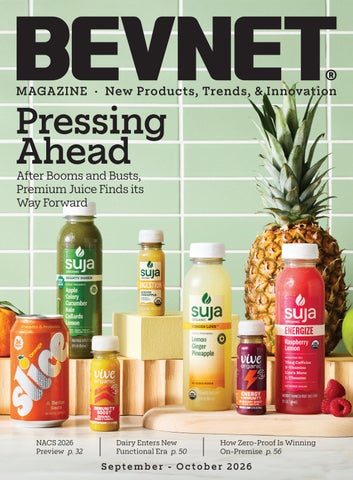
Pressing Ahead After Booms and Busts, Premium Juice Finds its Way Forward
NACS 2026 Preview p. 32
Dairy Enters New Functional Era p. 50
How Zero-Proof Is Winning On-Premise p. 56
September - October 2026
September – October 2026 • Volume 24 - No. 5
32
42
50
56
Columns
36 New Products GHOST, Olipop, Jumex, BUM Energy 60 Promo Parade Electrolit Signs Street Baller Jack Downer
6 First Drop (Happy) Voices from the Past 8 Publisher’s Toast Barry Signs Off
Event Coverage
10 Gerry’s Insights Why Distributors Need Non-Alc
32 NACS 2026 Preview
Departments
Features
14 Bevscape/Noshscape/Brewscape OLIPOP Announces
42 Juice Premium Meets Functional (with Brand News)
New CEO; Ferrero Group To Acquire Purely Elizabeth; Liquid Death Founder Launches Mr. Fancy
50 Dairy/Alt. Dairy Innovation for Everyone
28 Channel Check Spotlight on RFG Juice
56 Adult Non-Alcoholic Zero-Proof Progress in On-Premise
Follow Us Online:
x.com/bevnet
(with Brand News)
instagram.com/bevnet
www.bevnet.com/magazine/subscribe
BevNET Magazine (ISSN 2165-6061, USPS 24-552) is published bi-monthly by BevNET.com, Inc. 65 Chapel Street Newton, MA 02458. Periodicals postage paid at Boston, MA and additional mailing offices. POSTMASTER: Please send address changes to BevNET Magazine, Subscriber Services, 65 Chapel Street Newton, MA 02458 Cover Photo Credit: Suja
5
The First Drop
By Jeffrey Klineman
Happy Accidents I am not a fellow who is really prone to fits of nostalgia; I tend to lean more toward self-induced dementia. Nevertheless, we recently embarked on a marketing experiment internally that led to an email being sent to just about every single speaker who has ever joined us at BevNET Live. It turned out to be a happy accident. Even amidst the bouncebacks and the occasional “lose my number” reply – miraculously, there were many fewer than I’d imagined – the sheer volume of names, going back more than 15 years, worked pretty well as an electronic stand-in for the Proustian Madeleine. The names on the replies were wonderful and evocative. There were kind words from (I’m going to use the Barry Nathanson term here) old friends, everyone from Alissa Sears to David Karr, both of whom I met the first year I went to Expo West. There were reflections on the quality of conversation and connection off the stage and the great job our team does making the founders and attendees understand that they might carry the ideas that can guide them through similar challenges. Zooming from those earliest days to the present, it was amazing to hear from many of today’s emerging founders: Scarlett Leung, Rosa Li, Sandro Rocco, Jesslyn Rollins, Janelle Bass. It’s great to feel like we’re reaching different generations with the program. There was a lot in between. The responses brought to mind the lessons learned from incredible, hard-fought success stories, like Ken Uptain’s long quest to win with Essentia, or Seth Goldman’s ability to take a social and economic mission and make a brand embody it. I could picture myself speaking with the likes of Jack Belsito, Tom First, Tyler Ricks – all of whom are still in the game in some form or another. Jesus Delgado Jenkins of 6 2026 6 BevNET BEVNET Magazine MAGAZINE• –September/October JANUARY/FEBRUARY 2018
7-Eleven, whose email bounced back, but will likely activate again once he bounces back to 7-Eleven for the umpteenth time. To protect them from investor backlash, I’m not going to share the name of the founders (there were several!) who noted that my jokes are the true best part of the show. As I sorted through the replies, the intimacy of so many live interviews came flooding back, and I felt, once again, the cumulative stress that comes as we spend so long finding, scheduling, and fine-tuning discussion topics with our guests. It evoked the hours spent deciding whether one conversation will take 20 or 25 minutes, doing the math and making the hard cuts on timing to nail the talk lengths down to the second – and the natural dismay of our production team when we blow through those time windows to continue the conversation. It was great to hear from those people, and wonderful to remember. It grounded me in the events that we’re about to have in L.A. in December, and the hard push to once again take the thoughts of the current brand founders and integrate them into the collective wisdom of those who have specialized experience and knowledge, and to make it all digestible and coherent and beneficial for as many of our attendees as we can. Every fall, as we head towards Thanksgiving, much of the background noise fades and the work to pull these events together spirals into a whirlwind, and when the end comes, it’s always a bit of a surprise, and a letdown, because for a little while, we’re manifesting the community that we have all created, together. People say really nice things, and then they go back to work. It’s nice to know that the experience is memorable and positive, as the years stack up. I look forward to more fun, more conversation, more positive memories as we head into the next set of events.
Publisher’s Toast
www.bevnet.com/magazine
Barry J. Nathanson Publisher bnathanson@bevnet.com Jeffrey Klineman Editor-in-Chief jklineman@bevnet.com Martín Caballero Managing Editor mcaballero@bevnet.com Justin Kendall Editor, Brewbound jkendall@bevnet.com Adrianne DeLuca Assistant Managing Editor, Newsletters adeluca@bevnet.com Lukas Southard Senior Reporter lsouthard@bevnet.com Brad Avery Senior Reporter bavery@bevnet.com Zoe Licata Senior Reporter, Brewbound zlicata@bevnet.com Shauna Golden Reporter sgolden@bevnet.com
By Barry Nathanson
IT’S TIME! My time as the publisher of a beverage magazine is coming to an end: I will, sadly, be retiring from my role at BevNET at the end of the year. BevNET Live, in December, will be the final coda to a career that has given me joy, fulfillment and satisfaction for 35 years. It boggles my mind to think that I’ve been doing this gig for all these years. Just typing the word “retirement” evokes many emotions, but the strongest cocktail is one of sadness mixed with elation. I hope it was a job well done. I loved it. But I just turned 78, and now have three grandkids that will occupy my time. Nothing tops that, but it’s a close race, because chronicling this most dynamic industry has been the love of my professional life. I started in 1981, launching Beverage Aisle for Keller publishing. The magazine became an instant success,covering the machinations and nuances of marketing and retailing brands, something that was highly important for the growing marketplace. I had a great 10 year run with the magazine, but sadly, after three different owners, the last one I philosophically didn’t like or respect, it was time to go. I didn’t go far. With an industry friend who had admired Beverage Aisle, we launched a competitor, Beverage Spectrum. The large multi-national company that owned my old mag scoffed at us little upstarts having the audacity to challenge 8 BevNET Magazine • September/October 2026
Sales & Ad Operations
them, but we put Beverage Aisle out of business in 10 months. What they didn’t see or know is that there’s a winning combination: friendships and relationships are key, as is having a product that merits the industry’s respect. But I knew that a one-magazine company couldn’t survive, so the next progression was to bring the magazine to a rightful place. Hence the move to BevNET. Having met John Craven around the industry, liking him and the BevNET site, I thought the synergy of two terrific products would be a great marriage. John agreed, and the rest is history. He asked me to stay on for a little while, as I was the heart and soul of the magazine. Little did I realize then that a short-term commitment would lead to 25 years. And it has been a most glorious 25 years. I have staked my career around knowing and supporting the industry, giving its many professionals guidance and knowledge, but my strength, for the people that know me, has always been my ability to make friends. Throughout these 35 years, the most important endorsement to me has been hearing from people that they liked and respected me. I will be here for the rest of the year, and look forward to connecting to friends old and new. I’m grateful to have loved every minute of my beverage life. I wish for everyone to have that in their career.
John McKenna Director of Sales jmckenna@bevnet.com Bryce McDonald VP of Sales bmcdonald@bevnet.com Adam Stern Senior Account Specialist astern@bevnet.com John Fischer Senior Account Executive jfischer@bevnet.com Lou Calamaras National Account Executive lcalamaras@bevnet.com Colin Sughrue Digital Campaign Coordinator csughrue@bevnet.com
Art & Production Aaron Willette Director of Design
BevNET.com, Inc. John Craven CEO / Founder / Editorial Director jcraven@bevnet.com
Headquarters 65 Chapel Street Newton, MA 02458 617-231-8800
Publisher’s Office 1120 Ave. of the Americas, Fourth Floor New York, NY 10036 646-619-1180
Subscriptions For fastest service, please visit: www.bevnet.com/magazine/subscribe email: magazinesupport@bevnet.com
Do Your Part: Please Recycle This Magazine
Gerry’s Insights
By Gerry Khermouch
As Beer Bleeds, How Wholesalers and NAs Can Recalibrate the Relationship Outside of the large soft drink networks that are largely closed to independent outside brands, beer wholesalers represent the best DSD option for brands seeking to crack nooks and crannies like convenience stores, delis and independent grocers with some degree of hands-on execution. For many beer wholesalers, though, NAs continue to be a conundrum. NAs represent a hedge against the challenges for alcohol brands these days and a way of garnering greater influence with their retail partners. But they also bring no lack of challenges, from the need to call on non-alcohol accounts to the ever-present flight risk if the brand ignites and becomes coveted by one of the major strategic players. In alcohol, of course, franchise laws make it difficult for brands to flee at the drop of a hat. Still, at a time that the prospects for alcohol are so challenged, NAs harbor real potential to mitigate those declines. One magic bullet has been cannabis beverages – those Delta-9 drinks that emerged as a vibrant category thanks to a kink in the regs. Since they’re stimulating products that
concluded it needs to move into those impulse channels where many of the new rivals have been birthed. That initiative was just getting under way as I wrote this column. Premier Protein is by no means the only such established brand seeking DSD. Brands like the two-decade-old Zevia stevia soda have been patiently exploring that distribution mode. Others that had exited DSD have returned to the fold, as with Yerba Madre (formerly Guayaki) and Fiji Water. Given the early exits many promising brands have made, it’s completely understandable that beer wholesalers are anxious to protect themselves against the possibility that their efforts to help ignite an NA brand yield some kind of payoff – if not in a stream of increasing sales and gross profit dollars then via a buyout. My concern is that their demands are boxing them out of meaningful conversations. That may have been the case as Hint Water decided to rebuild its once extensive DSD network, ultimately dialing down the effort after concluding that the combination of category
serve similar occasions to beers and canned cocktails, wholesalers seem to have viewed them as a close-in adjacency, and there’s much to be said for the argument that alcohol distribs should be the gatekeeper should the category be federally legalized. D9s also offer one avenue to retrieving the ranks of alcohol drinkers who’ve strayed into a more abstemious lifestyle, or maybe prefer to toke up rather than raise a pint glass. So it wasn’t surprising to me that, in states where their legality seemed reasonably clear, wholesalers embraced D9s, which have grown. The problem, of course, is that as I write this the odds are that by December the category will be federally outlawed. That leaves us with the broader range of NAs, from iced teas and gut pops to protein shakes and of course energy drinks – not a small addressable market! As I’ve done over the years, I’m hoping to make a case here for the appeal of NAs, with full awareness of the challenges and frustrations they bring. For many established distributors, their impression of NAs is that they’re mainly offered by bright but inexperienced and undercapitalized entrepreneurs, some just out of college, who’ll have a steep learning and awareness curve to climb before their brands can become meaningful contributors to distributors whose growth needs are immediate. This is partly a misconception. At any given time in recent years there have been plenty of brands seeking distribution that are established volume generators in other channels than the convenience & gas and foodservice outlets that are bread and butter to many DSD players. And I don’t mean established just in e-commerce, though I wouldn’t snicker too much at a beverage brand that’s doing eight or nine figures on ecomm and can visit a prospective wholesaler with data showing that thousands of those customers live right within their service territory. What I’m focusing on here are brands that are playing right in retail, often in the most familiar large-format banners, with substantial history and sales behind them. As I noted, it’s a drum I’ve beaten in the past, sometimes at the request of the National Beer Wholesalers’ Association, which wants to see its members diversify more (though not necessarily into D9s). But I feel it bears repeating as a new flock of possibilities emerges. What prompted this thought was word that BellRing Brands had begun its first-ever DSD push behind its powerhouse shake brand Premier Protein. By now that brand has built a business of well over $1 billion plying large-format retailers and ecomm. After long pooh-poohing the wave of protein newcomers as ephemeral, a new leadership team has
economics and wholesalers’ contractual demands made it too difficult to accomplish. As for the flight risk, I’ll remind readers that some wholesalers have done exceedingly well taking equity stakes in promising brands under competent leadership so that if an exit does occur, they enjoy the twin benefits of the contracted buyout and the equity jackpot. True, it all makes for a lot of churn (though alcohol hasn’t been immune to churn either), but it does yield an economic return that helps to sustain the business through all the challenges of alcohol declines, regulatory purgatory for D9 bevs and consolidation among retailers and rival wholesalers. On the shelf-stable side, I constantly remind readers of my newsletter Beverage Business Insights that it’s hard to find any brands that successfully ignited without enlisting DSD during their crucial growth stage. But they’re no longer the only game in town. Both retailers and brand owners increasingly are open to alternatives – say, by layering some contracted merchandising execution onto a broadline distributor – that can get much of the job done with more consistent execution and maybe a bit less of a margin hit. Approaches like that avoid the inconsistent execution that mars the performance of the beer networks on NAs, with a superbly performing house sometimes sitting on the other side of a county line from one that can’t be bothered to show up. Making a move to DSD work requires a certain amount of adaptation by the brand owner. No doubt, that’s part of the reason for skepticism by beer houses. In the protein space plied by BellRing, for instance, other established endemic brands like Labrada have struggled to get their hands around DSD in a consistent way. In other categories over the years, that’s been true of brands from Campbell’s V8 Energy to Nestle’s Nesquik, seemingly plum additions that faltered because of their owners’ inability to figure out how to manage channel conflicts, promotional and incentive programs, and innovation flow. Too often they try to take the half-pregnant approach of consigning their DSD partners to difficult-to-service channels like C&G and indie grocers while withholding from them larger-format channels where they can make larger, more profitable drops, on both the conventional and natural sides. It’s reassuring when these players recruit a team with deep roots in DSD to manage the push, but all too often they find themselves stymied by other corporate interests, the wholesalers lose interest and the effort fizzles out. Given the heightened pressures both sides are facing these days, I’m hoping they’re better motivated to make it work this go-round.
Longtime beverage-watcher Gerry Khermouch is executive editor of Beverage Business Insights, a daily e-newsletter covering the nonalcoholic beverage sector. 10 BevNET Magazine • September/October 2026
11
Bevscape
Liquid Death, David Protein Facing Lawsuits Claiming Allulose Contradicts ‘Zero Sugar’ Claims Liquid Death is facing two proposed class action lawsuits, both taking aim at the brand’s claims that its energy drinks contain “0g sugar” despite its use of allulose, a sweetener that has been classified by the Food and Drug Administration (FDA) as a sugar. Both complaints were filed in late August, one in California and the other in New York, with plaintiffs represented by different law firms but making similar claims that the brand misled consumers by putting a “zero sugar” claim on its Sparkling Energy Drinks. The first lawsuit was filed in the U.S. District Court Northern District of California by Calif. resident James Williamson, followed by a suit filed in the Southern District of New York by N.Y. resident John Frelinghuysen. At the heart of both cases is the company’s use of allulose, a naturally occurring monosaccharide sugar sourced from fruits like figs and raisins, as well as wheat, maple syrup and molasses. The FDA recognizes allulose as a sugar, but has chosen to exercise enforcement discretion over its absence from total sugar listings on nutrition labels. “There is no such thing as ‘0g Sugar’ allulose; it does not exist,” Williamson’s complaint states. “To peddle this contradiction in terms, Defendant deceives the public through misleading packaging 14 BevNET Magazine • September/October 2026
statements and labels. This deception has earned Defendant many millions of dollars, while doing substantial damage to a broad class of consumers across California and the country.” Frelinghuysen’s complaint argued that there is also a high chance of consumer confusion, due to a general lack of awareness of allulose as an ingredient. “Allulose is not a common household name,” the complaint claims. “Reasonable consumers, including Plaintiff, are unlikely to recognize the term or to infer from the ingredient list alone that it is a sugar.” It’s unclear how much allulose is used in the energy drinks, although it is the second listed ingredient on the nutrition label after carbonated water. While class actions have long been a burden for CPG businesses, complaints around allulose labeling have become a more common issue, and there’s legal precedent to back the plaintiffs. In July, the U.S. Seventh Circuit court revived a proposed class action case filed against Chobani, which also claims the brand misled consumers by calling its yogurts “sugar free” despite the use of allulose. The decision reversed a previous dismissal of the case, arguing that allulose is regulated by the Federal Food Drug and Cosmetic Act and provided backing for arguments that the
ingredient should be included under total sugar listings. “The federal requirements at issue are plain — food products cannot be labeled sugar free unless they have less than half a gram of sugar, and sugars include every monosaccharide, including allulose,” the Seventh Circuit wrote in its opinion. Williamson’s complaint against Liquid Death leans heavily on the Seventh Circuit’s opinion, further arguing that the court held that the FDA’s October 2020 Allulose Guidance, in which the agency said it would exercise enforcement discretion for the exclusion of allulose from sugar declarations, “is not entitled to deference and does not change the analysis.” Rather, it states that the regulations are “unambiguous” and that the guidance is “an announcement of a change in enforcement policy,” and not an interpretation of regulatory law. Liquid Death isn’t the only brand facing fresh class action complaints over allulose; the same week, a complaint was filed against WK Kellogg alleging it falsely labeled its Special K cereals as containing no added sugars despite the use of allulose syrup. A similar lawsuit was also filed against David Protein, targeting its flagship protein bars zero sugar claims and the use of allulose. Liquid Death and David Protein did not respond to a request for comment.
Bevscape • The Latest Beverage Brand News
Investors Sue Simply Good Foods Over ‘Abject Failure’ To Integrate OWYN Brand Less than two years after its $280 million acquisition of Only What You Need (OWYN), Simply Good Foods Company is facing a proposed class action suit from investors alleging the integration of the brand has been “an abject failure.” The complaint, filed Aug. 14 in the U.S. District Court for the Southern District of New York by the Monroe County Employees’ Retirement System, argues Simply Good Foods and several current and former executives made materially false or misleading statements about OWYN and its integration. The proposed class action includes investors who purchased Simply Good Foods stock between Oct. 24, 2024 and April 8, 2026. Simply Good Foods’ former president and CEO Geoff Tanner, former CFO Shaun Mara and current CFO Christopher Bealer are named as defendants alongside the company. The complaint centers on the contrast between management’s public characterization of the transaction and the operational issues that later emerged. Simply Good Foods completed its acquisition of OWYN in June 2024, positioning the deal as a way to expand its presence in the ready-to-drink (RTD) protein shake market. In the months that followed, the suit alleges that Tanner repeatedly told investors the integration was “progressing as planned,” later describing it as “largely completed” and saying it had “gone well.” However, investors claim the reality inside the business was significantly different. Among the problems alleged in the suit: • Simply Good Foods lost key managers following the acquisition and responded by creating a layered organizational structure that ultimately became “bloated” and was “lacking strategic cohesion.” • A change in pea protein sourcing before the acquisition closed but implemented shortly thereafter allegedly hurt the taste, texture and shelf life of certain OWYN products, contributing to poor consumer reviews, weaker sales and lost distribution. • As sales weakened, plaintiffs allege Simply Good Foods leaned more heavily on promotions before cutting brand support. In October 2025, Tanner disclosed that a pea protein sourcing decision had resulted in taste and texture issues as products aged. At the time, however, he said the problem had been “recti16 BevNET Magazine • September/October 2026
fied” and was “mostly in the rearview mirror,” while maintaining that the integration had gone well. As recently as January, Simply Good Foods continued to express confidence in OWYN. Despite lingering effects from the quality issue, retail takeaway for the brand climbed 18% during the company’s first quarter, and management outlined plans to increase marketing spend to more than 10% of OWYN net sales. Three months later, after CEO Joe Scalzo returned to lead the company, the picture had changed dramatically. In April, Simply Good Foods reported that OWYN sales had fallen nearly 17%.The company reported a $187 million impairment charge against OWYN’s intangible assets. Scalzo said the company had lost brand expertise, struggled with marketplace execution and failed to meet its own expectations for the acquisition. He also cited rising G&A expenses, declining marketing investment and an overreliance on promotions as Simply Good Foods moved to reset the broader business.The company cut nearly 15% of its workforce in April to streamline operations and lower overhead costs. “While the growth opportunity with OWYN is compelling, we did not meet our own expectations with the integration of the brand into our parent company,” said Scalzo. “As a result, we lost some important brand expertise, our marketplace execution was poor and our brand performance fell well short of our plans.” The plaintiffs argue that the company’s later disclosures proved the company had omitted material information about the OWYN integration. Following the April earnings announcement, Simply Good Foods shares fell from $14.41 on April 8 to $10.44 on April 10, a decline of more than 27%, per the complaint. In July, Simply Good Foods recorded another $13 million impairment tied to OWYN. Cumulative impairments on the business now total $200 million – roughly 70% of the $280 million acquisition price. Management has maintained that OWYN’s underlying opportunity remains intact. In July, Scalzo said the company believes the brand’s challenges “stem primarily from integration and execution issues rather than a lack of consumer demand for clean-label plant-based nutrition,” while cautioning that distribution losses could continue over the next six to 12 months.
Bevscape • The Latest Beverage Brand News
OLIPOP Announces New CEO; Founder Goodwin Set for Innovation Role OLIPOP welcomed a new CEO this August, appointing Christian Patiño Webb to lead the brand as founder Ben Goodwin transitioned to executive chairman and head of innovation. Patiño Webb joined OLIPOP after a four-year run as CEO of sports drink brand Electrolit. He is charged with overseeing “business operations, distribution, organizational execution, brand expansion, and strategic growth initiatives that support OLIPOP’s long-term vision,” according to a press release. Prior to becoming CEO of Electrolit in 2022, Patiño Webb held leadership roles at Procter & Gamble, Johnson & Johnson, Red Bull and Unilever. Meanwhile, Goodwin is now helping guide OLIPOP’s long-term vision and innovation pipeline, as well as “shaping its next phase of growth.” In an interview with Bloomberg, Goodwin said he made the decision to step down after a “decompression spirit quest” at his home in Washington state. He called the search for a new CEO a “really long, very painstaking process.” “I am more replaceable as the CEO than I am as the founder and driver of formulation and innovation,” he said. “What Ben and the team have built is re-
markable and a step forward for the beverage industry. OLIPOP is not only a categorydefining brand, but a company with a clear mission, culture, best in class talent, and an extraordinary runway ahead,” said Webb. “I look forward to partnering closely with Ben as we continue scaling the business, investing in new capabilities, and building on the strong foundation already in place.” As he transitioned to his new role, Goodwin called founding and leading OLIPOP to mainstream success “the honor of my lifetime, and I feel extremely fortunate and proud of what we’ve accomplished to date.
I’m thrilled to evolve my role to focus on areas where I have strong natural talent and motivation, to serve as a source of meaningful differentiation for OLIPOP.” OLIPOP has been ramping up over the past 18 months, first with a $188 million Series C funding round in 2025 at a $1.85 billion valuation. That was followed by a brand refresh and a national marketing campaign this year. Amidst rumors of a potential sale or IPO, the changes “position OLIPOP to pursue future strategic and financial milestones with confidence, while maintaining the flexibility to evaluate capital markets opportunities alongside other strategic alternatives as the company continues to grow.” Patiño Webb’s hiring showed OLIPOP once again leaning on experienced Big CPG veterans. The company previously recruited Mel Landis, who previously integrated BodyArmor into the Coke system, as president in 2024. During his roughly four-year stint at Electrolit, Patiño Webb helped guide the brand (a division of Grupo PiSA) to massive gains in the U.S. and turning it into the fastest-growing scaled brand in sports hydration, per distribution partner Keurig Dr Pepper (KDP).
Podcast Star Alex Cooper’s Unwell Beverage Venture Is Shutting Down The beverage arm of celebrity podcaster Alex Cooper’s Unwell media empire was shut down in August. The brand, launched with Nestlé SA, will continue to produce drinks and new flavor launches through Halloween, but will cease operations soon after. Cooper announced her brand’s entry into the hydration space in December 2024 with 16.9 oz. plastic bottles, using a wellness positioning to market to women underserved by high-performance sports drinks. By November, Unwell had begun testing the energy drink set and followed with protein beverages. The reasons behind the shut down are still unclear. Cooper’s Unwell media
business received an investment at a $500 million valuation days before the closure was revealed. The undisclosed funding round was led by WTSL, an investment firm led by former Endeavor executive Patrick Whitesell and Jason Lublin, and could have signaled that Unwell’s partners are more interested in media endeavors than in consumer goods. Beverages are a notoriously difficult industry to break into; especially when the categories Unwell operates. Both the energy and sports (or hydration) drink categories are dominated by big names like Monster, Red Bull, Pepsi (Gatorade) and Coke (Body Armor and Powerade). Unwell also faced increased competi-
tion for female consumers from brands like Bloom, Alani Nu, FLRT and others.
For more stories, check out Bevnet.com 18 BevNET Magazine • September/October 2026
Noshscape
Ferrero Group Agrees To Acquire Purely Elizabeth Ferrero Group in August reached an agreement to acquire Purely Elizabeth, following months of speculation that the better-for-you granola brand was exploring a sale. Financial terms of the transaction were not disclosed. The company will continue to operate as a standalone brand within Ferrero Group, with founder and CEO Elizabeth Stein retaining her role alongside the existing leadership team, and expects to benefit from Ferrero Group’s product development resources to expand its portfolio. “Building Purely Elizabeth from an idea 17 years ago into the brand it is today has been one of the most rewarding journeys of my life, and I’m incredibly proud of what our team has accomplished,” said Stein in a statement. “As I thought about the next chapter, finding a partner who understood what makes Purely Elizabeth special and shared our commitment to quality, innovation, and building for the long term was incredibly important to me. Founded in 2009, Purely Elizabeth entered the gluten-free granola space while it was still a relatively niche national market. The Boulder, Colo.-based business has established itself as a key player, holding the number one spot in granola in natural channel sales for more than eight 20 BevNET Magazine • September/October 2026
consecutive years, while building a leading position in oatmeal and cereal made with simple ingredients such as oats, whole grains, nuts and seeds. According to a press release, Purely Elizabeth has more than doubled its sales over the past two years. “In Ferrero, we’ve found a family-owned company that believes deeply in what we’ve built and sees the tremendous opportunity still ahead. I couldn’t be more excited to continue leading Purely Elizabeth alongside our team as we bring our mission and products to even more people.” Ferrero Group, the Luxembourg-based producer of Nutella, Tic Tac and Kinder, has built a significant presence in North America over the past decade while expanding into snacking, ice cream and breakfast cereal markets. The company acquired Ferrara Candy Company in 2017, adding brands like Trolli and Brach’s. The following year, Ferrero bought Nestle USA’s candy business, including Butterfinger, Baby Ruth, Laffy Taffy and Nerds. A year later, it snapped up select cookie, fruit snack, ice cream cone and pie crust businesses from Kellogg Co. In 2022, Ferrero acquired Wells Enterprises, which added Blue Bunny, Bomb Pop and Halo Top to its sprawling
house of brands. And last year, Ferrero purchased WK Kellogg, which brought Frosted Flakes, Froot Loops and Rice Krispies under its roof. “Purely Elizabeth, with its terrific portfolio of quality, tasty products, is a great addition to Ferrero,” said Giovanni Ferrero, president of Ferrero International S.A., holding company of the Ferrero Group, in the press release. “With this transaction, Ferrero builds on its recent acquisition of WK Kellogg Co, reinforcing both its presence at breakfast time in America and its reach in the better-for-you segment.” Purely Elizabeth has raised over $53 million to-date, including a $50 million Series B round in 2022 led by the SEMCAP Food & Nutrition division along with Swander Pace Capital and SEMCAP’s partner, Fresh Del Monte. Previously, the brand secured $3 million from General Mills’ 301 INC investment group, led by John Haugen, who later co-founded SEMCAP. Purely Elizabeth has grown alongside broader shifts in consumer behavior, including rising awareness around ingredients and sustainable sourcing, increased demand for better-for-you snacks and the growth of adjacent categories like yogurt and smoothie bowls.
Noshscape • The Latest Food Brand News
Peppertux Raises $2.35M to Fuel Retail Expansion Can America’s appetite for pistachios extend beyond the viral Dubai chocolate trend? The founders of Southern California startup Peppertux – along with their new investors and retail partners – are betting on it. The company closed a $2.35 million bridge round in July led by Santatera Capital, with participation from Lever VC, in preparation to expand across thousands of conventional grocery stores and broaden its lineup of pistachio-based spreads and snacks. Founding husband-and-wife team Ahat and Lia Caskurlu told Nosh the funding coincides with the company’s biggest growth phase yet. After expanding its jars of Pistachio Cream spread into 1,140 Target stores earlier this year, the company recently launched a Pistachio Drizzle topping in squeeze bottles into more than 2,100 Kroger locations, with Albertsons set to add both products in August. Earlier this spring, the brand also entered H-E-B. Combined, the launches represent roughly 4,000 new conventional grocery doors, marking the brand’s largest retail expansion since its launch five years ago. Unlike many emerging brands, Peppertux reached this point without institutional capital. The new funding will primarily support inventory, promotions and retail execution as Peppertux scales its conventional grocery presence, while accelerating new product development. Although Peppertux began with pistachio spreads, the founders increasingly view the business less as a nut butter company and more as a pistachio innovation platform. Next up are individually wrapped Pistachio Squares, chocolate-covered wafer cookies filled with pistachio cream. Originally introduced as “protein squares,” the founders said retailer feedback prompted a repositioning. Buyers consistently assumed the products belonged in the protein bar aisle, creating confusion around merchandising. Rather than competing against bars containing 20 to 30 grams of protein, Peppertux repositioned the products as premium wafer cookies destined for the cookie aisle. Each individually-wrapped piece contains about half the calories and sugar of a KitKat bar, according to the company. The repositioning underscores a broader shift taking place across food and beverage, where brands are increasingly emphasizing familiar formats with incremental nutritional benefits rather than overt functional positioning. While pistachio has become one of food’s hottest ingredients thanks to the Dubai chocolate phenomenon, the opportunity emerged years earlier. In 2019, the Lia and Ahat began selling premium Turkish olive oil before realizing the category simply moved too slowly to build a scalable consumer brand. During countless grocery store visits, the pair noticed pistachios were a mainstay in the produce and snack aisles but almost nowhere else. “You would see bags and bags of snacking pistachios next to the watermelons, next to some of the end caps. But … where are all the other pistachios in other aisles?” Lia recalled wondering. After more than 70 recipe iterations, the founders launched a pistachio spread at California farmers markets before
attracting buyers from Gelson’s, Wegmans and eventually Target through trade shows. The founders say nearly every major retail account came inbound rather than through traditional sales outreach. The company hired its first broker late last year. Peppertux’s Pistachio Cream became Wegmans’ third-bestselling nut butter item last year behind Nutella and the retailer’s private label almond butter, according to the founders. The performance has prompted the retailer to expand the assortment with additional Peppertux products, including Pistachio Drizzle, single-serve pouches and a chunky Pistachio Cream developed at Wegmans’ request. But growth hasn’t come without challenges. Demand for premium early-harvest pistachios has intensified as more brands launch pistachio products, forcing Peppertux to compete for limited supply. The company sources the majority of its pistachios directly from Turkey, relying on longstanding farmer relationships while diversifying manufacturing across Europe and the U.S. to reduce supply chain risk. The founders said Santatera Capital was attracted not only to Peppertux’s recent retail momentum but also to its long-term vision of building multiple pistachio-based categories. Peppertux presented investors with a 10-year innovation roadmap spanning spreads, snacks and additional grocery categories, while emphasizing its strategy of becoming the categorydefining pistachio brand rather than chasing short-term trends. Santatera Capital – which has backed brands including Mezcla, Sunnie Snacks and Little Sesame – said it was drawn to Peppertux not only because of the recent surge in consumer interest around pistachios, but because it believes the category is still in its early stages. Fund manager Daniel Ramos described pistachio-based products as an emerging segment benefiting from growing demand for premium, indulgent foods that also carry a wellness halo. Santatera sees potential for the company to build a broader pistachio platform capable of expanding into adjacent categories such as snacks and foodservice. He also pointed to the company’s rapid growth, along with its expanding retail footprint, which is on pace to surpass 7,000 stores by year-end, as evidence of strong product-market fit and retailer demand.
For more stories, check out nosh.com 22 BevNET Magazine • September/October 2026
Brewscape
Gallup Poll: Record Low Respondents Believe They ‘Drink Too Much;’ Total Drinkers Unchanged from 2025 Gallup’s highly anticipated report on consumers’ drinking habits showed the underlying trends depend on which angle you’re cutting the data. Gallup surveyed 1,200 U.S. adults (aged 18 or older) between July 1 and July 19. Among respondents, 54% said they drink alcohol, unchanged from 2025’s headline-making record low. However, among those who reported drinking bev-alc, the number of drinks they consumed in the last week increased from 2.8 in 2025, to 3.2. Last year’s figure
matched the previously lowest-reported average of drinks consumed in 1996. While a cause was not shared for the latest uptick, the survey was taken during the FIFA World Cup (held June 11 through July 19), which we’ve previously reported had an impact on consumer drinking trends this summer. Additionally, the percentage of respondents who said they “sometimes drink too much” fell to 13% – a new low for the survey. The highest percentage of selfreported overconsumption was recorded
in 1989 (35%). In 2015, that number was at 25%, and by 2023 had fallen to 19%, followed by 16% in 2024 (no number was shared for 2025). Note, Gallup’s survey results have a margin of error of plus or minus 4% (5% for data of exclusively adults who drink bev-alc). Additionally, the survey was conducted via voluntary telephone interviews (80% via cell phones, 20% via landlines), and includes responses from consumers under the legal drinking age – both factors which may also skew results.
Former Stone Escondido Site Faces 220 Cuts as Sapporo Winds Down Brewery’s Operations Sapporo USA will lay off 58 employees across three Stone Brewing branded California facilities effective October 19, according to a WARN Act notice filed with the state. The cuts are a first phase of a wind down of the former Stone Brewing facilities with a total of 220 employees to be terminated as part of the closure, Sapporo USA SVP of people Kristin Perales wrote in the WARN letter, the San Diego Union Tribute reported. The first round of layoffs include: • 50 workers at the Stone Brewing World Bistro & Gardens in Escondido; • Six workers at a distribution center; • And two workers at a warehouse. Sapporo USA CEO Zach Keeling shared the following statement with Brewbound: “Following the sale of the Stone brand 24 BevNET Magazine • September/October 2026
earlier this year, Sapporo USA has been supporting a smooth production transition to the new brand owners. As this transition nears the end, we will begin a phased wind-down of our Escondido brewery and bistro operations. “Despite diligent efforts, we have not yet found a viable long-term solution for the Escondido site. We have notified our employees of upcoming layoffs in mid-October and midNovember, providing maximum advance notice. This is an understandably difficult time for our Escondido employees and community, and we’re committed to supporting them through this transition.” Although the facilities carry the Stone name, the workers are employed by Sapporo USA “and have no connection to Stone Brewing’s ongoing business under Firestone Walker or Duvel USA’s ownership,” Keeling wrote.
Brewscape • The Latest Craft Beer Brand News
Martignetti to Acquire Red/Gold Network Distributor Girardi in Massachusetts Martignetti Companies is expanding its New England footprint again. The beer, wine and spirits distributor has struck a definitive agreement to acquire Girardi Distributors, LLC, a Massachusetts-based, independent Anheuser-Busch InBev and Constellation Brands distributor. The deal is expected to close this fall. The acquisition is Martignetti’s third Massachusetts distribution deal in recent years, following the 2023 deal for Quality Beverage and the 2024 acquisition of A-B’s Boston-based wholly owned distribution operation. Fourth-generation, family-owned Girardi’s distribution territory covers Berkshire, Hampshire, Franklin, Worcester and Middlesex counties in Western and Central Massachusetts. In addition to the A-B and Constellation portfolios, Girardi’s book includes offerings from Kirin (New Belgium, Bell’s, Kirin Ichiban), as well as local and national craft beer brands Castle Island, Barrel One Collective (Harpoon, Catamount,
UFO, Clown Shoes), Outlaw Light, Sierra Nevada, Switchback, Hendler Family Brewing’s Wormtown and Yuengling, according to its website. The distributor also carries Liquid Death and hard tea and water producer NOCA.
Wild Goose, SS BrewTech Owner to Discontinue Brewing Division With a secondary market flooded with brewing equipment, one of the key makers of brewhouses, brew kits and canning lines is discontinuing that part of its business. The Middleby Corporation will shutter its Middleby Brewing & Distilling Solutions Group, which includes Deutsche Beverage + Process, Ss Brewtech and Wild Goose Filling, by the end of the year, the company announced Wednesday. “Always tough decisions to close businesses, but we felt like the end user, the end segment and the brewing business has been challenged the last several years,” Middleby chief commercial officer Steve Spittle said during a fireside chat at the Jefferies Industrials Conference. “There’s a pretty heavy secondary market for beverage equipment and we just did not feel like there was a good road map for growth in this segment.” In 2025, the brewing group lost $9 million in adjusted earnings before interest, taxes, depreciation and amortization (EBITDA) on net sales of $24 million. Similar performance is expected this year.
Liquid Death Founder and Sazerac Launch Mr. Fancy Canned ‘American Bubbly’ Liquid Death founder Mike Cessario is partnering with Sazerac to launch Mr. Fancy, a new RTD canned sparkling wine. Mr. Fancy, a 5.5% ABV, 140-calorie canned “American Bubbly,” comes in Brut and Rosé varieties. Six-packs carry a suggested retail price of $14.99 plus tax. Beginning October 1, it’s expected to hit independent retailers’ shelves across Texas, Tennessee and Massachusetts, with additional markets to follow, Sazerac brand director for global growth and innovation Lauren Selman shared with Brewbound. “Mr. Fancy offers the convenience and approachability and sessionability of the canned drinks consumers are accustomed to, but with a new twist,” Selman wrote. “The product may be American bubbly, but the brand is designed to compete for occasions that have historically belonged to more casual offerings like beer and seltzers.” For more stories, check out brewbound.com 26 BevNET Magazine • September/October 2026
Channel Check
Spotlight Categories Wondering how some of the HPP platforms are doing? Check out these two categories for a quick read: Pressed Juicery continues to move forward in retail, while the Evolution Fresh/Bolthouse pair owned by Generous Brands seems to be spinning its wheels a bit. That’s similar to competitor platform Suja: the publicly
traded mashup of parent brand and Vive Organic is showing growth from Vive shots, but similarly lackluster trends, especially around the green juices that helped put it on the map. Meanwhile, SolTi just pulled in a $30 million investment and its sails are showing tailwinds.
Rfg Juice and Drink Smoothies
Rfg Vegetable Juice
Brand
Dollar Sales
Change vs. Year Earlier
Brand
Dollar Sales
Change vs. Year Earlier
Naked
$452,331,293
-2.4%
Suja
$69,577,447
-4.8%
Bolthouse Farms
$159,567,880
-6.9%
Bolthouse Farms
$56,637,906
-22.4%
Pressed Juicery
$75,048,529
175.4%
Solti
$34,794,463
42.8%
Once Upon A Farm
$20,095,982
4.8%
Vive Organic
$28,281,766
26.3%
Evolution Fresh
$18,799,078
-7.3%
Private Label
$12,825,062
-0.8%
Stonyfield Organic
$8,608,383
-14.8%
Ardens Garden
$7,508,138
40.0%
Suja
$8,196,939
34.5%
Pressed Juicery
$7,067,320
45.8%
Private Label
$3,337,517
8.8%
Natalies
$6,570,830
47.5%
Gutzy Organic
$3,328,982
341.5%
Evolution Fresh
$5,000,633
-26.3%
Ardens Garden
$1,524,169
23.1%
Beetology
$2,301,361
35.7%
Harmless Harvest
$1,512,456
-14.1%
Love Beets
$1,817,398
34.7%
Columbia Gorge
$304,360
-3.9%
Just Made
$1,667,927
83.1%
Urban Remedy
$160,320
-10.8%
Barsotti
$1,228,677
-10.7%
Grace Harbor Farms
$53,767
7.6%
Sofresco
$927,029
427.6%
Floridas Natural
$53,596
-56.5%
Urban Remedy
$892,311
-16.3%
Lala
$52,332
-71.2%
Remedy Organics
$887,113
-13.9%
Mush Kins
$46,579
-90.0%
Nobrand Generous Brands
$808,166
243.5%
Nutri
$41,365
33.7%
Nobrand
$638,609
72.6%
Goodbelly
$12,934
-
Pure Green
$565,358
6.8%
Karuna
$12,638
-24.2%
Clamato
$528,043
69.3%
Topline Category Volume Sports Drinks
$12,144,887,992
5.9%
Energy Drinks
$29,586,573,444
13.9%
Bottled Juices
$9,499,555,900
-0.1%
Tea/Coffee - Ready-To-Drink
$8,412,270,446
-0.5%
Bottled Water
$31,303,647,267
3.4%
Liquid Drink Enhancers
$514,245,117
-3.5%
28 BevNET Magazine • September/October 2026
SOURCE: Circana OmniMarket™️ Shared BWS - 52 Weeks Ending 09-06-26
Channel Check • What’s Hot & What’s Not
Flavored Still Water Brand
Dollar Sales
Glaceau Propel
Energy Drinks Change vs. Year Earlier
Brand
Dollar Sales
$1,159,782,983
2.5%
Red Bull
$9,946,406,463
7.3%
$1,000,468,009
13.2%
Monster
$7,746,854,715
16.1%
Bai
$246,072,713
-3.0%
Celsius
$2,876,779,912
3.5%
Hint
$147,941,214
-8.7%
Alani
$2,469,065,746
71.4%
Private Label
$117,917,403
-1.1%
Ghost
$997,460,540
28.2%
Splash
$72,700,109
-4.6%
C4
$865,089,915
4.4%
Tum E Yummies
$53,761,821
-0.1%
Bloom
$705,940,224
320.5%
Capri Sun
$51,437,757
-6.2%
Rockstar
$577,910,930
-12.1%
Powerade
$34,879,955
4856488.2%
Reign
$534,797,881
-14.4%
Lemon Perfect
$28,730,041
-9.1%
NOS
$522,373,637
1.1%
Brand
Dollar Sales
Change vs. Year Earlier
Nonflavored Still Water
Change vs. Year Earlier
Rfg RTD Coffee
Brand
Dollar Sales
Change vs. Year Earlier
Private Label
$7,326,332,032
2.9%
Starbucks
$475,340,215
0.5%
Glaceau
$1,619,237,566
7.8%
Stok
$473,047,760
14.5%
Poland Spring
$1,067,673,878
1.6%
Intl Delight
$153,975,956
-6.3%
Pure Life
$930,051,556
6.0%
Private Label
$69,740,786
25.2%
Aquafina
$748,583,568
-23.1%
Califia
$54,578,844
0.4%
Dasani
$704,054,074
0.9%
Bizzy
$46,015,452
26.6%
Deer Park
$634,418,769
-0.6%
La Colombe
$44,544,789
24.3%
Fiji
$586,913,439
2.6%
Bolthouse Farms
$30,890,087
11.5%
Ozarka
$579,143,936
8.1%
Bustelo
$14,011,597
-8.3%
Essentia
$521,071,364
-1.8%
Nestle
$9,537,792
-39.4%
SOURCE: Circana OmniMarket™️ Shared BWS - 52 Weeks Ending 09-06-26
30 BevNET Magazine • September/October 2026
Channel Check • What’s Hot & What’s Not
Rfg Tea Brand
Dollar Sales
Change vs. Year Earlier
Milos
$860,236,190
17.1%
Private Label
$317,630,006
0.1%
Gold Peak
$175,391,888
-9.8%
Turkey Hill
$146,793,180
-3.6%
Red Diamond
$106,125,904
-9.2%
Bolthouse Farms
$33,416,565
-7.8%
Simply
$29,143,005
77.6%
Pure Leaf
$22,807,792
-22.5%
GTS
$22,405,971
-5.3%
Pom
$19,249,461
-7.6%
Brand
Dollar Sales
Change vs. Year Earlier
Gatorade
$7,840,154,483
5.4%
Bodyarmor
$1,474,320,071
5.7%
Powerade
$1,437,740,820
9.7%
Electrolit
$900,138,583
34.1%
Private Label
$173,538,098
-6.0%
Prime
$130,728,299
-55.5%
Biolyte
$26,566,862
-11.6%
Roar
$22,318,444
17.3%
Performx
$13,741,077
151.4%
Suerox
$12,936,221
2.9%
Brand
Dollar Sales
Change vs. Year Earlier
New Belgium
$585,451,844
6.6%
Sierra Nevada
$347,370,744
0.6%
Blue Moon
$264,415,494
-7.9%
Samuel Adams
$181,779,863
-7.1%
Lagunitas
$139,544,516
1.7%
Bells
$109,934,206
-3.3%
Goose Island
$109,070,381
3.1%
Elysian
$107,973,121
6.1%
Shiner
$107,394,008
-7.9%
Founders
$96,282,490
-7.1%
Brand
Dollar Sales
Change vs. Year Earlier
Premier
$2,465,474,552
4.8%
Core Power
$1,721,350,904
12.2%
Ensure
$1,035,709,398
-4.2%
Fairlife
$928,218,491
11.4%
Orgain
$795,991,246
8.3%
Optimum Nutrition
$762,544,256
17.4%
Private Label
$714,890,542
7.2%
Boost
$533,025,416
-2.6%
Muscle Milk
$469,690,335
-8.4%
Nurri
$368,061,619
154.5%
Sports Drinks
Craft Beer
Weight Control
SOURCE: Circana OmniMarket™️ Shared BWS - 52 Weeks Ending 09-06-26
31
Show Preview
2026 National Association of Convenience Stores Show Alphabetical Exhibitor List
Who
What
More than 100 beverage brand and approximately 24,000 attendees
National Association of Convenience Stores Show
Where
When
Las Vegas Convention Center Las Vegas, NV
Conference: October 6-9, 2026 Expo: October 7-9, 2026
Exhibitor
Booth
Exhibitor
Booth
Exhibitor
Booth
1st Phorm / Anheuser Busch
N3213
Chobani
N1629
Greatful Brands
N548
5-hour ENERGY
N1621
Cirkul, Inc.
C3782
ALO Drink by SPI West Port Inc
N3208
Clearly Canadian
C3878
Happy Dad | Convenience Catalyst (CL100)
Amigos
C3480
Constellation Brands
N2347
Anheuser-Busch
N2629
Crystal Geyser Spring Water
N2171
Athletic Brewing
C3681
DD Beverage & Nutrition
N237
Barebells USA VitaminWell USA
C4067
Delta Beverages
Be Love Hydration, Energy, & Protein
C3587
Beliv US High Brew Coffee, Big Easy Pop
C3583
Blake's Beverage Co.
Heineken USA, Inc.
N616
High Spirits
C3768
Icelandic Glacial
C4193
C3472
Joe Tea & Chips
C4572
Deschutes Brewery PARTYBOMB
N379
Ketone-IQ | Convenience Catalyst (CL100)
Diageo
N1951
Dream Water Sleep Aid
N1071
C3785
Drink Lick, LLC LICK Energy
C3872
Botanic Tonics LLC
C3880
Duvel USA
C3474
brooklyn bottling
N3054
Electrolit
C4403
BUBBL'R
N2077
Eternal Water
N1849
Bucked Up
N1651
Fire Brands
N239
BUM Energy
N1171
Firestone Walker Brewing Co
N235
C4 Energy / Bloom
C3969
GALLO
N2151
Geloso Beverage Group
N269
Genius Gourmet
N1877
Ghost Beverages KDRP
C3641
Calaveras Energy | Convenience Catalyst (CL 100) CALIFORNIA BEVERAGES INC
C3771
Carolina Ice Company Inc. Chilly Water
C3477
Celsius Holdings
N1251
Cheech and Chong's Global Holding Company
C3570
Good Boy | Convenience Catalyst (CL100)
Keurig Dr Pepper
N1447
Keurig Dr Pepper
C3830
Lifeway Foods, Inc.
C4380
Liquid Death
N378
LoDo Brands
C3770
Lotus Lifestyle LLC
N1171
Lucky Beverage Co
N929
Mark Anthony Brands
N3245
Melting Forest
C3580
Mitra9 Brands
C3682
Molson Coors Beverage Company
N2204
Monster Energy Company
N1929
Mpact Beverage Company
C5648
good2grow
N1141
New Brew
C3783
GoodBrew
C4384
Niagara Bottling, LLC
N329
BevNET, NOSH and Taste Radio will be interviewing, broadcasting and filming throughout the event. Reach out at news@bevnet.com, news@nosh.com, or ask@tasteradio.com 32 BevNET Magazine • September/October 2026
Exhibitor
Booth
Exhibitor
Booth
Exhibitor
Booth
NO CAP Soda Pop Inc
N1171
Proximo Spirits
N1073
The Boston Beer Company
N3229
Ready®
N2178
The Coca-Cola Company
C3805
Red Bull North America
N1029
The Real American Beer
C3585
RYSE Up Sports Nutrition
N238
The Vita Coco Company
C3979
Throne SPORT COFFEE
N1871
Tropicana Brands Group
N1041
TULIP INTERNATIONAL INC.
C3772
Tweaker Energy Drink Company
C4196
UPTIME Energy, Inc.
N3115
VIVAZEN
N2172
Welchs Company
N534
White Rabbit Energy
C3473
Willie's
C3476
Wonderful Pistachio FIJI Water
N716
NOCA Beverages | Convenience Catalyst (CL100) Novamex
N1973
Nowadays
C3784
NVE Pharmaceuticals
N1063
OLIPOP Inc
N938
One 11 Brands
C3577
Outlaw Beer | Convenience Catalyst (CL100) Pabst Brewing Company
N1017
PATH
N839
PepsiCo, Inc.
N2329
Pickle Juice Company
N1172
Pocas International Corp.
C4368
Polar Beverages
N545
Premier Nutrition
N1447
Primo Brands
C3820
RYTHM, Inc. | Convenience Catalyst (CL 100) Saint James Brands LLC Saint James Iced Tea
N1166
Sazerac Company, Inc.
N1645
Sierra Nevada Brewing Co.
C4269
Simply Good Foods- Quest
N529
Spindrift Beverage Co
N335
SPYLT
N919
Stateside Brands Surfside
N2139
Suja Life | Convenience Catalyst (CL100) Suntory Global Spirits
N2145
Yerba Madre
N937
Surprise Drinks USA
C4290
Zero FG
C3684
33
New Products
Energy Ghost Energy’s latest co-branded offering is an A&W Root Beer-flavored energy drink, launching this month, with 200mg of caffeine alongside other functional ingredients. Both Ghost and A&W are owned by Keurig Dr Pepper, demonstrating new synergies across the company’s portfolio. For more information, go to drinkghost.com. The holiday launches get earlier and earlier every year. For 5-hour Energy, developing its first Halloween-themed flavors meant launching them in August. The Halloween variety fourpack includes Ghoulish Grape, Cobweb Candy, Fright-Fetti and Candy Cauldron. Each Extra Strength 1.93 oz. shot contains 230 mg of caffeine, B-vitamins, zero sugar and zero calories. Learn more at 5hourenergy.com. Along with bringing back a seasonal release as a permanent roster addition, Red Bull is introducing a limited-edition can featuring Detroit Lions football star Amon-Ra St. Brown. Find it in 8.4 fl oz and 12 fl oz. cans exclusively in the state of Michigan while supplies last. Find more info at redbull.com/amonra. Fitness brand BUM Energy is reaching into pop culture with its new LTO, a special flavor release with country music star Ella Langley called Peaches & Honey. The drink pairs 112 mg of natural caffeine with 250 mg of Cognizin citicoline. Expect a robust marketing campaign with fan experiences, tailgating activations on Ella’s tour and a TikTok Shop-exclusive launch. Follow along at getrawnutrition.com/ collections/bum-energy
CSDs Apple is the favored fruit flavor of fall (say that five times fast!). Olipop is putting a Halloween spin on it with a Caramel Apple variety. Available online and at retailers like Target, Walmart, and Whole Foods, Olipop’s seasonal variety is launching with a “Best House on the Block Giveaway” marketing campaign to get consumers in the Halloween spirit. For more information, visit drinkolipop.com. 36 BevNET Magazine • September/October 2026
The Newest Beverage Options
Protein soda brand Proda is also getting into apple-palooza with its own f lavor launch. Golden Apple has 10 grams of protein and no sugar. The brand is debuting the new Autumnal variety at Sprouts Farmers Market in single cans and on Amazon in 12-packs. To learn more, visit drinkproda.com. Did we say “apple?” Culture Pop heard the call with an LTO Sparkling Apple f lavor. The fall f lavor has zero added sugar and no sweetener alternatives, relying on apple juice concentrate, organic cinnamon and organic clove to carry the f lavor. Sparkling Apple is launching at Albertsons, Wegmans, Giant Food and H-E-B, among others. Learn more at drinkculturepop.com.
Sparkling Water Waterloo Sparkling Water unveiled its new brand identity, taking a simpler approach to its can design. The Austin, Texas-based brand has enlarged its fruit imager y, added blocked colors for its various f lavors and removed some of the design f lourishes in its logo. For more information, visit drinkwaterloo.com. Ever wonder what peanut butter cup-f lavored sparkling water tastes like? No? Well, you’re still getting one. Liquid Death and MrBeast have teamed up to create Peanut Butter Cup Soda-Flavored Sparkling Water. The co-branded sparkling water comes in standard 12 oz. stout cans and is available in 12-packs for $14.99 on Amazon. For more information, visit liquiddeath.com.
RTD Coffee Jolene, the RTD coffee brand from Red Hot Chili Peppers frontman Anthony Kiedis, has peppered its portfolio with three new flavors: Hazelnut, Salted Caramel and Red Velvet. Each 8 oz. slim can is gluten-free and dairy-free, containing oat milk and no artificial flavors or concentrates. All three flavors are 120 calories with 10 to 14 grams of sugar and contain 188 mg of caffeine. Learn more at jolenecoffe.com.
New Products
Starbucks is celebrating pumpkin spice season early – and this time without sugar. The RTD category leader is launching a zero-sugar Pumpkin Spice Frappuccino, part of a pumpkin-powered innovation wave that also includes Starbucks Doubleshot Energy Pumpkin Spice and Starbucks Pumpkin Spice Crema Collection Premium Instant. You can read more about the brand’s at-home line at starbucks.com.
Protein shot maker Pure Genius Protein is launching a Pink Lemonade f lavor containing 23 grams of protein per 3.38 oz. bottle. Each bottle contains 100 calories, claiming 92% of those calories come straight from the protein content, making it a solution for picky eaters and low appetites, the company says. The shots are available now on Amazon and Target.com. For more information, go to puregeniusprotein.com.
Reduced caffeine RTD brand HalfCaff Coffee launched its initial lineup of canned brews. All three varieties – Lightly Sweetened Cold Brew, Vanilla Latte and Mocha Latte – have 50 mg of naturally occurring caffeine and 5 grams of cane sugar per 11 oz. slim can. Learn more at drinkhalfcaff.com.
This year has already seen Mexican juice producer Jumex jump into categories like energy and soda – why not protein, too? It recently introduced the Jumex Protein Shake, launching in retail at Walmart and on its website. Expect some Latin f lavors (Mango, Churro Chocolate, Vanilla Flan) along with 30 grams of protein per 12 oz. resealable PET bottle. Get more details at jumexus.com.
Iced Tea Autumn is here and Halfday is celebrating the changing leaves with Crisp Apple Tea, a canned iced tea made with 6 grams of prebiotic fiber, 50 mg of caffeine and 5 grams of organic cane sugar. Each 12 oz. can contains just 40 calories. The seasonal flavor is available now on Amazon with a national Walmart launch slated for October 1. For more information, go to drinkhalfday.com. After nearly seven years operating under the Avsome moniker, the brand has relaunched as Awesome Ice Tea with new branding, flavors and leadership. It’s still made with avocado seed extract and prebiotic fiber, but now comes in 16 oz. glass bottles in three varieties: OG Lemon Tea, Guavalicious Tropical Tea and Berry Loud Hibiscus Tea (the first two containing 40-60 mg of caffeine). Head to awsomeicetea.com to learn more.
Protein Protein and meal replacement brand Huel is adding Mixed Berry to its Black Edition RTD line, launching exclusively in Walmart stores nationwide. Each bottle contains 35 grams of protein, 400 calories, 27 essential vitamins and minerals and 6 grams of fiber. The drink is available as a grab-and-go product. For more information, go to huel.com.
38 BevNET Magazine • September/October 2026
Cannabis Sky High Brands has launched its 10mg THC beverage line, “giving consumers the f lexibility to choose the experience that best fits their lifestyle,” according to the brand. The higher-dose line, following the launch of its 4mg Sky Coolers, features Fuji Pear Apple and Ruby Crush f lavors. For more information, go to liveskyhigh.com. RYTHM’s latest release is more than just a new f lavor: thanks to a 1:1 ratio of THC + CBG– plus B-vitamins, L-Tyrosine and 30mg of caffeine – Lifted Lemon delivers an uplifting and energizing experience made for social occasions. It’s available in 12 oz. cans in two varieties: 10mg THC + 10mg CBG and 25mg THC + 12.5mg CBG. Get more details at rythmdrinks.com. Rapper Wiz Khalifa doesn’t lack for inspiration when it comes to cannabis. The outspoken weed fan and “Black & Yellow” rapper is releasing his first hemp-derived THC drink, Khalifa Kush & Orange Juice, this month in 5 mg and 10 mg THC versions. Get all the details here, then head to drinkkhalifa.com to try for yourself.
Pressure Test: Can HPP Cold-Pressed Juice Thrive in the New Functional Beverage Era? By Shauna Golden
Cold-pressed juice helped usher in the modern functional beverage era, giving consumers a convenient way to pack fruit, vegetables and other nutrient-dense ingredients into a single bottle. But in the decade since the category’s initial boom, the functional beverage landscape has become significantly more crowded. Consumers can now find hydration, energy, immunity and gut health benefits in everything from soda and sports drinks to powders and supplements. Meanwhile, juice as a whole has faced its own challenges as shoppers have become 42 BevNET Magazine • September/October 2026
increasingly conscious of sugar, even if it’s naturally occurring. But the cold-pressed juice segment – and its most common CPG variety, juice that undergoes highpressure processing, or HPP – appears to be finding fresh momentum. (HPP is a nonthermal processing method used to extend shelf life without relying on heat.) According to market research firm SPINS, the broader HPP beverage category generated $344 million in sales during the 52-week period ended Aug. 9, up 17.8% from last year. That growth outpaced the overall juice market, where
dollar sales increased roughly 2% over the same period across refrigerated and shelf-stable products. Scott Dicker, market insights director at SPINS, said the growth reflects both strong execution by individual brands and a broader shift in how consumers approach premium products. Even as shoppers remain mindful of their overall grocery bills, they are willing to selectively trade up in categories where they perceive meaningful differences in quality or benefits. At Whole Foods Market, cold-pressed
high prices and an inability to communicate its value to mainstream shoppers. Today’s momentum, however, doesn’t represent a return to the cleanse-driven, $10 green juice era. Instead, the category is being reshaped around more explicit functionality, accessible premium pricing and products designed to fit seamlessly into everyday routines. With functional benefits now available across virtually every corner of the beverage industry, what does cold-pressed juice need to offer to stand apart? And can HPP brands turn a historically premium proposition into something consumers can reach for every day?
The Functionality Question
Photo Credit: Suja
and HPP juices are punching above their weight. “HPP and cold-pressed juice has been one of our strongest performing segments within refrigerated beverage. It is meaningfully outpacing the broader juice category, and that gap has only widened over the past year,” Charlie New, senior category merchant for refrigerated beverages at Whole Foods, told BevNET via email. He continued, “This segment is not a niche anymore. It is becoming a core part of how our customers think about daily nutrition.” That’s a notable shift from where the category stood roughly eight years ago. In 2018, BevNET reported that HPP beverage growth had slowed to 5.4%, down from 31.5% the previous year, as cold-pressed juice struggled with oversaturation,
Juice has spent much of the past decade navigating an ever-evolving definition of “healthy.” Rising scrutiny of sugar has complicated the category’s traditional health halo, Dicker said, while a proliferation of functional beverages has given consumers more ways to seek out specific wellness benefits. For HPP cold-pressed juice, that has put a greater emphasis on communicating a clear reason to purchase. “Ten years ago, the primary proposition was relatively simple: cold-pressed juice was a convenient way to get more fruits, vegetables and nutrition into your day,” Saxon Seay, president of Suja Organic at Suja Life, told BevNET via email. “Today, consumers have an enormous number of ways to access functional benefits [...] so the role of cold-pressed juice has to be more than simply ‘juice that’s good for you.’” That shift is influencing how companies think about the boundaries of juice. Pressed Juicery, which began primarily as a cold-pressed juice and cleanse brand, now spans more than six categories, including tonics, wellness smoothies, probiotic lemonades, protein drinks and hydration; all of its bottled cold-pressed juices and wellness shots are processed using HPP. Pressed Juicery CEO Justin Nedelman said that expansion reflects the different ways consumers now incorporate wellness into their routines and the expectation that beverages can serve a specific need state throughout the day. “Consumers don’t just want a beverage that promises a benefit – they want to understand where that benefit is coming from,” Nedelman told BevNET. For Suja – which made its public market debut earlier this year – that means using fruits and vegetables as the foundation for benefits consumers can immediately understand, including immunity, gut health, hydration, energy and daily nutrition. The company’s portfolio includes “Boosted Juices” like Immunity Citrus Pineapple and Gut Health Berry Lemon, alongside its Suja Organic and Vive Organic wellness shots. Those products are among the strongest performers in Suja’s business. The brand’s benefit-forward cold-pressed juices are up 32% year-to-date, while its superfood-forward offerings have grown 76%, according to Seay. Whole Foods is seeing a similar pattern. Functional blends are currently the strongest growth driver within the retailer’s coldpressed set, New said, particularly products positioned around gut health, immunity or energy. Green juice remains a steady performer and an “anchor” of the segment, while lower-sugar and vegetable-forward recipes are also resonating with shoppers. Dicker sees opportunity for juice makers to lean into functions that consumers already associate with familiar ingredients. Tart cherry, for example, has gained traction around recovery, while orange juice has long benefited from its association with Vitamin C and immunity. For the HPP cold-pressed segment, making those connec43
tions more explicit can help turn inherent nutrition into a clearer purchase driver. “The sweet spot is when function doesn’t come at the expense of taste,” said Nedelman. “Consumers expect both now.”
Re-educating the Consumer
Functionality may be getting clearer, but communicating what makes HPP juice distinctive remains a work in progress. That has been one of the category’s longest-running questions. Back in 2018, Cold Pressure Council chairperson Joyce Longfield told BevNET that cold-pressed brands had often been “preaching to the converted,” successfully reaching wellness consumers who already understood juice cleanses and alternative processing, but had struggled to explain the proposition to a broader audience. Today, some brands are translating the technology through the attributes it enables. “I don’t think the average consumer wakes up thinking about HPP – and frankly, they shouldn’t have to,” said Seay. “HPP is the technology; what matters to the consumer is what that technology allows us to deliver.” Nedelman also emphasized the consumer experience rather than a technical understanding of the process. Consumers “don’t necessarily need to understand the mechanics of HPP,” he said. “What they experience is what the technology helps enable: fresh taste, simple ingredients, quality and convenience.” Consumer education around the technology itself also remains part of the opportunity. For Twisted Alchemy, HPP has been embedded in the business since its roots in hospitality. Co-founders Scott and Kim Holstein initially used the technology to address a practical challenge for restaurants and bars: delivering fresh citrus and other juices without the labor, inconsistency and waste involved with squeezing fruit on-site. As the company has expanded its retail presence, the Holsteins have also sought ways to increase consumer awareness of the 44 BevNET Magazine • September/October 2026
processing method. The founders said they are working to make HPP more visible on Twisted Alchemy’s packaging; the company is adding an HPP callout to the front of its labels, with an asterisk directing consumers to an explanation of the process on the back of the bottle. “I see and hope that consumers get more knowledgeable about the benefits of an HPP product versus a non-HPP product when it comes to juices,” said Scott Holstein. That education is taking place alongside a broader push to explain how the products can be used. Twisted Alchemy is now sold in roughly 250 Whole Foods Market stores, primarily in the produce section, and the Holsteins said the Whole Foods business has grown more than 175% overall. Together, the efforts illustrate the multitude of ways HPP can be translated at shelf, from communicating attributes such as freshness, simplicity and convenience to more direct education about the processing method and its applications.
Making Premium More Accessible
For all of the category’s evolution, one of its oldest challenges remains: price. Cold-pressed juice initially established itself at the ultra-premium end of the beverage market, with some bottles commanding prices north of $10. By 2019, many players were targeting a $3.99-$4.99 price point – a move that increased accessibility but also created pressure to reduce costs. That price range now looks close to the category’s sweet spot. At Whole Foods, New said the strongest velocity and repeat rates are coming from what he calls the “accessible premium tier,” roughly $3.49-$4.99 for a single-serve cold-pressed juice. “Our customers absolutely still pay a premium for HPP juice, but they want that premium to feel justified,” he said. “Clean ingredients, a real functional benefit, a brand they trust.” Dicker similarly sees consumers selectively trading up. A shopper may choose private label in one aisle and spend more on a premium product in another; for cold-pressed, HPP juice, the question is whether the proposition provides enough value to earn that additional spend. Scale can help, but HPP remains a premium process. Beyond processing itself, Nedelman pointed to produce sourcing and yield, refrigeration and cold-chain distribution as additional complexities. “The opportunity is to use scale to take cost out of the system without taking quality out of the product. For Pressed, accessibility has always been central to the mission. As we've scaled our manufacturing and
BOTTLED FRUIT DRINKS Brand
Dollar Sales
Change vs. Year Earlier
Snapple
$290,865,784
-10.7%
Hawaiian Punch
$238,556,322
-9.8%
Sunny Delight
$228,422,130
7.0%
Good 2 Grow
$221,870,213
10.5%
Arizona
$200,238,164
4.1%
Welchs
$186,233,813
-0.2%
Private Label
$118,745,512
-1.2%
Minute Maid
$111,496,429
-5.9%
V8
$110,232,715
-15.0%
Hug
$91,768,725
2.6%
RFG FRUIT DRINK Brand
Dollar Sales
Change vs. Year Earlier
Minute Maid
$443,114,851
2.1%
Sunny Delight
$266,024,931
0.1%
Simply
$242,482,440
8.8%
Tropicana
$215,846,115
-11.6%
Suja
$206,238,244
41.2%
Private Label
$114,292,427
25.3%
Welchs
$109,327,154
-4.6%
Wtrmln Wtr
$26,817,447
52.6%
Floridas Natural
$26,667,919
10.9%
So Good So You
$22,433,377
36.3%
BOTTLED LEMONADE
Change vs. Year Earlier
Brand
Dollar Sales
Minute Maid
$189,264,784
-1.9%
Calypso
$179,269,291
23.3%
Private Label
$129,705,688
2.9%
Brisk
$62,137,685
-7.6%
Grown Right
$36,317,126
27.3%
Dole
$32,234,465
-4.8%
Natures Twist
$14,260,920
-41.9%
Snapple
$11,322,154
-6.5%
Santa Cruz Organic
$9,674,548
-13.9%
Front Porch
$4,665,363
-21.3%
Dollar Sales
Change vs. Year Earlier
RFG LEMONADE Brand Simply
$620,763,931
1.7%
Private Label
$262,417,081
2.6%
Minute Maid
$161,945,822
5.6%
Milos
$140,473,032
37.8%
Tropicana
$41,747,972
-32.6%
Floridas Natural
$35,164,105
1.2%
Turkey Hill
$34,671,036
-0.5%
Newmans Own
$17,010,601
3.8%
Uncle Matts Organic
$9,977,484
49.3%
Starbucks
$9,057,739
-
SOURCE: Circana OmniMarket™️ Shared BWS 52 Weeks Ending 09-06-26
Photo Credit: Pressed Juicery
distribution capabilities, we've been able to reach more consumers while maintaining the product standards that differentiate HPP cold-pressed juice in the first place,” said Nedelman. He continued, “The challenge for the category is finding that balance: making HPP products accessible enough to become an everyday purchase while preserving the ingredient quality, freshness and experience that justify their premium positioning.” Distribution is the other side of the accessibility equation. Pressed is investing in wholesale across grocery, foodservice, hospitality and other channels as it works to reach consumers beyond its own stores. Suja is similarly focused on affordability, availability and awareness. Historically concentrated in natural and premium grocery, Seay sees conventional grocery, mass, club, convenience, foodservice, airports and other away-from-home channels as potential whitespace. “You can’t build a large category if consumers have to seek it out. Our ambition is for Suja Life's products to be available wherever and whenever the consumer wants our brands,” said Seay. Refrigeration can complicate the category’s expansion, but for retailers, HPP also provides retailers with an operational advantage. According to New, the technology can provide roughly 30 to 90 days of shelf life, compared to three to five days for raw juice, allowing Whole Foods to manage inventory more efficiently and reduce shrink. The retailer has progressively given more space to HPP and cold-pressed products as demand has increased.
Broadening Use Occasions
If accessibility is one piece of the growth equation, frequency may be another. The classic single-serve bottle doesn’t necessarily need to define the future of cold-pressed juice. Smaller formats, multiserve options and products designed around specific occasions can all give consumers new reasons to enter the category. Wellness shots have already demonstrated the potential of smaller functional formats, with New reporting strong repeat purchase rates at Whole Foods. “The per-ounce premium is significant, but customers see it as a daily wellness investment, not a juice purchase, and that reframes the value equation entirely. We are working with our brand partners to keep innovating on format and bundling across the cold-pressed set,” he said. Daily routines are also creating new opportunities for the category. Nedelman said HPP juice has shifted from something consumers may have encountered through 46 BevNET Magazine • September/October 2026
an occasional cleanse into products that can play throughout the day – an immunity shot in the morning, hydration or energy during the day and an Unwind tonic at night. “Wellness today is less about extremes and more about simple habits you can realistically incorporate into your everyday life. HPP cold-pressed juice fits naturally into that mindset because it’s convenient, approachable, and can serve different needs and occasions,” said Nedelman. Even the cleanse is evolving. Pressed’s Simple Cleanse is positioned as something consumers can add to their existing morning routine rather than requiring an all-day regimen. That evolution is a long way from the restrictive cleanse culture that helped put cold-pressed juice on the map. It also speaks to a potentially much larger opportunity: turning juice from an occasional wellness intervention into a repeatable habit. New usage occasions are emerging outside traditional juice occasions as well. Twisted Alchemy’s hospitality business puts its juice into cocktails, mocktails and culinary applications, while its retail business encourages consumers to bring those same uses home. That versatility gives consumers additional reasons to keep citrus and other juices in the refrigerator beyond drinking them straight. Collectively, those efforts point to a broader opportunity: increasing the number of occasions in which cold-pressed juice can fit into consumers’ routines.
What’s Next?
The HPP cold-pressed juice segment may look considerably different from the one that emerged during the cold-pressed boom roughly a decade ago, but many of the questions surrounding its long-term growth remain familiar. Sugar continues to influence perceptions of juice, HPP remains relatively expensive, and refrigeration adds complexity. At the same time, functionality, new formats, wider distribution and additional usage occasions are giving the categories more avenues for growth. At Whole Foods, lower sugar is becoming an expectation rather than a differentiator. New said the retailer is also watching prebiotic fiber, elec-
trolyte-enhanced cold-pressed products and “multi-functional benefit stacking,” where one beverage may address several wellness needs. Making HPP products part of more regular routines is another potential source of expansion. “For the growth to be durable, the category has to deliver more than novelty,” said Nedelman. “Products have to have great taste, have a clear reason for being, use ingredients consumers understand and be available at a price and in a place that makes repeat purchase realistic.” Seay expects the evolution of functionality to eventually change the composition of the refrigerated set itself. “Three to five years from now, I think the cold-pressed set will look less like a traditional juice set and much more like a destination for functional nutrition. Historically, the category has largely been organized around ingredients and flavors — greens, citrus, roots, fruit. Those things will remain important, but I think consumers are increasingly shopping with a different question in mind: What is this going to do for me?” she said. HPP will likely remain central to how these products are made, even as the consumer proposition surrounding coldpressed juice continues to evolve. Fresh taste and recognizable ingredients remain part of the equation, while functionality, accessibility, education and new use occasions are giving brands more ways to communicate the category’s value. For a segment that once built much of its identity around how its products were made, the next stage of growth may hinge just as much on giving consumers more reasons – and more opportunities – to reach for them.
Photo Credit: Pressed Juicery
Brand News Twisted Alchemy, the craft beverage brand known for its premium, coldpressed juices and cocktail mixers, announced the launch of Whole30 Approved 100% Mandarin Orange Juice, the newest flavor in its citrus lineup, arriving in the produce section at select Whole Foods Market stores in mid-September 2026. Pressed Juicery, the leading coldpressed juice and functional wellness brand, announced the appointments of Tina Reejsinghani as Chief Marketing Officer and Chad Peffer as Chief Sales Officer, strengthening its executive leadership team as the company enters an ambitious new phase of national growth. Natalie’s Orchid Island Juice Company, part of the Perricone Farms family, announced a new retail expansion with Gelson’s Markets, bringing a selection of its premium, clean-label juices to all Gelson’s locations throughout Southern California. The launch features a diverse assortment of Natalie’s signature juices, including 56oz Orange Juice, 32oz Organic Orange Juice, 32oz Tangerine Juice, and convenient 12oz bottles of Orange Mango, Orange Beet, Blood Orange, Carrot Ginger, and Tangerine. Playing up its functional credentials, tart cherry juice specialist Cheribundi released a pair of 2 oz. shots- one for faster recovery and another for sleep. Cheribundi Recovery and Sleep Shots are available now in 30-count packs on the brand’s website, on Amazon, and via FreshDirect, with additional retail expansion expected for later this year. Mexican juice brand Jumex has been on an innovation streak this year, including the launch of Jumex Reduced. The line is formulated with 50% less sugar than the brand’s traditional nectars, with flavors like Mango, Guava, Peach, and Strawberry Banana available in 11.3 oz. cans with 14 grams of sugar and 60 calories each. 48 BevNET Magazine • September/October 2026
Juice
Sunny D, but make it spooky (literally). With Halloween (already) creeping into the conversation, Sunny D has unveiled a mystery flavor, Spooky D, available in gallon jugs and 6.75 oz. bottles at Walmart Stores nationwide. Benefit Juice’s range of nutrientpacked drinks is getting a brand new look, along with revamped flavours and the welcome addition of fibre and vitamin D in every carton. Crafted specifically as a simple way to top up your daily nutrition as part of a varied and balanced diet, Benefit’s trio of juices—Cleanse, Enrich and Vitality— are getting a revamp with new packaging and new flavour profiles to reflect changing consumer needs. Ocean Spray Cranberries, Inc., the agricultural cooperative owned by roughly 700 family farmers, announced the appointment of Abigail Buckwalter as President and Chief Executive Officer. Buckwalter brings 20 years of global leadership experience across consumerpackaged goods and healthcare. good2grow, a leading beverage and snack brand for kids, is making even more smiles this holiday season as an official partner of the Macy’s Thanksgiving Day Parade, celebrating its 100th march this November. To bring the partnership to life, the brand is launching a nationwide sweepstakes that will send one lucky family of four to New York City to experience the iconic spectacle’s centennial celebration in person on Thursday, Nov. 26. With more than 75 years of delivering high-quality, fresh-tasting juice to households nationwide, Tropicana is introducing "Give Life Some Juice," a new masterbrand campaign that signals a bold creative evolution for the iconic brand. Rooted in the cultural idea that "juice" brings a natural lift to everyday moments, the campaign expands beyond Tropicana's orange juice heritage to unite its full portfolio as a vibrant family of flavors for a modern generation of consumers.
Photo Credit: Fairlife
Milk’s Moment
By Martín Caballero
50 BevNET Magazine • September/October 2026
Boosted by rising demand for protein, dairy milk is enjoying some much-needed love in 2026. A few years ago, market watchers and brand builders were seemingly convinced that plant-based alternatives were hastening the end of dairy as we knew it. But the winds have changed: with GLP-1 drug use soaring and functional nutrition trends shifting, fluid milk – specifically the high-protein, low-sugar ultra-filtered variety – and dairy-based drinks are back in style. Even as though protein has been the biggest rallying call thus far, there are signs that the innovation pipeline is still filling up. Milk’s rebound has fueled the rise of next-gen RTDs that are tapping into different functional benefits (like energy) and audiences (like toddlers) to meet consumers that are increasingly shopping based on needs rather than traditional beverage categories.
Whether it’s with a shake positioned as a nutrient-dense mid-day snack, a protein-boosted latte, or a hyper-caffeinated sweet milk drink, dairy beverages are fighting to earn their place with consumers who had been leaving the category behind.
Protein Moves the Needle
The connection between protein and dairy milk’s rising fortunes provides an apparently clear through-line for innovation: just add more protein. According to analysts from Jefferies, consumers continue to seek out protein-dense products, with categories offering more than 30 grams of protein per serving generating over 20% of category volume growth. That has sparked a slew of new product launches on both sides of the dairy divide. For longtime national operations like Dairy Farmers of America (DFA), the trend represents a much-needed reason to innovate, as it did earlier this year with the introduction of Protein+ ultra-filtered milk
Photo Credit: nurri
under Midwest-focused brands Kemps. The lactose-free line contains 13 grams of protein per serving, are lactose free, and comes in Chocolate and 2% Reduced Fat varieties in 48 oz. bottles. DFA has also integrated that approach into its other regional brands. Alta Dena, which is sold in California, and Meadow Gold, sold in Rocky Mountain and Northwest regions, both released Extra Protein versions this year featuring 15 grams of protein per serving. Elsewhere, Trilliant Nutrition leveraged its fast-growing high-protein milkshake brand Nurri in July to launch into the dairy case with a 52 oz. multiserve ultra-filtered milk in three flavors. Moreover, protein has given brands a more clear and impactful term to talk about the benefits of ultra-filtered milk. Nurri’s lineup is clearly billed as “protein milk,” aligning with the same primary callout from the RTDs. Organic Valley also leaned into the trend in calling its ultra-filtered milk line, released in March, as Protein Plus. The product
may also indicate how much consumers are willing to spend in a down economy; pitched as the only premium, pastureraised, ultra-filtered organic milk available nationwide, Protein Plus costs $5.99 - $6.99 per 48 oz. carton at stores like Target, Sprouts and Whole Foods Markets. And for those already deep in the protein game like Optimum Nutrition, ultra-filtered milk is a strong base from which to add more functionality: see the brand’s 30G Ultra-Filtered Milk Protein Shake + Fiber, released in September. Yet an education gap with consumers may still need to be bridged. According to a survey by fairlife, less than half (47%) of consumers believe dairy milk contains more protein per serving than plant-based milks. That’s despite protein being the benefit that those same consumers most closely associate with better-for-you milk products. Over one-third of respondents avoid dairy because they believed it was unhealthy, while 36% of Gen Z and millennials said more protein would
Photo Credit: ripple
make them choose dairy milk more frequently. Plant-based milks have long struggled to match dairy’s nutritional content, but boosting protein is one lever that brands in the category can pull. And some are, most notably with Danone-owned Silk expanding its Protein line in June with new 11.15 oz. single-serve Shakes, featuring 30 grams of plant protein, 5 grams of fiber and 50% less sugar than dairy milk per serving. Yet still, for plant-based brands like MALK, chasing protein is a delicate decision. This year, the Austin-based company, best known for its commitment to clean labels and organic ingredients, introduced Whole MALK as a higher-protein offering designed to compete more directly with dairy milk from a nutritional standpoint. The new line, launched nationwide in August with Whole Foods Market, Target and Sprouts Farmers Market, contains 12 grams of plant-based protein per serving, alongside calcium, iron and B vitamins. As MALK president Ryan Rouse explained, formulating Whole 51
Rfg White Milk
Photo Credit: malk
MALK was a unique challenge compared to its other releases. “At MALK, we’ve built the brand by leaving things out,” he said. “Whole MALK is the first time we’ve meaningfully added ingredients, but only because they genuinely improve the nutritional experience.”
Milk For All
Even if there’s plenty of runway ahead for protein, some milk brands are already looking further afield. Spylt may seemingly fit in alongside other high-protein ultra-filtered canned milk makers like Nurri and Slate. But while those brands feature more protein per serving, Spylt splits the spotlight between its 20 grams of protein and 60 mg of caffeine per 11 fl oz can. Billing itself as the preferred choice for those “who refuse to grow up,” the brand is backed by a trio of online content creators, Steven Shapiro (@stevenschapiro), Eric Booker (@badlandsboker) and Easton Simpson (@eastonsimp), and sports flavors like Banana, Cookies & Cream, Peanut Butter Chocolate and its latest limited release from September, Maple Donut. That’s given it license to lean into young, online audiences in a way that legacy milk brands can’t; according to 52 BevNET Magazine • September/October 2026
the brand, it reached No. 14 among all food and beverage sellers on TikTok Shop in March, “inspiring” nearly 40,000 creator videos along the way. Offline, Spylt has landed in over 1,300 Target stores and c-stores Circle K and QT. On the plant-based side, products designed for children have become an increasingly popular way for brands to extend. Category pioneer Ripple Foods had already done so with its own kids line launched in 2021; this year, it’s targeting a specific age range (12 to 36 months) with Ripple Toddler, launched exclusively at Walmart in September. The shelf-stable line contains 8 grams of protein plus DHA omega-3s, choline and calcium. As innovation accelerates, expect to see dairy brands further explore how they can fit into prevailing nutritional trends. The story around A2 milk, which may be easier to digest for some consumers, is already building in fluid milk through names like A2 Milk Company and Alexandre Family Farms, and in coffee with Laurel’s and Chameleon Cold Brew. Meanwhile Lactaid’s brought its leadership in lactose-free milk into coffee creamers this spring. And with good reason: according to Circana, products touting “lactose-free” claims saw 10.6% dollar sales growth in 2024.
Brand
Dollar Sales
Change vs. Year Earlier
Private Label
$9,859,347,646
1.1%
Hood
$1,313,905,898
2.9%
Fairlife
$1,078,761,251
13.4%
Horizon
$798,785,896
12.5%
Organic Valley
$376,489,931
21.5%
Prairie Farms
$278,499,464
-11.4%
Hiland
$179,280,196
-9.8%
A2 Milk
$127,427,496
28.9%
Darigold
$103,671,396
12.8%
Kemps
$103,491,503
3.7%
Shamrock
$96,073,396
18.8%
Cream O Land
$90,013,827
4.0%
Borden
$84,415,943
-18.4%
Clover Sonoma
$80,538,957
10.2%
Garelick
$65,582,262
-3.9%
Crystal
$62,464,995
12.3%
Meadow Gold
$60,009,173
-0.6%
Alta Dena
$58,817,722
-6.4%
United
$57,367,215
-1.2%
Maple Hill
$51,928,138
42.1%
Rfg Flavored Milk Brand
Dollar Sales
Change vs. Year Earlier
Private Label
$485,135,320
2.9%
Fairlife
$294,312,295
9.0%
Prairie Farms
$130,012,528
-3.3%
Hood
$102,797,604
4.5%
Hiland
$101,702,337
-0.4%
Borden
$68,047,616
-7.1%
Shamrock
$63,144,733
15.2%
Trumoo
$55,628,206
2.1%
Darigold
$54,464,823
-2.5%
Promised Land
$40,535,156
-9.2%
Marburger
$28,953,021
2.4%
Kemps
$28,645,475
-1.5%
Anderson Erickson
$26,162,346
4.1%
United
$25,147,962
4.0%
Maola
$22,788,286
26.3%
Mayfield
$21,698,492
25.3%
Creamland Trumoo
$20,611,800
-5.8%
Deans
$17,762,285
15.5%
Oakhurst
$17,247,360
-1.2%
Purity
$16,031,421
0.5%
SOURCE: Circana OmniMarket™️ Shared BWS 52 Weeks Ending 09-06-26
Brand News Billed as “pocket protein,” Grounded Shakes introduced a new 8.5 oz version of its dairy-free, plant-based milkshakes exclusively at Sprouts stores nationwide. Both flavors, Mint Chocolate and Chocolate, contain 10 grams of protein, 165 calories and 2.3 grams of fiber per carton and retails for $3.49. Dipping into one of the hottest recent flavor trends across CPG, Chobani is introducing Ube Sweet Cream as the newest entrant to its dairy creamer lineup, available nationwide at retailers like Target in 24 oz. cartons ($7.49). Danone’s dairy alternative brand Silk stepped up its protein game with Silk Protein Shakes and Yogurts. The former is a shelf-stable, 11.15 oz. RTD drink made with 30 grams of plant protein, 5 grams of fiber, 2 grams of sugar and 180 calories per serving. Packaged Tetra Pak cartons, the drinks come in Vanilla and Chocolate flavors, priced at $11.99 per 4-pack. Additionally, Silk Protein Yogurts contain 13 grams of plant protein per 5.3 oz. single-serve cup, selling for $1.99 per item or $6.79 per 24 oz. tub. Don’t cry over SPYLT banana milk. The RTD protein milk brand launched Banana Milk, a readyto-drink, lactose-free ultrafiltered milk containing 20 grams of protein, zero sugar and 60 mg of caffeine in each can. The drinks are launching exclusively on Amazon and TikTok Shop. Nurri has launched a fortified UltraFiltered Protein Milk. The lactosefree milk is made with 20 grams of protein per serving in 52 oz. cartons and comes in four varieties: 2%, Whole, Chocolate and Vanilla. The multiserve line is available in Walmart stores nationwide and online at walmart.com. TruMoo, a farmer-owned brand of Dairy Farmers of America (DFA), in collaboration with Universal Products & Experiences, brought
54 BevNET Magazine • September/October 2026
Dairy/Alt-Dairy Minions mischief to the dairy aisle with the launch of TruMoo LimitedEdition Banana low-fat milk. Inspired by Illumination’s Minions, the collaboration celebrates the biggest global animated franchise in history and the release of its riotous new chapter, Minions & Monsters. Plant milk drinkers need protein, too. MALK has got them covered with its new nutrient-dense Whole MALK. The new line blends coconut, cashew, soy and pea proteins and contains no gums, oils or fillers. Available at Whole Foods Market, Target and Sprouts Farmers Market, Whole MALK is $6.99 per 28 oz. bottle and contains 12 grams of protein alongside calcium, iron and B vitamins. End of summer? More like the start of fall LTO season, at least over at Califia Farms. The plant-based specialist is introducing two new limited-edition creamers this fall– Simple Horchata Almond ($5.49) and Simple Peppermint Almond ($5.49) – to pair with returning favorites like Pumpkin Spice and Holiday Nog. Some may call it ‘simple,’ but to Planet Oat it’s ‘humble.’ The oat milk maker’s new release, Planet Oat Humble Edition Oatmilk, made with just five ingredients for a creamy texture inspired by homemade oatmilk recipes, is now available at select Walmart locations nationwide. Ripple Foods, a leader in plantbased nutrition, announced the launch of Ripple Toddler PlantBased Milk, a new shelf-stable milk created specifically for children ages 12 to 36 months. With 8 grams of pea protein plus key nutrients, including DHA omega-3s, choline, and calcium, Ripple Toddler gives parents a convenient new option for growing toddlers at home or on the go. The new line is available exclusively in the Baby Aisle at Walmart stores nationwide and on Walmart.com.
ON-PREMISE : PIVOT How Zero-Proof Spirits Are Finding Success in Bars and Restaurants BY FERRON SALNIKER
Photo Credit: The Pathfinder
For years,
adult non-alc (ANA) spirits have chased after major retail placements. Now, as they turn to bars and restaurants, is it too late to make a splash? ANA beverage sales passed $1.08 billion in U.S. off-premise sales in 2026, with the real number likely higher when counting on-premise and alternative channel sales. Still, the category is cooling: retail sales growth rates have slid from +31.4% two years ago, +23.8% last year, to 14.6% in the latest 52 weeks, according to NIQ. More than halfway into 2026, the category is maturing and splitting into competing strategies, especially as brands circle new opportunities. Many of those are on-premise channels. 56 BevNET Magazine • September/October 2026
Dollar growth for NA beer, wine and spirits is accelerating faster on-premise (+44.3%) than off (+18%), and the format split is sharpening by channel: RTD cans dominate off-premise for convenience, while bottled NA spirits are becoming a bar-side reserve. Off-premise still supplies scale (64.9% share of dollars), but on-premise channels are the fastest recruitment and growth tools, according to NIQ. “The on-premise has always been that place for trial because the cost to try it might be a little bit lower,” said Kaleigh Theriault, NIQ’s Bev-Alc Thought Leader director. Unlike in Europe, where bars and restaurants blazed the trail
for zero-proof drinks, most ANA brands in the U.S. went from direct-to-consumer sales to retail, and now are expanding into the on-premise, where access and education, even among staff, is a challenge. In the U.S., brands who charged into retail last year are now building strategies around bars and restaurants, but they have obstacles ahead of them.
back, bars have been totally scared away from it,” said the founder of agave spirit alternative Tomonotomo, Amanda Chen. Facing those headwinds, brands have had to find creative ways to earn their place at the bar.
"Shooting Their Shot"
NA Spirits At a Crossroads
NA beer sales have long been the bulk of the non-alc alternatives market, making up 80.8% share of sales. But NA spirits are the fastest growing in sales dollars (+40.7%), cases (+62.7%) and UPCs (+15.1%), according to NIQ. NA spirit RTDs are dominating that growth: NA RTD dollar sales are up 61.5% compared to bottled NA spirits at 2%. Case numbers for NA RTDs are up 71.5% compared to 1.9% for bottled NA spirits, and UPCs are up 19.8% compared to 5.6%. Overall, NA RTDs represent a 75% share of NA spirits dollars. This also mimics the state of the full-proof spirits market, but whereas bottled spirits fuel mixology, RTD ANA’s fuel simplicity. RTDs don’t require bartender education, making them an easier NA addition to a menu – whereas bottled ANA spirit brands now have to prove that their products will create higher spends and more repeat business. “It’s all about disruption,” said LP O’Brien, creative director of beverage for F1 Arcade, at Tales of The Cocktail in July, in regards to NA drinks. There are five NA drinks on her menu, nearly half the amount of full-proof options, illustrating how mainstream ANA options have become. But the math often isn’t “mathing” on NA spirits. Restaurants and bars face pressure to maintain their profit margins, and filling the backbar with dusty bottles of spirit alternatives is expensive compared to creating in-house items. That means that high-end bartenders are trading NA spirits for their own, in-house concoctions, or else going with RTDs. “When it comes to this stage of pricing, especially for NA, and especially when considering R&D, do you really need an ounce and a half of that alternative spirit if the emphasis and the goal is just complexity and flavor integration?” she said. Meanwhile, the first wave of NA spirit options may have worked against new entrants. “Unfortunately, because a lot of agave specific non-alc products haven't captured the best of ‘agaveness’ and with so many customers sending the drinks
"ON-PREMISE IS A HUGE PART OF THE FLYWHEEL FOR RETAIL THAT NOT ENOUGH NA RTDS ARE FOCUSED ON..."
Jill Sites, former EVP of sales at The Pathfinder, has argued on-premise is an overlooked growth lever for all formats. “On-premise is a huge part of the flywheel for retail that not enough NA RTDs are focused on. You need to make sure that people are tasting the product,” she said. The Pathfinder, which has RTDs and an amaro-like alternative spirit, is addressing that gap by positioning itself as the NA or low-alc party shot. At Tales of The Cocktail, brand reps showed bartenders a low-proof version of the popular mezcal & montenegro shot – but subbed with The Pathfinder. To prove its place at the party, the brand paraded around a vintage dentist chair to bars where customers could take laybacks with the help of a mechanical arm. That strategy helped The Pathfinder land at Patterson Pins, a bar in Baltimore, on day one. In the first year it has landed four cocktails on the NA menu, a cocktail on the regular menu, plus three beer and shot combos (two with NA beers one with a house lager) and even a shotski option. “The focus on the NA shot offered a longevity alternative in our beer and shot menu that gave a new perspective for choosing NA alternatives,” said Patterson Pins beverage director Shaun Stewart.
Split Strategy
Other non-alc spirits have had to ditch their original strategies. Turned off by the price and taste of other non-alc agave alternatives, Tomonotomo pivoted from its planned merchandising around bartenders in L.A. and New York, and even from agave bars. Instead, Chen has found allies in other locales: first, chefs at high-end Mexican restaurants, who want to stack their bars with premium options for their moderating guests have, given the brand a bump in resorts across Cancun. Now, Chen theorizes, that may have sparked new orders the brand is currently finding in Las Vegas. Unlike most agave spirit analogs that use agave spirit or natural flavors, Tomonotomo is based in Oaxaca and highlights its traditional production methods. Chen argues that the production story appeals to travel retail channels. 57
Photo Credit: TOMONOTOMO
Hotel channels are now her biggest volume generators, with resorts in Las Vegas pushing for co-branded SKUs on their summer pool menus. Overall, NA cocktails have been gaining momentum in luxury hotels, with Hyatt’s The Lifestyle Group reporting a 32% sales increase over the past three years. Functional mushroom spirits brand Little Saints has long focused on the travel channel, and is now positioning its bottles even more as a premium pour for on-premise use, complete with bartender education and menu development, while reserving cans for retail. That strategy comes as the brand hits its fifth anniversary this year, with $28 million in lifetime revenue, a 50% year-over-year (YoY) retail growth rate. Little Saints has feet on the street in five states, and each rep comes from a cocktail background. But funding onpremise activations is expensive. With a term sheet in hand for $3 million of a $6 million raise – the first time the brand has opened to institutional capital – founder Megan Klein is using the Series A to build a wholesale team as the brand begins to build traction in major retail and support its on-premise team. “We've seen that when we can help the bartenders craft a really beautiful, low sugar, non-alc menu, then those cocktails turn a lot faster,” Klein said. Those cocktails often include other NA brands, and even other ingredients, such as THC. 58 BevNET Magazine • September/October 2026
Other Buzzes Moving In
As alcohol alternatives grow, NA spirit brands are also facing competition from other adjacent beverages. Those include kanna, kava, THC, and functional beverages in RTD or 750ml bottle format. At Brooklyn's Soft Bar + Cafe, bartenders are formulating around kanna and L-theanine instead of traditional spirit substitutions. Victoria Waters of Dry Atlas, an alcohol alternatives intelligence company, has also flagged kava and kanna as one of the category's “very proven, efficacious” functional plays – and noted interest may accelerate further as THC beverages run into regulatory headwinds. But THC is still a competitor. “We see a bit more of a skew towards younger consumers in bars and restaurants, and we see a little bit of an older skew in the off-premise,” said NIQ’s Theriault on THC ordering data. On average, about 14% of on-premise consumers say they've tried a functional beverage that contains THC in the past six months. Because consumers seeking out these drinks are looking to “relax,” there’s more one-for-one swapping between alcoholic and THC drinks, versus alternatives with no immediate buzz, she added.
Distribution Obstacles
Spirit alternatives, like much of the ANA category, face another obstacle – distribution. Traditional distributors aren’t incentivized to promote NA products over major portfolio items, even when they’ve added them on the truck.
“Unless alcohol goes completely out of style – which I don’t think will happen – ANA is always going to be at the bottom of the priority list,” said Sites. “Dry January and Sober October are going to be the two pushes we get, otherwise ANA is an item on a truck that gets delivered.” As a result, many bartenders seeking to get their hands on NA spirits have to work harder. That’s part of the reason alternative models of distribution and curation have popped up. The Zero Proof, a leading ANA beverage platform, recently acquired The New Bar, a West Coastbased non-alc hospitality and discovery program, bringing together The Zero Proof’s national e-commerce scale, owned brand portfolio, and distribution with The New Bar’s relationships across hospitality, live events and culture. With the distribution tier in a shakeup since Republic National Distribution Company’s collapse, smaller brands who lost their wholesalers could also take the opportunity to build a “great quilt for themselves in national distribution,” added Sites.
Non-Alcoholic Change vs. Year Earlier
Brand
Dollar Sales
Athletic
$140,587,145
20.1%
Michelob
$99,810,564
160.6%
Heineken
$96,348,956
4.6%
Bud
$54,230,796
-8.9%
Corona
$51,609,414
29.3%
Busch
$37,980,323
4.9%
Stella Artois
$21,485,057
4.6%
Blue Moon
$17,009,058
7.4%
Guinness
$14,124,231
13.6%
Odouls
$12,947,593
-27.8%
Sierra Nevada
$12,894,605
13.8%
Samuel Adams
$12,291,159
-19.0%
Coors
$11,159,410
2.7%
Deschutes
$8,847,838
27.4%
Best Day
$7,740,293
19.9%
Peroni
$7,363,188
29.0%
Clausthaler
$5,686,397
-8.0%
Bero Brand Family
$5,609,927
107.8%
White Claw
$4,794,706
-25.5%
Beck
$4,585,052
-21.6%
SOURCE: Circana OmniMarket™️ Shared BWS 52 Weeks Ending 09-06-26
Promo Parade
good2grow Partners with Macy’s for the 100th Macy’s Thanksgiving Day Parade good2grow, a leading beverage and snack brand for kids, is making even more smiles this holiday season as an official partner of the Macy’s Thanksgiving Day Parade, celebrating its 100th march this November. To bring the partnership to life, the brand is launching a nationwide sweepstakes that will send one lucky family of four to New York City to experience the iconic spectacle’s centennial celebration in person on Thursday, Nov. 26.
The sweepstakes gives families the chance to win a prize package worth approximately $5,000, including roundtrip airfare, hotel accommodations and four grandstand tickets to view the 100th Macy’s Thanksgiving Day Parade at Macy’s Herald Square. Families can enter at no cost for their chance to win by visiting good2growsweepstakes.com from Sept. 1 through Oct. 31. “We can’t wait to give one lucky fam-
Electrolit Signs Street Football Star Jack Downer Electrolit, the number one rapid hydration beverage, has unveiled a new partnership with street football standout Jack Downer, better known to millions as the face behind Street Panna. Specializing in panna, the high-skill, one-on-one format where nutmegs can instantly end a match, Downer has redefined what it means to win with style. Originally playing traditional 11-a-side football, Downer pivoted into street football after injury, channeling his understanding of the game into a new arena built on creativity, control, and instinct. Today, beyond a content creator, he’s a proven competitor, with two top finishes at the Superball Panna World Championships and a reputation as one of the most respected players in the space. Now, he becomes an Electrolit athlete, with the premium hydration brand supporting and hydrating him in every high-intensity moment, from street battles and global competitions to content creation and everyday performance. “Becoming an Electrolit athlete just made sense for me because everything I do in my game is high-intensity and nonstop. In panna, you’re constantly reacting, changing direction, making split-second decisions. There’s no time to lose focus or feel the effects of dehydration,” said Downer. “What I like about Electrolit is that it’s not just about hydration in a general sense; it’s built to actually replace what you lose when you’re pushing your body like that.” Through the partnership, Downer will collaborate with Electrolit across content, events, and community-driven initiatives, bringing the brand into the growing global movement around street football and skill-based play. 60 BevNET Magazine • September/October 2026
ily the opportunity to experience the 100th march of one of the country’s most beloved holiday traditions in person,” said Gunnar Olson, CEO of good2grow. “At good2grow, we’re always looking for meaningful ways to connect our fans to our brand beyond just our products. Macy’s Thanksgiving Day Parade has been bringing families together for generations, making it a natural fit.”
STORM Names Kate Mackz as Newest Brand Ambassador STORM, the premium wellness energy drink designed for modern, active lifestyles, announced Kate Mackz, the creator and host behind the viral Running Interview Show and Post Run High podcast, as its newest brand ambassador. Known for bringing candid conversations to life while running alongside some of the biggest names in sports, entertainment, business and culture, Mackz joins STORM’s growing community of athletes and influencers who embody the brand’s philosophy of Good Energy In – Good Energy Out. Mackz made her official STORM debut on September 2 in New York City, leading Run with Kate Mackz Fueled By STORM, a three-mile out-and-back run along the West Side Highway beginning and ending at Pier 45. The event marked Mackz’s first-ever run club. “I’m so excited to partner with STORM because so much of what I love about running is the energy it creates, not just physically, but the people you meet, the
conversations you have and the community you build,” said Kate. “Getting back into running after having my baby and
making my first-ever run club a STORM event in New York feels like such a special way to start this next chapter.” “Kate has built something incredibly authentic around movement,” said Tim Ryder, STORM General Manager. “What started with a simple idea, having real conversations while running, has grown into a community that makes movement feel accessible, social and fun. That is exactly the type of energy we want STORM to represent. Kate is a natural fit for the brand, and we’re excited to have her join us as we continue to build STORM at the intersection of fitness, lifestyle and community.” Mackz joins a dynamic roster of athletes and cultural influencers who represent STORM’s ethos of Energy for Life, including top-ranked tennis player Taylor Fritz, NBA star Quentin Grimes, Grammy-winning artist Maren Morris, leading lifestyle influencer Morgan Riddle, and Grand Slam champion and Olympian Sloane Stephens.
61
Promo Parade • Industry Promotions & Events
Zevia, Cardi B Launch “Real Talk Interpreter” Campaign Zevia, the better-for-you beverage brand built on great soda taste and real ingredients, announced the launch of “Real Talk Interpreter,” a new national campaign starring GRAMMY Award-winning artist, fashion icon and entrepreneur Cardi B. Launching across national streaming TV, video, social media and retail, “Real Talk Interpreter” marks Zevia and Cardi B’s first creative campaign together, bringing the brand’s “refreshingly real” ethos to life through Cardi’s signature honesty and humor. The campaign arrives as zero sugar soda continues to outpace the broader category, underscoring a shift in what consumers want from soda: the taste and refreshment they love, without sugar, fake sweeteners or other artificial ingredients. Zevia has been built for that shift since the beginning, delivering great soda taste with zero sugar and real ingredients. In the campaign, Cardi B stars as the “Real Talk Interpreter,” translating filtered everyday conversations into what people really mean. Two hero spots bring the idea to life in distinct but familiar settings: “Potluck,” where neighborly small talk masks what people are really thinking and “Guidance Counselor,” where polished parentteacher language is decoded in real time. In both, Cardi cuts through the niceties with the direct, funny, and unfiltered commentary fans know and love, while sipping Zevia Orange Creamsicle and Creamy Root Beer, respectively. The creative extends Zevia’s commitment to being real beyond the can and into everyday life, grounded in the belief that real beats fake every time. Zevia is real soda with real ingredients. Cardi is real talk with no filter. The campaign connects those ideas through a simple, universal behavior—the gap between what people say out loud and what they are really thinking—to prove that real hits harder.
62 BevNET Magazine • September/October 2026
“Real is at the core of everything we do at Zevia—from our ingredients to our brand voice—but we also believe better-for-you choices should be fun,” said Kirsten Suarez, Chief Marketing Officer of Zevia. “That’s what makes Cardi such a natural fit with Zevia. Her authenticity, humor and confidence help us introduce Zevia to new audiences and show that greattasting, zero sugar soda made with real ingredients can still have plenty of personality and flavor. Together, we’ve created a campaign that’s entertaining, memorable and unmistakably real.” “Let me tell you something, I’m always going to say exactly what’s on my mind, and that’s why Zevia and I are perfect for one another,” said Cardi B. “Zevia keeps it real with the ingredients, and I’ve never been one to bite my tongue. With ‘Real Talk Interpreter,’ we’re bringing that same energy to everyday moments and saying what everyone is really thinking.”