UNFI CLIMATE ACTION PARTNERSHIP
CASE STUDY Traceability and Monitoring Systems Help
Tony’s Chocolonely Achieve and Demonstrate Zero Deforestation
Tony’s Chocolonely was born when Teun van de Keuken realized that forced labor and illegal child labor still existed in the cocoa industry. Passionate about social and environmental issues in the supply chain from the start, Tony’s made a conscious decision to focus on preventing deforestation on the farms where they source cocoa. “We’re using 5 sourcing principles (fully traceable beans, paying a higher price, working with strong farmers, long-term contracts and increasing productivity & quality) to make all chocolate 100% exploitation free. We want to inspire other companies to do the same, as this is the best way to solve problems in cocoa including deforestation.”
Deforestation, particularly in cocoa-producing regions, poses a significant threat to the environment and local communities and contributes to climate change. The unsustainable practices associated with cocoa production, including illegal logging, land clearance,
KEY HIGHLIGHTS OF TONY’S DEFORESTATION EFFORTS:
• There is board-level oversight of main forest issues.
• The anti-deforestation efforts are holistic, address the root of why deforestation takes place and include a commitment to protect the rights and livelihoods of local communities.
• Forest issues are integrated into all parts of long-term strategic business plans, including financial planning, strategy, and objectives. For example, 16 non-financial KPIs are tracked, reported, and audited.
• There is a strategy in place to work with suppliers and to deal with non-compliance.
and monoculture farming, have led to widespread deforestation in many cocoa-producing countries.
Tony’s recognizes that to produce deforestation-free sustainable cocoa it is critical to address the root causes of deforestation. Climate change has already impacted the farmers they work with, affecting their ability to grow cocoa which is their livelihood. Preventing and counteracting illegal deforestation with practices that build greater resilience is not only a benefit to the environment but also an economic benefit to their farmers as it allows them to continue to farm.
The Role of Farmer Partnerships
Tony’s is working closely with cocoa farmers to combat deforestation by investing in partnerships, including long-term contractual relationships, and providing technical assistance, training, and financial support. Through these partnerships, Tony’s supports the financial resilience of the farming communities and promotes sustainable agricultural practices, including agroforestry and reforestation, as alternatives to destructive land-clearing practices.
Agroforestry, the practice of integrating trees with agricultural crops, is a key component of Tony’s approach to combating deforestation. By promoting agroforestry, the company encourages cocoa farmers to plant shade trees (including nitrogen-fixing species), fruit trees, and other native species alongside cocoa trees This approach not only enhances biodiversity but also provides ecosystem services, such as soil conservation, water retention, and carbon sequestration. Through agroforestry practices, farmers also have the opportunity to diversify the crops they produce which can build economic resilience.
As part of its agroforestry program, Tony’s helped create local shade tree nurseries, many of them female-run, to support the planting of shade trees to a level of eighteen trees per hectare (more than 500,000 trees are expected to be planted over the next two cocoa planting seasons - 2023-2025).
Traceability and Monitoring Systems to Achieve Anti-Deforestation Goals
One of Tony’s core principles is supply chain transparency. The company aims to create a fully traceable supply chain, allowing consumers to understand the origin of the cocoa in their chocolate bars. By mapping their supply chain and working directly with cocoa cooperatives and farmers, Tony’s seeks to ensure that the cocoa used in their products is produced without contributing to deforestation.
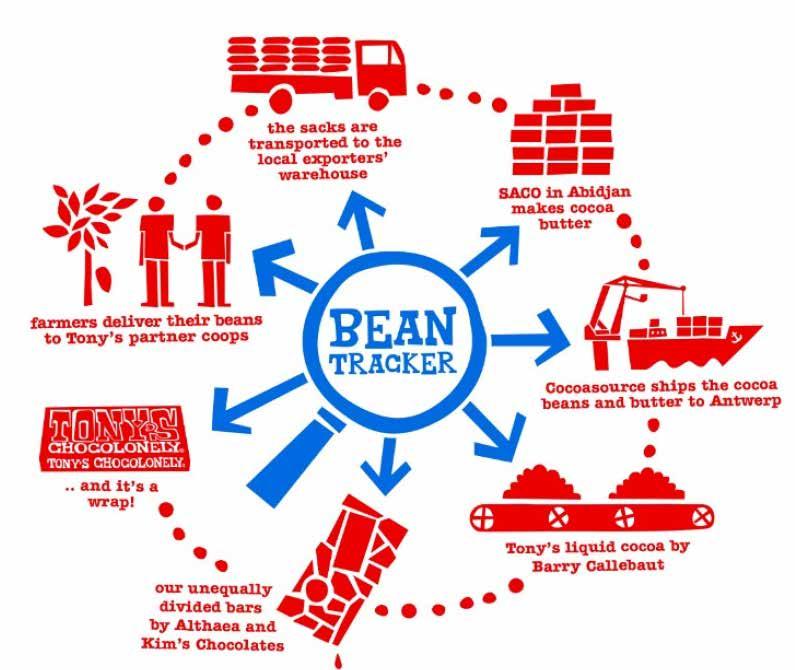
Tony’s has achieved 100% traceable cocoa for their chocolate. For Tony’s, traceability means full transparent bean-to-bar traceability, and knowing the origin, the flow, and the quantities of the beans. Their bean-tracking software system, built using ChainPoint technology, is called Beantracker.
The Beantracker digitally logs the data collection from cooperative to chocolate production and includes a monitoring tool for all actors in the supply chain to see where the beans are at any moment in time. On this shared value chain platform all supply chain actors are connected and enter data about incoming bean volumes, ‘beans volumes on stock’ and ‘bean volumes going out’. This system enables Tony’s to know, at any given moment, the exact volume of beans currently in shipment, data for every shipping container indicating which farmers provided how many beans, and how many beans are being processed.
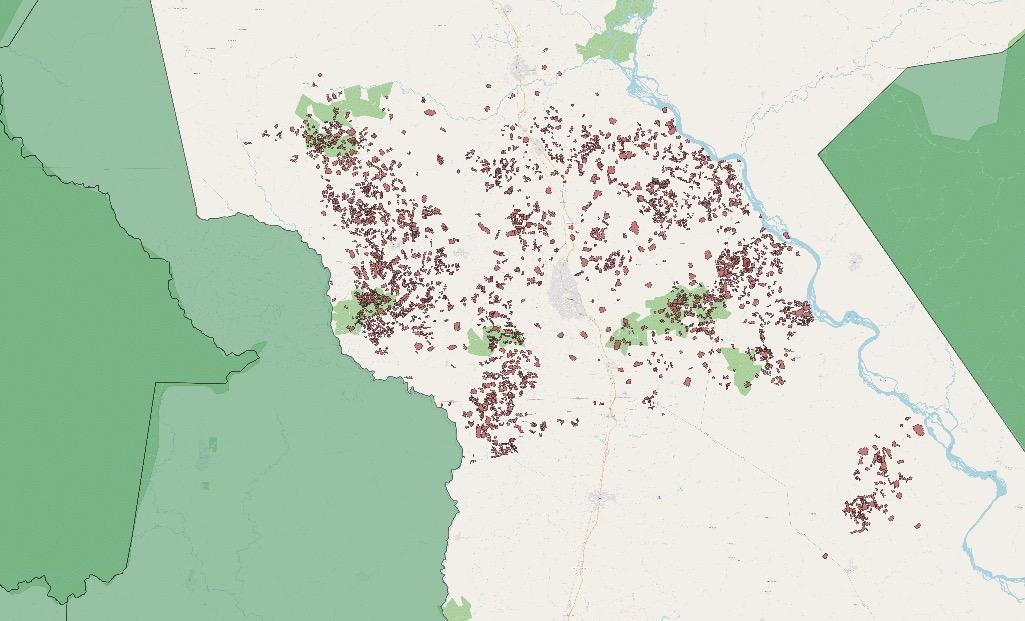
Tony’s is also able to link data sources like GPS mapping data and current productivity levels in Beantracker, which means volume deliveries can be squared with the sizes of the farms, and the system can provide insights into when a farmer has reached his/her expected yield. This way Tony’s gets an understanding when a farmer seems to be exceeding his/her quota and can - via the respective partner cooperative - conduct checks on that farm to ensure that the surplus production has not been attained by expanding into nearby forests, causing deforestation or forest degradation.
To demonstrate that no deforestation takes place, Tony’s undertakes deforestation risk assessments and monitors illegal deforestation through remote sensing technology. 100% of cocoa farms in Tony’s supply chain are GPS mapped and assessed against protected areas and boundaries used by the Cocoa & Forests Initiative via Satelligence, a remote sensing technology company. Satelligence has conducted a land use change analysis for the period from 2001 to 2021. The results of the analysis show that no deforestation or forest loss has occurred since 2001.
Role of Certification
Tony’s uses Fairtrade certification for their entire supply of cocoa, which supports their zero deforestation efforts. The Fairtrade Standard for Cocoa promotes the well-being of farmers and empowers them to protect forests. In the 2021/22 cocoa season, approximately 14,000 mt of cocoa were certified to the Fairtrade Standard for Cocoa. Recent updates to the Fairtrade Standard for Cocoa include strengthened deforestation requirements, which will take effect over the next two years.
Summary
Tony’s unique zero deforestation strategy seeks to empower cocoa farmers to protect forests and address the root cause of deforestation. Tony’s invests in long-term contractual relationships with farmers and provides technical and financial assistance to promote the social and economic wellbeing of their farmer communities, that in turn fosters a sense of stewardship towards forests. Tony’s also strategically uses Fairtrade certification for their entire cocoa supply to promote the well-being of cocoa farmers. Tony’s can work directly with cocoa cooperatives and farmers since 100% of the cocoa they source is traceable back to the farm. Further, the use of geospatial tools has helped with GPS mapping of all cocoa farms, which enables monitoring and demonstrating that no illegal deforestation has taken place. All of these efforts reflect Tony’s deep commitment to make chocolate that is free from exploitation.
Supplemental Resources:
• Anti-deforestation efforts
• Annual FAIR Report 2021/22
• Traceability through BeanTracker
Example of polygon mapping of cocoa farmers in Tony’s supply chain via latest GPS technology