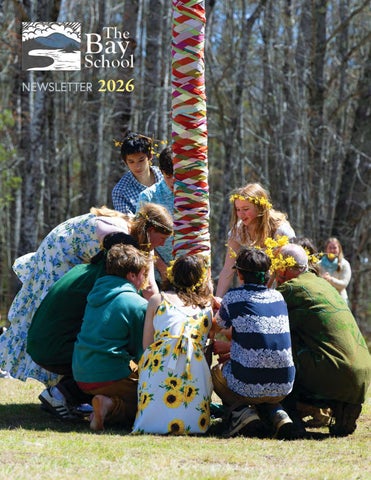
NEWSLETTER 2026
CURRENT FACULTY AND STAFF Tara Nemeth, HEAD OF SCHOOL
Stephanie Aquilina Mariah Baker Lynn Boulger Amy Bramblett Elizabeth Bruno Kialey Brache Laura Bryant Lindsey Canino
Edie Dunham Sasho Emlen Margot Entwisle Katharine Fodnaess Rachel Kennedy Timothy Laflam Zeya Lorio Itzel-Marine Gourmelon Mike McGlone
Moira McMahon Robin O’Connor Meg O’Dell Nikita Pesswani Scott Springer Shona Terrill Michele Turner Jessie Ray Ghigs Razi Paul Valentine Bethany Woods
CURRENT BOARD OF DIRECTORS Holly Arends Murphy,
Tara Nemeth,
PRESIDENT
HEAD OF SCHOOL
Alice Dillon ’11
Abe Noyes ‘07 Ghigs Razi ‘94,
Bill Entwisle, SECRETARY Ashley Hanscom, TREASURER
Jennifer Muscato Sally Mills, VICE PRESIDENT
FACULTY CHAIR
Sally Tomkins Amy Tunney Jan Emlen,
FOUNDER, HONORARY MEMBER
The Bay School,
CONTENTS Letter from the Head of School
2
Sheep as Teachers
3
Olympiad
5
8th Grade Projects
6
Class Plays
15
and cultivating a reverence for humanity
Remembrances
16
and the natural world.
Alumni Notes
17
rooted in Waldorf Education, engages and nurtures the whole child, inspiring a balanced growth of heart, mind, and body,
Letter from the Head of School
DEAR BAY SCHOOL FAMILIES, ALUMNI, AND FRIENDS: I began my position as the Head of School in July, as The Bay School was preparing for the 45th Anniversary celebration. It was a humbling moment stepping into this role, knowing full well that The Bay School has a rich history that predates me and will also have a future without me. The Head of School is one small spoke in a larger wheel that allows The Bay School to continue to thrive. We have multiple bins of old photo albums that we have been sorting through, and the dedication, love, and care that have been poured into the school over the years are evident in all of them. During my first year, we completed a building project in order to expand our Early Childhood program, completed a ten-year reaccreditation self-study, and hosted the 5th-grade Olympiad one week after Grandparents’ Day and May Fest! I was a participant in these accomplishments, but nothing would have been possible without the invaluable support of the other spokes of the wheel. Firstly, the Board of Directors, especially our outgoing President, Holly Arends Murphy, who met with me weekly to ensure I had the support I needed in my first year. The incredible Bay School faculty and staff work tirelessly and collaboratively in service of the school, and I am grateful for each of them. Finally, the wider community, including parents, guardians, extended family members, alumni, and community members, is essential in creating the network needed to support the school. I am inspired and excited to see what the future holds for this very special school and the community we serve. With gratitude and appreciation, Tara Nemeth
HEAD OF SCHOOL
2 | The Bay School NEWSLET TER 2026
Sheep as Teachers THE CONNECTION BETWEEN HUMANS AND NATURE is a primary theme in Waldorf education; it is woven throughout the curriculum. In Agricultural Arts, students study ways humans connect with plants and animals in mutually beneficial ways. In Handworks and Woodworking students use natural materials to create things of beauty and function. Class teachers integrate these themes into main lesson. Fourth graders at The Bay School—and Waldorf schools everywhere—focus particularly on farming, digging deeply into ways humans can nourish themselves and the world We are fortunate to have a 70-acre campus that includes a greenhouse, garden space, and a chicken coop to support this learning. Our chicken coop has been home to various flocks throughout the years. Chickens need year-round care, though, and the students are not on campus in the summer, making it difficult to maintain a flock. Sheep, it turns out, have an annual rhythm that aligns with the school schedule. They spend their summers on pasture eating grass. In autumn, around Michaelmas, as the
students are celebrating the diminishing light and cooler temperatures, the grass dwindles and the sheep are ready to move to their paddock on campus. In May, as we gather to dance around the Maypole in celebration of longer days and green buds, the sheep are ready to be shorn and turned out onto their summer pasture. Thanks to a partnership with local shepherds and Bay School parents, we welcomed a small flock of sheep to campus in the fall of 2024. Tim LaFlam and Suzanne Norgang are Bay School parents and Tim maintains the school’s buildings and grounds. Together, they tend a flock of Merino sheep raised for fiber. Suzanne, a passionate fiber-worker, recognized the potential value of having students experience the entire wool cycle, from sheep to yarn. Lindsey and Teo Canino, also Bay School The Bay School
NEWSLET TER 2026
|3
parents, raise Icelandic sheep on their homestead farm. Lindsey also teaches Handworks. Together they imagined that students could care for sheep in Agricultural Arts and then use the wool from the sheep in their Handworks class. Two years ago, a team of volunteers built a paddock at the edge of the back field near the Maypole. The sheep moved to campus in the fall. Ms. Razi’s students (fourth graders) learned about sheep and how to care for them. Every morning they visited the flock to assure they had fresh water, hay, and grain. Suzanne showed the students an Icelandic and a Merino fleece. The students were able to touch the fiber and look closely to identify the various characteristics of these two very different breeds. Each student chose which fiber they were more interested in working with on a felting project. “For me, the best part of having sheep at the Bay school is that it has allowed us to draw this very visible line between the clothes that we wear and the fiber that we use to the animals that are its source. It’s one thing to know that that is true but it’s another to see it and feel it.” said Suzanne. When spring arrived, the sheep left campus for their summer on pasture. That first year was such a success that the sheep returned to campus again in autumn 2025, this time accompanied by a few Icelandics from the Canino’s flock. Having sheep on campus has given students hands-on experience caring for animals and offered them the ability to learn through observation. Students participate in and witness the annual rhythm of sheep care, helping with both daily and seasonal chores such as feeding and shearing. During each recess, students old and young flock around the paddock to visit the sheep, referring to them by name and noting changes in their behavior and bodies. Students
4 | The Bay School NEWSLET TER 2026
over the past two years have not only studied farming in the classroom, but have been able to integrate that learning into their lived experience. This year, inspired by Suzanne’s flock, one of Mr. Springer’s students chose to raise sheep as part of his Eighth Grade Project (see page 11). With Suzanne as a mentor, he welcomed six lambs. Three of the lambs, triplets, were born to a ewe who was not up to the task of caring for them, leaving three lambs to be bottle fed every 2-4 hours. Being both a new shepherd and a student posed logistical challenges. The lambs needed tending during the school day. Mr. Springer, noting that a shepherd shouldn’t leave his flock, invited the sheep into the classroom. For three weeks, while the lambs were tiny and in need of frequent care, the wee animals came to school. The students did their schoolwork while the lambs napped and wandered about. Classmates helped with bottle feeding and diaper changes. There was great learning both about sheep and about the value of caring for other beings. It was a fitting completion of a circle. Sheep came to campus to extend learning outside the classroom and the lambs, in turn, brought a different kind of learning back into the classroom.
OLYMPIAD
AT WALDORF SCHOOLS AROUND THE WORLD, fifth graders participate in Olympiad, a cooperative celebration of peaceful competition inspired by the ancient Greek Olympics. Olympiad complements the academic study of Greek mythology that is part of the fifth-grade curriculum. Physically engaging in the original pentathlon events—sprint, discus, javelin, long jump, and ring wrestling—encourages deep and meaningful learning. It also serves as a rite of passage for Waldorf students. One fifth grader noted, “After you do the Olympiad you become a middle schooler.”
The Bay School
NEWSLET TER 2026
|5
8th Grade Projects Every year, eighth-grade students supplement their in-classroom learning with an Eighth-Grade Project. Students choose an area of interest and work with mentors to develop skill and
understanding about their chosen topic. The project culminates in a presentation to the school community describing their experience and demonstrating their newly developed expertise. (The descriptions that follow are excerpted from the students’ presentations, edited for length.) Thank you to those who served as mentors for these students, sharing their time and skills: Lynda Allen (baking), Avy Claire (baking), Tim Fisher (metal casting), Ruth Fiske (woolen handworks), Sean Keay (fly fishing), Matthew Murphy (publications), Suzanne Norgang (shepherding), Carrie Palmer (sewing and clothing design), Gray Stabley (genealogy), Liffey Thorpe (genealogy), Michael Whitmore (blacksmithing), Charlene Wiseman (sewing), Goody-B Wiseman (sculpture and casting), and Michael Young (blacksmithing).
Finley Bryant Sculpting in the Lost Wax Method To begin my project, I needed sculpting tools, clay or wax, and a workspace. I already had some sculpting tools from doing pottery and was able to use most of them for wax instead. In early fall, I had an idea for a sculpture: a pawn, detailed with wood grain and vines with leaves growing around it. I spent the first sculpting session working on it. The excitement of sculpting overshadowed any critical thinking. I could be completely free to sculpt without judgement from myself. The problem was that, when I came back the next day, my inner critic showed up. I was shocked by how bad the pawn looked and I put it aside. The rest of that day was spent fiddling with wax and made a sculpture of a little adventurer, but his legs were too thin to hold him up and he broke.
“I can let my creativity flow and don’t have to worry about any clear details.”
In January as soon as I picked up wax, the same excitement and inspiration appeared again. I had the idea of sculpting two small bears. I sketch it out. Goody-B suggested I build the bears up from a base, and heated up some foundry wax, which is the harder wax used for bases, and then layered softer waxes over it to slowly build the shape of the first bear. I continued work on that bear for the first half of January before I tried something else. In between working on the bears I tried another project where I didn’t start with an idea. I started by warming wax in my hands and making little shapes until something began to form. This is one of the most fun things to do. I can let my creativity flow and don’t have to worry about any clear details. I ended up making a small person out of simple shapes, with a small jacket, boots, and big headphones. I returned to working on the bears. I was spending 2-3 hours a day sculpting the bears to meet the foundry deadline. I did make a quick sculpture for fun, experimenting with melted wax to make a mushroom. It helped me to take a step back and refocus, and I finished the bears the night before the deadline. I made silicone rubber molds and wax multiples of my bears so that if there was a casting mistake at the foundry, we would have backups. We dropped the sculptures off at the foundry and watched them being cast. We left the cooling bears at the foundry, and I went home to begin sculpting again. We returned to the foundry near the end of March. It was time to patina my sculptures. We used liver of sulfur and ferric nitrate to alter the surface color of the bears before coating them with wax and buffing them. The bears looked beautiful after this! This experience was wonderful. I am so glad I got to explore sculpting in its process, as well as the freedom of creating. I got to learn about my capabilities and how to navigate situations that make me feel stuck. Sometimes I must do what first feels right and let go. I learned how I sometimes need to take breaks and reset. I am so happy with what’s come of this. I think I will continue to sculpt, as well as create with other mediums.
6 | The Bay School NEWSLET TER 2026
Asa Baldwin Blacksmithing After having many different ideas for projects, blacksmithing came to me from really wanting a sword, but realizing how expensive they were. I thought, “Why not make one?” I met my mentor at his old-fashioned coal-and-bellows forge. We worked together learning the basics of blacksmithing, starting with hammer control. This is a very important skill to learn so that you can aim the hammer where you want it to go. The first pieces I made were fiddleheads (which are spirals) and fire pokers. Then we made a couple feather hooks, which are decorative hooks in the shape of a feather that you can mount on a wall.
“Blacksmithing came to me from really wanting a sword… I thought, ‘Why not make one?’”
I also made a hole-punching tool. First, I hammered a point and then I tempered it. Tempering is when you harden the metal so it will not break when you hammer it into metal. We did this by heating it in the fire, then cooling it in water. Then I filed it. I was able to get the forge at school working again. I spent lots of time there on the weekends making knives, a sword, and many other pieces. I made the sword by flattening out a steel bar so that it had a point on one end and a tang on the other. It took hours of hammering. My hammer control was not great to begin with, so the sword ended up with lots of divots. Luckily, my grandfather gave me an angle grinder for Christmas. He also helped me make the wooden handle. Between the grinder, my whetstone wheel, and my belt sander, I was able to smooth out the blade a little more. I needed a new lamp for my room, so I decided to make one. I made the frame by cutting the bottom of a hollow iron pipe and forging the legs for a base. I forged four legs that curl into a fiddlehead on the ends. Then I welded them all to a square pipe that I could run the wire through. After that, we shined them on a wire sander and heated them with a blow torch so we could apply linseed oil and bowling-alley wax to make it bright and give it a bronze-like color in some places. I started making a second lamp that was shorter with different styled legs. I also learned how to do some wiring. I made a war hammer. I started with an old piece of metal that had a loop on one end and a tail on the other. At The Bay School forge I had tapered the tail of the piece of metal to a point, then I tempered it. I worked on a flat metal square with grooves, and I welded it onto the other end. Then I stuck a metal pipe in the hole between the two pieces for a long handle and added a spike on the top. This project has made me realize that working with metal is a lot more approachable than I thought it was. The process is hot and sometimes physically painful but so satisfying and rewarding because you end up with a functional product. I am content with my one sword…for now. I plan to continue blacksmithing. I will be building my own forge at my house using the forge, anvil, and whetstone wheel from my mentor.
The Bay School
NEWSLET TER 2026
|7
August Deniston Clothing Design Near the end of winter break, I began to sew a pattern for a long boxy jacket. I chose to use a large painter’s drop cloth which I thought would work perfectly as fabric for the coat. Next, I had to learn to read, use, and cut out the sewing pattern. This was the first time I had ever cut out a pattern. Even with help it was incredibly frustrating. Once that process was completed, I had to pin the pattern to the drop cloth and follow the pattern to cut out the fabric. This was even more difficult because the drop cloth was thick and did not want to cooperate with the pattern, pins, or scissors. Once I got to sewing it together, constructing the coat was fun. Overall, I think the coat turned out well.
“I learned a lot about the freedom of improvisation and problem solving.”
My next project was a long-lapeled, hooded, and collared sweatshirt. I wanted to make a modified hoodie. This project started out odd looking because I wasn’t following a pattern for most of it. Instead, I took a pattern for a zipper hoodie, and then completely altered it. I moved the bottom of the body down 7 inches, widened the sleeves, added a shawl collar, and added wide lapels. As I was sewing it together, it began to resemble a Jedi Robe, which wasn’t my intention. I decided to call it a test run and be done with it. Later I went back to it and decided to make it a more functional design. I folded up the bottom of the coat and sewed back the front lapels. Once I did this, I began to feel better about this coat. It has gone from a test piece to a usable piece of clothing that I will wear. After the green hoodie I wanted to make a more refined version in black but after a whole lot of consideration I chose to instead create a completely new pattern for a boxy cropped sweatshirt. For this project I used no premade patterns at all. I sketched my idea for a pattern based on several other hoodies I already had. I used a paisley couch cover for a side panel and an inset patch in the shape of a heart. I also added a cutout from the center of a bandana. For the sleeves, I inserted an elastic to scrunch up the ends instead of a standard ribbed knit cuff. Out of all my projects this one probably went the smoothest. As I neared the end of my project, I decided to make a pair of pants using a patchwork design. My next step was to find a pattern for the pants because I didn’t want to freehand the pattern on this project. Then I laid down all the patches. During this phase, I cut patches from several fabrics including drop cloth, denim, a linen, bandanas, and most prominently a thick brocade from a couch. These pants were my final product and are, in my opinion, the best of what I made. I’ve learned how to look at clothing, to think about fashion, to figure out how things are made, and then, how to make them. I learned a lot about the freedom of improvisation and problem solving. I’ve also learned about dealing with disappointment when things don’t work out the way I wanted them to, and how to use mistakes and turn them into new unexpected aspects of a design.
8 | The Bay School NEWSLET TER 2026
Loretta Dillon Desserts from Across the World I chose this project because I thought if I want to eat desserts, I should know how to make them. The first thing I made was chocolate ganache cupcakes for my class. Making the cupcakes with my dad, and having them taste good, is what solidified my decision to do this project. Next, I picked out several countries I wanted to make desserts from. I thought of countries I wanted to visit. I decided on about 20 countries. I looked up desserts from these countries. I began by making Challah bread. Challah bread originates from Jewish traditions. I was very pleased that it turned out so well, with a firm crust and a very soft inside. It tasted good toasted with jam.
“At Christmas I made three different kinds of cookies. Now, I was a cookie baker!”
I made three pies, two apple pies and one pumpkin. These recipes originated in the United States. One of the apple pies had a pastry covering while the other had a crumble top. I brought an apple pie to a family birthday dinner, and the pumpkin pie for my classmates. Both were a success. I was on my way to being a baker of breads and pies. At Christmas I made three different kinds of cookies. Now, I was a cookie baker! I made flan and churros from Spain. Flan has thick custard on the bottom and a rich caramel on the top. When you are making flan it helps to have two people working together because you must pour and stir the custard and the caramel at the same time. If you are wondering, they were fantastic. Churros are a sweet fritter from Spain. After mixing the churro batter, we put it into a pastry bag for piping. We rolled them in a cinnamon and sugar mixture. They turned out well, very crunchy on the outside and softish on the inside. In January, I made one of the desserts that had inspired me to learn baking: macarons. I made almond shell, chocolate ganache macarons. They were amazing. I assembled more to share with my classmates. I kept them in the refrigerator and they turned out very soft and yummy. It was a fun and hard process. At the end of February, I made croissants with Lynda. The whole process took three days. I made plain, almond, and ham and cheese croissants. For me, learning about baking desserts and how various countries like their desserts to be, felt special and made me want to go visit and try how they would taste in that country. I was also happy to be making food for other people. I really enjoyed it when people liked the desserts. I made 28 different desserts. I learned how to knead, letter fold, fold batter, fold butter in dough, and fry dough. I learned that if you put the crust of a pie in the pie tin and put it in the refrigerator for ten to fifteen minutes, it will help to lessen the retraction while baking in the oven. I learned that measurements must be precise. I learned how to separate egg yolk from white and when making meringue the beater must be extremely fast or it’ll lose air. I learned if you activate gluten too much, the dough will begin to bounce back like an elastic. And I learned it is okay to start over if something has gone wrong.
The Bay School
NEWSLET TER 2026
|9
Esme Filippo Zines A zine can be anything, really. I usually describe zines as booklets. Here’s the tricky part, though: there are zines that are the same size as magazines. So, what’s the difference between a magazine and a zine if they’re the same size? Well, magazines are made by larger companies, with editors and photographers and all sorts of people involved. Zines are independently published, and they’re rarely made by a company. If they are, it’s more like a group of zine makers who use the same photocopier to print multiple copies to distribute and sell. I loved the idea of making zines because they don’t have to appeal to the public-at-large. They can be whatever you want, and some people will find them intriguing.
“I love the idea of making zines because they don’t need to appeal to the public-atlarge.”
10 | The Bay School NEWSLET TER 2026
Zines have been used as a form of protest for years, because they are accessible and independently published. The concept of zines can be traced back to the 19th century, and some even say Thomas Paine’s Common Sense was a zine that gave voice to the American Revolution. Zines are closely linked with punk culture, feminism, and representation of all groups that have need for it. However, zines don’t have to be important. There are many silly ones. I have seen zines about anything from potato chips to knock-off Pac-Man games. Zines are meant to be accessible. They’re inexpensive to make as well as buy, and don’t use a lot of materials. Many are made using just a pencil or pen and paper. My first zine was made using a pencil, a sheet of paper, Mod Podge, and scissors. After I made a zine as a class assignment, I decided on a subject for my next one. I spent a lot of time on it, because I had to research, find free images, and write an entire 14 pages about the History of Georgian Era Make-up. In all I successfully created eight zines. I had a lot of fun with this project. I was able to improve my writing skills and learn about the subjects that I made zines about. Zines were a great way for me to express myself creatively, while also writing about things I like and am passionate about. They also covered my hands in Mod Podge for a long time, because for about a third of this project, I didn’t have a glue stick. This project taught me many things, from history to paper-folding techniques. However, one of the most valuable lessons I learned is that not everything is a contest. There are times when it feels like it’s me versus everyone and everything else, partly because I’m a competitive person. I learned how to ask for help from my friends and family. I have many people in my life that are willing to help, I just must ask for it. I was also afraid of what people would think. Sometimes I regard my life as essentially a giant Pinterest board, picking and choosing what to share with people. However, this project helped me see that I don’t need to be afraid of being weird, or the wrong kind of weird. For this project I needed a lot of willingness to learn. I spent a lot of time learning about new subjects. It was important to me because I think that a zine is a fun way to learn about something, and it’s accessible to many people.
Odin Murphy Raising a Flock of Fiber Sheep I chose this project because of my love of animals. I like that sheep don’t need to be killed to be useful. I have wanted sheep for a long time, and this project was the perfect way to convince my parents. As soon as it was decided that we would get sheep, I started lobbying for llamas, alpacas, and angora rabbits as well. To start my flock I borrowed three ewes and a ram. We put them together on October fourth in hopes that they would have lambs by presentation time. After the lambs were ready to be weaned, they would become my flock. The sheep needed regular care over the course of the year which included routine checkups, hoof trimming, injections, and crutching. They spent their first month grazing in our back field while I built their winter paddock, a hay feeder, and an enclosure inside the boatshed for shelter.
“I like that sheep don’t need to be killed to be useful.”
I moved them into their winter paddock. Every morning, I woke up far later than I should have and spent about twenty minutes feeding them. Using ultrasound we confirmed they were all pregnant and expected four or five lambs. Ruth helped me with the fiber part of the project and gave me two fleeces of wool: one for me to experiment with, and the other to make a felted sheepskin rug. I have been interested in making this kind of rug ever since seeing one at the Common Ground Fair last fall. I focused on dyeing, felting, and spinning, but to get the fleece ready I first had to skirt it, which is when you remove any undesirable wool usually from around the edge. I did as much wool work as I could before the first lamb came. Leah-Lochra lambed first. I was at school when my mom came to pick me up for the first lamb. When we arrived, there was already one born. He was big and adorable, and very playful. I decided to name him Oslo. The second birth was Bodie’s. She had an easy birth. She was a first-time mom, and we expected only one lamb from her, but to our surprise she had twins! They both came without needing any help. They were girls and I named them Gnocchi and Nori. Myrna was last, and she was having trouble. When we got out to her in the she had given birth to one already. Because of the ultrasound and how big she was we were sure she had twins. There were no more signs of birth for three and a half hours. We were getting concerned so I held Myrna steady while my mom pulled a second out. After another ten minutes when Myrna was acting weird, we checked for another and pulled the third out a minute later. Myrna was not interested in any of the three lambs for several hours. After eight hours she had made no progress with them. We gathered them up and brought them inside where they would need to be bottle fed and diapered. They slept in my room, usually in my bed. I named them after the Roman Fates: Morta, Decuma, and Nona. Because I needed to feed them so often, they came to school with me. They ate, slept, and walked around the classroom. These six lambs are my flock. Coming home to sheep, standing there, waiting for me expectantly, is amazing. And who knows, maybe someday I’ll have llamas, angoras, and alpacas too!
The Bay School
NEWSLET TER 2026
| 11
Kavi Starr Metal Casting For a long time, I have been experimenting with some small tin and zinc casting, but nothing ever really turned out the way I wanted. I decided I would finally learn how to cast small objects out of different types of metal. I started with a metal with a very low melting point, tin, because it’s the easiest to melt. It has a melting point of only 450 degrees Fahrenheit, which means I could use a stove. The great thing about tin for a casting material is that when molten, it has a very low viscosity, which means it flows well into small parts of the mold before it solidifies.
“With the explosion problem solved, I tried again.”
Sand casting is a technique where you carve the desired product out of wood, and then you pack damp sand around it to form an imprint. Then you separate the layers of sand and remove the wooden piece to leave behind the cavity into which you pour the metal. It’s less precise than lost wax, but if your cast doesn’t work, it’s easy to make a new mold. I made a tin heart, a cube, and an ornamental spearhead. Once I felt comfortable with tin, I progressed to bronze and was immediately greeted with innumerable unanticipated problems. The biggest difference between the metals is their melting point. Tin is relatively tame and easy to handle. Bronze, on the other hand, has a melting point of about 2200 degrees Fahrenheit. Anything that encounters it instantly ignites. The first thing I tried to make was a simple bronze cube. When I poured the molten bronze into the mold, the metal immediately bubbled and caused a steam explosion that threw molten metal everywhere. I contacted my mentor to help me. He said my sand was too wet. The excess water was boiling off and causing the steam explosion. The sand had to be just damp enough to hold together around the form, but not so damp that the water would boil. Sand casting is as much an art as it is a science. With the explosion problem resolved, I tried again, but a new problem arose. The top of the cavity was not being filled. When you cast something, the hot bronze fills the mold, but then as it cools, it contracts or shrinks and can create a hole, or bubble, in the casting. At first, I thought it was an air bubble, so I tried switching to aluminum instead of bronze, because aluminum’s lower melting point would allow it to have more time to push out the air before it cooled and hardened. This made it much worse. I knew that aluminum’s shrinkage is much higher than bronze’s. I just didn’t know what to do about it. I called my mentor and described the issue. That’s when I learned about risers. The riser functions as a reservoir of molten metal, and when your casting shrinks, it draws more molten bronze from the riser to fill in the shrinkage. I added a riser above my casting and that pretty much fixed the whole thing. I love to figure things out on my own, and sometimes a little help can really make a difference. I thought this project would be straightforward and easy to complete. I had some experience with forges and metal work. But it was, frankly, humbling. There were so many problems! From leaking propane valves, shrinkage, moisture levels, or bubbles. Thanks to my mentors, I learned a lot about casting semi-complex structures in sand.
12 | The Bay School NEWSLET TER 2026
Adelaide Trotter Genealogy Genealogy is the study of family history and how you are connected to your ancestors. I first became interested in genealogy because of a book of family history that my great-grandmother, Jean Kitson, wrote. I decided to put the information from the book into an Ancestry.com account and I started finding different records for my ancestors. I thought it was amazing how I could find information and records about my ancestors so easily (and sometimes not so easily).
“I added over a thousand people to my family tree.”
Most of my project involved working at my computer as I built my family tree. I have discovered whole branches of my family that I didn’t know anything about. While working with my mentor, she taught me how to confirm the information in the book and learn new information by searching for different kinds of documents. Some of the basic types of documents that I learned about during my project are birth records, marriage records, death records, and census records. These records can give you a lot of information about people’s lives. I’ve also spent time looking at newspaper articles and obituaries. One of the challenges of genealogy is different spellings of last names. It makes it difficult to search for documents for a person because they could be listed under a different name. One reason for the different spellings is that when someone moves to the United States they sometimes change their last name to make it easier to pronounce. One of my favorite documents that I have used throughout my project is the United States Federal Census. It has been taken every ten years since 1790 to count the number of people residing in the United States. At first, the census only recorded the name of the head of household and ages of the other residents. They started to ask for names of the other residents of the household in 1850. They started asking more detailed questions like your marital status, where you were born, or even in the 1930 census whether your household had a radio. The most recent census the public can look at is the 1950 census because they are not made public until 72 years after the information is collected. Over the course of my project, I added over a thousand people to my family tree. I chose to print my direct ancestors up to seven generations. It shows from me up to my sixty fourth great grandparents! I learned a lot about my family history. I really enjoyed finding different things I didn’t know about my family. I learned that it is important to document family history so it doesn’t get lost over time. There are parts of my family history that I wish were better documented. I am happy with what I accomplished so far. There are some things that I still want to explore more, like my dad’s side of the family. It was interesting for me to learn about what my ancestors’ lives were like and some of the challenges that they faced. And I would love to visit some of the places where my ancestors lived. I especially want to visit the Azores and Ireland. I would encourage everyone to learn about your family and ancestors. Genealogy research involves patience and good observation skills. Some of the time you’re not going to find anything at all. But Genealogy is worth it.
The Bay School
NEWSLET TER 2026
| 13
Olivier Viennot Fly Fishing I chose to study and explore the art of fly fishing. My grandfather, Bill Tomkins, also loved fly fishing. He spent a lot of time fishing in remote areas all over Maine and had many stories. He left us all his gear. He had everything I needed to be able to fly fish in Maine. There are many different types of fish in Maine: rainbow trout, largemouth and smallmouth bass, and salmon. They are found in rivers, ponds, and lakes. Fly fishing is different from fishing with a spinning rod. Instead of bait and weighted lures, fly fishing uses artificial flies that are made of little pieces of feathers, hair, and sometimes some small pieces of plastic all tied together. They are made to imitate real flies and other insects that land on top of the water which fish like to eat.
“You are trying to fool a fish. And they are smart!”
You also cast differently than in regular fishing. In fly fishing, you use the line like a whip, and you lay it out onto the water so it looks like an insect has fallen onto the surface of the water. To get started with fly fishing, you need a fly rod, which is lighter and more flexible than a spin fishing rod. You need a fly reel to hold the line, and you need a fly line, which is thicker than a normal fishing line. Attached to the fly line is the leader, which is used to connect the thick fly line to the tippet. The tippet is what connects the leader to the actual fly. Earlier this year, I went fly fishing on Mexico’s Yucatan peninsula. The Yucatan is one of the most exciting fly fishing destinations in the world, home to tarpon, bonefish, and snook. The warm waters and protective mangroves of the Caribbean coast create the perfect habitat for fish. One of the most time-consuming things is remembering all the knots. You need to learn how to cast and it is difficult to make your fly seem like a real fly or insect on the water. You are trying to fool a fish! And they are smart! What really makes a fly fisherman stand out is their knowledge of the local ecosystem. It’s hard to know which fly you should use for the type of fish you want to catch, where the fish hang out, and which place in the river is the best for catching them. Getting started was not only about using the gear. It was also about learning from books how fish behave and how to move in the water without scaring them. One of my goals for this project was to catch at least one fish, and I managed to catch four fish, including two 18-inch baby tarpon in Mexico. I want to continue fly fishing because I think it’s really satisfying to catch a fish with a fly that you make yourself. Fly fishing doesn’t care how bad you want to catch a fish. Fish will ignore you if you’re sloppy or impatient. That’s a lesson I’ll carry with me beyond fishing. If I had to sum up this project I’d say it demanded patience, and a sense of humor. There were plenty of cold mornings, tangled lines, and flies that looked more like an arts and crafts project gone wrong than an actual insect. I like where I ended up, and I know I’ve only opened a door.
14 | The Bay School NEWSLET TER 2026
Class Plays
A Christmas Carol 8th Grade
Into the Woods 6th–7th Grade
The Wonderful Wizard of Oz 4th–5th Grade
The Bay School
NEWSLET TER 2026
| 15
In memory
George Emlen By Sophie Spurr
IT WAS IMPOSSIBLE to not love George! He made music and life fun! He was The Bay School’s troubadour since his wife, Jan, founded the school 45 years ago. I solicited memories from my kids and others who were there in The Bay School’s early days: Jocelyn Kaley Kaye ‘92, Kate Tomkins ‘93, Karina Chase Dailey ‘92, Rosie Chase ‘95. Their memories include:
Paula Runge Dick By Catherine Razi
PAULA AND HER DAUGHTER, Sally, came to The Bay School in 1995. Over her ten years at the school, Paula served as kindergarten and games teacher. She was a mentor to many, including Merrie Eley, who worked with her for eight years. Merrie notes, “She mentored me in the wonder of a Waldorf kindergarten. It was a sheer pleasure to work alongside Paula as she modeled creating a warm, loving space for the children. I carried all that she taught me through my 28 years teaching in early childhood.” Paula’s openness and warmth made her a beacon of the school’s sense of community. She could be counted on to run Olympiad, be out on the field organizing games for the kids on festival days, and gustily joining in May Day dances! When I called her recently to reminisce about her mother, Sally shared that joining The Bay School was a dream come true for her mom. She described her mother as charismatic, generous, thoughtful, and determined. I concur, and would add courageous to the list as well. Even in the face of adversity, she was committed to focusing on the positive and finding the way forward. Paula’s enthusiasm and easy laughter were irrepressible. We always say that what matters most in a teacher is the human being reflected in the children, and Paula’s heart and joyousness infused her students with enthusiasm and a sense of being loved, safe, and capable.
16 | The Bay School NEWSLET TER 2026
•
He was the Pied Piper of the Land! Dressed in knickers with bells tied around his legs, he led us all through the church singing ‘Lord of the Dance.’
•
He was so warm and open-hearted, with a great bellowing, yet soft, laugh.
•
He was always at May Fest, leading all in song around the Maypole with his accordion.
•
He always looked you straight in the eye, wanting to really talk and know how life was going.
George was a dear friend. He wrote wonderful poems for those close to him, including me, for birthdays or special occasions. He and Jan drove up from Cambridge after my husband, Peter, died to lead us in singing “The Parting Glass.” That meant so much to us. Both George and Jan understood that songs, games, and music connect children, changing them from the inside, helping them to learn and grow. George had the gift of bringing out the song in all of us, young and old. His enthusiasm and joy for music were contagious. He will be deeply missed, but his legacy lives in our children and scores of others.
Alumni Notes Stefan Blanchard ‘05 is a real estate broker in Blue Hill, owner of First Light Reality and also works as a firefighter. Stefan is back at The Bay School attending Star Garden with his two-year-old, Amelia! Sylvia Burns ‘17 will receive a masters in science in Civil Engineering from Northeastern University in Boston this year. Sean Coolidge ‘25 and Linus Murphy ‘24 reunited on the tennis courts at George Stevens Academy where they play doubles together. Katie Herklotz ‘05 works in insurance and lives with her husband and flock of backyard chickens in Gorham. Tommy Norgang ‘19 is a nursing student at the University of New England and is working as an Emergency Medical Technician (EMT) at Cape Elizabeth Fire. Vincent Ossanna ‘09 is a licensed Maine arborist working in landscaping as well as keeping utility lines clear of trees. After a year of working in early childhood education, Magnolia Vandiver ‘16, is heading to Omaha for a monastic service year with the Benedictine way. She will help lead daily worship and work in the community gardens supporting the local food bank. She will also be marrying her darling Caleb Briggs (pictured) next May, and credits The Bay School for my ambition to make almost everything for the wedding!
Clockwise from top: Stefan Blanchard ‘05, Vincent Ossanna ‘09, Magnolia Vandiver ‘16, Tommy Norgang ‘19, Katie Herklotz ‘05, Sean Coolidge ‘25 and Linus Murphy ‘24.
The Bay School
NEWSLET TER 2026
| 17
PO Box 950 Blue Hill, Maine 04614