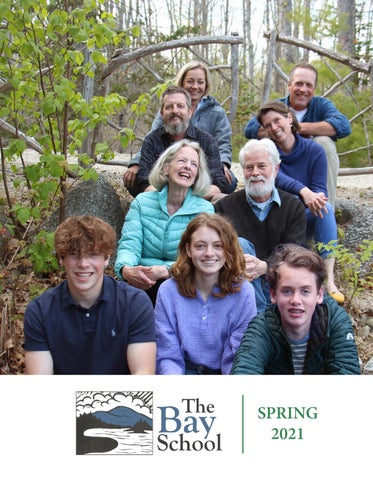
SPRING 2021
Marcia Diamond Head of School
Few school years have been so transformational for The Bay School as this one. And it wasn’t just because of the pandemic. Understandably, COVID-19’s threats to our school community’s health and safety sparked many of the changes that were adopted prior to and over the course of the school year. In true Bay School fashion, faculty, staff, parents, students, and friends collaborated to conceive and implement the necessary facility modifications implemented on campus. To paraphrase the well-known African proverb, it takes a peninsula to educate a child. As difficult as this “pandemic era” has been, we continued to find ways to enhance the quality of The Bay School’s educational offerings. Our curriculum—one that has always emphasized experiential learning and attention to the natural world and the environment—became enriched by the challenges and opportunities of outdoor classrooms. Our campus grounds became even more of a valued working lab for students; their time outside encouraged and enhanced topical lessons about the science of viruses, climate change, thermodynamics (everyone had to keep warm!) and many more. The outdoor learning experience has been positive and memorable, and the educational value of what we have gained will help guide future curriculum development and practice. The 2020-21 academic year was transformational in other ways. Further motivated by principles and world events, the faculty delved even more deeply into a coordinated study of systemic racism and the social, cultural, and educational importance of diversity, equity, and inclusion (DEI). For the faculty, this is a continuation of their own personal journeys to understand the experiences and perspectives of people of color in the U.S. It is also a continuation of ten years of DEI-related professional development work that we have pursued in both small groups and as a full faculty. Elements of these important topics were incorporated into age-appropriate lessons during the academic year. The faculty will be doing the same next year and in the years to follow. If education is supposed to help us learn how to meaningfully navigate the world, understanding its nature and complexities is essential. We also celebrate a significant moment in the school’s history this year: an alumni parent is now seeing not only her first, but now her second child become a Bay School alum as well. Enjoy reading about the Robbins/Tenney family who have been part of The Bay School for 40 years! Finally, we always enjoy hearing from our alumni and learning about their accomplishments and adventures. Many this year reflected on the importance of their Bay School years. Enjoy reading all their stories! Best wishes,
Marcia Diamond Head of School
The Bay School Answers The Call
Covid has a place in the history books. This time will forever define the generations that lived through it. People will ask us, “What it was like, how did everything change? What was it like to go to school?” Like a thief under the cover of night, Covid took with it our sense of normal. Schools around the world, including The Bay School, set out to find their own new normal. If we couldn’t be the school that embraced community with festivals and song, theater productions that gave our students unencumbered access to each other, or endless moments of huddling around an intellectual idea and being curious together, then who were we? What was to become of a school so deeply rooted in connection? Could we thrive? What could we find to be thankful for in this strange time?
The Bay School community answered the call to live and work by the rules of nature in a way we have never been asked to do before. Marcia Diamond, Head of School, recalls, “I can’t count the number of times I have said, ‘Covid pushed us outdoors.’ Our program, already rooted in nature, demanded that we spend even more time learning outside and embracing the elements. Looking back to the fall, it was clear that with each week of school, the weather shifted, and we had to figure out a way to shift with it. Keeping step with this new dance partner actually became part of our curriculum of learning. Students were able to flex in ways that surprised us—I can only imagine how this confidence will benefit them in the future.”
Teachers and parents in The Bay School community spent hours building outdoor structures and furniture that would help extend our time in the fresh air and promote focused academic learning. We kept fire pits lit all winter long remembering the importance of keeping our bodies and our souls warm.
Here we were, around fire pits, facing each other, learning from each other, organically, in our very own open-minded environment. Could it be that our little school was seeing new and beneficial ways of learning from each other sprout in this challenging time?
We had a growing sense that those who came before us, those that insisted on following nature-based learning methods, creating a strong foundation of observational curriculum, and supporting our deep Waldorf roots, were with us still and guiding us.
We committed CRF (Covid Relief Funds) to our Early Childhood program to outfit each child with well-made, warm, windproof, waterproof bibs and coats so that no child would feel encumbered by the lengthy explorations outdoors in all weather. The program was so successful, we then invested in individual nylon hammocks tied to sturdy trees with tent coverings to give each child an afternoon cozy, cocoon-like, safe rest space from which they sprung like butterflies!
We were determined to continue as many traditions as possible: first grade partners found ways to spend time with their eighth grade partners, and ukuleles were purchased to create music to replace classroom singing.
Mr. Chittenden’s 5th/6th Grade class made good use of the pizza oven turned outdoor stove, that had been designed and built by students as a result of a particularly inspired geometry block a few years back. We must ask some of our other traditions to wait patiently just a little longer, from Friday morning sing, to Winter Faire, to the always special Grandparents Day. We will be together soon. We miss our wider school community. It’s hard work for families and teachers alike to exist in our temporary new normal. Yet we revel in what we have created in its place.
With masks on, we have all learned to look each other in the eyes and find expression. For that, we are thankful. We are bolstered by an incredibly strong foundation from those who have come before us at The Bay School. For that we are thankful. In this time of covid, we stand so solidly on all those shoulders. And for that we are incredibly thankful.
A MISSING PIECE One of the many Bay School celebrations that we hold dear is our annual Grandparents Day. On the Friday before May Fest, we invite grandparents and special friends to our school to spend the morning with the children. Parents volunteer to bring in flowering branches and early spring bouquets, children ready their desks with paintings and work to show, and the faculty create special lesson plans inviting all to participate. There is group singing, Main Lesson Book viewing, and lots of smiles as grandparents and grandchildren huddle together over classwork that has been accomplished over the school year. Always joyous, always bustling, the day culminates in Emlen Hall with class performances followed by a plated lunch for our honored guests. It is that rare time when we open our school to others, and in doing so, our school community triples in size for the day. Of all the celebrations that The Bay School has had to put on hold due to the coronavirus pandemic, this one has had deep impact. Schools were not the only place that grandparents were avoiding. Everyone across the country was trying to keep this generation safe. For many, that meant that these children weren’t seeing their grandparents at all. Not only did one of our favorite days of the year get canceled two years in a row, but our families were experiencing a lockdown from each other that none of of us could have imagined. This year, we came up with an idea to bring the oldest and the youngest together in another way. Parent Robin O’Connor, an invaluable volunteer in the extraordinarily busy school office, also happens to be a gifted photographer. About halfway into the school year, it became clear that she was capturing life here at the school with such beauty in her photography that we had at least two, if not five, pictures of each child to document our unusual year. Thoughts immediately turned to finding a way we could send these
photos to the grandparents. We designed a card that would let our honored guests know how much we would miss them again this year with the idea we would tuck some pictures inside. But then we had another thought: would the faculty be willing to write a little note about each child to be included in the card? When approached, the class teachers answered with a resounding yes! Given their year, and the energy and creativity it takes to teach in these challenging times, their answer so clearly meant that they too were missing this special interaction. These cards were sent out in mid-May reaching populations from as close as Blue Hill to as far as France and Australia and just about everywhere in between. We hope they were received well and that they help to tell the story of a year that has been challenging at its core but has also been a year of resilience and growth. We can’t wait to have grandparents on campus again soon. We miss them so much!
DIVERSITY, EQUITY, AND INCLUSION AT THE BAY SCHOOL A PATH FORWARD The Bay School affirms and celebrates the inherent dignity of all people. We recognize that the world we live in is shaped by vast disparities in opportunity based upon identifiers such as race, social class, gender and gender identity, home language, sexual identity, learning profiles, and physical ability. Too often, educational structures and systems reinforce and recreate these disparities. The Bay School is an intentional community and not an incidental one. Our equity, inclusion, and diversity work is about deciding who we want to be and making a deliberate and concrete commitment to creating that community. -Holly Arends Murphy, Board Chair
In recognition of these documented realities, The Bay School is committed to conscious efforts to address the impact systemic oppression has on our school and community. We must actively seek, identify, and confront our own complicity in order to provide our students, their families, and our community with an educational experience that is generative, nourishing, inclusive, and equitable. These efforts must be sustained and integrated into every aspect of our educational and institutional evolution.
We highly recommend these resources because we have personally experienced them and found them valuable to our learning. The following list includes resources we’ve worked with individually and collectively, and we invite you to engage with them as well.
BOOKS My Grandmother’s Hands
Resmaa Menakem White Fragility
Robin DeAngelo
SELF-EDUCATION We have long valued the ongoing process of self-education. Our work with DEI has been a fertile place of both professional and personal growth. Internationally, the movement for social justice and racial equity is energized by many important individuals and organizations. Books, podcasts, webinars, trainings, workshops and faculty conversations have guided and advanced our understanding. The footer below features some of the resources we have found most valuable in helping us. If any are unfamiliar to you, we invite you to dive in. Thank you for joining us in this path of healing. THE E VOLVING CURRICULUM In light of this evolving understanding, the faculty’s ongoing work of curricular review has had a direct impact on school policies and educational practices, including leading to diversity, equity, and inclusion shifts in the curriculum. We recognize that this close examination of our curriculum, and the imperative to educate towards justice, cannot be finished until true equity exists. Below we offer but a few examples of ways this work is informing and refocusing our curriculum across the grades.
So You Want to Talk About Race
Ijeoma Oluo
Unpacking the Invisible Knapsack
Peggy Macintosh (article)
Supporting Gender Diversity in Early Childhood Classrooms A Practical Guide All the Colors We Are The Story of How We Get Our Skin Color (Early Childhood)
What We Believe A Black Lives Matter Principles Activity Book (Early Childhood) The Sum of Us
Heather McGhee
PARENT / CHILD & EARLY CHILDHOOD Compelling research has shown that infants as young as six months can notice differences in skin color. More strikingly, children under the age of five can detect nonverbal messages about race. Given the highly absorbent nature of the young child, these important truths must be embodied in our teaching and modeled behavior. Our parent/child and early childhood programs have begun to more actively engage parents in conversations about diversity, equity, and inclusion, including sending home articles and sharing information about local workshops. Additionally, we’ve begun offering tools for engaging the very youngest children in an age-appropriate way in these essential conversations. In the classroom, we strive to view every story through a DEI lens, and we are making important narrative changes towards racial justice. Likewise, we are making sure that the children’s books in our classroom illuminate a balance of diverse realities and portray multiple perspectives. Lastly, we are making sure to catch and amplify the “teaching moments” when we hear conversations or comments from the children in the classroom which bear examination. Young children learn through imitation and by watching what the adults around them do and say. We model inclusion and teach the children to love and respect each other and all those around us and to value our differences.
The more I learn, the more I listen, the more I ask...the less I seem to know in regards to this work. What stories, drawings, books, poems, and interactions should I choose? Whose permission must I ask to use them? And how do I use the gift of those mediums to offer our children a learning space that will enable them to grow and exist in a way that causes less harm to this earth and all of its inhabitants? What choices can I make that will, perhaps, open a path forward for them to use their own strengths to help this world heal? In some ways these daily considerations feel insufficient to the scope of the task, but this is a place to begin. -Tobyn Oxman, First Grade Teacher
THE EARLY GRADES: 1 - 4 The curriculum of the early grades also reflects changes arising from our DEI work. Storytelling in these grades, too, is an essential part of our curriculum. Teachers in the younger grades are now all the more committed to working with a variety of world stories, often with explanations beforehand to help create clarity around context. Teachers are delving closely into from where story sources are derived. While working to preserve the essence of the story, we are combing the details in stories to allow for a broader perspective. The greatest gift that our equity work has offered me is the opportunity to keep questioning my own practice as a teacher. Delving deeper into bias, representation, and from where and from whom stories arise has expanded the range of my own lessons. As I develop curriculum plans, I am stepping aside from lessons that are shaped by white patriarchal histories and seeking a greater breadth to all of my lessons. I feel grateful for this ongoing work. -Kristy Cunnane, Lower Grades Teacher
Examples of this include eliminating the common theme of men giving women away as a commodity; telling stories with gender neutrality; and making sure to represent a variety of skin tones in our drawings and tellings. We are including stories connected to community, equity, social action and stewardship of nature as integrated aspects of main lesson work. We are consciously telling stories of this Penobscot land that we are on and of the Wabanaki People. More broadly, we are making sure our classroom library has picture books and stories from a variety of cultures and perspectives as well as diverse authorship and characters. Related to this, we are consciously trying to counteract the “single story” by bringing to the class discussion topics including culture, patriarchy, biography, stereotype, injustice, poverty, power dynamics, consent, kindness, loss, family structure, and manifestations of love. Again, these themes are approached through the implicit power of storytelling and direct teaching moments in the social life of the class.
How to be an Antiracist….Stamped from the Beginning
Ibram X. Kendi
DEI RESOURCES FOR CLASS WORK
Indigenous Peoples’ History of the United States YA
Pollyanna Racial Literacy Curriculum
Between the World and Me Ta-Nehisi Coates
People’s History of the United States YA
Stamped
TRAININGS
Waking Up White Debby Irving
Howard Zinn
Roxanne Ortiz-Dunbar Ibram X. Kendi Now Is Your Time
Walter Dean Myers
Peace Literacy with Rivera Sun Racial Equity Institute
THE MIDDLE SCHOOL: GRADES 5 - 8 Our middle school curriculum has also benefited from the school’s commitment to DEI work. We are increasingly mindful of the power of the stories we select and the ones we neglect to tell, and we are being careful to ensure we are choosing a wide range of histories, perspectives, and cultures to represent. We are making use of our young adolescents’ questions and perspectives, guiding lessons through inquiry and active listening in discussions, and structuring the students’ growing self-awareness to include tools for speaking up in the face of injustice, environment, climate, service to others, and uplifting ideals of what the future holds.
EDUCATIONAL SUPPORT Our educational support program also is adapting and making adjustments in accordance with core curriculum adaptations. This includes those teachers pre-reading all material to look for language that is not inclusive or that actively perpetuates harmful narratives. We also continue to incorporate material and projects that challenge students (and staff) to see others’ perspectives. As a whole, we are striving to create an ever more robust educational support program, with a focus on understanding the wide spectrum of learning profiles and supporting teachers in delivering curriculum that meets all students.
In the classroom, examples abound. We are reworking, reimagining, and re-creating lesson blocks to more fully embody racial and gender representation. We are challenging and reshaping the “single story” mindset and committed to offering other perspectives so as to actively participate in the reformation of American white male primacy. We are creating distinct modules of DEI inquiry and emotional/social empathy. In the block “Perspectives on US History”, we now follow a more overt arc of Indigenous, African, white European, women’s experience and immigrant as the lens through which the foundational elements of American identity and society are formed.
Indeed, we don’t know what we don’t know. We must all participate in doing the work to understand systemic racism— and all systems that oppress individuals—to effect change in our school, our community, our state, and beyond. I am grateful to be in community with others who understand this importance.
I feel that through this work The Bay School is living up to and into its mission more fully with each passing day. I am grateful to be part of a community of teachers and parents dedicated to growth and meaningful change.
-Marcia Diamond, Head of School
THE PATH OF HEALING Our commitment to this work is unwavering. Since The Bay School’s founding in 1980, the school’s mission to educate all children has closely aligned with this work. Grappling with and coming to deeply understand systemic injustice is an ongoing process. Through this work we guide the school to realize its potential to serve all children and our community. In this way we align ourselves with human progress towards equity as the new social covenant.
-Ian Chittenden, Upper Grades Teacher
Across the grades, an important part of our work has been in the realm of self-education. We have enrolled in a wide variety of forums to further our own understanding of these important issues. Workshops, discussion groups, independent reading, podcasts, and collective faculty work have all contributed to expanding our awareness of systemic issues and given vital context to the urgent call of contemporary anti-racist teaching and learning.
Rootedkids.org
Laleña Garcia is an Early Childhood teacher
WORKSHOPS
REACH- History of Maine Tribal Nations
Anti-Racist Table 30 Day Challenge
WEBINARS
Ibram X. Kendi AISNE regional webinar
ONLINE RESOURCES Yes! Magazine
Facing History and Ourselves Teaching Tolerance aka Learning for Justice BARWE Building Antiracist White Educators Zinn History Project Safe Space Radio Based in Portland, Maine
MEMBERSHIP IN DEI/ TRUTH AND RECONCILIATION GROUPS Equity in Education/Readings on Race (local Blue Hill group) Wabanaki REACH
Three Generations and Four Decades of Celebrations at The Bay School: The Robbins Family When teenager Zoë Robbins was applying to colleges, she submitted an essay to Harvard. In the margins of her paper, she included a drawing of The Supreme Court along with other art along the edges. “That’s what we learned at The Bay School,” she said, “When you finish something important, it should also look like a work of art.” Her application impressed the admissions office. She was accepted at Harvard, but instead chose to attend Wellesley. Still, it made her point. It’s life lessons like that that have shaped Zoë’s worldview. Long before their son Oliver was old enough for school, Zoë had convinced her husband Keith Tenney that they needed to relocate from their home in Washington County to Blue Hill in order for Oliver to experience the educational enrichment that she herself had enjoyed at The Bay School. She realized how inspirational her own experience had been, and she wanted their children to have those same opportunities. That was 2008. Two years ago Oliver graduated from The Bay School and is now attening George Stevens Academy. Zoë and Keith’s younger child, Ansel, will be graduating from The Bay School in June. His departure represents a milestone, both for the family and for the school: it will be the first time in 41 years that a member of Zoë’s immediate family will not be a daily presence at the school.
A Family Matter Zoë’s parents, Judy and Peter, were involved in The Bay School from its beginning in 1980. When Mary Rousseau generously offered her seasonal home on Blue Hill’s Beech Hill Road as the site of the start-up school, Judy and Peter worked closely with Jan Emlen, the school’s founder, to transition the main building and barn into something more like a schoolhouse. It served that purpose until the current campus opened in 1991.
Above: Zoë Tenney ‘89 Kindergarten 1980 Below: Isaac Robbins ’86 up in an Apple Tree at Apple Fest 1981 Opposite Page: Zoë Tenney ‘89 pictured with Ansel Tenney ‘21 moments after completing his 8th Grade Project 2021 Above: Peter Robbins (Center in the white cap) during the first Apple Fest 1980 playing tug of war on the original Rousseau Campus. Below: Judy Robbins (far right with yellow ribbon) during the first May Fest 1981
“In the year leading up to the opening of the school, Peter was involved in a working group of parents looking at the potentials — and possible hurdles — of a new school,” Judy explains. “Jan produced the structure and legal requirements, staffing, budget, curriculum, as well as securing our ‘home’ in the Rousseau house, which required a spring and fall transformation from school to home and back again, performed with great care by the parents. “Looking back I see that we were pioneer families in a sense, but at the time we were simply driven by a search for excellence in education,” Judy continues. “As in all new adventures without a playbook, there were certainly challenges, some big ones. But families took joy in working together to solve them. ” Judy and Peter each filled many roles throughout The Bay School years, including terms on the Board of Trustees, serving on hiring committees, and helping with construction projects both large and small. Judy also served on the staff, initially starting in 2001 as an administrative assistant and retiring 12 years later as the school’s Business Manager. Judy Robbins pictured here (left) during her time as Bookeeper. Also pictured: Kitty Hall (center) and Kathryn Dillon (right).
“My greatest pleasure each morning was watching the children coming up the drive to the classrooms, some skipping, some running, some walking hand-in-hand with a friend deep in conversation,” she says. “Each new day began with joy and eager anticipation.” Judy and Peter’s dedication to ensuring a particular educational experience for their children—a Waldorf-inspired education—had the desired effect. Both their older son Isaac and Zoë graduated from The Bay School and agreed they wanted the same for their own children when the time came. Lilli Robbins, the daughter of Isaac and Lori, attended The Bay School for seven years. As active parents, Isaac and Lori wore many hats. Isaac lent his architectural expertise to the school during a period of growth, as Trustee and member of the Buildings and Grounds Committee. Lori transformed the school’s annual Winter Faire into an enduring success during two seasons of management. And though Zoë’s husband Keith had attended public school as a child, he became convinced of The Bay School’s educational richness when their boys were young, when he first observed 8th-graders make their project presentations and later heard them speak at graduation. “If our kids end up like that, it clearly is working,” he told Zoë.
Reaching a Milestone A few short years later, the everyday presence of someone named Robbins on The Bay School grounds is about to pause. In 2019, Oliver Tenney became the first child of an alumna or alumnus to graduate. On June 10, younger brother Ansel will become the second. “I am looking forward to meeting new people and going further. The Bay School has given me the stepping stones”, Ansel says of his transition to high school at George Stevens Academy. “[But] I’m going to miss my friends who are going to other high schools and I will miss the teachers at The Bay School.” It’s a bittersweet time for the boys’ parents and grandparents. After all, they represent three generations of family members who have shaped and been shaped by their ties to the school. Zoë, for one, fully recognizes The Bay School’s influence on her. When asked what in her life might have been different if she hadn’t attended the school, she quickly responds. “I’ve waited 41 years for someone to ask this question,” she replies. “I feel like [the answer is] ‘almost everything’. I really think that it was like the soil that I grew in, and it set my expectation for how my ideas of how communities function, of what teachers should be like, [and] how attentive and engaged and interesting teachers should be with their students.” Meanwhile, Judy and Peter have had the pleasure of watching Oliver, Ansel, and Lilli benefit from the school that they helped to launch, just as they did a generation earlier with Isaac and Zoë. They are looking forward to a familiar last-day-of-school tradition: reviewing Ansel’s 8th-grade Main Lesson Book, a treasured chronicle of Ansel’s final year at The Bay School. And as his mother told Harvard a few decades ago, when you finish something important, it should look like a work of art.
Left to Right: Ansel Tenney ‘21 2018 Olympiad, Lilli Robbins acting in The Princess and The Goblin 2016, Oliver Tenney ‘19 (right) 2016 Olympiad with Solomon Haggarty ‘19
Working with
My Grandmother’s Hands
For over ten years The Bay School faculty and staff have been invested in our own continuing education related to diversity, equity, and inclusion. While conversations on these important topics happen daily, we have also been dedicated to more formal professional development to advance our understanding and efforts. This school year we are in the midst of a year-long study of My Grandmother’s Hands, by Resmaa Menakem, as its exploration of the roots of systemic racism comåplements our years of equity work and provides a pathway towards healing. Some of our faculty participated in the study of this book last summer with the Blue Hill Peninsula group Readings on Race, and we decided it would be an excellent choice for our monthly all-school faculty meetings. Menakem argues that white supremacy (holding whiteness as superior to all other races and ethnicities) is, at its core, a “trauma response”--a perceived threat that society imposes on its members as being real, and which is
perpetuated through policies and practices. He says the attitudes, convictions, and beliefs associated with white supremacy are “reflexive cognitive side effects” of this trauma that are then reinforced by our institutions, practices, procedures, and standards. How is white supremacy an embedded trauma response? It extends back more than ten centuries when Europeans experienced violent secular and religious conflicts, extreme brutality and punishment imposed by what some in power viewed as anti-social behavior, and the fears and consequences of plagues and natural disasters. People sought ways to understand these traumas, often by blaming others, searching for differences, and responding to their trauma by imposing it on others. According to Menakem, Europeans brought their intergenerational trauma with them to the “New World.” During early colonization, these same forms of brutality were routinely inflicted by European landowners upon other white people with less access to power. Around the late 1600s, these
landowners (who previously identified by nationality as opposed to race) felt their claim to power being threatened by uprisings of landless workers of many races who shared common experiences and interests.
the privilege and authority to impose trauma on others. It marked the beginning of the institutionalized white supremacy that served to justify the genocide of Indigenous people across the Americas and the eventual complete racialization of slavery.
Menakem’s book
Menakem explains that European landowners in North America came up with a divide-and-conquer strategy in the form of the invention of “whiteness.” A series of new laws were passed that, for the first time in history, declared “white” as a race. Those who fit the concept of white at the time—a designation that has been fluid and changeable over the course of this country’s history—claimed privileges that they denied to others, most notably Black and Indigenous peoples. These laws gave people considered white the right to small parcels of land, weapons, resources, and a degree of authority over Black and Indigenous workers previously deemed of the same class. For the first time, laws were passed forbidding intermarriage based exclusively on race rather than class or condition of servitude.
provides a potent pathway for
exploring and
dismantling embodied racialized responses
and reconnecting with healthy and cohesive ways of knowing.
This battery of new, race-based laws served not only to functionally privilege people deemed white but also to promote and codify the notion that white people deserved special privileges because of their whiteness. It provided traumatized working-class Europeans with a fabricated sense of safety from their historical traumas—and a belief that they had
According to Menakem, all of this formed the foundation for the racialization of the embodied trauma that white supremacy continues to generate and reinforce in this country. Menakem emphasizes that all people in this country are adversely affected by racialized trauma—some by their unrecognized privileges granted to them in response to perceived trauma, others by the consequences of being subjugated in such a binary construct.
Menakem’s book provides a potent pathway for exploring and dismantling embodied racialized responses and reconnecting with healthy and cohesive ways of knowing. It can guide us through these times of transformation, deep reckoning, and cultural renewal. As with all of our equity work, we view this exploration as ongoing, and we will use all that we continue to learn to help us shape our practices, policies, and education at The Bay School.
ALUMNI
CLASS
NOTES
So in mid February Georgia and I headed west to take on the 800-mile Arizona Trail. Lucy chose to stick closer to creature comforts and has been (safely) visiting far-flung family and wrapping up 8th grade online. At 13, Georgia will be the youngest kid to thru-hike the Arizona Trail, though she doesn’t particularly care about accolades. At this writing, we’re 585 miles into the trip and it has been nothing short of amazing. Spending time with my tweenager (we share the tiniest tent possible!) and watching her take on this huge challenge is a true gift. The other day she decided to hike 25 miles through mud, snow, rocks and brambles in part because there was the possibility of a hot restaurant meal at the end of the day, but also because I think she wanted to know if she could really, actually do it. (And yes, the restaurant was open – phew!). I am continually amazed by the willingness of my kids and the other kids I’ve taken backpacking to jump-in. To say yes! Walking hard miles together we earn each other’s respect, along with a lasting personal pride – no one can hike those
1989 Charlotte Clews COVID asked us what we like about our lives and what we could do differently. My answer was “I like my kids and I like being outside”. So when my job teaching group fitness classes came to a screeching halt last spring I hatched a new plan. I got certified as a Maine Guide and planned a few summer backpacking trips for local kids. My husband Jerome came along as my co-instructor and in addition to my own two kids Lucy (14) and Georgia (13) we ended up leading several super-fun multi-day adventures with up to eight kids at a time. We concluded the summer by hiking Maine’s 100 Mile Wilderness in 11 days and shortly after we got back to civilization several of the kids asked “now what?”. Well the hard truth is that because of the loss of income from my fitness business we couldn’t send our kids to the Bay School this year. So we decided to do the next best thing – more hiking! My friend Clara Rutenbeck, myself, our four kids plus a bonus kid (Owen Norgang) spent the month of September thru-hiking Vermont’s 275-mile Long Trail. It was one of the harder trails I’ve done but the kids were amazing and put up with several days of rain and lots of Ver-mud, and of course plenty of beautiful fall foliage. You’d think that would be enough hiking for one year but no. With both my kids in virtual school and most of my private fitness clients out of town during March-April I decided the last thing my kids needed was to sit around staring at computers.
miles or carry that pack for you. In my role as a mentor I’m pretty goofy and nerdy with the kids but I also lay down the law and let them know what I think they’re capable of. (The word on the street is that until you hike with me and hear me sing, I’m “really scary”). Georgia and I only have a couple more weeks of hiking (including crossing the Grand Canyon on our way to finish at the Utah border). She’s eager to get back to Maine to see her friends, but I can also see how this time on the trail has worked its magic on her. Walking everyday, screen-free and offline for days at a time, surrounded by so much space, time and silence. Who would’ve guessed, it’s almost the perfect way to work through all the BIG feelings and ideas of being 13. (And 46.) So while we are sad to have missed this year at the Bay School, we were also super grateful to get to spend this year with our kids outside.
2004
Cerridwen McQueen (Aker) My partner Josh and I welcomed Aberdeen Aker McQueen earth-side in May 2020, and I’m still class teaching at Maine Coast Waldorf School.
2009 2005
Kelly Cutler Despite the many challenges of the last year, I’m feeling especially grateful for the friendships that grew out of my time at The Bay School. I connected with a few classof-2005 friends (Summer Plouffe Vogel, Katie Herklotz, Georgia Zildjian, and Acadia Jacob) and started a weekly Zoom room last spring (2020) to catch up and keep each other company during lockdown. We initially spent the majority of our time reminiscing about our Bay School days, reciting poems memorized side-by-side decades ago, and laughing about adventures in Emlen Hall, the thicket, and the chicken coop. So many gifts passed to each other beginning with the words: “Remember when…” We have kept in touch through the years with social media, letters and postcards, phone calls, and joyful in-person reunions, but it has been a blessing to reconnect on a more regular basis. Throughout the pandemic, we have supported and celebrated each other through anxiety, depression, downloading TikTok, graduation, a cross-country move, new jobs, new and old pets, dreams of restoring an old farm in New England, and more in between. Long story short, every time I do a personal gratitude inventory, these women are on my list. I am grateful for each of them and for the place and circumstances that brought us together. So looking forward to the time when we can safely be together again! With hope, Kelly
Jasper Adam Jasper has spent the last two years working in tech sales in Seattle, WA. This past December, he joined Salesforce working for one of their enterprise sales teams. “I’ve enjoyed working with both prospective and current customers to help transform their business within the new digital age that we all find ourselves in.” Jasper plans on moving to Denver this summer where Salesforce is expanding one of their offices. Although he’s enjoyed his time in Seattle, he’s in search of more sunshine!
Rights Foundation helping activists from closed societies share their work and stories at “Freedom Forum” events in Norway, Guatemala, and at Harvard University. Last year, Claire joined the UJA-Federation of New York and has been grateful to be part of a team that has contributed $72 million to Covid-19 relief. Claire lives in Brooklyn with the occasional foster cat, and continues to keep her Bay School education close to her heart. She enjoys knitting on the subway and often hops over to fellow alumna Morgan’s house for wine, sushi, and a hearty chorus or two of “The Circle Game.” (The photo (bottom left) is of my first foster cat, Gus, and me in Maine. I took Gus in at the height of the pandemic when the shelters were closing in New York. My parents fell in love and adopted him. He is hilarious)
Morgan Lavoie Morgan has spent the last three years in radio, just as Mr. Springer predicted. Over the summer, Morgan was hired by the podcast team at iHeartRadio (NYC) as a Producer. She says, “I love the work that I’m doing. I feel very lucky to be in a job that is all about storytelling and helping people feel a sense of connection. I’m working on shows in a hodgepodge of categories – from a news show for young people called The Ten News, Bill Clinton’s podcast Why Am I Telling You This, and a show hosted by actor Minnie Driver called Minnie Questions. My interest in a gig where I can share stories, ask questions, listen well and follow my curiosity is absolutely rooted in my time at The Bay School. I’m very grateful for my eight years there, and always make a pit stop at the thicket whenever I’m back in Blue Hill!”
2012
Olivia Bruno As the spring of 2021 arrives, I feel extremely grateful for the period of growth we have all felt, both internally and environmentally, over the last year. 2020 brought overwhelming change, I have moved to Surry (part-time), gotten engaged to my boyfriend of three years (Chien Chun Wang) and I started a company with a group of neuro-diverse women. Our company is called Art Behav-
Claire Russell Since graduating from Eckerd College and spending a year teaching with the Fulbright Foundation in Bulgaria, Claire has found a home in NYC. She has worked for the Human
ioral Analysis. It leverages computer vision, AI, and neuropsychological research to aid communication between children with autism and their caregivers, as well as build timelines of healthcare data. In the fall I will be pursuing a masters degree in Human Environment Relations and Environmental Psychology at Cornell University in
Ithaca, which will help me continue developing our algorithms. I feel immensely grateful for the faculty at The Bay School who taught me the importance of empathy, as well as the key role natural environments play in our lives. I can honestly say I would not be who I am today without this school and its teachers.
2013
2014
Maira Vandiver Maira has spent the last year locked in a single room pursuing an online theatre degree from Guilford College with a newly domesticated, slightly feral cat for company. She has become a master at transforming a single type of ramen into eight different meals. Her parents wait in trepidation for her return to Maine this summer, where she will be working at the Wilson Museum in Castine and practicing steel drum at horribly unpleasant hours. If all goes as planned, she will finish her undergrad in the spring of 2022, and then pursue a masters in Shakespearean performance, much to the dismay of her mother and the delight of The Bay School Theater Director Moira McMahon.
Gone fishing! (left to right: Julian Lindholm-Fiske '13, Sam Trowbridge '13, Merrin Brache ‘13, Silas Ziner ‘13
Emma Larson-Whittaker I am graduating from Dickinson College with a degree in Art History and Italian Studies. An exhibition on photography from 1839-2021 that I curated for my senior Art History seminar opened on campus in March. Before the pandemic, I studied abroad in Florence, Italy, and was able to see many of the Renaissance paintings that I learned about in Mr. Springer’s class almost ten years ago.
Apple Lieser Last fall Apple headed West on a cross-country road trip that ultimately landed her near Lake Tahoe, where she worked as a lift operator at Sugar Bowl Ski Resort. There she learned how to telemark ski. She says, “It was a really fun winter and really impactful to start out as an
absolute beginner and see myself gradually get better at something I really loved and was dedicated to. Being a beginner on a mountain where most of my coworkers were already really experienced was initially tricky, but once I owned up to my beginner ability I really started to improve! Now I feel good tearing it up most everywhere at Sugar Bowl and can’t wait to drop knees next winter. I credit The Bay School for teaching me resilience—drawing all those borders taught me how to stick with just about anything.” Apple got 115 days in this season and would like it to be said: free the heel, free the mind. She will be returning to school this fall at Whitman College in Washington State.
2020 Milo Fleming Milo Fleming ‘20 recently participated in several big iceboating and land sailing events in Maine. In March, he completed Winnipesaukee The Hard Way, an event dating back to 1947, where seasoned iceboaters attempt to sail the 26-mile length of Lake Winnipesaukee and back again in one day. This year brought extreme, near-gale conditions, and out of the 30 iceboaters to set out, only seven completed the event. Milo was the third boat back, the youngest ever to have done it, and his super-DN “Papadoo” clocked 66 mph on the final reach. In May he headed up to Limestone for the Eastern Landsailing Championships held at Loring Air Force Base. Milo placed third in the Unlimited Class of the regatta, sailing well over 50 mph in a converted Mini-Skeeter. He even beat his 8th grade project mentor in a few of the races!
P.O. Box 950 Blue Hill, Maine 04614
Celebrating May Fest 2021
Front Cover Photo: Front Row Pictured Left to Right: Oliver Tenney ‘19, Lilli Robbins, ‘18, Ansel Tenney ‘21. 2nd Row: Judy Robbins, Peter Robbins. 3rd Row: Isaac Robbins ‘86, Zoë Tenney ‘89. 4th Row: Lori Robbins, Keith Tenney