LIST OF ABBREVIATIONS
• AMOC - Activities Management Online Course
• AWG - Advocacy Working Group
• AWP - Annual Working Plan
• CB - Capacity building
• EB - Executive Board
• EMR - Eastern Mediciteran Region
• EuRegMe - European Regioanl Meeting
• EURO - European Region
• GA - General Assembly
• GHWN - Global Health Workforce Network
• HoD - Head of Delegation
• IFMSA - International Federation of Medical Students' Associations
• IFRC - International Federation of Red Cross and Red Crescent Societies
• IMRF - International Migration Review Forum
• IT - International Team
• LOs - Liaison Officers
• LWHO - Liaison Officer to the World Health Organization
• LWHO-As - Liaison Officer to the World Health Organization Assistants
• MBChB - Bachelor of Medicine and Bachelor of Surgery
• MYCP - Migration Youth and Children’s Platform
• NCD - Non-Communicable Disease
• NMO - National Member Organization
• NMO-P - National Member Organization-President
• OC - Organizing Committee
• OSDs - Open Space Discussion
• PC - Programme Coordinator
Application Form - TO 2024/25
• PMNCH - Partnership for Maternal, Newborn and Child Health
• RC - Regional Committees
• RD - Regional Director
• SCOPE - Standing Committee on Professional Exchange
• SCOPH - Standing Committee on Public Health
• SCORP - Standing Committee on Human Rights and Peace
• SDGs – Sustainable Development Goals
• SfGH UK - Students for Global Health - United Kingdom
• SRT - Sub-Regional Training
• SWG - Small Working Group
• TO - Team of Officals
• TOM - Team of Officals Meeting
• UCLG - United Cities and Local Governments
• UN - United Nations
• UNAIDS - Joint United Nations Programme on HIV/AIDS
• UNECE - United Nations Economic Commission for Europe
• UNFCC - United Nations Framework Convention on Climate Change
• UNFPA - United Nations Population Fund
• UNHCR - United Nations High Commissioner for Refugees
• UNSDGs - United Nations Sustainable Development Goals
• VPE - Vice President for External Affairs
• VPF - Vice President for Finance
• WHA - World Health Assembly
• WHO - World Health Organization
• YDP - Youth Delegate Programme
• Youth Pre-WHA - Youth Pre-World Health Assembly
CURRICULUM VITAE
Beth Elinor Stinchcombe (she/her)

NMO SfGH UK
Education
20202025 Bachelor of Medicine and Surgery (MBChB) University of Warwick, Coventry, United Kingdom
Experience
Please mention any relevant experience to the position you are applying to, including the level of involvement in the IFMSA General Assemblies attended.
IFMSA Positions
- External Affairs Regional Assistant for Europe | 2023-2024
- Youth Pre-WHA Organising Committee | Chairperson | 2023-2024
- Youth Pre-WHA Organising Committee | Academic Assistant for Meaningful Youth Engagement | 2022-2023
SfGH UK Positions
- NMO President & Director of International Affairs | 2022-2023
- Director of Branch Affairs | 2021-2022
- Affiliates Coordinator (aka Vice-President for External Affairs) | 2020-2021
IFMSA Meetings
General Assemblies (7)
- MM24 | NMO Mx Sessions Team
- AM23, MM23 and AM22 | SfGH UK NMO P / HoD Presidents Sessions
- AM20 | SCOPH sessions delegate
- MM20 | SCORP Sessions delegate Regional Meetings (3)
- EuRegMe 2024 | Euroteam / NMO Mx Sessions Team
- EuRegMe 2023, EuRegMe 2022 | SfGH UK NMO P / HoD Presidents Sessions IFMSA Team of Officials Meetings (TOMs) (1)
- TOM4 2024 | Observer
Capacity Building (Pre-GA’s, SRT’s and other events)
- Global Health Advocates | Pre-EuRegMe 2024 | COORDINATOR & TRAINER
- Meaningful Youth Engagement Sessions | Youth Pre-WHA 2023 | TRAINER
- UNSDGs Workshop | EMR Camp 2023, Lebanon | TRAINER
- Global Health Advocates | North Macedonia 2022 | PARTICIPANT
- International Training Disaster Medicine | Sweden 2021 | PARTICIPANT
- WHO do you want to be? | WHO Europe NCD Office | PARTICIPANT
- Transforming our world: 2030 Agenda | ANEM Portugal T4All 2020 | PARTICIPANT
- Activities Management Online Course (AMOC) | PARTICIPANT
- Public Health Leadership Training | Rwanda 2020 | PARTICIPANT
- Personal Influence & Impact | Rwanda 2020 | TRAINER
- Training New Trainers | 2017 | PARTICIPANT
External Meetings
- Youth PreWHA and 77th World Health Assembly | IFMSA OC | 2024
- UNFCC Conference of Parties, Dubai, UAE | IFMSA Delegate | 2023
- 73rd WHO Regional Committee for Europe | IFMSA Delegate | 2023
- World Health Summit | Youth Side Program | 2023
- Confronting Obesity: Co-creating policy with youth | IFMSA Delegate | 2023
- Youth PreWHA and 76nd World Health Assembly | IFMSA OC | 2023
- 152nd WHO Executive Board Meeting | IFMSA Delegate | 2023
- Regional Forum on Sustainable Development - UNECE Region | SfGH UK | 2023
- UNFCC Conference of Parties, Sharm El Sheikh Egypt | MYCP Delegate | 2022
- International Migration Review Forum (IMRF) | IFMSA Delegate | 2022
- 150th WHO Executive Board Meeting | Medicus Mundi Delegate | 2022
- Youth PreWHA and 73rd World Health Assembly | IFMSA Delegate | 2020
- WHO EURO Youth Consultation on Adolescent Wellbeing | SfGH UK | 2020
IFMSA Policy Documents
- 3 IFMSA Policy SWGs | SDG’s (SWG Coordinator) | Health Equity and Determinants of Health | Adolescent Health
- 2 IFMSA Policy Commisisons | Migrant’s Health | Meaningful Youth Engagement
IFMSA Small Working Groups
- Meaningful Youth Engagement | Sustainable Development Goals | European Strategy 2022-2025 | Alignment of IFMSA Programmes & Activities with SDGs | Adolescent Health Campaign | WHO Country Office Relations | Policy Campaign
Other Relevant Experience
- WHO Europe Youth4Health Network Member
- Associate Public Health Practitioner | Worcestershire County Council | 2020 - 2023
- Migration Youth & Childrens Platform | Health Specialist | 2022 - 2023 | Co-lead on the UN Network on Migration’s Workplan 2022-2024 alongside the WHO and UCLG
- Co-chair of International Child Health Group Student Committee | Royal College of Paediatrics and Child Health | 2020 - 2022
Awards
- Warwick Award for Public & Community Engagement | 2023
Languages Skills
English Native speaker
Skill 1
French Intermediate Skill 2
Spanish Basic
Skill 3
Skill 4
Skill 5
Leadership
Project Mangement
Communication
Google G Suite
Canva
MOTIVATION
What motivates you to apply for the position?
Dear fellow Global Health Advocates,
Let me start at the beginning of my first year of university, usually a time of freedom, fun and opportunities. Unfortunately, my experience was the opposite of this - I felt lost, confused, and uncertain. All this changed when I found a place where I truly felt I belonged, one that enabled learning, expression, and personal growth. This place was my NMO, SfGH UK and the entry point for my involvement with IFMSA.
Over the past eight years, I have undertaken various global health-related roles, all of which increased my passion for global health and governance and ensuring that youth voices are prominently included in global health decision-making. My IFMSA journey has shown me the power of young people in driving positive change. I have been fortunate to have had various local and national roles within my NMO, where I developed my communication, teamwork, and leadership skills. Additionally, attending the 9th Youth Pre-WHA in 2020 was an incredible experience and pushed me to intensify my efforts as a global health advocate to develop my NMO and become more involved with IFMSA. Furthermore, I gained important insights by attending various external meetings including 3 Youth Pre-WHA’s, 2 WHO Executive Board meetings and a WHOEurope RegionalCommittee which further developed my advocacy, leadership and public speaking skills.
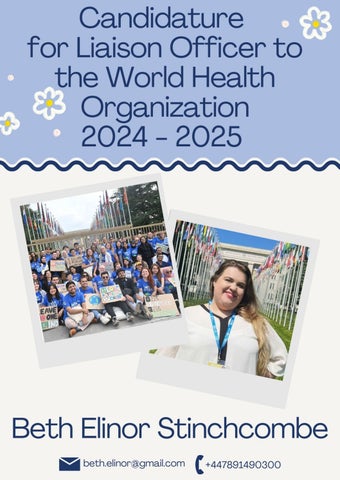
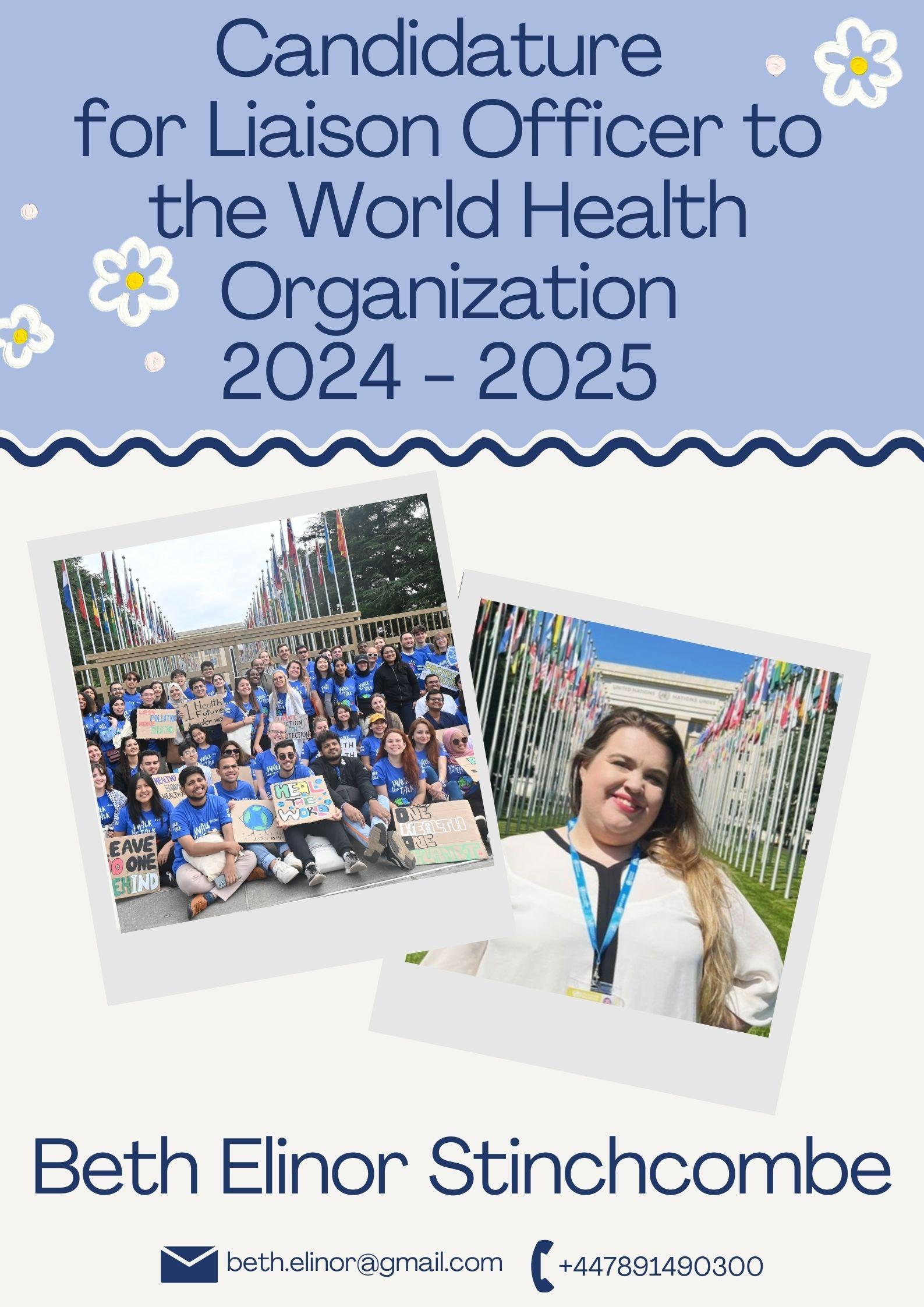
My name is Beth Elinor Stinchcombe, a medical student from the United Kingdom. It is a pleasure to present my candidature for the position of Liaison Officer to the World Health Organization (WHO).
Whilst not being elected for this position last year was disappointing, I am grateful as it enabled me to further develop myself through other roles this year. Serving as the External Affairs Regional Assistant for Europe and Youth Pre-WHA Chairperson has shown me the power of our organization in amplifying the voices of medical students. The introduction of the Youth Pre-WHA reform was an exciting challenge, one that pushed me to learn, grow, and develop a deep understanding of global health governance and diplomacy. These experiences have equipped me with the skills and knowledge needed to take on this position and represent our members’ interests. I was hesitant to reapply for this position, but the encouragementand support I havereceived fromthe Youth Pre-WHAOC,previous LWHOs, and IFMSA members in my dedication and abilities strengthened my resolve to serve IFMSA
Through my various experiences, I have gained a strong understanding of the WHO’s work and potential of IFMSA to collaborate further and drive sustainable impact. I also would like to develop existing partnerships and collaborate more meaningfully with other student/youth led organizations and civil society groups as by working together and sharing best practices we can increase our collective impact and drive the change we wish to see
IFMSA has shown me the effectiveness of collective action. The power of our organization is our ability to bring diverse voices and perspectives together to work on shared objectives.
As one of only two youth organizations in official relations with the WHO, IFMSA holds a unique and influential position to influence global health diplomacy, amplify youth voices and foster partnerships resulting in meaningful impact. We are currently experiencing unprecedented momentum in youth engagement within the WHO. Now is the time to build upon this, amplify youth voices and foster transformative change leading to a healthier and more equitable world
My passion for global health equity and my dedication to empowering youth is the driving force behind this candidature. I am not seeking this position out of personal ambition but to create meaningful change and provide opportunities to IFMSA members to engage further with the WHO whether that’s on a local, national or international level. I hope to enable members to forge meaningful connections and create an environment where they are confident to advocate for the issues they care about and hold those in positions of power accountable. By creating these opportunities, I aim to ensure that the unique perspectives of youth are not just acknowledged but integrated into global health discussions and decision-making processes, resulting in more inclusive, forward-thinking solutions to global health issues.
If elected I will be a tireless advocate for IFMSA ensuring that your voices and ideas are heard and acted upon. Additionally, if you trust me in this position, I will uphold the highest standards of transparency and accountability, display strong ethical leadership as demonstrated in my previous roles in the Youth Pre-WHA OC and as External Affairs Regional Assistant for Europe. I will always be available to support and assist you by creating an environment where everyone feels empowered and valued
As a highly motivated individual with a solution-focused attitude, I promise to bring my energy, enthusiasm and dedication to this role. I am 100% committed to empowering IFMSA members to become even greater change agents in their communities, amplifying youth voices and advocating for decisions that advance global health equity
Regarding my availability, if elected, I would be in my final year of medical school in which I have a very flexible and reduced schedule of rotations with my only exams in Spring 2025 so I could attend the WHO Executive Board Meeting, Youth Pre-WHA and WHA and both IFMSA General Assemblies’s in person as well as any other meetings as required.
Together, our collective efforts create waves of positive change Together, we have a unique opportunity, and I aim to work alongside you all, supporting you and advocating together for health equity. Together, we can close the gap between our aspirations and global health policymaking, ensuing that the next generation of medical professionals are actively involved in shaping the future of global health
Thank you for reading and considering my candidature. Please contact me if you have any questions or would like to discuss any aspect in more detail.
Yours sincerely,
Beth Elinor Stinchcombe
PLAN OF ACTION
What is your plan of action for the position? Please detail below.
INCLUSIVE & IMPACTFUL MEANINGFUL YOUTH ENGAGEMENT
Over the past years, our engagement with the WHO has significantly increased and changed, I aim to improve and sustain our presence in WHO meetings and enhance our advocacy efforts to ensure inclusive and impactful meaningful youth engagement. Additionally, I recognise that visa restrictions and high participation fees are barriers for some of our members applying for the Youth Pre-WHA. I am committed to reducing these barriers to ensure the event is accessible to everyone.
Youth Pre-World Health Assembly and World Health Assembly
• Revise the recent Youth PreWHA reform to maintain both the Global Health Education and Global Health Advocacy tracks, providing members with enhanced flexibility whilst ensuring participants in the Global Health Education track take an active role in supporting WHA advocacy tasks e.g. research, statement writing, and social media ensuring a more blended approach and less division between the two tracks.
• Restructure the Academic Pillars, based upon consultation with past LWHOs and Youth Pre-WHO OCs to ensure the pillars align closely with the WHO Fourteenth General Programme of Work. One proposal includes establishing three pillars: Global Health Education, Health Emergencies and Challenges, and Health Promotion and Well-being whilst incorporating Meaningful Youth Engagement and Social Accountability as overarching themes.
• Enable equitable access to the Palais des Nations for all Youth PreWHA delegates in Geneva by working to secure an increased number of WHA badges, enhanced flexibility in utilising such badges and organising guided tours of the Palais de Nations as well as supporting delegates to approach their county delegation prior to the WHA.
• Include tours of the WHO HQ and well as workshops with various WHO departments, PMNCH, the IFRC, and other UN offices such as the UNHCR, UNAIDS, UNFPA.
• Work alongside the VPE and LO’s to arrange meetings between each Youth Pre-WHA Advocacy Working Group (AWG) and the relevant WHO departments/UN agencies facilitating networking, a deeper understanding of WHO decision-making processes and amplifying our advocacy efforts at the World Health Assembly.
• Organise additional open Youth PreWHA sessions for all IFMSA members and facilitate open space discussions on relevant WHA agenda items prior to the WHA.
• Capitalise on advocacy opportunities, such as utilising events like Walk the Talk and a 'Youth Booth' inside the Palais to increase our advocacy efforts with Member States and collaborate with our partners to maximise impact.
• Open the call for Youth PreWHA organising committee (in line with the IT/PC call) and for the delegation earlier in the year (November) to enable a longer period of preparation for Youth PreWHA delegates providing them with extra time to work in their AWG’s and familiarise themselves with the outcomes of the WHO Executive Board and agenda items for the WHA.
• Ensure a stronger emphasis on increasing delegates’ understanding of the agenda items of the World Health Assembly, resolutions, and technical discussions during the sessions of the Youth PreWHA.
• Introduce parallel sessions to the Youth PreWHA agenda, offering more advanced skills-based sessions and fosteringdevelopment ofa diverse range of topics that align with delegates experience level and personal goals, fostering a more enriching learning experience for all whilst also ensuring an inclusive, supportive and empowering environment for all.
• Support and sustain early and clear communication between the Youth PreWHA OC, LOs, and VPE regarding our goals for the term and how to achieve our objectives and update ‘The Role of LOs in the Youth PreWHA’ document which outlines the roles and responsibilities of LOs versus OC to prevent any conflict and ensure a productive and efficient team.
• Ensure a diverse range of interactive sessions, including expert briefing and networking opportunities with in-person speakers.
• Compile daily summaries of agenda discussions, key take-aways and AWGs' advocacy efforts, sharing updates on the IFMSA website and social media platforms to enhance the transparency of our advocacy and outcomes to our members and partners.
• Facilitate tangible outcomes and broaden all IFMSA member’s knowledge post-WHA, by arranging OSDs or events focusing on specific advocacy projects initiated during the WHA, ensuring effective implementation, support and follow-up
Enhancing the Accessibility of the YPWHA and WHA
• Foster greater diversity and inclusivity within the delegation by collaborating with the VPF and OC to explore the possibility of obtaining more scholarships and grants in line with IFMSA's fundraising framework to financially support more delegates as well as long-term sponsorship agreements to lower registration fees.
• Investigate the option of accommodation in France, located within a 30-minute distance from Geneva, to lower the expenses associated with the Youth-Pre WHA.
• Enhance the hybrid Youth PreWHA through technological and innovative approaches, considering the time zones of delegates and increasing engagement opportunities for online delegates.
• Provide comprehensive support for delegates with visa applications, to try and limit the possibility of visa rejections in the form of a visa and fundraising document which will share insights and experience from past delegates.
• Partner with the WHO Youth Council and other student organizations with expertise in visa processes to facilitate the visa process for delegates.
Youth Delegate Programme and WHO Country Office Relations
• Prioritise updating and improving the IFMSA website with resources on Youth Delegate Programmes and WHO Country Office Relations as well as updating the YDP and WHO county office relations toolkits
• Actively track implemented Youth Delegate Programmes and provide guidance and support to NMOs to improve such initiatives and to support NMOs interested in establishing their own YDPs.
• Facilitate stronger collaboration between NMOs and WHO country offices by assisting NMOs in establishing WHO country office relationships and identifying potential joint initiatives to enable valuable partnerships.
• Include questions in the NMO report specifically addressing WHO country offices and YDPs to enable a sustainable way to capture progress in these areas.
• Provide letters of support to NMOs wishing to establish Youth Delegate Programmes or WHO Country Office Relations.
WHO Youth Council
• Formulate a strategy with EB and TO members as well through consultations with NMOs and alumni to enhance IFMSA member engagement in WHO consolations and working groups through the WHO Youth Council
• Strengthen IFMSA’s presence in the WHO Youth Council through active engagement in council meetings, discussions, working groups and initiatives thus effectively representing the interests, perspectives, and voices of IFMSA members as well as finding more opportunities for collaboration to ensure inclusive and diverse youth participation, amplifying our collective impact.
• Keep the VPE and LOs informed about the Youth Council's activities and develop efficient methods to engage LOs based on their relevant focus areas within the Youth Council's initiatives
• Support the development and execution of the WHO Youth Council’s Youth Engagement strategy, by conducting consultations with IFMSA members and establishing robust monitoring and evaluation mechanisms within the strategy, ensuring that the voices of young people are heard and valued in shaping the future of health policies and programs.
• Collaborate with RDs as well as the WHO Youth Council to explore the idea of advocating for regional mechanisms to engage youth with the WHO, such as the WHO European Region’s Youth4Health and the WHO EMRO youth council.
FURTHERING PROGRESS - SUSTAINABILITY & INNOVATION
Central to my vision is the establishment of sustainable engagement mechanisms with the WHO to facilitate ongoing collaboration, knowledge, and resource sharing. At the moment, there is a lot of momentum regarding youth engagement within the WHO, which presents a unique opportunity to further our progress enabling sustainability and innovation
Optimising Advocacy Efforts
• Organize handover meetings for delegates with delegates from previous terms, and an additional handover meetingbetween WHO EB delegates and WHAdelegates to learn from their experiences and build upon advocacy efforts, ensuring a cohesive and informed approach to our advocacy.
• Obtain live transcripts of WHO meetings to gather quotes and facilitate the development of Youth and Gender watches.
• Support the RD’s and their delegations in preparing for WHO regional committee meetings by organising preparatory sessions as well as scheduling regular monthly meetings to discuss their engagement with regional offices and facilitate the exchange of best practices.
• Ensure the VPE, LOs and RDs are familiar with using the WHO database and can track their contacts with WHO partners ensuring efficient communication and enhanced networking with WHO officials.
• Invite externals and IFMSA alumni to give inputs and recommendations to proposed policy documents
• Provide NMOs with the knowledge, tools and opportunities to contribute to IFMSA’s advocacy efforts at national levels by sharing policy briefs prior to external meetings that will be distributed to Member States and offer guidance to NMOs on how to follow up on this.
• Following external meetings, arrange open online sessions to discuss the outcomes of the meetings and explore how these can be translated into national advocacy and grassroots initiatives
• Strive for diverse representation when formingdelegations, small workinggroups, policy commissions, or other teams by considering regional diversity, gender balance and other forms of representation.
• Enhance collaboration with Program Coordinators by tappinginto their program-specific expertise to align our external work with local and national activities and advocacy and establish platforms to showcase the impact of enrolled activities to external stakeholders.
• Create a communication toolkit for WHO Executive board meeting and WHA to provide IFMSA members and our partners with an overview of our key messaging, policy
documents and advocacy efforts as well as providing links to IFMSA’s social media channels.
• Offer comprehensive post-meeting support to delegates guiding them in applying their acquired knowledge and skills and implementing their follow-up plans
• Develop advocacy strategies for WHO meetings in collaboration with LOs and build on the work carried out by previous delegations as well as ensure opportunities for NMOs to provide input on the advocacy plan before the meeting.
• Generate and utilise IFMSA data to strengthen our advocacy initiatives at WHO external meetings and through collaborations with WHO.
Youth Pre-WHA OC & LWHO-A’s
• Release bi-monthly updates on the activities of LWHO, LWHO-A’s (internal and external), and the Youth Pre-WHA Organizing Committee to maintain transparency and implement a feedback mechanism to enable IFMSA members to share comments, ask questions, and actively engage with updates.
• Work with the Youth Pre-WHA OC to define specific and measurable goals for the Youth Pre-WHA and WHA.
• Implement a robust evaluation system that enables us to measure the effectiveness of our initiatives, identify areas for improvement, and showcase our achievements to determine the final impact of the Youth Pre-WHA as well as our advocacyefforts during the WHA.
• Foster a collaborative environment among the OC and with the LWHO-A’s to optimise teamwork, cohesion, as well as mental health watches to ensure a supportive and healthy working environment for all.
• Use the Youth PreWHA alumni database, to enable alumni to stay up to date with Youth Pre-WHA activities and draw on their extensive expertise for the benefit of current Youth PreWHA OC and delegates.
Working with the IFMSA Executive Board and Team of Officials
• Support RDs and LOs in preparation for WHO meetings such as RCs and the WHA. This includes conducting preparatory meetings for delegations and developing strategic advocacy plans to ensure consistent and coordinated advocacy efforts. There would also be the opportunity for members outside of the delegation to join these meetings as observers.
• Assist RDs in with strengthening their relationships their respective WHO Regional Offices and establish avenues for IFMSA member involvement, such as organising courses, events, collaborative research, and projects.
• Since our collaboration with the WHO involves various LO focus areas, I will establish robust communication frameworks and implement effective monitoring and reporting mechanisms when collaborating with other LOs.
• Assist the VPE in fully integrating the General Assembly theme into the agenda by aiding in the coordination of theme-related events,includinginviting speakers from the WHO
• Collaborate with the VPE to prepare and submit all required documentation to uphold IFMSA's official status with WHO.
• Collaborate withother EBand TO members in aligning our efforts workingon the IFMSA Strategy, relevant mandates and internal working groups.
• Be an active and engaged member of the TO who attends all meetings and completes all tasks and deadlines as required.
• Conduct an effective handover, clearly communicate all relevant tasks and responsibilities to ensure a seamless transition
COLLECTIVE EMPOWERMENT - COLLABORATIONS & CAPACITY-BUILDING
We are stronger together! To ensure our voices are heard it is essential to foster an inclusive environment where every IFMSA member and NMO feels valued and listened to, to ensure that the IFMSA is an effective force for change. It would be a priority of mine to engage in regular discussions to address the needs of NMOs and strive to incorporate their needs into my work. Our strength lies in our diversity and collective action so it is essential to collaborate with other youth and civil society organsisations to drive positive change
Collaborations with other student organisations
• Since the removal of the LOSO position, the LWHO has become the primary contact point for student organizations. I will maintain regular communication with these organizations, share best practices and provide regular updates and feedback loops to ensure everyone is informed and engaged.
• Work closely with other student organisations to explore opportunities to work together on joint projects, advocacy campaigns, and knowledge-sharing initiatives
• Support NMOs to establish collaborations with national branches of international student organizations
• Organise a youth constituency event at the WHA to enable the youth to come together, exchange ideas and collectively advocate for important issues to amplify the voices of young people and facilitate meaningful engagement in shaping global health policies.
• Organise and participate in more jointly organised side events at WHO high-level meetings to showcase the perspectives and expertise of IFMSA members and encourage Members States to attend such events.
The Collective Voice of Civil Society
• Upon discussion with the VPE, apply to be part of the WHO Civil Society Commission which aims to foster collaboration and provide recommendations to support WHO’s Secretariat in its engagement with civil society to achieve the objectives of the WHO General Programme of Work and accelerate attainment of health-related SDGs.
• Build our existing partnerships with civil society organisations and continue to seek new partners.
• Take an active role as part of the working group for the World Health Care Students symposium.
• Collaborate with the Global Health Workforce Network (GHWN) on global health workforce initiatives especially GHWN Youth Hub and other WHO collaborating centers which align with IFMSA focus areas, to expand and support the work of LOs within their respective focus areas ensuring that IFMSA can actively contribute to global health challenges through research, advocacy and capacity building.
Supporting NMOs & IFMSA members
• Facilitate the process of setting priorities and develop my Annual Working Plan (AWP) in consultation with members by organising online consultations.
• Launch a WHO quarterly update with articles and resources for IFMSA members and a WHO calendar,highlightingimportantevents, deadlines, and opportunities such as WHO organised WHA simulations enablingour members to stay informed and actively engage with relevant WHO activities.
• Facilitate WHO-related CB sessions including WHA simulations at pre-General Assemblies (GAs), GAs, Regional Meetings, and other workshops.
• Actively seek opportunities for our members to engage in research and writing, including the authorship of articles that could be published in the WHO Bulletin
• Establish a mentorship program tailored for members with a keen interest in careers in global health diplomacy and policy. Organise networking sessions and careers fairs with external professionals providing a unique opportunity for IFMSA members to engage with experienced individuals who have first-hand knowledge and expertise of working at the WHO
• Organise a ‘WHO week’ in April to celebrate the founding of the organization, capacitate NMOs about the agenda items for this year’s WHA and work on an advocacy campaign or project.
• Disseminate information about WHO internships to members regarding the centralised application process. Explore additional internship opportunities, for example in collaboration with the Graduate Institute Geneva
Application Form - TO 2024/25
• Consult members to see what barriers they may be facing when it comes to collaborating with the WHO on national levels or applying/attending external events such as the Youth PreWHA and devise a strategy to enhance the accessibility of these opportunities, enhancing diversity and inclusion
• Be available and approachable to address any questions or concerns.
IFMSA-WHO Relations
• Maintain high-quality relationships with WHO departments in which is already have a partnership especially the WHO Health and Multilateral Partnership Office and GWHN Youth Hub to optimise our external representation efforts and participate in impactful collaborations.
• Create new partnerships with WHO departments who are working on topics relevant to IFMSA to enable more opportunities for advocacy and technical support.
• Utilise the WHO Executive Board meetings and other relevant gatherings to build stronger relationships with our allies in the global health community and enable targeted advocacy, allowing us to focus our efforts and maximize our impact during the World Health Assembly (WHA).
• Identify avenues for collaboration with OpenWHO to create specialised courses that equip IFMSA members with the proficiency to effectively engage in advocacy at the national level, addressing the issues that they are passionate about and ensuring their capability for impactful involvement
• To enhance the impact of our GAs and RMs, I will invite WHO speakers to theme events related to our priority areas. This collaboration will enrich our discussions, provide expert insights, and foster a closer connection between IFMSA and the WHO.
• Establish an informal LWHO advisory committee of previous LWHOs to provide structured advice and expertise when needed, enhancing our ability to effectively navigate and contribute to WHO-related initiatives.
Word Count : 2875/3000