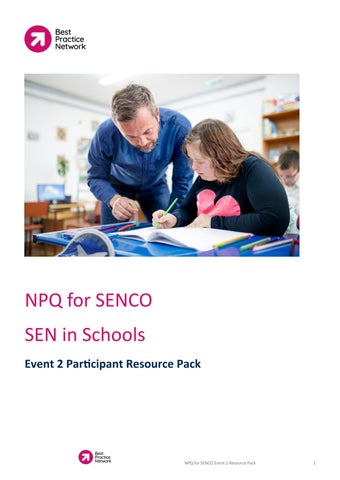
NPQ for SENCO SEN in Schools Event 2 Participant Resource Pack
NPQ for SENCO Event 2 Resource Pack
1
NPQ for SENCO: SEN in Schools Table of Contents NPQ for SENCO: SEN in Schools........................................................................................................................................... 2 Resource 1: Pre-event tasks................................................................................................................................................ 3 Resource 2: ‘Learn that’ and ‘learn how to’ statements addressed in the session (DfE, 2023)...............................................4 Resource 3: Check-in on leadership learning and practice.................................................................................................... 6 Resource 4: Leadership behaviours and skills (Best Practice Network, 2019)........................................................................7 Resource 5: Identifying SEN in schools (SEND Code of Practice)......................................................................................... 10 Resource 6: Broad areas of need....................................................................................................................................... 14 Resource 7: Case studies – identification of need.............................................................................................................. 15 Resource 8: Five-a-day principle........................................................................................................................................ 19 Resource 9: Special Educational Needs in Mainstream Schools: Evidence Review (Cullen, et al., EEF, 2020)........................20 Resource 10: Five-a-day sources of evidence..................................................................................................................... 21 Resource 11: Five evidence-based strategies to support high-quality teaching for pupils with SEND (Mould, K., EEF, 2020) 22 Resource 12: Questions to support metacognitive regulation – planning tool....................................................................25 Resource 13: Case studies – adaptive teaching strategies.................................................................................................. 27 Resource 14: Key learning points...................................................................................................................................... 35 Resource 15: Cycle 1 online self-study summary................................................................................................................ 39 Resource 16: Cycle 2 online practice activities................................................................................................................... 40
Additional resources
Leadership development record (LDR) template
Formative assessment task options
NPQ for SENCO Event 2 Resource Pack
2
Resource 1: Pre-event tasks Please complete the following pre-event tasks before attending the event: 1. Read SEND Code of Practice section on Identifying SEN in schools (in resource 5), and make notes. 2. Read Rosenshine’s principles of instruction. https://www.teachertoolkit.co.uk/wp-content/uploads/2018/10/Principles-of-Insruction-Rosenshine.pdf 3. Remind yourself about the graduated approach stages covered in Cycle 1: assess, plan, do and review. 4. Download the leadership development record (LDR) template from Canvas and complete Cycle 2, Section 1. Please bring to the event: 5. Your notes from the pre-event tasks above. 6. A copy of your school’s IDSR. Or, if you do not have one of these, please use your school’s internal data on school characteristics, school pupil outcomes and SEN profile breakdown. An explanation of the contents of an IDSR and an example IDSR for primary and secondary can be found at https://www.gov.uk/guidance/school-inspection-data-summary-report-idsr-guide. 7. Your leadership development record (LDR) with Cycle 1 completed and Cycle 2, Section 1 completed.
NPQ for SENCO Event 2 Resource Pack
3
Resource 2: ‘Learn that’ and ‘learn how to’ statements addressed in the session (DfE, 2023) Statutory framework ‘Learn that’
‘Learn how to’
2.14 Senior leaders and other staff should work with the SENCO and other agencies to ensure provision meets pupil needs (SEND Code of Practice 2015).
Support senior leaders to ensure staff and governors enact statutory guidance, including by:
2.15 Teachers are responsible and accountable for the progress and development of the pupils in their class (SEND Code of Practice 2015).
2.a Contributing to an accountability framework whereby teachers are responsible and accountable for the progress and development of all pupils.
Identification of need ‘Learn that’
‘Learn how to’
3.2 The SEND Code of Practice (2015) sets out four broad areas of need: communication and interaction; cognition and learning; social, emotional and mental health difficulties; and physical and/or sensory needs.
Implement an efficient SEND identification process across the school which ensures that barriers to learning are identified and addressed at the earliest opportunity, including by:
3.4 Identification of SEND should draw on regular and precise assessment information, including statutory test outcomes, and discussion with the pupil and their family. Identification of need should take in the holistic picture of a pupil’s development and not focus solely on a single primary area of need (SEND Code of Practice 2015).
3.a Constructing a record, such as a SEND Register, which reflects detailed and accurate identification of need; this will include core assessment data and record early indications of possible SEND. 3.f Analysing a range of data and evidence to support accurate identification, including information on behaviour, attendance and performance. 3.g Agreeing with families what information will be shared and with whom during the identification process.
Teaching ‘Learn that’
‘Learn how to’
4.6 Adapting teaching in a responsive way, including by providing targeted support to pupils who are struggling, is likely to increase pupil success.
With other leaders, establish and sustain effective curriculum planning and preparation across the school, including by:
4.8 High quality teaching for pupils with SEND is based on strategies which are often already
4.a Communicating the information about pupils with SEND that enable teachers to plan, adapt and teach
NPQ for SENCO Event 2 Resource Pack
4
practised by teachers, and which can be developed through training and support. 4.9 High quality teaching for pupils with SEND deploys explicit instruction and effective scaffolding as appropriate and develops cognitive and metacognitive strategies to support learning. 4.13 An effective way to develop a pupil’s executive function is the explicit modelling and teaching of metacognitive strategies.
effectively for all pupils. 4.d Supporting teachers to scaffold learning, reducing bespoke support as the pupil demonstrates mastery in the domain and becomes increasingly independent. Support teachers and support staff to understand the importance of precise expert teaching for all pupils and to implement the graduated approach effectively, including by: 4.f Enabling teachers and leaders to understand the graduated approach and utilise it in the classroom, subject or domain. 4.k Advising teachers on how to adapt teaching resources to cater to pupil need.
NPQ for SENCO Event 2 Resource Pack
5
Resource 3: Check-in on leadership learning and practice Use this sheet to capture your thoughts/comments to support your feedback to colleagues. Your leadership learning Specify which content areas and learn that and/or learn how to statements have moved your understanding on. Which research has had the most impact on your learning and leadership, and why? (Use your understanding identified at the end of Preparing to Practice Course 1.) How have you applied your understanding, and what impact has it had on a) your leadership? b) school practice? What behaviours have you demonstrated and how have these had an impact on your leadership? Refer to your LDR review where you have considered 2–3 behaviours, and resource 4. What areas from Preparing to Practice do you need to continue to work on/develop? How will you address these? Revisit your LDR review of the Preparing to Practice cycle to support this.
NPQ for SENCO Event 2 Resource Pack
6
Resource 4: Leadership behaviours and skills (Best Practice Network, 2019) Implementation Behaviours (EEF, 2024) Engage
Unite
Reflect
Engage people so they can shape what happens, whilst also providing overall direction.
Unite around what is being implemented, how it will be implemented and why it matters.
Reflect, monitor and adapt to improve implementation.
Behaviours
Selfawareness
Skills Effective leaders know themselves and their teams, continually reflect on their own and others’ practices, and understand how best to approach difficult or sensitive issues. They are aware of their personal strengths and areas for future growth and understand how their own behaviour affects others.
Integrity
Effective leaders act with honesty, transparency and always in the interests of the school and its pupils. They are able to gain the respect of others by acting in line with their own values, as well as making decisions and choices with the best interests of education and pupils in mind.
Resilience
Effective leaders remain courageous and positive in challenging, adverse or uncertain circumstances. They are able to respond appropriately, manage uncertainty and bounce back even in the most trying situations.
Critical knowledge and understandin g of research techniques and selfmanagement
The best leaders undertake and use research, drawn from a range of sources, to support decision making and strategy development – using their time effectively within disciplined and well-organised systems and methodologies.
Critical enquiry, review, analysis and evaluation
The best leaders use critical thinking and statistical and data analysis tools, techniques and concepts to identify strengths and areas for development. They design effective leadership plans to support intervention, direction and development. They analyse the implications of change, deploying well-evidenced research to frame school self-evaluation and improvement.
Challenge
The best leaders use challenge effectively and adopt a range of strategies in the best interests of achieving progress – demanding ambitious standards for all pupils and a strong sense of accountability in staff for the impact of their work on pupils’ outcomes.
NPQ for SENCO Event 2 Resource Pack
7
Impact and influence
Delivering continuous improvement
Future focus
Holding others to account
Respect
Effective leaders have a positive impact on students, colleagues and the wider community through persuading, convincing and bringing others round to their perspective. They understand others’ perspectives and priorities and tailor their communication to suit their audience. Effective leaders secure and maintain positive improvement through articulating a clear vision, setting high expectations and leading a cycle of research, planning, monitoring, analysis and change. They demonstrate the ability to combine operational action with strategic planning, securing short-term improvements while building sustainable change. Effective leaders recognise issues and opportunities and take action to resolve these. Leaders need to look ahead to identify and resolve potential issues and capitalise on opportunities as well as manage day-to-day problems. Effective school leaders hold others to account – including creating levels of accountability within the school – ensuring that everyone understands their roles, responsibilities, the standards required and accountabilities. They distribute leadership and delegate effectively, demanding high performance through making expectations clear, with the best interests of pupils and schools in mind.
Dealing systematically and creatively with complex issues
Priority identification
Clear articulation and application of knowledge
Self-direction and originality
The best leaders have clear systems and protocols in place that enable them to consider and find solutions to issues, as they arise, in a way which deals most effectively with the barriers and challenge they face. The systems in place do not constrain but create a firm foundation for taking positive action. The best leaders scan the horizon to anticipate change, taking a long-term view of the implications of change and improvement need to identify short- and long-term priorities and goals with specified milestones to ensure effective leadership and management.
The best leaders take time to reflect and learn from their leadership activity and apply this knowledge to bring about improvements in themselves and their work.
The best leaders have clear and ambitious targets for themselves as leaders, for their pupils and for their schools. They take a unique strategic view of situations and their implications for long-term impact and outcomes – sometimes using unexpected actions to get the best for those concerned.
Effective leaders respect the rights, views, beliefs and faiths of
NPQ for SENCO Event 2 Resource Pack
8
all pupils, colleagues and stakeholders.
Partnership working and collaboration
Leading by example
Effective leaders are able to work with a range of people in schools and the wider community to build a culture of cooperation and achievement. They engage with, and invest responsibility in, those who are best placed to improve outcomes, being open to different perspectives and viewpoints as well as sharing expertise and achieving common objectives. Effective leaders consistently demonstrate and communicate their vision, passion and commitment. They lead by example, have high levels of professional credibility and demonstrate total commitment to school improvement through their own leadership behaviours.
NPQ for SENCO Event 2 Resource Pack
9
Resource 5: Identifying SEN in schools (SEND Code of Practice) https://assets.publishing.service.gov.uk/media/5a7dcb85ed915d2ac884d995/ SEND_Code_of_Practice_January_2015.pdf 6.14 All schools should have a clear approach to identifying and responding to SEN. The benefits of early identification are widely recognised – identifying need at the earliest point and then making effective provision improves long-term outcomes for the child or young person. 6.15 A pupil has SEN where their learning difficulty or disability calls for special educational provision, namely provision different from or additional to that normally available to pupils of the same age. Making higher quality teaching normally available to the whole class is likely to mean that fewer pupils will require such support. Such improvements in whole-class provision tend to be more cost effective and sustainable. 6.16 Schools should assess each pupil’s current skills and levels of attainment on entry, building on information from previous settings and key stages where appropriate. At the same time, schools should consider evidence that a pupil may have a disability under the Equality Act 2010 and, if so, what reasonable adjustments may need to be made for them. 6.17 Class and subject teachers, supported by the senior leadership team, should make regular assessments of progress for all pupils. These should seek to identify pupils making less than expected progress given their age and individual circumstances. This can be characterised by progress which:
is significantly slower than that of their peers starting from the same baseline
fails to match or better the child’s previous rate of progress
fails to close the attainment gap between the child and their peers
widens the attainment gap
6.18 It can include progress in areas other than attainment – for instance where a pupil needs to make additional progress with wider development or social needs in order to make a successful transition to adult life. 6.19 The first response to such progress should be high quality teaching targeted at their areas of weakness. Where progress continues to be less than expected the class or subject teacher, working with the SENCO, should assess whether the child has SEN. While informally gathering evidence (including the views of the pupil and their parents) schools should not delay in putting in place extra teaching or other rigorous interventions designed to secure better progress, where required. The pupil’s response to such support can help identify their particular needs. 6.20 For some children, SEN can be identified at an early age. However, for other children and young people difficulties become evident only as they develop. All those who work with children and young people should be alert to emerging difficulties and respond early. In particular, parents know their children best and it is important that all professionals listen and understand when parents express concerns about their child’s development. They should also listen to and address any concerns raised by children and young people themselves. 6.21 Persistent disruptive or withdrawn behaviours do not necessarily mean that a child or young person has SEN. Where there are concerns, there should be an assessment to determine whether there are any causal factors
NPQ for SENCO Event 2 Resource Pack
10
such as undiagnosed learning difficulties, difficulties with communication or mental health issues. If it is thought housing, family or other domestic circumstances may be contributing to the presenting behaviour a multi-agency approach, supported by the use of approaches such as the Early Help Assessment, may be appropriate. In all cases, early identification and intervention can significantly reduce the use of more costly intervention at a later stage. 6.22 Professionals should also be alert to other events that can lead to learning difficulties or wider mental health difficulties, such as bullying or bereavement. Such events will not always lead to children having SEN but it can have an impact on wellbeing and sometimes this can be severe. Schools should ensure they make appropriate provision for a child’s short-term needs in order to prevent problems escalating. Where there are long-lasting difficulties schools should consider whether the child might have SEN. Further guidance on dealing with bullying issues can be found on the GOV.UK website – a link is given in the References section under Chapter 6. 6.23 Slow progress and low attainment do not necessarily mean that a child has SEN and should not automatically lead to a pupil being recorded as having SEN. However, they may be an indicator of a range of learning difficulties or disabilities. Equally, it should not be assumed that attainment in line with chronological age means that there is no learning difficulty or disability. Some learning difficulties and disabilities occur across the range of cognitive ability and, left unaddressed may lead to frustration, which may manifest itself as disaffection, emotional or behavioural difficulties. 6.24 Identifying and assessing SEN for children or young people whose first language is not English requires particular care. Schools should look carefully at all aspects of a child or young person’s performance in different areas of learning and development or subjects to establish whether lack of progress is due to limitations in their command of English or if it arises from SEN or a disability. Difficulties related solely to limitations in English as an additional language are not SEN. 6.25 When reviewing and managing special educational provision the broad areas of need and support outlined from 6.28 below may be helpful, and schools should review how well equipped they are to provide support across these areas. Information on these areas of need and support is also collected through the School Census and forms part of the statutory publication ‘Children and Young People with SEN: an analysis’ which is issued by DfE each year. 6.26 There is a wide range of information available on appropriate interventions for pupils with different types of need, and associated training which schools can use to ensure they have the necessary knowledge and expertise to use them. See the References section under Chapter 6 for links to organisations that provide this information. 6.27 These four broad areas give an overview of the range of needs that should be planned for. The purpose of identification is to work out what action the school needs to take, not to fit a pupil into a category. In practice, individual children or young people often have needs that cut across all these areas and their needs may change over time. For instance speech, language and communication needs can also be a feature of a number of other areas of SEN, and children and young people with an Autistic Spectrum Disorder (ASD) may have needs across all areas, including particular sensory requirements. A detailed assessment of need should ensure that the full range of an individual’s needs is identified, not simply the primary need. The support provided to an individual should always be based on a full understanding of their particular strengths and needs and seek to address them all using well-evidenced interventions targeted at their areas of difficulty and where necessary specialist equipment or software.
NPQ for SENCO Event 2 Resource Pack
11
Broad areas of need Communication and interaction 6.28 Children and young people with speech, language and communication needs (SLCN) have difficulty in communicating with others. This may be because they have difficulty saying what they want to, understanding what is being said to them or they do not understand or use social rules of communication. The profile for every child with SLCN is different and their needs may change over time. They may have difficulty with one, some or all of the different aspects of speech, language or social communication at different times of their lives. 6.29 Children and young people with ASD, including Asperger’s Syndrome and Autism, are likely to have particular difficulties with social interaction. They may also experience difficulties with language, communication and imagination, which can impact on how they relate to others.
Cognition and learning 6.30 Support for learning difficulties may be required when children and young people learn at a slower pace than their peers, even with appropriate differentiation. Learning difficulties cover a wide range of needs, including moderate learning difficulties (MLD), severe learning difficulties (SLD), where children are likely to need support in all areas of the curriculum and associated difficulties with mobility and communication, through to profound and multiple learning difficulties (PMLD), where children are likely to have severe and complex learning difficulties as well as a physical disability or sensory impairment. 6.31 Specific learning difficulties (SpLD), affect one or more specific aspects of learning. This encompasses a range of conditions such as dyslexia, dyscalculia and dyspraxia.
Social, emotional and mental health difficulties 6.32 Children and young people may experience a wide range of social and emotional difficulties which manifest themselves in many ways. These may include becoming withdrawn or isolated, as well as displaying challenging, disruptive or disturbing behaviour. These behaviours may reflect underlying mental health difficulties such as anxiety or depression, self-harming, substance misuse, eating disorders or physical symptoms that are medically unexplained. Other children and young people may have disorders such as attention deficit disorder, attention deficit hyperactive disorder or attachment disorder. 6.33 Schools and colleges should have clear processes to support children and young people, including how they will manage the effect of any disruptive behaviour so it does not adversely affect other pupils. The Department for Education publishes guidance on managing pupils’ mental health and behaviour difficulties in schools – see the References section under Chapter 6 for a link.
Sensory and/or physical needs 6.34 Some children and young people require special educational provision because they have a disability which prevents or hinders them from making use of the educational facilities generally provided. These difficulties can be age related and may fluctuate over time. Many children and young people with vision impairment (VI), hearing impairment (HI) or a multi-sensory impairment (MSI) will require specialist support and/or equipment to access their learning, or habilitation support. Children and young people with an MSI have a combination of vision and hearing difficulties. Information on how to provide services for deafblind children and young people is available
NPQ for SENCO Event 2 Resource Pack
12
through the Social Care for Deafblind Children and Adults guidance published by the Department of Health (see the References section under Chapter 6 for a link). 6.35 Some children and young people with a physical disability (PD) require additional ongoing support and equipment to access all the opportunities available to their peers.
NPQ for SENCO Event 2 Resource Pack
13
Resource 6: Broad areas of need
NPQ for SENCO Event 2 Resource Pack
14
NPQ for SENCO Event 2 Resource Pack
15
Resource 7: Case studies – identification of need Case study 1 Name: Alfie Smith D.O.B: 27th August Age: 4 Year group/phase: Early Years Foundation Stage Gender: Male Ethnicity: White British Provision: Mainstream school SEN Code of Practice Area of Need: Communication and Interaction with a diagnosis of autistic spectrum condition (ASC) and undiagnosed cognition and learning Stage: ECNA/EHCP/SEND support Other agency involvement:
Speech and language
Paediatrician
Family situation Alfie lives with Mum, stepdad and maternal grandmother. Home life is settled, and all adults fully support Alfie and the school. Alfie’s family are keen to provide any resources that will support him. This is often in the form of games on his tablet, which causes an issue at school, as he cannot access this when he chooses to. School is working with parents to support their understanding of alternative interests that could be provided.
Presentations Alfie is non-verbal and does not interact with others. Communication is through a range of noises. Alfie does not transition well from a family member at the start of the day, is extremely distressed and takes some time to settle. At playtime and lunchtime Alfie plays alongside other children. In the classroom, Alfie flits from one activity to the next and will not stay at a learning task if there is another child or adult in the space. When Alfie becomes frustrated and cannot make his needs known, he bites or lashes out at others, both adults and children.
The graduated response Assess Plan
NPQ for SENCO Event 2 Resource Pack
16
Do Review
NPQ for SENCO Event 2 Resource Pack
17
Case study 2 Name: Miriam Boateng D.O.B: 19th October Age: 6 Year group/phase: Year 2 Gender: Female Ethnicity: Black Provision: Mainstream primary school SEN Code of Practice Area of Need: Cognition and Learning and possible social, emotional and mental health needs Stage: ECNA/EHCP/SEND Support Other agency involvement: Learning Support Advisory Teacher
Family situation Miriam lives with her paternal aunt. Parents are still living in Ghana. Miriam has returned to Ghana on two occasions over the past two years to visit parents. Aunt finds the discussions around Miriam’s additional needs challenging, however she has high aspirations for Miriam and wants her to be happy and successful. Through discussions with the parents, they have indicated that they may take her back to Ghana, as they too have high expectations of Miriam and want her to be a successful learner. At weekends, Miriam attends the local church with her aunt, where the expectations on children’s behaviour within the Ghanaian community are reinforced. There have been some safeguarding concerns and Miriam is currently part of a Child in Need plan, as a result of aunt using some physical chastisement toward Miriam. Miriam, her aunt and parents speak Twi as their first language. However, aunt and parents also speak English and use this in their respective professions on a daily basis. Miriam’s parents and aunt write in English.
Presentations Miriam is very respectful and is a quiet member of the class. She has a small group of friends, who she enjoys playing with. Miriam's behaviour in the classroom is exemplary and she often receives certificates in the weekly assembly for her behaviour, kindness and her learning behaviours. Miriam can be timid around unknown adults and she can become tearful if she thinks she has done something wrong. She constantly seeks reassurance from the additional adults in the classroom and always strives to complete the learning she has been set.
The graduated response Assess Plan Do Review NPQ for SENCO Event 2 Resource Pack
18
Case study 3 Name: Baljeet Singh D.O.B: 21st January Age: 9 Year group/phase: Year 5 Gender: Male Ethnicity: Asian British Provision: Mainstream primary school SEN Code of Practice Area of Need: Physical and Sensory (Hearing Impaired) and possible social, emotional mental health needs Stage: ECNA/EHCP/SEND Support Other agency involvement: Sensory Inclusion Service
Family situation Baljeet lives with his mum and dad, paternal grandparents and four siblings. Parents are extremely happy with the adaptations made by school; however, they are concerned about how this support will be replicated in a larger setting, when Baljeet makes the transition to secondary school.
Presentations Baljeet is a happy and content member of the class. He has a wide circle of friends. There is a communication book in place between school and home to update on any issues linked to the radio aid or aspects that have been challenging for Baljeet in school.
The graduated response Assess Plan Do Review
NPQ for SENCO Event 2 Resource Pack
19
Case study 4 Name: Carly Edwards D.O.B: 25th April Age: 14 Year group/phase: Year 9 Gender: Female Ethnicity: White British Provision: Part-time alternative provision, mainstream secondary school SEN Code of Practice Area of Need: Social Emotional Mental Health and possible dyslexia and dyspraxia and communication and interaction Stage: ECNA/EHCP/SEND Support Other agency involvement: Child and Adolescent Mental Health Service
Family situation Carly lives with her two mums and has contact with her birth father. She has two stepbrothers who are younger than her. Family members find it difficult to manage Carly’s self-harm and often become annoyed and talk about her ‘attention seeking’. This causes a great deal of friction at home and will often result in Carly leaving the family home and being reported missing.
Presentations Carly will self-harm when faced with challenging circumstances. She is experiencing emotionally based school anxiety and this is having an impact on academic achievement and her attendance. She is currently identified as a pupil with persistent absence, with an overall attendance figure of 78%. Some absence is linked to appointments with Child and Adolescent Mental Health Service and others to her emotionally based school anxiety. Carly has dual provision; she attends an alternative provision every morning and is expected to attend mainstream secondary school every afternoon. This is causing Carly a great deal of anxiety, resulting in non-attendance at the mainstream secondary school.
The graduated approach Assess Plan Do Review
NPQ for SENCO Event 2 Resource Pack
20
Resource 8: Five-a-day principle Five-a-day-poster_1.1.pdf (d2tic4wvo1iusb.cloudfront.net)
NPQ for SENCO Event 2 Resource Pack
21
Resource 9: Special Educational Needs in Mainstream Schools: Evidence Review (Cullen, et al., EEF, 2020) https://d2tic4wvo1iusb.cloudfront.net/production/documents/guidance/ EEF_SEND_Evidence_Review.pdf?v=1710934366
“A focus on effective teaching should be the starting point of lesson planning for pupils with SEND, not individual needs or labels – since effective teaching strategies and approaches appear to work universally to support children’s learning. Understanding of individual needs may then be used to guide teaching adjustments to enhance learning outcomes for sub-group and individual pupil needs... High quality teaching that draws on teachers’ repertoire of skills to offer something additional and/or different to meet the learning needs of pupils is the foundation of effective special educational provision, as it is of effective education for every pupil.” Cullen et al., 2020
“Adapting curriculum tasks and materials for specific learning goals is a high-leverage practice.” McLeskey et al., 2017, in Cullen et al., 2020
“Teachers who accepted the responsibility for ‘the progress and development of the pupils in their class’ (DfE, 2015, 6.36, p99) had a high quality of engagement with pupils with SEN... In carrying out [the successful] discussions the teacher matched their questions and answers to the pupil’s response, following the pupil’s thinking rather than just checking that their understanding equated to the teacher’s.” Rix et al., 2009, in Cullen et al., 2020
NPQ for SENCO Event 2 Resource Pack
22
Resource 10: Five-a-day sources of evidence Five-a-day
Special education needs in mainstream schools
EEF Special Educational Needs in Schools: Guidance Report
EEF_Special_Educational_Needs_in_Mainstream_Schools_Guidance_Report.pd f (d2tic4wvo1iusb.cloudfront.net)
Explicit instruction
https://educationendowmentfoundation.org.uk/news/eef-blog-what-exactlyis-explicit-instruction pp. 24–25
Cognitive and metacognitive strategies
https://educationendowmentfoundation.org.uk/news/eef-blog-cognitivestrategies-lets-have-a-think#:~:text=The%20term%20%E2%80%8B'cognitive %20strategies,needing%20to%20be%20taught%20them pp. 22–23
Scaffolding
https://educationendowmentfoundation.org.uk/news/scaffolding-more-thanjust-a-worksheet 5-a-Day_Reflection_Tool_2023.pdf (d2tic4wvo1iusb.cloudfront.net)
Flexible grouping
https://educationendowmentfoundation.org.uk/news/eef-blog-flexiblegrouping-what-is-it-and-why-use-it p. 22
Using technology
EEF_Digital_Technology_Guidance_Report.pdf (d2tic4wvo1iusb.cloudfront.net) pp. 12–15
NPQ for SENCO Event 2 Resource Pack
23
Resource 11: Five evidence-based strategies to support high-quality teaching for pupils with SEND (Mould, K., EEF, 2020) https://educationendowmentfoundation.org.uk/news/five-evidence-based-strategies-pupils-withspecial-educational-needs-send Blog 4 minutes 28 August 2020 Kirsten Mould, Senior Content Manager How can schools best support learning for pupils with SEND in the unpredictable year ahead? That’s the question our Learning Behaviours specialist, Kirsten Mould – who also works at Mary Webb School and Science College in Shropshire as Head of Personalised Learning/ Transition and SENCo – addresses here, proposing five evidence-based strategies that can help… Pupils with Special Education Needs and Disabilities (SEND) are rightly at the forefront of our planning for the new academic year. Refreshing our repertoire of high-quality teaching with colleagues is something I am thinking about as we plan for the full return of pupils at my school. The EEF’s guidance report on Special Educational Needs in Mainstream Schools aims to support schools in evaluating and developing their provision, using the evidence base as a starting point to inform practice. Knowing our pupils is an important thread within the evidence on improving behaviour, but also in supporting pupils with SEND. So, how can we best adapt what we plan and do in the classroom? The EEF evidence review underpinning this guidance report found strong evidence that high-quality teaching for pupils with SEND is firmly based on strategies that will already be in the repertoire of every mainstream teacher, or can be relatively easily added to it. The five strategies outlined here were identified as having relatively strong evidence for their effectiveness in supporting pupils with SEND: 1. Scaffolding What is it? ‘Scaffolding’ is a metaphor for temporary support that is removed when it is no longer required. Initially, a teacher would provide enough support so that pupils can successfully complete tasks that they could not do independently. This requires effective assessment to gain a precise understanding of the pupil’s current capabilities. Examples:
Support could be visual, verbal, or written.
NPQ for SENCO Event 2 Resource Pack
24
Writing frames, partially completed examples, knowledge organisers, essay prompts, bookmarks, structure strips, sentence starters can all be useful.
Reminders of what equipment is needed for each lesson and classroom routines can be useful.
Scaffolding discussion of texts: promoting prediction, questioning, clarification and summarising.
2. Explicit instruction What is it? Explicit instruction refers to a range of teacher-led approaches, focused on teacher demonstration followed by guided practice and independent practice. Explicit instruction is not just “teaching by telling” or “transmission teaching”. One popular approach to explicit instruction is Rosenshine’s ‘Principles of Instruction’. Examples:
Worked examples with the teacher modelling self-regulation and thought processes is helpful. A teacher might teach a pupil a strategy for summarising a paragraph by initially ‘thinking aloud’ while identifying the topic of the paragraph to model this process to the pupil. They would then give the pupil the opportunity to practise this skill.
Using visual aids and concrete examples promotes discussion and links in learning.
3. Cognitive and metacognitive strategies What is it? Cognitive strategies are skills like memorisation techniques or subject specific strategies like methods to solve problems in maths. Metacognitive strategies help pupils plan, monitor and evaluate their learning. Examples:
Chunking the task will support pupils with SEND – this may be through provision of checklists, instructions on a whiteboard or providing one question at a time. This helps reduce distractions to avoid overloading working memory.
Prompt sheets that help pupils to evaluate their progress, with ideas for further support.
4. Flexible grouping What is it? Flexible grouping describes when pupils are allocated to smaller groups based on the individual needs that they currently share with other pupils. Such groups can be formed for an explicit purpose and disbanded when that purpose is met. Examples:
Allocating temporary groups can allow teachers to set up opportunities for collaborative learning, for example to read and analyse source texts, complete graphic organisers, independently carry out a skill, remember a fact, or understand a concept.
NPQ for SENCO Event 2 Resource Pack
25
Pre-teaching key vocabulary, using the Frayer Model is a useful technique here.
5. Use technology What is it? Technology can assist teacher modelling. Technology, as a method to provide feedback to pupils and/ or parents can be effective, especially when the pupil can act on this feedback. Examples:
Use a visualizer to model worked examples.
Technology applications, such as online quizzes can prove effective.
Speech generating apps to enable note-taking and extended writing can be helpful.
It will be helpful to ask your SENCo for advice if you are unsure about particular SEND strategies linked to specific needs. Talk to teachers who have worked with certain pupils previously. Using these strategies to deploy teaching assistants to supplement what you do as the teacher, not simply replace your instruction, would be a best bet. Nothing new here? Excellent… High-quality teaching for pupils with SEND is good teaching for all. This phrase trips off the tongue but it is sometimes difficult to define how it looks in school. Every teacher must find what works in their classrooms, for their teaching and their pupils. Do teachers in your school have a repertoire they can draw on? Is training required to add in additional strategies? Weaving in these specific approaches enables us to deftly adapt our teaching, bringing out strategies at appropriate times, well-matched to content and individual needs. Having a sharp, well-defined repertoire of approaches will help ensure high expectations for all are maintained, next steps are well-informed and pupils with SEND thrive.
NPQ for SENCO Event 2 Resource Pack
26
Resource 12: Questions to support metacognitive regulation – planning tool https://educationendowmentfoundation.org.uk/education-evidence/guidance-reports/metacognition
NPQ for SENCO Event 2 Resource Pack
27
QUESTIONS TO SUPPORT METACOGNITIVE REGULATION
This planning tool could be used by teachers when planning questions that encourage pupils to think metacognitively about their learning across subjects and phases.
2. Monitoring (during the task):
1. Planning (start of the task): How will you approach this learning task and why?
1
2
…enter text here
Is your plan working or do you need to try something else??
…enter text here
3 3. Evaluating (after the task): What have you learnt about yourself and your learning?
…enter text here
Resource 13: Case studies – adaptive teaching strategies Case study 1 Name: Alfie Smith D.O.B: 27th August Age: 4 Year group/phase: Early Years Foundation Stage Gender: Male Ethnicity: White British Provision: Mainstream school SEN Code of Practice Area of Need: Communication and Interaction with a diagnosis of autistic spectrum condition (ASC) and undiagnosed cognition and learning Stage: ECNA/EHCP/SEND support Other agency involvement:
Speech and language
Paediatrician
Additional information Cognitive ability Staff have identified that Alfie is working at 24–30 months, which is two years below his chronological age. This is currently a best fit model as the SENCO gathers evidence from the paediatrician, speech and language therapists, and the class teacher. Records show that Alfie is working below his chronological age in all areas of learning. He is not on track to meet the Early Learning Goals. Alfie is accessing phonic sessions; however, he cannot recall any sounds. He enjoys stories and rhymes, water, sand play and small world. Alfie has one information carrying word. Alfie communicates by taking an adult’s hand and leading them. When he is distressed in any way, he will lash out at both adults and children. Alfie is in the classroom with his peers and included in all aspects of learning. Additional information Alfie is entitled to the Pupil Premium Grant. He has good school attendance and is currently at 96.7%, above the national average.
NPQ for SENCO Event 2 Resource Pack
29
Additional information Potential barriers Alfie cannot make his needs known and therefore could be at risk of not being able to communicate pain or any form of abuse from peers or adults. He accesses child-led and continuous provision but does not access adult-led learning. School have talked about a modified timetable and a suspension as a result of hurting other children and staff when he becomes frustrated. Family will support this; however, there is a concern that Alfie will have a lack of routine and structure that is required and reduced opportunity to put interventions in place. School is now pursuing other options, such as a part-time setting, to support his language development.
The graduated response Additional information Assess The SENCO is in the process of working with a range of professionals, including the paediatrician, behaviour support service, speech and language, members of support staff and the class teacher to understand Alfie’s needs. Plan The SENCO is keen to plan Alfie’s interventions; however, his needs are complex and the behaviours when Alfie is frustrated are adding to lengthy discussions about which needs should be met first. At this stage, neither the parents nor Alfie have been involved in planning the targets.
NPQ for SENCO Event 2 Resource Pack
30
Case study 2 Name: Miriam Boateng D.O.B: 19th October Age: 6 Year group/phase: Year 2 Gender: Female Ethnicity: Black Provision: Mainstream primary school SEN Code of Practice Area of Need: Cognition and Learning and possible social, emotional and mental health needs Stage: ECNA/EHCP/SEND Support Other agency involvement: Learning Support Advisory Teacher Additional information Cognitive ability Working at around 24 months below Age Related Expectations in reading and writing and mathematics. Miriam has a particular passion for scientific enquiry, where she is working about 12 months below her peers.
Additional information She has 100% attendance and is proud of the regular awards she wins for the best attendance in her class and year group.
Additional information Potential barriers Miriam may leave the country to return to Ghana. This would mean her needs remaining unmet. Miriam’s self-esteem is often affected by her aunt’s comments. Agencies are working with aunt to support her understanding of the rights of the child within the United Kingdom.
The graduated response Additional Information Assess
NPQ for SENCO Event 2 Resource Pack
31
Miriam has been assessed by the Learning Support Advisory Teacher. She is working within the 7th percentile for reading, writing and mathematics. She has dyslexic traits, and some identified developmental co-ordination disorders (dyspraxia). Plan The SENCO has worked alongside Miriam’s aunt and Miriam to set a number of targets that are SMART (Specific, Measurable, Achievable, Relevant and Time-bound). Miriam’s aunt has found this process difficult and is not yet in agreement with the plan.
NPQ for SENCO Event 2 Resource Pack
32
Case study 3 Name: Baljeet Singh D.O.B: 21st January Age: 9 Year group/phase: Year 5 Gender: Male Ethnicity: Asian British Provision: Mainstream primary school SEN Code of Practice Area of Need: Physical and Sensory (Hearing Impaired) and possible social, emotional mental health needs Stage: ECNA/EHCP/SEND Support Other agency involvement: Sensory Inclusion Service Additional information Cognitive ability Baljeet is working at age-related expectations across the curriculum. He accesses all areas of the curriculum, but particularly enjoys PE and sport and excels at these. He wears a radio aid and school have spent time explaining how the transmitter, worn by the teacher, and the receiver, worn by Baljeet, work. Adaptations have been made to the physical environment of the classroom, and where Baljeet sits in assembly and the dinner hall. Baljeet’s attendance is currently at 93.4%. His absence is due to the regular medical appointments he has with the Sensory Inclusion Service.
Additional information Potential barriers On transition to secondary school Baljeet may lose part of his support network as there are three local secondary schools and, due to where his friends live, some pupils will transition to different schools. Baljeet has always been accepted and included at his primary school; there is a risk that this may not be the case as he transitions to secondary school.
The graduated response Additional information Assess Baljeet has been assessed as having a moderate (41dB-70dB) hearing loss. He wears a radio aid for the vast majority of the time, since being diagnosed in Year 4. Baljeet is confident to communicate when he needs
NPQ for SENCO Event 2 Resource Pack
33
to move in class or other places, such as visiting the theatre for the pantomime, or whole school assemblies. Plan Baljeet and his parents have been fully involved in setting his targets. As a result, everyone knows what is expected and Baljeet is making good progress, by demonstrating that he knows and remembers more. The school have already made contact with the local secondary school that is in Baljeet’s catchment area to arrange transition and information sharing, as soon as he starts in Year 6.
NPQ for SENCO Event 2 Resource Pack
34
Case study 4 Name: Carly Edwards D.O.B: 25th April Age: 14 Year group/phase: Year 9 Gender: Female Ethnicity: White British Provision: Part-time alternative provision, mainstream secondary school SEN Code of Practice Area of Need: Social Emotional Mental Health and possible dyslexia and dyspraxia and communication and interaction Stage: ECNA/EHCP/SEND Support Other agency involvement: Child and Adolescent Mental Health Service Additional information Cognitive ability Carly achieved age-related expectations at the end of Key Stage 2. This remained the case until the end of Year 7, when Carly’s anxiety began to affect her ability to access all lessons. This has impacted significantly on her academic outcomes and attendance. Carly does enjoy attending Street Dance classes and is part of a local dance troop. Her attendance at this has declined over the past few months. Carly is now accessing alternative provision to support her emotionally based anxiety and improve her attendance. Alternative provision adopt a ‘mindfulness’ approach and Carly is not expected to read or write for long periods of time.
Additional information Some absence is linked to her emotionally based school anxiety. Carly has dual provision; she attends an alternative provision every morning and is expected to attend mainstream secondary school every afternoon. This is causing Carly a great deal of anxiety, resulting in non-attendance at the mainstream secondary school. She has forged strong relationships with staff at the alternative provision. However, relationships with her mainstream secondary school are inconsistent. Where relationships are secure and adaptations have been made, Carly attends these lessons. However, where relationships are less secure, Carly does not attend the lessons or indeed school at all.
Additional information Potential barriers
NPQ for SENCO Event 2 Resource Pack
35
Increased risk of self-harm/suicide. Possibility of not meeting her full potential as a result of poor mental health and attendance impacting cognition and learning. Lack of understanding by school staff of emotionally based school anxiety.
The graduated approach Additional information Assess Carly has been on the waiting list to see a member of the Child and Adolescent Mental Health Service for six months. As a result of her increased self-harm, she has attended the GP, who has made the referral. Carly has been assessed as experiencing anxiety by the pastoral team, who are supporting her at school and the alternative provision that she attends during the morning sessions of school. Plan The SENCO has arranged for Carly to attend the alternative provision in consultation with her mums. Carly is yet to contribute to her targets. School is keen for Carly to be back in mainstream education on a fulltime basis, as she is predicted to achieve all Level 5 or 6 in GCSEs in Year 11.
NPQ for SENCO Event 2 Resource Pack
36
Resource 14: Key learning points Session
Key learning points
Additional statements and statutory guidance
There are four broad areas of need: communication and interaction; cognition and learning; social, emotional and mental health difficulties; and physical and/or sensory needs.
Identification of need
The broad areas of need are to give an overview of the range of needs of a pupil and to work out what action school needs to take, not to fit a pupil into a category. The support provided to an individual should always be based on a full understanding of their particular strengths and needs. Session 2: Identification of need
(adapted from SEND Code of Practice 2015, 6.27, 6.28)
Implement an efficient SEND identification process across the school which ensures that barriers to learning are identified and addressed at the earliest opportunity, including by: 3.e Working with other leaders across the school to ensure that where pupils’ needs intersect across different pupil groups, e.g. pupil premium or child in need, their provision needs are considered holistically. Ensure school stakeholders and families understand the purpose of identifying SEND, including by: 3.n Challenging the misconception that diagnosis of a condition is required in order for SEND to be identified. Implementation Make the right choices on what to implement, including by: 8.e Providing credible interpretations of reliable data, which focus on pupils’ knowledge and understanding.
Session 3: Case studies – identification of need
The SENCO role is both operational and strategic, and relies on effective distributed leadership approaches, working with and through colleagues… as well as with families, the local authority,
Identification of need Implement an efficient SEND identification process across the school which ensures that barriers to learning are NPQ for SENCO Event 2 Resource Pack
37
external agencies, and other education providers to ensure that every pupil identified with SEND attends school regularly and gets an excellent education. (NPQ for SENCO Framework 2023) Establish an efficient identification process across school to ensure barriers to learning are identified and addressed at the earliest opportunity. A range of data and evidence is needed to provide an accurate identification of need. Involving families in the identification process is essential. Involvement of families in the process of establishing SEND provision is rooted in statutory guidance and legislation.
identified and addressed at the earliest opportunity, including by: 3.d Engaging with the pupil and their family, drawing on their experiences and knowledge to inform the identification process. Teaching Support teachers and support staff to understand the importance of precise expert teaching for all pupils and to implement the graduated approach effectively, including by: 4.f Enabling teachers and leaders to understand the graduated approach and utilise it in the classroom, subject or domain. 4.g Strengthening teacher and support staff understanding of the four broad areas of need and how these might affect a pupil’s learning. 4.i Explaining that independent of identified need or diagnosis, pupils will have unique profiles of strengths and difficulties.
Session 4: Teaching
Executive functioning skills are the mental processes that enable us to plan, focus attention, remember instructions and juggle multiple tasks. They have been linked to key developmental domains such as reading, maths, mental and physical health and well-being.
Implementation 8.4. Effective implementation begins by accurately diagnosing the problem and making evidence-informed decisions on what to implement.
Pupils with difficulties with executive functioning skills may have barriers related to working memory, cognitive overload and mental
NPQ for SENCO Event 2 Resource Pack
38
flexibility. Provision planning needs to take account of these barriers to learning. The SENCO has an important role to play with the headteacher and governing body, in determining the strategic development of SEN policy and provision in the school. (SEND Code of Practice 2015, para 6.87).
Session 5: Adaptive teaching strategies
High quality teaching, differentiated for individual pupils, is the first step in responding to pupils who have or may have SEN. Additional intervention and support cannot compensate for a lack of good quality teaching. Schools should regularly and carefully review the quality of teaching for all pupils, including those at risk of underachievement. This includes reviewing and, where necessary, improving, teachers’ understanding of strategies to identify and support vulnerable pupils and their knowledge of the SEN most frequently encountered. (SEND Code of Practice 2015, para 6.37) Potential areas of difficulty should be identified and addressed at the outset. Lessons should be planned to address potential areas of difficulty and to remove barriers to pupil achievement. In many cases, such planning will mean that pupils with SEN and disabilities will be able to study the full national curriculum. (SEND Code of Practice 2015, para 6.12)
Implementation 8.2. Successful implementation requires expert knowledge of the approach that is being implemented and the related area of practice (e.g. behaviour), which is shared amongst staff. 8.5. Thorough preparation is important: time and care spent planning, communicating and resourcing the desired changes provides the foundation for successful delivery. Teachers and leaders should keep checking how ready their colleagues are to make the planned changes.
Adopting adaptive teaching strategies, such as the five-a-day principle, is likely to improve pupil success. Session 5: Adaptive teaching –
Teaching metacognitive strategies is an effective way to develop a pupil’s executive function.
Identification of Need Implement an efficient SEND identification process across NPQ for SENCO Event 2 Resource Pack
39
metacognition
With explicit teaching and feedback, pupils are more likely to use these strategies independently and habitually, enabling them to manage their own learning and overcome challenges themselves in the future. (EEF 2021) Metacognition and self-regulation strategies are most effective when embedded in a school’s curriculum and a specific subject lesson. (EEF 2021) The SENCO provides professional guidance to colleagues and will work closely with staff, parents and other agencies. The SENCO should be aware of the provision in the Local Offer and be able to work with professionals providing a support role to families to ensure that pupils with SEN receive appropriate support and highquality teaching. (SEND Code of Practice 2015, para 6.89) The key responsibilities of the SENCO may include:
Session 6: Adaptive teaching – case studies
overseeing the day-to-day operation of the school’s SEN policy
co-ordinating provision for children with SEN
liaising with the relevant Designated Teacher where a looked after pupil has SEN
advising on the graduated approach to providing SEN support
advising on the deployment of the school’s delegated budget and other resources to meet pupils’ needs effectively (SEND Code of Practice 2015, para 6.90)
the school which ensures that barriers to learning are identified and addressed at the earliest opportunity, including by: 3.c Recognising where issues with teaching or curriculum quality may manifest as SEND and working with other leaders to address these issues swiftly. Teaching Support teachers and support staff to understand the importance of precise expert teaching for all pupils and to implement the graduated approach effectively, including by: 4.h Working with other leaders across the school to identify where effective teaching practices can remove barriers to learning. 4.k Advising teachers on how to adapt teaching resources to cater to pupil need.
NPQ for SENCO Event 2 Resource Pack
40
NPQ for SENCO Event 2 Resource Pack
41
Resource 15: Cycle 1 online self-study summary Identification of need Introduction to identification of need Areas of need The purpose of identification Identification process Expert practice Teaching Introduction to teaching Learning and memory High-quality teaching Adapting teaching Graduated approach: Assess Graduated approach: Plan Graduated approach: Do Graduated approach: Review Supporting teaching and learning for pupils with SEND Expert practice
NPQ for SENCO Event 2 Resource Pack
42
Resource 16: Cycle 2 online practice activities Select two of the following six activities to submit to your leadership performance coach. Choose an activity based on your areas of interest and the results of the diagnostic review undertaken at the start of the course.
Identification of SEND Activity 1: SEND identification process The SEND Code emphasised the need for precise, accurate assessment and support from specialists to ensure accurate, early identification. In her practice piece, Kay Clarke describes the identification process in her school.
What key learning can you take away from Kay’s experience?
How could this be applied to your own practice and context?
Submit a summary of your response to your leadership performance coach (maximum 200 words). NPQSENCO 3 Identification of need - Data and the SEND register - Primary - Kay Clarke.pdf
Activity 2: Recording SEND “It is for schools to determine their own approach to record keeping in line with the requirements of the Data Protection Act 1998. The provision made for pupils with SEN should be recorded accurately and kept up to date. “ (SEND Code of Practice 2015)
What is the process in your school for recording SEND?
How do leaders ensure SEND is accurately recorded and maintained?
In her practice piece, Eleanor Sams describes how she organised the SEND register in her schools.
What key learning can you take away from her experience?
How could this be applied to your own practice and context?
Submit a summary of your response to your leadership performance coach (maximum 200 words). NPQSENCO 3 Identification of need - Data and the SEND register - Secondary - Eleanor Sams.pdf
Activity 3: Working with families The SEND Code of Practice 2015 states that pupils and their families should be involved in early discussions around SEND identification.
NPQ for SENCO Event 2 Resource Pack
43
What evidence is there in your school that families are effectively involved in early discussions around SEND?
What form do these discussions take?
How are teachers and families supported to have effective discussions around SEND identification (professional development, meetings, guidance material)?
What action could you take to improve support and facilitate these early conversations?
Submit a summary of your response to your leadership performance coach (maximum 200 words).
Teaching Activity 4: The science of learning With other leaders, establish and sustain effective curriculum planning and preparation across the school. Read Deans for Impact’s (2015) The science of learning, paying attention to the cognitive principles outlined. Choose two of the principles and reflect on their implications for pupils with SEND and the practice of teachers and leaders in your school. Submit a summary of your reflection to your leadership performance coach (maximum 200 words). Deans for Impact (2015) The science of learning
Activity 5: A graduated approach Support teachers and support staff to understand the importance of precise expert teaching for all pupils and to implement the graduated approach effectively. Read Becky Dunphy’s practice piece Implementing a graduated approach. Reflect on her strategy for developing teachers’ and leaders’ understanding of the graduated approach and areas of need.
How could you adapt and implement aspects of her approach for your own context?
Submit a summary of your reflection to your leadership performance coach (maximum 200 words). NPQSENCO 4 Teaching - Implementing a graduated approach - Primary - Becky Dunphy.pdf
Activity 6: Assistive technology Read section 2 of the Unicef (2022) guide to assistive technology (pp. 32–33), which provides guidance on identifying, selecting and using assistive technology, and section 4 (pp. 86 – 100), which supports a whole school approach to the use of assistive technology. Reflect on the implications of this guidance for the practice of teachers and pupils in your school.
NPQ for SENCO Event 2 Resource Pack
44
Submit a summary of your reflection to your leadership performance coach (maximum 200 words). Unicef (2022) The use of assistive technology in education: A guide for teachers and schools
NPQ for SENCO Event 2 Resource Pack
45
Contact us +44 (0) 117 920 9200 npq@bestpracticenet.co.uk bestpracticenet.co.uk
NPQ for SENCO Event 2 Resource Pack
46