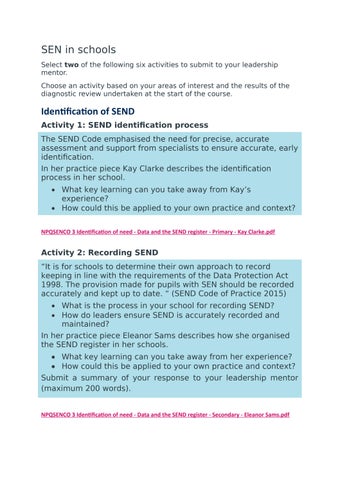
SEN in schools Select two of the following six activities to submit to your leadership mentor. Choose an activity based on your areas of interest and the results of the diagnostic review undertaken at the start of the course.
Identification of SEND Activity 1: SEND identification process The SEND Code emphasised the need for precise, accurate assessment and support from specialists to ensure accurate, early identification. In her practice piece Kay Clarke describes the identification process in her school. What key learning can you take away from Kay’s experience? How could this be applied to your own practice and context? NPQSENCO 3 Identification of need - Data and the SEND register - Primary - Kay Clarke.pdf
Activity 2: Recording SEND “It is for schools to determine their own approach to record keeping in line with the requirements of the Data Protection Act 1998. The provision made for pupils with SEN should be recorded accurately and kept up to date. “ (SEND Code of Practice 2015) What is the process in your school for recording SEND? How do leaders ensure SEND is accurately recorded and maintained? In her practice piece Eleanor Sams describes how she organised the SEND register in her schools. What key learning can you take away from her experience? How could this be applied to your own practice and context? Submit a summary of your response to your leadership mentor (maximum 200 words). NPQSENCO 3 Identification of need - Data and the SEND register - Secondary - Eleanor Sams.pdf
Activity 3: Working with families The SEND Code of Practice 2015 states that pupils and their families should be involved in early discussions around SEND identification. What evidence is there in your school that families are effectively involved in early discussions around SEND? What form do these discussions take? How are teachers and families supported to have effective discussions around SEND identification (professional development, meetings, guidance material)? What action could you take to improve support and facilitate these early conversations? Submit a summary of your response to your leadership mentor (maximum 200 words.
Teaching Activity 4: The science of learning With other leaders, establish and sustain effective curriculum planning and preparation across the school. Read Deans for Impact’s (2015) The science of learning, paying attention to the cognitive principles outlined. Choose two of the principles and reflect on their implications for pupils with SEND and the practice of teachers and leaders in your school. Submit a summary of your reflection to your leadership mentor (maximum 200 words).
Deans for Impact (2015) The science of learning
Activity 5: A graduated approach Support teachers and support staff to understand the importance of precise expert teaching for all pupils and to implement the graduated approach effectively. Read Becky Dumphy’s practice piece Implementing a graduated approach. Reflect on her strategy for developing teachers’ and leaders’ understanding of the graduated approach and areas of need. How could you adapt and implement aspects of her approach for your own context? Submit a summary of your reflection to your leadership mentor (maximum 200 words).
NPQSENCO 4 Teaching - Implementing a graduated approach - Primary - Becky Dunphy.pdf
Activity 6: Assistive technology Read section 2: of the Unicef (2022) guide to assistive technology (pp32-33) which provides guidance on identifying, selecting and using assistive technology and section 4 (pp86 to 100) which supports a whole school approach to the use of assistive technology. Reflect on the implications of this guidance for the practice of teachers and pupils in your school. Submit a summary of your reflection to your leadership mentor (maximum 200 words). Unicef (2022) The use of assistive technology in education: A guide for teachers and schools