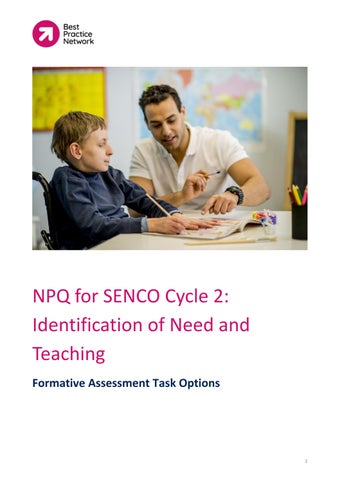
NPQ for SENCO Cycle 2: Identification of Need and Teaching Formative Assessment Task Options
1
Table of Contents Feedback guidance additional notes ........................................................................................................................... 3 Option one: Explore how needs are identified in your setting and how this informs how pupils are supported ......... 4 Programme framework statements covered.................................................................................................................. 4 Introduction .................................................................................................................................................................... 5 Resources........................................................................................................................................................................ 5 Task ................................................................................................................................................................................ 6 Option two: Explore how to communicate pupils’ individual needs to staff and how teachers are supported to scaffold learning ......................................................................................................................................................... 9 Programme framework statements covered.................................................................................................................. 9 Introduction .................................................................................................................................................................. 10 Resources...................................................................................................................................................................... 10 Task .............................................................................................................................................................................. 11 Option three: Analyse your identification of need data to create advice for teachers that will support them to adapt their teaching in response to a key SEN cohort ..........................................................................................................14 Programme framework statements covered................................................................................................................ 14 Introduction .................................................................................................................................................................. 15 Resources...................................................................................................................................................................... 15 Task .............................................................................................................................................................................. 16
NPQ for SENCO Cycle 2 FATs Options
2
Feedback guidance additional notes When responding to the FAT, please consider the four foci areas in the grid below. The feedback and feedforward questions for each FAT do cover these four areas overall. Please consider the feedback around implementation as a key focus, as this area is mandatory in the final SAT.
Foci
What this should include
Issues
Using their own context (or a case study), identify what the most important issues or problems are.
Identify problems or issues to be addressed. Solutions Identify solutions.
Rationale Set out your rationale for any solutions you propose.
Strategies Determine a strategy for implementing your proposals.
The solutions should address the issues identified but will be securely underpinned with the learning and research from the course and relevant content areas. The rationale for the solutions is taken from the research and is therefore securely evidence-based. For example, participants may refer to ‘EEF feedback’ research, which would then underpin their solutions. This should outline how they will address the issues and implement the solutions. For leadership programmes, and especially NPQH and NPQEL, these should be whole school/across school and strategic. For specialist programmes, these may be strategic but could be in the form of actions. In this section the different timeframes for implementing, i.e. short-, medium- and long-term strategies, could be included. How the strategies would be monitored and evaluated for impact would also be a feature in this section. Review of the implementation content area statements and the EEF implementation model would support the answers about implementing. As this area is weighted in the final SAT, please consider feedback against implementation in each FAT where it is relevant.
NPQ for SENCO Cycle 2 FATs Options
3
Option one: Explore how needs are identified in your setting and how this informs how pupils are supported Programme framework statements covered Learn that… 3.2 The SEND Code of Practice (2015) sets out four broad areas of need: communication and interaction; cognition and learning; social, emotional and mental health difficulties; and physical and/or sensory needs. 3.3 In practice, individual pupils with SEND will often have needs that cut across the four broad areas of need (SEND Code of Practice 2015). 3.4 Identification of SEND should draw on regular and precise assessment information, including statutory test outcomes, and discussion with the pupil and their family. Identification of need should take in the holistic picture of a pupil’s development and not focus solely on a single primary area of need (SEND Code of Practice 2015). 3.7 The SENCO should draw on specialists and external agencies, where necessary, to secure accurate identification (SEND Code of Practice 2015). Learn how to… Implement an efficient SEND identification process across the school which ensures that barriers to learning are identified and addressed at the earliest opportunity, including by: 3.a Constructing a record, such as a SEND Register, which reflects detailed and accurate identification of need; this will include core assessment data and record early indications of possible SEND. 3.f Analysing a range of data and evidence to support accurate identification, including information on behaviour, attendance and performance.
NPQ for SENCO Cycle 2 FATs Options
4
Introduction Before commencing the activities for this task, you should access some of the resources cited below and those available on Canvas. It is important that you do not omit this step. As the leader of SEN in your school, it is essential that you are able to underpin the validity of your approach by reference to relevant authoritative research.
Resources Department for Education [DfE] (2015) Special educational needs and disabilities Code of Practice, 0-25 years. DFE-00205-2013. https://www.gov.uk/government/publications/send-code-of-practice-0-to-25 Statistics: special educational needs (SEN) - GOV.UK Cullen, M. A., Lindsay, G., Hastings, R., Denne, L., & Stanford, C. (2020) Special Educational Needs in Mainstream Schools: Evidence Review. https://educationendowmentfoundation.org.uk/educationevidence/evidence-reviews/special-educational-needs-and-disabilities-send (Chapters 2, 3, 6 and 7)
NPQ for SENCO Cycle 2 FATs Options
5
Task Explore how needs are identified in your setting and how this informs how pupils are supported. Step 1: Review your SEN/Inclusion Register. Compare identified needs with available national data. If you are in a specialist setting, review the quality of the identification of needs section of the EHCP. Step 2: Consider whether your SEN/Inclusion Register is in line with national data sets and/or if needs are specific enough to support decisions about appropriate adaptive teaching strategies that might support the learner. If you are in a specialist setting, consider how useful information in EHCPs is – e.g., is an EHCP with SEMH specific enough? Step 3: Identify an appropriate sample size for your SEN/Inclusion Register, e.g., 10% to 20%. Thoroughly review the information available to you by reviewing pupil records/documentation fully. If you are in a mainstream setting, include samples at different levels of support, and stages of the graduated approach. To what extent is the identification of need useful? What are the assessments that support the justification for the identification of need? Which additional assessments would add to the quality and clarity of the information? Step 4: In what ways does the information available support appropriate referral to external professionals, e.g., speech therapists, occupational therapists, physiotherapists? Step 5: How does the identification of need lead to appropriate interventions and advice for staff about appropriate adaptive teaching strategies? Once these steps are complete, review the information available and create a presentation, with notes, of no more than 10 slides, that could be shared with the senior leadership team. Highlight how your SEN/Inclusion Register is made up and how this relates to national data. Demonstrate the strengths of identification of need and areas for development. In preparing your presentation and notes, you should consider (a) the language (style/tone) you will use, and (b) the external evidence base you will draw upon to underpin your policies or strategies. When you have completed your presentation, upload it and your notes (made on the resource below) to Canvas for your leadership performance coach within the timeframe identified.
NPQ for SENCO Cycle 2 FATs Options
6
Task: Explore how needs are identified in your setting and how this informs how pupils are supported. Step 1: Review your SEN/Inclusion Register. Compare identified needs with available national data. If you are in a specialist setting, review the quality of the identification of needs section of the EHCP. Statistics: special educational needs (SEN) - GOV.UK
Step 2: Consider whether your SEN/Inclusion Register is in line with national data sets and/or if needs are specific enough to support decisions about appropriate adaptive teaching strategies that might support the learner. If you are in a specialist setting, consider how useful information in EHCPs is – e.g., is an EHCP with SEMH specific enough?
Step 3: Identify an appropriate sample size of your SEN/Inclusion Register, e.g., 10% to 20%. Thoroughly review the information available to you by reviewing pupil records/documentation fully. If you are in a mainstream setting, include samples at different levels of support, and stages of the graduated approach. To what extent is the identification of need useful? What are the assessments that support the justification for the identification of need? Which additional assessments would add to the quality and clarity of the information?
NPQ for SENCO Cycle 2 FATs Options
7
To what extent is the identification of need useful?
What are the assessments that support the justification for the identification of need?
Which additional assessments would add to the quality and clarity of the information?
Step 4: In what ways does the information available support appropriate referral to external professionals, e.g., speech therapists, occupational therapists, physiotherapists? Findings:
Step 5: How does the identification of need lead to appropriate interventions and advice for staff about appropriate adaptive teaching strategies? Findings:
Once these steps are complete, review the information available and create a presentation, with notes, of no more than 10 slides, that could be shared with the senior leadership team. Highlight how your SEN/Inclusion Register is made up and how this relates to national data. Demonstrate the strengths of identification of need and areas for development.
NPQ for SENCO Cycle 2 FATs Options
8
Option two: Explore how to communicate pupils’ individual needs to staff and how teachers are supported to scaffold learning Programme framework statements covered Learn that… 4.5 High quality teaching can transform pupils’ knowledge, capabilities and beliefs about learning. 4.6 Adapting teaching in a responsive way, including by providing targeted support to pupils who are struggling, is likely to increase pupil success. 4.8 High quality teaching for pupils with SEND is based on strategies which are often already practised by teachers, and which can be developed through training and support. Learn how to… With other leaders, establish and sustain effective curriculum planning and preparation across the school, including by: 4.a Communicating the information about pupils with SEND that enable teachers to plan, adapt and teach effectively for all pupils. 4.d Supporting teachers to scaffold learning, reducing bespoke support as the pupil demonstrates mastery in the domain and becomes increasingly independent. Support teachers and support staff to understand the importance of precise expert teaching for all pupils and to implement the graduated approach effectively, including by: 4.f Enabling teachers and leaders to understand the graduated approach and utilise it in the classroom, subject or domain. 4.k Advising teachers on how to adapt teaching resources to cater to pupil need.
NPQ for SENCO Cycle 2 FATs Options
9
Introduction Before commencing the activities for this task, you should access some of the resources cited below and those available on Canvas. It is important that you do not omit this step. As the leader of SEN in your school, it is essential that you are able to underpin the validity of your approach by reference to relevant authoritative research.
Resources Department for Education [DfE] (2015) Special educational needs and disabilities Code of Practice, 0-25 years. DFE-00205-2013. https://www.gov.uk/government/publications/send-code-of-practice-0-to-25 Cullen, M. A., Lindsay, G., Hastings, R., Denne, L., & Stanford, C. (2020) Special Educational Needs in Mainstream Schools: Evidence Review. https://educationendowmentfoundation.org.uk/educationevidence/evidence-reviews/special-educational-needs-and-disabilities-send (Chapters 6, 7 and 8) Coe, R., Aloisi, C., Higgins, S., & Major, L. E. (2014) What makes great teaching? Review of the underpinning research. Durham University: UK. What-Makes-Great-Teaching-REPORT.pdf (pp. 1–25) Education Endowment Foundation (2020) Special Educational Needs in Mainstream Schools Guidance Report. Special Educational Needs in Mainstream Schools | EEF (pp. 1–27) Aubin, G. (2024) EEF blog: Five-a-day for pupils with SEND – a cluster of adaptive approaches. https://educationendowmentfoundation.org.uk/news/eef-blog-five-a-day-for-pupils-with-send-acluster-of-adaptive-approaches??
NPQ for SENCO Cycle 2 FATs Options
10
Task Explore how to communicate pupils’ individual needs to staff and how teachers are supported to scaffold learning. You should work through the following stages, bearing in mind throughout that you do not wish to make any excessive demands upon colleagues’ time. Step 1: Explore how your setting ensures that teachers are aware of the needs of the children that they teach. Consider to what extent this information is easy to access, relevant and supportive. Consider whether identification of needs is specific enough to provide information that supports teachers to plan their delivery. Step 2: Explore how your school supports staff to adapt the curriculum for pupils identified as having special educational needs. Use the research to identify the best adaptive teaching strategies to support learners. To what extent does the guidance for teachers in your school align with the research? Identify elements of good practice and how this could be improved. Step 3: How does your school support the professional development of teachers to develop adaptive teaching strategies? What has taken place in the last two years? To what extent does this training align with your research so far? What is planned for in the future? What changes would you make to the future planning to align more closely to the research? Step 4: Identify a colleague from another setting (this could be someone from your coaching group). Arrange to meet and share findings. Step 5: Identify next steps, ways that you could improve communication of need in your setting and ways you could improve support for staff to use adaptive teaching strategies. When you have completed this process, reflect on the outcomes of your activities. Develop an action plan (approximately 300 words) and accompanying rationale (approximately 300 words) that could be shared with your senior leadership team. In your action plan, consider the timescale and process for implementation. In your rationale, use the research to explain the recommendations in your action plan. In preparing your action plan and rationale, you should also consider (a) the language (style/tone) you will use, and (b) the external evidence base you will draw upon to underpin your policies or strategies. When you have completed your action plan and rationale, upload them and your notes (made on the resource below) to Canvas for your leadership performance coach within the timeframe identified.
NPQ for SENCO Cycle 2 FATs Options
11
Task: Explore how to communicate pupils’ individual needs to staff and how teachers are supported to scaffold learning. Step 1: Explore how your setting ensures that teachers are aware of the needs of the children that they teach. Consider to what extent this information is easy to access, relevant and supportive. Consider whether identification of needs is specific enough to provide information that supports teachers to plan their delivery. Accessibility
Relevance
Supportive?
Is the information about children’s needs useful?
Step 2: Explore how your school supports staff to adapt the curriculum for pupils identified as having special educational needs. Use the research to identify the best adaptive teaching strategies to support learners. To what extent does the guidance for teachers in your school align with the research? Identify elements of good practice and how this could be improved. Findings:
NPQ for SENCO Cycle 2 FATs Options
12
Step 3: How does your school support the professional development of teachers to develop adaptive teaching strategies? What has taken place in the last two years? To what extent does this training align with your research so far? What is planned for in the future? What changes would you make to the future planning to align more closely to the research? Findings:
Step 4: Identify a colleague from another setting (this could be someone from your coaching group). Arrange to meet and share findings. Findings:
Step 5: Identify next steps, ways that you could improve communication of need in your setting and ways you could improve support for staff to use adaptive teaching strategies. Notes:
When you have completed this process, reflect on the outcomes of your activities. Develop an action plan (approximately 300 words) and accompanying rationale (approximately 300 words) that could be shared with your senior leadership team. In your action plan, consider the timescale and process for implementation. In your rationale, use the research to explain the recommendations in your action plan.
NPQ for SENCO Cycle 2 FATs Options
13
Option three: Analyse your identification of need data to create advice for teachers that will support them to adapt their teaching in response to a key SEN cohort Programme framework statements covered Learn that… 3.1 The purpose of identifying a special educational need is to determine what action the school should take to address barriers to learning. Identification should not be intended to fit a pupil into a category (SEND Code of Practice 2015). 4.6 Adapting teaching in a responsive way, including by providing targeted support to pupils who are struggling, is likely to increase pupil success. 4.8 High quality teaching for pupils with SEND is based on strategies which are often already practised by teachers, and which can be developed through training and support. 4.9 High quality teaching for pupils with SEND deploys explicit instruction and effective scaffolding as appropriate and develops cognitive and metacognitive strategies to support learning. 4.11 Technology, including educational software and assistive technology, can support teaching and learning for pupils with SEND. 4.12 Executive functioning skills have been linked to key developmental outcomes in domains such as reading, maths, mental and physical health, and wellbeing. Learn how to… With other leaders, establish and sustain effective curriculum planning and preparation across the school, including by: 4.a Communicating the information about pupils with SEND that enable teachers to plan, adapt and teach effectively for all pupils. Support teachers and support staff to understand the importance of precise expert teaching for all pupils and to implement the graduated approach effectively, including by: 4.h Working with other leaders across the school to identify where effective teaching practices can remove barriers to learning. 4.k Advising teachers on how to adapt teaching resources to cater to pupil need.
NPQ for SENCO Cycle 2 FATs Options
14
4.l Advising teachers on how to maintain a classroom environment that attends to the needs of pupils with sensory and/or physical needs, including the use of assistive technologies and/or specialist equipment.
Introduction Before commencing the activities for this task, you should access some of the resources cited below and those available on Canvas. It is important that you do not omit this step. As the leader of SEN in your school, it is essential that you are able to underpin the validity of your approach by reference to relevant authoritative research.
Resources Department for Education (2015) Special Educational Needs and Disability Code of Practice: 0 to 25 years: Statutory guidance for organisations which work with and support children and young people who have special educational needs or disabilities. https://assets.publishing.service.gov.uk/government/uploads/system/uploads/attachment_data/file/39 8815/SEND_Code_of_Practice_January_2015.pdf Statistics: special educational needs (SEN) - GOV.UK Cullen, M. A., Lindsay, G., Hastings, R., Denne, L., & Stanford, C. (2020) Special Educational Needs in Mainstream Schools: Evidence Review. https://educationendowmentfoundation.org.uk/educationevidence/evidence-reviews/special-educational-needs-and-disabilities-send (Chapters 6, 7 and 8) Coe, R., Aloisi, C., Higgins, S., & Major, L. E. (2014) What makes great teaching? Review of the underpinning research. Durham University: UK. What-Makes-Great-Teaching-REPORT.pdf (pp. 1–25) Education Endowment Foundation (2020) Special Educational Needs in Mainstream Schools Guidance Report. Special Educational Needs in Mainstream Schools | EEF (pp. 1–27) Meltzer, L., Pollica, L. S., & Barzillai, M. (2007) Executive Function in the Classroom: Embedding Strategy Instruction into Daily Teaching Practices. In L. Meltzer (Ed.), Executive function in education: From theory to practice, pp. 165–193.
NPQ for SENCO Cycle 2 FATs Options
15
Task Analyse your identification of need data to create advice for teachers that will support them to adapt their teaching in response to a key SEN cohort. Step 1: Review your SEN/Inclusion Register. Compare identified needs with available national data. If you are in a specialist setting, review the quality of the identification of needs section of the EHCP and consider how useful the information is. Step 2: From your analysis, identify a key area of need to focus on that is either an area that is underrepresented, higher than the national average, or increasing within your own setting. In a specialist setting, this would be your main area of need. Step 3: Identify through research and discussions with staff the key barriers to learning for your chosen cohort and what strategies are used by staff to support these learners. Step 4: Identify elements of good practice that are already taking place and establish how good practice is shared with all teachers and support staff. Step 5: Explore what adaptive teaching strategies may support learning for this cohort and how these strategies can support developing executive function. Step 6: Identify how the classroom environment can be used to support this cohort and any physical or sensory needs they may have. Include the use of assistive technologies and/or specialist equipment. Once you have completed these steps, produce a report (600 words) that would provide advice for teachers to adapt their teaching resources to cater to this cohort’s needs. Where appropriate, include advice on the use of assistive technologies and/or specialist equipment. Make sure your report includes the research that supports your advice. In preparing your report, you should also consider (a) the language (style/tone) you will use, and (b) the external evidence base you will draw upon to underpin your policies or strategies. When you have completed your report , upload it and your notes (made on the resource below) to Canvas for your leadership performance coach within the timeframe identified.
NPQ for SENCO Cycle 2 FATs Options
16
Task: Analyse your identification of need data to create advice for teachers that will support them to adapt their teaching in response to a key SEN cohort. Step 1: Review your SEN/Inclusion Register. Compare identified needs with available national data. If you are in a specialist setting, review the quality of the identification of needs section of the EHCP and consider how useful the information is. Statistics: special educational needs (SEN) - GOV.UK Findings:
Step 2: From your analysis, identify a key area of need to focus on that is either an area that is underrepresented, higher than the national average, or increasing within your own setting. In a specialist setting, this would be your main area of need. Underrepresented
Higher than the national average
An increasing area of need or main area of need
Step 3: Identify through research and discussions with staff the key barriers to learning for your chosen cohort and what strategies are used by staff to support these learners. Barriers to learning:
NPQ for SENCO Cycle 2 FATs Options
17
Step 4: Identify elements of good practice that are already taking place and establish how good practice is shared with all teachers and support staff. Good practice
How is this shared?
Step 5: Explore what adaptive teaching strategies may support learning for this cohort and how these strategies can support developing executive function. Findings:
Step 6: Identify how the classroom environment can be used to support this cohort and any physical or sensory needs they may have. Include the use of assistive technologies and/or specialist equipment. Findings:
NPQ for SENCO Cycle 2 FATs Options
18
Once you have completed these steps, produce a report (600 words) that would provide advice for teachers to adapt their teaching resources to cater to this cohort’s needs. Where appropriate, include advice on the use of assistive technologies and/or specialist equipment. Make sure your report includes the research that supports your advice.
NPQ for SENCO Cycle 2 FATs Options
19
Contact us +44 (0) 117 920 9200 npq@bestpracticenet.co.uk bestpracticenet.co.uk
NPQ for SENCO Cycle 2 FATs Options
20