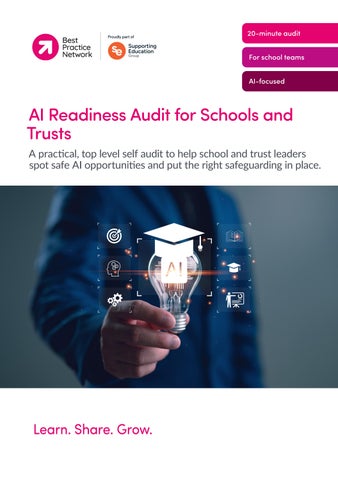

AI Readiness Audit for Schools and Trusts
A practical, top level self audit to help school and trust leaders spot safe AI opportunities and put the right safeguarding in place.

AI is already being used in schools
The question is whether it’s being used safely and strategically.
According to the National Education Union, 76% of school staff are currently using AI to support their day-to-day role, with the usage primarily being for resource creation, lesson planning and administrative tasks. However, many schools are still asking important questions:
• Who should oversee AI use?
• What tools are safe to use?
• How do we avoid GDPR and safeguarding risks?
• Where can AI genuinely save time?
• How do we move from experimentation to meaningful improvement?
This assessment is designed to help school and trust leaders evaluate their current position and identify practical next steps.
Discover:
How AI-ready your school is
Where AI could safely reduce workload
What governance and compliance gaps exist
Which processes offer the greatest opportunity for improvement
Whether your school would benefit from an AI Practitioner
Estimated completition time: 20 minutes


Section 1: AI Readiness Assessment
We
Staff
We
Your AI Readiness Score
0–9: Foundation Stage
AI use is likely happening informally
Priority actions:
• Establish governance
• Create basic guidance
• Identify approved tools
• Begin staff awareness conversations
10-18: Developing Stage
You have started exploring AI but may lack consistency
Priority actions:
• Introduce pilot projects
• Strengthen oversight
• Build staff confidence
• Define ownership
19-27: Advancing Stage
You have strong foundations in place
Priority actions:
• Scale successful pilots
• Measure impact
• Develop internal expertise
• Create long-term strategy

Section 2: AI Opportunity Audit
Identify where AI could have the biggest impact in your school
For each area below, score:
Time Pressure
How much staff time does this process currently consume?
Improvement Opportunity
How much could this process benefit from better systems, automation or AI support?
Staff onboarding
Meeting administration
Policy review and compliance
Data quality and reporting
Behaviour monitoring
HR administration
Operations workflow
General administration
What Your Score Means
18-35 | Low Opportunity
Current processes may already be manageable, or AI may not yet be a strategic priority.
36 - 60 | Moderate Opportunity
There are likely several areas where AI or automation could improve efficiency, consistency or workload.
8-10 | High Opportunity
Your school may have significant potential for operational improvement through AI-supported workflows, automation and better systems.
High-scoring areas are often strong starting points for an AI Practitioner project because they combine:
• repetitive workload
• process inefficiencies
• and measurable improvement opportunities
Your High Priority Areas
Identify Your Top 3 Opportunities
Opportunity 1
Current Process
Estimated time spent each week:
Potential benefit:
Opportunity 2
Current Process
Estimated time spent each week:
Potential benefit:
Opportunity 3
Current Process
Estimated time spent each week:
Potential benefit:
Safe AI Checklist
Before introducing any AI solution, ask:
Governance
Who owns this initiative?
Who approves the tool?
Who evaluates success?
Data Protection
Could personal data be exposed?
Is a Data Protection Impact Assessment (DPIA) required?
Have safeguarding implications been considered?
Human Oversight
Who checks outputs?
What decisions must remain human-led?
How will errors be identified?
Impact
What problem are we solving?
How will we measure success?
Will this genuinely save time?

Does Your School Need an AI Practitioner?
You may benefit from an AI Practitioner if:
Staff are already using AI but there is no clear ownership
You want to reduce administrative workload
You are exploring automation opportunities
You need stronger governance and compliance
You want to improve processes across departments
You want measurable outcomes rather than isolated experiments
Multiple teams are interested in AI but nobody is coordinating activity
Tick Count
0-2 ticks
You may only need basic awareness and guidance
3-5 ticks
You could benefit from a designated AI lead
6-7 ticks
Developing an AI Practitioner is likely to deliver significant value
Next Step: Build Internal AI Capability
Schools that achieve the greatest long-term impact from AI typically move beyond individual tool use and develop internal expertise.
The AI Practitioner for Schools Level 4
Apprenticeship is a fully funded development route for school and trust staff who want to coordinate the ethical and effective use of AI and automation acoross education settings.
Benefits
Coordinate the ethical and responsible use of AI and automation within school and trust environments
Identify opportunities to reduce workload through automation of administrative and operational processes
Improve data quality, reporting and information flow across school systems
Design, build and manage low-code automation solutions using commonly used school technologies
Lead change safely and effectively, including staff engagement, risk management and compliance
Apply safeguarding, data protection and GDPR principles to the use of AI and digital tools in schools
Deliver a substantial workplace project that creates measurable impact for their school or trust
Eligibility
To be eligible for the programme, participants must:
• Be currently employed in a school or trust setting and have employer support to complete the programme
• Have a role that involves systems, data, operations or administrative responsibility
• Be able to complete a workplace project as part of the apprenticeship
• Have the right to work and study in England
This course awards AI and Automation Practitioner Apprenticeship Course duration 14 months
Access to Cross-sector leadership resources & expertise
Apprenticeship Levy Funding
Fully-funded through the Apprenticeship Levy
£18,000
£0 with Apprenticeship Levy funding