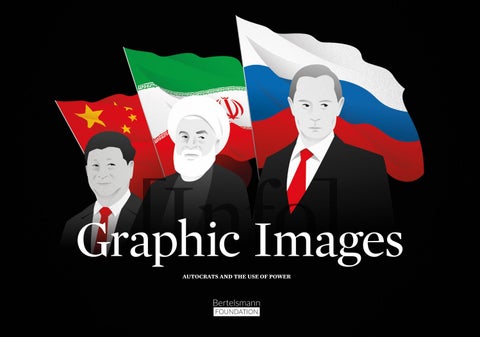
Graphic Images AUTOCRATS AND THE USE OF POWER
2
Graphic Images AUTOCRATS AND THE USE OF POWER
Diagnosing Democratic Decline
carefully constructed algorithms by our partners at the Institute for Competitiveness, we collected data points that showed the driving forces of political instability and social unrest in case studies such as Brexit, the elections of Indian Prime Minister Narendra Modi and Brazilian President Jair Bolsonaro, and the 2016 U.S. general
In 2015, the Bertelsmann Foundation launched its Disrupting
election. We took more than 10,000 pieces of raw data and converted
Democracy series to investigate the causes of a global downward
them into a compendium of 100 visualizations that provided a
trend in democratic governance and public support for democracy.
degree of depth that went well beyond any written analysis.
As we began this journey, the United Kingdom was still a member of the European Union, Donald Trump was best known for his work on
In Graphic Images: Autocrats and the Use of Power, the series’
“Celebrity Apprentice”, and attention to public health concerns largely
fourthandfinalinstallment,weexaminethewaysinwhichthree
focusedontheseasonalu.fl Somuchhaschangedinsuchashorttime.undemocratic regimes undermine the prospects for democracy and stability in their respective regions. We do this by drawing Weexaminedinthefirstvolumeof Disrupting Democracy the
on more than 15 years of country- and regional-level data from
ways in which technological innovations transform countries
the Bertelsmann (Stiftung) Transformation Index to produce
at various stages of political and technological development.
illuminating infographics. They shed light on Russian President
Our case studies — India, Germany, Israel, Cuba, and the United
Vladimir Putin’s assault on domestic democratic institutions,
States — demonstrated distinct experiences at the intersection of
which has strengthened his capacity to intervene militarily and
technology and democracy. But there were common themes that
through disinformation campaigns in post-Soviet Eurasia. The
cut across all the countries. Bridging the urban-rural access divide,
infographics also show the ability of Iran’s weak government to
combatting disinformation, and addressing the displacement of
leverage limited resources to bolster nationalism, and effectively
traditional media presented policy challenges with which each
reshape the Middle East. And they highlight China’s embrace
government had to contend in their own ways.
ofitssuperpowerstatustomold,througheconomicinfluence, aninternationallandscapereflectingitsownvaluesystem,and
We probed deeper in the second volume of Disrupting Democracy
thereby offer a counterexample to American governance.
by conducting our work within the crucible of election campaigns. Those pages tell the tales of the Democratic Party’s “blue wave”
Theimagesyound fi inthefollowingpagesoftenpresentableak
in the 2018 U.S. midterm elections, history-making victories for
picture for democracy’s prospects in 2022. We could react with
populism in Mexico and Italy, and Russia’s ongoing attempts to
despair. Or we can treat this book as a clarion call to begin reversing
influenceelectoraloutcomesinneighboringLatvia.Thesecases the steep democratic decline that we have observed since launching revealedanunbalancedledgerofcostsandbenefitsfortechnology Disrupting Democracy. Our hope is that your choice will be clear by on campaigning, elections systems and governance.
thetimeyouturnthenal fi pageofthisvolume.
Wedefiedexpectationsinthethirdvolume Disrupting of Democracy
Irene Braam
by using technology to explain democracy in the 21st century
Executive Director
rather than looking at its impact on democracy. Through the use of
Bertelsmann Foundation, February 2022 3
Methodology
functionally and empirically. We understand transformation as politically driven change in which an authoritarian system and a state-dominated or clientelist economic order evolve
The Bertelsmann Stiftung’s Transformation Index (BTI) analyzes
in the direction of democracy and a market-based economy.
and evaluates whether and how 137 developing and transforma-
However, this implies neither linear, irreversible develop-
tion countries are steering social change toward democracy and
ment nor a predetermined path of transformation, nor does
a market economy. Far more than being just a ranking, the BTI
it suggest that there is an ideal sequence of milestones to
distinguishes itself from other international studies by:
be passed. While the BTI holds that freedom of choice and freedom from want are universal aspirations best achieved in
Basing its numerical assessments on qualitative evaluations. Each of the 7,124 individual indicator scores is backed up by a separate paragraph in more than 5,000 pages of country reports and allows for informed international comparison.
a democratic system and a market-based economic setting, it does not adhere to any particular existing institutional model. COUNTRY SELECTION Transformation management toward more open societies differs from reform management in long-consolidated democratic systems with well-advanced economies and thus requires a
Analyzing processes of transformation comprehensively.
defined“thresholdofconsolidation,”theTransformation
By studying political transformation, economic development and
isation for Economic Co-operation and Development (OECD)
governance quality simultaneously, the BTI sheds light on their
by the year 1989. This is not to suggest that these countries
complex interplay in societal change.
have achieved a static end-state, but that good governance
different set of assessment criteria. In the absence of a clearly Index excludes all countries that were members of the Organ-
and the resulting reform agenda are not centered around the
Assessing governance with expert-based analyses. Relying on an academic network of close to 300 country and regional experts in more than 120 countries, the BTI offers textbased evaluations to explain successes and failures in governance.
systemic component of overcoming a closed regime. Small states with fewer than 1 million residents are also not examined in the BTI, except Bhutan and Montenegro as particularly interesting cases of transformation. Since 2003, the number of countries surveyed has increased from 116 to137.Theyaredividedintosevenregionalgroups:Latin America and the Caribbean (22 countries), West and Central
4
The BTI’s normative reference points for good governance
Africa (22), Southern and Eastern Africa (22), Middle East
– democracy under the rule of law and a market economy an-
and North Africa (19), East-Central and Southeast Europe
chored in principles of social justice – are closely related both
(17), Post-Soviet Eurasia (13), and Asia and Oceania (22).
Indicators
Criteria
INDEX AGGREGATION
pm e
tio itu st
so ra t
ic
in
la nd ty
of
de
Po
m
lit
oc
ica
cio f so
ns
cia l in
te gr at io
n
mi cd eve lo
eco
no
aniz atio Org
el o Dimensions
nt
n of and the ma rk com peti et tion
Bank ing s Libe ystem raliz atio n of fore ign t rade Com pet ition poli Ma cy rke t or gan So cio izat eco ion no mi cb arr ier s Ap So cia pr ov l ca al p ita of l de m oc In ra te cy re st gr ou Pa ps rty sy st em
Monet ary sta bility
Fiscal stabi lity
stability
Property rights
and fiscal Monetary
Lev
Gove perfo rnan rm ce an ce
G o ve rna nc e
Regional cooperation
peration
x de In
St
ab
ili
Economic transformation
S tat us In
t
cal n liti atio Po orm f ns ra
International coo
l of ve ty Le cul ffi di
ns tio u t i st ns in io ic ut t t i ra s st in ht oc rig m tic l e a i r v d Ci oc o se tt bu em d en ea f c i o m f it of ry ce m of icia an m ion m jud t r t Co u n ec rfo de rs os en Pe we Pr ep po d of In n tio n ara ssio Sep pre f ex o m ts edo righ Fre law bly f em o s s a / le n tion Ru over ocia to g Ass wer o p ctive s Effe ction ir ele nd fa a n e o e i r F ipat rtic tration l pa a dminis c i t Basic a oli
P
x de
Credibility
Private property
Private enterprise gime Welfare re y nets Social safet ance erform mic p nity Econo pportu Equal o y bilit aina Sust ength ut str Outp cy l poli enta onm lty Envir licy o icu p iff R&D fd on / lo s cati t ve Edu rain Le nst l co s ura ion uct dit Str tra ety oci y il s sit Civ en d int led ale ca ict c es nfl es Pr Co xr w PP de la .c. In of Ip n le io GN at Ru uc & Ed ss ne UN te ta IS BT
Pr io rit iza Im tio pl n em en Po ta lic tio yl ea n rn Eff i ici ng en tu se Po of licy as co se ord ts ina An ti-c tio orr n up St tio ee np Con rin olic sen y sus g ca on g pa oal Ant s i-de bi mo lit R crat es y ou ic a ctor r Clea c e s vage eff / con ici en flict man cy agem Civil s ociet ent y par ticipa tion Con Reconc sen iliation susbuil ding Effective us e of suppo rt
Stateness
gmas ligious do ence of re No interfer State identity Monopoly on the use of force
Dimensions
Criteria
Indicators
into a Status Index follows the normative premise of the BTI,
communicatingndings fi toabroaderpublic.Rankingsnecessarily
under which transformation is always conceived of as a com-
reduce complexity in order to highlight particular differences
The Status Index is formed by calculating the average of the
prehensive transition toward democracy and a market-based
between individual countries, call attention to trends in de velop-
total scores given for the dimensions of political and economic
economy. The Governance Index is formed by calculating the
ment,andmakefactorskeytoprogressmorereadilyidentifiable.
transformation. The state of transformation in each analytic
average of scores given for the governance criteria, which is
dimension is equivalent to the average of the scores of the
thenoffsetagainsttheassignedlevelofdifficulty.
associated criteria. Criterion scores are, in turn, based on the
For a more thorough analysis of a country’s strengths and weaknesses, please consult the BTI’s non-aggregated
average scores of the equally weighted indicators that com-
The high level of aggregation of individual scores and the use
individual scores as well as the country reports and regional
prise the criterion. Combining the two analytical dimensions
of rankings are primarily means of providing orientation and
analyses – all available online at www.bti-project.org. 5
GOVERNANCE PERFORMANCE
ANALYTICAL FRAMEWORK
POLITICAL TRANSFORMATION
ECONOMIC TRANSFORMATION
Constraints criterion
Levelofdifficulty Authority criteria
Democratization precondition criterion
Stateness Democratic core criteria
Political participation Rule of law Democratic consolidation criteria
Stability of democratic institutions Political and social integration The state of political transformation is measured in terms offivecriteria,whichinturnarederivedfromassess -
Inclusive and sustainable development criteria
Level of socioeconomic development Welfare regime Sustainability Economic order criteria
Organization of the market and competition Private property Economic policy and output criteria
Monetaryandfiscalstability Economic performance
ments made in response to 18 questions. Stateness, which is seen as a precondition to democracy, is included in the
6
Steering capability Resourceefficiency Inclusiveness criteria
Consensus building International cooperation TheGovernanceIndexiscomprisedofve fi criteria,whichare based on a total of 20 indicators. It focuses on how effectively policymakers facilitate and steer development and transformation processes. The BTI holds that successful governance must guarantee inclusive participation of all relevant interests, ideas and identities, and have the authority to
The state of economic transformation is measured in
facilitate agreement among stakeholders and implement joint
BTI’sdefinitionofpoliticaltransformationandexamined terms of seven criteria, which are based on a total of 14
decisions. Authority requires that governments are consistent
throughquestionsspecificallydealingwiththestate’s
indicators. The BTI explicitly puts elements of social
in pursuing their goals and use their resources wisely and
monopoly on the use of force and basic administrative
inclusion, such as social safety nets and equality of
effectively. Inclusion implies that decision-makers cultivate
structures. The BTI’s concept of democracy goes well
opportunity, as well as sustainability on an equal footing
the broadest possible consensus for their transformation goals
beyondotherdefinitionsofdemocracy,whicharelimited with market and competition criteria. In BTI terms,
and work reliably with external supporters and neighboring
primarily to basic civil rights and the conduct of free
comprehensive development not only aims at sustainable
states. Governance performance is weighted with the level of
elections. It also entails an evaluation of the rule of law,
growth, but also requires successful poverty alleviation
difficulty,whichisderivedfromthreequalitativeandthree
including the separation of powers and the prosecution
and the freedom of action and choice for as many citizens
quantitativeindicators.Itreflectstheobservationthateach
ofofficeabuse.TheBTIputsaspecialemphasisonthe
as possible. The BTI’s concept of a socially inclusive
country’squalityoftransformationisinfluencedbystructural
evaluation of democratic consolidation. It assesses the
market economy thus distinguishes itself from those that
constraints.Inthisway,difficultconditionsandthescarcity
quality of representation with regard to the party system
allow for socioeconomic intervention only if it conforms
of resources in a given country are factored in. The BTI is the
and interest groups, and also measures social capital and
with market rules and primarily accentuate the impor-
only index to analyze and compare governance performance
the approval of democratic norms and procedures.
tance of market organization and property rights.
in developing countries with self-collected data.
DEMOCRACIES AND AUTOCRACIES
MEASUREMENT AND REVIEW PROCESS
The Transformation Index is based on a qualitative expert survey in which written assessments are translated into numerical ratings and examined in a multistage review process so as to make them comparable both within and across regions. This method enables those factors of political and economic development that elude purely quantitative assessments to be captured in the experts’ qualitative appraisals. The resulting country assessments render the reasons behind each of the BTI’s 7,individual 421 scoresfullytransparentandverifiable.
qualitative indicators associated with each criterion. The second expert reviews, comments on and adds to this country report. Independently of one another, the two country experts translate the assessment into a numerical rating on a scale of one (the lowest value) to 10 (the highest value), structured by four levels of score-based categories contained in the codebook. In this way, countries are evaluated on the basis of whether and to what extent they comply with the specifiedratinglevelsandfulfilltheBTIcriteria.
Thesystemicclassificationofacountryasademocracy or an autocracy is not determined by the aggregate politicaltransformationscore,butbyspecificindicator scores. In accordance with the BTI’s comprehensive concept of democracy, seven threshold values marking minimum requirements are considered. The country is classifiedasanautocracyifevenonescorefallsshortof the relevant threshold.
Nevertheless, this type of qualitative expert survey will always contain a degree of subjectivity. The BTI survey process takes this into account during the preparation of reports and evaluations, as well as during the review of the data. It is designed to minimize subjective factors as far as possible throughout the process.
To ensure the validity, reliability and comparability of the assessment, each individual score undergoes a multistep process of review by the country experts, the regional coordinators, the project team and the BTI board.
Free and fair elections
Free elections are not held or are marked by serious irregularities and restrictions.
Effective power to govern
Democratically elected leaders de facto < 4 points lack the power to govern.
Association and
The freedom of association or
Political participation
assembly rights assembly does not exist, or civil society The scores and responses provided by the experts for organizations are suppressed. each of the 49 indicators are initially reviewed by regional Freedom of Freedom of expression or media A standardized codebook serves as the foundation coordinators, who examine the content to ensure it is expression freedom does not exist, or severe restrictions are in place. of the survey process, providing a single reference both complete and consistent. The regional coordinators, framework for the experts when answering the all political scientists with expertise in comparative Rule of law questions. The process of country assessment has studies, participate in each step of the report-creation Separation of Constitutional oversight of the both a qualitative and quantitative component, in each process and apply their regional expertise to ensure the powers executive, legislature or judiciary does not exist, or exists only on paper. case performed by two country experts. As a rule, high quality of the country reports. They subsequently one foreign and one local expert are involved in the perform an intraregional calibration of their countries’ Civil rights Civil rights are systematically violated evaluation process; this ensures that both external scores, and then they join with the project team to carry and internal perspectives are taken into account in the out an interregional score calibration for all 137 countries, Stateness course of assessment. In total, 272 experts from leading this time checking for across-the-board comparability and Monopoly on the The state has no control over large research institutions around the world contributed to viability. Finally, all scores are discussed once again by the use of force & Basic parts of the country and fails to fulfill administration basic civil functions. the production of the country reports for the BTI 2022. BTI Board before being adopted. The BTI Board, a panel (average) of scholars and practitioners with long-term experience Thefirstexpertdraftsadetailedreportonthebasisofintheeld fi ofdevelopmentandtransformation,provides Failing states with a severely limited capacity to act are also the criteria outlined in the codebook, referencing the the project with ongoing support and advice. considered autocracies.
< 6 points
< 4 points
< 4 points
< 4 points
< 4 points
< 3 points
7
North America
Atlantic Ocean
North Pole
Europe RUSSIA ›
Africa
CHINA
IRAN ایران
%H3
Indian Ocean
8
Ocean
ع
Ke e
pi
ng
t W he G on o ' Pa t Y ver 21 rtn ou nm B No ers A e M ent 20 P r y on o l Ci vil ace und Nei Tar 19 A F Soc for P the ghb get utu iety er Ta or? 18 re T su b Up rad asio le Str in itio n M 17 e Th t e O ngth ovin he A ns ' nly in 16 Nu on U ir Ga p m me Inte in T bers D rtw 15 ined esign own Fl Free I Putti The dom nstitut aws 14 ng D Lim ion to b emoc i s t e s ofPe racy S Thro opl ilent 13 ugh t e Po One N he Shred wer d ation 12 Monop Unde er oly on r Xi the Us Democr e of Fo acy Failin 10 rce g to Tak e Flight
22
CHINA
4
3
Table of Contents
66
69 71
70
68
32
23
29
24
28
FightingCorruptionisaHeav yLift 51 Marching into Pe ril A Table for One? 52 Cascad ingCoo People perati 53 onorCo P nfli ct? Takin ower g their Wha 5 S 4 e ats t The 's in the B F r i o e r fcase ever 55 Und ? Mo er the D Regime? r ome 56 Ira e Ban g A S nian for th 57 A P tate o Influe e Buc Fla auci f Fra nce k 58 Fly min ty of gmen onth g Po ta e i R ng Sol Out pular tion Mar ch 59 Po US Po o? w Do iso SI er 6 0 P N nin A Vo owe ot P g th 61 te r o as e W fo f t s G r P he o ell 62 ut Pu in 63 …o lpit rP 64 ut in 65
Putting the Pieces in Place 50 Putting Education to Work 49 le Stuck in the Midd ns tio 48 mitedOp Li bjects ovable O ion s eets Imm 47 Force M Expres oppable ack on plePower hen Unst An Att o 46 W sofPe c Façade imit rati ne TheL emoc cs are O il 45 i he D a t J i l o o ath t e tly t nd P Bene on a o Direc d Slop 44 eligi ar G N w re R own Whe IRA nd 's D 43 ou acy Gr lag ocr ble the F lth Dem 42 sta a Un ed in We ade e on r ? p h 41 t cy ap o T ef cra Wr ding wo t e Be Eye mo a e e T th n hy r D 40 Sp akes re's or a Fis ce T he e f 's en nt It 38 W Ey ing flu me h An et ic In ern om m ov S o G 37 on of Ec ure 36 a's ct in tru 35 Ch e S th ng pi ing 34 t ap M viga Na 33
31
30
25
26
27
72
73
74
75 76
77 d un o 78 n Gr t er ky n d e a 79 il y il W y Sh crac ne S e e l c o th ng mo l G 80 ien e na in asi ed rs cre in D Sig isob n 81 a n k o i o Be n In tem cy's of D ositi at p y c O Po cra ers t p u 82 i A emo ang or O sper erEd D e D om f Pro igh s 83 Th Ro from sofH wave No wer vel e Air 84 Po hLe ing th on my o Higntroll Missi gg n o 85 n Ec Co n on a Nest E ussia R a e e g h r M din 86 we l t of t Bui esinPo e Hear es h Profil itoring t Time Zon 87 ia s 's Rus Mon ndra and Putin in u n T 88 ctio Of r Proje ay Powe d Aw n a p 89 U Up, on the Drag Slaying ce an D icate Doing a Del
s es
Acknowledgements About
Methodology Diagnosing Democratic Decline
CHINA
IRAN
%H3
ایران
A New Superpower Has Arrived
With Crisis Comes Opportunity
The Politics of Revanchism
Page 10
Page 38
Page 66
91 92
RUSSIA ›
9
10
Graphic Images
Autocrats and the Use of Power
CHINA %H3
A New Superpower Has Arrived
M
any describe China as a rising power, but that has steadily corralled the levers of influence to solidify his description is outdated. The country has already control over the ruling Chinese Communist Party. At the same taken its place alongside the United States as a time, he has eroded democracy in Hong Kong, shrugged off world leader with the capability and influence to shape criticism the of human rights abuses in Xinjiang province, and political, economic and security landscape in its neighborhood taken increasingly provocative measures towards Taiwan. and beyond. China flexes its military muscle to intimidate neighbors while trumpeting territorial claims in regional wa- This chapter offers a collection of visuals designed to illuters. It asserts economic dominance to coerce others around minate Beijing’s evolving 21st-century domestic and foreign theglobeintofinancialdependency. policy goals. Understanding them, and China’s tactics for achieving them, are key to crafting strategies to capitalize A domestic consolidation of power enables Beijing to project on the most constructive aspects of the country’s rise while its strength abroad. Over the past decade, President Xi Jinping mitigating those that undermine global stability.
11
CHIN A!
%H3
Democracy Failing to Take Flight China's ranking on the Democracy Index.
Hybrid regimes
106 106
109 109
2008
111 111
11 2 11 2 2010
113 113
113 113
113 113
2018
2014 2012
2020
2016
114 114 2022
RANKING DEMOCRACY INDEX
12
1 167
Most Democratic
(Norway)
Most Authoritarian
(North Korea)
Authoritarian regimes
%H3
Monopoly on the Use of Force
MONOPOLY ON USE OF FORCE 10 9 8 7 6 5 4 3 2 1
9
9
9
2008
2010
9
9
9
2022
2020
9
9
2018
2016
State monopoly challenged in territorial enclaves State monopoly limited to key parts of the country No state monopoly on use of force
2012
To what extent does the state’s monopoly on the use of force cover the entire territory of the country?
State monopoly on use of force
2014
CHIN A!
13
10
10
0 201
10
200 8
202 0
2 202
%H3
One Nation Under Xi To what extent are legal order and political institutions definedwithoutinterferencebyreligiousdogmas?
14
20
8
CHIN A!
12
2 01
10
10
20
10
16
2 01
10
4
10
INTERFERENCE OF RELIGIOUS DOGMA 10 9 8 7 6 5 4 3 2 1
The state is secular The state is largely secular Secular and religious norms are in conflict The state is theocratic
CHIN A!
%H3
Putting Democracy Through the Shredder To what extent are political representatives determined by general, free and fair elections?
2
2
1
2008
2010
2012
1
1
2014
2016
FREE AND FAIR ELECTIONS
10 9 8 7 6 5 4 3 2 1
1
1
2018
2020
1
2022
No constraints on free and fair elections Some constraints including registration, campaigning and media access exist Serious irregularities during voting process occur Elections are entirely unfree and unfair
15
CHIN A!
%H3
The Limits of People Power To what extent can individuals form and join independent political or civic groups? To what extent can these groups operate and assemble freely?
2022 10
20
20
2
20
1 20
12 2 01 4
2 2
ASSEMBLY RIGHTS
16
Assembly rights are guaranteed Assembly rights are occasionally subject to interference or restrictions Assembly rights are often subject to interference or restrictions Assembly rights are denied
2
8
2 01 6
2
10 9 8 7 6 5 4 3 2 1
2
20
2008
2
2
CHIN A!
%H3
Freedom to be Silent To what extent can citizens, organizations and the mass media express opinions freely?
2
2 2
2
2 2 2014
2012
2 2010
2 2008
2016
2018
2020
2022
FREEDOM OF EXPRESSION 10 9 8 7 6 5 4 3 2 1
Freedom of expression is guaranteed Freedom of expression is occasionally subject to interference or restrictions Freedom of expression is often subject to interference or restrictions Freedom of expression is denied
17
CHIN A!
%H3
SEPARATION OF POWERS
Intertwined Institutions
10 9 8 7 6 5 4 3 2 1
U
TI
Separation of powers occasionally subject to interference Separation of powers is weak No separation of powers
VE
EX
E
C
To what extent is there a working separation of powers (checks and balances)?
Clear separation of powers
JU
D
IA
LEGISL AT
L
IV
IC
E
2
2016
1 20 18
1 2022
2008
20 10
12 20
2014
1
20 20
1 18
1
2
1
CHIN A!
%H3
Design Flaws
12
20
202 0
AN
0 201
8
11
200 8
2 202
201
11
11
W TA I
11
Are democratic institutions capable of performing?
20
201
16
11 PERFORMANCE OF DEMOCRATIC INSTITUTIONS
4
11 11
11 10 9 8 7 6 5 4 3 2 1
Democratic institutions are effective and efficient Democratic institutions are often inefficient Democratic institutions are unstable and ineffective No democratic institutions exist
19
PARTY SYSTEM
CHIN A!
The Only Game in Town
Party system is stable and socially rooted
10 9 8 7 6 5 4 3 2 1
Party system is fairly stable and socially rooted Party system is unstable with shallow roots
To what extent is there a stable and socially rooted party system able to articulate and aggregate societal interests?
No party system exists
10
10
9
8
20
3
2
2
1 2008
8
8
8
7
7
7
6
6
6
5
5
5
4
4
4
3
3
3
2
2
2
1
1
1
4
3
1
9
5
4
2
9
6
5
3
9
7
6
4
10
8
7
6
10
9
8
7
10
10
9
5
%H3
1 2010
2012
2014
2016
10
10
9
9
8
8
7
7
6
6
5
5
4
4
3
3
2
2
1 2018
1 2020
2022
CHIN A!
%H3
Strength in Numbers
SOCIAL CAPITAL 10 9 8 7 6 5 4 3 2 1
To what extent have social self-organization and the construction of social capital advanced?
5 4
5
5
5
High level of trust among the population Fairly high level of trust among the population Fairly low level of trust among the population Very low level of trust among the population
5
4
3
2008
2010
2012
2014
2016
2018
2020
2022 21
CHIN A!
1 2 3 4 5 6 7 8 9 10
22
%H3
Movin' on Up
GROSS NATIONAL INCOME RESCALED High income Upper middle income
The World Bank's method for classifying economies.
Lower middle income Low income
7
7
2008
2010
6
2012
5
2014
4
4
2016
2018
3
3
2020
2022
CHIN A!
%H3
UNITED NATIONS EDUCATION INDEX RESCALED
A Future Up in the Air 3
Does an educated population demand more from its government?
3
4
4
1 2 3 4 5 6 7 8 9 10
3
2010
2012
Least educated
4
5
2008
Most educated
3
2014
2016
2018
2020
2022 23
CHIN A!
%H3
Do We Have Any Volunteers? To what extent are there traditions of civil society?
CIVIL SOCIETY TRADITIONS 10 9 8 7 6 5 4 3 2 1
Traditions of civil society are very weak Traditions of civil society are fairly weak Traditions of civil society are fairly strong Traditions of civil society are very strong
9
2006 24
9
2008
9
2010
9
2012
9
2014
9 9 2016
2018
9
2020
CHIN A!
%H3
No Place for Persuasion
2
10
20
20
2
20
2
1
20
2 00 8
20 22
Can reformers exclude or co-opt anti-democratic actors?
12
2 01 4
2 01 6
1
20
18
1
1
2
10 9 8 7 ANTIDEMOCRATIC 65 ACTORS 4 3 2 1
Reformers successfully exclude or co-opt anti-democratic actors Reformers cannot completely control anti-democratic actors Reformers have little control over anti-democratic actors Reformers have no control over anti-democratic actors
25
CHIN A!
%H3
Partners Around the Table To what extent does the political leadership use the support of international partners to implement a long-term strategy of development?
7
7
2012
7
2014
7
2016
8
2018
8
2020
2010
8
2022
5
2008 EFFECTIVE USE OF SUPPORT 10 9 8 7 6 5 4 3 2 1
26
Well-focused use of international assistance for long-term strategy Use of international assistance without a long-term strategy Use of international assistance for short-term expediency Considers international assistance as undesired political interference
CHIN A!
%H3
Won't You Be My Neighbor? To what extent is the political leadership willing and able to cooperate with neighboring countries?
REGIONAL COOPERATION
7
2008
8
2010
Government cooperates with neighbors Government cooperates selectively with neighbors Government is uncooperative with neighbors
2016
2014
2018
Government actively builds relationships with neighbors
6
7
5
8
2012
10 9 8 7 6 5 4 3 2 1
5
2020
5
2022
27
CHIN A!
5.0
%H3
2008
Keeping the Government on Target
7.7 2022
5.0 2010
The government manages reforms effectively and can achieve its policy priorities.
5.0 2020
10
9
8
7
6
5
4
3
2
1
5.0 2012
STEERING CAPABILITY 10 9 8 7 6 5 4 3 2 1
Government implements its policies effectively Government fails to implement some of its policies
5.0 2018
5.0
Government fails to implement many of its policies Government fails to implement its policies
2014
5.0 28
2016
CHIN A!
%H3
Navigating the Structure of Government In the end, Chinese institutions report to one man. Xi Jinping
Party Secretariat
Commissions and Departments
State
General Secretary
Party Central Military Commission
State Central Military Commission
President and Vice President
Politburo Standing Committee
Central Commission for Discipline Inspection
National Supervisory Commission
National People's Congress
Politburo
Supreme People's Court
Central Committee
Supreme People's Procurotorate
Chinese People's Political Consulative Conference
State Council Ministries and Commissions
National Party Congress
29
B
.9
B
B
Si
In
$ nga $2 3.6 po .6 B re
a
Th
$3 aila . n 70 3B d M $1
B
$ do $1 2.0 nes .9 B ia A $4 ustra $2 .4 li
B
$4 aysi a $5 .7B .9
M al
M
40
M
$1 yanm 5 a $6 0M r
M
70
B
pt
Eg y
$1 .8
$6
B
.8
$1 ige 0. ria $5 4B
N
B
.1
$5 Gh 00 ana $2 M
2B
La
0 M M
s
ne
pi
B
B
am
M
tn
Vi e
10
$6
$ ang $4 3.5 lad .2 B es h B
.8
$1
$1 Israe . l $1 8B .1 B
M
n
M
R
$1 uss $4 .2 ia 60 B hs ta
5B B
.8
$1
$1 .4
K az ak
n
st a
0M 00
$1
$4 6
ek i
U zb
B
$ kis $9 1.7 tan .0 B B
Pa
i
M al
B
$1 .5
$ os $1 2.1 . B ili p
Ph
$ $1 27 00
0M
$6 Ira .4 n B $5 0
a k
n
a
B
Se
a in nt
$1 nega l $2 .3B .7
H
$2 unga .1B ry
U
$ nite $1 70 d S t .1 0 B M ate s
ia
il
$
iL 0M Sr 8 $8 3.7B
a
i ab Ar
a
pi io
Other transportation contracts
$
Infrastructure spending by amount and category ge B Ar .2 $5 2.1B
ab Ar d s te ate r
di
$
h B Et .9 $4 2.1B
Rail contracts
liv
Mapping China's Bo 0M B 0 2.3 $1 $
$
M az Br 80 M $6 200
ni
$
.7B $1 2B
an
. $1
d Su .5B $1 0B
a
ni
za B .6 B $1 $1.7
30
U mi B E .6 $1 1.8B
u Sa
. $4
n Ta
Za
ia
B .4 B $1 $2.6
rb Se
$2 mbi a $3 .3B .8
). 4 '7
CHIN A!
%H3
Something's Fishy The high cost of the Nobel Prize.
1 3 2 1
Norway award s Nobel Prize to huma n rights activist Liu Xia obo
2
Chinese cut off Norwegian sa lmon imports
3
Loss of $1.3 bil lion to Norway 2011-2 013
31
CHIN A!
%H3
An Eye for an Eye Retribution in the case of Huawei Chief FinancialOfficerMengWanzhou. 3 1
2 3
2
1
rests Canada ar Huawei Executive
32
n s Canadia China cut and soy pork, peas imports
xports Canada’s e ll by to China fe n in 2019 $3.5 billio
CHIN A!
%H3
Where's the Beef? Economic retailiation for challenging Beijing's COVID-19 narratives.
1 3
2
1
Australia calls for COVID investigation
2
China sanction s Australian exp ort
3
s
Australia loses $3 billion in exports in 2 020
33
CHIN A!
United States $452.6B (17.5%)
Hong Kong $272.7B (10.5%)
%H3
It Takes Two to Trade
Japan $142.6B (5.5%)
China's 15 largest trading partners(figuresinUS$).
Vietnam $113.8B (4.4%) South Korea $112.5B (4.3%) Germany $86.8B
(3.4%)
The Netherlands $79B
(3%)
United Kingdom $72.6B India $66.7B
(2.8%)
(2.6%)
Taiwan $60.1B
(2.3%)
Singapore $57.5B
(2.2%)
Malaysia $56.4B
(2.2%)
Australia $53.5B
(2.1%)
Russia $50.6B
(2%)
Thailand $50.5B
34
(2%)
CHIN A!
%H3
Spreading the Wealth TrackingChineseinvestmentinAsia(figuresinUS$).
North Korea
$873M
South Korea
$239B
CHINA
Taiwan
$101B Myanmar
$34.1B
Vietnam
$161B
35
CHIN A!
%H3
Wrapped in the Flag There is clarity about the nation’s existence as a state with adequately established and differentiated power structures.
10.0 Taiwan
STATENESS 10 9 8 7 6 5 4 3 2 1
9.0
North Korea
All individuals and groups enjoy citizenship without discrimination Some groups are denied full citizenship rights Significant aspects of citizenship are withheld from certain groups Different groups compete for hegemony and deny citizenship to others
8.8
Vietnam
8.5 China
36
3.8
Myanmar
CHIN A!
%H3
Democracy on Unstable Ground Democratic institutions are capable of performing, and they are adequately accepted.
9.5 STABILITY OF DEMOCRATIC INSTITUTIONS 10 9 8 7 6 5 4 3 2 1
Approval of democratic norms and procedures is high Approval of democratic norms and procedures is fairly high Approval of democratic norms and procedures is fairly low
2.5
Approval of democratic norms and procedures is very low
1.5
1 North Korea
2.5
Vietnam
Myanmar
China
Taiwan 37
38
Graphic Images
Autocrats and the Use of Power
IRAN ایران
With Crisis Comes Opportunity
T
he security vacuum in Iraq since the U.S. invasion in 2003 has are potentially lethal to the staying power of the Islamic Republic’s regional paved the way for Iran to expand its Middle East reach. Tehran has influence. The domestic political ramifications are also significant. Man increased assistance to regional allies and financed new Iranians militant view their country’s military interventions in Iraq and in Syria as groups that act as its surrogates. The 2011 Arab Spring uprisings, which saw ideologically driven wars of choice that are not critical to national security. anti-government protests and rebellions from Yemen to Syria to Tunisia, and Demonstrators at nationwide socio-economic protests that shook Iran in the subsequent, if short-lived, victories of the Islamic State have reinforced 2017 and 2018 expressed anger and frustration at, above all, the government’s Tehran’s desire to devote itself to using non-state militant actors to broaden prioritizing foreign ideological pursuits over people’s everyday needs. its authority. Iran’s religious leaders have considered the strategy to be the best way to defend the country’s external interests. Such incidents highlight the ongoing gap between the Iranian public and Tehran’s ruling elite. Left unaddressed, this and other similar grievance Domestic critics of this proxy model, however, argue that it cannot sustain- could challenge the Islamic Republic’s political stability. This chapter ably project Iranian power. The policy may be inexpensive, at least relative examines such domestic drivers and their potential impact on Iranian to recent regional military campaigns, but its considerable indirect costs adventurism in the Middle East.
39
es m e gi m re so es) rid ith tur yb w a H ian ic fe ar at rit cr ho mo ut de (A
IRA!N
ایران
Democracy's Downward Slope
100 2008
112
The erosion of democratic institutions continues unabated.
2010
114
RANKING DEMOCRACY INDEX
2012
1 167
118
Most Democratic
(Norway)
Most Authoritarian
(North Korea)
2014
119 2016
118 126
n ria ita or th es Au gim re
2018
2020
127 2022
40
ایران
MONOPOLY ON USE OF FORCE
Go Directly to Jail
10 9 8 7 6 5 4 3 2 1
8
8
8
2008
2010
7
9
7
2022
2020
7
7
2018
2016
State monopoly challenged in territorial enclaves State monopoly limited to key parts of the country No state monopoly on use of force
2012
To what extent does the state’s monopoly on the use of force cover the entire territory of the country?
State monopoly on use of force
2014
IRA!N
41
Where Religion and Politics are One
1
1
ایران
IRA!N
1
2 202
0 201
202 0
To what extent are legal order and politicalinstitutionsdefinedwithout interference by religious dogmas?
8
20
12
2 01
20 INTERFERENCE OF RELIGIOUS DOGMA 10 9 8 7 6 5 4 3 2 1
1
16
2 01
4
1
The state is secular The state is largely secular Secular and religious norms are in conflict The state is theocratic
1 42
1
200 8
1
IRA!N
ایران
Beneath the Democratic Façade To what extent are political representatives determined by general, free and fair elections?
4
2008
5
2010
4
2012
3
3
2014
2016
FREE AND FAIR ELECTIONS
10 9 8 7 6 5 4 3 2 1
4
2018
4
2020
3
2022
No constraints on free and fair elections Some constraints including registration, campaigning and media access exist Serious irregularities during voting process occur Elections are entirely unfree and unfair
43
IRA!N
ایران
The Limits of People Power 4
10
20
20
20
12
20
4
2 01 4
10 9 8 7 6 5 4 3 2 1
44
Assembly rights are guaranteed Assembly rights are occasionally subject to interference or restrictions Assembly rights are often subject to interference or restrictions Assembly rights are denied
2
18
2 01 6
3 ASSEMBLY RIGHTS
2
20
2 00 8
2 02 2
To what extent can individuals form and join independent political or civic groups? To what extent can these groups operate and assemble freely?
3 3
3
IRA!N
ایران
An Attack on Expression To what extent can citizens, organizations and the mass media express opinions freely?
4 2008
3 2010
2
2 1
2018
FREEDOM OF EXPRESSION
10 9 8 7 6 5 4 3 2 1
2
1
2012 2014
2 2020
2022
2016
Freedom of expression is guaranteed Freedom of expression is occasionally subject to interference or restrictions Freedom of expression is often subject to interference or restrictions Freedom of expression is denied
45
ایران
IRA!N
When Unstoppable Force Meets Immovable Objects Are democratic institutions capable of performing?
2
2
2
2
2
2
2
2
2008
2010
2012
2014
2016
2018
2020
2022
PERFORMANCE OF DEMOCRATIC INSTITUTIONS
46
10 9 8 7 6 5 4 3 2 1
Democratic institutions are effective and efficient Democratic institutions are often inefficient Democratic institutions are unstable and ineffective No democratic institutions exist
IRA!N
PARTY SYSTEM
ایران
Limited Options To what extent is there a stable and socially rooted party system able to articulate and aggregate societal interests?
10
10
9
9
8
2008
2
1
3
2
1 2010
8
8
8
7
7
7
6
6
6
5
5
5
4
4
4
3
3
3
2
2
2
1
1
1
4
3
2
9
5
4
3
9
6
5
4
9
7
6
5
10
8
7
6
10
2012
2014
2016
Party system is unstable with shallow roots No party system exists
9
9
8
8
7
7
6
6
5
5
4
4
3
3
2
2
1
1 2018
Party system is fairly stable and socially rooted
10
10
10
9
8
7
1
10
Party system is stable and socially rooted
10 9 8 7 6 5 4 3 2 1
2020
2022
47
IRA!N
1 2 3 4 5 6 7 8 9 10
ایران
Stuck in the Middle
GROSS NATIONAL INCOME RESCALED High income Upper middle income
Stagnant growth and its consequences for development.
Lower middle income Low income
4 5
4
4
5
5
5
6
2008
48
2010
2012
2014
2016
2018
2020
2022
IRA!N
1 2 3 4 5 6 7 8 9 10
5
2008
ایران
Putting Education to Work
UNITED NATIONS EDUCATION INDEX RESCALED Most educated
1
A young and educated workforce in search of opportunities.
Least educated
4
2010
4
2012
4
2014
3
2016
2
2018
2
2020
2022 49
IRA!N
10 9 8 7 6 5 4 3 2 1
ایران
Putting the Pieces in Place
POLICY COORDINATION Government coherently coordinates conflicting objectives Government tries to coordinate conflicting objectives
Towhatextentcanthegovernmentcoordinateconflictingobjectivesintoacoherentpolicy?
Government often fails to coordinate conflicting objectives Government fails to coordinate conflicting objectives
5
3
3
3
3
2
2008
50
2010
2012
2014
2
2016
2018
2
2020
2022
IRA!N
ایران
Fighting Corruption is a Heavy Lift
ANTI- CORRUPTION POLICY 10 9 8 7 6 5 4 3 2 1
To what extent does the government successfully contain corruption?
Government is successful at containing corruption Government is often successful at containing corruption Government is partly willing and able to contain corruption Government fails to contain corruption
3
3 2
3
2 1 1
2008
2012
2016
1 2018 2022
2010 2014
2020
51
IRA!N
ایران
Marching into Peril To what extent does the political leadership enable the participation of civil society in the political process?
3 2008
2
2010
2 2012
2
2
2016
2014
2
2018
2
2020
1 2022
CIVIL SOCIETY PARTICIPATION
52
10 9 8 7 6 5 4 3 2 1
Political leadership actively enables civil society participation Political leadership permits civil society participation Political leadership neglects civil society participation Political leadership obstructs civil society participation
IRA!N
ایران
A Table for One? To what extent does the political leadership use the support of international partners to implement a long-term strategy of development?
1
1
2012
3
2016
1
3
2018
2
2020
2014
2010
1
1
2022
2008 EFFECTIVE USE OF SUPPORT 10 9 8 7 6 5 4 3 2 1
Well-focused use of international assistance for long-term strategy Use of international assistance without a long-term strategy Use of international assistance for short-term expediency Considers international assistance as undesired political interference
53
IRA!N
ایران
CascadingCooperationorConflict? To what extent is the political leadership willing and able to cooperate with neighboring countries?
1.0 Syria
5.3 Iran
3.6
Lebanon
5.6 Iraq
CONSENSUS-BUILDING 10 9 8 7 6 5 4 3 2 1
54
All major actors agree on consolidating democracy and market economy Major political actors agree on either consolidating democracy or market economy Major political actors conflict on consolidating democracy or market economy No major political actors want to establish a democracy or market economy
1.8
Yemen
IRA!N
ایران
People Power PublicconfidenceintheIraniangovernment.
80% 72% 69% 75% 75% 71% 55% 52% 47% 2011
2012
2013
2014
2015
2016
2018
2019
2020
* 2017 data not available
55
IRA!N
ایران
Taking Their Seats Representation by political orientation in the Iranian parliament. Conservatives/Hardliners
221
Reformists/Centrists
Seats
Seats
38
Seats
20 20 P
56
Independents
arlia
lts es u r n mentary electio
19
Syria 178 Yemen 176
Iran
149
18
0
Highly corrupt
Iraq 160
Russia 129
China 78
IRA!N
ایران
What's in the Briefcase? Less corrupt
1
Iran and the scourge of corruption, Corruption Perception Index, 2020.
57
1410 (1989)
1411 (1990)
1412 (1991)
1413 (1992)
1414 (1993)
1415 (1994)
1416 (1995)
1417 (1996)
1419 (1998)
1420 (1999)
1421 (2000)
1422 (2001)
1423 (2002)
1424 (2003)
1425 (2004)
1426 (2005)
1427 (2006)
1428 (2007)
1429 (2008)
1430 (2009)
1431 (2010)
1434 (2012)
1435 (2013)
1436 (2014)
1437 (2015)
1438 (2016)
1442 (2020)
1443 (2021)
1444 (2022)
Rafsanjani
1418 (1997) Khatami
IRA!N
ایران
The Forever Regime?
Ahmadinejad
1432-33 (2011)
A timetable of theocratic rule (Hijri and Gregorian calendars).
Rouhani
1439 (2017)
1440 (2018)
1441 (2019)
Raisi Ali Khamenei as Supreme Leader of Iran
58
IRA!N
ایران
Under the Dome A breakdown of religious groups in Iran (2011 census est.).
99.4% Muslim(official)
90%-95% Shia
0.3%
Other (includes Zoroastrian, Jewish, andChristian)
5-10% Sunni
59
IRA!N
ایران
More Bang for the Buck Iran'sinfluenceoperationsacrosstheMiddleEast(figuresinUS$).
Syria
$16 billion for Assad regime (2012-2020)
Lebanon
TEHRAN
$700 million for Hezbollah (per year)
Iraq Palestinian Territories
$100 million
Support for Shia millitants (exact figures unknown)
for Palestinian groups (per year)
Yemen Hundreds of millions of dollars since 2012 for Houthi aid (exact figures unknown)
60
ایران
IRA!N
IranianInfluence on the March
Ka
A ح قsa'ib kat ل الAhl He أهal-H z ب اءbol ب نج lah ص ائaq هللا الal ع Ba زبNuja dr ة حba Or gan ح رك i ب درzati on ة
IranhasspreaditsinfluencethroughouttheMiddleEast Kata 'ib Say via its proxy militia model. Here is a snapshot of how داءyid this tactic has taken shape throughout the region. ش هalLi د الShu wa س يha Za بda in Li ت ائ e wa ك ون bi Fa ی y ب o زي ن t e ون واءun م يmi ل yo اط ف He ء الun وا z ين
AlAs
hta
Sar aya a
l-M ت ارuk مخ
h
ش ل لtar جي
rB
ri
Pa le
ش ت رgad e األ راي اs س
سط
sti n
فل
في
ian
م يIsla س الmi c اإل An ه ادJih ال جad sar رك ة A ح ٰل َّل هllah ار ٱ َ ْ َص أن
Bahrain
Yemen
bo
Ha m
سas ما ح
Palestinian Territories
هللا
lla
زبh ح
Lebanon
ta ' هللاib H زبezbo ب حllah ت ائ ك
Ha ra
ظم
من
ل
Syria
Iraq 61
IRA!N
ایران
A State of Fragmentation There is clarity about the nation’s existence as a state with adequately established and differentiated power structures.
5.5
Lebanon
STATENESS 10 9 8 7 6 5 4 3 2 1
All individuals and groups enjoy citizenship without discrimination Some groups are denied full citizenship rights Significant aspects of citizenship are withheld from certain groups Different groups compete for hegemony and deny citizenship to others
5.3 Iran
4.5 Iraq
3.0 Syria
2.0 Yemen
62
IRA!N
ایران
A Paucity of Popular Power
5.3
The populace decides who rules, and it has other political freedoms.
POLITICAL PARTICIPATION
10 9 8 7 6 5 4 3 2 1
1.3
6.0
Democratically elected representatives have the power to govern Democratically elected representatives have considerable power to govern Democratically elected representatives have limited power to govern Political decision-makers are not elected
1.5
2.3
Lebanon Iraq
Iran Yemen
Syria
63
IRA!N
ایران
Flaming Out The government makes optimum use of available resources.
4.3 3.0
2.0
1.7
1.3
Yemen
Syria
Iran
Lebanon
Iraq 64
RESOURCE EFFICIENCY 10 9 8 7 6 5 4 3 2 1
Government makes efficient use of all resources Government makes efficient use of most resources Government makes efficient use of some resources Government wastes all resources
IRA!N
7.0
ایران
Flying Solo? 4.7
Iraq
The political leadership is willing and able to cooperate with external supporters and organizations.
Lebanon
2.0
Yemen
1.3 Iran
1.3 Syria
INTERNATIONAL COOPERATION
10 9 8 7 6 5 4 3 2 1
Well-focused use of international assistance for long-term strategy Use of international assistance without a long-term strategy Use of international assistance for short-term expediency Considers international assistance as undesired political interference
65
66
Graphic Images
Autocrats and the Use of Power
RUSSIA ›
The Politics of Revanchism
I
n 2005, Russian President Vladimir Putin called the collapse of the Soviet Union “the greatest geopolitical catastrophe of the century”. He aimed three years later to reverse some of the Soviet empire’s loss by invading the Republic of Georgia. Annexing Crimea followed that misadventure, as did a subsequent prolonged standoff between Russian and Ukrainian forces in eastern Ukraine. The West pondered Moscow’s intentions. While Putin waxed nostalgic about the Soviet era, his consolidation of domestic power is perhaps more reminiscent of the tsars who once occupied the Winter Palace. At the conclusion of his second presidential term in 2008, Putin maintained control by choosing a successor, Dmitry Medvedev, who promptly named him prime minister. Putin returned to the presidency four years later to steer his country through economic cri-
ses, orchestrate crackdowns on domestic human rights groups, poison and silenceoppositiongures, fi andevenimplicatedindowningapassenger airliner. By 2020, the on-and-off Russian president had the constitution amended to keep himself in power, potentially through 2036. Trading placeswithanotherseniorofficialwouldnolongerbenecessary. As Putin extinguishes the few remaining embers of democracy at home, the Kremlin’s cyber forces and conventional military assets continue to seektoredefinethemapofpost-SovietEurasia.TheBalticcountriesand Poland have sounded the alarm, and the European Union and the United Statesstruggletond fi effectivetoolstofrustrateRussianrevanchism.This chapter illustrates the disturbing trendlines that have been the hallmarks of Putin’s Russia. Can the West still facilitate democratic reform and constructive engagement, or has the die already been cast?
67
RUSSI A!
›
Poisoning the Well Crackdowns on dissidents and independent organizations reduce space for democratic actors.
Flawed democracies
72 2008
69 73
2012
2010
83
86
68
2018
2016
2014
RANKING DEMOCRACY INDEX
81
Hybrid regimes (Authoritarian with some democratic features)
85 2020
1 167
Most Democratic
(Norway)
Most Authoritarian
(North Korea)
84 2022
›
Do Not Pass Go
MONOPOLY ON USE OF FORCE 10 9 8 7 6 5 4 3 2 1
2008
2010
8
7
7
9
2022
7
9
2020
9
9
2018
2016
State monopoly challenged in territorial enclaves State monopoly limited to key parts of the country No state monopoly on use of force
2012
To what extent does the state’s monopoly on the use of force cover the entire territory of the country?
State monopoly on use of force
2014
RUSSI A!
69
RUSSI A!
›
Power of the Pulpit
9
7
To what extent are legal order and politicalinstitutionsdefinedwithout interference by religious dogmas?
2 202
0 201
202 0
7
8
20
12
2 01
7
9
200 8
20
16
2 01
4
9
INTERFERENCE OF RELIGIOUS DOGMA 10 9 8 7 6 5 4 3 2 1
70
The state is secular The state is largely secular Secular and religious norms are in conflict The state is theocratic
7
9
RUSSI A!
›
Vote for Putin…or Putin To what extent are political representatives determined by general, free and fair elections?
6
2008
6
2010
6
2012
6
2014
FREE AND FAIR ELECTIONS
10 9 8 7 6 5 4 3 2 1
5
2016
4
2018
4
2020
4
2022
No constraints on free and fair elections Some constraints including registration, campaigning and media access exist Serious irregularities during voting process occur Elections are entirely unfree and unfair
71
RUSSI A!
›
Bears in the Wilderness 7
To what extent do democratically elected political representatives have the effective power to govern, or to what extent are there veto powers and political enclaves?
7
EFFECTIVE POWER TO GOVERN
6
2 2008 72
2010
2012
2014
3
2016
3
2018
10 9 8 7 6 5 4 3 2 1
Democratically elected representatives have the power to govern Democratically elected representatives have considerable power to govern Democratically elected representatives have limited power to govern Political decision-makers are not elected
3
2020
3
2022
RUSSI A!
›
On Increasingly Shaky Ground
STABILITY OF DEMOCRATIC INSTITUTIONS
Democratic institutions are capable of performing, and they are adequately accepted.
5.5
2010
Approval of democratic norms and procedures is high Approval of democratic norms and procedures is fairly high Approval of democratic norms and procedures is fairly low Approval of democratic norms and procedures is very low
5.5
5.0
2.5
2008
10 9 8 7 6 5 4 3 2 1
2012
2014
3.0
2.5
2016
2018
3.0
2020
3.0
2022 73
RUSSI A!
›
A Potemkin Democracy To what extent are democratic institutions accepted as legitimate by the relevant actors?
5
2008
COMMITMENT TO DEMOCRATIC INSTITUTIONS
74
10 9 8 7 6 5 4 3 2 1
4
2010
All democratic institutions are accepted as legitimate Most democratic institutions are accepted as legitimate Only individual institutions are accepted as legitimate No democratic institutions exist
5
2012
2
2014
2
2016
3
3
3
2018
2020
2022
APPROVAL OF DEMOCRACY
µ
4
10 9 8 7 6 5 4 3 2 1 N.A.
(N.A.)
Authoritarian regime
RUSSI A!
›
(N.A.)
2 01
µ (N.A.)
6
201
2 01
8
How strong is the citizens’ approval of democratic norms and procedures?
2
Democracy's Signal Gone Silent
201
µ
Approval of democratic norms and procedures is fairly low
4 202 0
(N.A.)
Approval of democratic norms and procedures is fairly high
0 201
µ
200 8
2 202
Approval of democratic norms and procedures is high
4
4
µ (N.A.)
75
RUSSI A!
›
The Dangers of Disobedience To what extent are there traditions of civil society?
8
8
2008
8
2012
2010
7
2014
7
2016
6
2018
CIVIL SOCIETY TRADITIONS
76
10 9 8 7 6 5 4 3 2 1
Traditions of civil society are very weak Traditions of civil society are fairly weak Traditions of civil society are fairly strong Traditions of civil society are very strong
6
2020
6
2022
RUSSI A!
›
No Room for Opposition
10 20
3
3
20
20
4
20
20 08
20 22
Can reformers exclude or co-opt anti-democratic actors?
12
2 01 4
2
2 01 6
2
20
18
3 2
3 10 9 8 7 ANTIDEMOCRATIC 65 ACTORS 4 3 2 1
Reformers successfully exclude or co-opt anti-democratic actors Reformers cannot completely control anti-democratic actors Reformers have little control over anti-democratic actors Reformers have no control over anti-democratic actors
77
RUSSI A!
›
Power from Prosperity
GROSS NATIONAL INCOME RESCALED
1 2 3 4 5 6 7 8 9 10
High income Upper middle income Lower middle income Low income
1
Can Putin retain a monopoly on power without growing the economy?
2
2
3
2 3
4 5
2008 78
2010
2012
2014
2016
2018
2020
2022
RUSSI A!
›
High Levels of Higher Education What will an educated population demand?
1
1
1
1
1
1
2 UNITED NATIONS EDUCATION INDEX RESCALED
2008
2010
2012
2014
2016
2018
2020
1 1 2 3 4 5 6 7 8 9 10
Most educated
Least educated
2022 79
RUSSI A!
›
TNIK
Controlling the Airwaves N
D
SPU
The reach of Russia Today (RT) and Sputnik.
RT
30
A
Languages
100 Countries
80
270M
Annualbudget(inEuros)
RUSSI A!
›
Men on a Mission Russia'sInternetResearchAgencyprojectingitsinfluence.
1
2
11
12
21
51
61
71
72
54
63
73
35
44
53
62
25
34
43
52
15
24
33
42
5
14
23
32
41
4
13
22
31
3
64
74
45
55
65
75
6
7
16
8
17
26
9
18
27
36
19
28
37
46
56
66
76
10
20
29
30
38
47
39
48
57
40
49
58
67
59
68
77
50
60
69
78
70
79
80
80 Staff / US$ 1 Million per Month 81
82
5.
Ky rg y ill
io n
e
e lic
Pe op l
Re pu b
n
op l
z
Pe
$8 9 .1B M
io
$ ublic 3 12 M . of Ar ill 4B
Re p
io
ia
en
m
n
pl
Pe o
e
lic
ub
of
Pe
le
op
an
9.3 Kazak B hst us
n
io
ill
M
$5 ublic 9, 9.6 of Be 5 M ill B lar
Re p
,4
17
$1 7
Re p
6, 3
14
ill io n
M
n
sia
n
ill io n
M
er at io
B
Fe d
le
op
Pe
61
$1 .6
Ru s
4
18
le
op
Pe
$1 .73 8B
E Ec ura o n si om an ic U ni on
RUSSI A! ›
Building a Nest Egg Economic development in post-Soviet Eurasia.
Integral parts of the Eurasian Economic Union (figures in US$)
RUSSI A!
›
ProfilesinPower Russian leadership since 1999.
Vladimir Putin
Dmitry Medvedev
Vladimir Putin
1999-2008
2008-2012
2012-
83
RUSSI A!
›
Monitoring the Heart of the Russian Economy
GDP Growth annual ( )%
$1,459T $1,391T
10%
5.4% $1,197T
4.7%
1.4%
$1,416T
$1,298T
Will Russia's economic strategy put the country on life support?
$1,197T
GDP constant ( 5US$ 1 02 )
-3.0%
2.8%
$987,822B
-2.0%
-3.0%
-5.3% -8.7%
$858,786B
-7.8%
-12.6% -14.5% 1990 84
1992
$666,808B 1994
1996
1998
2000
2002
2004
2006
2008
2010
2012
2014
2016
2018
2020
RUSSI A!
+11
›
Of Tundra and Time Zones Unique challenges governing the largest country on Earth.
+10 +9
:KMSM Ocean
+8 +7
North America
+6 Russia Asia
Atlantic Ocean
+4
Moscow
+3
Europe
+0
+5
+1
+2 85
RUSSI A!
›
Power Projection in Putin's Russia Influencingeventsinthepost- Sovietspaceandbeyond.
Belarus Current basing agreement
Moldova (Transnistria)
MOSCOW
Conventional peacekeeping
Ukraine (Crimea, Donetsk) Covert insurgent support
Georgia (Abkhazia) Conventional peacekeeping
Libya Indirect insurgent support
Syria Egypt
Current basing agreement
Conventional regime support
Armenia Conventional peacekeeping
Georgia (South Osetia) Conventional peacekeeping
Kazakhztan Current basing agreement
Azerbaijan (NagornoKarabakh)
Kyrgyzstan Current basing agreement
Conventional peacekeeping
Tajikistan Central African Republic Indirect regime support
Current basing agreement
Sudan Current basing agreement
Eritrea Potential basing agreement
Countries with a Russian presence by mission type 86
RUSSI A!
›
$79.0B
Up, Up and Away
$60.8B
Military spending in Russia (figuresinUS$).
$49.2B
2012
$63.8B 2013
$68.4B 2014
$73.7B
2016
2015
$63.7B 2017
$61.4B
$64.1B 2019
2018
$52.5B 2011
2010
87
RUSSI A!
›
RULE OF LAW
Slaying the Dragon State powers check and balance one another and ensure civil rights.
6.3 Ukraine
6.3 Georgia
10 9 8 7 6 5 4 3 2 1
Clear separation of powers Separation of powers occasionally subject to interference Separation of powers is weak No separation of powers
6.0 Armenia
4.0 Belarus
4.0 Russia
88
RUSSI A!
›
Doing a Delicate Dance The political leadership establishes a broad consensus on reform with other actors in society without sacrificingitsreformgoals.
CONSENSUS-BUILDING 10 9 8 7 6 5 4 3 2 1
3.6 Belarus
4.4
All major actors agree on consolidating democracy and market economy Major political actors agree on either consolidating democracy or market economy Major political actors conflict on consolidating democracy or market economy No major political actors want to establish a democracy or market economy
Russia
5.6
Ukraine
6.8
6.4
Georgia
Armenia 89
Graphic Images
Additional Credits and Sources
CHINA Partners Around the Table
Chapter Intro
Marching into Peril
Chapter Intro
Controlling the Airwaves
Shutterstock.com Wikipedia.org
BTI, 2022 Shutterstock.com Freevectormap.com
Shutterstock.com Wikipedia.org
BTI, 2022 Shutterstock.com
Shutterstock.com Wikipedia.org
Democracy's Downward Slope
A Table for One?
Poisoning the Well
Carnegieeurope.eu Shutterstock.com Naturalearthdata.com
BTI, 2022 Shutterstock.com Freevectormap.com
BTI, 2022 Shutterstock.com
Men on a Mission
Cascading Cooperation orConflict?
Do Not Pass Go
Building a Nest Egg
BTI, 2022 Shutterstock.com
Eaeunion.org Shutterstock.com
Power of the Pulpit
ProfilesinPower
BTI, 2022 Shutterstock.com Freevectormap.com
Britannica.com Shutterstock.com Wikipedia.org
Vote for Putin…or Putin
Monitoring the Heart of the Russian Economy
BTI, 2022
Monopoly on the Use of Force
One Nation Under Xi
BTI, 2022 Shutterstock.com
BTI, 2022
TheLimitsof People Power BTI, 2022.
Freedom to be Silent BTI, 2022
Intertwined Institutions BTI, 2022 Wikipedia.org
Design Flaws BTI, 2022 Shutterstock.com
The Only Game in Town BTI, 2022 Thenounproject.com
Art Direction and Graphic Design
Strength in Numbers
Mateo L. Zúñiga
Movin' on Up
Illustrations
BTI, 2022 Shutterstock.com Wikipedia.org
BTI, 2022.
A Future Up in the Air BTI, 2022 Shutterstock.com
Civil Society Traditions BTI, 2022 Shutterstock.com Wikipedia.org
No Place for Persuasion www.puntoaparte.com.co
90
BTI, 2022 Shutterstock.com
Keeping the Government on Target
Putting Democracy Through the Shredder
Chromagraphics, Inc.
Won't You Be My Neighbor?
BTI, 2022 Shuterstock.com
BTI, 2022 Shutterstock.com Freevectormap.com
RUSSIA
Chapter Intro
Democracy Failing to Take Flight
Guillermo Torres Dylan Quintero Michael Ramirez
IRAN
BTI, 2022
Navigating the Structure of Government Uschina.org Shutterstock.com Thenounproject.com
Mapping China's EconomicInfluence Chinapower.csis.org Thenounproject.com
Something's Fishy Foreignpolicy.com Shutterstock.com Wikipedia.org
An Eye for an Eye Foreignpolicy.com Shutterstock.com Wikipedia.org
Where's the Beef?
BTI, 2022 Shutterstock.com
Go Directly to Jail BTI, 2022 Shutterstock.com
Where Religion and Politics are One BTI, 2022 Shutterstock.com Freevectormap.com
People Power
Beneath the Democratic Façade
Iranprimer.usip.org Wikipedia.org
What's in the Briefcase? Transparency.org
BTI, 2022
Indexmundi.com
An Attack on Expression BTI, 2022 Shutterstock.com
When Unstoppable Force Meets Immovable Objects BTI, 2022 Shutterstock.com
LimitedOptions
It Takes Two to Trade
BTI, 2022 Shutterstock.com Wikipedia.org
Chinapower.csis.org Shutterstock.com Naturalearthdata.com
Wrapped in the Flag
Stuck in the Middle
Putting Education to Work BTI, 2022 Shutterstock.com
Putting the Pieces in Place
BTI, 2022 Wikipedia.org
BTI, 2022 Shutterstock.com
Democracy on Unstable Ground
Fighting Corruption isaHeavyLift
BTI, 2022 Shutterstock.com
Taking their Seats
TheLimitsof People Power
BTI, 2022 Thenounproject.com
Spreading the Wealth
News.gallup.com
BTI, 2022
Bloomberg.com Shutterstock.com Wikipedia.org
Worldstopexports.com
BTI, 2022 Thenounproject.com Naturalearthdata.com
BTI, 2022 Shutterstock.com
The Forever Regime? Under the Dome Indexmundi.com Shutterstock.com
More Bang for the Buck Wilsoncenter.org Thenounproject.com
IranianInfluence on the March
BTI, 2022
Bears in the Wilderness BTI, 2022 Shutterstock.com
On Increasingly Shaky Ground
Newlinesinstitute.org Thenounproject.com Naturalearthdata.com
BTI, 2022 Shutterstock.com
Democracy's Signal Gone Silent BTI, 2022 Thenounproject.com
BTI, 2022 Shutterstock.com
Flaming Out BTI, 2022 Shutterstock.com Wikipedia.org
Flying Solo? BTI, 2022 Shutterstock.com
Naturalearthdata.com
A Potemkin Democracy
A State of Fragmentation
BTI, 2022 Wikipedia.org
Of Tundra and Time Zones Power Projection in Putin's Russia
The Dangers of Disobedience
A Paucity of Popular Power
Data.worldbank.org} Shutterstock.com
BTI, 2022 Shutterstock.com
Wilsoncenter.org Wikipedia.org
BTI, 2022 Wikipedia.org
Carnegieeurope.eu
No Room for Opposition BTI, 2022
Power from Prosperity BTI, 2022 Shutterstock.com Wikipedia.org
HighLevelsof Higher Education BTI, 2022 Shutterstock.com
Up, Up and Away Sipri.org Shutterstock.com
Slaying the Dragon BTI, 2022 Shutterstock.com
Doing a Delicate Dance BTI, 2022 Shutterstock.com
Acknowledgements Five years ago, the Bertelsmann Foundation created the Disrupting Democracy series to uncover the factors that have eroded democracy worldwide over the past decade. We have since covered 16 country case studiesincludingprint,animation,documentarylms fi andinfographics.In thisnal fi installmentoftheseries,wetakeanin-depthlookintotheinfluence of regional powers on their neighborhoods, for better or for worse. Throughout the series the secret to our success has been the data. In this edition, we were privileged to work with our distinguished colleagues from the Bertelsmann Stiftung’s Bertelsmann Transformation Index team, who provided the lion’s share of the data points upon which the infographics were built. Thanks to the hard work and ingenuity of Hauke Hartmann, Sabine Donner, Sabine Steinkamp, Claudia Härterich and Hannah Kickert, we could examine country case studies and regions to uncover nuggets of information that provide deeper insight than conventional wisdom often allows. Once we had the data in hand, we turned our attention to bringing the numbers to life. That task was led by the Bertelsmann Foundation’s AnthonySilberfeldand.PuntoaparteEditores’MateoZúñiga,whofigured out how to tell complex geopolitical stories through visuals that incorporate art, analysis and even some humor. I also express sincere gratitude to my other Bertelsmann Foundation colleagues for their contributions: Brandon Bohrn, Nathan Crist, Chesney Garnos,SamuelGeorge,FaithGray,ChloeLaird,SaraLeming,MeganLong and Daniela Medina. In our boutique think tank, every team member plays an important role in ensuring our projects’ successes. Irene Braam Executive Director Bertelsmann Foundation, February 2022 91
About the Bertelsmann Foundation
About the Bertelsmann Transformation Index
The Bertelsmann Foundation (North America), Inc.,
Since 2006, the Bertelsmann Stiftung's Transformation Index
established in 2008, was created to promote and strengthen
(BTI) has regularly analyzed and evaluated the quality of democ-
the transatlantic relationship. Through research, analysis,
racy, market economy and governance in currently 137 developing
forums, and audio and multimedia content, we seek to
and transition countries. The assessment is based on over 5,000
educate and engage a transatlantic audience on the most
pages of detailed country reports produced in cooperation with
pressing economic, political, and social challenges facing
close to 300 experts from leading universities and think tanks
the United States and Europe. We are the U.S. arm of the
in more than 120 countries. The BTI is the only cross-national
Germany-based Bertelsmann Stiftung.
comparative index that uses self-collected data to measure the quality of governance and provide a comprehensive analysis of countries’ policymaking success during transformation processes. As such, it is one of the prime sources to assess development and transformation in international comparison, integral part of the Worldwide Governance Indicators, the Corruption Perceptions Index (Transparency International) and the Ibrahim Index of African Governance and used by policymakers as well as civil society activists around the world to broaden and substantiate the discourse on reform and democratization. Datasets, visualizations as well as country, regional and global analyses are available at www.bti-project.org. The BTI is a project of the Bertelsmann Stiftung, one of Germany’s largest private, nonpartisan foundations. Founded in 1977 by Reinhard Mohn, the Bertelsmann Stiftung is committed to ensuring that everyone can participate in society – politically, economically and culturally.
About the Creators
Anthony Silberfeld is the Director
MateoL.ZuñigaistheArt
of Transatlantic Relations at the
Director at Puntoaparte
Bertelsmann Foundation, and
Editors in Bogotá, Colombia.
leads our research and multime-
He has been the lead designer
dia initiatives at the intersection
on multiple Bertelsmann
of technology and democracy. To
Foundation publications
date, Tony has published three
including The No Collar Economy
volumes in the Disrupting De-
and Our Digital World.
mocracy series, and has produced a wide range of documentary filmsandanimatedshorts that tell the story of political transformation in a volatile world.
Graphic Images AUTOCRATS AND THE USE OF POWER Disrupting Democracy Volume IV
1108 16th Street, NW 1st Floor Washington, DC 20036 www.bfna.org