•
1
•
•
2
•
L
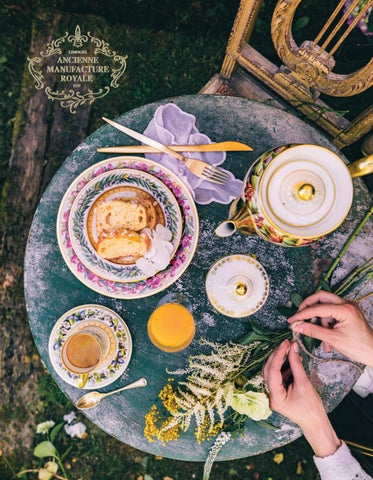
’Ancienne Manufacture Royale de Limoges
T he story of porcelain is that of a secret. Since 1295, when Marco Polo returned from China with this infinitely delicate ceramic, Westerners had tried to discover its secret. Oriental porcelain came to adorn the tables of European kings and princes. Beginning in the 17th century, it was imported by the shipload from China and Japan. But its thinness and transparency remained inexplicable. The mystery was at last resolved in the mid18th century, after the discovery in the Limoges region of a deposit of exceptionally white and beautiful clay: kaolin. The Manufacture de Limoges, founded in 1737 and dedicated until then to producing faience, began to work with this marvel. In 1771, the first pieces of “hard-paste” porcelain bearing the “Limoges” mark saw the light of day. In 1784, the Manufacture de Limoges, which had been put under the protection of the Comte d’Artois, Louis XVI’s brother, was united with the Manufacture Royale de Sèvres. The latter wanted to have an establishment located near sources of raw materials: kaolin, but also wood for firing, pure water to compose the paste, and a few deposits of rare materials used for decorative coloring. This new status as the Manufacture Royale de Limoges opened markets in France and Europe. Forms and decorations were developed and produced in its workshops, employing talents from every domain: modeling, sculpting, gilding, and painting. They contributed to an infinite number of creations which, over the centuries, adorned tables—beginning with those of the castle of Versailles.
[1] Hard-paste porcelain is a kaolin-based ceramic. It vitrifies during high-temperature firing (1400° C), the source of its characteristic whiteness, translucency, impermeability, hardness, and sonority. Unlike soft-paste porcelain, without kaolin, fired at low temperatures, and consequently opaque, porous, and easily scratched.
Covered terrine À la Reine Collection •
1
•
I
II
III
•
2
•
T
he Century of Louis XIV
I Abraham Bosse Feast Given by His Majesty Louis XIII to the Knights of the Holy Spirit After the Creation of the Order at Fountainebleau, May 26, 1633, Nantes, musée du château des Ducs de Bretagne.
Splendor and Etiquette
Banquets, holiday meals, dinners with family or friends: porcelain is inseparable from the customs of the table and the pleasures of the palate. It first appeared on royal tables in the late 18th century, becoming part of the history of an aristocratic cuisine established by Louis XIV. He included daily meals among a complex of rules codifying court life and indicating the behavior to be observed by each courtier: etiquette. The latter, notably, required the sovereign to take his breakfast, lunch, and dinner in public.
T he Ceremonial of Dining
II Brain de Sainte-Marie Menu of Supper Given at the Château de Choisy, Thursday, April 29, 1751 Versailles, châteaux de Versailles et de Trianon © RMN-Grand Palais (Château de Versailles) / Gérard Blot
III Table of eighteen places served in three services Marly, 1700 ©Hans Thorwid / Nationalmuseum, Stockholm
IV Martin Meytens (Atelier de), The Coronation Feast of Joseph II (detail), 1764 Kunsthistorisches museum, Vienne
Although the formal setting varied according to circumstance, each meal proceeded in the same way, according to a precise arrangement. The table was covered with a white tablecloth and individual napkins. It was set with plates and silverware for each guest, but no glasses, which were provided as requested. More than a hundred different dishes were laid out in successive waves known as services. A meal was generally composed of four services: soups and entrees; roasts and salads; desserts and savories; and fruit. Servers set dishes symmetrically around the surtout de table (centerpiece), forming a well-proportioned and harmonious grouping for the pleasure of the eye and nose. The arrangement and diversity of the dishes played an essential role, allowing guests to choose their dishes but not partake of all of them. This ceremonial, called service à la française, would endure until the Revolution.
THE SURTOUT DE TABLE Inseparable from the service à la française, the surtout was originally a sumptuous piece of goldsmith’s work meant to adorn the center of the table. It consisted of a base, adorned with decorative elements, holding salt cellars, boxes of spices and candied fruit, vessels for oil, vinegar, and mustard, and sugar bowls. Around these were vases and candelabra, the latter decorated with flowers or sugar sculptures when the meal took place in daylight. Starting in 1751, the surtout was renewed by the invention of biscuit porcelain, an unglazed white
porcelain capable of unprecedented thinness and detail. In 1770, for the wedding of the Dauphin, the immense royal table was adorned with a biscuit porcelain surtout more than five meters high, from the center of which rose a statue of Louis XV. It was completed by figurines of children evoking the four seasons, fountains, and little statues representing mythological deities. This piece was all the more sumptuous for being set—according to contemporaneous descriptions—at the center of a veritable garden of parterres and tiny sand-strewn paths. IV
•
3
•
•
4
•
The diversity of pieces in a porcelain service illustrates the French table of the 17th and 18th centuries. This example includes flat plates, deep plates (soup plates), dessert plates, and rafraîchissoirs à verres, as well as a multitude of dishes for the various services: tureens (pots-à-oille), terrines, platters, and salt cellars for the first service; jattes (shallow, round basins), navettes (elongated boat-shaped dishes), Relish dishs (small oblong “radish dishes”), butter dishes, and mustard pots for the second; plates, platters, sauce boats, salad bowls, and covered pots for the third. Finally, for the dessert, the table was cleared for a dazzling new setting of tasses à glace (ice cream cups), compotiers (pedestaled fruit bowls), platters, sugar bowls, seaux (coolers), and corbeilles (porcelain fruit or flower baskets). Not surprising that a porcelain service included at least two hundred pieces. Today, although a number of them are no longer in daily use, a table set and waiting with bols à bouillon, charger plates, and bread plates is a feast for the senses.
LES RAFRAÎCHISSOIRS À VERRES Also known as Flute chillers, they were set on a console table, behind the guests. Until the late 18th century, glasses were not set out on the dining table. When a guest wanted to drink, he indicated as much to the footman standing behind him. The latter would bring a glass of wine or perfumed water, which the guest emptied in one draft and
returned. The footman immediately returned the glass to the rafraîchissoir filled with ice water, setting it upside down. The use of a rafraîchissoir avoided a sudden change of temperature between the glass and the wine. Generally oval and supplied with handles, the vessel had a notched rim to hold glasses by their base.
Rafraîchissoirs Gobelet du Roy Collection (left) Marie-Antoinette Collection (above)
•
5
•
••
66 ••
T
he Century of Louis XV Scrolls and Garlands
In 1757 Louis XV had been in power for more than thirty years. Etiquette persisted, but the king himself drew away from it, preferring to receive his friends in his private apartments. There he had installed a “laboratory” where he prepared omelets and rich chocolate. A passionate hunter, Louis XV regularly stayed at the château de Fontainebleau, where he organized after-hunt suppers. The spontaneity, freedom, and gaiety of these meals contrasted with the formality prevailing at Versailles. The guests were essentially men, not necessarily of the highest title, and a few women, including the king’s mistresses—the queen was never present. Epigrams were exchanged, wit rivaled with wit, Madame de Pompadour played the comedienne, embodying characters evoked by the bisque figurines on the table centerpieces.
T owards Neoclassicism Louis XV Collection © Lily Rose
Like every royal residence, Fontainebleau had several services, including one for occasions of state and another, simpler, reserved for private gatherings. Furnished in 1757 by the Manufacture Royale de Sèvres, the Louis XV service was used by Louis XV, then by Louis XVI. Added to regularly by successive purchases, it included up to 620 pieces. Meant for a château that, while royal, was nonetheless more rural than Versailles, its delicate decoration is only the more refined. No colored background, but gilded scrolls and garlands of roses bound by ribbons emphasize its festooned forms; in the middle, a pattern incorporates four royal “L”s in a star formation. Known as camaïeu pourpre, the color of this decoration is all the more precious for being obtained from a mixture of gold and silver chloride. Little by little, the Louis XV style evolved, reflecting the king’s preference for less constraining ritual and a growing taste for comfort. In reaction to the extravagances of rococo, around 1750 the neoclassical style was adopted. Thus there appeared in 1752 a cup with straight, pure lines: the tasse litron. Its sobriety allowed it to be adorned with a multitude of patterns offered by the marchands-merciers. This was the case of CharlesRaymond Granchez, who in 1771 ordered from the Manufacture Royale de Sèvres the highly modern Quadrille Vert pattern (p. 9).
•
7
•
2
1
1
THE TASSE LITRON This form is the work of Jean-Charles Duplessis. The talented artist, who held the title of orfèvre du roi (the king’s goldsmith)— allowing him to work outside the constraints of the corporations—was recruited by the Manufacture de Sèvres to create new forms there. In 1752 he designed a particularly
harmonious cylindrical cup, its height equal to its diameter, with a shallow, flatbottomed saucer. A triumph of simplicity, the tasse litron became essential to enjoying chocolate, as well as coffee, both of which were increasingly popular at the court of Louis XV.
B leu Celeste and Grisaille Also in fashion were brilliant colors, as seen in the Perruche à joüe rouge cup created in 1769 by the Manufacture Royale de Sèvres. One of its most talented animal painters, Chappuis, chose bleu celeste and carmine to emphasize the delicacy of the red-cheeked cockatiel and American blue jay. The golden cartouches, engraved in an original style over an extraordinarily delicate lattice pattern, are the work of the famous gilder Etienne Henry le Guay, himself responsible for many royal porcelain pieces.
•
8
•
Au Roi Louis XVI cup and saucer The original is held by the musée Carnavalet, Paris.
2 À la reine Marie-Antoinette cup and saucer The original is held by the musée Carnavalet, Paris.
3
3 Perruche à joüe rouge cup and saucer The original is held by the musée des Arts décoratifs, Paris
4 Quadrille vert cup and saucer The original is held by the musée du Louvre, Paris
Jean-Baptiste Charpentier The Family of the Duc de Penthièvre in 1768 dalso known as The Cup of Chocolate Versailles, châteaux de Versailles et de Trianon © RMN-Grand Palais (Château de Versailles) / Gérard Blot
4
MARCHANDS MERCIERS Until the Revolution, these merchants played an essential role in the creation of luxury goods. In his Encyclopédie, Diderot defined them as “sellers of everything and makers of nothing,” because they created objects not with their own hands but by assembling different elements they had chosen or commissioned. At the heart of a network of artists and craftspeople, endowed with a royal and aristocratic clientele, they had
the means to inaugurate fashions. The Manufacture de Vincennes’ porcelain flowers are an example: assembled in bouquets or combined with an imported item, they became a new and fashionable item. Besides working as “designers,” marchands merciers combined the roles of interior decorator and antique dealer, particularly for crowned heads.
On May 16 and 17, 1770, Louis XV organized sumptuous festivities to celebrate the wedding of the Dauphin, the future Louis XVI, to the Archduchess Marie Antoinette of Austria. On that occasion, the Manufacture de Sèvres paid homage to the future sovereigns by creating in 1773 the cups Au roi Louis XVI and À la reine MarieAntoinette. Each is ornamented with portraits en grisaille, creating the illusion of cameos, signed Nicolas-Pierre Pithou the elder. The cups and saucers are decorated with two different friezes, the work of the young gilder Henri-François Vincent.
•
9
•
A Dream of Orient At the very moment the Manufactures de Sèvres and de Limoges were making their first hard-paste porcelains, France was strengthening diplomatic relations and expanding trade with China. Fascination by the objets d’art of the Middle Kingdom gave rise to works on Chinese themes in many domains: painting, prints, textiles, furniture, gardening, and, of course, ceramic. Louis XV’s wife, Marie Leszczynska, mad about the Far East, herself painted a Chinese cabinet representing scenes of a daily life that she had never seen … When he ascended the throne in 1774, Louis XVI acquired a breakfast or cabaret service from the Manufacture Royale de Sèvres. Its pattern, Au Jardin Chinois, is composed of two scenes: an emperor in his garden and a man smoking a pipe, evoking meditation and repose.
•
10
•
Tapestry (part of the second Chinese series): Tea c. 1745 Paris, musée du Louvre © RMN-Grand Palais (musée du Louvre) / Daniel Arnaudet
Au Jardin chinois cup and saucer The original is held by the château de Versailles
T
he Century of Louis XVI Cornflowers and Pearls
From the 1770s on, the craze for hard-paste porcelain grew unstoppably, to the great success of the Manufactures Royales. They had the exclusive privilege of using gold, indispensable for a glittering table in an era when candles shed a soft glow and glasses, absent from the table, could not add their sparkle. Thus the pattern of the Aux Papillons cup (p.12), produced in 1777, whose pure gold ground illuminates colored flowers and butterflies inspired by entomological plates. Preferring to work from nature, Armand the elder observed the aviaries of the Jardin des Plantes and captured their multicolored beauty to create the pattern of the Aux Perroquets cup (p.12). Birds, flowers, figures, decorative friezes: each Manufacture had its ornamentalists, often specializing in a single subject. Pierre-Joseph Rosset, for forty years a painter at the Manufacture de Sèvres, excelled in flowers and landscapes like that of the Paysage à la barque cup (p. 12), emphasized by its oeil-de-perdrix (finely dotted) background.
T he Art of the Miniature The miniature, very much in vogue at the time, represented pastoral scenes, allegories, or mythological subjects, as in the cup Vénus corrigeant l’Amour (p. 12). It is the work of the painter Charles-Nicolas Dodin, “figure painter” at the Manufacture Royale de Sèvres for over thirty years. His fame and talent brought him prestigious commissions for the royal family and the aristocracy, as well as royal gifts to be presented to foreign sovereigns like Frederick V of Denmark or Catherine II de Russie (p. 12).
•
11
•
Aux Papillons cup and saucer The original is held by the musée national de Céramique, Sèvres
Catherine II de Russie cup and saucer The original is held by the musée de l’Ermitage, Saint-Pétersbourg
Paysage à la barque cup and saucer The original is held by the musée du Louvre, Paris
Aux Perroquets cup and saucer The original is held by the musée national de Céramique, Sèvres
Vénus corrigeant l’Amour cup and saucer The original is held by the musée des Arts décoratifs, Paris
Myrtes et Roses cup and saucer The original is held by the musée du Louvre, Paris
•
12
•
In 1778 the Catherine the Great herself, mad for French culture, commissioned the Manufacture Royale de Sèvres to create the most elaborate service produced in the 18th century. While normally the Manufacture was content merely to vary patterns, for this project they produced new forms, requiring the manufacture of new molds. The design included cameos, one of the empress’s passions. Sculpted in biscuit porcelain, they appear on each piece. This creation occupied forty-four artists and craftspeople—effectively the entire Manufacture—for two years, producing the 744 pieces required to set a sixty-place table. Similarly lavish in execution, the Aux Dauphins cup was produced by the Manufacture Royale de Sèvres in 1781 to celebrate the birth of Louis, the first son of Louis XVI and Marie Antoinette. Heir to the crown, the child bore the title of Dauphin 2.
Aux Dauphins cup and saucer The original is held by the musée national Adrien Dubouché, Limoges
N ature Rediscovered Aside from the patterns created for these royal events, the vogue for painted scenes faded; they were replaced by abstract motifs, like the oeil-de-perdrix background in blue and carmine for the Myrtes and Roses cup. This design, created by Niquet in 1777, is enhanced by festoons of myrtle leaves surrounding roses painted in the au naturel style. Discreet as they are, these flowers are part of the esthetic renewal of the late 18th century, characterized by a taste for Antiquity, after the discoveries of Pompei and Herculaneum, and a new awareness of nature. The latter was supported by Rousseauvian theories 3, but also by the development of scientific botany and agronomy. 4
[2] This title, derived from the given name Dauphin borne by the lords of the Dauphiné, was assumed by the eldest son of the king of France when the crown bought that province in 1346. [3] Considered one of the fathers of democracy, Jean-Jacques Rousseau (1712–1778) imagined a society without inequity and violence, based on a social contract. The integration of nature and culture in this society is, according to him, one of the conditions of the success of the contract. [4] New techniques were implemented to improve cultivation in France (grain, fodder) and the colonies (sugar cane, coffee, indigo).
•
13
•
Marie-Antoinette Collection © Lily Rose •
14
•
Bouquet de la reine cup and saucer The original is held by the musée Carnavalet, Paris
It was in this context that, in 1774, Marie-Antoinette began to renovate her official apartments in Versailles. Created for her personal use, the Bouquet de la Reine cup illustrates her taste for modernity. Its “grand bleu” background is strewn with gold dots and adorned with a bouquet; its rim and saucer are bordered by a frieze of alternating ribbons, myrtle, and stylized sunflowers. The queen, who was particularly fond of this cup, made a present of it to her lady-in-waiting as a sign of deep affection. But it was at the Petit Trianon especially that Marie-Antoinette succeeded in creating the intimate setting that suited her. She overlooked no detail. Wanting to live among flowers, she had them woven, embroidered, recreated in gauze or porcelain. In 1781, she commissioned from the Manufacture Royale de Sèvres a service adorned with her two favorite motifs: cornflowers and pearls. Airily festooning the rims of plates and dishes, the decoration of the Marie-Antoinette service weds simplicity and refinement.
F lowers and Birds Sometimes, painters combined diverse influences. Thus Denis Levé and the gilder JeanJacques Dieu created, in 1783, the Chinois dans un jardin cup. Its astonishing pattern combines a purple ground, fashionable Chinese-influenced imagery, and lavish use of gold, emblematic of Sèvres.
Chinois dans un jardin cup and saucer The original is held by the musée national de Céramique, Sèvres
•
15
•
•
16
•
Gobelet du Roy Collection © Atelier Mai 98 et Thomas Dhellemmes
That same year, Louis XVI commissioned from the Manufacture Royale de Sèvres a service for the Château de Versailles, also ornamented with cornflowers: the Gobelet du Roy. It was intended for Officers of the Gobelet, one of the seven corps of household officers serving the table of the king and the royal family. The Officers of the Gobelet had two responsibilities. First, they set the table and ensured the provision of bread, salt, linen, and fruit. Then, they supplied drink (water, wine, liqueur, coffee), ices, and refreshments. Celebrating the era’s new penchant for nature, the pattern of this service entwines cornflowers and myrtle around a rose painted au naturel, represented differently in the center of each plate.
Gobelet du Roy Collection © Lily Rose •
17
•
•
18
•
Le Timbalier chinois cup and saucer The original is held by the musée des Arts décoratifs, Paris
Paysage aux oiseaux cup and saucer The original is held by the musée des Arts décoratifs, Paris
Ronde d’enfants cup and saucer The original is held by the musée national de Céramique, Sèvres
Cantharide cup and saucer The original is held by the musée national de Céramique, Sèvres
These painted flowers were most often inspired by engravings, like the floral pattern of the A la Reine service, furnished to Versailles by the Manufacture Royale de Limoges in 1784. Set off by the whiteness and purity of the porcelain, roses, tulips, honeysuckle, carnations, and daisies are skillfully strewn and gathered in negligent bouquets. This apparent spontaneity allowed flaws due to wood firing to be concealed.
Besides flowers, birds are a recurring theme in the 18th century. Denis Levé, a remarkable painter of birds at the Manufacture Royale de Sèvres, was often called upon by ornithologists who appreciated the delicacy and precision of his brushwork. This did not prevent him from painting more phantasmagorical birds, like those of the Paysage aux oiseaux cup (1786). The art of miniature painting reappears in 1789 with the pattern of the Le Timbalier chinois cup. It illustrates the talent of its creator, Jean Bouchet, and recalls the virtuosity of the Manufacture’s artists and the omnipresence of the miniature on porcelain pieces from the mid-18th century on.
À la Reine Collection © Lily Rose
•
19
•
A Taste for Antiquity Interest in Greek, Etruscan, and Roman cultures gave rise, in the second half of the 18th century, to a neoclassical style combining simple forms with sumptuous patterns. For the Ronde d’enfants cup, created in 1782, the painter and gilder Jean-Jacques Pierre le jeune borrowed a motif from the Renaissance, an era equally inspired by Antiquity. But the finest illustration of this taste for antiquity is the La Laiterie de Rambouillet service, an astonishing interpretation. It was created in 1788 for the Domaine de Rambouillet, which Louis XVI, a passionate hunter, had acquired a few years earlier. As Marie Antoinette did not like the château, the king had fitted out for her an extraordinarily luxurious dairy: furniture by Georges Jacob, marble bas reliefs by Pierre Julien, and a Sèvres porcelain service designed by Jean-Jacques Lagrenée. Its forms were inspired by the Etruscan pottery just brought back from Italy by Vivant Denon, diplomat and first director of the future Musée du Louvre, who, for lack of space, had stored them at the Manufacture. Lagrenée created sixty-five pieces, including milk pails (perfect imitations of the usual wooden pails), coupes, cups, and a bol-sein (a milk cup in the shape of a breast). Set on a tripod ornamented with goat heads, the tender hues of its glaze evoke soft flesh and mother’s milk. For the first time, a royal service was not set off with gold—which has no place in a dairy—but with black and mauve bands emphasizing a pattern of dairy animals and flowering branches. In this vein of inspiration by antiquity, prefiguring the Directoire style, the Cantharide cup (p.19), created in 1789, evokes the cult of Dionysus (Bacchus to the Romans). The god of joyous Life, Play, and Revels, but also of the Fine Arts, is subtly evoked by the use of a very special iridescent green: that of the Spanish fly, source of cantharides, a powder said to be aphrodisiac.
La Laiterie de Rambouillet Collection © Lily Rose
•
20
•
F
rom the Revolution to the Empire Roses and Miniatures
In the revolutionary period, the Manufactures Royales de Sèvres and de Limoges continued their activities, but met different fates. The first remained a national property, while the second became a private enterprise. Starting in 1790, its patterns, usually naturalistic, were steeped in the philosophy of the Enlightenment. Witness the delicately arranged geometric composition of the Aux Paniers cup, representing, like a still life, a woven basket full of fruits. It is the work of Jean Chauvaux and Nicolas Sinsson, two of the Manufacture de Sèvres’ major painters. This yearning for modernity, tolerance, and freedom, as expressed by the men of the Enlightenment, was also shown in the joyous vivacity of the Aux Fleurs des champs cup. It was the product of the Parisian factory of Dihl and Guerhard, which would reach its apogee during the Empire with the creation of its famous jaspé grounds, mottled like jasper or tortoiseshell.
Aux Paniers cup and saucer The original is held by the musée national de Céramique, Sèvres
Aux Fleurs des champs cup and saucer The original is held by the musée national Adrien Dubouché, Limoges
•
21
•
•
22
•
This freedom was real. The Revolution immediately established legislation entailing profound disruption in artistic professions. The corporations and their punctilious regulations were suppressed. While this new independence fostered the development of craft and industrial techniques, it also introduced competition. All the more so in that the mass emigration of the aristocracy and the nationalization of Church property eliminated traditional financial support. In was in this context that the Manufacture Royale de Clignancourt, formerly under the protection of Louis XVI’s brother and subsequently directed by the procureur of the new commune of Montmartre, created the Roseraie service. The favored motif of flowers here has an air of liberty: formal arrangements disintegrate, bouquets come apart. Sprigs and cut flowers find a pattern and straight lines discipline the exuberance of the branchlets, while gold makes the colors sing. The last vestige of a regime only recently abolished by the Revolution, a gilded crown encircles the ground.
1
O de to the Birds The theme of idealized nature persisted, as seen in the pattern of the Aux Aigrettes cup. Painted in 1792, it was the work of Etienne Évans, painter at the Manufacture de Sèvres for over fifty years and specialist in representing birds. The first patterns on this theme came from the models of the English ornithologist George Edwards, created for a service meant for the Duc de Richmond. For its national clientele, the Manufacture de Sèvres adopted the French models of the famous Comte de Buffon, author of an encyclopedic collection of works encompassing all the knowledge of the period in the domain of the “natural sciences.” Among the thirty-six volumes of the original edition, the Jardin du Roi (p. 24–25) draws from L’Histoire naturelle des oiseaux. Created in 1793, highlighted with yellow, its pattern showcases the species with the most astonishing and colorful plumage. The form of each piece illustrates the Directoire style, sober and strongly influenced by antiquity: a coffeepot with a recessed lid, a sugar bowl ornamented with two rings, and a creamer inspired by an Etruscan vase.
2
Although yellow was relatively easy to obtain in that era, purple was extraordinarily rare in Europe. In 1793, the Manufacture de Sèvres took on this challenge, creating the pattern of the Aux Chinois cup: on a purple ground, medallions frame chinoiseries by the painter Louis Le Guay. These genre miniatures are a motif that the Manufacture developed throughout the 18th century. In 1795, the painter and gilder EtienneCharles Legay produced the medallion of the Nature morte aux pêches as though it were a painting in its own right.
3 Roseraie Collection © Lily Rose
1 Aux Aigrettes cup and saucer The original is held by the musée de l’Île-de-France, Sceaux
2
3
Aux Chinois cup and saucer The original is held by the musée national de Céramique, Sèvres
Nature morte aux pêches cup and saucer The original is held by the musée national de Céramique, Sèvres
•
23
•
I
1
•
24
•
2
1 et 2 Jardin du roi Collection © Lily Rose
I et II Georges Louis Marie Leclerc, comte de Buffon Histoire naturelle des oiseaux. 1770-1786
II •
25
•
Marie-Antoinette Collection
•
26
•
F
rom Napoléon Bonaparte to Louis-Philippe Art and Gastronomy
In the early 19th century, with the Revolution, Restoration, and Republic, the great aristocratic tables disappeared. Although simplified, royal sumptuousness endured through the reigns of Napoléon Bonaparte (1804–1815) and Louis-Philippe (1830–1848). The renown of French cuisine developed. As ceremonial meals facilitated discussion and negotiation, Paris, the seat of power, established a “diplomatic gastronomy.” But the capital’s fame was due also to some of its numerous restaurants, often headed by the former chefs of great pre-Revolutionary households. At that time, every royal or imperial residence had two porcelain services, one more richly decorated. Although the ruler no longer dined in public, aside from ceremonial banquets, “service à la française” was still in use. But its codes were still complicated and demanding; the rising bourgeoisie was a stranger to them and restaurants could not offer such an abundance of dishes.
T he Ceremonial of the Table Simplified In this context, there appeared a new way of bringing out the courses of a meal. It was introduced at the table of Alexander Kurakin, ambassador of all the Russias in France. In 1810, he gave a dinner that surprised his guests: they discovered a table adorned with surtouts and flowers where desserts alone were displayed. Once the guests were seated, servants did not set before them a mass of different dishes, but brought them out one at a time, beginning with entrees. They presented them to the guests so they could serve themselves—each dish having been cut up beforehand—then carried them back into the kitchen. Wine was poured regularly into glasses set at each place. Plates were changed after each course. For the dessert course, the table was cleared of salt cellars and bread crumbs, then set with smaller plates. Known as “service à la russe,” this new arrangement significantly reduced the number of dishes—and consequently expense. But above all, it gave the kitchen time to cook and present each course perfectly. The dishes were brought in piping hot and served immediately, allowing each guest to appreciate them at their best. Over the course of the 19th century, service à la russe increasingly became the rule, prefiguring the arrangement of today’s tables.
•
27
•
Portrait de Joséphine cup and saucer The original is held by the château de Malmaison, Rueil-Malmaison
Portrait de Bonaparte cup and saucer The original is held by the château de Malmaison, Rueil-Malmaison
Paysage à l’or cup and saucer The original is held by the musée national Adrien Dubouché, Limoges
Chinoiserie bleue cup and saucer The original is held by the musée du Louvre, Paris
•
28
•
L ight on Gold The patterns of porcelain services were still influenced by Antiquity, but artists and craftspeople took liberties with it. Thus, the official architects of Napoléon, Charles Percier and Pierre-François Fontaine, cultivated elegance and majesty by playing with the colors and proportions of details. The exuberant blooms of the Aux Tulipes cup bear witness. Created in 1800 by porcelain manufacturers Dihl and Guerhard, it combines fluid lines and oversized designs, while the gold ground adds a touch of near-abstraction. Gold, no longer exclusively used by the Manufactures de Sèvres and de Limoges, was worked à l’effet. Matte after firing, it was patiently polished with agate to reveal all the delicacy and detail of the pattern. For the Paysage à l’or cup, the Pouyat factory used it two ways—brightly polished and satin-finished—on a matte red ground, demonstrating the skill of Parisian artisans of the era. In the pattern of the Chinoiserie bleue cup, gold is also prominent against a black ground, imitating the lacquers of the Far East. This type of porcelain, developed by the Manufacture de Sèvres starting in 1780, was particularly appreciated by the empress. But, as seen in the Aux Oiseaux cup (p.31), Josephine’s true passion was for the natural sciences. A passion she expressed in her Domaine de la Malmaison, a paradise of green and exotic plants, enhanced with immense aviaries.
T he Imperial Couple Charles-Etienne Leguay (attributed to) Portrait of Dihl at Desk with Jars of Pigment Sèvres, Cité de la céramique © RMN-Grand Palais (Sèvres, Cité de la céramique) / Jean-Claude Routhier
Aux Tulipes cup and saucer The original is held by the musée des Arts décoratifs, Paris
The charm and rank of Napoleon’s first wife are limned with infinite elegance in the Portrait de Joséphine cup, in the shape of a chalice, created in 1804. Her portrait, particularly delicate, is the work of the talented Marie-Victoire Jaquotot. She joined the Manufacture de Sèvres in 1801 as a figure painter, making portraits of the personalities of the age, and for nearly twenty years she directed a school of painting on porcelain. Its counterpart, the Portrait de Bonaparte cup, is ornamented with his portrait in the uniform of the President of the Italian Republic. He was elected to this function in 1802, while he was the First Consul of its young “sister,” the French Republic. The saucer is ornamented with a rooster, a symbol of the Republic, on a violet ground. The portrait is probably one of the first representations of the future emperor on a piece of Sèvres. It was produced in 1803 by the Manufacture’s head painter, Claude-Charles Gérard, after a miniature by Jean-Baptiste Isabey.
•
29
•
David Roberts Edfu Temple – Portico
E gyptomania As can be seen in the Étrusque bleu cup, the Empire style draws upon Greco-Roman art and the Pompeian style. But Bonaparte’s Egyptian campaign (1796–1799) aroused a genuine Egyptomania that ran riot in the French decorative arts of the early 19th century. Sphinxes, scarabs, lotus flowers, palmettes, solar disks, and hieroglyphs made up its ornamental vocabulary, as in the Hiéroglyphes cup, produced in 1810 by the Nast factory. Its motifs are not taken from authentic inscriptions, but are inspired by the ancient Egyptian monuments.
Hiéroglyphes cup and saucer The original is held by the musée national du château de Malmaison, Rueil-Malmaison
Vue de Philae cup and saucer The original is held by the musée du Louvre, Paris
•
30
•
Antoine-Jean Gros, baron Bonaparte Exhorting His Army Before the Battle of the Pyramids, 21 July 1798, Versailles, châteaux de Versailles et Trianon © RMN-Grand Palais (château de Versailles) /Daniel Arnaudet / Jean Schormans
Since Josephine was unable to give him an heir, on March 31, 1810, Napoleon wed the Austrian archduchess Marie-Louise. That very day, the Manufacture de Sèvres delivered to the Palais des Tuileries a coffee service in the Egyptian style, its cups ornamented with a Vue de Philae, the Egyptian island famed for an ancient complex of temples. The saucers bore the portrait of the mamluk Roustam Raza, Napoleon’s bodyguard and manservant for fifteen years. The emperor was so fond of this service that he took it with him on his exile to Saint Helena.
Etrusque bleu cup and saucer The original is held by the musée national du château de Malmaison, Rueil-Malmaison
Aux Oiseaux cup and saucer The original is held by the musée national du château de Malmaison, Rueil-Malmaison
•
31
•
•
32
•
Pierre-Joseph Redouté, Ipomoea / Ipomée, Watercolor on vellum, Collection des vélins du Muséum © Muséum national d’Histoire naturelle, Dist. RMN-Grand Palais / image du MNHN, bibliothèque centrale
Pierre-Joseph Redouté, Magnolia / Magnolia, Watercolor on vellum, Collection des vélins du Muséum © Muséum national d’Histoire naturelle, Dist. RMN-Grand Palais / image du MNHN, bibliothèque centrale
Pierre-Joseph Redouté, Redutea heterophylla / Redoutée hétérophylle, Watercolor on vellum, Collection des vélins du Muséum © Muséum national d’Histoire naturelle, Dist. RMN-Grand Palais / image du MNHN, bibliothèque centrale
Pierre-Joseph Redouté, Camellia japonica / Camélia du Japon, Watercolor on vellum, Collection des vélins du Muséum © Muséum national d’Histoire naturelle, Dist. RMN-Grand Palais / image du MNHN, bibliothèque centrale
Botanique Collection © Lily Rose
T he Botanique Service With the exploration of the last unknown lands, as well as the development of agronomy and plant biology, the 19th century saw a great expansion of the science of botany. One of those who reproduced flora with equal talent and scientific rigor was the painter Pierre-Joseph Redouté. In 1829, the Manufacture de Sèvres drew from his work for the pattern of the Botanique service, commissioned by a man who introduced himself under the name of Schaumbourg. He was in fact William II, Elector of Hesse, who came secretly to order a service of 566 pieces with a floral pattern. It was delivered to him in October 1831: nasturtiums, scabiosa, tulips, iris, primroses, St. John’s wort … : each plate bears the name of a flower, displayed in the shape of a garland. This motif is relatively rare, and so is its positioning: it appears not in the center of the plate, but on its rim, so that it may be admired even when the plate is full.
•
33
•
T echnical Innovations When Louis-Philippe moved into the Palais des Tuileries, he ordered from the Manufacture de Sèvres a new service, Élysée, indicating his desire to set himself apart from his predecessors. Its classic forms are inspired by those of ancient vessels; witness the sauce boat, the creamer, the navettes, and the handles of the tureens. Magnificently restrained, the pattern is composed of a frieze of gilded palms on a bleu agate ground.
•
34
•
Élysée Collection © Lily Rose
To fill this extremely large order in reasonable time, production was partially automated. This innovation, still used today, particularly to make round or deep pieces, is known as calibrage or jiggering. It consists of putting a lump of semi-soft clay in a plaster mold, itself set on a wheel. A metal jigger is lowered, pressing the clay against the walls of the mold and cutting off the excess.
•
35
•
Jeux de cartes cup and saucer The original is held by the musée des Arts décoratifs, Paris
•
36
•
The modernization of manufacturing techniques was accompanied by a constant search for the most dazzling white, the product of a genuine competition between factories. The Nast factory, in Paris, famous for the purity of its porcelain, illustrates this quest with its Jeux de cartes cup. This sophisticated composition contrasts the luxury of its decoration and the popular character of cardplaying, while the black ground sets off the whiteness of the porcelain. Like a blank white page on which the creativity of craftspeople and artists will forever vie to invent the most complex pattern.
The Tuileries, the Louvre, and the rue de Rivoli, Seen from the Jardin des Tuileries. 1850
Jean Baptiste François Bosio Bouillotte Game Paris, musée Carnavalet © RMN-Grand Palais / Agence Bulloz
•
37
•
Decoration workshop, Limoges Gold applied by a spinner. Collection Gobelet du Roy
•
38
•
L
a Manufacture Royale in the 21st Century Heritage and Savoir-Faire
Sold during the Revolution, then acquired by a series of proprietors, in 1986 the Ancienne Manufacture Royale de Limoges became part of the Bernardaud group. As a tribute to the heritage of French porcelain making, Bernardaud decided that the Manufacture would be dedicated to producing identical replicas of original pieces from the 18th and 19th centuries. So, in collaboration with the most prestigious national and international museums, the Ancienne Manufacture Royale de Limoges produces all its historical models in its Limoges workshops according to the strictest quality standards. And carries on, in this way, a savoir-faire that illustrates the French art of living, from 1737 to the mid-19th century. The diversity of table settings presented throughout this catalog illustrates a history of fashions, influences, and styles over more than a century. Each piece, each service, each historic cup is an invitation to rediscover, through porcelain, a few chapters of two great histories: art and the table. Inseparable, the pair have constantly transformed themselves, adopting culinary innovations and discovering new products, going from service “à la française” to “à la russe” to, as nowadays in many restaurants, “à l’assiette.” Guided by chefs, artists, and creators, French gastronomy has always sought to bring together form and content, making mealtime a moment of pleasure, favorable to conversation and conviviality. In 2010, the “gastronomic meal of the French” was inscribed on UNESCO’s Representative List of the Intangible Cultural Heritage of Humanity, recognizing an extremely living tradition that inspires both conviviality and creativity. Passed down over generations, it calls upon the excellence of savoir-faire in many domains, from agriculture, livestock breeding, and fishing to the culinary arts, not to mention design and decoration. Standing together with those who strive daily in this realm, the Bernardaud group is proud to participate in sustaining and enriching this tradition. THE GASTRONOMIC MEAL OF THE FRENCH The gastronomic meal of the French is a customary social practice intended to celebrate life’s most important moments: births, weddings, birthdays, triumphs, and reunions. On this occasion, guests practice the art of “eating well” and “drinking well.” The gastronomic meal emphasizes the satisfaction of being in company, the pleasure of the palate, the harmony between human beings and the fruits of nature. Among its important components are: the careful choice of dishes from a ceaselessly enriched corpus of recipes; the
•
purchase of superior products, preferably local, whose flavors go well together; the marriage between food and drink; the decoration of the table; and a vocabulary of behavior specific to dégustation (smelling and tasting what is served at table). The gastronomic meal begins with an aperitif and ends with a digestif, with between them at least four courses (entrée, fish and/or meat with vegetables, cheese, and dessert). The gastronomic meal brings family and friends closer together and, more generally, strengthens social bonds.
39
•
•
40
•
•
41
•
Louis XV
Réf. L006
Service plate D. 12’’
Dinner plate D. 10.5’’
Salad plate D. 8.5’’
Bread and butter plate D. 6.5’’
4567
13
17
3
Rim soup D. 9’’
Deep round dish D. 11.5’’
Soup tureen 74.5 oz
Gravy boat with cover 15 oz
23
115
3103
4114
Salad bowl D. 10’’, 50.5 oz
Oval platter L. 15.5’’
Relish dish L. 9.5’’ l. 5’’
127
107
125
Rectangular cake platter L. 15’’
Round tart platter D. 12.5’’
Coffee pot 12 cups, 37 oz
Tea pot 12 cups, 47.5 oz
95
121
2528
4112
Creamer 6 cups, 8 oz
Sugar bowl 2 cups, 6.5 oz
Coffee cup and saucer 3.5 oz
Tea cup and saucer 4.5 oz
4503
2462
79
89
•
42
•
•
43
© Lily Rose
•
Marie-Antoinette
R é f . L 004
Service plate D. 12’’
Dinner plate D. 10.5’’
Salad plate D. 8.5’’
Bread and butter plate D. 6.5’’
Rim soup D. 9’’
4567
13
17
3
23
Deep round dish D. 11.5’’
Soup tureen 74.5 oz
Gravy boat with cover 15 oz
Salad bowls (open vegetable dishes)
Relish dish L. 9.5’’ l. 5’’
115
3103
4114
D. 10’’, 50.5 oz 127 D. 9’’, 34 oz 129
125
Oval platters L. 15.5’’ 107 L. 13’’ 109
Rectangular cake platter L. 15’’
Round tart platter D. 12.5’’
Serving tray with handles L. 14.5’’ l. 11’’
121
2472
95
Flute chiller H. 6’’ L. 13.5’’ 2813
Salt and pepper cellar 3 compartiments H. 4’’ 3220
Large square squalloped tray L. 8’’ l. 8’’ 4128
Square cache pot H. 6’’, L. 4.5’’
Medicis vase H. 8’’, D. 7’’
Valet tray L. 8.5’’ l. 6.5’’
3065
2383
2371
Coffee pot 12 cups, 37 oz
Tea pot 12 cups, 47.5 oz
Creamer 6 cups, 8 oz
2528
4112
4503 •
Sugar bowl 2 cups, 6.5 oz
Coffee cup and saucer 3.5 oz
Tea cup and saucer 4.5 oz
2462
79
89
44
•
•
45
© Lily Rose
•
Le Gobelet du Roy
Réf. L713
Dinner plate D. 10.5’’
Salad plate D. 8.5’’
Bread and butter plate D. 6.5’’
Rim soup D. 9’’
Relish dish L. 9.5’’ l. 5’’
13
17
3
23
125
Covered terrine 84.5 oz
Soup tureen 74.5 oz
Gravy boat with cover 15 oz
3103
4114
Round tart platter D. 12.5’’
Deep round dish D. 11.5’’
Rectangular cake platter L. 15’’
121
115
95
Salad bowls (open vegetable dishes) D. 10’’, 50.5 oz 127 D. 9’’, 34 oz 129
959
Oval platters L. 15.5’’ 107 L. 13’’ 109
Flute chiller H. 6’’ L. 13.5’’ 2813
Salt and pepper cellar 3 compartiments H. 4’’ 3220
Square cache pot H. 6’’, L. 4.5’’
Medicis vase H. 8’’, D. 7’’
Valet tray L. 8.5’’ l. 6.5’’
3065
2383
2371
Coffee pot 12 cups, 37 oz
Tea pot 12 cups, 47.5 oz
Creamer 6 cups, 8 oz
Sugar bowl 2 cups, 6.5 oz
Coffee cup and saucer 3.5 oz
Tea cup and saucer 4.5 oz
2528
4112
4503
2462
79
89
•
46
•
•
47
•
© Lily Rose
À la Reine
R é f . L 003
Service plate D. 12’’
Dinner plate D. 10.5’’
Salad plate D. 8.5’’
Bread and butter plate D. 6.5’’
Rim soup D. 9’’
4567
13
17
3
23
Deep round dish D. 11.5’’
Soup tureen 74.5 oz
Gravy boat with cover 15 oz
115
3103
4114
Oval platters L. 15.5’’ 107 L. 13’’ 109
Rectangular cake platter L. 15’’
Salad bowls (open vegetable dishes) D. 10’’, 50.5 oz 127 D. 9’’, 34 oz 129
Round tart platter D. 12.5’’
Serving tray with handles L. 14.5’’ l. 11’’
121
2472
95
Flute chiller H. 6’’ L. 13.5’’ 2813
Salt and pepper cellar 3 compartiments H. 4’’ 3220
Relish dish L. 9.5’’ l. 5’’ 125
Large square squalloped tray L. 8’’ l. 8’’ 4128
Square cache pot H. 6’’, L. 4.5’’
Medicis vase H. 8’’, D. 7’’
3065
2383
Coffee pot 12 cups, 37 oz
Tea pot 12 cups, 47.5 oz
Creamer 6 cups, 8 oz
2528
4112
4503 •
Valet tray L. 8.5’’ l. 6.5’’ 2371
Sugar bowl 2 cups, 6.5 oz
Coffee cup and saucer 3.5 oz
Tea cup and saucer 4.5 oz
2462
79
89
48
•
•
49
•
Roseraie
R é f . L 0 02
Service plate D. 12’’
Dinner plate D. 10.5’’
Salad plate D. 8.5’’
Bread and butter plate D. 6.5’’
4567
13
17
3
Rim soup D. 9’’
Deep round dish D. 11.5’’
Soup tureen 74.5 oz
Gravy boat with cover 15 oz
23
115
3103
4114
Salad bowls (open vegetable dishes) D. 10’’, 50.5 oz 127 D. 9.2’’, 27 oz 53
Large square squalloped tray L. 8’’ l. 8’’
Relish dish L. 9’’ l. 5’’
Oval platters L. 15.5’’ 107 L. 13’’ 109
125
Cake plate with handles D. 10.6’’
Coffee pot 12 cups, 37 oz
Tea pot 12 cups, 47.5 oz
97
2528
4112
Creamer 6 cups, 8 oz
Sugar bowl 2 cups, 6.5 oz
Coffee cup and saucer 3.5 oz
Tea cup and saucer 4.5 oz
4503
2462
79
89
4128
•
50
•
© Lily Rose
•
51
•
Jardin du Roi Dinner plate Barbu de Maynas D. 10.5’’ L199/13
Dinner plate Cotinga de Cayenne D. 10.5’’ L202/13
Dinner plate Lory des Indes orientales D. 10.5’’ L203/13
Dinner plate Merle collier Cap bonne espérance D. 10.5’’ L204/13
Dinner plate Gros bec du Canada D. 10.5’’ L207/13
Dinner plate Martin pêcheur D. 10.5’’ L209/13
Salad plate Barbu de Maynas D. 8.5’’ L199/17
Salad plate Merle collier Cap bonne espérance D. 8.5’’ L204/17
Salad plate Cotinga de Cayenne D. 8.5’’ L202/17
Salad plate Lory des Indes orientales D. 8.5’’ L203/17
Salad plate Gros bec du Canada D. 8.5’’ L207/17
Salad plate Martin pêcheur D. 8.5’’ L209/17
Coffee cup and saucer 3.5 oz L21/79
Rim soup D. 9’’
Bread and butter plate D. 6.5’’
Cake plate with handles D. 10.6’’
Square cache pot H. 6’’, L. 4.5’’
L201/23
L197/3
L197/97
L197/3065
Tea cup and saucer 4.5 oz L206/89
Coffee pot 12 cups, 34 oz
Tea pot 6 cups, 27 oz
Sugar bowl 2 cups, 6.5 oz
Creamer 6 cups, 4.5 oz
L197/34
L197/194
L197/155
L197/65
Breakfast cup and saucer 8.5 oz L206/83
•
52
•
•
53
© Lily Rose
•
Botanique
R é f . L 0 02
Dinner plate Nasturtium D. 10.5’’ 6841
Dinner plate Morning glory D. 10.5’’ 6842
Dinner plate St John’s wort D. 10.5’’ 6843
Salad plate Iris D. 8.5’’ 6847
Salad plate Double flowering peach D. 8.5’’ 6848
Salad plate Renunculus D. 8.5’’ 6849
Dinner plate Primrose D. 10.5’’ 6844
Dinner plate Rosebush with reddish leaves D. 10.5’’ 6846
Dinner plate Tulip D. 10.5’’ 6845
Salad plate Scabiosa D. 8.5’’ 6850
Salad plate Sysimbrium D. 8.5’’ 6851
Salad plate Marigold D. 8.5’’ 6852
Rim soup D. 9’’
Bread and butter plate D. 6.5’’
23
3
Salad bowls (open vegetable dishes) D. 10’’, 57 oz 127 D. 9.2’’, 27 oz 53
Round tart platter D. 12.5’’ 121
Oval platters L. 15.5’’ 107 L. 13’’ 109
Gravy boat 9 oz
Jasmin vase H. 9.5’’ D. 7’’ Deep round dish D. 11.5’’ 115
Cake plate with handles D. 10.6’’
Relish dish L. 9’’ l. 5.5’’
Soup tureen 78 oz
97
6621
147
133
703
Large coupe L. 10.5’’ 4105
Coffee cup and saucer 3.5 oz 79
Coffee pot 12 cups, 34 oz
Tea pot 6 cups, 27 oz
34
194
Sugar bowl 2 cups, 6.5 oz
Creamer 6 cups, 4.5 oz
155
65 •
54
•
Tea cup and saucer 4.5 oz 89
Medium shell dish 6’’ 2377
•
55
•
© Lily Rose
Élysée
Service plate D. 12’’ 4567
R é f . L 0 09
Dinner plate D. 10.5’’
Salad plate D. 8.5’’
Rim soup D. 9’’
Bread and butter plate D. 6.5’’
13
17
23
3
Round tart platter D. 12.5’’
Salad bowls (open vegetable dishes) D. 10’’, 57 oz 127 D. 9.2’’, 27 oz (80 cl) 53
Oval platters L. 15.5’’ et L. 13’’
121
107 et 109
Deep round dish D. 11.5’’ 115
Large coupe L. 10.5’’ 4105
Cake plate with handles D. 10.6’’ 97
Small coupe L. 6’’
Gravy boat 9 oz
4460
133
Coffee pot 12 cups, 34 oz
Tea pot 6 cups, 27 oz
34
194
Soup tureen 78 oz 147
Coffee cup and saucer 3.5 oz 79
Sugar bowl 2 cups, 6.5 oz
Creamer 6 cups, 4.5 oz
Tea cup and saucer 4.5 oz
155
65
89
•
56
•
•
57
•
© Lily Rose
HISTORIC CUPS 1764
L727/4519
Bouquet de la reine
1769
L728/4519
Perruche à joüe rouge
1773
L725/4519
À la reine Marie-Antoinette
L627/4519
Au roi Louis XVI
Vers 1780
L697/4519
Étrusque bleu
L166/4519
1777
L717/4519
L620/4519
Aux Papillons
Myrtes et Roses
1778
Paysage à la barque
1778-1779
L413/4519
Catherine II de Russie
Vers 1780
L716/4519
Aux Paniers
1781
Aux Dauphins
Au Jardin chinois
1777
L450/4519
L596/4519
1774
L715/4519
L724/4519
1778
Vénus corrigeant l’Amour
L714/4519
Quadrille vert
1773
1777
Aux Perroquets
1771-1772
1780
L693/4519
Chinoiserie bleue
1782
L658/4519
Ronde d’enfants
1783
L636/4519
Chinois dans un jardin •
58
•
1786
1789
L181/4519
L541/4519
Paysage aux oiseaux
Cantharide
Vers 1790
1792
L177/4519
L167/4519
Aux fleurs des champs
Aux Aigrettes
Vers 1795
Vers 1800
L570/4519
L178/4519
Aux Tulipes
Nature morte aux pêches
1803
1804
L678/20283
L679/20283
Portrait de Bonaparte
Portrait de Joséphine
de 1808 à 1810
L682/4519
1810
L170/4519
Vue de Philae
Aux Oiseaux
1789
L540/4519
Le Timbalier chinois
1793-1802
L619/4519
Aux Chinois
Vers 1800
L657/4519
Paysage à l’or
1805-1845
L597/4519
Jeux de cartes
Vers 1810
L681/4519
Hiéroglyphes
LA LAITERIE DE RAMBOUILLET
Etruscan cup with handles and saucer 15 cl 567/5944 •
59
•
Tripod breast bowl H. 12,5 cm D. 13 cm 567/5922
1787
Tall goblet with two handles and saucer 25 cl 567/5945
We thank Elisabeth Caude (General Curator, Château de Versailles), Yves Carlier (General Heritage Curator, Château de Versailles), Antoinette Hallé (General Heritage Curator), Marie-Hélène Leclerc (Réunion des Musées Nationaux) for their invaluable help in ensuring the historical accuracy of this catalog.
•
60
•
•
61
•
•
62
Photo couverture : Collection Botanique © Lily Rose
•