Life in the Berkshires | Fall 2026
The Design Issue The Herringtons • Designer House Party • Tiny Homes The B’s List: State of the Art • Tree People
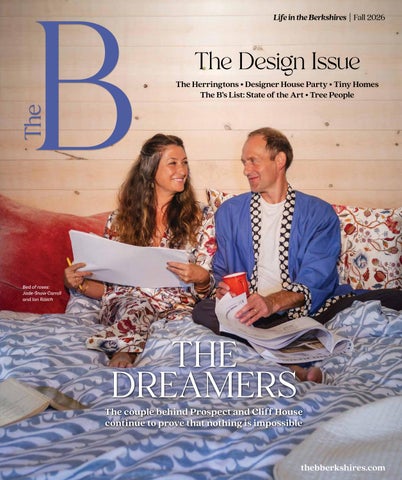
Bed of roses: Jade-Snow Carroll and Ian Rasch
THE DREAMERS
The couple behind Prospect and Cliff House continue to prove that nothing is impossible
thebberkshires.com
Building tomorrow together. At Beacon Bank, we’re focused on building your tomorrow. Whether you’re starting a business, navigating a new chapter or planning ahead, our experts can guide you every step of the way. Visit us online or at your nearest branch.
BeaconBank.com 8/26
Member FDIC Equal Housing Lender
sponsored content
The B asked Beacon Bank leaders,
“What do you love most about being a part of the Berkshires?” James J. Morris IV
President of Beacon Bank’s Berkshire County region Being part of a place where relationships matter and people genuinely care about their communities. Berkshire County has a strong sense of identity, and I’m proud that our team lives and works here and shares that commitment. To me, being a local bank means showing up, knowing our customers and communities personally, and helping them grow and succeed.
Matthew Emprimo
Director & Commercial Leader for Berkshire County and Vermont Supporting local businesses and seeing firsthand how the investments they make translate into a better quality of life across Berkshire County. Some of my professional relationships date back over two decades, so it is both rewarding and enjoyable to work on projects with people you know that make a difference in the community.
Lori Kiely
Director of the Bank’s Foundation and Charitable Giving The close-knit community that truly comes together in times of need. Berkshire County has so many nonprofits working hard to strengthen and improve our communities. Meeting the people who work for these organizations and supporting them through philanthropy and volunteerism is especially rewarding because they are genuine, passionate advocates for the people they serve.
Becky Sorrentino
Relationship Manager Running into familiar faces wherever you go and feeling a true sense of connection to the community. Building trust through long-lasting, meaningful relationships and being genuinely committed to helping local business owners and clients throughout Berkshire County succeed is one of the most rewarding aspects of my role.
Building tomorrow together. Through partnership, trust, guidance and shared vision.
There is so much to love about our community.
O P E N DA I LY FO R D I N E - I N & TA K E O U T
Food. Music. Local Flavor. Woodlife Farm Market is your destination for live music, seasonal events, and farm-fresh dining set across 150 acres of scenic countryside. Enjoy chef-crafted meals and handcrafted drinks, rooted in local flavor and the best of the Berkshires.
Chef David Israelow and I at the Hancock Shaker Village Farm-to-Table Dinner
Publisher Note I USUALLY WRITE MY PUBLISHER’S NOTE
after I’ve finished reading the issue. It’s a chance to look back and remember how our team made it come together. Every coffee, hike, gallery visit or summer gala seems to uncover another story for The B. Our sources aren’t influencers or social media. They come from a natural curiosity about the story behind a meal, the tablecloth under the plate and yes, the local artist who made that plate, too. That curiosity is all over this Design Issue. Writer Ann Volkwein takes us inside the creative world of Four Corners chef David Israelow in Chatham—from forging knives to server uniforms and the local makers bringing his vision to life for its 2027 opening (page 88). The authenticity of The B is what resonates with locals and visitors alike. We craft with reverence and love for this region—and always with you in mind. There are people we haven’t bumped into. Maybe you’re one of them. Take our Reader Survey and tell us your story and what we should discover next. Complete it and enter to win a one-night stay at Prospect Berkshires— featured on our Fall cover. We knew that would get your attention!
SCAN FO R O U R FU LL M E N U
Call (877) 899-2232 for Orders, Hours & Daily Specials woodlifefarmmarket.com 36 Old Route 20, New Lebanon, New York 12125
MICHELLE THORPE PETRICCA Founder and Publisher WIN AN OVERNIGHT AT PROSPECT BERKSHIRES! thebberkshires.com/reader-survey or scan the QR code.
Peter Batchelder, Lone Bale, oil on canvas, 48” x 60”
Peter Batchelder, Lone Bale, oil on canvas, 48” x 60” Peter Batchelder, Lone Bale, oil onand canvas, 48” x 60” Celebrating 10 years of Art Inspiration!
Celebrating 10 years of Art and Inspiration! Celebrating 10 years of Art and Inspiration!
Representing artists; Tracy Baker White, Peter Batchelder, Stanley Bielen, Susan Read Cronin, Mary Sipp Green, Curt Hanson, Jo Harrison, Hale Johnson, John MacDonald, Teri Malo, Leslie Peck, Stan Taft, andSipp KateGreen, Tortland. Representing artists; Tracy TracyHelgeson, Baker White, Peter Batchelder, Stanley Bielen, Susan Read Cronin, Mary Curt Hanson,
Representing artists; Tracy Baker White, Peter Batchelder, Stanley Bielen, SusanLeslie ReadPeck, Cronin, Mary Curt Hanson, Jo Harrison, Tracy Helgeson, Hale Johnson, John MacDonald, Teri Malo, Stan Taft,Sipp and Green, Kate Tortland. Jo Harrison, Helgeson, Hale Johnson,MA John MacDonald, Teri Malo, Leslie Peck, Stan Taft, and Kate Tortland. 71 Spring Tracy Street, Williamstown, 01267 | 413.884.6926 | www.greylockgallery.com
71 Spring Street, Williamstown, MA 01267 | 413.884.6926 | www.greylockgallery.com
From the editor
YOU’RE ABOUT TO HEAR FROM OUR DESIGN DIRECTOR because frankly, I don’t know all that much about design. I mean, I know what I like (our Herman Miller Eames lounge chair and ottoman!), and my personal aesthetic can be best described as “less is more” (I’m an editor, duh!). But for the most part, I cede all matters of design to the expert in my house: my wife, Janie. Don’t get me wrong—I’d be happy to tell you all about this great issue, jam-packed with brilliant designer-y people doing brilliant designer-y things. But I thought you should hear it from an actual expert.
As I write this letter, we’re putting the finishing touches on our 19th issue and getting it ready to print. It’s a moment that reminds me once again how lucky we are to live in a place where inspiration is everywhere. For me, the fun is figuring out how to bring that inspiration to life on the pages of The B. Design isn’t just about how something looks; it’s about how you tell a story. Our cover stars, Ian Rasch and Jade-Snow Carroll, are best known for Prospect, their stylish lakefront retreat in Egremont, but they are creative forces in their own right. As I prepped for the photo shoot there, I pondered how we could naturally bring Jade’s textile company, Sister Moons, into the visuals. Prospect’s chic cabins are layered with her gorgeous textiles. Could we shoot them in bed? Photographer Abigail Fenton and I shared mood boards and agreed the concept worked. It was unexpected, simple and brought together the people, the place, and the product. When I design The B, I look for the details that will give each story its own identity—the craftsmanship and history behind a family business, the beautifully made pieces of local makers, or the thoughtful details that make a space feel special. The stories themselves inspire the design. You may notice a few refreshed design elements throughout this issue, plus a fun new closing page. And, if you’re looking for inspiration of your own: explore an artist’s studio, wander our local shops, take a walk and enjoy the view. In the Berkshires, inspiration is everywhere.
P H OTO : A B I G A I L F E N TO N
LARRY CARLAT JULIE HAMMILL Editor-in-Chief Design Director
thebberkshires.com • THE B
7
Fall 2026
Features 52 Close to Home
52
The couple behind Prospect and Cliff House make dreams come true
58 The Tree People These tree experts dig deeper
O F F I C E : JAMES JOHN JETEL; P R O S P E C T: A B I G A I L F E N TO N ; M A K E R S : LU C A P E A R L K H O S R O VA ; C A R : S T E P H A N I E Z O L L S H A N ; H E R R I N G TO N S : G R E G O RY C H E R I N
64 House of Herrington There’s a good chance you were there this morning
71 The Little Projects in the Woods A tiny house can be a refuge from too-muchness
75
75 Rooms with a View A house party of local designers
88
64
84 The Long Way Home Old cars and the pleasure of taking the scenic route
88 The Taste Makers Chef David Israelow is adding local makers to his menu
84
93 State of the Art Six gallery owners talk shop
In every issue: Local Life 15 | Voices of the Berkshires 39 | What’s Goin’ On 101 | Last Words 112 On the cover: Ian Rasch and Jade-Snow Carroll at Prospect in Egremont • Photographed by Abigail Fenton
Contributors
GREGORY CHERIN (“House of Herrington”) is a well-traveled freelance commercial photographer living in the Berkshires. His award-winning work has appeared in many national magazines, books, and national network television. gregorycherin.com
ANNA LOTTO (“Last Words”) has written for a host of TV shows and created many things on the internet. She lives (and laughs and loves!) in her hometown of Pittsfield, after working in Los Angeles for 15 years. annaklotto.com
MARISA COHEN (“In Search of Berkshire Ghosts”) is a magazine editor and writer who has covered everything from theater and cabaret to women’s health, fitness, and aging. She and her family split their time between New York City and the Berkshires.
ALEXANDRA MARVAR (“Close to Home”) is a freelance journalist whose longform features have appeared in The New York Times, National Geographic, The Believer, WSJ Magazine, and elsewhere.
GUS HEAGERTY (“Why I Don’t Listen to Marie Kondo Anymore”) is a New York–based actor, comedian, writer, and director. He appeared in NBC’s “Stumble” and creates viral characterdriven satire videos online (@gus.heagerty). As a comedian, he performs regularly around New York and beyond. JULIANE HIAM (“A House of Imagination”) is a writer and filmmaker living in the Berkshires. For the past 15 years, she has collaborated with her partner, artist Gregory Crewdson, contributing writing and creative support to his large-scale photographic productions. ANNDEE HOCHMAN (“The Tree People,” “The Little Projects in the Woods”) is a journalist, educator, and storyteller whose work has appeared in WebMD, Poets & Writers, The Philadelphia Inquirer, and many other venues. LUCA PEARL KHOSROVA (“The Taste Makers”) is a photographer and multidisciplinary artist based in the Hudson Valley. She is also the owner and founder of Catskill Photo Studio, a photographer-run studio on the main street of Catskill, New York. catskillphotostudio.com
10
THE B • Fall 2026
MARIANNA POUTASSE (“Good Vibes”) is the founder and creative director of The Curated Home, where she partners with clients to design spaces for living well. She’s also a freelance writer specializing in design and social history and has also served as an independent curator. thecuratedhome.com LARA TUPPER (“Writing Her Way Home”) is the award-winning author of four books, including the novel “At the Center,” forthcoming in 2027. She offers writing workshops and book coaching via Swift Ink Stories and performs as a jazz/folk vocalist throughout New England. laratupper.com NEIL TURITZ (“The B’s List: State of the Art”) moved to the Berkshires from New York City, along with his wife. They have since welcomed a son. Turitz is a screenwriter, author, filmmaker, journalist, and creator of “6 Word Reviews.” @6wordreviews ANN VOLKWEIN (“The Taste Makers”) is a bestselling cookbook author and recipe developer based in Stockbridge. She is the author of the “Arthur Avenue Cookbook” and “Chinatown New York.” STEPHANIE ZOLLSHAN (“The Long Way Home”) is an award-winning photojournalist whose work has been featured around the world. Stephanie is a Boston University graduate and has been with The Berkshire Eagle since 2011.
P H OTO S : C O U R T E SY O F T H E C O N T R I B U TO R S
ABIGAIL FENTON (“Close to Home”) is an international photographer rooted in the Berkshires. Specializing in lifestyle and wedding photography, she expertly captures the essence of human experience. In her personal work, Abigail primarily works with film photography. abigailfenton.com
I
S
⋅ FURN
TU
RE
⋅ FIN
IS H E Lisa Vollmer Photography
DE GN
⋅ R E A L EST
HOME
SI
E⋅ T A
BOOK A DESIGN CONSULTATION thebramble.us | hello@thebramble.us 325 Stockbridge Rd, Great Barrington MA
inspired DESIGN
YOUR DESTINATION FOR
M
KITCHEN, BATH and TILE
eet our professional design team and explore an exceptional collection of premium cabinetry, elegant
countertops, and distinctive tile selections. Discover the latest trends, gather ideas for your next project, and see how thoughtful design can transform your home.
312 WHITE HILL LANE HILLSDALE NY
•
C E N T E R
518-325-3131
•
H E R R I N G TO N S . CO M
Fall 2026 | Issue 19 FOUNDER AND PUBLISHER
EDITOR IN CHIEF
Michelle Thorpe Petricca
Larry Carlat
EXECUTIVE EDITOR
EDITOR-AT-LARGE
Lauren Mechling
William Li
mpetricca@berkshireeagle.com
lmechling@berkshireeagle.com DESIGN DIRECTOR
Julie Hammill
julie@hammilldesign.com
lcarlat@berkshireeagle.com
CONTRIBUTING PHOTOGRAPHERS
Gillian Jones-Heck Stephanie Zollshan DIGITAL PARTNERS
COPY EDITOR
Hadley Clover
Amy Krzanik
hadleyclover.com
The B is a publication of Berkshire Eagle Media ADVERTISING MANAGER
PRESIDENT
Fredric D. Rutberg
Amy Filiault
frutberg@berkshireeagle.com
afiliault@berkshireeagle.com
PUBLISHER
SALES COORDINATOR
Gary Lavariere
Aly Dvorak
glavariere@berkshireeagle.com
advorak@berkshireeagle.com
EXECUTIVE EDITOR
CONTENT MARKETING SPECIALIST
Kevin Moran
Anthony Duval
kmoran@berkshireeagle.com
aduval@talonmediaagency.com
CREATIVE DIRECTOR
MULTIMEDIA ADVERTISING CONSULTANTS
John Supple
jsupple@berkshireeagle.com OPERATIONS MANAGER
Chuck Danforth
cdanforth@berkshireeagle.com DIRECTOR OF ADVERTISING SALES, BERKSHIRE EAGLE, THE B, SHOPPER’S GUIDE
Cheryl Gajewski
cmcclusky@berkshireeagle.com
Shannon Chapman
schapman@shoppersguideinc.com
Eileen Marran
emarran@berkshireeagle.com
Tristany Saldo tsaldo@berkshireeagle.com
Troy Schweitzer tschweitzer@berkshireeagle.com
SUBSCRIBE TO THE B! berkshireeagle.com/theb or scan the QR code. For subscription issues, call 800-245-0254
twmcclelland.com 597 Main Street, Great Barrington MA
ROCK-SOLID COVERAGE. LOCAL DECISIONS. MountainOne is the insurance provider more Berkshire residents and businesses trust. Our experienced team is based right here in the Berkshires, and all our claims decisions are made in house. From your home and vehicles to your business, cover what you care about with MountainOne. Give us a call at 800-447-2732 or stop by one of our Berkshires locations today.
Insurance products are not a deposit, not FDIC-insured, not insured by any Federal Government Agency, not guaranteed by the Bank, and may go down in value.
Local Life
IN SEARCH OF BERKSHIRE GHOSTS BY MARISA COHEN • PHOTOGRAPHS BY ROBERT OAKES
P H OTO : R O B E R T O A K E S
O
kay, let’s get this out of the way right at the beginning of an article about ghosts: I don’t believe in them. I don’t even like ghost movies (I think the last one I saw was “The Sixth Sense,” back in the waning days of the 20th century). But you know what I do like? Creaky old buildings with lots of good stories. Gossip about legendary literary circles and the splendor
of the Gilded Age. Tiptoeing around with a flashlight after hours in a spooky building where it feels like if ghosts did exist, this is where they might hang out. So that is how I recently found myself on a Ghost Tour of The Mount, Edith Wharton’s summer home in Lenox. The tour begins after dark in the stables, which are said to be haunted by the Wharton family’s driver.
After listening to a history of the home—after the Whartons divorced and Edith moved to France, The Mount was purchased by another family with a tragic story, then became a boarding school for girls and later the home of the theater troupe Shakespeare & Company before being restored as a museum and cultural center—we walked up some creaky stairs to the very creepy hayloft. * thebberkshires.com • THE B
15
A tour guide named Ben, who would not look out of place as one of the handsome young footmen in HBO’s “The Gilded Age,” was telling our group a (possibly apocryphal) story of a pregnant housemaid who had come to a tragic end, when a woman on the tour asked if anyone else could see a dark presence sitting hunched over in the corner, just a few feet from where I was standing (she had previously raised her hand when Ben asked if there were any “clairvoyants, mediums, or sensitives” in our group). Ben was speechless for a moment and then said, “A chill just went down my spine,” as he explained that there had been several sightings of the exact presence she had described in the exact same spot over the past few years. Um…. Now, I’m not saying I believe there was a ghost there. Maybe Ben was doing improv, a “Yes, and…” playing off the guest’s comment. Maybe it was just the way the moonlight cast shadows through the trees on that very spot. But something in that loft felt very, very eerie, and I could not wait to get back outside. Did I see some weird shadows flitting around the other end of the hallway as I made my way to the stairwell? I’m not saying I did, but I’m not saying I didn’t.
“Something in that loft felt very, very eerie, and I could not wait to get back outside.” Ghosts Exist If You Want Them to Exist “One thing I always encourage people to do is recognize that a lot of what they get out of a ghost tour is the presence they bring to it,” says Robert Oakes, who led our tour along with Ben and a guide named Tarryn (who reveals a delightful connection to the ghosts that I won’t spoil here). I was pre-gaming my tour by chatting with Oakes, who admits that he was a bit of a skeptic when he first came to work at The Mount. “But as I’ve heard more and more stories, and had experiences of my own, I’ve really come to feel that there is something to all this,” he says. Oakes tells me that over the years, as he has gotten to know the ghosts of The Mount, he has felt mysterious pats on the head and
16
THE B • Fall 2026
heard voices whispering his name. “There’s something to the experience of challenging your imagination and immersing yourself in a more sensory and intuitive experience,” he says. “Interesting things happen when you do that.” He points out that Edith Wharton herself was fascinated by the spirit world, and the Pulitzer Prize–winning author best known for “The Age of Innocence” and “The House of Mirth” wrote several eerie ghost stories later in her career. Oakes also leads the Ghost Tours at Ventfort Hall, a more Gothic, and traditionally haunted-looking mansion just five minutes down the road. “What I often focus on during the Ventfort Hall tours is the mingling of love and grief,” Oakes explains. Among the tragic losses that occurred in that Gilded Age mansion were the death of Sarah Morgan (sister of the OG finance bro J.P. Morgan) and, before that, the death of Robert Gould Shaw at just 25, as he led the first African-American regiment into battle in the Civil War (you may remember this story from the Oscar-winning film “Glory”). He and his young wife lived their brief but
happy marriage in a home on the property that predated the current mansion. A later resident of Ventfort Hall was a member of the Vanderbilt family who lost her husband in the sinking of the Lusitania. So, as far as historically relevant ghosts go, take your pick. “I’ve had people on the tours tell me they could feel the loss of all those people like a weight in their chest,” Oakes says. I asked Oakes if he believes there are so many haunted homes in the Berkshires because of its prominent role in the Gilded Age—an era that saw unimaginable riches and beauty, followed by the great economic crash of 1893. “Yes, it was a moment when people were riding high, and then all of a sudden everything was lost, and so many of these houses either became empty or turned into other things—their shining moment of glory was short-lived,” he says. But there’s more to it, Oakes adds: “You hear people talking about the spirit vortex in the Stockbridge Bowl…there has always been something here that has drawn artists and spiritual seekers, people who are trying to have some kind of transcendent experience.”
P H OTO : R O B E R T O A K E S
Local Life
Local Life Shaker Ghosts Speaking of transcendent experiences, you can’t think about ghosts of the Berkshires without visiting Hancock Shaker Village in Pittsfield. If you happened to catch the 2025 film “The Testament of Ann Lee,” you’ll know those Shakers had some seriously woo-woo experiences, including ecstatic dance parties that could last well into the night. “The early Shaker leaders believed that the spirit world was very close by,” says Stephen Pepper, one of the interpreters who lead the Haunted Hancock tours at the historic village. “It was more or less an everyday occurrence for them to be in communication with the spirit of God and with angels.” He points out that, over time, they also felt they were communicating with deceased members of the Shaker community. “They didn’t think of these people as ghosts, but as people on the other side of this thin curtain,” Pepper says. Interpreter Denise Wright adds that the land the Village stands on is part of the story. “The water that flows underneath the village has a tendency to provide a sense of peace and spirituality through the community,” she says. But there are also plenty of ghost stories, Wright says, mentioning a Shaker sister who fell when ringing the bell and now reportedly roams the dwelling house. And then there was that time Denise and Stephen were leading two separate tours at the same time and, on each tour, one of the guests felt her hair being pulled while walking through the house. So, did I become a believer after my spooky tour of The Mount? Well, I didn’t hear anyone whisper my name, tap on my shoulder, or pull my hair, but in addition to seeing those flickering shadows in the hay loft, I did get a shivery feeling while walking through the grounds and grand rooms of the mansion (did I mention the pet cemetery with tiny, intact gravestones for Edith’s fluffy pups?). But what I really took away from my tour was the power of storytelling to bring the people who last walked these halls more than a century ago back to life again, to imagine Teddy Wharton sipping from that bottle of liquor while battling the private demons of depression, to see Edith being driven around Lenox with her beloved dog, Jules, in her lap, to picture Shakespearean actors rehearsing a scene from “Hamlet” while ghosts both theatrical and perhaps real roamed the halls. It’s the power of literature, of history, of theater. And what is more hauntingly beautiful than that? B
DOG & CAT Daycare & Boarding
Now offering grooming services! Open 7 days a week Call about our late daycare hours available
413.394.4014
915 PLEASENT ST, LEE, MA hearthandhoundlee.com
JHA
J HARWOOD ARCHITECT
The Mount Ghost Tours 2 hours, $25-$35 (kid-friendly tours available on select evenings, $15), edithwharton.org Ventfort Hall Ghost Tours 2 hours, $30, gildedage.org Haunted Hancock Tours 90 minutes, $27/$30 for members; hancockshakervillage.org
LOVE WHERE YOU LIVE 413-637-8127 JHARWOODARCHITECT.COM
Local Life
Writing Her Way Home From subjects like Samuel Adams to the Salem witches, Stacy Schiff doesn’t stray far from where she grew up in the Berkshires
S
tacy Schiff, the Pulitzer Prize-winning author of six biographies, grew up in Adams, which was named for Samuel Adams in 1778. Her hometown stuck: Schiff’s most recent book is “The Revolutionary: Samuel Adams,” one of President Obama’s Favorite Books of 2022. Brad Gooch, in The Wall Street Journal, calls Schiff “perhaps the most seductive writer of non-fiction prose in America in our time.” Though immersed in writing her next book about Benjamin Franklin, Schiff graciously took the time to answer questions by email.
Not as often as I would like! I spoke in June in Adams, a little bit of an out-of-body experience as I was suddenly standing a few hundred years from my first speeding ticket, my first summer job, my first kiss. Down the street was the church where I earned my first Girl Scout badges. Across the street was the church where I sang (briefly, my Jewish mother was displeased) in the Congregational Church choir. How did your home state shape you as a writer and historian? What sparked your interest in local history?
Let me preface this by saying that the biographer can be spectacularly obtuse about her own life: There’s doubtless a good reason why she spends years losing herself in someone else’s. My best guess is that my childhood, like many New England childhoods, was steeped in history. Early on, I had the good fortune of winding up in classrooms with gifted history teachers. The most influential was probably Nancy Sizer, my 11th-grade American history teacher, to whom, 47 years later, I dedicated “The Revolutionary.” Which was hands-down the easiest page I’ve ever written.
18
THE B • Fall 2026
“The Witches” followed my biography of Cleopatra. At the time I was thinking about women’s voices, how they have sounded and how they were heard, more than I was thinking—or thought I was thinking— about 17th-century Massachusetts. For “The Witches,” I read more Puritan sermons than is probably healthy; they did not feel entirely foreign. Nor did small-town New England life, its charms, obsessions, and idiosyncrasies. In your talk with David Rubenstein on C-SPAN, you said you were drawn to subjects such as Cleopatra because “there’s a great deal of give around the edges of the story” which provides “an interesting narrative challenge.” Is this how your search for a subject begins?
There’s something immensely gratifying about crafting a compelling narrative with one hand tied behind your back, as the nonfiction writer is honor-bound to do. As for where the search begins, I think there’s probably a different answer every time. One book has led more or less naturally to the next. After “The Witches,” I felt I
needed a hero, someone who stood in the light after those five dark years in Salem. Adams was not the obvious answer—I had made a passing reference to him in an earlier book I’d done on Ben Franklin [“A Great Improvisation: Franklin, France, and the Birth of America”]—but the more I read, the more I found his writing irresistible. And then there was the fact that none of us seemed to know anything about him, while his contemporaries swore he was, as Jefferson had it, “the man of the Revolution.” And, you know, Adams, Massachusetts. I do have a friend, Megan Marshall, who has a theory that I keep landing on these subjects as a way of writing my way home. But what does she know? She’s just an award-winning biographer. Can you tell us a bit about your research process? It takes me somewhere between
five and six years to write a book. The first three to four are entirely devoted to research. Only then does something
P H OTO : E L E N A S E I B E R T
How often do you return to the Berkshires?
Local Life
Fall at The Mount Sculptures
resembling a narrative begin to emerge; when it does, the idea is to retreat to my office, though naturally once you start writing you also come around a corner and discover something you never thought to research. Also, as soon as you sit down to write, nothing is more compelling than a trip to the archives— or a day of organizing the basement. Anything but attempting to put words on the page. I have friends who write as they research, but I’ve never figured out how that works, as the material entirely dictates the shape of the narrative. I can too easily imagine the latter racing off without the former. What are you working on now? Does it get any easier from book to book? I’m working on a book about Ben Franklin, told
through the last five years of his life. I’ll manage to describe it better after I’ve finished, I promise. I promise, too, to let you know when it gets easier. Writing one of these things only seems to get more and more difficult, for reasons I could whine about at great length. On a good day, I tell myself it’s because the projects get more ambitious. Franklin’s final years are ones most biographers (myself included, in my 2005 book, “A Great Improvisation”) have skipped past, if only, I think, because he has by then exhausted us with all his pathological accomplishment. Michael Douglas stars in “Franklin,” the mini-series based on “A Great Improvisation.” What has it been like to see your work adapted for the screen? You know those stories about
the siblings who meet for the first time after 45 years and discover that they both eat butter straight from the packet and both named their dogs Boris? It’s like that, both thrilling and surreal. From a certain angle it feels familiar, but it also feels entirely like someone else’s project—as it should.
through October 24
TALKS
TOURS
Explore at EdithWharton.org Lenox, MA EdithWharton.org
Your table awaits.
What lessons from history do you hope we’ll learn, going forward? As democracy feels more and more fragile, I find
myself craving the company of an Adams or Franklin, who believed in selfless public service, who appealed to our best instincts and who trusted in the commonweal. Partly because of their Massachusetts roots, they stand among the most aggressively egalitarian of the founders. What are you reading now? My favorite question! This weekend, I finished “The Maple Stories,” because I’ve been wondering how we have forgotten John Updike so quickly, and if any single book is brilliant. (Yes, absolutely, in this case.) Also just read and loved Valeria Luiselli’s entirely original “Beginning Middle End.” On the non-fiction front, I had somehow missed Chloe Dalton’s “Raising Hare,” an antidote for the anxious. And, at the end of a long day, I’m savoring Ron Powers’ “Mark Twain: A Life,” a model of the biographical form. There should be a word for the kind of book which you hope will somehow seep into and reconfigure your DNA. This is one. —Lara Tupper
NIGHTWOOD
9 Sharon Road, Lakeville, CT fernlakeville.com | 860-596-1930
Local Life
LIFE IN THE BERKSHIRES ON EVERY PAGE
CLICK TO SUBSCRIBE
thebberkshires.com 20
THE B • Fall 2026
R 25TH ANNIV TING OU ERSA A R B E RY! L CE
INTERIOR DESIGN
MEADOW HOUSE
DESIGN BUILD - GENERAL CONTRACTORS GREAT BARRINGTON I 413-528-4935 CBSBERKSHIRES.COM
City of Peace VISIT THE
Where Design, History, Art, Innovation, Food, Ideas and Farming come to life.
PITTSFIELD, MA HancockShakerVillage.org
Local Life
Suet Cheeks Crafted with tallow from local cows, local skincare line My Neighbor’s has become a smash sensation
H
22
THE B • Fall 2026
In addition to tallow balms, soaps, and candles, the store also offers pottery, maple syrup, and other goods from womenowned businesses.
and lab; in the front, Magaldi features not only her tallow balms, soaps, candles, and hair-care products, but also pottery, maple syrup, and other goods from women-owned businesses. Local vendors also pop up outside the building most Saturdays. “I really wanted to help emphasize the mummy side-hustle,” she says. Neighbors have always been at the heart of the venture. Magaldi only works with local farms. “We probably go through about 1,000 pounds of fat a week at this point,” she says. “It’s really great for the farms to be able to make money from something that’s a waste product, but also for the animal to not go to waste in any way.” Several of the farms Magaldi works with sell her products in their stores. The entrepreneur is seeing sales quadruple year over year. My Neighbor’s products are sold in more than 500 physical retailers (including more than 180 stores in the tri-state area). The company is preparing for three national launches and acquiring a building to use as a warehouse and laboratory right in town. “We’re here to stay,” says Magaldi. —Jen Doll
P H OTO S : N I C K G L I M E N A K I S
arri Magaldi knew she was onto something when she realized she could get her bougie mom friends to put beef fat on their faces. “They were like, my skin is glowing,” says the Hudson, New York-based founder and CEO of My Neighbor’s Company, which makes grass-fed and finished tallow balms and other natural skincare products. Magaldi had been living in Darien, Connecticut, working in sales and trading on Wall Street when the pandemic began. She and her husband, who works in tech, had decamped to Hudson, where “we really got a taste for upstate living.” In 2022, two things happened: they were summoned back to their city offices, and Magaldi became pregnant. “When Wilhelmina was born, I looked at her and I was like, I can’t,” says Magaldi. She quit her job and the family sold their house in Connecticut. The plan was to settle full time in Columbia County. “I was actually going to be a stay-at-home mum,” Magaldi says. Wilhelmina was six months old when she developed eczema. Facebook forums mentioned beef tallow as a possible remedy. Magaldi turned to local farmers, including Kinderhook Farm, who gave her suet. The hard fat around a cow’s kidneys and loins can be rendered into tallow by melting and straining, as Magaldi did in her home kitchen. “It was the only thing that worked for Willa’s skin,” she says. With the encouragement of her mom friends, she launched the brand in May of 2024 at the Hudson Farmers Market. “I brought my baby, and we sold about $4,000 worth the first day,” Magaldi says. Next thing she knew, her brand had been picked up by the lead buyer for Terrain and Anthropologie. As of April, My Neighbor’s has a flagship store in Hudson, its front window offering a view of the Hudson Farmers Market where it all began. The back contains the warehouse
Local Life
FilmColumbia Is Coming to a Theater Near You The small-town festival with big Hollywood energy returns to Chatham for its 26th edition this fall
I
P H OTO : J O H N S H E A
magine catching Jessie Buckley’s 2026 Oscar-winning performance in “Hamnet,” or Best International feature winner “Sentimental Value” before any of your friends, and months before they hit your local movie theater—if they do at all. This October 16-25, FilmColumbia, an international film festival in the heart of downtown Chatham offers exactly that chance. “We try to get small, indie films that most probably won’t end up at ‘a theater near you,’” explains festival Co-executive and Co-artistic Director Peter Biskind.The film historian and noted Hollywood chronicler programs the lineup alongside fellow Co-executive and Co-artistic Director Laurence Kardish, senior curator emeritus for film and media at MoMA. “In other words, see them at our festival or most likely you won’t be able to see them at all,” says Biskind, “at least until they stream.” Longtime festival director Calliope Nicholas shared how the Columbia County
cultural event, once only for regional films, has become a draw for both locals and film buffs across the country. “We’re able to get the best of pre-released films,” she says, “all the best of Sundance and Cannes and the Berlin Film Festival, and it’s really exciting to put it together.” This year’s lineup features more than 40 American and international films, including: the politically coded vampire comedy “The Blood Countess” starring French actress Isabelle Huppert; the twisty, richly stylized melodrama “Bitter Christmas” by renowned director Pedro Almodóvar; “Rehearsals for a Revolution,” winner of the Cannes Film Festival’s top documentary prize, chronicling 40 years of protest in Iran; and “All of a Sudden,” Oscar winner Ryusuke Hamaguchi’s JapaneseFrench drama about two strangers whose chance meeting reshapes both their lives. The fest also includes two films built
for the big screen. The visually dazzling “Everest: The Other Side,” edited by local Bob Eisenhardt and directed by Jimmy Chin and his wife, Chai Vasarhelyi, the duo behind “Free Solo,” chronicles the love story of two elite ski mountaineers as they chase an unclimbed, un-skied line down Everest’s North Face. And Palme d’Or winner “Fjord” delivers a can’t-lookaway account of a Romanian family whose lives unravel after drawing the attention of Norwegian child welfare authorities. Another star of this year’s festival is the Crandell Theatre itself, which marks its 100th anniversary on December 25, fresh off a $4.2 million renovation. Built in 1926, the palatial theater reopened last October with a striking marriage of old and new: the original balcony, curtained screen layout, and historic color palette carefully restored alongside new cushioned seating, a redesigned concession stand, expanded bathrooms, and state-of-the-art projection, lighting, and sound systems. The Crandell isn’t the only piece of Chatham history getting new life. This year’s opening night ceremony on October 16 will honor American filmmaker and writer Jane Schoenbrun with a kick-off party at the newly restored Masonic lodge. FilmColumbia also features Q&As with filmmakers, a screenwriting workshop where participants can hear their work read by professional actors, and the popular Saturday Sneak—in which the film isn’t announced until audiences arrive in the theater. “It’s the first thing to sell out every year,” Nicholas warns. “Another favorite moment is, after a really interesting screening, [when] people are all gathered here and I’m walking out and they’re all talking about it,” she says. “I think people are starting to realize this is a really interesting way to bring the community together for one shared experience.” Film festival passes and individual tickets are available to the public starting October 3. Crandell Theatre members get early dibs and Nicholas notes that, even with about 450 seats, a lot of the evening films will sell out. —Betsy Korona crandelltheatre.org/filmcolumbia
Local Life
Bring the mountains home.
Field Days A new ideas festival is about to bubble up in Lenox
I
f uffalpaca.com fl Great Barrington
nspired in part by Wales’ celebrated Hay Festival, a new entrant to the Berkshires culture scene is field, a multidisciplinary ideas festival, with a distinctly Berkshire sensibility. Over one weekend at Shakespeare & Company’s Tina Packer Playhouse, writers, artists, scientists, scholars, and other thinkers will gather to talk about the questions that consume them. There will be plenty to disagree about. Physician and bioethicist Ezekiel Emanuel, one of the architects of the Affordable Care Act, will question our increasingly elaborate obsession with living to 100, in a conversation inspired by his new book, “Eat Your Ice Cream.” Artist Maira Kalman will consider joy as something fleeting but easy to take note of, in a presentation centered on her new book, “Joy.” Meanwhile, avid gardeners Saidiya Hartman and Jamaica Kincaid will explore gardening as a creative practice. Elsewhere, painter and printmaker Tom Hammick will talk about his operatic approach to art; former New York magazine editor Adam Moss will lead a live “Artists at Work” conversation with author Colm Tóibín; and developmental psychologists Carol Gilligan and Niobe Way will take on the complicated terrain of girls, women, and the mind. There will be history, too. Pulitzer Prize winners Annette Gordon-Reed and Brent Staples will meet for a conversation about politics and American life, while Kai Bird and Susan Goldmark will discuss their new biography, “American Scoundrel,” about Roy Cohn, with Bill Goldstein. And then there’s the paranormal. Writer Laura Buchwald, whose work blends literary fiction with the supernatural, will venture into the world of the dead in collaboration with evidential psychic medium Joe Perreta. The vast range is intentional. “The most interesting ideas often emerge where disciplines intersect,” says Bernard Schwartz, the festival’s programming director and former executive of the 92nd Street Y and the Authors Guild Foundation. The goal, he says, is not to send audiences home with all the answers, but with “better questions.” —Lauren Mechling
field takes place October 23-25 at Shakespeare & Company’s Tina Packer Playhouse in Lenox. fieldlenox.org
“The most interesting ideas often emerge where disciplines intersect.”
interior design + home staging allisoncraneinteriors.com
Building Change Expert builders transforming the way people learn, do business, and live. Keiter is a family-owned construction services company working with clients on residential, commercial, industrial, and institutional projects. LEARN MORE AT KEITER.COM
Local Life
GOOD VIBES Three artisans in and around the Berkshires are creating wow-worthy objects that elevate any space FLOWER POWER Petal-perfect and impossibly lifelike, Donna Kittredge’s paper flowers look like they were snipped from the garden at the exact peak of bloom. A trained horticulturalist, she brings a scientist’s eye and an artist’s hand to every stem—so convincing you’ll want to lean in and sniff. Before she gets to work, Kittredge studies her specimens closely, sketching their details, testing pigments, and taking notes. Then she builds each bloom layer by layer from hand-dyed, fine papers shaded and saturated to just the right hues, stacking, rolling, pinching, and molding them to her exacting standards, from root stems to the most delicate tips of the buds. The finished products are swoon-worthy—the perfect gift for the gardener in your life, or for yourself, because we all deserve to be surrounded by beautiful things. Especially the kind that keeps a little of that glorious Berkshires summer alive, long after the blooms themselves have faded. @understorypaperflowers
F LO W E R : @ U N D E R S TO RY PA P E R F LO W E R S ; G L A S S E S : S H I R G L A S S W O R K S .C O M ; P E A R S : A U D R E Y S H A C H N O W
BIG SIPPERS Ori Shir’s dazzling, jewel-colored glassware caught my eye last summer while perusing the artisan tents at the Berkshire Arts Festival, where it took only minutes to become mildly obsessed. His spiral-patterned tumblers, finished with a pop of colored glaze at the rim, are begging to seriously elevate your cocktail game. Pour a bourbon— neat, please—or whip up a classic gin and tonic in one of these bad boys. Hand-blown and furnace-blasted, Shir’s glassware comes in lots of shapes and sizes. The speckled cups are perfect for juice at the breakfast table, but I’d also use them as vases for small groupings of flowers. The Italianinspired Mezza Stampo footed glasses, wrapped in a thin, contrasting belt of color, throw off some serious Murano vibes, while the rainbow-hued martini glasses will make you feel like you’ve wandered into an “Alice in Wonderland”-themed party. shirglassworks.com
NATURAL ARTIFACTS Drenched in burnished golden or copper pigments, the pear sculptures by Audrey Shachnow are jaw-droppingly sensuous—decadent, glossy, and almost edible. While she is well known for her imposing, larger-than-life pieces, it is Shachnow’s smaller versions that are particularly irresistible to an architecture and interiors girl like me. Oh, the possibilities! Picture a single, glittering pear tucked into a bookshelf next to a stack of beloved books, or resting on a console table to catch your eye each time you walk by. But my all-time favorite idea for displaying these beautiful objects? A large collection—think three, five, or seven—spilling down a long dining table. Interspersed with flowers, bunches of grapes, and tall candlesticks, the arrangement creates a stunning tablescape reminiscent of a Dutch Master painting, but with a fun, modern twist. audreyshachnow.com
—Marianna Poutasse thebberkshires.com • THE B
27
Local Life
Shop and Stop
T
his past July, when he was ready to open Walker Street Market to the public, owner Matthew Ames organized what he thought was going to be a nice opening party, with crudités and fancy potato chips. What unfolded in Lenox on that blindingly sunny Saturday afternoon was more of a surreal shindig. A blur of neighbors, design insiders, and dogs floated about, admiring the smart objects and outfits at every turn. “Where did you come from?” a startled woman asked a reporter who’d pulled back a curtain only to find herself teleported into another room of the funhouse, a gallery space where Ames will put on rotating shows throughout the year. “I’ve always loved stores where you
28
THE B • Fall 2026
wanted to go even if you weren’t buying anything,” said Ames, 46, who moved from Chicago to Lenox to open his first retail venture. “Today, physical spaces have to do more than sell things. They have to make people want to come back.” Part design store, part gallery, part gathering place, Walker Street Market is set in a stunningly restored 19th-century neoclassical, white-columned building that was once the local department store, and later divided into three separate businesses. The 3,000-square-foot space features some 70 artists and designers, with furniture, ceramics, textiles, glass, books, fragrances, kitchenwares, and dangerously appealing apothecary items. Bottles from the all-natural,
New Zealand-based perfume line Abel are arranged on a Shaker-style wooden dresser near a shelf where a single flower sits in a perfectly spartan vase. “I need to get that moment,” Sarah Elliott, a photographer who lives in Hillsdale, said as she snapped a picture of the lonely bouquet. “I wanted it to be kind of a multidisciplinary space with artists who were working in wood, ceramic, glass, and textiles,” Ames said. “I wanted to create this sort of world of interiors.” He cites the San Francisco design store March, which recently closed after 30 years in business, as a prime example of retail as creative expression and miniature world-building. Among the commissions, visitors will find a nine-foot Shaker bench
P H OTO S : M AT T H E W A M E S
You’ll want to linger a while at Walker Street Market, the massive cabinet of curiosities disguised as a retail store. Plan accordingly.
The 48th Annual Outdoor Exhibition of Contemporary Sculpture at Chesterwood THROUGH OCTOBER 31
from Sawyer Made, a cherry dining table and walnut sofa by Brian Persico, and custom lighting by Jake Coan, who grew up in the Berkshires. “It was really incredible how open everyone was who I reached out to,” Ames said. Not a single artist declined his invitation. “People trusted the vision.” His vision changed over time, as visions tend to do. At first Ames was noodling on a design destination in northern Michigan, where he’d spent summers growing up. But the more Ames thought about it, the more he wondered about the Berkshires, where he’d spent weekends with friends when he was younger. And then he came across the real estate listing. The Lenox building with the neoclassical facade had once been the site of the popular Dee’s Department Store. Ames bought the building and spent the past year and a half restoring it. Neighbors stopped by almost daily to tell Ames stories about shopping at Dee’s with their parents and grandparents. That tradition is alive and well. A few days after the opening party, a mother and her teenage daughter stopped by the market. The woman and Ames chatted while the girl, a first-year student at RISD, explored the gallery with a sketchbook. “They left nearly two hours later,” Ames said. “Which is exactly what I’d hoped for. I wanted to create a store people would want to visit even if they weren’t buying anything.” —Lauren Mechling walkerstreetmarket.com
S TOCK BR I DGE , M A chesterwood.org
Local Life lead miniature horses through obstacle courses as a way to help build confidence and motor skills. Sometimes the animals travel to schools, libraries, nursing homes, senior centers, and disability facilities. “It’s really about fighting loneliness, finding motivation,” Borreda-Martinez says. “Animals are the only thing in our world today that is not polarizing. They just bring people together.”
‘We Are Not a Petting Zoo!’ The four-legged residents of Le Petit Ranch are cute as can be. They’re also teachers, study buddies, and healers.
“I
t was a childhood dream for me,” Marjorie Borreda-Martinez, the owner of Le Petit Ranch, says as she watches my 4-year-old daughter, Emma, walk into the Berkshires sunset. Emma is holding the reins to a miniature horse, and the expression on Borreda-Martinez’s face is one of wistful contentment. I first discovered Le Petit Ranch while looking for French language programs for my daughters, but quickly became swept up in the larger mission of Borreda-Martinez’s nonprofit. From animal engagement sessions that double as French lessons to
30
THE B • Fall 2026
an afterschool program where students do their homework alongside sheep and miniature horses, Le Petit Ranch taps into the power of animals to foster a sense of well-being—and even facilitate learning. The faculty includes miniature horses, donkeys, sheep, guinea pigs, a host of chickens, and a pair of rescued Spanish greyhounds, Yayi and Ronya. Sessions such as story time hour with sheep or French lessons attended by four-legged friends take place on the ranch itself, often inside its one-room schoolhouse. A program called equimotricité has children
Borreda-Martinez grew up in France with dreams of becoming a veterinarian, but life took her down a different path. She was a marketing executive for companies like Dannon and L’Oréal, but was ready to make a hard pivot when she was pregnant with her second child. “I just felt like I wanted to lead by example,” she explains. “I cannot tell my kids ‘you need to be passionate about your life’ while coming back every night at 8 p.m. and complaining about meetings and colleagues.” While on maternity leave, BorredaMartinez studied animal-assisted therapy in Switzerland, and has since added to her long list of certifications in the field. In 2025, she and her husband, Mitch Moulton, a fifth-generation Sheffield native, moved from New York to Sheffield and opened Le Petit Ranch. The nonprofit’s primary goal is to help people grow, feel, and learn. “I call it animal-assisted education,” she explains. “It’s bringing reading, writing, self-expression, and self-confidence with the animal as a medium. We are not a petting zoo.” Borreda-Martinez has seen firsthand how animals can change how people see themselves and the world around them. Some people with disabilities “cried because they felt that the guinea pigs loved them so much,” she recounts. “It makes me happy to see that I’m making a difference at a small level, and to watch visitors find the motivation to speak and to learn. So many people think this is a safe space.” —Michelle Yeoung lepetitranch.org visits by appointment only
P H OTO : @ L E . P E T I T. R A N C H
“The nonprofit’s primary goal is to help people grow, feel, and learn.”
Local Life
The Artist’s Way Ceramicist and painter Natania Hume knows a thing or two about artistic blocks and breakthroughs. Her new business is aimed at helping fellow makers get into the groove.
C
oaches are thick on the ground here in the Berkshires, but Natania Hume is doing things a little differently at Open Canopy, her new service geared at fellow creatives. When she isn’t studying to become a certified psychotherapist, she leads coaching sessions aimed at helping composers, pinch potters, romantasy writers, or even home cooks stuck in a recipe rut. Hume’s workshops tackle the psychological side of making things: identity, process and flow, fear and failure, feedback and vulnerability, and setting goals. “So many people are operating from a scarcity mindset,” she said. “There’s a lot of insecurity, a lot of doubt, a lot of negative self-talk.” Some people don’t want to call themselves “artists” because they don’t think they’ve earned the title. “Sometimes I have to remind them that there is no Ministry of Artist Identity,” she said. Hume knows the creative struggle because she lived it. For years, she maintained a successful ceramics business on the side while teaching full time. The work sold around the country, but, as orders piled up, she tore a ligament in her finger and had to stop working for three months. The enforced hiatus turned out to be what Hume called “the best three months of my life.” She had the time to see friends. She went out to restaurants. She allowed herself to loaf about and daydream. This was when she realized the toll her practice had been taking on her life. “Art has to serve me now,” she says. “I’m not there to serve the art.” When she was ready to return to her studio, she started going about things differently. She was paying better attention to her feelings and mindset, and started to expand her idea of what counted as work. If she was feeling at loose ends or preoccupied, rather than force herself to create, she’d
organize her materials, prep canvases, or visit a gallery to see what other artists were making. “Not every day in the studio is going to be the same, and you’re not doing yourself any favors by getting weighed down with guilt or fear.” Around the same time, her brother, a writer, was worried about how the autobiographical elements of his work in progress might land with readers. Hume told him to get out of the audience’s head and back into his own. He did, and started writing more freely. Now Hume is doing something similar on a larger scale. She is pursuing a master’s in social work and interning at a therapy practice in Great Barrington, while developing Open Canopy’s workshops and one-on-one coaching sessions via Zoom or in her new home office. She is also working with Berkshire Art Center, where she expects to teach a version of the program. The name Open Canopy came to Hume in a flash of inspiration. It conjures an image
“I’m not going to tell anyone what to make, but I can help them see what might be possible.” of light filtering through a forest. “I’m not going to tell anyone what to make, but I can help them see what might be possible.” —Lauren Mechling opencanopy.us
Workshops and coaching sessions happen in her new home office.
thebberkshires.com • THE B
31
Local Life
The Paint Whisperer Sure, you could go with your standard eggshell white. But Amy Krane has other, and way better, ideas.
A
my Krane feels color in her bones. Talk to her about her favorite subject long enough, and you’ll start to feel it, too. “Color enriches my life big time,” she said. “Not just on the walls, but everywhere.” The Ghent, New York-based color consultant helps homeowners navigate the overwhelming selection of paint hues, and figure out exactly which colors belong where in their homes. Her process begins before she ever sees your house. After booking a consultation, clients receive a questionnaire asking how they use their rooms, what colors they like and dislike, and how they want the spaces to feel. She also asks them to put together a Pinterest board. “Forty percent of the time, the photos are different from what they wrote,” she said. “Now we’ve got something we’ve got to sort through. I’ll say: ‘Why did you write this?’ Or ‘I think you think you like that, but you really like that.’” Krane spent decades in New York City producing television commercials. “I used to say it was a combination of being a mother, a general, and a diplomat. You’re basically always trying to get people to do stuff they may not want to.” Her powers of persuasion come in handy now as she coaxes people out
of what they think are their comfort zones into what might be their truest comfort zones. In 2012, she trained as a color consultant. “It isn’t decorating-based,” she says. “It’s actually science-based.” She learned about how the eye and brain respond to color and something called “visual ergonomics.” She also learned about the ways different colors can affect our moods. Most of Krane’s clients gravitate toward what she calls “warm neutrals.” Now that the gray craze has faded, more of her clients are asking for more expressive colors, often in individual rooms or on kitchen cabinets. And then there are the true color enthusiasts. “They’ll be like, here’s my peachy pink room with a mossy green trim and doors.” They often need her expertise the most. As Krane points out, the color you fall in love with on your phone may be deceiving. “What looks good 2D in a magazine or on Instagram, is not the same as being surrounded by four walls.” She has a simple warning for anyone tempted to choose paint from an inspo photo: Don’t. Once Krane and a client settle on the colors, she works with them on selecting the version that will perfectly co-exist with the room’s natural light. A committed color maximalist, Krane is an enthusiastic color appreciator. She’s crazy about pinks and plums. She recently painted her guest bedroom a yellowgreen that she said is surprisingly soothing. “I’m not a very woo-woo, touchy-feely person,” she said. “But this work stirs my soul.” —Lauren Mechling amykranecolor.com
32
THE B • Fall 2026
Hues You Can Use “Choosing favorite colors is like choosing favorite kids,” said Krane. Nevertheless, here are a half dozen shades that have a special place in her color chart. Chameleon, Benjamin Moore: “I’m a real lover of yellow-greens,” Krane said. “They can be far more flattering than people think.” Bewitched, Benjamin Moore: A rich plum from the family of deep, warm plums and ox-bloods that Krane likes for dining rooms and powder rooms. Setting Plaster, Farrow & Ball: A muted pink that Krane considers sophisticated and eminently livable. For the room where you’ll be letting the furniture or art do the talking. Mediterranean Olive, Benjamin Moore: A rich, earthy green with depth and character. Butter Pecan, Benjamin Moore: A warm shade Krane calls “fabulous” for its ability to come alive in natural light. Misty Memories, Benjamin Moore: A lavender gray that Krane considers “close to an ultimate bedroom color.”
sponsored content
M
Bringing Home with You
“We honor the past, stand with you in the present and set the vision for the future while managing the entire process so you can focus on what matters most to you.”
P H OTO S : S T E P H A N I E Z O L L S H A N
allthatmattersorganizing.com
oving is often described in terms of what gets packed into boxes and what gets left behind, but for adults leaving homes they may have lived in for decades, the harder question is what happens to everything those objects represent. Emily Kloeblen, owner of All That Matters, and her team help people answer that question. Her work involves the familiar tasks of moving and downsizing — designing a new space, sorting belongings, coordinating movers, packing and setting up a new home. However, those tasks can carry weight that has little to do with boxes or furniture. “It’s not just the design of a new home or the logistics of getting everything where it needs to go,” Kloeblen says. “The most important thing in your home is you. We honor the past, stand with you in the present and set the vision for the future while managing the entire process so you can focus on what matters most to you.” Kloeblen spent more than 20 years in health care, starting in biomedical engineering then attaining an MBA with Distinction from Harvard Business School. Post-business school, Kloeblen built innovative services that placed the person at the center of the care model for leading companies, like CVSHealth. Her experience moving to the Berkshires opened her eyes to how challenging a home transition can be. “It clicked for me when I understood that moving is considered one of the most stressful life events and can cause a number of health issues.” Her interest in homes and coursework in interior design at the Rhode Island School of Design eventually brought those experiences together to found All That Matters. For Fran, a longtime Lenox resident, that transition came after her husband died in 2025. She was preparing to move into a onebedroom apartment from a 4 bedroom home with no family nearby to help. “How could I ever figure out what to take and what to get rid of?” she wondered. “Where do I start?” Kloeblen started by listening closely to Fran and thoughtfully outlining a plan for how they would work through the project from start to finish. “Emily is a great communicator and she is efficient. Seeing empty shelves at the end of that first session
made me believe we could pack up my whole house down the road.” For Susie and Phil, the challenge was even larger. They had lived in their Williamstown home for 60 years. Rather than wait for circumstances to force a move, they decided to make the transition on their own terms with Kloeblen’s guidance. Phil observed, “Emily had a good sense of what made our home feel like our home. And, she listened. This helped us make better decisions and made us feel like we were making the decisions.” More than 60 family heirlooms were sent to relatives around the country. “It felt so much more significant than moving furniture. It was easier to leave our home knowing that pieces of it would be enjoyed by the next generations,” Susie shared. The move itself was made almost deliberately uneventful. When the couple arrived at their new apartment, their beds were made, the kitchen was set up and their artwork was on the walls.“It was a miracle! Emily’s attention to detail enabled us to relax because we knew everything was accounted for.” Susie says. Kloeblen helps people sort through choices without taking decision-making from them. What stays and goes can be personal, and she sees her role as a mediator that guides clients through the process. For Kloeblen, that means helping people understand what truly makes a place home.
thebberkshires.com • THE B
33
Local Life
From Farm to the Cliff House Table A pair of Brooklyn restauranteurs who fell for the Berkshires cooked up an excuse to keep coming back
Revolution to Rockwell Through Oct. 26, 2026
Exploring Calvin and Hobbes Opening Nov. 14, 2026
Organized by the Billy Ireland Cartoon Library & Museum at The Ohio State University. Exhibition Media Sponsor:
NRM.org • 413.298.4100 9 Glendale Rd. Stockbridge, MA Images © Bill Watterson, Courtesy of the Billy Ireland Cartoon Library & Museum
nce upon a time, Brooklyn restaurateurs Polo Dobkin and Stephanie Lempert made weekly trips to Polo’s father’s farm in Taghkanic, New York. The couple would load up on the fresh vegetables and herbs that would star in the coming week’s menu at Meadowsweet, their Michelin-starred restaurant in Williamsburg. On their first day off, they’d head north, visit farmers, collect whatever looked good, and bring it back to Brooklyn. By Tuesday morning, Dobkin would restructure the Meadowsweet menu around what they’d gathered. “Everyone in the kitchen would get so excited,” he recalls. “It was a really true farmto-table experience.” The overnight trips became harder to pull off when they became parents. But the pandemic gave them an excuse to return north of the city. With their restaurant closed and the birth of their second child, they rented a house in Egremont. When friends told them about Jade-Snow Carroll and Ian Rasch, a couple building a hotel on the lake down the road, they asked for an introduction and set up a site visit. The restaurant, located in a 19th century lakehouse that has been stunningly reimagined into a minimalist-luxe dining room, blew them away. “It was all Stephanie could talk about,” Dobkin says. So when Carroll called them up this spring and asked if they would like to be part of The Cliff House, it didn’t really feel like a question. Dobkin is now collaborating with executive chef Jon Starrett, and Lempert has joined forces with general manager Lannon Killea to oversee the front-of-house and beverage side of the operation. Nancy Thomas is no longer involved at the Cliff House, but Mezze will continue to work with them on larger weddings.
“I wanted to make sure the menu at The Cliff House was a real expression of the seasons, and also kind of backed the natural beauty of the space,” says Dobkin, whose style of cooking is deceptively simple and has earned him three James Beard nominations for Best Chef: New York City. The menu already had a farm-forward identity, and Dobkin has been incorporating more hyperseasonal ingredients as well as homemade pastas, which are the house special at Meadowsweet. A recent dinner at Cliff House started with house-cut tagliatelle with Jonah crab followed by an entrée of Tivoli Farms mushrooms. The strands of pasta were thrillingly airy, and the seared mushrooms were fleshy and crispy, served alongside a pool of romesco and decadent triangles of fried polenta. Part of Dobkin’s new gig involves visiting farms and seeding what he hopes will be long and healthy relationships with farmers. He has also returned to helping his father with the garden, which produces everything from peppers and tomatoes to leafy greens. “I’m very excited to be back.” —Lauren Mechling
C L I F F H O U S E : @ M E A D O W S W E E T N YC
American Stories:
O
Local Life
Growth Spurt The teens who garden and grow with local nonprofit Roots Rising now have a farm of their own
H
P H OTO S : S T E P H A N I E Z O L L S H A N
arvest season is always a special time on a farm. For Pittsfield’s Roots Rising, which teaches local teens agricultural and business skills, this year’s harvest holds extra resonance, since it’s the first one that’s filled with the bounty of their own land. The nonprofit acquired its 6.5-acre parcel, at 923 Barker Road, in 2024, and has been working to turn it into a farm and education center ever since. At the heart of the project is the Hub, a newly constructed, 5,000-square-foot, multiuse building with community space, processing and food storage facilities, a commercial kitchen, and even housing. About two acres of the land are dedicated to cultivating tomatoes, carrots, peppers, and greens, as well as squash, herbs, onions, and garlic. Even so, “this first season was as much about learning the land as it was about growing food,” said Co-founder and Executive Director Jess Vecchia. For Vecchia, Farm Director Lauren Piotrowski, and their crews of teens, those lessons included “how water moves across the site, what our soil needs, where wildlife
“This first season was as much about learning the land as it was about growing food.”
Executive director Jessica Vecchia and farm director Lauren Piotrowski
pressure is greatest,” Vecchia said. Just as crucially, the teens learned that “farming isn’t about everything going according to plan.” “There were plenty of moments where we had to get creative,” Vecchia said. Their propagation house still didn’t have electricity when it was time to start seedlings, so they germinated trays of vegetables in an old bedroom of the Tudor-style main house, set to become offices.
While they had drilled a well for water, the lack of electricity in those early days left their pump without power, meaning that fledgling crops had to be hand-watered. “It’s about observing, adapting, solving problems, and trying again,” said Vecchia. “Those are lessons that will serve them long after this season is over.” Long-term thinking and growth also informed the work of the volunteer Habitat Restoration Team, which “restored more than 50,000 square feet by removing plants causing ecological harm, making room for native species to return and thrive.” But for now, there is a first harvest to bring in, and a second gala to celebrate the season’s accomplishments, and raise money for the next. —Matthew Kronsberg
thebberkshires.com • THE B
35
Details Count
Y
our life story holds many details. Some ordinary, many special, but at times significant details can be harder to find. But they’re there. It’s why we’re here. We’re here for you. Financial planning is shaped by hope, your goals, your priorities. Together, we find the details that can make a difference. Start a conversation with us. We’re ready to hear your story.
103 West Park Street J Lee, MA 01238 413-243-4331 800-443-7624
stgermaininvestments.com
Precision Built. Distinctly Yours. custom homes • licensed and insured • stalwartbuildersllc.com
Local Life
MAGGIE MAILER’S LANDSCAPE The daughter of an iconic author is writing her own story—with paint
P H OTO : E R I C KO R E N M A N
Maggie Mailer’s famous father had his way with words. The youngest of Norman Mailer’s eight children prefers a more visual medium. In the three decades she’s been creating art, Mailer has more than come out from her dad’s shadow to establish herself as one of the Berkshires’ preeminent artists, with a unique style that even she is hard pressed to define. “It’s rooted in landscape, and I use that as a jumping off point to invoke more emotional terrain,” she says. “If you’re going to synthesize it into a simple idea, I think of them as backdrops for what’s happening in the front of the painting, like a set piece. They’re an open-ended dialogue, an abstract narrative that I have with the paint.” Mailer, 55, grew up going back and forth between Stockbridge and New York City, where she also went to college, earning a degree in English from Columbia University despite her father’s disapproval. “He thought it was a waste of time to be an English major,” she says with a laugh. She came back up to the Berkshires in 2002 to spend time with her mom, and thought it would be her last trip this way, but a funny thing happened along the way: she fell in love with her husband, and stayed. Twenty-four years later, she lives in Lenox and works out of a Housatonic studio. Mailer started selling her work in 2000 with the local gallerist Leslie Ferrin, who has since retired. “That’s when I realized, okay, this is my life.” —Neil Turitz maggiemailer.com
thebberkshires.com • THE B
37
Voices of the Berkshires
A HOUSE OF IMAGINATION This tiny, rustic log cabin in the Lenox woods continues to provide solitude and serve as a sanctuary of the mind BY JULIANE HIAM
J P H OTO : J U L I A N E H I A M
ust as I had remembered, the path leads into the woods behind Stonover Farm on Undermountain Road in Lenox. It’s not a long walk, but enough that you lose sight of the main property, round two more bends, pass a meadow, and go just beyond, to a spot that feels tucked away. There it sits. It’s a simple structure, and rustic, like a miniature house: four walls,
a chimney, and a roof. But as you draw closer, you see it takes itself seriously; it’s substantial despite its diminutive scale. Inside, there’s a magnificent fireplace with a large stone mantel, an overmantel with a perfect row of inlaid vertical birch pieces, fieldstone and brick in delicate communion. On this recent visit, I was with Randy Grimmett, a music executive who currently
co-owns and operates Stonover Farm with his partner, actress Allison Smith. Stonover Farm is a luxury boutique inn just up the road from Tanglewood. Everything on the main property is exquisitely finished and furnished, elegant, clean, and handsomely adorned. I suspect many of the people who stay in its well-appointed rooms have no idea this distant little outbuilding, set back in * thebberkshires.com • THE B
39
Voices of the Berkshires Finer touches like the birch detail above the fireplace and casement windows, which open outward, bring the outside in.
“It’s so carefully crafted, this thing. You know, it’s the country, it’s a log cabin, it has a wood-shingle roof, it has massive local stones, but it’s really made with intent.” Simple as it is, the cabin was designed for her by Christopher Grant LaFarge, an architect best known for his work on monumental structures such as the Cathedral of St. John the Divine, the original NYC subway stations, and other public spaces in New York. He was more than just an architect, though; he was Elsie’s intimate friend and her lover for about a decade, and later created illustrations for some of her important anthropological work. She did much of her writing in the cabin he created for her. The design of the space had everything to do with solitude, connection with nature, separation—a sanctuary rather than a cathedral. I recently had the opportunity to show some photos of the cabin to Deborah Berke, the celebrated architect and dean of the Yale School of Architecture. One of the first things she referenced was “Walden,” and that mindset, the “get me away from it all, have no distractions, have none of the decorations of the kind of house she would have had,” which would have been filled with “so much visual noise and distraction, of that era and of that social class. I don’t think anybody
Stonover Farm, 20 years before the cabin was built.
40
THE B • Fall 2026
in that time, except the modernists, would have described it as visual noise and distraction, but indeed it was.” Berke pointed out that when early Western settlers built with logs, it was simply the material they had in extraordinary abundance. By 1911, however, “the log cabin was a bit of an affectation.” For Elsie and LaFarge, building with logs was a choice, one that to Berke anchored the cabin “to this place of trees.” She was struck by some of the finer touches, like the birch detail above the fireplace, and even the casement windows, which open outward rather than the more common double-hung windows of that era in New England, and which, to Berke, seem to say “connect me with the outside.” She added, “All of these things take what is a kind of ordinary way of building and turn it into a piece of jewelry.” Though the Berkshires had its mansions and grand estates, and still does, alongside them is a strong tradition of finding solitude, tucking oneself away into simple surroundings, more of a resort for the soul and mind. A place where nature helps us connect with words, ideas, music, and movement is the Berkshires many of us know deeply. There is a powerful history of that impulse here, of leaving more populous areas, seasonally or full time, to search inward. It was something of that same impulse, I believe, that drew Elsie to her cabin, not a rejection of the world of privilege she lived in, but a respite from it. She, too, wanted a space designed for separation, reflection, and refuge.
C A B I N D E TA I L S : J U L I A N E H I A M ; S TO N O V E R FA R M : C O U R T E SY O F L E N OX L I B R A RY A S S O C I AT I O N
the woods, even exists. Yet Grimmett and Smith are going to extraordinary lengths to bring it back to its original state. Timber is being harvested from the property and hewn by hand, as it would have been when the cabin was first built in 1911. You might be wondering what’s so special about this cabin to warrant such effort and attention. Stonover Farm was once part of a much larger property that extended across what is now Parsons Marsh Reserve to Yokun Avenue, where Stoneover, a mansion, once stood. Stonover Farm, grand and elegant in its own way, was the working dairy farm of the estate. It became the home of Herbert Parsons, a congressman, and his wife, Elsie Clews Parsons, both from prominent society families. Elsie was no typical turn-of-thecentury wife and mother, though. She was fiercely independent, highly educated, and serious about her intellectual work. She became an important anthropologist, conducting extensive fieldwork and research, with a particular interest in the Indigenous cultures of the Southwest. Her work extended to boundary-pushing ideas about gender roles and open marriage. She was also among the founding teachers of the New School in New York. Elsie was a woman of considerable means—with grand, well-staffed homes in New York City and the Berkshires— and could have created any space for her writing, thinking, and research. But what she wanted was this cabin: spare, elegant, tucked away from the demands of children, domestic life, and social obligations.
Voices of the Berkshires When I was growing up in Becket and was about ten, an especially thoughtful teacher recognized I was a writer and made a writing desk for me in the corner of an empty classroom that only I was allowed to use. There was something powerful about having a place all my own, even a simple desk partitioned off from the rest of the room, to write, to daydream, to follow my own thoughts, and I’ve carried that feeling of safety and escape with me ever since. I’ve had many manifestations of that quiet writing spot over the years, in attics, anterooms, even a barn. In 2011, a century after LaFarge’s cabin for Elsie was conceived and built, I had the opportunity to spend time writing there and to briefly make that my house of imagination, thanks to then-owners Suky and Tom Werman. I wrote a play for Ventfort Hall about Elsie Clews Parsons titled “Open Marriage.” Returning now, after some 15 years, it was striking to see the cabin in its current inbetween state, pulled apart, covered in tarps, flanked with scaffolding, ladders, and tools. But Grimmett brought it all to life, narrating our walk with his and Allison’s vision for it. He pointed out the springhouse just south of the cabin, where milk might once have been kept cold. He dreamed aloud about having sheep one day, and where he’d build their barn. He told me how he and Allison had left Los Angeles during COVID and decided to buy Stonover Farm, where they had already been occasional guests over the years. Their own instinct toward something more elemental, simple, and quiet makes their determination to restore Elsie’s writing sanctuary feel particularly resonant. Here, in the Berkshires, we have unique access to the woods at all times. There are paths that beckon us to wander down, find our thoughts, connect with ourselves, and clearings to stand in, benches to sit upon, trees to sit beneath. Elsie’s cabin is a reminder that even a simple physical structure, or designated corner, gives importance to our impulses to dream, to write, to imagine. A place of our own, separate from the noise and obligations of life: simplicity by design. B
C. Herrington Home + Design Design consulting • Custom Sewing window treatments • Reupholstery
Visit our showroom in Hillsdale 2693 Route 23 • 518-325-6452 • cherringtonhome.com
Voices of the Berkshires
Why I Don’t Listen to Marie Kondo Anymore When you walk through our home in Craryville, you’re taking a tour of my boyfriend’s life…while I’m still trying to figure out where all my stuff went By Gus Heagerty
W
hen I first started dating my boyfriend, Dan, five years ago, I was astonished by the design of his Brooklyn apartment. It was colorful, textured, and operated on the organized chaos of objects from various stages of his life. I’d walk back to my own apartment a few blocks away, stare at my blank white walls, the minimalist Ikea bed frame I had chosen, and the few trending Monstera plants I was struggling to keep alive, and wonder how I could make my apartment feel like Dan’s. I’d plunge into a deep scroll of Instagram, Pinterest, and design blogs hoping to discover clues to a “concept” that I could adopt. Once I landed on it, I could then begin acquiring objects from the internet that fit neatly under that concept’s umbrella. Piece of cake, right? The trouble was—which concept was me? I grew up in a Northern California Craftsman home, the interior festooned with my parents’ collection of paintings done by friends in San Francisco and Seattle. There were textiles from trips they had taken to France. There was a dry sink my mother had saved from her parents’ home that she used to store all her serving vessels. There were tiny ceramic sculptures my brother and I had made, dotting their bookshelves. My parents had held onto things that mattered to them and found places for them
in our home. There was no particular name for what my mom had done. I couldn’t say it was “minimalist” or “mid-century modern” or “sort of bohemian southwest desert vibes.” None of the words I saw on Pinterest could grasp what the house was expressing, other than: Catherine and Ned live here! And the same went for Dan’s Brooklyn apartment. Dan had a sculpture that a thirdgrade classmate created. He thought it was beautiful and held onto it for three decades. Next to the 8-year-old’s sculpture was a hot pink crowbar that a professional designer, who graduated from RISD alongside Dan, had made. There was no rationale to what objects resided in my parents’ or Dan’s home other than: Is this beautiful to me? I’m a two-time survivor of Marie Kondo’s school of tidying. When I was in my twenties, moving to different apartments every two years in Brooklyn created an obsession with minimalism. I yearned to be able to pack everything up easily and avoid paying for movers. Every time I moved through Marie Kondo’s purging process, I felt a sense of lightness mixed with persecution. I forced myself to part with things that “no longer sparked joy.” What I didn’t understand back then is how I didn’t have any true sense of
what “joy” felt like in an object. We are steeped in a constantly shifting algorithm delivering us goods, thoughts, and lifestyles. Everything we are fed aims to lock in a sale. Trends have shifted from slowgrowing movements to hyperbolic answers to the cultural moment. So, anytime I decided to begin assessing what “sparked joy,” I couldn’t help but have the process completely contaminated by whatever happened to be trending at that moment. I may have loved the vintage Levi’s 501 jeans I found at a store in Berkeley, but we were in a “wide leg” jean moment, so the 501’s had to go. That black and white watercolor my friend painted for me? Unfortunately, it too had to say adios, as we were doing bold, colorful, checkered prints on the walls of our apartments. After I finished my Marie Kondo-ing for the second time, my apartment looked like a temporary living space for a visiting artist. Sure, it had the essentials and some choices: the mustard yellow bath towels were meant to compliment the tan tiles in the pre-war bathroom. The Monstera plant was meant to evoke a sort of tropical energy, and the Pendleton blanket played into that “sort of southwestern desert vibe.” But if you were looking at my apartment, you wouldn’t really be able to tell what I like. I had removed any object that had not fit the bill of whatever was popular and trending. I had removed myself from the apartment equation. Dan’s apartment works because he held onto things along the way. When it came time to move, he didn’t purge everything; he just got more boxes to fit the objects he wanted to bring with him. His apartment was a reflection of who he is. Everything that had meaning had a place in his place. When you walked through Dan’s apartment, you were taking a tour of his life. So, when people visit our home in Craryville now, they can’t quite name what the design aesthetic is, because there isn’t one. It’s Dan. It’s all the colors, objects, and shapes that please him. In the lower left corner of our gallery wall is one tiny framed ticket from a show I directed years ago— framed by a dear friend. For me, it’s a start. B
thebberkshires.com • THE B
43
Voices of the Berkshires
23 Ghosts and Me This city girl never thought she’d feel like a local in her adopted hometown. Then she learned her ancestors beat her there by 200 years. By Jen Doll
I
44
THE B • Fall 2026
I wouldn’t have to choose; I could have it all. Turns out, it’s very hard to split your time between two places. You always find yourself yearning a little bit for the world you’re neglecting. (Not to mention, the two mortgages you’re juggling.) So “there” became “here,” and I committed to a life I’d never expected in this new, small town. This involved weaving together a strange tapestry of identities and emotions, hoping it could all hold. I was a former city person who’d married a local and now lived here full time. Was I a local myself now? If not, when would I start to count as one? I was a stepmother to two increasingly adult stepchildren. I was a wife, new, and then not so new, but still figuring out how to mesh together life as a family after many years on my own. I
“Here, all of a sudden, are these 200-year-old ghosts popping up out of the blue to inform me, cheerfully, that I’d come to exactly the right place. was also a writer, stuck, and then less so. But who was I, really, and what was my place? That’s when I got the email from my dad, who’d been spending time on genealogy websites. “Do you realize some of our ancestors lived and are buried not far from where your house is now?” He wrote in his usual dry manner, though I could read his excitement between the lines.
P H OTO S : P E X E L S
’d never thought of myself as someone who’d drive to a local sheep farm to investigate wool bedding just for kicks, or who couldn’t wait to get into the muck and hike Mount Greylock at sunrise with my dog. But it happened. Another thing that happened? I’ve become a frequent visitor to cemeteries. I’ll walk through any graveyard on offer, but there is one that is special. It sits next to an old, steepled church on a hill on the edge of the town where I now live. In it are hundreds of tilting gravestones, a few of them leaning so far they might as well call it quits and lie down. This was once a colonial graveyard, which means the writing on some of those stones has worn so faint it’s indecipherable. Even so, I try to read them all. I used to live in New York City, and City Me did not rummage around old cemeteries looking at battered stones for evidence of people who died more than 200 years ago. City Me was far more occupied with finding people who were blatantly alive and, in 2017—while visiting a friend in this strange, verdant land two and a half hours north, with its exuberant nature and mountain ranges and a slower pace of life that lets you not only breathe but also enjoy the taste of air—I met a divorced dad with two teenaged children. I was coming from a bad breakup; this introduction, through friends, was a chance at something entirely new. It may not have been what I thought I was looking for, but once I found it, it was too good to let go of. We got married and, like so many people before me, I made the move from city to country. At first, I thought I’d slip between my lives, moving back and forth between Brooklyn and my “country home.”
Voices of the Berkshires
Apparently, we were related to a family known as the Lounsberys. This sprawling crew of English descent had been prominent enough to, at one point, own all the land on Main Street, from what was now the fancy hotel all the way down to the Mobil station. To me, this ranked up there with “Of all the gin joints in all the towns in all the world, she walks into mine.” I began to dig for more. Edward Lounsbery was my great-grandfather, five generations removed. In other words, he was my grandfather’s grandfather’s grandfather’s grandfather’s grandfather. He and his brother were among the first in the area to sign up to fight for America in the Revolutionary War. One of Edward’s sons built what would later become the local library where I regularly met up with my friend to write. The family had also owned the grand house right in the middle of town where George Washington once slept. The Lounsbery family was my family, however faintly: according to the internet, 0.39% of my DNA traces to them. But as a person who spent much of my childhood moving from town to town, school to school, and who then laid claim on “my” New York City for most of my adult life, knowing about the Lounsberys changes, well, not everything, but a lot. Here, all of a sudden, are these 200-year-old ghosts popping up out of the blue to inform me, cheerfully, that I’d come to exactly the right place. My stepkids may have grown up in town, my husband may have lived here most of his life, but my roots here, however attenuated, stretch back for centuries. According to my research, Edward is in that old colonial cemetery. I haven’t found him yet, and I’m not sure I ever will. The caretakers of the church and grounds inform me that many of the early records were lost to fire; others have simply been lost. Even so, my cemetery visits are far from meaningless. There are so many things that you can’t see but are irrefutably out there. I’ve found so many of them already. B
HL Propane Co. Inc.
Route 20, West Lebanon, NY • www.hlfuel.com Monday thru Friday 8 am to 4 pm
ALL PROPANE IS THE SAME
OURS IS CHEAPER!! We Beat ___ ANY Competitor’s Price! Heating System Installation Automatic Delivery
CALL TOLL FREE 877-794-9066 OR 518-794-9066
Voices of the Berkshires
This Old House The author’s family bought their dream home in the Berkshires— including a great many memories and small mammals that were already living in it By Alexis Schratkin
46
THE B • Fall 2026
checked every box. We bundled up our baby and off we went. I knew it was the one as soon as we stepped inside. I had always imagined living in an old house—a place with history, where I could daydream about the many lives that had passed through the rooms before I came along. This house had been built in 1771 by Judah Williams, soonto-be commissary to George Washington’s Revolutionary Army. Constructed just after a brickworks opened on the Green River, it was the first brick house in Williamstown. It still had its original pine floors; some of the planks were almost two feet wide. The beams in the attic were literal tree trunks, bark and all. There were wood-burning fireplaces all over the place. The floors and staircases slanted whimsically. Outside, centuries-old trees stood over the lawn and a stone-walled garden bed beckoned.
That afternoon, we made an offer. By evening, the house was ours. When we first moved in, I could hardly believe that this house, which had stood for a quarter of a millennium, was ours. It even came with a binder, lovingly assembled by a previous owner, detailing its history: the paint color that used to cover the floorboards in the dining room (“Dutch blue”), the original material of the roof (birch bark), the period when an Italianate portico was added to the exterior (sometime between 1850 and 1870).
“I could hardly believe that this house, which had stood for a quarter of a millennium, was ours.” The binder also contained a copy of an 1899 oil painting of the house by the artist Alfred Cornelius Howland. It shows the house’s brick front, dappled by golden-hour sunlight. A woman in a white pinafore stands in the doorway of the same portico in which we now store our sneakers and umbrellas and bug spray; another woman stands on the front walk beneath a red parasol; in the yard, a small black-and-white dog appears frozen mid-leap beside a young girl in a straw hat playing with a hoop and stick. Who were they? What were their names and which bedrooms were theirs? By the time they lived here, the house was already over a century old. Did they, too, walk these halls and stroll beneath these trees wondering about the people who’d preceded them? We had only been living in the house a few months when I realized we weren’t
PA I N T I N G : M U N S O N M U S E U M , U T I C A , N Y / A R T R E S O U R C E , N Y
I
t was the dream house. Every time I drove past, I looked out the window to admire it: a brick colonial with a slate roof, right on the town green. At the time, my husband, our toddler, and I were living in our third rental in Williamstown. In the 12 years since I’d graduated from college, I’d moved 10 times—for jobs in Thailand and New York City, for graduate school in Virginia, for whatever twist and turn my husband’s academic career brought us next. I was ready for the rental hopping to end, to find a house that could become our home. The minute I saw “the house” was for sale, we scheduled a viewing. When the day arrived, our toddler was sick. It was a frigid February morning. We nearly canceled. But I was a real-estate junkie. I zealously tracked Zillow. I dragged friends to Saturday morning open houses. In grad school, I’d freelanced as a copywriter for a realtor. I knew how rare it was to find a house that
Voices of the Berkshires alone in it. Sadly, this isn’t a ghost story. The snake was first. It was a baby, a skinny little garter that slithered out from behind the piano in the front hall. My husband suggested trying to sweep it outside. I countered that he drop a book on it; thus was a volume of the “Oxford History of the United States” turned from doorstop to lethal weapon. Then there were the groundhogs, who feasted on our newly planted garden, burrowed under the bulkhead door, and, when we poured an apron of concrete around the door to keep them away, burrowed under that, too. It goes without saying that May brought lines of teeny tiny ants eager to cart off every Cheerio our toddler dropped. But, most of all, there were mice. We couldn’t see them, but we could hear them at night, skittering in the walls. Before I knew it, setting traps had become my personal obsession. I found myself asking new, slightly deranged questions about the house’s previous residents: Did the ladies with the pinafores and parasols, too, feel that they were engaged in a forever war against animal incursions? Our critter situation was unexceptional. A man I know in a lovely house over the Vermont border took an entire shower before realizing there was a bat folded in the corner of the stall. Bees in eaves, squirrels in attics, bears in yards…This is just life in an old house in the Berkshires, par for the course, the price you pay for rural beauty and historic charm. But when I saw a mouse pop up, whack-a-mole style, through the grate of a gas burner on our stove, I decided we were done trying to solve the problem on our own. Much professional assistance and a whole lot of spray foam later, we haven’t seen a mouse in months. But I know they’re not gone forever. As I write this, it’s summer. Every night, as dusk turns to evening, our family goes outside. We sit on the front steps (daytime domain of sunning snakes) and watch as hundreds of fireflies bloom awake out of the darkness. We stay there until the nightly spectacle has ended, and then we go back inside, all together in our wonderful house. B
Norman Rockwell: At Home in Vermont examines how America’s beloved illustrator shaped an enduring vision of Vermont—and by extension the nation, during his formative years living and working in Arlington, Vermont, from 1939 to 1953. On view through October 25. Supported by SHELBURNE, VERMONT
Voices of the Berkshires
Dance Dance Revolution A course in the art of watching dance helped the author quiet her self-doubt and remember how to catch all the feels
I
entered the Doris Duke Theatre unsure of what to expect, but wide open to whatever was to come at my first Jacob’s Pillow performance. Melanie George, the choreographer who curated this season’s lineup, walked onto the stage and urged the audience to resist the need to categorize or make the performance about something. “Be in the moment,” she urged us in the final minutes before the show. “Be with your senses. Be vulnerable.” I watched the pair of dancers come together and spin apart. It was a yo-yoing of lust and repulsion, love and heartbreak, yearning and returning. The work built to a deep, aching climax that had me in tears by its conclusion. For the first time in too many years, I remembered what can happen when you watch other people dance. As a child, I took a few ballet, tap, and jazz classes. The movement was fun and freeing. I’m a natural swayer, the kind of person who shoulders her way to the front of the stage at concerts to be as close as possible to the source of the sounds. At weddings, you’d think the cake was made in my honor, the way other guests watch me unleash on the dance floor. I attended my first real dance concert in college, when the experimental collective glo visited campus. On Halloween, I watched the dancers’ strange and haunting movements. I was enraptured. I’d never seen a work of dance like this before. It
48
THE B • Fall 2026
was more than fun, more than movement. Here was a powerfully earthy and imperfect art, a true wonder to behold. I lost my footing for a little while there. I made the mistake of enrolling in graduate school, where I intended to study art and feel stimulated and energized. However, my classmates made it clear to me that I did not belong there. So much for my belief that I could write about arts and culture. For a long time, I avoided art shows and cultural events because selfdoubt is a hard thing to shake off. This summer, I was ready to try again. I missed the singular feeling that comes over me when I encounter a work of art so exquisite it feels simultaneously brand new and deeply known. I wanted to dip my toe back into the creative realm, to witness artistic expression so passionate and pure that I would remind myself such things are possible. With any luck, I’d catch the wind and pour it into my writing. “Experiencing Dance,” veteran dance critic Kate Mattingly’s online course at Jacob’s Pillow, was billed as a way to help “long-time learners” pick up new ways to experience dance as members of an audience. Throughout our six classes, people bandied about high-level concepts and terms I was unfamiliar with—like kinesthesia and embodied knowledge. But Kate (and the other students) approached the material with such a joyful, curious,
and inviting spirit that I felt safe to engage—as myself. I went in thinking I had no way into truly understanding dance, given my lack of bona fides as a dancer or an awardwinning critic. But when I shared my self-doubt with a guest speaker, dance writer Eva Yaa Asantewaa, she adjusted my point of view. “We need to hear your experience,” she urged. “You are the sensibility, you’re the pair of eyes, you’re the mind, you’re the heart, you’re the body in that seat at that particular time, which is not going to be like any other time, because no two performances are ever the same.” I still struggle to put into words what an artwork stirs in me. But I feel things strongly and viscerally, and I am learning to trust that again. Walking into the Doris Duke determined to turn off the part of my brain that worries about understanding a work of art perfectly and correctly is far from second nature. But when the lights dimmed, I joined the audience watching two dancers move between sparring and embracing on a stage designed to look like a boxing ring. There was no linear story to follow. There was a mystery unfolding before my eyes, one that moved me even as I sat completely still. B
P H OTO : C O U R T E SY O F A B BY C A R N E Y
By Abby Carney
FINE FURNITURE | MATTRESSES | OUTDOOR | DESIGN SERVICES DOWNTOWN PITTSFIELD | DELIVERY ANYWHERE | PAULRICH.COM
AN EXQUISITE EYE: INTRODUCING THE ASO O. TAVITIAN COLLECTION Through February 21, 2027 The first public presentation featuring works by Jan van Eyck, Andrea della Robbia, Gian Lorenzo Bernini, and more. Scan to learn more about the Aso O. Tavitian Collection at the Clark
An Exquisite Eye: Introducing the Aso O. Tavitian Collection is made possible by Denise Littlefield Sobel. Anthony van Dyck, Portrait of Margaret Lemon (detail), c. 1638, oil on canvas. The Clark, Gift of Aso O. Tavitian Foundation, 2025.1.56
WILLIAMSTOWN, MASSACHUSETTS CLARKART.EDU
fall Goldenrod Maggie Mailer Housatonic
Oil on panel, 40" x 30" maggiemailer.com Read more about Maggie on page 37.
thebberkshires.com • THE B
51
Ian Rasch and Jade-Snow Carroll on finding, reimagining, and resuscitating South County’s beloved historic properties
CLOSE HOme to
By Alexandra Marvar
G
r owing up, Jade-Snow Carroll would walk, with her family, on a four-mile loop near their house on Egremont’s Blunt Road. One of her favorite moments was passing by the mid-19th-century farmhouse and 200-yearold barn at the top of Baldwin Hill. She would think: It’s so beautiful up here. Today, she calls that farmhouse home. In her adult life, too, Carroll—with her husband, Ian Rasch— had admired the place, on its 15 scenic acres. Years before they came to own it, the couple knocked on the door and asked the owner if he’d let them know if he was ever thinking of selling. They’re self-proclaimed “house stalkers”—this is a thing they
52
THE B • Fall 2026
photo graphs by abigail fenton
do. And it’s not the first, nor last, time it has worked out for them. “The first night I spent there, I was like, ‘How is this real?’” Carroll recalls. The couple—Carroll, a designer, and Rasch, a developer and one half of Alander Construction—never sleeps on a chance to collaborate creatively, realizing projects that others may have written off as pie-in-the-sky. They restored the Baldwin Hill farm and, today, it houses three generations, including their daughter and—in the barn’s two spacious, bright in-law apartments—Carroll’s mother, Stella, and Rasch’s mother, Julia. *
thebberkshires.com • THE B
53
Of their c oll aborations, they may be best known lo cal ly for Prospect, the hotel-c amp they opened nearly a year and a half ago on the ed ge of Egremont’s Prospect L ake.
Of their collaborations, they may be best known locally for Prospect, the hotel-camp they opened nearly a year and a half ago on the edge of Egremont’s Prospect Lake. This is where they’re sipping coffee this late August morning, from satisfyingly thick ceramic diner mugs, on the wraparound porch of the central Cliff House. It’s so named for the well-worn building that predated it—the hub of the campground first built here in the 1870s. Nearby: the tap of a hammer, as workers put finishing touches on a newly expanded pavilion. An open-air version stood here previously— and some version of a pavilion has occupied this footprint since the 19th century. But this one, while in keeping with the surroundings, is an architectural upgrade. It can be rented out for everything from corporate retreats, to rehearsal dinners, to yoga classes, Carroll says. “We’ve been lacking this space. Over the last year, that became very clear—we needed a gathering space for such things.” Rasch grew up just over the border, at the Camphill Village community in Copake, New York, with designs to become a professional cellist. He met Carroll about 20 years ago, at a mutual friend’s jazz show in Manhattan, but they already knew each other—or, at least, they knew of each other. They’d overlapped at Hawthorne Valley Waldorf School.
54
THE B • Fall 2026
Carroll built a career in design in New York City, then returned home and, with her mother Stella DeLuca and her sister Dulcinea Sheffer, owns an organic textile company, Sister Moons, which sells fair-trade-certified, blockprinted sheets. She cherishes the human-made idiosyncrasies of block-printed fabric. “I think, in an AI world, these things will become more and more sought after,” she says. Rasch is out to make things beautiful, too, in his own way. His name may ring a bell among residents of downtown Great Barrington, where he’s worked on a number of projects since co-founding Alander with his partner, resident Roman Montano, in 2015. Among other undertakings in the past decade, they worked with partners to build out apartments in adjoining Railroad Street storefronts and converted a Berkshire Community College building on Main Street into 13 upmarket apartments and retail space including the wine bar Half Rats. Some of these projects have been the subject of contested permits, packed hearings, and follow-the-money reportage. Rasch started his career in construction in Battery Park City and Brooklyn, and Great Barrington was a learning curve, he says, in terms of scale and community engagement. One early project, for example—a three-story apartment complex
“I have to be real ly c areful about dreaming with Ian, bec ause he wil l run with it and then try to make it happen. And then you’re like, ‘Oh my God, how did we sign up for this? Oh, right. We tal ked about it, and now we made it into something.’”
The couple, nestled in Sister Moons bedding, never sleeps on a chance to collaborate creatively.
proposed for a Great Barrington street of twostory houses—secured town approvals, but hit a stumbling block when neighbors filed a lawsuit to halt the plans. It had been the first building permit taken out in Great Barrington for a project with more than four apartments in nearly 30 years. While it was a pricey outcome, it was the right one, Rasch says. “I learned a lot about what scale works, what scale doesn’t work. Even if the town says you can do it … not all development is good.” Alander’s more recent pursuits in town have focused on rehabbing and reviving historic buildings. In 2022, Alander purchased the Mahaiwe Block, near the landmark theater, for $3.5 million. Without the right resources, these buildings fall into disrepair, eventually reaching “a point of no return,” Rasch says. “They’re cultural icons that [need to] be really carefully stewarded.” On one of the Great Barrington properties he was gearing up to purchase, it came to light that an old, buried oil tank was leaking contamination—an issue discovered and remediated because of the sale. Indeed, caring for historic buildings isn’t all romance. At Prospect Lake Park, Rasch *
thebberkshires.com • THE B
55
and Carroll realized their investment— and the neighborhood—was on thin ice, as the lake’s century-old dam, Rasch says, was at risk of collapse. They pursued public money to repair it. “Individuals can’t come up with a million dollars to fix a dam,” Rasch says. But Alander could: The town of Egremont helped them secure a state grant to address the failing structure, with work done by the Army Corps of Engineers. In the lead-up, Carroll held her breath through
56
THE B • Fall 2026
every major rainstorm. Their friend—the jazz singer who first introduced them—lived in a house downstream at risk of flooding if the dam failed. But they beat the clock. Protecting the lake, in fact, was the project’s first design principle, Rasch says. While the dam was being upgraded, they also brought in landscape restoration experts, including native plant designer Raina Weber—a high school classmate of Carroll’s from the Great Barrington area—to replace invasives and re-green the waterfront, which for decades had been a man-made beach of trucked-in sand that, every year, would erode into the water and need to be replaced. And, with guidance from the Yale School of the Environment, they took out some 400 trees and planted over 600 more, this time native species. Forty-nine cedar cabins spot the hillside down to the lake, including nine smaller, lower-priced “hideaways” that share a bathhouse—“a more affordable option,” Carroll says, for “people that didn’t have $600.” Bedding from Sister Moons and other nostalgic ephemera of Carroll’s curation dress the minimalist rooms. “Ian and I live about a mile away,” she says. “We built this property of not wanting to be an island—wanting to have our local community feel welcome and able to access it.” Rasch adds that the people who built the property alongside them are neighbors who shared the same vision. Speaking of vision, this duo never knows when a flicker of an idea is going to spiral into a project that takes center stage for the next decade: “I have to be really careful about dreaming with Ian, because he will run with it and then try to make it happen,” Carroll says. “And then you’re like, ‘Oh my God, how did we sign up for this? Oh, right. We talked about it, and now we made it into something.’” Rasch sets his coffee on the saucer as young guests shuffle past in swimsuits and towels. “We feel so lucky to even have the privilege to do this,” he says. “And yeah, I’m gonna keep doing it.” B
Fontaine’s Fine & Decorative Art Auctions Accepting Quality Consignments Tiffany Studios "Peony" Chandelier 1485 W Housatonic St, Pittsfield, MA 01201
www.FontainesAuction.com
413-448-8922
THE TREE PEOPLE They love their work, even when it’s sweaty and hard and uncertain. They ask the big questions, always seeing the forest…and the trees. BY ANNDEE HOCHMAN
58
THE B • Fall 2026
PH OTO: MI TCH EPSTEI N
O
nce upon a tundra—we’re talking 12,000 years ago—the area we now call the Berkshires morphed from a postglacial landscape into dense forests of hemlock and beech, sugar maple and white pine. Indigenous groups, including the Mohican nation, managed the understory growth and opened space for hunting and gathering with occasional controlled burns. Europeans wielded the axe. By the mid-1800s, 75% of those forests were gone—cleared for timber and towns, pasture and farmland and roads. No matter what you think of trees today—shade cover for a picnic, prime real estate for your kid’s clubhouse-with-a-view, privacy screen between your hot tub and your neighbors—you live in relationship to these arboreal ancients. They capture carbon from the atmosphere. Their roots knuckle into the earth, preventing erosion. You breathe the oxygen they exhale. In the Berkshires, it seems every homeowner with so much as a sapling on their property has a “tree guy” (who might well be a tree woman) who prunes and tends and counsels about invasive insects or best times to plant. But some tree experts dig deeper; they think of trees as giant capsules of time, foot-soldiers in the fight against climate chaos, wagers on a future none of us will live to see. Those tree gurus act locally—plant a tree, right here, right now—and think generationally—do it for your children’s children’s children. They ask the big questions. They love their work, even when it’s sweaty and hard and uncertain. They can see the forest… and the trees.
The Old-Growth Evangelist
Bob Leverett and his wife, Monica, still venture out, albeit more slowly.
Historians used to believe that all the old growth forest in New England was gone. But Bob Leverett wasn’t convinced. On hikes in the Berkshires in the early 1980s, he spotted areas—often in difficult-to-access places—that resembled the primary forests of the southern Appalachians he explored as a teenager. Leverett, who served in the Air Force and later managed a consulting firm while nursing his passion for trees, convinced a Harvard researcher to come out with him and core a hemlock that Leverett estimated, on sight, to be about 300-330 years old. The sample proved him right—about that tree and about the enduring presence of old growth forest in the Berkshires. To date, Leverett and researchers have inventoried and confirmed 1,200-1,400 acres of primary growth forest—a lot, until you consider that the entire land area of Massachusetts comprises five million acres. What’s left of the old growth is less than one-tenth of one percent. Leverett is quick to point out that “old growth” doesn’t only mean elderly trees. A healthy old-growth forest is multigenerational, with older trees, dead trees and younger ones that have sprung up in their wake. “Old growth has resilience, because it has all of those components that aren’t equally set back in time,” he says. “It’s what nature does over 150 or more years if you don’t disturb it.” He also points out that such forests contain more than meets the eye. “Below ground, there is this immense fungal network that feeds what’s above ground,” and trees use that network to warn each other of pests and disease, to transfer needed nutrients, to wheeze out biochemical messages as they die to support seedlings in the understory. Primary forests retain more water than their younger counterparts; they can keep themselves moist even as the planet heats and dries. They also slurp carbon dioxide from the air—older trees do this better than younger ones—helping to counter global warming. Leverett is 85 now; his wife, Monica Jakuc Leverett, a classical pianist and avocational forest maven, is 82. They no longer go for vigorous hikes. But they still venture out, albeit more slowly, to commune with trees, flowers, mosses, and lichens. He’s even given playful names to trees in the stand of northern red oaks and white pines behind their Northampton house: Oakie, Doakie, Poakie, Little Poakie, Smoakie, and Pokemon. Old growth forests matter, the Leveretts say, not just for their climate-related contributions. “There’s biodiversity. And there’s continuity,” Bob says. “When you’re in an old growth forest, you are in a living, breathing, changing ecosystem with continuity to the distant past. Isn’t that important?” Then Monica quotes a line from poet W.S. Merwin: “On the last day of the world, I would want to plant a tree.” * thebberkshires.com • THE B
59
They called it the Honeysuckle Club—a fallen tree whose roots were draped in honeysuckle, making a kind of cave where Monti Lawson and a friend would crawl in to read books. That was in Anniston, Alabama— before Lawson grew mint and lettuce on the rooftop of his apartment building in Bushwick, before he enrolled in Farm School NYC to learn about urban agriculture and food justice, before he landed at Millerton, New York’s Wildseed Community Farm & Healing Village in 2023
as a site steward overseeing all the trees. Throughout, the natural world has been a source of refuge, liberation, and repair. “I’ve always felt the most free to be myself when I’ve been in nature,” Lawson says. Now, as Wildseed’s infrastructure and ecosystem partnerships manager—and founder of Catalyst Collaborative Farm, housed on 2.8 acres at Wildseed—Lawson works to connect people, especially queer and BIPOC people like himself—with the land. The grounds of Wildseed are literally a reparation; someone bought what was once a private estate and gifted it to become a farm, refuge, and community hub for BIPOC farmers, healers, organizers, and artists. For Lawson, there’s also metaphoric meaning in the land, especially when he thinks about the site’s trees—cherry, spruce, white birch, white pine, and a 250-foot stand of lilacs that bloom in seven different colors. “Trees focus on their roots first,” he says. “You need these deep roots to allow the plant to be strong.” Trees provide protection and beauty—“these little pockets where you’re looking at a pond and surrounded
Tree hugger Monti Lawson knows that the land heals.
60
THE B • Fall 2026
by these tall trees. You’d feel exposed if they weren’t there. Trees also provide habitat to our non-human kin who share this land with us.” At Wildseed, Lawson and the rest of the team think a lot about reclamation: how indigenous folks and people of color are “returning farmers; we have it in our bones,” he says. “We talk about being in right relationship with ourselves, with each other and with the land.” That philosophy informs the gatherings Wildseed hosts for 1,000 people each year—campouts, community workdays, and healing retreats, including one specifically for Black women who work on the frontlines of social justice movements. It inspires partnerships with organizations such as the Northeast Farmers of Color Land Trust, which works to return land to indigenous, BIPOC, and migrant land stewards to promote food sovereignty and community healing, and Growing Homes, which aims to build more farmer housing in the Hudson Valley. And it nourishes the “food forest” project—a former apple orchard to which the Wildseed team has added shiitake mushrooms, borage, comfrey, and edible flowers, and plans to add more perennial plants. On the hardest days—like the ones during his first year at Wildseed, when it seemed to rain nonstop—Lawson knows the land can hold all his frustration and anger. And on the most joyful days, he might watch another team member clamber up a tree, delighted as a child. “A lot of the work we’re doing allows queer, trans, and BIPOC people to reevaluate their relationships with the land and each other,” he says. “There’s a lot of healing we’ve been able to see because of people being on the land.”
PHOTO: MARITA DOMI NGUEZ COURTESY OF BERKSHI RE TACONI C C OMMUNI TY FOUNDATION
The Agroecology Healer
The Tree Doctor
PHOTO: COURTESY OF DAVE ONDERDONK
Dave Onderdonk nearly lost his right leg to a chainsaw. It was a few decades ago, before chainsaws came with anti-kickback locks. Onderdonk was kneeling, cutting a stump low to the ground, when the saw bolted back and chewed into his right leg, just above the kneecap. “I could see the bone,” he recalls. That experience reminded him of lessons he’d learned as a teenager, when he would drag brush after his father cut down trees for firewood near Crooked Lake, and later, when he worked day shifts with a tree company while pulling overnights as a senior lab tech: Be mindful. Work hard. Earn your reputation. Today, he has his own business, Onderdonk’s Tree Care—he’s “semiretired” after 50 years of work—and is a board-certified master arborist, a distinction he earned in 1987 after nine years as a certified arborist and a twohour, 400-question test. “People call me to fix their trees,” he says. “We trim them—it’s called crown reduction—and inject them with pesticides and fungicides. We cable them so they don’t split apart in storms.” He also transplants trees, sometimes using a giant spade he invented, capable of scooping up a tree with a 100-inch diameter, making it possible to move a beloved, large tree to a new property or to plant mature trees for privacy around a pool. When someone calls Onderdonk about a tree, he wields diagnostic tools first. “You’re a tree doctor, not a butcher,” he says. He examines the whole tree—top, sides, root connection, soil. He’ll use a
Dave Onderdonk moved a 55-foot locust tree at Arthur Ashe Stadium in Queens.
penetrometer to measure soil compaction or take core samples to sleuth out a source of rot. And while he can’t save every tree, he says it’s important to try. “When you move a tree, it’s like the ICU; you have to take extra care of them.” Onderdonk remembers a time, just a few years ago: he transplanted 26 maple trees, but when he returned weeks later to check on them, six were almost dead. “I went back and injected the fertilizer right into the trees, with capsules, and they came back to life. You’d be surprised how impressive that is, to save trees. It’s a joy.” So much has changed since Onderdonk started his tree-care business with a pickup truck and a chainsaw, even more since he tumbled out of an apple tree at age nine, hit his head and was blinded for several hours. The climate is warmer than it was a half-century ago; trees are plagued by insects creeping further and further north: emerald ash borer, birch tree borer. “The whole world’s changing,” Onderdonk says. “But I’m happy to be alive every day. I look at trees all day, even as I drive around. I love trees. Maybe I’m a nut. But they’ve been good to me, and I’ve been good to them.” *
“You’d be surprised how impressive that is, to save trees. It’s a joy.”
thebberkshires.com • THE B
61
Kelly Schramm likes to joke that the vegetable farmer’s mantra is “next year” while livestock farmers think “next decade.” The arborist’s chant, she says, should be “next century.” As the farm manager of Arthur’s Point Farm in Ghent, New York, Schramm sees treeplanting as both less invasive—trees don’t require annual tilling of the soil—and more permanent than, say, growing tomatoes. “It’s really an act of hope, planting and growing trees, because they’ve got to outlive me,” she says.
Schramm, 37, majored in English literature at SUNY Binghamton and worked restaurant jobs after graduation, which led to a political interest in farming and agriculture. She became a vegetable farmer, working in small, market-garden operations, until she realized that work was hard on her body and rough on the land. “I needed to work toward something that was more sustainable.” Arthur’s Point, where Schramm is in her fourth season, grows chestnuts, hazelnuts, and fruit trees that they sell both bare-root—trees dug up when dormant and sold for planting in late fall or early spring, when they are more resilient—and containerized trees in special fabric pots.
Planting and growing trees is an act of hope for Kelly Schramm.
62
THE B • Fall 2026
The farm sells trees native to the Berkshires, such as tulip poplar, maples and various species of oak, along with pawpaw, American persimmon, beach plum, and elderberry. Any one of these, Schramm says, is an investment in the future and a small pushback against the ravages of overdevelopment and climate change. “An oak tree can support 200 different insect species,” she says—and those insects, in turn, feed birds, squirrels, and other small mammals. “This is connectedness. We can’t replace what’s been lost, but we can try to support what’s still here. We can try to help the trees survive and thrive and continue to play an important part in this ecosystem that supports all of us.” As farm manager, Schramm splits her time between the nursery and the orchards: weeding, checking trays of seed cuttings, adding soluble kelp and molasses to the soil to provide micro-nutrients to trees, pulling Japanese beetles from vulnerable plants. If a customer sends her a photo of a troubled tree, Schramm leads with questions: What are the conditions in which this is growing? Is the soil moist? How much sun does it get? Are there weeds around it? She advises people not to rake or blow away all the leaf litter in fall, because decomposing leaves return nitrogen to the soil and provide habitat for overwintering fireflies. While Schramm has devoured both nonfiction and fiction about trees—she read Richard Powers’ “The Overstory” three times—she concedes that much of the natural world “is a mystery to us.” Part of that mystery has always included extinction, even before humans evolved. “But we are collectively accelerating habitat loss, which directly leads to species loss.” Working with trees, she says, is an antidote to environmental despair. “I don’t have children, I’m not planning to have children, but I think there is a lot of care for future generations that comes with this work—regardless of whether they’re related to me or if they’re even human.” B
P HOTO: @ARTH URSP OI NTFARM
The Sower of Sustainability
w o N able! l i a Av Order Online
For Easy Entertaining Pizza • SuperSubs • Fried Seafood • Custom Cakes • Platters • Floral & More
Scan to Order
or visit ordering.bigy.com thebberkshires.com • THE B
63
Richard and Carrie Herrington make themselves right at home in a retail section of Carrie’s fabulous design studio located in a 1783 family-built property in the heart of Hillsdale.
64
THE B • Fall 2026
house of herrington Five generations in, the Herrington family is still in business. They sell sandpaper and lumber and imported tiles, but what they’ve really built is a community, both inside and out. By Lauren Mechling • Photographs by Gregory Cherin
H
errington’s was always Herrington’s, even back when it wasn’t. What started as part of Ed Herrington, Lumber, Coal and Feed was incorporated in 1953 as Ed Herrington, Inc.—as made loud and clear by the shoulder-height white brick inlay on the Hillsdale storefront. The family-run business has become vanishingly rare in the big-box age. The Herrington family of Hillsdale has been working hard to uphold that American tradition. Initially carrying lumber, building materials, coal and feed, Herrington’s no longer serves farmers unless they are shopping for home goods. Which is often the case. Since the 19th century, the family firm has always exerted a gravitational pull on the community. By now, it has become a main
character in its own right. “Everybody always called it ‘Herrington’s,’ so we finally changed the sign and logo in the nineties,” says Richard Herrington, the fourth-generation vice president, part-owner, and father to three young adults. At 53, Richard is trim and handsome, with a cautious alertness that falls by the wayside every time he erupts into one of his loud, hearty laughs. His wife, Carrie Herrington, grew up just over the state line, in Great Barrington. An interior designer with an atelier just up the road from the hardware store, she is the Taylor to his Travis, a fast-talking aesthete who loves fashion and New York City. Now they’re launching a collaboration. From the lighting to the merchandise, Carrie called the shots for
Herrington’s newly constructed Kitchen, Bath and Tile Design Center, a multi-room state-of-the-art showcase that sits next to the flagship hardware store in Hillsdale. Growing up in town, the only boy in a family with three older sisters, Richard loved hunting and fishing and, lucky for everyone, building things. He watched his father, Ed, run the shop with the work ethic of a Navy SEAL. “He’d come home every night at six for dinner and then go back to work,” Richard says of Ed, who is president of Herrington’s and often to be found out on the sales floor. The family home was close enough for Richard to ride his four-wheeler to work as a teenager. “When we were growing up, there were around 10 or 20 employees,” Richard recalls. *
thebberkshires.com • THE B
65
66
THE B • Fall 2026
Herrington’s president Ed Herrington basks in the company of a few staff members in 2025. Right: Richard Herrington, Allison Neumann, and their father and boss, Ed Herrington, in 2006
have fond memories of him seating his grandchildren on the chair and wheeling us down the aisles, pointing out the products on the shelves,” recalls Allison Neumann, Richard’s sister and part-owner, who works as the head of marketing. A smattering of Gen-Z Herringtons help out in the summertime, including Richard’s son, Teddy, a regular summer employee and a college sophomore. Neumann is your go-to if you’d like to see old receipts and photographs from decades past. At some point—the exact year is uncertain, since the detailoriented Neumann was not around to preserve records—the family company
split into two businesses: one entity for fuel, one for building supplies. Another of the Herrington sisters, Heather Canetto, oversees Herrington Fuels, alongside her husband, John Canetto. Carrie and Richard met when they were both home from college during the winter of their sophomore years. They coupled up and stayed together throughout Richard’s time at business school and Carrie’s six-year stint in fashion in New York, working as an assistant buyer for Saks Fifth Avenue and Gucci. “He always likes to leave the part of the story out that he came to New York and visited me once,” Carrie says with a gleam in her eye. “No, I was there more than once,” he protests. Carrie gives me the let’s-getreal staredown. “I was commuting up every single weekend to the country, and essentially working all day, all week long, and then traveling every weekend. So it got
STAF F PHOTO & REC EIPT: ED H ERR INGTON, INC . U SED WI TH PER MIS SION; FAMI LY: S HOPPER’S GUIDE IMAGE PHOTO BY GAIL FAIVRE DELMOLINO (2006)
“Dad was ordering all the material and hiring all the people and answering the phone and doing the sales. He was also the main buyer, so we would go with him to hardware shows.” “I met Ed back in 1985 when I built my house,” says Jake Sauca, owner of CSJ Contracting in Chatham. “At the time when I was building, he extended me credit without a credit application, knowing it was a construction loan. He was the kind of businessperson that worked off a handshake, and I knew other contractors back then who told me Ed would see them and give a chop saw, table saw or cordless drill as a nice way to say thank you for doing business with them.” It takes a bit more than a free drill to ensure customer loyalty in 2026. Herrington’s hasn’t figured out a faster, cheaper alternative to Jeff Bezos and his Prime Days, but it continues to reel in business, attracting customers with its own entrenched values that set the tone at the six locations across the New York, Massachusetts, and Connecticut state lines. “It’s not about selling a volume of product,” says Richard. “It’s about truly being part of a high-quality building culture. The housing stock in the region where we live is, hands down, some of the finest quality in the country. We don’t cut corners around here. The builders that come through Herrington’s are putting together, quite honestly, one of the best products in home building throughout the country.” “Herrington’s is great, which can also be dangerous,” declares Frances Grace, the owner of Sweet Flower Farm in Copake. She purchased the 240-acre farm in 2023, and has since overseen innumerable improvements whose parts were sourced from Herrington’s. “Every time one of the farm hands needs something, they go to Herrington’s. It’s so close and it’s so reliable. I am frighteningly used to seeing their delivery truck in my driveway.” The family DNA threads throughout the corporation, from the lore of the early days when Richard’s grandfather, Richard, whose leg was weakened from polio, used to get around work by leaning on his wheeled office chair for support. “I
to the point of like, ‘I don’t want to do this anymore.’” So Richard suggested she move upstate. “And she said okay,” Richard says, leaning back in his chair with satisfied swagger. He’s wearing jeans and a button-up, and says he’s only into fashion “by default.” “Dressed by me, in other words,” Carrie says. Their daughter, Emma, also has “an eye,” Carrie says. “She’ll be standing in the front yard in Hillsdale in a vintage fur coat. She loves fashion.” When Carrie first moved to the area, newly committed to Richard, she got a job working at the Great Barrington shop of Tasha Polizzi, a former model who had worked in design at Ralph Lauren. “I had an epiphany when I moved back here that there was nowhere locally to get home furnishings. So I opened my business in 1999, before we had kids.” It was called Urban Country—an interesting choice for a fifth-generation Great Barrington resident, some of whose ancestors were Berkshire farmers. Her mother’s grandfather was the local visiting doctor in Southern Berkshire County. Her father’s family were original second homeowners in something like the 1940s. Her father and brother are both local cattle dealers. “She’s really good at elevating spaces,” Hannah Leonard, her design assistant, tells me when I swing by the design office she has occupied for 14 years, inside a mammoth brick building that sits at the intersection of Routes 23 and 22. Before 2012, she worked out of Great Barrington. Carrie is a force of nature, rushing into her studio in head-to-toe white linen and caramel Hermès sandals. Her sunny studio is surrounded by a jumble of eight rooms across two floors, all brimming with home goods for sale. There are bowls and pitchers alongside coffee tables and couches. Most of them are in a range of stones, grays and dark blues, at the ready to add texture if not dramatic tension to a room. Known for her window treatments and stair runners, Carrie actually does a little bit of everything. “Lighting plans, flooring plans, paint plans, space planning, wall-to-
wall carpeting,” she rattles off, then sidles up to Leonard to run through a zillion points of business at too fast a speed to make sense to an eavesdropper—timelines this, border shades that. And then there’s her biggest project at the moment, Herrington’s Kitchen, Bath and Tile Design Center. It’s a new direction for a company as true and American as a Red Delicious apple. “In their niche businesses, we’re creating these curated, elevated experiences,” she says, indicating that the newest wave of customers have sharp points of view on design. The center is filled with displays of luminous marbles and luxe apron sinks. Carrie’s fingerprints are all over the place, from the mood lighting to the serene paint colors. The C. Herrington Home & Design business cards are on hand at the shop. The design center makes little fuss about itself from the outside, and one could be forgiven for expecting an extension of Herrington’s clean utilitarianism. The hardware store’s pretty paints and colorful Yeti coolers have nothing on the Design Center’s gallery walls of marbles and
And then there’s her biggest project at the moment ... it’s a new direction for a company as true and American as a Red Delicious apple. patterned tiles. This might be the biggest thing to come to Herrington’s since Ed’s introduction of computers in the 1980s. There are now three kitchen-and-bath design centers—the other two are in Hudson, New York, and Lakeville, Connecticut. The design center’s exterior is a recreation of the building that existed on the same spot: the Hillsdale Harlem Valley Railroad Station, which remained in operation through 1976, at which point *
thebberkshires.com • THE B
67
the family purchased the building. It was used as a storage facility until 1987, when it was lost to a fire. At first, the client was a farmer, working in an industry that took a huge hit when the rail line ceased to run through town. Many of the farms shuttered. “Weekenders started to come up and buy the farms that were suddenly on the market,” Richard says of the late 1970s. “It really took off in the eighties. And our customers have changed throughout the years that we’ve been in business. What hasn’t changed is the
Left: The old Hillsdale train station, where Herrington’s new design center now stands.
68
THE B • Fall 2026
Like the sun and the moon and the clouds above, Herrington's is a central part of the atmosphere in these parts. enrolled at Montana State. This past summer, he came home but didn’t work for his father as he had in years past. Instead, he took his father’s advice and found a job with a builder. “It’s the single best education,” says Richard. This year, Teddy is enrolled at college in Charleston, South Carolina. “The snow was disappointing last year, so he traded mountain peaks for palm trees,” Richard says. “He wanted to be a little closer to home.” B
TRAIN: CHARLIE BALLARD
relationship-building that goes on with our builders and our retail customers.” Like the sun and the moon and the clouds above, Herrington’s is a central part of the atmosphere in these parts. The parking lot is always packed, with trucks and Volvos and Audis and a shiny BMWs. There are contractors and doctors, college students and grandmothers, shopping in harmony with one another, and the Herringtons. The next generation of Herringtons has just hit young adulthood. Like their mother, daughters Elle and Emma are pursuing their own passions away from home. Elle is an equestrian, working at a thoroughbred farm in Kentucky, and Emma lives in New York, where she is assisting a fashion editor and stylist. “Back when we were growing up here, there wasn’t this meshing of communities,” says Richard. The boy who had a passion for hunting and fishing and helping build
houses hadn’t come across the girl from Great Barrington and Sheffield whose family ran a group of retail stores and who liked to shop. She met him, and she liked him. And he liked her back. A lot. There was never any question where Richard was going to live after he graduated college and got his business degree. “Watching our kids go through college admissions and get their first jobs, I think I never had to worry about a job interview because I worked for myself out of college and then came to work for the family business.” Herrington’s now has 200 employees across six locations and three states. “We’re fortunate that, generation after generation, there were family members that were interested in taking over the business, and that’s not always the case,” he says. “I always used to bug my kids: Do you want to work for me this summer? I always got a no from the girls, and always got a yes from our Teddy.” Like his father, Teddy is his parents’ youngest child and only son. Last year he
Functional Folk Furniture
“Bite Me” By Richard Dunbrack
Phone: 978-394-3323 Email: RmdMagpie@gmail.com Instagram: @dunbrack_art
thebberkshires.com • THE B
69
The name you know and the name you trust
845-876-WOOD | www.williamslumber.com
Rhinebeck | Hudson | Hopewell Junction | Tannersville | Red Hook | Pleasant Valley | High Falls
T he lit tle pr oje c t s in the Wo od s
PH OTO: B& B TINY HOUSES
Tiny houses are now written into Massachusetts building code and into the lives of families who are building small, on purpose b y Anndee Ho ch man
thebberkshires.com • THE B
71
72
THE B • Fall 2026
The tiny house movement, launched in 1999—the year writer Jay Shafer drew media attention for his small, gabled, Iowa City house-on-wheels—gained traction during the 2008 recession and the 2020 COVID pandemic, when many adult kids drifted home and stayed, when in-laws relocated to be closer to kin, and as baby boomers contemplated a future in which their caregivers might need a place to crash. In 2002, Shafer and a few buddies started the Small House Society, an online community and resource hub. The realityTV series “Tiny House Nation,” which debuted in 2014, gave pop-culture cachet to the trend. And though tiny houses represent less than 1% of real estate transactions nationwide, they’ve become darlings of social media, celebrity videos, and HGTV. “A lot of people realized they could live simply,” says Shafer, who currently occupies a wheeled 7-by-8-foot house— not including the exterior kitchen and
PH OTOS: COURTESY OF MIC HAEL ROTHMAN
I
t started as a pandemic project. When Michael Rothman’s son was about to start a year of virtual middle-school, Rothman and his wife, Mireia Rothman-Simon, both educators, wanted to embark on a long-term, handson, outdoor endeavor that would be an immersive learning experience for all of them. Rothman and his son, Mateu, had dabbled in woodworking on their Manhattan roof terrace—benches, a table, some planters— and hatched the idea of building a small, bare-bones structure, sans plumbing or electricity: the Little Project in the Woods. But the idea morphed. “If we’re building, let’s make it our getaway place,” Rothman recalls thinking. They envisioned an allseason home that would be compact (under 400 square feet) and cozy, well-crafted and energy-efficient. He figured they could build it in six months. Four years later—200-plus weekends of leveling, measuring, framing, insulating, glazing, roofing, and chiseling that extra two millimeters off the wooden soffit that didn’t quite align—the family gained their certificate of occupancy for the house in New Marlborough they call Southfield Cottage. In doing so, they joined a small but avid niche of homeowners choosing—for economic, environmental, aesthetic, or communal reasons—the opposite of America’s super-size-me version of the dream house.
Michael Rothman and his son Mateu built their tiny getaway from the ground up.
bathroom—in Sebastopol, California. “A lot of people forget that the world at large can be their living room.” The International Residential Code, Appendix Q, defines a tiny house as a dwelling of 400 square feet or less, excluding lofts. Massachusetts adopted safety standards for tiny houses in 2020 and began to permit accessory dwelling units—smaller, secondary houses built on an owner’s property—in 2024. That was good news for B&B Tiny Houses, based in Adams, which builds 50-60 projects a year, ranging from 250-square-foot homes on wheels to 400-squarefoot “park models” to high-end modular homes replete with Botticelli marble and Swedish floating hardwood floors. And while it’s possible to buy a framing kit for a 320-squarefoot house from Home Depot for $38,000, a custom-built one from a company like B&B can cost anywhere from $50,000-$250,000, not including the price of land, permits, and utility hook-ups. For the most part, tiny house owners eschew excess, opting instead for an uncluttered aesthetic, a lower carbon footprint, smaller utility bills, and—in the case of the Rothman-Simon family—a more intimate relationship with the place they call home. Though Rothman consulted with an expert woodworker and pored over YouTube videos, constructing the cottage was an exercise in planning, patience, and flexibility. During the harsh winter of 2021, the wind blew tarps off the wood he’d carefully wrapped, and he found himself scraping ice from his future walls and floors. Other times, a single error in measuring would turn a three-hour job into a daylong remediation. Rothman wanted the house to be as environmentally sound as possible—no fossil fuels, a tankless electric water heater, and passive solar that called for a trigonometry refresher to calculate the proper size for the roof overhang: deep enough to provide a shield from summer
sun, but shallow enough to welcome lowerangled winter sunlight. And while do-it-ourselves was the family’s mantra, they hired contractors to excavate, survey the land, and build the well. When it was time to raise the walls, they gathered friends, Amish-style, to join them. Throughout the project, Mateu would sometimes ask, “Is it ever going to be finished?” Now he’s writing college application essays about the experience. “He loved that we made this thing, on our own, from scratch, but we also drew on all these other people,” Rothman says. The family uses Southfield Cottage as much as they can: gathering by the wood stove in the winter, listening to birds and crickets in summertime. “It went from a hill with trees to a house with a deck,” Rothman says. “It’s a peaceful, beautiful place in the woods.”
PH OTO: MVA DES IGN/B UILD
For some homeowners, a tiny house is a refuge— from too-muchness, from suburban sprawl, from the proximate frictions of urban life. These small-scale homes may also be part of the solution to the nation’s chronic housing shortage. Cities including Seattle, Fresno, Madison, Austin, and Portland, Oregon, have experimented with tinyhouse villages for the homeless. A handful of intentional communities, such as Village Hill Cohousing in Northampton, are smaller-than-typical houses. Resort operators may commission tiny houses as short-term rentals—bitty bungalows on the beach or clustered around a deluxe pool—and some businesses use them as standalone commercial spaces. Jason Koperniak and his partners at B&B Tiny Houses, longtime pals Mitchell Bresett and Christopher St. Cyr, build for all those uses—a total of more than 1,000 tiny houses since they started the company a decade ago. Koperniak loves the challenge of building smaller—being strategic about where to place water heaters (under the bed) or plumbing (behind kitchen cabinets), using every inch of under-stair space for storage or extending a tiny home’s footprint with outdoor fire pits, hammocks, pergolas, or hot tubs.
“We’ve been blessed to have pretty consistent demand,” Koperniak says. He used to work on Wall Street, with the abstract task of moving other people’s money. In contrast, building tiny houses means fulfilling someone’s needs. “[It might be] a business, a homeowner, somebody who needs temporary shelter. You’re always a solution to somebody’s problem.” Sometimes, people who’ve spotted Liz’s house from the road will inquire, “You live in that shed?” She considers it a compliment. A year ago, Liz and her husband, Dean (who prefer using only their first names for privacy), relocated from a Dallas house that was, by Texas standards, modest—4,000 square feet, including a formal dining room, living room, and game room—to a space less than one-fifth that size. They were returning to Dean’s native ground; he grew up in Lenox, and the area reminded Liz of her home turf of southcentral Minnesota. Each summer, after their annual visit to Dean’s family in the Berkshires, they felt increasingly glum to return to Texas. The two are inveterate planners, with a crystalline vision of what they wanted: a piece of land with a view of mountains or
water or both, rural in feel but still walking distance from a town center. The realtor chuckled at their wish list. But they found their spot: 8.5 acres near Stockbridge. “It literally checked every box,” Liz says, and they bought the property in 2021. Then came more months of planning, talking, and searching for a builder who could capture their vision of a contemporary, streamlined dwelling—a house that wouldn’t holler out from its natural surroundings. “We wanted it to look like it had always been here,” Liz says. The property had a two-bay garage that had previously been a horse barn; the couple decided to construct a small house on that footprint and live in it while their permanent home was being built. They found Michael Valenti of MVA Design/Build by happenstance; while driving around the area, they spotted a house whose modern vernacular appealed to them. Liz mailed a letter to the owner, and he led her to Valenti. The couple brought definite ideas to the drawing board: plenty of light, a neutral palette, space for both of them to work at home, room for Liz’s mother’s cherrywood dining table (which can expand *
Valenti’s clients wanted a house that wouldn’t holler out from its natural surroundings.
thebberkshires.com • THE B
73
This was Valenti’s first tiny-house project, though it’s in line with his goal of building smaller, more efficient homes. “We carefully designed the building to integrate all the duct work and plumbing inside the house. The staircase has a bookshelf built into it. You have to be very creative with storage.” And since Massachusetts now allows anyone with a residential property to build a second house of less than 900 square feet—an accessory dwelling unit, or ADU— on their property, Valenti hopes to build more tiny houses, whether as in-law suites, freestanding homes for returning young adults, or sites for live-in caregivers. This fall, builders broke ground on Liz and Dean’s larger house. By the time it’s finished,
74
THE B • Fall 2026
This tiny house has creative storage solutions and simple furnishings to keep clutter at bay. The one exception: a resident’s beloved ‘thinking chair.’
aspect of their tiny house: the concrete floors that absorb winter sunlight, then radiate heat; the office set-up, complete with retractable green-screen, in the garage that also serves as pantry and closet; the kitchen bench, sized to hold a camping mattress, that becomes overnight accommodation for one guest. Dean, an account executive for Microsoft, uses the garage/office during the day, while Liz, a professor in the business school at Southern Methodist University, grades papers and does planning at the kitchen table. At night, when Liz teaches online classes, they switch places.
they will have lived in the tiny house for two years—two seasons of cozy hubbub as a dozen family members gather for a holiday dinner; more than 100 weeks of serene mornings watching deer, bears, and coyotes from the deck. They expect to miss the satisfaction of having everything they need— well, everything but a second bathroom and a guest room—in one snug package. “The surprising thing is that it’s been great,” Dean says. “It’s very manageable when you have 750 square feet of living space.” Liz agrees. “It feels as if you’re always on a long-weekend trip somewhere.” B
PH OTO: MVA DESI GN/B UILD
to seat 14), and a kitchen that would be both compact and serviceable for the soups, stews, pastas, and appetizers Liz loves to cook. “We wanted to see the woods and feel connected with the woods,” she says. “So, big windows, lots of windows, and an inset deck upstairs, cut into the roofline, so you feel like you are outside.” In Texas, she says, people build showy, extravagant houses, “these giant, ugly, brick things with complicated rooflines. We wanted to go 180 degrees away from that.” The first time she and Dean camped on the property—to experience how the light moved throughout the day and evening— Liz took a nap in their van and woke to find a large buck peering through the window. Now she might savor a cup of morning coffee while the sun streams through the east-facing kitchen window. Dean may be in the “thinking chair,” the low-slung, fauxalpaca seat that is one of the few sentimental pieces of furniture they brought from Texas. The dining table is another. The two were intentional about every
ROOMS WITH A VIEW We’re throwing a house party in honor of our design issue, and we’ve invited some of our favorite local designers to swing by
N
obody in the Berkshires has a finished house. Ask anyone—your grocer, your neighbor, that face in the mirror—and you’ll hear variations on the same compulsion. Our homes are regal and humble, full of history and also potential. The natural surroundings excite our creative energies. Maybe it’s the light, or the radiance of the clouds, or the sheer number of curious items of furniture sitting in the windows of local vintage shops. The hills are awash in artisans and amateur designers. We zhuzh. We antique as a verb. We tinker with tabletops. We ogle teak. We wanted to bottle some of that restless, creative
energy and put it in our pages, so we built an imaginary house and asked the people whose taste we trust most to fill its rooms with their ideas. The result is this special section: a house’s worth of small, stealable suggestions, one room at a time. How to pack a punch with a single lighting fixture. How to turn the bedroom into more than just a place to crash out. A case for giving extra TLC to the in-between spaces you generally pass through. Happy futzing! We look forward to stopping by and seeing what you did to the place. *
thebberkshires.com • THE B
75
At the outset of any project, it’s always a good idea to carve out some alone time to get a feel for the place. Count the number of windows in each space, and take note of whether they face north, east, south, or west. Ceiling height is another major factor, and details such as the style of the windows and floor moldings can make a room feel bigger or more cozy. Examine the condition of the existing walls and floors, and consider how they’ll pair with any additional surfaces you introduce. Wood, polished concrete, paint finish, wallpaper, and so on—these can all alter the feeling of a room even before any furniture comes in. And don’t underestimate the power of color. We recently took a very nice, updated farmhouse from just that to a much airier, contemporary environment simply by using five carefully chosen paints: three cool whites and two pale grays, all in matte finishes. We mixed a quiet blue-white on the ceilings, a slightly warmer white on the walls, and a slightly grayer white on the floor moldings, staircase, and front door. The paler of the two grays covered the window moldings, the deeper one coated every interior door. The shift was subtle, yet unmistakable. —Rick Gillette, Designer and Owner, FRG Objects & Design / Art frgdesignart.com
76
THE B • Fall 2026
The bedroom is as much about retreat as it is about sleep, so it’s important for me to build in a soft landing space that’s separate from the bed. It’s a place to spend a little time at the beginning or end of the day that isn’t necessarily the bed, which has a different purpose. In our own home in Lakeville, Connecticut, my wife and I created a small living area within the bedroom, with a writing table and a sofa gathered around a coffee table. The furnishings are a mix of objects we love and things with personal history, including a Josef Hoffmann chair that was a gift from my wife, Bentley’s, parents, and a custom ceramic table lamp that Jesse Shaw of Episode built. We use the space to read, write, have coffee (or tea), or simply decompress, and it makes the bedroom feel almost like a private suite within the house. You don’t need an especially large bedroom to create that feeling. A comfortable chair and small table, or even a bench at the foot of the bed, can establish a place within the room that’s centered on the serenity we need in addition to our slumber. One thing to try is adding a settee anchored with a hanging pendant. Be sure to keep ample open space from the bed to preserve a sense of two distinct areas. —Jou-Yie Chou, partner at Post Company design firm postcompany.co
PH OTO: CHRI S MOTTALI NI
Orientation Session
EVERY BEDROOM DESERVES A SPOT FOR SERENITY
What Lies Beneath When it comes to investmentworthy pieces, a mattress is easy to defend. You'll spend a good portion of your time in bed, and your health and mood depend on the quality of your sleep, so don't skimp. We asked Tom Rich, owner of Pittsfield furniture dealership Paul Rich & Sons, for mattress-buying tips. When should we replace our mattress? You'll know when it's time. You'll wake up tired and sore, or you'll notice that the mattress has started to sag. How do you identify a first-rate mattress? A good mattress should disappear beneath you, not announce itself. You'll want to avoid anything that is too stiff or squishy. Even if it feels intriguing or extra nice at first, nobody wants an interesting mattress.
TVs ARE OUT
...and calming window dressings are in when it comes to bedrooms.
P HOTO: SAM BACK HAUS PHOTOGRAPHY
I believe the bedroom is a space for rest, for comfort and privacy, but that doesn’t mean it can’t be beautifully designed. Colors always make people feel something, so when it comes to color in a bedroom, think comforting and calm. I love to drench bedrooms in warm, soothing colors like soft blues, warm taupes, and real creamy whites. Once color is nailed down, feel free to add more little pops of color with accessories and art. I’m a firm believer that no bedroom should have a TV (I know many may come at me for this). Last, but certainly not least, window treatments. People often forget the windows and just throw up some blinds and call it a day. That’s a big no-no for me. Elevate your space by layering airy linen curtains over woven wood shades to balance light control with rich texture. Window treatments don’t have to be hard to figure out. Once in place, they add so much fluidity, texture, and depth to a space. —Shana Luther, principal of Shana Luther Interiors
How do you advise I shop? In person, and slowly. Take your time. Lie down. Stretch out. Put on a face mask and call your mom. Don't be shy. A proper test-drive is the only way to know if a mattress is the one. paulrich.com
Elevate your space by layering airy linen curtains over woven wood shades to balance light control with rich texture.
shanaluther.com
thebberkshires.com • THE B
77
A Pendant, Perchance? You could say pendants are the jewelry of the home. They’re hanging punctuation marks, enhancing a space without creating clutter. Sometimes a well-chosen light fixture is all it takes to make a room pop, without throwing off the harmony of the overall design.
They're hanging punctuation marks enhancing a space without creating clutter.
First, determine the function: Do you want brighter task lighting or an ambient glow? Then ponder the layout. How much of the overall space does the particular kitchen island or dining table that you are lighting up take in the room? The rule of thumb is to select a fixture (or multiple fixtures) with a diameter (or combined width) between one-half and two-thirds of the target area to be illuminated. If you’re hanging it over an eating area, I find the sweet spot tends to be 34” above the surface. If you’re using multiple pendants, you’ll want to space their centers 24”-36” apart.
Onto the fun part! When selecting a style, consider materials that integrate with the surroundings. Look at your door and cabinet hardware for a suggestion: is it matte black, brushed nickel, or brushed brass? Or introduce a new layer of materiality to the room. Glass globes can add polish while wood fixtures introduce a natural element. A large woven basket or paper drum are your friends if you want to veer toward a more bohemian look. —Allison Crane, principal of Allison Crane Interiors allisoncraneinteriors.com
LOOSEN UP THAT DINING ROOM “Everybody uses a dining room differently, especially in Berkshire County,” says Carly Allen, founder of Meadow House. If throwing dazzling dinner parties isn’t your main personality trait, here are ways to rethink the space so it serves you more things than food.
1
Rethink the table. Before buying a giant dining table, consider how often you actually entertain. “I think it’s really digging into: Is this table going to be used to serve 12 people once a month, or is this for puzzles and Thanksgiving?” Allen says. If you’re rarely hosting, a smaller round table can make the room more useful, while leaving space for an accent chair or another seating area where you can have coffee, read, or do a 500-piece jigsaw puzzle.
2 3
Play dress-up. Allen says she’s not afraid of putting something on the table to add warmth. “A lot of people think it’s not really cool or fashionable to use tablecloths but I’m not one of them,” she says. A cloth can soften the room and make the table feel more inviting. “And they’re definitely not just for formal dinners,” she points out. Think of your table covering like a jolly picnic blanket—it’s just inside, and a few feet above ground. —Carly Allen, founder and creative director of Meadow House
meadowhousedesign.com
78
THE B • Fall 2026
PH OTO: EMMA S KAKEL
Add a bench. A bench can make even a formal dining room feel more relaxed. Allen likes them because they’re practical. “When you’re hosting, you can squeeze more people onto one without adding a forest of chairs, but they also make the room feel less rigid,” she says. For extra coziness, layer on a fur or blanket.
PHOTO: TAMARA FLANAGAN PHOTOGRAPHY
79
thebberkshires.com • THE B
LOW-KEY, HIGH-IMPACT LIVING ROOMS
portilladesign.com
The In-Betweeners Sometimes the best design moments happen in the places we’re most likely to overlook. An entryway or even corner of a room are the places where personality can sneak in with the most ease. Think of the entryway as the opening paragraph to the story of the home. A built-in bench, attractive coat hooks, a beautiful rug, and layered lighting can turn a hardworking space into one that feels both practical and inviting. Hallways and corridors present an opportunity to tell a story. Think of passageways as galleries for artwork, family photographs, or collected objects. Sconces, Venetian plaster, or a richly painted color can transform a narrow hallway into an intentional design moment. Corners deserve love, too. A good reading chair, a sculptural floor lamp, a pedestal displaying a favorite piece of pottery, or a small writing desk can transform an otherwise forgotten area into a sought out nook. Along the same line of thinking, any underwhelming wall can be activated with art, a bold color, or one small object that catches your attention. Bring in objects that reflect your personality and combine them with the qualities already present in the home. A handful of wonderful details can do so much more than any single grand gesture. —Christopher Riggleman, principal of Studio Riggleman studioriggleman.com
80
THE B • Fall 2026
LIVI NG ROOM: GABRI EL DE LA PORTILLA; IN-B ETWEENERS:
I am an ardent believer in a big focal piece for a living room. It doesn’t have to be a painting, and it certainly doesn’t have to be expensive. Start by looking for something with scale. An oversized piece of art can completely change the feeling of a room, but you can create your own. For my home, I turned an 18th-century Japanese paper screen into wall art above a sofa. The front of my Japanese paper screen was too damaged to display, but the reverse side was covered with layers of ancient paper repairs and variations in color. It looked like a large abstract painting, so I treated it as one. I painted the board of my own faux fireplace a deep blue-black to add a bit of drama to my 18th-century home. The rest of the living room is a collection of finds: a 1970s chrome coffee table surrounded by midcentury chairs upholstered in traditional ikat, a 1960s Danish leather lounge chair, and a simple sofa. One of the end tables is actually a pottery sculpture that I had topped with a piece of glass. The lamps are Italian pottery from the 1960s. The key is to mix things up without making the room feel chaotic. Different periods, materials, and styles can live happily together when there’s a sense of balance. You want the room to feel collected, not decorated. Those are the rooms we remember in traditional ikat, a 1960s Danish leather lounge chair, and a simple, clean-lined sofa. One of the end tables is actually a pottery sculpture that I had topped with a piece of glass, transforming it into a table. The lamps are Italian pottery from the 1960s. There are countless comfortable and good-looking rooms out there. The ones with little dollops of surprise are the ones we remember. —Gabriel de la Portilla, principal of Gabriel de la Portilla Interior Design
GIVE YOURSELF A PROPER HOME OFFICE
PH OTO: JAMES JOHN JETEL
I’m a big proponent of working remotely, but just because you can work from anywhere doesn’t mean you actually should. That’s why I inevitably push back on clients who say they can just use a dining table or living room sofa in lieu of a proper office. Having a well-considered space that meets all your professional needs and allows things to be easily tucked away, even if that’s just a nook under the stairs (like it was for me when I founded my company), helps create a psychological barrier between work and play that can be difficult to maintain when you’re taking business meetings from the same place you’re folding laundry. Being able to close a door, clear a desk, or shut a bureau to signal the end of your day creates a routine. That routine gives your day structure, and that structure cultivates greater creativity and productivity—iPhones be damned! —Nick Spain, principal of Studio Nick Spain studionickspain.com
thebberkshires.com • THE B
81
SIMPLE KITCHENS ARE MADE WITH LOVE
My Mamaw’s kitchen counter had a yellow laminate countertop, and simple cabinets painted white. Mamaw’s Sunday-before-church breakfasts were epic; eggs, bacon, ham, biscuits and gravy, hash browns, pancakes, freshly whipped honey butter, homemade jam, orange juice, milk, and coffee. Yes, that was her menu for a single breakfast. When breakfast was over and she pinned her flowered hat in her hair and squiggled fingers into white gloves as we prepared to leave for church, she looked every bit as if she finished dressing following a leisurely bubble bath. My Mamaw lived in a modest two-bedroom cottage with a galley kitchen that overlooked her mulberry tree and an assortment of flowers and vegetables growing in her backyard. Even an unexpected visit to her house would be met with a slice of yellow cake with chocolate frosting, or peach pie. In a pinch she’d offer last night’s cornbread crumbled into a glass topped with cold milk and sprinkled with sugar to create an instant cornbread pudding. This became my favorite treat as soon as I could hold a spoon. Meanwhile, our family kitchen was in a trailer at Tumbleweed Trailer Park, a stone’s throw from Mamaw’s house. Mamaw taught my mother how to cook. The lessons took. My mother used to roast the perfect brisket, and churn ice-cream from the milk my brother and I got from our own goats. Those modest kitchens had no cutting-edge design or “must have” gadgets. Those spaces were layered with love, comfort, learned skill, and delicious things to eat. Neither kitchen held judgement for the sissy boy I clearly was. Beyond the magic created within them, Mamaw’s and mama’s kitchens were my safe harbors. As I moved into adulthood and made my way in the world, I continued to feed myself well, even when funds were limited. I replicated Mamaw’s biscuits or mom’s very 1970s carrot cake, continuing the tradition of well-being and emotional safety while navigating my life. Were the kitchens of my youth polished and fashionable? No. Did every meal reach Michelin-acclaimed heights of culinary perfection? That’s not the point. Snacking on the homegrown tomato sandwiches that my mother put together or the chicken and dumplings that were a staple of Mamaw’s simple kitchen was my portal to a wonderful feeling that I’ve been trying to recreate ever since. —Matthew White, Hillsdale General Store & HGS Home Chef hillsdalegeneralstore.com
82
THE B • Fall 2026
PH OTO: MATTHEW W HITE
Those modest kitchens had no cutting-edge design or "musthave" gadgets.
Built to Spill Over The last decade has seen a striking shift in how we think about the areas directly surrounding our homes—be they porches, decks, or pool houses such as the one that Jack Miller built in Lee, working alongside Burr and McCallum Architects. The name of the game is making the transition between indoors and out more seamless, more useful, and more comfortable, said Miller, principal of the eponymous building company based in Williamstown.
1
Master the materials. Miller recommends thinking about durability: materials should be able to “tolerate some abuse as well as the elements and be easy to maintain.” In this pool house, natural materials are paired with polished concrete, which he says has an earthy feel despite not being natural stone.
YOUR LOO CAN BE A SANCTUARY
POOL: P ETER BAI AMONTE; BATHROOM: C OURTESY OF PAMELA SANDLER
Bathrooms are often among the smallest rooms in a house, but they are also technically complex, expensive spaces to design or renovate. Plumbing, waterproofing, cabinetry, stone, tile, lighting, ventilation, and fixtures are all compressed into a relatively small footprint. A powder room is a perfect place for surprise. Nobody spends that long there, so a small space can support a bold idea that might overwhelm a larger room: dramatic stone, richly textured wall covering, or saturated color. I like to think of it as a jewel box within the house. A primary bathroom is deeply personal. You may easily spend over 30 minutes there between your morning and evening routines. The architecture should respond to how you live every day: where daylight enters, what you see from the vanity or shower, how you move through the room, where everything is stored, and how materials feel underfoot and to the touch. Avoid designing from a checklist of luxury-bath clichés. A freestanding tub that no one uses does not make a bathroom spectacular. Neither does an all-white “spa” palette or a jumble of competing statement tiles. Joyful spaces come from a clear idea, good proportions, beautiful materials, and balance. —Pamela Sandler, owner and principal of Pamela Sandler Architect
2 3
Know your upkeep. Before choosing a finish for an outdoor or semi-outdoor space, ask your builder what living with it will actually entail. That beautiful finish may not be beautiful six months later if it requires constant upkeep. On a screened porch, for example, Miller says, “a painted floor is not as easy to maintain as an oiled floor.” Open wide. Extra-large windows and doors create more seamless connections between indoors and out. “Window manufacturers are making bigger and better windows,” he says, noting that large-format sliding patio doors can now create openings 12 or even 16 feet wide. The result? “You’re almost outside.”
4
Make that chore list. Think about the chores before the fun. “Make the practical considerations of the space easy, so you can enjoy it instead of it being an additional burden,” Miller says. In this pool house, a laundry area keeps wet towels from migrating to the main house, while a shower and kitchenette eliminate other unnecessary trips back and forth.
5
Tie it together. A pool house can be playful without looking like it was dropped onto the property afterward. Miller says it’s common to make a pool house “architecturally coherent with the house itself.” Here, the deep-black exterior relates to the main house, while the pool house still has enough personality of its own to feel like a destination. —Jack Miller, principal of Jack Miller Contractors jackmillercontractors.com
sandleraia.com
thebberkshires.com • THE B
83
Joy Rider: The author and his beloved “Lady Cabernet,” a 1988 Mercedes-Benz 560 SL convertible.
84
THE B • Fall 2026
THE LONG WAY HOME From Aston Martins and Cadillacs to beloved Mercedes and MGs, four local enthusiasts share what old cars teach us about craftsmanship, memory, and the simple pleasure of taking the scenic route By William Li • Photographs by Stephanie Zollshan
T
here are easier hobbies than old cars. Modern cars start every morning. Their air-conditioning works. Their dashboards don’t smell faintly of old leather. They rarely require roadside negotiations, emergency tool kits, or late-night searches for parts that haven’t been manufactured in decades. And yet, throughout the Berkshires and Columbia County, old cars continue to inspire extraordinary devotion. On any given summer weekend, you’ll spot them winding through the hills: a classic Mercedes convertible gliding through Stockbridge, a Cadillac Coupe de Ville rumbling down Route 22, an Aston Martin parked outside a café in Great Barrington. Some are meticulously restored. Others wear
their age proudly. Yet they all seem to attract the same reaction from passersby: a smile. The appeal is not entirely logical. These cars are expensive to maintain. They break. They leak. They occasionally strand their owners on the side of the road. But talk to the people who collect them, restore them, drive them, and care for them, and a different picture emerges. The cars themselves are only part of the story. For Stockbridge resident Chris Greendale, the fascination began as a boy growing up in New Zealand with a glimpse of an Aston Martin DB5. Part James Bond fantasy, part rolling sculpture, the car lodged itself permanently in his imagination. “I’ve got to have one,” he remembers thinking. Decades later, he would own *
The appeal is not entirely logical. But talk to the people who collect them, restore them, drive them, and care for them, and a different picture emerges.
thebberkshires.com • THE B
85
Danny Bell is refurbishing this 1989 Range Rover Classic Vogue SE 5 SPD.
not one Aston Martin but a dozen. He chaired the Aston Martin Owners Club, assembled a significant collection, and owned a rare DB5 originally built for Aston Martin owner David Brown’s wife in a deep Roman Purple. “I don’t collect them to look at them,” Greendale says. “They get driven.” For years, he drove them throughout the Berkshires, raced historic Aston Martins, and immersed himself in a world where every detail—from paint colors to coachwork to engine notes— mattered. But eventually the hobby became something else. “The cars owned me,” he says. What began as joy slowly turned into logistics, restoration projects, and endless visits to specialty mechanics. The turning point came one day when he walked into the barn and looked at his favorite car. “I didn’t smile at it anymore,” he says. “I just thought, ‘Time to go.’” The collection was sold, but the love of cars never disappeared. Today his garage contains newer machinery—a pair of Ferraris, a Bentley Bentayga, and a Range Rover Sport SVR. “The overall thing about car collecting is that it’s visceral,” he says. That word—visceral—came up repeatedly in conversations with enthusiasts. The appeal isn’t rational. It’s emotional. No one understands that better than Danny Bell. Bell has been working on cars since he was 12 years old, when he talked his way into a job at a body shop by claiming he was 14. More than four decades later, he remains one of the region’s most respected restorers and mechanics. Ask Bell what he appreciates about old cars and he doesn’t talk first about horsepower or auction values. He talks about people. “The best part is when someone calls and says, ‘The car has never driven this well,’” Bell says. His own beloved 1987 Mercedes-Benz 420 SEL has been with him for 35 years. Ask Bell what he loves about the car and the answer comes quickly: “I love the creak of the leather.”
86
THE B • Fall 2026
Bell has developed a simple way of judging an old car. “I open the door and I know immediately,” he says. “They’re neglected, they’re liked, or they’re loved.” It’s a distinction he has spent a lifetime learning. For Bell, restoration is part detective work and part craftsmanship. Every car presents a different puzzle. The challenge is figuring out what is wrong and bringing something beloved back to life. The reward is seeing someone fall in love with their car all over again. Dan Martucci sees the hobby from yet another angle. As founder of Precision Auto Storage in Millerton, New York, he cares for an encyclopedic collection of museum-quality automobiles belonging to enthusiasts from throughout the region. Some are driven regularly. Others are family heirlooms. A few rarely leave the building at all. “I have people who just come to visit their cars,” he says.
Martucci understands. His own love affair with automobiles began with Matchbox cars under a swing set and continued with a 1972 Dodge Dart he bought at 15 years old. Today his collection includes a beautifully preserved 1961 Cadillac Coupe de Ville and a 1959 Buick LeSabre. But what fascinates him most isn’t necessarily the cars themselves. It’s what they represent. In a world dominated by screens, notifications, algorithms, and digital distractions, old cars offer something increasingly rare: simplicity. He pauses, then sums it up in a single image. “It’s you, your windshield wipers, and your AM radio.” “It’s a better way of life,” he adds. “A simpler one.” Like many, Fred Rutberg’s appreciation for old cars is rooted less in collecting than in driving. Rutberg, president of Berkshire Eagle Media, which publishes The B, isn’t a concours competitor or restoration fanatic. He’s simply someone who enjoys being behind the wheel. Years ago, Rutberg owned a 1977 MGB, a charming British roadster that, in his telling, spent nearly as much time being repaired as being driven.
Dan Martucci is all smiles in his 1961 Cadillac Coupe de Ville (pictured in full on the adjacent page).
“The electrics were terrible,” he says with a laugh. Eventually he gave the car away, but he never lost his affection for open-air motoring. Today he spends summers behind the wheel of a 1997 BMW Z3. When asked what he loves about driving with the top down through the Berkshires, he doesn’t mention horsepower, engineering, or investment value. “The whole world’s outside,” he says. On scenic byways like Alford Road, Tyringham Road, and Swamp Road in Richmond, the experience becomes something larger than transportation. “How lucky I was,” he says, recalling a recent drive to work. “Here I was driving a BMW Z3 with the top down, looking at the trees.” Listening to these conversations, I began to realize that nobody was really talking about cars. A few years ago, after losing two close friends far too young, I found myself
thinking about time differently. On my birthday, I bought a 1988 Mercedes-Benz 560 SL convertible I had admired since childhood. It was not a sensible decision. The car was nearly 40 years old. It would inevitably require repairs. It had no modern conveniences worth mentioning. But there was something about its proportions—the long hood, the upright grille, the simple elegance of a Mercedes from another era— that I’d loved since I was a kid. The first time I drove it down Prospect Hill Road in Stockbridge, with dappled sunlight filtering through the trees, I understood why people put up with all the inconvenience. The more people I spoke with for this story, the more I realized what these cars represent. They’re about the pleasure of caring for something. They’re about memory and craftsmanship. They’re about slowing down. They’re about taking the
scenic route when the faster route is sitting right there. Since buying my Mercedes, I’ve spent countless hours wandering our area’s back roads. There is no navigation system and no voice telling me where to go. I simply follow roads that look interesting and see where they lead. Sometimes I get lost. More often, I find something unexpected. A forgotten lane. A roadside farmstand. A view I’ve somehow driven past for years without noticing. And every now and then, a reminder that getting there isn’t always the point. B
I simply follow roads that look interesting and see where they lead.
thebberkshires.com • THE B
87
The Taste Makers While David Israelow readies his highly anticipated Four Corners restaurant, he’s gathering a circle of local makers whose work is world-class
By Ann Volkwein Photographs by Luca Pearl Khosrova
88
THE B • Fall 2026
D
avid Israelow’s ambitious Chatham, New York, restaurant is slated to open next fall. In the meantime, the banker-turned-chef has been overseeing a slow rollout of pop-up “design dinners” taking place everywhere from Catskill, New York, to North Adams. In addition to showcasing Israelow’s cooking, the dinners highlight the local artisans who are pivotal to his project. His first maker collaboration was with Chatham native Jack Dolan, who forged him a set of steak knives handled in spalted birch that fell in his parents’ backyard. Others in the circle include long-established ceramicist Mary Anne Davis (@davistudio) and glassmaker Pierre Bowring (@bowglassworks). Like many Manhattan chefs who have moved north of the city, Israelow praises the farm-fresh ingredients, but finds the cast of creative characters who keep turning up here no less exciting. “So much of this design community got priced out of Brooklyn and are now relocating to the Hudson Valley and Columbia County,” he says of his collaborators, many of whom live within 20 minutes of one another. A chef friend visiting from Brooklyn put it plainly: this was what he’d always thought Brooklyn would be, “but now it’s just $20 bacon, egg, and cheeses and $8 lattes.” Israelow’s artisan-forward approach at Four Corners was partly inspired by a restaurant he visited in Japan known for its ceramics. He likes to use the phrase “restaurant as gallery,” less a shop than a rotating showcase, with the art in use on the table. For now, the dinners are the restaurant, and an endearing tribute to this community of makers. *
thebberkshires.com • THE B
89
Aliza Simons, Ceramics The afternoon Simons and I spoke, she was throwing ceramic side tables and epoxying doorknobs, explaining that tableware is “a true passion and just one aspect” of her work. She’s spent a dozen years working at Henry Street Studio, the ceramics company she started with her mother and is now stepping out under her own name. With much love for the chemistry of the craft, Simons mixes her own clay and glazes. She sources the materials herself, from around the Eastern Seaboard, and fires them in Chatham. “I’m ultimately making things that could not be made anywhere else,” she says. “It’s very much from the place that I’m making it in, and reflects pieces of that place.” The same idea will hold at Four Corners: the objects, design, and food will be top-rate in their own right, but together they will stand for “points of connection that can happen between people,” she says. “They represent new relationships that are being made and forged in Chatham.” @henrystreetstudio
Cates loves that, at Israelow’s dinners, people eat off his plates who otherwise never would. Elizabeth Griffin, Flowers Elizabeth Griffin grows peonies and dahlias on the land her parents bought in 1976. What stayed with her from her father’s vegetable garden wasn’t the produce. It’s “the way you can be responsible for this life form, the way you nurture it,” she says. “And that was honestly, for my mental health, huge.” Dahlias are the focus, and a useful one when growing flowers for a chef who loves exploring with new ingredients. The flowers are octoploid, carrying eight sets of chromosomes compared with two in humans, which is why the genus sprawls into tens of thousands of varieties and forms. Griffin was already staging her own pop-ups as Friday Night Flowers, a flower bar at the Chatham Berry Farm cidery, when she showed up as a guest at one of Israelow’s. “I was completely stalking his food,” she admits. What she encountered was a kindred spirit who wanted to support the community. “He’s working with locals, he’s highlighting local farms, local flower growers. He’s not outsourcing.” @stillpointflowers
90
THE B • Fall 2026
Samantha Pleet, Uniforms Samantha Pleet trained at Pratt, interned at threeASFOUR, and built a wholesale women’s clothing label in New York City. When the pandemic canceled orders, rather than rebuild the machine, she dismantled it. She is now based in a studio in Chatham, where she produces at her own pace, according to her own beliefs. The pieces are inspired by everything from Renaissance painting to her local friends. Local painter Francesca DiMattio’s canvases have been translated into prints, and Pleet has collaborated with crochet artist Hannah Kristina Metz. For the Four Corners uniforms, she says, “I wanted to have this quirkiness, but still have a classic look.” Pleet works in natural silk, cotton, and linen, layered with embroidery and the appliquéd roses she’s known for. The clothes are beautiful, but the point, she says, is “feeling like you are bringing your power.” @samanthapleet
Chad Cates, Ceramics Chad Cates grew up in North Little Rock, Arkansas, studied fine arts and photography, and fell for clay. Columbia County became home in 2017 after five years of eternal summer bouncing between Cape Cod and Palm Springs. “I was like, I’m going to be a 55-year-old bartender,” he quips. “This is not what I want.” Cates is not a production potter, and he wants that to be understood as a choice rather than a limitation, working with his clients individually. “Whatever I make for you, I wouldn’t remake for somebody else,” he says. “There might be the same glaze, but I don’t repeat the shapes.” For the design dinners, he’s made plates and crazy-footed bowls that exist nowhere else. And he makes bright, geometric lamps sometimes formed tall and totem-like, and more recently shorter with thrown shades and bases he wires himself, crafted dimmer and plug included. Cates loves that, at Israelow’s dinners, people eat off his plates who otherwise never would. But what really lights him up about them is the creative connections made. “I know there’s tons of makers around, but it’s hard to meet people,” he says. “In this environment, for some reason everyone’s really open.” @_chadcates_
Liz Burroughs, Architect
For Four Corners, Burroughs is focused on the choreography of service: the flow that greets you at the door and makes a room feel effortless.
Liz Burroughs is designing Four Corners, which makes her the one who has to convert this concept into walls, sightlines, and lighting. She started out at a Detroit firm specializing in merging public space with private life, integrating apartments and shopfronts or renovating old vernacular buildings. The questions she designs against are simple, which is why they’re hard: “How do you feel when you enter the space? Are you welcomed?” For Four Corners, she is focused on the choreography of service: the flow that greets you at the door and makes a room feel effortless. And Burroughs has treated Israelow’s design dinners as fieldwork, observing how the pieces on the table play together, and how the meals allow people to sample living with a piece. And, she says, “It’s been equally interesting to hear from the ceramicists that feeling of having a space where they can share ideas. A place for the makers to come together.” @el.burroughs
thebberkshires.com • THE B
91
ART BEYOND THE WALLS PERSONALIZED ART CONSULTING FOR COLLECTORS, BUSINESSES, & DESIGNERS.
• CUSTOM CURATION FOR YOUR SPACE • PRIVATE ACQUISITIONS & COMMISSIONS
CONTEMPORARY FINE ART IN THE BERKSHIRES
Sandy Litchfield, Sage, 2025, Gouache and colored pencil on paper
• EXCLUSIVE ACCESS TO LEADING & LOCAL ARTISTS
296 Main Street, Great Barrington | bernayfineart.com | @bernayfineartgallery | 413-645-3421
Field Guide
THE B’s LIST
State of the Art These six galleries—building local careers and preserving long legacies—are art stars in their own right By Neil Turitz
W
hen people talk about arts and culture in the Berkshires, they tend to praise the big guns—Olana, MASS MoCA, and The Clark. Sprouting up in these landmarks’ shadows are galleries showcasing the work of an evolving crop of artists, many of them local. From a gigantic multi-artist gallery in Hudson to a quaint spot tucked into a former office space in Williamstown, the exhibitions never stop rotating, so your art adventure never has to end.
1
Morrison Gallery Kent, CT
Most gallery owners inherit a space’s flaws. Not William “Billy” Morrison. After 19 years at the Barns in Kent, he built his own gallery from the ground up, creating what he considers the ideal place to show art. “It was an empty lot,” he says of the spot he found on Route 7—the last available plot on Kent’s main drag. He bought it after a change in ownership at the Barns soured him on that location. “To be able to design a gallery to my perfect specifications, to not have to, say, work around some cinder block thing someone else built, and to have this beautiful white tube and an exterior that blends in with the rest of the town— it’s not something many people get to have.” *
thebberkshires.com • THE B
93
Behind the gallery, he also built MASF (pronounced “massive”), a 30,000-squarefoot storage and private show space that has become a key part of his operation. “Not being in an old school, or something that was transformed into a storage facility, with old pipes and all that kind of stuff, is a big plus.” The bespoke space allows Morrison to showcase a single artist, as in his recent Michael McGrath show, or many at once. The 2024 grand opening featured 30 artists; the current show features two, Wolf Kahn and George Rickey, beneath 24-foot ceilings. Morrison represents more than 50 artists and estates, spanning older and contemporary artists and sculptors, with a focus on abstract expressionism. “It’s great to have the space to show both at the same time, older artists and newer ones,” he says. “When it clicks, it really is the best of both worlds.” morrisongallery.com
2
Bernay Fine Art Great Barrington
The children of artists, Sheffield natives and siblings Paula and Lou Friedman went off into the world and had their own careers before deciding that, as a second act, they would open up their own gallery. “I’m a scientist and he’s a finance guy,” Paula observes. “He’s more of a business side person and I love artists and their art, their spirit and their craftsmanship, and I tend to be more willing to take risks.” Since opening in 2019, despite having eight to 10 shows per year, they had never hosted a solo show until this summer when they installed an exhibition of Warner Friedman’s art. Yes, that would be their dad. “We were talking about him and his work,” Lou recalls. “How his paintings tend to be bigger than most, often dwarfing other paintings, and he’s 92. We were going back and forth, and all of a sudden, I just blurted out: ‘We should just have a solo show for him.’” It was successful enough that the duo will have one solo show per year moving forward. bernayfineart.com
“Through more than three decades, her lack of a master plan has clearly paid off.”
3
Kenise Barnes Fine Art Kent, CT
So much of Kenise Barnes’ career comes down to her realizing she wanted to be doing something she was already doing. “I did not start out saying: ‘I'm going to open an art gallery,’” she recalls of the first incarnation of the Kenise Barnes Gallery, back in 1994. “I started out saying I'm going to be an art consultant and help friends, on a very part-time basis, get art for their homes.” Then the artwork went from storage to being on the walls, and the walls became a curated exhibition on its own. “Before I knew it, I was running an art gallery.” Barnes previously worked at Christie’s Auction House and had branches in Larchmont, New York, where she used to live, and Kent, her adopted home. When the lease expired on her Larchmont space, it occurred to her, “I was spending so
94
THE B • Fall 2026
PHOTOS COURTESY OF THE GALLERIES
Field Guide
Field Guide
4
much more time here, anyway, I just decided to move here full time.” She brought her roster of 47 artists with her, and tends to put up eight or nine shows per year, with one solo show and the rest featuring anywhere from two to six artists. The current show, “The Naturalist,” features five artists; the next one features abstract artists Melissa Marks and Will Hutnick. Through more than three decades, her lack of a master plan has clearly paid off. “I read something years ago,” she says. "It was meant to be about writing, the idea being some people are architects and some are gardeners. Architects have a plan. They have a scaffolding. They're gonna write a novel, and here's all the bullet points, and they're gonna then flesh it all out, or they're gonna have a life plan with a career and all that stuff. And then other people are just gardeners, trying this here and that there, and seeing if it works.” She’s in full flower. kbfa.com
Carrie Haddad Gallery Hudson, NY
Linden Scheff and Lena Petersen came of age together, learning the gallery business side by side from Carrie Haddad, who opened her eponymous spot in Hudson in 1991. The pair began working at the gallery in 2013 and, as Haddad shifted into semi-retirement, took over as codirectors 10 years ago. Scheff is from Tivoli, New York, and Petersen from Germantown, and the gallery focuses on regional artists. There are roughly 60 on its roster and, thanks to the quirks of the 3,000-square-foot space, the pair is able to feature a handful of artists at a time, each with their own dedicated area. This rhythm allows everyone in the roster to be featured at least once every other year or so. This also means that Scheff and Petersen are always assembling a jigsaw puzzle. “The space allows us to show a comprehensive view of an artist’s body of work while also creating a unique dialogue with other artists that we put in the same show,” Scheff explains. “We like to sometimes put artists together that you wouldn’t think belong side by side, like perhaps a modern, abstract piece with a more traditional landscape. Sometimes, those things can talk to each other, show somebody what else is possible.” Over the course of nearly a decade and a half working together, more than half of it co-running one of the region’s oldest and most prestigious art galleries, they claim to have never had a fight. Not even once. “I wish there was some fun story we could tell about that,” Scheff says with a laugh. “But the truth is, at this point, we’re so used to each other and so aligned in our tastes, we’re just on the same wavelength.” *
carriehaddadgallery.com
Field Guide
Greylock Gallery Williamstown
Rachele Dario never considered herself a serious artist, even though she spent her youth engrossed in it and vacations at art retreats, making jewelry. That history helps explain why she identifies so strongly with the artists she represents—and why she’s such an intuitive gallerist. “Getting to work with artists and seeing them create, bringing those pieces into our space, and watching that resonate with people who come in—whether they just haphazardly walked through our door or have been following some of our artists and found that connection with a painting—is inordinately special,” Dario says. Since opening the gallery in 2016, the Williamstown native has kept things personal on the business side, limiting her roster to 16 New England artists, most working in traditional modes: classic landscapes, bronze animals, tonalism, and expressionism. Some relationships predate the gallery by 15 or 20 years. “Watching the artists I've represented, knowing what their pieces were like 15 years ago, and watching how much they've evolved,” she says, “is a deeply personal thing.”
96
THE B • Fall 2026
greylockgallery.com
6
The Berkshire Galleries Great Barrington
Ronald Wells understands the mindset of a collector, perhaps because he is one himself. In addition to art, he collects Bruno Sacco-era Mercedes— the over-engineered, absurdly durable cars that still prowl America’s roads. If you see one tooling around the Berkshires, there’s a decent chance Wells is behind the wheel. “The difference between a buyer and a collector,” he observes, “is the concept and understanding that your ownership time is limited to your lifetime. You are given a stewardship of this item, and when I collect these vehicles, yes, there is a visual appeal, as there would be with a painting. There are conditions you need to look at, too: restoration, repairs, provenance. It’s the same concept.”
That kind of deep thinking is in character for the Hudson-based dealer, who works out of The Berkshire Galleries in Great Barrington, a collective of 31 dealers occupying roughly 6,000 square feet on Main Street. Wells specializes in early-to-mid-20th-century abstract expressionism, but says communication is one of his most valuable skills. “I think a lot of art dealers don't think about connecting with people,” he says. “Especially in a world where there's so many people you meet that tell you they're not comfortable with a phone call, but they're okay with texting you to death. It’s really important to be able to communicate properly with clients, and that is something I've never had a problem with.” When the Galleries opened in 2022, Wells was one of the original vendors. Since then, 90% of the original dealers have been replaced. He considers the turnover a positive. “The dealers that are there now, this is not a hobby for them,” he says. “These are independent small business owners within a larger independent business, and everybody works well with each other. Everyone knows each other and has a bit of knowledge to share. There’s no competition. It’s more like a family, and I think that is what makes it really succeed.” theberkshiregalleries.com
The Cliffs by Balcomb Greene painted in 1978
PH OTOS C OU RTESY OF THE GALLERI ES
5
Dario mounts a new show each month, but rather than completely rehang the gallery, she swaps out paintings here and there to “just constantly keep it fresh.” Her October show will feature John MacDonald and the late Mary Sipp Green, on the first anniversary of Green’s death. “One of the things that’s special to me is— be it a purple barn that isn't representational or something like Mount Greylock, where you know it when you see it—people respond,” she says. “Whether they're from the Berkshires or they just discovered it, they want to take something home that reminds them of their childhood, and that’s really powerful.”
Field Guide
Fall Art Crawl BERKSHIRE COUNTY Art in the Berkshires Great Barrington artintheberkshires.com AsiaBarong Gallery Great Barrington asiabarong.com Bernay Fine Art Great Barrington bernayfineart.com Gallery SGD Great Barrington sgdphoto.com Lauren Clark Fine Art Great Barrington laurenclarkfineart.com Lisa Vollmer Photography Great Barrington lisavollmer.com Hado-Mark Gallery Lenox hadomarkgallery.com Hoadley Gallery Lenox hoadleygallery.com Sohn Fine Art Lenox sohnfineart.com The Wit Gallery Lenox thewitgallery.com Future Lab(s) Gallery North Adams futurelabsgallery.com Gallery 51 North Adams @gallery_51 Gallery North North Adams @gallerynorthadams Gary Lichtenstein Editions North Adams gleditions.com
LAPINcontemporary North Adams lapincuriosities.com Rosasco’s North Adams rosascosgallery.com Clock Tower Artists Pittsfield clocktowerartists.com Lichtenstein Center for the Arts Pittsfield lovepittsfield.com Art on Main Gallery West Stockbridge @art_on_main_gallery No. 2 Main West Stockbridge no2main.com TurnPark Art Space West Stockbridge turnpark.com Greylock Gallery Williamstown greylockgallery.com ROAM Gallery Williamstown roamgallery.photo
COLUMBIA COUNTY Art Omi Newmark Gallery Ghent artomi.org LABspace Hillsdale @labspace_art 510 Warren Street Gallery Hudson 510warrenstreetgallery.com Caldwell Gallery Hudson caldwellgallery.com The Campus Claverack thecampusupstate.com
STOCKBRIDGE, MA 413.298.4227 SANDLERAIA.COM
• • • ••• • • • •
Show Y
•
olors e C••••••••••
Pup’s Tr r ou•••••••••u
•••••••••
Custom Creative Color & Expert Pet Grooming
Animal Inn
of The Berkshires animalinnoftheberkshires.com
120 Hubbard Ave., Pittsfield, MA • (413) 442-3472
Field Guide Carrie Haddad Gallery Hudson carriehaddadgallery.com Circle 46 Gallery Hudson 46greenstreetstudios.com Front Room Gallery Hudson frontroomles.com Galerie Gris Hudson @galerie_gris Hudson Milliner Art Salon Hudson hudsonmillinerartsalon.com Lightforms Art Center Hudson lightformsartcenter.com Limner Gallery Hudson limnergallery.com Peter Jung Fine Art Hudson peterjungfineart.com Private Public Gallery Hudson privatepublicgallery.net Robin Rice Gallery Hudson robinricegallery.com Jack Shainman Gallery Kinderhook jackshainman.com/the_school September Gallery Kinderhook septembergallery.com
964 Main St (Rt7) Gt Barrington, MA Open 7 days/week 10am-5pm 413-644-8848
theberkshiregalleries.com
theberkshiregalleries
Spencertown Academy Spencertown spencertownacademy.org/ gallery
DUTCHESS COUNTY Mad Rose Gallery Millerton madrosegallery.com
LITCHFIELD COUNTY Kenise Barnes Fine Art Kent kbfa.com Morrison Gallery Kent morrisongallery.com Alofft Gallery Lakeville alofft.com Argazzi Art, Lakeville argazziart.com Tremaine Art Gallery at Hotchkiss School Lakeville hotchkiss.org/arts Geary Salisbury geary.nyc Eckert Fine Art Washington Depot janeeckertfineart.com Souterrain Gallery West Cornwall souterraingallery.net
Get into the Halloween spirit at this annual family favorite! Sip cider, snack on seasonal treats, and marvel at more than 1,500 hand-carved jack-o-lanterns that light up the property. Preregistration required.
WEDNESDAY–SUNDAY, OCTOBER 1– 31 For tickets, visit: thetrustees.org/naumkeag Stockbridge, Massachusetts
JOIN US FOR
PUMPKIN FEST Sept. 19th - Oct. 25th Fridays 1pm-5pm Saturday & Sunday 11am-5pm
Join Us To Celebrate Fall In The Berkshires Hayrides, Petting Zoo, Corn Maze, Giant Slides, U-Pick Pumpkins
1775 South State Rd. Rt 8 Cheshire, MA 01225 Whitneysfarm.com
What’s Goin’ On
What’s Goin’ On
More than 1,500 pumpkins light up the grounds at Naumkeag’s Halloween extravaganza in Stockbridge.
PEAK EVERYTHING Foliage, pumpkins, ghost tours, harvest fests—the Berkshires has it all in fall BY AMY KRZANIK
FESTIVALS & EVENTS Weekend Workshops at Omega
Fall Foliage & Halloween Train Rides
Rhinebeck, NY | Ongoing This fall, Omega Institute welcomes author Cheryl Strayed, performer John Cameron Mitchell, and other big names for three-day events, plus a Women’s Health & Wellness Summit from October 2-4. eomega.org
Adams | Through October Hop aboard the Hoosac Valley Train and take a family-friendly journey from Adams to North Adams and back while leafpeeping, trick-or-treating, and learning about local history. berkshiretrains.org
Weekend Retreats at Mohonk P HOTO: DAV ID EDGECOMB
New Paltz, NY | Ongoing From Oktoberfest, Halloween, and Fall Wellness events to weekends for word lovers and artisans, Mohonk Mountain House has something for everyone, and a beautiful setting, too. mohonk.com
Hudson Jazz Festival Hudson, NY | October 2-4 Downtown Hudson venues play host to mainstage and pop-up performances by Dafnis Prieto and the Sí o Sí Quartet, Vuyo Sotashe, Chris Pattishall, Shenel Johns, and more. hudsonhall.org
The Second Homelands PowWow: Tending the Fire Lenox | October 3-4 More than 160 Stockbridge-Munsee Mohican tribal members and descendants are expected to travel from across the country to return to their ancestral homelands to connect through dance, music, song, culture, and community. Shakespeare & Company. homelandspowwow.org
thebberkshires.com • THE B
101
What’s Goin’ On
Hawthorne Valley Harvest Festival, Ghent, NY
Pittsfield | October 4 Sample craft beer and cider, savor delicious food, enjoy live music, and participate in contests and games for children and adults, all with the best view in the Berkshires. bousquetmountain.com
Celebrating Jewish Plays Lenox | October 9-11 Shakespeare & Company welcomes back this weekend of readings for the second year in a row, now with added live poetry, speakers, and musical performances. shakespeare.org
Hawthorne Valley Harvest Festival Ghent, NY | October 10 This free event celebrates agriculture, ecology, education, art, and community with live music, local vendors, and organic food, plus hay and horse rides, cider pressing, and more. hawthornevalley.org
102
THE B • Fall 2026
Berkshire Botanical Garden Harvest Festival
Ramble Weekend
“Exploring Calvin and Hobbes”
Stockbridge | October 10 This annual tradition transforms the Garden into a family-friendly celebration, including a hay maze, petting zoo, and haunted house, plus food trucks, live music, square dancing, and more. berkshirebotanical.org
Adams | October 11 (rain date: October 18) Sunday’s RambleFest party includes live music, food trucks, a beer tent, and tons of vendors. Monday’s Ramble hike is your chance to climb Mt. Greylock, the tallest mountain in Massachusetts. exploreadams.com
Stockbridge | Beginning November 14 Norman Rockwell Museum presents Bill Watterson’s beloved comic strip art, marking the first time that these original drawings have been made available for a touring exhibition. nrm.org
Fairy House Festival
Berkshire Museum Gala
West Stockbridge | October 10 After a successful 2025 debut, TurnPark Art Space brings back this fest featuring hands-on activities, live performances, a market, and a juried fairy house competition, open to all. turnpark.com
Pittsfield | October 16 This gala returns to celebrate the newly renovated museum with an evening of friends, festivities, and special moments. berkshiremuseum.org
Pittsfield | November 6-14 Wandering Dance returns to downtown Pittsfield for a week-long celebration of movement, creativity, and community, culminating in a dynamic showcase performance at The Colonial Theatre. milltownfoundation.org
Connecticut Garlic & Harvest Festival Bethlehem, CT | October 10-11 Celebrate all things garlic at the Bethlehem Fairgrounds: learn to grow and cook garlic, enjoy live music, kids’ activities, and crafts, and dine in the garlic-themed food court. garlicfestct.com
FilmColumbia Chatham, NY | October 16-25 Over the course of 10 days, this fest screens the best upcoming American and international films at Chatham’s historic Crandell Theatre. Stay tuned for the last-minute announcement of Saturday night’s Sneak Preview. crandelltheatre.org
Wandering Dance Festival
FARMS Samascott’s Garden Market & Corn Maze Kinderhook, NY | Through October Each fall, Samascott’s offers a newly designed, 7-acre corn maze in which visitors can get lost. Find the eight hidden items
PH OTO: HAW THORNEVALLEY.ORG
Oktoberfest at Bousquet
What’s Goin’ On while you’re in there and win a prize! After all that walking, you’ll want to grab apple cider, donuts, and ice cream for the road. samascott.com
Whitney’s Farm Market Pumpkin Fest Cheshire | Through October Pumpkin Fest returns each September with a haunted corn maze, hay rides, a bouncy house, a petting zoo, and, of course, lots and lots of pumpkins. Stop inside to grab a sandwich or a homemade sweet treat while you’re there. whitneysfarm.com
Ioka Valley Farm Hancock | Through October Fall weekends mean a trip to Ioka for pumpkin-picking, a kid-sized corn maze, a giant pumpkin house, and more. Have lunch at the Calf-A, serving the farm’s roast beef and maple BBQ sandwiches, snacks, and more, plus desserts to go. iokavalleyfarm.com
FRIGHTS Ghost Tours at The Mount Lenox | Through October Edith Wharton’s former mansion offers a darker (literally and figuratively) guided tour of the house and grounds after sundown. Family-friendly tours take place earlier in the evening. edithwharton.org
13 Nights at Jiminy Peak Hancock | Through October The terror on the mountain returns with 13 nights of spooky tours and nighttime Mountain Coaster rides for the brave. 13nightsatjiminy.com
autumn vignettes around the property. thetrustees.org/place/ naumkeag
Prideoween Dalton | October 9 Berkshire Pride hosts an evening of spooky fun at The Stationery Factory, with dancing, costumes, and connection for the queer and trans community and their allies. berkshirepride.org
Halloween at Hancock Shaker Village Pittsfield | October 17-30 Nighttime Haunted Hancock walking tours return, plus an all-day Pumpkin Extravaganza family day on October 17. hancockshakervillage.org
Masquerade Macabre Lenox | October 24 Ventfort Hall celebrates its resident spirits with a formal masquerade ball featuring music, dancing, drinks, and other dark delights. gildedage.org
A WEEKEND OF STAGED READINGS OCTOBER 9–11 Tina Packer Playhouse & Elayne P. Bernstein Theatre
A Lively, Costumed Reading
PRIDE AND PREJUDICE by Claire F. Martin Directed by Ariel Bock
Based on the novel by Jane Austen
DECEMBER 18–20 Elayne P. Bernstein Theatre
Tickets Available at 413.637.3353
SHAKESPEARE.ORG
Williamstown | October 31 Dress up like a work of art in the collection to receive free admission. Trick or treat between 10 a.m.-5 p.m. and pick up a free art mystery box. At 2 p.m., join a “ghost” tour to explore artworks with shadowy and supernatural subjects. clarkart.edu
LENOX, MASS.
(413) 997-4444 BerkshireTheatreGroup.org
Halloween at The Clark
OCTOBER 7–31
at The Unicorn Theatre The Larry Vaber Stage
NightWood Lenox | Beginning in November This popular nighttime, outdoor light, sound, and sculpture experience returns to The Mount, offering a magical experience for all ages. edithwharton.org
The Incredible Naumkeag Pumpkin Show Stockbridge | Through October Naumkeag’s wildly popular Halloween extravaganza is always a hot ticket, so make your reservation soon. The show features more than 1,500 carved and illuminated pumpkins set in
CELEBRATING JEWISH PLAYS
For more of What’s Goin’ On, subscribe to The B’uzz!
by David Auburn
directed by Isadora Wolfe featuring Kate Baldwin and Jennifer van Dyck
Kate Baldwin
Jennifer Van Dyck
The Unicorn Theatre • 6 East Street • Stockbridge, MA
vitamin string quartet & girl named tom October 16
kate kortum October 24
samantha bee
how to survive menopause November 13
Plus, VOCES8, A.J. Croce, Richard Marx, Chris Thile & Aoife O’Donovan, John Pizzarelli, and more!
14 & 20 Castle Street, Great Barrington, MA ∂ 413–528–0100 ∂ mahaiwe.org
What’s Goin’ On
TWENTY YEARS OF BIFF — and Still Glowing!
Berkshire International Film Festival Glow Ball September 6 | at the Home of Kate and Hans Morris, Stockbridge Friends, filmmakers, supporters, and community members came together to celebrate a milestone in style at BIFF’s 20th Anniversary Glow Ball Gala. It was a sparkling night filled with friendship, laughter, and gratitude—celebrating two decades of independent film, unforgettable moments, and the extraordinary community that makes BIFF shine.
Left: James Crane, Kate Morris, Annie Selke, Kelley Vickery; Above: Gregory Crewdson and Juliane Hiam; Below: Kelley Vickery, Hans Morris, Kate Morris, and Anne McLaughlin
Below: Kyle Wilkenson, Vicki Cohen, Maxine Lieberman, Chris Jones, Deb McAlister, Ann Lombard, Peter Lombard
Above: Sarah Eustis, Diane Patrick, Deval Patrick, Liz Krupp, Bianca Ward, Dan Mathieu, George Krupp; Right: Tom Potter, BIFF Board Chair Patricia Fili-Krushel, Dan Mathieu; Below: Perri Petricca, Michelle Thorpe Petricca, Lauren Gabrielson, Christo Morse
P HOTOS: JU LI A K APLAN PH OTOGRAPHY AND ATSUK I STUDIOS
Above: Kate Rachesky, Andrew Vickery, Kelley Vickery; Right: Seth and Emily Gabriel
Above: Jeff Konowitch, Wendy Konowich, Lisa Newman, Lauren Ferin, Matt Mandel, Jonathan Swartz, Amy Jamrog, Kim Cook; Left: Tanya Mazursky, Kelly Kaiser, Bill Kaiser, Danny Mazursky
thebberkshires.com • THE B
105
What’s Goin’ On Chesterwood Garden Tea Party
Reimagine Your Jewelry Repurpose
July 18 | Chesterwood, Stockbridge Chesterwood’s annual signature fundraising event featured live performances, such as Tableaux Vivants by actor and filmmaker Doria Bramante, alongside the presentation of the Daniel Chester French Medal awards to prominent figures in the field of sculpture and civic engagement. This year’s honorees were journalist Martin Baron and Gwen Pier of the National Sculpture Society.
Redesign Restyle 63 Church St, Lenox LaurieDonovan.com
Above: Rev. Brett Johnson, Betsy Burleigh, Joyce Griggs, Miguel Rodriguez, David McSweeney, Peter Rothstein, C.C. Cave, and Michele Bergonzi; Left: The Daniel Chester French Award
Above: Roberto Cremonini, Victoria Mills, Yuisa Perez, Juan Carlo Morales, Elsa Mosquera, Pedro Reina-Perez; Left: Leah Weinman, Carolina Rosenstein, Ute DeFarlo
PH OTOS: TRI CI A MCC ORMAC K
Right: Honoree Martin Baron, Nancy Fernandez Mills, Chesterwood Executive Director Miguel Rodriguez and Honoree Gwen Pier
What’s Goin’ On Berkshire Botanical Garden Fête des Fleurs July 11 | Berkshire Botanical Garden, Stockbridge Floral hats, disco music and midsummer blooms set the stage, transforming the Garden’s 24 acres into a colorful celebration of horticulture, community and philanthropy. This year’s theme, “Garden Disco,” invited the 160 attendees to wander the grounds at peak bloom before gathering beneath a festive tent for food, music and dancing. The annual fundraiser supports the nonprofit’s operations, including its community educational outreach.
Home i Lifestyle i Elevated Décor at The Red Lion Inn Open 7 Days A Week @theshop.aroundthecorner | 413.298.1623
Above: Executive Director Mike Beck; Above center: Director of Horticulture Eric Ruquist; Above right: Trustee Brett DeRocker and guest; Right: Trustee Madeline Hooper and Board Chair Matt Larkin
Fairview Hospital Gala July 22 | Gedney Farm, New Marlborough The 2026 Fairview Hospital Gala honored Carrie Herrington for her outstanding contributions to the community and to Fairview Hospital. More than 300 supporters attended the event, which raised $315,000 in support of the Fairview campus revitalization project.
B BG: FELIX CARROLL; FAI RVI EW: STEP HEN DONALDSON
Left: BHS President and CEO Darlene Rodowicz, BHS Vice President and Fairview Hospital COO Anthony Scibelli, Rich Herrington, Carrie Herrington, Robin McGraw; Below left: Elaine Mack, Carrie Herrington, Cheryl Raifstanger, Helice Picheny; Below: Dr. Blake Williams, Arielle Dufour, Michael Fazio, Alexandra Cosgrove
Give locally. See the difference. berkshiretaconic.org
Donor Advising | Community Grants | Scholarships
DO YOU KNOW YOUR NUMBERS? Metrics like your blood pressure and BMI are powerful tools in monitorin g and managing your health.
What’s Goin’ On PS21 Gala July 11 | PS21, Chatham, NY The PS21 2026 Gala was a sold-out smash success: the organization raised $465,000 in support of its mission to bring adventurous interdisciplinary performing arts to Columbia County at affordable prices. Chatham philanthropist and civic leader Lael Locke was presented with the 2026 PS21 Polestar Award, given each year to catalytic and visionary change makers in the cultural life of the Hudson Valley.
Ask your healthcare provider for more info on how knowing your numbers leads to positive health outcomes. Left: PS21 Artistic & Executive Director Vallejo Gantner; Above: PS21 Staff: Clare Sloane Vance, Kelly Mackerer, Janet Romano, Lex Catania, Meghan Mercier, Maggie Pate For more info please scan the code or visit our site, chpberkshires.org
Above: Nandi Levine, PS21 Director of External Affairs Zack Levine; Right: Saha Gnawa led gala guests on a procession to dinner
WAM Theatre Summer Soirée WAM Theatre’s Summer Soirée raised more than $30,000 to amplify women’s stories and expand whose voices enter the cultural record. The brunch-style celebration featured the new, woman-created musical “Fountain of You,” a live dance-on-canvas performance by Nicole Rose, and an auction of work by New England artists. WAM’s Pearl Award was presented to Vernice Miller and Dr. Lisa Donovan, honoring their enduring legacy of art, advocacy, and education.
chic + comfortable
BOUTIQUE INN L ocated in the heart of downtown Lenox 413 400 3333
|
THIRTYTHREEMAIN.COM
Above: (Back) Calla Delsignore, Molly Merrihew, Genée Coreno, Toula Taliadoros, and Lauren Fritscher. Middle: Serena Johnson, Shela Levante, and Ericka Hanger, (Front) Susanna Sharpe, Kelly Binder, Rebecca Daly
PS 21: CATSK ILL P HOTOGRAPHY STUDI O; WAM: OUTDOOR C HRONI CLES PHOTOGRAPHY
July 26 | Doctor Sax House, Lenox
What’s Goin’ On Naumkeag Garden Party July 25 | Naumkeag, Stockbridge
DELICIOUS
BY DESIGN.
The Trustees of Reservations hosted its annual Naumkeag Garden Party on July 25, where guests strolled through lush gardens and explored the historic Gilded Age “cottage” while enjoying seasonal cocktails, gourmet bites, and live music. Proceeds from the event support the continued stewardship and programming of Naumkeag and all The Trustees’ Berkshire region properties.
Above: Chris Calbert, Brett Larmon, Joanne Larmon; Above right: Roland Lesterlin, Clare Hawthorne; Right: Katie Theoharides, president and CEO of The Trustees; Below: Deena Weinhouse, Brett Weinhouse
Shop our locally owned Family of Businesses:
BELLA L FL oOrReAm Ipsum MAZZEO’S MEAT & SEAFOOD THE CHEF’S SHOP
Located along Rte 7 - Pittsfield & Great Barrington
A NEW WAY TO BUILD IN THE BERKSHIRES
Right: James Obanhein, Rachel Fagerburg, Kimberly Obanhein; Below: Amanda Barcenas, Samantha Guerin, Alberto Barcenas
P HOTOS: DAV ID EDGECOMB
DE SIG N F ROM T H E I N SI DE OU T. BUILT FOR HOW YOU LIVE. Beautifully designed. Healthier to live in. Built to perform. EXPLORE HIGH PERFORMANCE HOMES AT
CRAFTED-HOME.ORG
What’s Goin’ On Barrington Stage Company Summer Gala July 26 | Stationery Factory, Dalton Barrington Stage Company rolled back the clock with That ’70s Gala, a dazzling night honoring actress Debra Jo Rupp (BSC Associate Artist and star of “That ’70s Show”) and in memory of legendary BSC supporter Reba Evenchik. Guests donned bell bottoms, drank from disco balls, were serenaded by Deanna Cudjoe (Cassie in “A Chorus Line”), and grooved to music by DJ Pat. Proceeds support BSC’s education programs.
Left: Board Member Violet Eagan, Associate Artist Mark H. Dold, Honoree Debra Jo Rupp, Associate Artist Peggy Pharr Wilson
LIFE IN THE BERKSHIRES ON EVERY PAGE thebberkshires.com
A ONE OF A KIND
HOMEMADE PASTA. FARM FRESH. AUTHENTIC ITALIAN. From our kitchen to your table— handmade every day with locally sourced ingredients, passion and traditional Italian soul.
Reservations suggested. Walk-ins always welcome!
24-30 MARSHALL STREET • NORTH ADAMS, MA ZIOROBERTO.COM
Above: Andrew Seltzer Wong, Angela Seltzer Wong, Cloteal Horne, Robin Gerson Wong, Denis Wong, Katerina Wong; Left: Vicki Bonnington, Diane Pearlman, Elizabeth Aspenlieder; Below: Fredric C. Friedman, Cathy Demain Mann
Above: Nicole Deller, Matt Bliwise, Dina Port, Larry Port, Ella Goldberg, Jason Goldberg; Right: Kurtwood Smith of “That ’70s Show”
PH OTOS: BERKSH IRE P HOTO BOOTH, JULIA KAPLAN, AND ARTHU R PROVENZ
Experience
What’s Goin’ On Hancock Shaker Village Summer Gala August 1 | Hancock Shaker Village, Hancock Hancock Shaker Village’s Summer Gala was a sold-out event featuring carriage rides, visits with the farm animals, a jazz performance by Andy Wrba and Friends, and a delicious meal by Mezze Events.
Who doesn’t want to stay at Prospect ...on us?
Above: Lisa Cushman, HSV Director and CEO Carrie Holland, Lisa Jenks
Take The B’s Readers Survey for a chance to win!
Mahaiwe Performing Arts Center Gala August 2 | Memorial Field & Mahaiwe Performing Arts Center, Great Barrington The Mahaiwe Performing Arts Center in Great Barrington honored its former board chair Margaret Deutsch at its annual gala, held this year on August 2. The evening also included a performance by GRAMMY-winning countertenor Anthony Roth Costanzo accompanied by pianist Bryan Wagorn.
H SV: MEGAN CROSS PHOTOGRAPH Y; MAHAI WE: AV IDA LOVE P HOTOGRAP HY
Above: Former Mahaiwe Board Chair and Gala Honoree Margaret Deutsch; Right: Mahaiwe Board Vice Chair Allison Wintner, Board Chair Sheila Parekh-Blum, and Board Vice Chair Jamie
Above: Fiona Roeder, Caroline Frohne, board member Ronald Frohne, Emilia Roeder, Frederic Roeder, Louisa Roeder, Jakob Brattke Left: Board member Ron Ashendorf, Sandy Ashendorf, Leslye Alexander, David Hoffman, Carol Parrish, Paul Clark, Kathleen Triem, Carla Hoffman, board member Debi R. Feinman
Last Words
This Is Where We Live Something to puzzle over By Anna Lotto • Illustrations by Aaron Meshon
ACROSS 1 Bike trail name that could stump a spelling bee nerd
1
2
3 4
5 Foolish sounding outdoor winery 7 The box you don’t think outside of, you just eat outside of
5
6
7
8 Pittsfield institution that celebrates tiny wieners 10 Goats partake in this at Hancock Shaker Village
8
9 10
12 Town that sounds like it sided with the Confederacy
11
13 Confused tourists might look for Machu Picchu in this town
12
13
14
15 Superman’s favorite museum: The___ 17 What the F in WTF stands for... in summer theater! 18
15
Namaste place
20 Stockbridge Gilded Age mansion we’re not sure how to pronounce 22
This renowned cellist is no joke
16
17
23 Edith slept here 18
19
DOWN
20
2 The place “to be” (or not): ___& Company 3
Invasive species that returns each autumn
4 A little slice of pizza heaven, a little over the border 6
21
22
America’s illustrator 23
7 Grocery store whose name might cause an egg-istential crisis 9 Museum that sounds like a Starbucks order
11
Pittsfield/GB market where you might see James Taylor buying the perfect tomato
14
Prestigious college where you cheer for a cow
16 Ski resort for a famous cricket 19 Highschoolers here are officially “Millionaires” 21 Great Barrington café named after the first man
Answers Across: 1 Ashuwillticook, 5 Balderdash, 7 Bistro, 8 Teos, 10 Yoga, 12 Lee, 13 Peru, 15 Clark, 17 Festival, 18 Kripalu, 20 Naumkeag, 22 Yo-Yo Ma, 23 Mount; Down: 2 Shakespeare, 3 Leaf Peepers, 4 Tommy Bs, 6 Rockwell, 7 Big Y, 9 MASS MoCA, 11 Guidos, 14 Williams, 16 Jiminy, 19 Lenox, 21 Adam
112
THE B • Fall 2026