UC Berkeley Law
2025-2026
th
4
C
it
"
/
■
V'.
7,
th.-
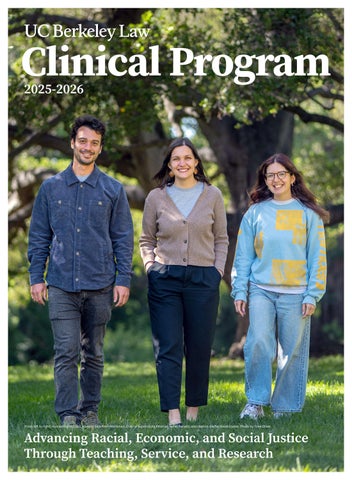
(From left to right) Human Rights Clinic student Sam Klein-Markman, Clinical Supervising Attorney Helen Kerwin, and student Rachel Rood-Ojalvo. Photo by Tone Oliver
Advancing Racial, Economic, and Social Justice Through Teaching, Service, and Research
Behind the Work The Practice and Process In an age of rapid technological advancement, it is important to continue to ask big questions: What do we want education to look like next year, in five years, and in 10 years? How do we want justice realized in the East Bay, California, across the United States, and around the globe? There is no singular answer to these questions, but grappling with them alongside stellar faculty, students, staff, alumni, and clients who are fighting to ensure justice for their communities generates a creative and productive process that we have the honor of seeing in clinic.
Together, the 15 clinics that make up the Clinical Program play a pivotal role in Berkeley Law’s public mission as they advance racial, social, and economic justice. The Clinical Program interweaves teaching and learning with the research and service that anchor the impact-driven work of the clinics. Last year, among many other projects, clinic students filed a challenge in the San Diego County Superior Court under the California Racial Justice Act; provided legal advice to the Kootzaduka’a Tribe (which was among those expelled from the Yosemite area during creation of the national park); provided immigration legal services to youth and adults needing representation; and advised on a social enterprise’s governance framework and drafted the operating agreement.
Under the supervision of faculty members, students also wrote and launched multiple reports, examining how climate change intensifies insecurity, poverty, weak governance, and other drivers of migration from Central America; documenting that incarcerating elders in California’s women’s prisons is unjustified, inhumane, and costly; showing how local advocacy influenced the nationwide eviction moratorium to safeguard tenant health and safety; and exposing surveillance technologies used to monitor people on parole and probation while recommending reforms to protect against wrongful incarceration. In this year’s report we hope to show not only these highlights, but also the process of clinical legal education in action and the practice of lawyering that it takes to achieve
these hard-fought victories. Just as legal writing is part structure and part art, clinical legal education is part transferable skills and part student and client empowerment. It is critical to show the process behind cases in such wide-ranging practice areas as environmental law and immigrant youth defense because, as all lawyers and all people know, arriving at victories is brilliant but the struggle to get there is where the learning happens, where the magic lies, and where transformations begin. We hope that in these pages you can get a feeling for how we are all wrestling with the big questions and see the effort and the care our community is taking to work toward our collective liberation.
In community, Ty, Roxanna, Rebecca, and Laura
Ty Alper Faculty Co-Director, Clinical Program
Roxanna Altholz ’99 Faculty Co-Director, Clinical Program
Rebecca Oyama Clinic Director, East Bay Community Law Center
Laura Riley Assistant Dean, Clinical Education
In this Issue Highlights From Our 15 Clinics, 56 Faculty, and 308 Students Death Penalty Clinic
6
Environmental Law Clinic
8
Global Rights Innovation Lab Clinic
10
Human Rights Clinic
14
Policy Advocacy Clinic
16
Samuelson Law, Technology & Public Policy Clinic
18
Social Enterprise Clinic
22
East Bay Community Law Center
24
Consumer Justice Clinic
24
Education Justice Clinic
25
Youth Defender Clinic
25
Health and Public Benefits Clinic
25
Homelessness Advocacy Clinic
26
Housing Clinic
26
Immigration Community Justice Clinic
27
Immigration Youth Defender Clinic
27
Clinical Programs Holding the Line Ty Alper and Laura Riley co-wrote “Holding the Line on Academic Freedom in Law School Clinics” along with the clinical program directors of four other law schools in response to increased threats to academic freedoms in clinical legal education. The article argues that protecting clinical autonomy does not require special treatment of clinics, only fidelity to ordinary academic freedom principles. When universities depart from these ordinary norms, they do not reduce institutional risk; they normalize political control over academic judgment which threatens not only clinical education but also faculty governance and the role of the university itself. The article urges universities, their boards, their administrators, and their faculty to “hold the line” in defending academic freedom.
Read "Holding the Line on Academic Freedom in Law School Clinics”
Listen to an interview with the co-authors on the “Voices Carry” podcast
"Holding the Line on Academic Freedom in Law School Clinics" was co-authored by Ty Alper (Berkeley Law), Praveen Kosuri (University of Pennsylvania Carey Law School), Beth Lyon (Cornell University Law School), Alicia Plerhoples (Georgetown University Law Center), Laura Riley (Berkeley Law), and Robin Walker Sterling (Northwestern Pritzker School of Law).
Berkeley Law Clinical Program 2025—2026 | 2
“Justice is fairness in action, creating peace that is sustainable.” — Environmental Law Clinic student Ananya Subramanian
Student Standouts Honoring Clinic Students Who Put Passion into Practice Jacob Bendicksen ’26 Brian M. Sax Prize for Excellence in Clinical Advocacy Over four semesters in the Policy Advocacy Clinic (PAC), Bendicksen distinguished himself through an unwavering commitment to justice and to the people at the center of the work. In his first semester, he conducted outstanding research for his Colorado client and pioneered a new area of advocacy for PAC — abolishing prison medical fees. In his second semester, when he wasn’t testifying in the Colorado Legislature on the repeal bill he drafted, Bendicksen helped launch PAC’s new IL clinic, providing exceptional mentorship to students working on behalf of a client to defeat harmful criminal justice bills in the California Legislature. In his second year, Bendicksen incubated a new prison medical fee repeal project in Virginia, building a deep, trust-based relationship with his client who was directly impacted by incarceration. (From left to right) PAC Clinical Supervisor TJ Grayson, Jacob Bendicksen ‘26, and PAC Co-Director Jeffrey Selbin. Photo by Mikie Schultz
Kaleb Indra ’26 Brian M. Sax Prize Honorable Mention Over two years with the PAC’s Debt Free Justice California team, Indra made sustained and consequential contributions to the campaign to eliminate monetary sanctions in the criminal legal system. His work helped advance landmark legislation, Assembly Bill 1186, which prohibits juvenile courts from ordering young people to pay restitution fines, relieves an estimated $14.8 million in annual financial burden, and eliminates all youth and adult restitution fine debt older than 10 years. He also played a critical role in defending against harmful legislation, producing an extraordinary volume of bill analyses, nearly single-handedly drafting key legislative language, and emerging as a central architect of the coalition’s strategy. Equally notable is the humanity Indra brought to his work. (From left to right) PAC Clinical Supervisor Asher Waite-Jones ‘16, Caitlin Andersen ‘26, Kaleb Indra ‘26, PAC Interim Co-Deputy Director Delaney Green, and Rachel Heimann M.P.P. ‘26. Photo by Bryson Washington
Olivia Lebo-Planas ’26 Outstanding Clinic Student Award Over four consecutive semesters in the East Bay Community Law Center’s Housing Clinic, Lebo-Planas worked on 40 eviction cases, securing more than $288,000 in rent waivers and preserving housing for countless low-income tenants in Alameda County. Their accomplishments are remarkable on their own — arguing motions, conducting a full deposition, winning an unprecedented motion to set aside judgment, and successfully reinstating a Section 8 voucher for a terminally ill client facing homelessness. Even with all of these experiences, their colleagues explain that what distinguishes Lebo-Planas most is the depth of humanity they bring to every client relationship. Olivia Lebo-Planas ‘26 (left) and EBCLC Housing Clinic Director Meghan Gordon. Photo by Anthony Ruano
Berkeley Law Clinical Program 2025—2026 | 3
“Justice cannot be achieved through a single individuals action, but rather through collective actions that in the aggregate tear down structural inequalities upholding the global status quo — Kevin Steward ‘24, Death Penalty Clinic and East Bay Community Law Center
Death Penalty Clinic Founded in 2001, the Death Penalty Clinic (DPC) seeks justice for individuals facing the death penalty by providing them with quality representation and offers students a rich opportunity for meaningful hands-on experience in high-stakes, complex litigation. Students participate in field investigations, consult with experts, draft pleadings, prepare for hearings, and help shape case strategy. Through direct representation, policy advocacy, and friendof-the-court briefs, the clinic also exposes and tackles problems endemic to the administration of the death penalty, such as racial discrimination, prosecutorial misconduct, ineffective assistance of counsel, and unconstitutional methods of execution.
Leveraging the California Racial Justice Act and Sentencing Reform Legislation
Elisabeth Semel Clinic Co-Director and Chancellor’s Clinical Professor of Law
Ty Alper Clinic Co-Director and Clinical Professor of Law
Mridula Raman Deputy Director
A San Diego County Superior Court judge issued an order to show cause on the clinic’s challenge under the California Racial Justice Act (RJA) to La Twon Weaver’s conviction and sentence of life without parole. The RJA, passed by the California Legislature in 2020, created opportunities for defendants to raise claims of racial bias based on implicit as well as explicit discrimination, and to demonstrate systemic racial or ethnic disparities based on statistical evidence.
Weaver, who is Black, was originally sentenced to death in 1992. The clinic has been co-counsel for him with attorney James Thomson since 2002. In its petition to the court, the clinic presented empirical studies of San Diego capital cases examining data over a 15-year period, which show that harsher prosecutorial decisions and harsher case outcomes were systematically associated with cases in which the victim was white and/or the defendant was Black. The clinic also raised RJA claims alleging that individual actors in his case, including detectives, the prosecutor, and the judge, exhibited racial bias toward him. The judge’s order means that the court will consider the claims at an evidentiary hearing.
Clinic Garners Support for Clemency for Alabama Client DPC students focused this year on amplifying the voices of many people who know client Mark Jenkins well and believe he deserves clemency. Students spoke to Jenkins’s supporters, including correctional officers who have known him over the course of his 35 years on death row, and captured their sentiments about what makes Jenkins a compelling candidate for mercy. The goal will be to seek a commutation of Jenkins’ sentence to a sentence of life in prison without the possibility of parole.
Retired Alabama Department of Corrections Sergeant William James, who has worked with several clinic students to gather support for Jenkins among fellow correctional officers.
Advocacy for Toforest Johnson Grows Across Alabama Advocates across the state continued to promote awareness of the case of Toforest Johnson, who was wrongfully convicted and sentenced to death in Alabama almost 30 years ago. Dozens of clinic students have worked on Johnson’s case during that time, alongside clinic alum Kathryn Miller ’08 (now the co-director of the Death Penalty and Criminal Defense Clinic at Cardozo Law School) and attorneys at the Southern Center for Human Rights in Atlanta.
One of hundreds of signs in yards across Alabama, part of an advocacy campaign led by Greater Birmingham Ministries.
Berkeley Law Clinical Program 2025—2026 | 6
“Speaking to legislators in the Alabama State
House about our client on death row was not
only a new experience for me, but it also allowed me to explore — and practice — an expansive
view of lawyering and creative advocacy/’ — Lande Watson ’26
(From left to right) Deputy Director Mridula Raman, Emilia Schwallie ‘26, and Lande Watson ‘26 meet with Alabama state legislators to advocate for clemency on behalf of a clinic client.
Two DPC Alums Win Landmark Appellate Victories on Behalf of Indigent Clients
Francesca Buzzi ’18
Paris DeYoung ’19
Francesca Buzzi argued and won a case in the Louisiana Supreme Court prohibiting the state from introducing the expert testimony of a nurse practitioner who would have diagnosed the complaining witness with “child sex abuse.” The court, in State v. Cloudie, agreed with Buzzi’s argument that the testimony would violate Louisiana evidence law. The court held that the expert’s opinion was based solely on their interview with the child, lacked a reliable methodology, would not assist the jury in understanding the evidence, and risked impermissibly bolstering the complaining witness’s credibility.
Paris DeYoung is a supervising attorney with the Criminal Appeals Bureau of the Legal Aid Society in New York City. She and her colleagues won a landmark decision in the New York Court of Appeals, which ensures that prosecutors cannot require defendants who enter into a plea agreement give up their right to have their history of domestic abuse considered during sentencing. DeYoung argued the case in the state’s highest court. The case centered around a legislative reform, which acknowledged that the standard sentencing scheme fails to consider how domestic violence impacts a defendant’s conduct and their capacity for rehabilitation. The statute gives survivor defendants the right to a hearing where they may present that evidence. The opinion, People v. N.H., holds that the right was “too valuable both to the [survivor defendant] and to the community to be sacrificed in plea bargaining.”
After more than eight years at Orleans Public Defenders, Buzzi is joining the clinical faculty at Tulane Law School. She will continue to represent indigent clients in the Louisiana courts as a clinical assistant professor in the law school’s Women’s Prison Project.
A Remarkable Journey from Wrongful Imprisonment to the Practice of Law At an event sponsored by the clinic, Calvin Duncan answered questions from criminal justice reform advocate Sophie Cull, his co-author for the new book The Jailhouse Lawyer. Duncan described the harrowing story of his wrongful conviction for a murder committed in New Orleans and chronicled his unrelenting push while incarcerated to learn about the law and use it to pursue justice for himself and hundreds of fellow prisoners. Co-authors Sophie Cull (left) and Calvin Duncan address a full house at Berkeley Law. Photo by Laurie Frasier
Berkeley Law Clinical Program 2025—2026 | 7
Read the article “From Inmate to Lawyer
Environmental Law Clinic The Environmental Law Clinic (ELC) tackles critical environmental justice and health issues while providing students with hands-on experience representing live clients. The clinic’s tools include litigation, agency practice, legislative drafting, and policy analysis. Clinic projects reduce human exposure to pollution, toxic chemicals, and radiation; promote racial and economic equity in environmental policy; and increase access to nature for all. The clinic aims to make students creative, effective, culturally competent lawyers; to address unmet legal needs; and to make an environmental difference.
Claudia Polsky ’96 Clinic Director and Clinical Professor of Law
Marcela E. von Vacano ’97 Deputy Director
Steve Castleman Clinical Supervising Attorney
Emily Griffith Clinical Supervising Attorney
As news of ELC’s work has spread, the clinic’s docket has come to span the nation, encompassing matters in Alaska, Hawai’i, and Pennsylvania, as well as California.
(Clean) Power to the People! ELC Works to Expedite Installation of Rooftop Solar A team of law and public policy students passionate about clean energy this year assisted Permit Power, a repeat ELC client that works to reduce the bureaucratic friction associated with installing residential solar and battery storage systems. Permit Power asked the clinic to explore how Federal Emergency Management Agency floodplain regulations inhibit municipalities from permitting residential clean energy systems in floodplains and make it difficult for state legislatures to expedite solar permitting through use of an electronic platform.
ELC interviewed city managers, floodplain coordinators, and insurance experts across the nation to identify opportunities for policy innovation at the floodplain/solar home interface. Students’ suggestions and model legislative language are already having an impact in informing negotiations around amendments to the National Flood Insurance Act.
As part of ELC’s ongoing work to accelerate the clean energy transition, the team visited Hawaii to visit a community solar cooperative on Molokai that creates energy security for low-income Hawaii Natives while also helping the island reach its clean-energy goals. The ELC team’s visit sparked local curiosity, and was featured in the Molokai Dispatch.
PFAS in PA In 2026, ELC’s work to address the multi-local crisis of PFAS (“forever chemicals”) in drinking water brought a project team to rural Pennsylvania. There, Penn State’s use of PFAS-containing firefighting foam at the college’s airport has contaminated groundwater in local communities, transforming what was formerly known as Happy Valley into what some now dub “PFAS Valley.” The ELC team met with families whose health and finances had been impacted by PFAS exposure; analyzed site contamination reports; probed the inadequacy of the remedies provided under a settlement the airport had reached with state regulators; and advised clients about options for further redress. Berkeley Law Clinical Program 2025—2026 | 8
Clinic Work Centers Indigenous California in Site Visits, Discussion, and Action The clinic this year continued its work to assist California’s Native Nations in regaining access to, control of, and decision-making authority over land and natural resources. One project team deployed to the Mono Lake area in the Sierras to provide legal advice to the Kootzaduka’a Tribe, which was among those expelled from the Yosemite area during creation of the national park. Closer to home, the full clinic visited the Shellmound Site in West Berkeley, where the Lisjan Ohlone have purchased a land tract that is being repurposed as an interpretive site to educate the public about the pre-colonization Bay Area.
ELC’s actions to support such efforts include payment of Suumi, an annual voluntary land tax that funds Indigenous property (re)acquisition. Additionally, litigation against the Trump administration by the clinic’s director, clinic alumni, and others this year restored a National Science Foundation grant to the Lawrence Hall of Science that enabled the mounting of a significant new exhibit about Ohlone heritage and traditions. Co created by museum staff and Indigenous youth, the installation centers the Ohlone acorn harvest, and describes Indigenous ways of knowing about the natural world through intense direct observation and oral transmission of knowledge.
Standing Up for the Rule of Law Honoring Clinic Director Claudia Polsky "96
D
The Thakur v. Trump lawsuit that ELC’s director conceived and initiated in 2025 to restore University of California research grants illegally terminated by the Trump Administration has reinstated roughly 1,000 research grants and $1 billion to the UC system, garnering wide praise. Recognitions include placement on the Association of American Law Schools’ Pro Bono Honor Roll (2025); receipt of Ecology Law Quarterly’s Environmental Leadership Award (2026); profiles in California magazine and Transcript magazine; and a 2026 CLAY (California Attorney of the Year) award (to the full litigation team).
Read the article “Someone Had to Go First”
Read the article “Answering the Call”
Spectacular New Hires Enhance ELC
(From left to right) Lieff Cabraser partner Kevin Budner ‘12, Farella Braun + Martel partner Tony Schoenberg, ELC Director Claudia Polsky ‘96, Farella Braun + Martel senior associate Kyle McLorg ‘19, and Lieff Cabraser associate Annie Wanless. Photo by Brittany Hosea-Small
ELC has benefitted greatly from the otherwise-tragic decimation of the U.S. Environmental Protection Agency, gaining two spectacular and experienced attorneys. Marcela E. von Vacano ’97 has joined as ELC’s new deputy director, following a 26-year winning streak litigating in EPA’s Office of Regional Counsel. Of particular relevance to ELC, von Vacano brings deep expertise in clean water law, administrative law, and Tribal issues, along with an intense passion for social justice rooted in her lived experience as a Bolivian refugee from a politically persecuted family.
Emily Griffith, also coming to Berkeley Law from EPA Region 9, has joined ELC as a clinical supervising attorney, bringing considerable knowledge of hazardous waste law and field experience deploying to provide emergency response to environmental disasters, such as wildfires. Griffith also brings clinic-relevant experience from her design and instruction of a course on Climate Justice and Environmental Advocacy at UC Law San Francisco.
ELC Alum Joins LSE Sustainability Law & Policy Clinic Berkeley Law Clinical Program 2025—2026 | 9
ELC alum Chloe Smith LL.M. ’24, who made the clinic proud by becoming a Climate Change Fellow at Berkeley Law’s Center for Law, Energy & the Environment upon graduation, has made it prouder still. After an extensive search, the Global School of Sustainability at the London School of Economics has just tapped Smith to instruct its Sustainability Law & Policy Clinic. ELC is thrilled for Smith and her future students, and hopeful about across-the-pond collaborations.
Global Rights Innovation Lab Clinic The Global Rights Innovation Lab (GRIL) Clinic, one of the newest clinics at Berkeley Law, stands at the cutting edge of global rights advocacy, strategically leveraging the power of technology to drive evidence-based justice in the digital age. In GRIL, graduate students in law, data science, and technology-related fields work together to reimagine advocacy strategies. GRIL builds legal case theory, and design and execute on advanced tools in digital technologies such as data analysis, machine learning, and Al to uncover hidden patterns and turn them into evidence of violations and the foundation for data-driven solutions.
Laurel E. Fletcher Clinic Director and Chancellor’s Clinical Professor of Law
Valentina Rozo Angel Data and Technology Clinical Supervisor
Photo by Mikie Schultz
Gender Apartheid What does consolidation of Taliban rule mean for women? De facto authorities are publicly flogging women accused of violating a strict morality code that regulates women’s dress, intimate relations, and movement in public. On behalf of a client organization, GRIL is documenting these trends through open-source information, analyzing the international human rights violations of these patterns, and preparing data visualizations of these harms for submission to United Nations human rights mechanisms as well as for a wider audience,
https://gen View the Visualizations: Mapping the Construction of Gender Apartheid in Afghanistan
Climate Justice in California Jails Climate change generates extreme temperatures in carcerai facilities. For GRIL’s client organization, the clinic collected and analyzed evidence on the impact of high temperatures on incarcerated people in California jails to determine the nature and extent that high temperature impacts are violating human rights of detained and incarcerated people.
US Immigration Appeals
War Crimes in Syria
As the highest administrative body for interpreting and applying immigration laws, the Board of Immigration Appeals (BIA) plays a central role in the legal system. Yet, its decision-making patterns are often difficult to analyze at scale. GRIL evaluated historic BIA data on case appeals outcomes to identify statistical variations in case outcomes and map processing timelines across different variables, including petitioner, city, and judge. To make this information accessible, the clinic translated these complex datasets into an intuitive, user-friendly research tool, enabling legal practitioners, researchers, or any individual to effortlessly navigate the data.
During the Syrian conflict multiple states conducted military campaigns, including the U.S.-led coalition, Russia, and Turkey. Thousands of airstrikes caused civilian harm, destroyed residences, hospitals, schools, and other civilian infrastructure. Civilian objects are protected under the laws of war, and parties that intentionally target them are committing war crimes. GRIL integrated laws of war research and data science methods to analyze thousands of airstrikes, and develop a methodology for our client, Airwars, to identify patterns of intentional targeting. GRIL’s work advances documentation and investigation for legal accountability.
Berkeley Law Clinical Program 2025—2026 | 10
Learning in a Law Laboratory "I no longer see legal work as inaccessible. Through GRIL, I began to
understand legal reasoning as something active, interpretive, and grounded in judgment rather than hard thresholds. Data can participate in legal advocacy
by revealing patterns that support a narrative, rather than by meeting
predetermined numerical standards.
— Chelsea Chen ‘26, Master of Information Management and Systems, School of Information
"I want to be someone who helps legal and data systems communicate with clarity, ethics, and imagination. I am beginning to see myself not
just as someone who uses data, but someone who builds methods and frameworks that make advocacy work stronger, more transparent, and
more sustainable.”-Marwa Abubakr ’26, Master of Public Policy, Goldman School of Public Policy
"The multidisciplinary model is one of the most valuable aspects of the GRIL
Clinic. Itforces legal, investigative, and data-driven empirical approaches into a mutually reinforcing dialectic that produces methodologically rigorous and legally credible work product.” - Aman Madan, Berkeley Law student
Disappeared in Plain Sight Panel
GRIL at WCCL 2026
(From left to right) Somos Defensores Data System Manager Juan Manuel Quinche Roa; Presidential Advisor for Human Rights and International Humanitarian Law to the President of Colombia Lourdes Castro Garcia; CEJIL Executive Director Viviana Krsticevic; U.N. Special Rapporteur on the Rights to Freedom of Peaceful Assembly and of Association Gina Romero; CAJAR litigation lead Alejandra Escobar Cortazar; GRIL Data and Technology Clinical Supervisor Valentina Rozo Angel
How can data and technology be used to prevent violence against human rights defenders? At the World Congress of Constitutional Law (WCCL 2026), the Center for Justice and International Law officially launched a new blueprint addressing this vital question. Developed with support from GRIL, the report provides clear, actionable recommendations for policymakers. During the event, Valentina Rozo Angel joined civil society leaders, independent experts, and institutional allies on a panel exploring how data systems can move past documenting violence toward driving real-world protection.
GRIL in preLaw Magazine Berkeley Law earned an A+ ranking on the International Law Honor Roll, with the GRIL Clinic featured as a standout program.
Berkeley Law Clinical Program 2025—2026 | 11
Read the article “Top law schools for international law”
GRIL Director Laurel E. Fletcher moderated a panel on gender apartheid in Afghanistan at the law school, featuring leading advocates discussing the Taliban regime’s systematic removal of women from public life since its return to power in 2021. Panelists shared frontline reports about Afghan women and their allies fighting erasure, including through an international initiative to codify the crime of gender apartheid in a new U.N. Crimes Against Humanity Treaty. Watch “Disappeared in Plain Sight: Fighting Gender Apartheid in Afghanistan as a Crime Against Humanity.”
GRIL on “Voices Carry” On a recent episode of the Voices Carry podcast, Laurel Fletcher and Valentina Rozo Angel joined host Gwyneth Shaw to discuss how GRIL’s model pairs data science with digital storytelling to help students build legal cases and advocate for policy change.
Listen to GRIL on the podcast
Justice is not a verdict. It is a verb. Justice emerges when we get to engage with our chents as co-investigators of a problem, when legal education
meets lived experience not as a transaction, but as a collaboration." — Neha Ghorpade LL.M. 26, Social Enterprise Clinic
Human Rights Clinic For nearly 30 years, the Human Rights Clinic has advanced human rights at home and abroad through litigation, documentation, evidence-based policy work, and client-centered advocacy. Today, teams of faculty and students work shoulder to shoulder with grassroots organizations, clients, and advocates to hold perpetrators of mass atrocities and environmental crime to account; defend civic space from overbroad counter-terrorism and national-security measures; confront climate-driven displacement and protect the rights of people on the move; secure land and resource rights for Indigenous and other threatened communities; and bring international human rights standards home to domestic struggles over policing, immigration, reproductive freedom, and more. The clinic strives to meet the urgency of this moment while staying true to the collaborative, victim centered approach that has defined its work for decades.
Roxanna Altholz ’99 Clinic Director and Clinical Professor of Law
Radhika Kapoor Clinical Supervising Attorney
Helen Kerwin Clinical Supervising Attorney
Following the Money Behind Berta Caceres’s Murder In January 2026, the Interdisciplinary Group of Independent Experts (GIEI) Honduras released its final report on the assassination of environmental activist Berta Caceres, finding that her murder was part of a coordinated operation involving gunmen, military-trained intermediaries, corporate actors, and state networks. The report traced development bank funds to payments for the hitmen and documented broader harms to Caceres’ family, the organization she founded, and the indigenous communities she was fighting to protect. Clinic Director Roxanna Altholz served as one of the panel’s three independent experts, with clinic students contributing to the documentation of harms and reparations recommendations. (From left to right) Human Rights Clinic students Alejandra de Maar, Kevin De Leon, Clinic Director Roxanna Altholz ‘99, Clinical Supervising Attorney Helen Kerwin, and student Sam Klein-Markman. Photo by Laurie Frasier
Learn more about the GIEI Honduras report
“I walked away feeling the privilege of being allowed to participate in this work. The people whose experiences I documented do not get to take breaks from this reality. They do not get to put theirfear on hold. The fact that
I was trusted to help tell these stories, and to support a process that may someday contribute to accountability or recognition, was not something
I took for granted."— Student Kevin De Leon
Screening a Family’s Fight for Justice at the Border In March, the Human Rights Clinic hosted a screening and panel discussion of Critical Incident, the Emmy-winning HBO documentary about Anastasio Hernandez Rojas, a longtime San Diego resident and father of five killed by U.S. border agents in 2010. The film follows his family’s fight for truth and accountability, which helped secure a historic Inter-American Commission decision finding the United States responsible for Hernandez Rojas’s killing and torture and ordering reforms to prevent future abuses. The event featured Marfa Puga, Hernandez Rojas’s widow; Andrea Guerrero
’99 of Alliance San Diego; and Clinic Director Roxanna Altholz ’99, in a conversation moderated by Professor Leti Volpp about family advocacy, border impunity, and the fight for accountability.
(From left to right) Professor Leti Volpp, Clinic Director Roxanna Altholz ‘99, Maria Puga, and Andrea Guerrero ‘99. Photo by Hannah Lynde Wittman
Berkeley Law Clinical Program 2025—2026 | 14
Watch Critical Incident: Death at the Border on HBO Max
Documenting Climate-Linked Migration from Central America In April, the Human Rights Clinic launched “Climate Change and Migration from Central America: Insights from Migrants in Mexico”, a report produced with the Mexico City-based Institute for Women in Migration. Based on migrant surveys, interviews, and desk research, the report examines how climate change intensifies insecurity, poverty, weak governance, and other drivers of migration from Central America. Clinic students helped conduct interviews, analyze data, draft the report, and support its Mexico City launch. Read “Climate Change and Migration from Central America: Insights from Migrants in Mexico”
(From left to right) Human Rights Clinic student Rachel Rood-Ojalvo, Clinical Supervising Attorney Helen Kerwin, and student Sam Klein-Markman. Photo by Tone Oliver
“After working on my clinic projectfor a fall school year, it was so special to travel to Mexico City to meet our clients and to attend the report launch, witness the report’s packed, lively reception, and see the
project’s impact in the real world.” - Student Rachel Rood-Ojalvo
Advocating for the Rights of Detainees in Northeast Syria
In spring, the Human Rights Clinic partnered with counsel representing families of individuals arbitrarily detained in camps and prisons in Northeast Syria on alleged ISIS-related grounds. Under Clinical Supervising Attorney Radhika Kapoor’s oversight, students drafted communications for U.N. Special Procedures seeking the urgent repatriation of a critically ill detainee and the return of remains to grieving families, challenging states’ refusal to provide legal process, consular support, or repatriation.
Defending Water, Demanding Justice The Human Rights Clinic Joins Screenings of Waterfor Life This spring, Clinic Director Roxanna Altholz ’99 joined members of Peace Brigades International, Civic Council of Popular and Indigenous Organizations of Honduras (COPINH), and filmmaker Will Parrinello for screenings and discussions of Water for Life at UC Berkeley and in the Netherlands and Geneva. The documentary follows Indigenous and grassroots leaders defending land, water, and community rights in Honduras, El Salvador, and Chile, including the struggle led by Berta Caceres against the Agua Zarca dam. Berkeley Law Clinical Program 2025—2026 | 15
Alumni in Action Human Rights Clinic alumni continue to carry forward the clinic’s commitment to justice, accountability, and victim-centered advocacy. This year, we are delighted to highlight two recent graduates.
Belen de León ’25 is a Larsen Justice Fellow at the Criminal Law and Justice Center, where she works on urgent challenges in the criminal legal system. During law school, Belén devoted hundreds of hours to the clinic and other public interest organizations, advancing immigrant justice, prison abolition, and human rights.
Marian Avila Breach ’25 is the Brian Lewinstein Public Interest Fellow at the East Bay Community Law Center’s Education Justice and Youth Defense unit, where she advocates for young people’s safety, freedom, and access to education.
Policy Advocacy Clinic The Policy Advocacy Clinic (PAC) is the nation’s premier interdisciplinary clinic where law and public policy students team up to represent organizational clients taking on systemic racial and economic injustice. The clinic’s approach is ground-up (rooted in the lives of impacted people), problem-based (addressing pressing social issues), and community-driven (accountable to client organizations). Students provide technical legal and policy support to state and national campaigns to reduce the harmful impacts of the criminal legal system while exploring the potential and limits of law and public policy to solve real-world problems.
Stephanie Campos-Bui ’14 Clinic Co-Director and Assistant Clinical Professor of Law
Jeffrey Selbin Clinic Co-Director and Chancellor’s Clinical Professor of Law
Devan Shea Deputy Director
Delaney Green Interim Deputy Director
Cameron D. Clark Clinical Supervisor
Samantha Lee Clinical Supervisor
Gus Patel-Tupper ’20 National Director of Strategy
Georgia Valentine Research Director
Asher Waite-Jones ’16 Clinical Supervisor
Maiya Zwerling Clinical Supervisor
TJ Grayson Clinical Supervisor
Debt Free Justice California PAC continued representing Debt Free Justice California. Students provided legal and policy support for three coalition-sponsored bills that are advancing through the state legislature: AB 2122 (Kalra), banning custodial bench warrants for infractions; AB 2428 (Rodriguez), eliminating twelve administrative fees; and SB 498 (Becker), protecting electronic communications for incarcerated people. (From left to right) Kaleb Indra ‘26, PAC Clinical Supervisor Asher Waite-Jones ‘16, Rachel Heimann M.P.P. ‘26, and Caitlin Andersen ‘26
Adult Fines & Fees: Protecting Constitutional Rights Building on its California experience, PAC began representing client campaigns to repeal adult criminal legal system fees in other states. Highlights include the bipartisan passage of Arizona House Bill 2265, which abolishes fees charged to defendants for exercising their constitutional rights (public defender, jury, and appellate fees). PAC also co-authored a report with the Oregon Justice Resource Center and the CLEAR Clinic about fees, fines, and restitution in Oregon.
Juvenile Fines & Fees Hundreds ofMillions in Debt Discharged
PAC and partners at the 2026 Coalition for Juvenile Justice Annual Conference. (From left to right) Fines & Fees Justice Center Policy & Research Director Tim Curry; PAC Research Director Georgia Valentine; PAC Clinical Supervisor Cameron D. Clark; Hawai'i Juvenile Justice State Advisory Committee Youth Chair Andi Sabanal.
Berkeley Law Clinical Program 2025—2026 | 16
PAC and the national Debt Free Justice campaign continue to support state and local efforts to abolish juvenile court fines and fees. Juvenile courts in 18 states no longer charge youth and families tens of millions of dollars each year, and they have discharged more than $775 million in debt. Read the article “Policy Advocacy Clinic Celebrates a Decade of Nationwide Success in Ending Juvenile Fines and Fees”
Read "The Price of Justice in Oregon.”
“It has been incredibly meaningful to see years of organizing, advocacy, and persistence translate into tangible relieffor so many people and families.” — Co-Director Stephanie Campos-Bui ’14
Read the article “How a National Movement Is Eliminating Millions in Youth Debt”
California Prison Reform Releasing Elder Women PAC and the California Coalition for Women Prisoner’s released a pathbreaking report: “No Time to Wait: A Case for Releasing Elders from California’s Women’s Prisons.” The study found that incarcerating elders is unjustified, costly, and inhumane, while releasing them will help begin to address the crisis of aging prison populations.
Read “No Time to Wait: A Case for Releasing Elders from California’s Women’s Prisons”
(From left to right) PAC Deputy Director Devan Shea, Melanie Girod M.P.P. ‘26, PAC Clinical Supervisor Maiya Zwerling, Karla Castellanos M.P.P. ‘26, and students Claire Elliman, Claudia Deitch, and Caroline McGinnis. Photo by Hannah Lynde Wittman
"An important part of this project was addressing how the elder incarceration
crisis is a direct result of the tough-on-crime era’s excessively punitive laws and the criminalization of acts of survival. I hope this report helps illuminate how different the real-life circumstances are from the dehumanizing narratives used to justify elder incarceration.” - Student Caroline McGinnis
Celebrating PAC Student Leaders Jacob Bendicksen ‘26 Brian M. Sax Prize for Excellence in Clinical Advocacy
Claudia Deitch & Dawson Wilcox Justice John Paul Stevens Public Interest Fellows
Jacob pioneered a new area of advocacy for PAC, supporting client campaigns to abolish medical copayments charged to incarcerated people. He distinguished himself through an unwavering commitment to justice and to centering the human beings at the heart of the work.
Funded by the John Paul Stevens Foundation, the fellowships help expand access to justice and the pool of those entering the legal profession. Deitch and Wilcox are part of a national cohort working during summer 2026 to increase access to justice.
Kaleb Indra ’26 Brian M. Sax Prize Honorable Mention Kaleb helped defend against harmful legislation and advance a landmark California Assembly Bill 1186 to prohibit juvenile courts from ordering young people to pay restitution fines and to discharge old debt. He brought intellectual rigor, moral clarity, and humanity to all his work.
Neil Gallagher UC Berkeley Chancellor’s Award for Civic Engagement Gallagher was the 2026 graduate student recipient of this prestigious University award for his contributions to the community, including the Berkeley Law student-led pro bono project Legal Obstacles Veterans Encounter. In PAC, he worked on projects to implement criminal fee reforms in Indiana and repeal medical fees charged to people incarcerated in Virginia and Connecticut.
PAC in preLaw Magazine Berkeley Law Clinical Program 2025—2026 | 17
PAC’s 1L Clinic was highlighted as part of Berkeley Law’s A+ Criminal Law Honor Roll ranking.
Sunnie Liu Institute for the Study of Societal Issues Thomas I. Yamashita Prize A student in PAC’s 1L clinic, Liu was recognized by the University as an outstanding emerging social change activist in California for her work as an interdisciplinary artist, community organizer, narrative strategist, and public interest scholar.
Read the article “Top law schools for criminal law”
Samuelson Law, Technology & Public Policy Clinic The Samuelson Law, Technology & Public Policy Clinic trains the next generation of lawyers to advance the public interest in a digital age marked by rapid technological change. The clinic’s work focuses on three main areas: protecting civil liberties, promoting balanced intellectual property laws and access to information policies, and ensuring a fair criminal justice system. The clinic does this through strategic litigation opportunities, regulatory and legislative processes, and policy analysis.
Catherine Crump Clinic Director and Robert Glushko Clinical Professor of Practice in Technology Law
Erik Stallman ’03 Clinic Associate Director and Assistant Clinical Professor of Law
Jennifer M. Urban ’00 Clinic Director of Policy Initiatives and Clinical Professor of Law
Juliana DeVries Clinical Staff Attorney
Policy Analysis of Police Drone Use
(From left to right) Samuelson Clinic Director of Policy Initiatives Jennifer Urban ‘00, Lindsay Lake ‘26, student Eleanor Stalick, Inspector General Zurvohn A. Maloof, student Ariana Garrotto Pefley, Deputy Inspector General Charlotte Jones, and Clinic Director Catherine Crump.
On behalf of the City of Oakland’s Office of the Inspector General (OIG), two teams of Samuelson Clinic students conducted research and provided suggestions for a review and assessment report of the Oakland Police Department’s drone policies. The report recommended several privacy protections that were accepted by the police department, and Inspector General Zurvohn Maloof wrote to the students, “Your contribution serves Oakland by supporting positive changes in police technology policy that will benefit those affected.”
“Drafting the policy review was an incredibly
“Working with the OIG to contribute to safer
rewarding project. From the client, to the subject
policing in Oakland taught me a great deal —
matter, to the mentorship and team camaraderie,
especially about the dedication of the teams who
I truly can’t imagine a better clinic experience.”
work tirelessly to uphold public safety.”
— Student Julia Adams
— Student Trisha Srivalsan
Amicus Brief to Stop Illegal Cancellation of the Digital Equity Act
Defending the Incarcerated People’s Communications Services Order
The National Digital Inclusion Alliance is suing to stop the illegal termination of the Digital Equity Act’s grant program, which would support broadband adoption, digital literacy, and digital inclusion efforts. On behalf of a coalition including UnidosUS, the Hispanic Federation, and the United Church of Christ Media Justice Ministry, the Samuelson Clinic filed an amicus brief in federal district court explaining the initiatives and communities that the grant program would support. In total, 22 local governments, unions, and nonprofit organizations joined the brief.
In an ongoing project on behalf of the United Church of Christ Media Justice Ministry, Samuelson Clinic students drafted and filed a petition for review, motions to intervene, and other preliminary filings in a case challenging a new Federal Communications Commission rule that substantially increases the rates that incarcerated people and their loved ones must pay for communications. UCC Media Justice became the lead petitioner in multi-circuit litigation before all cases were transferred to the U.S. Court of Appeals for the First Circuit, where the clinic has been active in defending the FCC’s previous rule that capped the rates for those services.
Berkeley Law Clinical Program 2025—2026 | 18
Examining Parole and Probation Surveillance Technologies Probation and parole supervision increasingly relies on 24/7 surveillance by complex technology, including electronic monitoring and alcohol- and drug-testing methods, which do not always produce accurate results. A Samuelson Clinic white paper examines these surveillance technologies, highlighting risks of inaccurate evidence and recommending reforms to protect against probation and parole revocations. Read “Check the Monitor: Parole & Probation Technologies in Review”
(From left to right) Abby Smith ‘26, Niyati Narang ‘26, Katarina van Alebeek ‘26, and Corinne Johnston ‘26. Photo by Hannah Lynde Wittman
“This research inspired me to further explore the
“I am so grateful I got to work alongside this
private companies present in the prison industry
team. I am hopeful that our work will inform
and how consumer protection law could be used to
practitioners and policymakers alike.”
hold them accountable.”
— Katarina van Alebeek ’26
- Abby Smith ’26
"As technology becomes increasingly embedded in
“This project was one of the most impactful parts
the criminal justice system, investigating whether
of my law school experience. It was eye-opening
these tools perform as advertised is essential to
to realize how deeply entrenched these flawed
protecting people’s fundamental rights.”
technologies are in the legal system and how they
— Niyati Narang ’26
are used unfairly.”
— Corinne Johnston ’26
25 Years at the Digital Frontier Anniversary Celebration for the Samuelson Clinic In fall 2026, the Samuelson Clinic will mark its 25th anniversary with a memorable conference and gathering of alumni, students, faculty, and friends. This dynamic two-day program of receptions, toasts, keynote speeches, and panel discussions will reflect on the clinic’s pioneering work and explore what lies ahead.
Samuelson Law, Technology & Public Policy Clinic Fall 2025 Class. Photo by Brittany Hosea-Small
Berkeley Law Clinical Program 2025—2026 | 19
“Justice is being a leader, thought partner, lawyer, child, farmer, formerly incarcerated organizer, father, mother, grandmother, human being, and showing up. We all play a role in writing history and reimagining what the future can look like." — César Nije ‘26, Environmental Law Clinic
rr” 11511 244)
wywobhl
Social Enterprise Clinic The Social Enterprise Clinic serves as transactional counsel for its clients — for-profit and nonprofit businesses that use market-based strategies to address social and environmental issues. The clinic prepares law students to be transactional lawyers while providing high-quality legal services to enterprises serving disenfranchised communities. Students explore the power and limits of market-based methods and examine the intersections of law, business, and racial equity. The clinic advises clients on corporate governance, compliance, contracts, and entity formation. Through these representations, students develop sophisticated transactional lawyering skills while helping clients minimize risk, strengthen organizational capacity, and advance sustainable, communitydriven solutions to racism, poverty, and climate change.
Alina Ball Clinic Director and Clinical Professor of Law
Jeremy Chen Clinical Supervising Attorney
Understory Worker Collective Advancing Economic Resilience in East Oakland In the heart of Oakland’s Fruitvale District, Understory operates a workerowned restaurant grounded in collective action. Understory brilliantly utilizes food, culture, and active collaboration as tools for social and economic resistance. The business is majority queer-owned, offering a vibrant and inclusive space where everyone can enjoy themselves, connect, feel nourished, and build community resilience. Through this hands-on representation, clinic students gain firsthand experience navigating sophisticated transactional issues for this worker-owned business, as well as help preserve a vital community institution committed to economic justice. (Left) Worker-owners of Understory pose for a group portrait. Photo by Estefany Gonzalez/COYOTE Media Collective
The Call Fund for the Social Enterprise Clinic Gregory Call ’85 and Carolyn Sherwood Call understand how few opportunities exist for law students to explore business mechanisms advancing justice. Their creation of the Call Fund to support the launch of the clinic helps close this gap. Drawing on Carolyn’s background as an economics professor and Greg’s four decades of corporate legal experience, the Calls are excited that their financial support expands access to much-needed legal services for social enterprises while creating learning opportunities for Berkeley Law students to become thoughtful, justice-oriented transactional attorneys.
Connecting Lived Experience with Legal Education Office Administrator Adelaida Caballero’s life story is featured in Emily Galvin-Almanza’s new book, The Price of Mercy: Unfair Trials, a Violent System, and a Public Defender’s Search for Justice in America. Caballero guest lectured in the clinic’s seminar, candidly sharing with students the long-term impacts that incarceration inflicts on an individual’s economic mobility. (From left to right) Debra Gore, Emily Galvin-Almanza, and Adelaida Caballero
Berkeley Law Clinical Program 2025—2026 | 22
Clinic Welcomes Social Enterprise Expert Expanding the clinic’s instructional depth and capacity to serve mission-driven clients, Jeremy Chen joined as a clinical supervising attorney. Chen brings over a decade of private practice experience acting as outside counsel to social enterprises, community businesses, and nonprofit organizations. He has dedicated his career to addressing structural inequities through critical legal mechanisms, specializing in entity formation, corporate governance frameworks, for-profit/ nonprofit collaborations, and complex business transactions. Chen, an alumnus of UC Berkeley (B.A. Asian American Studies and Legal Studies) and UCLA School of Law (J.D. with a specialization in Critical Race Studies), expressed immense enthusiasm about returning to Berkeley.
“I have dedicated my career to working on issues of racial and economic justice, and
continuing that work through teaching is an honor and a joy.” —Jeremy Chen
Justice as Collaboration For students, the clinic extends far beyond mastering transactional skills — it fundamentally shifts their understanding of corporate lawyering
as a vehicle for social change. Neha Ghorpade LL.M. ’26, a Social Enterprise Clinic alum, reflected on the clinic’s unique dual focus, illustrating how its transactional representations ultimately serve a broader pursuit of equity and community empowerment.
"I've gained a deeper
appreciation for the art of transactional lawyering, particularly how to balance
complex legal analysis with the mission-driven goals oft
social enterprises we serve.” —Neha Ghorpade LL.M. ’26 (From left to right) Clinical Supervising Attorney Jeremy Chen, Neha Ghorpade LL.M. ‘26, and Director Alina Ball. Photo by Brittany Hosea-Small
Influencing the National Landscape of Legal Education Professor Alina Ball served on the executive planning committee for the Association of American Law Schools (AALS) 2026 Conference on Clinical Legal Education in Portland, Oregon. Bringing her specialized vision of structural equity to the national stage, Ball also moderated the opening plenary, “Engineering Democratic Renewal,” prompting the panelists to critically assess eroding democratic norms and legal safeguards — particularly within national security and civil rights enforcement — and their disproportionate impacts on marginalized communities.
Berkeley Law Clinical Program 2025—2026 | 23
Social Enterprise Clinic in preLaw Magazine The Social Enterprise Clinic’s innovative approach to transactional legal education has already garnered national recognition. In a feature highlighting the country’s leading law schools for business law, National Jurist celebrated Berkeley Law’s launch of the Social Enterprise Clinic for its distinctive, forward-thinking curriculum. The clinic diversifies and deepens Berkeley Law’s reputation for producing powerhouse business lawyers. Read the article “Top law schools for business law”
East Bay Community Law Center The East Bay Community Law Center (EBCLC) houses UC Berkeley Law’s eight community-based clinics, which serve thousands of clients annually in the surrounding community. For more than three decades, UC Berkeley Law students have advanced vital legal support and policy advocacy at EBCLC — Alameda County’s largest provider of free, holistic legal services. The center teaches critical, practical, and hands-on lawyering skills, while fighting for racial justice and reflecting on the lawyer’s role and the lawyering process.
Zoe Polk Executive Director
Rosa Bay Co-Deputy Director
Jay Kim Co-Deputy Director
Rebecca Oyama Clinical Program Director
This year, EBCLC staff and clinic students helped achieve the following victories:
4,217 Critical legal services provided including brief services, limited scope, and full representation
$4.8M Recovered for EBCLC clients
20,914 Calls fielded from community members seeking EBCLC’s help EBCLC fall 2025 clinic students. Photo by Tone Oliver
Consumer Justice Clinic The Consumer Justice Clinic provides assistance and representation to low-income Alameda County residents on a variety of consumer issues, including debt-collection defense, student loans, car fraud, predatory lending, and consumer scams. Students engage in a full range of litigation practice, including drafting motions, representing clients in court, and negotiating settlements. Students also support the clinic’s pursuit of state policy initiatives that address the most significant challenges faced by low-income consumers.
Miguel Soto Senior Supervising Attorney
“This semester reshaped how I understand both law and justice. I saw that resistance law is not defined by dramatic courtroom moments but by the everyday insistence that our clients deserve to be believed, supported, and protected. It is in the conversations where we counter shame with compassion,
the letters where we correct power imbalances, and the decisions where we
choose to show up for clients others have written off.” - Student Matthew Gavieta Berkeley Law Clinical Program 2025—2026 । 24
Education Justice Clinic and Youth Defender Clinic The Education Justice Clinic and the Youth Defender Clinic (EDJY) work together to fight back against the criminalization of youth of color, so that they can thrive in their communities and get the education they deserve. The clinics collaborate to provide holistic representation to youth in the juvenile legal system. Law students represent clients in juvenile court, special education (IEP) proceedings, and at expulsion hearings. Students also participate in policy advocacy to disrupt the school-to-prison pipeline and youth carcerai system.
Atasi Uppal Clinic Co-Director
Whitney Rubenstein ’14 Clinic Co-Director & Director of Social Work
Eric Singerman Supervising Attorney
Gloria Yi Supervising Attorney
Marian Avila Breach ’25 Brian Lewinstein Youth Justice Fellow
EDJY 10th Anniversary In November 2025, EBCLC celebrated a decade of EDJY students engaging in youth-centered advocacy, impact, and community. Hundreds of EDJY alumni have provided legal services for youth ensnared at the intersection of the education and juvenile legal systems. Their work has increased the number of Alameda County youth, most of whom are low-income Black and Latinx youth, who have been able to stay and thrive in their communities. Many of our past students joined us as we reflected on ten years of EDJY’s impact.
“EBCLC reminded me that my job is to inform my clients ofpathways they might not have considered and to serve as a support system when things get, well, messy.
My clients don’t have to do things alone, or rely on what the school districts tell them. Our legal system is not perfect, but places like EBCLC customize their
representation in way that puts the client’s needs and comfortfirst.” — Johnsenia Brooks ’26
Health and Public Benefits Clinic The Health and Public Benefits Clinic provides critical legal services to individuals at risk of poor health outcomes due to poverty, unsafe housing conditions, homelessness, and/or inadequate health coverage. Through medical-legal partnerships with local providers, law students work to provide stability for their clients. Students represent clients at administrative hearings involving the denial of disability-related benefits and provide limited-scope representation regarding public benefits issues. Milo Manopoulos Beitman Clinic Director
Kelly Lou Densmore Clinic Deputy Director
$1.4 Million Recovered In 2025, Health and Public Benefits Clinic students significantly impacted clients’ outcomes by recovering $1.4 million dollars for their clients.
"My experience at EBCLC was a bright spot amidst all that is going on in the world. Ifeltfor the first time some usefulness in being a law student. The ability that came with understanding how to read legal documents and cases for the
purpose ofgetting someone out of an incredibly detrimental financial situation
was very motivating, and I felt like I was chipping away at some level of the
larger predatory lending industry that we live in today.” - Sauntharya Manikandan ’26 Berkeley Law Clinical Program 2025—2026 । 25
Homelessness Advocacy Clinic Students in the Homelessness Advocacy Project engage in direct service work, policy advocacy, and impact litigation to address the intersections of racism, economic disenfranchisement, and displacement for individuals experiencing homelessness. In addition, students engage in litigation and negotiation while representing tenants in civil eviction proceedings.
“My clinical experience has confirmed for me that I could see myself doing legal aid after
law school. I had experience doing direct client services prior to lave school and suspected legal Brigitte Nicoletti Supervising Attorney
aid could be a path for me. Working at EBCLC this semester has helped me visualize myself
doing legal aid as a
career — and I like what
I see! I’ve really loved
$810 Million Allocated
working with clients.”
Homelessness clinic students have been partnering with homelessness advocates across the county to ensure that the over $810 million in accrued funds collected through Measure W are adequately allocated to provide real, tangible resources to the unhoused community in Alameda County.
— Student Nina Liss-Schultz
Housing Clinic The Housing Clinic is a high-volume litigation practice designed to protect and promote safe, healthy, and affordable housing for low-income tenants through eviction defense and affirmative litigation to compel landlords to maintain their rental properties in a habitable condition. Students engage in a full range of litigation procedures while representing tenants in civil eviction proceedings and in administrative matters under local rent control ordinances.
Meghan Gordon Clinic Director
Linda Yu Supervising Attorney
Laura Bixby Supervising Attorney
Hannah Flanery ’19 Supervising Attorney
Maria Guerra Supervising Attorney
“Working at EBCLC this last semester, I have felt that I have made more of an
impact on people’s lives than ever before. Working directly with clients, listening to their stories and doing my best to provide them with a sense of dignity fulfills that need in me to work towards that better world.” -RafiGrossman-Naples ’26
Eviction Moratorium Report The Housing Clinic released a report, “Sheltered in Place: The Community-Centered Advocacy Behind America’s Strongest Eviction Moratorium”, which highlights a multi-prong and community based advocacy model that helped secure the longest and strongest eviction moratorium in the country during the COVID-19 crisis. The report details how EBCLC’s local actions directly influenced the creation of a nationwide eviction moratorium and offers critical recommendations for policymakers, health advocates, and the housing justice community to strengthen the health and safety of tenants. By starting local and scaling up, and partnering with local housing advocacy and legal organizations such as the Berkeley Tenant’s Union and Eviction Defense Center, among others, EBCLC mobilized community, advocates, and students to amplify the voices of those most at risk of eviction to achieve a countywide moratorium. (From left to right) EBCLC Executive Director Zoe Polk, Alameda County Supervisor Nikki Fortunato Bas, and Housing Clinic Director Meghan Gordon at a community gathering celebrating the release of the report. Photo by Anthony Ruano
Berkeley Law Clinical Program 2025—2026 | 26
Read “Sheltered in Place: The Community-Centered Advocacy Behind America’s Strongest Eviction Moratorium”
Immigration Community Justice Clinic The Immigration Community Justice Clinic provides critical legal services to low-income adults across a full spectrum of immigration services, with a focus on vulnerable populations — people with disabilities, chronic illness, members of the LGBTQ+ community, etc. The clinic prioritizes complex legal cases including those involving criminal issues. Students carry their own client caseload and experience the full range of client representation through assessing legal relief in initial consultations and providing direct legal representation and defense in immigration court and before other government tribunals.
“Working in immigration community justice made it much harder for me to think of legal
practice as merely technical
problem-solving or prestige
accumulation and reminded me that the lave lands on actual
people, usually at moments
when time, money, language, and emotional capacity are
already strained. This has made me think more seriously about Hanna Haile Supervising Attorney
Athena Johns Supervising Attorney
Melissa Phatharanavik Senior Supervising Attorney
pro bono work as something that should be central to my career.” — Student Brayan Ramos
Courtney McCausland Immigration Clinics, Co-Director
Abigail L’Esperance, Immigration Clinics, Co-Director
(Left to right) EBCLC students Brayan Ramos, Leeya Kekona, Ashanti Hernandez ‘26, and Eleanor Gartstein ‘26. Photo by Tone Oliver
Azizah Ahmad Supervising Attorney
Karla Cruz Supervising Attorney
Abigail Rich Supervising Attorney
Immigration Youth Defender Clinic The Immigration Youth Defender clinic advocates for youth in immigration legal matters, at the intersection of family, probate, and/or criminal law, with a focus on holistic, client centered representation. The clinic has formal school-based partnerships providing legal services to immigrant students in the Oakland Unified School District, community colleges, and UC Berkeley. Clinic students carry their own client caseload and experience the full range of client representation through assessing legal relief in initial consultations and providing direct legal representation in immigration court and before other court systems.
Holistic Care in Action EBCLC represents youth through participation in California’s key initiative, the Children’s Holistic Immigration Representation Project (CHIRP). The clinic’s CHIRP clients, affectionately referred to as “CHIRPies/Pollitos” by the Immigration and Social Work Programs, receive immigration legal services and trauma-informed social work care from EBCLC to support their overall well-being and development. This year, several CHIRPies/ Pollitos graduated from high school, with two finishing at the top of their class and delivering beautiful commencement speeches. Berkeley Law Clinical Program 2025—2026 | 27
“I believe the women of color centered platform operates very
meaningfully at EBCLC. My
conversations with these clients have heightened my awareness
of the ways disparity can present itself in different women’s lives.
This was an especially painful reality for the mothers I talked
to, all of whom survived extreme
hardships and struggled with how to protect their children.” — Eleanor Gartstein ’26
“Berkeley Law’s clinical faculty are excellent teachers and dedicated advocates for their clients. They also produce consequential scholarship that has real-world impact and shapes how academic and broader communities think about achieving justice.” — Dean Erwin Chemerinsky
Photo by Anastasiia Sapon
Recent Clinical Program Faculty Scholarship Ty Alper and Laura Riley
Laurel E. Fletcher
Samantha Bei-wen Lee
Jeffrey Selbin
Holding the Line on Academic Freedom in Law School Clinics
Reimagining Human Rights Advocacy in a Changing World: Harnessing Technology and International Law
The Hypocritical Oath: How Child Abuse Pediatrics Harms Children and How to Limit Their Unconstitutional Searches
Suicide by Cop? How Junk Science and Bad Law Undermine Accountability for Killings by Police
Ty Alper, Praveen Kosuri, Beth Lyon, Alicia Plerhoples, Laura Riley, and Robin Walker Sterling, Journal of Legal Education (forthcoming 2026)
Laurel E. Fletcher, Berkeley J. Int’l L. Travaux (2025)
Roxanna Altholz
Laurel E. Fletcher and Valentina Rozo Angel
Claudia Polsky
GIEI Honduras: Report on the Murder of Human Rights Defender Berta Caceres, Related Crimes, and Comprehensive Reparation Measures
Designing Justice: Data Science for Human Rights Advocacy, A Blueprint for the Global Rights Innovation Lab Clinic
How a Right-to-Know Law Shifts Industry Away from Chemicals of Concern: The Case of California’s Proposition 65
Roxanna Altholz, Pedro Biscay, and Ricardo Guzman (2026)
Laurel E. Fletcher, Valentina Rozo Angel, Ariel Sim (2025)
Stephanie Campos-Bui
Why Data Science Belongs at the Heart of International Human Rights Advocacy
Reform’s Oversight: The Limits of Youth Restitution
Stephanie Campos-Bui, 125 Colum. L. Rev. 1867 (2025)
Stephanie Campos-Bui, Gus Patel-Tupper, and Georgia Valentine The Price of Justice in Oregon: Rethinking Court-Ordered Monetary Sanctions
Stephanie Campos-Bui, Gus Patel-Tupper, Georgia Valentine, Zach Winston, ‘llima Umbhau, and Leni Tupper (2026)
Claudia Polsky, Jennifer Ohayon, and Megan Schwarzman, Environ. Sei. & Technol. 59,3344 (2025)
Claudia Polsky, 52 Ecology L.Q. 767 (2026)
Radhika Kapoor
Mridula Raman
A Climate of Harm: International Law, Propaganda and Genocide
The New Nullification: Unconstitutional Criminal Laws and Unreviewable Prosecutions
A Transparency Deficit and an Equity Deficit: The Need to Reform the UN Security Council’s Sanctions Committees
Mridula Raman, 115 Calif. L. Rev._ (forthcoming 2027)
Learning Under Levy: Quasi-Criminal School Discipline
Helen Kerwin
Laura Riley, 66 Santa Clara L. Rev. 67 (2026)
Cameron D. Clark, 60 Loy. L.A. L. Rev. (forthcoming 2027)
Teitiota and Climate Non-Refoulement: The International Law Obligation to Create Domestic Protection Mechanisms
Reforming Policing from the White House: The Challenges of Implementing Police Reform Through Executive Order
Catherine Crump, Research Handbook on Penal Policy (Alessandro Corda ed., 2025)
Helen Kerwin, 59 U.S.F. L. Rev. 500 (2025)
Governing Data: The Role of State Privacy Law
With Regulatory Pressure, Operational Focus: Twelve Action Priorities for Global Privacy, Al Governance and Cybersecurity Clearance
Lothar Determann, Graham Doyle, Jennifer M. Urban, and Michael Will, Journal of Data Protection & Privacy (forthcoming 2026) (peer-reviewed)
Asher Waite-Jones The Courthouse & The Bathhouse: The Elusiveness of Queer Liberation in an Era of Gay Marriage
Asher Waite-Jones, 51 N.Y.U. Rev. L. & Soc. Change (forthcoming 2026)
The Unavoidable Consequences of Homelessness
Laura Riley, Sara Rankin, 2025 Utah L. Rev. 1093 (2025)
Climate Change and Migration from Central America: Insights from Migrants in Mexico
Criminalization of Homelessness and Poverty Post-Grants Pass Is Still Unlawful and Ineffective at Reducing Homelessness
Helen Kerwin, UC Berkeley Law Human Rights Clinic and IMUMI (2026)
Laura Riley, Hum. Rts. Mag. 1 (2025)
UC Berkeley Law Clinical Program
Pamela Samuelson, Erik Stallman, and Jennifer M. Urban, 66 Santa Clara L. Rev. 382 (2026)
Laura Riley
Radhika Kapoor, 27 Max Planck Y.B. of United Nations L. 565-586 (2025)
Catherine Crump
Unbundling 17 U.S.C. §1202: Construing the Law’s Scope in Light of Its Text, Purpose, and Remedies
Jennifer M. Urban, 28 Yale J.L. & Tech. 1 (2026)
Criminalizing Survival: How the Johnson Decision Is Intensifying the Homelessness Crisis in California and Beyond
Cameron D. Clark
Erik Stallman and Jennifer M. Urban
Jennifer M. Urban Foreword: Breathing Easier in a Polluted World
Laurel E. Fletcher, Valentina Rozo Angel, Ariel Sim, Open Global Rights (2025)
Radhika Kapoor, Routledge Handbook for Genocide Studies (Jeffrey S. Bachman & John Cox eds., forthcoming 2026)
Jeffrey Selbin, 113 Calif. L. Rev. 1833 (2025)
Samantha Bei-wen Lee, 26 Conn. Pub. Int. L.J. (forthcoming 2027)
0 clinicalprogram@law.berkeley.edu
© @BerkeleyLawClinics
• law.berkeley.edu/experiential/clinics
© UC-Berkeley-Law-Clinical-Program