The Good Neighbor Experiment: Evaluation of the GNE Curriculum Outcomes

Report #3
Dasha Shamrova, Ph.D., MSW
 Amy Alberton, Ph.D., LMSW

January 2021 – December 2022
1
Content
of Content..................................................................................................................................1 Executive Summary............................................................................................................................. 2 List of Tables and Figures 3 List of Acronyms 3 Introduction 4 The Good Neighbor Experiment: Program Description 4 What are the goals of the program?................................................................................................ 5 Logic Model for the Program..........................................................................................................5 Evaluation Background ........................................................................................................................ 6 Methodology .......................................................................................................................................7 Findings ..............................................................................................................................................9 Change in Participants’ Knowledge.................................................................................................9 Change in Attitudes
Individual and Congregation Capacity to Become Catalysts of Change in Their Neighborhoods................................................................................................................10 Change
Comfort Level
Small Group Work............................................................ 12 Neighboring Behaviors..................................................................................................................13 Change
Participants’ Facilitation Skills ...................................................................................... 14 What Affects the Change in Participants’ Outcomes? ....................................................................15 Conclusion and Recommendations ...................................................................................................17 Attachment 19
Table of
Table
towards
in
with Church
in
Executive Summary
• This report includes the cohorts of the Good Neighboring Experiment (GNE) program, which occurred between January 2021 and December 2022.
• The results include the results of 41 GNE participants that completed both the pre- and postquestionnaires.
• Findings indicate that there was approximately a 22% increase in knowledge among participants across the five cohorts.
• Although modest, participants showed a 2% improvement in attitudes towards the possibility for positive changes in their neighborhoods and churches.
• Participants showed a 15% improvement in their comfort with organizing small group work within their churches. However, there was quite a difference between groups. The two new cohorts, Leviticus and North Texas showed 5% and 7% increases, respectively.
• On average, participants increased the frequency and intensity of their neighboring activities and almost doubled the number of neighbors they had relationship with. Despite facilitators reporting high levels of facilitation skills prior to participating in the GNE, on average, they reported about 20% growth in their ability to translate GNE to their churches.
• Even with the addition of two out-of-state cohorts, participants from Kansas still show larger gains from the GNE than those from out of state. As of this report, findings indicate there is a significant difference in the change of attitudes between those from Kansas and those from out of state. Participants in Kansas slightly increased their mean scores while the out of state participants’ mean scores slightly decreased.
Corresponding author: Dr. Dasha Shamrova, shamrova@txstate.edu
Preferred citation: Shamrova, D., & Alberton, A. (2022). The Good Neighbor Experiment: Evaluation of the GNE Curriculum Outcomes. Report #3. [Insert Link Here]
Contributors: We are grateful for the Good Neighboring Experiment Team for assistance in collecting the data and communicating with the participants
2
List of Tables and Figures
Figure 1. Logic Model for the GNE Program
Figure 2. Change in Participants’ Knowledge
Figure 3. Change in Participants’ Attitudes towards becoming a catalyst of change
Figure 4. Change in Comfort Level with Church Small Group Work
Figure 5. Change in Neighboring Behaviors
Figure 6. Change in Participants’ Facilitator Skills
Figure 7. Differences in Gains from the GNE Curriculum for Kansas and Out-of-State Participants
List of Acronyms
WSU – Wichita State University
TXST – Texas State University
GNE – Good Neighbor Experiment
ABCD – Asset-Based Community Development
3
Introduction
The Good Neighbor Experiment: Program Description
The Good Neighboring Experiment (GNE) program is a 5-year program conducted by the Neighboring Movement and funded by the Lilly Endowment Inc. The GNE program has an emphasis on asset-based community development. This program focuses on the strength and gifts of our neighbors rather than the needs and deficits in the community. The GNE program intends to deepen relationships within neighborhoods to enhance love among neighbors, as it is a mandate from God, to combat loneliness within our community, build social capital within neighborhoods, transform the lives of others, and spread joy. The concept of seeing oneself as a neighbor versus a person who proselytizes allows for a worldview that sees abundance over scarcity. That abundance allows for hope, optimism, and contentment.
This is a preliminary report #3 describes the GNE participants’ outcomes which occurred from January 2021 through December of 2022. The GNE program occurred within church congregations that committed to becoming a part of Healthy Congregations. Each congregation was tasked with recruiting 4 laypersons and 1 staff person to lead GNE in their congregation. The GNE program trains congregants to utilize their talents to build on their strengths and positively impact their community. The GNE program includes assigned learning cohorts, workshops, appropriate worship materials, a 24-week small group curriculum on good neighboring, asset mapping, and the 8 Front Doors Project Block Mapping. The learning cohort is made up of congregants at their training and peer coaching sessions. The workshops included additional leaders within their church for three workshops throughout the GNE program. Each congregation was provided materials to supplement worship at the congregational level that focused on neighboring. The leaders also guided their congregation through 24 weeks of activities included in a small group curriculum. This small group curriculum comprised the theological approach to neighboring, which focused on identifying their neighborhood's abundance, relationships, and joy. Asset mapping was completed in their neighborhoods to understand the connection of shared mission and interests within their neighborhoods. The purpose of the 8 Front Doors Project was to connect with the 8 front doors closest to your own and to meet those neighbors. Finally, the workshops concluded with plans to apply this new knowledge and take actionable steps to engage intentionally with the community.
Congregations selected for the GNE program included Great Plains United Methodist churches, other United Methodist Churches, and non-United Methodist churches. Churches interested in participating were expected to commit to the leadership team of 4 laypersons and 1 staff person. The benefactors of the GNE program are the congregations and their local community, with the goal of various growth indicators that show the strengthening impact of the GNE on their communities.
4
What are the goals of the program?
Goals of the GNE program include:
• Helping congregations strengthen social and emotional health not only in their congregation but in their community.
• Move churches from a scarcity model to one of abundance and joy.
• Give congregations the skills they need to reach out to their neighbors and communities with an asset mindset.
• Empower congregations to identify their strengths and merge those with the strengths of their communities.
Logic Model for the Program
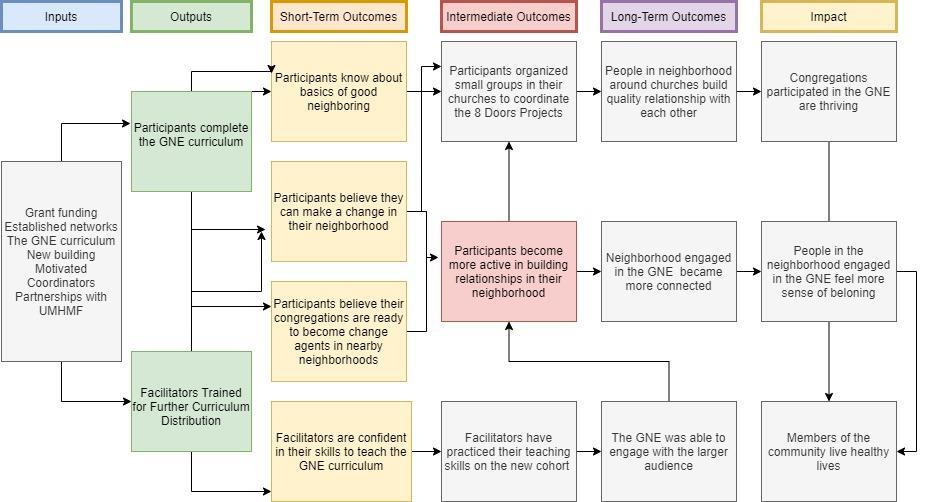
These goals were/could be achieved in multiple ways. The logic model below is the evaluators’ perception of the mechanisms of outcome achievement embedded in the GNE program. This perception is based on the analysis of the program documents, conversation with the GNE coordinators, and our interpretations of the current literature on the neighboring interventions. This is not the final version of the model. Logic models are meant to evolve as programs develop over time.
Figure 1. Logic Model for the GNE Program
Based on the logic model we assume that the resources invested in the program will manifest themselves in at least two kinds of outputs: (1) the participants will complete the GNE curriculum, and (2) facilitators will be
5
trained for further curriculum distribution. If these two outputs are achieved, we can expect changes in participants’ and facilitators’ knowledge about neighboring, their attitudes towards their role as change makers in the neighborhood, the congregations would be prepared to act in the community, and facilitators would be confident in their skills in teaching the curriculum. If we achieve these short-term outcomes, we assume that the participants will organize small groups in their churches to coordinate further 8 Doors projects, and participants' relationships with their own neighbors would become more active. In addition, those who were trained to facilitate will have practice in doing this with new incoming cohorts. If these intermediate outcomes are achieved, we should see neighbors living around participating churches building quality connections as a result of this small group work; neighborhoods where the GNE curriculum participants live become more connected as a result of them practicing building relationships. Also, if the facilitators practiced their teaching skills on the new cohort, we expect more people to be trained on the GNE curriculum as a result. All these efforts should broadly lead to community impacts including thriving communities, increased sense of belonging among neighbors affected by the GNE, and ultimately improvement in health outcomes among community members.
This report focuses on the evaluation of preliminary results for the outcomes highlighted in the logic model.
Evaluation Background
Purpose and Intended Use: This is a preliminary report on the outcomes achieved in the GNE curriculum from January 2021 to December 2022. These data should be used as a pilot to improve the program curriculum. Considering the COVID-related circumstances and small sample sizes, these data should not be used to make major programmatic decisions. Rather these data should be used for monitoring and improvement purposes.
Scope: This evaluation was conducted from January 2021 to December 2022. It focuses only on the GNE curriculum part of the program. Specifically, it addresses only short and intermediate outcomes outlined in the logic model above. The curriculum was delivered online and face-to-face and had no geographical eligibility requirements.
Stakeholder engagement: Our partners from the Neighboring Movement were engaged in developing and piloting the questionnaire used to collect the data for this report. Particularly, the Neighboring Movement and GNE coordinators were engaged in aligning the questionnaire with the Christian-based content pertinent to their project values and culture.
Evaluation team: Dr. Shamrova and Dr. Alberton were external evaluators to the program. They have not participated in the design of the intervention or its delivery. No conflict of interest has been identified.
6
Methodology
Overview: This program evaluation employs survey-based methods to estimate the changes that occur before participants enter the program and after its completion. The workshop participants were provided a link to an online questionnaire. This program evaluation utilizes a pre-experimental pre-post-test design without randomization and comparison/control groups. The pilot nature of the project informed the choice of methodology. The curriculum participants went through the workshops related to good neighboring in the time between pre- and post-tests.
We will be focusing on answering the following evaluation questions in this report:
1) How does the GNE workshop curriculum effect participants’:
• Knowledge about neighboring;
• Attitude towards individual and church capacity to become catalysts of change in their neighborhoods;
• Comfort level with neighboring skills
• Neighboring behaviors
• Facilitation Skills (if applicable)
2) What factors affect participants experiencing changes in the main outcomes?
Content of Intervention & Recruitment: This is the first group of participants recruited for participation in 6- to 8-month curriculum. The curriculum was delivered both online and face-to-face. The curriculum includes four labs that focus on neighboring skills, leadership, and community asset mapping. The participants were asked to complete activities such as meeting their neighbors and sustaining relationships during the GNE. The curriculum provides COVID-specific ideas on safe neighboring during the pandemic. The Neighboring Movement used its existing network of churches to recruit the participants.
Data Collection: The online survey data was collected directly by the TXST/WSU Research Team using the Qualtrics platform. The online questionnaire was administered twice for each of three cohorts included in this report. The pre- and post-questionnaires were matched based on the participants’ birthdays and zip codes. No compensation for participation in this survey was provided. The questionnaire instruments are included at the end to this report.
What Did We Measure?
We collected data to measure the following:
• Demographics: age, gender, race, ethnicity, marital status, employment, religious affiliation, and zip codes
• Knowledge about neighboring was measured using 11 questions, including knowledge about personal gifts, what meaningful neighboring relationships look like, and how to create joy in a neighborhood, among others. Participants responded to the statements on the scale from “1” - completely disagree to “5” - completely agree.
7
• Attitude towards individual and congregation’s capacity to become catalysts of change in their neighborhoods was measured by asking to respond to 6 statements. For example, “I am ready to make a change in my neighborhood,” “I feel that our congregation has a high energy level.” Participants responded to the statements on the scale from “1” - completely disagree to “5” - completely agree.
• Comfort level with church small group work was measured by asking to respond to 6 statements. For example, “I understand how to recruit a small group for the Good Neighbor Experiment,” “I am confident in conducting idea activities and experiment reflections.” Participants responded to the statements on the scale from “1” - completely disagree to “5” - completely agree.
• Neighboring behaviors are measured in terms of frequencies of certain behaviors (e.g., number of an hour per week spent building relationship with neighbors) and the quality of relationship building (e.g., number of neighbors whose names are known to the participants; the number of neighbors they can call acquaintances; and number of neighbors they have a relationship with)
• Facilitation skills (if applicable): Some participants were also prepared to become future facilitators of the GNE curriculum. We measured the increase in their facilitation skills before and after the program using 6 statements. For example, “I can articulate the mode of ABCD,” “I can articulate a theological framework for neighboring.” Participants responded to the statements on the scale from “1”completely disagree to “5” - completely agree.
All items used in the design of data collection instruments are unique and tailored for the GNE programming.. These scales were not validated and statistically tested before the use.
Sample: Data were collected for five cohorts (1. Matthew and Genesis, 2. Mark, 3. Exodus, 4. Leviticus and Rio Texas, and 5. North Texas and Puget Sound cohorts) and included 41 valid pre- and post-responses. There were multiple pre-tests that could not be matched with the post-test (i.e., respondents did not complete post-test). Also, some participants responded to the post-test only. Therefore, these responses were excluded as they are not appropriate for assessing the change in the main outcomes.
Demographics: Pre- and post-test data were submitted by 41 participants in total. These participants were, on average, 50 years of age, but they ranged from 21 to 83 years of age Of the participants, 58% were female, 37% indicated they were male, and 5% (n = 2) identified as non-binary The sample was predominately White/European with only 2 out of 41 participants identifying as part of another racial/ethnic group All 41 participants except for 1 held a college degree with about 83% of participants holding a graduate degree and higher. This finding indicates that this sample is relatively highly educated. About 63% of participants reported being married, 24% reported being single, and all others were divorced or widowed. About 71% of participants worked full-time and others were either employed part-time or not seeking employment. About 85% of the respondents were Methodist. The sample was split between local and national participants. About 34% were from Kansas, another 34% were from Texas and the remaining 32% were split among 9 other locations including Florida (5), and one person each from Arizona, Wisconsin, North Carolina, Pennsylvania, California, Illinois, Washington, and Missouri. About 44% of the respondents were part of the special curriculum for the facilitators.
8
About 27% of the participants graduated in 2021 and the rest finished the curriculum in 2022. This sample includes 11 participants from the Matthew and Genesis cohort, 9 from the Mark cohort, 6 from the Exodus cohort, 6 from the Leviticus and Rio Texas cohort, and 9 from North Texas and Puget Sound cohort.
Data Analysis: The data analysis was conducted using descriptive as well as parametric and non-parametric statistics. Non-parametric statistical tests were used due to the non-normal distribution of data and small sample sizes. The bars displayed in Figures 2 through 4 represent values in numbers of participants. The bars displayed in Figures 5 through 7 reflect the frequencies of certain behaviors or number of neighbors.
Findings
9
Change in Participants’ Knowledge Figure 2. Change in Participants’ Knowledge (# of participants who “agreed” or “completely agreed” with the knowledge statements) 37 31 27 28 25 12 13 17 33 31 18 41 41 40 38 38 32 35 34 40 41 38 0 5 10 15 20 25 30 35 40 45 Articulate why neighboring is important Know my gifts Know how to grow into being a good neighbor Know what meaningful relationships with neighbors looks like Know how to create meaningful relationship with neighbors Can list the assets of my community Know how to find abundance in my neighborhood Know how to create joy with my neighbors Understand how God models good neighboring Aware of design elements of my house that impact neighboring Know what actions I could take in my neighborhood After GNE Before GNE
We measured knowledge about neighboring using the 11 indicators shown in Figure 2. We observed the number of people who reported being confident in their knowledge increase across all indicators. The largest growth in knowledge changed with the addition of the two newest cohorts (i.e., Leviticus, and North Texas and Puget Sound). This time, the largest growth in knowledge was related to participants’ ability to find abundance in their neighborhoods Although this was the largest area of growth, there was positive change across all 11 indicators. So, participants were better able to articulate why neighboring is important, understandings of their gifts, how to grow into being a good neighbor, how to recognize and create meaningful relationships with neighbors, how to list the assets of their neighborhoods, how to create joy within their neighborhood, how God models good neighboring, awareness of design elements of their houses that impact neighboring, and what actions they could take in their neighborhoods
We also calculated an average score to reflect participants' knowledge by calculating the mean of all knowledge item responses. Knowledge scores ranged from 1 to 5. Before participating in the program, the 41 respondents from the five cohorts scored on average 3.61 on the scale from 1 to 5 After the program, the participants scored 4.39 on the knowledge scale. These findings indicate about 22% of knowledge increase among the participants across the five cohorts. However, it should be noted that cohorts 4 and 5 showed modest increases in knowledge of 8% and 1%, respectively. A Kruskal-Wallis H test showed that there was no significant difference in knowledge post-test scores between the different cohorts, χ2(4) = 5.34, p = 0.25. Based on this data we can say that all five cohorts equally gained knowledge from the GNE curriculum.
10
in Attitudes towards Individual and Congregation Capacity to Become Catalysts of Change in Their Neighborhoods Figure 3. Change in Participants’ Attitudes Towards Becoming Catalysts of Change (# of participants who “agreed” or “completely agreed” with the attitude statements) 23 25 20 6 5 26 27 21 13 7 0 5 10 15 20 25 30 Ready to make change in my neighborhood Believe I have capability to be a good neighbor Feel a lot of hope for the future of our congregation Feel our congregation has a high energy level Feel my congregation has relationships with neighbors near our church building After GNE Before GNE
Change
These findings indicate about a 22% knowledge increase among the participants.
Participants reported some growth in their positive attitudes toward their ability to promote good neighboring and their church’s capacity to do so. For the most part, those who completed the program started with very positive attitudes. Therefore, the growth in readiness to make change, perceptions of their potential to be a good neighbor, and feelings of hope for the future of their congregations were not large. Here, we see another trend related to a congregation's capacity to serve as an agent of change in the community. At post-test, all 41 participants who completed the program believed they have the capability to be a good neighbor, 37 reported they were ready to make change in their neighborhoods, and 33 reported feeling a lot of home for the future of their congregation More modest attitudes were expressed regarding participants attitudes toward their congregations’ energy levels and feeling as though their congregation has relationships with neighbors near the church. Just over half of participants (n – 22) reported feeling their congregation has a high energy level and only 32% reported feeling as though their congregation has relationships with neighbors near the church.
We calculated a cumulative score to represent the attitudes of participants across these five questions1. The attitude score ranges from 1 to 5. Participants from all five cohorts, on average, scored 3.91 out of 5 before the program and 3.98 out of 5 after the program, indicating a modest 2% improvement in attitude towards the possibility of positive changes in their neighborhood and church. Cohort 4 (Leviticus Cohort) showed a 7% decrease in attitudes related to the possibility of changes in their neighborhood and church while cohort 5 (North Texas Cohort) showed a 2% increase. A Kruskal-Wallis H test showed that there was no significant difference in attitude post-test scores between all five cohorts: χ2(4) = 2.71, p = 0.61.
1 Chronbach’s Alpha =.562
11
These findings indicate modest 2% improvement in attitude towards the possibility of positive changes in their neighborhood and church.
Change in Comfort Level with Church Small Group Work
Live according to the program values of abundance, relationship, and joy
Have ideas on how I can make the GNE fit my context
Know how to handle situations when things are not going as planned during sessions
Confident in conducting idea activities and experiment reflections
Know to connect neighboring with the Bible
Understand how to recruit a small group for the GNE
Figure 4. Change in Comfort Level with Church Small Group Work (# of participants who “agreed” or “completely agreed” with the comfort level statements)
The largest area of growth related to changes in participants’ comfort levels with church small group work was related to their confidence in conducting idea activities and experiment reflections. However, growth can be seen across all six indicators. At post-test, at least 83% of participants agreed that they were more comfortable with each aspect of church small group work.
We calculated a cumulative score to reflect the comfort level with organizing small groups in their churches across 6 questions included in Figure 42. The skills score ranges from 1 to 5. Participants from all five cohorts, on average scored 3.72 out of 5 before the program and 4.26 out of 5 after the program, indicating a 15% improvement in comfort level in this area. Cohort 4 (Leviticus Cohort) showed a 5% increase while cohort 5 (North Texas Cohort) showed a 7% increase in comfort levels A Kruskal-Wallis H test indicated no significant difference in comfort level post-test scores between the different cohorts, χ2(4) = 2.74, p = 0.60.
2 Chronbach’s Alpha =.778
12
22 29 22 28 30 29 34 38 35 37 36 38
0 5 10 15 20 25 30 35 40
After GNE Before GNE
These findings indicate a 15% improvement in the participants’ comfort level with organizing small group work within their churches.
Neighboring Behaviors
Number of Hours Spent Outside in the Neighborhood Weekly
Number of Neighbors Whose Names are Known to the Participants
Number of Acquaintances
Number of Neighbors Who Participants Have Relationship With
Number of Hours Building Relationship Weekly After GNE Before GNE

Number of Neighborhood Events Attended
Figure 5.
Change in
Neighboring
in All Cohorts (in number of behavioral occurrences)
Behaviors
Overall, we continue to observe positive dynamics in most core neighboring behaviors. The participants who completed the pre- and post-questionnaire shared that, on average, they increased the frequency and intensity of their neighboring activities after completing GNE compared to before participating in the program. For example, after completing GNE:
• They spent 25% more time each week focusing on building relationships with their neighbors
• They knew names of 2 more neighbors, on average
• At post-test, each participant had, on average, more than 1 acquaintance (e.g., knew some of their interests and skills) among their neighbors
13
2.25 3.2 4.35 6.56 3.34 1.94 2.88 6 5.76 8.41 3.82 2.7 0 1 2 3 4 5 6 7 8 9
On average, each participant almost doubled the number of neighbors they had relationships with.
• Each participant, on average, almost doubled the number of neighbors they had relationship with (e.g., send card, borrowed something from them).3
Comparison across cohorts: These positive dynamics are present across all cohorts of participants who completed the GNE. No cohort was different on these four indicators described above. At the same time, we found that there is a significant difference (p < .05) in the growth of the number of acquaintances and neighbors whose names the participants knew between those who graduated in 2021 vs. 2022. Graduates in both years experienced growth in the number of names of neighbors they learnt and acquaintances they made, but the intensity of this growth was greater in 2021.
At the same time, there are two findings that need to be noted: • No change in number of neighborhood events attended is at least partially driven by a large number of participants who did not have an opportunity to attend a neighborhood event. About 56% of those who responded to the pre- and post-test left this question blank or reported that they were not aware of or did not have events in the neighborhood.
Change in Participants’ Facilitation
14
0 0.5 1 1.5 2 2.5 3 3.5 4 4.5 5
Skills Figure 6. Change in Participants’ Facilitator Skills (n = 10) (Confidence Score from 0 to 5) 3 Findings about change in number of hours building relationship, number of acquaintances, and number of people they have relationship within the neighborhood are statistically significant (p < .01) 3.4 3.3 3.3 3.8 4.1 4.6 4 4.3 4.4 4.3 4.6 4.3 4.7 4.3
Articulate the ABCD model Articulate the advantages of an asset-based approach Describe how neighboring improve community health Articulate a theological framework for neighboring Seek to live accordingly to the program values of abundance, relationship, and joy See neighboring as a spiritual practice rather than church growth model Comfortable teaching church leaders a group discernment model Before GNE After GNE
Ten potential facilitators completed the pre- and post-questionnaires. We asked them about their confidence in facilitation skills. The facilitators reported multiple changes in their skills. The largest growth was observed across four indicators:
• 27% growth in their ability to articulate the ABCD model
• 33% growth in their skills related to articulating the advantages of the asset-based approach
• 30% growth in knowledge of how neighboring improves community health
• 21% growth in their ability to articulate a theological framework for neighboring
The rest of the indicators also exhibited some growth. It should be noted that all facilitators scored high prior to their participation in the GNE curriculum.
What Affects the Change in Participants’ Outcomes?
We conducted additional analyses to better understand what demographic factors might be related to whether the GNE participants experience a change in the major outcomes. Here is the summary of the findings:
• Age: Age was not significantly related to knowledge, attitude, or comfort level with church small group work changes. In addition, age was not found to be a significant factor in any of the neighboring behaviors. In other words, participants connected with their neighbors on different levels at the same rate regardless of their age. However, age was found to be meaningful for those who were trained to be facilitators. The younger facilitators showed evidence of more change in facilitation skills that we could observe.4
• Gender: There was no significant relationship between participants’ gender and the outcomes. We believe, again, that this is at least partially due to the small sample size. However, we observed some findings that have practical significance. Even with the addition of the two new cohorts, on average, male participants reported larger changes in knowledge related to their congregation’s capacity for neighboring. However, with the addition of the two cohorts, females now show slightly larger changes in attitudes than males. The finding related to female participants, on average, reporting larger gains in comfort working in small church groups remained. Participants of both genders reported equal changes in the number of hours they spent building relationships with their neighbors as well as the number of new acquaintances and new relationships they gained after
4 Spearman R = -.706; p >.05
15
On average, the facilitators reported about 20% growth in the skills of translating GNE to their churches. The vast majority had a high level of these skills coming into the GNE program.
completing the GNE curriculum. Gender did not have any effect on the gains in facilitation skills for those who were trained..
• Geographical location: Of the participants, 34% were from Kansas while the other 66% were from out of state. Once again, there was no statistically significant difference in knowledge gained nor in levels of comfort between participants from Kansas and those from out of state. It is important to note, though, that regardless of statistical significance, for both knowledge and comfort, Kansas participants reported larger gains. Additionally, findings now indicate there is a significant difference in the change of attitudes between those from Kansas and those from out of state (U = 115; p = .04) Participants in Kansas increased their mean scores by 0.34 while the out of state participants’ mean scores decreased by 0.07. Overall, those in Kansas almost always reported larger gains from the program than those out of state with one exception out of state GNE participants reported spending more hours building relationship than those in Kansas. Here is some important data to keep in mind:
6.3 2.9 3.1 0.8 0.2 0.5 1.2 1.9 1.9 2 0 1 2 3 4 5 6 7
0.9 0.5 1 0.7
Change in Knowledge (Point on the scale)
Change in Attitudes toward Congregational Capacity for Neighboring (Point on the scale)
Change in Comfort Working with Small Church Groups (Point on the scale)
Change in Number of Hours Spent Building Relationships
Changes in Number of Neighbors Known By Name
Change in Number of Aquaintances among Neighbors
Change in Number of Neighbors Respondents Have Relationships With Kansas Participants Out of State Participants
Figure 7. Gains from the GNE Curriculum for Kansas and Out-of-State Participants
(Differences in mean scores from pre- to post-test)
• Knowledge and attitudes: The more knowledge participants gained, the better their attitudes were toward their ability to promote good neighboring and their church’s capacity to do so 5 Changes in knowledge were not related to changes in comfort based on the data we have available. 5 Spearman’s r = .482, p = .001
16
Improvements in attitudes were also positively correlated to comfort. So, more positive changes in attitudes were related to more positive changes in levels of comfort. 6
• Knowing neighbors by name: If participants knew more neighbors’ names after the GNE program, they were more likely to report having more acquaintances after completing the curriculum.
• Having acquaintances: The more acquaintances participants gained, the more people they reported having relationships within their neighborhood.7 These findings suggest that there is a pathway for building relationships from simply knowing someone’s name, to knowing about who they are, and what their strengths are to making deeper connections with them.
• Other factors worth noting: It is important to note that we have not observed statistically significant differences on the neighboring behaviors across cohorts of participants. Some cohorts were represented by too few participants to make a strong claim about across cohort differences. When we examine the difference in the main outcomes for those graduated in 2021 and 2022, the vast majority of outcomes did not vary across the years with two exceptions – the number of neighbors who participants new by name and number of neighbors who they consider to be acquaintances with. Larger gains in these two indicators were observed in 2021 Marital and employment statuses did not play a significant role in the change in main outcomes.
Conclusion and Recommendations
• Positive trends in knowledge, attitudes, and comfort: The findings here suggest that knowledge being imparted through the GNE program is successfully being translated to participants. It should be noted that the two newest cohorts reported quite modest changes in knowledge. This may be related to participants in these cohorts from being from out-of-state. This issue is discussed further below. In terms of attitudes, many participants start the GNE program with very positive attitudes related to their readiness to make change, perceptions of their potential to be good neighbors, and feelings of hope for the future of their churches. Due to this high baseline, the changes were quite modest. Of note, the Leviticus Cohort showed a 7% decrease in attitudes related to the possibility of changes in their neighborhood and church It is unclear why this decrease in attitudes occurred. It may be worthwhile to follow up with this cohort to qualitatively assess this change. Overall, findings related to attitudes suggest that efforts should be made to recruit participants who, perhaps, are not quite as ready to change or are not yet able to see their potential to be good neighbors or hope for the future of their churches. Findings also indicated positive trends in participants’ comfort levels with small group work within their churches. The largest area of growth related to changes in participants’ comfort levels with church small group work was related to their confidence in conducting idea activities and experiment reflections. However, growth was seen across all six indicators. Given participants reported comfort levels with small group work, perhaps it would be
6 Spearman’s r =.424, p=.007
7 R=.685, p=.029
17
worthwhile to begin to engage them in larger group work at the congregation level to enhance energy levels. This is discussed further below.
• Future focus on energizing congregations: Because the GNE is designed to impact large systems like neighborhoods and communities through building the capacities of change agents, including congregation members and churches, further attention to their roles as change agents is warranted. While overall, those who completed the GNE curriculum show positive attitudes towards their neighborhood change-maker roles, reportedly, the same does not apply to other members of their congregations or churches as a whole Participants were skeptical of their congregation's energy levels and relationships that their churches currently have with surrounding neighborhoods. These findings might imply several things:
o The curriculum may have larger effects on individual attitudes and motivations than on congregations’ dynamics.
o The lasting impacts of COVID-19 may be continuing to prevent the curriculum and individual knowledge from trickling down to enact organizational shifts within churches.
o Future efforts might be focused specifically on what is happening in small groups within churches
o Re-energizing and/or motivating congregations might be a separate task that needs to be monitored. It may be worthwhile to consider adding elements to the curriculum aimed at building participants’ capacities to motivate the broader populations within their churches.
• Neighboring behaviors: One of the key outcomes of the GNE curriculum is that there has been a consistent increase in neighboring behaviors across several cohorts. While this evaluation can only capture the data within a limited timeframe, it is not clear if participants sustain these behaviors when they graduate from the curriculum. Follow-up data are needed to ensure sustainability of the main outcomes. Neighboring events are consistently an area where the respondents are either having a hard time responding on the questionnaires, are unaware of events taking place, or do not attend. While it might not be the largest part of the GNE curriculum, opportunities to spend quality time with the neighbors can boost other indicators being measured in the evaluation as well as create opportunities for sustainable relationships It may be worthwhile to re-consider what roles neighboring events play in the curriculum.
• Participants of all ages seem to experience knowledge gains evenly However, the younger facilitators showed evidence of more change in facilitation skills. What is contributing to younger people’s greater levels of change should be explored further. Moreover, it might be useful to reflect on whether the online mode of delivery has some impact on it and whether certain modes of delivery work better for some age groups versus others.
• Considering the significant number of participants residing out-of-state, it is important to pay attention to how well the program is designed to serve those completing it remotely. Findings continue to suggest that local Kansas participants do better when it comes to achieving the program outcomes. It might be the case that some additional components should be introduced to the out-of-state participants. For example, these components could include face-to-face residencies in Kansas or internship programs with successful neighboring initiatives
18
Attachment
[All participants will need consent prior to completing the survey]
Questionnaire for the Good Neighbor Cohort Participants (Post-Test)
Please mark the appropriate answer on each question. If you feel uncomfortable answering a question, simply mark “Prefer not to answer”.
1. In order for us to match your responses before and after the program, we will create an identification number for each of the questionnaires. This number will be the combination of your birthday date. Please write here in numbers only in the following format: MMDDYYYY (ex. 03071987) ___________
2. What best describes your gender identity: a. Female b. Male c. Specify if not listed: _____________ d. Prefer not to answer
3. What best describes your race (select all that apply): a. African American/Black b. Native American/Alaskan Native c. Pacific Islander d. Asian e. Native Hawaiian f. Caucasian/White g. Middle Eastern h. Specify if not listed: ____________________ i. Prefer not to answer
4. What best describes your ethnicity (select all that apply):
a. Hispanic/Latinx b. Non-Hispanic/Latinx c. Specify if not listed: ____________________ d. Prefer not to answer
5. Please check the highest level of education you have completed: a. Did not complete High School b. GED/High School Diploma
19
c. Some College d. Undergraduate Degree e. Graduate Degree f. Doctoral/Advanced Medical g. Other: __________________ h. Prefer not to answer
6. What best describes your current marital/relationship status:
a. Single (Never Married) b. Committed Relationship/Partnership/Polyamorous c. Married d. Separated e. Divorced f. Widowed g. Specify if not listed: _____________ h. Prefer not to answer
7. Are you employed?
a. Full Time b. Part Time c. Unemployed, Seeking employment d. Not Seeking Employment (ie. retired, stay at home parent) e. Specify if not listed: _________________ f. Prefer not to answer
8. What is your religious affiliation?
a. Methodist b. Baptist c. Presbyterian d. Catholic e. Evangelical f. Lutheran g. Mennonite h. Specify if not listed:___________________ i. Prefer not to answer
9. What is your zipcode? ______________________
20
10. Let’s talk about what you know about the following as of now. It is ok to not know something. This is probably why you are part of this program. How much do you agree or disagree with the following statements? Simply mark the box that best reflects your response.
Completely disagree Disagree Neither agree or disagree
Agree Completely Agree I don’t know Prefer not to answer
I can articulate why neighboring is important for my community
I know my own gifts (strengths, skills, talents, hobbies) as a neighbor
I know specific ways I can grow into being a good neighbor.
I know what it looks like to have meaningful relationships with my neighbors
I know ways to create meaningful relationships with neighbors
I can list the assets of my community
I know how to find the strengths (abundance) of my neighborhood
I know how to create joy with my neighbors
I understand how God models good neighboring
21
I am aware of design elements of my house that facilitate or hinder neighboring
I know what actions I could take in my neighborhood
I am ready to make change in my neighborhood
I believe I have the capability to be a good neighbor
I feel a lot of hope for the future of our congregation
I feel that our congregation has a high energy level (eg. members take initiative, shared leadership among members, connected to the community).
I feel my congregation has relationships with neighbors near our church building
Now let’s talk about what you are doing in your neighborhood as of now. Give us your best guess for how many hours per week you spend on the following activities.
11. How many hours per week do you spend on building relationships with your neighbors? a._____
b. Prefer not to answer
12. How many hours a week do you spend outside of your house in your neighborhood? (ex. Gardening, reading outside, working on the car)
a. _______
b. Prefer not to answer
22
13. Of the neighbors who live in close proximity to you, how many do you know by name?
a. b. Prefer not to answer
14. Of the neighbors who live in close proximity to you, how many are acquaintances (i.e. you know some of their interests and skills)?
a. b. Prefer not to answer
15. Of the neighbors who live in close proximity to you, how many do you have a relationship with (i.e. you might send them a card, or ask them to borrow something)?
a. b. Prefer not to answer
16. How many neighborhood events did you participate in last year (ex. clean up day, block party)?
a. b. I was not aware of any neighborhood events c. Prefer not to answer
17. How much do you agree or disagree with the following statements? Simply mark the box with the response that best reflects your answer. Completely disagree Disagree Neither agree or disagree
I understand how to recruit a small group for the Good Neighbor Experiment
I know how to connect neighboring with the Bible
I am confident in conducting Idea activities and experiment reflections
I can handle the situation when things are not going
Agree Completely Agree I don’t know Prefer not to answer
23
as planned during the sessions
I have ideas on how I can make the Good Neighbor Experiment to fit my context
I live according to the program values of abundance, relationship, and joy
18. Are you planning to take part in additional training for the trainers? It means you might have agreed to train others who will facilitate the Great Neighboring Experiment in their communities. If you are unsure, feel free to contact the workshop organizers.
a. Yes, I will train other people on how to train facilitators b. No c. Not sure
19. If you are planning to train facilitators, please respond to the following: How much do you agree or disagree with the following statements? Simply mark the box that best reflects your answer.
Completely disagree Disagree Neither agree or disagree
Agree Completely Agree I don’t know Prefer not to answer
I can articulate the model of AssetBased Community Development
I can articulate the advantages of an assetbased approach over a needsbased approach
I can describe how neighboring improves community health
24
I can articulate a theological framework for neighboring
I seek to live according to the program values of abundance, relationship and joy
I see neighboring as a spiritual practice that is transforma-tive for me, rather than as a church growth model or an evangelism tool
I am comfortable teaching church leaders a group discern- ment model for a changing society
Thank you for taking the time to complete this survey!
25