
What do I do next?
After the death of someone close, there are a number of practical decisions to make, and this can feel overwhelming during a time of grief.
This leaflet should help guide you through the process and a funeral director can offer support, advice, and reassurance.
If you have any other questions, please speak to our clinical team and they will help you.
Arranging the funeral
When someone dies in England and Wales the death must be certified by a doctor or coroner and registered with a Registrar of Births, Marriages and Deaths, usually within five days. Funeral arrangements can then be made.
It is a good idea to check if the deceased left instructions about funeral arrangements in a Will or made a funeral plan.
If there are no plans then, although the deceased must be either buried or cremated, there are more options concerning a funeral than many people realise. For example:
• You do not have to have a funeral ceremony.
• You do not have to use a religious minister (e.g. a Humanist celebrant/ceremony).
• You do not have to use a funeral director.
• A ceremony does not have to be in a crematorium or place of worship.
• Woodland burials and other green options are increasingly available.
• A less expensive option is a Direct Funeral Service, which is an unattended basic funeral.
Some people see ‘do-it-yourself’ funerals as more personal and less expensive. If this approach appeals, and you feel able to take on this responsibility, enquire at the cemeteries and crematorium department of your local authority for guidance. You could also get information from the Natural Death Centre (see later for contact details). Some funeral directors are willing to help with such funerals.
Organisations such as the Bereavement Support Network and Arranging A Funeral offer free telephone and online services which can give practical information, advice and signposting on many of the issues and procedures that face someone following a death.
Making arrangements through a funeral director
The majority of people choose to make their arrangements through a funeral director. Funeral directors will manage funeral arrangements and give advice and support. Check if the funeral director you choose belongs to a trade association. This requires them to provide full information about their services and prices.
Most people would probably require the funeral director to provide the following services as a minimum, and this is often referred to as a simple funeral:
• Make all the necessary arrangements.
• Provide appropriate staff.
• Provide a suitable coffin.
• Transfer the deceased from the place of death to the funeral director’s premises.
• Care for the deceased prior to the funeral.
• Provide a hearse to the nearest cemetery or crematorium.
• Arrange for burial or cremation as appropriate.
• Embalming, viewing of the deceased, or providing a limousine for mourners are additional things you may wish to include.
Funeral costs
Funeral costs have risen steadily in recent years. In 2025, the average cost of an attended funeral was £4,285. The actual cost of a funeral service will depend on choices such as whether it is a burial or cremation, the level of services you require and so on.
Costs for the same services may vary considerably from one funeral director to another so you may wish to get more than one quote to compare costs.
‘Disbursements’ are fees paid to others, such as for the use of the crematorium, minister/celebrant, doctors’ certificates, newspaper announcements, flowers etc. Ask the funeral director for a written quotation detailing all these fees.
Paying for the funeral
If you arrange a funeral you are responsible for paying the bill, so check where the money will come from first. Many funeral directors now ask for a deposit.
The law says that funeral costs take priority over other debts on the estate. It is sensible to check if the deceased had money available to cover the funeral costs, such as:
• Whether they took out a prepayment funeral plan.
• Whether they had a pension scheme or insurance plan which included a lump sum for funeral costs.
• Whether they belonged to a union or professional association which pays benefits when a member dies.
• Whether a lump sum could be released from a national savings account.
• Whether there is enough money in a bank or building society account belonging to the deceased. Banks will usually pay the funeral director from that account if you show them the invoice.
Alternatively, you or the executor (the person who is sorting out the deceased’s affairs) may have to pay the costs yourself and then recover them from the estate.
If you think you may have trouble paying for the funeral
If you are worried that you may find it difficult to pay for a funeral that you have to arrange, you may be able to claim a Funeral Payment from the Social Fund if you, your partner or civil partner are getting a means-tested benefit.
There are additional rules about who can get a Funeral Payment but you can phone the Department for Work and Pensions (DWP) Bereavement Service to check if you are eligible and, if appropriate, they can take a claim over the phone. This line is run by The Pension Service, but deals with calls about people of any age. You can also get information and a claim form from your local Jobcentre Plus office.
It is important to be aware that a Funeral Payment only covers certain things.
An additional payment of up to £1,000 may be given to cover other funeral expenses such as funeral director fees, flowers or the coffin but this is dependent on individual circumstances. If you get a Funeral Payment some or all of it may have to be repaid from the deceased’s estate.
If you think you may apply to the Social Fund, you should mention this to your funeral director who can then advise about costs. If there is nobody who is able to pay for the funeral then the local authority where the person died takes responsibility, but they will only do this if you have not already made arrangements with a funeral director. They will try to recover whatever costs they can from the deceased’s estate. The hospice Social Work team can support when a local authority funeral is needed.
Complaints
Most funerals are conducted well, but if you have a complaint you should contact your funeral director. If you are not satisfied with the response, you can complain to whichever of the trade associations listed below your funeral director belongs to:
• National Association of Funeral Directors (NAFD)
• National Society of Allied and Independent Funeral Directors (SAIF)
Personal belongings and valuables
Any personal property should normally be available from the hospice as soon as possible. Personal identification may be required to collect certain items.
The Medical Certificate of Cause of Death (MCCD)
When someone dies at Moya Cole Hospice, the Medical Examiner is informed of the death by our hospice doctors. Medical Examiners are senior medical doctors who independently review the cause of all deaths. They make sure the cause of death on the Medical Certificate of Cause of Death (MCCD) is accurate and decide whether there should be further investigation by the coroner.
You will be contacted by the Medical Examiner’s office who will confirm your loved one’s cause of death, discuss the care they received, and answer any questions or concerns you may have.
The Medical Examiner will send the MCCD directly to the register office and will explain to you what you need to do. You have five days to register the death once the Medical Examiner contacts you.
Registering the death
All deaths must be registered at the local office of Registration of Births, Marriages and Deaths in the district where the death has occurred, five days after the medical certificate has been completed (unless the Registrar extends this period). If the death has been referred to the Coroner, the procedure is slightly different; we will advise you concerning this. The Registrar’s Office will advise you of what documents you require.
Who may register a death?
Regulations state that only certain people can register a death with the Registrar of Births, Marriages and Deaths.
For a patient who has died in hospital these people are:
• A relative of the deceased who was present at the time of death.
• A relative of the deceased, in attendance during the last illness.
• A relative of the deceased residing in the same local district.
• A person present at the time of death.
• The person dealing with the funeral arrangements (not the Funeral Director).
When you register the death
You should tell the Registrar:
• The date and place of birth.
• The deceased’s last (usual) address.
• The deceased’s first names and surname, and the maiden name if applicable.
• The deceased’s date of and place of birth.
• The deceased’s occupation and the name and occupation of husband (if applicable).
• Whether the deceased was receiving a pension or allowance from public funds.
• If the deceased was married, the date of birth of the surviving widow or widower.
You will need to take with you:
• Document(s) for your loved one showing the name, date of birth, place of birth and address.
• This could include: passport, driving licence, utility bill/bank statement, birth certificate, NHS medical card, marriage/civil partnership certificate, deed poll.
At the Register Office you will be issued with a copy of the Death Certificate. If you think you may need more than one copy to give to other parties, e.g. insurance companies, it would be better to obtain more copies at this time, as some organisations may not accept photocopies of the certificate (the fee for certificates is currently £12.50).
The Registrar will provide:
A certificate for Burial or Cremation (known as the Green Form), unless the Coroner has given you an Order for Burial or a certificate for Cremation. Whichever form you are given will be needed by the funeral director so that the funeral can be held.
You will be able to purchase a Certified Copy of an Entry Certificate, which is needed for any pension claims, insurance policies, and financial matters. You may need several.
Stopping Junk Mail to the recently deceased
If someone you know has died, the amount of unwanted marketing post being sent to them can be greatly reduced which helps to stop painful daily reminders.
By registering with the free service www.stopmail.co.uk the names and addresses of the deceased are removed from mailing lists, stopping most advertising mail within as little as six weeks. If you cannot access the internet you can call 0333 006 8114, where you will be asked for very simple information that will take only a few minutes to complete. Alternatively, ask the bereavement team for a leaflet that can be returned in the post.
This free of charge service provided by the Bereavement Support Network will actively reduce the unwanted marketing mail but also can help reduce the likelihood of identity theft following the death of someone close. The information is not used for any other purpose and you only have to complete this once. Additionally to Stop Mail a comparable service can also be accessed from the Bereavement Register or Deceased Preference Service if you would prefer to use them.
Further advice
If you would like to discuss anything in this leaflet further then ask to speak to one of the Moya Cole Hospice Social Workers. You can contact them through the ward staff, or on: 0161 437 8136 (Heald Green); or 0161 702 8181 (Little Hulton).
Contact details for other organisations
If you wish to contact one of the agencies or organisations mentioned in the leaflet, their details are listed below:
Department for Work and Pensions (DWP) Bereavement Service
Telephone: 0800 151 2012
Textphone: 0800 731 0464
Website: www.gov.uk/funeral-payments
Bereavement Support Network
Telephone: 0333 240 0360
Website: www.bereavementsupport.co.uk
Arranging A Funeral
Website: www.arrangingafuneral.co.uk
Humanist UK
39 Moreland Street
Telephone: 020 7324 3060
Website: www.humanism.org.uk
Email: ceremonies@humanism.org.uk
Natural Death Centre
In The Mill House
Watley Lane
Twyford
Winchester SO21 1QX
Telephone: 01962 712690
Website: www.naturaldeath.org.uk
Email: contact@naturaldeath.org.uk
National Association of Funeral Directors
618 Warwick Road
Solihull
West Midlands B91 1AA
Telephone: 0121 711 1343
Website: www.nafd.org.uk
Email: info@nafd.org.uk
National Society of Allied and Independent Funeral Directors
3 Bullfields
Sawbridgeworth
Hertfordshire CM21 9DB
Telephone: 0345 230 6777 or 01279 726 777
Website: www.saif.org.uk
Email: info@saif.org.uk
Once Upon a Smile
Children’s Bereavement Support
Sidley House, 6 Brindley Road, Trafford, Manchester M16 9HQ
Telephone: 0161 711 0339
Website: www.onceuponasmile.org.uk
Email: info@onceuponasmile.org.uk
Beechwood Cancer Care
Beechwood Cancer Care Centre
Chelford Grove
Stockport SK3 8LS
Telephone: 0161 476 0384
Website: www.beechwoodcancercare.org.uk
Email: enquiries@beechwoodcancercare.co.uk
What is grief?
Grief is a natural and normal response to any type of loss we experience throughout our lives. The process of adjusting to life without your loved one can be both a painful and lonely experience.
Depending on the personal circumstances surrounding your loss and your own life experiences, the intensity and length of the grief process can vary. There is no timeline by which you are expected to have finished grieving and we all grieve in our own way.
Many people go through several stages of grief when they have experienced a loss. These are:
• Denial – “This isn’t happening!”
• Anger – “Why is this happening? Who is to blame?”
• Bargaining – “Bring them back, and I promise I will….”
• Depression – “I’m too sad to do anything.”
• Acceptance – “I have accepted this has happened.”
You may or may not go through these stages, or you may go through them in a different order. Whatever your experience, it is important to be patient with yourself - there is no right or wrong way to feel. Loss is a very individual experience, with every reaction to grief as unique as the person who has died.
What reactions might I experience?
Although how you grieve is unique, you may experience common reactions, such as:
Some people can also experience physical symptoms of grief which can be very distressing. These can include chest pain, panic attacks, general body aches and nausea.
If you are worried about any physical symptoms you may be experiencing, or feel overwhelmed by negative thoughts, you should contact your GP to discuss your concerns. If you feel unable to approach your GP, we have included a list of support organisations, which you can contact directly for immediate support.
How long will I feel this way?
After the initial shock has settled you may experience intense feelings of loss and grief which may feel all-consuming. For the majority of people the pain of grief will slowly start to subside as you process your feelings, and you will be better able to focus on the happy memories you shared together. There may be times, particularly around significant dates, when you once again feel overwhelmed by grief. These feelings should lessen with time. As time passes your life should slowly begin to feel more enjoyable and meaningful again.
What can I expect from my friends and family?
You may find that some of your friends and family are very supportive, and will take an active role in supporting you through your grief. You may also find that people you were usually close to may distance themselves from you. This may be because they are worried they will say the wrong thing and upset you further, or they may also be struggling with their own emotions surrounding your bereavement. Sometimes it could be beneficial to explain to your family and friends specifically how they can support you, and that you appreciate any help they can give.
What might help me cope?
• Giving yourself time to grieve and adjust.
• Making a conscious effort to eat and sleep regularly.
• Taking the time to look after yourself.
• Spending time with supportive friends and family.
• Avoiding making snap decisions.
• Explaining your situation to your employer before returning to work.
• Trying to maintain links with like-minded people (e.g. Church or social circles).
• Accessing help if you are struggling.
• Picking up new hobbies when you feel motivated.
• Taking regular exercise and getting some fresh air.
Bereavement Support at Moya Cole Hospice
At Moya Cole Hospice bereavement support is provided by our Let’s Talk Team. Our team of practitioners provide specialist 1:1 therapy, as well as a bereavement group, to help you at this difficult time. Our confidential service provides support for both those facing bereavement, and those who have already experienced loss. Often, it can be beneficial to have an opportunity to discuss your feelings with somebody who is not personally connected to you.
We offer counselling, bereavement support and psychological support. Sessions are currently available in person, via the telephone or a secure online video platform.
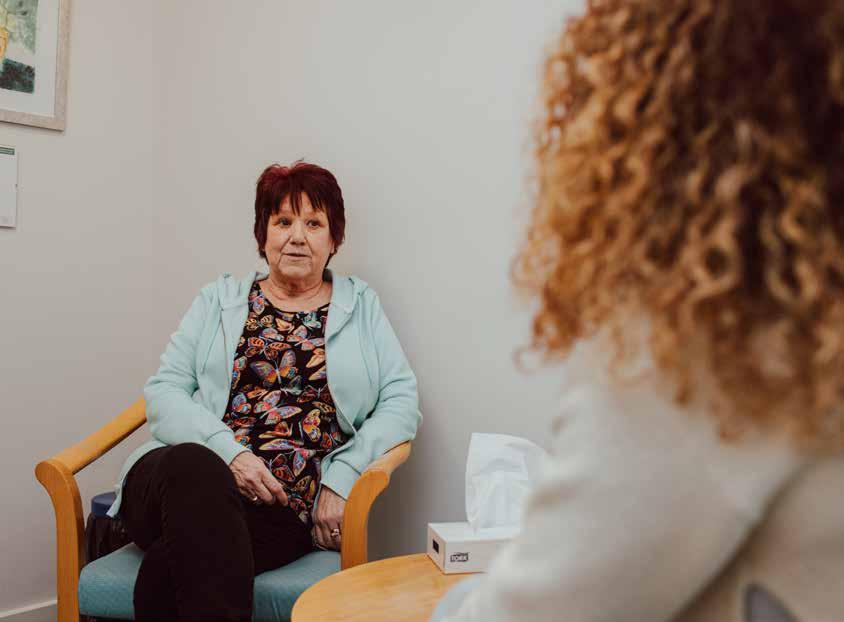
How to access the Let’s Talk Team and what happens next
Whenever you feel ready to talk please make contact. We understand that every person grieves in their own time, whether that is weeks, months or longer. Moya Cole Hospice bereavement service will always be here for you whenever you feel ready to reach out for support.
This is a free service and you do not have to go through your GP or any other professional.
Your first appointment will be an assessment with a member of the Let’s Talk Team. They will enable you to talk about what has happened to you and both you and the therapist will look at the different support options available and together make a plan for the best way forward.
If you decide after your initial appointment that therapy is right for you, you will be appointed a therapist who will support you on a weekly basis. At this point, we will ascertain your preference for accessing ongoing sessions – face to face, telephone or video. Sessions are time limited and an individual session lasts up to 50 minutes. We will review how you are finding sessions with your therapist and whether they are helping. Once sessions come to an end we will help you consider other support options if necessary.
To talk with someone about how Moya Cole Hospice Let’s Talk Service can help you, please contact:
The Let’s Talk Team at Moya Cole Hospice
Telephone: Heald Green 0161 498 3 668/661
Telephone: Little Hulton 0161 702 5 413/414
Email: enquiries@moyacole.org.uk
Adult Bereavement Contacts
The Black, African and Asian Therapy Network:
Psychological support for individuals from ethnic minorities.
Telephone: 07946 582012
Website: www.baatn.org.uk
Care Concern Loss and Bereavement Service: Bereavement and loss counselling for all Greater Manchester Communities. Telephone: 0161 796 0807
Email: care.concern@hotmail.co.uk
Cruse Bereavement Care Helpline: Support for all bereaved people. Telephone: 0808 808 1677
Mon-Fri 9:30am-5:00pm Tues, Wed & Thurs 9:30am-8:00pm Weekends 10:00am-2:00pm
Online Cruse Chat: www.cruse.org.uk/get-help/ crusechat
Mon- Fri 9:00am-9:00pm Website: www.cruse.org.uk
Good Grief Trust:
A support and advice service led by people who have experienced loss.
Email: hello@thegoodgrieftrust.org Website: www.thegoodgrieftrust.org
Greater Manchester
Bereavement Service: Telephone: 0161 983 0902
Mon-Fri 9:00am-5:00pm
Wed 9:00am-8:00pm
Email: salccg.gm.bs@nhs.net
Website: https://greatermanchester-bereavement-service. org.uk
Jewish Bereavement Counselling Service: Telephone: 020 8951 3881
Email: enquiries@jbcs.org.uk
Website: www.jbcs.org.uk
Survivors of Bereavement by Suicide Telephone: 0300 111 5065
Mon-Sun 9:00am-9:00pm
Email: email.support@uksobs.org Website: www.uksobs.com
The Samaritans:
24/7 Helpline: 116 123
24/7 Email: jo@samaritans.org
Manchester and Salford: 0161 236 8000
Stockport: 0330 094 5717
Website: www.samaritans.org
The Silver Line
General support for older people
Telephone: 0800 4 70 80 90
Website: www.thesilverline.org.uk
The WAY Foundation: Support for young widowed people (younger than 50).
Telephone: 0300 012 4929
Website: www.widowedandyoung.org.uk
Young People Services
Winston’s Wish
Support for grieving children and their families.
Helpline: 08088 020 021
Mon-Fri 9:00am-5:00pm
Email: ask@winstonswish.org
Website: www.winstonswish.org
Beechwood Cancer Care Centre
Supporting adults, children & young people when there’s serious illness or bereavement in the family. Telephone: 0161 476 0384
Email: enquiries@ beechwoodcancercare.co.uk Website: www.beechwoodcancercare.org.uk
The Gaddum Centre
Children and families’ bereavement service (Manchester & Salford) Telephone: 0161 834 6069
Email: info@gaddum.org.uk
42nd Street
Support for young people aged 13-25 under stress
(Manchester, Salford & Trafford) Telephone: 0161 228 7321
Mon-Fri 9:30am-5:00pm
Email: theteam@42ndstreet.org.uk
Website: www.42ndstreet.org.uk
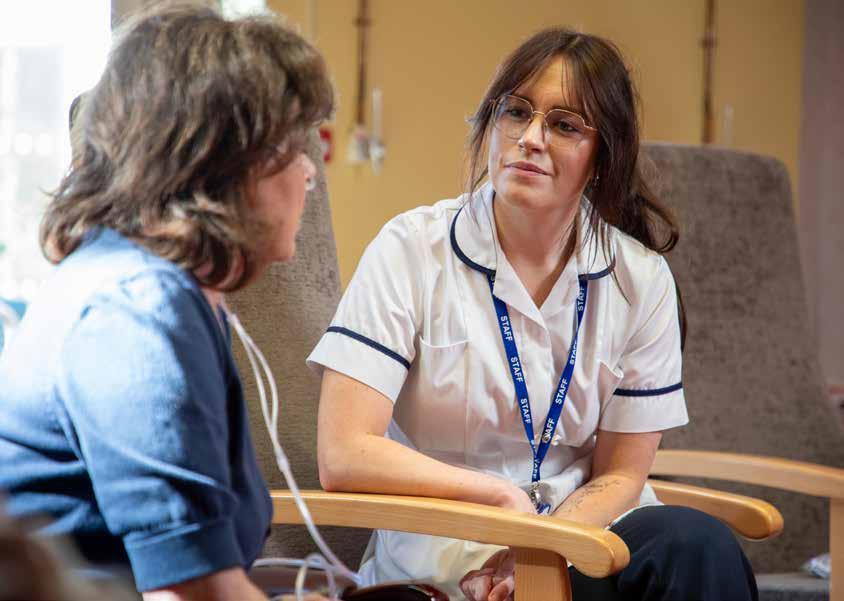
24-hour advice line
Patients, carers and healthcare professionals can get advice around the clock on 0800 970 7970 (Stockport area) and 0808 144 2860 (Manchester, Salford and Trafford areas).
Moya Cole Hospice, Heald Green:
2 Hardy Field Lane, Heald Green, Cheadle, SK8 3SZ
Telephone: 0161 437 8136
Moya Cole Hospice, Little Hulton:
Meadowsweet Lane, Off Peel Lane, Little Hulton, Worsley, M28 0FE
Telephone: 0161 702 8181
Textphone users please prefix any of the numbers above with 18001.
Get more information
We have a wide range of information and leaflets available in a variety of formats and languages. Please get in touch for more information via one of the main hospice telephone numbers.
Comments and feedback
We welcome your feedback. You can visit www.moyacole.org.uk/ feedback, talk to a member of staff or fill in a comments card (found near the red posting boxes around our sites). Formal complaints can be made in writing to our Chief Executive at our Heald Green address.
Find out more about us
You can find out more about Moya Cole Hospice on our website, www.moyacole.org.uk
All contact details can be found at www.moyacole.org.uk/contactus
Reference: Moya Cole Hospice Bereavement Booklet (Little Hulton)
Publication date: April 2026
Review date: April 2028

The Hospice would like to thank RNS Publications for publishing this information and the following pages contain some features from services o ering their help at this time.
Whilst the Hospice is grateful of their support it does not endorse or recommend any of the services that they provide.
Please note, whilst information is correct at the time of publication, this may be subject to future change.
STOPPING JUNK MAIL

all you want is either a simple cremation or funeral

We understand how expensive funerals can be and we specialise in providing a valued service.
In recent years families have increasingly chosen more straightforward options. We can connect you with a local partner who can o er a simple and digni ed cremation from £990.00, as well as more traditional funerals where we can add personal touches to re ect your wishes.
To discuss how we can provide a discreet and caring service for your
and con rm a xed price:
If someone you know has died, we can reduce the amount of unwanted marketing post being sent to them, stopping painful daily reminders.
By registering with our free service, the names and addresses of the deceased are removed from mailing lists, stopping most advertising mail within as little as six weeks.
This publication has been jointly developed between ourselves and the hospice. We hope that it has been or will be of help at this time and we welcome any comments or suggestions that you may have.
Please contact us either by phone, email or by post.




Do you need help with Probate?
You may need help, support or advice on what to do when someone dies in relation to probate. It may not always appear obvious if it will be required.
We offer free guidance on the legal and financial aspects of bereavement including your responsibilities and whether probate is required.
You may need to establish whether a property is held in joint names or tenants in common, we can perform a simple check at no cost to establish the title deeds.