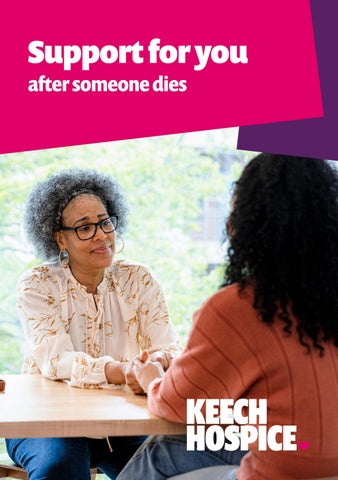
Support for you after someone dies

We’re all deeply affected when someone we love dies – it can be a distressing time. However, there are still official tasks which must be done even though it can seem confusing or even daunting at a time when you’re coming to terms with so much.
The first part of this guide will help you through practicalities such as registering the death and organising the funeral.
The second part offers ways in which Keech Hospice can support you emotionally, psychologically, spiritually and practically.
When someone dies at the hospice
When someone dies in the community
Medical Examiner (ME)
The coroner
Post-mortem
Registering the death
Tell Us Once
Other agencies that need informing
Stopping marketing mail
Equipment return
People react in different ways following the death of a loved one. Some want to spend time with the deceased while others would rather not. It’s important you do what feels right for you.
Let us know if there are any specific cultural or religious requirements we should be aware of and respect.
Once you’re ready, the nursing team will wash and change your loved one and they will then be moved to the Pasque room. If doctors are able to, they will certify the death at the hospice.
An appointment will be made for you to return to Keech Hospice at a mutually convenient time to collect your loved one’s belongings. You’d meet with one of our nursing staff in a quiet room and they’d be able to discuss any questions you may have. If you’d like to speak to a doctor, let us know and we’d arrange this if possible.
When someone dies at home, their district nurse or the single point of contact (SPA) should be contacted. In most cases the nurse will verify the death. If this is not possible, they’d make contact with the GP to attend, in or out of hours, to verify the death. Within 12 hours of the death, you’d need to contact a funeral director of your choice to begin funeral arrangements.
This may require them to collect your deceased loved one. Your funeral director can also arrange for you to visit your loved one if you wish. You may have special religious needs, which your spiritual advisor can help with. If there is a nurse present at the time, (possibly a district nurse or a nurse from the hospice team) they may offer to wash and change the body. You or a family member can assist if you wish, or you may prefer the funeral director to do this once your loved one is taken to the funeral home.
It is now mandatory that all causes of death are reviewed by a Medical Examiner. One of the hospice doctors will issue a ‘Certificate of Cause of Death’ which will then be sent to the ME. An ME is a senior NHS Doctor who has not been involved in the care of the person who has died. The ME will review the relevant medical records, looking at the quality of clinical management and the care provided by medical and other staff. A member of the Medical Examiner Team will phone you within a day or so of the death of your relative or friend.
The ME will first tell you what has been proposed as the cause of death, to go on the death certificate. You will be asked if it is what you expected and if you need any explanation. The ME will ask you if you have any comments, good or bad, on the healthcare provided to your deceased relative. The conversation with the ME is covered by the usual rules of medical confidentiality, but in some circumstances it may be necessary to pass information to others in order to improve future care, protect other patients or satisfy the law.
In certain cases, a doctor may be required to report the death to a coroner.
For patients who die at Keech Hospice, this may be because:
• The patient died within 24 hours of admission
• The patient had surgery in the last year
• The patient had a fall during their admission
• The cause of death is unknown
• The death was sudden and unexplained
• An industrial disease may have contributed to their death
The coroner may decide the cause of death is clear, in which case:
• The doctor signs a medical certificate
• An appointment is made with the registrar for 48 hours after the patient has died
• The medical certificate is emailed to the registrar
• The coroner issues a certificate to the registrar stating a post-mortem isn’t needed. This is unless the patient has mesothelioma, in which case the coroner writes and issues the death certificate, and organises the cremation forms if required. For this, they will liaise directly with the family.
In very rare cases, the coroner may decide a post-mortem is needed to find out how the person died. This can be done either in a hospital or mortuary. You can’t object to a coroner’s post-mortem, however, if you ask, the coroner must tell you (and the person’s GP) when and where the examination will take place.
The coroner will release the body for a funeral once they have completed the post-mortem examination and no further examinations are needed. If the body is released with no inquest, the coroner will send a form to the registrar stating the cause of death. The coroner will also send a ‘Certificate of Coroner’ form if the body is to be cremated.
Once the Medical Examiner has approved the cause of death we will email the medical certificate to the registrar. The death must be registered by the registrar for the area where the death occurred. For the hospice, the registrar is at Central Bedfordshire Registration Service. There are offices at Ampthill, Biggleswade, Bedford, Dunstable and Leighton Buzzard.
You should register the death within five days. You will need to telephone the Central Bedfordshire Registration Service on 0300 300 8089 for an appointment at any of the above offices. For more information or to book your appointment online, go to www.centralbedfordshire.gov.uk.
If it’s more convenient, you may register the death ‘by declaration’ at any other register office in England or Wales. If the death is registered by declaration outside of Bedfordshire, then the registrar in the office you attend will send the forms by post to Central Bedfordshire Registration Service.
If you wish to order copies of the death certificate (which is a certified copy of the entry in the death register) a cheque made payable to ‘Central Bedfordshire Council’ can be sent with the declaration. You won’t receive any paperwork until the death has been registered in Central Bedfordshire.
When you register the death, you will need:
• Medical card of the person who has died (if possible)
You will also have to provide the following information:
• The date and place of death
• The forename(s) and surname (and maiden name if the deceased is a married woman) and any other names used currently or previously
• Their date and place of birth
• Their occupation
• Their usual address
• The full name, date of birth and occupation of a surviving or late spouse or civil partner
• Whether the deceased was in receipt of a pension or allowance from public funds, such as benefits from the Department for Work and Pensions (DWP, previously the DSS).
You may find it helpful to take a copy of the person’s birth and marriage certificates with you as all the necessary information can be taken from them. Although more than one person may go to the registrar, legally they can only take the information from one person. It will take about half an hour to register the death.
The registrar will give you:
• A green form known as the Certificate for Burial or Cremation. This form is for the funeral director, so the funeral can take place.
• A Certificate of Registration or Notification of Death (BD8). This must be sent to the DWP along with any benefit books. If you live in Luton or Dunstable (postal districts LU1-LU6), send it to Cheviot House, Guildford Street, Luton, LU1 2ER. If you live in Barton, Flitwick or further north, send it to Wyvern House, 53-55 Bromham Road, Bedford, MK40 2EH.
The registrar can also issue copies of the death certificate, although you’d need to pay a fee. If you obtain copies at the time of registration, there is a small cost. Copies requested later may cost more. Most people find it helpful to obtain more than one copy as banks, insurance companies and other institutions don’t normally accept photocopies. However, they’d often return the original to you in due course.
Tell Us Once is a useful service which lets you report a death to most government organisations in one go.
Tell Us Once will notify:
• HM Revenue and Customs (HMRC) to deal with tax and cancel benefits
• Department for Work and Pensions (DWP) to cancel benefits, for example, income support
• HM Passport Office to cancel a British passport
• Driver and Vehicle Licensing Agency (DVLA) to cancel a driving licence
• The local council to cancel housing benefit, council tax benefit, a Blue Badge, inform council housing services and remove the deceased from the electoral register
• Public-sector or armed-forces pension schemes to stop pension payments
When you register the death, the registrar will:
• Let you know if the Tell Us Once service is available in your area and its contact details
• Give you a unique reference number to use the Tell Us Once service online or by phone
Sometimes the registrar will register you for the Tell Us Once service.
To use Tell Us Once, you’ll need the following details of the person who died:
• Date of birth
• National Insurance number
• Driving licence number
• Passport number
You’ll also need:
• Details of any benefits or entitlements the deceased was receiving, for example a state pension
• Details of any local council services the deceased was receiving, for example a Blue Badge
• The name and address of the deceased’s next of kin
• The name and address of any surviving spouse or civil partner
• The name, address and contact details of the person or company dealing with the deceased’s estate (property, belongings and money), known as the deceased’s ‘executor’ or ‘administrator’
• Details of any public-sector or armed-forces pension schemes the deceased was receiving or paying in to

We will inform:
• The deceased’s doctor
• The deceased’s community nursing team
• My Care Co-ordination Team (MCCT)
• The Palliative Care Hub (PCH)
• Any hospital the deceased was attending
• Social services, if involved.
Some agencies you may need to inform:
• The bank and building society
• The local Inland Revenue office*
• The local social security office to cancel pensions, allowances, benefits and so on*
• Any employer or trade union
• A child’s or young person’s teacher, employer or college should be informed if a parent, brother, sister, grandparent or close friend has died
• Car insurance company - people driving a car insured in the deceased’s name are not legally insured
• Suppliers of gas, electricity and telecoms, Royal Mail deliveries and the local newsagent, if relevant
• The local housing department if the deceased was receiving housing benefit, council tax or living in council property*
• Landlord of private rented property
• Passport office (you’d need to return the passport)*
• Solicitor
You’d find the address of local government and council offices in a telephone book or online. Further information is available in the DWP leaflet, What to do after a Death. This leaflet is available from the hospice or your funeral director.
The amount of unwanted marketing post being sent can be greatly reduced to stop painful daily reminders. By registering with the free service www.stopmail.co.uk the names and addresses of the deceased are removed from mailing lists, stopping most advertising mail within as little as six weeks. If you can’t access the internet, you can call 0333 006 8114, where you’d be asked for very simple information which will take only a few minutes to complete.
Contact your district nurse or single point of contact (SPA) to arrange equipment collection.
You, your family or your loved one’s carer needs to return all medication to the local pharmacy for disposal. This should be done at your earliest convenience.
A digital legacy is the digital information available about someone following their death. Someone’s digital legacy is often shaped by interactions the person made and information they created before they died. This might include their social media profiles, online conversations, photos, videos, gaming profiles and their website or blog.
Visit: www.digitallegacyassociation.org for guidance and information.
A funeral is an important part of saying goodbye so it’s crucial it meets your wishes. There’s no standard for funerals but here are some options to help you decide.
The hospice has a list of local funeral directors. Alternatively, you can look on the internet or ask family or friends for recommendations. It’s a good idea to get an estimate of costs, as these expenses can be more than expected. If you’re on benefits, you may be able to seek help from the Social Fund. Ring the benefits agency on Freephone 0800 882200 or speak to our social workers.
Ensure you give yourself enough time to plan the ceremony. A funeral offers you and your family comfort. It is an opportunity for you all to come together. Try not to exclude your children as they can value being consulted or perhaps help to choose the music, hymns and readings.
You can contact the funeral director before or after you have registered the death. They will then arrange an appointment to see you, either at their office or your home, to advise you on how to arrange a religious or non-religious funeral. Should you wish, they can contact a member of the clergy, a religious leader or member of the Humanist Society to help you with the service.
www.direct.gov.uk offers practical guidance under its ‘Births, deaths, marriages and care’ section.
The Natural Death Handbook (4th edition, published 2003) is a useful guide to alternative forms of funeral, family-organised ceremonies, alternative coffins, and woodland burial grounds
All family support staff at Keech Hospice have a copy for your use.
A burial can be in a cemetery or churchyard. If you don’t already have a plot, your funeral director will advise you how to organise one. If you already have a reserved burial plot, you will have a deed or grant giving you the plot number. You’d need to take this document to your funeral director. Unfortunately, many churchyards are no longer open for burial due to lack of space. You should check with the resident priest or minister. Alternatively, a green funeral in a woodland site or burial on private grounds can be arranged.
If you choose a cremation, you’ll need an additional form signed by two doctors. This will be arranged by the hospice and your funeral director will then collect it from us.
Following the cremation, you will be asked what you’d like to do with the ashes. There are several options: to bury them in a churchyard or cemetery, to scatter them in a Garden of Remembrance or place of your choice or to keep them in a special container. Your funeral director can provide any information you may need. There is no hurry to make this decision, you can decide sometime after the funeral.
Holding a collection at a funeral, or asking for donations in lieu of flowers is a simple and thoughtful way of supporting our care. Your funeral director will be happy to arrange this for you.
We can provide you with special donation envelopes or a collection box for use at the service. Or you can ask people to make a donation online at keech.org.uk/donate and select ‘In memory of someone’ as the reason for the donation.
Funeral costs are normally recoverable from the deceased’s estate, but the person organising the funeral will be responsible for paying the bill. It is advisable to check where the money will come from before making arrangements. Check if a pre-purchased funeral plan has been arranged. Contact the deceased’s bank or building society where their funds are held to inform them of the death. Many banks will release money to pay for funeral costs before probate is granted, but not all. The bank or building society will need a copy of the death certificate. The Funeral Director can send their invoice directly to the bank or you can send the invoice yourself to the bank for payment.
Where the payment for the funeral is an issue, you may be entitled to help with the costs. Contact the DWP on 0800 731 7898 to discuss your eligibility. There is a time limit for claiming bereavement benefits and a funeral grant. So it’s important to contact the DWP at your earliest convenience or within one month of the bereavement. Funeral grants have a maximum threshold and not everyone is given the full amount. You ought to check this when organising the funeral to prevent running up large costs. Where no one is able to pay for the funeral, the local authority may help – but you must contact them before the funeral has been arranged. Choice is restricted in these cases. Your funeral director should be able to advise you.
• This is the legal process for the distribution of the deceased’s estate, for example money and property. You need to establish if the deceased had made a Will. This may be found at their bank, solicitor or home, or with family or a friend. If the Will has been registered, you should call the Principle Probate Registry who can be telephoned on 020 3985 9553.
The Will may include funeral wishes, wishes regarding the deceased’s estate and the name of the executors or people legally entitled to deal with the estate. The executors are legally responsible for administrating the estate according to the wishes in the Will. If the Will is with a solicitor, they should be informed of the death. Named executors can administer the deceased’s estate on their own (visit www.gov.uk for further information) or they may prefer to get help from a solicitor to carry this out. Further information on Wills can be found at www.ageuk.org.uk.
When someone dies without making a Will, they are said to have died ‘intestate’ and different rules apply. When this happens, the law sets out who should deal with the deceased’s affairs and who benefits. This can be complex and there’s a list of people who may be entitled to the estate in turn. Further information can be found at www.gov.uk. This website also contains a stepby-step guide on how to proceed if you want to administer the estate yourself. Or you can involve a solicitor to help you through the process.
If you were receiving carers benefit prior to the bereavement, this will continue for six weeks after the death of the person you were caring for.
Check the council tax benefit and housing benefit are in your name. If not these may need to be reapplied for.
If you or your spouse/partner were claiming a benefit before the bereavement, or if you are now on a low income, you may need this reviewed.
If you have children and are working, available benefits will depend on your income and the age of your children. If you’re unable to work or are unemployed, you may be eligible for increased benefits. You may also be eligible for a bereavement payment or support.
If you’re a parent and any of the following benefits are in the deceased’s name, these will have to be changed or reapplied for
• Child benefit (HMS 0300 200 3100)
• Child tax credit or working tax credit (HMRC 0345 300 3900)
If your spouse or partner dies, you may need a benefits review, particularly if you’re now living alone.
A review is recommended as not all benefits are means tested.
• Contact the DWP bereavement line on 0800 151 2012 for advice.
• www.gov.uk has excellent advice on all benefits. Or contact your local Citizens Advice Bureau for support in finding out what is available and how to apply.

Often we get help from our family, friends and our local community.
You may want to seek outside help, particularly if:
• You feel you have no-one you can talk to
• You’d like to talk to someone outside of your circle of family and friends
• You can’t eat, sleep or are having nightmares
• Your work is suffering
• You have frequent mishaps or are smoking, drinking or taking drugs excessively
‘Grief’ is the word we use to describe the feelings and reactions which occur when someone we love dies. It is the universal reaction to loss. It is painful and stressful, but also natural, normal and entirely necessary. Three aspects of grief to bear in mind:
Every person experiences grief differently and there is no right or wrong way to grieve. Over time, the emotional swings will lessen in intensity as you learn to adapt to your changed circumstances but, to begin with, it can be hard.
We all need to grieve in our own way and in our own time, but these are some of the normal feelings and problems you may experience. At first, it can be difficult to believe what has happened. You may feel shock, disbelief, sorrow, regret or even a sense of relief. It can take time for the reality to sink in.
Grief is time consuming and exhausting. You may feel tired, lethargic, unable to make decisions or to concentrate on things you feel you should be doing.
Let go of ‘ought’ and ‘should’ for a while. You may need to take extra time off work. On the other hand, some people find going back to work and getting into a routine helps. Do what feels best for you.
Many people feel guilty, panicky or angry. There may be times when you feel it’s all too much and you can’t cope – it’s best not to hide these feelings. Try to find an empathetic listener with whom you can talk. This isn’t always easy as some people expect you to be ‘back to normal’ within a few months. However, others will understand what you say and will help you through. Don’t be afraid of letting your friends and family know what helps you and that you need their comfort and support.
Grief is painful. You may find yourself crying at unexpected times. Tears can be a positive step, a natural expression of the loss which you are feeling. Some people find they cannot cry to begin with, as if numbed by the shock of their grief, whereas others find talking too painful initially.
Some people feel despair and depression, or lose interest in normal activities, which for a while may seem pointless. This is absolutely normal. Allow yourself to grieve. Slowly your energy will return and you’ll feel like enjoying yourself again.
You may have good days and bad days - it’s part of the process. Bereavement can be like a long, difficult, painful and lonely journey. However, in time, the painful memories will soften and become easier. Sorrow remains but gradually you’ll find your way of coping.
Post-bereavement, we continue to support families, giving them the opportunity to share their feelings and talk about their loss, using the most appropriate supportive care service.
Support can be given at the hospice, in the community or - for children and young people - at school and can be accessed either through one-to-one sessions or by attending one of our support groups.
We also hold an annual remembrance events:
• Adult remembrance service ‘Light Up a Life’ held on the first Sunday in December.
• Children’s remembrance service ‘Forget me not’ held on the last Sunday in September.
We have a Chaplain and spiritual care volunteers who can provide you and your family with spiritual support. This may mean you would like time to reflect and pray, are questioning what is happening to you or would like to talk about what or who is important to you.
We’ve made things simple - there are several ways:
• Self refer via our website keech.org.uk/refer
• Speak to a member of your care team or your health professional
• Contact Bedfordshire Palliative Coordination Service call 111 press option 4
Child Death Helpline - For anyone affected by the death of a child.
0800 282 986
www.childdeathhelpline.org.uk
Compassionate Friends - Offering support and care for bereaved parents and family after the death of a child.
0345 123 2304
www.tcf.org.uk
CRUSE Bereavement Care - A national organisation which helps with advice on bereavement and practical matters
0808 808 1677
www.cruse.org.uk
Grief Encounter - Free, professional and specialist bereavement support services for children and young people.
0808 802 0111
www.griefencounter.org.uk
Age UK - Produces a useful booklet on bereavement and can help with general support and advice.
0800 678 1602
www.ageuk.org.uk
LGBT Bereavement Helpline - Supporting lesbian, gay, bisexual and transgender people who have been bereaved.
0800 0119 100 switchboard.lgbt
Hope Again (c/o CRUSE) - Internet support for young people.
0808 808 1677
www.hopeagain.org.uk
Samaritans - 24 hour telephone counselling offering emotional support. 116 123 www.samaritans.org
SOBS - Survivors of Bereavement by Suicide
0300 111 5065 www.uksobs.com
WAY Widowed and Young - Peer-to-peer support for anyone who’s partner has died before their 51st birthday.
0300 201 0051
www.widowandyoung.org.uk
Winston’s Wish - This charity provides services to bereaved children, young people and their families.
08088 020 021
www.winstonswish.org
Keech Hospice is an all-age hospice. We provide free, specialist care for adults in Luton and central Bedfordshire, and, children in Bedfordshire, Hertfordshire and Milton Keynes with life-limiting illnesses and provide vital support for their family and friends.
As a charity we rely on the generous support of the community for the majority of our funding.
The difference our supporters make
Without the support from our community, Keech Hospice would not be able to continue providing vital care and support. We’re extremely grateful for all those who make donations, fundraise and volunteer for us. Without them we would not be here today.
Some ways our supporters help us by:
· Making a one off or regular donation
· Leaving a gift in their Will
· Playing our lottery
· Taking part in a sponsored event
· Fundraising for us
· Visiting our retail shops
· Volunteering for us
At Keech we understand how important it can be to honour the memory of a loved one. Over the next couple of pages we will share some of the different ways you can create a lasting tribute in their memory whilst making a real difference to our patients and their families. Whatever and whenever you decide, we’ll be here to help you. For further information, please contact our fundraising team on 01582 707940 or email letmehelp@keech.org.uk.
At a funeral service, many people kindly ask family and friends to make a donation in lieu of flowers. We can provide you with special donation envelopes ahead of the day and can also help you set up online donations if you wish.

Our beautifully crafted Memory Tree offers a heartfelt way to celebrate your loved one and stands in the communal space of Valerie’s. You can dedicate a leaf on the tree which can be engraved with their name or a short message. By dedicating a leaf, you’re not only creating a lasting tribute but also supporting the essential care provided by Keech Hospice. You are always welcome to visit your leaf at our Luton site.
www.keech.org.uk/memory-tree
An online tribute page is a dedicated web page that is free to set up and gives you, your family and friends somewhere to visit and share thoughts, stories and photos. Your ‘Much Loved’ tribute page allows those near and far to come together and share precious memories and you can watch the page grow.
On the first Sunday of December we welcome families and friends to the hospice for our annual Light Up A Life celebration. We come together to remember loved ones, the joy they bought to our lives and precious times shared. The lights on our tree are in memory of all the people being thought of in a special way; each light shining out in celebration of a life lived.

The Hospice would like to thank RNS Publications for publishing this information and the following pages contain some features from services o ering their help at this time.
Whilst the Hospice is grateful of their support it does not endorse or recommend any of the services that they provide.
Please note, whilst information is correct at the time of publication, this may be subject to future change.








You may need help, support or advice on what to do when someone dies in relation to probate. It may not always appear obvious if it will be required.
We offer free guidance on the legal and financial aspects of bereavement including your responsibilities and whether probate is required.
You may need to establish whether a property is held in joint names or tenants in common, we can perform a simple check at no cost to establish the title deeds.