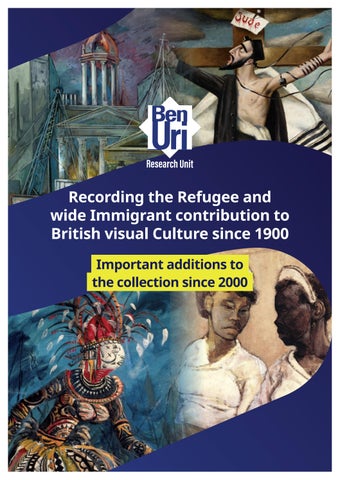
Recording the Refugee and wide Immigrant contribution to British visual Culture since 1900 Important additions to the collection since 2000
2025:
Ben Uri celebrates 110 years in London 25 years researching and celebrating the Jewish, the Refugee and the wide Immigrant contribution to British visual culture since 1900. Explore over 3,300 profiles of remarkable individuals who migrated to Britain and enriched our visual culture at buru.org.uk and diaspora-artists.net Explore our Collection on benuricollection.org.uk and exhibitions and lots more on benuri.org Page 2
From There to Here – Britain’s Gain! Ben Uri Research Unit is a unique and important ongoing global initiative that demonstrates just one of many ways Ben Uri uses art differently.
population were born ‘there’ not ‘here’ and continuously enrich our country in many ways, not least the visual arts.
It records the Jewish, Refugee and Immigrant contribution to British Art since 1900. Ben Uri offers free online access to over 3300 scholarly researched profiles, principally covering European, Black, and Asian contribution from over 100 countries of birth via buru.org.uk and diasporaartists.net.
This ongoing research is a distinctive and valuable educational resource used extensively by secondary school and university students, researchers, the art sector, as well as families looking to find out more of their namesakes. Surprise yourself! Have a look online and discover more about the refugee and immigrant contribution to British art and society by remarkable individuals from over 100 countries of birth.
Did you know around 20% of Britain’s, and approximately 40% of the London’s,
Afghanistan Bulgaria
Finland
Israel
Malta
Portugal
Sudan
Algeria
Canada
France
Italy
Mauritius
Romania
Switzerland
Angola
Canary Islands
Germany
Jamaica
Mexico
Russia
Syria
Georgia
Japan
Montserrat
Serbia
Tanzania
Ghana
Jordan
Morocco
Sierra Leone Tibet
Greece
Kenya
Netherlands Singapore
Trinidad
Grenada
Kosovo
Slovakia
Tunisia
Grenadines
Kuwait
New Zealand
Slovenia
Turkey
Guyana
Laos
Hungary
Latvia
India
Lebanon
Iran
Lithuania
Iraq
Malaysia
Ireland
Malawi
Argentina Australia Austria Bahamas Bangladesh Barbados Belarus Belgium Bolivia Bosnia Brazil
Chile China Croatia Cyprus Czech Republic Denmark Dominica Egypt Estonia
buru.org.uk
Nigeria Palestine Pakistan Peru Philippines Poland
South Africa Uganda South Korea Ukraine Spain
USA
Sri Lanka
Venezuela
Saint Kitts
Vietnam
Saint Lucia
Yemen
diaspora-artists.net Page 3
Ben Uri 110 years: from Local to Global 1915: A new institution founded in Whitechapel by Lazar Berson, an immigrant Russian born Jewish artist from Paris whose extraordinarily ambitious vision was a National Jewish Art Museum. 1995: After 80 years being the centre of London’s Jewish community’s cultural arena it lost its gallery in Central London and was only kept alive by the belief of its Trustees. 2000: A new board, a new future in the centre of Britain’s mainstream museum sector representing the Jewish community rather than being focussed on and in it. 2002: A new home – a gallery in Boundary Road off the ‘Beatles’ famous Abbey Road 2015: Out of Chaos - our hugely successful centenary exhibition at Somerset House generously funded by the National Heritage Lottery Fund 2016: A new future following our critical analysis that a museum building in one of central London’s museum sectors will prove unsustainable even if £30+m capital could be raised. 2018: A new detailed Sustainability and Public Benefit Strategic Plan was published redrawing how small and medium sized museums can generate distinctive public benefit. The prescient strategy repositioned Ben Uri to focus on academic research on the wide immigrant contribution to British visual culture since 1900 and be digitally led. 2025: A new web user record broken – 40,834 in October compared to 936 in March 2018. This compares to less than 500 physical visitors a month to the Page 4
Gallery. Online equates to over 500,000 in 2026 with some 40% from abroad. Clear evidence of the transformation from Local to Global. 2026 > A new socially valuable, productive, and expanded hybrid future, building on our DNA, our last 25 years of prioritising and 8 years of recording our research on the Jewish, the refugee and the wide immigrant contribution to British visual culture. The new Ben Uri Research & Dissemination Institute will digitally record, share, and teach the refugee and wide immigrant contribution to British society since 1900. The deliverables and benefits serve to contextualise the place and the significant, more regularly overlooked and unsung contribution of the 20% of our population who are immigrants. 2050 / 2100 > A world-leading Ben Uri Research Institute recording, sharing, and teaching the refugee and wide immigrant contribution to British society since 1900.
It has been my privilege to lead Ben Uri since October 2000 and rethink, reinvent, reposition, and revitalise, alongside wonderfully talented colleagues, a remarkable institution that is establishing a unique place in the cultural and academic heritage of this country. I am proud of the transformation from Local to Global as I prepare to hand over the honour and responsibility to others to crystalise this ambitious and achievable vision. David J Glasser Executive Chair
TODAY:
Recording, Sharing and Teaching the Immigrant Contribution to British visual culture since 1900 through 3300 published profiles and another 1800 in the works. See buru.org.uk and diaspora-artists.net
How Ben Uri Uses Art Differently Why Ben Uri Uses Art Differently We prioritise global digital engagement over the physical.
We frame our research within the context of social integration.
We prioritise artists and their milieu over their artworks.
The stories of migrations captures imagination beyond the art.
TOMORROW:
Recording, Sharing and Teaching the Immigrant Contribution to British Society since 1900 - launching in 2026 Rationale: Research on its own no longer generates a positive return on investment. Accurate and inaccurate information is widely available online and with the rise of AI, which promises to misinform as much as inform, factual evidence and testimony is essential. Ben Uri’s academic research needs to be, and is designed to be, easily understood by scholars, students and the general public alike.
Deliverables: Fact not Fiction
Our research is widely used by universities across Britain and abroad, supporting undergraduate, postgraduate and doctoral work across the humanities, with a special focus on bridging the gap between the digital and the physical. We are developing citizenship modules for schools based on our evidence that a high percentage of superstars and superheroes, in whichever sector of our local communities or national and global societies, are either first or second generation immigrants and often to Britain. Benefits: We believe that if we can educate children at school, students at university, and the general public at large on the contribution of immigrants to our society, we have a greater chance of minimising racial friction and bigotry based on ignorance and misconception.
12 Key Specialisms within the new Research Institute launching in 2026 are Visual Arts: Design: Architecture Media: Technology: Science
Literature: Performance: Music Business: Sport: Hitler Emigres
Page 5
From Local to Global: An obsession for qualitative collecting, 1915 - 2025 Ben Uri’s 110th birthday marks an auspicious moment in the development of its collection – the most comprehensive and important collection of works by late 19th to present day immigrant artists in the UK and the international museum sector. The Collection’s early years were shaped by Polish-born jeweller Mosheh Oved, a key influencing figure, who always maintained that its main goal should be to collect pictures and open a gallery. The earliest acquisitions were diverse and often opportunistic: the Collection was inaugurated in 1918 by the purchase of a portfolio of works by Pre-Raphaelite Simeon Solomon, followed in 1920 by David Bomberg’s Ghetto Theatre (1920), purchased direct from the artist and set in the Yiddish-language Pavilion Theatre in Whitechapel. In 1923 Polish master Samuel Hirszenberg’s Sabbath Rest (1894) was the first work acquired by public subscription. Its narrative of not just Jewish religious observance but also of identity and migration, reflects the history of Ben Uri’s founders, fleeing pogroms and economic deprivation in the Russian Pale of Settlement to settle in London. At Ben Uri’s Opening Exhibition in 1925 (see Rachel Dickson’s essay in this volume), the collection numbered 37 works by nine artists, rising to 77 works by 31 artists in 1930. Upon the publication of a printed catalogue in 1987, this had reached 450 works by 221 artists and with the reprinted and expanded 1994 edition, this increased to 638 works by 301 artists. Since 2001, under a broader remit, in line with the academic focus of our Research Unit, the collection has expanded to include relevant works by immigrant artists to the UK from all national, ethnic and religious origins who have helped to enrich British visual culture. Following a rationalisation in 2018, then a further expansion, the Collection currently comprises more than 1,000 works by some 416 artists from 48 countries of origin, three-quarters of them immigrants and 29% women. This essay outlines selected Collection highlights since 2001, by both distinguished and overlooked artists, that have enriched and enhanced the original collection while also unfolding poignant, often interlinked and ever relevant stories of identity and migration. Works acquired with substantial support from national funding bodies are marked with an asterisk (*); full credits are given on https://benuricollection.org.uk. Works by the ‘Whitechapel boys’ have always had an important place in the Collection. All first- or second-generation immigrants and direct descendants of a shared EasternEuropean Jewish heritage, they trained together at the Slade School of Fine Art training (the majority assisted by the Jewish Education Aid Society) and came together uniquely in the Whitechapel Art Gallery’s so-called ‘Jewish Section’ in 1914, co-curated by David Bomberg and Jacob Epstein. Among the exhibits was Bomberg’s radical Racehorses* (1912-13), purchased for the Collection in 2004, demonstrating both his pre-war ambition and connections to the European avant-garde. The tension between traditionalism and modernism with which he – and many of this group – struggled, is reflected in Mark Gertler’s Rabbi and Rabbitzin* (1914), purchased in 2002, in which the couple yoked
Page 6
together at the centre of the composition also evoke the broader history of the Jewish diaspora. Poet-painter Isaac Rosenberg’s final Self-portrait with Steel Helmet* (1916), purchased in 2009, was drawn on rough brown paper, possibly salvaged from a parcel sent from home to the Front in Northern France, where he was then serving in the army and from where he would never return. His Portrait of Sonia Cohen, presented by Joan Rodker (the sitter’s daughter) in 2008, tenderly portraying the object of his unrequited love as a Renaissance Madonna, was completed on his only leave from the army in 1915. In the same year, Rosenberg’s contemporary, French-born Henri Gaudier-Brzeska, was also killed in the trenches; his head of another Whitechapel boy, Horace Brodzky (c. 1913), a study for a sculpture, was purchased in 2018 through the support of three great friends of Manya Igel in her honour. Romanian-born ‘Whitechapel girl’ Clare Winsten’s portrait of another Whitechapel boy, journalist and poet Joseph Leftwich* (1919), purchased in 2015, draws on both her knowledge of Vorticism and of Bloomsbury textiles. Bequests in 2019 by both Ernest Hecht OBE, publisher and philanthropist, of Bomberg’s landscape Mount Zion and the Church of the Dormition, Jerusalem (1923), and by Luke Gertler with Art Fund support, of a series of Gertlers including Coster Woman (1923), demonstrate these artists’ change in focus as part of the general rappel à l’ordre in the following decade. Two notable acquisitions have filled longstanding gaps of significant works by prominent L’Ecole de Paris Juifs painters Marc Chagall and Chaïm Soutine, both Eastern-European immigrants who settled in Paris before being displaced by the Second World War. Soutine famously never made works relating to his Jewish heritage but Jeune Servante *(c.1933), purchased in 2012, the last of his anonymous female, working-class figures in uniform, was painted in the year that Hitler acceded to the German Chancellorship. Forced into hiding in Touraine, following the German occupation, Soutine returned to Paris for a failed operation and died shortly afterwards. Chagall’s crucifixion, Apocalypse en Lilas: Capriccio* (1945), purchased in 2009, was painted during his wartime exile in New York as he emerged from mourning for his late wife Bella, compelled to document his horror at the unfolding reports of concentration camp atrocities. By contrast, Emmanuel Levy’s Crucifixion (1942), purchased by members of Ben Uri’s board in 2004, was painted in wartime Britain and mounts a powerful protest against Nazi persecution of Jews in mainland Europe. Three works by German-born satirist George Grosz, an excoriating critic of the Nazi regime, were created during his period of exile in New York. Both Interrogation* (1938), purchased in 2010, and The Lecture (aka Letter to an Anti-Semite) (1935), presented by Sally, Richard and Andrew Kalman in honour of their late father, refugee gallerist Andras Kalman, in 2013, commemorate the brutal death of Grosz’s friend, the radical Jewish writer and anarchist Erich Mühsam. A long-time critic of successive German political regimes, Mühsam was tortured and murdered in Oranienburg concentration camp; for Grosz, his fate symbolised that of all victims of the Nazi regime. In a third work, purchased in 2025, Final Solution (1941), the title is ironically applied to Hitler himself as, with astonishing prescience, Grosz anticipates the Nazi leader’s suicide by shooting in his Berlin bunker, beneath a map of the USSR. Among more than 300 artists of the ‘Hitler émigré’ generation who made forced journeys to Britain was German Jewish graphic artist Dodo (Dörte Bürgner). Her agonised selfPage 7
portrait, Verkündigung (Annunciation), presented by the Dodo Estate, Athens in 2012, was made in 1933, the year of Hitler’s accession to the German Chancellorship and three years prior to her own departure. Presented by his estate in 2023, Czechoslovakian Jewish painter Ernst Neuschul’s defiant Double Portrait, a self-portrait with his protégée Mimi, was painted the same year; dismissed from his position as Professor of Fine Arts at Berlin’s Academy and labelled a ‘degenerate’ artist, he fled to England from Prague in 1939. Polish painter Josef Herman’s poignant painting, Refugees* (1941), painted in Glasgow, draws strongly on his own Eastern European Jewish heritage, but the refugees also represent all those uprooted and forced into exile by the upheavals of war. Depictions of refugees form a small sub-theme in the Collection with a further watercolour by Herman (purchased in 2023), a drawing of a single male figure by Eva Frankfurther (purchased in 2020), and an oil depicting a group of recent arrivals by Orovida (purchased with the support of the Stern Pissarro Gallery in 2022), reflecting a heightened sense of community in the wake of the widespread displacement caused by the war. With the very recent purchase of a significant collection of rare, early works by Herman, executed in Norwood internment camp in 1940 and in Glasgow between 1940–43 (many exhibited at the gallery in 2011), Ben Uri has become the custodian of the largest, single collection of his work. Since the exhibition, Forced Journeys in 2008, which drew attention to the mass internment of so-called ‘enemy aliens’, works by refugee artists made in and referencing internment both in Britain and abroad, have become a further strand within our collecting. They illustrate the resilience, adaptability and commitment to artmaking displayed by the artist internees. Among them, are three Austrians: Ernst Eisenmayer’s drawing Internment in Douglas (1940), purchased and presented by David and Eva Wertheim in 2013, depicts an armed sentry in front of a barbed wire fence at Central camp on the Isle of Man, where he was first held in October 1940. A companion drawing (formerly attributed to Eisenmayer) featuring 29 internees’ signatures, including the artist’ own, shows a youthful figure breaking free of these constraints. Hugo Dachinger’s Portrait of a Man: Wilhelm Hollitscher (1940), purchased in 2016, was painted in Huyton Internment Camp, Liverpool using thinned watercolour applied to a copy of The Times newspaper. Michael Schreck’s Internment Camp, Warth Mills: Agony, purchased in 2023, that records the appalling conditions endured in a hastily converted factory outside Bury, Greater Manchester, was supported by a gift in memory of fellow internee Hans Felix David, also interned at Warth Mills at the age of 18. To these, most recently, has been added German Dadaist Kurt Schwitters’ surprisingly lyrical Douglas, Isle of Man (1940), purchased in 2025, executed on a rough, cracked panel – its fragility a testament to the conditions in which it was made. Painted at Hutchinson Internment Camp in Douglas on the Isle of Man – known as the ‘artists’ camp’ because of the high number of artist internees – it provides a contrast to his better-known Merz practice. Moldovan émigré and Prisoner of War at Stalag XC at Nienburg-on-Weser, near Bremen in Germany, Grégoire Michonze also drew on his own experience in his drawing of a group of exhausted Polish soldiers enclosed by barbed wire (c. 1940-42), purchased in 2020. Further works created during wartime show various aspects of the refugee experience: German painter Walter Nessler’s Boarded-up London (1940), presented by the artist’s Page 8
estate in 2022, symbolises the curtailing of artistic opportunities during wartime. Prussian-born graphic artist Katerina Wilczynski’s artworks, presented by her estate on behalf of the descendants of Arthur and Tamara Kauffmann in 2023, document her friendships among the émigré network with refugee art dealers including the Kauffmanns. They offered Wilczynski and fellow dealer Grete Ring wartime refuge and Wilczynski recorded Ring’s bombed-out premises; a contrast to William Ohly’s kitchen interior, filled with objets d’art. While the pre-migration friendship between fellow German refugee sculptors Kurt Schwitters and Else Fraenkel is documented in the tiny, dedicated collage of ephemera (1928), purchased from her family in 2019, and brought with her during her own flight to England. Viennese émigré cartoonist Joseph Otto Flatter’s portrait of Nigerian law graduate Simeon Alex Chima Onyejiako (1962), on longterm loan to the Collection since 2023, records his postwar friendship with his north London neighbour. and his wife Elsa (née Jones), a young opera singer from colonial Trinidad and Tobago, tutored by Flatter’s wife Hilde. As fellow émigrés, the Flatters gave the Onyejiakos courage to face uncertainties and to pursue their ambitions as new arrivals in a hostile, often discriminatory environment. Flatter’s portrait of Simeon, created in 1962, captures their close friendship. Viennese sculptor Georg Ehrlich’s classical bronze, Two Sisters (1945–46), purchased in 2020, is a portrait of intimate family ties and of loss; depicting his artist wife Bettina and her sister Mira as children, it commemorates Mira’s death in exile in England in 1944. Commemoration and loss are also powerfully conveyed in postwar works by many refugee artists including Hungarian sculptor and Ravensbrück survivor Edith Kiss; her Untitled: Figurative Group (c. 1949), a portrait of suffering, was presented to the Collection by Dr Sylvia Goldwyn in memory of her husband Mr Leslie Goldwyn in 2016. Hungarian painter and, later mosaicist, George Mayer-Marton’s The March of the Parents (1956), on long-term loan from the artist’s estate since 2022, painted in the year of the Hungarian Uprising, both commemorates this event and also marks the loss of his parents and brother in the Holocaust. Works referencing the aftermath of war and its long shadows include Dame Laura Knight’s chalk and watercolour drawings, Nuremberg Trials 1946: Study no. 1 and Study no. 2 (1946), on long-term loan to the collection since 2022, preparatory studies for the Imperial War Museum’s commissioned painting of the trial of 19 major Nazi war criminals by the only woman to depict this momentous event. Works by child survivors include those by Polish Jewish ‘Windermere Boys’ Shmuel Dresner, whose Pages from the Diary of David Rubinowicz (2005), presented by the artist in 2015, references the Naziauthorised book burnings, and Roman Halter’s idyllic studies of the Dorset countryside (2008) overlaid with horrific memories, presented by the Halter family in 2014. Halter also worked substantially in stained glass, the same medium in which another child survivor, Moshe Galili, honoured Raoul Wallenberg (2005), the man who saved thousands of Hungarian Jews (presented by the artist’s son Rafael Galili in 2019). Later depictions include Anthony Sher’s dark, introspective Self-portrait as Primo (2008), presented by the artist in 2021, and Peter Howson’s large scale Holocaust Crowd Scene II (2011), purchased in 2020. London in all its variety – its people and its streets – provided rich subject matter for many artists postwar including Eva Frankfurther, whose empathy for workers, immigrants and other people on the margins, was probably due at least in part to her Page 9
own experience as a German Jewish child refugee to Britain. Her West Indian Waitresses (c. 1955), presented by the artist’s sister Beate Planskoy in 2015, depicts her fellow workers at Lyons Corner House, Piccadilly, and also documents the changing landscape of postwar Britain including the introduction of self-service cafeterias with counter staff portioning out standardized food from open bains-marie. In Mornington Crescent: Summer Morning II* (2004), fellow German Jewish child refugee Frank Auerbach foregrounds the area of north London where he lived and worked for more than 70 years, and which became a significant and distinctive motif within his oeuvre. By contrast, Chicago-born postwar immigrant Alfred Cohen’s View from Panton House (1962), presented by the Alfred Cohen Foundation 2022, takes an oblique rooftop view across the city towards a London landmark – Nelson’s column rising from Trafalgar Square. Austrian émigré, Oskar Kokoschka’s fine signed limited edition lithograph from 1967 of the Houses of Parliament from the Thames was added to the Collection earlier in 2025. Three Polish-born artists worked in widely differing styles and media: Halina Korn’s Bus Stop (c. 1950s), presented by Maria Zulawski in 2019, likely observed in Kilburn, exemplifies her preference for everyday subject matter, also to be found in the bold still life arrangements (c. 1950s) of Guta Vardy, presented by her estate in 2025. By contrast, Franciszka Themerson’s The Family at Home (1960), presented by Jasia Reichardt in 2024, is one of a series of witty, inventive drawings, examples from which were published under the title Traces of Living by the avant-garde Gabberbochus Press that the artist established with her husband and creative partner Stefan Themerson. The sixties was a time of great experimentation for many artists. In Circus Scene (1964), purchased in 2020, Viennese refugee painter Marie-Louise von Motesiczky presents an arresting and dramatically lit composition, as carefully composed as one of her still lives. In King Lear (1964), presented by the artist’s estate in 2022, Indian-born painter Lancelot Ribeiro draws on the Christian imagery that informed his religious upbringing to explore concepts of power and evil, and personal and artistic identity. Painted in 1964, the year of the British General Election, which followed the 1962 Act controlling the previous liberal postwar immigration policy, and his own response in co-founding the Indian Painters’ Collective, UK (IPC) in 1963, King Lear, could also be read as one of a series of selfportraits. Migration is also referenced in works by contemporary artists including Dominican-born Tam Josef: The Hand Made Map of the World (2013), purchased with the kind assistance of the artist in 2016, draws on his childhood recollection of the map of the British Empire and the divisive legacy of colonialism to playfully reorder conventional geographies and arbitrary territorial divisions. Both Iranian-born Zory Shahrokhi and Guler Ates, born in Eastern Turkey and from a Zaza ethnicity, investigate issues of displacement, identity, oppression and gender. In Ates’ Home Performance (2014), presented by the artist in 2017, a veiled figure crosses the foreground pulling a house behind her, while Shahrokhi’s Revolution Street 2 (2019), commissioned by Ben Uri in response to Liberators: 12 Extraordinary Women Artists from the Ben Uri Collection (2018), features six fabric swallows made from scraps of Persian cloth sent to the artist from friends and relatives in Iran. Indian-born Hormazd Narielwalla’s multi-panel collage Bands of Pride (2017), presented by the artist in 2018, uses pattern and collage to explore the expulsion of Jewish people from England in 1290. Nasser Azam, the first artist of Pakistani heritage to Page 10
enter the collection, who came to England with his family at the age of seven, explores close family relationships in The Newborn (1981) and The Contrast (1982), presented by the artist in 2023. Julie Held’s Shoe Shop (2004), presented by the artist in 2008, Sarah Lightman’s It’s OK (2006), presented by the artist in 2006, and Jacqueline Nicholls’ Maternal Torah (2008), presented by the artist in 2009, all respond to aspects of their Jewish heritage and identity. More recently, Indian-born Gerry Judah’s sculpture Bengal Cloud (2018), purchased from the artist in 2025, is part of a series of sculptures that reflect on his roots and engage with climate change. After revisiting Bengal, rickshaws overloaded with structures, including power stations, pylons, temples made from ash, and polluted materials, became a composite symbol in his work. Important long-term loans exploring personal and artistic identity include leading German Jewish impressionist Max Liebermann’s Self-portrait (1927), painted when the artist was in his eighties, six years prior to this cancellation by the Nazi regime; it has been on long term loan from the Zondek Legacy through the good offices of the Board of Belsize Synagogue in 2002. In USA-born R. B. Kitaj’s Red Self-portrait after Masaccio (2005), on long term loan from a private collection since 2022, the artist explores his relationship with the Old Masters and his Jewish identity amid his continuing experiments with colour. Similarly, Nigerian Ben Enwonwu’s The Dancer (Agbogho Mmuo - Maiden Spirit Mask) (1962), also on long term loan from a private collection since 2022, and currently featured in Nigerian Modernism at Tate Modern, reveals a strong identification with his Igbo heritage and took on new meaning in the aftermath of the Civil War. Our mission is to share the Collection, digitally and physically, as widely as possible. Today, Collection works are loaned both nationally and internationally. This includes partnerships, such as that with St. Bonifatius Church, London, with the assistance of the German Embassy, London, to place on long-term loan German Jewish émigré Hans Feibusch’s Five Stories from The Old Testament (1973) panels, commissioned by Rabbi Hugo Gryn for the West London Synagogue and purchased by Ben Uri in 2013, after their removal from the building. In recent years, our Loans Out programme has lent to various exhibitions works by Soutine (The Courtauld Institute of Art, 2017; Hastings Contemporary, 2023), Chagall (The Jewish Museum, New York, 2013; Palazzo Reale, Milan, 2014; Royal Museums of Fine Arts of Belgium, 2015; The Schirn Kunsthalle, Frankfurt, 2023; Henie Onstad Kunstsenter, Norway, 2023; La Piscine, Roubaix, 2023, Fundación MAPFRE, Madrid, 2024), Gertler (Whitechapel Art Gallery, 2009; Tate Britain, 2018), Bomberg (Museo del Novecento, Milan, 2023; Centro de Arte Moderna, Calouste Gulbenkian Foundation, Lisbon, 2025), Enwonwu (Venice Biennale, 2024; Tate Modern, 2025), Ribeiro (Sainsbury Centre, Norwich), Frankfurther (The Barbican, 2022; The Towner, Eastbourne, 2024; Kunstmuseum Den Haag, 2026); Knight (Russell-Cotes Art Gallery & Museum, Bournemouth, 2025), and Nicholls (Two Temple Place, London, 2026), to name but a few. We look forward to the next 110 years of building, shaping and sharing the Collection.
Sarah MacDougall, Head of Collections & Special Projects November 2025 Page 11
SOME acquisition highlights 2002 - 2025 Acquired 2025
Houses of Parliament, 1967 Oskar Kokoschka (1886–1980) Born in Austria-Hungary (now Austria)
Migrated to UK in 1938 Purchased, 2025
Page 12
SOME acquisition highlights 2002 - 2025 Acquired 2025
Final Solution, 1941 George Grosz (1893–1959) Born in Germany
Migrated to the USA 1933 Purchased, 2025 Page 13
Acquired 2025
Internment Camp Portraits, Norwood, 1940 Josef Herman (1911-2000) Born in Russian Empire (now Poland)
Migrated to UK in 1940 Purchased, 2025
Page 14
Acquired 2025
Memory of Memories, 1940-43 Josef Herman (1911-2000) Born in Russian Empire (now Poland)
Migrated to UK in 1940 Purchased, 2025
Page 15
Acquired 2025
Douglas from the Internment Camp, 1944 Kurt Schwitters (1887-1948) Born in Germany
Migrated to UK in 1940 Purchased, 2025 Page 16
Acquired 2025
Still Life, c. 1960s
Song of Songs 6:2 ‘ To feed in the gardens and gather the Lillies’,
Guta Vardy (1904–1992)
David Hillman (1894–1974)
Born in Russian Empire (now Poland)
Born in Russian Empire (now Latvia)
Bequest, 2025
Purchased, 2025
Chaim Weizmann, 1933
Bengal: Cloud, 2018
Jacob Epstein (1890–1959)
Gerry Judah (1951–)
Born in USA
Born in India
Migrated to UK in 1932
Migrated to UK in 1908
Migrated to UK in 1905
Migrated to UK in 1961
Gifted, 2025
Purchased, 2025 Page 17
Acquired 2024
Winston Churchill, 1950s Oscar Nemon (1906–1985) Born in Austria-Hungary (now Croatia)
Migrated to UK in 1938 Gifted, 2024
Menu at House Kauffmann, 1954
Abstract, 1990
Katerina Wilczynski (1894–1978)
Michael Druks (1940–2022)
Born in Poland
Born in Palestine (now Israel)
Gifted, 2024
Purchased, 2024
Migrated to UK in 1939
Page 18
Migrated to UK in 1972
Acquired 2024
The Family at Home, 1960 Franciszka Themerson (1907–1988)
Christ Church, Spitalfields, 1987
Born in Prussia (now Poland)
Leon Kossoff (1926-2019)
Gifted, 2024
Born in England to Russian immigrants On loan, 2004
Migrated to UK in 1940
St. Tropez, 1925 Mark Gertler (1891–1939) Born in England in 1891
Migrated from Poland in 1896 Bequest, 2024 Page 19
Acquired 2023
Refugees, 1941
Simeon Alex Chima Onyejiako, 1962
Josef Herman (1911–2000)
Joseph Otto Flatter (1894–1988)
Born in Russian Empire (now Poland)
Born in Austria-Hungary (now Austria
Purchased, 2023
Long term loan, 2023
Migrated to UK in 1940
Migrated to UK in 1934
Internment Camp Warth Mills, Bury - Agony, 1940 Michael Schreck (1901–1999) Born in Austria-Hungary (now Poland)
Migrated to UK in 1938 Purchased, 2023
Page 20
Acquired 2023
Double Portrait, 1933 Ernest Neuschul (1895–1968) Born in Austria-Hungary (now Czech Republic)
Migrated to UK in 1939 Gifted, 2023
Bella (Second Version), 1982 Lucian Freud (1922–2011) Born in Germany
Migrated to UK in 1933 Long term loan, 2023 Page 21
Acquired 2023
The Newborn, 1981 Nasser Azam (1963–) Born in Pakistan
Migrated to UK in 1970 Gifted, 2023
Birds of Passage: Artist’s Book, 2022 Hormazd Narielwalla (1979–) Born in India
Migrated to UK in 2003 Gifted, 2023 Page 22
Acquired 2022
Refugees, 1947 Orovida Pissarro (1893–1968) Born in England into the Danish-French dynasty Purchased, 2022 Page 23
Acquired 2022
The March of the Parents, 1956
Welsh Cottages, c. 1950s
George Mayer-Marton (1897–1960)
Fred Uhlman (1901–1985)
Born in Austria-Hungary (now Hungary)
Born in Germany
Migrated to UK in 1938
Migrated to UK in 1936
Long term loan, 2022
Gifted, 2022
Head of an African Women, c. 1920s
A Gentleman Wearing a Blue Coat, c. 1790
Dora Gordine (1895–1991)
Solomon Polack (1757–1839)
Born in Russian Empire (now Latvia)
Born in The Netherlands
Page 24
Migrated to UK in 1935
Migrated to UK in 1779
Purchased, 2022
Gifted, 2022
Acquired 2022
Boarded-up London, 1940 Walter Nessler (1912–2001) Born in Germany
Migrated to UK in 1937 Gifted, 2022
Page 25
Acquired 2022
King Lear, 1964 Lancelot Ribeiro (1933–2010) Born in India
Migrated to UK in 1950 Gifted, 2022 Page 26
Acquired 2022
Self-Portrait, 1925 Marc Chagall (1887–1985) Born in Russian Empire (now Belarus)
Migrated to France in 1923 and USA in 1941 Long term loan, 2022 Page 27
Acquired 2022
Page 28
Romilly John, 1907
Getrude (The Bather), 1911
Jacob Epstein (1880–1959)
Jacob Epstein (1880–1959)
Born in USA
Born in USA
Migrated to UK in 1905
Migrated to UK in 1905
Long term loan, 2022
Long term loan, 2022
Albert Einstein, 1933
Law and Order, 1962
Jacob Epstein (1890–1959)
Ernst Eisenmayer (1920–2018)
Born in USA
Born in Austria
Migrated to UK in 1905
Migrated to UK in 1939
Long term loan, 2022
Purchased, 2022
Acquired 2022
Prisoners in the Dock at the Numerberg Trials no.1, 1946 Laura Knight (1877–1970) Born in England Long term loan, 2022
Prisoners in the Dock at the Numerberg Trials no.2, 1946 Laura Knight (1877–1970) Born in England Long term loan, 2022 Page 29
Acquired 2022
The Dancer (Agbogho Mmuo-Maiden Spirit Mark), 1962 Ben Enwonwu (1917–1994) Born in Nigeria
Migrated to UK in 1936 Long term loan, 2022 Page 30
Acquired 2021
Self-portrait as Primo, 2008 La Malade Imaginaire, 1861
Sir Anthony Sher (1949–2021)
Abraham Solomon (1823–1862)
Born in South Africa
Born in England Purchased, 2021
Migrated to UK in 1968 Gifted, 2021
Feliks Topolski drawing on Zika, 1944 Feliks Topolski (1907–1989) Born in Russian Empire (now Poland)
Migrated to UK in 1935 Purchased, 2021
Page 31
Acquired 2020
Holocaust Crowd Scene II, 2011 Peter Howson (1958–) Born in England
Migrated to Scotland in 1962 Purchased, 2020
Page 32
Acquired 2020
Two Sisters, 1945–46 Georg Ehrlich (1897–1966) Born in Austria-Hungary (now Austria)
Migrated to UK in 1937 Purchased, 2020
Circus Scene, 1964 Marie-Louise von Motesiczky (1906–1996) Born in Austria-Hungary (now Austria)
Migrated to UK in 1938 Purchased, 2020
Page 33
Acquired 2019
Raoul Wallenberg, 2005 Moshe Galili (1930-2017) Born in Hungary
Migrated to UK in 1962 Gifted, 2019
Talmudic Discussion, 1911 Mark Gertler (1891–1939) Born in England in 1891
Migrated from Poland in 1896 Long term loan, 2019 Page 34
Acquired 2019
Mother and Child II, 1941 Jankel Adler (1895–1949) Born in Russian Empire (now Poland)
Migrated to UK in 1940 Long term loan, 2019
Page 35
Acquired 2019
In the Synagogue (The Writing on the Wall), c.1837–38 Solomon Alexander Hart (1806–1881) Born in England Purchased, 2019
Woman with Hands on Hips (Pregnant), c. 1940s–50s Peter László Peri (1899–1967) Born in Austria-Hungary (now Hungary)
Migrated to UK in 1933 Purchased, 2019
Page 36
Acquired 2019
The Coster Woman, 1923 Mark Gertler (1891–1939) Born in England in 1891
Migrated from Poland in 1896 Bequest, 2019
Daffodils in a Blue Bottle, 1916 Mark Gertler (1891–1939) Born in England in 1891
Migrated from Poland in 1896 Bequest, 2019 Page 37
Acquired 2019
Untitled, 1928 Kurt Schwitters (1887–1948) Born in Germany
Migrated to UK in 1940 Purchased, 2019 Page 38
Acquired 2019
Photograph of Elisabeth Tomalin, c.1950 Edith Tudor-Hart (1908–1973) Born in Austria-Hungary (now Austria)
Migrated to UK in 1933 Gifted, 2019
Portrait Sketch of Chaim Soutine, 1967 Marevna (Marie Vorobieff-Stebelska) (1892–1984) Born in Russian Empire (now Russia)
Migrated to UK in 1948 Gifted, 2019
Page 39
Acquired 2018
Actaeon Devoured by his Hounds, c.1968–69 Janina Baranowska (1925–2022) Born in Poland
Migrated to UK in 1945 Gifted, 2018
The Philosopher, 1922
Sculptural Head of Brodzky, c.1913
Jacob Kramer (1892–1962)
Henri Gaudier-Brzeska (1891–1915)
Born in Russian Empire (now Ukraine)
Born in France
Page 40
Migrated to UK in 1900
Migrated to UK in 1910
Purchased, 2018
Purchased, 2018
Acquired 2018
Mount Zion and the Church of the Dormition, Jerusalem, 1923 David Bomberg (1890–1957) Born in England to Polish immigrants Bequest, 2018
Head of Chungsen Chou, 1928 Elsa Fraenkel (1892–1975) Born in Germany
Migrated to UK in 1935 Long term loan, 2018 Page 41
Acquired 2017
Shakespeare’s ‘The Tempest’: 50 Lithographs, 1975 Marc Chagall (1887–1985) Born in Russian Empire (now Belarus)
Migrated to France in 1923 and USA in 1941 Purchased, 2017
Tribute to Goya’s Black Pictures (aka In Memory of the Fighters for the Warsaw Ghetto), 1974 (reworked 1998) Josef Herman (1911–2000) Born in Russian Empire (now Poland)
Migrated to UK in 1940 Gifted, 2017
Page 42
Acquired 2016
The Hand Made Map of the World, 2013 Tam Joseph (1947–) Born in Dominica
Migrated to UK in 1955 Purchased, 2016
Determined Couple Arriving, 2015
Moshe Oved (1885–1958)
Leslie Morgan (1955–2017)
Born in Russian Empire (now Poland)
Born in England to Anglo-Indian parents Gifted, 2016
Purchased, 2016
Migrated to UK in 1903
Page 43
Acquired 2016
Revolution Street 2, 2019 Zory Shahrokhi (1963–) Born in Iran
Migrated to UK in 1985 Commissioned and Gifted, 2016
The Last Days of Rabbi Ben Ezra, 1905 Alfred Wolmark (1877–1961) Born in Russian Empire (now Poland)
Migrated to UK in 1883 Long term loan, 2016
Page 44
Acquired 2016
Portrait of Wilhem Hollitscher, Internment Camp, 1940 Hugo Dachinger (1908–1995) Born in Germany
Migrated to UK in 1932 Purchased, 2016
Untitled (Figurative Group), c.1949
Hands At Your Service (Ticket Collector), 1946
Edith Kiss (1905–1966)
Hans Schleger (1898-1976)
Born in Austria-Hungary (now Hungary)
Born in Germany
Migrated to UK in 1962
Migrated to UK in 1932
Gifted, 2016
Gifted, 2016 Page 45
Acquired 2015
Pages from the Diary of David Rubinowicz, 1944 Shmuel Dresner (1928–2019) Born in Poland
Migrated to UK in 1945 Gifted, 2015
Portrait of Joseph Leftwich, c.1919 Clare Winsten (1894–1989) Born in Kingdom of Romania (now Romania)
Migrated to UK in 1902 Purchased, 2015
Page 46
Acquired 2015
West Indian Waitresses, c.1955 Eva Frankfurther (1930–1959) Born in Germany
Migrated to UK in 1939 Gifted, 2015 Page 47
Acquired 2014
Refugees, c.1941 Josef Herman (1911–2000) Born in Russian Empire (now Poland)
Migrated to UK in 1940 Purchased, 2014
Page 48
Acquired 2014/2013
Supper at Emmaus, 1959 Horace Brodzky (1885–1969) Born in Australia
Migrated to UK in 1908 Bequest, 2014
The Emigrants, 1910 Victor Hageman (1868–1940) Born in Belgium Gifted, 2013 Page 49
Acquired 2013
Sir Norman Rosenthal, 1996 Daniel Quintero (1949–) Born in Spain
Migrated to UK in c.1975 Gifted, 2013
The Lecture (aka Letter to an Anti-Semite), 1935 George Grosz (1893–1959) Born in Germany
Migrated to the USA 1933 Gifted, 2013 Page 50
Acquired 2013
Head, c.1928–34 Elisabeth Tomalin (1912–2012) Born in Germany
Migrated to UK in 1936 Gifted, 2013
Interment in Douglas, 1940 Ernst Eisenmayer (1920–2018) Born in Austria
Migrated to UK in 1939 Gifted via purchase, 2013 Page 51
Acquired 2013
In the Synagogue, 1906 Alfred Wolmark (1877–1961) Born in Russian Empire (now Poland)
Migrated to UK in 1883 Purchased, 2013
Sabbath Afternoon, c.1909–10 Alfred Wolmark (1877–1961) Born in Russian Empire (now Poland)
Migrated to UK in 1883 Purchased, 2013
Page 52
Acquired 2012
La Soubrette (Waiting Maid), c.1933 Chaïm Soutine (1893–1943) Born in Russian Empire (now Belarus)
Migrated to Paris in 1913 Purchased, 2012
Page 53
Acquired 2010
Interrogation, 1938 George Grosz (1893–1959) Born in Germany
Migrated to the USA 1933 Purchased, 2010
D-Day Preparations (Briefings), 1944 Barnett Freedman (1901–1958) born in England to Russian immigrants Gifted, 2010 Page 54
Acquired 2009
Curaçao Lovers, 1956 Maternal Torah, 2008
Suzanne Perlman (1922–2020)
Jacqueline Nicholls (1971–)
Born in Hungary
Migrated to UK in 1990
Born in England Gifted, 2009
Gifted, 2009
Street Scene, Ystadaynlais, 1945 Josef Herman (1911–2000) Born in Russian Empire (now Poland)
Migrated to UK in 1940 Gifted, 2009
Page 55
Acquired 2009
Butcher, 1990 Arnold Van Praag (1926–2020) Born in England Purchased, 2009
Tea Time at Wimbledon, 1990 Naomi Alexander (1938–) Born in England Gifted, 2009 Page 56
Acquired 2009
Self Portrait in steel helmet, 1916 Isaac Rosenberg (1890–1918) Born in England Purchased, 2009 Page 57
Acquired 2009
Apocalypse en Lilas, Capriccio, 1945–47 Marc Chagall (1887–1985) Born in Russian Empire (now Belarus)
Migrated to France in 1923 and USA in 1941 Purchased, 2009 Page 58
Acquired 2009
Rooftops over Camberwell, 1969 Ben Levene (1938–2010) Born in England Gifted, 2009
Rage, 2008 Sophie Robertson (1988–) Born in England Gifted, 2009 Page 59
Acquired 2008
Ein Jude, c.1926 Jankel Adler (1895–1949) Born in Russian Empire (now Poland)
Migrated to UK in 1940 Purchased, 2008
The Shoe Shop III, 2004 Julie Held (1958–) Born in England Gifted, 2008 Page 60
Torn Poster, London, 1984 Dorothy Bohm (1924–2023) Born in Russia
Migrated to UK in 1939 Gifted, 2008
Acquired 2008
Forest Cathedral, 2007
Portrait of Sonia, 1915
Willow Winston (1943–)
Isaac Rosenberg (1890–1918)
Born in England Gifted, 2008
Born in England Gifted, 2008
Untitled (Vorticist Figures), c.1911-12 Clare Winsten (1894–1989) Born in Kingdom of Romania (now Romania)
Migrated to UK in 1902 Gifted, 2008
Page 61
Acquired 2008
Portrait of John Rodker, 1931 David Bomberg (1890–1957) Born in England to Polish immigrants Gifted, 2008 Page 62
Acquired 2006
White Trees & Yellow Fence, 1980 Joash Woodrow (1927–2006) Born in England to Polish immigrants Gifted, 2006
L’Intime et L’Interdit, 2006 Lélia Pissarro (1963–) Born in France
Migrated to UK in 1988 Gifted, 2006 Page 63
Acquired 2006
Mornington Crescent, Summer Morning II, 2004 Frank Auerbach (1931–2024) Born in Germany
Migrated to UK in 1939 Purchased, 2006
Page 64
Acquired 2004
Crucifixion, 1942 Emmanuel Levy (1900–1986) Born in England to Russian immigrants Purchased, 2004 Page 65
Acquired 2004
The Big Bang, 2003
Sir Claus Moser, 1987
Komar & Melamid (1943–; 1945–)
R. B. Kitaj (1932–2007)
Born in Russia
Born in USA
Migrated to Israel 1977 / to USA 1978
Migrated to UK in 1957
Gifted, 2004
Gifted, 2004
Self Portrait, 1927 Max Liebermann (1847–1935) Born in Germany Long term loan, 2004 Page 66
Acquired 2004
The Moon (Feeling of Distance), 2003 Raphael Pepper (1979–) Born in England Gifted, 2004
Racehorses, 1912-1913 David Bomberg (1890–1957) Born in England to Polish immigrants Purchased, 2004 Page 67
Acquired 2003
Bronze bust of ‘Jacob Kramer’, 1921 Jacob Epstein (1890–1959) Born in USA
Migrated to UK in 1905 Purchased, 2003 Page 68
Acquired 2002
Classical Figures (The Bathers), c. 1930s–40s Bernard Meninsky (1891–1950) Born in Russian Empire (now Ukraine)
Migrated to UK in 1891 Gifted, 2002
The Breakfast Table, 1921 Solomon J. Solomon (1860–1927) Born in England Bequest, 2002 Page 69
Acquired 2002
Rabbi + Rabbitzen, 1914 Mark Gertler (1891–1939) Born in England in 1891
Migrated from Poland in 1896 Purchased, 2002 Page 70
Acquired 2002
Design for Ben Uri Art Society, 1915 Lazar Berson (1882 - 1954) Born in Russian Empire (now Lithuania),
Migrated to UK in 1914 Gifted, 2002
Head, 2000
Portrait of the Poet Avram N. Stencl, 1946
David Breuer-Weil (1965–)
Josef Herman (1911–2000)
Born in England to Viennese and Danish immigrants Gifted, 2002
Born in Russian Empire (now Poland)
Migrated to UK in 1940 Gifted, 2002
Page 71
Explore Visit us online whenever suits you as open 24/7 and join over 40,000 who explore every month. Benuri.org & Buru.org.uk open 24/7 to suit you Gallery exhibitions open every Wednesday to Friday at Boundary Road, London NW8
Recording the Refugee and Immigrant contribution to British culture and society since 1900