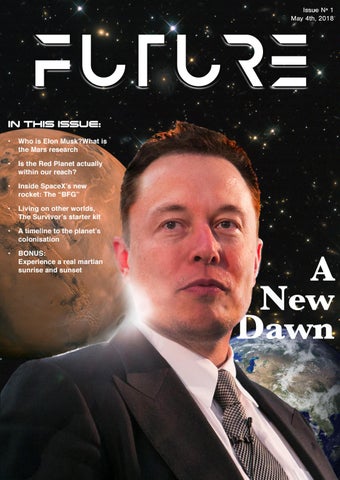
Issue Nª 1 May 4th, 2018
FUTURE IN THIS ISSUE: • Who is Elon Musk?What is the Mars research • Is the Red Planet actually within our reach? • Inside SpaceX’s new rocket: The “BFG” • Living on other worlds, The Survivor’s starter kit • A timeline to the planet’s colonisation • BONUS: Experience a real martian sunrise and sunset
A New Dawn
THE PATH
S
pace’s billionaire founder and CEO just published the plan, which he unveiled at a conference in Mexico in September 2016, titled “Making Humanity a Multi-Planetary Species.” KILLER ATMOSPHERE The atmosphere of the planet Mars is composed mostly of carbon dioxide. The atmospheric pressure on the Martian surface at about 0.6% of Earth’s mean sea level pressure of 101.3 kilopascals. It ranges from a low of 30 pascals on Olympus Mons’s peak to over 1,155 pascals in the depths of Hellas Planitia. This pressure is well below the Armstrong limit for the unprotected human body. THE ARMSTRONG LEVEL The Armstrong Limit is an altitude beyond which nobody can survive. It is the altitude that produces an atmospheric pressure so low (6.3 kPa) that water boils at the normal temperature of the human body. UNSUITABLE FOR LIFE Mars is a planet that shows climate change on a large scale. Although its atmosphere used to be thick enough for water to run on the surface, today that water is either scarce or non-existent. The atmosphere today is also too thin to easily support life as we know it, although life may have existed in the ancient past.
The billionaire entrepreneur has long stressed that he founded SpaceX in 2002 primarily to help make humanity a multiplanet species — a giant leap that would render us much less vulnerable to extinction. Human civilization faces many grave threats over the long haul, from asteroid strikes and climate change to artificial intelligence run amok, Musk has said over the years. He emphasized that he’s not predicting an imminent global conflict, only that one is likely to occur at some point in the future, given humanity’s track record. If and when that next big war occurs, Musk added, it could usher in a planet-wide “dark ages.”
TO MARS
M
STEEP LEARNING CURVE The Falcon 9 and Cargo Dragon have experienced such a tiny number of failures over their short but active existences.
usk isn’t all talk on this topic; SpaceX is developing a huge, reusable rocket-spaceship combo called the BFR, with the chief aim of making Mars colonization economically feasible. Musk unveiled the latest plans for this transportation system at a conference in Australia last September, and he gave a brief progress update at SXSW.
Out of a total of 46 Falcon 9 laun-
ches, approximately 94% have been
complete successes. For perspective SpaceX’s first orbital rocket, Falcon 1, experienced total failures during
its first three launch attempts, for a success rate of 40%.
The BFR BFR is a design by SpaceX for a privately funded next-generation reusable launch vehicle and spacecraft announced by Elon Musk in September 2017. Musk has said the first spacecraft prototype will begin testing in early 2019. A ‘BIG FREAKING ROCKET’ The Big Freaking Rocket is freaking big. At 400 feet tall, it’s the height of a 40-story skyscraper. At 40 feet in diameter, a school bus could fit entirely underneath its footprint. It’s more than three times the mass and generates over three times the thrust of the gargantuan Saturn V—the rocket used in the Apollo mission—which currently stands as by far the biggest rocket humanity has made.
FAST TRAVELS
With BFR for Earth to Earth transport, we are traveling at 27,000 kilometers an hour, or roughly 18,000 miles an hour. During the final descent is where propulsive landing becomes very important. Most of what people consider to be long-distance trips would be completed in less than half an hour. The great thing about going to space is there is no friction, so once you are out of the atmosphere, it will be smooth as silk.
THE ‘BFR’
BFR CARGO/CABIN AREA
The cargo area has a pressurized volume of 825 cubic meters—greater than the pressurized area of an A380. BFR is capable of carrying a tremendous amount of payload. In a Mars transit configuration, since you would be taking three months in a really good scenario but maybe as much as six months, you probably want a cabin, not just a seat. The Mars transit configuration consists of 40 cabins. You could conceivably have five or six people per cabin if you really wanted to crowd people in, but I think mostly we would expect to see two to three people per cabin, or about a hundred people per flight to Mars. And then there is a central storage area and galley and a solar storm shelter, entertainment area, and I think probably a good situation for at least BFR version one.
BFR MAIN BODY
In the center body of the vehicle, this is where the propellant is located—sub-cooled methane and oxygen. As you chill the methane and oxygen below its liquid point you get a fairly meaningful density increase. You get on the order of 10 to 12 percent density increase, which makes quite a big difference for the propellant
load. We expect to carry 240 tons of methane (CH4) and 860 tons of oxygen. In the fuel tank are header tanks; when you come in for landing, your orientation may change quite significantly, but you cannot have the propellant just sloshing around all over in the main tanks, you have to have the header tanks that can feed the main engines with precision.
BFR ENGINES
The ship engine section consists of four vacuum Raptor engines and two sea-level engines. All six engines are capable of gimbaling. The engines with the high expansion ratio have a relatively smaller gimbal range and slower gimbal rate. The two center engines have a very high gimbal range and can gimbal very quickly. You can land the ship with either one of the two center engines. When you come in for a landing, it will light both engines but if one of the center engines fails at any point, it will be able to land successfully with the other engine. Within each engine there is a great deal of redundancy as we want the landing risk to be as close to zero as possible. The sea-level engines are about 330 ISP at sea level. The upper stage engine is 375 ISP.
BFR REFILLINg
For refilling, the two ships would actually mate at the rear section. They would use the same mating interface that they used to connect to the booster on liftoff. We would reuse that mating interface and reuse the propellant fill lines that are used when the ship is on the booster. To transfer propellant, it becomes very simple—use control thrusters to accelerate in the direction that you want to empty. If you accelerate in this direction, propellant goes that way, and you transfer the propellant very easily from the tanker to the ship.
BFR Reusability
It is really crazy that we build these sophisticated rockets and then crash them every time we fly. This is mad. I cannot emphasize how profound this is and how important reusability is. Often I will be told, “but you could get more payload if you made it expendable.” I say “yes, you could also get more payload from an aircraft if you got rid of the landing gear and the flaps and just parachute out when you got to your destination. But that would be crazy and you would sell zero aircraft.” So reusability is absolutely fundamental.