
Do you like
Bennington Magazine?
To vote, scan your answer with your phone s camera or type in the web address below it.
Ashley Brenon Jowett
Editor and Director of Communications
Kat Hughes
Senior Art Director and Designer
David Morelos Zaragoza Laguera
Photographer
Natalie Redmond
Associate Writer
Patrick Bredehoft
Interim Vice President for Enrollment
Management and Marketing
CONTRIBUTORS
Charlie Nadler
Art inspired by the Y2K era, the last time society was on the brink of such drastic technological transformation.
Bennington Magazine welcomes letters, opinions, essays, interviews, thought pieces, fiction, nonfiction, poetry, captioned work samples, and personal and professional updates. Please send submissions, proposals, and story ideas to magazine@bennington.edu. All will be considered. Due to limited space, we may not be able to publish all submissions.
Bennington Magazine is printed on stock that is Forest Stewardship Council® and Preferred by Nature™ certified, and is designated Ancient Forest Friendly™. The cover is made from 30% sustainable recycled fiber and the interior from 100% sustainable recycled fiber.
Dear Alumni and Friends,
This past term, I was given the opportunity to lead Bennington for a short time between its illustrious past and its bright future. It has been exhilarating. I came out of retirement, after having served as president of the School of the Art Institution of Chicago, and back to Bennington after being provost and dean 2002–2010 knowing that I would feel at home, once again, proximate to Bennington’s creative buzz. The cadence of speakers and performances, new projects, admissions events, publications, screenings, and debuts is dizzying in the best sense.
Among the highlights this term was the illustrious return of the Martha Graham Dance Company. The company was founded 100 years ago, but Graham had her breakthroughs here as a part of the Bennington School of Dance in the thirties and forties. Here, dancing on Commons Lawn, she created her most iconic and enduring works; their emotional portrayals and still-relevant questions leave audiences spellbound, even now. To Graham, Bennington was a catapult.
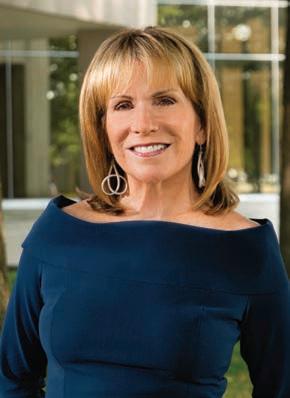
For Bennington, Graham was an infusion of creativity and rigor that authored Bennington’s claim as the birthplace of modern dance. She validated our assertion that collaboration equals brilliance and collaboration across disciplines is akin to magic. And she animated Dewey’s philosophy of learning by doing. These concepts shape us to this day.
Graham and Bennington found in one another an indispensable creative partner. We emboldened one another and became a lasting part of each other’s history. We proclaimed together—to the world— that art is both powerful and necessary.
Having been here for the last six months, I see the spirit of Martha Graham among our alumni, students, faculty, and staf. You use Bennington to its greatest advantage and activate what Graham called Bennington’s “freedom and possibility” every day. Your work continues to shape Bennington, just as Graham’s does.
As we graduate the class of 2026, anticipate the arrival of the class of 2030, and prepare to welcome the next president of Bennington College, I hope each of us nurtures the emboldened self that we found here at Bennington, that we continue our work with that same sense of freedom and possibility, and that we continue to beneft from infusions of the education we found here. And yes, I hope you will commit to making the education you received possible for the next generation of students, as yet unknowing but still hungry for a life inspired by this place.

Elissa Tenny Interim President | Bennington College
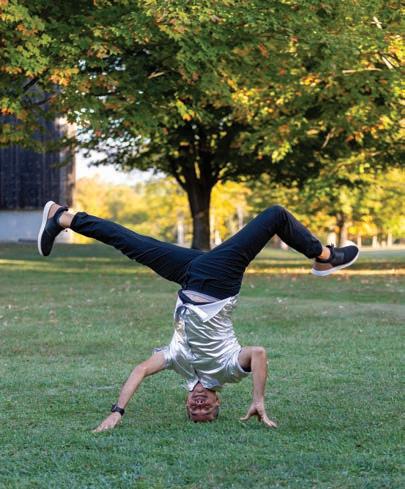
28 | Adnan Iftekhar ’97 while visiting campus to present a lecture titled, “Brain Coaching With AI”
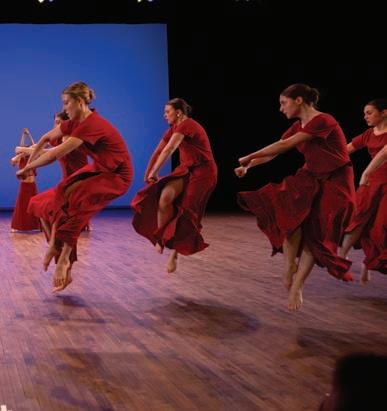
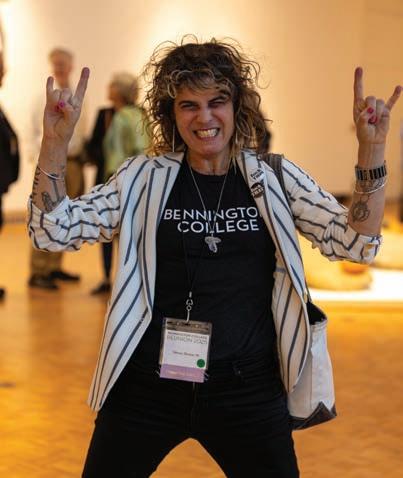
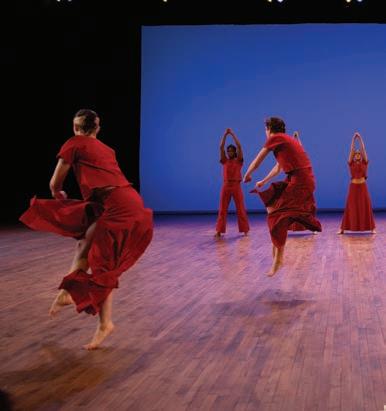
4 | Bennington students perform in Panorama, which Martha Graham 34 | Taliesin Thomas ’98 in Usdan Gallery during the 2025 All-Class Reunion originally created at Bennington College in 1935; Photo by David Morelos Zaragoza Laguera; Used with
of Martha Graham Dance Company
First & Foremost
1 A Century in the Making
On March 28, Martha Graham Dance Company (MGDC) made a long-awaited return to Bennington College. The event series—which included a residency, conversation between Jacob’s Pillow Scholar Emeritus Norton Owen and MGDC Artistic Director Janet Eilber, and a performance—was a highlight of the international Graham100 centennial celebration. For the frst time in decades, the company performed on the campus where Martha Graham developed and premiered some of her most groundbreaking works in the 1930s and reignited the creative spirit that helped establish Bennington as the birthplace of modern dance.
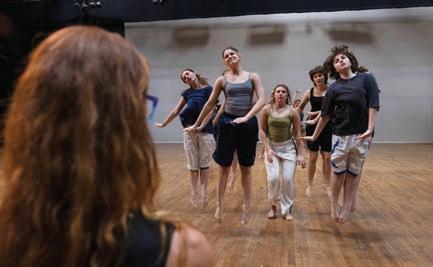
Former principal dancer with Martha Graham Dance Company and current faculty member at the Martha Graham Center Blakeley White McGuire led an intensive residency from March 7–13 to teach current Bennington College BA and BFA in Dance students Panorama, the politically charged 1935 work Graham originally created on the Bennington campus. Under the continued guidance of faculty members Dana Reitz and Cameron Childs, students performed the work during a MGDC performance curated specifcally for the College.
The event series, organized by Music faculty member Michael Wimberly, was supported by the Ford Foundation, with special thanks to former president Darren Walker, as well as the Jerome A. and Estelle R. Newman Assistance Fund and an anonymous donor.
2 Rhythms of Peace
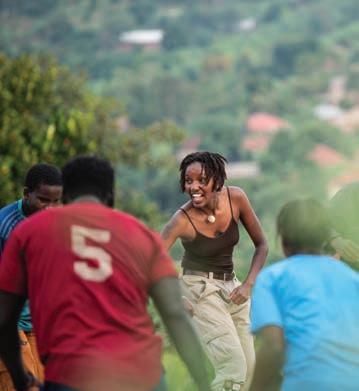
Anuarite Wairimu Gikonyo ’25’s Davis Projects for Peace initiative, “Midundo Ya Amani (“Rhythms of Peace”): Dance for Sustainable Peace in the Grand Lac Region,” appeared on the front cover of the organization’s Projects for Peace 2025 Immersive Viewbook, issued in February.
Projects for Peace is a global program that encourages young adults to develop innovative, community-centered, and scalable responses to the world’s most pressing issues and provides a $10,000 grant for the most promising projects.
Gikonyo’s Rhythms of Peace, created in collaboration with Bertin Kasolene, of Inuka Dance Company, was a transformative dance initiative aimed at fostering meaningful creative collaborations across regional and socio-economic barriers in the Grand Lac Region. It brought together talented youth and young professionals to engage in a specialized workshop module that integrates training in dance and confict resolution.
“Midundo Ya Amani was a reminder of the power of dance as a catalyst for personal, interpersonal, and social transformation,” wrote Gikonyo about her experience. “As dancers, we speak to humans beyond the social barriers of race,
1. Visiting choreographer Blakeley White McGuire oversees a rehearsal of Panorama with Bennington students; Photo by David Morelos Zaragoza Laguera; Used with permission of Martha Graham Dance Company
religion, gender, and language. As artists, we have the power to circulate ideas that challenge the normalised social orders and power structures. Through this programme, we witnessed how creative expression can unlock healing, inspire leadership, and ofer a path forward in a region that has long sufered from confict.”
Follow the project on Instagram @midundoyaamani.
3 Chiang Mai Embassy Project Opens
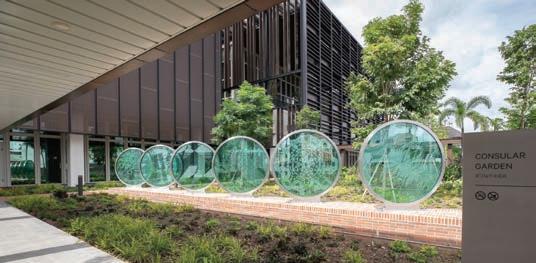
Artwork created by Bennington students and others is now open on the grounds of the U.S. Consulate General in Chiang Mai. Commissioned by the U.S. Department of State Ofce of Art in Embassies, the project ofered students the opportunity to defne a creative process rooted in research, dialogue, and cultural exchange.
A series of glass disks, etched with patterns representing individual voices, encourage visitors to see and hear others’ points of view, while a hand-crafted mosaic depicts voices along with the rivers, mountains, and agrarian landscapes shared by Vermont and Chiang Mai.
4 Rejuvenating the Connection to Frost
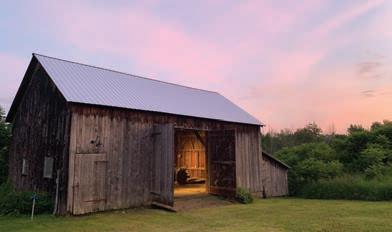
The Robert Frost Stone House Museum, stewarded by Bennington College, is excited to announce the completion of a phase of restoration to its historic barn. Work included the addition of electricity and water to the 1850s structure and enhanced electrical and water access to the small meeting barn on the property.
The Museum received generous support from the Edwin S. Webster Foundation, a Cultural Facilities Grant from the Vermont Arts Council, a grant from the Windham Foundation, and donations in memory of Lea Newman, a local Frost biographer and friend of the Museum.
“We are so grateful for this show of commitment to the preservation of these beautiful and evocative structures,” said Museum Director Erin McKenny. “Through programming in the historic barn, the Museum can further explore Frost’s lifelong connection to agriculture and its relationship to his poetry and strengthen our community’s connection to creative innovation and rural traditions.”
2. Anuarite Wairimu Gikonyo ’25 leads a dance session as a part of her Davis Projects for Peace initiative: Midundo Ya Amani
4. The Robert Frost Stone House Museum’s newly restored historic barn
3. Artwork created by Bennington students and others on the grounds of the U.S. Consulate General in Chiang Mai
5 Your Bennington Bookshelf
Unpacking the Plastic Crisis
Since 2019, Bennington College has housed Beyond Plastics, a nationwide project that pairs the wisdom and experience of environmental policy experts with the energy and creativity of college students to build a vibrant and efective anti-plastics movement. Beyond Plastics is led by President Judith Enck, a former EPA Regional Administrator and currently a Center for the Advancement of Public Action (CAPA) Senior Fellow and Bennington College faculty member.
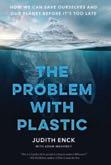
Enck’s book The Problem with Plastic: How We Can Save Ourselves and Our Planet Before It’s Too Late, co-written with climate journalist Adam Mahoney, was released in December 2025 from The New Press.
“Plastic is poisoning our bodies, our communities, and our planet—but this problem is not insurmountable,” said Enck. “It’s the result of choices made by corporations and governments, and that means we have the power to change it. This book is about giving people the tools to do exactly that.”
In The Problem with Plastic , Enck and Beyond Plastics trace plastic’s full life cycle—from its fossil fuel origins to the toxic chemicals released when it’s produced, used, and discarded. The book exposes how the plastics industry has misled the public about recycling and “green” alternatives, while offering a clear vision for systemic reform and individual action.
Cutting-Edge Consciousness
Over his lauded career, bestselling author Michael Pollan ’76 has guided readers through new therapeutic research on psychedelics, offered simple and profound wisdom on how to eat food that nourishes, and explored the reciprocal relationship between humans and plants.
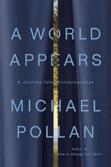
Pollan’s latest, A World Appears: A Journey into Consciousness, appeared in the world on February 24, 2026. Delving into the psyche itself, the book explores the phenomenon that is the subjective self—the way our biological mental workings branch into a unique personal identity and are accompanied by subjective thoughts and emotions.
Writes the publisher, “In Pollan’s dazzling exploration of consciousness, he discovers a world far deeper and stranger than our everyday reality. Eye-opening and mind-expanding, A World Appears takes us into the laboratories of our own minds, ultimately showing us how we might make better use of the gift of awareness to more meaningfully connect with our deepest selves.”
6 Bennington Presents Machinal
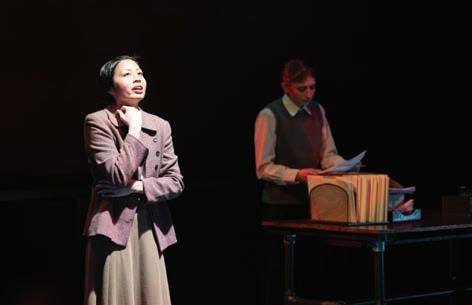
“I wanted this role because I was unsure if I could do it,” said Rosemarie Sison ’25, who played the lead, Helen Jones, in the fall term’s production of Machinal by Sophie Treadwell.
The play focuses on Jones, who is based on the real-life Ruth Snyder, a wife and mother who, along with her lover, murdered her husband in 1929.
“I have always felt that this play, which is a famous expressionist work, by a woman about a woman, was a way of investigating the pressures that were common among women at that time, along with feelings about technology and alienation,” said director and Bennington College faculty member in Drama Jenny Rohn. “In some ways it is specifc to the late twenties; in others, it still resonates today.”
6. Rosemarie Sison ’25 as Helen Jones in Machinal by Sophie Treadwell
7 Custom Clothing, While You Wait
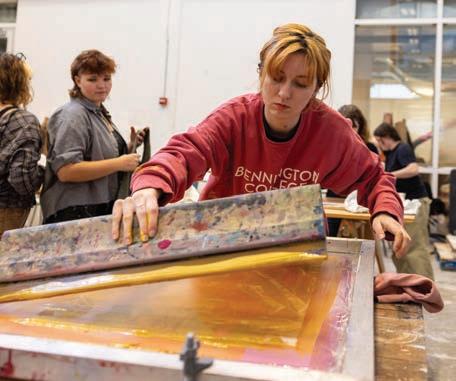
On December 8, printmaking students fulfilled an annual tradition by inviting the campus community to bring a t-shirt to the printmaking shop for original artwork. It’s called T-Shirt Day.
Students, faculty, and staf, with t-shirts from home in hand, circulated around the working artists in the Printmaking Studio until they found a design they liked. In moments, they had the art of their choice printed on their clothing item. Designs included original art by the printers themselves and a photo of a man riding an ostrich.
“T-Shirt Day has always been a study break from more serious projects, a day to relax and focus on the community and the spirit of working together,” said faculty member in the Visual Arts Thorsten Dennerline, who started the event about 15 years ago. “It is generally held towards the end of term when people are starting to get stressed about fnals. I realized back long ago that this was a moment of hesitation, and I wanted to get people fred up. I often see how it can build confdence in a student’s voice and what they have to ofer others.”
8 “Islands in the Sky”: Willa Donovan ’26 and Alpine Biodiversity
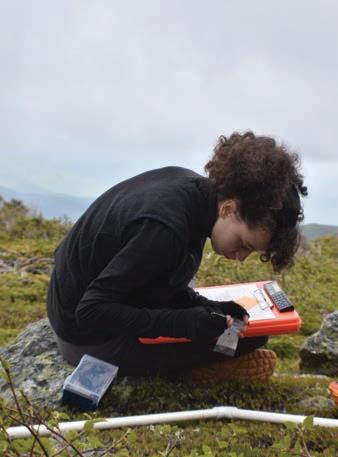
Willa Donovan ’26 joined Bennington faculty member in Ecology Caitlin McDonough MacKenzie and teams from the University of Maine and the University of Vermont as a research assistant and contributed to a multi-year project examining how northeastern alpine plant communities are changing as the climate warms.
Each day, Donovan hiked with others on the team to the mountaintops to collect data on elevation, slope, and aspect; document plant species and percent cover; and install microclimate sensors that measure temperature and soil conditions.
The alpine zones of the Northeast are often described as “islands in the sky” because they are metaphorical islands of habitat that are surrounded by lowlands and valleys.
“It’s incredible to think that these tiny mountain plants can tell us so much about the past—and about our future,” Donovan refected.
Donovan has since presented research at a poster session at the Plant Migration in a Changing Climate Conference at the Maine Coast Botanical Gardens.
7. Bennington’s annual T-Shirt Day
8. Willa Donovan ’26 conducts research on how northeastern alpine plant communities are changing as the climate warms
9 New Equipment for Science
Bennington College invested $400,000 in new equipment for its science classrooms as a part of a $10 million multi-institution grant awarded by the National Science Foundation (NSF) to support the growth of science, technology, engineering, and mathematics education in southern Vermont.
Equipment includes a scanning electron microscope (SEM) for use in geology, gas chromatography-mass spectrometry for use in chemistry, and fast performance liquid chromatography and a plate reader for use in microbiology, in addition to ornithology and ecology resources and equipment.
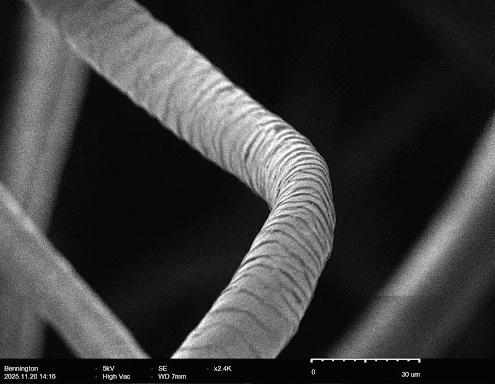
Faculty member in Geology Tim Schroeder taught students to use the SEM during the fall term. Students made micro-scale images of wool, meteorites, strips of black ash tree, and other samples.
Such training on tech is a prerequisite for any career in science, Schroeder noted. “To be a working scientist, you need to know how to use sophisticated analytical equipment. Spending a term working on the SEM provided our students with that unique opportunity,” Schroeder said.
Students from the class presented their fndings at a Science Workshop on February 20. In the coming terms, the SEM and other equipment will be used to inform classes and research based at the campus’s farm and to strengthen understanding of regional agricultural conditions.
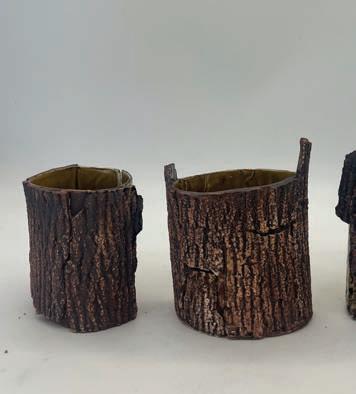
10 “Interdisciplinarity” in a Cup
Studying ecology can be difcult…emotionally. Often the bad news outweighs the good. Caitlin McDonough MacKenzie, faculty member in Ecology, along with Groundskeeper Nate Cornwell, taught a class about ash trees and their formidable pest species, the emerald ash borer (EAB). They asked students to not only learn the ecology, but also to consider the emotional question, “What does it mean to say goodbye to a tree?”
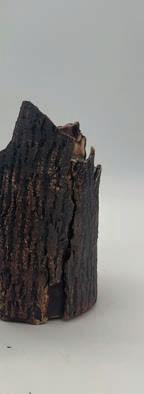
To answer, Hazel Haskovec ’28 used information she learned from MacKenzie, Cornwell, and the guest speakers MacKenzie invited along with her experience in slip casting ceramics with faculty member in Visual Arts Yoko Inoue. Using ash logs Buildings & Grounds staf had cut down due to the invasive beetle, Haskovec created mugs of casts of the actual tree, both its bark and under the bark where the evidence of damage remained in the form of galleries made by EAB.
Despite being admittedly fragile, Haskovec said, “the oldest artifacts that we have are of clay sculptures.” Interested in the diferences between the materials—the ephemerality of wood and the fragile-yet-enduring qualities of ceramics—she said, “my hope is that, somewhere down the line, someone who will likely never see a live ash tree in person will feel the bark and experience this tree.”
9. A micro-scale image of wool made by a student with Bennington’s new scanning electron microscope (SEM)
10. Ceramic cups by Hazel Haskovec ’28, made from casts of ash trees cut down on campus due to the invasive emerald ash borer
11 Celebrating an Outrider
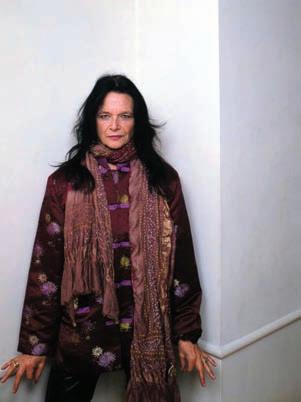
Anne Waldman ’66’s work and life is the subject of a new documentary titled Outrider and executive produced by Martin Scorsese. Directed by Alystyre Julian, the flm is “a kinetic portal into fast-speaking poet Anne Waldman’s transcendent role as a visionary word-worker…. Guided by ancestors of the Beat generation and poetic kinships with radical female musicians, Outrider channels the ancient, bardic tradition and celebrates the thunderous power of poetry.”
Visit outriderflm.com for screenings.
12 At Usdan This Fall
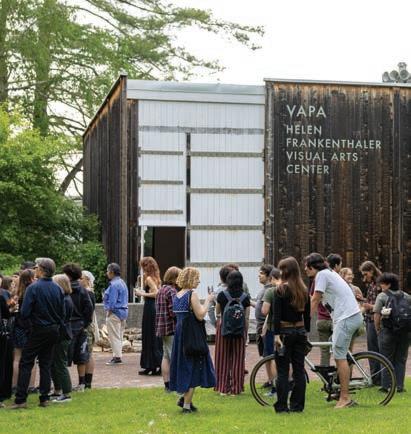
To commemorate the 50th anniversary of the opening of the Visual and Performing Arts Center (VAPA), Usdan Gallery will mount an exhibition tracing the history of the building from its initial conception through its completion and subsequent evolution. Co-curated by faculty emeritus in architecture Donald Sherefin and Garrick Jones ’94, the exhibition will feature archival drawings and photographs among other materials. As part of the exhibition, Sherefin will ofer a 7-week studio seminar for Bennington students, taught at Usdan Gallery. A large-scale model of the VAPA complex will serve as an armature for students to investigate future permutations of the facility. ●
For more Bennington news, visit bennington.edu
11. Anne Waldman ’66; Photo by Greg Fuchs
12. Community members gather outside VAPA
for an opening reception at Usdan Gallery
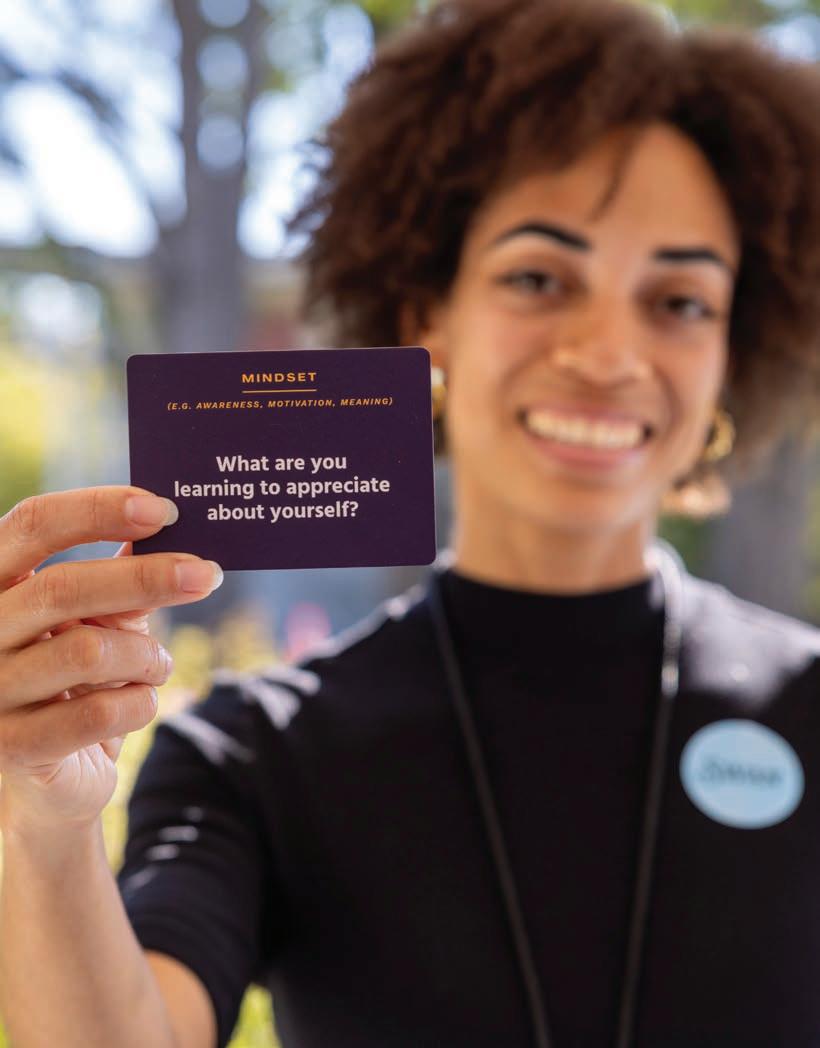

Inspired by her own experiences navigating life transitions and enabled by her education at Bennington College, Dānia Clarke ’15 launched the game Transitions, and her company BRIDGE (which stands for Building Relationships in Diverse Group Environments), to help people feel less alone during life changes: a move, a breakup, or a new job.
“It doesn’t matter what the transition is,” Clarke said. “The feeling we get from change... there’s a bittersweetness to it: a sense of loss and a sense of opportunity. And so it got me thinking about how we can talk about transitions in an approachable way. It doesn’t have to feel so heavy, and we can feel less alone in the process.”
Designed to be non-competitive, Transitions uses a simple format: players draw a set of three cards. Each has a question designed to spark introspection and connection. (“What’s the best decision you’ve ever made, and what made it so?”) Each player also draws an “expansion” card, which takes the conversation deeper. One of them reads, “what does that teach you about your needs?”
Transitions is already being used by organizations like Habitat for Humanity, at nonprofts supporting reentry and transitional services, and other organizations.
“Our collaboration with Dānia and her game has proven to be a valuable and enjoyable experience,” said Stephanie A. Burke, director of the Center of Equity and Excellence in Aviation, who used the game to help lead her team through an ofce move. “Through the game, our team bonded and got to know one another better, which has been instrumental in preparing us for the major transition we’re undertaking. It was a fun, yet meaningful, way to spend our time, and we all felt more equipped and unifed for the challenges ahead.”
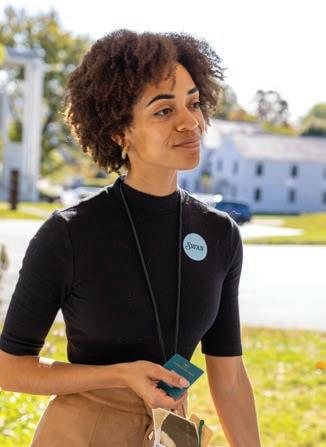
Clarke studied flm and video at Bennington. She often uses the cards in video street interviews with strangers for her Instagram. The approach has pushed her outside her comfort zone but also afrmed how much people crave real conversation.
“I honestly have to give myself a pep talk because I don’t want to bother people or make them feel uncomfortable, especially when I ask to record,” Clarke said. “But they are pretty receptive, especially because I frame it as a way to inspire others. Ultimately, everyone’s story is a source of inspiration for someone out there, and people love to talk about their stories.”
Clarke credits her senior year at Bennington for the ability to advocate for her vision, a skill that now fuels her independent entrepreneurial path. “Thinking deeply, experimenting, and not being afraid to try diferent things defnitely came from Bennington,” she reflected. Now based in Denver, Clarke is fully committed to growing BRIDGE, including building partnerships and offering workshops. Though she currently runs everything herself, she’s open to building a team as the work expands.
“When your heart’s in it, [spending a lot of time on a project] doesn’t feel like a loss of anything,” she said. “It takes time and energy, but I’ve never felt more fulflled in my life.” ●
Bennington Rising COLLEGE STUDENTS
TEAM UP WITH LOCAL HIGH SCHOOL STUDENTS TO IMPACT THE COMMUNITY
hen the latest Youth Risk Behavior Survey results came in for the Bennington area, they revealed something heartbreaking: many young people in the region feel they have few trusted adults in their lives. That sobering statistic might have remained just a number—if not for Bennington College students and a coalition of leaders from across education and the community.
It started with Bennington College student Yasmine Fundi ’25, who was working at Bennington’s Southwestern Vermont Medical Center, a member of Dartmouth Health, for Field Work Term. With encouragement from James Trimarchi, SVMC’s director of planning, and AmeriCorps VISTA member Faye MacDonald, Fundi began to envision a program that would connect local high school students with Bennington College students in a meaningful way. And with that, Bennington Rising was born.
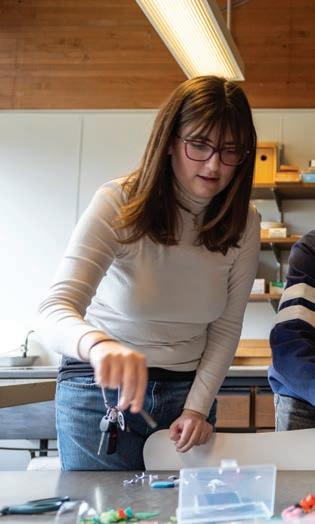
Fundi’s idea found its frst champion in Barbara Alfano, director of Bennington’s First-Year Forum—a course designed to help new students explore their interests, build community, and connect to the world beyond the campus. Alfano pitched the idea to her First-Year Forum faculty members in Chemistry Fortune Ononiwu and in Biology Blake Jones. Both enthusiastically jumped in. Each created a project for their First-Year Forum group that high school students could join.
One group, Kids for Science!, connected college and high school students to explore methods of teaching hands-on science lessons about artifcial intelligence, simple machines, camoufage, evolution, and other topics, while a second group, What’s in Your Food?, challenged both high school and college students to create projects about the chemical compounds in processed foods.
“It was Yasmine’s brilliance that students of diferent ages could bond by working side-by-side on a community project,” said Trimarchi. “Whether it’s doing a research project or designing a science lesson, it gives students a reason to talk and share ideas and a way to connect.”
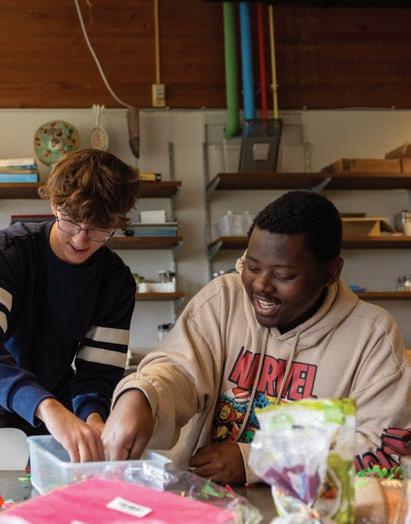
Thanks to support from school leaders, including the Southwest Supervisory Union’s Director of Curriculum Instruction & Assessment Melissa Senecal, the project enrolled about a dozen high school students and arranged for them to make two trips to Bennington’s campus to work on their projects with their college-student counterparts in person. The groups also met online.
The partnership with the Southwestern Vermont Supervisory Union additionally extended to Bennington Elementary School, where teams in the Kids for Science! group delivered the lessons they designed to fourth- and ffth-grade classes in late November.
Meanwhile, the teams in What’s in Your Food? developed and installed pieces for a gallery exhibit displayed for two weeks at Bennington Museum.
Devon Giardini ’29 and Radames Cordero Ramos ’29 teamed up with a high school student named Noa to make an animation about gut health. “We started with a question about kombucha and prebiotic sodas,” said Giardini. “Working together was pretty chill. We met once a week. Noa worked on the script and did the voiceover.”
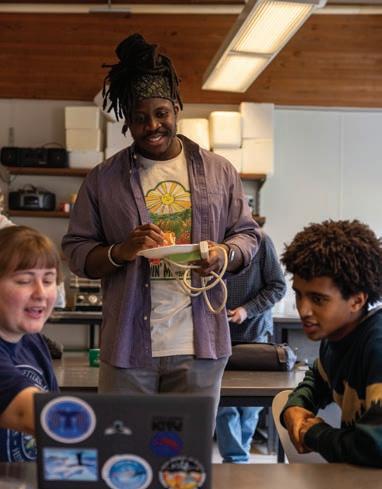
“I am glad we got Noa in our group because he was really into it and on top of his stuf,” said Ramos.
Audrey Kim, the AmeriCorps VISTA member at SVMC, inherited the project from Fundi and brought it over the fnish line. She’s inspired by the people she has found in this community.
“Even if it takes ten times the energy and time and work as their regular day-to-day, they are willing to make that efort,” she said. “It’s been cool to see people go the extra mile knowing it’ll uplift and support the community.”
“When you stand here today and you see the students who may have started out a little indiferent…. Now they are feeling proud that they got to do this work. They are bringing their friends and showing them,” said Ononiwu. “To get the opportunity to have students actively engage with the community, it’s hard work but it makes it meaningful. We plan to keep doing this, and it will just get better and better.”
For Fundi, who is originally from the Democratic Republic of the Congo, Bennington Rising was never only about a program; it is about belonging. “I come from a place where community is how we survive and heal,” she said. “If one person fnds a trusted mentor, one college student discovers their purpose through service, or one child begins to believe that their voice matters, then this initiative has already changed the future. Bennington Rising is proof that when we choose to see each other, we don’t just build projects. We build hope, continuity, and community that feels like home.” ●

The Inimitable Laura-Lee Whittier Woods ’48
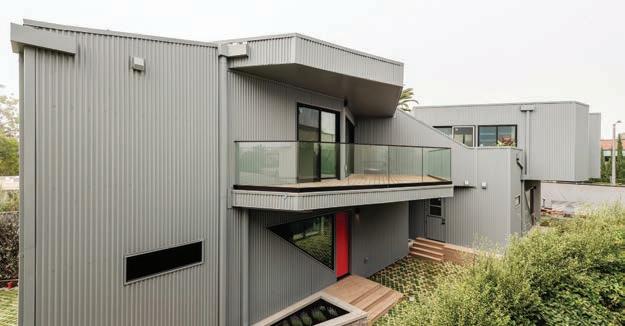
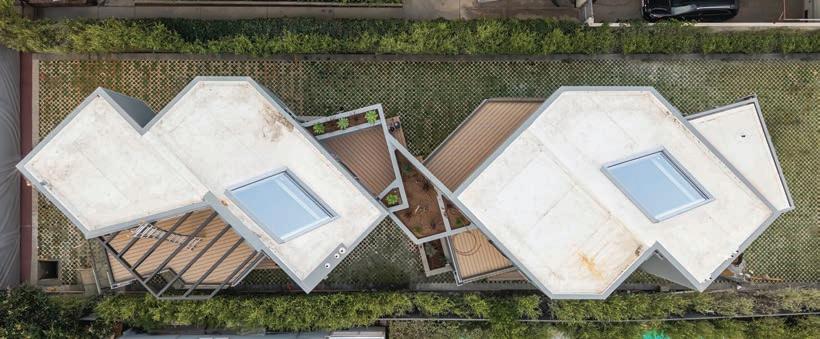
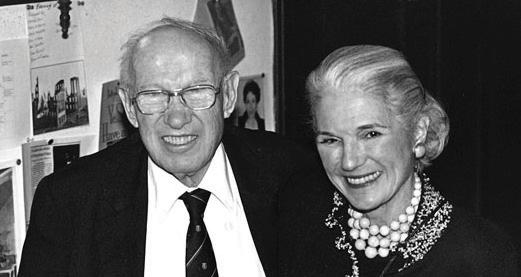
Above: Homes designed by Laura-Lee Whittier Woods ’48; Opposite: Woods with faculty member in Politics and Philosophy
Peter Drucker

On an early summer day, Laura-Lee Whittier Woods ’48, at 98 years old, was thinking about which plants she wanted to move from her home in Montecito, California, to a new site in nearby Venice Beach. But landscape design was just a small part of Woods’s work. On the new site were two homes Woods conceptualized and designed. The project was the latest in her long, visionary, and creatively driven life full of artistry, bold taste, and entrepreneurial verve.
Each home is constructed from three shipping containers arranged on top of each other in an asterisk pattern. Where the units intersect, a large diamond-shaped skylight foods the foating staircase with light, creating a quasi-atrium, and bringing architectural drama to a modest footprint. “They’re small but don’t feel small,” said Woods. “Even if you’re outside on the patio, you feel like you’re the only one on the property.”
Woods was deeply involved in every detail, from the type of toilets to the technology included in each home. During the fnal stages of the build, as drapes were being hung, Woods surprised the design team with insights no one else had considered. “The interior designer was stunned,” said Greg Custer, Woods’s longtime advisor and collaborator of 25 years. “Laura-Lee pointed out things she hadn’t anticipated, and they were so simple and so right.”
This wasn’t Woods’s first foray into inventive housing. Years earlier, she purchased a commercial property on Main Street in Santa Monica from Arnold Schwarzenegger and developed a sixteen-unit apartment complex that, two decades later, still looks brand new. She also pioneered livework housing for artists in Los Angeles—studio lofts with large workspaces below and living quarters above—spaces now inhabited by a variety of creatives and professionals.
“Each project was entirely unique. You think you’ve seen it all, and then Laura-Lee brought in an idea that stunned you— not because it was fashy but because it was obvious in hindsight,” said Custer. “That was her brilliance.”
Woods’s seemingly innate creativity and verve were embraced when she was a student at Bennington. She studied painting with Paul Feeley and sculpture with Simon Moselsio. It was Moselsio who helped her conceptualize her senior project. “He took me into his garage, and we picked out a big log for me to carve,” she recalled. “He showed me how to cut it to look like a sculpture. He was very helpful and very sweet. His wife was the same way. It was a lot of fun.” Woods placed the piece—so admired that Helen Frankenthaler’s sister ofered to buy it—in her Montecito home.
Between Bennington and her later work, Woods wore many hats—model, art collector, style icon, and philanthropist. Her taste for fashion and contemporary art was featured in Vogue ’s August 2002 issue, where her eye for boundary-pushing style earned high praise. “Her collection is very progressive and independent,” said Paul Schimmel, then chief curator at the Museum of Contemporary Art in Los Angeles. “She buys from the heart.... It’s not about fitting in; it’s about what excites her.”
A major supporter of Bennington College for more than fve decades, she founded the Peter Drucker Fund for Excellence and Innovation in 1999. Her transformative gift continues to support scholarships and cutting-edge programs across disciplines. Most recently, the Drucker Fund made possible a student workshop with visionary theater director Robert Wilson. “It still blows my mind that we took part in two short pieces directed by Mr. Wilson,” said José Rubén Ruiz Garrido ’26. “It was a privilege to see his process in person.”
Bennington College’s immediate past president Laura Walker praised Woods for her enduring impact. “Laura-Lee was 98 years old, and yet she was still looking at new trends in housing. That, in itself, is extraordinary—but with Laura-Lee, it was just who she was,” said Walker. “She never stopped imagining, designing, questioning, and creating. Whether it was through her groundbreaking art collection, her unwavering support of education and innovation at Bennington, or her eye for architecture, Laura-Lee brought the same curiosity, style, and conviction to everything she touched. She is an example of what it means to live a fully engaged, intentional life.” ●
Laura-Lee Whittier Woods passed away on July 23, 2025.

Innovatorin-Chief THE PRESIDENCY OF LAURA
WALKER
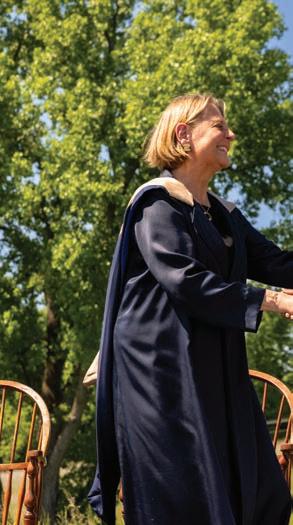
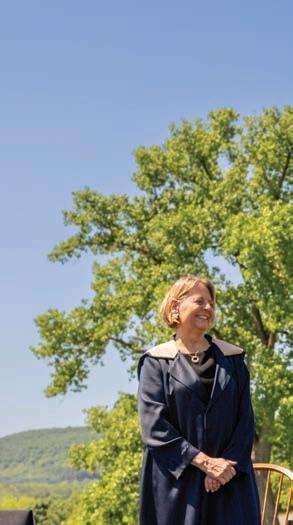
During the quiet of winter Field Work Term in an airy sunlit space on the top foor of the rebuilt wing of the Barn, Bennington College’s senior leaders gathered to toast Laura Walker and her 5 years as its 11th president.
They shared stories and celebrated Walker’s leadership.
“You led with optimism and a genuine belief in what this community can be and will become,” said Alfredo Medina, Jr., PhD, Bennington’s Vice President for Inclusive Culture and Belonging. “It has been an honor and a pleasure to work with you and as part of your leadership team, and I’m incredibly grateful for all you have done for Bennington.”
STUDENTS FIRST
As they gave Walker gifts of appreciation, they asked her about her favorite memories. All related to her personal interactions with students. She recalled the student who dressed as her for Halloween and the one who returned a book that she had borrowed from Walker with a note including favorite passages.
Walker remembers a student who thanked her. “‘I couldn’t do the things I am doing here anywhere else,’ he said.” And a student who showed her a new tattoo, of a chair, which she got after a workshop with famed theater maker and chair afcionado Robert Wilson, who Walker worked to bring to campus in 2024.
“The idea of bringing Robert Wilson here, fnding a generous donor to partner with, getting support from faculty and staf from all over campus.... Everyone worked so hard to bring him here,” said Walker. “And to have it add up to this transformational experience for this student and so many others. She loved it so much she got a tattoo of a chair! She is going to be talking about that experience for the rest of her life. That’s what you wish for.”
When Walker started at Bennington in August 2020, the campus was quiet. The COVID-19 pandemic had gutted the campus’s social scene and left academic buildings empty.
“The students were all isolated in their houses that fall,” recalled Nick Stephens ’77, the chair of the Board of Trustees. “It was not a great way at all to start your presidency. Laura came in and had to fgure it out, with minimal direct interaction, and get people to pull in the same direction. Just starting out that way and getting through it was a major accomplishment.”
Walker came with deep experience in leading transformation. She worked as an Executive Fellow at Yale School of Management and, for more than 20 years, was President and CEO of New York Public Radio, the country’s largest public radio group. There, she increased the local newsroom from 20 editorial staf to 75 and led the addition of radio podcasts, including the launch of 20 award-winning national shows. Titles include some of the most-listened-to podcasts worldwide: Freakonomics Radio, On the Media, Radio Lab, The New Yorker Radio Hour, The Brian Lehrer Show, The Takeaway, Trump Inc., and more. The shows were popular with audiences, aired on stations across the country, and won numerous awards, including ten George Foster Peabody Awards.
“I remember my program director coming to me and saying, ‘There’s this new thing. It’s called a podcast.’ When he asked if he could try it, I said, ‘Why not?’” recalled Walker. “I loved being a leader that people could come to with their wild ideas and receive support in achieving their goals. That risk provided new energy, relevance, and revenue for the organization.”
MENTALHEALTH AND WELLBEING
MENTAL HEALTH
Despite the challenges related to COVID-19 and the cultural upheaval it caused, Walker kept students and their needs at the center of her focus. She is noted for her work in forming the President’s Working Group on Antiracism, which followed the murder of George Floyd. She reinitiated student government with the formation of Student Council and made major investments in Career Development and Field Work Term.
She recruited 21 faculty members and staf for several key positions, including Darcy Otto, faculty member in Computer Science.
“[During my interview,] she asked me about my research, and my answer was not smooth or comprehensible to someone from outside the feld. I realized about a minute in that it was not going well,” Otto said. “She followed up with, ‘Can we approach this from another angle, and can you give me something more concrete?’”
He was relieved to have a second chance. “I thought she’s actually someone who wants to get the best out of the people she works with, and that certainly contributed to my wanting to come to Bennington.”
Among her most notable accomplishments was a shift toward students’ mental health and wellbeing. Dina Janis, who has been a faculty member in Drama at Bennington for the last 25 years, made several pleas to previous presidents. “For at least 15 years, I would go in and meet with whomever the current dean of the college or president was and convey my deep concern about the entire mental health and wellness piece of the student experience, especially the lack of support for faculty navigating students’ mental health crises.” While other presidents and deans had been empathetic, Janis said, “Laura was the frst person who listened and tried to fgure out how Bennington was functioning in that way.”
Initiatives included bringing a researcher to campus to conduct a major study and produce actionable insights and creating a mental health and wellness task force of people from across the college, including students. Walker was able to advocate for the Endeavor Lab Colleges, a consortium of ten small colleges from across the country, to catalyze improved mental health for college students. Walker acted as a prime architect of a multi-million-dollar multi-campus initiative funded by the Endeavor Foundation.
The grant convened several working groups, with members from each institution. Here at Bennington, funding was used to cover a comprehensive reorganization of student wellness services, along with faculty development, staff training, wellbeing activities, a major renovation of the Meyer Recreation Barn, and place-based and curricular enhancements, like an ArtRX program.
STUDENT SUCCESS
Concurrently, Bennington was making great strides attracting applicants and enrolling and retaining students. More than 200 students, the largest class ever, graduated in 2025. Perhaps in part due to the wellness work, the retention rate grew to 88%, which is thought to be an all-time high. (For the sake of comparison, that national frst-year retention rate is 68.2%, according to the National Student Clearinghouse.)
“What stands out to me is Laura’s commitment to student success,” said Medina. “She demonstrated a steadfast commitment to ensuring that students who wanted to be here could call Bennington home while providing them with an experience that made them feel like this was where they belonged.”
Medina also noted that Walker supervised work that attracted Bennington’s most diverse classes. “That just goes to show you Laura’s commitment to making Bennington a global community,” he said.
Focusing on students did not preclude Walker from working to expand Bennington’s influence and secure
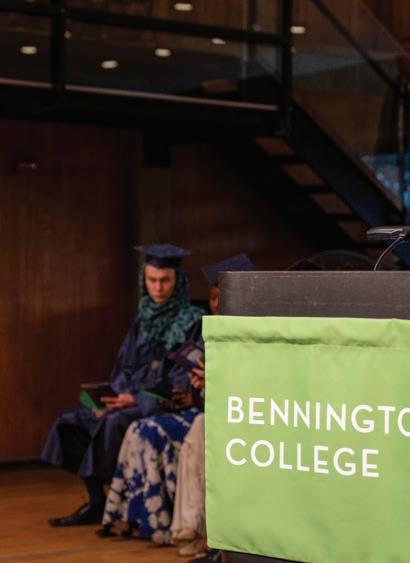
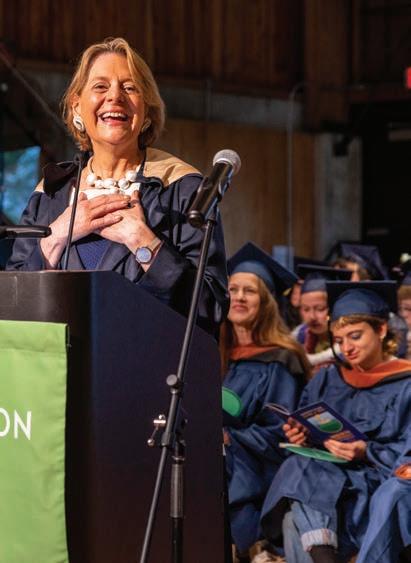
Above: Senior Class Reception, 2022; Below: Commencement, 2024
Bennington’s fnancial future. The tallest order was creating new programs, particularly graduate programs. The frst one was the BFA and low-residency MFA in Dance, once part of University of the Arts in Philadelphia (UArts).
“Laura believes in and understands the arts,” said the UArts former Dean
of Dance and Bennington College’s current director of the BFA & LowResidency MFA in Dance Donna Faye
Burchfield. “I find myself, in all my encounters with her, amazed. She has
endless energy. When it came to the hard work of bringing my students and
faculty to Bennington, you could just tell… She had this confdence that we were going to make this work. She kept
giving me challenges, and I kept pushing myself. She met with me every single
week. She was a real partner.”
Jim Simon ’97, vice chair of
Bennington College’s Board of Trustees, agreed. “Laura sees partnerships and growth in an interesting way. When
“She is jus excellent
at esablishing
relationships and
cultivating them
and matching a
donor’s interes
with a project they
care about.”
-JIM SIMON ’97
UArts closed, there was a lot of gasping and worry about what it meant for places like Bennington,” said Simon. “Laura was sensitive to the people afected by it but also saw it as an opportunity, seized it, and brought it over the fnish line.”
Other new programs followed, including the Master of Arts in Clinical Mental Health Counseling, a new MFA in Screenwriting, and a new 2-year BFA in Writing, which will launch this fall.
BIG IDEAS
As president, Walker loved big gutsy ideas. Nothing was better than when someone, like the program director at New York Public Radio, walked into her ofce with an audacious idea or an insurmountable challenge. “I like to hire people who have vision and give them autonomy,” she said. But more than that, she ofered guidance and support.
Addressing the emergence of AI, Darcy Otto, faculty member in Computer Science, formulated the Bennington Center for Artifcial Intelligence (BCAI). Walker heard Otto out, asked questions, emphasized points of interest, and shared valuable contacts.
“She gave me an opportunity to discuss the idea with senior leaders. She consulted on my proposal to the Board and made time for me to share it with them. By helping me reframe that pitch, she was responsible for bringing the project to life,” said Otto. “BCAI would not exist without her, and this will always be part of her legacy at Bennington.”
The center launched this spring and now ofers teaching support, classes that consider AI from various angles, and a speakers series. The aim is to ensure that students know not just how to use AI, but also how it works and also to interrogate the ethical and environmental implications of the technology.
“Being able to take risks and experiment is central to the purpose of the liberal arts, and Laura understands that,” he said.
Walker also spent signifcant time fundraising and garnered unprecedented support from donors, including some of the largest gifts in the College’s history. Along with staf from the Ofce of Institutional Advancement, Walker raised an average of $20 million per year for each of the 5 years of her presidency, including 17 commitments of $1 million or more and a transformative $16 million gift, the largest in the institution’s history. Walker hired major gift ofcers and a foundation and government fundraiser resulting in awards for curriculum development, scholarships, Field Work Term, Museum Fellows, agriculture and sustainability, and other key projects, in addition to the Endeavor grant for mental health and wellbeing.
“She is just excellent at establishing relationships and cultivating them and matching a donor’s interest with a project they care about,” said Simon. “Her record speaks for itself.”
A PASSION FOR DEMOCRACY
If students were Walker’s top priority and Bennington’s financial sustainability was her second, American democracy was her third. Serving Bennington was about more than Bennington itself; her work here was connected to a deep personal belief in liberal arts colleges, along with public media, as cornerstones of a healthy democracy. It was a common theme among her speeches throughout her presidency.
But she did more than talk about the links between liberal arts and democracy; she brought them to life through initiatives like the seven-week series Saving Democracy Together, which happened in the fall of 2024, in advance of the 2024 U.S. presidential election. With Susan Sgorbati ’72, MFA ’86 and Brian Campion of the Center for the Advancement of Public Action, the series attracted national and regional political players to present to a multigenerational audience of students from across the country. Walker was a supporter of the project and used her past experience in public media as a presenter during the Media and Democracy session.
The people who have enjoyed working with Walker are reassured that she has continued as a strategic advisor to the Board of Trustees. Her focus has been on leading an initiative to open campus to older students.
“Laura was a standout president and is a standout person. She is a friend and professional and someone I will deeply miss at the helm of the College,” said Simon. “I know she will serve the world in ways that make Bennington proud to have had her as its 11th president.” ●
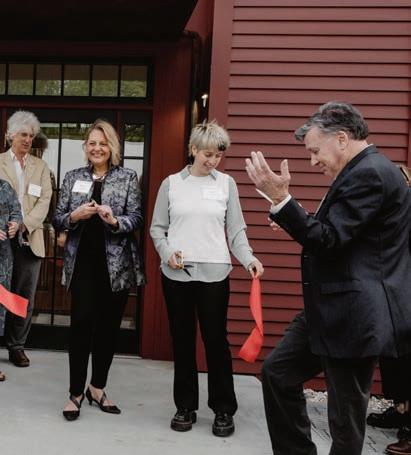
Above: Ribbon-cutting for the newly renovated east wing of the Barn, 2022.
Photo by Molly Hennighausen; Below: Commencement, 2025
CONNECTING THE DOTS DOTS
TWO BENNINGTON
ALUMNI
REIMAGINE GLOBAL HEALTH AFTER TRUMP’S CUTS TO USAID
In January 2025, Eric Ramirez-Ferrero ’85 watched colleagues disappear. “One day their profles were on the website,” he recalled. “The next day, they were gone.”
For 35 years, Ramirez-Ferrero had built a career in domestic and international public health with the U.S. Agency for International Development (USAID). That interest was sparked in a medical anthropology tutorial with Bennington College faculty member Joanna Kirkpatrick.
“Medical anthropology brought my interests in health and culture together,” he said. “That was the frst time the idea of a career in international health was planted.”
Oklahoma to Bennington to East Africa to Washington
Ramirez-Ferrero’s career stretched to a PhD in anthropology at Stanford just after Bennington. His dissertation, which became a book, was on farmer suicides in Oklahoma, where he’s from. After the PhD, he applied to jobs in international development but found that he couldn’t get hired without more international experience, so he returned to school for a master’s in public health. A USAID leadership program for public health professionals without international experience at the University of Michigan placed him in a reproductive health and HIV prevention project in Tanzania for two and a half years; he stayed for seven. Four years in Mozambique followed, where he led maternal and child health initiatives.
After 15 years abroad, he returned to the United States as a technical director on global maternal and child health projects funded through USAID, where he worked for nearly 20 years.
Working on population-level public health projects left him craving the one-on-one human connection at the root of all successful public health projects. He had been quietly preparing for a career pivot, even before Trump’s cuts to USAID became apparent. He had begun applying to social work programs with a vision to serve as a social worker as a “retirement career.”
By late January, after President Donald Trump began
“We graduated with the sense that we can do anything. I sometimes have to remind myself of that brave person I used to be, and apparently still am.”
dismantling the foreign aid infrastructure, Ramirez-Ferrero could “see the handwriting on the wall.” Projects vanished. Staf were laid of in widening circles. He was told his last day would be February 21, 2025.
“It moved fast,” he said. With the next phase of his career already in the works, Ramirez-Ferrero simply asked the colleges where he had applied to switch his application from part-time to full. “The cuts simply accelerated the timeline.”
This past fall, at 61, he enrolled full-time in the Master of Social Service program at Bryn Mawr College’s Graduate School of Social Work and Social Research. He chose Bryn Mawr over ofers from the University of Chicago and Washington University in St. Louis because he was drawn to its small scale and personal attention. “Bryn Mawr warmly reminded me of Bennington,” he said. Now attending full-time while completing an annual practicum, he plans to graduate in 2027.
Ramirez-Ferrero plans to work as a clinical social worker in the United States or return to work abroad, especially with people in “fragile zones,” where war or disaster causes widespread trauma and there are no mental healthcare professionals available. “If international development rises from the ashes,” he said, “I’d like to bring clinical skills in trauma-informed mental health to those settings.”
-ERIC RAMIREZ-FERRERO ’85
Bennington, he said, instilled that audacity. “We graduated with the sense that we can do anything. I sometimes have to remind myself of that brave person I used to be, and apparently still am.”
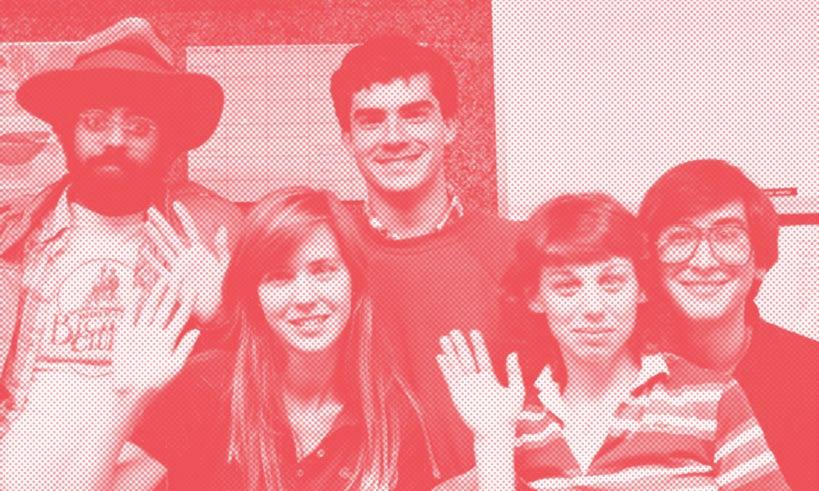
Bennington senior science cohort signing off. Left to right: Dushyant Pathak ’85, Lucia Paronetto Caruana ’85, Eric Ramirez-Ferrero ’85, Bethany Stanley ’85, and David Kirshenbaum ’85.
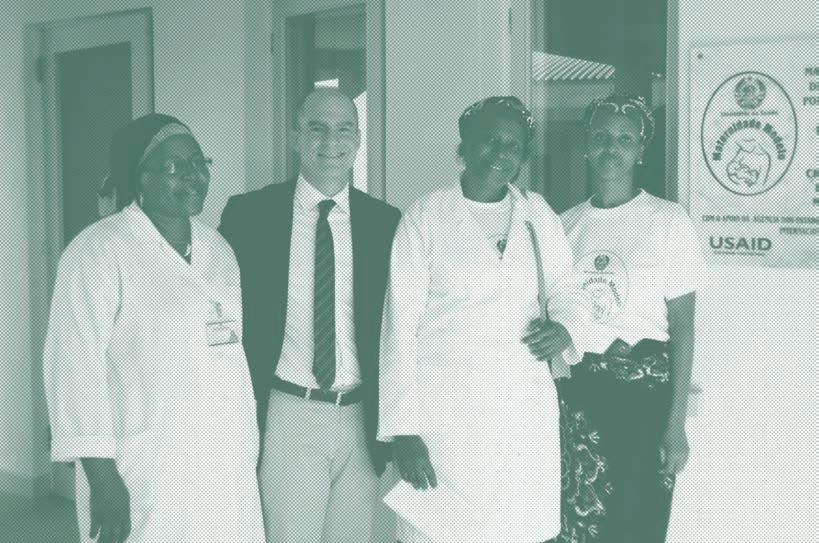
Ramirez-Ferrero (second from left) with colleague Dr. Ernestina David (second to right) and two hospital nurses
FEATURES at a Model Maternity inauguration in Mozambique.
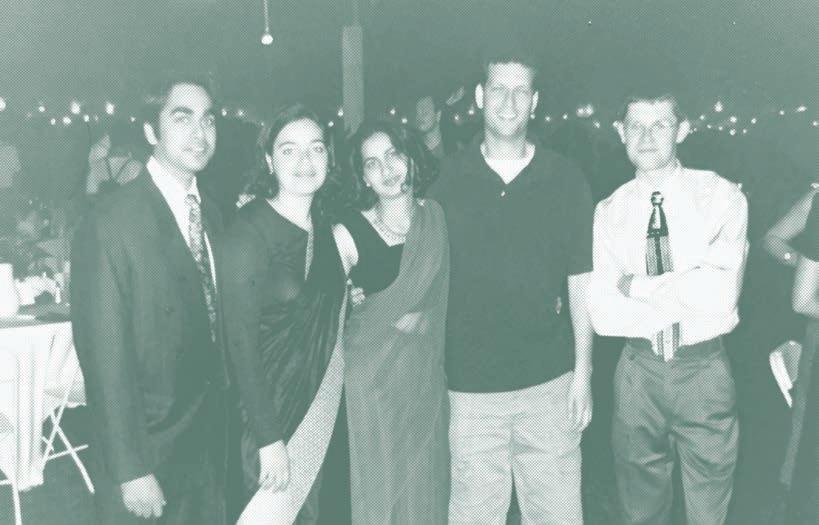
Left to right: Ravi Runial ’99, Kachina Chawla ’99, Shazia Bakar ’00, Justin Stone ’96, and a visiting friend at Bennington College
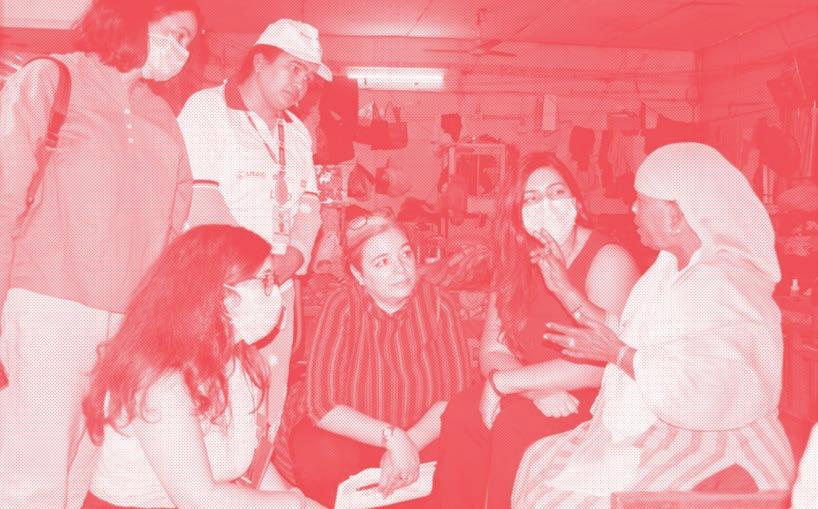
Kachina Chawla ’99 (center) visiting a USAID funded program in New Delhi that helped people access tuberculosis treatment in a homeless shelter.
Making Healthcare
Work for Everyone in a New Way
Thousands of miles away, another Bennington alum, Kachina Chawla ’99, was also watching her life’s work unravel.
As a health systems strengthening division chief for USAID/India, she had spent 7 years building programs focused on equity, reducing outof-pocket health expenditures for the poor, addressing gender disparities, and helping India’s sprawling health system adapt to climate stressors.
tocomewhileallthedespairwassetting in, especially in health. We had some projects that were canceled whilst others were being preserved. And so you think to yourself, ‘Well, they’re going need people to run the ones that they are keeping….’”
Beyond the mixed messages, Chawla and her colleagues endured name-calling and accusations of fraud. Elon Musk said that the agency was not an apple with a worm in it but “a ball of worms.” He publicly alleged that $21 million in USAID funds had interfered in Indian elections. The political fallout was swift. India’s government blacklisted USAID. Parliamentary inquiries followed. The team knew that no such money had come to India, but contradicting the administration as a public servant was not an option.
“It was a double whammy,” she said. “Your host government doesn’t want you here and your government (the U.S.) says it doesn’t need or value you or the work you do. It was traumatizing.”
Connecting the Dots
But like Ramirez-Ferrero, Chawla did not despair or wait for instructions. Between the notice and her termination, and inspired by her own mother’s dementia diagnosis, Chawla began researching home-based care models in India, where multigenerational families, rather than nursing homes, shoulder responsibility for care and where hospital visits can be chaotic and traumatic for elders. The deeper she looked, the more she saw gaps not only in medical care, but in cognitive and emotional support for elders and their family caregivers.
“That ability to transcend felds is Bennington’s infuence.”
-KACHINA CHAWLA ’99
“We helped the Government of India ensure its health system worked for everyone, asking who was being left out and what could we do to give them timely access to quality healthcare,” Chawla said. Her last day was July 1, 2025. Despite having been given notice in March, it still came as a shock.
“The thing about working with the U.S. government is that you’re used to political fuctuation. You’re told that a reduction in force is coming. At the same time, you’re being asked, ‘Can you draw up plans for expansion of global health security?’ So we had these little drops of hope that continued
“Development economics often prioritizes youth, productivity, and return on investment,” said Chawla. “Elder care is entirely overlooked, yet it is a major area of need in India.”
With the multidisciplinary education Chawla received at Bennington, she began collaborating with neuroscientists, music therapists, artists, and technologists, including teams in Brazil and Canada. She points to organizations like Room 217 Foundation, which curates therapeutic playlists calibrated to heart rates, and startups developing AI tools that can predict agitation in dementia patients 17 minutes before it escalates. There were so many tools that in the hands of caregivers could signifcantly alter the experience of someone living with dementia and their loved ones.
Out of that research, Chawla founded Lighthouse Health Solutions and expanded into aging. Its frst “employee” was an AI agent named Lumi. In addition to her and her partners, the company now has two additional fulltime human employees and a network of 17 consultants (many of whom also lost their jobs with USAID’s closure).
Lighthouse Health Solutions is working with the underemployed youth population across India to uncover new ideas to enable aging with agency. It is launching a “grand challenge,” which will provide young entrepreneurs who identify solutions in cognitive and emotional care for elders with access to capital and connections they need to build their capacity to expand. Lighthouse aims to incubate two or three promising solutions.
“What Bennington taught me is how to connect the dots,” she said. “Venture capital, youth unemployment, art, and technology…. That ability to transcend felds is Bennington’s infuence.”
Ramirez-Ferrero refected, “Bennington students seem to absorb an unusual confdence from the environment. It is in the College’s DNA: ‘If I can imagine it, I can do it.’ I am so grateful that has stuck with me.” ●
ADULTS IN THE ROOM
During a 45-second pause in an interview about artifcial intelligence (AI), Adnan Iftekhar ’97— self-proclaimed AI Humanist with 25 years of experience at the intersections of education and technology, including with frms like Google—created and shared an audio fle. It was former U.S. President Barack Obama delivering a speech.
“The American justice system has come under attack, and we need better representation,” says Obama. “Therefore, I am endorsing Adnan Iftekhar as the next representative who will change the system from within. Please give him your utmost support.”
The audio is fawless.
“If I can create that in about 45 seconds, with the tools that I have at my disposal, what can nefarious folks do?” asked Iftekhar. Using generative AI, anyone can create an audio fle and even video flled with misinformation and present it as real. Scammers, who once relied on grandparents not recognizing the sound of their grandchild’s voice, can now spoof the voice. Those are far from the only risks.
THE RISKS
Environmentally minded Bennington students are upset about the natural resources being used to power AI data centers, which are sometimes said to need vast amounts of energy, water, and rare minerals and to create technological waste. Other concerns include AI companies placing data centers in economically depressed regions, whose residents are least capable of fghting the pollution and water scarcity they may cause. However, AI advocates claim that the environmental impact has been exaggerated.
Economically minded people worry that AI will replace workers and lead to vast unemployment. They worry that the investment bubble AI is causing will lead to volatility in the stock market and serious economic upheaval. Many experts claim that AI founders are overinfating how close they are to achieving general artifcial intelligence in order to raise outsized investments in the technology.
People are worried about generative AI using words, images, and even music from genuine works of art to create
new works without compensating the original artists, writers, and musicians. “AI slop”—quickly produced, low quality content—is already choking the Internet, while human artists struggle. And, because AIs are trained on human-produced content, there is a risk of perpetuating harmful biases.
On top of that, real functional human relationships are being replaced by AI companions, who, it should be said, cannot loan you a cup of sugar or feed your cat when you’re on vacation. At least not yet.
“The way that it’s being used right now is pretty harmful in a wide variety of ways: to artists, workers, and then to the environment,” said Andy Farrell ’26, who studies AI and ethics at Bennington. “Communities are being actively harmed by where they place data centers. It is a big social issue, the way it’s currently being used.”
From an academic perspective, faculty members are worried about students using AI to farm out their thinking. Small classes and the
expectation of participation make learning at Bennington less fakable than at many other colleges, but a great classroom experience alone doesn’t solve the problem. Faculty members still rely on essays and reports to challenge students and assess their progress.
“AI has knocked the pins out from under some of the traditional evaluation methods,” said Darcy Otto, Bennington College faculty member in Computer Science. “It’s removed the ability to assign some tasks because you can’t guarantee the integrity of those assignments. If students are using AI and not writing and thinking for themselves, they are not learning.”
Adnan Iftekhar is convinced that the negative aspects of AI are inevitable. “I tend to be a lot more optimistic than other folks, but I do think that there are a lot of dangers ahead,” he said. “The speed at which China, the United Arab Emirates, France, Albania, and the U.S. are going…it’s just a race. And none of this is being done, except maybe in China, with government control. So it’s almost useless to talk about the dangers, because the dangers are there and can no longer be avoided. The point of no return has already been reached.”
ALUMNI, FACULTY MEMBERS, AND STUDENTS IN THE ACTION
Farrell is uneasy about the corporate-, proft-driven path AI has taken but is also convinced that certain types of AI can do good, especially in the medical feld. In 2024 and 2025, Bennington students have worked with Southwestern Vermont Health Care as a part of Field Work Term. One group created an AI program to predict when patients would need a follow up visit. Medical professionals could use the prediction to provide more attention and care during an initial visit, so the patient wouldn’t need to come in again. That could improve care and decrease medical costs.
Agentic AI completes rudimentary tasks, like summarizing emails and suggesting responses. Many, including Iftekhar, are excited by the ways that AI will provide us with more time for human interaction and connection. He and others, including Jacob Bielecki ’09, have built businesses to consult companies and nonproft organizations about how to optimize their operations with AI.
“At a typical desk job, you’re spending 70 percent of your time in front of a screen and 30 percent of your time with humans: clients, colleagues, and customers,” said Iftekhar. “I want to switch those numbers around so you’re only spending 30 percent of your time in front of a screen and 70 percent of your time with colleagues and customers, and hopefully, also with your family and friends.”
Bielecki founded beneAI in 2025. He helps resource-sensitive nonproft organizations use AI to improve operations ethically. He has also helped foundations implement AI solutions to automate the intake of grant applications, which have increased dramatically with the use of AI.
“Nonproft leaders want to use their brains, get more out of what they have, and realize their missions as much as they can,” he said. “We look at the opportunities and weigh the risks and ethical concerns. I guide them through that and determine if there is a responsible way to use these new tools.”
Trustee Bryn Mooser ’01 is founder of Asteria, an artist-led generative-AI flm studio. Late last year, his work was profled in Vanity Fair. He is particularly interested in using AI in animation.
“It’s not like now we don’t need a stop-motion artist,” Mooser was quoted by Vanity Fair . “It’s just now he can do more.”
Faculty members in Cultural Studies and Languages Noëlle Rouxel-Cubberly and Ikuko Yoshida have been examining whether or not AI helps reduce the fear of reading and writing among introductory-level language
students. They presented at the Northeast Conference for Teachers, for Languages, for Cultures in February.
Talha Chowdhury ’26, who has worked for Amazon and Autodesk, the $50 billion dollar company that makes AutoCAD, has founded a company that uses AI to help students and researchers work more efciently. Flowsurf is a new subscription-model interface currently raising investment capital. It incorporates a chat system into an infnite canvas specifcally for researchers and students, who often complain about the need to have too many tabs open.
“That is the core problem we are trying to solve. They have all of these tabs open and none of them talk to each other. That is unproductive,” Chowdhury explained. “Rather than being trapped in a linear chat, you can import a PDF of a research paper and chat with the PDF. We are reinventing the ways we use ofce products. Our ultimate goal is to make this product as popular as Google Docs.”
Farrell wants people to take a nuanced perspective when evaluating AI.
“AI technology itself isn’t necessarily a great work of evil,” said Farrell. “The ways that it’s being used and distributed and the promises that are being made are the problem with it.”
So how do you get the benefts of AI while minimizing the negative efects?
“We need some adults in the room,” said Farrell. “We need people who have the technical knowledge, like Darcy Otto, to say ‘This is not working. They’re doing these things that are acutely harmful. They’re lying about what they can accomplish.’”
BENNINGTON’S ANSWER
Enter the Bennington Center for Artifcial Intelligence (BCAI). “That’s why I’m here and working collaboratively to start this new Center; I don’t think that a ‘let ’er rip’ approach is a good one,” said Otto. “A liberal arts college like Bennington is a great setting. We think about difcult problems, and we’ve got all the pieces; we’ve just got to assemble them and start doing serious work on how we’re going to respond to AI and how we’re going to use it.”
Otto presented the initial idea of the Center to the administration in the early spring of 2025 and then spent the spring and summer gathering input from faculty members in all discipline groups. The Board of Trustees approved the project with a $79,000 investment from an outside donor in June. Otto continued to work on the idea with additional faculty members and, over the summer, went to Europe as a part of a Whiting fellowship to study AI in the educational context.
The next step was to identify an advisory board for the
center, which includes Otto, Farrell, Faculty Member in Music Cristian Amigo, Technical Instructor in Video and Design/Animation John Crowe, Faculty Member in History
Carol Pal, Faculty Member in Science Tim Schroeder, and Dean of the Library Oceana Wilson. “These six people are the custodians of the Center,” said Otto. Throughout the fall, they worked on initial principles and initiatives. “We’re looking at our pot of money and trying to fgure out how to squeeze the most we can out of it,” said Otto.
The core initiative is technical. It consists of three classes. The class Prompts, Pixels, and Power will help students understand how AI works. A second class, AI Ethics,
emphasizes critical thinking, interpretations, and values. (So you can do this. Should you be doing it? How should you be doing it?) The third class, AI Algorithms, covers application and exploration. (So you’ve got AI. What can you make it do for you?)
“I don’t want to teach the students the ‘how to’ part and allow them to start harnessing this and using it before they have the awareness of how AI does things and whether it ought to,” said Otto.
The Center hopes to engage faculty in ofering classes that address the AI revolution and its impacts in diferent felds. Otto stresses that a multidisciplinary liberal arts college is the best place to do this work.
“It can’t live entirely within Computer Science because studying AI pulls from all parts of the campus,” said Otto. “What are the sociological ramifcations? What are the environmental ramifcations? What are the consequences for creativity? What are the economic ramifcations? All these different elements go way beyond just ‘can you make it run?’ My hope is that we’ll have a slate of courses starting in the fall of 2026.”
Beyond classes for students and guidance for faculty members, BCAI aims to make recommendations for staf and the administration of Bennington College, including how to increase efciency in a responsible way. The Center also hopes to form partnerships with those using AI in Vermont and the surrounding region, to host a speakers series or symposium, to ofer an AI Summer Institute, and to look at governance.
“We need to inform people about how we should use AI and what policies should be in place,” said Otto. Otto is equally excited and dismayed that other colleges are not looking at AI in this way.
“AI centers set up in places are generally technical. They focus mostly on how to make it work, and then they pull in a lot of money from companies that have a vested interest in
selling you AI technologies,” said Otto. “But we need to go beyond that if we’re going to make a serious mark.”
“Bennington is a place with people who are so passionate about doing right by the world and the people in it. I think that there ought to be more people trying to fgure out how to use AI technology for good because it’s obvious that AI is the next step in terms of technological progression,” said Farrell. “If we just let the people who are currently researching and using it be the only people who are researching and using it, we’re never going to be able to take hold of it and use it in an ethical way.” ●
For a story about Bennington’s AI policy for students and how faculty members are handling the new educational environment, visit bennington.edu/ai-teaching
For information about Bennington’s Summer Programs, including AI, Creativity, & Ethics, visit bennington.edu/summer-programs
Have you ever gone to an event that was so good you never wanted it to end? For many, the 2025 All-Class Reunion, October 3 5, 2025, was that event. How can we tell? Alumni are at the center of two major initia tives that were born at Reunion and are con tinuing on in expanded forms.
The success of both the Life After Bennington and Speed Networking sessions gave Director of Alumni and Constituent Relations Shay Totten ’91 the idea that he needed to fnd ways to make connections between students and alumni more regularly.
“Students are the best ambassadors for alumni reengaging with the College,” said Totten. “When we bring students and alumni together, I don’t have to do much of anything at that point. They click. And meeting alumni while in college is our best hope for keeping students connected after graduation.”
Read on for Reunion highlights and more about the new initiatives.
BY ASHLEY BRENON JOWETT
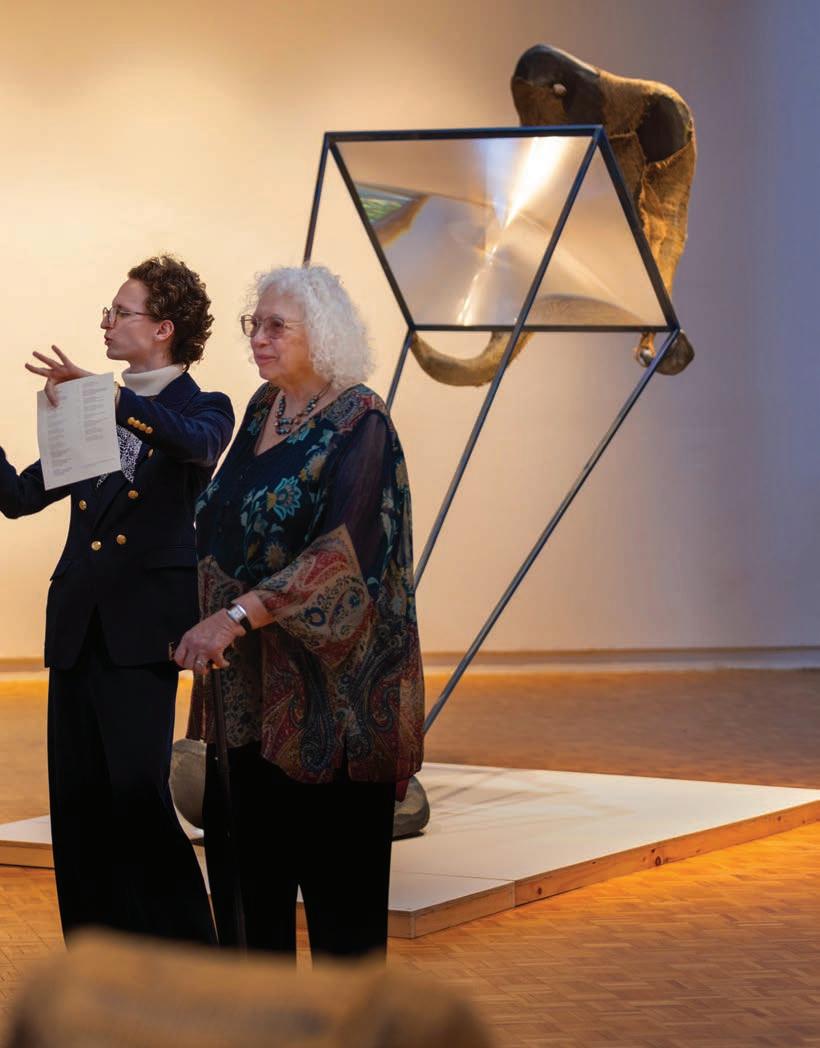
Alumni in Usdan Gallery view
Overbody: New Works by Sreshta Rit Premnath during Reunion weekend 2025
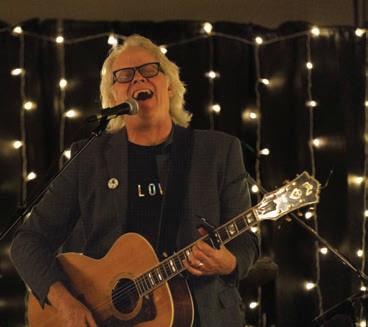
WINTERPILLS CONCERT ▼
Winterpills, fronted by Phillip Price ’85, previewed their eighth full-length album This Is How We Dance on Saturday night. The band formed in 2003 in Northampton, MA.
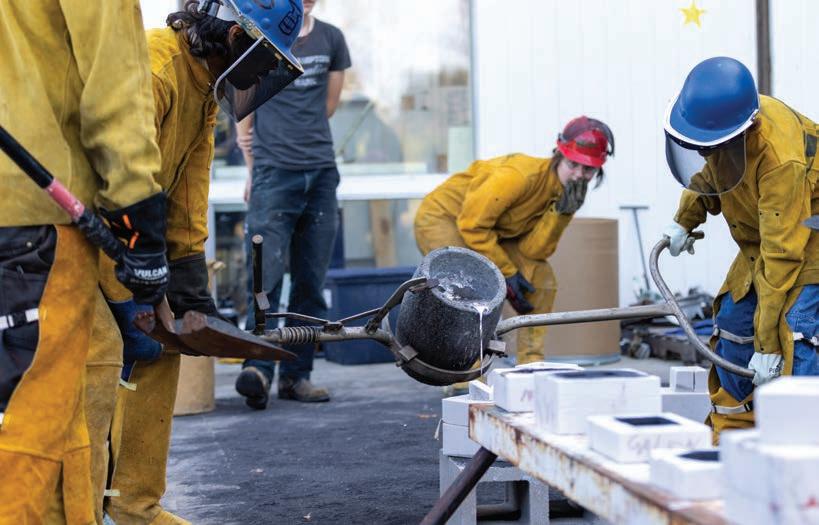
ALUMINUM POUR ▲
Alumni, students, families, and staff shared in the experience of molten aluminum being poured into sand molds prepared by students in the sculpture course Examining Space. Some early attendees were able to make a mold for themselves.
While our immediate goal was to have a successful and safe pour, the most exciting and rewarding byproduct of this experi ence is observing the self-confidence built within the students. To sweat and be nervous and to create with one another is like nothing else,” said John Umphlett, faculty member in Sculpture.
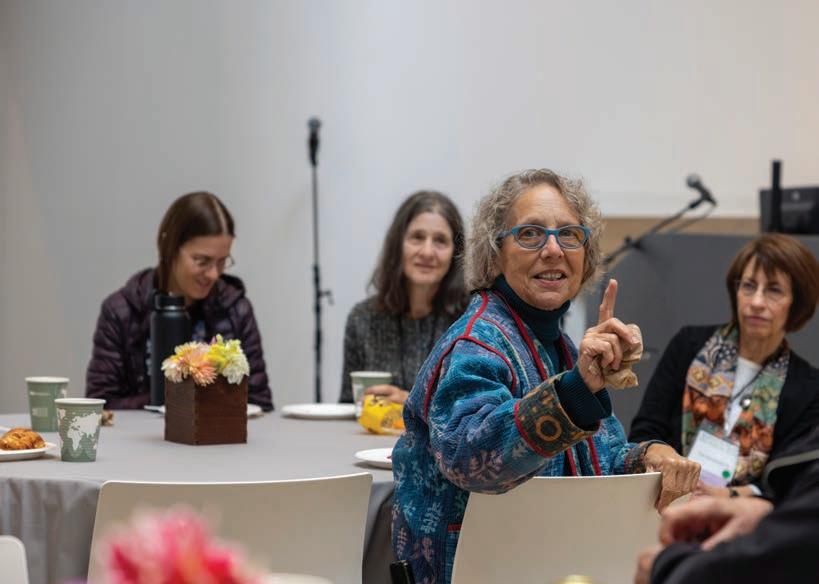
MILESTONE BREAKFAST ▶
Lisa Kraus ’75 came back to campus twice since grad uation, both times to dance. The last time she visited, before All-Class Reunion, was 38 years ago. “So I walked into Commons Theater, what was Commons Theater, which is the space where I spent most of my time at Bennington, and immediately saw how vast the ren ovation had been, how light and open the space is, and how accommodating. But at the same time, I was heartbroken because it had been a place where there were magnificent teachers working: Judith Dunn expressing a beautiful phrase across the floor and Bill Dixon playing the piano in the corner.... I just experi enced the fullness of the past in the present,” she said.
ALUMNI DINNER ▼
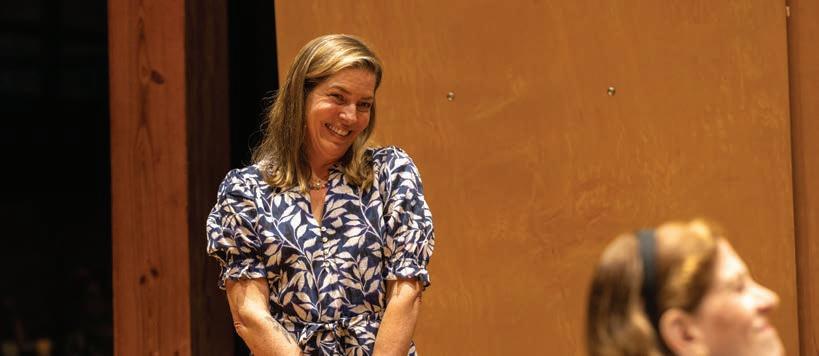
The Hudas Schwartz Liff ’47 Award for out standing volunteerism was presented to Mary Bucksbaum Scanlan ’91. She has served on the Board of Trustees since 2017 and is co-chair of Benningtons innovative Art for Access initiative.
“Mary holds a deep commitment to strength ening the alumni network, said then-President Laura Walker during the pre sentation. “She is con stantly seeking ways to connect alumni to each other throughout the years and to connect Bennington s work to the wider world.
24-HOUR PLAYS ◀
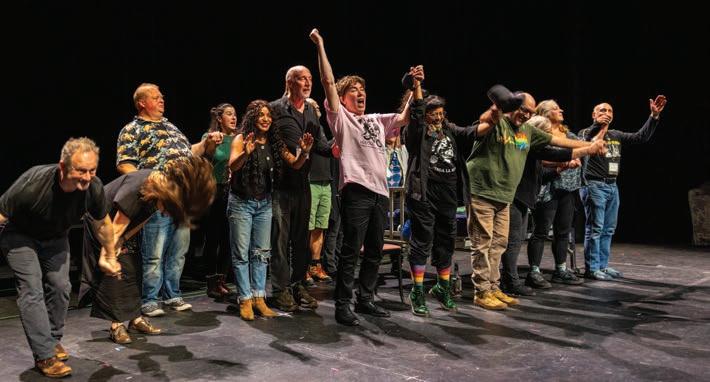
24-Hour Plays, incredible performances—written, directed, and acted by alumni and friends within the course of just 24 hours—made their debut on campus! Approximately 30 alumni and 10 stu dents participated. All proceeds supported the Spencer Cox ’90 Field Work Term Fellowship for Student Activists and the Nicky Martin Memorial Scholarship for Performing Arts.
MINDFUL RHYTHMS FOR ALL ▲
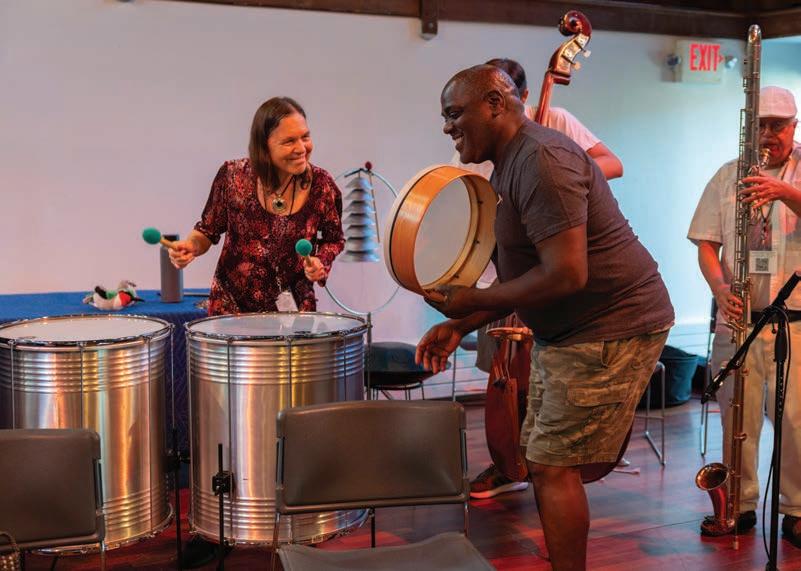
Bennington faculty member in Music Michael Wimberly and percussionist Sarah Tenney ’71 led participants in a creative, meditative musical experience during Mindful Rhythms for All on Sunday morning. Steve Redmond ’71, who studied literature, along with music, when he was a student, said, “Playing again was great. It was so open and friendly.” said. He enjoyed meeting fellow alumni, or non-resident students, as he calls them. “Even after you graduate, there’s something of Bennington that you take with you and continue to use. I never stopped learning in the ways Bennington taught me.”
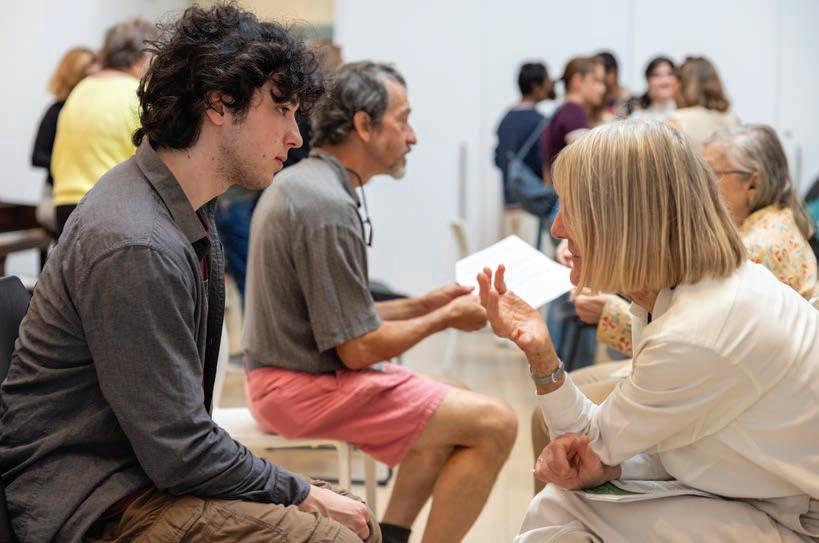
SPEED NETWORKING ▶
“The speed networking event was far more popular for both students and alumni than I anticipated,” said Director of Alumni and Constituent Relations Shay Totten ’91. “It opened the possibility for students to see alumni out there as having value for mentoring them when they leave Bennington and to imagine what’s possible for them after they graduate. For alumni, it gave them the sense that they still have a lot to offer students in terms of how to take a Bennington education and make it work in the world.
Redmond attended. He has had a varied career as a news journalist, boatbuilder and designer, columnist, chef, director of software development, and artist. At the Speed Networking event, he could sense students’ nervousness about finding a job after graduation.
He wanted them to know that a “loose approach” to life can work as well. “Don’t be afraid. You already have this knowledge in these fields. It may take some time to get your bearings. Get some experience. You will likely work in the field you studied eventually.
Abraar Arpon ’26, who studies Computer Science and Public Action, attended and met several helpful alumni, including Jeff Williams ’91, Head of Global Security at soft ware company Avast.
“I told him what certifications I was doing, and he guided me toward others I should look into,” said Arpon.
Another alum prompted Arpon to consider how he could put his skills to work for law firms who need help cre ating data-infused visuals for their clients to use in cases. “He encouraged me not to limit myself. The interactions broadened my idea of how I can use my skills.
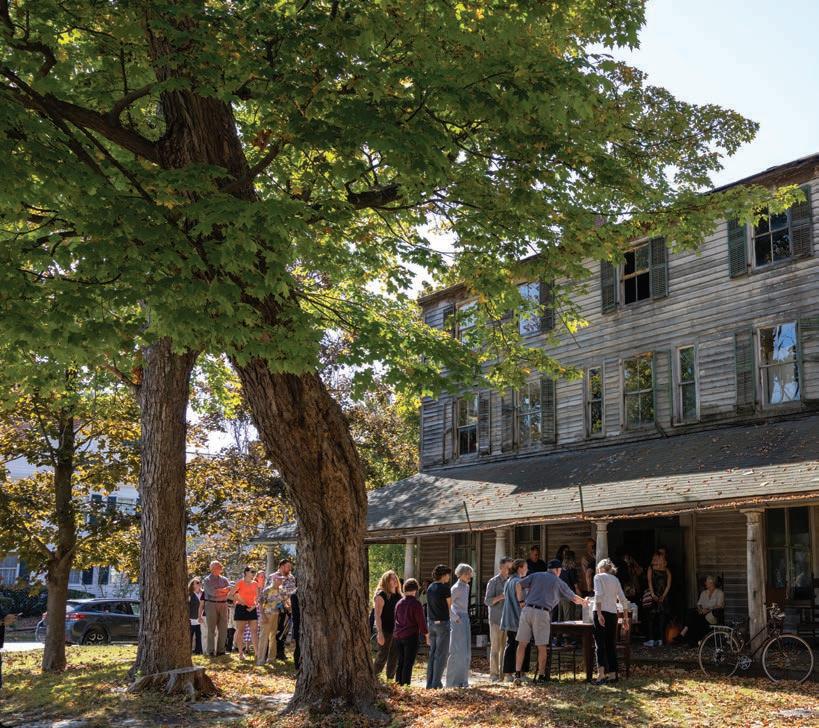
WALLOOMSAC INN TOURS ◀
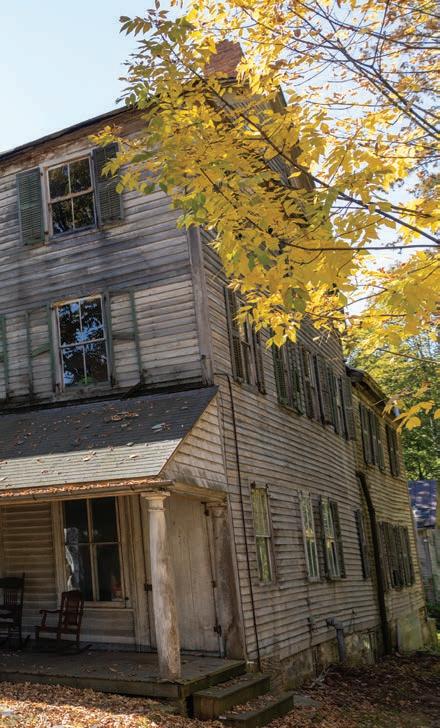
On Saturday afternoon, Rafe Churchill ’91, P ’25 ’28 and his wife and business partner Heidi Hendricks, of architecture and design firm Hendricks Churchill, shared their architecture and design work. This workshop, titled Distinctly American, was accompanied by photographs from their book by the same title. On Sunday, they offered tours of their latest project, a renovation of the historic Walloomsac Inn in Old Bennington. They have created a hospitality brand and plan to restore the property into a functioning inn, antic ipated to open in 2028.
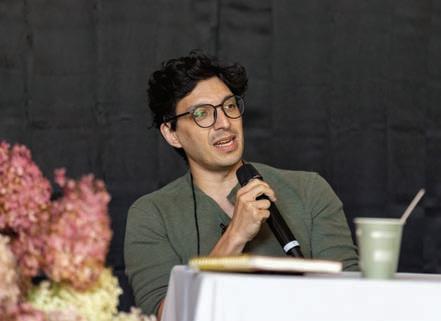
LIFE AFTER BENNINGTON ▲
The Life After Bennington panel featured a mix of alumni from across generations—Dania Clarke ’15; Wyatt Kirby ’10 (pictured above); Ayesha Raees ’18; Valerie Marcus Ramshur ’89, P ’27; Jeff Williams ’91; Audre Wirtanen ’17 who talked about what they studied at Bennington, what they do now, and how those two things connect.
To continue the Reunion vibes and benefits, Totten and Dean of Faculty John Bullock designed a 2-credit course called Life After Bennington, where 30 students hear from a different alum every week and reflect on how the guests stories may affect their own career or life trajectory.
This past term, students heard from Executive Director of Bennington Theater Kaiya Kirk ’20, State Legislator Will Greer ’24, Software Developer and Business Owner Wyatt Kirby ’10, Dance Artist/Food Systems Leader Lynn Ellen Schimoler ’03, Medical Nonprofit Founder Audre Wirtanen ’17, two-time Tony Award-nominated actor Brooks Ashmanskas ’91, and several others.
“I like that the speakers have had different Bennington and post-Bennington trajectories,” said Isabella Cohn ’26. Getting to hear their stories and journeys and hear how they got to where they are is something I find really valuable.
A NEW ALUMNI ASSOCIATION
At the Alumni Cofee Hour event, Totten joined Jeannie Cross ’72, former trustee (1991-1992) and past president of the Alumni Association (1988-1992); Wendy Lif ’77, past president of the Alumni Association (1992-1996); and Trustees Ciaran Cooper ’87 and Sekka Scher ’90 for a discussion about revitalizing the Alumni Association, which was disbanded in 1997.
Cross, a transfer student, said that she didn’t get enough of Bennington as a student. She had to focus on her Plan and didn’t have the chance to take dance, for instance. The Alumni Association of the past gave her access to fellow alumni.
“Through the Alumni Association, I got to meet all of these people and learn about what they were doing and see them at all diferent stages in all diferent areas of interest: art, dance, social work, politics…,” Cross said. “It was so valuable to me to be able to continue that education and continue learning from this unbelievably diverse, exciting group…. So I want to get that back.”
The event went well, according to Totten. “People asked a lot of good questions. Jeannie and Wendy had so much knowledge to share,” he said.
In addition to the people who attended the session and those who have been involved in the past, many others have stepped forward, including those in Bennington, Boston, Chicago, Los Angeles, New York City, Portland, San Francisco, Seattle, and Washington, DC.
“We have the makings of chapters around the country at this point,” said Totten. “My aim is to provide what these alumni need to help build a self-sustaining volunteer-led association with support from the Alumni ofce.”
Totten is working to fnalize bylaws and organizational charts and writing a chapter handbook for chapter leaders. The group is choosing an executive committee and committee chairs. Totten hopes to help hold inaugural events for as many as possible and have the infrastructure in place in time for the next College president to do a national listening tour.
“There are a lot of alumni who want the connection. They miss it,” said Totten. “If you are one of them, this is a great time to get involved. I am excited about what the new Alumni Association can and will do, especially leading up to the College’s Centennial. We can leave a mark on Bennington again.”●
Those interested in participating in Life at Bennington or in the new Alumni Association should email alumnirelations@bennington.edu
6 QUESTIONS WITH STEPHANIE HURLEY
By Charlie Nadler
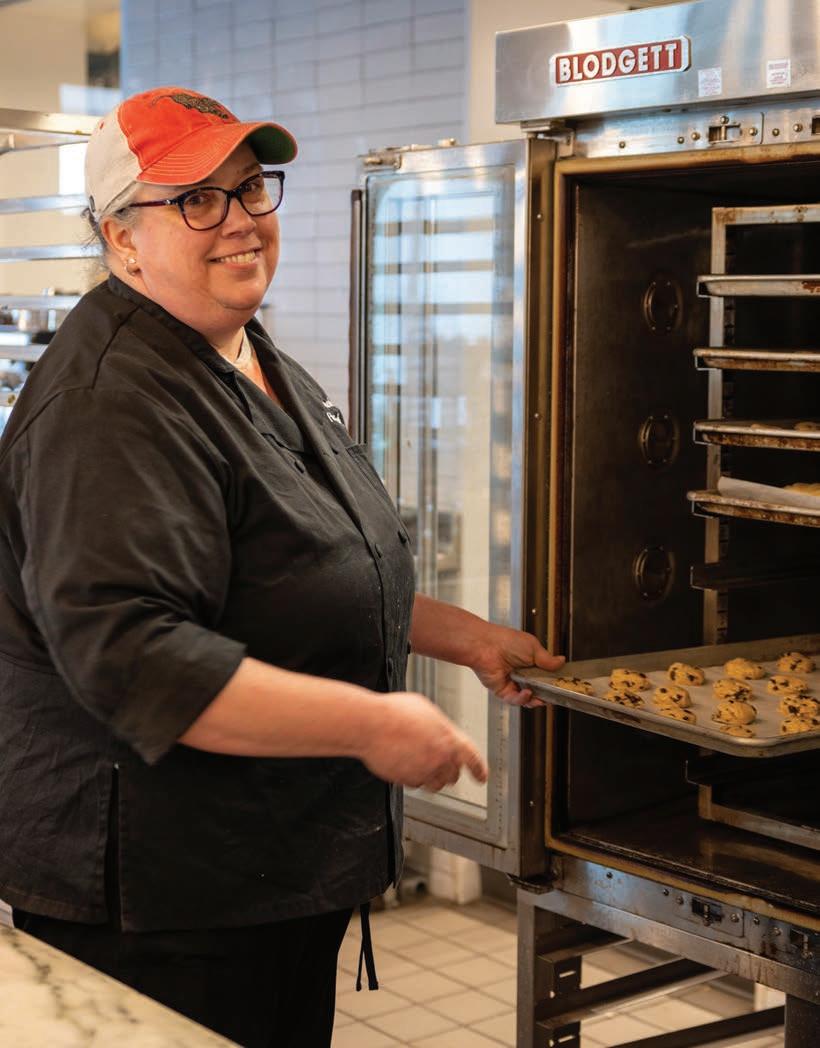
Stephanie Hurley has been serving up tasty treats since November 16, 2001, when she joined the Dining Services team. A Bennington native, Hurley cut her culinary teeth in local eateries and then at The Equinox Golf Resort & Spa in Manchester, where she learned a lot about food and received classical French training across multiple areas, including their bake shop, restaurants, and banquet catering.
As a “Cook I,” a classification that means she is a lead for the meal, she works behind the line to prepare food directly for our community. Her work is legendary across campus. Holly Andersen [former project manager for Buildings & Grounds] once closed a convocation address by saying, “I hope Stephanie Hurley baked today…her cookies are not to be missed.”
We sat down with Hurley to learn more about her countless contributions [and cookies!] over the last 24 years and counting.
1. What was your last job before coming to Bennington?
I was in transition and had recently met my now ex-husband. We worked different schedules, and I was looking for something that corresponded more with a life together, a family life. I saw the job was open, applied, and began as a relief cook.
2. What were your first days like here at the College? I started shortly before Thanksgiving and worked that holiday. I met a lot of colorful characters and formed great friendships with my coworkers. I’m currently third in seniority here, meaning there are two people here who have been here longer than I have. We’ve always worked closely with each other and are still a tight crew.
I eventually moved from a swing shift to the lunch cook position, which I did for about 18 years. Later, I was bumped into the baking position. I also gained a lot of experience during this time at Pangaea [in North Bennington] working their weekend catering events and doing their wedding cakes. It was a great opportunity to work with amazing chefs. Those were some busy weeks, but that’s how it works with food.
3. What is a typical day like now?
I start at 6:30 am, Monday through Friday. I come in and I
bake for 700 college students. It’s a sweet gig! I love it. I’ve
always loved baking; it was a hobby that turned into a career. Thankfully, I was given carte blanche. I was told, “I see what you’re capable of... I want you to make it your own.” That was an amazing opportunity not given to many people. I feel blessed to step into a position that I honestly love doing every day.
Our Executive Chef Josh [Ruff] makes it a point to bring in locally sourced products, so I get to follow the seasons. In the fall, we are deep in pumpkin spice and cinnamon season. In the summer, it’s berries and lemons. I’ve developed staples like salted lavender white chocolate chip cookies and a Kentucky Butter Cake, which is a buttermilk pound cake with a luscious glaze like a donut. The ends of that cake never get thrown away, but are always gone the next day! One of my favorite things to do is cook for people that I care about. It’s a form of love.
4. What is your favorite thing about working at Bennington?
We have a little side program called “Hugs from Home,” where parents can order birthday cakes and snack baskets for their kids. I get to make birthday cakes for these students—sometimes for all four years they are here. It’s a cool opportunity to be an extension of that family love for kids who can’t be home for their birthdays. I love the amazing messages I get to write on the cakes and in the cards. It also gives me a chance to be creative. It’s really dope. I once made a cake covered in plastic bugs, and another for a recently diagnosed student that read, “Congrats on the autism!”
5. What’s your funniest memory of working at the College?
We had a flying squirrel that had been getting into the bake shop for a while. It was creeping on the pipes, and had made itself a little home somewhere in the walls of the bake shop. Someone put a Havahart® trap up in the ceiling tiles. We checked it, and there was a flying squirrel. Our opener, Marshall, got it out of the ceiling and asked if I wanted to go with him to let it loose. I said, “What kind of a question is that? Of course!” We hopped in the “cookie wagon,” went down Silk Road over the bridge and across the river, and set it free.
6. Pretend I’m a student and it’s my first day on campus. What advice would you give me? Enjoy the beauty around you. Even if you only get to spend four years in this environment, make sure you enjoy the sky, the sunrise, the sunset, the stars, the mountains, the air. It’s just such a beautiful place. We are so fortunate to be here. Also, participate in as much tomfoolery as you can. Life is short. YOLO, you know? ●
Class Notes
1940–1949
From April to September 2025, the Guggenheim Museum Bilbao presented Helen Frankenthaler ’49: Painting Without Rules, the largest exhibition of Frankenthaler works ever held in Spain.
1950–1959
Elizabeth Lauer ’53 shared two photographs: The frst one is of Julian DeGray and Lauer, taken in 1955 when she was 22. “Julian was a member of the original music faculty at Bennington in 1932. We remained friends until his death in 1995. I had spent the years between graduation and the photo earning an MA at Columbia. We were photographed at a party of friends who were wishing me well as I went to Germany. I was the recipient of a Fulbright scholarship, and it was extended, so I spent a year and a half in Hamburg.” The second, Lauer standing by her Bösendorfer, was taken in December 2025.
1960–1969
In October 2025, Liz Mamorsky ’60 hosted an open studio weekend at her Lizland art studio in San Francisco, CA.
Held at the gallery in the ofces of CambridgeSeven Architects, 40
Years of Painting and Collage by Ruth Mordecai ’60 showed some of the major changes in her work between 1985 and now.
Peggy Adler ’63 won the Shore Publishing 2025 Beacon Award in October. In September 2025, a live recreation of Adler’s Great Gildersleeve episode “Marjorie’s Hotrod Boyfriend” launched Radio Enthusiasts of Puget Sound’s four-day 2025 Showcase.
Elizabeth (Weiss) Burk ’63 is living part-time in southwest Louisiana and writing and publishing poetry. Her debut fulllength poetry book, Unmoored, was published in November 2024 by Texas Review Press.
Harriet Fraad ’63 earned a doctorate from Columbia University in 1975 and has been a mental health counselor for more than 50 years and a hypnotherapist for 30 years. She has been a left political activist since 1959 and produces a podcast, Capitalism Hits Home, with Democracy at Work. She has led the feminist movement— including eforts to gain midwifery rights at Yale New Haven Hospital and with organizations such as Save Our School and the National Abortion Rights Movement—and has written numerous articles in books and journals such as the International Psychohistory Journal, Tikkun, and Rethinking Marxism. She is one of the three authors who wrote the central
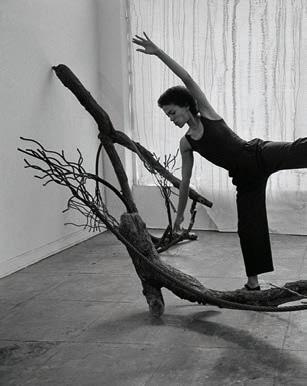
article in the book Class Struggle on the Home Front (Palgrave Macmillan, 2009). “I analyze and speak about the mutual shaping of political, economic, and psychological forces that create personal life,” she wrote. She has been married to Richard D. Wolf (“He keeps his own name,” she noted.) for 60 years and has two grown children.
Barbara Kent Lawrence ’65 published Both Sides of the Pond, My Family’s War: 1933-1946, an intimate chronicle of her family’s World War II saga.
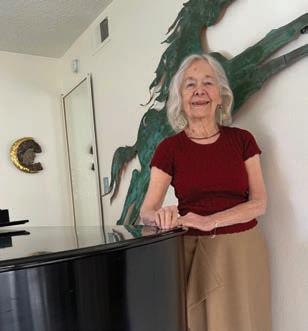
After teaching high school in Los Angeles and Seattle, Ellen Taussig ’66 joined two colleagues to found The Northwest School in Seattle, WA, where she has lived since 1976. Founded in 1980 on idealistic principles, including an integrated humanities program and strong arts program, it serves 450 students in grades 6–12. Northwest alumni who attended Bennington saw a strong connection between the schools. Taussig was the Head of School for 20 years and retired in 2011. She was then recruited to found a school, modeled on the Seattle School, in Ethiopia in 2013.
Victoria Kirsch Houston ’67’s 30th book, The Wolves Are Watching, was published on February 24, 2026, by Crooked Lane Books. This is the fourth book in The Lew Ferris Mystery Series, which is an extension of The Loon Lake Mystery Series from Simon & Schuster. The same characters experience “murder, mayhem, and fshing in northern Wisconsin.”
Art & Object took readers behindthe-scenes into the studio of painter Joanna Pousette-Dart ’68, who recently exhibited Centering at Lisson Gallery in New York.
Masters of Photography highlighted Fran Antmann ’69, who is a documentary photographer, writer, and professor. Her photographic work has focused on the lives and culture of the indigenous people of Guatemala, Peru, Mexico, the Dene First Nation people of the Western Canadian Arctic, and the Inuit of Bafn Island, Canada.
Maren Hassinger ’69’s largest retrospective to date will open at the Berkeley Art Museum and Pacifc Film Archive in June 2026. The exhibition was covered in Cultured.
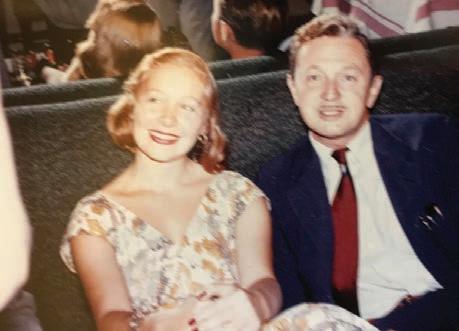
Brenda Kydd ’69 created and opened her own website (BKBaubles. shop) to sell her handcrafted jewelry for people with taste. The site was launched in December 2025.
1970–1979
Historian and author Phil Holland ’71 led the frst-ever guided tour of “The Rocky Ridge,” which played a key role in the second and decisive phase of the Battle of Bennington. He also published an expanded second edition of his book, A Guide to The Battle of Bennington & the Bennington Monument
Randie Denker ’72 and her partner decided about 10 years ago to travel for 3 months every year. In the past 22 years, they have been to almost 100 countries. Their latest project has been buying a home in Mexico and retroftting it to solar and creating a natural gray water fltration system for the garden. Denker is still practicing environmental protection law and also still serves on the Sierra Club Legal Advisory Board and many other urban planning and environmental boards. She has been president of her neighborhood association for the past 8 years (mostly because no one else wanted the job). Denker and her partner collaborate on international water issues through their Waters without Borders foundation.
The Adirondack Theater Festival (ATF) summer 2025 season ended with Caleen Sinnette Jennings ’72’s Queens Girl: Black in the Green Mountains. The play also ran through March 8, 2026, at Karamu House’s Bank of America Arena Theatre in Cleveland, OH.
Maren Hassinger, documentation of performance Tree Duet I, 5617 San Vicente Blvd, Los Angeles, c. 1974.
Courtesy of Susan Inglett Gallery, NYC.
Photo: Adam Avila.
Elizabeth Lauer ’53 in 2025 (opposite) and 1955 (below) with Julian DeGray
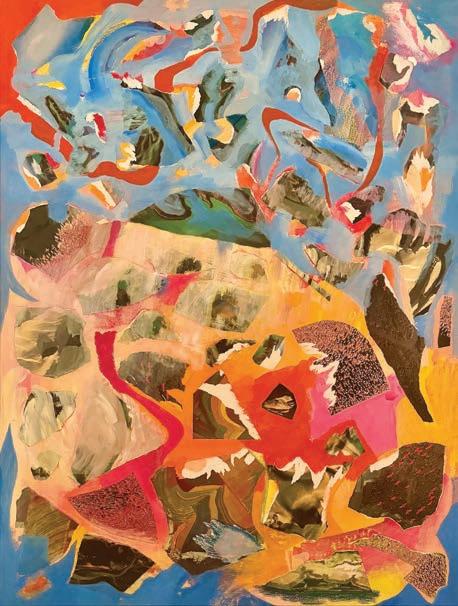
Composer Erik Nielsen ’72 was highlighted by The Rutland Herald with a retrospective in honor of his 75th birthday.
The 2025 American Prizes in Orchestral Programming included two Bennington alums: Stephen Michael Smith ’72 and Brian Stone ’92, who claimed two of the three awards.
Martha Aladjem Bloomfeld ’73’s new exhibition, Stories We Were Never Told: Visualizing the Holocaust in Bulgaria and Beyond, opened in January 2026 at the Holocaust Memorial Resource and Education Center in Maitland, FL. It remains open through July 10, 2026.
New York City Councilwoman Gale Brewer ’73 renamed 93rd and West End Ave “Malachy McCourt Lane” in honor of the famed actor and writer.
Betsy Robinson ’73 writes, “Since 47 was elected a second time, I have become a daily contributor on Substack. I write a mix of politics, culture, and self-awareness articles. Being part of this vibrant community of independent journalists is beyond rewarding. Subscribe for free if you’re interested.” betsyrobinson.substack.com
Rhythm: Pattern in Time (Wooden Books) by Julian Gerstin ’75 explores rhythm in music, not only in drumming, but also in melody, composition, and improvisation.
In November 2025, artist Lindy Smith ’75 held a book signing at the Lenox Bookstore in Lenox, MA, for the release of her new book Leaves and Light: Sunprints of American Native Plants (Prospecta Press). The book highlights one hundred images of wild native plants collected and made around the country using nineteenth-century photo processes.
Artpace San Antonio announced the Fall 2025 International Artistsin-Residence, including artist Elana Herzog ’76. Her work was the subject of a thirty-year survey exhibition at Kofer Arts in Toronto, Canada, from February 13 through May 11, 2025. On October 8, 2025, Herzog visited Vassar’s Taylor Hall auditorium to discuss an overview of her work.
Brant Houston ’76 attended the 2025 Global Investigative Journalism Conference in Kuala Lumpur, Malaysia, in November. He and a colleague started the conferences in 2001. Houston was re-elected as chair of the board of directors of The Global Investigative Journalism Network, which runs the conference. He was recognized at the 50th anniversary Investigative Reporters & Editors Gala for his work with IRE and NICAR in the 1980s around the emergence of data and consumer investigations.
Amy Sawelson Landes ’76 has been the Administrative Director for the nonproft Horses in the Hood in Los Angeles for more than 20 years. The goal of the organization is to give kids from Watts, Compton, and the surrounding urban environs of Los Angeles the opportunity to attend a summer camp where they learn to care for and ride horses. This is a
unique experience for them, and they come away with skills that enhance their patience and self esteem.
Through September 21, 2025, Inner Worlds, an exhibit by Janice Geller ’77, was on view at Pink Dog Gallery in Asheville, NC.
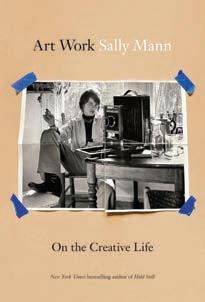
Art Work: On the Creative Life by Sally Mann ’77 was published by Abrams in September 2025.
Mel Watkin ’77 is honored that three of her map drawings are now in the collection of the Newberry Library in Chicago: U.S. Army Corp of Engineers Mississippi River Charts #90, #91, and #92. Reports Watkin, “The Newberry houses an amazing collection of maps from ancient times to contemporary.”
Vessels & Voids: Architects and Artists Explore Organic Spaces , an experimentalexhibition curated by 2025 Mentoring Curator Rebecca Cross ’78,
celebrated the exciting advances in engineering and 3D printing that open up new ways to create organic forms in architecture.
Jan Hadwen Hubbell ’78 published The Boy Who Couldn’t Say Goodbye, a picture book aimed at helping young children better cope with life transitions.
In September 2025, Jonathan Rosch ’78 and his band, Jonny Rosch and Friends, played a special appearance at the Marlin Bar and Restaurant in Long Beach Island.
Leslie Johnson Piotrowski ’79’s picture book The Northbound Train will be published by Abrams Books for Young Readers in January 2027.
1980–1989
In December 2025, CMAY Gallery in Los Angeles, CA, presented Where Are You From?, the frst exhibition at the gallery by Los Angeles-based artist Brian Paeper ’82
Linda Dowdell ’83 was awarded the 2025 Original Music Composition Award from The Sound On Stage for her new musical Wild Man of the Wynoochee, produced at Key City Public Theatre in Port Townsend, WA, in October 2024.
Work by Jill Goldman-Callahan ’83 was on display as part of Joy and Peace at the Allie Kussin Gallery in the Umbrella Art Center.
In fall 2025, nearly 1,000 paintings by Matt Chinian ’84 were featured in an art exhibit at Hudson Valley Community College.
Denise Walsh ’85, associate professor of Politics at the University of Virginia, published Imperial Sexism: Why Culture and Women’s Rights Don’t Clash (Oxford University Press, 2025), which draws on feldwork across South Africa, France, and Canada to argue that the compounding harms of race and gender rooted in the colonial era shape contemporary debates about practices like veiling and polygyny in democracies worldwide.
The Blue Benn Diner, owned by John W. Getchell ’86, received a favorable review by Family Destination Guides. The restaurant was also featured on WCVB Boston.
Lucie McKee MFA ’86’s second book, Stoking Up Morning, is out in July 2026 from Green Writer’s Press. Her frst book, Anything and its Shadow, was published by Green Writer’s Press in 2025. Her work has appeared in The Times Literary Supplement, Southern Review, and many others.
Barbara Owen ’86 participated in a two-person exhibition with Olivia Baldwin at Overlap Gallery in Newport, Rhode Island. The exhibition was featured in the Two Coats of Paint newsletter and received mentions in ArtScope Magazine and Boston Art Review.
Emily Rauch ’86 opened a new exhibition at Hilltown Commons in Rensselaerville, NY, on April 17, 2025: thirty years after her frst show in the same space. Her latest pieces are made from the discarded and overlooked: found fragments, driedout markers, and mistakes. “There’s too much junk, too much noise, too much pretending,” she writes. “This is my answer: reuse, reimagine, and have fun.”
Melissa Rosenberg ’86 appeared on The Writer Files and The Screenwriting Life podcasts. She spoke about how she fnds her creative center and helped promote the new MFA in Screenwriting at Bennington College.
Landscapes is a new collection of photographs from across North America, shot and curated by Lincoln Schatz ’86.
Liz Silver ’86, founder of Believe Media, has co-produced the debut feature flm Sound of a Dream with independent production company Unsound Films. The feature premiered in London in October 2025.
Artist Erin Parish ’88 participated in a beneft art auction and fundraiser on October 3, 2025, to support Red Hook Responds, a nonprofit addressing food insecurity.
Claudia Rowe ’88 was a fnalist for a National Book Award in Nonfction for her book Wards of the State: The Long Shadow of American Foster Care
After many years living in Northeastern Pennsylvania, Nicole Rademan ’89 moved closer to work and family and is now living in Kennett Square in Southeastern, PA. She was promoted and continues to love her job as Deputy Law Clerk to the Honorable Megan Sullivan of the Pennsylvania Superior Court. She writes, “I am so grateful to Bennington, especially [former faculty member] Gail Russell and Maura Spiegel ’76 for teaching me the skills I use everyday.”
Valerie (Marcus) Ramshur ’89 serves as Academic Director of Design and Production and Head of Costume Design at Mason Gross School of the Arts at Rutgers University. During
her 2024–25 sabbatical, she launched Tabards of Place, a cross-cultural research and creative project exploring the tabard as a symbolic garment of identity, allegiance, and ritual.
Michael Sylvan Robinson ’89 gave an artist talk at the University of Massachusetts Amherst College of Humanities & Fine Arts in October 2025.
The latest book by Tom Sachs ’89, Tom Sachs: Guide (Phaidon, December 2025), is the most comprehensive retrospective of the globally acclaimed artist and features more than 650 images and deep insight into his inventive, hands-on studio practice.
1990–1999
The Detroit Institute of Arts appointed Sara Moy ’90 its new Director of Conservation. Moy brings more than two decades of broad and dynamic conservation experience across leading museums and institutions in the United States, Europe, and Asia.
Guitarist Anthony Wilson ’90 and his band played four concerts at SFJazz Center in San Francisco, CA, in September 2025. Wilson’s new album House of the Singing Blossoms was listed as top album of 2025 by Jazz Times.
Rafe Churchill ’91’s company’s purchase of and plans to restore the historic Walloomsac Inn in Old Bennington were featured in a VTDigger article.
Peter Dinklage ’91 played Malvolio in Public Theater’s production of Twelfth Night at the newly renovated Delacorte Theater in Central Park in August and September 2025.
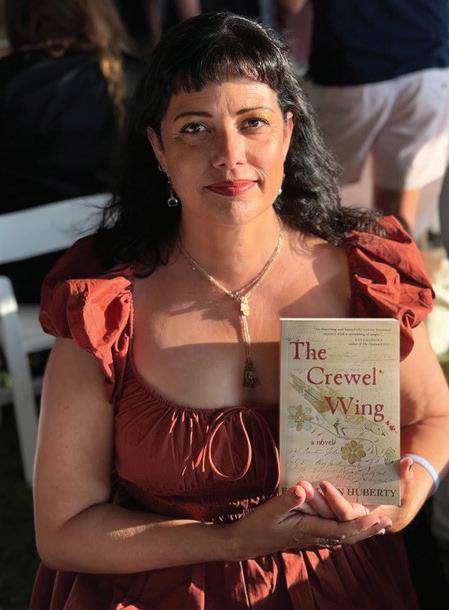
Orlando Alvarez ’92 was elected to city council in Shaker Heights, OH.
Amy Lorraine Brooks ’93 published “I Was My Daughter’s Champion. Behind Closed Doors, I Was Keeping A Dangerous Secret” in HufPost on July 20, 2025.
Loosely inspired by Robert Frost’s poem “The Silken Tent,” artist Kate McPhee ’93 presented She is as in a Field a Silken Tent: A Show of Paintings and Sculpture, her latest show at Eclipse Mill Gallery.
The Crewel Wing (Briar Press NY, 2025), the debut novel by Erica-Lynn Huberty ’95, was featured at Author’s Night in August in East Hampton, NY. Briar Press is a women-founded and women-owned press with deep ties to Bennington, including Co-Founder and Editor Jaclyn Baer ’95, Associate Editor Aeven O’Donnell ’24, and web/ graphics designer Jen Van Arsdale ’95.
Work by Manju Shandler ’95 was included in Fibration III: Anxiety and Hope at L’Space Gallery. Curated by gallery director Lili Almog, the exhibition
Erica-Lynn Huberty ’95 with her debut novel
showcased sixteen contemporary artists working at the intersection of textile, storytelling, and resistance.
Mary Early ’97’s Līnea XIV debuted in the exhibition Radius: Land Form at The Delaware Contemporary in June 2025. The piece is a site-specifc installation of more than 400 beeswax elements forming a moiré-patterned curtain that shifts with perspective. She was featured on Art Clinic Online.
Two-time SAG award-winning actor Joel Marsh Garland ’97 appeared in Lindsey Ferrentino’s new play, The Fear of 13. It is directed by Tony Award® winner David Cromer and features Academy Award® winner Adrien Brody and Golden Globe® Award nominee Tessa Thompson in their Broadway debuts.
Adnan Iftekhar ’97 has published Navigating Nav: A Journey Through AI, Emotions, and Climate Change, co-written with his daughter, Zarmina Iftekhar.
Seth DeCroce ’98, pen name Sparrow Hall, published The Invisible Eye, a paranormal conspiracy thriller that blends literary and speculative fction.
Work by Carleen Zimbalatti MFA ’98 was included as part of the Cambridge Art Association (CAA) 2025 National Prize Show.
Rachelle Michaud ’99 was recognized as a “Top Ten Women Disruptors to Watch in 2025” by MSN.
2000–2009
Asad Ayaz ’00, chief brand ofcer for Disney, was highlighted for his festive work on Disney’s “Best Christmas Ever”
campaign. He was then promoted to chief marketing ofcer, where he will oversee a new company-wide marketing group.
Rachel Jans ’00 is Curator of Modern and Contemporary Art at the San Diego Museum of Art. She recently curated Eduardo Chillida: Convergence, which was reviewed in The Wall Street Journal in December 2025.
Andy Dehnart ’02, founder and editor of realityblurred.com, was elected president of the Television Critics Association, which represents 230 journalists, critics, and editors in the U.S. and Canada.
Work by Heather Dewey-Hagborg ’03 was included in The Arrested Image: Identity Through the Lens of Law Enforcement at SUNY New Paltz, which takes a close look at the portraits produced by police vision.
Daniel Bertram Grossman ’04’s January 2026 wedding to Danielle Bluma Garonce was covered by The New York Times
In November 2025, Carl Linich MFA ’04 hosted a workshop on Georgian Polyphonic Folk Singing at First Unitarian Church of Oakland in Oakland, CA.
Dylan Thuras ’04 published a new book for children, The Atlas Obscura Explorer’s Guide to Inventing the World.
Thomas Wiehl ’04 was nominated as commissioner to Connecticut Public Utilities Regulatory Authority.
Susan Barr-Toman MFA ’05 taught an introduction to mindful meditation at Movement, Meditation & the Muse on March 15, 2026, at The Baird in New Jersey.
Jeremiah Matthew Davis ’05 was appointed San José Museum of Art’s next Oshman Director and Chief Executive Ofcer.
In September 2025, Jordan Rosenfeld ’05 read as part of Writing at the Root at Readers’ Books in Sonoma, CA.
Niloufar Talebi MFA ’05 edited and translated Elegies of the Earth: Selected Poems by Ahmad Shamlou (World Poetry, November 2025), a sweeping bilingual volume marking Iran’s iconic twentieth-century poet’s centennial.
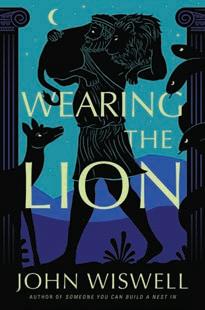
Wearing the Lion , the latest novel from John Wiswell ’05 , was released in June 2025. Wiswell’s frst book, Someone You Can Build a Nest In , won the 2025 Nebula Award for Best Novel.
Academy Award-nominated actor Michael O’Keefe MFA ’06 returned to Beaufort, SC, as a special guest of the 10th annual Pat Conroy Literary Festival.
Cary B. Ziter MFA ’06 has published his frst chapbook of thirty poems, Someone is Looking for You, from Rockwood Press, Portland, OR.
Sofa Alvarez ’07 will write the flm adaptation of Rebecca Ross’ fantasy romance novel Divine Rivals for Paramount Pictures.
Lee Clay Johnson ’07 published Bloodline, the inaugural release from Panamerica Books, the new imprint established by County Highway.
Sarah McAbee ’07 relocated to Los Angeles with her husband Kevin and dog Lady. She serves as the Associate Vice President of Advancement Marketing and Communications at the University of Southern California. “I’m turning 40 this year and am most excited about being able to compete in powerlifting’s Masters I class.”
Mary Louise Penaz MFA ’07 is the editor of the literary journal Five Poems that includes frst-issue poet Denton Loving MFA ’14.
Ian M. Rogers ’07’s second novel, Carcrash Parker and the Haven of Larpers, was published with Vine Leaves Press in July 2025. The novel is a satirical blend of high fantasy and eighties and nineties pop culture and features illustrations by Sam Roman ’07.
Matthew Souther ’07, trumpet player for the pickPocket ensemble, played as part of Music Without Borders at the Occidental Center for the Arts in Occidental, CA, in September 2025.
Amanda Auchter ’08 reviewed Apostasies by Holli Carrell for Rhino.
Michigan Public News announced that Kate Furby ’08, PhD, has joined
the station as the senior environment reporter. She covers science and the environment for the state’s largest public radio station.
Minneapolis-based non-fction writer Jack El-Hai MFA ’09, award-winning author of The Nazi and the Psychiatrist (the basis of the movie Nuremberg), Face in the Mirror (published in May 2025), and many other works of nonfction, was interviewed by his undergraduate alma mater Carleton College for their video series, Carleton Connects.
Tod Goldberg MFA ’09 published the essay “Building a Dark Place: Creating A Fictional Crime Scene Out of Familiar Places” for CriminalElement.com
Amanda Sullivan ’09 published Playful STEAM Learning in the Early Years: An Educator’s Guide to ScreenFree Explorations with Teachers College Press.
2010–2019
V. Hansmann MFA ’11, innkeeper at Prospect Street Writers House in North Bennington, VT, was selected for inclusion in Marquis Who’s Who.
Greg Obis ’12 became the sole owner of Chicago Mastering Service (CMS), founded in 2007 by Bob Weston and Jason Ward, in July 2025.
In October, Rev. David Black ’13, the pastor of The First Presbyterian Church of Chicago, was interviewed by national news media about his experience being assaulted by Immigration and Customs Enforcement (ICE) while leading a peaceful protest at an ICE facility.
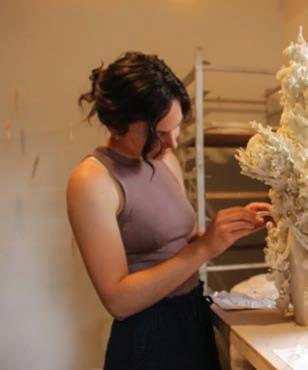
Laura Cresté ’13 released her debut poetry collection In the Good Years in September 2025 from Four Way Books.
Christina Stiles ’13 edited the documentary Riders on the Storm, which chronicles the Taliban’s rise to power through the lens of Afghanistan’s national sport, buzkashi. The flm had its world premiere at SXSW and went on to several other festivals, including DOC NYC, where Stiles was named one of the “40 Under 40” flmmakers to watch. The film was acquired by Canal+ and is available to stream in the United States on Kanopy. Other notable credits include her work as an additional editor on the HBO documentary Surviving Ohio State, directed by Eva Orner and produced by George Clooney. Currently, Stiles is a Karen Schmeer Film Editing Fellow and in development on her frst directorial project.
Erick Daniszewski ’14 and Hannah Lipper ’14 are celebrating their daughter Meadow’s frst birthday this fall. Hannah is a ceramicist and creates work under Cosmos Pottery, and Erick is a Software Engineer with Oracle. They live in Holden, MA, with their daughter, dog, and chickens.
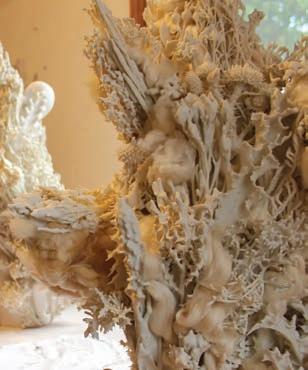
Lauren Davis MFA ’14 participated in The Next Best Book Blog’s Books & Booze challenge to promote her recent short story collection The Nothing (YesYes Books). She created a drink recipe inspired by her story “The Bright.”
Cantor Ze’evi Tovlev ’14 studied vocal performance and music composition while at Bennington College. Hebrew Union College interviewed Tovlev about their work as a pioneer in the emerging feld of nonbinary liturgy.
Poet Devon Walker-Figueroa ’15 did an interview with Elizabeth Metzger of the Los Angeles Review of Books. Her book Lazarus Species is one of fve fnalists in poetry for the prestigious LA Times Book Prize.
Jessica Danger MFA ’16 published the article “Why Reading Substance Addicted Characters Matters” in Oh, Reader Magazine
Kevin Fitton MFA ’16 was appointed a visiting assistant professor of English at Kalamazoo College in Kalamazoo, MI.
Danuta Hinc MFA ’16 was featured in the tenth season of HoCoPoLitSo’s
Photo courtesy of Molly Altman ’19, photographer Elise Hillbrand, and Aspen Collective Gallery owner DJ Watkins. It was taken while Altman was an artist in residence at the Carbondale Clay Center. The piece, “Or just some human sleep,” is named after a line in Robert Frost’s poem, “After Apple Picking.” Altman was in the first class following the acquisition of the Frost Stone House Museum. “The use of this poem is a direct link to my Bennington time.” It is now in a private collection in Snowmass, CO.
Wilde Reading Series, which highlights local authors in Howard County, MD.
Olivia Hurd ’16 is the Creative Executive at Amasia Entertainment, a Los Angeles-based flm production company. Amasia’s flm Audrey’s Children, co-produced by Hurd, is available to stream.
Princeton Alumni Weekly featured Morgan Jerkins MFA ’16, author of Zeal.
Erika Lygren ’16 edited a featurelength documentary on LGBTQ+ media representation called Love Me Bait Me, which covers topics including queerbaiting, the “Bury Your Gays” trope, actors “cripping up” to play disabled characters, inauthentic trans representation, bisexual media tropes, whitewashing queer stories, and antifat bias in the flm industry.
Lucas Marten ’16 self-published Prodigious Kin, a book of comedic poetry on family and American values.
Brendan McPherson ’16 is a practicing personal injury and workers’ compensation attorney. He graduated from the University of Connecticut School of Law in 2020 and was admitted to the Connecticut bar in 2021. He lives in New London, CT, with his wife.
Andrew Barnes MFA ’17 was recognized by the UIndy School of Business with an Outstanding Alumni 2026 Award. He is the fourth President of the Pennsylvania College of Art & Design in Lancaster, where he is guiding a period of growth and transformation, expanding the college into a more industry-connected and career-focused institution.
Alex Burgess ’17 took the author portrait for the book and the cover photo for faculty member in Music Allen Shawn’s latest book In the Realm of Tones: A Composer’s Memoir.
Izzy Casey ’17 was selected by Poetry Daily as a featured poet and discussed her poetic voice, her childhood, and her experiences at Bennington College. Poetry Daily published the interview along with her poem “The Most Beautiful Thing About Me.”
“The Perfect Age,” an essay by Andrea Caswell MFA ’17, was selected for the anthology Rising From the Ashes, published by Pearl Street Press in 2025.
Katie Yee ’17’s frst novel, Maggie; or, A Man and a Woman Walk Into a Bar, was published in July. It was noted as a summer read by Oprah, Time, The New York Times, and others.
Lisa Johnson Mitchell MFA ’18 published Hair Brush with Fame in spring 2026 by Finishing Line Press.
Disaster Tourism, a poetry collection from Rena J. Mosteirin MFA ’18, was released by BOA Editions in October 2025.
Colorado-based ceramic artist Molly Altman ’19 presented her show Always So at Aspen Collective through February 13, 2026.
Amy Lyons MFA ’19 was nominated for a Pushcart Prize for her story “The Cats of Old San Juan” in Brilliant Flash Fiction. She was also longlisted for the 2025 Granum Prize.
Family Language, the debut novel by Nicole Nelson MFA ’19, will be published by Melville House in November 2026.
2020–2025
Emily Gordis ’20 and her husband, Ben, joyfully announce the birth of their daughter, Rosemary, in May 2025. Emily works at the California Department of Public Health, Sexually Transmitted Diseases Control Branch and is a second-year Master of Public Health student at San Francisco State University, where she is a Health Equity Institute Student Scholar.
Katie Hibner ’20 was selected by the U.S. Department of State’s English Language Programs as a Virtual Educator. Through online courses this spring, she is training Mexico City security ofcers in English listening and speaking in preparation for the 2026 FIFA World Cup.
Cameo Wood ’20 executiveproduced the documentary Joybubbles, which premiered at Sundance 2026.
Lydia Duf ’21 performed as Fanny Dashwood, Lady Middleton, and
Lucy Steele as part of Shakespeare published in the summer issue of & Company’s Traditional Winter Tahoma Literary Review in August. Reading of Sense & Sensibility. Her poetry manuscript Why I Am Not a Gravedigger was named a fnalist for Susan Dines MFA ’22 released her the 2025 Jack McCarthy Prize from debut poetry collection Late Arrival in Write Bloody Publishing. November 2025 from Kelsay Books.
Aidan Ellison ’25 interned at North Patricia Martin MFA ’22 Bennington’s Living Room Theater in published WILL THE FUTURE LIKE summer 2025. YOU: Refections on the Age of Hyperreinvention on January 29, 2026, with Rayven Leak MFA ’25 performed Karnac Books UK. It explores the “On the Way to Freedom Day – A profound dangers our 24/7 online Journey in Song” in Winston-Salem, existence poses: not only to how we NC, in June 2025. behave and think, but to who we are and how we form ourselves. She was Rachel McCauley ’25 received a featured on the Seize the Day podcast. remote writers residency with Mouths of Babes Theater in Wilmington, NC, Hafsa Zulfqar ’22 has been selected a company known for documentaryfor the 2026 Residency for Emerging style plays. She is working on a Writers at The Mount and Western research-based play for the theater. ● Massachusetts’ Straw Dog Writers Guild.
Car Simione ’23 recently graduated from the Iowa Writers’ Workshop and started an online lit journal with another Workshop alum, Scout Faller. The journal is titled Hearsay and is currently open for submissions of text and sound.
Julia Juster MFA ’24 sold Breaking West: Mustangs and the Wrangling of an American Myth to St. Martin’s. The title is anticipated in 2027.
Finbar LaBelle ’24 published “‘It’s all in here’: Inside the battle to save Please submit your professional San Francisco Art Institute’s historic and personal updates to archive” in the San Francisco Chronicle classnotes@bennington.edu in July.
Amy Raasch MFA ’24’s poem “ontology of llorando” won the 2025 Sonora Review NOISE Poetry Contest. Her poem “Broken Sonnet for the Phone Call I Didn’t Pick Up” was
Faculty & Staf Notes

Work by Beverly Acha was included in group exhibitions Making Space at the Brattleboro Museum and Order and Other at Main Projects in Richmond, VA. In December 2025, she completed her first public art commission for Miami-Dade County Art in Public Places. It was a 2-year project resulting in a monumental 32-foot oil painting permanently installed at the Osvaldo N. Soto Miami-Dade Justice Center in Miami, FL. In addition, she was awarded a 2025 FST StudioProjects Fund Award and published the first catalogue of her work, “Beverly Acha: Nothing Static,” which was made possible through faculty grant funding from Bennington College.
Maya Cantu joined three episodes (133, 134, and 135) of Broadway Nation, a podcast, to discuss concepts connected to her book, Greasepaint
Puritan: Boston to 42nd Street in the Queer Backstage Novels of Bradford Ropes, released in 2024 by the University of Michigan Press.
Franny Choi was invited to serve as one of the inaugural residents of the H.D./Bryher Residency for LGBTQ Poets at the University of Arizona’s Poetry Center, along with their partner, the poet Cameron Awkward-Rich.
Next page
Alex Creighton recently published two essays in academic journals: “Diversity Is a Commitment, Not a Checkbox” in a special issue of Eighteenth-Century Studies for The ASECS Women’s Caucus at 50 and “Between ‘Extensive Circuit’ and ‘Boundless Futurity’: Habit and Time Use in Rasselas” in The Johnson
Society’s journal, Transactions. He traveled to Japan on a Whiting Fellowship from the Marion and Jasper Whiting Foundation to research the pedagogical approaches to critical writing and to develop a new class focused on the animated films of Studio Ghibli.
Hugh Crowl was interviewed by the Bennington Banner for “Pluto Day.”
An Duplan ’14 was a member of the keynote panel at the Massachusetts College of Liberal Arts (MCLA) 8th Annual Day of Dialogue in October 2025. He spoke on “From Scarcity to Solidarity: Imagining a Shared Future.” He presented a second lecture at MCLA in March called “Collective Futures: Queer Healing, Radical Education, and Imagined Freedom.”
Beverly Acha in the studio; Photo by Ally Caple
Peacock released The Miniature Wife, which is based on the short story written by Manuel Gonzales. It stars and is executive produced by Elizabeth Banks and Matthew Macfadyen.
Mariam Ghani and Director of Undergraduate Writing Initiatives
Camille Guthrie were selected for 2025 MacDowell Awards in Film/ Video Arts and Literature, respectively. In addition, Guthrie’s poem “Come Back!” from her book DIAMONDS, which addresses the Modernist poet H.D. (Hilda Doolittle), was featured and read by the poet Maggie Smith on the literary podcast The Slowdown
John Hultgren published the article, “Trump’s War on the Administrative State Is a Class War,” on Jacobin.com.
Steven James, faculty member in Bennington’s Masters of Clinical Mental Health Counseling (CMHC) program, offered a psychological perspective on the public’s choice of responses to homelessness in a January 2026 The Manchester Journal article.
Dina Janis was featured on Stage Whisper, an arts & culture podcast for her work with LAByrinth Theater.
J. Vanessa Lyon’s Black Studies/ Visual Studies article “‘Remember me! But ah, forget my fate,’ Delores Fullman and Untitled (Asheville
Citizen), 1952” was accepted by the interdisciplinary, peer-reviewed journal Representations for publication in late spring 2026. The journal is among the most prestigious in the humanities and accepts approximately 6.5 percent of submissions each year.
In celebration of the 125th anniversary of Rhodora, the peer-reviewed journal of the New England Botanical Society, the journal published a retrospective on its most downloaded articles.
Caitlin McDonough MacKenzie is a coauthor on both of the publication’s top two.
Clutch , the second novel by Bennington Writing Seminars faculty member Emily Nemens , was published by Tin House/ Zando on February 3, 2026. She was interviewed by the Los Angeles Times by Victoria Lancaster MFA ’26 , the podcast Otherppl , and Bookstr.com. In addition, Nemens has published essays in Poets & Writers , BOMB , and Writer’s Digest
Faculty member Mariam Rahmani was an Artist-In-Residence at The Shangri La Museum of Islamic Art, Culture & Design in Honolulu, HI. Rahmani was also shortlisted for The Center for Fiction’s 2025 First Novel Prize. She reviewed Tareq Baconi’s Fire in Every Direction for The New Republic in February.
Bennington Writing Seminars faculty member Lance Richardson’s book, True Nature: The Pilgrimage of Peter Matthiessen, was published in October from Pantheon Books.
Noëlle Rouxel-Cubberly and Ikuko Yoshida presented at the Northeast Conference for Teachers, for Languages, for Cultures in February. The work explores AI’s effect on the fear of reading and writing among introductory-level language students and the integration of virtual reality in educational settings. It was funded by a grant from the Sherman Fairchild Foundation.
Work by faculty member John Umphlett was featured in the group show Spaces Places Traces at the Emery Community Arts Center Gallery at the University of Maine at Farmington in March. He traveled to Japan to install work by Rina Banerjee, who he has worked with as a designer and fabricator for more than 18 years, at the Espace Louis Vuitton Tokyo show. “It has been a real honor of mine to travel around the world installing Rina’s complex installations. I support the thinking and importance of her work,” he
Mariam Rahmani during her residency at The Shangri La Museum of Islamic Art, Culture & Design in Honolulu, HI
said. And in May, Umphlett gave a talk about his work and process at Vermont Studio Center.
Faculty member Emily Waterman published the article “Measures to Assess Efficacy of Family-Based Programs for Indigenous Populations: Adaptation, Psychometric Properties, and Congruence” in the journal Family Process
Faculty member Michael Wimberly joined VPR’s Vermont Edition to discuss the history of Bennington College’s Black Music Division and faculty member emeritus Milford Graves. In addition, Wimberly appeared in five DanceAfrica performances with the National Song and Dance Company of Mozambique at BAM during Memorial Day weekend. In June, he participated at a music residency on Lake Dunmore in Leicester, VT, at New Music On The Point and taught Conductions, Improvisation, and the music of Sun Ra. Wimberly was also featured at the 29th annual Vision Festival at Roulette in Brooklyn, NY. He performed with spiritworld and celebrated the work of visual artist/sculptor Jeff Schlanger’s musicWitness.
Retired Faculty, Visiting Faculty, and Staf
On November 9, 2025, at the Bennington Museum, faculty member emeritus Tom Bogdan, Music Fellow/ Instructor Chris Rose, and Piano Accompanist/Instructor Yoshiko Sato presented An Eclectic Cabaret for a Sunday Afternoon. Curt Wells, technical instructor in Sound and Music, handled the live sound for the event.
Visiting faculty member Dr. Kathy Bullock is featured in Pushing the Rock, a documentary film about systemic racism released by the John Brown Project. In addition, she presented the Underground Railroad Bus Tour, June 12-25, 2026. It included 7 states and 9 historic sites and the performance of songs of freedom, protest, and revolution from the 17-1800s.
Faculty member emerita Marguerite Feitlowitz was featured on Backlit literary podcast, discussing literary translation. Her translation of Ennio Moltedo’s New Things is forthcoming from World Poetry Books in Spring 2027. Excerpts from New Things have appeared or are due to appear in Asymptote, Circumference, The Denver Quarterly, Ezra, Itinerant, and Shearsman.
Faculty member emeritus Milford Graves is featured in NOW JAZZ NOW, a new book co-authored by music writer Byron Coley, baritone saxophonist Mats Gustafsson, and iconic Sonic Youth guitarist/singer Thurston Moore.
Visiting faculty member Emma Kast was featured on the public radio program Marketplace in a segment discussing the history of economic terminology.
Faculty member emeritus Jonathan Kline , with ongoing support from the American Scandinavian Foundation, continued his experimental photography project above the Arctic Circle in Tromso, Norway, for three months in the winter. Kline observed and recorded the daily shifts in the gradations of twilight while the sun lies below the horizon.
Dean of Integrated Learning & Career Readiness John Link was honored with the J.W. Paquette Superior Leadership Award at the 2025 Midwest Association of Colleges & Employers (Midwest ACE) Annual Conference, held in Cincinnati, OH, on November 6, 2025.
Vice President for Inclusive Culture and Belonging and Title IX Coordinator Dr. Alfredo Medina, Jr. has been appointed to the Blueprint for Belonging Advisory Council with Common Ground USA.
Dance and Drama Technical Instructor Davison Scandrett’s lighting and production design were recognized in The New York Times “Best Dance Performances of 2025.”
Director of Advancement Services
Dan Snyder attended BBCON 2025, the Blackbaud user conference, in Philadelphia. There, he was a panelist for the Super User Panel. He also co-presented “There’s and Add-In for That” with Elizabeth Johnson, Development Data Systems Director at The Putney School in Putney, VT.
Executive Director of the Bennington Writing Seminars Mark Wunderlich’s forthcoming poetry collection was called “delightful…profane and erudite and charming” in Literary Hub. ●
Obituaries
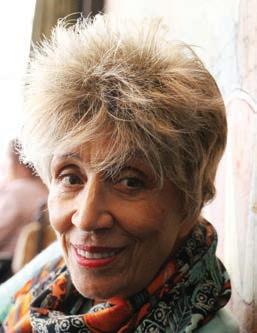
Jacqueline Llewellyn ’51
Jacqueline Melbourne Brown Llewellyn ’51 died on October 21, 2025, at her home in Beverly Hills, Calif. She was 96. Jacqueline was born in New York City on March 17, 1929, to Dr. Lucien Brown and Ida Goldbourne, Jamaican immigrants. They became among Martha’s Vineyard’s early Black homeowners, purchasing a cottage in Oak Blufs for $5,000. The property remains in the family today.
A graduate of Evander Childs High School in the Bronx, Jacqueline was among the frst Black graduates of Bennington College. She studied at Sorbonne and wrote her senior thesis in French on the existentialist philosopher Jean-Paul Sartre.
She worked in distinguished and varied careers, including as assistant buyer at Bloomingdale’s, member of the United Nations Welcome Committee, executive at Equitable Life Assurance, assistant deputy commissioner at the New York City fre department, and licensed real estate broker.
She is survived by her two daughters, Lisa Llewellyn Thompson and Alexandra Clancy; a granddaughter, Alexis Clancy; a grandson, Keyveon Thompson; and a niece, record executive Suzanne de Passe; and nephews Christopher Koefoed and Erik Koefoed.
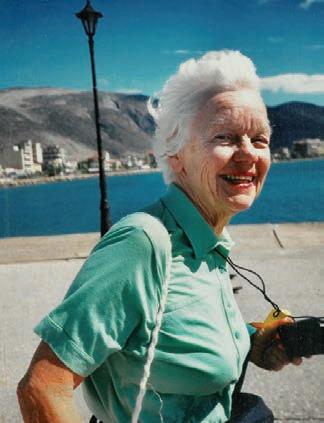
Alicia Ruhl MacArthur ’43
Alicia Ruhl MacArthur ’43 died on June 22, 2025, at her home at Foulkeways in Gwynedd, Pennsylvania. She was 104 years old. Born on May 9, 1921, Alicia was raised in Medford, Oregon, the second daughter of Robert and Mabel Ruhl. She studied art, urban planning, and architecture while at Bennington. During World War II, Alicia volunteered in the war efort. After the war Alicia served as a feature writer for the Medford Mail Tribune and the New York Herald Tribune covering the peace talks from Europe. In 1953, Alicia traded her career in journalism for the role of wife and mother when she married engineer John R. MacArthur of Bronxville, NY. John’s work took the family, which grew to six children, to the west coast in 1960 and to Pakistan in 1965. Tragically, her husband was killed in a mountain climbing accident in 1966. She moved back to Medford, Oregon, where she lived as a single parent with the invaluable help of their long-time nanny, Marion MacFarlane. Although burdened with many responsibilities, Alicia devoted much of her life to service and the care of others. She served on several not-for-proft boards, enjoyed hiking and the outdoors, was a voracious reader and a steady bridge player, and actively tended her garden, while raising her children and caring for her aging mother until the latter’s death in 1987. She was an enduring caregiver, always looking out for the welfare of others even in her centenary years. She never lost her sense of adventure and shared the most infectious laugh and her brilliant smile with all who came near her.
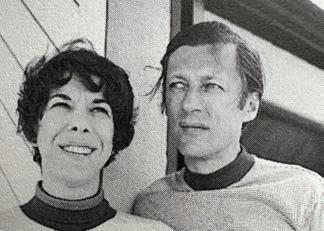
Barbara Neski ’49
Architect Barbara Goldberg Neski, FAIA, passed away on March 23, 2025. Barbara grew up in Highland Park, New Jersey. While at Bennington College, she studied art, art history, and mathematics. She went on to become one of the frst women to earn a Masters of Architecture (M.Arch.) at Harvard University’s Graduate School of Design, then directed by Walter Gropius.
In 1952, Neski began working in the ofce of architect José Luis Sert and helped design urban plans for the LatinAmerican cities of Bogotá, Colombia, and Havana, Cuba. At Sert’s ofce, she met Julian Neski, her future design partner and husband, whom she married in 1954.
They moved together to architect Marcel Breuer’s ofce, where she helped develop plans for a factory in Canada, a house in Connecticut, and a library for Hunter College, in New York City. In the early 1960s, the couple started their own frm and designed more than 35 houses, 25 of them in the Hamptons, NY. She became renowned for her pioneering contributions to modernist residential design. Barbara taught at Pratt Institute between 1978 and 1992 and became a Fellow of the American Institute of Architects in 1985.
Later in her career, Barbara emerged as a vocal advocate for architectural preservation, particularly of Hamptons modernism. She is survived by two sons, two grandchildren, and a great grandson.
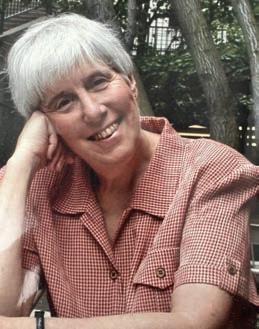
Margot Welch ’61
Margot was born in Cincinnati. She attended Walnut Hills High School and then went on to Bennington College, where she made many lifelong friends. She was a passionate intellectual; she received master’s degrees from University of California, Berkeley and Tufts University and a PhD from Harvard.
A single parent, she raised two sons and worked for thirty years as a teacher and psychologist in university, school, court, and community settings. Professionally, she focused on issues critical to children. Her book, Promising Futures: the Unexpected Rewards of Engaged Philanthropy (2006), describes the transformative impact on philanthropists of making longterm engaged commitments to low-income children.
A devout Francophile, art lover, and musician, committed humanist, and practicing Unitarian Universalist, Margot found great joy in simple things and her large and loving family. She remained ever a midwesterner, despite living most of her life in Cambridge, Mass. She passed away on January 15, 2026. She leaves many family and friends who will miss her dearly. ●
Barbara with husband Julian Neski
At Bennington, we celebrate risk-takers, artists, scientists,
Support the Bennington Fund. Empower students. Champion the future. and change-makers ready to shape the
This transformative experience is made possible through the Bennington Fund.
The Bennington Fund ensures that students from all backgrounds can explore boldly and discover who they are meant to be. Help sustain the people and programs that make a Bennington education possible.

Make your gift at bennington.edu/givemagazine
In Memoriam
Alice Abraham ’83
Anne S. Adams ’54
Catherine Appleton ’49
Greg Bathon MFA ’08
Roberta Anne Berke ’65
Jeannette W. Bertles ’49
Linda R. Blondel ’67
Trudy Carter, former staf member
Ann Chapin ’59
Loretta Lang Forbes Coykendall ’54
Richard “Dick” Cuyler MFA ’56
Matthew James Denton ’98
Aileen DeVergie-Zmuran ’53
Walter G. Dunnington III ’84
Kathleen J. Earthrowl, EdD ’62
Simon Fainsilber ’93
Dorothy Feher ’61
Beth Fernandez ’74
Lynn Freed, former faculty member
Jo Ann Gardner ’56
Martha Gibson ’45
Patrick K. Harnett-Marshall ’16
Solange Herter ’50
Rosemarie Heyer ’58
Edward Hoagland, former faculty member
Paul Marcel Hohenberg, former faculty
Derrik C. Hoitsma, Jr. ’77
Martha Tappan Howell ’55
Blayney Anderson Hull ’49
Julie Kaneta ’61
Barbara R. Kapp ’61

Dorothea “Debby” Booth Katz ’55
Sally Wolter Kirouac ’63
Jan Krukowski, friend of the College
Jacqueline Melbourne Brown Llewellyn ’51
Alicia Ann Ruhl MacArthur ’43
Carla L. Maxwell ’67
Georgia M. Myer ’75
Sarah M. Nelson ’49
Barbara G. Nemirof ’59
Barbara J. Neski ’49
-
Helen Nunberg Morales ’74
Cynthia Nyary ’50
Roberta Panter ’55
Aron Percey, former staf member
Pamela A. Picciotti ’61
Bryant Sagisi Rayngay ’92
Stanley Rosen, former faculty member
Carol Rubenstein ’55
Christina Russo ’00
Ruth B. Salloway ’54
Joyce Scarborough ’53
Janet A. Schuman ’87
Jean Sloss ’48
Henry D. Smith, Jr. P ’05
Josephine Stead ’56
Pamela K. Sullivan ’64
Olive Tamm, MD ’43
Mary-Low “Low” Taylor ’51
Margot A. Welch ’61
Cristina Guiu Wood ’70