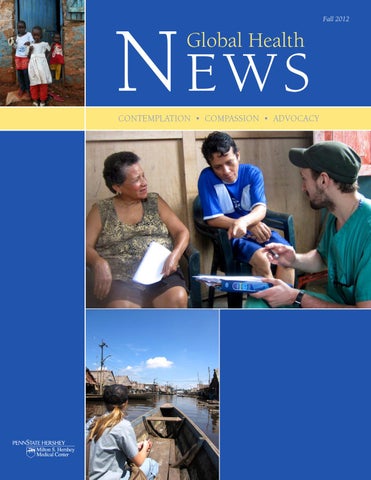
N EWS Global Health
CONTEMPLATION • COMPASSION • ADVOCACY
Fall 2012
Global Health Scholars Program Follow-up In 2008, the first set of medical students at Penn State College of Medicine began the longitudinal global health effort called the Global Health Scholars Program (GHPS). The program aims to educate students about global health and allows them to have hands on experience in a foreign country. The first set of Global Health Scholars has graduated and moved on to residency programs. I was able to catch up with Sean Boley and Todd Schneberk, two graduates of the GHSP who went to San Pablo, Ecuador, to ask them how participation in the GHSP has affected them. Where are you practicing and what specialty did you choose? SB: I am in St. Paul, MN at Regions Hospital working in Emergency Medicine TS: I am in Los Angeles County at the University of Southern California Medical Center working in Emergency Medicine How did the Global Health Scholars Program affect you as an individual? SB: The program helped me on a few fronts. First, it definitely made me aware of various issues in global health including the problems with medical tourism, HIV/AIDs in the developing world, tons of things related to health systems development. It also helped me to put the medicine I was learning at Hershey into perspective as well as helped me to learn about how medicine is practiced in resource poor areas (and how to perhaps, bring some of those creative techniques back here). TS: I think it taught me an immense
amount about the actual practice of global health work. The idea of global health is often romanticized into something it isn’t. The only way to understand how it really functions is to try to assess the needs of a community and then work to address them working with the resources allotted. It is a difficult science and finding ways to sustainably better the health of a community takes painstaking work and affords a substantial amount of reverence for guys like Drs. Groh and Fredrick who pull it off with such style. Did the GHSP influence your career choice? SB: Global Health Scholars Program definitely got me excited to look towards a specialty that was broad enough that I could be useful in a resource poor area. There are few specialties out there that enable you to see undifferentiated patients, work them up, and then treat them. Emergency allows for that and encourages this one-stop-shop feel that places without doctors or hospitals really need. TS: It made me realize that in order to pursue careers in global health it helps to have a skill set that can be transferable and useful in under-served settings, as well as a schedule and patient base that doesn’t restrict you from spending time away in these places. From an emergency specific standpoint, I think as gatekeepers, the ER will have a pivotal role in innovative distribution of care for the under-served. Are you planning on practicing global health in the future? SB: I would love to practice global health in the future. It all depends on what opportunities are available to me when I graduate. There are some global health fellowships (including one at my current program) that would allow for it.
By Catherine Nicka (Class of 2014) TS: Yes Do you think that your participation in the GHSP affected your match and is it something that came up during interviews? SB: My experience with GHSP definitely helped me get into residency. It was brought up at every interview. People always wanted to talk about it, and were very interested in the project as it involved research, project development, broadening perspectives (ie getting out of the hospital), a volunteer aspect, etc. Programs love stuff like that. I think it showed them a lot about what I was interested in and committed to. TS: My choice was undoubtedly affected. Looking at it realistically, I realized the maximum amount of time I could spend doing global health projects in residency was probably around 6 months. Therefore, I decided I wanted a program where I didn’t necessarily have to travel to see the types of patients I would see in the developing world. As for how it affected how I matched/ interviews, I think it was instrumental to my success... It was the focal point of most of my conversations with my interviewers. This program is novel in the autonomy and ownership it allows students in community assessment and application of their OWN intervention. Not only that, but it is one of the only programs that has a built in longitudinal aspect, where the students can engender trust with the population as well as establish a presence in order to augment sustainability. Several faculty at multiple programs mentioned they would like to emulate many parts of the GHSP model and said if I attend their residency they would like me to help enrich their programs.
Damien House: A Home for Persons affected by Hansen’s Disease By Lauren Schmidt (Class of 2014) In June, as part of the Global Health Scholars Program, students traveled to Guayaquil, Ecuador where they had the opportunity to visit the home of over 60 patients diagnosed with Hansen’s disease (leprosy). Since 1988, through the leadership of Sister Annie Credido (pictured with Annie Odom, MSII), Damien House has become a second home for many of the patients, who were abandoned by their families. In addition to providing medical treatment and rehabilitation, the principal goal of the foundation is to eradicate the stigma that surrounds Hansen’s by informing the public that the disease can be cured with basic medication. Although today Damien House strives to bring dignity to the lives of people affected by Hansen’s, before Sister Annie arrived in Ecuador nearly 23-years ago, patients living with Hansen’s were subjected to a life of despair. According to several of the residents at Damien House, “We lived worse than the stray dogs. The leprosy wing of the hospital [which is where we lived at the time] was infested with rats, and dogs would not have dared to eat the food they served us.” Today, wound care is an area of medical treatment that is a necessity at Damien House. Many of the patients have had their fingers, toes, and legs amputated. This year, 65 nerve decompression surgeries were completed through the foundation. Before the surgeries these patients lacked the sensation to perform daily activities, now the majority of the individuals make crafts as a means to keep their hands and feet active and to delay the effects of nerve atrophy. Difficulty with vision is common among the patients; many can no
longer close their eyes when they are sleeping. Throughout the year the Global Health Interest Group will be collecting sunglasses (either new or used) to donate to the residents of Damien House. In addition, the GHIG will be collecting used clothing and shoes (especially sandals with Velcro straps) so that we can aid in restoring hope and dignity to those affected by such a devastating disease. Two of our 4th year scholars will be presenting their poster, “An Assessment of Diarrheal Disease in the Community of San Pablo, Ecuador” in November at the combined GHEC, Canadian Society for International Health, and Consortium of Universities of Global Health 2011 conference. The Scholars Program is now in its fourth year. To view other scholarly activity by the Scholars Program, please visit: https:// sites.google.com/site/ ghsphershey/ [Search: GHSP Scholarship]
Family Medicine Global Health Conference By Sarah Roberts (Class of 2013)
In September, I traveled to Minneapolis, MN, to attend a conference where I met and learned about family doctors who practice medicine all over the world. My ticket to admission was a poster on the research I did with Global Health Scholars Program in Ecuador in summer 2011 on underweight children and giardia carriage. In short, my research showed that about 1 in 4 kids in San Pablo, Ecuador is underweight, and 1 in 4 kids in San Pablo has a giardia infection. However, these aren’t the same kids, so another factor must be
at play. More exciting than showing my poster was seeing a variety of different talks from family doctors who also do global health work. Talks included discussion about working with refugees in the US and then continuing exposure to that group by traveling to the corresponding native country to do mission work. Another way that people achieve continuity of care with their foreign population is with telemedicine. I learned about many established global health groups and partnerships between doctors in the US and other countries
that provide opportunities for students and residents. Numerous talks discussed global health opportunities in residency. Some of the organizations that seemed particularly good were Child Family Health International and Shoulder to Shoulder. I also gained contacts with people who do work in Ethiopia, Kenya, Ecuador, Haiti and other nations. This was a great conference and definitely something I’d like to attend again next year, since I will be in the midst of applying to residencies.
Family Medicine Global Health Conference continued By: Ashley Morrison (Class of 2014) Early in September I traveled along with my fellow medical students Megan Ferderber and Sara Roberts, as well as Dr. Brandt Groh, to Minneapolis, Minnesota for the American Academy of Family Physicians Global Health Workshop. The workshop involved several lectures from experts in global health and international family medicine development as well as several opportunities to exchange ideas and experiences with fellow participants. The workshop also included a poster presentation session. Megan and I presented a poster derived from our Global Health Scholars debate topic “Is There a Role for User Fees in Developing Nations?” Dr. Groh, co-director of the Global Health Scholars Program, served as advisor to both presentations. The conference not only provided an excellent forum for learning about the role of family medicine globally, but also included interesting discussions on how to incorporate global health experiences into residency and medical school training. We’d like to thank the Department of Family and Community Medicine for helping to make this experience possible.
The Global Health Center provides organization and oversight for the medical center’s educational, service, and community research activities in global health. The Center is responsible for promoting global health issues on campus. If you would like to contribute to the quarterly newsletter, or if you are not receiving this publication, but would like to be added to the list, please send an email to nfredrick@psu.edu. Director of Penn State College of Medicine’s Global Health Center: N. Benjamin Fredrick, MD, Family and Community Medicine
Upcoming Conferences Global Health Missions Conference November 8-10, 2012 Louisville, KY http://www.medicalmissions.com/ American Society of Tropical Medicine and Hygiene November 11-15, 2012 Atlanta Marriott Marquis Atlanta, Georgia, USA http://www.astmh.org/Home.htm Tropical Infectious Diseases: From Bench to Field February 10-15, 2013 Hotel Galvez Galveston, TX http://www.grc.org/programs. aspx?year=2013&program=tropical Consortium of Universities for Global Health (CUGH) March 14-16, 2013 Marriott Wardman Park Washington DC http://www.cugh.org/ Unite for Sight: Global Health & Innovation Conference April 13-14, 2013 Yale University New Haven, CT http://www.uniteforsight.org/conference/ Western Regional International Health Conference ~April, 2013 University of Washington Seattle, Washington http://wrihc.org/
Student Global Health Newsletter Co-Editors: Sarah Smith, Kimberly Faldetta (Class of 2014) Global Health Center Advisory Board: Elizabeth Bates, BS DN (Nursing) Dennis Gingrich, MD (Fam Med) Brandt Groh, MD (Pediatrics) Graham Jeffries, M.D. (Medicine) On the Web: http://www.pennstatehershey.org/web/globalhealth Like Us on Facebook: http://www.facebook.com/PSUGlobalHealth Bi-weekly announcements: if you would like to receive Global Health Center announcements, please notify Thao Danz by email (tdanz@hmc. psu.edu).
How to Donate If you are interested in donating to the Global Health Center Scholarships you can: 1. Send a check to the Penn State University Global Health Center 2. Go to the Give Penn State fund on the web at giveto.psu.edu 3. Contact Devon Johnson to set up your own scholarship at DominickJohnson@hmc.psu.edu