
John Taylor (Philadelphia, 1735-Bath, 1806)
River Landscape with the Ruins of an Abbey, 1792
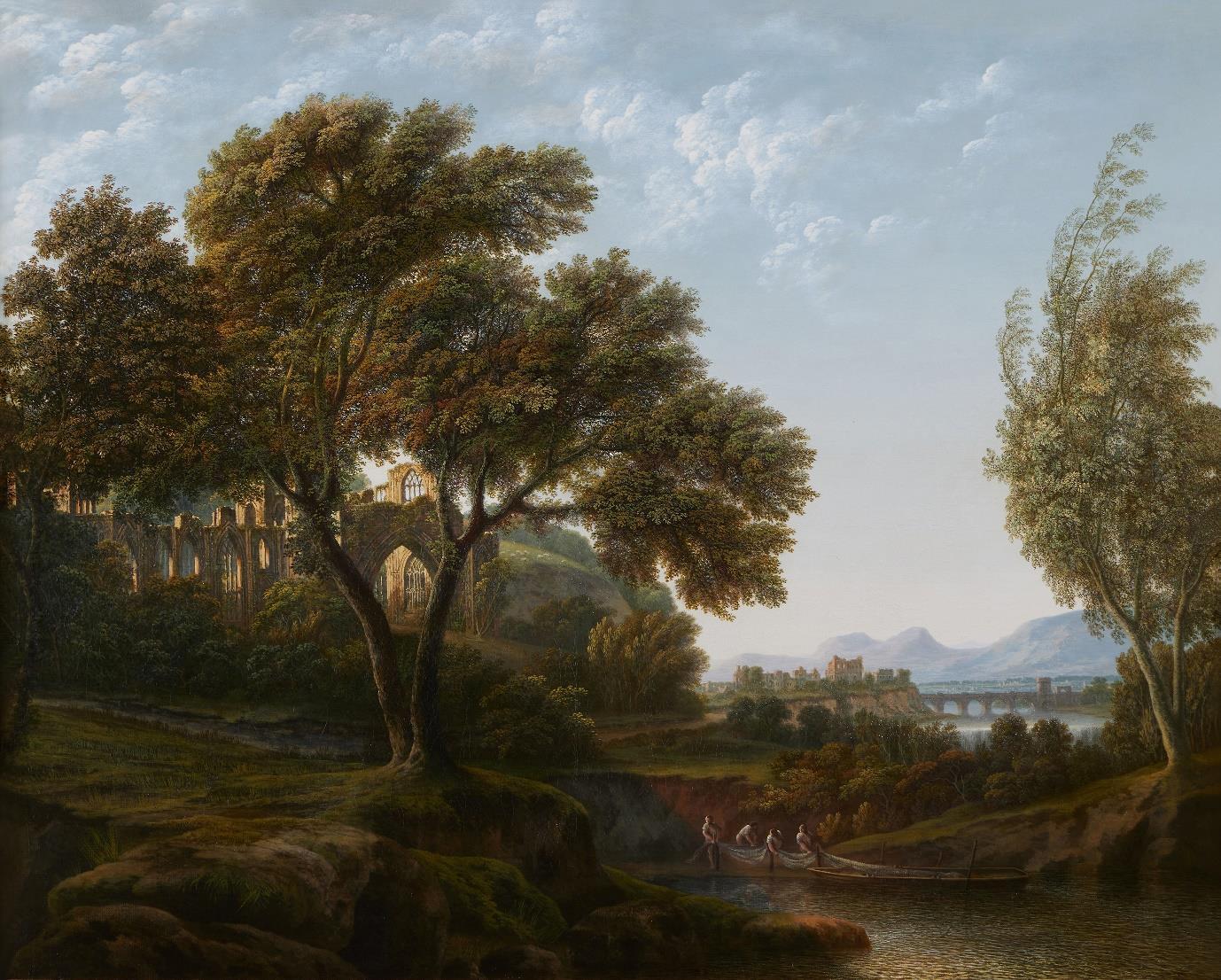
John Taylor (Philadelphia, 1735- Bath, 1806)
River Landscape with the Ruins of an Abbey, 1792
Oil on canvas
Canvas: 101.6 x 127.3 cm (40 x 50 ⅛ in)
Framed: 122.6 x 147.3 cm (48 ¼ x 58 in)
Signed and dated, lower right, on boat hull: Taylor 1792
Provenance:
The artist
By descent to the artist’s son
Sold at "A Catalogue of Twenty-Five Landscapes, The work of that Distinguished Amateur, the Late, John Taylor, Esq., of Grosvenor Place" Christie's, London, March 14, 1840, lot 16, where described as: “A ruined Gothic abbey near a river, with the remains of a castle in the half-distance, figures are drawing nets in a stream under a fine group of trees; beautifully clear in tone.”
Where acquired by “Farrant” for 4 guineas 4 shillings
Alan G. Fenwick, Thirlestaine House, Cheltenham
His sale, London, Christie's, 21 July 1950, lot 51 (as John Glover)
Where acquired by "Beverley," for 18 guineas
Anonymous sale ("The Property of a Gentleman"), London, Christie's, 15 July 1988, lot 47 (as John Taylor);
With Irving Galleries, Milwaukee; Acquired by a private collector, USA
Ben Elwes Fine Art, London
John Taylor (1735-1806) was the first American to work exclusively as a landscape painter; he belongs to an exceptional generation of American-born artists that includes Benjamin West (1738-1830), John Singleton Copley (1738-1815), and Charles Willson Peale (17401827). Like West and Copley, he would move, (at age 27 in his case; 22 in West’s, 36 in Copley’s), to England, which was the center of the English-speaking art world.
Benjamin Franklin singled out Taylor as America’s great eighteenth-century landscapist in one of the remarkable letters he exchanged with Jan Ingenhouz, a Dutch natural philosopher and Hapsburg court physician, who was curious to know about the arts and sciences in the emerging United States. Ingenhouz reported to Franklin that many European artists and scientists were tempted to move to “a country of freedom, whose laws are framed by those who submit to them, and where no frowns of a monarch will ever inspire terror and apprehensions to any man.”1 He specifically asked Franklin what the prospects might be for the notable Roman sculptor Giuseppe Ceracchi.2 But Franklin had to report back, on May 16, 1783, that “Private persons are not rich enough to encourage sufficiently the fine arts [in America], and therefore our geniuses all go to Europe. In England, at present, the best History Painter, West, the best Portrait Painter, Copley; and the best Landscape Painter, Taylor at Bath, are all Americans.”3
It is significant that Franklin expressed his pride in Taylor - and in what America was fully capable of producing - while he was in the midst of negotiating the Treaty of Paris, which would end the American Revolution and officially launch the United States on the world stage. At the same time, Franklin recognized that it was difficult for home-grown American talent to reach its potential under the present conditions; ambitious American artists who were interested in professional careers necessarily had to travel to England for
1 Ingenhouz to Franklin, August 20, 1782, Franklin Papers, American Philosophical Society, Philadelphia.
2 Ingenhouz to Franklin, April 29, 1783, Franklin Papers, American Philosophical Society, Philadelphia.
3 John Bigelow, editor, The Complete Works of Benjamin Franklin. New York and London, G, P. Putnam’s Sons, 1888, volume 8, 292.
training, to Italy for art history, and in the case of Taylor, West, and Copley, to remain in England for their careers.
What fragments we know about John Taylor’s origins mostly reflects the work of Arthur Marks, an art history professor at the University of North Carolina, who in 1978 published his research in American Art Journal. 4 Taylor was born in Philadelphia, the son of Abraham Taylor (1702-1772). His mother, Philadelphia Gordon Taylor, was the daughter of Major General Patrick Gordon, the Deputy Governor of Pennsylvania. Abraham Taylor was English-born but had emigrated to America, settling in Philadelphia in 1724, where he entered a prosperous partnership with John White as “Merchant Adventurers in the North American Trade.” With his significant wealth, he involved himself in the Library Company of Philadelphia and the University of Pennsylvania, as well as public affairs, including the Governor’s Council. The portraitist John Smibert painted the Taylors in 1740.5
Of the Taylor’s three children, John was born in 1735. His youth is largely undocumented, and that includes his artistic training and production while in America. Professor Marks wonders whether he was briefly sent abroad in the 1750s, but there is no hard evidence for that. A good counter-argument is that he may have trained in Philadelphia under the Welshman William Williams (1727-1791; resident in Philadelphia from 1747), who influenced young Benjamin West. Williams painted maritime scenes, history painting, portraits, and landscapes, in which he featured groomed natural settings with the kind of detailed foliage that would mark Taylor’s later work. British and Continental prints, available in Philadelphia, would also have been a source of self-instruction for Taylor, as they were for Copley in Boston.
The Taylor family, including John, moved to England in 1762. In 1763, John married
4 Arthur J. Marks, “An Eighteenth-Century American Landscape Painter Rediscovered: John Taylor of Bath,” American Art Journal, 10, November, 1978, 81-96. The Taylor genealogy can be found in the Nurse Family History: http://www.nursefamily.ca/_book/Part_2/Chapter2.1.html
5 The Taylor portraits are listed as “unlocated” and as numbers 447 and 448 in Richard H. Saunders, John Smibert: Colonial America’s First Portrait Painter, New Haven, Yale University Press, 1995, 238.
Rebecca Luther. Together, John and Rebecca settled in Bath, an affluent resort town, where they lived in a terrace-house within the recently designed and highly desirable Circus (at no. 22). The Taylors would have seven children, six of whom lived to adulthood. Because of the significant wealth they would inherit from Taylor’s father and the British properties inherited from Rebecca’s relatives, John Taylor did not have to be as entrepreneurial as, say, Copley.
Taylor’s neighbor and new friend in Bath was Thomas Gainsborough, (1727-1788; residing at no. 17, The Circus), who had come to Bath in 1759 and was the reigning artistic genius of the town. In one account, Taylor and Gainsborough entered into a friendly competition, judged by professional artists, over who could paint the better landscape, the results ending in a tie. Taylor would sell his Bath house in 1788. When he painted River Landscape with the Ruins of an Abbey in 1792, he was living in new quarters in Grosvenor Place, London, not far from Copley’s house in tony Hanover Square.
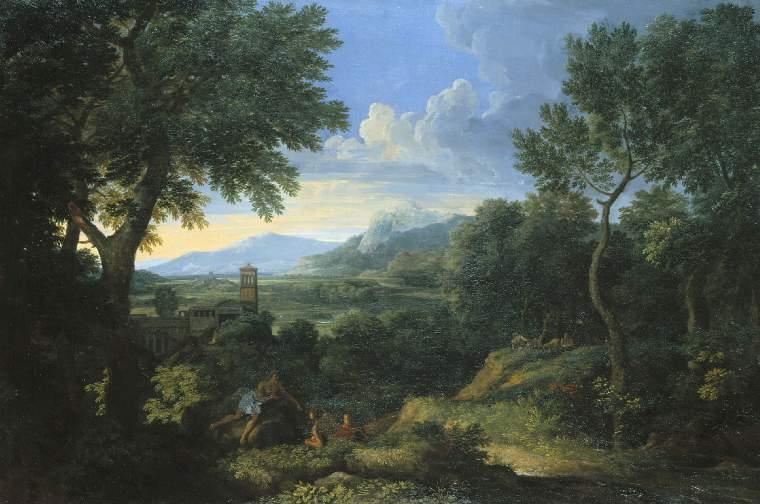
Gaspard Dughet (1615-1675), Landscape near Rome, oil on canvas (73.7 x 110.5 cm). The Fitzwilliam Museum, Cambridge, M.73.
Taylor’s precise technique and compositional strategies indicate the influence of Italian art, rather than Gainsborough’s feathery rococo style. Marks speculated that Taylor
made the Grand Tour, which he could have done in the six years between his marriage and his first dated work. He could have absorbed the Italianate landscape at home through the avidly collected paintings by and prints after Claude Lorrain (1600-1682), as well as through the numerous paintings of Gaspard Dughet (1615-1675) in British eighteenth-century collections, or works by Richard Wilson (1714-1782), or those by George Lambert (17001765).
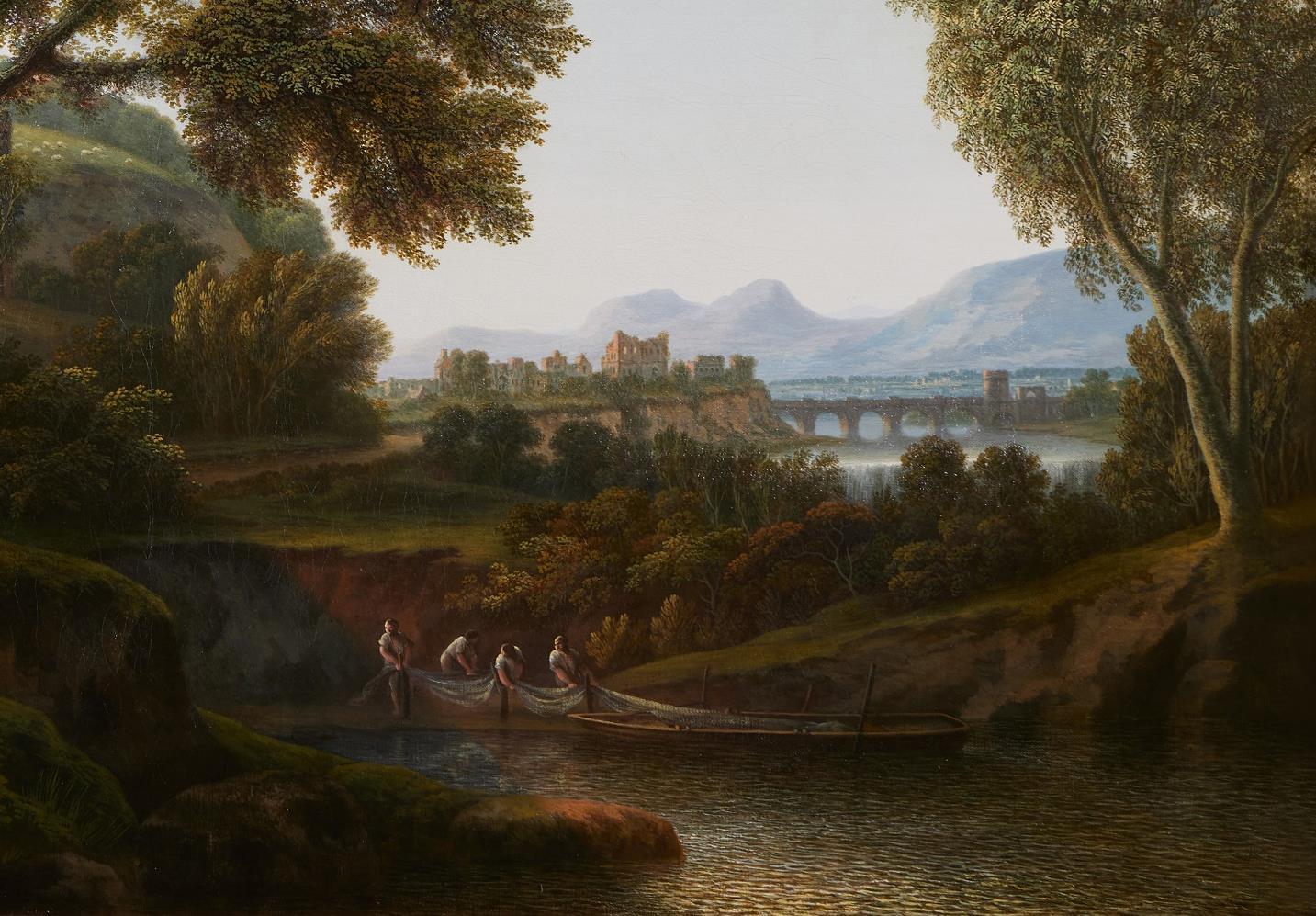
(Detail) John Taylor (Philadelphia, 1735- Bath, 1806), River Landscape with the Ruins of an Abbey, 1792, oil on canvas, (101.6 x 127.3 cm). Ben Elwes Fine Art, London.
When put side by side with Dughet’s or Claude’s works, it becomes clear what makes Taylor’s River Landscape with the Ruins of an Abbey so exceptional. There is a spectacular silvery effect, almost a vibration, in the delicate foliage that is being teased by a gentle breeze. The upper branches of the slender tree on the right side of River Landscape catch a left-to-right wind and help to invest the picture with a sense of real time. In Dughet’s and
Claude’s pictures, by contrast, there is, instead, a stasis, as if nature were frozen in classical perpetuity.
Compositionally, Taylor followed Italianate landscape conventions, but with more precision in his execution than Dughet or other artists. Massings of trees frame a central corridor of space that zigs and zags from near to far. That is, from the widened foreground pool of a stream that, in effect, serves as the viewer’s launch into the space of the picture.
Angling left, the stream encounters fishermen casting nets near a boat, before angling right toward another broadening of the stream which is then crossed by an arcaded bridge in the middle distance that, in turn, serves the function of cinching, left and right, the two sides of the landscape. At that point, the previously diverse color palette ebbs toward blue, the result of aerial perspective, and the voyage into the distance is finally closed by a range of hills.
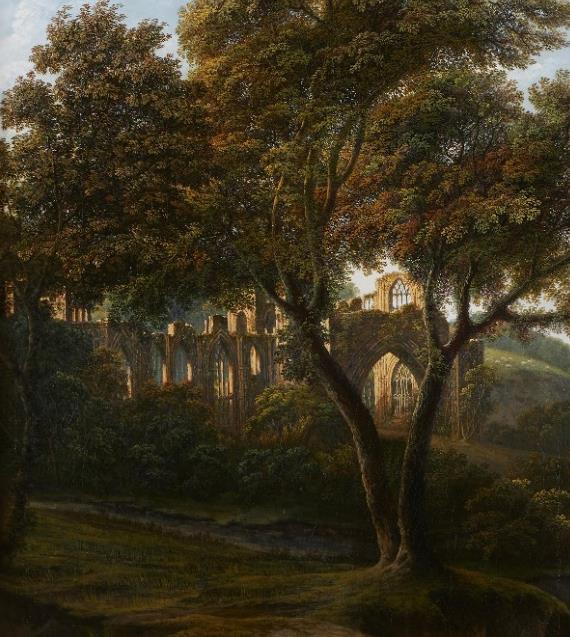
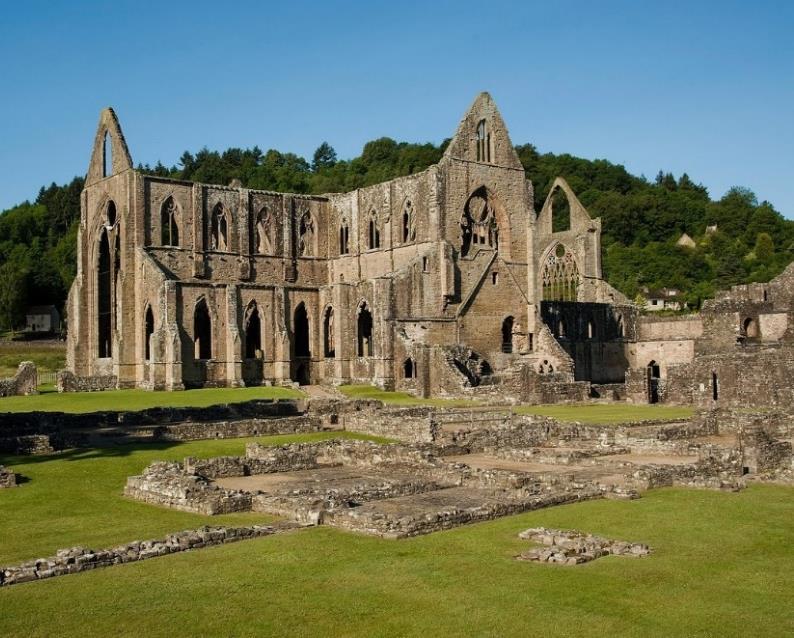
Left: (Detail) John Taylor (Philadelphia, 1735- Bath, 1806), River Landscape with the Ruins of an Abbey, 1792, oil on canvas, (101.6 x 127.3 cm). Ben Elwes Fine Art, London.
Right: Tintern Abbey, 1131. Monmouthshire, Wales
Medieval ruins abound in the middle distance and most prominently in a collapsed Gothic abbey that evokes twelfth-century Tintern on the River Wye in Wales, which was only thirty miles from Taylor’s Bath home. At the time he painted the picture in 1792,
Medieval subjects were newly in vogue. William Gilpin (1724-1804) had introduced the aesthetic category of Picturesque, which highlighted those places as well as pictures of those places redolent with Gothic and Celtic beauty, while Uvedale Price (1747-1829) gave descriptive rubrics for what constituted the picturesque. Among painters, J. M. W. Turner was making his first trip to the Wye Valley in 1792, which would lead to a suite of watercolors on the subject of ruined Tintern. Other eighteenth-century painters, such as Richard Wilson, also gravitated to picturesque ruins. Meanwhile, Horace Walpole’s “gothic castle,” Strawberry Hill, was nearing completion in Twickenham when Taylor was painting River Landscape.
One of Taylor’s clever moments in the picture comes in the form of the reciprocal relationship between the wishbone trunk of a foreground tree and the Abbey’s lancet window that nestles in between. As viewers, we first pass through the V of the tree, then the Gothic arch of a transept, and finally through the blown-out windows of the other transept.
Understandably, Taylor acquired a reputation for excellence. A number of his landscapes were made into marketable prints cut by William Smith, Peter Paul Benazech, and Daniel Lerpiniere. James Boswell and Hester Thrale noted their encounters with Taylor’s works.6 George III and George IV collected his landscapes, eight of them identified in the Royal Collection. David Garrick, the renowned actor, upon the gift of a Taylor landscape, wrote of “a most exquisite piece of painting. . .. We have scarcely look’d at anything Else till this moment, . . . our wishes are fulfill’d by it, and our Expectation Exceeded.” John Henderson, another actor, wrote of Taylor that, “his genius is like the Dryads and Hamadryads, embosom’d in woods and fields. In plain English, he is perhaps the greatest Landscape painter we have.”7 Tobias Smollett, the Scottish novelist, said that “I had often
6 Geoffrey Scott and Frederick A. Pottle, editors. Private Papers of James Boswell from Malahide Castle Mount Vernon, New York, W. E. Rudge, 1929-36, vol. 11, 267. For Thrale: L. F. Powell, editor, Boswell’s Life of Johnson, 6 volumes. Oxford, Clarendon Press, 1934-50, vol. 3, 422.
7 David M. Little and George M. Kahrl Garrick, The Letters of David Garrick, 3 volumes. Cambridge, Mass., Belknap Press of Harvard University Press 1963, vol. 2, p. 813; David Garrick Sale, Christie’s, June 23, 1823,
heard very extraordinary encomiums passed on the performances of Mr. T.. . I went yesterday to see the pieces, which had been so warmly commended. . .. If I am not totally devoid of taste, however, this young gentleman of Bath is the best landscape-painter now living. I was struck with his performances in such a manner as I had never been by painting before. His trees not only have a richness of foliage and warmth of colouring, which delights the view, but also a certain magnificence in the disposition and spirit in the expression. . ..
His management oof the chiaro oscuro, or light and shadow, especially gleams of sunshine, is altogether wonderful, both in the contrivance and execution.”8
Richard Graves, the poet and novelist, wrote the most elaborate tribute to Taylor in his Euphrosyne [translation: muse of good cheer], an assembly of poetic encomiums in which Taylor is lauded as “equally excellent” to Gainsborough:
To J. T yl r, Esq. at Bath
On his admirable Landskips
Such are the scenes, thro’ which gay Fancy roves
In airy dreams; and such th’ enchanted groves
Which sacred Poets feign, the blest abodes
Of fawns and dryads, nymphs and demi-gods.
Landskip had long with curious search explor’d
Each charm that Art or Nature’s view afford,
To grace her works: hill, rocks, and sylvan bow’rs, Flocks, herds, or rural cots; or distant tow’rs, Or Gothic piles amidst the tufted woods; Cascades, wild cataracts, and crystal floods.
lot 55.
8 Tobias Smollett, The Expedition of Humphrey Clinker. Originally published in 1772. London, edition printed for Harrison and Co, 1785, 45.
Their harms exhaulted, T yl r figh’d to find
Unfill’d the vast idea in his mind;
Then search’d imagination’s teeming cell, Where yet unform’d ten thousand wonders dwell.
There the sublime, the beautiful, the great, At Fancy’s call in bright assemblage meet.
Drawn thence we view with pleasure and surprise
Fresh objects with celestial splendor rise: Whilst Taste and Spirit animate the whole, And with their powerful charms transport the soul.
From Nature, Art, and Fancy’s richest store,
Thus T yl r forms a style unknown before.
10 Oct 17709
Paul Staiti
Alumnae Foundation Professor of Fine Arts
Mount Holyoke College
Author of Of Arms and Artists: The American Revolution through Painters' Eyes (Bloomsbury Publishing, 2016); and The Killing of Jane McCrea, An American Tragedy on the Revolutionary Frontier (Westholme Publishing, 2025)
9 Richard Graves, Euphroysne: Or, Amusement on the Road of Life, 2 volumes. London, J. Dodsley, 1776, vol 1, 130-131.