
Robert Smirke (1752-1845)
The Murder of Lucinda, c.1805
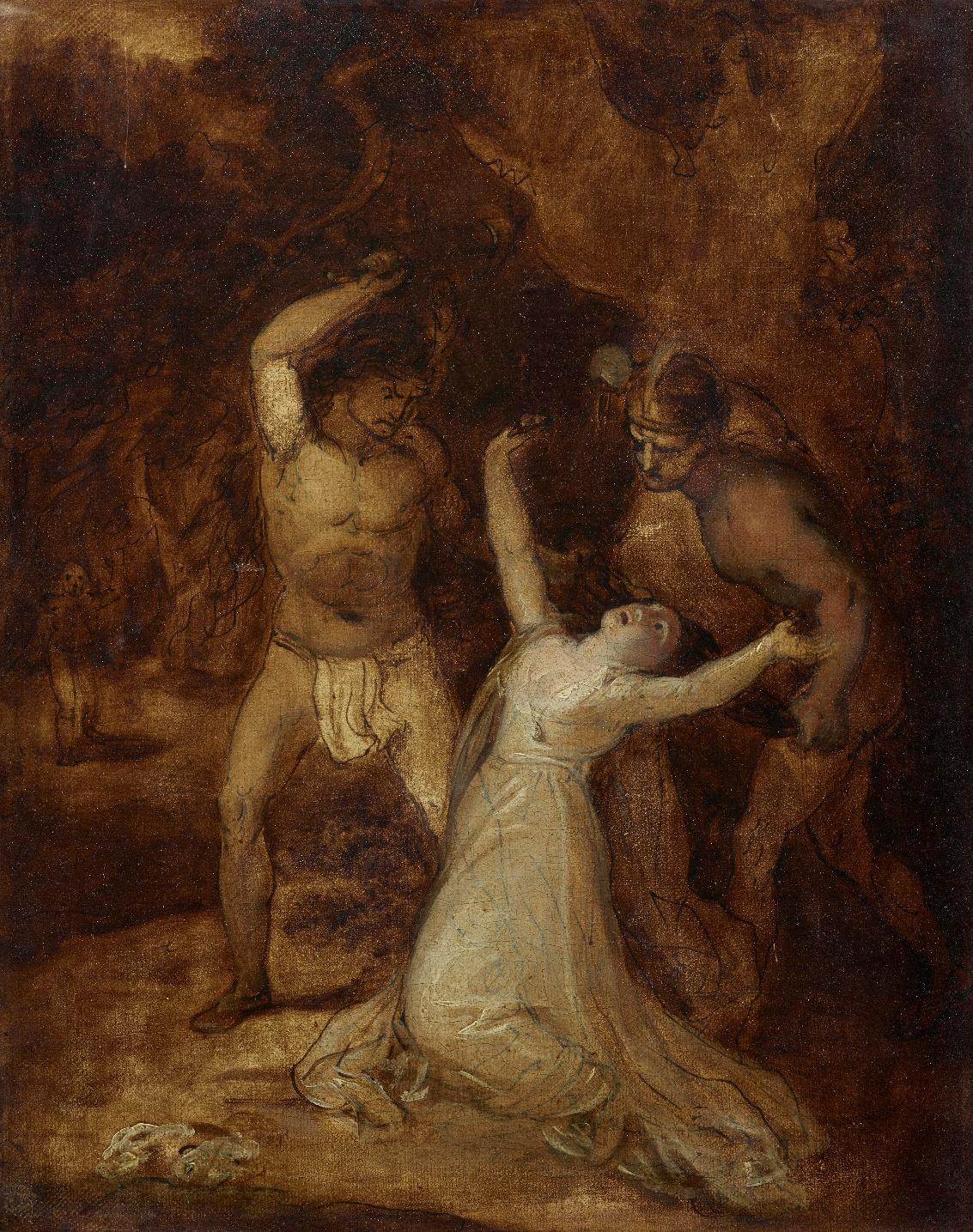
Robert Smirke (1752-1845)
The Murder of Lucinda, c.1805
from Book VI of Joel Barlow’s The Columbiad: A Poem
Oil on canvas, brunaille
35.8 x 28 cm (14 1/8 x 11 in)
Framed: 45 x 38.1 cm (17 ¾ x 15 in)
Provenance: Private collection, USA
The Backstory:
The story of Robert Smirke’s oil sketch of The Murder of Lucinda begins with the person who commissioned it, Joel Barlow (1754-1812). A poet and diplomat from Redding, Connecticut, Barlow arrived in Paris the year before the onset of the French Revolution. He had been an ardent Patriot during the American Revolution, and was coming to France to sell land in Ohio and also hoping to export American republicanism to Europe. He joined the revolutionary French National Assembly, became a French citizen in 1792, and soon thereafter found himself plunged into the politics of The Reign of Terror.
As much as Barlow was political, he was also a major intellectual figure on both sides of the Atlantic, having published the 4700-line poem The Vision of Columbus in 1787, in which Christopher Columbus chats with a guardian angel with whom he takes the reader across the sweep of Western history, narrates the American Revolution, and unveils the breathtaking debut of the United States. It made Barlow’s international reputation.
After a period of shuttling between London, Hamburg, Washington, and Algiers, he returned to Paris in 1797, fully immersed in the possibilities of French republicanism. He was the most recognized American expatriate living in the capital. Around 1802 he began a drastic revision and expansion of The Vision of Columbus that would result in an epic hymn to America, titled The Columbiad: A Poem Clocking in at 514 pages and 8350 lines of heroic couplets, and laced with Jeffersonian ideology, Barlow intended the project to be on a par with the great works of Milton, Virgil, and Homer. It would span Western history and in particular the previous 300 years of the Americas.
His plan was to illustrate the first printing as an édition de luxe, replete with quality engravings. For the original art work, he enlisted Robert Fulton (1765-1815), a pioneering engineer, part-time painter, and close friend since 1797. Barlow considered which scenes to be illustrated and wrote out instructions for eight of them.1 Fulton took a stab at the
1 Bidwell 360; Edgerton, 485, cites letters, here and subsequent endnotes, from Barlow to Fulton in Houghton Library, Harvard University: bMS Am 1448.64.
illustrations, one of which was the killing of Lucinda, but his drawings were met with disapproval by Benjamin West (1738-1820) and Vivant Denon (1747-1825), the French Director General of Fine Arts.2 Moreover, Fulton was too occupied with naval projects a steam-powered surface boat, as well as torpedoes and a military submarine to focus on Barlow’s project.
As a result, Fulton recommended Henry Fuseli (1741-1825), the Swiss-born British artist, who had sketched and illustrated many literary scenes. Fuseli, whom Barlow had known since 1792 and with whom he shared radical political views, was asked to produce seven paintings or oil sketches that could be converted into engravings.3 Fuseli’s wild imagination, however, led to illustrations that were such flights of fantasy that they poorly matched Barlow’s words, as exemplified by Inquisition. None of Fuseli’s work would find a place in The Columbiad
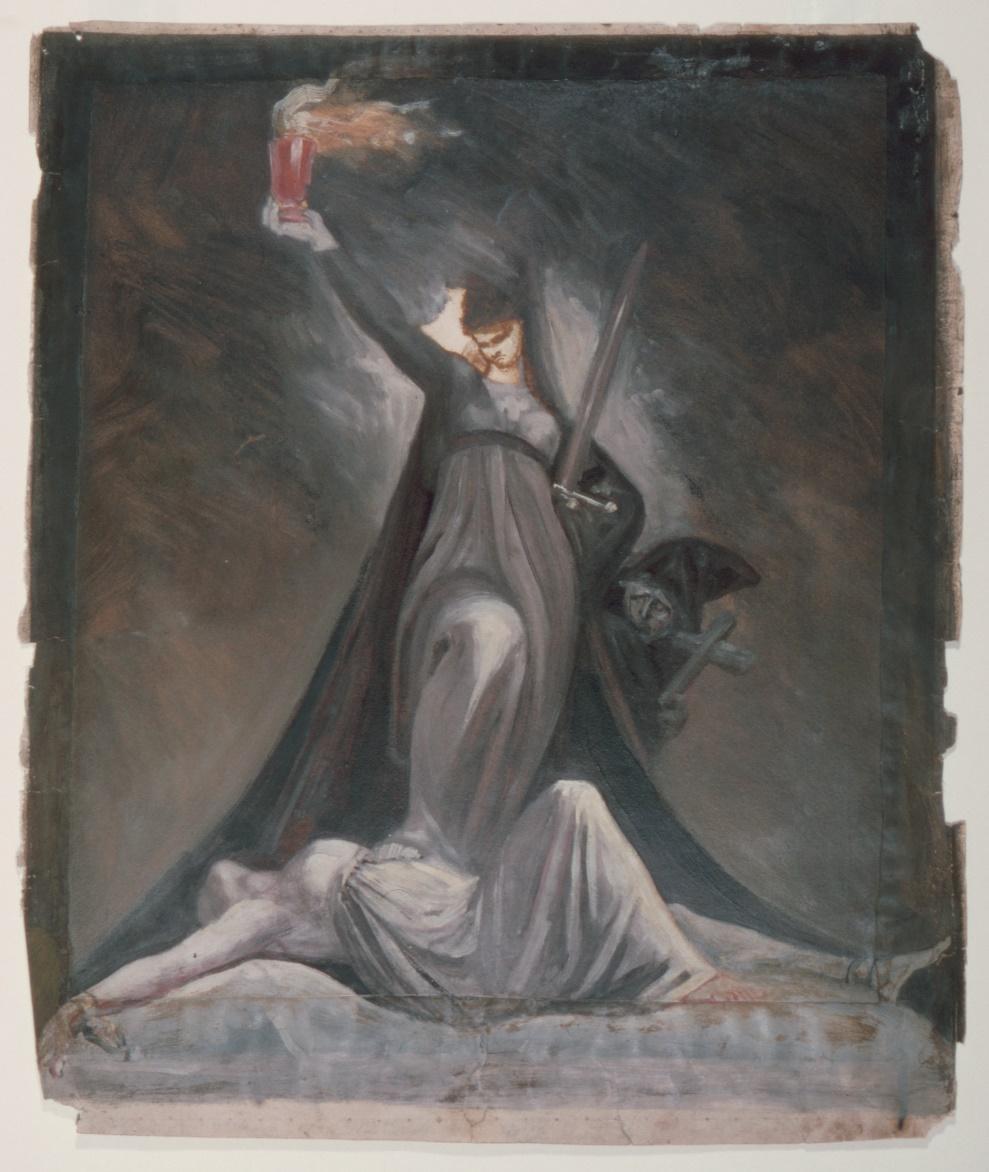
Henry Fuseli (1741-1825), Study for Inquisition, Illustration to Columbiad, c. 1806, oil paint, over touches of graphite, on cream wove paper, laid down on stipple etching, etching, and aquatint in black
2 Rebora, 45; Bidwell 360; Edgerton 485.
3 Bidwell 361; Schiff, 338.
on cream wove paper (52.9 x 44.6 cm) Art Institute of Chicago, 1922.5686.
Fulton next suggested his friend John Vanderlyn. Hailing from Kingston New York, Vanderlyn trained at the Académie de Peinture under François-André Vincent, was living in Paris, and had the backing of American Vice President Aaron Burr Barlow assigned two scenes to Vanderlyn, one of which was Lucinda’s murder.
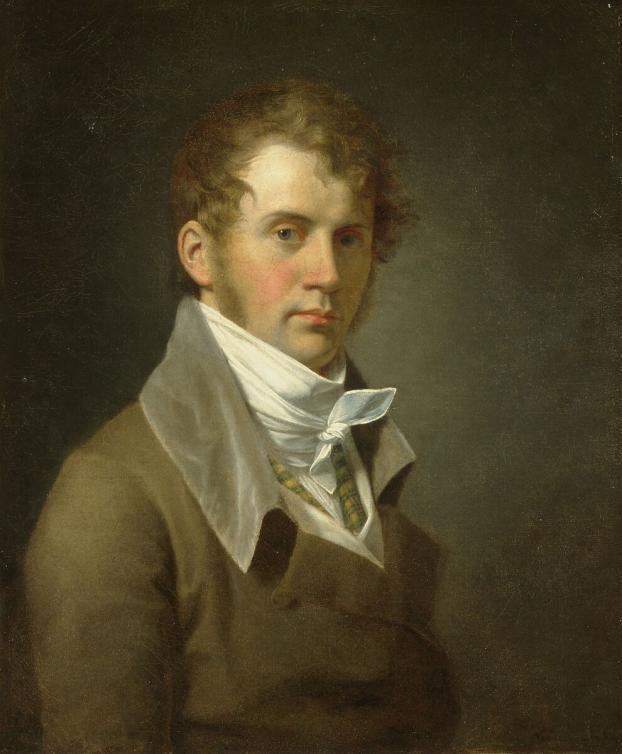
The story of Lucinda, still in manuscript form, came from the sixth book of The Columbiad, which tells the tale of the upper Hudson in 1777. In it, Native Americans in British employ slaughter a young American woman.4 Barlow based the fictional Lucinda on an actual historical figure, Jane McCrea, who was already well-known to international audiences.5 John Vanderlyn (1775-1852), Portrait of the Artist, 1800, oil on canvas (64.1 x 53cm). The Metropolitan Museum of Art, 18.118.
Twenty-six-year-old Jane McCrea (1751-1777) had left her family home in upstate New York in order to rendezvous with her fiancé, David Jones (name changed to Heartly by Barlow), an American fighting with the advancing British under General John Burgoyne. On
4 The other was Zamor Killed by Capac, which he never started.
5 The ever-pedantic Barlow outfitted The Columbiad with sixty-seven pages of footnotes. Number 47 finally identifies Lucinda as “The tragical catastrophe of a young lady of the name of Macrea, whose story is almost literally detailed in the foregoing paragraphs of the text, is well known.” Her killing, Barlow added, “made a great impression on the public mind at the time, both in England and America.”
that day, two years into the American War, Native warriors working for Burgoyne were tasked with bringing her into camp in order to marry Jones. The operation went horribly wrong. The warriors fought over custody, and when Americans attempted to rescue her, she was killed and scalped, following a long-standing custom among Native Americans.6
Though McCrea was hardly the only civilian killed during the Northern Campaign, and despite the fact that she was engaged to a Loyalist and almost nothing is known about her or her thoughts on independence from Britain, McCrea’s killing became an effective propaganda tool in winning over support for the American cause. American newspapers carried elaborate descriptions of her murder, and in short order seventy percent of British newspapers featured her death. On the floor of Parliament, she was the political cudgel effectively wielded by William Pitt, Edmund Burke, and John Wilkes to denounce the Tory government of Lord North. She quickly became a mythic subject for poets, historians, and painters, including Barlow and Vanderlyn.
In The Columbiad, Lucinda, standing in for McCrea, risks everything to arrive at her fiancé’s camp for a wedding ceremony, whereupon Heartly, “in youth’s o’erweening Pride,” has decided to reschedule because he feels compelled to follow his “valorous heart” into a battle that day. An anxious Lucinda, sensing death, ties a feather to Heartly’s cap, a “mystic knot, the knot of love,” that will allow her to spot him from a distance.7 The battle becomes apocalyptic, stained with “thick flames” and “sulphureous clouds” wafting atop a field “sheeted o’er with blood.” Lucinda catches sight of Heartly, then suddenly he “vanish’d in the warrior cloud.”8 Thinking him dead, she recklessly abandons camp and drifts into the woods, bewildered. Heartly fruitlessly searches through the night for her, only to discover that “sweet” Lucinda has already encountered two Mohawk warriors.
In an extended passage, Barlow detailed the pathos of her murder:
She starts, with eyes upturn'd and fleeting breath, In their raised axes views her instant death, Spreads her white hands to heaven in frantic prayer, Then runs to grasp their knees, and crouches there. Her hair, half lost along the shrubs she past, Rolls in loose tangles round her lovely waist; Her kerchief torn betrays the globes of snow That heave responsive to her weight of woe. Sexual suggestion intended, Barlow then pointed an accusatory finger at the British:
Does all this eloquence suspend the knife?
Does no superior bribe contest her life?
There does: the scalps by British gold are paid;
6 For a discussion of the poetry, see Stephen Blakemore, Joel Barlow’s Columbiad: A Bicentennial Reading (Knoxville: University of Tennessee Press, 2007).
7 Barlow, Columbiad, 198.
8 Barlow, Columbiad, 205.
A long-hair'd scalp adorns that heavenly head; And comes the sacred spoil from friend or foe, No marks distinguish, and no man can know.
Barlow’s heroic couplets technically, rhymed iambic pentameter created a metrical tomtom beat, suitable for Lucinda’s inexorable march toward death.
With calculating pause and demon grin, They seize her hands, and thro her face divine Drive the descending ax.
Barlow changed historical fact by pulling Hartley into the murder scene.
The shriek she sent Attain'd her lover's ear; he thither bent
With all the speed his wearied limbs could yield, Whirl'd his keen blade, and stretch'd upon the field
The yelling fiends; who there disputing stood Her gory scalp, their horrid prize of blood. He sunk delirious on her lifeless clay, And past, in starts of sense, the dreadful day.9
Finally, Barlow admonished his readers never to forget “Lucinda’s fate; the tale, ye nations hear; Eternal ages, trace it with a tear.”10
9 Barlow, Columbiad, 207-208.
10 Barlow, Columbiad, 205.
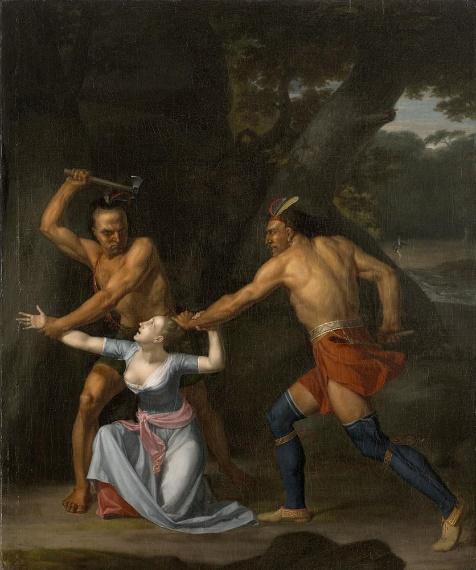
John Vanderlyn (1775-1852), The Murder of Jane McCrea, 1804, oil on canvas (82.6 x 67.3 cm) Wadsworth Athenaeum Museum of Art, Hartford, 1855.4
Vanderlyn could have just made a pencil drawing or an oil sketch to satisfy Barlow’s commission, but instead produced a finished painting. Before delivering it to Barlow, he submitted it to the Salon of 1804, held in the Musée Napoléon (the Louvre was temporarily renamed when Napoléon declared himself Emperor in the spring). Vanderlyn did not display the picture with any reference to Jane McCrea, or Lucinda, or Barlow. Instead, the title at the Salon, translated from French, was, A Young Woman Slaughtered by Two Savages in the Service of the English During the American War. Historical Event Documented in the Sixth Book of The Columbiad, American Poem.11
When the time came to deliver the picture to Barlow, Vanderlyn was cheeky enough to ask for more money. So much more that Barlow felt justified in not paying. Barlow was civil in his response to Vanderlyn’s extravagant almost extortionate demand, perhaps because he could see that the picture was perhaps too terrifying for his poem. Barlow walked away, left the picture in Vanderlyn’s studio, and wished this “man of genius” well, hoping him “success & prosperity equal to your merit, which I really think is very great. . . . I do not pretend to say that the picture in question is not worth more . . .; my moderate fortune will not permit me to give whatever maybe its value.”12 Fulton would buy the Vanderlyn painting and donate it in 1805 to the New York Academy of Fine Arts.
Robert Smirke and the Murder of Lucinda:
Having failed with Vanderlyn, Barlow at this point recently moved to London needed to find another artist he could depend upon to produce timely and appropriate pictures for The Columbiad. For that, he consulted both Fulton and West.13 Barlow and his wife had attended an elegant dinner that West hosted in Paris in 1802, and it was through West that the Barlows became friends with Mary Linwood (1755–1845), the accomplished British needlework artist.
11 Oedel, 221.
12 Oedel, 223
13 Bidwell 343; Edgerton, 486.
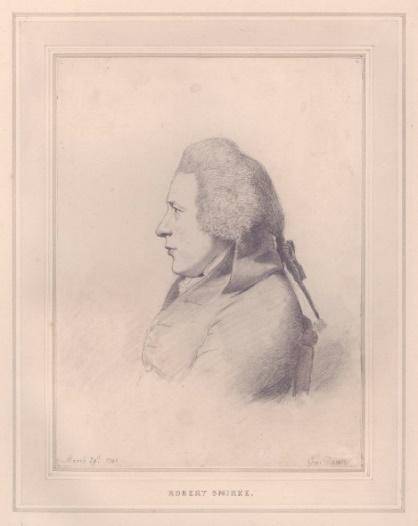
George Dance (1741-1825), Portrait of Robert Smirke, RA , 29 March 1793, 1793, pencil, black and white chalk on cream wove paper (25 x 18.3 cm). Royal Academy of Arts, London, 03/2654
Though the precise mechanism is not known (interviews, work samples, or nothing), Barlow turned, on the recommendation of West, to Robert Smirke (1741-1825) to produce all the art work except for the frontispiece, which would be a portrait of Barlow by Fulton. Eleven paintings, twenty guineas each.
Smirke, from Cumberland, had entered the Royal Academy Schools in 1772. In 1793 he was elected Royal Academician. His specialty was illustrations and paintings from literary subjects, some of which were engraved for John Boydell’s Shakespeare Gallery. That in itself was enough to attract Barlow’s interest. But Barlow, a radical republican, likely knew of Smirke’s politics, too. In 1804, the year in which Barlow arrived in London, King George III quashed Smirke’s promotion to the position of Keeper of the Royal Academy Schools because of his zealous anti-monarchist democratic views. Moreover, Smirke, like Barlow, was a fierce abolitionist (Barlow would denounce slavery in Book VIII and Smirke would soon work on illustrations for Poems on the Abolition of the Slave Trade.) That suggests the Barlow-Smirke alliance was a perfect meeting of political as well as aesthetic minds.
Smirke’s eleven finished paintings for The Columbiad are all lost, but the oil sketch of The Murder of Lucinda survives. As a first draft or proof, it may have been submitted to Fulton for his and Barlow’s approval, especially after the twin debacles with Fuseli and Vanderlyn. Edgerton raises the possibility that Smirke was in some way beholden to Fulton’s sketch from 1802.14
14 Edgerton, 486.
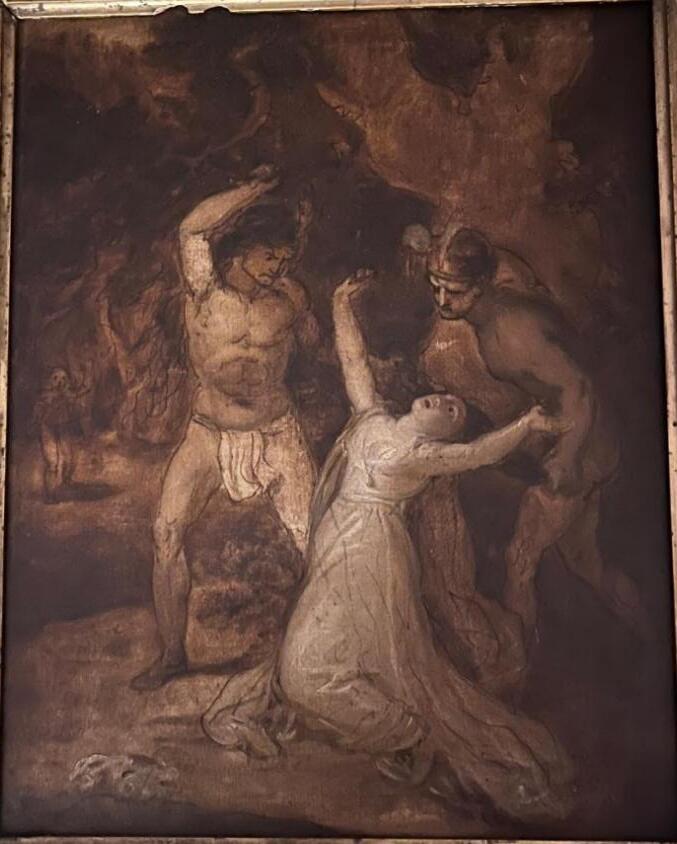
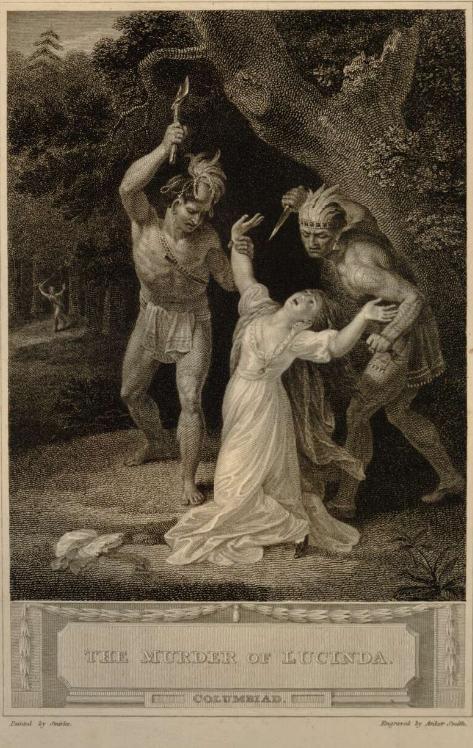
The scene, as represented in Smirke’s sketch, contains key elements from the poem: the edge of a wood, a looming tree, a female figure bracketed by two Native warriors, and a distant figure of a man running toward the foreground. But Smirke diminished the terror evident in Vanderlyn’s painting. His warriors are less bloodthirsty, the woman less exposed.
It is now impossible to compare the oil sketch to the lost finished picture, but the Anker Smith engraving after Smirke’s finished picture can suffice. Questions emerge on why the engraving is not the reverse of the oil sketch. Because no other original artwork for the eleven-picture project remains, it is impossible to determine the relationship between finished paintings and their corresponding prints.
Though the composition remains the same in the print and oil sketch, each figure underwent adjustments. Lucinda’s raised arms are more vertical in the sketch and her wedding gown indicates she has walked in, or was pulled into position from the right, whereas the gown merely puddles indolently to the ground in the print. In the sketch, the warrior on the right is less muscular; in the print he is tattooed and his headdress decorated with more feathers. The warrior standing on the left is most changed. Frontal with legs horizontal in the sketch, he is striding into position in the print. His loincloth is widened in the print, legs tattooed, axewielding arm more vertical, and a scalping knife is slung over his chest. He is adorned with an elaborate headdress. And, most importantly, he grasps Lucinda’s wrist. In the sketch, Lucinda’s fiancé, running in the left distance, is closing in on the murder scene, but is pushed back in the print.
Prints were made from the finished painting of Lucinda. From London, Fulton wrote Barlow,
in Philadelphia, on September 12, 1806 to say “I have sent you 300 complete sets of prints for the Columbiad.”15 That is to say, 3000 engravings (if we count the Smirke images alone).
Afterword:
What became of Smirke’s finished paintings, all of them long-since unaccounted for? The oil sketch of The Murder of Lucinda, thus, is the one known object to have survived from Smirke’s original body of work for Barlow’s Columbiad.
Fulton owned all eleven of the finished Columbiad painting, as well as the Vanderlyn. The next to last we know of the finished Smirke paintings is a loan he made to the Pennsylvania Academy of the Fine Arts for an 1807 exhibition that coincided with publication of The Columbiad. Charles Willson Peale, upon seeing the pictures, said he was “very much pleased with the masterly performance of Smirk.”16 Peale painted portraits of both Barlow and Fulton. In 1816 The Smirke’s were sent to the American Academy of Fine Arts in New York.17
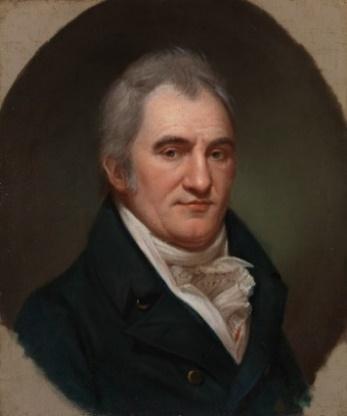
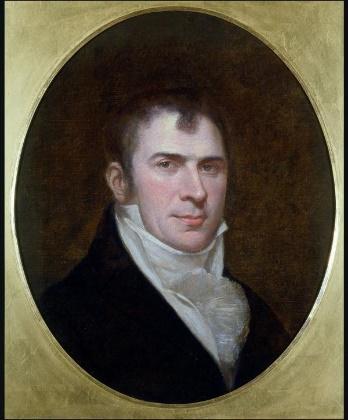
Historical Park, 1982, 1988
15 In Beinecke Library, Yale University.
16 Bidwell, 364.
17 Rebora, 60-61.
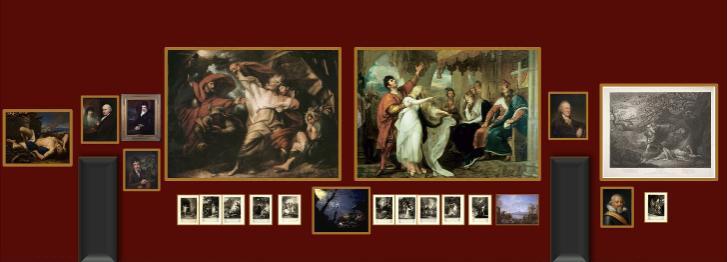
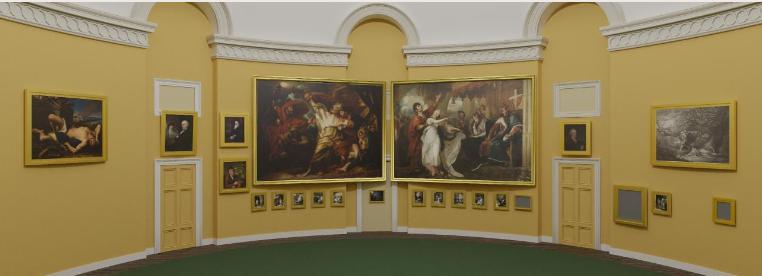
The entire Academy show consisted of Fulton’s impressive art collection, including two by West: King Lear in the Storm, and Ophelia Before the King and Queen. Fulton had initially imagined separating Smirke’s small paintings from the larger ones by West.18 But Peale forced a unified design as seen below. Smirke’s Murder of Lucinda is Number 7.
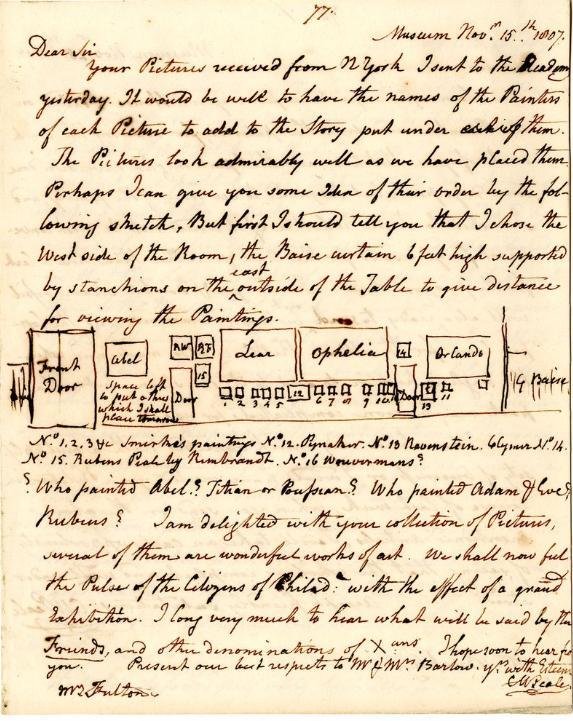
Charles Willson Peale to Robert Fulton, November 15, 1807. Peale-Sellers Papers, American Philosophical Society, Philadelphia.
Wendy Bellion assembled a team to digitally recreate the Academy’s 1807 exhibition. She relied on the engravings after Smirke because the original suite owned by Fulton is unlocated or destroyed.
18 Fulton to Peale, November 18, 1807, Gratz Collection, Historical Society of Pennsylvania.
Bibliography
Joel Barlow, The Columbiad, A Poem (Philadelphia: Fry and Krammerer, 1807).
Wendy Bellion, Lea C. Stephenson, and James Kelleher, “West on the Walls: The 1807 Exhibition of the Pennsylvania Academy of the Fine Art,” Nineteenth-Century Art Worldwide: A Journal of the Nineteenth-Century Visual Culture 21:1 (Spring, 2022) https://www.19thc-artworldwide.org/spring22/bellion-stephenson-kelleher-west-on-thewalls-project-narrative
John Bidwell, “The Publication of Joel Barlow’s Columbiad,” Proceedings of the American Antiquarian Society 93:2 (October, 1983), 337-380.
Samuel Y. Edgerton, Jr., “The Murder of Jane McCrea: The Tragedy of an American Tableau d'Histoire,” The Art Bulletin 47:4 (December, 1965), 481-492.
Carrie Rebora, “Robert Fulton’s Art Collection,” The American Art Journal 22:3 (Autumn, 1990), 40-63.
Gert Schiff, Johann Heinrich Füssli, 1741-1825: Oeuvrekataloge, Schweizer, Künstler, Band I/l (Zurich and Munich, 1973).
William T. Oedel, “John Vanderlyn: French Neoclassicism and the Search for an American Art,” Ph.D. dissertation, University of Delaware, 1984.