
John Singleton Copley (1738-1815)
Captain Gabriel Maturin, New York, 1771
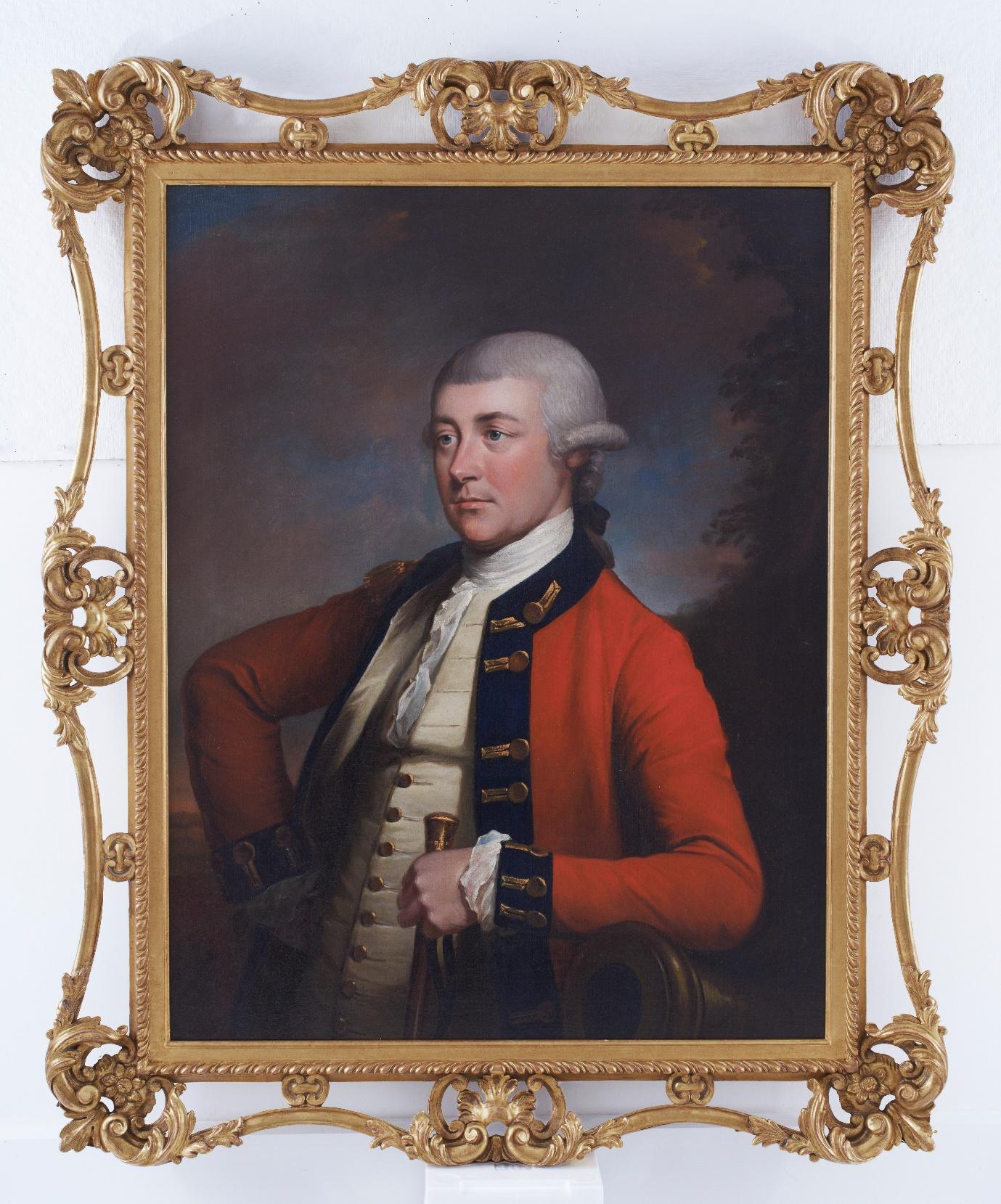
John Singleton Copley (1738-1815)
Captain Gabriel Maturin, New York, 1771
Oil on canvas
111.7 x 93.9 cm (44 x 37 in)
Provenance:
Mary Livingston Mallet (1748-1830); Bequeathed to the Reverend Henry Maturin (1771-1842), nephew of the sitter; To his son, the Reverend Edmund Maturin (1819-1891); Sold to Oscar Livingston (1824-1901); By descent to his nephew, R. Livingston Sullivan (1892-1970); Gifted to General Milton G. Baker (1896-1976); Private Collection, USA.
Bibliography:
Christopher Bryant, "A Recovered Copley Portrait of Captain Gabriel Maturin," The Magazine Antiques (2007). https://www.themagazineantiques.com/article/copley-portrait/.
Mike Osborne, "Captain Gabriel Maturin," maturin.org.uk (n.d.), https://maturin.org.uk/Captain-Gabriel-Maturin/.
It was the Spring of 1771 when John Singleton Copley began his adventures in New York. He travelled from his birthplace, Boston, to seek higher profits from his portrait commissions. He hoped to invest these earnings in his new home in Boston. This pursuit started after Copley completed a remarkable portrait in 1768 of Major General the Honourable Thomas Gage (1719-1787). The work brought him potential opportunities in New York. Copley’s portrait was highly politicized and boosted his reputation. This led to recognition by Gage’s headquarters three years later. He then received requests for sixteen portraits from fifteen individuals. Most were from the Anglo-American colonial-administrator environment, all during Copley’s travels.
One subscriber whose name stood out was Captain Gabriel Maturin (1730-1774). He was General Gage’s military secretary and chief of staff in 1760 and left a memorable regiment in Quebec. Born in Ireland in 1730, Maturin was the second son of Gabriel James Maturin, Dean of St Patrick's in Dublin. He grew up in an intellectual household and spoke French and English from a young age – Maturin’s grandfather was born and raised in Guienne, a Frenchspeaking province. His fluency in French later allowed him to be the military governor of Montreal by Thomas Gage’s side. Maturin’s career began in 1752 when he joined the British Army as an Ensign in Otway's Regiment. In 1756, he was commissioned as a lieutenant before they sailed to North America. His service was indispensable during the Seven Years’ War in America. On September 13, 1759, Maturin was wounded at the Battle of the Plains of Abraham. After the war, he became secretary to Thomas Gage in Montreal. In 1765, Maturin married Mary Livingston, the daughter of an important colonial family of New York. In 1771, Maturin sat for a portrait with his wife by Copley, as did the fourteen other subscribers. In 1774, Maturin died in Boston from a pneumonia of the throat called “Peripnenon”. After
his death, the portrait was shipped back to Ireland, where it remained lost until it was found at an auction in Philadelphia in May 2012.
For years, the portrait of Captain Gabriel Maturin and his wife had been mislabelled as a portrait of Walter Livingston by Copley. Walter was the first Secretary of the US Treasury and never served in the British Army. The confusion arose because Maturin’s wife, Mary Linvigston, married Jonathan Mallet in 1778 after Maturin’s death. Mallet’s name appeared right before Maturin’s on Copley’s subscribers' list. The two portraits looked very similar, following Copley’s artistic style, which caused confusion. However, after analysing the provenance of the portraits, two Copley scholars at the Met and Mount Holyoke confirmed Captain Gabriel Maturin’s identity.