The Chippewas of Rama First Nation
Our Heritage Place Mzinigan (newspaper)
(summer)
Niibin 2021
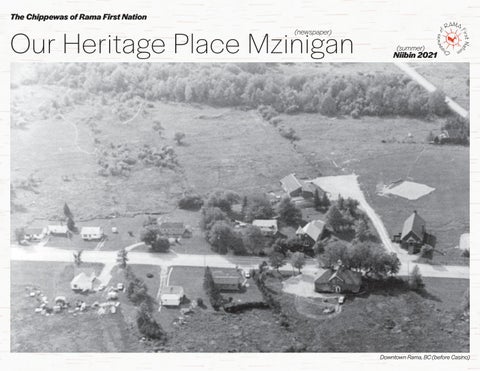
Downtown Rama, BC (before Casino)
Aaniin Boozhoo
Miigwech for reading Our Heritage Place Mzinigan. The Mzinigan is a new initiative by Our Heritage Place. What is the “Our Heritage Place Mzinigan? It’s a little booklet about the heritage of Rama. While not a “newspaper” exactly, it is perhaps the closest translation we can find. We will have articles on history and language; fascinating stories that may be new to you or perhaps forgotten; photographs; department updates; art features; community member interviews, and guest articles. What do you want to read about? Let us know. We write this not for ourselves but for the community (and beyond). Our Heritage Place Mzinigan will be printed in limited numbers, and it will be published online for reading from your electronic devices. If you’d like a physical copy, please let us know.
We created this mzinigan to share what we have and know. Our archives hold many stories and photographs that need to be read and seen. We’ve accumulated thousands of documents, photographs, and videos over the years. While preservation is important, it is just as important that these files are shared. They belong to the community. This is why this booklet was created. As a way to share our archives with you. Another way we’ve begun to share our archives is by putting them online. Many of our historical photographs are now available online at http://ramafirstnation.pastperfectonline.com/ . Once again, gchi miigwech for reading. We hope you enjoy what we have to share. The next issue comes out in September 2021.
A New Name You might have noticed the Quarterly has a new name. This booklet is now called the “Our Heritage Place Mzinigan”. In 2018, The Rama First Nation Culture and Research Department decided to change its name. The old name didn’t capture all that we do. The Elder’s Council helped us come up with the new name: Our Heritage Place. It will take some time for the name to stick, but we are proud to be the place for you to learn about Rama’s heritage! Whether it’s learning our history, taking part in an Anishinaabemowin language class, discovering your family tree, or so much more...we are here to help! Our Heritage Place is located at 6145 Rama Road, Rama First Nation. You can email us at culture@ramafirstnation.ca, or give us a call at 705 - 330 - 8003.
Our Heritage Place Updates A lot has changed at Our Heritage Place in the past couple of years. Firstly, we have a new Director of Education who oversees the department: Lise Kwekkeboom. Ron Douglas has joined the department on a short-term contract as the Mno Bimaadziwin worker. Long-time staff Vicki Snache, Cultural Liaison, and Ben Cousineau, Researcher, are back fulltime after lay-offs due to COVID-19 earlier in the year. Stephanie McInnis is back to work full-time as Mno Bimaadziwin worker, now under the Heritage Department rather than Social Services. In addition, we have short-term staff member Jade Scheuneman joining us to help us develop an immersion Anishinaabemowin program.
ability to connect with our many off-reserve members. With more than half of our band membership living off-reserve, and often far away, we’ve since been able to connect with people we otherwise wouldn’t have been able to. We look forward to continuing to offer virtual services, even after COVID-19 restrictions are lifted.
COVID-19 forced a re-think in how we deliver cultural services to the community. We offered a series of virtual programming: Connect to Culture, held on Zoom, was a well-received success. We also offered a series of Anishinaabemowin classes via Zoom. It was rewarding being able to continue to offer services to the community despite the restrictions of COVID-19. One amazing aspect of virtual programming is the
Finally, our building will be re-open to the public starting August 2021. Please feel free to stop by for a visit.
Although our virtual offerings were succesful, we look forward to our inperson ceremonies, classes, and events. With restrictions loosening this summer, please keep an eye on Rama First Nation social media and the Ojibway Times for information about upcoming events.
Gchi Miigwech
Some of our ancestors at the “Rama Fair”, early 1900’s.
From the Archives: Mzinaazwinan pictures
Do you see any of your ancestors (or perhaps yourself)?
History: The Ojibway-Iroquois War: The War the Five Nations Did Not Win Not much is known about the intertribal wars that took place before Canada, from around 1650-1750. We know a lot about the wars involving the Wendat and Haudenosaunee a few decades earlier, thanks to the presence of the French and Jesuits. The French and Jesuits kept detailed journals of their lives, and during times of war, details were recorded. You would be forgiven for thinking that there were no intertribal wars after the Wendat were chased out of the area, around the middle of the 17th century. However, we Anishinaabe know this not to be true. We know there were battles with the Haudenosaunee, and we know that ultimately, we won. Our Heritage Place Researcher/Archivist Ben Cousineau recently found an old journal article by Dr. Leroy V Eid from the University of Dayton (Ohio). Written in 1979, some of the terminology is a bit dated, but the research and content is strong and fascinating. This is the first part of the article, the second will be shared in dgwaagi/fall edition of Our Heritage Place Mzinigan. Enjoy!
both sides, a great campaign in which Algonquian-speaking Indians combine in great numbers to crush their common enemy, a great campaign in which armies start at different sites, move along the Great Lakes waterway, clear the enemy from these bodies of water, and chase the foe down several rivers connecting numerous lakes.
Many historians have noticed the wars of the Six Nations, and their conquests” complained the 19th century Ojibwa Indian writer Peter Jones (Jones 1861:130). One of his goals was to tell the story of the war the Iroquois did not win, the nation they failed to conquer. George Copway, another 19th century Ojibwa writer, proudly wrote that: “as far as I am able to learn, our nation has never been conquered” (Copway 1850:44). His book, The Traditional History and Characteristic Sketches of the Ojibway Nation (1850) centers on the “disastrous war” between the Iroquois and the Ojibwas. If historians are correct in holding that when an oral civilization moves to become literate, the first items recorded are the texts felt to be the most important, then the importance of the question to this very widespread and populous Indian people is obvious. Since the Ojibwas themselves considered this war to be so important, then the historian in this case does not have to concern himself over the recent methodological question of what exactly should be “Indian” history. This war does not pit a skulking warrior looking for a scalp or two against the ever-vigilant Indian family. The war does not consist of small, indecisive skirmishes fought by the traditional small Indian war party. Rather, Jones and Copway paint a great campaign mobilizing thousands of warriors on
The “Ojibwa Thesis” A number of Indians who belong to the general Ojibwa/Chippewa/Ottawa(Anishinabe) tribal stock have written about the war of their nation and its allies against the Iroquois of the Five Nations. The fullest description is found in George Copway’s Traditional History. Copway’s “preface” self-consciously states that his work was “the first volume of Indian history written by an Indian, with a hope that it may in some degree benefit his nation . . .” Peter Jones outlines more briefly the actual struggle, but spends some time on the historic Indian proofs that the titanic struggle actually took place. Robert Paudash, Ojibwa Chief, fills in traditional family details of the struggles that marked the end of the war. Francis Assikinack of the Ottawa tribe also fills in details, in his case one of the beginning battles of the war. Schoolcraft (married to an Ojibwa) in his The Indian In His Wigwam (1848) and also in his Algic Researches (1839) gives brief accounts of the Huron (Wyandot) traditions of the same event. Peter Clarke’s Origin and Traditional History of the Wyandotts (1870) emphasizes the western segment of the struggle.
The loser, the Five Nations, never fully recovers. The winners divide up the area north and west of the Iroquois New York homeland. For numbers participating, for strategy employed, for importance of the consequences following from the war, there’s absolutely no other Indian military campaign like it. What follows will be divided into three parts. Part one will describe the war as reported by Algonquian, particularly Ojibwa, informants. Part two examines how historians have judged the credibility of these reports. Part three tries to show why the reports are in general credible.
William Warren, a young Ojibwa, rather slights the entire story in order to concentrate on the centuries-long Sioux-Ojibwa
war with which his informants and relatives are vastly more familiar, but his paragraph summary is worth quoting (Warren 1885:146): Their anxiety to open the road to the white traders, in order to procure fire-arms and their much coveted commodities, induced the Ojibways, Ottaways, Pottawatumies, Osaukies, and Wyandots to enter into a firm alliance. They sent their united forces against the Iroquois, and fighting severe and bloody battles, they eventually forced them to retire from Canada. Warren also lays down elsewhere the important principle that “the confederation of the six nations, whom [the Ojibwas] denominated nod-o-way-se-wug, from nod-o-way, ‘The Addler’, appears to have been their most inveterate foes. . .” (Warren 1975:139). This enunciation of the cardinal historic enemy is particularly significant since the history of the Ojibwas that Warren repeats in his book is rather the history of the Sioux-Ojibwa war. These traditional accounts all tell the same story: the Ojibwa and their allies around the turn of the 17th century utterly crushed the Iroquois of the Five Nations. Because Copway, Jones, Warren, Paudash and Schoolcraft are either Ojibwas or related to Ojibwas, then it can be called the “Ojibwa” war. But “Ojibwa” must be taken to be a shorthand word for all the linguistically related groups that fought the Iroquois of the Five Nations. Some historians emphasize the unity of these groups by lumping under the title of the “Council of the Three Fires” the tribes individually (and somewhat artifically) identified by Europeans as Ojibwa, Potawatomi and Ottawa. Moreover it must not be forgotten that Ontario Ojibwas became known as “Mississaugas” while Western Sault Ste. Marie Ojibwas are also called “Salteaux”. According to some Indian traditions a relatively peaceful Algonquian-Five Nations interchange had been going on for many years prior to the middle of the 17th century. In any case, not until the destruction by the Five Nations of the Hurons did overt Ojibwa-Five Nations enmity begin.
History: The Ojibway-Iroquois War: The War the Five Nations Did Not Win Mosang Paudash (1914:n.p.) places the blame for the war on Iroquois barbarities to which Ojibwas were told, submit or “if not, war to the knife was to be ever between the Mohawks and the Ojebwas.” The Five Nations disagree and point to the presence of emigre Hurons among the Ojibwas as being the leading factor for breaking a treaty that had lasted according to their traditions for two hundred years. Both groups were interested in the same thing - the fur trade. The Five Nations were unable to mount immediately a really effective military force against the Ojibwa if for no other reason than the presence of so many enemies closer at home. Increasingly though through the last decades of the 17th century the tensions increased between the Ojibwas and the Five Nations. Treaties made, treaties broken. Increasingly the remnants of the Hurons who had fled to the protection of the Ojibwas insisted on the necessity and desirability of decisively defeating the Five Nations. Iroquois had broken treaties, Iroquois blocked trade with the English and French, Iroquois were moving into the Huron peninsula-three reasons, says Copway (Copway 1972:83, 87, 93), for war against “the Turks of the American forest.” More simply put by Robert and Johnson Paudash (Paudash 1905:8), the Ojibwas decided that it was “a matter of life and death.” Jones, Copway and Paudash insist that the Iroquois were the aggressors. Copway lists in some detail three provocative “offences” committed against the Ojibwas (Copway 1972:7882). The first offence was in 1652 when the Iroquois “barbarously plundered and massacred the Ojibway warriors.” This was followed by a Council of Peace at a place below Sault Ste. Marie between the Iroquois and the Ojibwas. The second offence is supposed to have occurred near where Bytown (Ottawa) stands on the Ottawa River where 22 of 25 Ojibwas of a hunting party were killed. The “highly exasperated” Ojibwas went to the Iroquois and demanded restitution for the killings. After an emotional debate between the aggressive young Iroquois and the more pacific elders, a second peace treaty was signed. The treaty lasted only three years for then “bands of the Iroquois waylaid the Ojibways simultaneously at various points” on the Ottawa River. The first great battle of the campaign against the Iroquois will center the next year around
an ambush of a Mohawk war party in the lower Georgian Bay area. When news of this organized Iroquois campaign reached the Ojibwas they decided at a general council on a major campaign of reprisal starting early in the next spring. Copway, Jones and Paudash all insist that it was a decision arrived at in a general gathering of the Indians of the Sault Ste. Marie area. During the winter months the wampum belt was sent to all their Algonquian speaking allies. The emigre Hurons “excited the revengeful feeling of the Ojibwas by telling them of the outrages the Iroquois had committed on their children” (Copway 1972:83). Both Copway and Jones vividly describe the frenzy of excitement in the Algonquian camps. The Algonquian-speaking warriors met below Sault Ste. Marie in early May. The Ojibwas had evolved in the 17th century the custom of huge multiclan settlements in early summer, and this tradition of a gathering of groups of a thousand or more facilitated the planning of the movements of a large number of warriors. The presence of so many Hurons no doubt accentuated the movement toward large numbers of braves taking a role in the formation of a war party. The Hurons had regularly fielded 500-600 warriors in the annual spring and summer raids, war parties which got even larger in the years just before their 1648 defeat. Moreover, Ojibwas in the 17th century did not portray those individualistic and atomistic traits that 20th century anthropologists think now characterize contemporary Ojibwas. In both centuries Ojibwas were a hardy people and Copway held (1972:10) that there is as much difference between the Ojibwas and many tribes of the south as there is between “the strong wind and gentle zephyr.” Several accounts insist that the military force was composed of warriors from many tribes. Robert Paudash alone ignores by name other tribal groups as he only lists warriors of his eastern branch of the Ojibwas (the Mississaugas) in his description of the fighting, but Paudash also mentions (Paudash 1905:8) “reinforcements” arriving to help the Mississaugas. Jones’ account also centers exclusively on the Ojibwas, yet his description of how the victors divided up the conquered area shows he is using “Ojibwa” as the translation of “Anishinabe,” the
designation that would include groups like the Ottawas and the Potawatomis. Assikinach, who gives the Ottawa account, speaks of the “Ottawas and their allies.” Copway and Warren emphasize the many tribal groups that share in the campaign. Large numbers of tribes (e.g., Sacs, Foxes, Shawnees, etc.) are listed as arising against the “Nadoways,” the traditional enemy of all Algonquian-speaking Indians. Copway and Warren also mention the Hurons as important participants. The Huron (Wyandot) historian Peter Clarke (Clarke 1870:11-14) lists the great battle against the Senecas on Lake Erie as being the result of a combined Wyandot and Ojibwa military operation. While the various accounts generally emphasize just one aspect of the campaign, the total picture adds up to a description of a complicated strategy in which the attackers subdivide to assault different areas and then reunite to continue the war. Assikinach portrays a great battle fought at the Blue Mountains of northern Ontario near the town of Penetanguishene. In this portrayal, Ojibwa forces have come from Lake Superior to join Ottawa forces from Manitoulin Island as both move on to the Blue Mountain staging area (Schmalz 1977:231). Ojibwa spies hundreds of miles away at Rice Lake spot the oncoming Iroquois war party, and rush back to alert the camped Ojibwa-Ottawa forces. At that point messengers rush to the west and southwest to call in the Ojibwas at the Saugeen River on the Ontario side of Lake Huron and the Ojibwas from the Owen Sound of the Georgian Bay area. These forces easily outnumber the invading Iroquois who are almost annihilated except for a few who are left to go back to tell their relatives of the defeat (see Fig. 1, next page). The simplest description is Peter Clarke’ s. He straightforwardly tells that a Wyandot and Ojibwa party completely defeated a large Seneca party on Lake Erie. Clarke’s laconic approach to his tribe’s momentous victory can be supplemented by the Wyandot tradition (cf. Mansfield 1899:62-63) that found its way into the Buffalo Gazette of March 17, 1818: The nations among whom the Wyandots now found themselves Pottawatomies, Ottawas and Chippewas - received them [Hurons/ Wyandots] with friendship and gave or lent them land to settle on. At the solicitation of the strangers they even went so far as to fit out a fleet
History: The Ojibway-Iroquois War: The War the Five Nations Did Not Win of large and elegant birch canoes, with a view to meeting the Senecas, whom they expected with a fleet from the East. These canoes were chiefly built at the Straits and higher lakes, and came to a rendezvous about where Malden is now located. The Senecas, not having as good materials, were obliged to make use of log canoes hollowed out of the trunks of trees. These were far more clumsy and unmanageable than the birch ones, the latter being equal in sea-worthiness to the finest skiffs of our day...Soon, a grand manouever took place. The birch canoe party proceeded to the end of the Point, and in full view of the enemy put out directly into the lake. The Senecas immediately pursued, and when they had reached about midway of the lake, the birch canoes turned upon them and gave them a battle that could not be withstood. The Senecas were all slain but one man, who was allowed to return and report the catastrophe to his nation.
Schoolcraft (1848: 91-94) recorded a more complex Huron version of the dramatic conclusion of the long campaign that completely routed the Five Nations: . . . the Wyandots had been forced backwards as far as Lakes Huron and Michigan. Here they made an obstinate stand, from which all the efforts of their relentless enemies to dislodge them were ineffectual. Their inveterate hatred of each other was fostered by war parties of the respective tribes, whose vindictive feelings led them to hunt and destroy each other, like so many beasts of the forest. These resulted generally in favor of the Wyandots, who, inspired by these partial successes, prepared for more active operations. Three encounters took place, on the same day, two being had on Lake Michigan and one on Lake Erie, and which from their savage and exterminating character, closed this long and merciless contest.
While it strains historical credulity to believe that three battles took place on exactly the same date, the account correctly emphasizes the importance of the Hurons to the long Ojibwa war against the Five Nations. Copway’s Ojibwa informants (Copway 1972:88) on the land battles in Ontario also give a great deal of credit to the Huron armed forces: Forty years had nearly elapsed since the Hurons had been routed, but they had not forgotten the land of their birth - the places that were once so dear to them. The thought of regaining their former possessions inspired them with a courage that faced every danger. They fought like tigers.
Strategically the Hurons helped their Algonquian-speaking allies significantly because they are a major part of a three pronged Ojibwa attack. The southern Hurons were assigned the task of moving north to meet an Ojibwa-Huron force moving south along the eastern shore of Lake Huron. After the two forces combined, they, in Copway’s words, “overran the whole of the south of the peninsula.” The Robert and Johnson Paudash account also pictures a complex military plan. After the victorious army has reached Lake Simcoe, and received reinforcements, the forces divide and one unit goes south to Toronto while the other unit fights its way down a long chain of lakes until it reaches the Bay of Quinte in Lake Ontario. Then it is joined by the group that had previously taken over the area around Toronto. The re-combined forces then can-y on the war into the homeland of the Iroquois in present New York State. Copway’s (1972:8788) detailed account presents the most complex picture of the war. At the start the northern army of Algonquians divides three ways, one of which is to make contact with the fourth group, the Hurons coming north from their homes in the south (see Fig. 2). The first prong of the attack, as Copway tells the story, moves across the French River to the Ottawa River. Because they easily outnumber the Iroquois living this far north, the Ojibwa warriors readily rout them. The second group of warriors goes south towards the St. Clair River to meet the Hurons. But first on the Saugeen River is a principal village of the Iroquois, and here the terrible battle of Skull Mound takes place. In the middle of the 19th century the artist Paul Kane could still see not only the mounds erected
over the slain dead but also a profusion of bones in the area. The victorious warriors were joined then by the Hurons into a force powerful enough to overrun the whole of the south of the peninsula. Copway’s account is ambiguous here, and one can read him as paralleling the account of Assikinach in which the combined Ojibwa-Huron force (or some part of it) goes back north to join the third northern arm of the offensive. This third group in Copway’s version had to fight its way to Lake Simcoe which lay on the northwest-southeast lake route that the Iroquois used to travel from Iroquoia to the old Huronia. A series of bloody battles takes place as the brave Iroquois are pushed back lake by lake. This third arm of the Ojibwa campaign had moved down from the Georgian Bay via the Severn River to Lake Couchiching to the entrance to Lake Simcoe at a place directly north of Toronto near present Orillia and close to the present-day Rama Indian Reserve. Large numbers of Iroquois were collected here and stoutly resisted for three days the combined Huron-Ojibwa force. Only a few Iroquois survived. Moving nearly due east through the chain of lakes the force came to Pigeon Lake where the Iroquois had built a strong fort. “For a time the result was doubtful” but finally the fort was taken by storm. Only a few Iroquois were spared. The victorious Ojibwa and the retreating but fighting Iroquois square off a third and fourth time around present Peterborough. The battle a dozen miles north of Peterborough proved particularly savage as Copway reports that not a male was spared.
History: The Ojibway-Iroquois War: The War the Five Nations Did Not Win The next day the battle continued on the site of Peterborough and “an immense number [were] slaughtered.” The Ontonabee River as it connects with Rice Lake southwest of Peterborough saw still another struggle. As several hundred persons were slain, two heaps of bodies were piled up, one for the dead of the Iroquois, the other for the Ojibwas. The remaining Iroquois warriors, Copway writes, were finally “panicstruck” but that seemingly only increased their desperate valor for when the Ojibwa moved from Rice Lake to the Trent River another battle took place and “for two days and nights they fought like wild beasts.” The final battle took place on an island where the Trent River flows into the Bay of Quinte area. Again the fierce handto-hand struggles, again the ruthless destruction of all the Iroquois warriors who could not somehow flee. At this point Copway (1972:91) ends his account of the war. When the news of these victories reached the Mohawks, they were incredulous, but soon learned that the Iroquois were entirely broken up and the country subdued. The war-whoop of the trading Indians and their host abounded. The last major Ojibwa account of the war is Robert (and Johnson) Paudash’s. In many ways it parallels Copway’s. Paudash also describes a large force coming down the traditional river and lake route destroying the enemy entrenched along the way. After “various skirmishes” the two forces met in largescale conflict in the Otonabee-Trent valley where the Iroquois had “numerous villages.” Like Copway, Paudash notes two major battles around the town of Peterborough. Like Copway, Paudash describes battles where the Otonabee River connects with Rice Lake. Paudash mentions two further battles on Rice Lake. Like Copway’s account the conquering Ojibwas arrive at the mouth of the Trent River. But Paudash’s account continues. The Indians who had gone to Toronto from Lake Simcoe have now reappeared and reinforced the tired and depleted forces that have just fought that long series of battles on the river and lake route. The leaders meet (Paudash 1905:9-10) and:
It being known that the Iroquois would never rest until they should return and attack the Mississaugas, and, perhaps, at a disadvantage to the Mississaugas, the latter decided to advance against the Mohawks and Iroquois generally, beyond the Great Lake. They came upon them at their fort on the Mohawk River, and laid seige to it.
Finally, according to Paudash, the two tired enemy forces decide to agree to a peace. The long war was over and seeing that Ontario “was full of game and an excellent hunting-ground” the Ojibwas (Mississaugas) decided to settle along the Otonabee-Trent Rivers and along the St. Lawrence to the east. The Ojibwa conquerers, according to Copway, divide up the spoils with the Ottawas and Ojibwas occupying the north and the “Shawnees” [referring no doubt to a group of people and not just to the tribe bearing that name] occupying the south. Jones (1861:113) also has a two-fold division of the lands, although he has one part of the “conquering remnant going west to the banks of the Detroit River while the other goes east to the shores of the St. Lawrence. The Ojibwas “by their prowess, [had] gained the waters of Ontario and Erie” (Copway 1972:3). The Ojibwa Thesis As Seen by Historians The view that the Iroquois were pulverized by a confederation of Algonquians led particularly by Indians now known as Ojibwas, can be conveniently labeled the “Ojibwa Thesis,” in honor of the group that both participated most fully in the war and which later best described the war. As we have seen, this latter name, of course, does not mean that the ancestors of the present-day Ojibwas destroyed the Iroquois by themselves for their kin are given full coverage by the Ojibwa informants. Indeed the Iroquoian-speaking Hurons are also prominently featured in the defeat of the Five Nations. On the other hand, Arthur C. Parker’s An Analytical History of the Seneca Indians (1926) devotes not a word to any such major Ojibwa-Iroquois war. Parker describes in detail the devastation by the Five Nations of their Huron neighbors in the 1640s. Then there follows no further martial narrative and the reader supposes that in that geographical area the Five Nations were supreme. Certainly there’s no hint of an idea
of a Huron revival. Parker’s historiographical approach to the troubled history of his own and the Huron tribe typifies the average historian’s picture of the relations between the Five Nations and their Indian neighbors. For simplicity sake, let this be called the “Parker Model.” Calling this view the “Parker Model” does not imply anything except that this is a well-known Iroquois published view of their past military exploits that can conveniently stand for a larger body of tradition. For example, Oronhyatekha (1865:184) similarly speaks of his Iroquois nation subduing nation after nation, “their arms dreaded by nearly all tribes east of the Rocky Mountains.” This Parker model of the ruthless and eminently successful Iroquois war machine accounts for the usual descriptions of Iroquois war parties continually and savagely pursuing and wrecking vengeance on any Indian group that dared challenge their hegemony. William Brandon’s oftprinted The American Heritage Book of Indians (1974:190) picks up the logic of Parker’s account and describes all the Indians of the Northeast as Ishmaels displaced and rootless, engaging in useless wars on all they chance to meet. According to this view, the Iroquois by adopting European values and tactics have disrupted fatally the lives of those Indians living north and west of them. William J. Kubiak’s informative chart in his Great Lake Indians (1970) catalogues the Iroquois punitive expeditions against the Hurons. The sad description of this harried refugee group is finally ended on the note that a pitiable remnant is allowed by a suddenly quiescent Iroquois Five Nations council to return to areas in present-day Toledo and Detroit as owners of a large part of Ohio (Kubiak 1970:172-177). A glance at any book of maps of colonial North America shows the immediate plausibility of Parker’s model. The 1755 map by Nicholas Bellin, is a beautiful map, but one that has the site north of Lake Ontario listed as settled by the Iroquois. The map, moreover, has the land north of southern Ontario marked as “unknown.” Whether published in England, France, Germany or America, most of the 18th century maps visually claim the present-day area of southern Ontario for the Five Nations Iroquois, or ambiguously list the land as “the former country of
History: The Ojibway-Iroquois War: The War the Five Nations Did Not Win the Hurons.”
to them are well known to scholars of the Indian Northeast.
Elizabeth Tooker, the well-known and highly respected Iroquoian scholar, follows this Parker tradition in her article on “The League of the Iroquois” (1978) in a recently published volume of the Smithsonian on Indians of the Northeast. Her recounting of the League’s history neither lists nor hints at any major war - much less defeats - by Algonquians of the North. This same volume also contains an article “History of the Upper Great Lakes Area” by Lyle M. Stone and Donald Chaput (1978) that likewise gives no hint of a major Iroquois confrontation, much less of a major Iroquois defeat.
The problem is that the Algonquian answers do not seem immediately and self-evidently correct. Nevertheless, a number of historians can not accept the Parker view of continued Iroquois military supremacy. In effect, these historians accept in practice the position that histories of American Native peoples can not be legitimately reconstructed unless oral traditions are carefully investigated.
Bruce G. Trigger’s universally praised life-long labor on the Hurons unfortunately suggests the same principle of a centuries-long, all conquering Five Nations. Fellow scholar, C. E. Heidenreich, in a thoughtful review (1977:627-632) for the Queen’s Quarterly of Trigger’s monumental The Children of Aataentsic does nothing to suggest that many Hurons fled to their Algonquian neighbors. For both Trigger and Heidenreich the clear implication is that the League simple destroyed the Hurons so completely that they play no further causative role in Northeast Indian politics. For both authors the Hurons are without a doubt the most written about and best known native group of early Canada up to the 1640s campaign against them by the Five Nations. By itself it may be a bit unreasonable to accuse Trigger and Heidenreich of not quickly unveiling the future of the Hurons after the defeats of the 1640s, Certainly, to take a well-known historical example, books on World War I Germany end with the Armistace, but readers know that new leaders will shortly appear on the scene and an even more powerful Germany will appear on the scene to start World War II. Unfortunately, the Parker model doesn’t permit the reader to assume that the Hurons could soon in some significant way fight, much less help destroy the hegemony of the Five Nations. But did the Hurons ever recover from the lambasting handed them by the Five Nations? Did the Algonquian tribes that took the Hurons into their part of North America ever actually mount a campaign against the Iroquois? And if mounted did the campaign overcome the military superiority of the Five Nations? Both these questions and the traditional Algonquian answers
Scholars investigating the Ojibwa of the Southeast face head on the question of the accuracy of the Ojibwa tradition. Edward S. Rogers (1978:760-761) summarizes a minimal position of these scholars: During the 1690s, some began moving south into extreme southern Ontario and soon replaced, often it appears by force, the Iroquois who had settled after 1650 along the north shores of Lakes Erie and Ontario. By 1702 a group from the mouth of the Humber River had settled near Fort Frontenac at the east end of Lake Ontario and proceeded to terrorize the Iroquois who lived there, destroying their village in 1704. Around 1707 Ojibwa arrived in the Niagara region unopposed by the Iroquois.
Historian Donald B. Smith has extensively researched the Ojibwas of the Ontario area. He also thinks that suddenly in the 1690s the branch called the “Mississaugas” noticed the enfeebled condition of the Five Nations, and unleashed a fierce campaign that completely defeated the Iroquois Confederacy. By 1710, according to Smith (1975b:20-21, 25, 55): “with their Algonkian allies, the Mississauga forced the Iroquois, who had apparently reneged on their promises, to allow them to pass directly through their country ‘as far as Albany’.” Smith of course, accepts the “accuracy of the native oral [Ojibwa] tradition.” Iroquois capitulation came, according to the Ojibwas (Paudash 1905:9- 10), when the League found itself being attacked in its very heartland. The Mississaugas, realizing that their enemies would never rest until they had returned to avenge their defeat and humiliation, determined to carry the war into the enemy’s country. The rival forces met at the Mohawk River in New York State.
Donald H. Kent, the historian for The Indian Claims Commission, in his study of the Iroquois Indians concludes as false the
well-known claims of the Iroquois that they had completely conquered the tribes to the north and west of them. In fact, says Kent (1974:2:13, 16, 19), “the New York Iroquois were on the defensive in their home territory, the Finger Lakes and Mohawk valley region, within forty years of their reputed ‘conquest’....” In particular, within a quarter-century of the defeat of the Hurons, the Iroquois had to watch the French on the Niagara River itself which controlled the important Niagara portage route pass. The Iroquois Sachems, however played a bluffing diplomatic game with the English at Albany. In June of 1700 the Iroquois envoys calmly announced to the colonial Commissioners for Trade at Albany that they had given permission to the Mississaugas (identified as Ottawas) to settle at present-day Toronto. This was good diplomacy and great public relations and even better historical misrepresentation, but military nonsense. In passing, it should be pointed out that the Iroquois in 1700 no more controlled the Ohio Valley than they controlled Ontario. In the earlier part of the 17th century they had terrorized the Ohio Valley, but as early as 1686 a Miami war party was seen on the offensive near present Rochester, New York. By 1697 (Kent 1974:1:189), the Cayugas told the Albany Commis-
sioners that they were ‘menaced by the French and Twightwicks [Miamis] Indians, both our enemies,’ and that the ‘Sinnekes’ had suffered in an engagement with them. In the same year two Susquehannock Indians, Kyanharro and Oriteo, told Governor Markham of Pennsylvania that ‘a certain Indian King (being Kyanharro’s old acquaintance)’ had been attacked by the ‘Titwa’s, the naked Indians’, on his way from the ‘Cayogues.’
The oral traditions of the Delaware recorded by Moravian missionaries (Heckewelder 1819:9-24) firmly insisted that the Delawares had not been militarily conquered by the Iroquois. The Delaware’s exotic rationale for their undoubted role as “women” finds some verification (certainly plausibility) in the Iroquois oral tradition of the “Peace Queen” of Kienuka (see Beauchamp 1965:140-142) which in fact is simply an institutional manifestation of the matrilineal aspects of both Iroquois and Delaware tribal life.
History: The Ojibway-Iroquois War: The War the Five Nations Did Not Win Historians of the Ontario area generally accept the view that the Ojibwas wrestled by force from the Five Nations the area known now as Ontario. Perhaps this tradition was never more authoritatively given than in the following 1895 account by David Boyle (1895:14) as " an appendix to the report of the minister of education for Ontario”: “After the extermination of the Hurons and the Neuters by the Iroquois in 1649 and 1650 respectively, the Ojibways (of various tribes and clans) generally took possession of the Ontario peninsula formed by the Great Lakes. The Iroquois, however, did not readily give up this territory, according to the current beliefs of the Ojibwas, by more than one of whom I have been assured that the claim was ultimately settled by a great battle, in which the Iroquois were defeated, when by solemn treaty both parties agreed to be at peace forever. However this may be, it is well known that when Canada became British all the Indians with whom the imperial and provincial governments had to deal in what is now Ontario, were Algonkians. In general, historians studying Indians in Ontario are forced to accept the idea that the Iroquois had been stunned by a monstrous defeat or series of defeats inflicted on them by the Ojibwas and their allies.”
Percy Robinson (1933:59) represents clearly the general historian's discomfort in relying on an evidential base which his entire training has taught him to avoid, but which in this case at least seems to give a truthful story: Indian tradition is notoriously inaccurate, but the fact that Copway, himself a Chippewa, in his traditional history of the tribe, asserts that it was in the latter part of the seventeenth century that the Mississaugas expelled the Iroquois from the country north of the lakes, may be allowed some consideration. Peter Schmalz (1977:3-8) does not shilly-shally over the use of the Ojibwa accounts. His discussion of the Saugeen Indian branch of the Ojibwas centers on these traditional accounts which he employs to give a detailed descriptive account of the beginning of the great campaign of the Ojibwa- Iroquois war. This acceptance of the Ojibwa position by Ontario historians is not characteristic of all Canadian historians any more than it is characteristic of American historians. Canadian
historians, according to James Walker, have a dilemma when they face the question of the Iroquois. On the one hand (1971:28): According to the space devoted to them, the most significant place reserved for Indians in Canadian history belongs to the Iroquois, and that for their wars against the French. The attitudes and sympathies of Canada's historians are revealed in their choice of descriptions for the Iroquois and their warfare. They are termed the 'Iroquois menace,' 'la nuisance' and 'le peril iroquois', the 'Iroquois peril' and 'pillaging', liked to 'the pirates of the sea', all of which at least imply unprovoked hostility or banditry on the part of the Indians.
From this angle one would have expected Canadian historians to relish and trumpet the stories of any group of Indians that seemingly had destroyed the hated Iroquois. But nationalistic Canadians have difficulty explaining the demise of Iroquois power in the 1701 Treaty through the agency of another Indian group. That is, James Walker speculates (1971:29, 35-37), national pride dictates that (in these early days) Frenchman be the ones to save Canada's national destiny. Hence the inability to accept the Ojibwa view of the late 17th century that "it was rather they [Ojibwas] who protected him [French Governor] than he who protected them." Hence both the exaggerated importance given by Canadian historians to Adam Dollard's death-tothe-last-man fight in 1660 at Long Sault, and the scant attention given to the numerically larger The Ojibwa Iroquois War number of Huron Indians led by Chief Annahotaha who also perished in the struggle. The most common Canadian explanation for the 1701 Treaty where the Iroquois had to admit defeat is found in the military fortifications and expeditions of the French. In this view the building of French forts had forced the Iroquois to leave the area north of Lake Ontario. French punitive expeditions then took the war to the League's own homeland and forced them to come to terms. Many American historians, of course, also have accepted this explanation. Recent revolutionary experience, however, vitiates the force of this explanation. An accounting of the various French punitive expeditions simply does not add up to an explanation of why the Iroquois gave up the war.
It certainly doesn't follow that Frontenac's 1696 villageburning expeditions forced the Iroquois to their knees. For people as resilient as the Five Nations something more devastating had to happen than "warring against the corn and the bark houses that did not offer resistance like the foe," to quote the 1689 words (Thwaites 1900:64:33) of the Mackinac Indians as reported by the resident Priest, the Jesuit Carheil. Since Ojibwas partly warred against the Iroquois in order to trade freely with the English at Albany, then the Ojibwa victory over the Iroquois was really a set-back for French commercial aspirations. "Whereas before, Iroquois strength had been the main threat to New France, Iroquois weakness now proved to be an equal, if not greater, menance" (Eccles 1969:135). The Jesuit Etiene Carheil wrote in 1689 from his post at Mackinac that the Indians there openly said that the trade with the English was "incomparably more advantageous to them" than trade with the French. As Bruce Trigger (1971:286) has noticed, the French in reality needed the Iroquois to keep the Algonquians in line: "If the hostile Iroquois had not existed, the French would have had to invent them." Indian tribal politics, as many authors have seen, did not parallel European political divisions. Indian political realities complicate any historical explanation of Anglo-French rivalry in North America. In any case, Ontario historians question the reasons for the fact that "the vast majority of publications deal with the less populous Iroquois in Ontario, rather than the Ojibway who are the most numerous Indians in Canada" (Schmalz 1977:ii). On the other hand, Harold Hickerson in his sympathetic The Chippewa and Their Neighbors (1970) ignores any chance of the Ojibwa (the Canadian name for what Americans call the Chippewa) having crushed the Iroquois military juggernaut. Yet the successful Ojibwa war against the Sioux is fully described and analyzed. But Hickerson makes no attempt to make a similar case for the Ojibwa boast that they are an exception to the rule that Western tribes must concede to tribes east of them with their European supplies and their hardened war experience.
History: The Ojibway-Iroquois War: The War the Five Nations Did Not Win It is surely noteworthy when an authority on the Ojibwas writing a general history of the group does not rush to accept the position of John Maclean in his Canadian Savage Folk (1971:171): Eastward and westward the Ojibways travelled, until they were to be found throughout Ontario, Manitoba and the North-West. They carried on an incessant war with the Sioux and Iroquois, the latter being compelled to sue for peace, . . .
Why would Hickerson not build up his subject matter by portraying them as successfully carrying on a two-front campaign against two particularly formidable opponents? For one thing, Hickerson with his primary interest in Western Chippewas thinks that Indians “were merely pawns” in European struggles, because “they had no control over the areas they occupied” and this may account for the oversight. The Eastern Ojibwas in the 17th century, however, were sovereign lords doing their own will and this freedom would be hard to place in Hickerson’s thinking. But there is a more fundamental reason for the oversight. The more important reason why such well-informed ethnohistorians as Hickerson do not readily accept the Ojibwa thesis follows from the general scepticism most historians display toward oral traditions. For most scholars, George T. Hunt in his meticulous The Wars of the Iroquois has resolved the question in favor of the League. Hunt bristles at the thought that oral tradition can be legitimately used in history writing. He (1960:9, 181, 187) accepts the dictum of George Hyde, “one of the regrettably few writers in the field of Indian History who has his feet on the ground,” that “there is no worse source than unsupported memory or tradition.” Hyde had investigated Charles Eastman’s statements of Sioux oral tradition and had found Eastman regrettably misinformed. Hunt’s general position was actually anticipated by George Copway a hundred years earlier in his Traditional History (1972:138) where he protested the views of those who “think we cannot keep the words or tradition longer than one hundred years.” Hunt, nevertheless, decided that the Iroquois could not in fact have had the defeat of such magniture inflicted on them that the Ojibwa tradition outlines. In the last sentence of his influential book, Hunt
concludes that the idea of such a huge defeat “is too formidable even to deny.” The early French explorer, Baron de Lahontan, described in detail a severe Iroquois defeat in the northern wilderness in the late 1680s. In his Some New Voyages (1905:489494), Lahontan alleges that the Fox Indians, forewarned by some Ojibwa hunters, crushed a large Iroquois force of a thousand warriors. In itself and if true, this could be considered one proof of the general view that the Iroquois had suffered a series of monstrous defeats at the hands of the Algonquian tribes in the late 17th century. Of more interest here is the fact that this story and its historiography constitutes a model of historical editorializing that is the normal for historians. In his editorial notes on the alleged incident, Reuben Thwaites takes the usual position that the story is of “doubtful authenticity” because the signal victory was not “mentioned in the official documents of the period. “ Similarly the Lake Superior trader Alexander Henry mentions in his book that he was told a thousand Iroquois died at Point Iroquois (or “Grave of the Iroquois” as he called it) and to this assertion, the editor of his papers (James Bain) simply puts a footnote listing the number as a hundred! Proponents of the validity of oral history know that traditional historians consider oral traditions as the least valid form of evidence. For that reason, Hunt’s strictures are immediately congenial to the historian. Historians who do base work primarily on traditions, whether oral or written, are labeled “ethnohistorians” somewhat to their disadvantage in conservative historical circles. Ethnohistorians, however, have convincingly shown the value of certain types of oral tradition in the reconstruction of the past, particularly in pre-literate societies. Speaking of the Iroquois, William Fenton (1971:129) mentions that “Great heed is paid to verbatim recall; virtuoso performers are honored, and learned arguments vie over variant versions.” This can be proven according to Fenton, by the complete accuracy of oral tradition (as substantiated by documentation through journals of Quaker missionaries) regarding the “good message”
of the Seneca prophet, Handsome Lake. Basic to oral historians is the view that people remember what they consider important (Thompson 1978:104): Although laboratory experiments have succeeded in establishing the main elements of the memory process, they provide a poor guide to its reliability, because they take place in a social vacuum isolated from the needs and interests which normally stimulate remembering and recalling.
Unless the tradition is placed into one official version, a group of people will often in time simplify the story keeping only the essentials. When, in addition, the story is oft retold, variants multiply. One does not go to oral history to learn details or chronology; one generally goes to it to learn the general outlines of a historical situation. When, for example, the Wyandots told James B. Finley (n.d.:62), their resident missionary, that the leader of the Indians who defeated General St. Clair in Ohio was a Mississauga, then one may at least assume that it was a traditional belief that the Mississaugas were a particularly effective military tribe. In addition, the Ojibwa tradition was not quite completely oral. The bark “writings” of the Ojibwa were well known to Schoolcraft and distinguished the Ojibwas from their Indian neighbors (Schoolcraft 1848:203). Of all the existing branches of the Algonquin stock in America, this extensive and populous tribe [Ojibwas] appears to have the strongest claims to intellectual distinction, on the score of their traditions, so far, at least, as the present state of our inquiries extends. They possess, in their curious fictitious legends and lodge-tales, a varied and exhaustless fund of tradition, which is repeated from generation to generation. These people possess also, the art of picture writing, . . . Warriors, and the bravest of warriors, they are yet an intellectual people.
Copway, as one might expect, spends a good deal of time in his Traditional History discussing these bark writings and how they contribute to the continua tion of true and correct traditions. Moreover, the Ojibwas, in common with their neighbors, had wide experience with messages delivered through wampum belts. According to the long
History: The Ojibway-Iroquois War: The War the Five Nations Did Not Win account by Jones (1861:118-122), the original treaty ending the struggle between the Iroquois and the Ojibwas as well as its many confirmations were enshrined in wampum. The Wyandot historian, Peter Clarke (1870:66), tells of that tribe possessing an “international repository or archives” in which seventy years of material was collected and which formed the basis of his history. The continuing importance Indians give to these memory aids can be seen in the present project of the Center for the History of the American Indian at the Newberry Library where wampum belts are being sought as part of a documentary history of the Iroquois. In the case of the Ojibwa and Huron traditions, many of the technical difficulties concerning the validity of an oral tradition have been surmounted by the fact that the transmitters of the tradition (Copway, Warren, Jones, Paudash, Clarke) were themselves respected members of the Indian community, and Schoolcraft was married to an important Ojibwa. There is a very high probabilitythat they accurately knew the tradition. Credible historical research based on oral traditions necessarily demands that thorough expertise that comes only from an intimate knowledge of both the culture and its language. Moreover most of these same transmitters were partly European, scions of respected colonials. As such they knew and were imitating the art of writing history of the European sort. Peter Jones, for example, was the offspring of a Provincial Deputy Surveyor and a daughter of a Mississauga Chief. Warren went to school in New York City. Both Copway and Jones married educated women and both travelled extensively overseas. When Copway lectured in Boston in 1849, Longfellow entertained him in his home. Elemire Zolla’s (1973:238) analysis of Copway’s religious material points out that Copway is no naive woodsman for “his book, though quite chaotic on the surface, becomes coherent, carefully elaborated to demonstrate without openly saying so, the superiority of the natives.” Copway’s or Clarke’s historical sophistication can best be appreciated by comparing their historical writings with David Cusick’s Sketches of Ancient History of the Six Nations
(1976). Copway (1850:14, 44-47) distanced himself from the traditional Indian tale by his self-conscious scientific approach. With these traditions there are rules to follow by which to determine whether they are true or false. By these rules I have been governed in my researches. The first is to inquire particularly into the leading points of every tradition narrated. A comparison with Copway’s own earlier composed The Life, Letters, and Speeches of Kah-ge-ga-gah-bowh (1850) reveals his later success in his Traditional History in telling a coherent historical account. In The Life, Letters and Speeches (1850:14-15, 44) Copway had completely misconstrued the relationships between the Ojibwas and the Hurons, an error easily made since the The Ojibwa Iroquois War same word “Nodoway” applies to both the Hurons as well as to the Five (Six) Nations Iroquois. Evidently then, Copway can not be considered the last word; but of course, no informant or historian can be. For the Ojibwas living in Ontario in the 18th century that historically important story concerned itself with their occupation of old Huronia down to the northern shore of Lake Ontario. Of necessity, the Ojibwas in Ontario (the Mississaugas) need remember the basis of their land claims. It is thus eminently reasonable that the Ojibwas there would have often “reminisced” on the subject, probably evolving a simplified, more functional version of the great events that gave them their homeland. That this happened in fact can be seen by the relatively large number of accounts that have come to us. Copway, Jones and Warren wrote general histories incorporating the Ojibwa conquest of the Iroquois. There simply are too many parallel Ojibwa versions, supplemented by too many supportive versions from other sources, to be ignored or easily discredited by historians. La Potherie (1911:1:280), an eyewitness, correctly stated that the Ojibwas came to occupy the land because “they were the first to defeat the Iroquois.” Evidence Supporting the Ojibwa Thesis The commonsense editorial position that oral tradition must be judged in the light of the written word must not be
allowed to destroy the Ojibwa thesis ipso facto through an overzealous application of a historical methodological principle. Since “Indian history is a thing of tradition, “ then there will never be an “Indian History” if these traditions are not analyzed closely and with respect. What must be avoided is (Vansina 1971:442) that “prejudice of contempt for the spoken word” for “any historian who deals with oral tradition will have to unlearn this prejudice.” In fact, the principles of validating oral history do not vitiate the Ojibwa thesis. Certain known facts about the Iroquois Five Nations support the Ojibwa view. By every standard the most important historical proof would be that one already mentioned by David Boyle; viz., that after the American Revolution the British government had to buy land in modem Ontario from the Mississaugas in order to relocate the Iroquois loyal to the crown. The Mississaugas were paid 1,180 pounds for the lands they ceded at a council attended by both the British and Six Nations’ officials. Ironically, some Mississaugas were forced after a number of years to seek a refuge with the Canadian Iroquois of the Grand River Reservation. These Ojibwas successfully appealed according to Horatio Hale (1974:91) to this treaty, an appeal they nevertheless supported with the evidence of the wampum-belts. The Treaty of 1701 clearly marked “the eclipse of Iroquoian power.” French forts certainly contributed to the defeat, but could hardly be the chief cause for stopping a guerrillalike war. Certainly the Five Nations later never felt they had been destroyed by the village-burning Sullivan campaign of the American Revolution. The Ojibwa Thesis, on the other hand, would explain the 1701 Treaty... This document will be continued in the Dgwaagi/Fall 2021 Our Heritage Place Mzinigan. If you’d like to finish reading it earlier, please email benc@ramafirstnation.ca for a copy of the full document.
1755 Partie Occidentale de la Nouvelle France ou du Canada; Bellin Map of the Great Lakes
2019 Rama Powwow Memories
Photos by Cindy Rossit Photography
Dbaajmowin: Nanabush and the Giant Beaver (story)
The following story is from the book, “The Adventures of Nanabush”, a collection of stories told by Rama’s Sam Snake, Alder York, David Simcoe, Annie King, and Elijah Yellowhead. This story and several others were recorded and compiled by Emerson Coatsworth in Rama during the 1930’s. They were published in 1979 by Doubleday Canada Limited.
T here came a time, the Ojibway storytellers say, when Nanbush was at war with Waub-Ameek, the Giant Beaver. Just why they began to quarrel no one really knows, but the fact remains for many months Nanabush pursued Waub-Ameek all through the north country. He followed his trail from lake to lake, down rushing rivers and across swampy marshlands. Waub-Ameek was a magician too, and Nanabush discovered that he was on the trail of someone who was just as cunning and tireless as he was.
“Nokomis!” he shouted, “I’ve found the trail of Waub-Ameek again! He’s dammed up the waters at the head of the lake, and I know he must be hiding somewhere nearby. I want you to sit on his dam and wait for him to appear. I shall walk around the lake, and when I find him, I’ll drive him toward you. It may take several days, but you must keep your eyes open. As soon as he knows we’ve found his trail again, he’ll try to escape, so do not let yourself fall asleep.”
Now at the time our story took place, Nanabush was living with his grandmother, Nokomis. In spite of her age, she was quite able to keep up with the pace set by her grandson, but finally even the two of them became discouraged. They had followed the trail right to the great inland body of water we now know as Lake Superior, and there the trail had petered out. They stood and gazed out over the rippling blue waters, as sad as they could be, for Waub-Ameek had disappeared without a trace. They had been travelling for so long that they were both very, very tired, and so they decided to build a wigwam and rest. They gathered the poles and stitched together great sheets of birch bark, and soon were living comfortably in their new home. They spent the next few days fishing and basking in the warm sun. They had been in their new home about a week when it suddenly occurred to Nanabush that the level of water in the lake was rising. He noticed that rocks along the water’s edge, which had been quite visible when they had first arrived, were now several inches under water. “This is a strange thing,” he said when he mentioned the matter to Nokomis, “I must find out what is causing the water to rise.” He began to walk along the shore of the lake, toward the eastern end where the lake narrows at the approach to Lake Huron. As he reached the narrows, Nanabush looked ahead - and stood stock still in surprise! For there, ahead of him, was a freshly built dam of giant proportions, stretching right across the narrows! “Aha!” Nanabush exclaimed. “So that is why the water has been rising. WaubAmeek has built a giant dam. Well, we’ll soon fix that!” He took one more look at the long pile of sticks and rocks and mud which was holding back the waters of Lake Superior, and then ran back to his grandmother.
Nokomis ran to the dam, taking up a position where she was able to see far down into the waters, while Nanabush began his journey around the shore of the lake. In a few minutes, he disappeared from sight and Nokomis was left alone. It was a quiet, lonely sort of day, and Nokomis kept her watch
Dbaajmowin: Nanabush and the Giant Beaver (story)
as the hours slowly rolled by. The sun moved down toward the west and finally disappeared. The hours of darkness stretched out, and Nokomis thought they would never end, but the sun finally appeared again in the east, and slowly mounted in the sky. Nokomis began to feel very sleepy, but forced herself to stay awake. The sun set for a second time, and the old woman wondered how she would be able to keep awake for a second night. Without knowing it, she began to doze, and her head began to nod. Suddenly, she sat bolt upright. She had heard a sound of quiet splashing. She jumped to her feet and ran along the top of the dam, and there, ahead of her, was the giant form of Waub-Ameek. She raced toward him just as he looked up. In a flash he recognized her, and turned to dive back down into the water, but Nokomis’ nimble fingers were too quick for him and she managed to grab his broad, flat tail and hold on to it tightly. Waub-Ameek struggled mightily but he could not shake off the fingers of old Nokomis. He flailed the water with all his might, but to no avail. He could not escape. Nokomis called out to Nanabush, but there were no sounds in the night save the splashings of Waub-Ameek. She called again and again, but her grandson was probably many miles away. She clung on tightly to Waub-Ameek’s tail, hoping against hope that Nanabush would appear and help her pull the giant beaver out onto the land. Now Waub-Ameek, as we have said, was very cunning. It did not take him long to realize that, although Nokomis had a firm grip on his tail, the old woman did not have the strength to pull him out of the water. He thought for a moment, and a plan of escape came into his mind. He twisted his body around and, with his teeth and his fore paws, began to burrow a hole through the great dam that he had built. It was hard and unpleasant work, but he kept at it doggedly. The hours passed, and in the east, the first faint streaks of light appeared. Then, suddenly, there was a loud gurgling noise and the great dam quivered. Waub-Ameek had burrowed right through his dam! The gurgle became louder and turned into a roar. The dam began to tremble, and then shook violently. One instant more and the dam gave way. With a mighty roar the waters rushed through the hole, carrying with them the mass of sticks, great lumps of clay, and mud and boulders. Fortunately, Nokomis realized what was happening, and despite her weariness, stepped back out of danger. As she did so, Waub-Ameek gave a mighty tug and wrenched his tail from her hands. In an instant, he was free again, and swam
far down beneath the surface of the water, where he was carried along by the mighty current. When the sun rose, Nokomis, feeling sadder than she had for many a day, looked up, vainly hoping that she might catch a glimpse of Waub-Ameek. The giant beaver was now several miles away, but Nokomis beheld a wondrous sight. There, in front of her, in the narrows between the two lakes, the large mass of sticks and clay and mud and boulders had come to rest. They formed a maze of islands, stretching out for miles and miles, further than the eye could see in the narrow channel between Lake Huron and Lake Superior. This chain of islands that came from the great dam of Waub-Ameek is today called the Thirty Thousand Islands. Poor Nokomis stood, cold and tired in the early morning light, staring at the amazing sight, and did not hear Nanabush approach her. He was panting, as though he had run a great distance. He saw in an instant what had happened. “Poor Nokomis,” he said tenderly, “do not worry. No one could hope to hold the tail of Waub-Ameek alone day after day. I was still searching for him when I saw the waters of the lake suddenly drop. I knew what must have happened. Now you must have some sleep - and then we will take up the trail of the Giant Beaver again.” Nanabush and his grandmother never did catch up with Waub-Ameek again. They found signs of him here and there, and the trail led them along the Great Lakes. They followed the shoreline, past Lake Huron and Lake St. Clair, past Lake Erie and Lake Ontario. They travelled further east than they had ever travelled before, following the mighty St. Lawrence River to its mouth, right to the Atlantic Ocean itself. They stood on the sea shore, and looked out to the east, over the rolling waves of water that seemed to have no other shore. They were about to turn back and trace their way to their home in the north country when they heard a shout, a shout that seemed to be a war cry of triumph. They looked out over the ocean once again, and there, far out to sea, they saw the head of Waub-Ameek, bobbing above the waves. Nanabush laughed. He cupped his hands over his mouth and shouted: “Come back, Waub-Ameek, come back! You are too cunning for me to catch. Let us make peace and let us be friends. I want to have you for a friend.” And so Waub-Ameek returned to the north country and became the friend of Nanabush and old Nokomis. In his own magic way, Waub-Ameek created the beaver we know today, and taught them how to make dams such as the one he had made at the narrows between Lake Huron and Lake Superior, though of course on a much smaller scale.
From the Archives: Dinwemaawaan (they are related to someone)
Sonny George, Dick Snake, Virginia George and others. Date unknown.
The Fawn Family (date unknown) above; the Rama Bandstand below
Arthur Shilling, William Shilling, around 1910-1920
Sue and Harvey Anderson
Harvey Anderson & Ivan Douglas unveiling our cenotaph. Date unknown.
Ella Taylor, Sadie Ingersoll
Sam Williams, fishing at Hartley Bay (French River) n 1944.
Minwaajmo (tell a good story) In the fall of 2017, parks staff from Queen Elizabeth Wildlands Provincial Park contacted the Culture Department. Queen Elizabeth Wildlands Provincial Park is a beautiful, massive expanse of bush and lakes between Minden and Coopers Falls. It’s over 33,000 hectares and much of is part of the traditional territory of our ancestors.
The park contacted us because they were interested in installing some interpretive signage throughout the park, and they wanted assistance from Rama with information about the history of the area, and some Anishinaabemowin translations as well. The park staff then casually said, while we’re chatting, we’ve also found a pictograph in the area. We were surprised and excited. Pictographs (paintings on rocks) aren’t found very often, and there are few examples around here. As it turns out, locals in the area were walking around and discovered a small pictograph. They went to the Park staff and told them, and they then went looking for more. A few small pictographs were found, deep in the bush. The park staff invited us out for a tour of the park and a visit to the pictograph - we excitedly said yes. The day came. We drove to the park, and we hiked about 45 minutes into the bush to the pictograph site. The park is beautiful and remains mostly undeveloped. It is backcountry and the trails are merely well-worn footpaths. One section of the park in particular is incredible. You climb up a hill of jagged-rocks, which link a lake to a small creek. In the spring, climbing this stretch would be impossible as the rocks would be below rapids. In early fall, it was dry, but the water still ran. You couldn’t see the water, but you could hear
the place where the water flows under the rocks
it: somewhere below the rocks, the water rushed onwards. The water still flowed, low enough to allow foot passage but strong enough to be clearly audible. We remarked that we’d never seen anything like it, and carried on to the pictograph site, which interestingly were very close to the top of this area.
the legend says, lies a fortune in silver ingots and even greater riches, white silver ore. According to old timers, Indians worked the silver mine before the white man came. Everyone appears to agree on the location ‘between Three Lakes near the place where the water runs under the rocks’.
They were there, as promised, mysterious and ancient. We looked around the site for awhile, took some pictures, tried to imagine what the original artist was trying to convey, and finally began to make our way back home.
Once I remembered this, and re-read the email to be sure, I was hooked. The place we had visited had a lot more to it than we expected.
On the way back home, I remembered an email I received 4 years earlier from a Minden resident. This resident was compiling the history of Minden and she was curious if I had ever heard of a silver mine in the Minden area. According to the resident, there was once a silver mine utilized by local First Nations before Europeans arrived. When the First Nations realized Europeans were coming to the area (around 1800), the mine was supposedly ordered to be hidden or destroyed, in order to prevent it from being discovered. Minden is fairly close to the park. There’s a bay in Minden called “Miner’s Bay”, and a local resort shares the same name. In the early 1900’s, the legend of the silver mine was well-known. Prospectors came to the area from far and wide, hoping to discover riches hidden in away in the Haliburton Highlands. Eventually, the hopeful explorers gave up, but the mine remained a local legend. This email I remembered contained a story that the Miner’s Bay Lodge posted on their website. Part of the story goes as follows: “Somewhere in the hills,
A well-known book, Mysteries of Ontario, also includes a mention of the mine:
The place where the water flows under the rocks was a legendary place, and has been whispered about for over 150 years. And we had trampled right over it, amazed by the uniqueness but unaware of the legend of the silver. The place where the water flows under the rocks is not exactly a hidden place. Although it is deep in the bush, it is on one of those “well-worn-footpath” trails. People have been using the trail for a long time. And yet, nobody has discovered this silver.
the place where the water flows under the rocks
Minwaajmo (tell a good story)
The early prospectors couldn’t find it (one wonders if they were even able to find the place where the water flows under rocks, in a time likely before the existence of a trail). Wayward hikers have never found the mine. Locals who knew of the place where the water flows under the rocks searched in vain. Even some of our own ancestors once tried their luck at repossessing the treasure. Two men from Rama, Jacob Henry and Robert Sawyer, travelled to Minden in the early 1900’s hoping to get lucky and discover the stash. At this point, both men were in their 70’s. Robert was said to have a map marking the treasure. Jacob and Robert spent two years in Minden, selling crafts and bentwood furniture in between searching for the silver. Residents of Minden got to know the two men, and some of their crafts survive in peoples’ homes today.
Despite the map, they never found the treasure. Jacob died in Minden; he got caught in a blizzard on Gull Lake and froze. Robert returned to Rama soon after, and the legend of the mine grew.
The disappointing and tantalizing answer to this is that we will probably never know.
We don’t know exactly how or when the story of the silver mine started. But it grew enough to bring many people to Minden, looking for the mine. It was well-known enough to find its way into government reports and become enshrined on maps (“Miner’s Bay”). It became legendary and mysterious enough to find its way into books. And it is fascinating enough to make otherwise reasonable, stable individuals such as myself (and many before me) want to become full-time silver mine hunters. Our territory possesses ancient secrets and stories. They’re on rocks, they’re in the water, they’re under the earth. They’re all around us. Some have been passed down through storytelling, others are discovered accidentaly (like this one), and countless more have been forgotten with the passing of time. Our connection to the land is continually reaffirmed through legends and places such as the place where the water flows under the rocks.
The pictograph. What does it mean?
Not only was there pictographs at the site, but there was a lone petroglyph (rock carving). This image shows what appears to be a horned being, which is consistently seen in pictographs and petroglyphs.
Now we go back to the pictographs. The legend of this silver mine, or perhaps more aptly described, stash of silver, is even more interesting when the pictographs are factored in. The pictographs are located just a short distance away from the place where the water flows under the rocks. They’re about a 5 minute hike away. Are the pictographs connected to the stash of silver? Are they directions to the stash, or more intriguingly, a warning to stay away?
A view from the top of a bluff near the pictographs
The view of the mirror-like lake the pictographs sit near
(day school)
From the Archives: Giizhigad Kinoomaagewgamig The Rama Indian Day School operated from the late 1800’s up until the 1960’s. After its closure, our kids were bussed into Orillia, to David H. Church Public School. The school was located where the current Casino Rama administration building is; across from the community hall. There’s been a lot of questions regarding our people and residential schools. Certainly, our people attended residential schools. The Day School meant many of our children were spared residential schools, but not all were. Regardless, the Day School itself was not a place of wholistic, happy learning. Many remember difficult times at the school. According to government records, the school staffing was always an issue (teachers were rarely “good” teachers). Attendance was mandatory and enforced by Indian Agents. Despite the poor standards and quality of learning, teachers often described our children as “bright” students, and quick learners. The pictures of classes below and on the following page were recently sent to Our Hertiage Place by the daughter of a former Day School teacher. Do you recognize anyone in the photos? If so, please let us know.
(day school)
From the Archives: Giizhigad Kinoomaagewgamig
Anishinaabemowin: An Update Introducing: The Language Committee There is a language committee which consists of community members dedicated to preserving, promoting, and teaching our language to and for the community. The committee helps to guide language teachers and staff in their revitalization efforts. They make recommendations and provide advice as to how to best move forward in regards to language revitalization. The Language Committee Members are: Vicki Snache, Lorraine McRae, Arnold Ingersoll, Myrna Watson, Glenda Snache, Jessica Shonias, James Simcoe, Allison Sawyer, Dee-Anne Walmsley, Norman Stinson, Fay McKenzie, Marsha Shilling, Kory Snache, Cindy Simcoe, and staff-members Lise Kwekkeboom (Director of Education), Debbie Williams (Executive Assistant), and Ben Cousineau (Community Researcher). Where we Began In May 2016, a Language Revitalization Strategy was created. It outlines the process best determined to revitalize our Anishinaabemowin language in Rama. Created by Vicki Snache, it has been put into motion. Pre-COVID, we held a variety of in-person language classes and language camps. We created “Phrases of the Day”, Anishinaabemowin labels for items around the home, signage for buildings throughout Rama First Nation, and different types of classes and programming for several Rama First Nation departments. In 2021, a new Language Action Plan was recently created by staff to ensure the Strategy is not just a dream but a reality. Without the Strategy and Action Plan, and more importantly, support and efforts from the community, we face an extinction of Anishinabemowin in Rama, and the loss of our Rama dialect. The language committee, Chief and Council, and staff recognize the need to act quickly when it comes to our language. Work has begun to save our language, but we need your help. What’s Happening Today The Language Committee has begun to meet (virtually) once again. They are helping the process of revitalizing Anishinaabemowin in Rama. One early outcome was the creation of a new contract position known as Immersion Program Administrator. This employee began in May 2021, and their responsibility is to put our long-standing dreams of Anishinaabemowin immersion
daycare and school programs into reality. This employee is researching best practices, funding opportunities, and creating a plan for immersion options for our children. In addition to the Immersion Program Administrator, a new parttime Anishinaabemowin language staff will be started at the Rama Early Childhood Education Centre in May 2021. Our children are little sponges who learn so quickly; this teacher will help our community’s youngest learn our language. Anishinaabemowin classes ran virtually through the spring. These classes, particularly the Beginner class, were successful and there is demand for more classes in the future. We have plans for adult immersion programs, continuation of the temporarily paused (due to COVID) There was a time, not too long ago, when our community was fluent. Mentor-Apprentice program, more virtual language learning and workshop opportunities, and preserving our dialect by recording our speakers. More details on all of these initiatives will be made available once plans are finalized. Where do we go from here? Our language is at a critical state. We invite all members of the community to join us in saving our language. We need to act quickly. Language-learners of all levels are invited to join our community-wide effort. Keep an eye on the Rama “Our Home” Facebook page and Ojibway Times newsletter for information about classes and language initiatives. Please email culture@ramafirstnation. ca for more information about our Anishinaabemowin revitalization efforts. We also welcome you to share your thoughts or questions as well. Together, we can save our language. Miigwech.
Anishinaabemodaa Outline of Writing System From Rama Ojibwe Dictionary
Vowels
3 short vowels i (zid) - sounds like “win” a (mkak) - sounds like “mum” o (nimosh) - sounds like “push”
Tenses
Singular, Present Tense I (niin) - Nwiisin (I am eating) You (giin) - Gwiisin (You are eating) He/she (wiin) - Wiisni (He/she is eating) Singular, Past Tense I ate - Ngii wiisin You ate - Ggii wiisin He/she ate - gii wiisni Singular, Future Tense I am going to eat - Nwii wiisin You are going to eat - Gwii wiisin He/she is going to eat - Wii wiisni Plural, Present Tense We (but not you) are eating nwiisnimin We (and you) are eating gwiisnimin You are eating - Gwiisnim They are eating - wiisniwag
Anishinaabemowin Sound Chart You can use this chart to learn how to pronounce every sound in Anishinaabemowin
4 long vowels ii (giin) - sounds like “beet” aa (naanan) - sounds like “walk” oo (goon) - sounds like “toe” e (kwe) - soudns like at Plural, Present Tense We (but not you) are eating nwiisnimin We (and you) are eating gwiisnimin You are eating - Gwiisnim They are eating - wiisniwag Plural, Past Tense We (but not you) ate nigii wiisnimin We (and you) ate - ggii wiisnimin You ate - ggii wiisnim They ate - gii wiisniwag Plural, Future Tense We (but not you) are going to eat nwii wiisnimin We (and you) are going to eat gwii wiisnimin You are going to eat - gwii wiisnim They are going to eat wii wiisniwag
b ch d g j k m n p s sh t w y z zh
aa
ii
oo
e
a
i
o
baa
bii
boo
be
ba
bi
bo
chaa
chii
choo che cha
chi
cho
daa
dii
doo
de
da
di
do
gaa
gii
goo
ge
ga
gi
go
jaa
jii
joo
je
ja
ji
jo
kaa maa naa paa saa shaa taa waa yaa zaa zhaa
kii mii nii pii sii shii tii wii yii zii zhii
ka ma na pa sa sha ta wa ya za zha
ki mi ni pi si shi ti wi yi zi zhi
ko mo no po so sho to wo yo zo zho
koo ke moo me noo ne poo pe soo se shoo she too te woo we yoo ye zoo ze zhoo zhe
Source: Waking Up Ojibwe www.wakingupojibwe.ca
Miigwech for reading. Next issue Mndaamin-Giizis / September 2021