The Chippewas of Rama First Nation
(fall)
(newspaper)
Dgwaagi 2021
Our Heritage Place Mzinigan
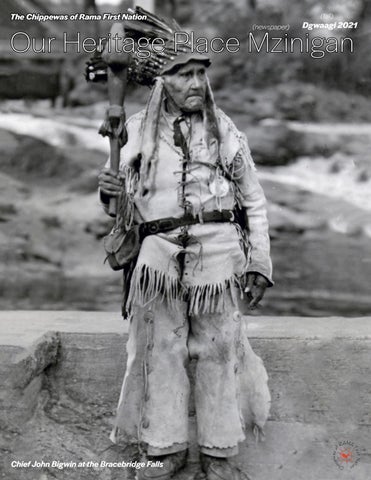
Chief John Bigwin at the Bracebridge Falls
Aaniin Boozhoo Miigwech for reading Our Heritage Place Mzinigan. The Mzinigan is a new initiative by Our Heritage Place. What is the “Our Heritage Place Mzinigan? It’s a little booklet about the heritage of Rama. While not a “newspaper” exactly, it is perhaps the closest translation we can find. We will have articles on history and language; fascinating stories that may be new to you or perhaps forgotten; photographs; department updates; art features; community member interviews, and guest articles. What do you want to read about? Let us know. We write this not for ourselves but for the community (and beyond).
We created this mzinigan to share what we have and know. Our archives hold many stories and photographs that need to be read and seen. We’ve accumulated thousands of documents, photographs, and videos over the years. While preservation is important, it is just as important that these files are shared. They belong to the community. This is why this booklet was created. As a way to share our archives with you. Another way we’ve begun to share our archives is by putting them online. Many of our historical photographs are now available online at http://ramafirstnation.pastperfectonline. com/ .
Our Heritage Place Mzinigan will be printed in limited Once again, gchi miigwech for reading. We hope you numbers, and it will be published online for digital enjoy what we have to share. The next issue comes reading. If you’d like a physical copy, please let us out in January 2022. know.
Our Heritage Place Staff Directory Lise Kwekkeboom, Director of Education lisek@ramafirstnation.ca Vicki Snache, Cultural Liaison vickis@ramafirstnation.ca Stephanie McInnis, Mno Bimaadziwin Worker stephaniem@ramafirstnation.ca Ben Cousineau, Researcher/Archivist benc@ramafirstnation.ca 705-325-3611
Our Heritage Place Updates -We’re open again! The Heritage Place doors have been locked to the public due to COVID-19 for over a year. With the uptick in vaccinations and the loosening of COVID restrictions, we are comfortable welcoming the public back to our building. We welcome anyone to visit the building between 10-3 Monday to Friday. Come visit! -We have to say Baa Maa Pii to Mno Bimaadziwin Worker Ron Douglas. Ron initially joined on a short-term contract for the summer, but after looking at the amount of work ahead of us, it was decided we need some extra help in the department. We were able to get an extension for Ron’s contract, but Ron will be moving on to start a new chapter in his life! We wish Ron all the best and are grateful for the help and wisdom he provided for us during his short stay. We will be hiring a replacement this fall. In the
meantime, Stephanie McInnis continues her good work as our Mno Bimaadziwin worker, helping get our Anishinaabe Aadziwin (Anishinaabe culture) into the community. -The Heritage Place team met in July and plotted out our workplan for the next year (and beyond). We filled our biggest wall with post-it notes with all the things we aspire to do. You can find a the Heritage Place Vision Wheel on page 5. We aim to complete all of the things on the Vision Wheel in the near future, or offer them on an ongoing basis. For the loftier ideas, they’re a dream that we want to work towards. This was a rewarding experience, and one which we haven’t done before. Have a look at the wheel; if there’s something missing...please let us know! We are here to serve the community, and if there’s something you want to see happen please get in touch. Gchi miigwech!
History: The Ojibway-Iroquois War: The War the Five Nations Did Not Win ...continued from Niibin 2021 Our Heritage Place Mzinigan
The Iroquois Book of Rites was composed in the decade or two after the 1701 Treaty. The Onondaga version (Hale 1974:59, 153; Maclean 1971:157) of the chant speaks of such a sad state of affairs that the Ojibwa Thesis implies:
Woe! Woe! Harken ye! We are diminished! Woe! Woe! The cleared land has become a thicket, Woe! Woe! The clear places are deserted. Woe! They are in their graves They who established it Woe! The great League. Yet they declared It should endure The great League Woe! Their work has grown old. Woe! Thus we are become miserable. Iroquois historiography suffers from a “structural amnesia” in regard to the Iroquois-Algonquian war, but this contemporary religious ceremony rather clearly evokes the unfortunate result of a catastrophe. The Iroquois admitted to the English in the year 1711 that they were reeling in their heartland under the attacks of Indian enemies who “now twelf times fallen upon us & kill’d of our men.” Evidently these were difficult times for the Iroquois. Diplomatically, they did their best to disguise this diminution of their power. Even so (Kent 1974:1:185), In fact, the British were quite aware that there was nothing real about the claim that the Six Nations owned land in the area on the basis of conquest. It was convenient and expedient in the eighteenth century to use these claims based on alleged seventeenth century conquests in order to support British claims against French claims to sovereignty; and it was also easier to deal with the New York Iroquois than with other Indian groups. But these officials did not deceive themselves about the Iroquois claims.
After all, their bitterest enemies the Hurons were safely living in the Detroit area; their old trade rivals the Ottawas were wheeling and dealing all over the Great Lakes. In short, some-
(...continued from Niibin 2021 issue, contact us if you’d like a copy)
thing - or combination of things - caused the League to lose its power. The Ojibwa thesis would explain a good part of this decrease of power. While Parker’s “analytical” approach to Iroquois history makes no mention of any Ojibwa invasion, the potpourri of tales collected by William Beauchamp (1965:136-137, 140-141) alludes a number of times to at least a serious struggle between the two groups. For example, the Iroquoian tale of “The Algonquin and Wan-nut-ha” incidently mentions that “for fifty years the Algonquins had waged a terrible offensive war against the Iroquois. “ The most important of these slips of Iroquoian folklore comes from the hands of David Cusick, an old Tuscarora in 1825. Cusick (1976:20, 27-28, 70) says a history of the Iroquois was a difficult endeavor because of the “fables” met. While Cusick’s jumble of events in a matrix of hopelessly wrong dates forms an invaluable point of reference for the polished story presented by the Ojibwa Copway, Cusick’s material has a relatively heavy emphasis on the Twakanka, a term applied by the Iroquois to all western Indians, but used by Cusick for the “Mississaugas.” He has, for example, the Mississaugas on the Niagara River at an early date. Moreover About this time the Twakanhah or Messissaugers began to wage a war against the five nations; the Senecas on the frontier were most engaged in the warfare. After various skirmishes the enemy was so excited that they determined to destroy the fort Kauhananauka (now in Tuscarora near Lewiston) [but fails].. . ., but the commotions were not quelled, small parties of the Senecas often take the canoes and go by water to the head of Ontario lake, in search of the enemy, but they avoid the attack of superior force . . . [Iroquois collect army of two thousand warriors but retreat after a “desperate contest” with a “strong force of the enemy.”]
These troubles between the Iroquois and the Mississaugas occur, Cusick continues, shortly after “the Ottawahs become numerous and powerful nation, occupied an extensive country lying between the Lake Erie and the Ohio River, and was supposed their national force amounted to about 4,000 men.” Two caveats must be entered here. The Ojibwa view does not mean or imply that the Iroquois did not continue to remain as individuals and as a group, excellent warriors, greatly feared and militarily aggressive or that the Iroquois had never secured some temporary form of hegemony. Nothing, for example, in Copway’s account would indicate anything other than a universal heroism among the Iroquois. Later Ojibwa accounts list “Point Iroquois” in Lake Superior as the site of
History: The Ojibway-Iroquois War: The War the Five Nations Did Not Win the traditional heartland of the Ojibwas. Earlier the place was called “the Grave of the Iroquois” to emphasize the great numbers who died there. The distance from the Genessee River area to Point Iroquois illustrates the great courage of the Iroquois warriors. After Nicholas Perrot (1911:181) described this defeat, he concluded on the cautionary note that: “It is said that the Iroquois have not dared since that time to enter the Lake Superior, but in truth they have never set any limits. ....” These thrusts and counter-thrusts partially account for that absence of human habitation in the dense words of southern Ontario that the Dollier-Galinee Expedition of 1669-1670 discovered. Warren (1885:147) mentions the ambiguous military aftermath that followed even the peace after the ending of the great Ojibwa-Iroquois war of the 1690s: From this time, . . , the route from Lake Superior to the French settlement on the St. Laurence became comparatively free and open, though the trading parties were often waylaid by the ambushed warriors of the Iroquois on the Ottaway River.
The Ojibwas long continued to eye nervously the Iroquois, for as late as the 1830s the Ojibwa “villages at Rice, Mud, and Scugog lakes have been known to be temporarily deserted merely from the prevalence of reports that the Mohawks were coming.” As late as the 1840s, Peter Jones still spoke of the “smothered feeling of hatred and enmity” between Iroquois and Ojibwas “so that when either of them comes within the haunts of the other they are in constant fear.” James Beaven at the same time in his Recreations of a Long Vacation (1846) talked about the formal enmity (“they were sure to fight”) between the Ojibwas and Iroquois. Moreover the Iroquois did dominate events in present-day Ontario for several decades after the destruction of Huronia in the middle of the 17th century. As Keith Otterbein (1964:56-63) has already pointed out, the Iroquois did possess for certain periods superior tactics. Chief Blackbird’s account of the Ottawa-Iroquois skirmishes around Lake Michigan both describes the “great disaster” in war “sometimes” inflicted by the Iroquois while at the same time Blackbird insists that the “Iroquois were not able to conquer them or drive them from the country. “ Mosang Paudash’s short account of the OjibwaMohawk struggle for Rice Lake describes a situation that evolved over some years. For first, according to Mosang, “there had been for some time a jealous feeling existing,” which “like a smothered fire had burnt in the heart of each, without having burst into a decided flame.” Then dramatically in Mosang’s version comes a great massacre of Iroquois by Ojibwas in retali-
ation against what they judged to be Iroquois provocations. The Ojibwa accounts make no attempt to have the Iroquois crushed right after the annihilation of Huronia, but rather these accounts talk of a slow build-up of events to a sudden and dramatic military conclusion. Even in the relative lull after the Iroquois destruction of Huronia and before the Ojibwa conquest of Ontario, the two future combatants increasingly traded blows as equally fearless military groups. Nicholas Perrott’s unforgettable anecdote of a large party of Ojibwas being temporarily paralyzed by a party of only sixteen Iroquois can seem to point to overwhelming Five Nations superiority. Yet the really significant thing is that the party of Ojibwas did proceed forward. Even Pierre Radisson’s account of a similar experience happening to another group of Indians about the same time (the early 1600s) still has a large percentage of the group continuing despite Iroquois military presence. Moreover the year before the above Ojibwa-Iroquois incident, Perrot says that the Ojibwas at Sault Ste. Marie had ambushed and totally annihilated an Iroquois war party. The Ottawa tale, “The Magician of Lake Huron,” which was collected by Schoolcraft (1848:175-178), actually incorporates the historical sequence of initial Iroquois domination followed by Algonquian counter-offensive. At first the tale says that “it happened, by the fortune of war, that the Ottawa tribe were driven off that chain of islands [Manitoulin] by the Iroquois, and obliged to flee away to the country lying between Lake Superior and the Upper Mississippi.” After a fight with some fairies and after a spirit gives a gift of corn, the Magician announces that “I will go over to the Nadowas [Iroquois] living at Penetanguishine” and he kills them. Hurons, as every Ojibwa was accutely conscious of, were also an Iroquoian people for before their 1640s humiliation at the hands of the Five Nations, the Hurons (in Copway’s words) “had made depredations upon the Algonquian tribes in the south, north, and west.” These Iroquoian-speaking people insisted in their own oral traditions that they completely recovered from those mid-17th century defeats administered by the Five Nations. Henry R. Schoolcraft (1839:22, 31, 50) recorded the generalized Wyandot version of events subsequent to the Huronia 1640 debacle: . . . and led to their expulsion into the region of the upper lakes, even to the farther shores of Lake Superior. They were, however, supported by all theinfluence of the French, and by the whole of the confederate Algic tribes, and finally fixed themselves upon the Straits of Detroit, where
History: The Ojibway-Iroquois War: The War the Five Nations Did Not Win they were privileged with a high political power, as keepers of the great council fire, and enjoyed much respect among the Western tribes through the whole of the eighteenth century.
Schoolcraft’s summary is even more valuable because he realizes the difference between “oral imaginative lore,” “class of oral fictions” and factual accounting of historical events. Hurons under the protection of Algonquians early recovered from the demoralizing defeats of the 1640s. The Baron de Lahontan, whose writings on the Northeast “bear the stamp of verity,” very much extols the 1680s Huron leader Kondiaronk for his skill in diplomacy. In command of a hundred Hurons, Kondiaronk insisted with the French “that the War should not be put to an end till the Iroquese were totally routed. “ In pursuing this end, according to Lahontan’s (1905:220) version, Kondiaronk used “a malicious Strategem . . .to prevent the conclusion of a Peace between Mr. de Denonville and the Iroquese.” Peter Clarke (1870:39, 62-66) in his Origin and Traditional History of the Wyandotts claims to validate this tradition of a successful reversal of earlier Iroquois victories. He tells us that in 1775 some Senecas appeared to instruct the Wyandots that they were subject to the Iroquois. The Wyandots in turn called for the oldest man in the town to appear and describe how in the early 1700s (1701) he saw the great battle where the Wyandots and Chippewas crushed the Senecas. Then a wampum bead belt was produced and it was explained to the Senecas that this was the peace belt given them by the Senecas in the peace proceedings following the great battle. “Sullenly” the Senecas, Clarke finishes, withdrew from the camp. Then twenty years later, Clarke again describes the Iroquois leader Captain Brant trying to form an alliance with the Ojibwas to destroy the Wyandots. Brant’s emissaries are called before the Ojibwas where “aged members of the tribe were sent for to tell the council what they knew from memory about a compact between the Ottawasj Chippewas, Potawatomies and the Wyandots . . .” Again, tradition recalled, thwarts the Iroquois. Clarke’s views are later repeated and substantiated by the long-time early 19th century Methodist missionary to the Wyandots of Upper Sandusky, Ohio, James B. Finley (n.d.:95, 105), who was convinced that “as to the extent of the Iroquois in the west, and the influence they exerted over other nations, we think Mr. Thatcher’s [a historian of the last century] account somewhat exaggerated.” Finley had seen many occasions when Wyandot chiefs informed their neighboring Senecas that the Iroquois there “had no right
to sell their land without the consent of the Wyandot chiefs, for they at first only borrowed it from them.” In any case the Huron’s successful recovery from the shellacking received in 1649 needs explanation. Copway puts the answer in the briefest terms: “the chief cause of their subsequent success, which was the fact of their having enlisted in their favor the Ojibway nation.” Copway’s answer finds general confirmation in Clarke’s Wyandot history. In a firey clash between Wyandot and Algonquian leaders in the 1790s, Clarke (1870:61) pictures his tribe losing the debate when: “Listen!” replied one of the opposition party, “when you Wyandotts found your way here from another country, fleeing from your enemies, the Senecas and their allies (some of the Six Nations), you found protection here,” suiting the word to the action, “under my arm.”
Clarke’s confirmation of a tradition that certainly does not glorify his own tribe is particularly noteworthy since oral traditions have increased credibility where self-humiliation is acknowledged. Unless one completely reorients oneself through the use of all tribal traditions, the tendancy will be to fall easily into Parker’s published Iroquoian model. Authors note that the Ottawa suffered in turn a double whammy from depradations of both the Iroquois and the Sioux to become the middlemen in the fur trade. How two-time losers could come to occupy such an important position is not broached in the usual explanation of the Ottawa. For Indian middlemen are not simply tattoed merchants or shopkeepers grasping for profits, according to Ray (1978:30, 32): These middlemen traders differed from their European counterparts in terms of their economic behavior. Since the middlemen refused to take any more goods than they could use themselves, ... it follows that most of the goods that the middlemen groups would have passed on to the other inland trapping bands would have been used.
In fact, Ottawas became so powerful because they had joined with their kin (Ojibwas and Potawatomis) into the powerful confederation known as the Council of the Three Fires. Chief Andrew Blackbird (1977:81) (Ottawa) in his History of the Ottawa and Chippewa Indians of Michigan relates that: Quite often, the Iroquois would attack them [Ottawa], but the tradition says that in almost every battle the Ottawas would come out victorious over the Iroquois. The Ottawas too, in retaliation, would go to the Iroquois country to scalp some of the Iroquois, . . .
History: The Ojibway-Iroquois War: The War the Five Nations Did Not Win Perrot [judged by George Hunt (1960:20, 181) to be “without question the best authority of his century on Indian life”] gave credance to what the old men of the Ottawas told him concerning a great defeat of the Iroquois, and there’s no reason for any historian to do otherwise. Excluding the dates, always a serious problem in any oral history, and remembering that an oral tradition tends to simplify the story, then there’s solid reason for believing in the validity of the main thrust of that old “Anishinabe” Algonquian tradition that the Five Nations Iroquois were soundly defeated in a war with the combined Algonquian tribes. Allen Salt’s (Chamberlain 1888:150) two sentence summary of his Mississauga tradition correctly tells a historical fact:
According to tradition, the Ojibwas of Lake Superior came in bark canoes to Georgia Bay, and destroyed the Iroquois, as the latter had done to the Hurons. At the same time the Northern Ojibwas followed the course of the rivers running southerly, destroying their enemies. The Ojibway-Iroquois War: The War the Five Nations Did Not Win was written by Leroy V. Eid of the University of Dayton in 1979. It is one of the most complete descriptions of the wars between our ancestors, the Anishinaabeg, and their old enemy, the Haudenosaunee.
Champlain’s drawing, described as “fanciful”, showing early battles between indigenous nations (with the French soldiers firing from a distance in the trees). The Haudenosaunee forts our ancestors and their allies raided during wars looked similar to this one (sketched by Samuel de Champlain). They were heavily fortified with large palisade walls protecting the village.
Image source: Library and Archives Canada C-5750
Image source: The Champlain Society.
A treaty of peace was signed by the Anishinaabe (Ojibway included) and the Haudenosaunee (Iroquois) in 1701. This peace treaty ended the fighting between the two nations and reminded each nation of its responsibility to share the land, and be respectful of each other. In 1840, this treaty of peace was renewed at the Atherley Narrows. At this renewal, Chief Yellowhead exhibited the wampum belt shown above left and made a speech, in which he said, “At the Narrows our father placed a dish with ladles around it, and a ladle for the Six Nations, who said to the Ojibways that the dish or bowl should never be emptied”. The two wampum belts above describe the some of the history between the Anishinaabe and the Haudenosaunee peoples. Left is the belt commonly referred to as “Yellowhead’s Belt” and the right is the Dish With One Spoon Belt. Sources: Alan Corbiere, Clayton King
Ojibwa Myths and Tales The next few pages are from a book called, “Ojibwa Myths and Tales”. They were a series of stories told by Rama people, especially Peter York, in the early 1900’s. They were transcribed by Colonel G. E. Laidlaw and the stories survive for us to enjoy today. All the following text is directly from the book; some stories are funny, some are scary, some are crude. Enjoy. OJIBWA MYTHS AND TALES By COL. G. E. LAIDLAW. This series was obtained from Peter York this summer of 1915, when camped here with his family of basket makers, and also after his return to the Rama Reserve where he lives. This reserve is to the east of Lake Couchiching in Ontario County in Ontario Province. The tales told by John York were told in Ojibwa to Peter York and were written down in English by Peter York, who can read and write English. I have followed York’s phraseology in the stories as closely as possible, using his terms, such as “ went to work.” etc., and not changing his meaning in any sense. Some of these stories may appear crude, and others rather indefinite, but I have in no way altered them, preferring to leave them as they are. John York is an old man of 96 years and his Indian name is “Kitche-Penascie“’ or “ Big Thunder.” Peter York is is years old and his Indian name is “ Penascie “ or “Thunder.” Both names, according to Peter, are “hard” names. York frequently visits this section which is only a score of miles from the Reserve. Nanabush is one of the variants of Nanabozo, others being Nanabozho and Nenebue. This personage while being human possesses certain supernatural powers, one of them being, that whoever or whatever he addressed had to answer him. Nanabush seems to have been a joker and a scapegoat at times, and is reputed to be alive yet. York remarked upon one occasion that Nanabush “ was some sort of god” and addresses him as Mr. Nanabush. This band of Ojibwas did not know where or when Nanabush was born, or the circumstances of his birth. Perhaps some of the older Indians on the Reserve might know. Enquiries will he made in the future. York’s ending to the stories is “ This ends this story.” And his use of the words “great big” means a giant such as “ a great big man,” a giant. “ A great big beaver,” a giant beaver, etc.
Nanabush and the Ducks. (Modern.) Told by Peter York. A long time ago Nanabush when out hunting ducks came to a lake. He saw a nice bay, round (curved) all along to the end which we all know bays are not straight. And in this bay there were a lot of ducks sitting along the shore, and Nanabush would like to kill them all with one shot. He did not know how to do it. He thought that he must get them all. He looked at his gun which was straight, and he thought if he could bend his gun he might get them all. He went to work and bent his gun. He got close and made a good aim, pulled the trigger and “Bang.” When the smoke cleared away there were no ducks to be seen dead or alive. Nanabush got so mad (angry) that he made another plan. Nanabush and the Ducks. Told by Mrs. Joseph Kenice The other plan that Nanabush made to get these ducks was this: He and his mother made a big camp (lodge or wigwam) and invited all the different kinds of ducks to come to a big dance on such a day set apart for the dance. All the ducks uame and when they came up Nanabush started to sing a song. Before the dance started he told the ducks that they had to keep their eyes closed when they danced and had to dance around the middle of the camp. Nanabush seated himself near the door and as the ducks would dance near him he would grab them and twist their necks and throw them behind him (York exemplified this by gestures) and got quite a lot this time. But one of the birds, a diver, opened her eyes a little bit and saw what Nanabush was doing. She made for the door and told all the ducks to run away. Nanabush made for the one that told on him. He got the duck in the door as she was going out and reached out his foot and stamped on her as she ran past, and this is the reason the diver has flat feet and legs that stick out behind. These are some of Nanabush’s works while he lived. This ends this story. Thunderbirds. (No. 1.) Told by Peter York. The old people once went to the Blue Mountains near Collingwood a long time ago. At the end (escarpment) near the Bay a Tlmnderbird had its nest. It had two young birds. They were shaped like geese, but were naked and were and were about as high as a man’s chest and were of brownish red or russet color. By and by they began to grow pinfeathers and get big. Then they went away. The old people went over several times to see them, and they first saw them during a thunderstorm.
Ojibwa Myths and Tales Thunderbirds. (No. 2.) Told by John York. Once two Indians, a man and his wife, camped near a little lake. The Indian was trapping. He had a dream one night never to cross on the ice at night on any lake, but one day shortly afterwards he went too far away hunting and got very tired. As he was coming home with his bag of beaver on his back, and his ice chisel in his hand, he came to a narrow place in the lake where he either had to cross on the ice or go a long way around, so he thought he’d chance the ice (risk it for once), but when he got about half way over he heard something coming down from above, but could not see anything because it was dark. He fainted (became unconscious) and dropped on the ice, and the next thing he knew he found himself sitting inside a big bird’s hand (or claws) with all his game, beaver, ice chisel and bag. He could not do anything except to remain very still. After a while he saw something ahead, which was a rock, and the big bird lit on the rock and let the man go and flew away again.
Some one inside told him to “‘come in.” Inside he saw a very old lady. He thought “this can’t be my wife, she’s too old. I’ve been only away a few days.” He asked her “ where was her man ?” She said, “ A good many years ago my husband had a dream ‘ never to walk across the ice of any lake ‘ and he may have tried to go across some lake at night and was taken by some big bird (Thunderbird) or somebody I never heard of. Here I have been ever since he went away and nobody knows where he is.” The man told her who he was and they kissed each other and lived together the rest of their lives. This shows that he was away a long time, but it seemed short to him. When on the Thunderbird ‘s rock he killed only one of the young Thunderbirds. The other he did not touch.
Rat and Beaver Story—Wah-zesk and Ah-mic. The man saw two young ones (young Thunderbirds) comTold by Peter York. ing towards him, and when one of these got near enough it A long time ago the Rat had the Beaver’s tail, and the Beaopened its mouth wide. The man got up and got his chisel ver the Rat’s tail. The Rat wanted to trade tails very badly, and knocked the young bird down and killed it. This young but the Beaver didn’t care enough about trading, but at last bird was very ‘big and heavy (as York expressed it, “it would he traded. Then the Beaver when he got his present tail weigh easy a ton “). The man made up his mind what to do, liked it very much for he found that he could swim faster, but as he had got to die anyway, so he went to work and opened the Rat didn’t like it, because he had to swim slower, so he the young bird and took all the insides out and got in himself. begged the Beaver to trade back, but the Beaver would not He found that he could stay inside the bird in going down to trade ; so the Rat cried and cried till his eyes got small, and earth again. He managed to get the young bird to the edge this is the reason that the Tat has small eyes and a small tail. of the rock. Then he got inside and fastened himself in with (Tat here means the Muskrat.) his long sash, closed the open hole with strings and rolled off. The Bear, The Wild Cat and The Big Sturgeon—Muh Kwah, Pezhew and Kitche Nuh mah. The young Thunderbird spread its wings and began to float Told by Peter York. down through the air. The man fainted and when he came Near the mouth of the Nottawasaga Eiver there are rapids. to he found himself on the edge of a lake in a strange place, The bear was fishing there one day. He was catching sturso he got up and wandered about till he came on some man geon in his paws and throwing them over his shoulder on to tracks which he followed up till he came to two men and the bank. By the time when he had enough he quit fishing asked them where he was. They told him where he was and and started to carry the sturgeon back into the woods the name of the place, and then he knew which way to go to from the pile he had thrown them into. The wild cat (lynx) reach his own camp. was watching the bear whilst the bear was fishing. When the bear went away, the wild cat went to fish at the same When he got near his own camp he saw that the place place He caught a very big sturgeon, but on account of his looked very old anyway. He went nearer and got to the door crooked claws, could not let go, and the sturgeon swam oul and called “ Who’s in there ?” to deep water and drowned the wild cat.
Ojibwa Myths and Tales Ne-we-no-nah K’she Muh The story of the woman who visited a man who lived in a tree, and who could change himself into a serpent when he wished. Told by Peter York. A very long time ago there was an Indian who lived with his family in the Wilderness or wild bush where nobody wras to he seen. This man lived by hunting wild game. One time he noticed his wife dressing up very nice. This kept on for a good many days. One day the oldest boy told his father that the mother went away every time the father left camp for hunting. The man thought that he would watch her, so he went away one morning, but went only a little way and watched the camp. After a little while the while came out dressed in her best. She went out in the bush and the man followed to see what she would do. She went to a big tree and stood at the foot of the tree and rapped, just the same as a person would do on a house door. Then he saw a very nice man come out of the tree and observed what was going on, so he thought he would kill his wife as soon as she got back to camp. When he got home he made a big fire and told his two children (boys) what he was going to do, and also told them what to do when he (the father) would run away. His wife came home in the evening and he killed her and burned her in the fire. He then told his boys “if they saw the sky red that would show them that he (their father) was killed by his wife’s sweetheart.” The next day they saw the sky red which showed them that their father was killed, so they ran away themselves. Before their father went away he told them that their mother would follow them though she was dead, so the father gave them some things to use in case they wanted help; an awl, a stone, and a thorn. When they saw their mother coming, they threw the stone down, when it became a big mountain, and the two boys went a long way before their mother was able to get over the mountain and catch up to them. When she came close again the boys threw the thorn down when it became a very big bush of thorn trees (Haw trees), which gave the two boys a chance to get ahead a good bit before she got through. When she got close again the boys threw the awl down, which became many hundred awls with their points sticking up, but she managed to get over them and kept on trying to get her children. The boys came to a big river and saw a big snail which they asked to take them across the river. The big snail stretched himself across the river and the two boys got across. When the mother got to the river she also asked the big snail to take her over. The snail told her he would, but when about half way across the snail dropped the woman into the river, and
that was the last of her. The two boys went on and came to a lake where nobody was to be seen only themselves. The big boy made a little bow and arrow for his little brother. After a little while they saw someone coming in a log canoe, who turned out to be a bad old man. As soon as the old man saw the two boys he made up his mind to take one of them and leave the other, so he told the little boy with the bow and arrow to shoot up in the air. The arrow dropped into the canoe, and the old man told the big boy to come and get it. As soon as the big boy got in the canoe the old man pushed out quickly and left the little boy behind. The big boy asked the old man to take his brother along but the old man said “ No !” When they got to the old man’s place the big boy was locked up (confined) for a good many days and could not get a chance to run away. One day the old man told the big boy that if he wanted to go out with him he could go. They came to a big hill and he asked the boy to go for a sleigh ride down the hill. The old man wanted the boy to sit in front but the boy chose to sit behind. There were stumps and stones down the hill and as they went down the hill very fast, the boy thought to hit a stone and kill the old man, which he did. Then the boy thought about his little brother and went back and looked for him. When he got to the place where his brother was left he saw a wolf which was his brother who had become half a wolf and half a boy. Which all Indians believe to be where the wolf came from. The boy got too hungry and became part wolf. This ends this story. Ojibwa and Mohawk. (No. 1.) Told by Peter York. Long years ago there were two Ojibwa boys who lived so close together that they called each other “Brother,” and one time when they got to be big boys they talked about getting married, so they went away to an Indian (Ojibwa) village not far away and got girls to marry them. When they got married they wanted to know what to do to make a living. One said “We’will go a long ways up the river to hunt and stay there for a good while and will be able to get enough to keep us during the winter months.” They got ready for the trip and started with a good supply. They stayed a long time till they got enough (furs and meat) and then started to come home. On their way home they came to a place where there were a lot of stumps and snags and one of them struck a stump and made a big hole
in his canoe. He had to go to shore to fix his canoe, whilst the other canoe went on ahead.
When the canoe was mended they started on again and when they came to a little lake they saw their comrade just
Ojibwa Myths and Tales about the other side of the little lake going into a river where there were lots of other Indians (Mohawks their enemies) waiting for them to come home with their catch of fur and meat. The man in the second canoe said to his wife, “Well, my brother is going to get killed, as he goes into the river, you watch !” And when the first canoe was just goins; into the river there was smoke of gunfire from both sides. The wife (in the second canoe) said, “ We will be killed the same way.” The husband replied, ‘Well, no. If I get mad (angry) there is no shot that could hit me. I will go alone to see, and you stay here till T come back.” “ No.” she said, “ You can’t go, you will be shot too.” “Well,” said he, “ let them shoot, they can’t hit me. I had a dream in my early days that no gun could hurt me, and if my dream is no good I won’t come back.” So they got everything out of the canoe and he started in the canoe with his gun for the same place where his comrade got shot. When he got there the gunfire started from both sides of the river and kept up for a long time, till after a while the fire was so bad, after another while the fire ceased and the wife Looked and Looked and after a short time she saw something coming straight to where she was waiting. She know the canoe but there was a different man in it. She hid herself in the bush till she heard her man calling to her and then she came out. Her man was all black, and it was because he had so many close shots fired at him that the gunpowder blackened him up so that the wife only knew him by his voice when he called her. They got ready and crossed the lake to where the fight took place. They got out of the canoe and he showed his wife where there were a good many dead Indians (Mohawks) on both sides of the river. They went to work to see if they could find their friends’ bodies. It did not take them long to do so and to bury them the best way they could. They then started on their way home and upon arrival spread the story and went to see the parents of the dead ones. This ends this story.
These children would die at once. She had the power to take these joints off. One day she wanted to go to near where Atherley now is, and compelled two young men to go with her in the canoe, for she had the power to compel young men to go with her, generally the best of them. She wanted to go to a man’s place who had two black dogs. She wanted these dogs. When she arrived there she asked the man for the dogs, but he said “ No !” She then asked him for one dog, but still he said “ No.” She then took a paddle and shoved the canoe off shore saying to the man, “I shove off with one of your children” (Meaning that one of his children would die). The man said, “Maybe you will die yourself before you get home. The bees will have your meat.” She sat in the middle of the canoe with one of the young men paddling at the bow and the other at the stern. When about half way home the young man at the stern heard a bee humming overhead and looking up he saw the bee enter the woman’s ear into her head. In a short time her body was full of bees, eating her up, and she began to twist around and say “Youh, youh,” and died in the canoe. The young men put her ovefboard at what is now Ground Hog Point, which took its name from her, for she was called “Kuk-oh-chees,” “ The Ground Hog.” She had forgotten to take her bag (medicine bag) with her and had left it in her camp. The man’s power was stronger than hers, for he killed her and nothing happened to him. He had power over the bees. Sometimes when this witch was looking for children at night she carried a light. The young men went with her because they were afraid she would kill them if they didn’t go. She said as she died, “Well, anyway I never killed any big people, just children,” but the people found joints of fingers of grown-up persons on the strings as well as those of children in her camp.
Rama Witches. (No. 1.) Told by Peter York. One time an old witch lived in Rama on the west side of We will share more Ojibwa Tales in future editions of Lake Couchiching. She covered herself with the skin of an owl when she wanted to fly at night for the purpose of taking the Mzinigan; if you would like the stories before the next issue, please let us know! the first joints off the fingers of children, which she used to string up like old-fashioned, dried apples in her camp.
Treaties: Older Than Canada Did you know that our ancestors signed several treaties
before Canada even existed as a country? These are referred to as pre-confederation treaties. Here is a brief summary of two important treaties to Rama First Nation’s history - Treaty 16 and Treaty 18. These two treaties surrendered nearly 2,000,000 acres of land to the Crown and changed the course of history for Ontario forever. Treaty 16 Lake Simcoe Treaty Treaty 16 was signed November 17, 1815. Signed by Kinayibicoinin, Aisance, and Yellowhead (Musquakie). The land surrendered was the approximately 250,000 acres and consisted of modern-day areas such as Barrie, Springwater, Oro-Medonte, Orillia, and much of Tiny and Tay Townships. The land was sold for 4000 pounds of goods. The British government wanted this land to help traders of the Northwest Company. American revenue officers frequently interfered with British trading vessels on the Great Lakes, and an alternative route to York was desired in order to avoid the Americans. Thus, recognizing that fur traders and First Nations could easily meet at Penetanguishene, the British government decided that their vessels could avoid the Great Lakes (and the Americans), and instead, utilize the Toronto Carrying Place (an ancient route between Toronto – Lake Simcoe) for trading. It was decided to purchase the land, and shortly after, construct a road between Penetanguishene and Lake Simcoe (along the old portage route; this road became Highway 12).
Treaty 18 Lake Simcoe – Nottawasaga Treaty Signed October 17, 1818. Signed by Yellowhead (Musquakie), Kaqueticum, Maskigonce, and Manitonobe. The total acreage was 1,592,000 acres, sold in exchange for 1200 pounds in goods and a “yearly sum forever”. Earlier purchases in 1785, 1798, and 1815 provided the government with a massive amount of land. However, the government wanted to acquire a portage route between Kempenfelt Bay and Nottawasaga Bay. The portage route area was fairly small, and didn’t include the Nottaswaga River (an important communications line e.g., delivering messages via vessel). Assistant Secretary of Indian Affairs, William Claus, recommended buying all land 2 miles west of the Nottawasaga River, or purchase a large amount of land from King Township to Nottawasaga Bay. The government instead decieded to buy a much bigger tract of land. The 1,592,000 acres included the area which now consists of Collingwood, the Blue Mountains, New Tecumseth, Shelburne and Bradford. Claus assured our ancestors that although they were selling the land, it would be “many years after both of us and most of your people will have left the world before any settlement would come near to your villages”. Claus stated the land would “remain idle” and not be settled. This did not occur; the land was developed and settled soon after purchase. The government purchased the land for 1200 pounds in goods. Yellowhead asked that a doctor be placed near his village as part of the treaty. There was no mention of harvesting rights in this treaty.
Minwaajmo (tell a good story) T
The Fallen Rocks
he Sumerians (who lived in ancient Mesopotamia, modern-day Iraq) were the first peoples to “write”. This occurred around 3000 BC. Needing to keep track of their grain and livestock but unable to rely on memory, the Sumerians “wrote” on damp clay tablets with a pointed tool. The damp clay eventually hardened, and the written materials were literally solidified in history.
and these two Nations they live sort of together all through the land but no particular Nation own it. They hunt together, and then they got a little trouble over this and over some marrying, and the other Nation starts to kill the Chippewas. Sometimes they go off to hunt and they never come back, and so the Chippewas took counsel what they will do, and they make big battles, and they won it and they defeat the Mohawks, and that is how we have these lands.
While the Sumerians were the people who began the long process of the evolution of writing, they were not the first people to attempt to preserve information or tell a story in a visual way. Methods to do so have existed since time immemorial.
Sinclair: Then the Chippewas became the sole possessors of the land and drove the Mohawks off? This is the story of your tribe?
One of those methods was a pictograph (or pictogram). Different from a petroglyph, where pictures are carved into a rock, a pictograph is created by painting symbols and figures onto a rock. Using red or yellow ochre (a naturally occurring clay pigment), the illustrator would tell stories or preserve information by painting symbols and figures onto a rock. Archaeological evidence supporting ochre used in pictographs dates as far back as 75,000 years ago. As ochre is a natural material, chances are much of its earlier evidence of use has eroded. First Nations people are one of many ancient cultures who used ochre to create pictographs. As a storytelling culture, we told stories verbally but sometimes through pictographs too.
George: Yes, there is an inscription, no, a story on a rock here, where a Chippewa stands and the Mohawk is sitting down. That has been wrote over 300 years ago, and the Chippewa stand up and the Mohawk is down and it shows he has been beaten. That rock has been turned over now, but it is there and ti could be turned back, and that is convincing proof our Nation drove the Mohawks out of here. It is big, it is perhaps 50 ton. That’s the big Falling Rock at Geneva Point. I have seen it. Sinclair: How long is it since the fell over? George: Before the big war with the Germans. I’ll tell you we know that it is to happen, all these Indians who live here, because the old people of the many years ago – the old people who can see both ways – they tell us there is to be a great war, so big that it will be bigger than all the other wars put into one war, and they say that before the war comes, this rock will fall over, and we watch it, and then one day that rock fall upon itself, and then in one-two years this big great war, it comes to pass just like the old people who see both ways said in the long ago.
On September 21, 1923, at the Council House in Rama, a series of interviews were being conducted by the federal government. Aiming to extinguish traditional hunting and harvesting rights through surrender, three Commissioners from the government of Canada were asking Rama men and women about where and when they hunted, how the territory was obtained, and how long the territory had been used for. About Sinclair: How was the inscription put on the rock? Was it 25 Rama people were questioned. When Sampson George carved? was interviewed, a fascinating piece of history emerged. The interviewer, Mr. Sinclair begins to ask Sampson about the hunting limits.
George: No, it was painted, it was red paint – Indian paint, the picture was there.
Sinclair: Do you know the way these hunting limits were first acquired by the Chippewas? Did you ever hear anything about that?
Sinclair: How far is the rock from here?
George: Well, I hear a little about it. You know the Mohawks lived here in this country, and the Chippewas lived here too,
George: About three miles over. It is on the shore of Couchiching, on this side. It is in what they call, “Geneva Park”. The story about the Fallen Rocks is verified several more
The Fallen Rocks
Minwaajmo (tell a good story)
more times, not just by Rama people, but also by people from places such as Scugog. Many stated they had seen the rock prior to its falling over, detailing what it looked like and what it meant. The painting on the rock was a story painted on stone to tell the tale of the Anishinaabeg defeating the Mohawk in war, and winning the territories where we still live today. It was painted in the 1600’s, and remained visible right up until the early 1900’s. Many generations saw the rock, and learned the history of their ancestors from the story that was painted on it. The pictograph is hidden, probably submerged under water and never to be seen again. Today, the rock simply looks like a giant boulder. But now we know that it contains an important piece of history; it is a special place. It can be found at Geneva Park, by following the aptly named Fallen Rocks Trail.
Is this the “Fallen Rock”?
Above: Two men from Rama (unknown names) stand on the rock which had fallen into Lake Couchiching in the early-1900’s. Photo taken approximately 1923. Left: A quill box in the collection at the Royal Ontario Museum (ROM). The museum records note: “The work on the lid is said to be an imitation of some painting on a rock which, a few years ago, fell into Lake Couchiching. According to “Mesaquab” (Jonathan Yorke, the Rama Indian who made the box), the picture represents 2 Ojibwas, and a Mohawk, the latter being clubbed by one of the former.” https://collections.rom.on.ca/objects/215534/box-with-quilledbattle-scene;jsessionid=3208CDC4A77F29B85323E96F0C8 137EA
From the Archives
GCHI NOODIN CHIEF JOHN BIG WIND
Chief “Johnny” Bigwind was a popular man throughout his life. We have relatively few photographs of our people from the 1870’s into the early 1900’s, yet we have nearly twenty photos of Chief John Bigwind. He made his way around the world, as far as London, England, often wearing full regalia...war club and all. Many tourists had their photo taken with him, which is the reason so many photos survive today. Bigwind was an advocate for our traditional rights. He wrote letters and went to Ottawa on many occasions, petitioning (apparently, angrily) on Rama’s behalf. When the King and Queen came through Washago in 1939, Bigwind went there to meet them (bottom left photograph) but they never met. He raced a train in canoe over a distance of 2 miles and won. Chief Bigwind just may have been one of the most interesting men in the world, and the stories and photographs point to a fascinating life. Bigwind lived to be about 102 years old, passing away in 1940. Twicemarried, Bigwind was said to have outlived both wives, his children, and his grandchildren.
From the Archives
Left: 1914 article regarding Bigwin and two others from Rama going to London, England Right: 1921 article about Bigwin helping secure hunting priviliges (just prior to 1923 Williams Treaties) Bottom Right: 1922 article on Bigwin’s visit to Ottawa
GCHI NOODIN CHIEF JOHN BIG WIND
Anishinaabemowin Update Cultural Liaison Vicki Snache has spent the past two months updating the Rama First Nation Language Strategy. Originally created by Vicki back in 2016, after 5 years, it was time to update the strategy. The Strategy is currently being reviewed by management and Rama First Nation Chief and Council. Once it is approved, it will be ready to be shared with the community. We will share parts of it in the Mzinigan too. The Strategy is huge - over 100 pages - and will set the path for the future of Anishinaabemowin in Rama. Our language is critically endangered (according to UNESCO) and all Anishinaabe people have a responsibility to do their part to save the language. With the Rama First Nation Language Strategy, we have a plan on how to save the Rama dialect of Anishinaabemowin. We can’t wait to share it with the community. Until then, please feel free to contact Our Heritage Place with any Anishinaabemowin-related questions or comments. Gchi Miigwech.
Anishinaabemowin Sound Chart b ch d g j k m n p s sh t w y z zh
aa
ii
oo
e
a
i
o
baa
bii
boo
be
ba
bi
bo
chaa
chii
choo che cha
chi
cho
daa
dii
doo
de
da
di
do
gaa
gii
goo
ge
ga
gi
go
jaa
jii
joo
je
ja
ji
jo
kaa maa naa paa saa shaa taa waa yaa zaa zhaa
kii mii nii pii sii shii tii wii yii zii zhii
ka ma na pa sa sha ta wa ya za zha
ki mi ni pi si shi ti wi yi zi zhi
ko mo no po so sho to wo yo zo zho
koo ke moo me noo ne poo pe soo se shoo she too te woo we yoo ye zoo ze zhoo zhe
You can use this chart to learn how to pronounce every sound in Anishinaabemowin
Source: Waking Up Ojibwe www.wakingupojibwe.ca
Miigwech for reading. Next issue Shki-Biboon Dbik Giizis / January 2022