1
2
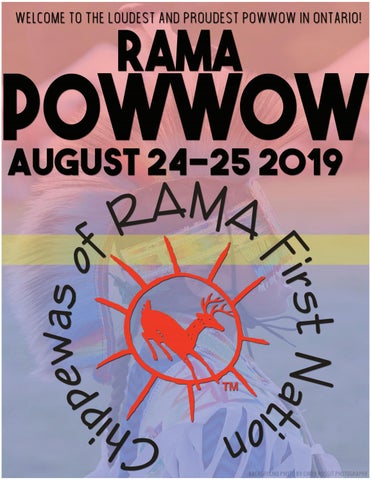
Aaniin, Boozhoo, and welcome to the 34th annual Rama First Nation Powwow. Miigwech for choosing to spend your weekend with us. We are proud to be one of the biggest and best powwows in Ontario. This weekend, you will get to see and hear some of the best powwow singers and dancers on Turtle Island. The singers will be competing for one of the biggest drum contest prizes in ontario, with first place receiving $10,000 and a big drum donated by Tribal Spirit Music. Many of our dancers are also in competition for cash prizes, while others dance simply for the love of dancing. We have specials lined up, including the ever-popular hand drum special. The Rama Powwow is in its fourth year here at the John Snake Memorial Multipurpose Community Grounds. Those of you who were here last year will recognize that the site has continued to be developed. We now have a pavilion for our elders to sit under, and we finished our stage last year. Every year, we continue to improve the grounds to work towards the original vision of John Snake’ban and the Powwow Committee. We are fortunate to have such a beautiful place to host the Rama Powwow as well as many community events throughout the year. Chi Miigwech to Rama Chief and Council and all the departments and staff for making the vision a reality. The Rama Powwow simply would not be possible without the support of Rama Chief and Council, the Powwow Committee and our volunteers. As Rama’s biggest event of the year, with over 4,000 people attending, there is a tremendous amount of planning and work involved. Much of the work happens months in advance of powwow. Booking our world class line-up of head staff, obtaining sponsorships, renting tents and portapotties, organizing the feast, and creating this powwow guide are just some of the many jobs that are taken up dutifully by the Powwow Committee. It truly is a team effort. Chi Miigwech to the Powwow Committee, our volunteers, head staff, drummers, dancers, vendors, and spectators for making rama powwow the best powwow around! This is a weekend about celebrating First Nations culture and history. Whether it’s your first Rama Powwow or your 34th, please enjoy your time with us. Listen to those ancient songs and watch the beautiful dancing, visit our food and craft vendors, re-connect with old friends or make some new ones, and enjoy every moment. This is a special weekend. Miigwech, The powwow committee Chippewas of Rama First Nation our heritage place 5884 Rama Road, Suite 200, Rama, ON L3V 6H6 Telephone: (705) 325-3611 www.ramafirstnation.ca www.facebook.com/ramapowwow
3
Weekend Schedule Saturday August 24th 2019
4
6:00AM 11:30AM 12:00PM
5:00PM 6:30PM 7:00PM 8:00PM
Sunrise Ceremony at the Powwow Grounds Roll Call Grand Entry Exhibition - Tiny Tots Exhibition - ADults contest - golden age contest - youth intertribals hand drum special Supper Break Grand Entry woodland special Exhibition - Golden Age Exhibition - youth Contest - teen contest - adult Hand Drum Special intertribals
Sunday August 25th 2019 12:00PM
Roll Call
12:30PM 1:00PM 2:00PM
Grand Entry Exhibition - Tiny Tots Contest - Golden Age Contest - Youth Contest - Teen Contest - Adult woodland special Snake Dance Announcement of Winners Giveaway Retiring of Flags
5:00pm
rama powwow head staff are: emcees - Meegwans Snake and paul owl arena director - allan manitowabi; head dance judge - raven noganosh head singing judge - rodney stanger; head veteran - walker stonefish *Please note, the only firm times are the times for Grand Entry. Other times and order of events are subject to change. the emcees will provide updates as the day moves along.
free wifi provided by point to point communications
Welcome from Our Emergency Services
5
On behalf of the men and women of the Rama Police Service, I am pleased to welcome you to the Chippewas of Rama First Nation while joining us for the 2019 Annual Powwow. Our officers patrol the community on a 24/7 basis and are here to ensure everyone’s safety and security. If you require an officer, call 1-888-310-1122 or dial 9-1-1 in an emergency. Have a safe & enjoyable weekend. Miigwech, Jerel (Jerry) Swamp Chief of Police Rama Police Service
On behalf of the members of the Rama Fire & Rescue Services, I am pleased to welcome you and your families to the 2019 Chippewas of Rama First Nation Powwow. Rama Fire & Rescue Services provides full-time 24 hour fire and emergency coverage to members of Rama and our guests. Please don’t hesitate to drop by our fire hall at 7454 Williams Road and one of our firefighters will take you on a tour of our facilities. We hope you have a safe time as you enjoy our annual powwow. Michael French Fire Chief/CEMC, CMM III, CFEI, CFII Fire Suppression Professional Fire Prevention Professional Emergency Management Professional
Aaniin and Welcome to the Rama First Nation 2019 Annual Powwow. Rama Paramedic Services are happy to keep you safe while you enjoy Rama’s 34th Powwow. We are proud to have one of the highest skill sets for Primary Care Paramedics in Ontario to assist in providing the highest level of prehospital care for our community and visitors. Our Paramedics service the community on a 24 hour 7 day a week basis as well as we do some routine home visits to check on our community members that are in need. We are always here to lend a hand to our community and its visitors. If you have a medical emergency please dial 9-1-1 and ask for an ambulance. Please enjoy the Powwow safely and feel free to visit our first aid booth should you need anything. Just look for our ambulance. Carrie Hassberger Chief of Paramedic Services Rama Paramedic Services
6
A Look Back at the 2018 Rama Powwow Photos by Cindy Rossit Photography
Powwow 101: History and Types of Powwows
7
with information provided by John Snake’ban, Vicki Snache, James Simcoe, and Ryan Stiles, 2013
A
s far back as we can remember the Chippewas of Rama First Nation has been a meeting place for visitors. We are a community that is known for its hospitality; from the earliest explorers, to the fall fairs in the 1920’s. From the powwow under the big tent at the Rama Ball Field, to the competition pow-wows at the MASK arena, our community continues to enjoy being a host to the many guests who frequent our community on a daily basis. In the early 1970’s, there was no song and dance happening in Rama First Nation and no sign of local powwows in the surrounding area. Emerson Benson, Co-founder of the Chippewas of Rama First Nation Thanksgiving Powwow, was working at the Native Canadian Centre in Toronto and had been surrounded by drumming and dancing on a weekly basis. Being inspired to bring back tradition in his own community, he said “I’m from the area, there’s nothing going on, so hey let’s try it”. Emerson also recalls how Rama had always been noted for its hospitality. In 1977, with the support of Rama First Nation band members, the community held its first annual Thanksgiving Powwow at Victoria Park. “It was a real community event [and] there was a lot of volunteerism at that time.” For generations people have gathered at Rama, particularly in the autumn or harvest months, to celebrate, socialize, eat, and have fun together. The following year, the entire community and the Social Services Department got involved in what was then a non-competition powwow held every Thanksgiving weekend. The Old Mall, which now houses Casino Rama Administrative Offices, Victoria Park, the ball field at Rama, and the Orillia Roller Skating Place were all used as venues for the annual powwow. In 1986, the Rama Powwow again made another transformation as a result of a ‘Social Recreation Needs Assessment’ (SRNA) the first Community Visioning Process, which began in 1983 and extended into 1985. The community was canvassed in what was referred to as ‘Kitchen Dialogue’ by former Chief Ted Williams who held leadership during this time. Members of the SRNA committee went to each household to ask a series of questions and sit in the kitchen (a place of comfort) to discuss the people’s dreams and aspirations that they had for the community. “Many of the success’s we find we have today have come from these kitchen table discussion,” relates Ted Williams. “Powwow was part of that talk and some members of the community built on this.” The 1986 Powwow was organized by Emerson Benson, James Simcoe, Aaron Benson, Ned Benson and Scott Snache.
Over the years, Rama First Nation has witnessed an exponential growth of the powwow, which was once mainly a small event where about a dozen community veterans would attend along with guests from Walpole, Wiky, Sarnia, and even Milwaukee. Now a competition powwow, the event has grown substantially, hosting between 3000 and 5000 visitors each year. It is an honour to have so many guests visit Rama to take part in the event which has been part of the community’s culture for several decades and continues to evolve. Had it not been for the indomitable will of a few individuals in the 1970’s, we would not be celebrating so many years of powwow at the Chippewas of Rama First Nation. TYPES OF POWWOWS: All powwows practice the four virtues of Honour, Respect, Generosity and Kindness. Each powwow has its importance and they are all equal to each other. They are celebrations and social events where everyone is welcome participate, have fun and give thanks for the blessings we receive. Each type of powwow is a little different than the next, but they all share the same underlying values and traditions. Competition Powwow: A dance and drum contest event for prizes. These powwows give dancers and singers the opportunity to be the best that they can be, much like the Olympics. Categories for dance contests are determined by age and dance style. Rama First Nation recognizes all tiny tots (0-5) as winners. As such, we do not have competition for them. Instead, they receive an honorarium for their participation and are encouraged for their interest in dancing as a leisure activity. Any dancers who do not wish to enter into contest are still welcome participants during all intertribal songs. Traditional Powwow: A time to send prayer to our Mother Earth. We send our prayers through the dance and movements of our feet. This powwow focuses on taking care of creation and all our relations. This powwow also offers honorariums to all drummers, singers, and dancers ensuring that they walk away with something to help them get back home and to give thanks for the blessings they have offered the host community through song and dance. It is usually free for visiting spectators to attend these powwows. It is rare for a ‘Special’ to be performed at these powwows. Specials are dances and songs that are performed for prize money. Non-Competition Powwow: Also known as the “sharing powwow”. This powwow, like a traditional powwow, also offers honorariums to all participating drummers, singers, and dancers. Like a competition powwow, ‘Specials’ (songs and dances for prize money) are sometimes performed
8
Powwow 101: Traditions, Songs, and Dances
POWWOW TRADITIONS: Invocation: Ancestral teachings tell us that prayer is what comes first for anything in life. As such, we will begin our event with an invocation. This blessing is brought by a respected elder of the community. Whistles: Wooden, copper, and silver whistles may be heard at the powwow. They are sometimes used by whistle carriers for the purpose of keeping a song going during social events like a powwow. Some whistle carriers have Eagle bone whistles which are generally used for ceremonial purposes, by those who have been given the honour to carry them. Giveaway: We provide gifts as a way of giving thanks. The powwow giveaway is how the Chippewas of Rama First Nation offers thanks to visitors for coming to dance and sing on behalf of our community. Pow-wow singers and dancers perform for various reasons: for the blessings they have received, to dance for someone who is ill, or for those who cannot dance. Dancers and singers also perform out of joy, for good health, and happiness. When spectators enjoy the sights and sounds of a powwow, they have an opportunity to feel blessed by receiving a release of any trials or negativity; thus the opportunity to feel good takes its place. The giveaway is also a means of thanking dancers and singers for all of the good feelings that they brought and for honouring a host community with their visit. Grand Entry: This is the time when all dancers line up by dance style and age to enter the powwow arena. The community Eagle Staffs lead the way. Following Eagle Staffs are the Canadian and American flags, Veterans flags, visiting eagle staffs, Missing In Action flags, Union Jack, the Ontario Flag, and any other visiting flags to the community. Veterans will usually carry flags. Often, Chief and Council, and other special invited guests, will be asked to be part of Grand Entry. It is customary to stand and remove your hat during the Grand Entry. SONGS AND DANCES Songs are a mixture of chanting and language and they tell a story of our past. Like several cultures around the world, our songs and dances act as a filing cabinet. They represent a living past and tell us stories of our life and history. Each song and dance has its very own unique meaning and importance. Carriers of songs are a type of historian, in that the singer not only carries the song, but also the origin and significance of it. Although First Nation music is vast and predates written history, many songs and dances were hidden away during a time in which our ancestors were not allowed to practice their culture and heritage. Today, several songs and dances that were hidden away have slowly made their way back into dance or powwow arenas. Just as song is a way to send prayers to creator and creation, dance is a way to send prayers to mother earth, through our feet. Grand Entry Song: The Grand Entry song is the first song
that brings in the spirit and sets the tone of the day. This is when a procession of all dancers enter the dance arena according to dance style and age. Eagle staffs, flag carriers, veterans and dignitaries lead the way during the grand entry. Flag Song: The second song we hear at a powwow is the flag song. Once all the dancers have entered the dance area after grand entry, the flag song is “sent up” to acknowledge our Eagle Staff and memory of our past and present veterans. A flag song is given the same respect as a National Anthem. After the flag song, eagle staff and flag carriers are introduced during the posting of the colours. This honors all warriors and veterans of the past and present for the sacrifices they have made. This is a moment of respect given to those who gave the ultimate sacrifice. During this time, we remember and honour them. Honour Song: These are songs that are requested to honour someone; for example, a son returned from war or in memory of a relative that has passed on. Honour songs are usually requested prior to the powwow. These are also sung for the accomplishments of community members and can also be requested to welcome people home. Inter-tribals: Once the grand entry and opening ceremonies are finished, the Master of Ceremonies will call the drums to offer songs in the way of ‘inter-tribals’, which mean everyone can dance: wearing regalia or not. These songs are open to all and give the drums an opportunity to sing. Inter-tribal means all inclusive. People of any age and every ethnicity, religious or spiritual belief, and cultural background are invited to dance. Sneak-up: This is a specialty or exhibition dance. where male Traditional dancers tell a story of sneaking up on game or simulate a confrontation with an enemy. The sneak up also represents storming the shores of Normandy, in WWII. Dunk and Dive: A warrior dance that represents our warriors charging onto enemy or prey. It is a story of how they came to be victorious re-enacting the battle or hunt. Chicken Dance: This dance imitates the mating dance of the bird. It reflects how the male bird seeks the attention of the female. Snake dance, Smoke dance, Switch dance, Clown dance, Crow Hop, Round Dance, Blanket Dance, and Jingle Dress Dance are just a few more that have been performed at the Chippewas of Rama First Nation Powwow. Each one has its own unique significance and purpose. The Master of Ceremonies at a powwow will usually explain songs and dances in more depth. There are countless songs and dances that one can enjoy along the powwow trail. Keep an eye (and ear) out for all the different kinds today!
9
10
11
12
A Look Back at the 2018 Rama Powwow Photos by Cindy Rossit Photography
CHI MIIGWECH TO OUR 2019 SPONSORS!
CINDY ROSSIT PHOTOGRAPHY SPIRITHANDS PHOTOGRAPHY
13
14
Our history begins like many anishinaabeg communities: with a great migration. our ancestors migrated from the east coast to inland north america, especially around the great lakes. more recently, our ancestors lived on the northern and northeastern shores of lake huron and georgian bay. During this time (around 1200-1650), the huron-wendat nation lived in the area near modern-day rama first nation. It is said that our ancestors let the huron-wendat nation move into our territory as they were fleeing war further south with the haudenosaunee people. regardless, war between the huron-wendat and haudenosaunee continued. after many battles, the haudenosaunee defeated the huron-wendat, and the remaining huron-wendat fled the region forever. the haudenosaunee took control of the area nearby (simcoe county and much of central and southern ontario) before the anishinaabeg came back. many battles took place right here in and around rama throughout the 17th and 18th centuries. the anishinaabeg brutally defeated the haudeosaunee, and they retreated back to their homeland further south. wampum was exchanged and the two powerful nations agreed to eternal peace, which remains to this day. the anishinaabeg, rama’s ancestors, were in control of the area. they took control of the fur trade, and continued to demonstrate their political, war, and economic prowess. gradually, settlement by europeans increased. until suddenly, settlers were everywhere. rama’s ancestors found themselves surrounded by settlers, and increasingly pressured by the federal government to give up their traditional ways of life. one strategy employed by the federal government was to re-locate rama’s ancestors to one of the first “reserves” in canada. called the “Coldwater Narrows Experiment”, the government was attempting to curtail first nations’ traditional hunting and gathering ways of life (as this took up lots of land), and to assimilate first nations into euro-canadian culture. rama’s ancestors lived on this 10,000 acre reserve for about 6 years, which spanned between coldwater and the atherley narrows. in 1836, the government gave up on the experiment, realizing that our ancestors remained true to their traditional ways of life. in addition, settlers began demanding the fertile land our ancestors had expertly farmed and developed (including a road which became highway 12). rama’s chiefs, including chief yellowhead, went to to-
15 ronto and signed a document, believing it to be a document finalizing the transfer of the land and properties into their communities’ names. instead, they were misled into surrendering the land to the government. the chippewas of lakes simcoe and huron had few options. they petitioned in vain, before ultimately deciding to split up into three smaller communities, known today as: chippewas of rama, chippewas of georgina island, and beausoleil first nation. Rama’s ancestors moved first to the narrows before purchasing rama (including the land you’re on today) for $3,200, using their annuities from their war of 1812 pensions (many rama warriors fought alongside the british in this war). rama’s ancestors moved to rama (the township in which we bought land was known as “rama township”, thus, we became known as the “rama indians”). they toiled away, farming the land, travelling to muskoka to hunt, fish, and harvest, and dealt with the ever-changing world around them. in 1923, the williams treaties were signed by rama and 6 other first nations and the government. these treaties surrendered over 12 million acres of land including much of central and towards northern ontario. the government interpreted the surrender to mean that we gave up our rights to hunt, fish, and harvest on the territories... that was no our ancestors’ intention. regardless, they were now unable to practice their traditional way of life, something they had done for thousands of years. our ancestors had to turn to wage earning jobs, including working as guides to tourists in muskoka; selling crafts; and working at local timber mills. rama was a simple and humble place for a long time. Throughout much of the 1900’s, work and money were scarce. our people endured residential schools, the 60’s scoop, and systematic racism. we persevered. we survived. in 1996, casino rama opened, and our community’s future was changed. within a few years of the casino opening, rama built an elementary school, arena, health centre, fire/police/ems stations, band office, and more. our community developed very quickly. today, we are prosperous and successful. we have several exciting business ventures. we have over 100 young adults in post-secondary education. our people have jobs and bright futures. our culture and language is becoming revitalized. we are a proud, progressive first nation.
16
Gchi Miigwech to a major sponsor of rama powwow:
Rama Moccasin and Smoke!