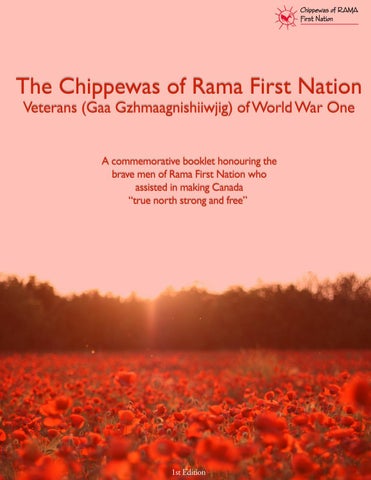
The Chippewas of Rama First Nation Veterans (Gaa Gzhmaagnishiiwjig) of World War One A commemorative booklet honouring the brave men of Rama First Nation who assisted in making Canada “true north strong and free�
1st Edition
Acknowledgements On behalf of Rama First Nation’s Chief and Council and the community, miigwech to all Rama’s veterans who left their homes and families to stand in defence of our land.
First Nations people have historically demonstrated their willingness to stand for our communities and with our allies. It is estimated that more than 7,000 First Nations members served in the First and Second World Wars as well as the Korean War. Rama First Nation’s members have taken their place alongside our allies in conflicts throughout history and we honour their courage and commitment. On Remembrance Day, we are reminded of the extraordinary sacrifice our soldiers face every day from standing as honour guard at the Tomb of the Unknown Soldier to the front lines around the world. We are grateful for the spirit that compels them to stand ready and be counted on whenever and wherever democracy is threatened.
This commemorative booklet, produced in 2014, is dedicated to each and every veteran, their loved ones, and their descendants; we are eternally grateful for the sacrifices made in order to protect our land and treaties. Research and information was obtained from a variety of sources: various websites, in particular www.ancestry.ca and www.ramaracardendalton.com; Library and Archives Canada Service Record files, The Grey and Simcoe Foresters Museum (Barrie, ON), Languagekeeper Irene Snache, and documents archived in the Rama First Nation Culture and Research Department. Chippewas of Rama First Nation 5884 Rama Road, Suite 200 L3V 6H6 Rama, ON (705) 325-3611 Research, content, layout and design: The Chippewas of Rama First Nation Culture and Research Department November 2014 Efforts were made to ensure that the research obtained and published was as accurate as possible. If you notice inaccuracies, please inform the Rama First Nation Culture and Research Department at (705) 325-3611 ext. 1288
In Flanders fields, the poppies grow…
Bezhig (1)
For many Canadians, poppies and Remembrance Day are synonymous. Canadian Lieutenant Colonel John
McCrae penned “In Flanders Field” in 1915, a poem that is memorized even today by thousands of schoolchildren.The First World War was called The Great War, ‘the war to end all wars’; it was believed that the world would never again become involved in a war on such a scale. We were wrong. The National War Memorial was erected in Ottawa in 1939, and was originally built as a monument to those who served in the first war. Since then, more dates commemorating newer conflicts have been added to the memorial’s base. We hope that no new dates will be added in the future. Canada at the start of World War I, in 1914, was still a young country, with Confederation only having taken place in 1867. Although only a four year long conflict, the effects of the first war were felt throughout Canada and the world for decades. In First Nations communities, it was not uncommon for every eligible man to enlist. Canada and the entire free world needed our help, and we answered the call- we did not hesitate. Many who enlisted were very young men- some even lied about their date of birth so they could serve. World War I saw almost 650,000 Canadians sign up. One in ten did not come home. In brutal battles and desolate battlefields characterized by trench warfare full of rats and lice, malnutrition and illness, machine guns, mud, barbed wire, bayonets, tanks, flame throwers and mustard gas, those who did make it home were forever changed. They had lived through a time of unending death and destruction. Local stories have been handed down from those who have gone on before us. In Rama, so many men enlisted from our small population, that the quiet sobbing of the women and mothers could be heard throughout the village for days. Loved ones waited for news from their sons, brothers, uncles, husbands and fathers, to let those at home know that they were alright. Postcards and letters from the front lines were rare. The arrival of men home after their discharge from duty was cause for great celebration, even though times were tough in Rama’s little community. 2014 marks special Remembrance Day thoughts. The events at the National War Memorial in October 2014 will continue to serve as a reminder to us all to be thankful for those who continue to stand on guard for us. In 2014, the one hundredth anniversary of the start of World War I, we are reminded that we have no veterans from the Great War left alive from Rama. It was a war that began more than a hundred years ago, but it cannot be forgotten. It helped shape the future of a young Canada and at the same time, changed the future of a small First Nations community in southern Ontario. The surnames of Rama’s World War veterans continue to sound familiar. Their descendants still live in Rama and other places throughout the free world. On monuments and in ceremony we will continue to honour those who served, those who did not hesitate to fight for a Canada that was strong and free. Lest we forget.
Niizh (2)
Table of Contents . I . T C . T G W . R F N...A C . L F . P . M W F . A, M; B, W; B, F FF. B, P; C, H; D, A AA. F, D; F, P PP. T C F C . H, G; H, H HH. H, R; H, W; J, J JJ.. J, E; J, H HH. M, W;N, H; S, B; ;;. S, S; S, A; S, A . S, C; S, H; S, J JJ. S, B BB. S, W; S, W; S, E EE. S, G; S, N; S. G, B BB.. S. G, J; S. G, J . S. G, O; S, A; S, . S, R; W, H; W, L; ;;. Y, F; Y, I; Y, T
Nswi (3)
The Great War: “The War to End All Wars” The Conflict Begins An assassination in Sarajevo in June 1914 went almost unnoticed in Canada. Few Canadians expected that it would lead to war; fewer still anticipated the sacrifices Canada would be called to make. Yet the war was to change the world they lived in, and in a very real sense the Canadian nation was born on the battlefields of Europe.
International relations in Europe in the summer of 1914 appeared to be quiet: but great tensions existed under the surface. The Great European Powers were ranged against each other in two alliances—The Triple Alliance (Germany, Austria-Hungary and Italy) and the Triple Entente (France, Russia and Great Britain). The situation was heightened by economic and imperial rivalries, national pride, the nationalism of new countries, ambitious statesmen, the instability of eastern Europe (particularly the Balkans where the Ottoman Empire was collapsing) and the constant talk of wars somewhere. All the ingredients were there for a small international fire to become a raging inferno. Once started by those fatal shots, efforts to stop the blaze proved futile. On Sunday, June 28, 1914, Archduke Franz Ferdinand, heir to the Austro-Hungarian throne, was shot and killed by a Serbian nationalist during a visit to Sarajevo in Bosnia. Convinced that the Serbian government was involved in the plot, Austria-Hungary, supported by Germany, sent a harsh ultimatum to Serbia. Although Serbia met nearly every demand, Austria-Hungary, bent on conquest, declared war. The fire spread. Russia, the self-proclaimed protector of the Slav nations, mobilized. Germany demanded promises of peace from Russia and France and, when there was no answer, declared war on Russia on August 1, and on France two days later. France looked to Britain for support. Although Britain was not bound by a formal treaty to join France in a war, Sir Edward Gray, the Foreign Secretary, had made an informal agreement with the French. Then, on August 4th, 1914, the German Army on its way to France invaded neutral Belgium. Britain sent an ultimatum demanding withdrawal of German troops and reminding Germany of the Treaty of 1839 guaranteeing Belgium’s neutrality, to which Prussia (effectively the predecessor of Germany) was also a signatory. Unanswered, the ultimatum expired at midnight on August 4. Britain was at war. And when Britain was at war, Canada was at war. That was her sole obligation. How Canada reacted to the war and what measures she took in support of Britain was up to Canada’s government
It was with a spirit of light-hearted optimism and exuberant enthusiasm that Britain and her Empire went to war. It would be exciting; it would be good for business; and the boys would be home by Christmas. They did not know that four years of death and destruction lay ahead in a war revolutionized by high explosive shells, rapid-firing machine guns, poison gas, mighty dreadnoughts, stealthy submarines, and airplanes. Nor did they know that it would destroy thousands of young men and transform society. Germany, France and Russia already had elaborate war plans and proceeded to put them into effect—all failed. The object of the German Schlieffen Plan was to strike quickly against France, destroy her armies, and then turn against the more slowly mobilizing Russians, on the eastern flank. The plan almost succeeded. Massive German armies struck through Belgium, battered the fortified cities of Liège and Namur, and wheeled southward into France. At Mons a small British Expeditionary Force made a determined stand, but the task was impossible, and the “Old Contemptibles” were forced to retreat. Then, the German advance weakened, and the French and British counter-attacked. In the First Battle of the Marne the invasion was checked, and the Germans were driven back to a line along the Aisne River. The Schlieffen Plan had failed. The French “Plan XVII” also failed as French drives against Germany in Alsace and Lorraine were bloodily repulsed. On the eastern front the outcome was similar. At first the Russians, moving with unexpected speed, threw back the Austro-Hungarians and advanced into Eastern Prussia. But Allied hopes were dashed as the Germans under von Hindenburg inflicted a crushing defeat on the Russian armies at Tannenberg and the Masurian Lakes. By late autumn a military deadlock had been reached on both the eastern and the western fronts. In the west, after the “Miracle of the Marne,” there followed a race to the sea as German and Allied armies tried to outflank each other in a desperate bid to gain the Channel ports. While the heavy fighting moved north, the battlefields to the south became quiet. The soldiers there dug themselves into the ground to provide shelter and security from bullets and shells. The Germans were able to select the best positions for a defensive position—already they were expecting to defend a line rather than to attack on the Western Front. The positions they selected were not only, generally, excellent from the point of view of defence, they also ensured that vital strategic railways to maintain their armies were secure and away from enemy artillery, well behind the lines.
Niiwin (4) The Germans also took full advantage of the heavily industrialised areas of France and Belgium now under their control. These early and primitive fortifications were a start to a complex system of trench lines, machine gun and artillery positions that were to reach their height with the construction of the Hindenburg Line in the winter of 1916/1917. But at this stage they were simple trenches defended at best with a few strands of barbed wire. By the end of the war, the line stretched for approximately 750 kilometres from the Belgian coast to the Swiss frontier; and it was on this Western Front that Canada was to be chiefly engaged. On October 29, the German Army made one final effort to reach the Channel ports. In the First Battle of Ypres, in a little corner of Belgium known as Flanders, the British Expeditionary Force and their French allies held against overwhelming odds and the ports were saved. Unfortunately in these early campaigns Britain lost the greater part of her precious regular army, while the efforts to protect the Ypres Salient were to be even more costly in the future.
The Conflict Widens
With a regular army of only 3,110 men and a fledgling navy, Canada was ill-prepared to enter a world conflict. Yet, from Halifax to Vancouver, thousands of young Canadians hastened to the recruiting offices. Within a few weeks more than 32,000 men gathered at Valcartier Camp near Quebec City; and within two months the First Contingent, Canadian Expeditionary Force, was on its way to England in the largest convoy ever to cross the Atlantic. Also sailing in this convoy was a contingent from the still separate British self governing colony of Newfoundland. A suggestion that Newfoundland’s men should be incorporated into the Canadian Expeditionary Force had earlier been politely but firmly rejected (Newfoundland did not become a province of Canada until 1950). Upon reaching England the Canadians endured a long miserable winter training in the mud and drizzle of Salisbury Plain. In spring 1915, they were deemed ready for the front line and were razor-keen. Nothing, they believed, could be worse than Salisbury. In the years that lay ahead, they were to find out just how tragically wrong that assessment was. The first Canadian troops to arrive in France were the Princess Patricia’s Canadian Light Infantry, which had been formed at the outbreak of war entirely from ex-British Army regular soldiers. The “Princess Pats” landed in France in December 1914 with the British 27th Division and saw action near St. Eloi and at Polygon Wood in the Ypres Salient. Today, their battalion memorial stands on the high ground of Bellewaarde Ridge.
The war of rapid movement ground to a halt, and the
two great enemy armies became completely deadlocked along a 1,000 kilometre long front of impregnable trenches. For the next four years there was little change. As attack after attack failed to penetrate the enemy lines the toll in human lives grew rapidly, and the Western Front became an area of bloody stalemate. Faced with the prospect of a long struggle both sides began an urgent search for allies. The Dominions had already joined Britain and their troops were soon involved in the far-flung operations. The war became more truly a world war as Japan, in 1914, and Italy, in 1915 joined the Entente Powers, while Turkey lined up with Germany and Austria. Other countries were drawn in, one by one, until by 1917 every continent and all the oceans of the world were involved.
Early in February 1915, the 1st Canadian Division reached France and was introduced to trench warfare by veteran British troops. Following this brief training they took over a section of the line in the Armentières sector in French Flanders. Faced with the realities of dirt, disease and death, their illusions of military glory quickly disappeared.
Canada Enters the War The fact that Canada was automatically at war when
Britain was at war in 1914 was unquestioned as from coast to coast, in a spirit of almost unbelievable unanimity, Canadians pledged support for Britain. Sir Wilfrid Laurier spoke for the majority of Canadians when he proclaimed: “It is our duty to let Great Britain know and to let the friends and foes of Great Britain know that there is in Canada but one mind and one heart and that all Canadians are behind the Mother Country.” Prime Minister Robert Borden, calling for a supreme national effort, offered Canadian assistance to Great Britain. The offer was accepted, and immediately orders were given for the mobilization of an expeditionary force.
National War Memorial, Ottawa, ON (Wikipedia)
Text obtained from: http://www.veterans.gc.ca/eng/remembrance/history/first-world-war/canada
Naanan (5)
Rama First Nation’s Men Answer the Call As with other First Nations groups across Canada, men from Rama, upon hearing of the war overseas, began enlisting in droves. Each man would have his own reasons for enlisting, be it loyalty, honour, decent pay, adventure, or overseas travel. Ultimately, over 40 men enlisted from what was, at that time, a tiny community. The majority of men from Rama served within three battalions: The 122nd Muskoka Overseas Battalion, the 157th Overseas Battalion, and the 177th Overseas Battalion. 122nd Muskoka Overseas Battalion The 122nd was known as the Muskoka Battalion of the Canadian Expeditionary Force (CEF) as they were based and recruited out of Muskoka. The 122nd set sail for Britain on June 2nd, 1917. Upon arrival, the 122nd was absorbed by the Canadian Forestry Corps (CFC), who were in need of reinforcements. The CFC were an administrative corps of the Canadian Army. Their existence was requested by England after it was realized England lacked the skills to produce lumber on a massive scale as Canada could. The CFC were tasked with widespread clearing of English and French land for roads and bases, as well as manufacturing timber for building. Their role was a vital one and are considered some of the many unsung heroes of World War 1. The Canadian Forestry Corps was formed following an appeal from Britain on February 14, 1916 for troops to undertake lumbering operations overseas. The Canadian Forestry Corps assumed various tasks, including clearing land for airfields, preparing railway ties and lumber for use in trenches, building barracks and hospitals as well as growing food as farmers. During the critical days of 1918, the Corps also supplied 1,280 men to the infantry. The Canadian Forestry Corps operated in both Britain and France. In France, The Corps often worked under fire from both artillery and the air. In some cases, they had to abandon their mills when the German army overran their operations during an advance. France awarded the Croix de Guerre (“Cross of War”) to members who had experienced heavy artillery fire. In Britain there were more than seventy forestry operations that were fully funded by the Canadian Government. The Canadian Forestry Corps produced 70% of allied lumber used during World War I. The Base Depot for the Canadian Forestry Corps was located on Smith’s Field in the Windsor Great Park, which featured 8,000 acres of forest at that time. 157th and 177th Grey Simcoe Foresters The eruption of the First World War resulted in a tremendous upsurge of patriotism. Frustrated with waiting for their Regiments to be called up, many 31st and 35th men left their units and joined the early contingents. It was not until 1916 that local battalions in the form of the 147th Grey and 157th Simcoe Foresters were authorized. The response was so great that 2 more battalions, the 177th Simcoe Foresters and 248th Grey Regiment soon followed. Companies of the 157th battalion helped clear the new Camp Borden and by the summer of 1916, most of the 4 battalions were training there. In the fall, they were shipped to England only to find that the Canadian Corps had decided not to expand the number of divisions in the Corps. As a result, the new battalions and many others were broken up for badly needed reinforcements. Nevertheless, many of the men would go on to carry out important deeds for the war effort.
http://www.army-armee.forces.gc.ca/en/grey-simcoe-foresters/index.page
Ngodwaaswi (6)
The following are letters received at the Rama Day School. Children sent gifts to the soldiers from Rama who were overseas, and on January 25th, 1917, the teacher and children received two letters: “I have the greatest pleasure in writing these few lines to let you know that we got the letters from you and your pupils. We were glad, and it was entertaining reading them. We will be very glad to get the presents that you are sending us. We know they are on their way now. Well, we like this country very much, only we had wet weather for a couple of weeks. We didn’t see a sun all that time. When we went to London, we were up to London Tower. We saw what we never see in Canada, and I am sorry we don’t get a pass again. I would be very glad to meet that Sergeant-Major. I was looking for him at Bramshott and I couldn’t find him. Well, we’re taking musketry. We’ll finish that next week, so we’ll be ready to meet the Germans. I will send you the Weekly Mirror. I know you’ll be glad to see it. I haven’t time to answer all the letters from the children, but I’ll send some cards next week. I’ll write again soon.” Private Bert Williams “Again I am sending a few lines to you to tell you we are all well at present. Of course myself, I got a bad cold mostly right along, and also good many of the boys. I guess the climate up here don’t agree with us, and I know the weather is often changeable this time of the year, and I guess you ought to know. Thank you for the Christmas parcel. I received it yesterday, and I am really sorry that parcel was undone when it reached me. I got the other things, all o.k. except the socks. I am really sorry for them. I got mine first, before the other boys. Their’s might be all right. I am using this notepaper that you sent me, and also the lead pencil. I also sent some post cards to the pupils who wrote to me from Rama. I saw where they keep lots of deer near London, and we saw that tower clock on Westminster Bridge– Big Ben. In London, to go to picture shows, we are just too busy sizing up the big buildings. Only once we went to a picture show since we came to England, and it was last night, in the little town of Godalming. It is only three miles from Witley and it is just a nice little walk for the evening. I never thought to fill this paper-note when I started to write to you. Do you have much news from Bert and perhaps better? I think when you read this letter we will be somewhere in France. We received a call some time ago last week and so we are busy getting ready for France. Today we received a draft of 200 men to fill our battalion, but we are not drilling much now, only once in a while. When we go, I will drop a card to someone at home to let them know. Every time the bugle band plays the tune of “Pack up your troubles in your old kit bag, and smile, smile, smile,” my it makes me think of home.” Private Ben Sawyer
Niizhwaaswi (7)
The desolate fields at Passchendaele, Belgium. 1917
Left: Trenches at Vimy Ridge, France. Trench warfare was introduced in World War One. It is estimated nearly 25,000 miles of combined trench length were dug by hand with small shovels. The trenches were almost always wet and muddy, resulting in severely uncomfortable conditions for soldiers, as well as widespread disease and infection. Minor wounds often turned to gangrene, and death due to the wet, unsanitary conditions. www.collectionscanada.gc.ca
Left: World War One saw the first use of a chemical weapon in war: gas. The Germans used chlorine gas, phosgene, and eventually mustard gas, all to devastating effect. The British, while at first condemning the use of gas, eventually resorted to using it themselves. It is estimated that there were over 1.2 million casualties, with nearly 90,000 being fatal. Many veterans returned home with serious lung problems after exposure to chemical warfare.
Nshwaaswi (8)
Department of National Defence
World War 1 Rama Veterans
Shaangswi (9)
(in alphabetical order)
Moses Anderson Regiment number 643823, 157th Overseas Battalion, CEF. The 157th Overseas Battalion, also known as The Simcoe Foresters, received battle honours in: Arras 1917, 1918; Hill 70; Ypres (Passchendaele)1917; Amiens (“Hundred Days Offensive”); Hindenburg Line; and Pursuit to Mons. Moses Anderson was born on February 24, 1884 in Peterborough, Ontario (Hiawatha First Nation). Moses was the son of Charles Anderson and Mary Muskrat. He married Elizabeth Jeanette Benson (daughter of Samuel Benson and Annie Sandy) on April 24, 1915, in Rama. Moses signed his attestation papers 10 months later, aged 31, on January 24, 1916, and soon left for training with the 157th at Base Borden near Barrie. Prior to the war, Moses worked as a labourer, and upon returning from overseas continued to do so. Later on in life, Moses worked as a hunting and fishing guide, eventually retiring back to his birthplace at Hiawatha First Nation.
Wilfred Clarence Benson
Regiment number 868160; 116th Overseas Battalion, CEF The 116th Overseas Battalion, later known as The Ontario Regiment, embarked for Britain in July of 1916. The 116th’s primary role was to provide support to the Canadian Corps. In doing so, the 116th received numerous battle honours, including Ypres (Passchendaele) 1917. In February of 1917 it joined the 3rd Canadian Division and fought in France for the remainder of the war. Wilfred Clarence Benson was born October 17, 1893. The son of Samuel Benson Nanigishking and Annie Benson (nee Sandy), Wilfred resided in Rama. Wilfred’s siblings included Annie and Elizabeth Benson (wife of Moses Anderson). Wilfred enlisted at age 22, April 13, 1916, and although he was at first assigned to the 182nd Overseas Battalion, he was transferred to the 116th. Wilfred was soon medically discharged. He returned home, and lived out his life in Rama. Wilfred passed away in the 1970’s.
Frederick William Benson
Regiment number 853092; 177th Overseas Battalion, CEF The 177th Overseas Battalion began recruiting in early 1916, drawing primarily from Simcoe County. The 177th trained at Base Borden near Barrie, and embarked for England in May of 1917. Battle honours received by the 177th include: Arras, 1917, 1918; Ypres, 1917; Amiens; Hindenburg Line; and Pursuit to Mons. Frederick Benson was born October 11th, 1878, to James Benson and Charlotte Charles. Frederick enlisted for service on February 25, 1916 at age 37. At the time, he was married to Mary Benson and living in Rama. He arrived in England on May 14, 1917, and remained there until Sept. 19, 1917. An August 1917 edition of the Orillia Times reported, “Official notice has been received here that Pte. Fred Benson, who was with the 177th Batt. and shortly after proceeding overseas he took a stroke, will return home.” Heart troubles continued later in life, and on August 9, 1935, Frederick passed away due to heart failure.
All signatures are copied from digitized versions of each soldier’s original WW1 attestation form.
Midaaswi (10)
Peter Bigwin
Regiment number unknown; 157th Overseas Battalion, CEF The 157th Overseas Battalion, also known as The Simcoe Foresters, received battle honours in: Arras 1917, 1918; Hill 70; Ypres (Passchendaele)1917; Amiens (“Hundred Days Offensive”); Hindenburg Line; and Pursuit to Mons. Peter Bigwin, born in 1889, served as a “sapper” in the war. A sapper was a soldier who predominantly worked as an engineer, performing a wide variety of essential logistical duties. In Peter’s case, he may have been a bridge-builder, clearer of land for roads and railways, or even a minesweeper. Peter married Lillie Pawis, from Shawanaga First Nation soon after returning from the war. They had a son, William James, who sadly passed away within a few months of his birth. Peter and Lillie lived in Rama up until Peter’s death in 1939. Peter is buried at the Rama First Nation Cemetery.
Herbert Charles
Regiment number 763591; 122nd Overseas Battalion, CEF The 122nd Battalion, also known as the Muskoka Battalion, was based out of Huntsville, ON, and recruited exclusively from the Muskoka region. The 122nd completed their training and embarked for Britain in June of 1917. A week after arriving, the 122nd was absorbed by the Canadian Forestry Depot, CEF. Herbert was born on Georgina Island, March 12, 1897, to George Charles and Josephine George. He signed his attestation papers when he was 19 on April 19, 1916, during recruitment by the 122nd in Gravenhurst. At the time of enlistment, he was single and living in Longford. Herbert married Annie Alice St. Germain (daughter of Emma Charles and James St. Germain) on September 11th, 1920 in Rama. Herbert and Annie continued to reside in the Simcoe and Muskoka areas for the rest of their lives.
Alexander Joseph Douglas Regiment number 763664; 122nd Overseas Battalion, CEF The 122nd Battalion, also known as the Muskoka Battalion, was based out of Huntsville, ON, and recruited exclusively from the Muskoka region. The 122nd completed their training and embarked for Britain in June of 1917. A week after arriving, the 122nd was absorbed by the Canadian Forestry Depot, CEF. Alexander (Alex) Joseph Douglas was born in Rama on March 22, 1876. Alexander signed his attestation papers on May 1, 1916. The then 40 year old Alexander was married to Emily Douglas, and they lived in Rama. In August 1917, after Alexander’s battalion, the 122nd, was absorbed by the Canadian Forestry Depot. Rather than stay with the Canadian Forestry Depot (who were responsible for clearing land of trees for bases and roads, as well as building barracks), Alexander joined the 19th Battalion, CEF, in France. As a result, Alexander fought in the epic Battle of Passchendaele. The Battle of Passchendaele lasted until November of 1917, and shortly after an Orillia Times article states that Alexander Douglas was one of three local soldiers to return home in December of 1917. Alexander Joseph Douglas passed away on Nov. 27, 1938.
Midaaswi shi bezhig (11)
Daniel Fawn
Regiment number 853225 177th Overseas Battalion, CEF The 177th Overseas Battalion began recruiting in early 1916, drawing primarily from Simcoe County. The 177th trained at Base Borden near Barrie, and embarked for England in May of 1917. Battle honours received by the 177th include: Arras, 1917, 1918; Ypres, 1917; Amiens; Hindenburg Line; and Pursuit to Mons. Daniel Fawn was born in Rama in 1891. Born to Charles Fawn and Rose Benson, Daniel’s 9 siblings included Charles, Sarah, and Percy, who also served with the 177th. Daniel married Elizabeth Jane Stinson (daughter of Jabez Stinson and Charlotte Williams) on October 17, 1912 in Rama. They had 10 children, including Sarah Helena, Milton, and Sadie. 25 year old Daniel signed his attestation papers on April 26, 1916. After spending nearly a year in training, Daniel and the rest of the 177th arrived in England, May 14, 1917. The 177th eventually joined the 19th Battalion in France. They then spent the remainder of the war fighting alongside their brothers of the 19th Battalion. Daniel returned home safely after the conclusion of the war. Many of his descendents reside in Rama today.
Percy Fawn Regiment number 853105; 177th Overseas Battalion CEF The 177th Overseas Battalion began recruiting in early 1916, drawing primarily from Simcoe County. The 177th were part of a larger regiment known as The Grey and Simcoe Foresters. The 177th trained at Base Borden near Barrie, and embarked for England in May of 1917. Battle honours received by the 177th include: Arras, 1917, 1918; Ypres, 1917; Amiens; Hindenburg Line; and Pursuit to Mons. Percy Fawn was born August 21, 1896. The younger brother of Daniel Fawn, Percy’s parents were Charles Fawn and Rose Benson. At the time of enlistment, March 8, 1916, Percy was 20 years old. He was single, and worked as a lumberman at a local mill. Percy joined the 177th in training in 1916. Following training, Percy and the rest of the 177th embarked for England, arriving on May 14, 1917. The 177th soon joined the 19th Battalion in France, Sept. 14, 1917, where they remained until August 10, 1918. They then returned back to Canada. Percy passed away in March of 1973, at age 77.
Midaaswi shi-niizh (12)
The Canadian Forestry Corps The success of German U-Boats in the Atlantic in the First World War caused a restriction on the number of imports to Britain. Millions of tons of lumber has travelled across the ocean from Canada to the UK in 1915. In February 1916, the British government requested assistance from Canada with regards to the production of timber, hoping to utilize resources available in Britain. The 224th Canadian Forestry Battalion was raised and arrived in England in April 1916, less than three months after the initial request. The battalion moved to Virginia Water Camp in Surrey, to produce sawn lumber. Detachments were sent to other places in England and Scotland. A second British request for additional forestry units resulted in the formation of the 238th Canadian Forestry Battalion, which arrived in England in September 1916. In October 1916, authority was granted to form the Canadian Forestry Corps. Both battalions joined the corps; by November 1916, six forestry battalions had arrived overseas, including the 242nd Battalion, CEF. In December 1916, the battalions were broken up to form independent forestry companies. Eventually 102 companies were formed in Europe. A small group was already operating in France at Bois Normand, with the first headquarters at Conches (Eure). This headquarters was expanded into a Canadian Forestry Group headquarters (eventually designated Centre Group) divided into two districts. By Jun 1918, three other groups were in operation; Jura Group, Bordeaux Group, and Marne Group, and each of these groups also had two district headquarters under command. Canadian Forestry Corps headquarters for France was established at Paris-Plage, near Boulogne, with an office in Paris linking the district and group headquarters with a corps supply depot where technical equipment was warehoused, at Le Havre. Arrangements had been made in Canada for the purchase and shipment of necessary machinery and equipment to operate saw mills and other facilities. The corps also ran three forestry hospitals. In Mar 1918, the corps was called on to train 800 men as reinforcements for the Canadian Corps, to be drawn from across all the districts. At the end of the war, 56 companies were in operation on the Western Front, including 13 made up of German prisoners of war. In total, 19,162 men were on strength. Seven more companies were engaged exclusively in technical work for Allied air forces, including clearing, grading, leveling and draining land in the creation of airfields. A scarcity of rivers and waterways in France had necessi-
tated the adoption (and creation) of broad, narrow-gauge railways. Six districts were in operation in the UK at war’s end (at Carlisle, Egham, Southampton and East Sheen in England and Stirling and Inverness in Scotland). Some 43 companies were in operation, with a strength of 12,533 including 3,046 attached labourers and prisoners of war. Their base depot was located at Smith’s Lawn, Windsor shortly after the 224th Battalion arrived overseas, and all newly arriving soldiers for the corps arrived at the depot before reinforcements for companies in France or the UK were selected. The average monthly turnover at the depot was 1,500 men. In total, the combined strength of the corps on 11 Nov 1918, including attached officers, foreign soldiers (including British, Portugese, Finns and prisoners of war) was 31,447. The 122nd (Muskoka) Overseas Battalion, CEF, found themselves re-assigned to the Canadian Forestry Depot almost immediately after arriving overseas. Many of the men worked as lumbermen in Muskoka, Longford Mills, and throughout Simcoe County. The skill and knowledge obtained by these men in forests and lumber mills proved invaluable overseas, as they were tasked with producing millions of feet board measure of timber over the course of the war. In addition to the production of timber, the Forestry Corps cleared land for airfields, bases, and roads, and built barracks and camps. While not as glorious as performing heroics on the frontline, the Canadian Forestry Corps played an essential part to the war. Without their work in the mills, the outcome of the war likely would have been much different.
One of the many mills established in France by the Canadian Forestry Corps. Canada. Dept. of National Defence / Library and Archives Canada Information obtained from http://www.canadiansoldiers.com/corpsbranches/ forestrycorps.htm
Midaaswi shi-nswi (13)
George A. Hopkins Regiment number 409336; 37th Infantry Battalion The 37th Infantry Battalion, also known as the Northern Ontario regiment, began recruitment in early 1915. Recruitment primarily took place in Northern Ontario, but camp was situated in Niagara-on-the-Lake. The 37th departed for England on November 27, 1915. Up until July of 1916, the battalion was used as a reserve regiment by the Canadian Corps. The 37th was then absorbed by the 39th Battalion. An active and heavily involved battalion, the 37th received battle honours for Ypres (Passchendaele)1915, ‘17; Festurbert, 1915; Mount Sorrel; Somme, 1916; Arras, 1917, ‘18; Hill, 70; Amiens; Hindenburg Line; and Pursuit to Mons. George Hopkins was born December 24, 1884, to Benjamin Hopkins and Mary Ann Garnett. The Hopkins were descendents of one of the first non-First Nations settlers in the area. While living in Longford Mills, George enlisted for service. The date was September 11, 1915, and George enlisted as a 29 year old widower, due to the fact that his wife Elizabeth Ingersoll had passed away in December of 1914. They had three children, Orvil (1908), Alvin (1909), John (1910), and Lyda (1913). George re-married in October of 1915, to Mabel Snake (daughter of Edward and Fannie). George passed away on June 10, 1931.
Herbert Milton Hopkins Regiment number 868182; 182 Overseas Battalion The 182nd embarked for England in May of 1917. Upon arrival the 182nd was absorbed by the 3rd Canadian Reserve Battalion, providing support to the Canadian Corps. Battle honours received by the 182nd include Ypres (Passchendaele) 1917; and France and Flanders 1916-1918. After the war, the 182nd as well as the 116th went on to form The Ontario Regiment (RCAC). Herbert Hopkins enlisted in the 182nd on April 19, 1916, when he was a mere 16 years old. Like thousands of other young men, it’s likely that Herbert lied about his age in order to serve in the war. Herbert was born August 27, 1900 to Willliam and Annie Hopkins (nee Ego). Herbert’s father William (182nd) and brother Russel (116) also served with the CEF. Herbert returned home from the war after its conclusion, still a boy in age but a man in spirit. Herbert passed away at age 35, on June 14, 1935.
Over the Top
Millions of soldiers in World War One spent most of their time in the thousands of miles of wet and muddy trenches. A reoccurring yet supreme act of courage was going “over the top” of the trench wall, into the vast and desolate “No Mans Land” situated between opposing infantry units. In a letter to his mother, British Lieutenant Wilfred Owen stated, “Noman’s land under snow is like the face of the moon: chaotic, crater ridden, uninhabitable, awful, the abode of madness”
Midaaswi shi-niiwin (14)
Russell Hopkins Regiment number 745836; 116th Overseas Battalion The 116th Overseas Battalion, later known as The Ontario Regiment, embarked for Britain in July of 1916. The 116th’s primary role was to provide support to the Canadian Corps. In doing so, the 116th received numerous battle honours, including Vimy, 1917, and Ypres (Passchendaele) 1917. In February of 1917 it joined the 3rd Canadian Division and fought in France for the remainder of the war. Russell Hopkins was born on December 9, 1896, to William and Annie Hopkins (nee Ego). Russell’s siblings were Herbert, Mary, and Alice. Russell enlisted for service at 19, signing his attestation papers on December 27, 1915. At the time, he worked as a chauffeur in Rama. Russell and the 116th supported the Canadian Corps overseas and eventually joined the 3rd Canadian Division. For reasons unknown, Russell was discharged early in 1917. Upon returning home, Russell married Ruth Whetung of Curve Lake. They had a son, Milton, and a daughter, Aileen. Russell and Ruth continued to reside in the Rama area, raising their children as Russel worked as a postmaster.
William Henry Hopkins
Regiment number 868223; 182nd Overseas Battalion The 182nd embarked for England in May of 1917. Upon arrival the 182nd was absorbed by the 3rd Canadian Reserve Battalion, providing support to the Canadian Corps. Battle honours received by the 182nd include Ypres (Passchendaele) 1917; and France and Flanders 1916-1918. After the war, the 182nd as well as the 116th went on to form The Ontario Regiment (RCAC). William Henry Hopkins was born September 27, 1872. His parents were Benjamin Hopkins and Mary Ann Garnett. William’s ancestors who were amongst the first non-first Nations settlers in the area. William was married to Bonnie May Hopkins, and, like his son Russel, William worked as a postmaster. A 43 year old William signed his attestation papers on May 15, 1916. His sons, Russel and Herbert, had enlisted earlier and war for the Hopkins - like thousands of other families - had become a family affair. William returned home safely from the war, and worked as a postmaster until his death in 1939, aged 67.
John Jacobs
Regiment Number 763417; 122nd Overseas Battalion The 122nd Battalion, also known as the Muskoka Battalion, was based out of Huntsville, ON, and recruited exclusively from the Muskoka region. The 122nd completed their training and embarked for Britain in June of 1917. A week after arriving, the 122nd was absorbed by the Canadian Forestry Depot, CEF. John (Johnny) Jacobs was born in Rama, July 28, 1878. His parents were Charles and Mary Jacobs. John married Sarah Jane Ingersoll (daughter of Alexander Ingersoll and Lucy Bigwind) on December 3rd, 1906. They lived in Longford Mills as well as Muskoka, and John worked as a lumberman. John signed his attestation papers on March 24, 1916 at age 37 in Gravenhurst. Although Rama provided over 40 veterans to the Allied cause, John is the only one who achieved rank higher than Private. John earned the title of Lance Corporal, meaning he was second-in-command of an infantry. Once he returned back to Canada, John, like his grandfather Peter, became an Anglican pastor, and served around various reserves, including at Walpole Island.
Midaaswi shi-naanan (15)
Ernest Stanley Joe Regiment number 868174;
182nd Overseas Battalion The 182nd embarked for England in May of 1917. Upon arrival the 182nd was absorbed by the 18th Reserve Battalion, providing support to the Canadian Corps. Battle honours received by the 182nd include Ypres (Passchendaele) 1917; and France and Flanders 1916-1918. After the war, the 182nd as well as the 116th went on to form The Ontario Regiment (RCAC).
Agnes Joe and Peter Joe. Ernest lived in Longford Mills with his parents and his siblings: Howard, Irene, Russel, Margaret, and Agnes. Prior to the war, Ernest worked as a labourer. A 19 year old Ernest enlisted for service on April 11, 1916, the same day as his younger brother, Howard. Ernest returned back to Canada on March 20, 1919. He later married, and lived out his life in Toronto.
Ernest Stanley Joe was born in Rama on March 1, 1897. Ernest’s parents were Delina This portrait shows 16 year old Howard, left, and older brother Ernest, right, in 1917
Howard Peter Joe
On April 12, 1917, amidst the frantic battle of Vimy Ridge and nearly a year to the day of his first enlistment, Howard again enlisted for service. Howard changed his birthdate this time, from 1900 to 1899, Howard Peter Joe was born on April and he may have thought his newly 1st, 1900, to Peter and Delina Agnes obtained forearm tattoo would help convince all of his maturity as Joe. Howard and his brother Ernest enlisted for war together on April 11, well. The then 17 year old Howard, 1916. Both Howard and Ernest soon 2 inches taller and tattooed, became solider 104107 of the 240th made their way to the 182nd camp, at Niagara-on-the-Lake. Six months (Lanark-Renfrew) Battalion. With the Allied forces in need of reinforcelater, Howard was discharged from ments, he arrived in England only a service. He had been deemed medimonth after enlistment, on May 14, cally unfit, partially due to enlarged 1917. Howard then joined the 42nd tonsils but primarily because of his Battalion in France, fighting with age. Although tens of thousands of underage applicants successfully lied them until October of 1918. Battles Howard and the 42nd participated their way into service, Howard was in include The Battle of Amiens (the unable to. Just 16, Howard’s undofirst battle of The Hundred Days Ofing was his small size: he was only fensive), and The Battle of Scarpe. 5’2 and 110lbs. Howard returned home, but he did not give up on his Howard went on to serve with the desire to serve his country in the war. 75th (Missisauga) Battalion. Regiment numbers 868175 and 104017 182 Overseas Battalion, CEF; 240th Overseas Battalion, CEF; 75th Overseas Battalion, CEF
The 75th fought as part of the 11th Infantry Brigade, 4th Canadian Division. Within the 75th, Howard fought in The Battle of Valenciennes and The Passage of Grande Honelle. The 75th was a part of the Advance to Victory, right up until armistice on November 11th, 1918. Howard returned to Canada on May 31, 1919. He was formally discharged on June 8, 1919, and began his post-war civilian life in Hamilton. Howard married Eva Beattie in Toronto on September 17th, 1928. Howard passed away of March of 1930 from haemophilus influenza.
Midaaswi shi-ngodwaaswi (16)
William Martel Regiment number 853221; 177th Overseas Battalion The 177th Overseas Battalion began recruiting in early 1916, drawing primarily from Simcoe County. The 177th were part of a larger regiment known as The Grey and Simcoe Foresters. The 177th trained at Base Borden near Barrie, and embarked for England in May of 1917. Battle honours received by the 177th include: Arras, 1917, 1918; Ypres, 1917; Amiens; Hindenburg Line; and Pursuit to Mons. William Martell was born on November 5th, 1887, to Louis Martell and Marie Simcoe. William married Jessie Stinson (daughter of Jabez Bunting and Charlotte Stinson) on June 21st, 1911. When he was 28, William enlisted with the 177th Overseas Battalion on April 26, 1916. While most men from the area who enlisted had no prior service experience, William had spent 3 years with the 35th Simcoe Battalion of Infantry - later known as the Simcoe Foresters. While not at camp with the 35th, William worked as a labourer. In mid-May, less than three weeks after signing his attestation papers, William was in England with his comrades. He soon joined the 19th Battalion, providing much-needed reinforcements. William remained with the 19th Battalion until his discharge in June of 1918. William passed away on April 3rd, 1965.
Hugh Nanigishkung
Regiment number 835098; 177th Overseas Battalion, CEF The 177th Overseas Battalion began recruiting in early 1916, drawing primarily from Simcoe County. The 177th were part of a larger regiment known as The Grey and Simcoe Foresters. The 177th trained at Base Borden near Barrie, and embarked for England in May of 1917. Battle honours received by the 177th include: Arras, 1917, 1918; Ypres, 1917; Amiens; Hindenburg Line; and Pursuit to Mons. Hugh Nanigishkung, son of Charles and Hannah Young, was born December 21st, 1886. He signed his attestation papers on February 25, 1916, when he was 30 years old. Prior to the war, Hugh worked as a labourer in Rama. Hugh served with many other Rama men in the 177th, but was soon discharged from service due to medical reasons. In September of 1918, Hugh married Rosanna Sandy at Christian Island. Hugh passed away in his late 70’s. His relatives and descendents continue to live in Rama today.
Ben Sawyer Regiment number 643968; 157th Overseas Battalion, CEF The 157th Overseas Battalion, also known as The Simcoe Foresters, received battle honours in: Arras 1917, 1918; Hill 70; Ypres (Passchendaele)1917; Amiens (“Hundred Days Offensive”); Hindenburg Line; and Pursuit to Mons. Ben Sawyer was born on December 22nd, 1886. Ben was adopted by his grandparents, Joe and Mary Sawyer. While many soldiers listed their next of kin as parents or relatives, Ben listed his next of kin as his good friend, David Simcoe. Ben spent his days working in Orillia as a labourer. 29 year old Ben enlisted for service on January 21, 1916, the same day as his brother Sylvester. Ten months later, in October, Ben was in England with the 157th Battalion. The 116th, situated in France, was in dire need of reinforcements, and Ben was re-assigned to the 116th. He remained with the 116th until August 24th, 1917, taking part in the Battle of Vimy Ridge in April of 1917. Ben suffered an undisclosed injury, and was medically discharged from duty. He returned home to Canada. On May 31, 1919, Ben married Caroline Taylor (daughter of Henry Taylor and Mary Muskrat) of Curve Lake First Nation. Ben passed away on June 8th, 1969.
Midaaswi shi niizhwaaswi (17)
Sylvester Everett Sawyer Regiment number 643966; 157th Overseas Battalion The 157th Overseas Battalion, also known as The Simcoe Foresters, received battle honours in: Arras 1917, 1918; Hill 70; Ypres (Passchendaele)1917; Amiens (“Hundred Days Offensive”); Hindenburg Line; and Pursuit to Mons. Sylvester Sawyer was born on May 17, 1878. Like his brother Ben, Sylvester was adopted by his grandparents, Joe and Mary Sawyer. Sylvester lived in Rama, and like many other Rama men of the day, he worked as a guide. On June 3, 1916, a just a few weeks before he enlisted for duty, he married Laura Irons of Curve Lake. 38 year old Sylvester enlisted in the 157th(Simcoe Foresters) Battalion, June 26, 1916, the same day as his brother Ben. Shortly after arrival in England, the 157th was broken up as men were re-assigned to other units needing reinforcements in preparation for the Battle of Vimy Ridge. After the war, Sylvester and Laura, now living in Mud Lake, had two daughters: Mary Ann and Eliza Jane. Sylvester passed away from pneumonia in 1936, aged 58.
Albert Leroy Shilling Regiment number 853096; 177th Overseas Battalion, CEF The 177th Overseas Battalion began recruiting in early 1916, drawing primarily from Simcoe County. The 177th were part of a larger regiment known as The Grey and Simcoe Foresters. The 177th trained at Base Borden near Barrie, and embarked for England in May of 1917. Battle honours received by the 177th include: Arras, 1917, 1918; Ypres, 1917; Amiens; Hindenburg Line; and Pursuit to Mons. Born August 6, 1897, to Jerimiah Shilling and Mary Elliot. Albert’s brothers were Silas and Ambrose Shilling, and he had a sister named Laura. He was an 18 year old single labourer living in Rama when he signed his attestation papers on February 26, 1916. Albert spent over a year in training prior to leaving for England. He arrived on May 14th, 1917, and joined the 19th Battalion in September of 1917. Albert fought throughout France with the 19th Battalion until April 4, 1919. He finally returned home on May 22nd, 1919.
Arthur Shilling Regiment number 853773, 177th Overseas Battalion The 177th Overseas Battalion began recruiting in early 1916, drawing primarily from Simcoe County. The 177th were part of a larger regiment known as The Grey and Simcoe Foresters. The 177th trained at Base Borden near Barrie, and embarked for England in May of 1917. Battle honours received by the 177th include: Arras, 1917, 1918; Ypres, 1917; Amiens; Hindenburg Line; and Pursuit to Mons. Arthur Shilling was born March 22nd, 1900, to William Shilling and Susan Wesley. Arthur had several siblings, including Eva, Lavina, and Ephriam. He enlisted for war on February 12, 1917. Arthur enlisted himself as “William Hill”, and he stated that his date of birth was March 15, 1896. Arthur, like thousands of other underage soldiers, lied about his true age and identity in order to be eligible to serve his country at war. Arthur’s height (5’11”) and demeanour likely fooled recruiters, who were desperate for reinforcements abroad. In this era, recruiters were unable to verify identification in a multitude of ways as they can today. A solider simply stated his age, and if he looked close to it, he was accepted. At the time, the 17 year old Arthur was a labourer and lived in Orillia. Arthur’s desire to serve Canada at war materialized, and he and the rest of the 177th Battalion joined the 19th Battalion in battle throughout France. Many men, although under Arthur Shilling died on October 8, 1920, aged 20, from unspecified war-related injury and illness. Arthur is buried on Rama’s Chief Island Cemetery.
Midaaswi shi-nshwaaswi (18)
Clarence George Shilling Regiment number unknown; 122nd Overseas Battalion, CEF The 122nd Battalion, also known as the Muskoka Battalion, was based out of Huntsville, ON, and recruited exclusively from the Muskoka region. The 122nd completed their training and embarked for Britain in June of 1917. A week after arriving, the 122nd was absorbed by the Canadian Forestry Depot, CEF. Clarence Shilling was born on March 12, 1895, to Jacob and Mary Shilling (nee Wesley). He had 7 siblings: Eliza, Frank, Mervin, Lillie, Rose, Herbert, and Alder. Prior to the war, Clarence and Priscella Evelyn Snake conceived a child together. Clarence signed his attestation papers, and set off for camp. Clarence and the 122nd were training at their camp in the Huntsville area when typhoid fever swept through the area. Clarence contracted the illness and was hospitalized. He succumbed to the illness in March 1916, after battling it for nearly a month. The child Clarence and Priscella conceived, whom he never met, was named George Clarence Snake. Clarence and George’s descendents live on in the community of Rama today.
Herbert Shilling Regiment number 763589; 122nd Overseas Battalion, CEF The 122nd Battalion, also known as the Muskoka Battalion, was based out of Huntsville, ON, and recruited exclusively from the Muskoka region. The 122nd completed their training and embarked for Britain in June of 1917. A week after arriving, the 122nd was absorbed by the Canadian Forestry Depot, CEF. Herbert Shilling was born on May 20th,1898. Herbert was one of the 8 children of Jacob and Mary Shilling. 17 year old Herbert signed his attestation papers on April 19, 1916, the same day as his brother Clarence. Prior to the war, Herbert worked as a labourer while living in Rama. Herbert returned home safely from the war in February of 1919, and he went back to work as a labourer. Herbert and Emma York had a child together on July 8th, 1934. His name was Arnold James Shilling. He passed away from pneumonia just after turning one. Herbert lived in Rama for the remainder of his life, passing away in his 70’s.
James Shilling Regiment number 739293; 114th Overseas Battalion, CEF The 114th Overseas Battalion recruited in Haldimand County as well as at Six Nations reserve. They became known as “Brock’s Rangers”, and the battalion was almost entirely made up of First Nations soldiers. The 114th embarked for England on December 22nd, 1915. Upon arrival it was absorbed by the 35th and 36th Reserve Battalions, providing reinforcements for the Canadian Corps in the field. James Shilling was the son of Joe and Amy Shilling. Born on March 23, 1890, he was the younger brother of Richard, Charles and John. James lived in Rama, working as a labourer, but also spent time (1909-1915) serving with the 23rd Regiment. The 23rd Regiment, also known as The Northern Pioneers, were placed on active protection duty in the Huntsville area in 1914. They soon joined the 122nd Battalion, however 25 year old James enlisted earlier than his comrades by travelling to 6 Nations to join the 114th on March 6, 1916. James did not serve for long before being medically discharged from service. He returned home to Rama, and lived in the region for the remainder of his life.
Midaaswi-shi shaangswi (19)
Benjamin Simcoe Regiment number 643967; 177th Overseas Battalion, CEF The 177th Overseas Battalion began recruiting in early 1916, drawing primarily from Simcoe County. They were part of a larger regiment known as The Grey and Simcoe Foresters. The 177th trained at Base Borden near Barrie, and left for England in May of 1917. Battle honours received by the 177th include: Arras, 1917, 1918; Ypres, 1917; Amiens; Hindenburg Line; and Pursuit to Mons. Benjamin Simcoe was born on January 1st, 1891 in Peterborough, Ontario. Benjamin’s father was David Simcoe, and his mother was Charlotte Taylor (from Curve Lake). He was one of five sons: his brothers were Wellington, David, John, and William. When Ben enlisted on January 20th, 1916, he was assigned to the 157th Overseas Battalion but was later transferred to the 177th. At the time, Benjamin was a 25 year old labourer living in Rama, and he was married to the widowed Delina Agnes Joe. Delina was 11 years Benjamin’s junior - aged 36 - when they married. This occurred on March 7th, 1916, shortly before Benjamin and the 177th departed for England. Benjamin’s marrying of Delina meant he was stepfather to Howard and Ernest Joe, both of whom served overseas as well. Upon arriving in England, he was assigned 116th Battalion, and in 1918, he was awarded the Military Medal for bravery in the field. The July 31, 1919, Orillia Times reports that Private Ben Simcoe, “returned last week on the Regina. Private Simcoe rendered excellent service overseas in recognition of which he was awarded the Military Medal, and later the bar to it as well”. The Military Medal is described as being “awarded for individual or associated acts of bravery on the recommendation of a Commander-in-Chief in the field.” Benjamin arrived back in Canada in July of 1919, 8 months after armistice, as Rama’s most decorated World War One veteran. His descendents and relatives live on in Rama today.
Niizhtana (20)
Wellington Simcoe Regiment number 868158; 182nd Overseas Battalion, CEF The 182nd embarked for England in May of 1917. Upon arrival the 182nd was absorbed by the 3rd Canadian Reserve talion, providing support to the Canadian Corps. Battle honours received by the 182nd include Ypres (Passchendaele) 1917; and France and Flanders 1916-1918. After the war, the 182nd as well as the 116th went on to form The Ontario Regiment (RCAC). Wellington Simcoe was born in Rama in 1897, to David Simcoe and Charlotte Taylor. He was a brother of William, Benjamin, John, and David. Wellington enlisted for service on April 13, 1916, a few months after his brothers Benjamin and William. At the time, he was, 19, a labourer and living in Rama. A possible reason for Wellington’s delayed enlistment is the fact that he married Sara Victoria Williams in January 1916. He likely would have wanted to spend some time with his new wife prior to embarking for war overseas. Wellington Simcoe was wounded in war in the summer of 1917, and returned home in late March of 1918. Wellington lived in Rama and Muskoka for the rest of his life, passing away around 80 years old.
William Simcoe
Regiment number 643695; 157th Overseas Battalion, CEF The 157th Overseas Battalion, also known as The Simcoe Foresters, received battle honours in: Arras 1917, 1918; Hill 70; Ypres (Passchendaele)1917; Amiens (“Hundred Days Offensive”); Hindenburg Line; and Pursuit to Mons. William Simcoe was born in Curve Lake on April 16, 1893 to David Simcoe and Charlotte Taylor. William was the brother of Wellington, John, David, and Benjamin. When William enlisted for service, on January 28, 1916, he was a 22 year old single labourer and lived in Rama. William arrived in England on October 28th, 1916, and soon joined the 116th Overseas Battalion in France. William was stationed in France from March 20th, 1917 to August 30th, 1918. William then returned home to Rama. On July 2nd, 1920, William married Alma Jacobs in Rama. They soon had two children: son, Murdock, and a daughter, Plais Geraldine. William spent the rest of his days working as a labourer and a farmer in Rama. Williams descendents and relatives continue to reside in Rama today.
Edward John Snache United States Army
Edward John Snache was born on September 1st, 1887, to Edward Snache and Fanny Snache (nee Sandy). Edward’s brothers were Nelson, Norman, Albert and George, and his sisters were Mabel, Cellie, Ethel, Maggie, Mildred, Francis Eva, and Hattie. Edward registered for service with the U.S. Military on June 15, 1917 when he was 29. It is likely that although Canadian, it was easiest for Edward to enlist as an “alien” with the U.S. Military. At the time, Edward was working for the Northwestern Leather Company, a company which was based out of Sault St. Marie, Michigan. The Sault St. Marie enlistment center in Michigan was the probably the quickest way for Edward to join his comrades abroad. Edward served overseas with the United States military. He returned home safely, and on May 8th, 1919, Edward married Martha Jane Charles (daughter of Jacob Charles and Mary Porte) of Georgina Island. He and Martha had two children, Edward (1920) and Frances (1918). They lived in Orillia at 143 Borland Street, and Edward worked as a labourer. Edward passed away in the 1960’s.
Niizhtana shi bezhig (21)
George Daniel Snache Regiment number 763605; 122nd Overseas Battalion, CEF The 122nd Battalion, also known as the Muskoka Battalion, was based out of Huntsville, ON, and recruited exclusively from the Muskoka region. The 122nd completed their training and embarked for Britain in June of 1917. A week after arriving, the 122nd was absorbed by the Canadian Forestry Depot, CEF. George Daniel Snache was born on April 8th, 1889 to Fanny Snache (nee Sandy) and Edward Snache. George was one of 12 children, and two of his brothers, Norman and Edward, also served in World War One. George enlisted with the 122nd Overseas Battalion in Gravenhurst on April 20, 1916. Aged 35, George was a single man residing in Rama, working as a labourer. Like many men, George was probably enticed to enlist by the prospect of a decent pay, overseas travel, and honour in serving his country. George travelled overseas with his brother, Norman, and the rest of the 122nd in June 1917. After toiling away in the Canadian Forest Depot, George was discharged and returned home. On September 18, 1918, George married Elizabeth Douglas (daughter of his comrade Alex Douglas) in Barrie. They had several children including Irene Helen, born in 1920, Manley, born in 1922, and Dorothy, born in 1927. George and Elizabeth lived in Rama for the remainder of their lives. George passed away in 1948, aged 59, and Elizabeth passed away in 1985, aged 88.
Norman Snache Regiment number 763639; 122nd Overseas Battalion, CEF The 122nd Battalion, also known as the Muskoka Battalion, was based out of Huntsville, ON, and recruited exclusively from the Muskoka region. The 122nd completed their training and embarked for Britain in June of 1917. A week after arriving, the 122nd was absorbed by the Canadian Forestry Depot, CEF. Norman Snache was born on November 10th, 1892. His parents were Edward Snache and Fanny Snake (nee Sandy). Two of Norman’s four brothers, Edward and George, also served in World War One, with George serving within the same battalion. 24 year old Norman enlisted one week after his older brother George, on April 27, 1916. Shortly after enlisting, Norman married Phoebe Charles (daughter of Jacob Charles and Mary Porte). They married on August 9th, 1916, in Rama. Phoebe was the sister of Norman’s sister-in-law, Martha Jane Charles. Their first child, born in 1917, passed away at 3 months of age. Frances Lavina, born in 1921, passed away at 15 from pneumonia.
Bernard St. Germain Regiment number 853116; 177th Overseas Battalion, CEF The 177th Overseas Battalion began recruiting in early 1916, drawing primarily from Simcoe County. The 177th were part of a larger regiment known as The Grey and Simcoe Foresters. The 177th trained at Base Borden near Barrie, and embarked for England in May of 1917. Battle honours received by the 177th include: Arras, 1917, 1918; Ypres, 1917; Amiens; Hindenburg Line; and Pursuit to Mons. Bernard (also known as Barney) St. Germain enlisted in the 177th (Simcoe Foresters) Battalion, March 2, 1916, the same day as his older brother Owen. At the time, he was single, 17, a lumberman, and living in Orillia. Bernard was born in Rama in 1901 to James and Emma St. Germain (nee Charles). On May 14, 1917, just over a year after enlisting, Bernard arrived in England. He would remain at war abroad until November 22, 1918. Bernard then returned home safely to Canada. Bernard later married Mamie St. Germain and together they had 7 children: Cecilia (oldest) George, Jim, Lottie, Joe, John and Dalton (youngest). Many of Barney’s ancestors live in Rama today.
Niizhtana shi-niizh (22) A Family Affair: Millions of men left the safety of their homes and families for the muddy trenches of World War One. In many cases, families were split up as a husband or multiple sons left home to join their fellow Canadians abroad.
The picture above shows three of the St. Germains, an example of one of the millions of families left severely diminished during WW1. Left to right: Owen, James (Jim), and Barney
A fallout effect of millions of men courageously volunteering for service was their work responsibility in Canada suddenly being left idle. Factories, mills and farms grew silent. Production slowed. Food was at risk of becoming scarce. There was an urgent and significant need for extra bodies in the now empty workplaces. Women across Canada stepped up and answered the call. They began entering the workforce, temporarily filling the void left by the men who were fighting abroad, but most importantly, they kept Canada functioning in a time of international turmoil.
This led to newfound responsibilities and respect for women, as well as a demand for equality by women. The women’s suffrage movement, which called for the ability for women to vote, garnered momentum. In 1916, women won the right to vote in Manitoba, Saskatchewan and Alberta, and in 1917 at the height of the war, women were finally able to vote in Ontario and British Columbia. The thousands of women who joined the men abroad as Canadian Nursing Sisters and the millions who filled the void at home ensured that future generations of women would begin commanding respect in the home, workplace, and political arena. It is worth mentioning that although most Canadian women were allowed to vote after WW1, native people, male or female, were not given the right to vote until 1960; more than forty years after WW1, and fifteen years after WW2.
James Edward St. Germain Regiment number 763636; 122nd Overseas Battalion, CEF The 122nd Battalion, also known as the Muskoka Battalion, was based out of Huntsville, ON, and recruited exclusively from the Muskoka region. The 122nd completed their training and embarked for Britain in June of 1917. A week after arriving, the 122nd was absorbed by the Canadian Forestry Depot, CEF, where they assisted in the logistics of the war, including building barracks, clearing trees for roads, and timber production. James Edward St. Germain was born on June 16th, 1887 to Mary St. Germain. James’ sisters were Agnes and Mary Anne. He enlisted for service on April 25th, 1916, and on May 27, 1919, James returned to Canada. Shortly after in 1920, a 33 year old James Edward married 19 year old Marjorie. James and Marjorie had 7 children together, who were: daughters Marcella Norma (passed in 2012), Marie, and Ruby Verna (passed in 2010), and sons Gary, Gordon, James Clifford, and George. James retired as a labourer in the 1950’s, and he and Marjorie moved from Regent Street in Orillia to Parliament street in Rosedale, ON. James passed away on May 5, 1968, and Marjorie passed away 5 years later in 1973.
James (Jim) St. Germain Regiment number 853220; 177th Overseas Battalion, CEF The 177th Overseas Battalion began recruiting in early 1916, drawing primarily from Simcoe County. The 177th were part of a larger regiment known as The Grey and Simcoe Foresters. The 177th trained at Base Borden near Barrie, and embarked for England in May of 1917. Battle honours received by the 177th include: Arras, 1917, 1918; Ypres, 1917; Amiens; Hindenburg Line; and Pursuit to Mons. James (Jim) Edward St. Germain was born in Rama on July 5, 1896. Jim joined his two brothers, Owen and Barney, in the 177th Overseas Battalion, enlisting on April 26, 1916. At the time, he was 20, single, and working as a labourer while living in Orillia. James returned home from the war in 1918. On June 16, 1929, Jim married Helena Jones of Shawanaga in Sudbury. They had a child, Helen in 1936, however Helen passed away at a very young age . They lived in the Muskoka and Parry Sound areas throughout the 30’s and 40’s. Jim’s relatives continue to live in the area today.
Niizhtana shi-nswi (23)
Owen Oscar St. Germain Regiment number 853123; 177th Overseas Battalion, CEF The 177th Overseas Battalion began recruiting in early 1916, drawing primarily from Simcoe County. The 177th were part of a larger regiment known as The Grey and Simcoe Foresters. The 177th trained at Base Borden near Barrie, and embarked for England in May of 1917. Battle honours received by the 177th include: Arras, 1917, 1918; Ypres, 1917; Amiens; Hindenburg Line; and Pursuit to Mons. Owen Oscar St. Germain was born on June 17th, 1894 to James and Emma St. Germain (nee Charles). Owen was the oldest of the three St. Germain brothers to serve in World War One, and he enlisted with his brother Barney, on March 2nd, 1916. At the time, Owen was a 22 year old lumberman living in Orillia, working at one of the local mills. Owen arrived in England over a year after enlisting, in May of 1917, and was promptly thrust into duty with the rest of the 177th. Owen remained overseas until 1918. In 1924, Owen travelled to Sault St. Marie, Michigan, to live with his stepfather Patrick Gethons. Owen passed away in the 1960’s.
Alfred Davis Stinson
Regiment number 763603; 122nd Overseas Battalion, CEF The 122nd Battalion, also known as the Muskoka Battalion, was based out of Huntsville, ON, and recruited exclusively from the Muskoka region. The 122nd completed their training and embarked for Britain in June of 1917. A week after arriving, the 122nd was absorbed by the Canadian Forestry Depot, CEF. Alfred Stinson was born on October 29th, 1885 to Jabez Bunting Stinson and Charlotte Williams. One of four children, Alfred’s siblings were Robert, Eliza, and Jessie. Alfred and his brother, Robert, enlisted with the 122nd in Gravenhurst together on April 20th, 1916. At the time, Alfred was a 30 year old labourer. Alfred had a unique role in the war: he was a bandsman. Bandsmen formed brass bands within their respective battalions, and they were tasked with the unenviable duty of cheering up their comrades with music, as well as performing during quieter times. Alfred was married to Emma Stinson (nee Gendron) on March 11th, 1906. They had two children, Mary Jane (born 1907) and Sandford Frederick (born 1909). Alfred passed away at the age of 39 in 1923.
Joseph Stinson
Regiment number 763631; 122nd Overseas Battalion, CEF The 122nd Battalion, also known as the Muskoka Battalion, was based out of Huntsville, ON, and recruited exclusively from the Muskoka region. The 122nd completed their training and embarked for Britain in June of 1917. A week after arriving, the 122nd was absorbed by the Canadian Forestry Depot, CEF. Joseph (Joe) Stinson was born on March 18th, 1883. Joseph’s parents were Joseph and Elizabeth Stinson. Joe had two younger brothers named John and Charles. He married Victoria Williams, and together they had two children: Joseph (born 1917) and Madeleine (born 1920). Joe enlisted for duty on April 24th, 1916. At the time, Joseph was 33 and farmed in Rama. Joe was overseas until May 9th, 1919, when he and his comrades boarded a ship in Liverpool, England destined for Halifax. He would arrive back in Canada safely, and at last be able to spend time with his young family.
Niizhtana shi-niiwin (24)
Robert Stinson Regiment number 763604; 122nd Overseas Battalion, CEF The 122nd Battalion, also known as the Muskoka Battalion, was based out of Huntsville, ON, and recruited exclusively from the Muskoka region. The 122nd completed their training and embarked for Britain in June of 1917. A week after arriving, the 122nd was absorbed by the Canadian Forestry Depot, CEF. Robert Stinson was born February 25, 1893 to Jabez Bunting Stinson and Charlotte Williams. Robert’s siblings were Alfred, Eliza, and Jessie. 23 year old Robert, with his brother Alfred, enlisted for service with the 122nd Battalion on April 20th, 1916. Another musician, Robert was also assigned to bandsman duties. Robert, his brother Alfred, and the rest of the brass band would play for their comrades in somber times, or even in between action and regular duties. Robert returned home on March 1st, 1919. Robert and Mildred Wesley had a child together in 1933, however that child died soon after birth. Robert continued to reside in the Rama area for the remainder of his life.
Herbert Wellington Williams
Regiment number 643993; 157th Overseas Battalion, CEF The 157th Overseas Battalion, also known as The Simcoe Foresters, received battle honours in: Arras 1917, 1918; Hill 70; Ypres (Passchendaele)1917; Amiens (“Hundred Days Offensive”); Hindenburg Line; and Pursuit to Mons. Upon arrival in England, the 157th was broken up and men were distributed to various different battalions needing re-inforcements, including the 1st Division, the 19th Division, and the 116th Battalion. Herbert “Bert” Wellington Williams, a son of Thomas Williams and Sophia Lute, enlisted for war on January 26th, 1916. Born in 1894, the then 25 year old Bert was a single labourer living in Rama. Ten months after enlistment, Bert arrived in England with the 157th. On March 20th, 1917, Bert’s battalion was absorbed by the 116th in France. A few weeks later, the 116th took part in the epic Battle of Vimy Ridge. Those who survived were then re-assigned to battalions needing reinforcements following heavy losses at Vimy. Bert returned home on July 12th, 1919. On March 6th, 1919, Bert married Adelaine Taylor of Curve Lake. They were wed in Peterborough, and resided in the area in the years to follow. Herbert worked as a trapper in Peterborough up until his death at age 32 in 1929.
Levi Williams Regiment number 763638; 122nd Overseas Battalion, CEF The 122nd Battalion, also known as the Muskoka Battalion, was based out of Huntsville, ON, and recruited exclusively from the Muskoka region. The 122nd completed their training and embarked for Britain in June of 1917. A week after arriving, the 122nd was absorbed by the Canadian Forestry Depot, CEF. Levi Williams was one of 9 children of Alfred Williams and Louisa Knott. Born on February 17th, 1898, Levi resided in Rama, and worked as a labourer. He enlisted for service on April 27th, 1916, signing his attestation papers in Gravenhurst where the 122nd Overseas Battalion were recruiting. Although only 16, it appears that Levi did serve overseas, safely returning home in 1919 and resuming work as a labourer. Levi never married, and passed away at age 36 on July 7th, 1936. Levi Williams’ relatives live on today in Rama and beyond.
Niizhtana shi-naanan (25)
Frank York Regiment number 853506; 177th Overseas Battalion, CEF The 177th Overseas Battalion began recruiting in early 1916, drawing primarily from Simcoe County. The 177th were part of a larger regiment known as The Grey and Simcoe Foresters. The 177th trained at Base Borden near Barrie, and embarked for England in May of 1917. The 177th was then absorbed by the 3rd Canadian Reserve Battalion, CEF, providing reinforcements to Canadian Corps in the field. Battle honours received by the 177th include: Arras, 1917, 1918; Ypres, 1917; Amiens; Hindenburg Line; and Pursuit to Mons. Frank York was born in Rama in 1896. A son of Peter York and Nina St. Clair Wesley, Frank’s siblings included brothers Thomas, Allen, and Andrew. Frank signed his attestation papers on June 3rd, 1916 at 20 years old. One year later, Frank arrived in England with his comrades in the 177th. Frank returned home safely in 1918, and lived in Rama for the remainder of his life.
Isaac Almer York
Regiment number 868410; 182nd Overseas Battalion, CEF The 182nd embarked for England in May of 1917. Upon arrival the 182nd was absorbed by the 3rd Canadian Reserve Battalion, providing support to the Canadian Corps. Battle honours received by the 182nd include Ypres (Passchendaele) 1917; and France and Flanders 1916-1918. After the war, the 182nd as well as the 116th went on to form The Ontario Regiment (RCAC). Isaac Almer York was born in Scugog on February 19th, 1899. His parents were James and Rachel York, and he had several siblings, including Wellington, Hazel, John, Mannie, George, Sussana, and Lulella. Just 17, Isaac enlisted for service overseas on November 8th, 1916. Originally assigned to the 182nd, Isaac was soon re-assigned to the 3rd Canadian Reserve Battalion. Isaac was one of over 3,700 prisoners of war in World War 1. It is unknown exactly how and where Isaac was captured, however he was released on January 4th, 1919, 3 months after armistice. Isaac returned home and was discharged on March 27th, 1919. Isaac passed away on September 2nd, 1968, at the age of 69.
Thomas York
Regiment number 142337; 76th Overseas Battalion, CEF The 76th Overseas Battalion, CEF, recruited in Barrie, Orillia, and Collingwood. The battalion trained at Niagara prior to embarking for England. It arrived in England on April 23rd, 1916, and on July 6th, 1916, the battalion was absorbed by the 36th Battalion, CEF. Prior to being absorbed by the 3rd Canadian Reserve Battalion, the 36th provided reinforcements to the Canadian Corps in the field. Battle honours obtained by the 76th include The Great War, 1916. Thomas York enlisted in the 76th Infantry Battalion on September 24, 1915 at the age of 23. He was the first man from Rama to enlist, likely due to his extensive experience with the 23rd Regiment (The Northern Pioneers) prior to World War One’s commencement. Not long after Thomas arrived in England with the 76th was he “invalided to Canada” for further medical treatment. Thomas York had been wounded, and returned home to Rama to recover. Thomas York, nephew of former Chief Alder York, spent his days as a trapper and labourer in Rama and the surrounding areas. The son of Peter York and Nina St. Clair Wesley, Thomas York was married to Gertrude York (nee Williams), daughter of Richard Williams and Rebecca Anderson. They married on September 19, 1915, only five days before he enlisted for World War 1. Thomas and Gertrude had two children, but unfortunately both children passed away within their first year of life. Thomas York had many siblings, and his relatives live on in Rama today.
Niizhtana shi-ngodwaaswi (26)
Created by the Chippewas of Rama First Nation Culture and Research Department 2014