The Rama First Nation
CULTURE AND RESEARCH DEPARTMENt
quarterly - biboon/winter 2018
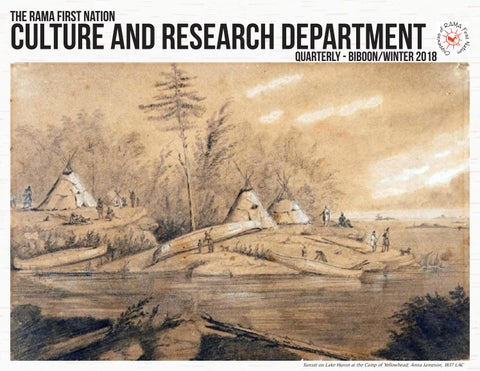
Sunset on Lake Huron at the Camp of Yellowhead; Anna Jameson, 1837 LAC
1
Aaniin Boozhoo
M iigwech for reading the very first RFN Culture Quarterly. Although the Culture and Research Department regularly contributes to the community’s Ojibway Times newsletter, there is so much more we want to share with Rama and the world. Our archives hold countless stories and photographs that need to be read and seen. The history and culture of Rama First Nation is rich and vibrant. As the Culture and Research Department, the role of stewards of this history and culture unofficially falls to us. It is our job to share it with the community. The Culture and Research Department is continually searching for ways in which we can meet our mission: the promotion, preservation, and education of First Nations culture. We hope that this ongoing publication will be another method in which we can achieve this. So, what is the “Culture Quarterly”? Put simply: it’s a publication about the culture and history of Rama. We will have articles on history, language, and stories; photographs; department updates; art features; community member interviews, and guest articles. This is the first issue. Changes might arise in structure and content - we want to hear from you, the reader, as to what those changes should be. All feedback can be sent to benc@ramafirstnation.ca The Culture Quarterly will be printed in limited numbers, and it will be published online for reading from your phone, tablet, or computer. This will be a seasonal booklet, published in February, May, August, and November. Access is free of charge. Once again, miigwech for reading. The next issue comes out in May 2018.
table of contents 2. Department Calendar 3. History 4. Museum 5. Art 7. Langauge Revitalization Strategy 11. From the Archives 12. Story 14. From the Archives 15. Minwaajmo (Tell a Good Story) 20. From the Archives
contact Chippewas of Rama First Nation Culture and Research Department Sherry Lawson, Adminstrator of Heritage Services 705--325--3611 x1212 sherryl@ramafirstnation.ca Vicki Snache, Cultural Liaison 705--325--3611 x1297 vickis@ramafirstnation.ca Ben Cousineau, Researcher/Archivist 705--325--3611 x1288 benc@ramafirstnation.ca
2
Department calendar
Subject to change - contact us to confirm. all are welcome to attend these free events! you can write in events as they are announced as well!
Sunday
Monday
Tuesday
Wednesday
Thursday
Friday
Saturday
february 1
2
3
4
5 craft day at culture
6
7
8
9
10
11
12 craft day at culture
13 wiisinidaa (let’s eat)
14 introduction to
15
16 CHA (Come have anishi-
17
18
19 craft day at culture
20
21
22
23
24
25
26 craft day at culture
27
28
march 1
2
3
4
5 craft day at culture
6
7
8
9
10
11
12 craft day at culture
13
14
15
16 CHA (Come have anishi-
17
18
19 craft day at culture
20
21
22
23
24
25
26 craft day at culture
27 CYA (Cultural young
28 hand drum group with
29
30
31
april 1
2
3
4
5
6
7
8
9
10
11
12
13
14
15
16
17
18
19
20 CHA (Come have anishi-
21
22
23
24
25
26
27
28
29
30
may 1
2
3
4
5 next culture quartlery
dept. 2-4pm dept. 2-4pm dept. 2-4pm dept. 2-4pm
dept. 2-4pm dept. 2-4pm dept. 2-4pm dept. 2-4pm
lunch n’ learn 12-1pm at seniors center boardroom
adult) 330-5 at culture
anishinaabemowin 530-7 pm at culture dept.
lorraine mcrae, 11am at rama library
Ambe Dbaajmotaadidaa Storytelling at Culture dept. 10am-3pm
naabe amusement) 1pm-2pm at rama library
naabe amusement) 1pm-2pm at rama library
naabe amusement) 1pm-2pm at rama library
released
3
History: Fallen Rocks at Geneva Park T he Sumerians (who lived in ancient Mesopotamia, modern-day Iraq) were the first peoples to “write”. This occurred around 3000 BC. Needing to keep track of their grain and livestock but unable to rely on memory, the Sumerians “wrote” on damp clay tablets with a pointed tool. The damp clay eventually hardened, and the written materials were literally solidified in history.
While the Sumerians were the people who began the long process of the evolution of writing, they were not the first people to attempt to preserve information or tell a story in a visual way. Methods to do so have existed since time immemorial. One of those methods was a pictograph (or pictogram). Different from a petroglyph, where pictures are carved into a rock, a pictograph is created by painting symbols and figures onto a rock. Using red or yellow ochre (a naturally occurring clay pigment), the illustrator would tell stories or preserve information by painting symbols and figures onto a rock. Archaeological evidence supporting ochre used in pictographs dates as far back as 75,000 years ago. As ochre is a natural material, chances are much of its earlier evidence of use has eroded. First Nations people are one of many ancient cultures who used ochre to create pictographs. As a storytelling culture, we told stories verbally but sometimes through pictographs too. On September 21, 1923, at the Council House in Rama, a series of interviews were being conducted by the federal government. Aiming to extinguish traditional hunting and harvesting rights through surrender, three Commissioners from the government of Canada were asking Rama men and women about where and when they hunted, how the territory was obtained, and how long the territory had been used for. About 25 Rama people were questioned. When Sampson George was interviewed, a fascinating piece of history emerged. The interviewer, Mr. Sinclair begins to ask Sampson about the hunting limits. Sinclair: Do you know the way these hunting limits were first acquired by the Chippewas? Did you ever hear anything about that? George: Well, I hear a little about it. You know the Mohawks lived here in this country, and the Chippewas lived here too, and these two Nations they live sort of together all through the land but no particular Nation own it. They hunt together, and then they got a little trouble over this and over some marrying, and the other Nation starts to kill the Chippewas. Sometimes they go off to hunt and they never come back, and so the Chippewas took counsel what they will do, and they make big battles, and they won it and they defeat the Mohawks, and that is how we have these lands. Sinclair: Then the Chippewas became the sole possessors of the land and drove the Mohawks off? This is the story of your tribe? George: Yes, there is an inscription, no, a story on a rock here, where a Chippewa stands and the Mohawk is sitting down. That has been wrote over 300 years ago, and the Chippewa stand up and the Mohawk is down and it shows he has been beaten. That
rock has been turned over now, but it is there and ti could be turned back, and that is convincing proof our Nation drove the Mohawks out of here. It is big, it is perhaps 50 ton. That’s the big Falling Rock at Geneva Point. I have seen it. Sinclair: How long is it since the fell over? George: Before the big war with the Germans. I’ll tell you we know that it is to happen, all these Indians who live here, because the old people of the many years ago – the old people who can see both ways – they tell us there is to be a great war, so big that it will be bigger than all the other wars put into one war, and they say that before the war comes, this rock will fall over, and we watch it, and then one day that rock fall upon itself, and then in one-two years this big great war, it comes to pass just like the old people who see both ways said in the long ago. Sinclair: How was the inscription put on the rock? Was it carved? George: No, it was painted, it was red paint – Indian paint, the picture was there. Sinclair: How far is the rock from here? George: About three miles over. It is on the shore of Couchiching, on this side. It is in what they call, “Geneva Park”. The story about the Fallen Rocks is verified several more times, not just by Rama people, but also by people from places such as Scugog. Many stated they had seen the rock prior to its falling over, detailing what it looked like and what it meant. The painting on the rock was a story painted on stone to tell the tale of the Anishinaabeg defeating the Mohawk in war, and winning the territories where we still live today. It was painted in the 1600’s, and remained visible right up until the early 1900’s. Many generations saw the rock, and learned the history of their ancestors from the story that was painted on it. The pictograph is hidden, probably submerged under water and never to be seen again. Today, the Two Rama men on top of the “Fallen Rocks”, 1923 rock simply looks like a giant boulder. But now we know that it contains an important piece of history; it is a special place. It can be found at Geneva Park, by following the aptly named Fallen Rocks Trail.
4
museum Did you know the Culture and Research Department is home to a small museum? We have artefacts as well as works of art which have been donated over the years. In the coming months, we will be picking a new name for the museum - “The Culture and Research Department” doesn’t imply a museum is here. We want to find an Ojibwe word which encapsulates what the museum is for: preserving our history for the next generations. In addition to a museum, the Culture and Research Department also hosts Rama’s community archives. We have thousands of digital photographs. These photographs are the pictorial history of Rama. It is incredible to see how far we have come as a community. Our day-to-day lives sometimes leave little time for reflection, but in looking at these pictures we are reminded of our past. We also have hundreds of hours of video and audio recordings. Importantly, some of our videos are of our ancestors who have since gone on to the spirit world. They tell their story, and with it Rama’s story, often in fluent Ojibwe. Other videos include community gatherings such as the corn roast, LNHL games, powwow footage, and much more. Our audio files are generally Ojibwe-language based and they can be an excellent supplement to those learning Ojibwe. Although we refer to the archives as “our archives”, they’re actually yours. Museums and archives are not the property of the staff, but the communities they serve. We simply maintain them; we are stewards of the history you are welcome to explore. Whether it’s looking for an old photo of your grandparent, researching First Nations history, discovering your family tree, or so much more...we can help. Please send us an email or give us a call anytime or drop by the department during office hours. We’d love to help you learn more about our history and culture!
5
Art: an interview with chief lady bird How does First Nations culture guide your art?
sister Aura, who is also an artist.
My art practice empowers me by empowering other Indigenous people. To quote Lakota hip hop artist Frank Waln: “When I rise, you rise.”
Sometimes people will ask her “How long did this take for you to make?” and she always says “My entire life.”
I think the ways in which “First Nations culture” guides my art practice are very specific. It is important to note that to call our culture the culture of First Nations people perpetuates erasure of the immense diversity of our nations, from the Maliseet to the Haida Gwaii to the Oneida to the Potawatomi. We all come from different landscapes, Different grandmothers, Different languages, Different stories. This is what my artwork celebrates.
Most of our readers know who you are, but for those who don’t, who are you? Ogimaa Kwe Bnes ndizhnikaaz Rama miinwaa Moosedeer Point ndoonjibah Migizii ndodem. I always like to acknowledge that the name Chief Lady Bird was given to me in ceremony by my grandfather Ralph King Sr. (Moosedeer Point First Nation). It has always made sense for me to sign my art with this name because I connect to it more than I connect to my legal “colonial” name. By using my spirit name to sign my work, I acknowledge the importance of spirit, culture, ceremony, family, community and connection. I am an artist. I am 25 years old. I live in Toronto. I create: Illustrations; Street art; Collaborative community murals; Mixed Media paintings; Beadwork; Textilebased works. I facilitate: Youth arts-based workshops with 7th Generation Image Makers and the Native Learning Centre I graduated from: OCAD University in 2015 with a BFA in Drawing and Painting and a minor in Indigenous Visual Culture My parents are Maureen and Ralph King and my brother is Douglas King.
I create artwork as an Anishinaabekwe who grew up in Rama, attended a school off-reserve, visited her family at Moosedeer Point and then moved to Toronto to go to university. I use visual culture as a way to decode my personal experience and further understand my relationship to my homeland while living in an urban space. My work challenges the lens that Indigenous people are often viewed through. It subverts the dominant culture’s frequent fetishization of Indigenous culture by highlighting the diverse experiences that we all come from. I tackle issues of representation, sexuality, language, connection/disconnection, identity, etc. Through these explorations, much of the culture, language, stories, songs and ceremonies that I have learned throughout my life influence the care that I put into my imagery. Specifically, while creating work, the two teachings that I think of are humility and love. Currently I am working on a series that uses “beaded glyphs” as fragments of made-up visual language, referencing wampum belts, syllabics and petroglyphs as a way of understanding the loss of language through colonization. These beaded glyphs convince the viewers that they mean something (or that they should mean something), which creates tension between the work and viewer that ultimately emulates the frustration that many Indigenous people feel when they can’t speak or access their traditional languages.
Rama has a long history of artists, most notably with Arthur Shilling. You are continuing the trend of amazing artists emerging from Rama...how did you get started? Whenever I get asked this question I think about my
I started making art when I was two years old. It just felt right, so I never stopped doing it! When I found out that I could go to post-secondary to pursue the arts, I set my sights on OCADU and spent my teen years preparing a portfolio and studying. When I graduated OCADU, I refused to put my art practice on the back burner in favour of “steady and guaranteed income” because I wanted to build a career as an artist, not build a career around an arts hobby. Being an artist is hella exhausting sometimes because you have to really hustle and line up your projects- but it’s always exciting. I’m not the kind of person who enjoys monotony, so I think I chose the perfect career path.
Did you have any notable teachers or influences along the way? Mike Martell was really cool because he was the one that convinced me to submit my art to my first exhibition when I was 14. He organized and delivered my work. It was a huge stepping stone for me, and I am always expressing gratitude for this first step. Notable influences & inspirations: Ardash Crowfoot, Wendy Redstar, Joshua Mangeshig Pawis Steckley, Skye Paul, Christi Belcourt, Isaac Murdoch, Aura, Weshoyot Alvitre, Alice Baca, Dayna Danger, Adrienne Loon, Tenille Campbell, Quill Christie, J. Chavez, Jaclyn Roessel, Tanaya Winder, Frank Waln, Janet Rogers, Jeneen Frei Njootli, Charlotte Allingham, Conor Pion, Nigit’stil Norbert… to name a few! Our community is full of so many amazing artists. What do you find difficult about being an artist? As an indigenous artist, the emotional labour is intense. Often when making work, especially street art or collaborative community murals, shared trauma is unearthed. We have to work extra hard to reclaim; we have to re-learn how to love, we have to rely on each other for support- even in spaces that are deemed “safe,” and we have to remain passive in the eyes of the government otherwise we are deemed the angry Indians. But we have a right to be angry. We are re-traumatized daily. Our children are growing up in a world of injustice- colonialism is perpetuated through our institutions in the most harmful ways- and we are expected to continually educate and make up for the broken system. I am tired.
6
Art: an interview with chief ladybird What are your goals and aspirations as a professional artist? To not be tired anymore.
Do you have any advice for young and aspiring artists in Rama? To Indigenous youth: our community and your ancestors love you. No matter what you decide to pursue, never forget that you have us to lean on for support. To be an artist, there’s a lot of hustle. You become an entrepreneur and the rest of the world will expect a lot from you. But you have the right to define your career for yourself. But most importantly, I believe that you can succeed. It’s really easy to doubt yourself but if you ask your community for support, we will all be there for you.
Kinship Chief Lady Bird
Traditional Miijim Chief Lady Bird
Trail Chief Lady Bird
Squeak Chief Lady Bird
Check out all of Chief Lady Bird’s work! Online: http://chiefladybirdart.tumblr.com/, Facebook: www.facebook.com/chiefladybirdart Instagram: @chiefladybird
7
Language revitalization strategy In June 2017, Vicki Snache from the Culture and Research Department began the immense task of creating a Language Revitalization Strategy for Rama First Nation. What follows is the strategy. Without immediate efforts to revitalize our language (Ojibwe/Anishinaabemowin), we will lose it forever. Please note that this is a strategy of best or recommended practices only. Not necessarily everything contained within will be implemented, but it is to be used as a guiding document as we move forward with our efforts of langauge revitalization.
Ojibwe language dialects comprise of the second most commonly used Native language in Canada after Cree. Ojibwe or Anishinaabemowin is spoken in southwestern Quebec, Ontario, Manitoba, Saskatchewan, Alberta, Michigan, Wisconsin, Minnesota, North Dakota, Montana, Kansas, and Oklahoma. The language is comprised of several dialects including Algonquin, Eastern Ojibwe, Odawa, Western Ojibwe (Saulteax), Severn Ojibwe (Oji-Cree), Northwestern Ojibwe, and Southwestern Ojibwe (Chippewa). Rama First Nation speakers use Eastern Ojibwe. Our community speakers are known as the “sing talkers” because of the unique ‘sing-song’ way we sound when speaking. Although Anishinaabemowin is spoken over a vast area in the United States and Canada, it is an endangered language. Through the effects of colonialism, including the displacement of First Nations livelihoods and way of life, Residential School systems, the 60’s scoop, disenfranchisement, and Christian Influence, to name a few, government policies throughout history had worked to remove First Nations from their traditional existence to have them absorbed into a Western culture and lifestyle. For over 100 years our ancestors were not allowed to practice their culture. Children were not allowed to speak their first language and were forced to speak English or French. Elder generations, having endured oppression, had generally encouraged their children to only learn English or to speak their first language in secret. Today, although we are now able to speak and learn our language freely, the decimation of our traditional livelihoods throughout history has severely impacted our ability to speak. According to the 2011 Canadian census, the First Nation Population of Canada was 851 560. Only 22.4% of that population reported an ability to have a conversation in their native language. In Rama, the 2011 Census reported out of 870 people, 12.7 % reported an Aboriginal language as a mother tongue. 2.6% speak and Aboriginal language most often at home, and 13.9% have knowledge of an Aboriginal language. In 2005, a “Fluent Ojibwe Speakers” list was made by the Culture and Research Department. It listed 52 known speakers who had variable fluency levels. Myrna Watson, a fluent speaker from Rama, has kept this list and made note every time a speaker has passed in our community. According to this list we have 28 speakers left today, all at various fluency levels. We should take note here, that some people on this list may understand the language, but do not speak it. These people are known
as ‘sleepers’ of the language. They may not speak publicly due to the generational trauma they have suffered from colonialism. Some people on this list may be able to speak, but not teach. Some can speak but not read or write. Some are quite elderly, and although they have the ability to teach, may not be able to due to health reasons. Others too, may not be First Speakers (those who learned Anishinaabemowin as a child) but learned possibly another dialect through post-secondary education. Out of the 29 listed, I count only 4 who I am certain are able to teach the language. Arnold Ingersoll, Emerson Benson, Lorraine McRae, and Myrna Watson. Others on the list may also be able to teach the language but further exploration needs to be done. Most speakers of Anishinaabemowin in our community are seniors. Adults know very little language. Most cannot say more than brief greetings. Children are learning in the public school setting, but are only coming out of the school system having a limited vocabulary of nouns and verbs. Not one becomes a conversational speaker. This is due to a number of factors, namely, parents not speaking at home, lack of resources, lack of curriculum, and the limited time-span of 40 minutes a day, which is not enough to retain a new language. Our community is in a current state where children are no longer using language at home and it is only very few of the grandparental generation who still speak Anishinaabemowin. We are in a make or break time of revitalization. Today, successful revitalization strategies for First Nation languages are emerging worldwide in places such as Minnesota, Manitoulin Island, Hawaii, New Zealand, and British Columbia. Even still, there are whole generations who do not speak their language. It is said that a language dies every 14 days and is replaced with a more dominant language such as English, Mandarin, or Spanish. In the community of Rama, the few remaining speakers are elderly, therefore we only have one generation left to bring back the language. If the creation of Anishinaabemowin speakers is the goal, we are in a race against time to relearn.
What
are the goals of the language strategy?
This strategy is a living document that can be updated and changed. The objectives were considered upon looking at the overall state of the language in Rama First Nation today, taking into account known resources that are available including the community visioning plan, discussions with a few community members, and preliminary research on successful initiatives in other communities. The goals of this strategy include: creation of language speakers who can teach; creation of conversational speakers; waking up the ‘sleepers’ of the language; preservation of dialect; preservation of knowledge including medicinal, place name, last name, legends, songs, stories, and teachings; understanding of ceremonies; and aiding in resolving sociocultural issues (e.g., through empowerment and reclaiming of identity, healing generational trauma)
8 There are challenges and barriers to the strategy, including the fact that Anishinaabemowin is one of the most difficult languages in the world to learn; there are only 4 speakers left in the community who are able to teach; possible apathy toward learning a language that has no ties to economy (it won’t get you a job) and isn’t used by the majority of the population; disputes over dialect; disputes over Fiero and phonetic systems of writing; generational trauma, fears, discomfort, and shame around speaking and learning the language; and finally, inadquate funding from the federal and provincial governments. Compounding the challenges and barriers are the weaknesses we face. There are only 4 speakers in Rama who are able to teach; there are a number of sleepers of the language, adults are not learning the language, daycare-aged children are not learning the language, elementary and high school-aged students are not learning an adequate amount of language; there is a large gap between school-children and parents; the language generally isn’t spoken at home; and it is minimally spoken at work, around the community, or events. However, our strengths can help us overcome these challenges and weaknesses: there are funding opportunities available; leadership is able to update policies that ensure language development happens; and the community has many resources available to begin preservation, community engagement, and revitalization. The opportunities that result from this strategy becoming reality include an increase in the amount of language speakers; maintenance of dialect; the next generations can learn the langauge as well; generational trauma could be healed; identity is strengthened; spiritual practices and cultural knowledge become stronger; pride restored in being Anishinaabe and Indigenous; and our community will build better relationships with surrounding First Nations communities.
Recommendations After identifying the goals, strengths, weaknesses, and opportunities, we are able to provide the recommendations on how to make the strategy a reality. Language restoration can be broken down into three categories: Preservation, Community Engagement, and Revitalization. One or all of these methods may be part of a programming initiative.
Considerations Language Circle: The first step in implementing a successful language strategy is to create a language circle. This group can oversee the strategy and make changes to it as community needs change; meet regularly with community members to discuss language needs; work with a cyclical planning method that includes Evaluation, Planning, and Implementing; create evaluation methods to enhance programming over time; find funding resources as needed; develop best practice methods developed for programming; and research existing programming in other communities Declaration of Anishinaabemowin as official language in Rama First Nation: A declaration of Anishinaabemowin as a first language and English as a second was
declared by the Peoples of the Anishinaabek Nation June 6th 2012. Something similar could be done in Rama First Nation to make a move toward revitalization.
Preservation Preserving the language usually encompasses the preservation of one’s dialect, stories, legends, teachings, and culture through the language. Examples of preservation include audio / video recordings of first speakers, transcriptions and translations of texts, research around place names, last names, and traditional teachings or ceremonies that are exclusively done in the language. This method helps to conserve the unique culture and language of a community, including its dialect, the flow of the language and how it has changed. There are a few ways in which we can preserve the language: audio and video recording of speakers and transcriptions (can be used as community engagement tools by sharing recordings on multimedia platforms); cataloguing archives, resources and documents in the language; and through the research and documentation of language i.e.: place names, last names, ceremony, medicines, teachings, traditions.
Community Engagement Community engagement is a promotional and educational aspect of language regeneration. This type of programming helps reduce apathy toward language learning. The aim is to educate on the reasoning why Anishinaabemowin is important, give opportunities to use and learn language, and motivate people to want to learn. Examples of this can be ‘the phrase of the day’, bringing in language speakers from other communities, having lunch hour language classes, Weekend language camps, and changing community signage, to name a few. Community engagement also deals with education on the current state of the language, the importance of revitalization, healing generational trauma and moving forward. Education around the interconnectivity of the language with the land, history, medicine, cultural practices, spiritual beliefs, worldview and identity also play an integral role. Community engagement provides people with an opportunity to learn about why the language is important and why it is no longer spoken fluently. It builds momentum for revitalization efforts, strengthens relationships within the community and the surrounding First Nation communities. Invite speakers from other communities to speak about their language journey: There are several people in surrounding communities who are trying to bring back the language. It would be helpful for us to hear what challenges and triumphs they have faced. This is part of building relationships with other communities on language goals and educating our own community around language, as well. Invite people from other communities to help conduct ceremonies and or teachings: Some of this is happening already. Examples of this include midewewin teachings, responsibilities of boys and girls, fasting, sweats, creation story teachings, etc. Bringing in people from other communities to assist us in our language goals helps us to gain an understanding on what other people in the Anishinaabek nation are doing. We can all learn from each other.
9
Language revitalization strategy Conduct traditional activities and incorporate the language: Part of learning our language is learning the culture around our language. Both work hand in hand to strengthen our understanding of ourselves as unique people with a distinct culture from Western society. Some activities may include medicine walks, harvesting, making syrup, spearing, making wiigwaams, carving, ash and birch bark making, crafting, beading, lacrosse, cooking traditional foods, regalia making, drum and shaker making etc. All of these programs can include parts of the language. Workshops to conduct traditional activities: Sometimes there are traditional activities that we want to learn, but are no longer practiced by anyone in our community. Bringing people to our community to help us relearn is great for community building and education. Language can be part of these initiatives. Language Conference at Rama: Holding a language conference at Rama to bring about education around the state of the language, share resources, and build relationships will help us to gain a deeper understanding of how to continue our strategy. This type of program promotes the language and motivates people. Trips to other community language events: Seeing and engaging in what surrounding communities are doing with the language helps to build relationships with other communities while simultaneously strengthening our own relationships. We can learn a lot from our neighbors including best practices, dialect differences, and how to overcome challenges. Interview community about language (for TV screens): Asking people on video how they feel about the language and putting it on the TV screens around Rama will help to build momentum for language revitalization. It gives people a voice and lets them know that their opinions matter. Immersion Camp Weekends: Hosting immersion camp weekends is an excellent community engagement strategy. It gives people a comfortable space to learn, speak, and test their skills at any level of fluency. Update Rama Ojibwe Language Dictionary: The work of Irene Snache for the Rama Language Dictionary is an unprecedented valuable asset to not only our community, but other communities and educational institutions. It is unique in that it is the only Dictionary in Rama’s dialect. Updating it to include and Ojibwe-English version will assist language learners. There are other updates that can be incorporated, as well, such as a breakdown of verb conjugations tables and information around sentence structure. These updates will enhance this dictionary for learners of the language.
(Continued)
Revitalization
Revitalization is the action of creating language speakers. Language programs throughout the world have shown that the most successful form of revitalization is through immersion. The least amount of time being immersed in a successful language program has been 10 hours of language immersion a week. Over a period of three years with 10 hours a week, a student can acquire a conversational language base as can be seen in the Master Apprentice programming done in California and British Columbia. Examples include Daycare immersion or ‘language nests’, Public School immersion, Bilingual public schools, Master Apprentice Programming for adults, Immersion Wiigwaams, and three week immersion training programs for intermediate speakers. Ways to Use Revitalization: Research around successful language revitalization strategies; researching what is already working will give us a better understanding as to what might work for Rama First Nation. Trips to some of these programs would be beneficial in our research. Creation of new words as needed: As with any language, new words are created all the time. As the fluency levels of the community increase, so will our need to create words that explain new technologies and other things in our society that we may not have words for. The language group along with other speakers may be of assistance in finding suitable words as they are needed. Education: Adult Master Apprentice Program; Adult Immersion House (8 months bi-weekly); Adult Immersion (3 week summer); Full Immersion Daycare; and Immersion (JKGrade 3) at MKES. Note that these options are not in place nor are they planned to be, but for a fluent community (one day), immersion would most likely need to occur.
Questions About Second Language Learning Is immersion integral to learning another language? The easiest way to learn another language is through immersion. Successful programs that create speakers have a minimum of 10 hours of immersion a week. Unless a person is actively seeking to learn another language on their own and putting in a concerted effort to learn, immersion is the one proven method of creating speakers. Will children who learn in an immersion school be able to develop their English skills at the same rate as other children?
10 Generally in an immersion environment, there is a lag in English performance until grade 3. After this time, children who are in immersion will perform at least as good as and in most cases, better than children who are in an English only school. Learning a second language through immersion actually strengthens the first language. It enhances the complexity of the first language syntax, enhances skills using narrative strategies, vocabulary building, reading and writing in the first language. It also enhances non-linguistic skills in areas of divergent thinking, meta-linguistics, attitudes toward others, and mathematics. Therefore, Immersion programming gives students a positive impact on learning and the opportunity to excel in both English and Anishinaabemowin. If we don’t focus on learning only our dialect, will we lose our dialect? Several dialects are spoken across Italy. In 1861 Italian became a standardized language that was taught in public schools. Today, several dialects still exist in Italy even though only one dialect is taught in schools. In Rama, we have 3 people left who are able to teach the Rama Anishinaabemowin dialect. This means that if we choose to create more speakers, we will inevitably have to bring in teachers who speak other dialects. Although this is the case, preservation and community engagement programming can help to ensure that we do not lose our unique sound.
Best Practices Methods Developed
for
Programming
Best practices methods are a way to gauge and ensure that we are moving in a positive direction. Examples of best practices include: engage and support First Speakers; have First Speakers mentor teachers; have First Speakers at all revitalization programming to benefit the teachers and students; audio / video recordings of programming; consistent evaluation and assessment of programming; consistent meetings for community input; using preservation and community engagement methods whenever possible while implementing revitalization programming.
Successful Revitalization
and
Preservation Examples
Although there is a lot of work to be done, and it is possible. Research these three examples; they are leading the way in langauge revitalization. PRESERVATION: Bemidji State University Oshkaabewis Native Journal – This preservation strategy is a collection of Anishinaabemowin stories that have been made available online with audio recordings and transcriptions. KTEI Immersion School: JK to Grade 4 immersion in Mnidoo Mnising (Manitoulin Island). Starts with full immersion and graduates to 50% immersion as the children move ahead in each grade. By Vicki Snache, 2017. Waadookodaading Language Immersion school: Lac Courte Oreilles, Hayward Wisconsin. Teaches Full immersion from JK to grade three and incorporates traditional culture in their programming.
If you’re interested in learning more or have any questions or comments, please contact the Chippewas of Rama First Nation Culture and Research Department.
11
from the archives: 2001 rama powwow
12
story: How nanabush created the world The following story is from the book, “The Adventures of Nanabush”, a collection of stories told by Rama’s Sam Snake, Alder York, David Simcoe, Annie King, and Elijah Yellowhead. This story and several others were recorded and compiled by Emerson Coatsworth in Rama during the 1930’s. They were published in 1979 by Doubleday Canada Limited.
Iexist. n the beginning, so the Ojibway story tellers say, the world in which we live did not In its place was a far older world, the home of the first birds and animals, and of the mighty magician, Nanabush.
To look at Nanabush, you would have thought him quite an ordinary sort of man. Unless you had seen him performing his deeds of wonder, you would never have imagined that it was he, and he alone, who created the world we see around us today. So powerful a magician was he, that he could turm himself into an animal, an old tree stump, or a maple leaf - simply by wishing it! Now in the old world, which existed long before our world, Nanabush and his young brother lived together by the shore of a lake. For company, the two men talked and played with the birds and animals. They were friendly with them all - all, that is, except the treacherous Serpent People, the evil, giant snakes who lived beneath the water and who tried to kill the kindly animals who were Nanabush’s friends. Nanabush and the Serpent People often fought with each other, and it was because of one of these fights that Nanbush made our world. One winter day, Nanabush’s brother was out hunting alone. When he did not come home in the evening, Nanabush thought that perhaps he had lost his way in the woods. The next day, the young brother still had not returned, and Nanabush became worried. So he set out to try and find him. He had often warned his brother never to return home across the ice which covered the lake, but rather to walk around the shoreline on solid ground. He now began to fear that his brother had forgotten his warning and that he had been pulled through the ice by the Serpent People and drowned in the icy water below. Nanabush searched everywhere, but not a trace of his brother could he find. He knew that the worst must have happened: the Serpent People had drowned his brother as he feared. He set out again, this time to find the Serpent People and punish them. Now the Serpent People were very cunning, and kept themselves well hidden. Nanabush tramped in vain through the woods and across the frozen rivers for days, and weeks, and months. Before he knew it, spring had come. One day, just as he was approaching a steep hill, he heard a peculiar booming sound. “What cant hat be?” he asked himself. “I must climb the hill and find out”. When he reached the top, he saw a little lake in the valley below, and there, sunning themselves on the shore, were two Serpents. The booming noise came from the pounding of their hearts. Quietly but swiftly, Nanabush drew his bow and shot an arrow at each Serpent. Though he hit htem both, they were still very much alive, for they slithered into the water and in the twinkling of an eye and disappeared.
Then a strange thing happened. The water in the little lake began to rise. It rose steadily, soon flooding the whole valley. “Oho!” exclaimed Nanabush. “The Serpents know I am hunting them. They are going to try and drown me.” He climbed the tallest pine tree on the hill, but the water, which by this time had covered the hill, was lapping at his heels. He climbed as quickly as he could, and before long was at the very top of the tree. The water kept on rising and soon reached the level of his chin, but then, strangely, the water began to go down again. It went down as quickly as it had risen, and when it had receded to its old level Nanabush climbed down out of the pine tree. “They nearly drowned me,” said Nanabush, cathcing his breath. “I shall have to be careful, or next time those evil Serpents will certainly kill me.” He then chopped down a number of trees and made a giant raft, which he left on the top of the hill. Wondering what he should do next, he wandered through the woods again. He had walked for nearly an hour when suddenly he stopped. He thought he could hear a woman crying. He crept on cautiously, and came to a clearing where an old woman was sitting on a log and, just as he had imagined, she was crying. “Why are you crying, old woman?” “Ah, a sad thing has happened. That wicked man, Nanabush, has wounded my brothers with his arrows.” Nanabush knew at once that the old woman was a Serpent Woman in disguise. He also realized that she did not know who he was. Smiling to himself, he exclaimed, “That Nanabush must be a rascal! But tell me, what are you going to do?” “I am gathering herbs to heal their wounds,” she replied. “I am also gathering basswood bark. We shall twist the bark into a long string and stretch it around the base of the hill. We shall watch the string and if it vibrates, we shall know Nanabush tripped over it. He is hiding somewhere on the hill.” “Where do the Serpent People live?” he asked next. “All you have to do is follow this path to the lake,” replied the old woman, pointing the way. “When you get to the lake, walk right into it. A short distance in, you will find a door. The Serpent People are inside.” Without saying another word, Nanabush slew the wicked old Serpent Woman and dressed himself in her clothes. He followed the path to the lake and found the door. He opened it and found himself inside a huge lodge - the home of the Serpent People. Walking along quickly, he soon came upon the two Serpents whom he had wounded, with his arrows still in their bodies.
13 The Serpents were guarded by a group of fierce animals, and Nanabush discovered that one of the Serpents he had wounded was the Chief of all the Serpents. However, the fierce animals thought Nanabush was the old woman, and let him pass.
The loon dived intot he water and was gone a long time. Presently, he returned. “I couldn’t reach the old world,” he reported sadly. “It was too far down”. “Beaver!” called out Nanabush, “you are a good diver. You try next.”
In another corner, he saw the body of his brother, who had indeed been drowned by the Serpents. In a flash of anger, Nanabush leaped forward and pushed the arrows deeper into bodies of the two Serpents, killing them instantly. “Now I have avenged my brother’s death!” he shouted. And, before the fierce guardian animals had time to realize what had happened, Nanabush slipped out of the Serpent lodge and raced back to the shore of the lake, running as fast as he could. When the guardian animals realized what had happened, they roared with rage and summoned the rest of the Serpent People, who immediately caused the water to rise again. But Nanabush heard the movement of the water as it began to rise, and he ran toward the hill where he had hidden his giant raft. As he ran he called loudly to his friends, the birds and animals. “Come with me, my friends!” he shouted. “Come to my raft on the hill. The water is rising again, and this time you will drown unless you come with me.” The birds and animals answered his call not a moment too soon. Just as they reached the giant raft and climbed safely aboard, the water rose over the crest of the hill and set the raft afloat. In a few more minutes, the whole world was covered by the surging water. There was not a single thing to be seen on the top of the water except Nanabush and the birds and animals on the raft. Even the highest hills were now lost from sight.
The beaver dived in and was gone much longer than the loon had been, but he too failed to reach the bottom of the vast ocean. “Muskrat!” exclaimed Nanabush, “you must try for us”. The muskrat dived in and was gone for so long that they were certain he had drowned. Just as they were giving him up for lost, he suddenly appeared on the surface, motionless, floating around as if he were indeed dead. Nanabush pulled the muskrat onto the raft and revived him. He noticed that the little animal was holding one paw tightly closed. He pried it open - and there were a few tiny, wet particles of sand. The muskrat had reached the old world after all! Nanabush took the grains of sand and dried them carefully. He fashined them into a tiny globe, on which he breathed lightly. Then he planted the globe gently on the wtaer beside the raft and commanded it to grow. The little ball began to revolve and spin on the water, and soon it started to grow in size. Within a few minutes, it had grown large enough to hold two ants which Nanabush placed on it. The ants made the globe spin faster and grow bigger. In no time at all, it had grown large enough to hold two mice. Thus it was that the little ball grew and grew. At last, when the moose - the largest of all animals - had climbed onto it and disappeared from sight, Nanabush commanded the globe to stop growing. He himself stepped onto it, and said: “Here is the new world - a home for all the birds and animals.” And that, so the Ojibway story tellers say, is how Nanabush created the world in which we live today.
Nanabush and the birds and animals floated around aimlessly on the raft for many days and nights. At first Nanabush thought the water would go down again, but after they had been on the raft a full month he realized the old world was submerged forever beneath the water and that the wicked Serpent People had drowned with it. Nanabush himself would have to find a way to create a new one. “Loon!” he called, when he had decided what he should do. “You are an excellent swimmer. Dive down and bring me a lump of mud in your bill.”
Illustration included in original book, by Francis Kagige, Wikwemikong.
14
from the archives: our ancestors
Left to Right: Former Chief Alder York, Victor York, Abigail York
Dan Fawn (sitting, second from right) and family
Above: George Snache (playing saxophone) and friends; Below - unknown at an event in Rama The Joe Family, Left to Right: Sarah Emeline Joe, Doris Joe (on Sarah’s lap), Sid Joe, Flora Joe (holding her doll), and Frank Joe.
If you know anything about these photos (additional names or information? dates? etc.) please contact the Culture and Research Department.
Left to Right: George, Eva, Marjorie, and William Shilling
Left to Right: Ron Edgar, Jesse Martel, Louie Martell
15
minwaajmo (tell a good story) a loon’s story - shared by mark douglas There are many stories that our people, the Anishinabek, have about the place called Mnjikaning.
Some of the people that are living in the villages of Christian Island, Georgina Island, and Rama are the direct descendants of a large gathering of Anishinabek people that camped at the Mnjikaning site. We were a part of a significant Anishinabek group that gathered throughout this Lake Simcoe region. We remain allied and linked to the greater Anishinabek Nation to this day. Many, many winters ago, when our Nation returned to live at Mnjikaning, each Anishinabek clan (family) would take the time to share with the whole community their stories of our history. This opportunity was taken during the winter time when all seven clans would gather for winter ceremonies. While seated in the lodge, each clan would rise in turn to tell their story, sharing its perspective of what happened during our long migration journey and how we found ourselves at the place called Mnjikaning for the second time. Each clan would tell the stories which emphasized the role that each of their clan members played in building the community of Mnjikaning. These many stories were weaved together or blended in such a way, that a holistic understanding of who we are was gained. More recently, some of the remaining few Anishinabek that were still camped at the Mnjikaning site moved to the settlement located in Rama township in 1836. They build the new community with a fresh perspective in mind and over the ensuing years they continued to modify their lifestyle significantly. The move from the Narrows to Rama signaled a new direction that our people would take. Our new guardians had placed tremendous pressure on our people to be more productive and to work harder to become more successful. The records of that time are available in the various archives and contain references to the fact that the Anishinabek preferred to spend time being together and talking about the old ways and they showed little interest in farming. The guardians instituted many new standards that were based on a strong work ethic and the records reference that productivity levels suffered significantly due to an idle character flaw in our nature. We were labelled as being “too lazy” to become good farmers. The ministers from the various faiths, the teachers, and the Indian agents had a clear mandate to instruct our people to become “civilized” and to encourage us to change our way of life to be more like them. They made rules that governed our behaviour and one of those rules prevented our people from attending any gatherings whatsoever, unless these gatherings were properly supervised. Sanctioned assemblies included religious instruction on the merits of Christian behaviour, school instruction, farming technology, and meetings dealing specifically with government matters. The Royal Mounted Police patrols enforced these strict laws. The people from Rama have always worked hard. They were determined to dispel the misunderstanding that we were lazy. In retrospect, it seems as though we lost the concept of “sharing time” as an important ingredient to a good way of life by taking on all of these new responsibilities. The clans were not allowed to gather. The Royal Mounted Police were diligent with their duties and several raids were conducted to break up unsanctioned gatherings. Without having that gathering time to share the stories which contained the collective knowledge of our Anishinabek history, they say our elders slowly went to sleep with the knowledge. With each succeeding generation, the traditional collective knowledge began to lose its relevance. The laws granting us Canadian citizenship with the right to assemble changed in the 1960’s. There was a tremendous re-awakening of interest in knowing our native heritage. We began to search for the missing pieces. We spent time with our community elders and they told us to forget about the old ways. We began searching harder to find the knowledge of our Anishinabek
history and culture. Many young Anishinabek individuals from Rama journeyed afar to remote regions of the greater Anishinabek Nation territory to meet with other Anishinabek people. We asked them to take pity on us. We begged them for their help to learn more about the traditional culture and real history of our people. We invited various elders to come home to our community and meet the rest of the young people. We were most fortunate and forever grateful for the help from one elder, who has since passed on to his next life, Fred Wheatley of the Wauksauksing First Nation. Uncle Fred made many trips at his own expense to share his traditional knowledge with us. He told us that our native culture and traditions were kept from us because of the tremendous pressure that was put on our forefathers to learn new ways and forget the old ones. He told us that one of the prophesies from ancient times had forewarned that the Anishinabek people would forget who we were and where we came from. The prediction continued with a warning that the Anishinabek people would become disoriented and that we would lose our way. Times of great despair would follow. In the neck of time, the old ones would wake up and begin to talk the language once again. We would re-discover the important bundles that were left along the trail by retracing our steps. The Wauksauksing elder told us that the people from Rama were always known as the people from Mnjikaning. He told us that the literal translation of that word was “fish fence farmer”. Many of us felt terrible that we were given such an unflattering name. Our adopted Uncle Fred explained that we did not name ourselves. That our neighbours chose that name, and that there was much more that we would have to learn to accept that word –Mnjikaning- into everyday usage. He told us that we would have to search hard to comprehend and respect this name that we were given. He told us that most of the families from Rama will have gone to sleep and will have forgotten their stories. He warned us that many of our people living in Rama today would be sensitive and in fact would resent that one word because we chose to leave many things behind on the trail to our new village. Uncle Fred reminded us that we would have to be patient with the community members and that the community membership would eventually grow to understand that beautiful word… Mnjikaning. He told us that our community would eventually be ready and that other traditional native people would come to our community and share their stories about how we were given our name. Fred took a few of us to meet an old man who lived in the Rocky Mountains. The old man, Peter, could remember all the stories and that allowed him to trace his ancestry back five generations to Sault Ste. Marie. Uncle Peter spoke broken English and with Uncle Fred’s help, a few of us were privileged to hear and learn many things. Uncle Peter told us that it would take time to double understand that there are many native concepts and to understand that the western world could not figure our people out when we first met. With the arrival of the new people and their culture, many things that the native people had went underground. The newcomers were not ready to understand the Gifts that the Creator had given our people. Uncle Peter spent a lot of time explaining one concept of collective knowledge that is shared using a traditional storytelling methodology of the seven clans of the Ojibway Nation. This is a very powerful process or tool that is patterned in such a way to help the people talk together. He told us that the new people called our idea “consensus” but that they did not really understand our traditional process to arrive at consensus. Our Uncles were adamant that using the old ways can help us find solutions for today’s problems.
16 They stressed that we would have to work hard and at the same time be gentle with our older people. We would have to shake the old ones awake, to ask them to share the bits of information that they can remember. They told us that almost every family living in our community and in the surrounding communities would be the keepers of significant pieces of information. They warned us that these parts of the story would be hard to gather up because each family had been told, many generations ago, that they were to be kept a secret. They encouraged us to gain the trust of the old people. They told us to help the old ones with their tasks and eventually our own elders would begin to share their stories with us. We would have to gather these small parts up and take time to put the stories back together again. Only in this way would we learn the truth about our origins and our traditions. We were encouraged to find a way to work together to understand our traditions and history. Great conflicts and despair were two signs that we were to watch for. These would give us an indication that we were no longer on the good road of life. We were told that when these signs appeared, we would have to smudge ourselves with the four sacred medicines that the Creator gave directly to our nation and that we would have to begin again more slowly, looking very hard to see the faint signs of the old trail of life. If we lost sight of the good road, we would have to retrace our steps back to a time when more positive things were happening. Using that time as a reference point, or bench mark, we would have to look back at the past and line up those good points with this day. Then by looking forward, we would be able to re-sight a new bearing towards our future. This would enable us to find a clear direction towards the good life that the Creator meant for us to have. They shared many other things with us. Uncle Fred helped our community kick-start the rebuilding of our traditional language. Uncle Peter helped us to understand that we have to take time for our ceremonies. These things have helped us to become proud of who we are. It has taken many winters to collect some of these small bits of information that each family holds. The pressure to forget this “stuff” was much greater than we could imagine and some families are still reluctant to share the little bit that they know. From the few bits that we have collected, we can see that there is indeed a pattern. Elder Fred encouraged us not to lose hope. These small pieces, woven together, form a complex puzzle. We would have a beautiful picture in the end. An example of one small piece of seemingly trivial information and how it contributes with the other families’ information is shared: “When I was about eight winters old I went on a boat with my dad and his friend, Ranson Ingersoll, who worked as a licensed Indian fishing guide for the Harris Boat Livery at Atherley. From the boat we could see some cedar posts that were under the water. Ivan and Ranson spoke in their language and I was only able to grasp small pieces of what they were talking about. We were out to the north of the bridge on Lake Gojionjing. They had a smoke and put some tobacco on a lily pad. They let me have a puff. Ranson pointed to the share and told my dad where his parents had their place at one time. He told of how they would stay there during the summer to fish. Ranson and Ivan talked for a long time about this placed called Mnjikaning – “the narrows” – and the cedar posts in the water. These cedar posts formed a fish fence, or weir. Ranson said the weirs were special. In fact, the whole area was a very special place for our people. They also talked about the shoganosh people living there now and the fact that they didn’t want us to live around there with them. This is one of the reasons that we moved to Rama.” That outing was so insignificant that I had almost forgotten what my dad and Ranson were talking about. It has been hard shaking awake each family and asking them to remember their small stories. My own grandmother, for instance, would tell us many stories during the winter evenings when we were small. In fact, it would take several days to tell one small story.
I enjoyed those times as a youth. As I grew older, I forgot most of those stories. When I finally woke up in the late 1960’s and asked her to repeat her stories so that I could write them down, she would not tell me one story. She was most adamant that these stories would hold us back. She stressed that we should go to school and get a good education and a good job and never mind about the old ways and old stories. I could not convince her that I really needed to know these important stories in order to know who I was. I worked hard helping her with all the jobs she had for me. I was gentle. I waited patiently. It took a long time to rebuild a new relationship. I waited to hear her stories. I did the things she asked me to do. I went to school. I found a good job. I got involved with the community. But, the pangs of hunger remained. This hunger to know and understand the Anishinabek teachings grew and grew. Uncle Peter and Uncle Fred and many other new Uncles and Aunties that I met convinced me that our community in Rama needed to regain a reference point to help fix some of the complex problems that existed. The love for my community and the beauty of my people was too great a force. I know in my heart I respected my grandmother’s counsel, but I felt that I was missing something. With apology to my grandmother, Gaawikaajigankwe, “fancy basket maker”, I will begin by sharing the framework of the traditional teachings and add some of the small bits of our community’s history. Much more work has to be done to add the additional information that the other families have held on to. We need to find time to spend together to hear everyone’s story. We must find a way to make this story “our story”. I am ready to share the parts of the story that my family has learned to date. There are many elders and Uncles that have helped us to understand the following story. They shared. We are most grateful for their teachings. The following is one version of the story of the place called Mnjikaning, a camp that was near the Narrows at Atherley, which is between Lake Simcoe and Lake Couchiching, and the fish fence that is located there.
Boozhoo. Biidaanakwad ndishnikaas. Mnjikaning ndoojibaw. Maang dodem.
M
any, many winters ago, the Anishinabek Nation lived to the south of the great ice cover. Our legends told us that we came from an island that was completely surrounded by salt water. That island was shaped like a turtle. The visionaries of our nation foresaw a time of trouble. Prophecies told of a new people coming ashore and upon that meeting these newcomers, we would forget who we were. The Anishinabek would become lost and confused and we would almost perish. The people got ready and as the ice began to recede, they began a long migration to find a new place. The prophets also told us that we would know when we reached our new home and the special place that Creator had set aside for us by a sign. We would find food growing on top of the water. The journey was to be a very long and hard one. We would become sick along the way and we would find special food that would help us heal ourselves. We would find many new things that would help us deal with the many obstacles that we would face along this journey on the sweet grass trail to the good life. Our storytellers say we moved north slowly alongside of the great ocean. We travelled up the great river (St. Lawrence). The Anishinabek people stopped seven times at places along this trail where we sensed that the “Great Spirit” had created as special and significant places. The Great Mystery would be present at each of the seven places where we camped for extended periods of time. Our people would travel throughout each of these new regions looking for the place where the special food grew on top of the water.
17 It is said that they discovered seven smaller places of mystery that surrounded each of their seven stops. They also met many new people. It is not entirely clear but one of the seven stops was most likely at the Great Falls (Niagara Falls). The Petroglyphs which is to the north of Peterborough has many symbols of our migration including an arrow pointing directly to the Great Falls. As our people journeyed outward from the Great Falls, we discovered the Wendat Nation fishing at the narrows. We spent considerable time with the Wendat learning and sharing new things. We were familiar with the concept of a fish fence and we saw that the Wendat had developed a very efficient system. We stayed long enough to gain the Wendat’s trust and we were given gifts symbolizing our new relationship that reflected an alliance of friendship that would last forever. The fact that food was so plentiful at this location and that the food was brought to the surface of the water caused great excitement amongst the Anishinabek. Many trips were taken by most of our people and in time we became brothers to the Wendat. Several winters passed by. The Anishinabek decided that we should continue to move westward seeking the place where the food grew on top of the water. We probably camped at Detroit, Chicago, and finally while living near Duluth we discovered the wild rice growing on top of the water. The prophecies were fulfilled. The Anishinabek Nation flourished. As the numbers of our descendants grew we gradually spread out from Madeline Island. We continued in a clockwise direction around the Great Lakes, harvesting the special food that was provided for our people by the Great Mystery. Food was plentiful. Life was good. Eventually, after many winters, we journeyed south where we met the descendants of the Wendat Nation. It took more time, but eventually we brought forth the gifts that we were once given by their ancestors. They recognized the gifts symbolizing the importance of our friendship and the fact that we were long lost brothers to the Wendat. We fought alongside of the Wendat when they went to war fighting their cousins from the south over the right to live in this location. The Iroquois were facing tremendous pressure from the new race that had come ashore from the East. The Iroquois were trying to find a new territory where they could move to in order to live without molestation and interference. They had waited too long to move. They tried to move to the North too quickly and without adequate consultation with the Wendat. The consequence was they met with ferocious opposition from their cousins, the Wendat and their old allies and brothers, the Anishinabek. We put on the war paint. This war lasted for some time and many battles were fought. Some of these occurred locally. Eventually, the Iroquois were pushed back and told to stay home. They were hurting pretty bad and they had no choice but to move into Christian settlements that were being established in New York State to help them out. They were encouraged to settle down and concentrate on learning the new Christian way. They eventually apologized to our nation and together we made a wampum belt that still exists to this day that symbolizes that our two nations had a major problem, and that we agreed to lay down our tomahawks, and that we would make every effort to live in harmony. Many of our brothers, the Wendat, were lost and hurt badly. The few that were left were either adopted by the Marten clan of the Anishinabek Nation, or moved east to Quebec. The Anishinabek people assumed the operation of the fish fence. Food was of abundance and our culture flourished. The Anishinabek people and the French people that travelled throughout this region got along very nicely. We adopted some of them into our Marten clan. They brought new ideas and were hungry to live like we did. They really enjoyed some of our ceremonies. They could sure eat fish. They loved to sing and dance and tell stories. Eventually, some British representatives that were living to the south of our area came up to meet with us. They sent many teams, time and time again, to meet with our leadership and
they brought many small gifts with them. They told us that they were not mad at the few French that were now living with us, but that back home over the great ocean their two countries were at war with each other. They told us that a war was going to take place in New France between their two nations. They begged us to stay home until they could resolve their differences once and for all. They told us that it would be a good clean fight and that they would do battle both here on this Turtle Island and back home over the ocean. They promised us many things in the future that they would give to us if we did not help our brothers the French. Our nation eventually agreed not to take sides. We figured that these two small groups could settle their own problems. We went down to watch their fair fight. They sure used a lot of big weapons. After their big fight on the Plains of Abraham they sat down together to make a peace treaty. Our nation was present and we have a wampum belt that was made during this ceremony. It has three persons standing beside each other. The Indian is in the middle holding one hand with the British and one hand with the French. This belt describes how the French, the British, and the Indian Nations would live in harmony side by each. Each of the three nations would make their own rules or laws. They each would keep their own religions, languages, their own systems of government, and their own institutions as needed. They would not make anything or do anything that would interfere with each other. They would travel on three separate paths or in three separate canoes. They would go into the future as brothers. Each would move ahead in harmony, side by each, and if necessary, lend a hand to help if asked. They would go into the future as equals, no one ahead and no one behind. They especially liked the new phrase that they made: three “distinct” nations. They had a real good party after that peace treaty. We were not home for a very long time when we were called by the greater Anishinabek Nation to go to Toronto. We met with the British. They were asking for our permission to live here. As there were only a few of them, and because there was plenty of space, we agreed. By Treaty we gave them the permission that they needed which allowed them to live there. The British were so grateful that they made many more promises to share their good life with us. It seemed like we had just arrived home when the British came to our community and begged us to help them with another big problem. It seems as though they had left some of their cousins and brothers back down south when they came up this way and that some of their southern brothers were not brothers anymore. They said something else about how their former brothers didn’t want to have a king anymore, so they were no longer related. In any case, these southern people were getting uppity and demanding ownership and control of all the resources that the Creator had provided. They even wanted the land that we had given to the British in Toronto and eventually they would want the land we were living on as well. Of course, the British in their usual manner, made us many more promises – more than all the other promises-
if we could just see our way clear to help them out with their new problem.
Our nation put on the war paint again. We pushed their brothers and their cousins so far south that they almost fell off Turtle Island. We went to their peace treaty meeting and they invented two new concepts, something about a line along the 49th parallel and a line through the middle of the waters of the big lakes.Even though many of us were venturing far from home for extended periods, our home community at the narrows continued to flourish.
18 The principal Chief, Musquakie, was of the Reindeer (hoof) clan. People came from great distances to spend time at this good place. They would help fix the fish fence. They came with their wounds and soreness looking for the healing powers of our medicine people. They came with their bad feelings looking for the good therapy. Ceremonies were held often. More and more people came to spend some time at this good clean place. Lots of food. Lots of good talk about the future. It was a nice safe place to spend some time. People came from further away just to stay awhile. In no time at all we became known as the Mnjikaning Nation. The credibility of our name as the Mnjikaning Nation was very high. We were the best warriors, the best healers, with the most fish, wild rice, and medicine. We were kept very busy helping everybody that came to visit. We were aware of the ancient traditional teachings that foretold of the time as the seventh fire. This would be a time when the Anishinabek would almost lose their way of life. We had done battle with the Sioux, the Iroquois, and the Americans. We were banged up pretty good during these conflicts. Surely these were the terrible times we would barely endure. Now life was good again. The teachings of the eighth fire tells of a beautiful time – the good life. Our elders spent a lot of time talking about the bad times that we barely endured. They held many good talks about security that we were feeling and whether we were living a false life. Governance of Mnjikaning was based on an established protocol. Visitors were expected to help with all the chores. They helped maintain the fence by hauling fresh logs and helped with the pounding to set them into the fish trap pattern. They helped with the harvesting of the fish. They helped with the cleaning and preparation of the fish: dried, smoked, baked, or stewed. Wild rice, venison, potatoes, corn, beans, and squash complemented the diet that kept everyone healthy. It’s hard to say, at this time, what the significance of Mnjikaning is to our people. Many people have tried to describe the good life that we experienced. Perhaps this short story from one of the elders at Chimnissing (Christian Island) says it best. The elder said that when she was very young, she was very curious about many things about the Anishinabek people. One time, she was speaking with her grandfather and she asked him why the people of Mnjikaning (Rama) were so different from the people at Chimnissing since we were all one people at one time. She could see Rama’s language was more sing-song and that we had many more types of crafts and that we seemed to be more creative with what we had. The elder’s grandfather told her that the people from Rama were special, and that it was because that at one time they lived at the narrows and took care of the fish fence there. Their language eventually took on the rhythm of the water as it flowed between the two lakes. When our people split up, those who remained at Mnjikaning were given the lifetime responsibility of caring for the fence and to keep the Spirit of Mnjikaning alive forever. This is how we got our name Gikganingoninnewak – the keepers of the Spirit of the Fish Fence. Life was good at the narrows. Lots of people moving in and out of our community. We hardly noticed the few Methodists that came to stay in our village. They had great ideas about us learning to be more than plain harvesters. They had great ideas about spirituality and they began to express concerns that we were being held back because we had not converted to their brand of Christianity. They also felt that we were spending too much time collecting the food and resources to keep our village going. They talked on and on about their type of life where food was grown on a farm and the harvest was easy. They suggested that we should be more like them. They seemed like nice people.
It was not too much later when the British government official speaking for his King re-appeared. The Methodists told him that the Anishinabek wanted to become farmers. The British government thought this was a great idea. They supported the concept and they designed a concept that would prove to their countrymen back home that we were as good as they were. We began to develop a farm which stretched from the narrows to Coldwater (later called the Coldwater Experiment). The British gave us a few of the gifts that they had promised to bring earlier; time and time again they had promised these gifts. These gifts helped us clear a road for their wagons. We cleared the land for farming. We worked real hard. We went to school to learn about farming. We also built a grist mill and we shared the small gifts that they gave us with each other. The gifts were called farm tools. We passed them back and forth and all around. We had one team of oxen that we shared to plough the fields and pull all the stumps out. We were kept very busy. The British kept dropping by and asking if it was okay to have more land for their relations from over the ocean. They wanted to live near us. They promised us new technology, schools, and hard currency to buy their fancy things from their trading posts if we would share more and more land with them. Some of our people built new homes in their town of Orillia. We went to their churches on Sundays to socialize and make new friends. Life was hard. Sundays were beautiful. There was a lot of work to do. Work six days and rest one. The first trading post opened up in the region. It was located right beside our community at the narrows. The character of the Mnjikaning and the Spirit of this special place began to suffer. The Spirit of Mnjikaning was similar to the concept of any embassy and of any place of higher learning. People could come there with their problems and they would find new ways to solve them. It was said that our worst enemies could come and spend time with us. They were not molested while they were there. Our ceremonies helped us to understand the differences and helped us find new approaches to solve our difficulties. The “yes” group could sit with the “no” group and find the “maybes”. The trading post became established and new people would drop in for a short visit. They were always in a hurry to get home. For the next several moons people would drop by, but hardly ever spend time with us. They could not help the fish fence. Everybody was too busy. The commitment to keep the fish fence alive and working began to wane. Liquor became more available from the trading post next door. Mnjikaning shifted its emphasis and became a detox center. Lots of new sicknesses began to show up and our medicine people were kept busy. The medicines were not readily available as they used to be. Cleared land with fences and warnings to keep out did not help the new problems. Too many Anishinabek people got so very sick and died before the medicines and ceremonies could be made ready. There were not enough people to help deal with all the problems. More and more people kept moving into the region. Too many strangers, and nobody taking the time to get to know one another. The elders warned us that the worst was yet to come. Things changed rapidly. The church in town decided that we would be better off with our own church. Over fifty people signed a petition to their government. The British people stated that the Coldwater farm was not doing that well and that they should be allowed to run it properly. We had built them a road to use. We let them use our gristmill, which we built. We had cleared the land which they now wanted. They didn’t want us camping in their town. They didn’t want us in their school. They didn’t want us in their church. They didn’t want us in their lives. These new people were making more and more rules every day and we seemed to always be on the wrong side of these rules. We said a lot of prayers for them.
19 The British government came and suggested that we move our village to the east shore of Lake Couchiching in Rama Township. We were feeling pretty low. In retrospect, all the things that we had done seemed so insignificant at this point. Every time they had asked us to help them with just one more problem, we gave our help willingly. We all went to help with their two World Wars and the Korean conflict. That part of our spirit is still very much alive. Nonetheless, we lost a part of our spirit when we moved up the road to Rama. The prophecies of the seventh fire began. You can fill in many sad parts of this story for yourself. These new people were making more and more rules every day and we seemed to always be on the wrong side of these rules. We said a lot of prayers for them. The British government came and suggested that we move our village to the east shore of Lake Couchiching in Rama Township. The last of our people, the Ingersoll’s and the David’s, were seen as squatters on the land of Mnjikaning near the narrows. They were pressured to move to Rama in the mid-1950’s. Luckily, it was okay for Ranson Ingersoll and Hubert Sawyer to work as licensed fishing guides for the man at the narrows. Ranson, Hubert, and some of the other men kept our people linked to the fish fence. Their retirement marked the end of being the stewards and guardians of the Spirit of Mnjikaning. The Anishinabek Nation don’t gather at the narrows anymore. We find it difficult to participate in any gatherings. Traditional ceremonies are laughed at by some members of our own community and not supported by some of our neighbours. A few of them have given generously. Feasts are still okay. Hardly anyone understands the importance of fasting and the need for our traditional ceremonies. It was foretold that we would enter a time of chaos with lots of unkindness and major misunderstandings would arise amongst the membership. There was a prediction that came true: “The Eagle would fly by early in the morning, and would barely see any Anishinabek offering their medicines to the sacred fire down below.” The narrows was placed here by the Creator as a special place. It has always been a clean place to be together. If we spend our time together, we can learn from one another. It was meant to help the seven clans of our nation be together and to help each other. Our nation is now on the road to recovery by re-discovery. We have discovered that we have never really lost our kindness. We still have gifts to share with the whole world. We have ancient teambuilding methodologies and old problem-solving techniques that still work and one can add the new approaches that the Western world use to enhance these methods to help solve the problems that the whole world is facing today. We put our gifts away once.
Miigwech to Mark Douglas for sharing this beautiful story.
The Ontario Heritage Plaque found near the Mnjikaning Fish Fence. You can visit this site anytime. Although you cannot see the fish fence from above water, the place of the fish fence - Mnjikaning - is a special place. We sometimes meet there and hold ceremony, just as our ancestors did for millennia. See the map below to find out how to get to the site.
from the archives: early rama
Clockwise from top left: Rama Road; Rama Community Hall; Rama Bandstand (with jail underneath); Rama Community Hall with Bandstand in background; Aerial shot of Rama. All photos taken between 1910-1950.
20
21
Miigwech for reading Comments or questions can be emailed to benc@ramafirstnation.ca or call 705-330-8003 Next issue is out may 2018 baa maa pii