The Rama First Nation
CULTURE AND RESEARCH DEPARTMENt quarterly - fall 2018
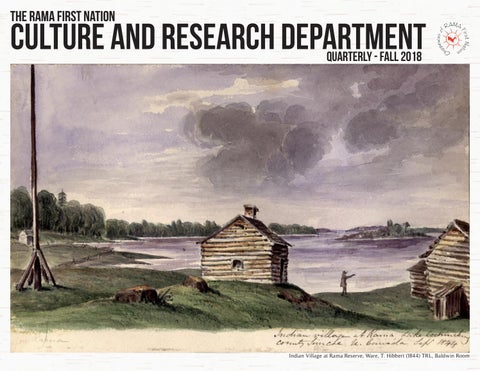
Indian Village at Rama Reserve, Ware, T. Hibbert (1844) TRL, Baldwin Room
1
Aaniin Boozhoo
M iigwech for reading the second Rama First Nation Culture Quarterly. Although the Culture and Research Department regularly contributes to the community’s Ojibway Times newsletter, there is so much more we want to share with Rama and the world. Our archives hold countless stories and photographs that need to be read and seen. The history and culture of Rama First Nation is rich and vibrant. As the Culture and Research Department, the role of stewards of this history and culture unofficially falls to us. It is our job to share it with the community. The Culture and Research Department is continually searching for ways in which we can meet our mission: the promotion, preservation, and education of First Nations culture. We hope that this ongoing publication will be another method in which we can achieve this. So, what is the “Culture Quarterly”? Put simply: it’s a publication about the culture and history of Rama. We will have articles on history, language, and stories; photographs; department updates; art features; community member interviews, and guest articles. This is the first issue. Changes might arise in structure and content - we want to hear from you, the reader, as to what those changes should be. All feedback can be sent to benc@ramafirstnation.ca The Culture Quarterly will be printed in limited numbers, and it will be published online for reading from your phone, tablet, or computer. Once again, miigwech for reading. The next issue comes out in February 2019. Baa Maa Pii.
table of contents 2. Museum 3. Veterans 4. Museum 5. Language 6. From the Archives 7. Chippewas Family Hunting Territories 9. Story 11. From the Archives 12. Minwaajmo (Tell a Good Story) 20. From the Archives
kAWAABMIN mIINWAA, sherry! Sherry Lawson, the Administrator of Heritage Services has officially retired. Sherry spent the past several years with the Culture and Research Department, and we will certainly miss her. We wish her all the best as she enjoys retirement, travelling and spending more time at her place in Florida. Chi Miigwech, and kawaabmin miinwaa (see you again), Sherry.
2
museum museum? We have artefacts as well as works of art which have been donated over the years.
in fluent Ojibwe. Other videos include community gatherings, LNHL games, powwow footage, and much more. Our audio files are generally Ojibwe-language based and they can be an excellent supplement to those learning Ojibwe.
In addition to a museum, the Culture and Research Department also hosts Rama’s community archives. We have thousands of digital photographs. These photographs are the pictorial history of Rama. It is incredible to see how far we have come as a community. Our day-to-day lives sometimes leave little time for reflection, but in looking at these pictures we are reminded of our past. An exciting update since the last Culture Quarterly: our archives are now available online! Some of our collection can be viewed at: https://ramafirstnation.pastperfectonline.com. We will continue to update the archives, migrating more and more of our collection online.
Although we refer to the archives as “our archives”, they’re actually yours. Museums and archives are not the property of the staff, but the communities they serve. We simply maintain them; we are stewards of the history you are welcome to explore. Whether it’s looking for an old photo of your grandparent, researching First Nations history, discovering your family tree, or so much more...we can help. Please send us an email or give us a call anytime or drop by the department during office hours. We’d love to help you learn more about our history and culture!
Did you know the Culture and Research Department is home to a small
We also have hundreds of hours of video and audio recordings. Importantly, some of our videos are of our ancestors who have since gone on to the spirit world. They tell their story, and with it Rama’s story, often
Finally, we’re always looking to build our collection of photographs, artefacts, and artwork. If you have anything you’re looking to lend or donate, we would be very grateful to hold it and share it with the community for you. Chi Miigwech.
3
veterans Our community has had over 100 men and women serve alongside Canadian and allied troops over the past 200 years. Rama and other First Nation soldiers have contributed immensely to the war efforts; without them, Canada would likely be a very different country today. The War of 1812 During the War of 1812, the British, joined by the legendary Shawnee warrior Tecumseh and as many as 10,000 First Nations warriors, were at war with America. Many of the major battles occurred in the northeastern United States and southern Ontario. The Battle of Fort York, which occurred in April 1813, featured men from Rama. Chief William Yellowhead and as many as 50 men from Rama met at the Atherley Narrows. Together, they ran to York (now Toronto) to defend Fort York with the British. Ultimately, the Americans won the battle. However, First Nations warriors’ contributions to the war were invaluable and proved to be a decisive factor in determining the future of Canada and the USA. Chief Yellowhead and his men answered the call for help from their allies, and men from Rama First Nation would continue to do so over the next two centuries. 1914 - 1918: World War I Headed by Prime Minister Robert Borden, the Canadian government didn’t expect so many First Nations people to volunteer for service. The federal government had initially planned to discourage First Nations people from applying, due to the fact that stereotypes and racism were still rampant. The “savage” stereotype accompanied many peoples’ thoughts of First Nations people, and as a result, the Government was Howard Peter and Ernest Joe WWI hesitant to have these men represent Canada abroad. Soldiers were meant to be However, an urgent need for more troops as well as an overwhelming amount of applications from First Nations people quickly changed this way of thinking. Most of these First Nations volunteers (conscription didn’t initially apply to “Status Indians”) wound up serving with the Canadian Expeditionary Force (CEF), excelling and impressing their brothers-in-arms. Although the government’s attitude towards the First Nations soldiers before and after the war was disgraceful, the attitude of the many of the men whom the First Nations soldiers served
alongside with was admirable. They learned that First Nations soldiers were some of the bravest and proudest warriors there was. The trenches were no place for racial prejudice. An estimated 4,000 First Nations men volunteered for World War I, including over 40 from Rama First Nation. 1939 - 1945 World War II Two decades after the end of World War I, which was referred to as “the war to end all wars”, the world saw an even more devastating six years of warfare. The United Kingdom and France declared war on Germany after the German invasion of Poland. Canada, as a Dominion of the United Kingdom, was summoned to join the British at war.
Sandford Stinson, WWII (Killed in Action)
First Nations men (and women) again answered the call. Many wonder why so many First Nations peoples volunteered to protect a country which had taken so much from them. After all, only two hundred years before the beginning of World War II, European settlers and eventually Canadians systematically eroded First Nations culture, broke up families and ensured decades of sociological problems for First Nations peoples. Barney, Owen and Jim St. Germaine. WWI
The desire to serve Canada in war generally arose from three causes. Firstly, a major factor in the desire to serve was honour. Many men listened to stories told by their family and community members about warrior ancestors: those who fought in intertribal wars, the War of 1812, and World War 1. To be a warrior is a position of honour and respect in all cultures; many surely coveted this honourable title. Secondly, First Nations men felt they had to honour treaties their ancestors had signed; treaties in which First Nations promised to answer the call from “the Crown” when help was needed. Finally, economic hardship encouraged enlistment, because men were paid a small daily fee as a member of the military. For some young men (native and non-native), the prospect of earning a bit of money and seeing different parts of the world was enough to enlist.
4
veterans The Second World War devastated thousands of Canadian families. First Nations families suffered the same effects -loss, substance abuse, mental struggles- as well as a host of other sociological issues perpetuated by a paternalistic Federal government. Post-War Struggles First Nations people returned home, victorious and revelling in the idea of finally being home in Canada. The effects soon wore off. Veterans Affairs ignored First Nations families after the wars, preventing them from taking part in post-war programs and receiving veterans benefits. Veterans Affairs repeatedly passed concerns on to the Department of Indian Affairs, who were indifferent to the fact that many men had Monty Marsden, WWII valiantly sacrificed so much overseas. The veterans who resided on reserve continued to be considered “wards� of the Department of Indian Affairs, and as such were at the behest of the Indian Agent in charge of their respective reserve. This model prevented many First Nations veterans from ever receiving the benefits and respect their non-First Nations counterparts received for their same service overseas. In addition to the lack of access to veterans benefits, First Nations veterans generally struggled with re-establishing themselves into Canadian society. The equality and respect they found on the battlefields alongside their allies disappeared when they returned home. Upon returning back to Canada, it became clear that their service was not appreciated, and the First Nations veterans were reduced to being mere wards of the Crown. It was not until the late 20th century that First Nations veterans finally began to receive the commendations they so richly deserved. Finally, tales of what First Nations veterans did throughout the various wars became heard. The contributions from First Nations veterans such as sniper Francis Pegahmagabow are now known. Canadian citizens at last began to understand just how much native veterans gave up in order to serve in the military. Today, we honour our veterans at our annual powwow with special songs and dances, as well as with the rest of Canada every November 11th.
Top Row L-R: Benjamin Sawyer, Korea; Wellington Simcoe, WWI; George Sawyer, WWII; Charlie St. Germain, WWII (KIA); Marshall Noganosh, WWII; Middle Row L-R: Dan Fawn, WWI; Myrtle Smith, WWII; Chester Stiles, WWII; Harvey Anderson, WWII; Melville Simcoe, WWII; Bottom Row L-R: Cameron Shilling, Korea; Emelius Benson and Russel Fawn, WWII; Leland Williams, WWII; Gordon Douglas, WWII; Ivan Douglas, WWII
5
2018 rama powwow The 2018 Rama Powwow was held on August 25-26. It was an awesome weekend full of beautiful singing and dancing. Our 33rd annual powwow featured 10 drums, 300 dancers, and about 5000 visitors. These photographs were taken by Cindy Rossit, a photographer who attends the Rama Powwow every year (www.facebook.com/cindyrossitphotography)
6
Anishinaabemowin Dwaagi (Autumn): Co-op Student at Culture: Paige Valliere has joined the Culture Department for a co-op placement until December. Paige has been making Bingo Cards for the seniors, language trivia presentations, and transcribing recipes from past cooking classes at Rama for a language recipe book. We are very fortunate to have Paige with us.
Anishinaabemowin Book Club: The book club meets once a month and reads books that have Ojibwe language in them.
Language Restoration Strategies:
The Culture and Research Department and Language Committee have been working toward revitalization programming for Rama First Nation. The ultimate goal is to provide opportunities for people to become Ojibwe language speakers before the language becomes extinct. There are three types of language programming as outlined in Rama’s language strategy from 2016.
Some schools will have full immersion up until a certain grade such as grade 3.
Community Engagement Programming that creates interest, motivation, and comfort around language. Here are some examples of programming that we have offered: lunch and learn language classes, language book club, scavenger hunts, storytelling days, evening classes, language camps.
Adult language immersion language programming For adults who already have a basic understanding of the language, immersion programming can help boost a person’s fluency level. Jessica Shonias and Kevin Ritchie, both from Rama First Nation, currently teach language immersion programming to adults for two weeks a year.
Ojibwe Phrases: These lunch and learn lessons are taught for one hour on Fridays at the GetsiRevitalization djig Endaawaad (Senior’s Centre) from November Documenting language through audio, video, or written recordings. Some examples include record2nd to December 14th. ing phrases of the week and video recordings of language programming.
Storytelling Day at Christian Island: Christian Island has invited speakers and seniors from Rama Preservation to visit for the day on October 26th to speak Creating opportunities for people to become seclanguage. Cooking Classes: The Culture Department has teamed up with the Diabetes Cooking Classes hosted by Sandy Carpenter. We will be adding language to each class. Biboon (Winter): Evening Language Classes will begin in January. We are working on two storytelling days throughout the winter months. For more information please contact Vicki at (705)330-8002
Master apprentice programming originated in California. This is a 3 year program where a language speaker and learner team up for immersion settings on their own time.
Anishinaabemowin Verb Lesson!
ond language speakers. Many communities across North America have created different types of programs that are helping to save the language. These include:
Nmadabi (He or She is sitting.)
Language Nests: originated in New Zealand with the Maori. They are early childcare centre programs that focus on language immersion with the help of speakers in the community.
Ndinmadab - I am sitting. Gdinmadab - You are sitting. Ndinmadabimin - We (not you) are sitting. Gdinmadabimin - We (all) are sitting Gdinmadabim - You (all) are sitting Nmadabiwag - They are sitting. Nmadabin! - Sit! Nmadabiyok - Sit (pl.)! Ambe nmadabi daa. - Come, let’s sit.
Language immersion schools, such as the Akwesasne Freedom School, are taught completely in the native langauge. Other schools will have a 50 - 50 component (50% english, 50% native language).
Key to pronunciation A - as in but; I - as in pin
7
chippewas family hunting territories Did you know there was a time when every Rama family/clan had their own hunting territory? In the early 1920’s, Rama community members were interviewed as part of the Williams Treaties process. They were asked where their families traditionally hunted, how they travelled to the territory, how long they spent in the territory, and what they hunted or harvested. These community members were our ancestors, and they described how their ancestors survived off the land. They described how their fathers and grandfathers paddled their way north, navigating rivers and portaging their way between bodies of water until they finally reached their hunting grounds. Their testimonies confirmed that we the Ojibway have been in this area for a very long time. Years later, the United Indian Councils of the Mississauga, Chippewa, and Pottawatomi First Nations created the map on the following page. The circles represent the family hunting territories. Every circle has a name in it; this is the family who the territory “belonged” to. The concept of property ownership was alien to our ancestors. Instead, the right to different territories was known and respected. Families understood who hunted where, and perhaps more importantly, they respected the limits of Anishinaabe/Ojibway territory. To the north, they recognized the Algonquins hunted. To the east, it was understood to be Mississaugas territory. This style of land-use had been practiced for centuries. In the interviews, “blazes” on trees were often referred to. These blazes denoted where territories began and ended. In addition, landmarks were used (e.g., big rocks, bluffs, turns in river). There were no geographical coordinates or land surveys to dictate property lines, but rather respect and understanding. Our ancestors would travel to their hunting territories seasonally. Sometimes they are referred to as “nomadic”, but that disrespects their knowledge of the land. Our ancestors didn’t travel aimlessly, but they strategically accessed areas where they knew resources and game to be. This knowledge was obtained in only one way: by spending time learning from the land. Centuries of learning resulted
in families knowing when and where to hunt and harvest, and this knowledge was passed down through generations (finally being transcribed during the Williams Treaties process). We lost our right to hunt and harvest from our traditional territories after the Williams Treaties were signed in 1923. Immediately, our ancestors began fighting against the loss. The original intention was not to surrender our right to use the land, but the federal government interpreted the treaties that way. This was devastating to our ancestors. The ability to live off the land was taken away from them. The exchanges of knowledge, culture, and language that happened on trips to traditional territory couldn’t occur anymore. It is impossible to say how much we have lost in the 95 years since the Williams Treaties were signed. Our ancestors had to adjust their lives. Unable to access their traditional territories for resources, many turned to wage-earning jobs to survive. As a result, land-based skills have declined, and knowledge has been forgotten. The trips to our territories that had been occurring for generations were suddenly outlawed. Our ancestors’ lives were changed forever. Recently, the Williams Treaties First Nations were recently able to negotiate a settlement with Canada and Ontario regarding the Williams Treaties. This was a very long battle; fought since the treaties were signed but officially in courts since the 1980’s. The Williams Treaties First Nations leadership have done an amazing job negotiating and ensuring that not only we receive financial compensation, but that our treaty rights to use the land have been acknowledged. This is an exciting time in our history. All of our ancestors and former Chiefs and Councils would be proud to see that we have successfully negotiated a resolution to the Williams Treaties. We hope that one day, the next generations can also proudly point to a map and say, “that is where my family has always hunted”.
8
9
story: Nanabush learns a lesson The following story is from the book, “The Adventures of Nanabush”, a collection of stories told by Rama’s Sam Snake, Alder York, David Simcoe, Annie King, and Elijah Yellowhead. This story and several others were recorded and compiled by Emerson Coatsworth in Rama during the 1930’s. They were published in 1979 by Doubleday Canada Limited.
One day, during his travels, Nanabush was walking through a great forest.
Hearing a peculiar noise ahead, he stopped and listened. Then he crept slowly closer to see what was causing it. In a clearing were two animals quarrelling over a large piece of meat that lay on the ground between them. Nanabush laughed to himself. “I shall have that meat for my dinner,” he thought. “It will save me the trouble of hunting for my food.” He jumped into the clearing, waving his arms and shouting at the top of his voice. The two quarrelling animals were so startled that they turned tail and ran off into the forest just as fast as they could. Nanabush laughed again as he picked up the meat. He put it on his shoulder and carried it to his camp. “I shall cook some of the meat now,” he said to himself as he walked along, “and I shall hide the rest for tomorrow’s dinner.” At his camp, he made a big fire and put half the meat on to roast. He hid the rest in what he thought was a safe spot in his wigwam. He felt so happy that he went for a walk, singing as he went while he waited for his dinner to cook. Poor Nanabush! He made so much noise that he attracted the attention of a pack of wolves who were prowling through the woods nearby. The wolves stopped to listen to him singing - and they smelled the roasting meat. So, as quietly as they could, they sneaked to his fire, pulled out the roasting meat and ate it. Then -to make matters worse- they crawled into his wigwam, and ate the raw meat hidden in there, too. When Nanabush came back to his camp to eat his dinner, he was very angry to discover it had been stolen. He ran into his wigwam, and when he saw that the meat that he had hidden there had been stolen as well, he was so furious that he could have killed the thieves then and there. But of course, by then the wolves had run away and Nanabush had no idea at all who had stolen his meat.
“It is too late now to do any hunting,” he grumbled. “I think I shall visit my friend Cock O’ The Woods, the Giant Woodpecker. He should be eating soon and perhaps he will invite me to eat with him.” So the hungry Nanabush walked through the woods to the camp of the Giant Woodpecker, who was an old friend, and the two of them sat down to talk. Woodpecker seemed to have a lot to say and Nanabush began to think that he wasn’t going to eat at all. However, Woodpecker finally got up and said “I think we should have some dinner now, Nanabush. What would you like to eat?” “Oh - anything at all,” replied Nanabush, “anything at all.” He walked over to a shelf and took down two long, pointed bone pins. Putting one pin by each nostril, he went out the door. He flew up into a pine tree nearby and began to tap the bark with the bone pins. Within a minute, a raccoon came tubling down from the branches above, and shortly afterward, a second raccoon followed it. Woodpecker roasted the raccoons and the two friends sat down to eat. The meal was delicious, to say the least. At length, Nanabush got up and, thanking the Woodpecker for his hospitality, prepared to go back to his own camp As he passed the shelf, he took a good look at the two bone pins. “Thank you again for your kindness, Giant Woodpecker,” he said. “You must come over to my camp one of these days and have dinner with me.” When Nanabush arrived home, he pulled down his wigwam. He moved it further into the forest, putting it up again right under the branches of a tall pine tree which was just like the one by Woodpecker’s wigwam. Then he made himself a pair of pointed pins. “I shall make my pins of wood,” he thought. “Bone is too much trouble.” By and by, Woodpecker came to call on Nanabush. The two friends went inside the wigwam and sat down to talk. They talked and talked for so long that Woodpecker began to wonder whether Nanabush was going to offer him
10
story: Nanabush learns a lesson any dinner. There were no signs of food anywhere and the fire was not lit. Woodpecker finally decided that he would go home and cook his own dinner. “Oh, don’t go,” exclaimed Nanabush when he saw his friend getting up, “please don’t go, I was just going to make our dinner. Now tell me, what would you like to eat?” “Anything at all,”replied Woodpecker politely, “anything at all, Nanabush.” Nanabush stood up and reached for his wooden pins. “We’ll have raccoon then,” he said, and went outside. He pushed the pins right up his nostrils and climbed the pine tree. Inside, Woodpecker began to laugh quietly to himself. “Silly old Nanabush,” he chuckled, “he thinks he can hunt his food the same way we woodpeckers do. He doesn’t know it, but using pointed pins is a magic trick, and only a woodpecker can learn the trick. Poor old Nanabush will find this out, and when he does, I’ll go and hunt for the raccoons. That will teach him a lesson.” Meanwhile, Nanabush was very busy up in the branches of the pine tree, tapping on the bark with the two wooden pins. He tapped and tapped and tapped, but the trick did not seem to be working at all for him. There wasn’t a sign of a raccoon. But Nanabush was stubborn, and he began to tap all the harder. Suddenly, Woodpecker heard a loud crash. Startled, he ran out of the wigwam and saw Nanabush lying unconscious on the ground at the foot of the pine tree. Blood was dripping from his nose. Woodpecker propped Nanabush up against the tree and stopped the bleeding. He pulled out the wood pins and threw them away. He produced his own bone pins and in no time at all had tapped two raccoons out of the tree. He put them on the fire to roast, and shook Nanabush until the silly man came to his senses. “Stupid Nanabush! You have now learned that there are some things which even you can never do. You must never try that trick again - it is a woodpecker secret.”
Nanabush smiled weakly. “I have learned my lesson, and I thank you for saving my life. As a reward I shall give you a red crest, a crest that all woodpeckers shall wear proudly on their heads forever after.” Nanabush took the blood which had come from his nose and placed it gently on Woodpecker’s headfeathers, thus creating a crest of brilliant red. And this is why, even to this day, all woodpeckers, large and small, wear a red crest on their headfeathers.
from the archives: our ancestors
11
12
minwaajmo (tell a good story) During the War of 1812, General Sir Isaac Brock is remembered for his sacrifice at the Battle of Queenston Heights, and Laura Secord is still famed for her epic walk to warn British officials of an impending attack. School children still read of the aged Colonel Moodie’s ill-fated ride down Yonge Street in the opening hours of the 1837 Rebellion, selling his life to raise the hue and cry that an uprising had erupted. Sadly, we know little of a true Canadian hero who served bravely and loyally in both conflicts: Chief William Yellowhead of the Ojibwa, a Canadian hero and implacable friend to Britain who always demonstrated loyalty to the crown. The contributions of this native leader and his people in defending the nation from American aggression and civil insurrection are unheralded, but important nonetheless. The natives of Upper Canada (present-day Ontario), the Ojibwa included, were largely misunderstood by white settlers. Those settlers who came from the United States (and there were many, perhaps as much as half the population in 1812 and a quarter in 1837) were raised on exaggerated stories of Indian savagery. Some of the older among them may even have remembered the brutal fighting that had periodically erupted along the American frontier during the latter years of the 18th century, as the colonies expanded west and settlers moved into Indian lands. American-born residents of Upper Canada told of Indians with blood-curdling war cries, scalping, and devastating raids upon isolated farmsteads that left trails of blood and smoke in their wake. To them, Indians were barbarians,
never mind that Americans were equally guilty of barbaric acts during these conflicts. British or Canadian-born residents didn’t have the same instinctual fears of their native neighbors, largely because there had been little in the way of conflict between them. In general, the two cultures co-existed peaceably. Nevertheless, Indians represented an alien culture, and in most eyes, an inferior one. Despite these prejudices, the Ojibwa, a tribe who inhabited most of central and northern Upper Canada, had since the 17th century, cultivated close ties with Europeans. Yellowhead, or Musquakie in his native language, was born some-time around 1765. His father, also called Yellowhead by the British, was an important chief. Both were brave warriors and unusually loyal to the British Crown. They proved themselves during the War of 1812, when the United States attempted to annex British North America (Canada) and add the territory to their young republic. The use of local irregulars to make good shortages of regular troops was already an established British practice in North America, India, and elsewhere in the empire when the war erupted. Both sides courted the native tribes of British North America and the American frontier; native warriors were superb scouts and skirmishers, and their mastery of terrain enabled them to draw off a disproportionate number of troops from a battle through deceit and distraction.
Chief Yellowhead by Andrew Hind for History Magazine December/January 2013
During the War of 1812, the elder Yellowhead had ensured that the Ojibwa remained loyal to the British, in spite of efforts by Americans to woo their support. In fact, many warriors of the tribe fought bravely against the American invaders, standing shoulder-to-shoulder with English soldiers and Canadian militiamen. Their contribution should not be overstated. America had a population of 7.5 million, and could draw on tens of thousands of militia. By contrast, Upper Canada was inhabited by less than 50,000 people and garrisoned by a mere handful of British troops. The military support of native peoples proved vital in a number of battles. Both Yellowheads, father and son, for example, were present at the Battle of York in 1813, during which the aging chief was severely wounded. As a result of his father’s wounds and advancing age, Musquakie found himself thrust into a leadership role, assuming the position of head chief of the Ojibwas around lakes Simcoe and Huron. If Yellowhead had thought his people’s service and sacrifice would be rewarded in the post-war years by a grateful government, he was sadly mistaken. He wasn’t expecting medals or special treatment, but simply recognition of their land claim. It didn’t work out that way. In 1815, the elder Yellowhead had surrendered to the Crown 250,000 acres in Simcoe County for a payment of 4,000 pounds. Three years later, Musquakie, along with several other Ojibwa chiefs, were compelled to make an even more humiliating concession: for an annual payment of 1,200 pounds, they were to surrender
Chief Yellowhead by Andrew Hind for History Magazine December/January 2013
1,592,000 acres of land consisting of most of present day Grey, Wellington, Dufferin and Simcoe Counties. Then, in 1830, they were convinced to give up their migratory lifestyle and settle on a reserve at The Narrows and Coldwater in Orillia, Ontario. In 1839, Lieutenant-Governor Sir Francis Bond Head gave into demands by white settlers and relocated the Indians to Rama, Ontario. The government built homes, a meeting house, and other structures, and hired white settlers to teach them farming. The Ojibwa, to their credit, proved extremely adaptable and willing to embrace their new role. Many, Musquakie included, converted to Christianity. Despite the constant upheavals and deception, and the fact that they were excluded from most areas of politics and the economy, the Ojibwa remained steadfast in their loyalty to the Crown. They had fought bravely for the British during the War of 1812, and were determined to do so again in 1837. When word of a rebellion of disaffected farmers and tradesmen under the leadership of William Lyon Mackenzie reached the Ojibwa, Chief Yellowhead called a council where he announced his intention to go to the aid of the government. Despite his people’s mistreatment over the years, he felt compelled to assist the British. The force Yellowhead commanded probably numbered between 50 and 100 warriors, not particularly large, but during the War of 1812, natives had proven so intimidating that the mere sight of them had caused veteran American soldiers to panic, and on more than one occasion, hardened commanders surrendered to British officers to spare them-
13
minwaajmo (tell a good story) selves from ‘the savages’. Imagine, then, the psychological effect they would have had upon the untrained civilians that composed Mackenzie’s army. By the time Chief Yellowhead and his men reached Toronto, the Battle of Montgomery’s Tavern (7 December 1837) had been fought and won, the rebel army shattered and its leaders in hiding. Yet the atmosphere remained tense. Mackenzie was attempting to reignite the flames of rebellion from the safety of the United States, where he and his men enjoyed considerable popular support. Lieutenant-Governor Bond Head, worried that this simmering resentment would once again boil over into violence, requested that Chief Yellowhead and his band spend the winter encamped at Holland Landing, a community located on the south shore of Lake Simcoe, and the home of a disproportionate number of the rebels and their leaders. While the Ojibwa obliged, life in the hastily established camp was a miserable experience and they faced considerable hardships over the harsh months that followed. They were unable to do their winter hunting, so were reliant upon the government to tend to their needs. And yet, pay and provisions suddenly stopped arriving after only a few weeks. Though a proud man, Yellowhead was forced to petition the government for supplies, claiming that his people were in imminent threat of starvation unless they got immediate relief. Finally, food began to arrive and the immediate danger passed, but the combination of biting cold and utter boredom made for a dreadful existence.
Come spring, Chief Yellowhead and his warriors returned to the reserve with the thanks of a grateful British government. The contribution of the Ojibwa warriors in 1837 and 1838 was the last occasion in which tribal allies served directly with the British in the defense of Canada. Mackenzie’s Rebellion was also the last time William Yellowhead was called upon to take up weapons. He lived the rest of his life in peace. After returning from a winter hunting trip in 1864, the venerable chief suddenly took ill with pneumonia and died. At the time, he was thought to be upwards of one-hundred years of age, although the burial register at St. James Church, Orillia, lists his age as 95. Despite serving bravely in two conflicts, he was a man of peace and so it was appropriate that he died in bed at an advanced age. A large gathering of settlers and Indians, unprecedented in size, attended Chief Yellowhead’s funeral out of respect for this influential chief. Most believe that the District of Muskoka was named in honor of Musquakie, an implacable friend to Britain who always demonstrated loyalty to the Crown. Indeed, during both the War of 1812 and the 1837 Rebellion, crises that threatened the very existence of British North America, Yellowhead led his people in helping to protect the territorial and political integrity of what would soon be the independent nation of Canada. He deserves a place among the nation’s pantheon of heroes.
14
Miigwech for reading Comments or questions can be emailed to benc@ramafirstnation.ca or call 705-330-8003