Welcome/Biindigen
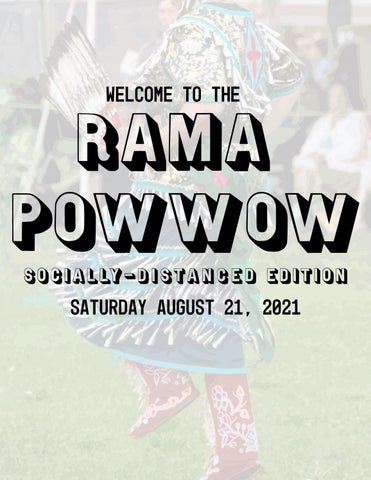
Aaniin, Boozhoo, and welcome to the 2021 Rama First Nation Powwow - Socially-Distanced Edition!
Last year, due to COVID-19, we were unable to hold a powwow at all. It was difficult. For the first time in over 30 years, we didn’t hear the drums over powwow weekend in Rama. We know the community, and many people from across North America, really missed Rama Powwow. This year, we are so happy to be able to host a small powwow. Obviously, it is much different than what we’re used to. We can’t welcome over 4,000 guests, 100 vendors, 12 drums, or 300 dancers. It simply wouldn’t be safe for the community at this time. However, we did want to at least host a small traditional powwow for the community. We had to keep the powwow planning somewhat under wraps, because we knew that if word got out too early, we would receive too many guests from far and wide. We had to be mindful of COVID guidelines and social distancing, and all along, our plan was to be able to invite the community. With the guidelines frequently changing, and with community safety at the front of our minds, planning was difficult, but we hope a great weekend is had for all! Beginning in mid-July, we sent out invitations to dancers from the community, or those who have been coming to Rama Powwow for a long time, asking if they would dance at Rama Powwow. Many were honoured and excited to be asked to dance once again. Miigwech to all of our dancers this weekend. We also asked a drum, Charging Horse, to be our host drum. Charging Horse are made up of singers from around Ontario and have been a regular drum at Rama Powwow for years. Miigwech Charging Horse for singing for us this weekend. All of our regular contests have been moved “virtual”, and we’ve received many video submissions. The winners of the contests will be announced at the end of the in-person powwow, on August 21. You will see compilations of the submissions throughout the day on the screens set up around grounds, or live on your phones via Facebook (Rama Our Home will livestream event!).
The Rama Powwow is in its fifth year here at the John Snake Memorial Multipurpose Community Grounds. Every year, we continue to improve the grounds to work towards the original vision of John Snake’ban and the Powwow Committee. One big improvement we’ve made to the site is the addition of a world class sound system. The Powwow Committee submitted an application to the Coldwater Narrows Trust for a new sound system for community events, and they generously approved our application. Gchi miigwech to the Trust for approving our appplication. We are fortunate to have such a beautiful place to host the Rama Powwow as well as many community events throughout the year. Gchi Miigwech to Rama Chief and Council and all the departments and staff for making the vision of these community grounds a reality. We look forward to many more years of awesome events here. The Rama Powwow would not be possible without the support of Rama Chief and Council, the Powwow Committee and our volunteers. In a “normal year”, the Powwow is Rama’s biggest event of the year, with over 4,000 people attending and there is a tremendous amount of planning and work involved. Much of the work happens months in advance of powwow. Booking our line-up of head staff, obtaining sponsorships, renting tents and portapotties, organizing the feast, and creating this powwow guide are just some of the many jobs that are taken up by the Powwow Committee. It truly is a team effort. Although this year is different for Rama Powwow, it still took a lot of work and time to pull together by many staff and volunteers. Gchi Miigwech to the Powwow Committee, our volunteers, head staff, drummers, dancers, vendors, and spectators for making Rama Powwow the best powwow around! Today is about celebrating our community and our culture. We hope it brings you some joy after the difficult year we’ve all endured together. Miigwech for being here. The Powwow Committee
Powwow Schedule Saturday August 21th 2021 The agenda for the day will have live-streamed and video compilation events. All dance contests and special contests were virtual contests and we will broadcast compilations of the submissions throughout the day. Winners will be announced near the end of the powwow. Go to www.facebook.com/RamaPowWow for livestream and video links, and a list of winners following the powwow!
6:15AM
Sunrise ceremony at the grounds
12:00PM Grand Entry Flag Song, Veteran’s Song Intro - 60’s Scoop 60’s Scoop Song / Welcome Home Intertribals Teens (video compilation) Jingle Dress Special (video compilation) Intertribals / Exhibition Juniors (video compilation) Hand Drum Special (video compilation) Intertribals / Exhibition Golden Age (video compilation) Adults (video compilation) Intertribals / Exhibition Woodland Special (video compilation) Singing Contest (video compilation) Announcement of Winners Retiring of Flags Closing & Travelling Song Giveaway
Rama Powwow Head Staff are: Emcee - John (Meegwans) Snake Arena Director - Allan Manitowabi; Head Dance Judge - Wesley Cleland Head Singing Judge - Rodney Stanger; Head Veteran - Tom Cowie
Check out the vendors behind the Heritage/Culture building! There are a variety of food and arts/crafts vendors set-up, from 11AM-4PM!
A Look Back at the 2019 Rama Powwow Photos by Cindy Rossit Photography
Powwow 101: History and Types of Powwows
with information provided by John Snake’ban, Vicki Snache, James Simcoe, and Ryan Stiles, 2013
As far back as we can remember the Chippewas of Rama First Nation has been a meeting place for visitors. We are a community that is known for its hospitality; from the earliest explorers, to the fall fairs in the 1920’s. From the powwow under the big tent at the Rama Ball Field, to the competition powwows at the MASK arena, our community continues to enjoy being a host to the many guests who frequent our community on a daily basis. In the early 1970’s, there was no song and dance happening in Rama First Nation and no sign of local powwows in the surrounding area. Emerson Benson, Co-founder of the Chippewas of Rama First Nation Thanksgiving Powwow, was working at the Native Canadian Centre in Toronto and had been surrounded by drumming and dancing on a weekly basis. Being inspired to bring back tradition in his own community, he said “I’m from the area, there’s nothing going on, so hey let’s try it”. Emerson also recalls how Rama had always been noted for its hospitality. In 1977, with the support of Rama First Nation band members, the community held its first annual Thanksgiving Powwow at Victoria Park. “It was a real community event [and] there was a lot of volunteerism at that time.” For generations people have gathered at Rama, particularly in the autumn or harvest months, to celebrate, socialize, eat, and have fun together. The following year, the entire community and the Social Services Department got involved in what was then a non-competition powwow held every Thanksgiving weekend. The Old Mall, which now houses Casino Rama Administrative Offices, Victoria Park, the ball field at Rama, and the Orillia Roller Skating Place were all used as venues for the annual powwow. In 1986, the Rama Powwow again made another transformation as a result of a ‘Social Recreation Needs Assessment’ (SRNA) the first Community Visioning Process, which began in 1983 and extended into 1985. The community was canvassed in what was referred to as ‘Kitchen Dialogue’ by former Chief Ted Williams who held leadership during this time. Members of the SRNA committee went to each household to ask a series of questions and sit in the kitchen (a place of comfort) to discuss the people’s dreams and aspirations that they had for the community. “Many of the success’s we find we have today have come from these kitchen table discussion,” relates Ted Williams. “Powwow was part of that talk and some members of the community built on this.” The 1986 Powwow was organized by Emerson Benson, James Simcoe, Aaron Benson, Ned Benson and Scott Snache.
Over the years, Rama First Nation has witnessed an exponential growth of the powwow, which was once mainly a small event where about a dozen community veterans would attend along with guests from Walpole, Wiky, Sarnia, and even Milwaukee. Now a competition powwow, the event has grown substantially, hosting between 3000 and 5000 visitors each year. It is an honour to have so many guests visit Rama to take part in the event which has been part of the community’s culture for several decades and continues to evolve. Had it not been for the indomitable will of a few individuals in the 1970’s, we would not be celebrating so many years of powwow at the Chippewas of Rama First Nation. TYPES OF POWWOWS: All powwows practice the four virtues of Honour, Respect, Generosity and Kindness. Each powwow has its importance and they are all equal to each other. They are celebrations and social events where everyone is welcome participate, have fun and give thanks for the blessings we receive. Each type of powwow is a little different than the next, but they all share the same underlying values and traditions. Competition Powwow: A dance and drum contest event for prizes. These powwows give dancers and singers the opportunity to be the best that they can be, much like the Olympics. Categories for dance contests are determined by age and dance style. Rama First Nation recognizes all tiny tots (0-5) as winners. As such, we do not have competition for them. Instead, they receive an honorarium for their participation and are encouraged for their interest in dancing as a leisure activity. Any dancers who do not wish to enter into contest are still welcome participants during all intertribal songs. Traditional Powwow: A time to send prayer to our Mother Earth. We send our prayers through the dance and movements of our feet. This powwow focuses on taking care of creation and all our relations. This powwow also offers honorariums to all drummers, singers, and dancers ensuring that they walk away with something to help them get back home and to give thanks for the blessings they have offered the host community through song and dance. It is usually free for visiting spectators to attend these powwows. It is rare for a ‘Special’ to be performed at these powwows. Specials are dances and songs that are performed for prize money. Non-Competition Powwow: Also known as the “sharing powwow”. This powwow, like a traditional powwow, also offers honorariums to all participating drummers, singers, and dancers. Like a competition powwow, ‘Specials’ (songs and dances for prize money) are sometimes performed.
POWWOW TRADITIONS: Invocation: Ancestral teachings tell us that prayer is what comes first for anything in life. As such, we will
Powwow 101: Traditions, Songs, and Dances
begin our event with an invocation. This blessing is brought by a respected elder of the community.
Whistles: Wooden, copper, and silver whistles may be heard at the powwow. They are sometimes used by whistle carriers for the purpose of keeping a song going during social events like a powwow. Some whistle carriers have Eagle bone whistles which are generally used for ceremonial purposes, by those who have been given the honour to carry them. Giveaway: We provide gifts as a way of giving thanks. The powwow giveaway is how the Chippewas of Rama First Nation offers thanks to visitors for coming to dance and sing on behalf of our community. Pow-wow singers and dancers perform for various reasons: for the blessings they have received, to dance for someone who is ill, or for those who cannot dance. Dancers and singers also perform out of joy, for good health, and happiness. When spectators enjoy the sights and sounds of a powwow, they have an opportunity to feel blessed by receiving a release of any trials or negativity; thus the opportunity to feel good takes its place. The giveaway is also a means of thanking dancers and singers for all of the good feelings that they brought and for honouring a host community with their visit. Grand Entry: This is the time when all dancers line up by dance style and age to enter the powwow arena. The community Eagle Staffs lead the way. Following Eagle Staffs are the Canadian and American flags, Veterans flags, visiting eagle staffs, Missing In Action flags, Union Jack, the Ontario Flag, and any other visiting flags to the community. Veterans will usually carry flags. Often, Chief and Council, and other special invited guests, will be asked to be part of Grand Entry. It is customary to stand and remove your hat during the Grand Entry. SONGS AND DANCES Songs are a mixture of chanting and language and they tell a story of our past. Like several cultures around the world, our songs and dances act as a filing cabinet. They represent a living past and tell us stories of our life and history. Each song and dance has its very own unique meaning and importance. Carriers of songs are a type of historian, in that the singer not only carries the song, but also the origin and significance of it. Although First Nation music is vast and predates written history, many songs and dances were hidden away during a time in which our ancestors were not allowed to practice their culture and heritage. Today, several songs and dances that were hidden away have slowly made their way back into dance or powwow arenas. Just as song is a way to send prayers to creator and creation, dance is a way to send prayers to mother earth, through our feet. Grand Entry Song: The Grand Entry song is the first song that brings in the spirit and sets the tone of the day. This is when a procession of all dancers enter the dance
arena according to dance style and age. Eagle staffs, flag carriers, veterans and dignitaries lead the way during the grand entry. Flag Song: The second song we hear at a powwow is the flag song. Once all the dancers have entered the dance area after grand entry, the flag song is “sent up” to acknowledge our Eagle Staff and memory of our past and present veterans. A flag song is given the same respect as a National Anthem. After the flag song, eagle staff and flag carriers are introduced during the posting of the colours. This honors all warriors and veterans of the past and present for the sacrifices they have made. This is a moment of respect given to those who gave the ultimate sacrifice. During this time, we remember and honour them. Honour Song: These are songs that are requested to honour someone; for example, a son returned from war or in memory of a relative that has passed on. Honour songs are usually requested prior to the powwow. These are also sung for the accomplishments of community members and can also be requested to welcome people home. Inter-tribals: Once the grand entry and opening ceremonies are finished, the Master of Ceremonies will call the drums to offer songs in the way of ‘inter-tribals’, which mean everyone can dance: wearing regalia or not. These songs are open to all and give the drums an opportunity to sing. Inter-tribal means all inclusive. People of any age and every ethnicity, religious or spiritual belief, and cultural background are invited to dance. Sneak-up: This is a specialty or exhibition dance. where male Traditional dancers tell a story of sneaking up on game or simulate a confrontation with an enemy. The sneak up also represents storming the shores of Normandy, in WWII. Dunk and Dive: A warrior dance that represents our warriors charging onto enemy or prey. It is a story of how they came to be victorious re-enacting the battle or hunt. Chicken Dance: This dance imitates the mating dance of the bird. It reflects how the male bird seeks the attention of the female. Snake dance, Smoke dance, Switch dance, Clown dance, Crow Hop, Round Dance, Blanket Dance, and Jingle Dress Dance are just a few more that have been performed at the Chippewas of Rama First Nation Powwow. Each one has its own unique significance and purpose. The Master of Ceremonies at a powwow will usually explain songs and dances in more depth. There are countless songs and dances that one can enjoy along the powwow trail. Keep an eye (and ear) out for all the different kinds today!
gchi miigwech to our 2021 Sponsors!
Cindy Rossit Photography Spirithands Photography
Gchi miigwech for being here today! Save the date for next year’s Rama Powwow: August 20-21, 2022