Portland Out of


By Tom Landry
Portland’s Housing Crisis Priced Out of Portland
By Tom Landry

Dedicated to Maddie Moo (Madelyn Landry), my daughter and the inspiration behind my efforts to make Portland even better.
Second Edition, December 2025
Exclusive Property of Tom Landry and Benchmark. Sharing/dissemination in any way is strictly prohibited. ConfidentialAll rights reserved-2025 © Copyright Tom Landry, 2025
Cover and Book Design by Katrina James.
Contact Tom Landry (207) 775-0248
landryteam@benchmarkmaine.com
About the Author

Tom is a Maine native who lives with his wife and daughter in a Victorian home he restored off Portland’s Back Cove. They love all things Portland, give back to a host of local non-profits and charities, and buy local whenever possible.
A small business owner, Realtor®, developer, contractor, and consultant, Tom Landry is one of the most accomplished and respected real estate professionals in Maine. As the founder of both Benchmark Real Estate and CornerStone Building and Restoration, Tom brings a rare breadth and depth of knowledge to every purchase, sale, development, restoration, or remodel project he undertakes. In his main focus of real estate sales, he has been one of Maine’s top-producing agents and Portland’s #1 Listing/Selling Realtor® for over two decades.
Tom has over 30 years of practical real estate experience as a Realtor®, buyer, seller, developer, investor, multi-unit building owner, building/restoration/development consultant, general contractor, and more. He has the firsthand knowledge, integrity, proven negotiating skills, and attention to detail to help even the most complex real estate deals succeed. With a corporate background in marketing, sales, process improvement, management, and client service, Tom and the professionals on his team provide the very best service and results to every client.
Why Listen to Me?
“You are not entitled to your opinion. You are entitled to your informed opinion. No one is entitled to be ignorant.”
― Harlan Ellison
I have made local real estate my life’s work. In my capacity as a Realtor®, historic home renovation/restoration expert, builder, developer, landlord, consultant, real estate marketing expert, and process improvement trainer and facilitator, I approach the subject of housing and zoning in a truly informed manner. I have been a member of the MEREDA presentation committee, founder of YIMBY Portland, chair of the Priced Out of Portland Forum (2019), a participant in the 2023 Housing Supply Bootcamp, moderator of ‘The Crystal Ball Conversation’ at 2024 ClimateWork Maine, and a student of best practices in zoning,
land use, and development. My background makes me uniquely qualified to assess and offer suggestions to help Maine’s largest city address its housing challenges. While the information and recommendations here are my own opinions, they were the result of extensive consultation and collaboration with industry experts.
Along with my work as Portland’s #1 listing/selling agent and one of the most active real estate agents in Maine, I have been an active developer over the last three decades. In fact, I’ve just recently navigated the approval of a new mixed-use development. I have firsthand knowledge of the strengths and shortcomings of the current system. Putting on my process improvement hat, I can’t help but think of ways to make things work better for all stakeholders.
I hope you find this information informative and that it inspires you to take action to make our city a better place.

Priced Out of Portland
“Look not mournfully into the past, it comes not back again. Wisely improve the present, it is thine. Go forth to meet the shadowy future without fear…”
- Henry Wadsworth Longfellow

Portland is in a housing crisis! Rents and sale prices are at record levels and seem to be going nowhere but up. This is the case despite rent control and sustained high interest rates. So how did we get here and what can we do about it? This quick read is designed to provide you with context, facts, solutions, and a call to action.
Why you should care! Portland is struggling to meet the housing needs of its growing population due to several significant challenges. These include inclusionary zoning policies, outdated land-use regulations, soaring construction loan interest rates,
the high cost of suitable housing sites, and lengthy, expensive permitting processes. All of these obstacles have made it increasingly difficult for Portland to keep pace with demand. If we add in work-from-home trends and climate migration (which is already happening now and will dramatically increase over the next decades), we are facing a perfect storm.
Want to…
• Pay lower taxes? We need more housing in Portland!
• Ensure rents are more affordable? We need more housing in Portland!
• Protect the environment? We need more housing in Portland!
• Preserve farms and forests? We need more housing in Portland!
• Offset the inflation we can’t control? We need more housing in Portland!
• Address racial and economic disparity? We need more housing in Portland!
Take action right now! Portland’s Department of Urban Planning and Development has put forth the most comprehensive update to zoning in over a century. The current proposal is a terrific start and represents a significant improvement, but it is nowhere near as ambitious as we need to effectively address either the city’s housing issues at hand or what we will face in coming years. There is also a proposal to realign Franklin Arterial and return much of this land to housing. This effort will go a long way toward righting a wrong that happened during urban renewal, returning housing to this urban area.
The Planning Board is seeking public input before turning their zoning update over to the City Council for a vote. The Planning Department, Planning Board, and City Council need to hear your opinions and suggestions on how we can solve the housing crisis.
The Facts Are The Facts
“Facts are stubborn things; and whatever may be our wishes, our inclinations, or the dictates of our passion, they cannot alter the state of facts and evidence.”
― John Adams

• Nationwide and here in Greater Portland, the two largest segments of the population—boomers and millennials—are both choosing to live in more urban locations. As a result, southern Maine, the Greater Portland area, and especially the city of Portland, have seen unprecedented in-migration and population growth in recent years.
• Following a national trend, companies/universities such as WEX, Sun Life, Covetrus, Roux, and many more are opening headquarters and campuses in urban centers.
• Maine Health is the largest employer in the state with its flagship campus, Maine Medical Center, located in Portland.
• Portland is on the map and for good reason. Our small city is consistently ranked on the top of many lists, including the best places to retire, raise a family, and start a business, as well as named one of the best foodie cities in the U.S.
• The “work from home and live anywhere you want” trend is here to stay, and many remote workers are choosing Portland. In fact, Portland has been named the #1 city in the U.S. to work remotely (#7 worldwide) by remote.com.
• According to Bankrate.com, Maine is the 4th most climateresistant state in America.
• Residential construction of all types has lagged and not kept pace with re-urbanization trends and in-migrations, leading to a dramatic imbalance between supply and demand.
• As other parts of the country face one climate crisis after another, Maine will continue to be seen as a relatively stable place to live, attracting climate migrants from across the country. Climate scientists predict that Maine’s population and economy will continue to grow while those of many other states shrink.
• According to the “State of Maine Housing Production Needs Study” by HR&A, the average Maine household needs to make over $100,000 to afford the median home price in Maine—almost double what it was before the pandemic.
• According to local mortgage broker Ed Gosselin of Total Mortgage, lenders historically capped the percentage of a buyer’s income used for housing at 28%. To offset rising prices, these ratios have been increased to 45%. In other words, a buyer might have to spend as much as 45% of their income on housing. The numbers are even worse for renters.
• Many of Portland’s land-use regulations were written nearly 100 years ago and reflect a very different time. A century ago, commercial/industrial zones needed significant
space from residential zones to buffer noise and polluting activities. Today, commercial and industrial activities are much cleaner and quieter, allowing the city to embrace mixed-use neighborhoods.
• The 1950s ushered in a time of suburban sprawl and urban decline/decay, which was followed by urban renewal efforts. During this time, exclusionary zones like R3 were established and represent the largest and one of the most limiting residential zones in Portland.
• By some estimates, 90% of Portland’s land mass is not zoned for multi-unit residential development. This includes the majority of land in Portland’s urban core, the peninsula.
• Fueled by a Not-In-My-Backyard (NIMBY) mentality, a small number of organized, highly vocal residents have fought nearly every development.
• The passage of the Green New Deal, with its 25% inclusionary housing requirements, has added significant cost to projects and made most large-scale construction financially infeasible.
• There is a perception that Portland is anti-developer and anti-development which has led to many in this community to vow to ‘never build in Portland.’
• The cost of land, construction, and building is higher than it’s been in the last 20 years.
The result is a dramatic imbalance between housing supply and demand.
Let’s Set The Scene
“Numbers have an important story to tell. They rely on you to give them a voice.”
– Stephen Few
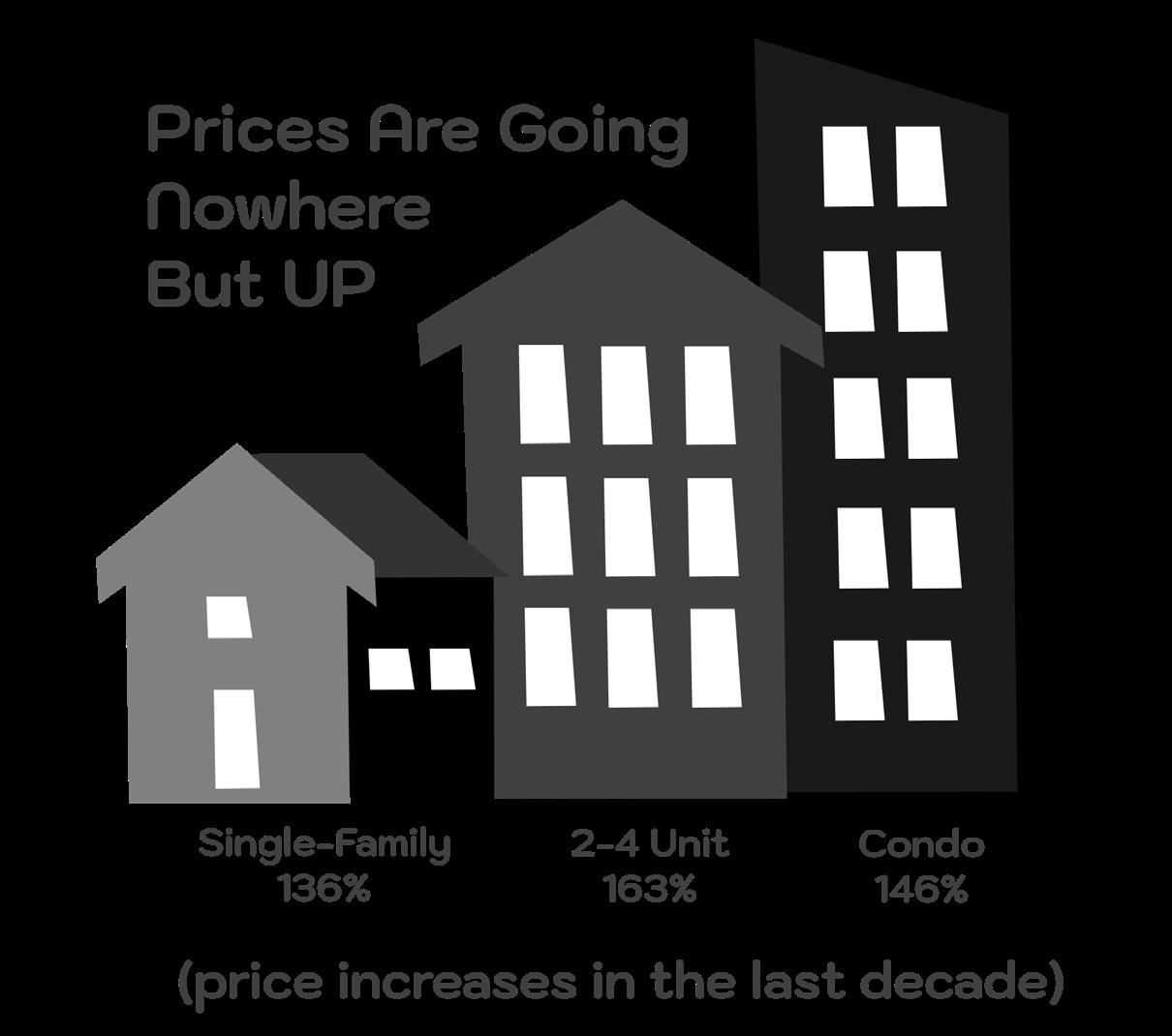
Let’s examine data that highlights the severity of the situation and the housing shortage across all types in Maine’s largest city. (All data sourced from Maine Real Estate Information System, Inc.)
Single-family homes have seen a median sale price increase in Portland of:
• 12% in the last year, from $490,000 in 2022 to $550,000 in 2023.
• 74% in the last 5 years, from $316,500 in 2018 to $550,000 in 2023.
• 136% in the last 10 years, from $232,950 in 2013 to $550,000 in 2023.
At this rate, the median price of a single-family home in Portland in 2030 could be $1,235,000.1
Condos have seen a median sale price increase in Portland of:
• 15% in the last year, from $455,000 in 2022 to $525,000 in 2023.
• 58% in the last 5 years, from $332,450 in 2018 to $525,000 in 2023.
• 163% in the last 10 years, from $200,000 in 2013 to $525,000 in 2023.
At this rate, the median price of a condo in Portland in 2030 could be $1,430,000.
Two- to four-unit multi-family homes have seen a median sale price increase in Portland of:
• 6% in the last year, from $707,500 in 2022 to $750,000 in 2023
• 56% in the last 5 years, from $480,000 in 2018 to $750,000 in 2023.
• 146% in the last 10 years, from $304,375 in 2013 to $750,000 in 2023.
At this rate, the median price of a two- to four-unit multi-family home in Portland in 2030 could be $1,128,000.
The situation isn’t better for Portland renters.
• According to Zillow, the median rent for all unit types in Portland is $2,700, which is 26% ($555 per month) higher than the national median.
• According to the State of Maine Housing Production Needs Study, Portland is 38,500 units short due to historic underproduction. Even with recent large-scale developments and as many as 700 housing units in the pipeline, Portland’s supply of apartments will be 45,800 units behind demand by 2030.
1These are strictly examples and are not intended to be financial advice.
Based on information from the Maine Real Estate Information System, Inc. (d/b/a Maine Listings) for the period Jan. 2013 through July 2023. © 2024 Maine Listings.
The Green New Deal
“It’s presented a whole new set of challenges that has caused us to move our focus outside of Portland, unfortunately… We love Portland and it’s been a wonderful market for us, but it’s a really hard place to do business and it’s only gotten harder.”
– A local developer

In 2020, residents narrowly passed a referendum that has had far reaching, albeit unintended, negative consequences. The opinion of many experts working in the industry is that the Green New Deal has done more to negatively impact housing supply than rising interest rates, record-high costs for construction, restrictive zoning, and a complicated and costly permitting process combined of the Green New Deal, the number of permits for multi-unit developments dropped by 82%, according to city permit records. Why? The cost implications for both for-rent and for-sale units make the construction of larger developments cost-prohibitive. Under the Green New Deal, developments of ten or more units must meet a 25% workforce housing requirement and therefore sell for under-construction costs.
Let’s do the math:
The 2025 fee-in-lieu is $182,830 per IZ unit, and applies to 25% of the total units in a project—the portion required to comply with the IZ ordinance.
So, for a 100-unit project, the fee would apply to 25 units, resulting in a total of $4,570,750 (25 units x $182,830).
The ‘math’ doesn’t math with this type of penalty. Banks won’t finance developments that cost more to build (not just construction costs but fees and these IZ penalties) and therefore development of scale is on hold.
Another surprising result of the Green New Deal is that all new construction falls under the ruling, including the conversion of and occupancy in decline because of work-from-home trends, many experts have speculated that converting these commercial spaces to residential units might be an answer to the housing crisis. Unfortunately, the Green New Deal requires those hoping to do this to comply with workforce housing requirements, thereby pushing the already staggering cost of converting these spaces over the top.
The Green New Deal has resulted in fewer permits, less new housing of all types, and an incentivization to construct buildings with fewer than 10 units to avoid the need to comply with workforce requirements. Since the enactment of the Green New Deal, we have seen ever-increasing rents and a 43% increase in residential real estate prices.
We are not alone, and we need only look to municipalities that have enacted inclusionary housing over the last several decades to see why this is a failed policy. Inclusionary zoning hurts more
than it helps! That is the primary takeaway from Emily Hamilton’s 2019 deep dive into the negative consequences of inclusionary housing across the US.
In New York City, inclusionary housing produced only 172 units Order without Design.
How do we negate the negative consequences of the Green New Deal?
1.Fully repeal and eliminate all inclusionary penalties.
2.Implement my suggestions under Re-recode Portland.
Re-ReCode Portland.
Let’s Make ReCode ReMarkable
“Perfection is not attainable, but if we chase perfection we can catch excellence.”
— Vince Lombardi

Where We Are.
On December 4, 2024, Portland made significant strides by passing ReCode, aiming to simplify and enhance zoning regulations. Despite this progress, the anticipated surge in permits and the corresponding increase in housing supply have not materialized. To truly unlock housing potential, we must examine and address the cost, constraints, roadblocks, and disincentives. Developers are eager to meet the moment, but existing city policies and processes impede progress.
Why Haven’t We Seen More Development/Housing?
It all comes down to economics. While ReCode, in most locations, allowed or more height and density, there are underlying deterrents, in and out of our control, affecting whether projects pencil out. Here are a few:
• Landowners increased prices – with the up-zoning came corresponding price increases. We can’t blame these property owners, and there is nothing we can do about this.
• Record high cost of construction – from labor, materials, and tariffs, this is the macro-level stuff that is out of our control
• Near record high and more conservative lending, banks are more conservative and charging more for money. This is a massive hit to the bottom line for condo projects (they now need pre-sales or more pre-sales to even obtain this costly funding) and those that would be listed for rent (the ongoing cost of capital evaporates the return on investment.
• Softening demand for commercial space – both office and retail vacancies
• Rent Control – even though new developments can set their initial rental rates where they choose, this is, along with IZ, one of the major factors pushing development outside Portland.
• IZ – this is the BIG ONE and it’s within our control to change or hopefully eliminate.
It's About Supply & Demand Being Out of Balance
Fundamentally, to meet past, present, and future housing demands, we must substantially increase supply. Given a 20-year supply slump and escalating re-urbanization and in-migration, urgent and ambitious action is required. To achieve this, we need to unlock land potential, provide maximum flexibility to housing providers, remove disincentives, and streamline processes. ReCode was a massive step forward but, its clear that more is needed and needed now.
The Time is Now – The Crisis is Real
Portland faces a housing shortage of near biblical proportions. State data indicates a need for ~80,000 new units by 2030, with the demand most acute in Greater Portland and coastal southern Maine. If we think about Portland’s ‘obligation’ in this crisis, we should plan to carry 1/4 of this obligation and plan to build ~ 20,000 new units (that’s 4,000 units per/year over the next 41/2 years). The addition of 200-300 units here and there, and even the promise of Franklin Street (with as many as 2,000 units), is cause for celebration, but doesn’t come close. Beyond this, and likely due to the Green New Deal and rent control, rental and purchase prices have tripled over the past decade.
According to MREIS, the median sale price of a single-family home reached $584,500 in 2024 (a 150% increase in the last decade), and the average cost of a 2-bedroom apartment hovers around $2,442 (according to Zumper, this represents a 6% increase in the last year). Consequently, many have been priced out, seeking affordability in suburban and rural areas, leading to longer commutes and negative environmental impacts due to increased vehicle emissions and the conversion of natural landscapes into housing.
Eliminate Inclusionary Zoning (IZ)
Currently, Portland's IZ policies disincentivize the very development we aim to encourage. For example, developers building 10 or more units face fees of $182,830 per additional unit beyond nine units. This structure deters and disincentivizes larger-scale developments that are crucial for addressing housing shortages. Fun fact – IZ not only applies to new construction condos and rentals, but to those who might want to convert vacant office buildings and warehouses to units to housing.
The Math – when we layer on IZ to the elevated cost of land, construction, lending, and more, this pushes projects into the red. This is the #1 deterrent to development of scale in our city, and changing it is within our control (the 5-year moratorium on changing, under the Green New Deal, ends at the end of 2025).
Example – someone wants to build 100 residential units
The 2025 fee-in-lieu is $182,830 per IZ unit, but that amount only applies to 25% of the total units in a project—the portion required to comply with the IZ ordinance. So, for a 100-unit project, the fee would apply to 25 units, resulting in a total of $4,570,750 (25 units x $182,830), or a developer could construct the units on-site.
If we just can’t give up on IZ (eliminating is the ideal), we should reverse the approach: impose fees on smaller developments to incentivize larger projects. For instance, constructing a single-unit development (the last thing we should be building more of in our city) could incur a $200,000 fee, decreasing incrementally with each additional unit, reaching zero at 10 units. Let’s incentivize the behavior we want!
Rethinking IZ: From Developer Fees to Homebuyer Support
Currently, those IZ funds are primarily used for “last mile” or bridge financing for affordable rental projects. While important, this approach keeps renters locked in a cycle of renting rather than offering a path to ownership and long-term stability.
We propose a smarter use: reallocating IZ revenue to help renters break free from the forever-rent cycle and realize the American Dream of homeownership through down payment assistance.
By investing directly in helping residents buy their first homes, we can build generational wealth, stabilize neighborhoods, and create true affordability, without adding costs to new housing production. Cities like Denver and Boston have shown that expanding access to ownership is one of the most effective ways to strengthen communities. Portland now has the opportunity to stop taxing the supply side and start empowering the demand side—and create a city where owning a home is possible for more of our neighbors. See my separate white paper.
Increase Allowable Heights in On-Peninsula B Zones
ReCode increased allowable heights in many zones, but this didn’t go far enough. We should boost heights by an additional 20 feet (2 stories) across all on-peninsula B zones, and couple with requirements for first-floor commercial or retail use that would promote mixed-use developments. Additionally, permitting 10-foot appurtenances for features like elevator access, solar panels, and rooftop gardenswould enhance building functionality, sustainability, and provide much-needed and immediate access to the outside for residents.
Change All ILB (Industrial Light) to IL/B5
Reclassifying ILB zones to IL/B5 would allow for a mix of industrial and residential uses, reflecting the modern trend of integrating living spaces with light industrial and commercial activities. This change would unlock large tracts of land for development, particularly in areas like East Bayside, without displacing existing businesses.
Simplify Permitting
Portland's permitting process is often cited as a barrier to development. To streamline this process:
• Increase staffing in the Planning & Urban Development Department, assigning dedicated staff to projects of four or more units to expedite approvals.
• Eliminate public notice and comment requirements for developments that comply with existing zoning, aiming to approve 80% of such projects within 60 days.
• For projects requiring zoning changes, consolidate public comment to a single Planning Board meeting, targeting approvals within 90 days for 80% of cases.
• Further expedite processes for developments of 10 units or more.
Edit the Planning and Historic Preservation Board Process
The current process for project approval, especially within historic districts, is lengthy and complex. Recommendations include:
• Implementing the aforementioned permitting simplifications to reduce the Planning Board workload. This will decrease the workload.
• Establish two Planning and Historic Preservation Boards vs one. Drop the required number of board members to 3 and ensure each board meets once per month (so 2 Planning Board and 2 Historic Preservation Board meetings each month).
• Ensuring board members focus on compliance with zoning and design standards, avoiding subjective preferences.
• Streamlining the approval process within historic districts to a maximum of two meetings, with collaborative presentations by developers and HP staff.
Establish Pre-Approved Property Types for Specific Zones
Within six months, develop a catalog of pre-approved, pre-permitted building designs for multi-family or mixed-use structures of four or more units. These designs should be applicable in all B and TOD zones, allowing for permits to be issued within 60 days, thereby reducing design costs and permitting delays.
Simplify and Expand TOD Zones
Transit-Oriented Development (TOD) zones are instrumental in creating complete neighborhoods. To enhance their effectiveness:
• Merge existing TOD zones into a single, comprehensive category – TOD2
• Eliminate step-backs and setbacks, allowing for 10-foot appurtenances to accommodate modern building features.
• Expand current TOD zones by 500 feet in all directions along major intersecting streets.
• Introduce new TOD2 zones in strategic locations, including:
- Washington Ave (from Congress Street to the I-295 overpass)
- Washington Ave (from Congress to I-295 and along Ocean Ave, Canco Rd, and Jackson St)
- Forest Ave (from Stewart St to Westlawn Rd and from Hannaford Rd to the Westbrook line)
- Congress St (along Douglas St, Stevens Ave, and Jetport Access Rd)
- Brighton Ave (along St John St, Stevens Ave, Woodford St, and Capisic St)
- Riverside Golf Course – South Course (9-hole course only). 1158 Riverside Dr.
- Portland Technology Park – Technology Park Dr.
Create Financial Incentives
To encourage the development of affordable and attainable housing, Portland can:
• Provide low-interest loans, grants, or Tax Increment Financing (TIF) to offset high development costs.
• Leverage the Housing Trust Fund to extend financial support, similar to Maine Housing's approach of offering $70,000 subsidies per unit for below-market-rate ownership units.
• Offer financial assistance to homeowners constructing up to two Accessory Dwelling Units (ADUs) per lot, now permitted citywide.
• Open up more city-owned land to development, and don’t limit the buyer to those proposing affordable housing. ANY housing, at any price point, helps meet the ever-increasing demand.
By implementing these recommendations, Portland can position itself as a leader in addressing the housing crisis, fostering sustainable growth, and enhancing the quality of life for its residents.
The American Dream A Better Plan for Portland's
Inclusionary Zoning (IZ) Funds
“Homeownership is a way to build wealth over time. It’s often the foundation of financial security.”
— Warren Buffett
For too many, the American Dream of homeownership has become a myth - a mirage that feels forever out of reach. Instead, many settle into a lifetime of renting, missing one of the most powerful pathways to housing stability, community investment, and wealth building: the opportunity to own a home.
While both market-rate and affordable rentals are important parts of our housing landscape, they alone are not enough. If we truly want to solve our housing crisis and build a stronger Portland, we must make ownership a reality for more residents.
• If we want to provide housing stability, people must have the opportunity to own, not just rent. • If we want to ensure long-term housing affordability—people must have the opportunity to own, not just rent.
• If we want to create deeply invested, engaged communities—people must have the opportunity to own, not just rent.
• If we want to improve the livability and resilience of our city—people must have the opportunity to own, not just rent.
• If we want to help residents climb the economic ladder and build generational wealth—people must have the opportunity to own, not just rent.
How This Program Would Work
Eligibility
Single individuals or couples earning up to 120% of Area Median Income (AMI). • Purchase of a single-family home, condominium, or a 2–4 unit multi-family property.
Down Payment Assistance
• Up to $100,000 in assistance.
Terms
• Secured by a second mortgage.
• .5% interest rate, amortized over 30 years (low rate but repayment is important)
• Repayment/Forbearance:
- If the buyer remains in the home and makes all payments, the loan is fully forgiven after 10 years.
- If the home is sold within 10 years, repayment is prorated: 90% repayment if sold in year one, declining by 10% each year thereafter.
Important:
No ongoing affordability restrictions: owners are free to sell at market value after repayment or forgiveness, ensuring they can benefit fully from appreciation and wealth-building opportunities.
The Math – Real Numbers for Real Portlanders
Example: Purchase of a $550,000 Home (Reflecting Portland’s median sale price for Q1 2025)
• $100,000 second mortgage at .5% interest over 30 years ≈
$299/month
• $450,000 primary mortgage at 6% interest over 30 years ≈
$2,698/month
• $5,600 annual property taxes ≈ $466/month
Estimated Total Monthly Payment ≈ $3,463/month
Note: This estimate reflects the high interest rates of today. With lender collaboration—offering lower interest rates and/or 40-year amortization—the monthly payment could be even more affordable. Beyond this owners can re-finance at any time to lower payments if interest rates drop. on and wealth-building opportunities.
Why This Plan Matters
• Ownership is stability: Homeowners are more likely to stay in Portland, invest in their properties, and contribute to the vitality of their neighborhoods.
• Ownership is affordability: Fixed mortgage payments protect owners from the skyrocketing rents that displace so many Portlanders today.
• Ownership is equity: Unlike renters, homeowners build personal and generational wealth through home appreciation.
• Ownership strengthens Portland: Vibrant, stable neighborhoods create a stronger, more resilient city for all.
This plan uses the city's Inclusionary Zoning funds not just to house people temporarily, but to change lives permanently. It gives Portlanders the chance to own a piece of the city they love—and, in doing so, strengthens our entire community.
Research Findings on Down Payment Assistance
For cities looking to utilize inclusionary housing funds effectively, investing in down payment assistance programs offers a research-backed approach to expanding homeownership opportunities and fostering equitable communities.
Addressing Wealth Constraints:
A study by the U.S. Department of Housing and Urban Development (HUD) evaluated the potential of down payment assistance programs, such as those provided through the American Dream Downpayment Act, to increase homeownership among low-income and minority households. The study found that cash grants significantly impact the propensity to own by alleviating wealth constraints that limit homeownership.
Reducing Racial Homeownership Gaps:
The Urban Institute highlights that DPA programs are essential in closing America's racial homeownership and wealth gaps. By providing financial support to cash-constrained first-time homebuyers, these programs enable more equitable access to homeownership opportunities.
Overcoming Barriers to Homeownership: Research from the Urban Institute indicates that saving for a down payment is one of the most significant barriers to homeownership, especially for renters. DPA programs can effectively lower this barrier, making homeownership more accessible.
City-Level Implementation Examples
New York City: The NYC Department of Housing Preservation and Development offers down payment assistance loans up to $100,000 for first-time homebuyers, aiming to make homeownership more attainable in a high-cost market.
District of Columbia: The DC Housing Finance Agency provides interest-free loans up to $202,000 for down payment assistance, coupled with $4,000 for closing costs, targeting low- to moderate income residents.
Policy Implications
Implementing DPA programs at the city level can:
• Increase Homeownership Rates: By reducing upfront costs, more renters can transition to homeownership. Minnesota Homeownership Center
• Promote Economic Stability: Homeownership contributes to wealth building and community stability.
• Address Housing Inequities: Targeted assistance can help close racial and economic disparities in homeownership.
Historic Preservation
“If today’s rules for historical preservation had been in place in the past, the buildings that some now want to preserve would never have been built at all.”
– Alex Taborrok
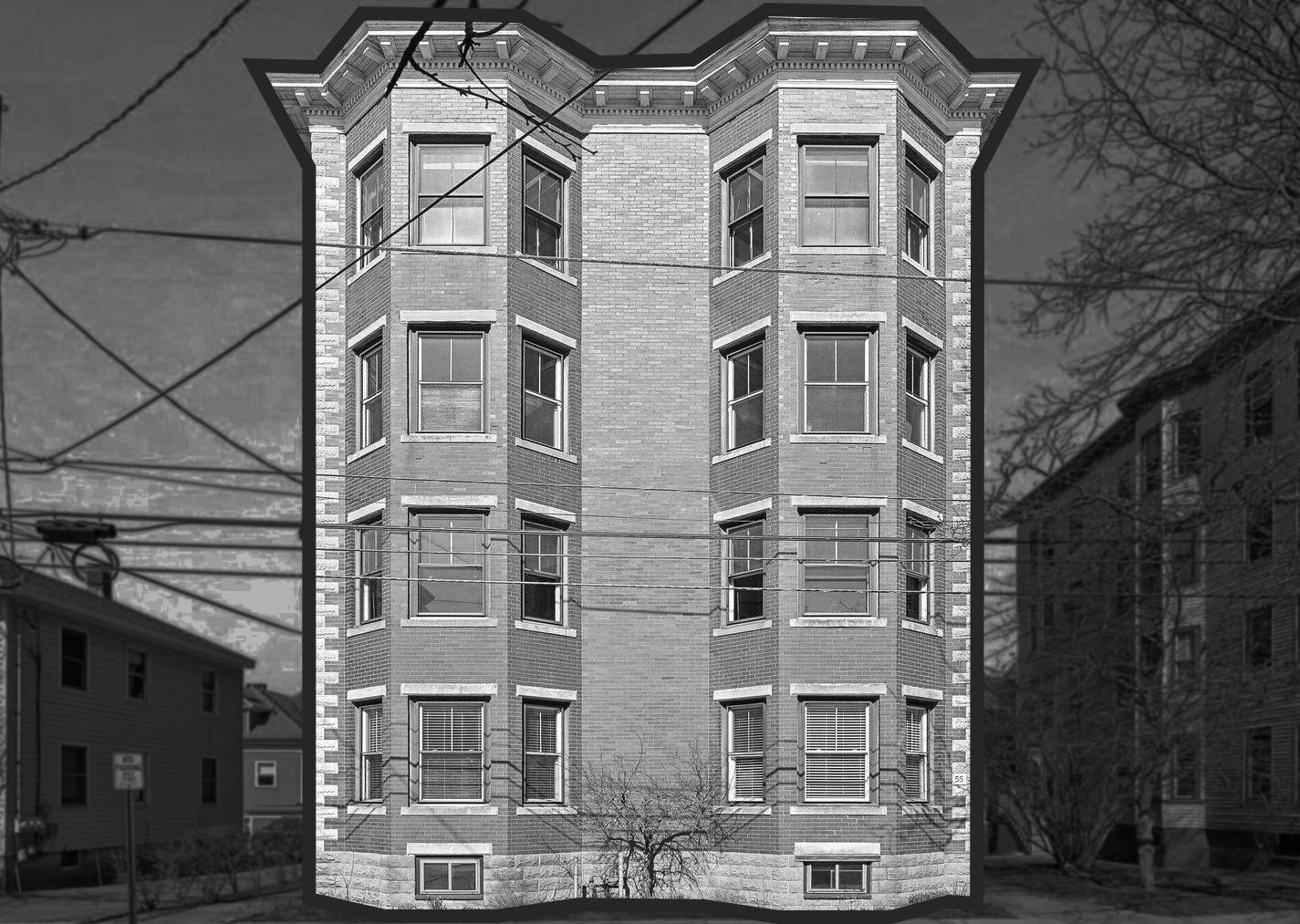
55 Morning St. on Munjoy Hill
(This beloved four-story historic building could not be built today)
We can all agree that Portland’s unique architectural history must be preserved. From individual landmarks to entire neighborhoods, the preservation of unique places is paramount. In 1973, the first historic districts in Portland were listed on the National Register of Historic Districts. In 1990, the city adopted a historic preservation ordinance, and, in the last several years, the amount of land preserved has expanded greatly, with the addition of much of Munjoy Hill. Today, approximately 20% of the landmass on Portland’s peninsula is in designated historic districts, and nearly one-third of all Portland residents live in a historic district.
So, what does this have to do with housing? A lot! Every property within a designated historic district falls under a unique set of rules and limitations. This means that any changes to the property must be approved by the city and meet certain criteria. On its face, this makes sense when talking about ensuring historic properties retain the characteristics of the past. However, such strict rules and regulations negatively impact new housing developments. Of course, in nearly every instance, demolition is not permitted in historic districts. This usually means that the construction of a larger building with more units on the same lot is almost impossible. Without such strict demolition rules, a developer might look to a vacant lot in a historic district to create housing. However, since the new structure will be in a historic district, any plans must be run through the city’s historic preservation department as well as the historic preservation board. It is a time-consuming and costly process. Unfortunately, the result is that few, if any, developers building at scale will venture into these waters.
Climate Change & Housing
“What you do makes a difference, and you have to decide what kind of difference you want to make.”
– Dr. Jane Goodall

Climate change is here, and it is wreaking havoc on communities around the globe. From extreme heat and droughts to atmospheric rivers, devastating floods, and once-in-a-generation storms—now occuring yearly—we are facing a new and deeply troubling reality. Communities are bracing for extreme weather by becoming more “climate resilient.” This can take many forms, from building new sea walls and pumping stations to the implementation of new building codes. These efforts and many more are urgent and important, but they fall short of a more comprehensive approach.
Where you build is as important as what you build. No, I’m not talking about the basic strategies of avoiding lowlands or coastal plains subject to flooding or storm surge—realities we will all
grapple with over the decades to come. I’m referring to building in urban areas versus rural/suburban areas. The rationale for building in more urban areas is threefold:
1. Transportation is the #1 carbon-emitting activity, and Mainers commute the furthest of any state in the country.
2. Maine is already feeling the impact and strain of climate migration, and this is just the beginning.
3. For Maine and other communities to retain their small, rural feel and less suburban sprawl, we need our cities to significantly up-zone their community centers.
Since the dawn of modern civilization, people have gathered and lived in densely populated towns and cities. Around them were vast, open, and nearly untouched farms, fields, and forests. With the advent of the automobile and post-war suburbanization, that all changed. People fled cities in search of the American Dream of homeownership. Around countless cul-de-sacs sprouted strip malls, highway spurs, and shopping centers. In the half-century since then, we have seen the largest transformation of open land to housing the world has ever seen. In some ways, the growth of the suburbs has been terrific; it has led to a corresponding economic boom, and many of us have wonderful memories of growing up and living in these areas. So, where does this fall short and how should those of us in Portland and other smaller cities look at housing in this time of climate change and climate migration?
According to HUDUser.gov, “low-density suburban environments generate more emissions than compact environments in the same city, and the more a city is marked by sprawl overall, the more emissions it generates.” If we hope to combat climate change and retain our unique quality of life—one in which you can move from our most densely populated areas to rural areas within minutes— we need to act now.
Some facts about our population growth:
• Since 2013, Maine’s population has increased by 67,179.2
• From April 2020 to July 2022, Maine had a cumulative population growth of 1.7%, the 14th highest in the United States.3
• From July 1, 2022 to July 2023, Maine’s population increased by 6,384, making Maine the fastest-growing state in New England.4
• From April 1, 2020 to July 1, 2023, Portland saw a 1% population increase.5
Predictions for 2030:
• Statewide, Maine’s total population is projected to increase by 2.6% for the decade between 2020 and 2030.
• According to recent studies, 84,000 new homes will be needed to account for the current short supply and expected population growth.
• The Portland metro area is where this population growth will be concentrated.
Given the current shortage and projected population increases, we needed to start building yesterday. The Governor’s signing of LD2003 is a terrific step that overrides municipal zoning to allow for more density, but more is needed. To meet this moment and prepare for a population boom, Portland and other Maine cities must dramatically up-zone and re-zone. These efforts will decrease the development pressure on suburban and rural communities, in Portland and Greater Portland, and ensure that farms, fields, and forests are kept in their carbon-sequestering state. This will also provide housing where it’s needed (close to employment centers), leading to less commuting and reduced CO2 emissions. (Of course, there is also a need for a corresponding zoning change in our suburban and rural communities, but that is a topic for another time…)
2 https://www.macrotrends.net/global-metrics/states/maine/population’>Maine Population 1900-2023
3 https://www.maine.gov/dafs/economist/sites/maine.gov.dafs.economist/files/inline-files/2022%20 Year%20in%20Review.pdf
4 https://www.maine.gov/dafs/economist/sites/maine.gov.dafs.economist/files/releases/2023%20 Year%20in%20Review.pdf
5 https://www.census.gov/quickfacts/fact/table/portlandcitymaine/PST120223
Franklin Arterial
“That’s our North Star in this work—that Franklin can be a vibrant street where people can work and play and live and cross the street safely and also where cars can move.”
— Markos Miller
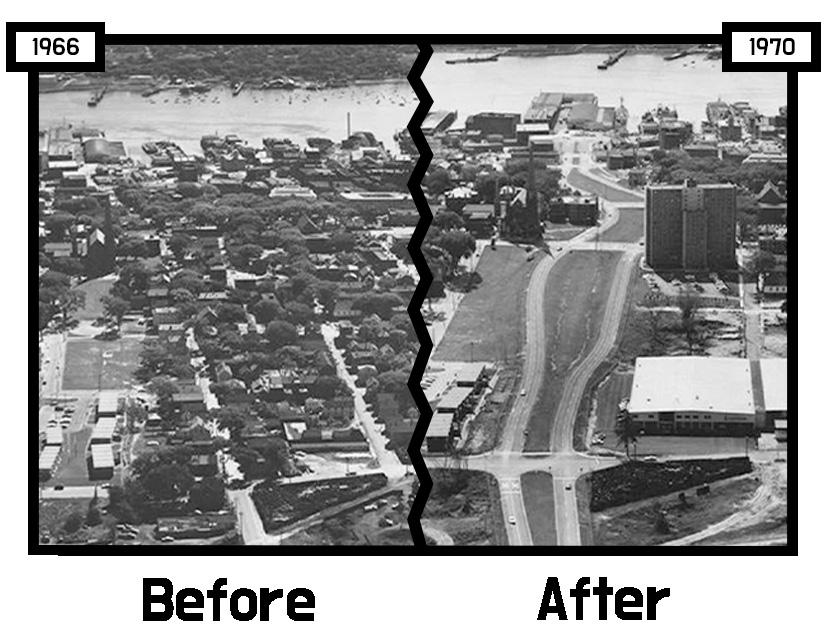
Franklin Arterial Project, 1966 vs. 1970. Sourced from Portland Old Port. www.portlandoldport.com/future-friday-franklin-street-.arterial
Nearly 15 years ago, I attended a visioning session for Franklin Street. In a large room, city staff created an interactive environment where members of the public could share ideas and learn. As a lifelong resident of Greater Portland and someone who has lived in the city since the 1990s, I was shocked at what I didn’t know. I had no idea that this river of roads that now divides the peninsula was once home to thousands of residents. I had no idea that, in 1951, there was something called the Slum Clearance and Redevelopment Authority that, coupled with the broader urban renewal movement, led to some of Portland’s darker and most destructive days. You only have to look at old images1 of these once-vibrant neighborhoods to see for yourself.
In 2015, some six years after that initial brainstorming session, the city released the Franklin St Master Plan 2015 Final Report. This was later updated in 2023: Franklin Street Update 2023 Council Wkshp PPT Sept 11 2023 FINAL.
The Portland Press Herald revisited this subject in February with a terrific article: “Could a revamped Franklin Street once again anchor a lively Portland neighborhood?”
As we move into the next phase toward construction (pending funding) in the next five or so years, I encourage you to learn more and let your voice be heard. The righting of a wrong is long overdue, and reclaiming this land for residents will help mitigate our housing crisis.
Send comments and questions to: Jeremiah Bartlett; jbartlett@portlandmaine.gov
P.S. A BIG thank you to Markos Miller for his tireless work to keep this alive!
1 https://www.portlandlandmarks.org/blog/2020/4/28/historic-preservation-in-the-urban-renewal-era
Hotels vs. Housing The False Choice
“Tourism is a force for economic development and job creation. It brings life to communities and opportunity to families.”
— Bill Clinton

On November 4, 2024, Councilor Kate Sykes proclaimed, “We are in a crisis, so everything we can do needs to prioritize the building of housing, not the building of hotels.” She then called on the Council to support a six-month moratorium on new hotel development, along with a study aimed at increasing the inclusionary fee (a $4,700 per-room tax paid by hotel developers)—or risk being labeled “anti-housing.”
Sitting in the chamber, it struck me that this was less about constructive policy and more about public shaming—part bullying, part false choice—and ultimately a ploy that adds unnecessary cost and complexity for those working to create jobs, prosperity, and vibrancy in Portland. Unfortunately, the measure passed on a 6–2 vote, with Mayor Dion and former Councilor Rodrigues courageously standing as the only “no” votes.
That same night, the Council also voted unanimously to pass ReCode—a major milestone after a decade of hard work by the Planning Department. Its passage was and is cause for celebration, and Planning deserves high praise for their tireless work. Yet behind the scenes, compromises with serious consequences were made to secure passage. One such concession, tying into this misplaced ant-hotel sentiment, was the removal of hotels from the list of allowed uses in secondary, yet still urban business zones like B2b.
While no one can fault Planning for doing what was needed to obtain passage, this capitulation has consequences, erodes economic vitality, stifles opportunity, and how it happened eroded the public confidence in what was otherwise a very transparent process.
Inconsistencies and Public Confusion
Days before the ReCode vote, a constituent and affected property owner identified and aired a glaring inconsistency. In the zoning charts (page 68), boutique hotels are listed as a permitted use in B2b — aligning with longstanding policy. Yet in Section 6.4.19 (page 79), hotels are expressly prohibited in B2b zones.
This internal contradiction (allowing hotels—a previously approved use in the former zoning—in one section, while prohibiting them in a sub-section/fine print) meant that affected property owners had a change forced upon them without notice. We can try to pass this off as a ‘miss’ or clerical error, but the consequences are too high. Trust in government relies on transparency and accuracy—both were undermined by this inaccuracy, the failure to correct it, and the passage of ReCode with this change.
The Argument in Favor – Of a Pause and Increased Tax
The rationale for the moratorium and the increased penalty on new hotels seems to rest on three key premises:
1. A pause will stop more people from submitting hotel applications.
2. Making hotel development more expensive will push property owners to choose housing instead.
3. Funds raised through this tax will help Portland build more affordable housing.
The Problem with The Argument
• There’s no surge of hotel proposals. It’s not as if people are lining up with new hotel plans— there’s no “emergency” driving a flood of applications.
• Hotel vs. housing is rarely a real choice. Developers aren’t choosing between hotels and apartments on the same lot. Sites suitable for hotels are often inappropriate for housing. Denying hotel development doesn’t magically result in more apartments or condos. The two are not interchangeable.
The revenue impact is minimal. So few hotels are being built that this fee increase—unless extreme—won’t significantly help affordable housing efforts. Worse, it will likely act as a deterrent, much like the original inclusionary zoning policy adopted five years ago under the “Green New Deal,” which unintentionally led to less housing, and less affordable housing.
We should be wary of these kinds of reactive, feel-good measures. Instead of relying on penalties and mandates, we should let the free market meet this moment.
In Summary - Let’s play out the logic
• If we never build another hotel, will that result in more housing? No.
• If we overtax those who create new hotels and they walk away or reduce the number of rooms (and thus reduce the per-room fee), will that create more housing? No.
What it will do is result in a host of unintended, negative consequences, which I’ll touch on next.
Bad Policy and Bad Economics
More troubling than the inconsistency is the underlying policy itself. Making it harder and more costly to open hotels, especially in our second-tier business zones, is economically and socially harmful. Here's why:
1. Hotels Supercharge the Local Economy — Even Before Opening
The economic impact of hotel development starts well before the first guest arrives. Local surveyors, soil testers, engineers, architects, contractors, artists, consultants, bankers, brokers, and countless suppliers all benefit during the planning and construction phases. The American Hotel and Lodging Association notes that hotel construction generates millions in direct and indirect economic activity per project — and in secondary markets, this can be transformative.
2. Ongoing Jobs and Economic Ripples
After opening, hotels create a wide range of jobs — from entry-level to management — across industries including hospitality, farming (local food sourcing), art, event management, and maintenance. Guests staying in boutique hotels inject spending into local shops, restaurants, services, and attractions — creating an economic "wake" far larger than the hotel itself.
3. Boutique Hotels Serve Housing Needs Too
In residential areas where condos and apartments often have just one or two bedrooms, boutique hotels provide critical "overflow" for visiting friends and family. They also serve newcomers who haven't yet found permanent housing — a reality in cities experiencing growth pressures.
4. Hotels Offset Airbnb Pressure
Hotels provide legitimate short-term lodging alternatives and reduce the incentive for residential units to be converted into short-term rentals. Studies, such as those by the Urban Institute, show that cities with balanced hotel availability have lower Airbnb-induced housing market distortions.
5. Emergency Shelter Capacity
In times of crisis — whether weather disasters, fires, a pandemic or shelter overflows — hotels offer crucial temporary housing stock, as seen in numerous FEMA responses nationwide.
6. Appropriate Scale and Fit
Boutique-sized hotels (100 rooms or fewer) complement, rather than overwhelm, the surrounding neighborhood fabric.
7. The Myth: "Hotels Crowd Out Housing"
There's no credible data to support the idea that building hotels takes away from housing. Boutique hotels do not cannibalize residential projects. Instead, they preserve housing by providing purpose-built lodging. In fact, cities like Austin and Seattle have actively zoned for small hotels to protect residential housing stock while supporting local businesses.
8. Parking Concerns Can Be Managed
Boutique hotels are accountable for meeting their own parking needs. Cities routinely use approval conditions to ensure this, balancing neighborhood concerns with project viability.
9. Fear of "Hotel Overbuilding" is Misplaced
Hotels, particularly boutique hotels, are notoriously difficult to finance. Lenders demand third party demand studies and proven market viability before funding. Developers won't build speculative hotels where the market doesn't exist.
10. Proven Success Stories in Portland
The Francis and The Longfellow are shining examples. These boutique hotels fit their neighborhoods (out of the Old Port and down-town) beautifully, create quality jobs, support local businesses, and have been widely praised, not opposed.
11. National Examples: Proof It Works
Cities across the U.S. have embraced boutique hotels in mixed-use districts.
• The Ramble Hotel in Denver’s RiNo District is a particularly strong example. RiNo, like inner Washington Avenue, blends residential, commercial, and creative spaces — and The Ramble became an anchor for revitalization without displacing housing.
• The Perry Hotel in Key West’s Stock Island district is another example — revitalizing an industrial area while boosting the local economy without harming housing supply.
Who cares? We all should!
• As elected leaders, Councilors have a duty to ensure consistency, transparency, and public trust.
• As property owners, we deserve accurate information and the ability to plan based on stable rules.
• As residents, we need thoughtful policies that support housing and economic vitality — not false choices.
At a time when local businesses are struggling, retail and office vacancies are rising, and remote work threatens downtown cores, Portland can’t afford to strangle smart, modest growth. We need more housing, more jobs, more customers for locally owned businesses and we need more ways to spread critical tourist dollars beyond the Old Port and downtown into neighborhood business areas.
More hotels, especially outside of downtown, are one of the best ways to do exactly that.
They stimulate the economy. They ease housing pressures. They sustain local businesses. They enliven neighborhoods. They provide resilience. They make sense.
What Now?
I urge the Mayor and City Council to lift the pause on new hotel development, maintain the current inclusionary fee per room (or better yet, eliminate this tax all together), and direct Planning to revise zoning in our secondary business districts—such as B2 and B2b—to once again allow hotels as a permitted use.
If we’re serious about addressing the housing crisis, there are far more effective, impactful ways to do so. I outline many of them in my book Priced Out of Portland and expand on them in an upcoming white paper, soon available at Home with Tom Landry. Let’s commit to real solutions—not false choices with costly consequences.
Want Proof? Here is what the research says. Hotels as Catalysts for Economic Vitality
Job Creation and Local Spending:
Hotels directly employ local residents and rely on nearby suppliers, which ensures that a large portion of their revenues stay within the community. According to research from the American Hotel & Lodging Association (AHLA) and Oxford Economics (2023), the hotel industry supports 8.3 million
jobs nationwide and contributes $211 billion in taxes at the federal, state, and local levels. Source: American Hotel & Lodging Association and Oxford Economics, 2023 Economic Impact Study
Stimulating Local Economies:
Hotels, especially midscale and economy properties, play a crucial role in stabilizing and stimulating local economies by supporting small businesses and generating consistent visitor spending. Analysis shows that for every $100 spent at a hotel, an additional $222 is generated in local spending across restaurants, retail, transportation, and entertainment.
Source: American Hotel & Lodging Association, “Economic Impact Report” (2023)
Hotels and Housing Affordability
Buffering Housing Price Increases: Research indicates that developing more hotel accommodations can help alleviate pressure on local housing markets. By offering sufficient lodging options for visitors, hotels reduce the demand for converting long-term residential units into vacation rentals. A study published in Research in Transportation Economics found that adequate hotel supply is associated with less strain on rental housing and helps maintain greater housing affordability in high-tourism markets.
Source: Research in Transportation Economics, “The Impact of Tourism Accommodation on Housing Markets,” Volume 91 (2022)
Supporting Local Businesses
Economic Diversification and Local Business Growth:
Hotels contribute to the diversification and vitality of local economies. Research shows that hotel guests spend significantly on local services and businesses, creating a ripple effect that supports a wide range of industries, from food service to transportation to cultural attractions. Areas with strong hotel industries typically experience faster small business growth and more stable job markets.
Source: Lodging Magazine, “Hotels’ Role in Local Economic Development” (2023)
Contact: Tom Landry
Broker/Owner, Benchmark Real Estate
207-939-0185 | tomlandry@benchmarkmaine.com www.benchmarkmaine.com
About Benchmark Real Estate
Benchmark Real Estate, based in Portland, Maine, is a locally owned and operated firm specializing in residential, luxury, and investment properties. Led by top-producing broker Tom Landry, Benchmark is known for market expertise, client-first service, and a results-driven approach.
The Blame Game
“Concern yourself more with accepting responsibility than with assigning blame. Let the possibilities inspire you more than the obstacles discourage you.”
— Ralph Marston

There are many reasons we find ourselves in the housing situation we are in, and I’ve outlined several of them already. However, I often hear people assigning blame.
A few examples:
• “It’s people moving here from larger cities.”
• “It’s greedy landlords making Portland unaffordable by raising rents.”
• “It’s the city and their lack of planning.”
• “It’s immigrants coming here and taking up all the housing.”
• “It’s the fact that we allow short-term rentals.”
• “It’s baby boomers who are driving up the prices.”
• “It’s high interest rates.”
• “It’s those greedy developers.”
• “It’s the fact that the city has become too desirable.”
• “It’s the publications that put us at the top of the most desirable places to live.”
• “It’s sellers who purchased years ago for pennies and want to sell for millions.”
• “It’s companies that aren’t paying a livable wage.”
• “It’s gentrification.” …and so on and so on…
But playing the blame game doesn’t help anyone. That is scapegoating—focusing on assigning blame instead of looking for a solution. When special interest groups, who all have their own agendas, attempt to implement solutions for the wrong problems, we wind up with unintended consequences. We need only look at rent control and the Green New Deal. The first has had no impact on rental rates and the latter has led to fewer building permits. Right now, there are efforts to further curtail short-term rentals. These and more are solutions to the wrong problem that often hurt those they intend to help.
The answer is to significantly up-zone and re-zone to meet the needs of today and tomorrow.
• Want to reduce the sting of inflation? Up-zone & Re-zone!
• Want to offset the cost of housing? Up-zone & Re-zone!
• Want to ensure people make a livable wage by reducing the cost of living? Up-zone & Re-zone!
• Want to create an economically diverse city? Up-zone & Re-zone!
• Want to have housing closer to employment centers? Up-zone & Re-zone!
• Want to help people save and invest? Up-zone & Re-zone!
• Want to counterbalance high interest rates? Up-zone & Re-zone!
• Want to have a positive impact on the environment? Up-zone & Re-zone!
What does up-zoning and re-zoning look like in Portland?
• We will have more housing of all types and for all budgets.
• Rents will stabilize and come down.
• Open spaces will be preserved.
• Suburban areas (West End, East End, and nearly everything off-peninsula) will remain as they are and how we love them.
• Portlanders will wake up to a more walkable, bikeable, public-transportation-commutable, livable, and much more affordable city.
We Must...
“Change will not come if we wait for some other person or some other time. We are the ones we’ve been waiting for. We are the change that we seek.”
— Barack Obama

1. We must take bold and immediate actions to increase housing supply of all types.
2. We must expedite and streamline the process from pre-application to permit-in-hand.
3. We must break down the silos between departments and simplify and streamline the process from planning to permit-in-hand.
4. We must create a culture of collaboration with the development community.
5. We must solve the housing crisis in a climate-conscious and people-conscious way.
6. We must remove obstacles that disincentivize development and have unintended consequences.
7. We must go beyond affordable housing as the answer to a place of knowing that more housing is the answer to ensuring there is more affordable housing.
8. We must identify city-owned properties that can be re-zoned and up-zoned and put them out for RFP.
9. We must go beyond the idea that ADUs, adding a few 2-4 units here and there, and building a few 300’ skyscrapers on the peninsula will solve the problem.
10. We must dramatically re-zone and up-zone current business zones, most of the land on the peninsula, in neighborhood centers, and along busy arterials.
11. We must re-zone and up-zone industrial land on and off the peninsula.
12. We must look at ways to mitigate the potentially negative impacts as we implement LD2003 in our residential areas (R3 zones).
13. We must ensure all residents are a short walk to all they need for daily living. Let’s make every location a complete neighborhood and eliminate all food deserts.
14. We must look for best practices locally, regionally, nationally, and internationally.
15. We must vote for politicians who make increasing housing supply a top priority.
Let Your Voice Be Heard
“The world as we have created it is a process of our thinking. It cannot be changed without changing our thinking.”
— Albert Einstein

What You Can Do:
1. Attend and speak in favor of new housing developments presented to neighborhoods and boards such as Historic Preservation and Planning.
2. Volunteer to be on boards such as Planning, Historic Preservation, Zoning Board of Appeals, and others, and speak up for more housing.
3. VOTE NO on housing referendums—this is no way to set housing policy.
4. Share the message that increasing supply is the best solution to our housing shortage.
5. Contact these people—right now:
• City Counselors: council@portlandmaine.gov
• City Manager: citymanager@portlandmaine.gov
• City Clerk: cityclerk@portlandmaine.gov
• Housing & Community Development Division Director: mpd@portlandmaine.gov
• Assessor’s Office: assessors@portlandmaine.gov
• Planning Division: planning@portlandmaine.gov
• Rent Board: rentboard@portlandmaine.gov
• Zoning Administration: zoning@portlandmaine.gov
• Ethan Hipple, Director of Parks and Rec: ehipple@portlandmaine.gov
• Ameriz Gamez, Planner: agamez@portlandmaine.gov
• Bruce Hyman, Transportation Program Manager: bhyman@portlandmaine.gov
• Eric Freeman, Planner: efreeman@portlandmaine.gov
• Evan Schueckler, Historic Preservation Program Manager: evans@portlandmaine.gov
• Helen Donaldson, Acting Deputy Director: hcd@portlandmaine.gov
• Jennifer Munson, Office Manager: jmy@portlandmaine.gov
• Kevin Kraft, Acting Department Director: kkraft@portlandmaine.gov
• Matthew Grooms, Development Review Services Manager: mgrooms@portlandmaine.gov
• Maxwell Martin, Development Review Coordinator: mjmartin@portlandmaine.gov
• Maya Balassa, Planner: mbalassa@portlandmaine.gov
• Megan Cindrich, Principal Administrative Officer: mcindrich@portlandmaine.gov
• Natasha Kypfer, Senior Planner: nkypfer@portlandmaine.gov
• Robert Wiener, Associate Preservation Planner: rwiener@portlandmaine.gov
• Sean King (PLA), Urban Designer: sking@portlandmaine.gov
• Talor Colbeth, Administrative Assistant: tcolbeth@portlandmaine.gov
• Zachary Powell, Senior Planner: zpowell@portlandmaine.gov
• Mark Dion, Mayor: mdion@portlandmaine.gov
Draw & Describe Your Ideal Portland
Use this page to draw and describe your ideas for the best Portland possible. When done, take a picture and email it to landryteam@benchmarkmaine.com. We will post and share.
Resources
• Portland Maine - www.portlandmaine.gov
• Portland’s Plan 2030 - portlandmaine.gov/484/Portlands-Plan-2030
• ReCode Portland - www.recodeportland.me
• Congress For The New Urbanism - www.cnu.org
• American Planning Association - www.planning.org
• Urban Land Institute - uli.org
• Mercatus Center - www.mercatus.org
• Housing Supply Accelerator Playbook - planning.org/publications/ document/9289884
• Strong Towns - www.strongtowns.org
• Smart Growth America - smartgrowthamerica.org
• Market Urbanism - www.marketurbanism.com
• GrowSmart Maine - growsmartmaine.org
• Urbanist Coalition of Portland - urbanistportland.me
• YIMBY Portland - yimbyportland.me
• Build Maine - www.build-maine.com
• National Housing Conference/Housing Recourse Center - hrc.nhc.org
• Governing - www.governing.com
• The Dark Side of Historic Preservation - www.discoursemagazine. com/p/the-dark-side-of-historic-preservation
• Historic Preservation Is Great, Except When It Isn’t - www.governing. com/community/historic-preservation-is-great-except-when-it-isnt. html
• News Center Maine: “Maine Needs Nearly 80,000 New Homes By 2030” - www.newscentermaine.com
An Exclusive Interview with Bangor Daily News

In this book, I explore the root causes of Maine’s housing crisis and present bold solutions to help resolve it. From eliminating inclusionary zoning to increasing density in downtown areas, I believe these changes are critical for meeting our housing demand. Below are some key thoughts I’ve shared in an interview with Zara Norman with Bangor Daily News.
BDN: Your book is called “Priced out of Portland,” but a lot of what you write can be extrapolated and applied to other cities and other towns all across Maine. Why have communities of all sizes been so unable to respond to the changing market conditions of the last few years? Why are we so ill-equipped to meet this moment?
“It’s a very valid question. I think that gets to the frustration people have, right? However, the population of Maine hasn’t increased except in the last several years. We’ve been chugging along, with maybe Cumberland County doing fairly well but still nowhere near the growth other places have seen.
You don’t build housing in advance of the need, so I think it’s OK to let ourselves off the hook. We weren’t going to build on spec when there was no demand. But now there’s demand, which really started because of COVID and the “work wherever you want, live wherever you want” trend. Now you add in climate change, climate
migration, and you wind up with this perfect storm. We need to act swiftly. Nobody’s to blame, but we need to do something now.” - Tom Landry
BDN: That’s something you explore in your book: How do we build all this housing without worsening our climate crisis? For you, the answer to that is density.
“Oh, absolutely. We have to build significantly taller.
I think rural communities have much more at stake here, because if they can look at their downtowns and up-zone and rezone them, they’re going to create walkable environments. They’re going to create these vibrant downtowns which we saw 70 or 80 years ago, before the flight of people out of urban areas, before the automobile took over. I think we need to just get back to that. These rural areas need to think about their zoning, and some of the worst zoning that they have is 4-acre minimum [lots]. The idea was to keep growth away. Well, it just created sprawl, and it’s just terrible for the environment, terrible for our way of life, and also is one of the things that we do that has the worst carbon impact. The zoning needs to change.” - Tom Landry
BDN: You write that, in meeting our housing goals, we need to “go beyond” affordable housing and unleash market forces to fill that void. But if we don’t mandate affordable housing construction, how are we going to sort of ensure that affordable units get built?
“To me, that’s just a fundamental misunderstanding about how this works. The free market is going to apply. When municipalities do inclusionary zoning, you have consequences. It adds a level of complexity — usually cost — and it causes [developers] to pause. So how do you do it? You really try to streamline the process for building and building more of any type.” - Tom Landry
BDN: Does that also hold outside of southern Maine, where there’s less private demand?
“Absolutely. It’s supply and demand, fundamental economics. If
you increase supply, anything at any price point, it’s going to help meet that demand and drive prices down.” - Tom Landry
BDN: How big a role do you think the not-in-my-backyard phenomenon plays in our low housing inventory?
“It is a huge thing. We say to ourselves, “Yeah, I’m all for housing, but,” you know? “Not by me,” or, “not if it affects my view.”
To me, the thing that’s going to help with the whole “NIMBY” thing is if municipalities up-zoned in places which are not going to cause consternation. If we build in the business zones, in the downtowns, those are already commercial areas.
That’s less chance for people to say, “Well, I don’t like that because it’s blocking my light or my view,” because it was always a business area. Let’s think strategically.” - Tom Landry
BDN: What do you hope reading your book inspires people to do?
“I hope they get involved. I hope they say, “I have agency, I can go down to City Hall and talk to my planning department and talk to my economic development folks and say, “What are we doing right now, to plan ahead, not be reactive?
We are in a reactionary mode. That’s fine, but we need to take fairly bold action because the demand is there. We know it’s there, we’re on the backside of that. We probably haven’t done enough and quickly enough. So, what are we doing right now?
I hope that people realize that they have a voice in this. We’re going to have [sprawl] if we don’t plan ahead and start to really rethink our zoning statewide.” - Tom Landry

Zara Norman znorman@bangordailynews.com
news@bangordailynews.com

Advice for buyers, sellers, investors, developers, current and potential property owners, agents and anyone interested in real estate. Tom talks about sales, building, remodeling, restoration, development, financing, marketing, what he loves locally and more. No matter your interest, Home with Tom Landry can help. A Realtor®, developer, business owner, and entrepreneur, Tom Landry is one of the most accomplished and respected real estate professionals in Maine. Welcome Home With Tom Landry! homewithtomlandry.com



WORK WITH THE BEST
When you work with Benchmark Real Estate, expect the highest level of service, an exceptional experience, and outstanding results. Led by Portland Maine’s top Realtor for over two decades, our team of local market experts provide concierge-level service from the first interaction to long after closing. If you’re buying, selling, investing, or developing in Greater Portland, work with the best.
benchmarkmaine.com

COMMERCIAL & RESIDENTIAL CONSTRUCTION
As design professionals, general contractors and builders, we provide a full spectrum of design, building, restoration, and renovation services throughout Maine. From ground-up construction of high-tech commercial spaces and modern condos, to full scale historic restorations and construction of the finest residential buildings, we provide unparalleled service and results.
cornerstonebr.com
Praise for Priced Out of Portland
“Tom is spot on. Portland hasn’t been allowing enough housing to be built, and the environmental, economic, and equity impacts are only going to get worse unless we make it a lot easier to build housing and focus on more walkability and bikeability, especially along our corridors.”
-Liz Trice, Portland resident
“Tom’s experience as a real estate broker, developer, and businessman gives him a unique perspective to call from when breaking down the complex issue of housing. This digestible overview of the housing crisis and associated practicable solutions should be taken seriously. The development community is ready to get to work building new homes under smart growth principles, and Mainers who are looking for stable, attainable housing can’t wait any longer. The time to act is now.”
-Sam Lebel, Civil Engineer
“Don’t let the colorful cover fool you. Tom provides a comprehensive yet quick-moving look at a highly complex issue. More importantly, he offers some surprisingly simple solutions.”
-J. Baldwin
“Good land use is a tide that raises all boats. Whether you care about housing affordability, equity, the environment, transit, or economic growth, more is possible when we make room for people. This call for a bold ReCode is a once-in-a-generation chance to get our land use right, not just for today, but for the next generation.”
-Todd Morse, President, Urbanist Coalition of Portland
Praise for Priced Out of Portland
“Priced Out of Portland offers a compelling agenda to get housing production and affordability back on track. We urge all policymakers to take the recommendations seriously so that Portland can build once again.”
- Portland Regional Chamber of Commerce
“Priced Out of Portland should be required reading for any city staff involved in housing, the city council, the Mayor, Manager and anyone running for local
- C. Collins
“Tom is right that Portland has seen in recent years that the most wellintentioned aspirations for housing creation will not come to fruition unless the city’s land use ordinance matches its stated ambitions for housing creation in Portland’s Plan 2030*. ReCode presents a unique opportunity to align the city’s goals with the actual laws in place. Tom’s insights should be read by everyone engaged in ReCode and taken to heart.”
- MEREDA (Maine Real Estate Development Association)