
BH CELEBRATES SEÑOR MONTOYA
After 31 Years at Belmont Hill, Señor Montoya Leaves His Mark
By Billy Palumbo ’28 and Tiernan Emmert ’28 Panel Staff
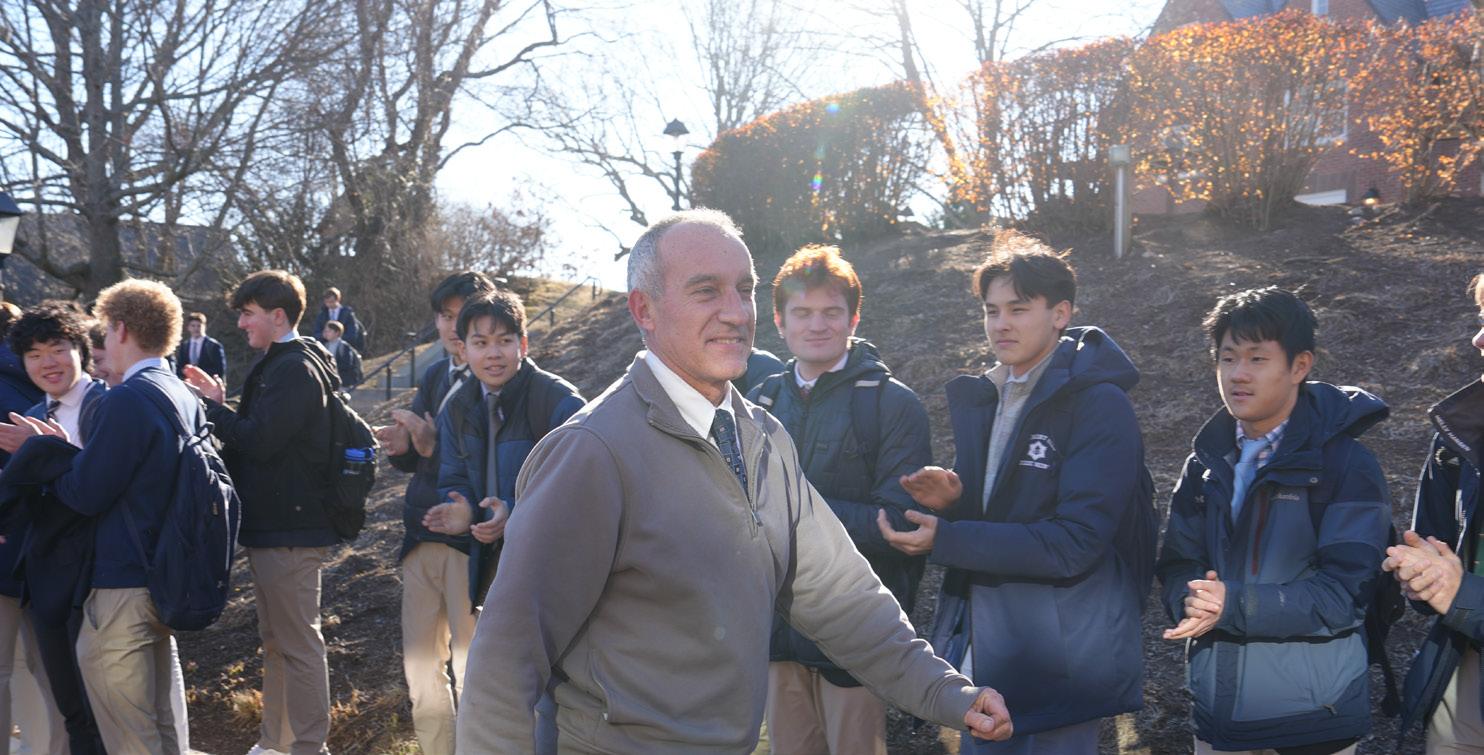
On January 16, 2026, Belmont Hill said goodbye to Señor Montoya after 31 years of service to Belmont Hill. Sr. Montoya is an alumnus of Boston College, having captained the men’s Soccer Team in his senior year. After graduating in 1984, Sr. Montoya continued his soccer career as a player for seven seasons in professional soccer. In 1993, he began his Belmont Hill journey and immediately contributed on both sides of campus. Through patience, clarity, and a genuine love of learning, generations of his students have not only learned to speak Spanish but also to appreciate the culture that comes with it.
Sr. Montoya's legacy at Belmont Hill is best seen in his love of learning and his true passion for bettering his students. “He focused on every single one of the guys in our class,” recalled Eli Norden ’26. “Even though we were all at different levels, Sr. Montoya worked to level the playing field.”
Since 1993, Sr. Montoya has coached the Varsity Soccer team, leading them to 15 appearances in the NEPSAC tournament and five ISL titles. Sr. Montoya holds an impressive 340-12484 record as head coach of the soccer team. Mr. Bracken ’15, Assistant Varsity
Coach and former Varsity Soccer athlete, mentioned Sr. Montoya’s “immense sense of fun” and ability to make practices enjoyable. Many of Coach Montoya’s players attest to his contagious enthusiasm that brought an unmatched level of energy into every practice. Another characteristic that made Sr. Montoya's coaching special was his ability to adapt. Because of Belmont Hill’s smaller size in comparison to other New England Prep Schools, the recruitment process is often challenging. Coach Montoya's ability to adapt his style of play to his players while consistently delivering success makes him such a great coach. Even as his team adapted, Coach always enforced a strict culture of team -
work and selflessness. As his time at Belmont Hill comes to a close, the legacy left behind remains clear: stronger students and a program shaped by excellence. Besides his impressive accolades and success, Sr. Montoya’s true legacy is in the example he set for those around him. Mr. Bracken commended his fun-loving personality and genuine sense of humor. In addition, he mentioned Sr. Montoya’s ability to remain calm and composed in tricky situations multiple times. Mr. Bracken mentioned a match a few years back against Brooks in which the squad was not playing up to par. Despite this, they pulled off an upset win against all odds. Throughout the game and the practices leading
up to the match, Mr. Bracken recalls that Sr. Montoya stayed calm and collected. This mentality was not reserved only for game days, either. On the way home from one of the soccer team’s trips to Costa Rica, their flight was canceled, and another one wasn't available for three days. Mr. Bracken lauded his coach’s demeanor: “He was so calm and composed…He ended up getting us home pretty much that same day. And so nothing really fazes him. He’s super calm, and he just models composure under pressure in a really positive way.” Real legacy isn’t built through championships or banners; it is in the impact coaches have on their players. This situation has certainly not been forgotten by Sr. Montoya’s players and fellow coaches. Actions like this have made Sr. Montoya a role model and leader on campus. After 31 years, replacing a figure as influential as Sr. Montoya will not be easy. Mr. Bracken said that transitions after tenured coaches are always difficult. Belmont Hill soccer has faced similar situations before and has continued to succeed. What makes this transition possible is the foundation Sr. Montoya leaves behind, a program built on accountability, adaptability, and genuine care for its players; Sr. Montoya’s legacy will continue to impact his players, students, and colleagues, well after his departure. ☐
Nat Fleck '59 Alumni Profile: An Exclusive Interview
By Patrick Snail ’28 Panel Staff
If you had one message that embodies your story, what would it be?”
The voice on the other end of the line paused, calculating each word before carefully stating, “I chose to have a rich life, not becoming a rich person.”
Nat Fleck ’59 graduated from Belmont Hill 67 years ago and has since lived an adventurous life. Growing up in Lincoln, Massachusetts, Fleck attended Belmont Hill before studying physics at Williams College in Western Massachusetts. After graduating, he taught in multiple countries and traveled extensively with the Peace Corps. Outside of work, Fleck immerses himself in nature. His experiences range from learning to canoe at a young age to biking over 60,000 miles, backpacking over 4,000 miles, and even becoming a published photographer.
When applying to college, Fleck chose Williams College, where he ma -
Page 2: Detainment of President Maduro

jored in physics, inspired by a Beta version of a physics course from the Physical Science Study Committee at
MIT he took in his senior year. As he approached graduation, Fleck was unsure of his career and lacked confi -
A Look Inside The Panel
Page 4: Artist of the Issue
dence: “I didn’t feel like I was ready to go on to graduate school. I grew up in a very sheltered environment in Lincoln, Belmont, and Williams.” Luckily for Fleck, he had past experiences to guide him. On Moosehead Lake in Northern Maine, Fleck’s grandfather ran a canoeing camp. The lake was so secluded that one could only reach it by foot, boat, or seaplane. Fleck spent lots of time at his grandfather’s camp, learning to canoe with the J-stroke and Indian-stroke and taking relaxing walks to examine the nature around them, before teaching the same lessons to younger children when he was in high school.
“What I really knew how to do well was work with kids,” Fleck reflected. Additionally, Fleck has two uncles and a grandfather who were teachers. Using these as inspiration, he contacted the Dean of Students at Williams and asked about pipeline schools to Williams. Continued on page 3...
Adrian Chen ’28 and Ryan Ho ’28 delve into the recent detainment of President Nicolás Maduro with a detailed analysis as well as an interview of faculty member Mr. Duarte about the incident.
Page 8: Winter Activities Poll
Tiernan Emmert ’28, Billy Palumbo ’28, and Shea McDonald ’28 write a light-hearted article about a survey they sent out to the entire school ranking the best activities to partake in during the winter season, and analyze the final results of the poll.
Liam MacLean ’27 writes this issue’s Artist of the Issue on senior Will Achtmeyer ’26, detailing Will’s endeavors in filmmaking, cinema, and theater throughout his time as a devoted member of the arts at Belmont Hill.
Page 10: Mr. Schneider as New Soccer Coach
Tyler Grossman ’27 reports on Mr. Schneider’s recent promotion to head Varsity Soccer coach, and details his soccer journey to Belmont Hill as well as his goals and hopes for the future of the team in the coming seasons.
Mr. Montoya Clap Out
BH Communications
Nat Fleck '59 in Giza
Nat Fleck '59 Website
Mr. Duarte: US Detainment of Nicolás Máduro
By Adrian Chen ’28 and Ryan Ho ’28 Panel Staff
On January 3, 2026, Venezuelan President Nicolás Maduro was captured by US Forces in a large-scale military operation called “Operation Absolute Resolve.” Taking just about two hours and 20 minutes, this operation involved 150 aircraft and 200 Special Operations forces, with no American casualties.
An early supporter of Hugo Chávez, Máduro campaigned for the former’s release after a failed 1992 coup. In 1998, Chávez became president of Venezuela, allowing Maduro to quickly rise in the ranks of the government. Under the rule of Chávez, the Plan Bolivar 2000 program was created, which included road building and housing construction, highly popular policies among Venezuela’s masses. However, after Chávez appointed political allies to the head of the state-owned company PDVSA, Chavez rapidly fell out of popularity.
Before his death in 2013, Chavez named Máduro as his successor, leading to Máduro's narrow victory in the subsequent election. In the following years, Maduro would rule as an authoritarian leader with highly disputed elections in 2018 and 2024. Over this period, Venezuela experienced a 75% drop in GDP due to mismanagement and declining oil output. In recent years, the US State Department has accused Maduro of narco-terrorism and drug trafficking, eventually leading to his ousting.
For many Venezuelan families living abroad, the events unfolding have brought a complicated mix of relief, hope, and cautious optimism. This news marked a moment many had long believed might never come. We spoke with photography teacher Mr. Duarte (the Chair of Visual Arts at Belmont Hill School), whose family still mostly lives in Venezuela, to understand what these developments mean on a personal level, beyond news outlets, the headlines, and politics. His perspective offers a tangible account of how Chávez and Maduro’s rule affected everyday life and what his removal represents for those who endured it.
Mr. Duarte learned the news in the early hours of the morning. “It’s an experience I’ll never forget,” he said. “My

phone buzzed at around 3:00 A.M. I had missed six or seven calls from my dad.” Expecting bad news, he picked up the phone only to hear music and celebration in the background. “I stayed up all night.”
His father is the only member of his immediate family who was able to immigrate to the United States, while the rest remain in Venezuela. Like many families separated by the crisis, WhatsApp became their primary means of communication. Hugo Chávez, Maduro's predecessor, came to power when Mr. Duarte was 13 years old, bringing with him a socialist revolution in Venezuela. Under the new regime, Mr. Duarte was no longer able to return to Venezuela. As a child, he would travel back to Venezuela every year to visit his family. “When we traveled [as a child] to visit family, it was a joyous experience. I was very close to my family there. There were parties, family gatherings, beach gatherings.” Mr. Duarte recalled. “And always enough food.” While poverty existed, his family never faced deprivation. That changed dramatically as corruption, inflation, and violence worsened under the regime.
“Never in my life did I think I would see it happen,” Mr. Duarte said of Maduro’s removal. After years of protests, marches, and rigged elections,
disappointment became routine for him. “There was a part of me where I was about 98% sure I would never go home. I was starting to come to peace with that chapter of my life that would just be memories from the distant past.”
As Venezuela’s economy collapsed, daily survival became increasingly difficult. The government implemented a rationed food distribution system tied to identification numbers. “If your day to buy food came and there was no chicken, you just didn’t get chicken,” he explained. Mr. Duarte and his father in the U.S. began sending frequent shipments of supplies to relatives in Venezuela: powdered milk, basic medicine, toilet paper, soap, and clothing. These items had become scarce or unaffordable. Over time, even video calls changed. “We noticed the FaceTimes getting shorter,” he said. “Our family was losing weight and looked gaunt. They didn’t want us to worry.”
In the aftermath of Maduro’s removal, Mr. Duarte says his family feels relief, but not certainty. “They’re very happy,” he said. “I don’t have a single family member who expresses hatred toward the United States.” Still, they remain “cautiously optimistic,” a term Mr. Duarte often used, aware that many figures from the Maduro regime remain in positions of power
and that rebuilding political and economic infrastructure will take time.
Mr. Duarte emphasized that his reaction, and that of his family, should not be misinterpreted through partisan lenses. “People assume that because I’m happy about Maduro’s removal, I support everything associated with it politically. That kind of binary thinking is dangerous,” he said. “You can support one outcome without endorsing everything behind it.” He also urged Americans to consider their own lived experiences when discussing Venezuela. “Many people here analyze this from a theoretical perspective, because they’ve never lived in those conditions,” he said. “When you’ve lived like that for 27 years, like an animal in a cage, you don’t have the ability to sit and think about hypotheticals.” His message is not one of certainty, but of urgency. “There are a lot of unknowns in the next year or two. This is not over,” he said. “But when the alternative is continuing the same suffering, people are willing to try something different.”
As Venezuela enters an uncertain transition, Mr. Duarte hopes that Venezuelan voices remain at the center of the conversation. “Listen to the people who lived it,” he said. “If you haven’t lived it, you can’t speak over them.” ☐
China Conducts Military Drills Near Taiwan
By Ryan Li ’28 and Cooper Schuldt ’28 Panel Staff
On December 29th and 30th Taiwan’s defense ministry detected 89 military aircraft and 28 warships participating in firing drills around Taiwan. The Chinese military participated in many firing drills as China moved parts of the PLA Army, Navy, Air Force, Rocket Force, and Coast Guard to surround Taiwan. China conducted live firing in seven zones around Taiwan, which marked the largest exercises to date. China’s military also launched missiles and rockets as part of their drills. Due to China’s exercises, Taiwan remained on high alert during the period. Taiwan’s Ministry of Transportation and Communications stated that hundreds of flights were cancelled, affecting tens of thousands of passengers on both international and domestic flights.
Chinese embassies have stated that they wish to unify China and create “One China” and the drills could be a part of their plan to unify Taiwan with China. Xi Jinping has claimed that

unification is inevitable. However, most Taiwanese people have stated in various polls that they want to keep the status quo. Currently, Taiwan is a democracy with its own military, government, and economy, so most wish to maintain those institutions. Nationalists fled and took control of Taiwan in 1949 when the People’s Republic of China was founded. However, most Taiwanese people do not
want to claim formal independence because of the threat China poses to them.
The attacks occurred just eleven days after an $11.1 billion arms sale to Taiwan from the US, the largest ever in the island’s history. The deal drew protests from China’s defense ministry, with warnings that the military would take forceful measures. Taiwan’s defense ministry posted a video on Facebook
showing its new weapons, including the US-made HIMARS rocket system, which has a 300-kilometer (186-mile) range and covers several regions in China’s Fujian province. In response, China’s defense ministry released a video weaponized robot dogs and microdrones. Additionally, China’s state broadcaster said the exercises were focused on sealing off two of the island’s port cities, Keelung in the north, and Kaohsiung in the south.
Chieh Chung, a researcher at Taiwan’s Institute of National Defense and Security Research, said, “They are sending a strong message on external interference.” He also explained how China cut off links to Japan to the north for three zones. On the other hand, Fu Zhengyuan, a researcher at China’s Academy of Military Science, claimed that increased communication between Taiwan and the US posed a threat, thereby justifying the attacks. Now that both China and Taiwan are engaged in a developing arms race, the exercises could rapidly escalate, leading to a much longer conflict, especially given China’s fear of US involvement.
Protestests Against Maduro US State Department
China Military Drill 2023
Global Times
Cont. Nat Fleck '59 Alumni Profile: An Exclusive Interview
Continued from page 1...
“He gave me the school, Northfield Mount Hermon, so I applied and fortunately was able to take the job there.”
He began teaching math at the boarding school, which he recalled being “academically extremely similar to Belmont Hill School.” After a while at Mount Hermon, Fleck was eager for new experiences. Luckily, he found an advertisement for a teaching position at The American School in Switzerland, and was soon offered a job. The program in Switzerland was a post-graduate program for kids who finished high school but did not feel quite ready for college.
“It was an amazing program,” Fleck explained, “I was teaching courses as I would at Belmont Hill if I were to teach there.” Interestingly, school started as soon as they left for Switzerland: “I was helping students get higher math SAT scores on a ship in the middle of the Atlantic!”
After his time in Switzerland, Fleck found a job at the Colorado Rocky Mountain School near Aspen. “That’s where I learned my real teaching craft,” Fleck stated, “For one, we gave no grades, but we were told to leave a comment on each assignment, which included at least one positive thing in it, no matter what. That made all the difference in the world.” He noticed that weaker students improved dramatically and accomplished much more than they had previously thought possible.
Fleck also spent five years teaching in Africa. While serving in the Peace Corps, Fleck moved to Ghana to teach in a girls’ school. The school was one of six high schools, half boys’ schools and half girls’, composed of the top students from all of Ghana. At Fleck’s school, he had girls from 26 tribes, each speaking a different language, and instruction was also in English. Although there are negative stereotypes surrounding education in Africa, Fleck recalled that he was “teaching the same level of physics that he learned at Williams.”
Additionally, the selectiveness of the school provided an extra perspective on his own quality of life: “The education is so far out of village life. It really makes you realize that you take so much about your education, let alone a Belmont Hill education, for granted.”
Aside from his teaching in Ghana, Fleck also taught at an international school in Zambia for two years. The

students came from all over the world; in fact, the graduating class represented 24 countries. Lastly, he also spent a year teaching Egyptian students in an Egyptian school in Cairo with the now-shuttered United States Agency for International Development (USAID) before the program was shut down prematurely.
Unlike a “normal” job, international teaching allowed Fleck to explore the world year-round. “I would have only had two to three weeks to vacation each year. With teaching, I could continue exploring all the time.”
Among many stories of his travels in Africa, notable ones include climbing Mount Kilimanjaro for four days and descending for two, finding mountain gorillas in Zaire, and visiting the Pyramids of Giza.
Fleck’s outdoor adventures don’t end in Africa. Rather, they just scratch the surface. As mentioned before, Fleck is an experienced canoer and has often gone on month-long expeditions. However, his most impressive expedition was his 1,000-mile backpacking trek from the Oregon-California border to Canada.
Before his excursion, Fleck was teaching at a school in Atlanta, and he and his wife did not like it. Looking for an alternative experience, they decided to backpack the Pacific Crest Trail. Starting on the Oregon-California border, they spent three months traveling over 1,000 miles. “We were carrying all our food, tents, clothes with us, and on the whole way, we had five stops at the only five roads we saw to pick up more food,” Fleck recalled picking berries with his wife to accompany their dinners as
they made their way north into Canada.
Moreover, the wildlife on the trip was incredible. Fleck remembered seeing bighorn sheep, a lynx, black and grizzly bears, and more.
“You know, I grew up without much confidence, but doing something like this trip instills a lot of confidence in you,” Fleck reflected on the unique lessons he learned on this trip. “You feel like, Good Lord! I accomplished this whole trip. I walked for three months for a thousand miles! The more you do that, the more you feel like a person who can accomplish challenges like that. You learn to have a ‘can-do’ attitude.”
Apart from his backpacking journeys, Fleck has made countless biking trips: “I’m an environmentalist, so I’ve made sure to live close to work so I can bike there.”
For ten summers, Fleck went on biking expeditions, nine of which were over 1,000 miles. He even biked in Greece, realizing that Ancient Greece was settled because of its mountainous terrain.
Even though driving a car is much faster than biking, Fleck finds it important to slow down and observe: “You learn so much more about the place you’re traveling through when you are biking. When you are driving, it’s all one blur. You don’t actually learn.”
Tagging along with all of his outdoor activities is his camera. Fleck, a published photographer, avidly documents his travels through photography. He posts his pictures online on his own website and on Flickr. His work ranges from places, including New Mexico, Vermont, and Costa Rica, to vehicles, to more na -
ture-focused topics, such as trees, birds, and, of course, his own exciting travels
“It’s been an exciting life,” Fleck admitted to me, “I never set out to make a lot of money, and that has allowed me to live in five countries, eight states, backpack for thousands of miles, become a ski-instructor in Colorado and New York, and all my other adventures.”
Fleck used his father as a counterexample for his ideology. His father, who came from a wealthy family, wanted to pursue a career in foreign services. However, his family convinced him to major in business in order to keep the family business going. Fleck explained that “it is important to be careful about your choices. Do not get swayed by the prospect of a big salary. That gets a lot of people into trouble.”
He related another story: “One of my good friends from Belmont Hill went to Harvard Law School because he knew that lawyers made a lot of money. After years of studying, he got a job at a very prestigious firm, but as soon as he started working, he realized that he hated practicing law!”
Fleck encourages people to focus on passion rather than success: “Don’t become a doctor because you can make a lot of money. Become one because you love the profession.”
Fleck has made many choices that others found questionable, and he admitted he regretted them at times. Sometimes, he wished that he had gotten his PhD in physics so that he could have a higher standing in society, or maybe become a recognized research physicist. However, in the end, Fleck also remembers the immense impact he has had on hundreds, if not thousands, of students, and his travels around the world would not be possible without his “questionable” decisions.
“In retrospect, at this point now, I’m really glad that I ended up with the path I followed,” Fleck calmly asserted. “Well, that leaves me with only one more question left,” I admit to the now-familiar, enlightening voice on my phone, “If you could give only one piece of advice to a Belmont Hill student, what would it be?”
Fleck paused for a moment, deep in thought. “Here’s my one piece of advice,” he said, taking a deep breath. “Try to find experiences that will enrich your life, not make your life rich, and your life will be more wonderful than anything money can buy.” ☐
BH January Chapel Recap: Inclusion and Respect
By Will Greenhill ’28 and Sean Park ’28 Panel Staff
Rosetta Lee challenged how we think about ourselves and others. Ms. Lee delivered the annual Martin Luther King Day address on Jan 20. She began the speech by defining terms, such as identity, and breaking it down into three categories: Internal, External, and Institutional. Internal identity is the set of characteristics that do not or cannot change about a person. Some examples of internal identity are race, gender, or religion. She stressed that the younger generation should be educated about these characteristics, recalling that when she was a child, as an able-bodied person who consumed media with able-bodied people, she never thought about people with disabilities. External identity focuses on differences that are not usually considered identity but can be determining factors, such as the language you speak, if you have a dialect, and the type of neighbor-
hood you live in. Institutional identity is a sense of self shaped by roles in society, such as a position at a company.
Ms. Lee then talked about her upbringing, being born in South Korea with two sisters, and how her parents came to the United States. Her parents divorced, and then her father married another woman in the United States, in order to gain entry for the family. Ms. Lee talked about how she knew her parents had made a great sacrifice for her by coming to the country, so she worked extraordinarily hard to get admitted to Harvard University. While at Harvard, Ms. Lee applied for U.S.

citizenship, and during her final interview, her interviewer commented that, since she had attended Harvard, she was among the people the country wanted.
In the final minutes of her speech, Ms. Lee talked about how to find your identity through remembering your origin story and how you got here. Ms. Lee’s talk touched on identity, which relates to the early December Chapel about homophobia at Belmont Hill. The chapel featured the Travaglini ’21, ’21, ’24 brothers and Bennett Morris ’18, who recounted their Belmont Hill experiences through an interview format with Ms. Schmunk and Mr. Grant. Their community received their words well, and, according to many, they had a genuine impact. In a form, when asked about what they took away from the chapel, many students offered insightful comments like “I should take action if words are hurtful, even if they are not directed towards me,” and “Don't be homophobic…Try to foster a community that is accommodating to all people.”
Many students viewed the
chapel as a reminder to be careful with their language and to not say anything they don’t mean. Finally, students were asked if having an ally be part of the chapel impacted their experience. The general consensus amongst the students was that it broadened perspectives and made the issue feel much more real. In the words of one respondent, “I think it gave a more relatable experience and also a role model to follow. Personally, I don't identify with the LGBTQ+ community, but seeing someone up there who was heterosexual and interacting with the other two speakers showed me how I should act and what it might actually entail to have and support friends in the LGBTQ+ community.” In the future, Belmont Hill should continue to have chapels and speakers like this to educate boys about how to be more considerate towards others in a genuine way, even if they are received as just simple reminders. After all, character is decided by the small acts and decisions just as much as the big ones. ☐
Nat Fleck and his Wife Debby
Nat Fleck '59 Website
Rosetta Lee BH Communications
Artist of the Issue: William Achtmeyer ’26

By Liam MacLean ’27 Panel Staff
Will Achtmeyer ’26 has always been deeply involved with film and film making. In his early years, he would make short movies with Legos. He was so young at this point, however, that he had not experimented with stop motion animation, so he would film himself—in his own words—“basically just playing with the Legos.” Regardless of the production quality, Will was putting in time and effort into film at a young age and was only getting better. In a few years, this hobby or pass-time quickly turned into a passion that became a large part of his life. His first more formally shot film took place during his time at Belmont Hill a few years ago.
“The Library,” his first real mov -
ie, which he described as “fine, though it was really fun to make,” was a short horror production that was shown in Chapel on Halloween. It followed a student who suspected a murderer was on the loose in the library, though in the end, he realized it was all a dream. It was a valuable first experience for him as he learned and grew in this field. Continuing the passion, he made another short film the following summer. The two summers following sophomore year, he began working on a low-budget set. Will spoke of this experience in his Woodbury speech last fall. To Will, the value of this experience was being able to work with real actors and real equipment, learning the ins and outs of the technical side of filmmaking, even if it was a “bad film”. Though it was a new and unfamiliar setting at first, work -
ing with real equipment and actors, he had friends and a crew that welcomed him. A major change in this environment was working with high-quality audio devices, because up to this point, Will had only recorded audio on his phone or hadn’t recorded at all.
When The Panel questioned Will on where he finds his passion for film, and what keeps him coming back to the camera and set, he said that “it’s really the storytelling part of it.” His interest lies mainly in creating stories, and filmmaking is just the medium he uses to tell them. Movies combine many aspects of storytelling, incorporating most of the human senses, which is why he likes them so much and continues to use film to tell his stories.
His favorite memory from working on set was that first summer when he was just starting to figure it all out. He was working with friends, having fun, and even though the movie itself was “of questionable quality”, it was a way to continue his passion in a new professional manner. He says that working with friends was especially valuable, as he had familiar faces to rely on in such a new environment.
Will has also been a long-time contributor to The Panel, writing numerous
film reviews. He often focused his reviews on plot, production, and distribution, and gave readers insight into the complex nature of the film industry, including profit margins and strategy. As a movie lover, both behind the camera and in front of the big screen, Will left The Panel with his top four films: Good Will Hunting, No Country for Old Men, The Silence of the Lambs, and Baby Driver. Looking ahead, Will hopes to work with JJ Pena ’26 on a new project this spring and possibly through the summer. In terms of college and beyond, he says he does not plan to study or major in film, which would lead him down the more technical path in the industry. Instead, hoping to become a director, he will continue producing short films and submit them to festivals.
Additionally, by the end of his time at school, he hopes to have filmed one feature-length movie, breaking from his short-form work to that point. After graduating, he wants to pursue a career as a director immediately, in whatever form that may entail. As Will departs from Belmont Hill this spring, The Panel wishes him the best of luck and hopes to see his name behind a film of his own someday. ☐

Movie Review of Recently Released Marty Supreme
By Liam MacLean ’27 Panel Staff
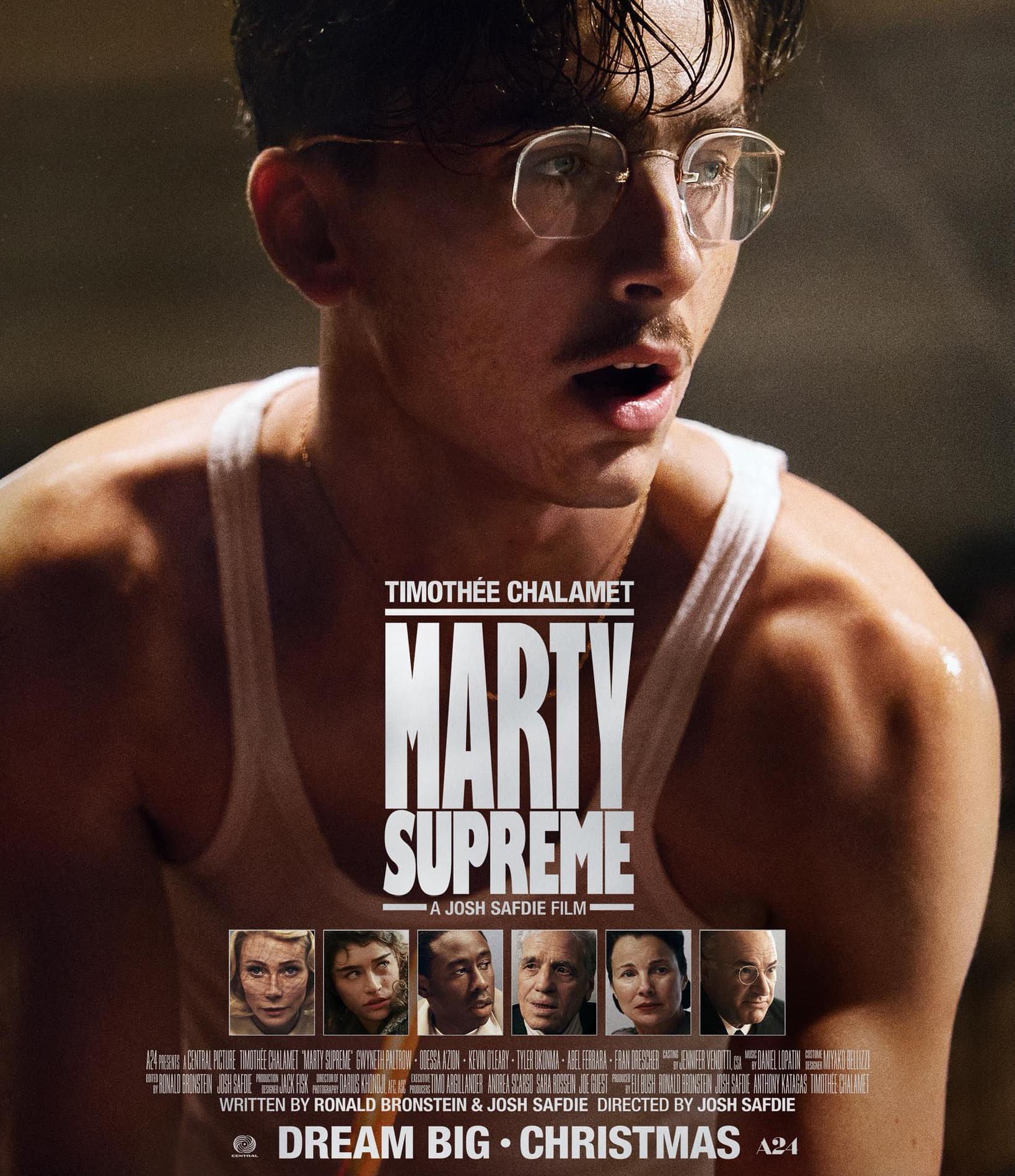
Marty Supreme is the newest A24 production, starring the new A-list actor, Timothée Chalamet. Directed by Josh Safdie, the film is loosely based on the story of real-life table tennis champion Marty Reisman. While Marty works as a very persuasive shoe salesman at his uncle’s store, he rises through the ranks of the New York table tennis scene. Even though his uncle offers him the store’s management position, Marty refuses, with his sights set on the British Open. With the tournament approaching, Marty demands the money that he says he is owed, and after being refused by his uncle, he holds his coworker at gunpoint to steal the necessary money. Not looking back, Marty heads to Europe, focused on nothing besides his personal aspirations.
Marty’s Jewish identity is prominently featured throughout the film, from his Star of David necklace to his family identity and community. Marty is a complicated and brash character, which has led many to question why Jewish director Josh Safdie would give this character such a strong Jewish identity. Through analysis of his other works, however, this portrayal was carefully planned and considered. As in his previous film, Uncut Gems , Safdie does not want to emphasize the suffering of
post-WWII Jewish Americans. In Uncut Gems , Adam Sandler plays a compulsive gambler, similar in nature to Chalamet in Marty Supreme . Safdie instead wishes to portray the real-life experiences and struggles of a Jewish American, in this case, through the body of a rough and controversial 1950s table tennis player.
Chalamet delivered one of his best performances as Marty Mauser, rivaling his work in Dune and A Complete Unknown . He fully embraced the role, practicing his table tennis for 6 years before filming. Additionally, because the role of Marty Mauser required prescription glasses, he wore blurring contacts to wear real prescription lenses. Similar to Marty’s obsession with victory, Chalamet has been on his own “pursuit for greatness,” as he said at the SAG Awards last year. This role gets him one step closer to that goal, playing it as well as any current actor could. Supporting actors also put on worldclass performances, with Odessa A’zion as Rachel and Gwyneth Paltrow as Kay Stone. Some critics attack the film for its self-centered main character or lack of emotional depth, despite Marty’s clear evolution as an anti-hero, discovering what’s truly important. No matter the critical reviews, Marty Supreme is an incredibly entertaining story, with a performance from Timothée Chalamet that will be long remembered. ☐
“The Library” Audition Poster Panel Staff
Will Achtmeyer ’26
Panel Staff

Festive Spirits at Schoolwide Holiday Chapel
By Cooper Schuldt ’28 Panel Staff
On Friday morning, December 12th, the Chapel was filled with festive music from the B-flats, faculty, and other students. The chapel began with Carol of the Bells played by Ryan ChangWu ’27 on the violin, Harry Liu ’27 on the cello, Nathan Zhang ’26 on the piano, Ethan Xie ’26 on the saxophone, Brandon Li ’26 on the saxophone, Grant Hanser ’26 on the cello, and Jai Somani ’26 on the saxophone. This amazing performace set a nice Christmas tone for the rest of the Chapel. Following their performance, the B-flats sang This Christmas with Fritz Sainthelmy ’29, Josh Langham ’28, and Zachary Park ’28 as solos, with Mr.
Patterson directing. When asked about the B-flat’s performance, B-flat’s member Zach Park ’28 said, “I think it went well. We practiced a lot for it, and I think the practice showed in our performance.” Then, Mr. Schneider, Mr. Sherman and Mrs. Hamilton put on their usual performace of a few christmas songs, with Mr. Schnieder on saxaphone, and Ms. Hamilton singing. Finally, to close the chapel, all the faculty sang “The 12 Days of Christmas.” Faculty members dressed up to match the song’s lyrics, dressing as swans, drummers, geese, and hens, with some throwing choclate to students at the end. When reflecting on the Chapel overall, one student mentioned, “I enjoyed it, and it was a good chapel to have on the last day of school before exams.” ☐

Faculty Singing on Stage
Belmont Hill Communications
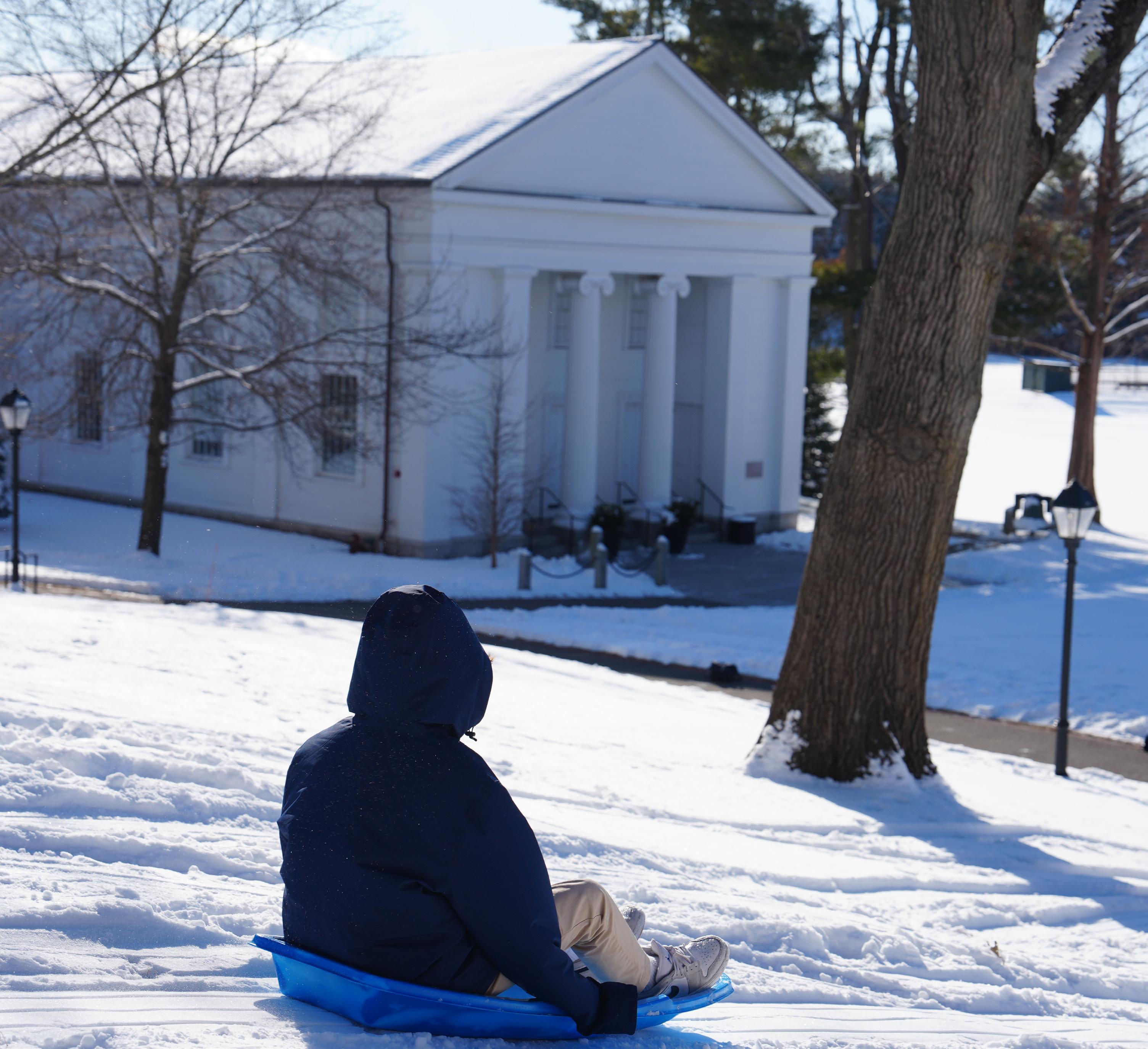
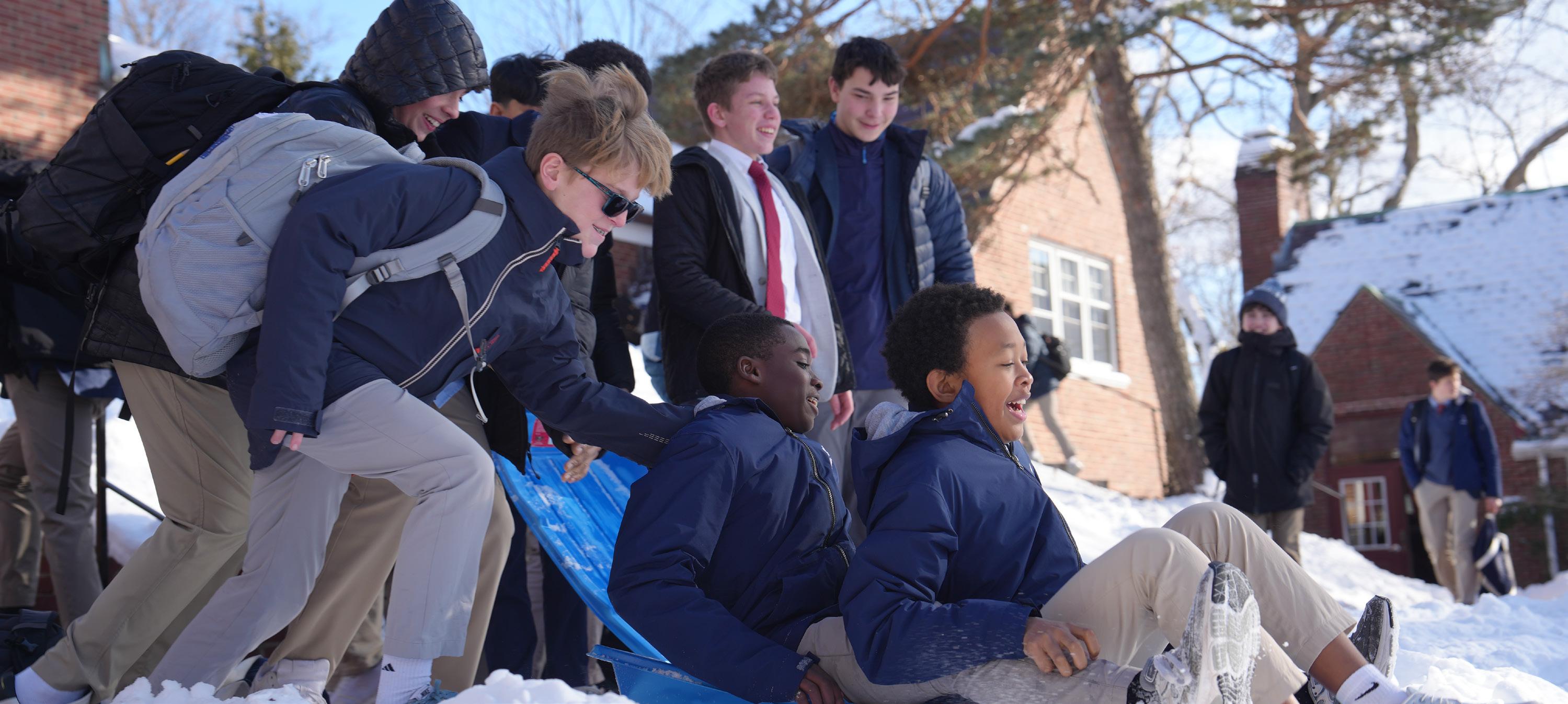
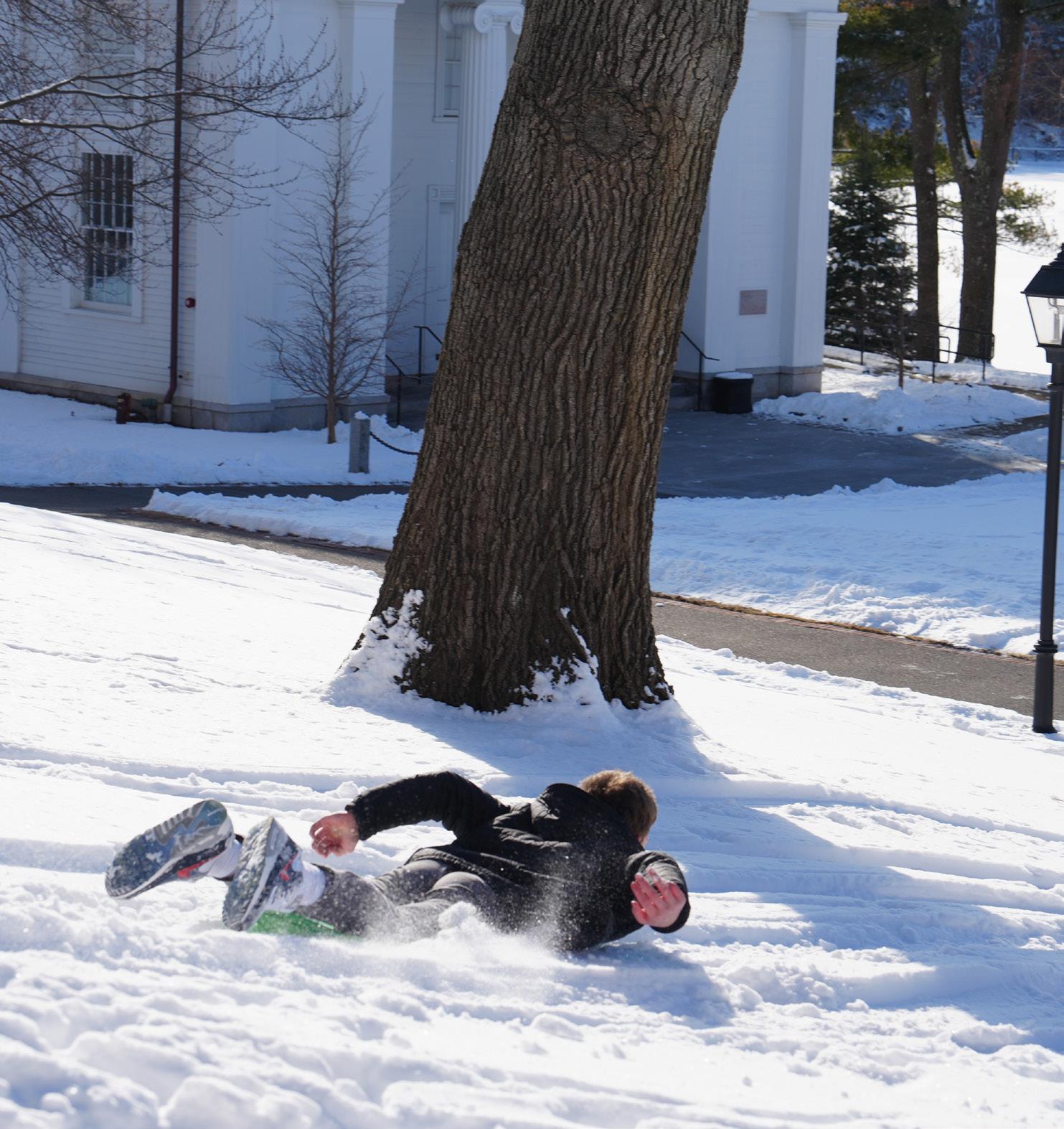
Winter Collage: Snow and Sledding on The Head’s Hill


Superbowl LX: BH’s Kraft Family and Jake Bobo ’17


Winter Collage: Snow and Sledding on The Head’s Hill (Continued)

The Verdict on Operation Absolute Resolve
Sam Leviton ’28 Panel Staff
What is “Operation Absolute Resolve” Operation Absolute Resolve (OAR) received the go-ahead from President Trump late on January 3rd and was executed early the next morning in Venezuela. OAR had been planned for months, including covert surveillance on Venezuelan President Nicolás Maduro’s every move. Every step of the operation was meticulously planned in collaboration with the US Army Delta Force. For two hours and twenty minutes, US soldiers, planes, boats, and drones entered Venezuela and executed their objectives. Delta Force captured Nicolás Maduro and his wife, and they were delivered to New York City on Saturday. Both Maduro and his wife are currently being detained in a New York City prison and are expected to face federal drug trafficking charges. The stated reasoning for the United States’ operation was to fight the influx of drugs into the United States from Venezuela. President Trump also said that Maduro has been “emptying his prisons and insane asylums” and encouraging those people to immigrate to the United States. This quote from President Trump was not supported by evidence. What comes next, for both Venezuela and the United States?
Operation Absolute Resolve leaves Venezuela in a volatile state. In a press conference shortly after the operation, President Trump stated that the United States would temporarily “run the country.” President Trump implied that if Venezuelan Vice President Delcy Rodríguez follows Trump’s orders,

the United States can have minimal involvement. When asked if he would deploy US troops to Venezuela to organize the country, President Trump stated, “No, if Maduro’s vice president — if the vice president does what we want, we won’t have to do that.” President Trump also added that he is “not afraid of boots on the ground.” President Trump agreed to an oil deal with Venezuela worth an estimated $500 million, but no long-term structure has been put in place. The United States has imposed sanctions on imports from Venezuela, aiming to halt trade in and out of the country. Currently, former Vice President of Venezuela, Delcy Rodriguez, is serving as interim president. Was Operation Absolute Resolve Legal?
To understand the legality of Operation Absolute Resolve, it is necessary to understand that President Trump and the United States military not only
captured Venezuelan President Nicolás Maduro, but also plan to temporarily “run the country” (quoted from President Trump). The United States has not yet detailed its complete legal reasoning for the operation. OAR raises questions in both international and domestic law. First of all, the execution of Operation Absolute Resolve may not even be legal under United States law. The United States War Powers Resolution of 1973 “requires Presidents to notify Congress within 48 hours of sending U.S. armed forces into hostilities or certain other situations abroad.” President Trump and his cabinet failed to notify Congress of the impending operation. It is unclear whether Trump will face punishments for violating US law, but it firmly questions the bounds of presidential power. Under Article 2(4) of the United Nations Charter, which the United States ratified, “a nation may not use force on the sovereign territory of another country
without its consent, a self-defense rationale, or the authorization of the U.N. Security Council.” In the past, the United States has executed operations without UN consent, either with consent from the attacked country or in self-defense. OAR was executed without any of the three legitimizers. That being said, arresting someone to face trial, as in the case of Maduro, is not a violation of international law. The defense of the operation using the objective of retrieving Maduro could legalize the operation, but if the United States stays to run Venezuela, that would violate the UN Charter. The verdict on Operation Absolute Resolve:
Operation Absolute Resolve will have a significant impact on the future geopolitical landscape and will push the limits of Presidential power. First of all, President Trump should have alerted Congress and made a greater effort to ensure that his actions were lawful. Secondly, the most glaring issue is undoubtedly the scary international precedent set by this operation. Trump sending troops onto the ground of a sovereign country without having one of the required factors from the UN Charter is undoubtedly a violation of international law and sets a dangerous precedent. Whether it be with the United States and Iran, or China and Taiwan, this operation in Venezuela pushes the boundaries as to what major powers can do to a sovereign country. While there may be short-term benefits for the Venezuelan people and the US oil market, they do not outweigh the detrimental long-term effects of a dangerous international precedent. ☐
What is the Best Winter Athletic Activity?
By Tiernan Emmert ’28, Billy Palumbo ’28, Shea McDonell ’28 Panel Staff
Winter Athletics are a quintessential aspect of Belmont Hill culture. This year, my colleagues and I decided to determine which is superior. To reach a logical conclusion, we sent out a Google Form to gather community feedback. Our survey consisted of 7 options: Ice Hockey, Alpine Skiing, Nordic Skiing, Snowboarding, Figure Skating, Curling, and Snowshoeing, plus an “other” option. Of the 112 responses, 82 said one of our options was the best. The other 30 responses were write-ins, with 20 different sports being written in. According to the survey, Ice Hockey is the most popular athletic activity, receiving 33 votes (29.5% of the total). Ice Hockey was the only team sport on this list, and the most popular option that we also offer at Belmont Hill. The most appreciated aspect of Ice Hockey seems to be the contact and hitting. Other reasons include: “It has the perfect mix of skill and physicality”, “The Loop”, and “It’s just so nails.” Frankly, it’s no surprise that Ice Hockey is the most popular option amongst the student body. Lots of people play it, and those who don’t participate in the Loop help build a strong culture at the Varsity and sub-Varsity levels.
Alpine (downhill) skiing is the second most popular winter sport amongst the student body. Thirty people (28.6% of the total) voted for alpine skiing. The reasons behind this were pretty uniform. Seven responses said
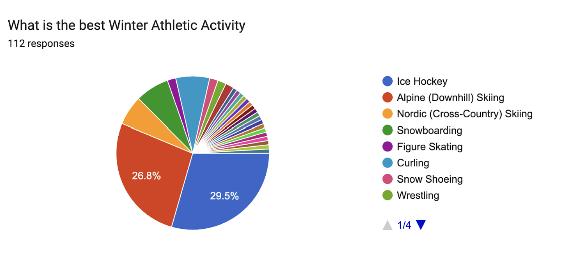
they enjoyed alpine skiing most for the speed, which is no joke. Some downhill ski racers have reached speeds of up to 90 miles an hour in competition. Nearly twice as many students cited fun as their favorite thing about skiing. Compared to Ice Hockey, skiing can be much more relaxing and recreational rather than intense and competitive. It seems that many students really have fun skiing with friends and just getting outside. Some more reasons included “going down.” Alpine Skiing offers a more relaxing, less intense experience. Snowboarding and curling tied for the third spot with eight votes (7.1% of total votes) each. Snowboarding seemed popular for the same reasons as skiing, but responses also included hostility toward skiing. One voter remarked, “better than skiing, also more athletic.”
Curling was much more popular than expected. It seems Belmont Hill students are very fascinated by the dedication, accuracy, and viewing experience this rather niche sport offers. Some go as far as stating, “Its [sic] a unique sport that requires lots of technique and knowledge [sic] of the sport.” Our takeaway from these responses was an underwhelming turnout among snowboarders compared to skiers, alongside an amazing, shocking abundance of curling enthusiasts. Right behind snowboarding and curling in fifth place was Nordic (cross-country) skiing, which received seven votes (6.3% of the total). Despite the sport being difficult and physically demanding, many still seemed to have true passion. The reasoning behind this varied greatly. The most common being adoration of the
coaches, Dr. Calloway, Mr. DeCaprio, Mr. Kendall, Coach Weiter, and Coach Kirby. Some student responses included, “Jakey-poo, the big doctah,” and “Because I love Graeme Calloway and Decap.” Some appreciated the difficulty and “Grittiness.” A student even mentioned that he enjoyed “gliding on skis.” Figure Skating and Snow Shoeing came tied in sixth place with two votes each (1.8% of total). Both students who voted for Figure Skating appreciated the grace required. Those who enjoyed snowshoeing enjoyed the laid-back experience, saying, “I like walking” and “It’s awesome, dude.”
Regarding the write-ins from the “Other” option, we received twenty different responses (many of these were the same sport with different misspellings). Sports that were written more than three times were Basketball, Wrestling, and Bobsledding. We do apologize to the apparently quite passionate bobsledding community for not including it as an option. Bobsledding fans seemed deeply invested in the sport and in someone named Kuznetsov Smith III. Other notable write-ins include Mr. Bracken, Cheese rolling, Karl Marx, and the Winter Play. Based on our research, the statistics showed an undeniable conclusion: the two best winter athletic activities are downhill skiing and ice hockey. With a sample size of only 112 responses, the difference between 29.5% of votes and 28.6% is not definitive enough to make a clear-cut decision on which of the two is better. ☐
Gen. Caine detailing Operation Absolute Resolve
Google Images
Winter Activity Pi Chart
Panel Staff
Milk and Cookie Flavors Power Rankings
By Kai McCallum ’28 Panel Staff
Once in a while, the question of “what is the best cookie?” arises. This question alone is hard to answer, since each cookie has its pros and cons, but there are a few that undoubtedly make the top 5. Belmont Hill’s long-lasting tradition of Milk and Cookies made Massachusetts’s own chocolate chip cookie popular among Belmont Hill boys. What makes a good cookie, you might ask? The criteria used to judge cookies consist of:
1. Texture (crunchy, chewy, crisp on the ends, soft in the middle);
2. Mix in’s (chocolate chips, nuts, dried fruit, sprinkles);
3. Flavor (chocolate, cinnamon, peanut butter, cookie dough);
4. Difficulty to make (baking time, ingredients, cost, fragility);
5. Visual appeal (melting chocolate, sprinkles, cool designs, engravings)
Peanut Butter Cookie:
The peanut butter cookie has a peanut butter flavor, mixed with a thick, crumbly cookie dough, giving it a unique combination of flavor and texture. The peanut butter cookie has very good visual appeal. Notorious forkpressed engravings on the top of the cookie give it an original appearance and design, making it an above-average cookie in the visual criteria. They taste good and look good; however, they are more of a process to eat than the cookies higher up on the list. Peanut butter cookies tend to be extremely dry and can be very fragile. Overall, the interesting combination of flavor and texture, combined with the forkpressed design and thick shape, makes

peanut butter cookies a solid 7.75/10.
Snickerdoodle :
Snickerdoodles have the classic sweet flavor and chewy texture that’s hard to hate. The crisp edge on the outside, combined with the chewy texture in the center, makes the snickerdoodle iconic. When baked perfectly, sugar cookies equal the top competitors in texture and flavor; however, they lack visual appeal. Snickerdoodles have a thin cinnamon coat that makes them look bland compared to others. Overall, I give the snickerdoodle an 8.25/10. Oreos:
Oreos are a reliable, quick treat that always prevails. The combination of vanilla and chocolate gives the Oreo a subtle sweetness. The ability to take a cookie apart and eat it however you please is a rare trait that automatically makes the Oreo a topthree contender. The well-known Oreo
New Year’s Resolutions
By Will Sandor ’27 Panel Staff
“New Year, New Me.” That’s what everyone says, but is it really true? In 2026, America’s most common resolutions were to exercise more, be happier, eat healthier, and save more money. Although these goals are productive and achievable, only 9% of people who make New Year’s resolutions successfully achieve their goals, despite 39% saying it is very likely they do so. About 31% of Americans make them, but that number is much higher amongst Gen Z teens and adults. Some suggest setting SMART goals, instead of just making a New Year’s resolution. SMART stands for specific, measurable, achievable, relevant, and time-bound. A study by Drive Research shows that using this framework in different ways can drastically improve the likelihood of following through. In a study, people who wrote their goals down had success rates of 76%, which was 33% higher than those who did not. This shows that establishing a framework for achieving your goals is an important step to completing them. Even though achieving your goals without a SMART plan is significantly more difficult, that doesn’t mean you shouldn’t set New Year’s resolutions. A survey from YouGov shows that 32% of Americans think that making a New Year’s resolution makes their year better. This may suggest that simply making a resolution leads people to have a more positive outlook for the next year, making resolutions beneficial even if they aren’t necessarily achieved.
To conclude, if you want to make
and follow through with your New Year’s resolutions, make a SMART plan and write it down on paper, but even if you decide not to, at least think about your goals so that you can start the year on a positive note. ☐

engraving makes it a recognizable dessert. Although the Oreo is easy to eat, it is quite small and hard to make at home. The sweet center and chocolate edges make the Oreo an 8.9/10.
Macarons:
Maybe the fanciest cookie on this list, macarons look beautiful, taste amazing, and have the best texture of any cookie. The visual appeal of the macaron is unmatched. The chewy meringue crust and sweet jelly center make it the perfect cookie sandwich, while its vibrant colors and shiny toppings make it visually one-of-a-kind. Macarons are often served in groups of 3, making them the perfect dessert or snack. Macarons are also surprisingly healthier than the other cookies on this list. Traditional macarons contain under 90 calories per cookie, which is a 22% decrease compared to Oreo cookies and an even larger decrease compared to larg -
er cookies. It is incredible how such a sweet, perfectly crafted cookie can be healthier than a smaller Oreo, but macarons are usually made in a local bakery, whereas Oreo and other cookies are mass-produced. Although the macarons have a health benefit, they come with a price tag. A 3-pack of macarons usually costs anywhere from 8-15 dollars, which is almost 7x the price of a 4-pack of Oreo cookies. Overall, the dreamy texture, incredible taste, and beautiful designs make the Parisian macarons a 9.5/10.
Chocolate Chip Cookie:
The stampede of seventh graders at 9:45 in the morning makes it clear that the chocolate chip cookie is the best cookie of all time. The sweet dough with random milk-chocolate chips in the chewy middle of the cookie is one of the best combinations, not just in cookies but in all desserts. The chocolate chip cookie was created by a genius. In 1938, in Whitman, Massachusetts, a woman by the name of Ruth Graves Wakefield added a chopped-up Nestle semi-sweet chocolate bar and added the chopped pieces of chocolate into a cookie recipe. The result changed history forever. In WWII, soldiers deployed overseas from Massachusetts shared the cookies they received from care packages with other soldiers from the United States. Within the next year, the Toll House Cookie (Chocolate Chip Cookie) became the most sought-after cookie in the United States. Easy and fun to bake, with sweet chocolate chips throughout, a sweet chocolate/cookie dough flavor combination, crisp on the outside and chewy within, and a distinguished appearance, the chocolate chip cookie is a 10/10. ☐
Stranger Things 5 Review
By Will Achtmeyer ’26 Panel Staff
The series finale of Stranger Things aired this New Year’s Eve, marking the end of the decade-running, groundbreaking series. To many teens who grew up with the show, as well as its countless other fans across all age groups, the ending was highly anticipated. So did it hold up and stick the landing, or did it let down the fans and leave a sour taste in the mouth like the infamous ending of Game of Thrones ?
The answer, for myself and for many fans, was that “it was alright.” There was nothing about the ending that was particularly awful, but there was also nothing about it that really made it stand out as stellar. The final episode is essentially divided into two parts, the first being the crew finally defeating the series’ villains and the 2nd being the epilogue that gives closure to the characters. Unfortunately, the disparity in quality between these two parts was quite large, with the first being a lackluster, overblown fight, filled with plot holes and oversights. Many fans were disappointed about the lack of deaths, feeling that the Duffer Brothers played it too safe and didn’t take any risks. I personally believe they did this simply so that they wouldn’t accidentally “ruin” the show like so many others (Dexter and Lost, to name a few). Honestly, this decision is probably why people viewed the ending as favorably as they did. While the reviews weren’t glowing, there was technically nothing about the ending that destroyed the lore or characters. The lack of Demigorgons in the final fight, the
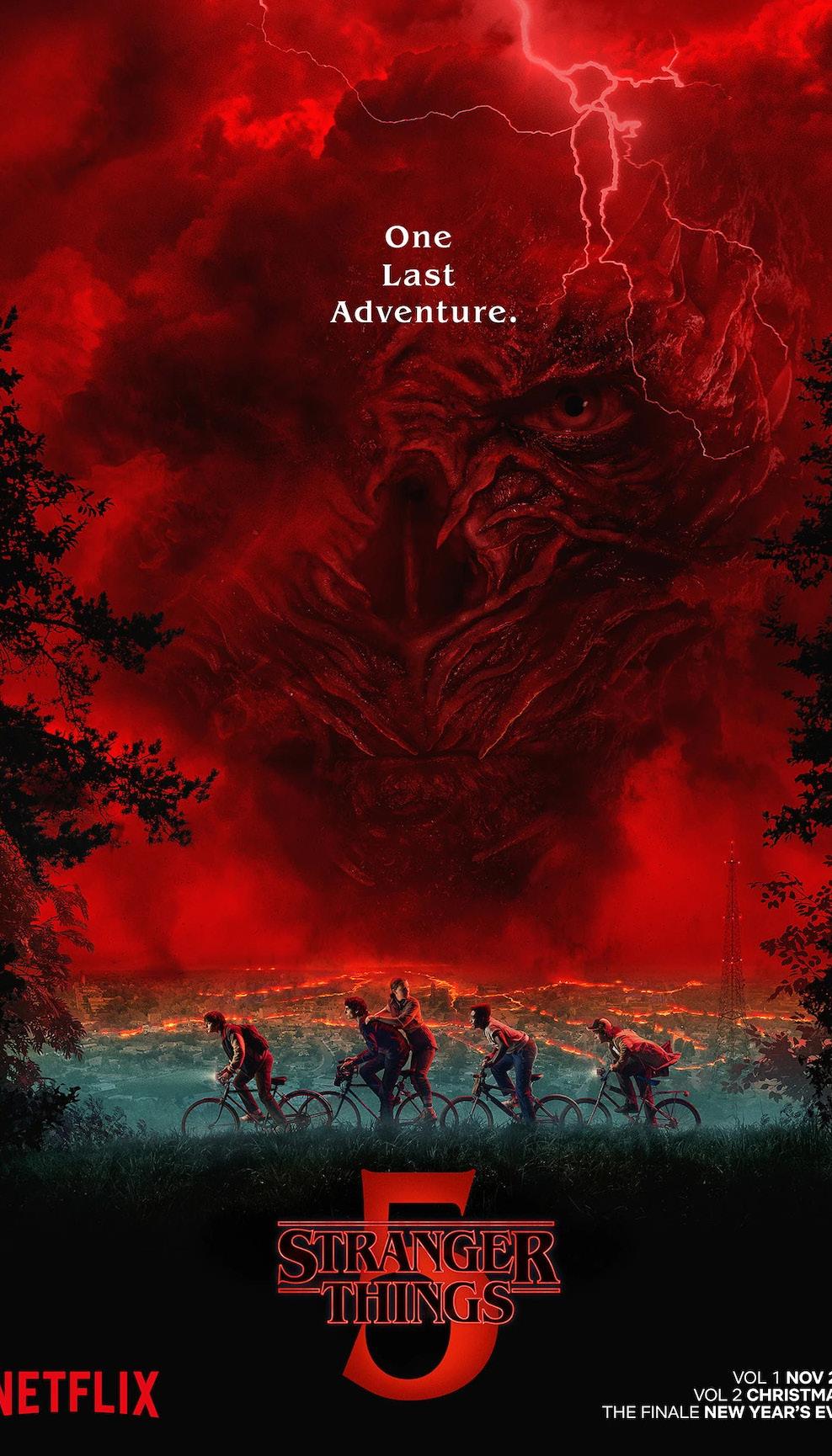
military not arresting the main characters despite their numerous crimes, and other noticeable but relatively small flaws ultimately don’t ruin anything. Fortunately, what stands out the most about the final episode was the wonderfully done epilogue, which perfectly ties up the character arcs and sends them away with a poignant ending, with the main characters passing their torch to a new generation. While it wasn’t perfect, it did stick the landing and was certainly entertaining, a better finale date than most.
Rating: 7/10 ☐
Belmont Hill Milk and Cookies
Adam Richins
Stranger Things 5 Google Images
New Gaffer for Belmont Hill Varsity Soccer
By Tyler Grossman
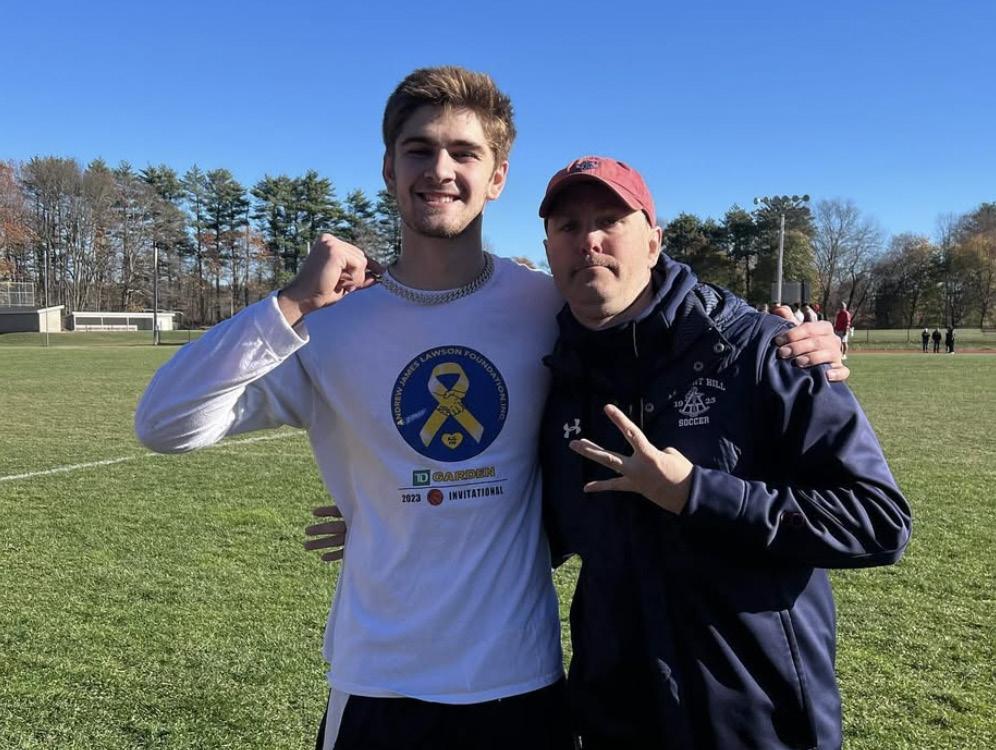
On Monday, December 8th, Mr. Craig Schneider was announced as the new Head Coach of the Belmont Hill Varsity Soccer Team. Coach Schneider takes over with an outstanding resume. As a player, he was an All-State honoree at Manchester High School in Connecticut before taking his talents to Trinity College, where he was a four-year starter, captained the team in his senior year, and was named All-NESCAC. After college, he continued his playing career, joining semi-pro side Glastonbury Celtic FC. Since then, he has played with a few other clubs before joining Charlestown FC, where he still plays today.
Additionally, Coach Schneider has an equally impressive coaching resume to date. He began his managerial career as the head coach at St. Clements High School, where he coached for two years before joining the staff at Malden Catholic, where he served as an assistant coach for five years, in addition to teaching there. After the 2014 season, Coach Schneider was offered the head coaching position at Malden Catholic; however, he declined the job to become a physics teacher at Belmont Hill, where he has coached the JVA soccer team. During his tenure as the head coach of JVA, his teams have achieved immense success, boasting multiple undefeated seasons and an impressive 51-7-7 record over the past four years.
In addition to his outstanding resume of results, a conversation with any past JVA player will tell you all you need to know about Coach Schneider. Imran Yonis ’27, a two-year veteran of the JVA team, said, “He has been my favorite coach at Belmont Hill because he makes it fun while also helping us get better and playing to win.” Leo Nuernberg ’27 felt a similar way, describing the coach as “someone who holds us to high standards while also making it enjoyable.” Both also touched on Coach Schneider’s sense of humor, specifically mentioning his typical British sayings as well as “Put the round thing in the rectangle thing more times than them,” a saying he uses to describe what the team needs to do to win.
When asked about his goals for the soccer program, Coach Schneider said he “wants to establish a unified culture throughout the ranks from the 7th grade to the varsity team.” This was something Coach Schneider continually returned to in our interview: cohesion throughout the ranks. Given his experience as JVA coach, he hopes to use that team as a platform for varsity and to have the 3A team play a similar style to varsity. His hope in all of this is to help develop the younger guys so that they are ready to play when they join the varsity team.
In terms of tactics, Coach Schneider hopes to instill a fast-paced, possession-based style of soccer, with an atmosphere where “People want to show up every day and work.”
For next season on the field, Coach Schneider recognized that, in addition to coaching, the team would undergo significant roster changes, having graduated over half of the previous season’s
roster. Therefore, Coach Schneider is entering the season with the mindset of not measuring success in terms of wins and losses, but instead of establishing the team’s culture for years to come. This culture will revolve around the mentality of “working harder than your opponents, controlling what you can control, and a constant commitment to improving.” With that, Coach Schneider believes “everything else will fall into line.” He added, “We can always work on fitness and tactics, but we want players to have desires to get better every day.”
One issue Coach Schneider will have to deal with under the new club soccer format is MLS Next Homegrown players. Under current rules, MLS NEXT Homegrown players are not allowed to play high school soccer unless they receive a waiver from their clubs. At the moment, many of these players who attend Belmont Hill do not play for the school. Coach Schneider believes that many players are told by their club teams that MLS Next Homegrown is the best way to get to play at the next level. Coach Schneider hopes to create a program that these players want to be part of that offers them the full Belmont Hill experience in addition to helping the team. In the future, Coach Schneider hopes to create a preseason trip to Europe similar to the one the team used to take to Costa Rica, to help build chemistry and camaraderie. He also hopes to build on the team’s success over the past few seasons by creating a program that can compete with any team in the ISL and New England. The Panel would like to congratulate Coach Schneider on his new role and wish him the best of luck in the future! ☐
2026 Winter Men’s Olympic Hockey Preview
By Tyler Grossman ’27 Panel Staff
For the first time since 2014, beginning on February 11th, NHL players will be allowed to represent their countries in the Olympics, creating the first true best-on-best international hockey tournament in 12 years. Additionally, following a record-breaking Four Nations Faceoff last year, where the NHL pitted Finland, Sweden, the USA, and Canada against each other in a 4-team tournament, hype for Olympic hockey is at an all-time high. Coming off their overtime Four Nations Faceoff victory and gold medals in the last two Olympics, where NHL players were allowed to play, Canada enters the tournament as the favorites. The Canadian roster is loaded with talent from top to bottom, including NHL point leader Connor McDavid, all-time great and Canadian legend Sidney Crosby, and the hottest young talent in the NHL, Macklin Celebrini. The one question mark for the Canadians entering the tournament is goaltending. Jordan Binnington is likely to be the starter after his stellar performance in the Four Nations Championship, where he came up with multiple clutch overtime saves to salvage Canada’s gold medal hopes. However, Binnington, known for his clutch gene, has been unable to find any consistency between the pipes over the past few seasons with his team, the Blues. So far this season, he has posted a lackluster .871 save percentage (SV%) and a 3.55 goals against average (GAA), both ranking near the bottom of the league. If Canada wants to come
home with another gold medal, their plethora of goal-scoring talent and lockdown defense are going to need to play lights out in front of a shaky goaltender.
The United States will arrive in Milan looking to get some long-needed revenge on the Canadians, who have gotten the better of them in nearly all best-on-best tournaments this century, and more importantly, to capture their first gold medal since the “Miracle on Ice” in 1980. The Americans will enter the tournament with arguably the best forward group they have ever assembled, featuring the one-two center punch of Jack Eichel and Austin Matthews, along with the physical, talented Tkachuk brothers, who will be the heart and soul of the team. This will not be a group anyone wants to mess with. Additionally, between the pipes, they will have the reigning Hart (MVP) and Vezina Trophy (Best Goaltender) winner, Connor Hellebuyck, which will give the Americans some serious confidence in their goaltending in what will inevitably be some tight moments. With one of its most talented and determined groups ever, the US is one of the favorites for the tournament, looking to break its 46-year gold medal drought.
In addition to the favorites, Sweden, coming off a gold medal at the World Juniors, is another team capable of challenging for the gold. However, injuries to many key contributors, such as Leo Carlsson, Victor Hedman, Joel Eriksson Ek, and others, in the weeks leading up to the tournament could spell trouble for their chances. Swedens Scandinavian rival and defending gold medalists, Finland, is also load -

ed with NHL players and could make a run at the gold. Without the best defensive forward in the game, Alexandar Barkov, and prolific goal scorer Patrick Laine, a massive burden will be placed on Mikko Rantanen and Roope Hintz to lead this forward group. The back end should be strong for Finland, and they will need to step up if they want a chance to defend their gold medal.
Finally, Germany and Czechia both possess top-end talent that can go toe-to-toe with anyone, giving them the ability to upset some of the favor-
ites. However, they lack the depth to challenge for the gold. The host country, Italy, will also compete in the tournament with a roster made up of only players from European leagues and will likely struggle, especially given that they will be in the “group of death” with Finland, Sweden, and Slovakia. Whether we get another edition of the greatest rivalry in international hockey, Canada vs USA, or one of the other nations makes a run to the finals, this year’s Olympic Hockey is sure to create a thriller for fans around the world. ☐
Coach Schneider Celebrates Win with Ben Adams ’25
BH JVA Soccer Instagram
’27 Panel Staff
US Team Celebrates a Goal at Four Nations Faceoff
Athlete of the Issue: Evan Jones ’26
By Sam Norden ’28 Panel Staff
Evan Jones ’26 first began to play hockey with his dad and brother on his backyard rink before he was even two years old, and now, in his second and final year at Belmont Hill, he has been a key player for the varsity hockey team. His talent, alongside his determination, has made him a star defender on a strong Belmont Hill team, consistently making big plays while leading by example on and off the ice, elevating himself and those around him. With a deep understanding of the game combined with a strong work ethic, Evan continues to develop into one of the team’s most reliable and impactful players.
Evan began his organized hockey career at age six, playing with the Boston Jr. Eagles, and has played for them ever since. He began his high school career at Arlington High School, where he spent his freshman and sophomore years, before switching to Belmont Hill for his junior season. In his first year at Belmont Hill, he tallied a team-leading 31 assists and 11 goals, which is very impressive for a defender. Through 13 games played in his senior season, he has seven goals and six assists, which are lining up to be another stellar season. When asked about the team this season, Evan said, “I would describe our team this year as very close-knit and hardworking. We’re committed and dedicated to being the best versions of ourselves and supporting one another. To ensure I’m helping the team to the best of my ability, I focus on the day at hand. I strive to lead by example and prioritize the team’s success.” His consistency and team-first mentality
have been instrumental in Belmont Hill’s success and demonstrate his leadership and presence he brings to the team.
Alex Guo ’28, who has played with Evan both years that he has played on the hockey team, said, “On the ice, Jonesy is just so nasty. He never loses the puck and always makes the right plays, but he’s an even better teammate. He is always pushing everyone to try harder, and he’s a great captain who leads by example, and you can tell how much he cares about the team.” Alex’s words do not just demonstrate Evan’s skills as a player but highlight his strong qualities as a leader, teammate, and person, showing his impact on the younger guys and the rest of the team. A true quality of a leader is indeed someone who can connect with every single player on the team and tries to build a strong team culture. On this topic, Evan said, “I try to be approachable for younger guys on the team and set a good example. Whether it’s helping them with systems, offering encouragement, or simply saying hello in the halls, I want them to feel confident and supported both on the ice and in school.” Through his performance and commitment to his teammates, Evan has established himself as an essential part of the hockey team and a respected leader among his younger teammates.
As Evan is getting ready to continue his hockey career at Dartmouth and beyond, he will be remembered not just as an incredible defender and player on the ice, but as a strong teammate who puts the values of the team first, leaving a lasting impact on the Belmont Hill hockey program, setting a standard for dedication and leadership for those who follow in his footsteps. ☐
Indiana Wins the CFP
By Jack Good ’27 Panel Staff
With Fernando Mendoza, the Heisman Award-winning quarterback, and Curt Cignetti as head coach, Indiana looked destined to win the national championship, completing the first perfect season in the school’s history.The game started off slow; the Hoosiers only kicked a field goal for three points, and Miami got none in the first quarter, but it picked up quickly. After a long battle between the teams, Indiana was up by 6 points with 50 seconds left, and Miami had the ball, with any play now deciding the game. As Carson Beck threw the ball downfield, Jamari Sharpe, a cornerback from Indiana, intercepted the ball, and brought Indiana their first ever National Championship win. After years of being a team with one of the worst records in college football history and a 3-9 record in 2023, completed one of the greatest turnarounds in NCAA history. After a long regular season with many twists and turns, the College Football Playoff started out with a bang, even from the team selection. Many blue bloods made the playoffs, such as Indiana, the number one seed, and reigning champions Ohio State. Ole Miss, Georgia, Texas Tech, Texas A&M, Oklahoma, and Oregon also made the cut. Tulane and James Madison took the 11th and 12th seeds for winning their respective conferences, which left the 9th and 10th seeds up to three teams: Alabama, Miami and Notre Dame. Alabama entered the playoffs at 10-3, and many fans were upset they were selected over Notre Dame, who only had two losses, highlighting


Craftsbury Nordic Trip
the committee’s bias to SEC schools as a whole. Many fans also felt James Madison and Tulane, while both having excellent records, their strength of schedule was weaker than SEC counterparts such as Texas or Vanderbilt, meaning James Madison and Tulane took playoff spots from other teams that deserved them. Nevertheless, the committee set the bracket, and the games started off with a bang on December 19th, with Alabama beating 8th-seed Oklahoma 34-24.
Both James Madison and Tulane lost their first games, while Oregon and Ole Miss advanced through to their respective rounds. Ole Miss beat Georgia in a very close game by a margin of a few points within the game to then advance to the semifinals. Miami was similarly not expected to perform outstandingly, but after winning their first game against Texas A&M, the Canes beat out the defending champs, Ohio State, in a complete upset to advance to the semifinals against Ole Miss. Oregon, after having an easy first round against James Madison, would beat Texas Tech in their second game to make it through successfully to the semifinals as well, with three teams receiving a first-round bye being knocked out in their first game. However, Indiana beat Alabama by a staggering 38-3, then beat Oregon in a similar fashion, 56-22, advancing to the final national championship that takes place in Miami. Miami would beat out their opponent Ole Miss subsequently, stopping a last-second hail mary to dramatically win the game and advance to the championship, but would ultimately come up short against Indiana in the national championship. ☐
By Patrick Snail ’28 Panel Staff
On New Year’s Day, the Belmont Hill Nordic Skiing team traveled up to Craftsbury, Vermont, to the Craftsbury Outdoor Center for the annual training trip. The center offers more than 100 kilometers of trails, which the boys used to their advantage, skiing around 90 kilometers each over the four-day trip, not to mention the hundreds of feet of elevation per day. The annual trip provides a brief hiatus from the rest of the world, allowing the boys to spend four days only skiing and bonding.
“As a first-year skier, I feel like I really got to know the guys on the team well,” Shea McDonnell ’28 recounted, “I don’t have a lot of experience on
Nordic skis, but the snow felt perfect.”
The multiple feet of snow closed practically all the trails, even on the lakes, which were popular with the ski team. With each day starting in the negative degrees and rising into the high single digits, the snow stayed packed and quick, unlike the slush around Massachusetts.
On the third day, when snacks in the cabins ran low, the team took a group ski to the closest town to resupply, which became a well-favored moment.
After the trip, as the current reigning Lakes Region League champions, the Nordic Ski team began its season by winning at Proctor Academy, sweeping the podium in a race against nine other schools. The Panel wishes the Nordic Ski team good luck for the rest of their season! ☐

Belmont Hill Nordic Team
Adam Richins
Evan Jones ’26
Adam Richins