Historic Government Shutdown Ends After 43 Days
By Adrian Chen ’28 Panel Staff
After the longest government shutdown in U.S. history, federal services resumed on November 12, 2025, following President Trump’s signature on a bipartisan funding bill. However, this 43-day crisis left lasting impacts on millions of Americans, from families struggling to afford groceries to federal workers facing unprecedented job insecurity. One major devastating effect of the government shutdown was the crisis in SNAP benefits.
The shutdown triggered widespread chaos for the program, as it temporarily cut off such subsidies for the first time in the nation’s history. According to Mass.gov, over 42 million Americans who rely on SNAP faced dire uncertainty when the Trump administration initially announced it would suspend the program in November. In Massachusetts alone, approximately one million people rely on SNAP benefits for sustenance, which accounts for nearly 15% of the state’s population. Federal judge John McConnell in Rhode Island ordered the Trump administration to deliver full SNAP payments to states, ruling that many millions of people would go hungry without immediate action. However, the administration appealed the decision, sparking a complicated legal battle that sent mixed messages to states about whether to distribute full or partial

benefits. The administration eventually used $4.65 billion in contingency funds to provide partial SNAP benefits covering about half of each eligible household’s benefits. However, these efforts varied across states as some managed to distribute full benefits before court orders were paused, while others provided only partial payments or nothing at all.
As a result, millions of Americans continued to face widespread hardship. Food banks experienced significant increases in usage, with one Kansas facility reporting a 300% rise in demand. In Boston, food bank usage surged due to the lapses in SNAP benefits; additionally, Massachusetts allocated an additional $4 million in funding to food banks to help them meet the increased demand caused by SNAP instability.
The shutdown began on October 1, 2025, after Congress failed to pass legislation appropriating funds for the 2026 fiscal year, with Senate Democrats blocking the Republican-controlled House of Representatives from advancing a continuing resolution. The legislation failed 14 times before a revised appropriations bill was finally passed, over a month later. A major point of contention was Democrats’ demands to extend Affordable Care Act subsidies, which were set to expire in November 2025. The expiration of this act would directly impact millions, who would lose health coverage, face sharp increases in insurance premiums, and ultimately lead to worse health outcomes and increased financial hardship for families, with many individuals having to
choose between their health and financial well-being. Eight Senate Democrats eventually crossed party lines to vote with Republicans on November 10, as they faced the hard decision of whether to extend the government shutdown, which would perpetuate uncertainty for millions of Americans, or make concessions and agree to Republican demands. Two days later, on November 12, the House passed the bill, officially marking the end of the government shutdown. With government funding secured only through January 30, Americans face the possibility of another shutdown in a matter of weeks. The SNAP benefits crisis revealed a key weakness in the food assistance program, while mass layoffs continue to reshape the workforce. This instance also raises some fundamental questions about our economy as a whole—if so many Americans are unable to afford food without supplemental programs, how can our government change to address the root cause? If health care subsidies are not extended, tens of millions of Americans will see their health insurance costs increase, adding another layer of financial strain to families already struggling with economic uncertainties created by the shutdown and job cuts. For now, the 2025 government shutdown has come to a close, and millions of Americans can breathe a sigh of relief as a period of uncertainty comes to at least a temporary end. ☐
Veterans Day 5K Fundraiser and Chapel Recap
By Will Sandor ’27 & Jack Good ’27 Panel Staff
This past November, the Belmont Hill Veterans Club hosted its second annual Veterans Day 5K Fun Run and Fundraiser. The club, founded by Tyler Smith ’26, was established last year to raise awareness about veterans and those who have served. After achieving significant success last year, the team looked forward to their second Veterans Day 5K, with club members putting up signs all around campus, distributing flyers in the shops of Belmont Center, and posting on Instagram for weeks leading up to the event.
More than a dozen kids, prepped bright and early at 7:30 AM, were ready to race. Chef Joshua Smith fired up the grill alongside several other private chefs who were helping to make breakfast for the volunteers and others who wanted to contribute to the
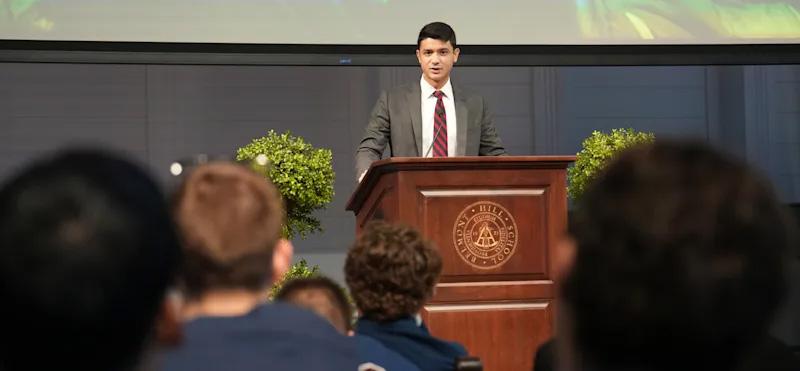
fundraiser. Soon, many more students came down to join in on the event. Many families with younger siblings and parents attended the race, and after a decisive battle, Roger Zhang ’28 won the entire race, and Mr. George himself came in third place. After the race had finished, breakfast was served, along with the raffle prizes being picked. Out of $2,500 worth of
A Look Inside The Panel
Page 2: Turkey Drive Tradition
Jack Ramanathan ’26 delves into Belmont Hill’s longstanding tradition of the Turkey Drive, a meaningful community service event that has taken place annually to help those in need.
Page 8: Mr. Duarte Faculty AOTI
Sean Park ’28 writes about Mr. Duarte, this issue’s Faculty Artist of the Issue; the piece expands on Mr. Duarte’s initiatives as a professional photographer, looking into his experiences
Page 4: A Look Into Mamdani
In a captivating opinion piece, Eli Norden ’26 provides his perspective on the election of NYC mayor Zohran Mamdani and what consequences may emerge with his upcoming role.
Page 11: CFB Coaching Carousel
In an in-depth analysis of the recent developments in coaching changes, Tyler Grossman ’27 takes the readers into a deep dive of why this year’s offseason will be one of the craziest yet.
raffle gifts, many were hoping for the Bruins tickets, which were the grand prize. After the event concluded, over $6,000 was raised from the raffle and breakfast. When asked why he wanted to start this club and these fundraisers, Tyler Smith ’26 says that he has always had an admiration and respect for those who have served our country since he was little. He hopes that this tradition
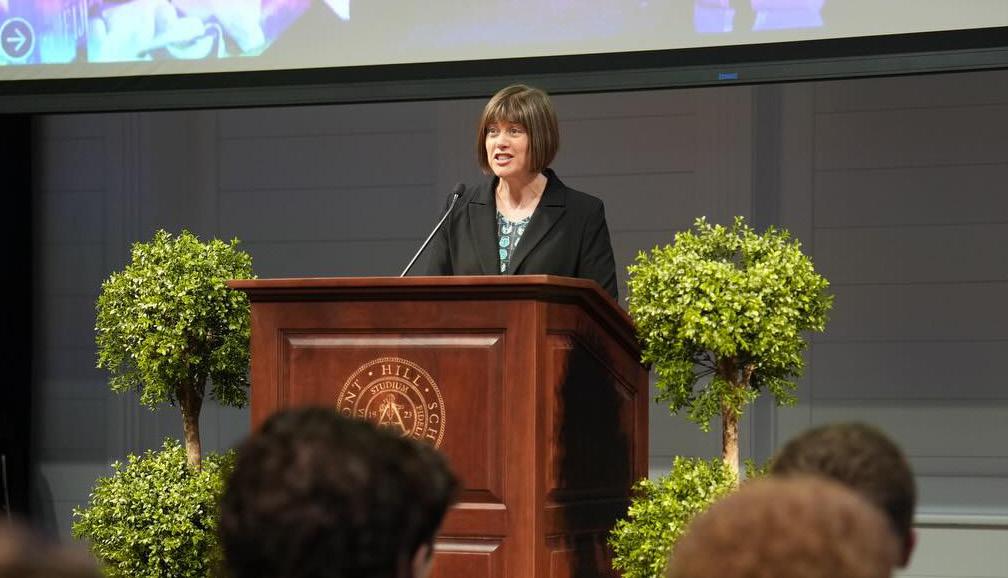
will continue, even after he graduates from Belmont Hill with plans to row at the U.S. Naval Academy next year. Along with the 5K, former U.S. Naval Officer Alex Santangelo ’15 spoke at Belmont Hill’s annual Veterans Day chapel. Mr. Santangelo shared his experiences in the Navy and connected them to life at BH. He spoke about the value of teamwork and the importance of understanding the people with whom you work. He also explained that service does not only mean serving in the military; it also means making a positive impact on the people around you, whether that be at BH or anywhere else. Near the end of his speech, he said, “Fidelitas, providentia, studium. These are not just Latin words. They’re part of the code that turns ordinary people into people whom we remember on days like this. You don’t need to join the military to live these values or to lead a life of service.” His speech clearly resonated with
Letter from the Editor:
Welcome to Issue 5 of Volume 74! Our news section focuses on community-centered events including recent Chapels and community service efforts like the Thanksgiving Turkey Drive. Our Ops section features a DOTI between TikTok and IG Reels, as well as articles centered on political topics like New York mayor Zohran Mamdani. Our Arts sections spotlights a Playlist of the Issue revolving around the theme of the holidays, pinpointing fan-favorite Christmas carols of the modern day. The issue’s AOTI also highlights the works of our very
own Mr. Duarte as a photographer and artist. Our sports section features Fitz Courtney ’26 as our Athlete of the Issue, and recaps Fall team seasons, and spotlights Mr. Montoya’s final soccer season on the Hill. Finally, the centerspread of expands on the News section’s coverage of the Turkey Drive and has a short article by Exec Eli Norden ’26 recapping Dr. Courtney’s inspiring speech on gratitude and responsibility. We would like to give a big thanks to everyone involved in the process of publishing this issue. Thank you, and enjoy the issue! ☐
Alex Santangelo ’15 Speaking in Chapel
BH Communications
Trump Signs Bill Ending Government Shutdown
Fox News
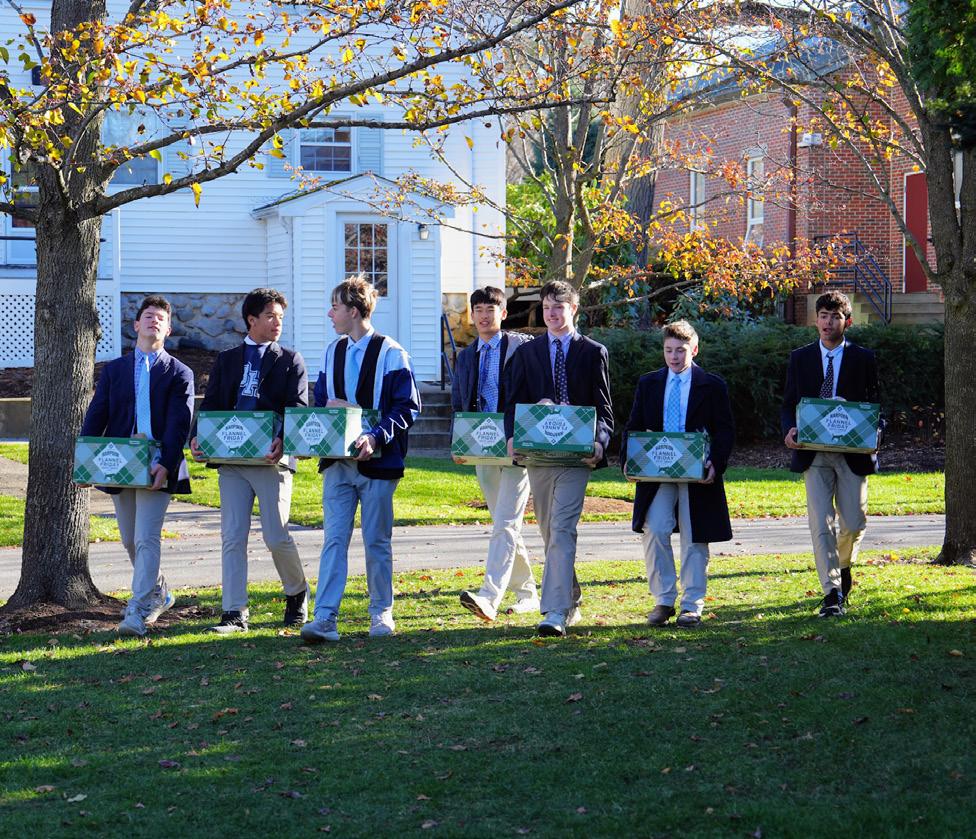
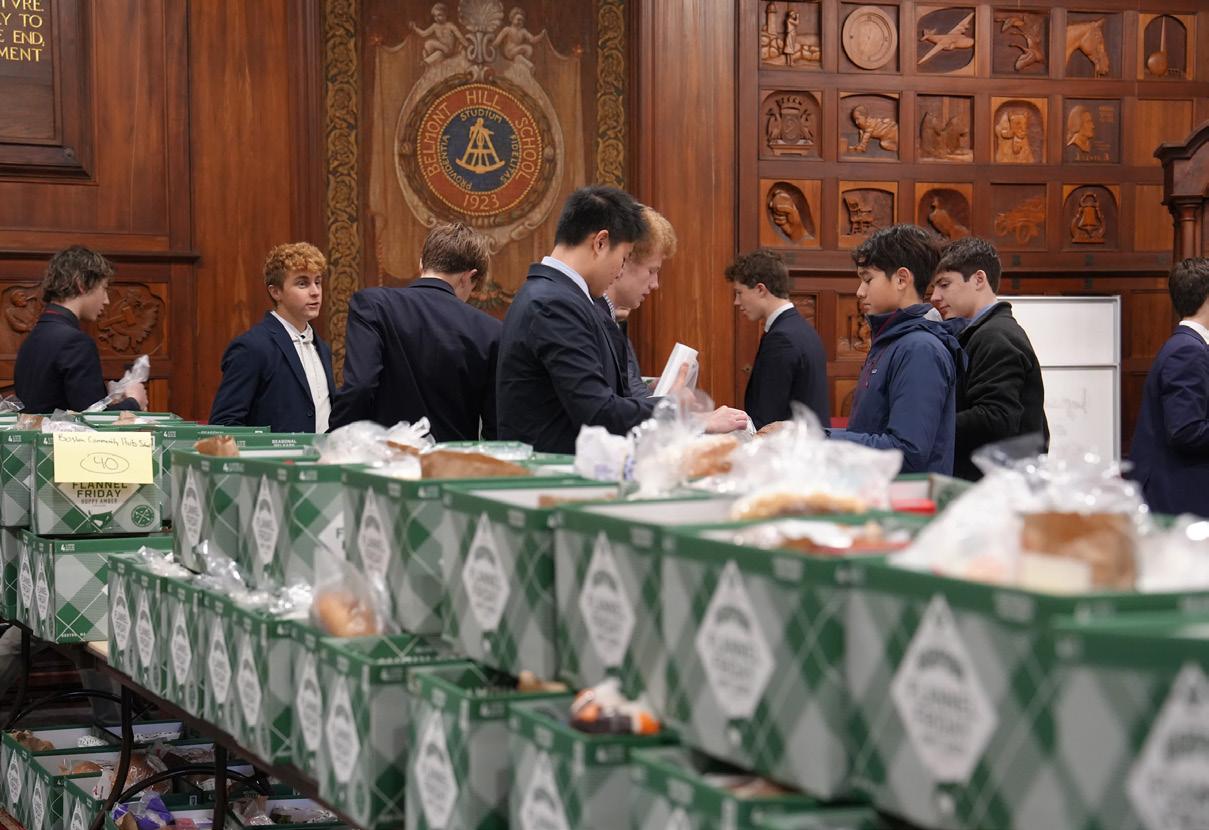
An Evolving Tradition: Belmont Hill’s 2025 Turkey Drive
By Jack Ramanathan ’26 Panel Staff
Belmont Hill’s longstanding tradition of community support continued this November as the School completed its annual Turkey Drive, distributing 543 complete meal kits to food pantries, churches, shelters, schools, and community health centers across Greater Boston. The effort, which began at Belmont Hill in 2010, has grown from its early years of assembling just 50 meals to one of the school’s largest community service initiatives—this year overseen once again by Mr. George, who has led the project for many years.
The drive has for years concentrated on Thanksgiving meal staples, but 2025 marked a turning point when the contents of each box changed. Mr. George spoke with the partner organizations and learned that many families supported by the sites “aren’t traditional Thanksgiving people” and would be more inclined to use the week’s worth of high-utility foods rather than just one meal. “We discovered that rice and beans would last much longer,” he said. With the recommendations of a member of the Belmont Hill Board who looked into local food needs, the committee exchanged cranberry sauce and gravy—“the least nutritional,” as Mr. George termed it—for bagged rice and canned or dried beans while still including gift cards for families who wanted the more traditional items.
There was more to this project than just giving away food; it involved massive coordination of efforts by students,

teachers, and the maintenance crew behind the scenes. Mr. George pointed out how people like Mrs. Gallinaro, a school nurse, were crucial in making everything work out smoothly. He remembered one particular incident that reflected the character of the drive: at the beginning of the week, when almost one thousand pounds of potatoes had to be turned over and moved, a group of Form III students, along with several teachers, came and spent more than an hour and a half sorting and transporting the food.
Reaching 543 boxes, however, did not come without challenges. “The response is always slower than we’d like,”
Mr. George admitted. Initial advisory collections yielded only about 130 of the planned 500 boxes, and increased demand this year made the stakes higher.
Cuts to SNAP benefits during the recent government shutdown left many partner organizations with fewer resources and more families to serve, further exacerbating our lack of food boxes.
“The need has grown,” he said plainly.
Obesity Drugs Bring Rapid Weight Loss, Real Risks
By Ethan Xie ’26
Panel Staff
Obesity drugs such as Ozempic and Wegovy have moved from being utilized in diabetes clinics into everyday use, reframing obesity as a chronic condition that can be medically treated with consumer drugs. Ozempic is labeled for type 2 diabetes, while Wegovy is typically used for more chronic weight management.
Although these medications were initially marketed to help manage blood-sugar problems, their rapid shift into mainstream dieting culture has been accelerated by social media and celebrity use. Countless posts now highlight dramatic “before and after” photos, normalizing the idea that weight-loss can be medically engineered rather than achieved through lifestyle change alone. This shift has raised questions about whether public interest is driven more by genuine health goals or by societal pressure to reshape the body quickly.
Semaglutide is a GLP-1 receptor agonist, meaning it mimics a gut hormone released after meals, which sig -
nals to the brain that the stomach is full and quenches hunger. It can also slow down stomach emptying, allowing people to feel full for longer, and improve blood-sugar control through glucose-dependent insulin effects.
These drugs are meant for people with diabetes, where the upside is not only cosmetic. Meaningful weight loss can lower blood pressure, improve metabolic health, and reduce risks associated with obesity-related diseases. In 1 instance, these drugs helped cut major cardiovascular instances in adults with obesity and cardiovascular disease, even without diabetes, indicating benefits beyond just weight.
However, taking such drastic measures to lose weight, especially without diabetes, can incur numerous tradeoffs. Side effects such as nausea, vomiting, diarrhea, constipation, and abdominal pain are common, and more serious risks are being discovered, including pancreatitis, gallbladder disease, and severe gastrointestinal reactions.
Oftentimes, using semaglutide serves as a temporary relief for a chron -

ic condition. In many cases, after stopping semaglutide, many people regain a substantial share of the weight they lost.
Culturally, easier access to rapid weight loss could tighten beauty standards, making thinness feel more “normal,” while also reducing stigma by acknowledging the importance of biology and metabolism on weight.
At Belmont Hill School, the ripple effects could include stronger body-image pressure among students and new questions from coaches and athletes about the appropriate use in sports, particularly those that emphasize weight, such as wrestling. Wegovy is indicated for some adolescents aged 12 and older with obesity, which may increase awareness and potential misuse in school settings. ☐
BH Senate Recap
By Nathan Zhang ’26 Panel Staff
Form I
• Noah Darfoor ’31 and John Kogler ’31 were newly elected as class president and vice president, respectively.
Form II
• Community block: hosting a dodgeball game in wrestling room.
• Survey planned for food, in communication with Mr. Maws, feedback planned.
Form III
• Booked MacPherson for “movie night”.
• Pushing for dress code privileges later in the year.
Debate of the Issue: IG Reels Versus TikToks
By Patrick Snail ’28, Ethan Xie ‘26 Panel Staff
Yet, as often happens, the school rallied late: gift card donations surged, and Form III students helped finish gathering and sorting boxes across campus.
Looking ahead, the Turkey Drive team will continue refining the process, including the possibility of standardizing gift cards to a single grocery chain. But for now, Belmont Hill celebrates another year of generosity—one that not only met urgent community needs but strengthened the school’s sense of shared purpose. ☐
Form IV
• Community block: hosting advisory basketball games.
• Donut social/hot chocolate during open Tuesday advisory around winter.
• Semi planning commences in January; date finalized for April 2026.
• Broad check-in survey to be sent out at the end of the semester.
Form V
• Community block: hosting a basketball tournament in Fritz Gym, with an award for the winner and best group uniform.
• Planning on hosting a waffle bar in January
Form VI
• Holiday Chapel planning commences.
• Open skate in mornings implemented.
• Planned Toy Drive for Little Wanderers, set to occur on Tuesday, 12/9.
• Planning New Freedoms event with NCDS.
• Planning to change the Panel Prize to student vote
• Writing panel blurbs for seniors
• Veteran’s 5k ($6,000 raised).

Instagram Reels: For many, it’s the roadblock before their math homework. The “five minutes” before sleeping. Most importantly, the source of brainrot for Forms I and II. But no matter how many scrolls, likes, and shares one puts in every day, one thing is clear: it is superior to TikTok. Reels surpasses its competitors in three categories: versatility, uniqueness, and community engagement. Instagram Reels provides a unique structure, in which not only Reels, or short videos, appear on one’s feed, but also the slideshows that made Instagram famous in the first place. TikTok also has slideshows, but they conform to corny memes. On the other hand, on Instagram Reels, your favorite sports player’s latest gameday slideshow can pop up in your feed. From funny videos to sports statistics updates to news, Instagram Reels has it all. On Instagram Reels, trends seem to take a secondary role to creativity. The vast majority of videos seen on TikTok follow the same trends, making TikTok scrolling feel like watching parodies of the same movie on an endless loop. By contrast, niche content dominates Reels, offering a diverse range of entertainment. Stumbling upon a small creator with fewer than one hundred followers can truly only be compared to finding a diamond in the rough. This exposes devoted scrollers to a diverse content pool. Because it encourages finding new, niche creators, Instagram Reel’s diverse feed makes each doomscroll session feel like an adventure. It is impossible not to find one’s niche, with the algorithm morphing to cater to highly specific in -

terests, from local sports fanatics like @drakemayelover to stellar singers such as @heyitsnogood. The last and most prominent feature of Instagram Reels is the community. Aside from the hilarious videos on Instagram Reels, one can open the comment section to unleash another tsunami of rebounded jokes. Instagram users amplify the humor in the comment sections by using GIFs that perfectly reflect their emotions, making references, and adding new layers to the joke, turning one video into a collaborative burst of laughter. Seeing Instagram’s success, TikTok scrambled to add the feature of commenting on photos. Even then, these lackluster, single-frame, offbrand GIFs fall flat in comparison to Reels, solidifying its dominance over TikTok. Keep the trendy dances over on TikTok; Reels is where the real doom -
scrollers break the chains of life to scroll.
TikTok: TikTok is where the best scrolling happens. It might fall under the same trap of reels where hours disappear at your fingertips, but the time in that doomscroll becomes an effortless bliss. The content itself is more funny, niche, and unique. Instagram Reels has good content, but it’s almost always a copy of a better version on a better platform. That is to say, TikTok is better in three categories: discovery, creativity, and depth.
First, TikTok excels at finding content you did not know you wanted. Reels usually play it safe, leaning into familiar creators or echo chambers of videos all with the same theme. TikTok’s feed feels more precise and more daring. It does not just show you all of the popular stuff; it finds small, undiscovered videos that
Should there be a Presidential
By Sam Leviton ’28 Panel Staff
74 years old, 82 years old, and 82 years old. Those are the ages of the last three US presidents on their final day in office. President Trump ended his first term at 74; President Biden ended his term at 82; and President Trump will end his second term at 82. According to the US Government, specifically under the Medicaid Program, someone becomes a senior citizen when they turn 65 years old. With presidents stumbling over words, falling asleep during ceremonies, and falling on stairs, many wonder if it is time to implement an age cap for presidents. After all, we have a minimum age requirement (35) to run for president.
Both serious discussions and internet jokes have raised questions about the need for an age cap. Specifically with President Trump and Biden, viral internet posts have made fun of geriatric politicians. Videos of President Biden freezing up during speeches and debates have gone viral on TikTok, YouTube, and Instagram. More recently, videos of President Trump sleeping during meetings in the White House and falling up the stairs on his plane have surfaced. These viral videos mock the cognitive and physical abilities of our nation’s leaders. While these videos can be amusing, they shed light on a crucial discussion. Aging presidents could pose a risk to national security and stability. Arguments Against Age Caps
A widely beloved candidate, who promotes and actualizes success -
ful progress, wants to run for a second term as president. Almost everyone in the United States loves this candidate.
During their first term, they kept America safe, improved the quality of life, and made significant contributions to the country’s future. They are both physically and cognitively sharp, but turn 70 just a few weeks before the election. If a new cap were implemented that prevented anyone from running after the age of 70, a strong candidate would be ineligible to run for office. This rule could directly prevent a great candidate from running.
Arguments for Age Caps
According to a study conducted by the National Institute of Health, cog -
to ensure that our president is as prepared as possible to make such important decisions. An age cap for the president could significantly decrease the chance of the president suffering from cognitive decline while in office. While it may not seem significant, symptoms of cognitive decline, such as memory loss and difficulty with complex tasks, could hinder the president when it matters most. In 2023, then-Representative George Santos proposed the Executive Mental Competency Protection Act, which included provisions for mental competency tests. Santos stated, “Regardless of political affiliation, this should be a common-sense and bipar-

nitive decline most often occurs around the age of 70. The president controls the usage of nuclear weapons, maintains relations with foreign countries, and influences many other important decisions. I hope there are systems in place
tisan agreement that when a man or a woman becomes President, they submit to an annual cognitive evaluation.”
Is an age cap a violation of freedoms?
The Constitution states that anyone born in the US, who has lived
it knows you will find engaging. One minute you are watching a Drake Maye edit, the next you are watching Bird Game 3 updates. TikTok does not just match your interests; it expands them, and that immerses you in a world of rot. Second, TikTok has more original creativity, whereas reels rely on copying or reuploads. On reels, trends get repeated tirelessly until the format loses any humor it had. TikTok trends do spread, but the platform rewards people for twisting them. This enables TikTok to have better content, remixes, stitches, duets, and edits that give each scroll a refreshing spin. Even when two videos start from the same idea, they often end in totally different places because each creator is rewarded for adding a unique touch to their video.
Third, TikTok content tends to have more substance. Reels are great for mindless clips or edits, but these videos are constantly repeated and saturated. TikTok has that too, but it also has creators who explain, teach, and engagingly tell stories. There is a reason people go to TikTok to understand new trends and get information faster. It is short-form, but it is not empty. It can be funny and even still have a good point, which is a rare combination online. Reels are fine when you want a quick break between homework. But when it comes to the actual feed, the one that consistently delivers interesting content and makes every scroll feel like it could turn up something new, TikTok is ahead. Tiktok will give you the quality scrolls that you want, keeping you intrigued. Reels can be used to fill up small gaps in time, but if you want to really doomscroll, you might have to start using TikTok. ☐
Age Cap?
here for 14 years, and is at least 35 years of age, can run for President. Critics of a presidential age cap may question whether implementing an age cap restricts freedom, specifically the freedom to run for office. Initially, I would agree with this statement, as it appears that an age cap limits one’s freedom, therefore going against the Constitution. I would argue that using the same logic as the Constitution, an age cap should be allowed. Article II, Section 1, Clause 5 of the Constitution outlines the restrictions for running for President. If there is a minimum, why can’t there be a maximum? While I am not saying the Constitution promotes an age cap, using the logic from the Constitution, I would argue that an age cap is theoretically constitutional. Where to go from here?
A hard age cap for presidential candidates is not always ideal, as it may potentially restrict strong candidates from running for office. On the other hand, an age restriction can ensure our presidents are at their cognitive best. Additionally, the Constitutional inclusion of an age minimum may legally support the constitutional inclusion of an age maximum. I believe a fair and reasonable solution would be to implement scientific and objective cognitive assessments that the president must pass on an annual basis. I am not a scientist, so I can’t state exactly what these tests may include, but they should aim to ensure that the president is functioning at a capable cognitive level and is ready to lead the nation.
Turkey Drive in MacPherson
BH Communications
Instagram and Tiktok Logos Google Images
President Trump and President Biden Google Images
Zohran Mamdani and Possible Fear for NYC’s Future
By Eli Norden ’26 Panel Staff
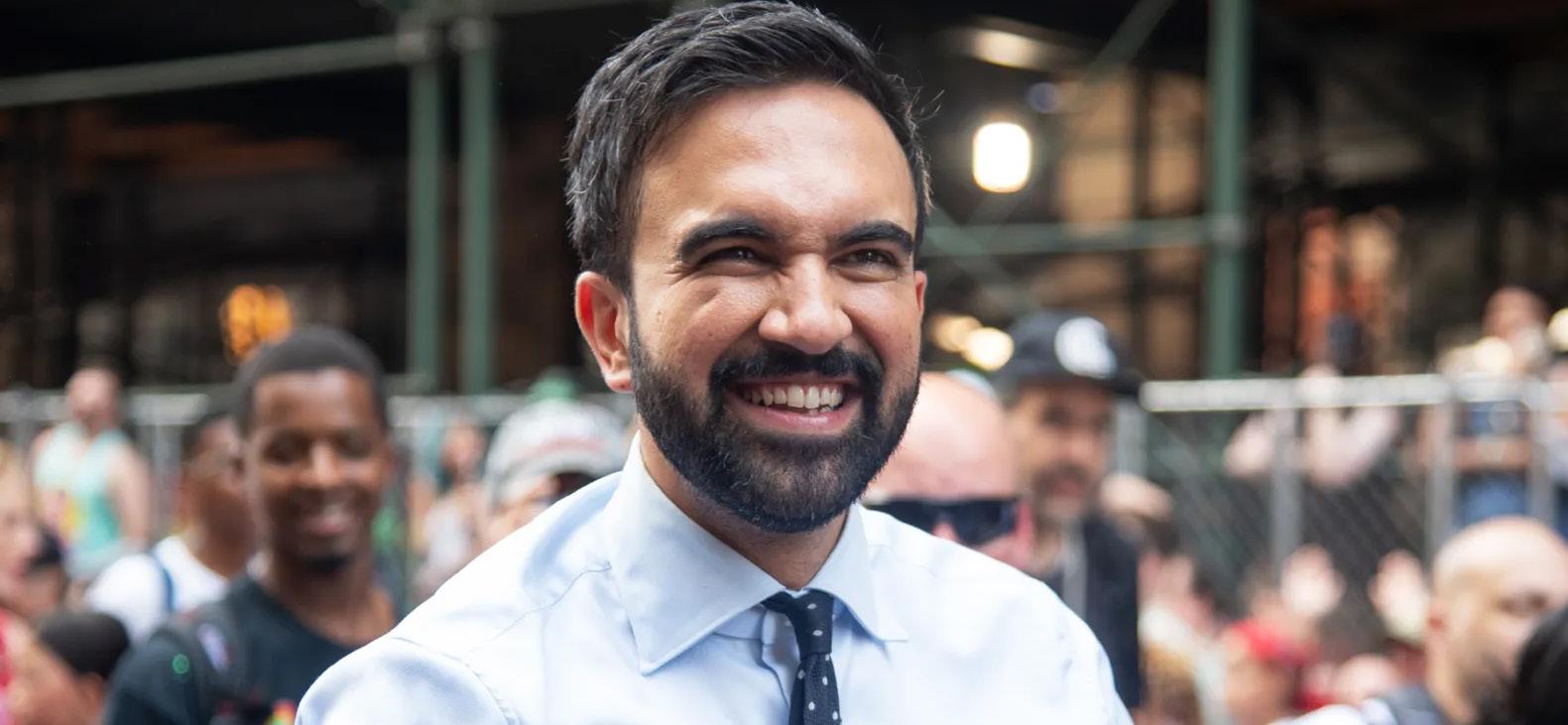
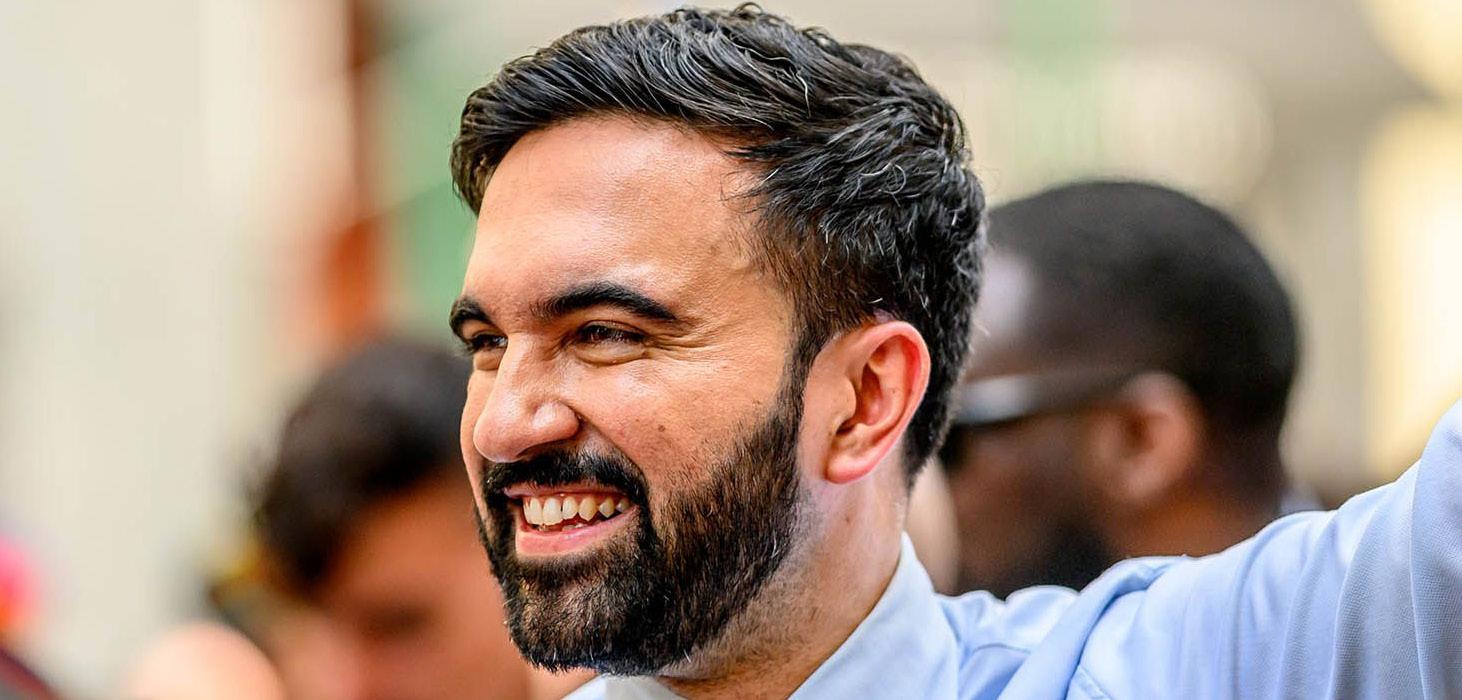
On November 4, Zohran Mamdani won the New York City mayoral election. He won because the city’s youth are disillusioned with the world they have been raised in. As political dialogue becomes harder to engage in, young people are radicalizing and pushing against the political establishment.
Zohran Mamdani’s campaign was marked by his young age, unique place of origin, and leftist ideology. Thirty-four years old and from Kampala, Uganda, he is anti-Zionist and (unlike recent New York mayors) doesn’t support the State of Israel as a Jewish state. Closely affiliated with the Democratic Socialists of America, Mamdani advocates for high taxation on the rich, dissolution of certain private property, single-payer healthcare (Medicare for all), more renewable energy, and many other social policies that characterize today’s far left. As a New York state assemblyman, he advocated for clean energy and budget cuts to police departments. As mayor, he plans to freeze rent for two million rent-stabilized apartments, construct 200,000 new rentable units at a budget of $100 billion, eliminate bus fares (which cost the city approximately $750 million annually), and establish city-owned grocery stores at a budget of $60 million per year.
His other policies include universal healthcare for children under five and a minimum wage increase to around $30/hour. Supposedly, the higher taxes on corporations and the wealthy are intended to fund his ventures. In practice however, these higher taxes will likely drive wealthy New Yorkers out of the city and exacerbate the wealth gap between those who can stay and those who can’t.
While on paper, many of his policies are quite appealing, Mamdani’s romantic ideal of a socialist Big Apple in which every single person is equal is impossible. Freezing the rent on millions of apartments will disincentivize construction of new homes. The City’s record-low rental vacancy rate of 1.4% suggests that rent freezes will likely
exacerbate the existing housing crisis by decreasing the number of available homes. Similarly, Mamdani’s plans to increase the minimum wage will hurt many of New York City’s employers.
Most of the City’s industries are characterized by monopsony, where a single buyer dominates the market, allowing them to pay workers lower wages.
Minimum wage increases will only consolidate power in the very corporations Mandani opposes, ultimately harming small businesses that can no longer afford to pay their employees.
Mamdani’s political capacity will be undercut by resistance from Albany; coordination between the mayor, state legislature, and the governor is necessary to enact any significant economic changes, and Governor Kathy Hochul has said that a tax hike is “the last thing on my mind.” As for supermarkets, which already operate on an incredibly low profit margin of 2% or less, there just isn’t much more money to be saved. By bulk purchasing and long
supply chains, corporate grocery stores can keep costs low. Government-operated stores will be unable to mimic this successful business style. If Mamdani wants to make buses free, he needs to get past a 23-member transportation board. Either way, free buses will certainly become mobile homeless shelters or new temporary homes for New York’s roughest and rowdiest. The free bus plan is a disaster, causing everyday New Yorkers to lose trust in their public transit. Beyond Zohran’s economic policies, his alienating Social views have no place in the New York mayor’s office. Mamdani’s reactionary politics and polarizing outspokenness on select international issues pose threats to New York’s ability to continue thriving. Notably, the mayor-elect has refused to condemn the term “Globalize the Intifada.” The Second Intifada killed about 1,000 Israelis between 2000-2005 on buses, in public squares, and in restaurants. Mamdani’s anti-Zionism will make the city an even more hostile place
for the City’s Jews, who live in the largest Jewish community outside of Israel.
Mamdani’s supporters include young and secular Jews (about onethird of New York’s Jewish population) who have moved away from the synagogue and towards liberal, DEI, social justice organizations, seeing the State of Israel and Zionism as a colonial project, built on creating a system of Jewish superiority in the land of Israel, not on creating a homeland for Jews in their indigenous land. From Mamdani’s perspective, these Jews are ‘good Jews’ and Zionists are ‘bad Jews.’ Throughout history, non-Jews have decided what types of Jews are ‘good’ and ‘bad,’ from capitalists and communists to the wealthy and the poor. This is antisemitism.
In a city that has already been riled by antisemitism, from rhetoric spewed at college campus encampments and protests to attacks on visible Jews across the city, Mamdani’s election will further inflame tensions. While he will not be able to really affect policy in this area, I fear for the Jews in New York City who will no longer feel comfortable wearing their kippahs on the Subway, and will need to cross through even more security in order to enter their house of worship.
To me, Mamdani’s election represents a scary horizon for New York. More so, it represents a frightening future for American politics as a whole. Political discourse should not alienate people, but rather impel constituents from diverse backgrounds to make change for the common good. Mamdani’s politics are downright divisive. In centering the Israeli-Arab conflict in this local race, he angered hundreds of thousands of Zionist New Yorkers, Jewish or not.
Is this what the Big Apple stands for? Were Mamdani to pursue his politics in a less reactionary manner, many more centrists, on the right and left, would likely have supported his policies. But the manner in which Mamdani has divided his city into factions that aren’t willing to work together represents a bleak future for his city and the nation. If we can’t talk to the other side, we lose our Americanness, and our democracy will suffer the consequences. ☐
The Most Influential 21st Century Movie Series
By William Achtmeyer ’26 Panel Staff
The 21st century so far has been cinematically defined by franchises. It seems now that every production company is scratching the bottom of the barrel for yet another property to dust off for the creation of a cinematic universe. Indiana Jones, John Wick, even The Devil Wears Prada all have or are getting more sequels and spin-offs. The phenomenon, for better or worse, has been a hallmark of entertainment as of late, and it’s all a result of the resounding success of the Marvel Cinematic Universe.
Starting at humble beginnings in 2008 with Iron Man , a movie that was not expected to perform even remotely well, the Marvel Cinematic Universe set on its course. Iron Man went on to gross over $585,000,000 worldwide. A success indeed, but not necessarily one to write home about. After all, it was only the 8th-highest-grossing film of the year, with The Dark Knight coming in first place with over $ 1 billion in gross. However, the writers at Marvel had something novel up their sleeve, which was revealed later that year in June 2008, at

the end of The Incredible Hulk , in which Tony Stark appears in a post-credit scene. This is the first time audiences have been exposed to a movie that crosses over with a seemingly unrelated film.
The Incredible Hulk was not a sequel to Iron Man , yet they clearly co-existed. This new approach made the world of the growing Marvel Cinematic Universe feel larger, and audiences latched onto it.
Since then, the Marvel Cinematic Universe has produced 37 feature films, in addition to 40 shows. The fran -
chise has grossed over $31 billion, making it the largest-grossing franchise of all time by a significant margin. However, its impact has been more than simply inspiring other production companies to create franchises and unnecessary sequels. The result of this phenomenon has been the ultimate dilution of creativity in mass media. In the 90s and up through the early 2000s, you would see indie movies and standalone films garner significant praise and attention: Sex, Lies, and Videotape and Forest Gump,

Upper School Play Review
By Ryan Ho ’28
just to name a few. Now, movies like this are pushed down by production companies, who only see profit in large blockbuster franchises. They have flooded the market with what Martin Scorsese calls “rollercoaster” films that serve as a stimulating experience more than a true storytelling venture. Films in theaters have become a mess of CGI, oddly placed humor (a trope started by the Marvel Cinematic Universe), and nostalgia bait.
As a result, the only refuge for creativity has been through streaming services. Instead of watching your legal thriller at the theater on a date, you now watch Presumed Innocent from the comfort of your home on Apple TV+ for a low price of $12.99 a month. Audiences have become so accustomed to huge cinematic experiences that they feel no need to go to the theater to watch anything other than just that. However, as the Marvel Cinematic Universe’s profits decline, it’s hard to say what the future holds. However, the Marvel Cinematic Universe has undoubtedly changed the very landscape of entertainment, and will go down not only as the most influential franchise of the 21st century, but likely of all time. ☐
On November 1st and 2nd, the Upper School Theater presented All Quiet on the Western Front. Originating as a 1929 novel by Erich Maria Remarque, the play follows a young German soldier through the horrors he faces during World War I.
The cast, starring William Achtmeyer ’26, Andrew Agular ’28, Boston Ezedi ’26, Jake Ma ’27, PJ Nolan ’27, Zach Park ’28, and Jai Somani ’26, embodied their roles, capturing moments of fear, madness, and profound sorrow. Their ability to use subtle expressions made the characters feel real, allowing the audience to connect with the harshness of the soldiers’ experiences. Additionally, the actors’ dramatic moments captivated the audience.
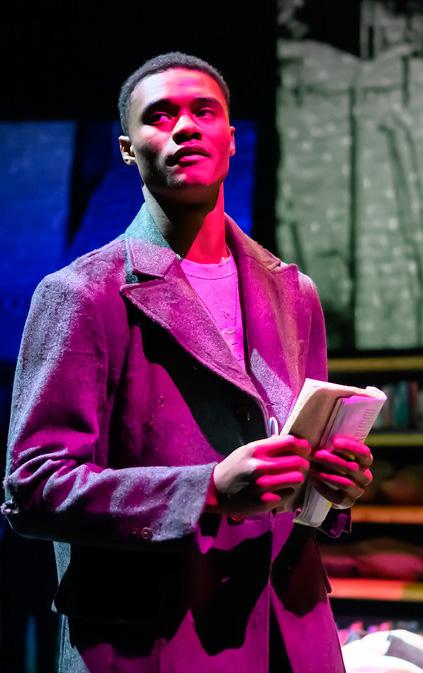
The technical elements of the production also played a major role in elevating the performance. Every background detail helped immerse the audience in the world of the Western Front. A notable prop was a decommissioned rifle from World War I, adding authenticity to the scenes. Lighting and sound effects further enhanced the play’s realism; bright flashes and loud bangs simulated the constant bombardment faced by soldiers, giving the audience a sense of the danger that defined life in the trenches. These elements worked together to highlight the horrors of warfare. Overall, the production was a powerful interpretation of All Quiet on the Western Front. The Panel congratulates the Upper School Theater for two great performances! ☐
Fall Concert & Coffee House
By Patrick Snail ’26 Panel Staff
On Friday, December 5, students and faculty gathered to perform for the Winter Coffee House. The Coffee House kicked off with the Middle School Rock Band’s rendition of Queen’s “Another One Bites the Dust,” setting the tone for an energy-filled night of music. Another ensemble, the Upper School Rock Band, performed “Pool House” by The Backstreet Lovers, striking the audience with electric guitar solos and powerful vocals, backed by a steady drumbeat to capture an emotional piece. Although no other official BH ensemble performed, there were many other group performances, including Mr. Greg Schneider and his daughter, Avery, playing “Angel from Montgomery,” in addition to his solo Lady May” by Tyler Childers. A second faculty member, Mr. George, played his own original piece, using a backing track while playing piano and synthesizer live. There will be another Coffee House in the Spring, to which all are welcome to perform or enjoy. The Panel would like to congratulate all the performers on their hard work and courage in performing! ☐

Zohran Mamdani
Google Images
Marvel Cinematic Universe Google Images
Panel Staff
Act 1 Adam Richins Photography
Mr. Schneider and his daughter Avery Adam Richins Photography
Recent Chapel Talks Shine Spotlight on Character
By Eli Norden ’26 Panel Staff
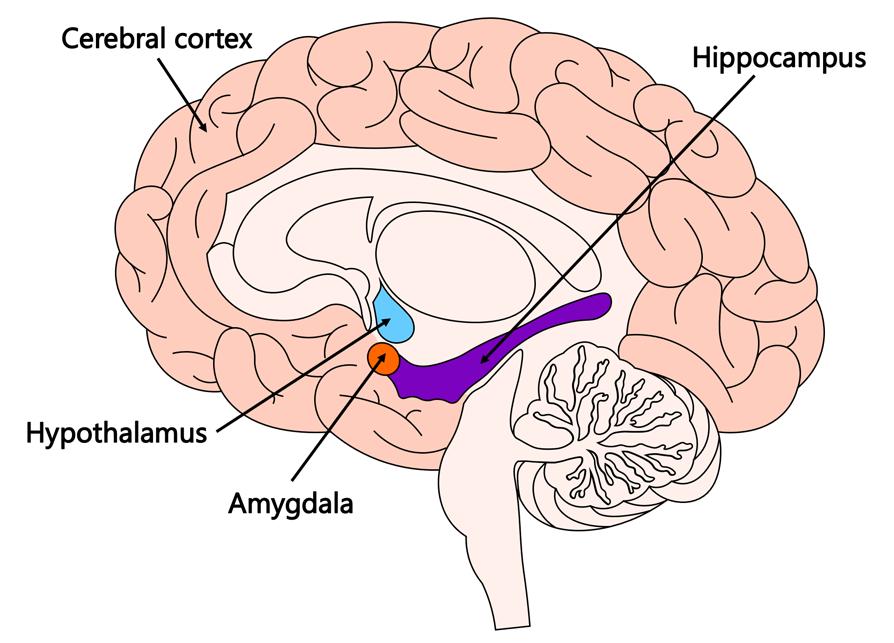
In just two weeks, our community has been blessed with two of the most meaningful chapel talks we have witnessed in recent years. In her Thanksgiving gratitude speech, Dr. Courtney made a unique connection between gratitude and joy, as well as sadness and regret, drawing on her in-depth knowledge of neurological pathways and systems. She made a full circle between a Phillies pitcher, Orion Kerkering, seen as the man responsible for the team’s loss to the Dodgers in game four of this year’s NLDS.
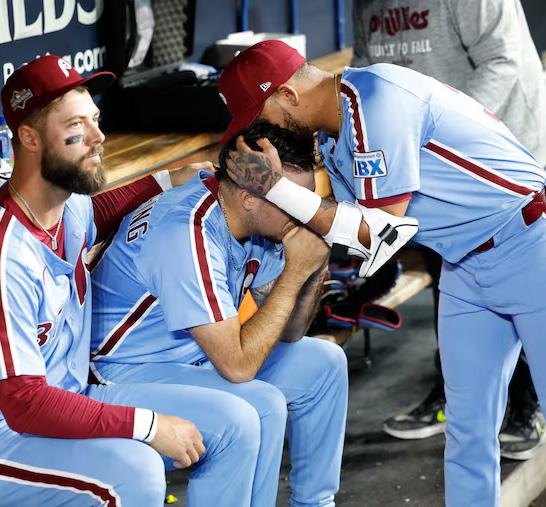
Dr. Courtney showed many images of Kerkering after his poor play. After breaking one of the simplest rules in the book—by not throwing to first base with the bases loaded—Kerkering returned to the dugout in distress, his face in his hands. This
image headlined all the major news outlets that night, making Kerkering the scapegoat for the Phillies’ loss. The stats, however, painted another picture. The team’s first four hitters had an incredibly poor series. Their poor performances were led by an astoundingly terrible few games by star hitter Bryce Harper. Kerkering’s error was literally the straw that broke the camel’s back.
Dr. Courtney connected Kerkering’s sudden feeling of emotional pain the the way the brain functions. In short, humans are more prone to having memories of embarrassment stick more than the memories of joy. When reflecting on our worst moments, we can vividly recall everything that happened. When we think about joy, though, we can only recall the general details.
When Dr. Courtney opened the Philly local paper the next day, she saw a picture of catcher J.T. Realmuto with his arm around Kerkering’s
slumped shoulders. She then asked the community to remember and replicate Realmuto’s reaction in their own lives. Philadelphians then rallied around Kerkering, recognizing that his error was just one step in the really long equation of defeat. While Kerkering will never forget his error, he will also never forget the beautiful moments of friendship that occurred directly afterwards.
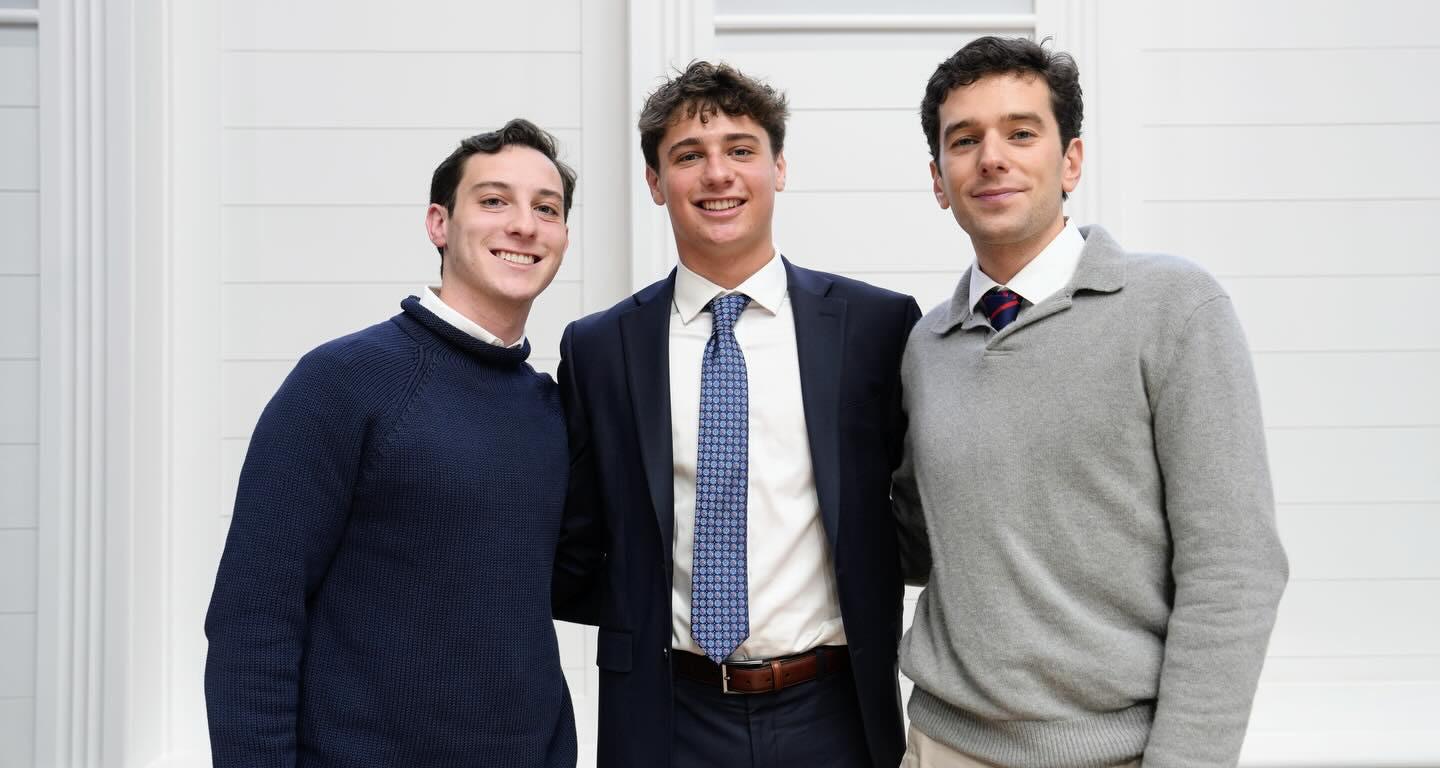
Just last week, Bennett Morris ’18, Matt Travaglini ’21, and his brother, Luke ’24, spoke to the community about their experiences as gay students and allies to gay students on campus. Bennett and Matt shared their stories at school, both the highs and lows. Luke, a more recent graduate, imparted wisdom as both Matt’s brother and as a general ally to gay people in his personal and social life. Bennett and Matt both discussed the negative effects of chirping culture, and how it can be taken too far, alienating members of our community.
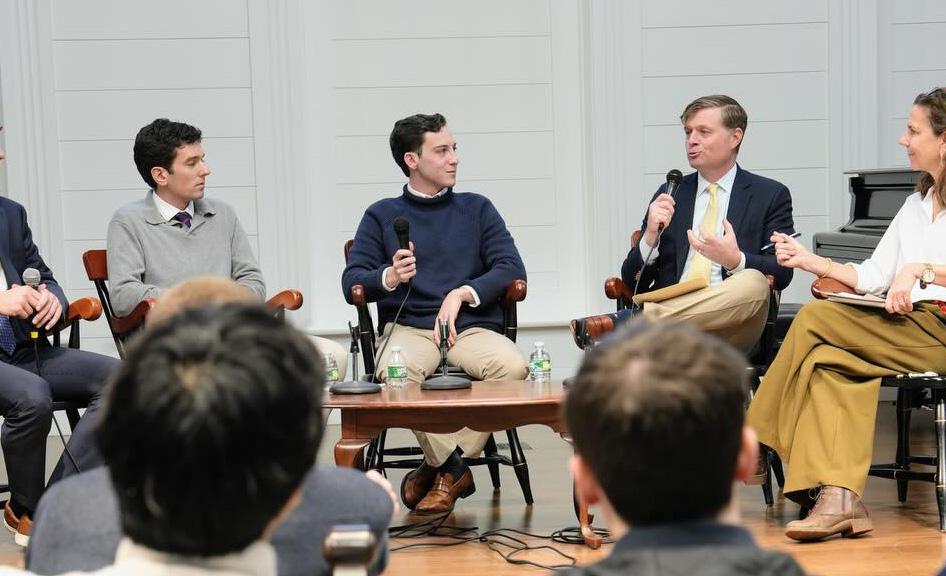
Character, as displayed in both chapel talks, has the extraordinary power to shape how others, namely our peers, think and feel. Dr. Courtney’s compassion reframed a moment of public failure, helping our community see Kerkering—and others who make public mistakes of this caliber—as humans deserving as empathy as much as any other. Similarly, Bennet, Matt, and Luke used their honesty and courage to change our understanding of what it means to support our gay or questioning peers. Their unique stories challenged our assumptions, opening our minds through vulnerability and integrity. both of these amazing all-school experiences highlighted how we each have the capacity to transform each others’ minds and feelings of belonging through kind and compassionate actions. Now that is brotherhood! ☐

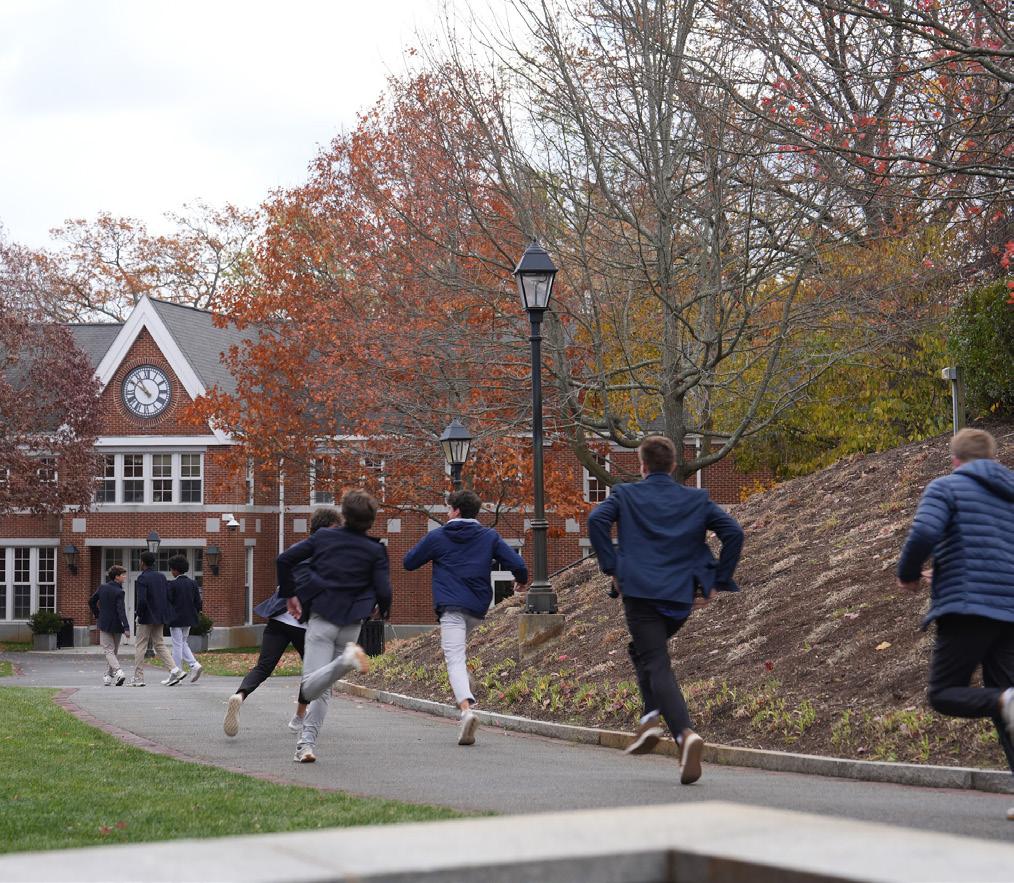
Turkey Drive Photo Collage







Dr. Courtney Giving her Thanksgiving Talk
BH Communications
The Phillies The Philaldephia Inquirer
The Amygdala Brainframe
Bennett Morris ’18, Matt Travaglini ’21 and Luke Travaglini ’24
December Arts Faculty Artist of the Issue: Mr. Duarte
By Sean Park ’28 Panel Staff
Whether through his enthusiastic teaching or the hundreds of gigabytes worth of photos he has stored in his SSDs, evidence of Mr. Duarte’s love for photography is everywhere. In recognition of his passion and proficiency, Mr. Duarte is one of the most renowned faculty artists at Belmont Hill and serves as the Chair of Visual Arts. Mr. Duarte’s journey as an artist was one full of twists and turns. Before college, he “was not a photographer at any point.” It was an art alien to his parents, friends, and even his high school’s curriculum. Instead, Mr. Duarte pursued painting before and during his college years, only briefly showing an interest in photography by considering taking Photo I at his college. Photography only truly entered his life when he began looking for photographers to take pictures of his work for his portfolio. After looking at their egregious pricing, Mr. Duarte realized that a lot of money could be saved in the long term if he bought a camera and took his own photos, a process he thought would be easy. In his later reflections, he called this a “really stupid statement, because it turned out to be, uh… not that easy.” The new challenge of learning photography filled Mr. Duarte’s life after graduation, and the challenge quenched his thirst for knowledge.
Mr. Duarte now has a deep understanding of photography, but he is still constantly looking to improve his craft. One person he draws inspiration from is Gregory Crewdson, a photography professor at Yale. Crewdson’s photos call out to Mr. Duarte because he says that “Crewdson’s not a photographer.” Instead, he is a “world builder”, using the camera as a tool to capture scenes straight from the world he envisioned. To successfully replicate Crewdson’s mental images, the shots must be staged, which makes his work appear fake to some. However, Mr. Du -
Springsteen Movie Review
By Liam MacLean ’27 Panel Staff
Released on October 24th, “Springsteen: Deliver Me from Nowhere” follows Bruce Springsteen’s making of his famous album “Nebraska.”
The biopic, which follows the difficult time in the artist’s life that the album was produced, draws influences from both the book “Deliver Me from Nowhere,” published in 2023, and Springsteen’s autobiography. The film stars Jeremy Allen White, a rising star known for his roles in “Shameless” and “The Bear,” who represents the musical artist through intense emotion and a striking replication of Springsteen’s voice.
The film details Springsteen’s temporary retirement to a home in Freehold, New Jersey, with the help of his manager, Jon Landau. Still committed to his music, Bruce employs Mike Batlan, his technician, to arrange his personal room into a studio. In contrast to a more professional and public recording, this intimate setting allowed for the exploration of more personal and intense themes. Springsteen draws influence from his early childhood, including dark memories like confronting his alcoholic father. Despite his growing popularity and increasing opportunities, he remains focused on his album. After a brief con -
frontation with his father, Springsteen travels to New York to record the new album with the E Street Band. After two weeks of recording, he remains unsatisfied with the album. Insisting on not releasing the new recording, Jon Landau agrees to release the raw demo as the album, using older recording equipment to recreate the tape as the master vinyl.
Springsteen tells his love interest, Faye Romano, that he is moving across the country to Los Angeles, and he departs, experiencing a mental breakdown on the way. Landau reaches out to Springsteen, urging him to seek help. After months of growth and recovery, he returns to tour with the support of Landau and his parents.
“Springsteen” is not a typical Hollywood production and has received mixed reviews from audiences and critics. Instead, it follows the true experiences and emotions of a growing artist, yet some say it has fallen short of this endeavor as well.
Despite an impressive performance from Jeremy Allen White, many claim that the story doesn’t capture the whole story and emotion that the artist experienced. Despite potential shortcomings, the biopic details the life and story of an individual many may know of, but not about, and it is a valuable watch for all fans. ☐

arte finds Crewdson’s storytelling beautiful, and connects it to his own art by saying that “[his] best photographs do the same, where they’re constructed.”
At times, upwards of 50 images are used to create a single final result, showcasing Mr. Duarte’s desire to enhance his photos through Crewdson’s techniques. Still, Mr. Duarte has faced challenges in photography throughout his life. He says that in general, American culture doesn’t support artists, as they need to be constantly on the grind for the next grant or the next residency.
“You feel like you’re always in this, like, lonesome battle. Like, it’s always just you and nobody else, and that’s hard.”
Mr. Duarte was able to secure his life as an artist by teaching at Belmont Hill, yet even that has its own challenges. Teaching full time is draining, only exacerbated by the fact that he has a family to look after. Both lead to a decrease of time and energy to devote to the next photo. However, he is still able to find opportunities to improve his skills, demonstrating to everyone that you will always find time to do things you love.
To any aspiring photographers, Mr. Duarte advises them to make a habit of practicing photography. Whether it be through taking photos, watching YouTube videos on techniques, practicing using Photoshop, or reading things related to photography, he emphasizes that it is important to have photography on the mind constantly.☐
Landau Gallery Update
By Ryan Li ’28 Panel Staff
Bringing a new artistic style to Belmont Hill through her striking acrylic paintings, the Landau Gallery showcased the work of local artist Mary Hanlon from October 3 to November 21. Hanlon, who currently resides in Melrose, creates beautiful landscapes through what she describes as impressionistic realism, painting boldly and colorfully. “The paint is acrylic and very thick; she paints in a very aggressive manner,” explained Mr. Duarte. “Boys on campus often pointed out that the paintings weren’t delicate and that they had never seen paintings like that.” A crucial goal of the gallery is broadening student horizons through different art forms, and Hanlon, through her vibrant landscapes, demonstrates the emotional sense of still art, creating masterpieces without extreme precision and intricacy, introducing another art form to Belmont Hill. In terms of preparing the gallery, finding artists is no easy task either. Not only must you pitch your gallery space,
but you also have to be involved in local art communities. Two methods for this are social media and libraries, as it is easy to reach out and view art on those platforms. Mr. Duarte was able to find Mary Hanlon through Facebook before reaching out and agreeing on a deal. He remarked, “Running a gallery is no different than any other business; it’s a lot of emails, a lot of communicating with people to try to sell your gallery space to them, to have them come visit, and then have them commit.” What set Hanlon apart from others was her local connection and unique acrylic style, leading to her two-month-long exhibit.
Now that the Mary Hanlon exhibition has concluded, the gallery will undergo a period of restoration. As a result of the constant art shows, the gallery walls are often in need of repair. Therefore, for the next few weeks, the walls will remain bare.
The Landau gallery plays a vital role in Belmont Hill, bringing an outside perspective to the community. The next show will take place in January, featuring student work from various art classes.☐

Varsity Football Team Looks to Bounce Back in 2026
By Tyler Grossman ’27 Panel Staff
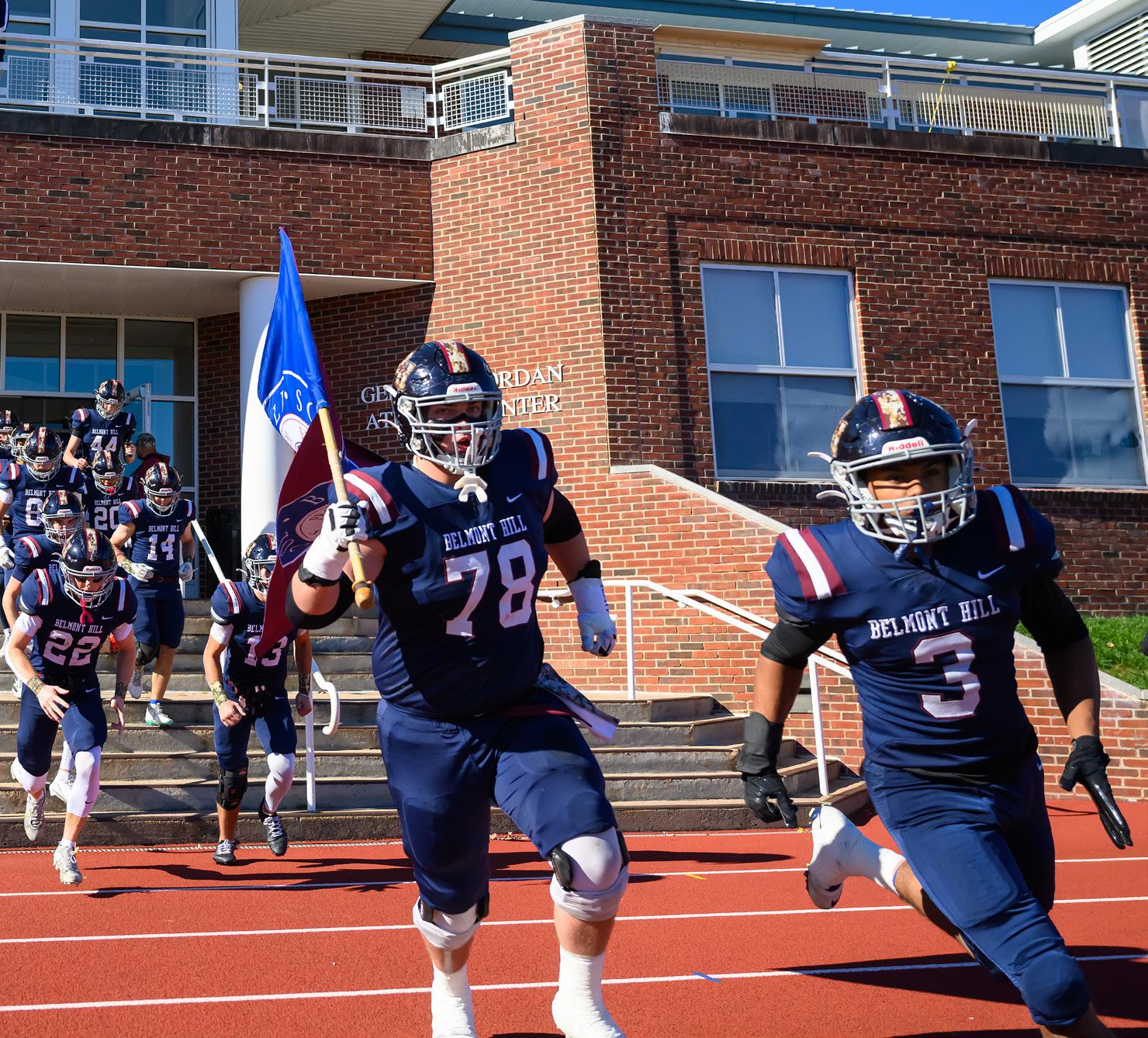
The varsity football team battled through much adversity throughout the season to salvage a 2-6 record after starting 0-6. Jack Hurley ’27 thought during the season that, “We learned a lot about ourselves this season, learned that we can battle through a lot, and stay focused with our goals in mind, and I think that allowed us to finish the season well.”
However, the slow start to the season was not all bad. To open the season,
BH gave a talented St. Paul’s School a valiant effort, leading early in the first quarter before the game slipped out of their grasp in the second half. Additionally, the team put up an incredibly spirited effort against a highly talented Tabor Academy team, holding Tabor to their second-lowest score of the season while visibly frustrating their four-star quarterback. Following another good battle against a very talented Milton team, it felt like another game was slipping away from Belmont Hill against Lawrence Academy. However, a gritty
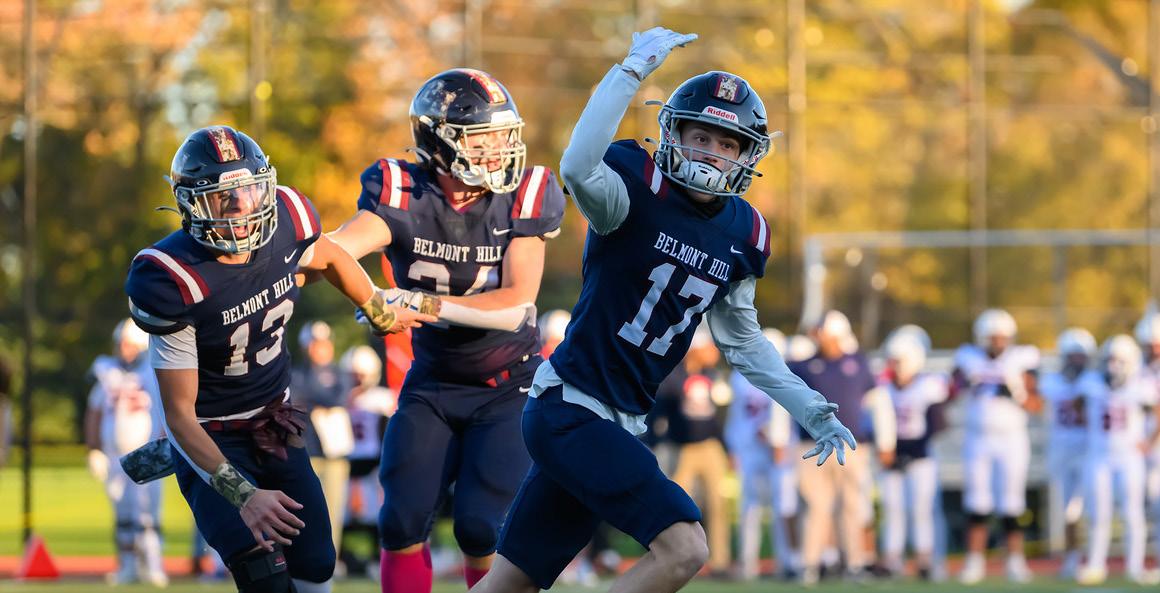
effort and thrilling comeback, where BH overcame a 22-point third-quarter deficit, which was capped off by a 36-yard game-winning kick by Dylan Casillo ’26, gave the team its first win of the season. They carried this momentum from their second half of the Lawrence game to a 49-24 victory over Trinity Pawling in their final game of the season.
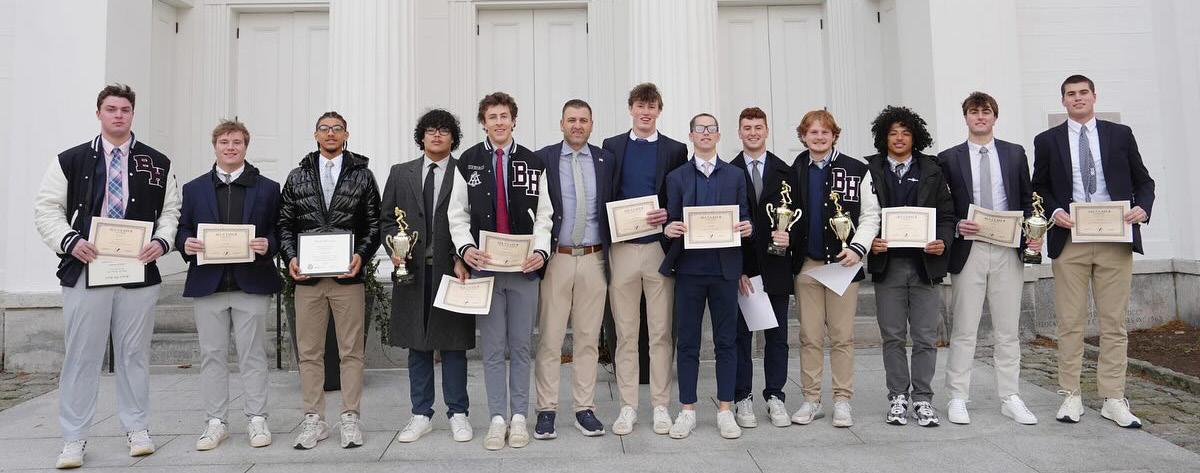
In addition to their team’s success, many players received individual honors. These included current senior players Nick Fiumara ’26, Trey Clayton ’26, and Griffin Vail ’26 were named to the All NEPSAC Class B first team. Furthermore, Réis Little ’26, Dylan Casillo ’26, Cam Kelly ’26, Ky-Mani Monteiro ’27, Michael Zapach ’27, Ajani Kromah ’27, and Jack Conway ’28 were all members of the second team. Finally, Riley Castillo ’26, Leopold Kuehberger ’26, Marcus Griffin ’26, and Declan Curtin ’26 received honorable mentions. The Panel would like to congratulate the football team on their perseverance, grit, and success this season, and wish them the best of luck in preparing for next year’s season. ☐
Soccer Successful in Coach Montoya’s Last Season
By Bradford Adams ’26 Panel Staff
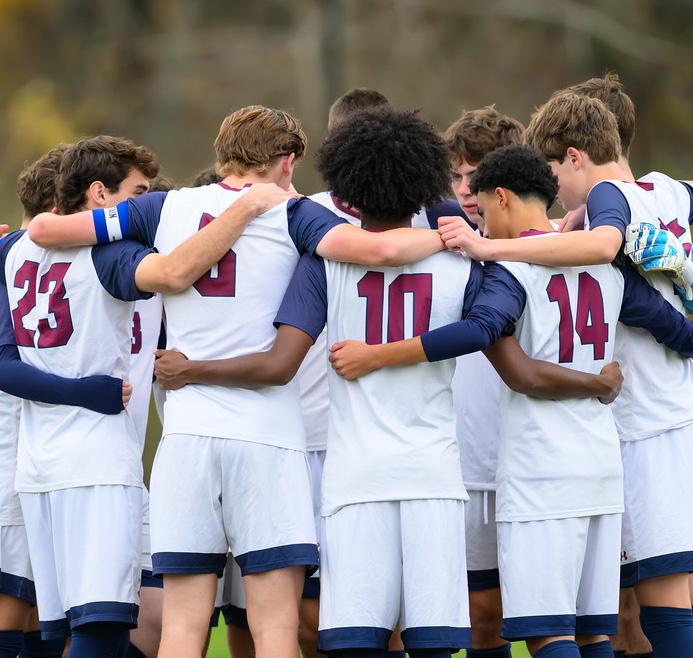
Following a successful 2024 campaign, the Belmont Hill Varsity soccer team looked to build on its success in Mr. Montoya’s final season as head coach. Under the leadership of captains Sam Lawrence ’26 and Jack Bartlett ’26, the team entered the season eying the ISL title and a deep NEPSAC playoff run. They started exceptionally, win -
ning their first six games, including the first three league matches, to sit atop the table heading into a top-of-the-table clash at home against Rivers. However, the team let a lead slip away in the dying moments of the match and drew 2-2. The result began a downturn in form that saw the squad win just two of their next eight games, while struggling to create chances and put away inferior teams.
Following a tactical tweak from the coaching staff to move winger Adonai

Samuel ’26 to the center of the pitch and play a more direct and high tempo style, the team produced better performances. Notably in the second half against league runner ups Milton, they fought back to draw 3-3 after being down 3-1 at halftime, helped by a clever backheel finish from left back Andrew Lyon ’26. An upturn in form saw the team
Soccer Team Huddling Before a Game Adam Richins
Nick Fiumara ’26 and Marcus Griffin ’26 lead the charge Adam Richins
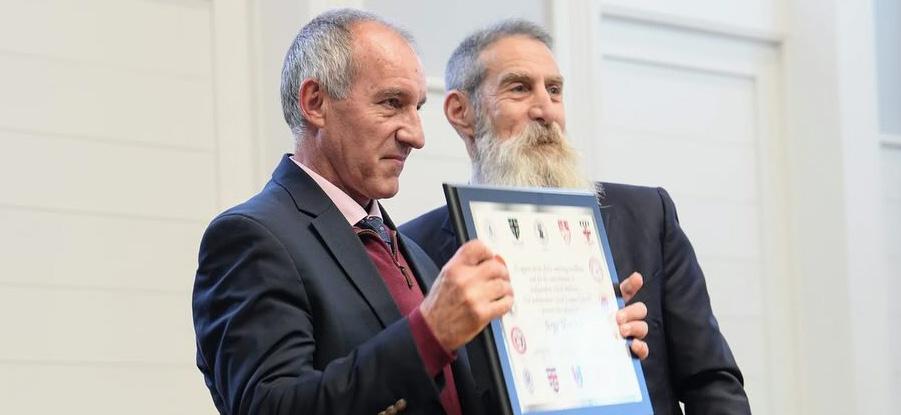
Top: Mr. Montoya is Recognized Bottom: Award Winners BH Communications
Top: Dylan Casillo ’26’s Walkoff Field Goal Bottom: Award Winners Richins,
Mr. Duarte Belmont Hill Directory
Jeremy Allen White as Bruce Springsteen Google Images
Athlete of the Issue: Fitz Courtney ’26
By Cooper Schuldt ’28 Panel Staff
Over the last four years, Fitz Courtney ‘26 has been an essential contributor to Belmont Hill’s Cross Country and Nordic Skiing programs, both athletically and as a leader. Due to his contributions and leadership, he earned the title of Captain for both the Cross Country and Nordic Skiing Teams for the 2025 and 2026 seasons.
He joined both teams as a freshman at Belmont Hill and quickly found success, becoming a varsity contributor in both sports. Just last season, the Nordic team placed first in the Lakes Region Championship with five athletes in the top 10. Fitz finished 7th, helping score the team first. Fitz also placed well at New England’s, finishing 11th, which helped the team secure 2nd place.
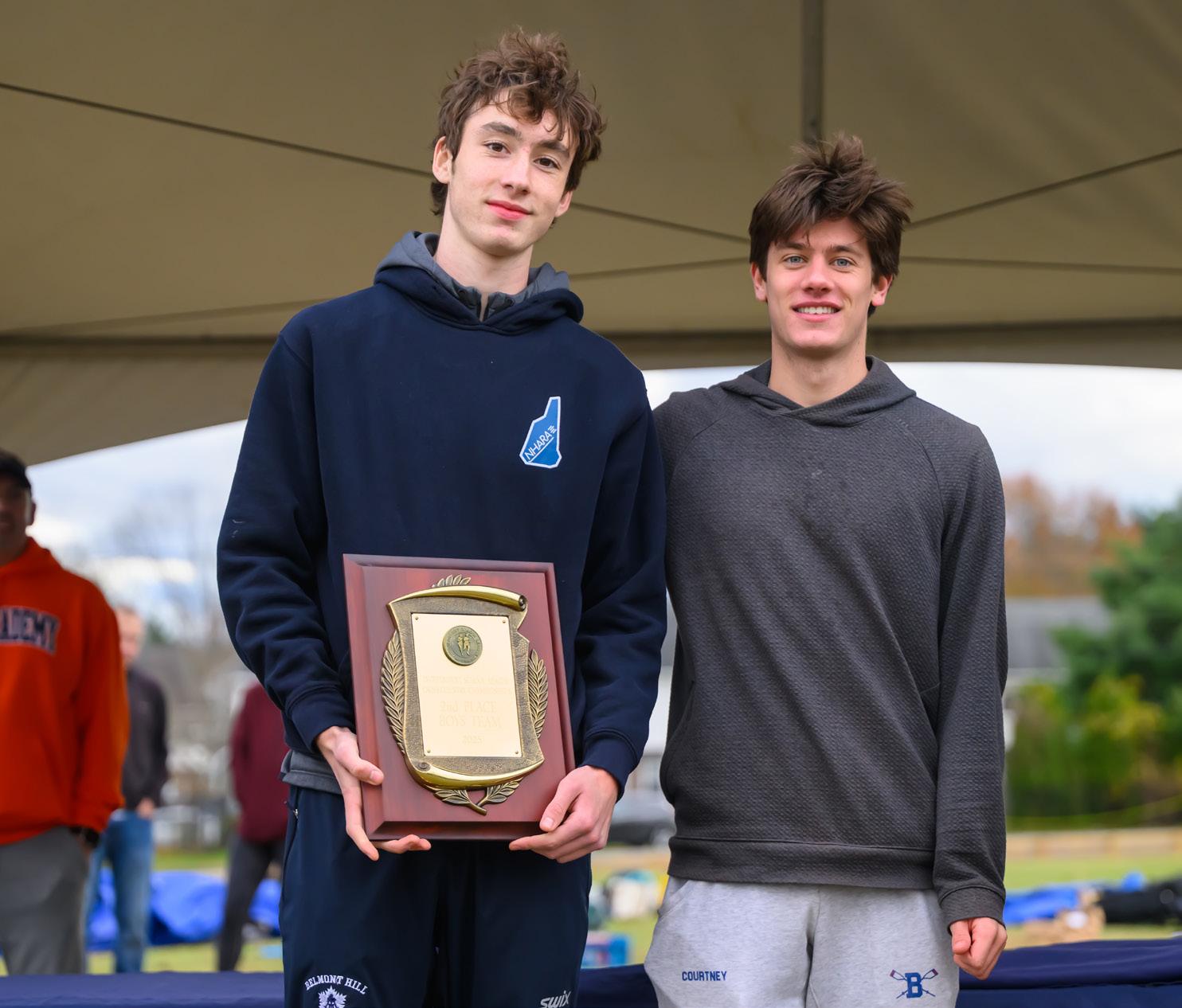
In Cross Country, Fitz completed an impressive season this year, finishing 7th at ISLs and 2nd on the team, an impressive feat and improvement from 17th the year before, which helped contribute to the team’s 2nd place title in ISLs.
Along with being a skilled athlete, Fitz constantly demonstrates leadership. When asked about his goals for this upcoming season, Fitz mentioned, “One goal is to continue to support the people on the team that are younger or less experienced to have them feel like part of the team and that they matter.” Fitz embodied much of this goal these past few years, with many of his teammates having said the same.
One teammate in particular mentioned, “Fitz is a really great leader; he leads by example with his work ethic, especially on workouts, and he talks

and connects to the younger guys on the team.” Another teammate added, “I always liked how Fitz was able to make everyone on the team feel included; the team is always bringing in new guys every year and I feel like the team culture is always very supportive because we have leaders like Fitz who are able to create an environment where there is a shared feeling of brotherhood.” Fitz understands how to get the younger kids on the team involved and engaged because when he was younger, he mentioned that he felt a little distant from the older kids on the team, particularly during workouts and in the overall team culture. As a result, he made one of his own goals when he stepped up as a senior leader to make sure that everyone felt like they knew each other and felt comfortable being on the team. His younger brother, Pierce ‘28, has also played a key role in
Fitz’s perspective on the team culture as one of the younger athletes on the team.
Fitz got into both cross country running and Nordic skiing at a young age. He participated in running races with his dad when he was young and joined a skiing club team from kindergarten to 3rd grade before moving to Pennsylvania in middle school, where he took a break from skiing. When he moved back to Massachusetts and joined Belmont Hill in the 9th grade, he officially joined the Cross Country running team and restarted his career in Nordic skiing. Looking back on his years at Belmont Hill, Fitz mentions that the support from his teammates and coaches was one of the most important parts of his athletic experience. Particularly, coaches like Mr. Trautz, Mr. DeCaprio ’16, and Dr. Calloway have always been there for him and helped him improve
every day. Fitz has credited those coaches with also contributing to a team environment where athletes and coaches feel comfortable with each other and feeling like a unified team. Fitz also mentioned some older kids on the team from his younger days who helped him when he was younger who were juniors and seniors when he first joined the team; he credits those older athletes as being sources of inspiration for how to be a true Belmont Hill leader as well as lifting others up through leading by example.
One of Fitz’s largest challenges was time management. During his first two years at Belmont Hill, time management was something he struggled with often both inside the classroom and out of it:“Time management took me two years to figure out. Until junior year, it was something I really struggled with and I had to constantly look for ways to address this problem.” Junior year, he figured out how to use his time much more efficiently. He focused on using his time effectively during school and study halls, visiting teachers to get ahead on his work. Therefore, he now has a more manageable workload at home, especially if he comes home after a very challenging workout.
This season, Fitz and the Nordic skiing team are working to try and win another Lakes Region title. He is hoping to make a top 5 finish in the Lakes Region Championship. Outside of school, Fitz is trying to qualify for the EHS meet to attempt to make the state team and compete against other states. The Panel congratulates Fitz on a successful Belmont Hill athletic career and wishes him the best of luck in the rest of his time at Belmont Hill and beyond. ☐
Cross Country Finishes Strong Once Again
By Jack Good ‘27
Panel Staff
The Varsity and JV Cross Country teams both had exceptional seasons this past year. In the first race of the season, the Bobcat Invitational, JV placed second overall and Varsity placed 4th, with Will Trautz ’27 coming in first place and breaking the course record with an impressive time of 16:09.9. The team finished 12-1 in ISL races over the fall.
At the ISL Championships, for the first time in many years, both races were won
by Belmont Hill students, with Jack Good ’27 winning the JV race and Will Trautz ’27 winning the Varsity race for the second year in a row. The JV team placed second and placed 5 runners in the top 15: Riley Marth ’27, Pierce Courtney ’28, Babikir Saeed ’26, Colin Grierson ’29, and Jack Good ’27. The Varsity team also captured the second-place award, with 4 boys in the top 21 runners: Yamin Ibrahim ’27, Eita Fuse ’27, Fitz Courtney ’26, and Will Trautz ’27. The varsity team finished in 8th place overall at the NEPSAC D1 Cham-

pionship, with Will Trautz ’27 coming in fourth place in the varsity race, and Babikir Saeed ’26 coming in 12th place in the JV race. Many boys earned All-League and All-NEPSAC awards, with Will Trautz ’27, Fitz Courtney ’27, Eita Fuse ’26, and Yamin Ibrahim ’27 all receiving AllISL honors, Fitz Courtney ’26 receiving All-NEPSAC honorable mention, and Will Trautz ’27 receiving All-NEPSAC.
At the Fall Sports Awards Chapel, Yamin Ibrahim ’27 and Declan Woolbert ’27 earned the Most Improved prize, Will Achtmeyer ’26 and Fitz Courtney ’26 both
received the Henry B. Sawyer Sportsmanship Award, and Will Trautz ’27 received the Cross-Country Award, the ISL Cross Country MVP Award, and the Globe All-Scholastic Award, in recognition of his accomplishment in breaking a total of 3 course records.
With the end of the season comes, unfortunately, the retirement of the senior class and captain Fitz Courtney ’26, but the team looks forward to another shot at the ISL championship trophy next year, under the guidance of captain Will Trautz ’27. ☐
An Analysis of the College Football Coaching Carousel
By Tyler Grossman ’27 Panel Staff
A college football season filled with surprising frontrunners, wild upsets, and disappointment from perennially talented programs has led to a record nine Power Five schools parting ways with their coaches before Black Monday, the day after the regular season ends, often marked by teams making changes at the head coaching position. With these firings came buyouts for the coaches, reaching up to $50 million, setting the universities back financially for years to come. What makes these coaching changes most surprising is who is being relieved of their duties. Both James Franklin at Penn State and Brian Kelly at LSU entered the season ranked in the top 10 in the AP Preseason top 25, coming off multiple years of success with their programs. Furthermore, both schools started the season well, winning their first three games respectively. However, a string of bad losses for both coaches put
the writing on the wall and led to their departures. Additionally, within the SEC, Billy Napier and Hugh Freeze entered the season on the hot seat, and another mediocre start to the season led to their firings. Another shock firing was Oklahoma State’s decision to move on from Mike Gundy, who had been at the helm in Stillwater for 21 years, having accumulated 170 wins during this time.
One of the reasons for these “quick
trigger” fires is NIL and its impact on recruiting. Now that millions of dollars are being pumped into recruiting by donors and the schools to attract the best high school recruits and transfer portal talent, it leads to a shorter leash for coaches. In the past, it had been customary to give coaches at least three years to get “their guys” in and build a culture before being evaluated. Now, with the transfer portal, rosters are being
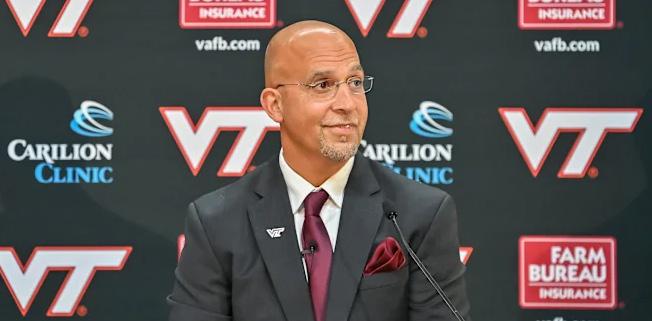
turned over every year, leading schools and fan bases to expect instant success from new coaches. Additionally, with the expansion of social media, backlash and criticism of poor coaching decisions lead fans to turn on their coaches more quickly, causing them to be fired sooner than they would have been in the past. This trend is also evident in professional sports leagues in America and Europe. For example, in both the Premier League and the NHL, fewer than 30% of teams’ coaches have been at the helm for the past two seasons or more. These numerous vacancies are likely to entice many coaches to jump ship from their current teams to take open jobs at a “blue blood” program, such as Florida, LSU, or Penn State. Outside of James Franklin, who has already taken a job at Virginia Tech, some of the most likely candidates to be sought after include SMU’s Rhett Lashlee, Missouri’s Eli Drinkwitz, and Tulane’s Jon Sumerall. These many coaching openings are sure to make this off-season one of the wildest ones in college football history. ☐
MLB 2025-2026 Free Agency and Offseason Preview
By Sam Norden ’28 Panel Staff
The MLB is now a month into the offseason, and with major free agent signings and trades soon to come, anticipation is building across the league. In a free agency class highlighted by players such as Chicago Cubs outfielder Kyle Tucker, Houston Astros starting pitcher Framber Valdez, and Boston Red Sox third baseman Alex Bregman, this offseason should be interesting. While this year’s free agency lacks a truly generational talent, such as Juan Soto last year or Shohei Ohtani the year prior, there is strong talent across the board this year, and it will be interesting to see which teams will separate themselves from the rest. No matter what happens, the decisions made in the next month or two will have lasting implications, determining how competitive the league will be on Opening Day in April.
Sunday, November 23, marked the first major trade of the offseason, with the New York Mets sending outfielder Brandon Nimmo to the Texas Rangers
for All-Star and World Series Champion Marcus Semien. This was a much-needed middle-infield upgrade for the
taka Murakami and Kasuma Okamoto, and pitchers Tatsuya Imai and Kona Takahashi. Murakami and Okamoto are

Mets, filling a significant hole in their roster, while Texas received a strong bat and strong outfielder in Nimmo. Additionally, this year’s free agent class features some notable stars looking to make the move over to the states from Japan, including infielders Mune -
powerful bats on the corners of the infield, but both leave something to be desired defensively. Imai is one of the best pitchers in this year’s free agent class and will provide instant relief to any team that needs help in that area, while Takahashi can work as a starter or out
of the bullpen. These four players hope to have the chance that other Japanese baseball players have had in the MLB, such as Shohei Ohtani and Yoshinobu Yamamoto, who just won their second World Series in a row in Los Angeles.
The goal for the Boston Red Sox this offseason is to build off of last season by filling some key roster holes, whether trying to keep Alex Bregman in Boston, trying to sign a powerful first baseman in Pete Alonso, or bringing back Kyle Schwarber, who helped bring the Red Sox to the ALCS in 2021, after spending the past couple of seasons in Philadelphia. The Red Sox’s largest roster holes come at the right side of the infield, bullpen, and they could use some additional help in the starting rotation. As the winter unfolds, all eyes will be on how aggressively teams move to reshape their futures. With a strong free agency class available and unexpected trades possible, this winter will provide a ton of drama. Ultimately, the choices made in these next few months will define who emerges as true contenders in 2025 and beyond. ☐
Contenders or Pretenders: A NFL Playoff Preview
By Jackson Hurd ’26 Panel Staff
This NFL playoff race has been unlike anything we have seen recently. Budding superstars and injuries have defined this year’s current standings.
In the AFC, as of early December, all four divisions have leaders who did not win the previous year, reminiscent of the mid-2010s, with the Patriots, Steelers, Jaguars, and Broncos. In the NFC, we have unexpected competitive battles in all four divisions. It is safe to say that finding a Super Bowl favorite this season is no cake walk.
When considering the potential Super Bowl favorites, one must consider the previous year’s victors, the Philadelphia Eagles. Early on, they looked like the team to beat, with a 4-0 start to begin the season, but since that close win over the Buccaneers, they have gone 4-4, with surprising losses to both the Giants and Bears. With the recent struggles of the Eagles, one might
look to the runner-ups and three-time champions of the last six years, the Kansas City Chiefs, but that wouldn’t be a safe option either. They started the year with a relatively slow start, going 0-2, and while it has improved since then, they are still only 6-6, with elimination breathing down their necks.
With both of the top two teams from last year struggling this year, one might see how reigning MVP Josh Allen and the Buffalo Bills are performing. While they would be in the play -

offs if the season started today, they would be holding onto the 7th seed with a two-and-a-half-game deficit to their division leaders. Lastly, considering last season, people might look at the Lions, who were a league-leading 15-2 last season before a surprisingly early exit in last year’s playoffs. Sadly, they are also struggling, ranked 3rd in the NFC North behind both the Jordan Love-led Packers and the Chicago Bears. If all of these star teams from last year are struggling, who should you place your money on? A couple of teams that have looked good this year are the New England Patriots, captained by MVP candidate Drake “Drake Maye” Maye. While their schedule is seemingly weak compared to the rest of the league, they have beaten everyone put in front of them as of late with a 10-game win streak. Another viable option is the offense-led Seattle Seahawks, whose young receiver, Jaxon Smith-Njigba, has taken the league by storm and is on pace to break most NFL receiving records. Unlike the Seahawks, the Broncos have been a tough team to beat, led by Patrick Surtain and widely regarded as having the best defense in the league. While their offense has room to improve, their quarterback, Bo Nix, has stepped up when it mattered most, helping bring Denver to a 10-2 record. While these teams are playing great football at the moment, the wide spread of talent in the league is going to make for an exceptionally entertaining sprint in these playoffs, where any team can come out on top. ☐
James Franklin at his Virginia Tech Introductory Press Conference Sports Illustrated
A Graphic Showing some of the Top Free Agents in this Year’s
Belmont Hill Varsity Cross Country, Including This Year’s Captains, Fitz Courtney ’26 and Will Trautz ’25
Adam Richins
Fitz Courtney ’26
Adam Richins

Who Would Win?

Versatility
Battle IQ

Experience
Eyesight
Athleticism
Stamina
Camouflage
Intimidation
Tolerance for John Pork
Vocabulary