Wisdom In Counseling and Psychotherapy: A Conceptual Model for Practice Mitchell Waters, Ph.D, LPC-MHSP, ACS Belmont University, School of Mental Health Counseling
Introduction
Conceptual Framework
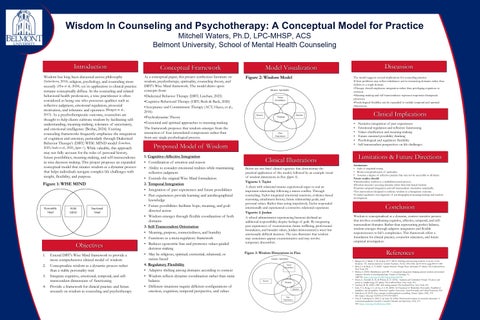
Wisdom has long been discussed across philosophy (Sulavikova, 2014), religion, psychology, and counseling more recently (Zhu et al., 2024), yet its application to clinical practice remains conceptually diffuse. In the counseling and related behavioral health professions, a wise practitioner is often considered as being one who possesses qualities such as reflective judgment, emotional regulation, prosocial motivation, and tolerance and openness (Bangen et al., 2013). As a psychotherapeutic outcome, counselors are thought to help clients cultivate wisdom by facilitating selfunderstanding, meaning-making, tolerance of uncertainty, and emotional intelligence (Beshai, 2024). Existing counseling frameworks frequently emphasize the integration of cognition and emotion, particularly through Dialectical Behavior Therapy’s (DBT) WISE MIND model (Linehan, 2025; Seah et al., 2025; figure 1). While valuable, this approach may not fully account for the roles of personal history, future possibilities, meaning-making, and self-transcendence in wise decision making. This project proposes an expanded conceptual model that situates wisdom as a dynamic process that helps individuals navigate complex life challenges with insight, flexibility, and purpose.
As a conceptual paper, this project synthesizes literature on wisdom, psychotherapy, spirituality, counseling theory, and DBT's Wise Mind framework. The model draws upon concepts from: •Dialectical Behavior Therapy (DBT; Linehan, 2025) •Cognitive Behavioral Therapy (CBT; Beck & Beck, 2020) •Acceptance and Commitment Therapy (ACT; Hayes, et al., 2016) •Psychodynamic Theory •Existential and spiritual approaches to meaning-making The framework proposes that wisdom emerges from the interaction of four interrelated components rather than from any single psychological process.
Figure 1: WISE MIND
Objectives 1. 2. 3. 4.
Extend DBT's Wise Mind framework to provide a more comprehensive clinical model of wisdom Conceptualize wisdom as a dynamic process rather than a stable personality trait Integrate cognitive, emotional, temporal, and selftranscendent dimensions of functioning Provide a framework for clinical practice and future research on wisdom in counseling and psychotherapy
Discussion
Model Visualization Figure 2: Wisdom Model
Clinical Implications
• • • • • •
Proposed Model of Wisdom 1. Cognitive–Affective Integration • Coordination of emotion and reason • Ability to consider emotional realities while maintaining reflective judgment • Extends the original Wise Mind formulation 2. Temporal Integration • Integration of past experiences and future possibilities • Past experiences provide learning and autobiographical knowledge • Future possibilities facilitate hope, meaning, and goaldirected action • Wisdom emerges through flexible coordination of both domains 3. Self-Transcendent Orientation • Meaning, purpose, connectedness, and humility • Functions as a meta-regulatory framework • Reduces egocentric bias and promotes values-guided decision making • May be religious, spiritual, existential, relational, or nature-based 4. Regulatory Flexibility • Adaptive shifting among domains according to context • Wisdom reflects dynamic coordination rather than static balance • Different situations require different configurations of emotion, cognition, temporal perspective, and values .
The model suggests several implications for counseling practice: •Client problems may reflect imbalances across interacting domains rather than deficits in a single domain. •Therapy should emphasize integration rather than privileging cognition or emotion. •Meaning-making and self-transcendence represent important therapeutic processes. •Psychological flexibility can be expanded to include temporal and spiritual dimensions. •Wise action may produce emotional discomfort while still promoting longterm wellbeing and flourishing.
Clinical Illustrations Below are two brief clinical vignettes that demonstrate the practical application of this model, followed by an example visual of wisdom dimensions in flux (figure 3). Vignette 1: Taylor A client with relational trauma experienced urges to end an important relationship following a minor conflict. Through counseling, Taylor integrated emotional reactions, evidence-based reasoning, attachment history, future relationship goals, and personal values. Rather than acting impulsively, Taylor responded intentionally and experienced a corrective relational experience Vignette 2: Jordan A school administrator experiencing burnout declined an additional responsibility despite feelings of guilt. By integrating past experiences of overextension, future wellbeing, professional boundaries, and broader values, Jordan demonstrated a wiser but emotionally difficult decision. The case illustrates that wisdom may sometimes appear counterintuitive and may involve temporary discomfort. Figure 3: Wisdom Dimensions in Flux
Narrative integration of past experiences Emotional regulation and reflective functioning Values clarification and meaning-making Future-oriented possibility thinking Psychological and regulatory flexibility Self-transcendent perspectives on life challenges
Limitations & Future Directions Limitations: • Lack of empirical testing • Broad conceptualization of spirituality • Assumes a degree of reflective practice that may not be accessible to all clients Future studies should: •Operationalize wisdom as a multidimensional process. •Develop measures assessing dynamic rather than trait-based wisdom. •Examine temporal integration and self-transcendent orientation empirically. •Test interventions designed to cultivate wisdom as a therapeutic outcome. •Conduct qualitative investigations of autobiographical meaning-making and wisdom development.
Conclusion Wisdom is conceptualized as a dynamic, context-sensitive process that involves coordinating cognitive, affective, temporal, and selftranscendent domains. Rather than representing perfect balance, wisdom emerges through adaptive integration and flexible responsiveness to life's complexities. This framework offers a foundation for clinical practice, counselor education, and future empirical investigation.
References • Bangen, K. J., Meeks, T. W., & Jeste, D. V. (2013). Defining and assessing wisdom: A review of the literature. The American Journal of Geriatric Psychiatry, 21(12), 1254-1266. doi:10.1016/j.jagp.2012.11.020 • Beck, J. S. & Beck, A. T. (2020). Cognitive Behavior Therapy: Basics and beyond (3rd edition). The Guilford Press. New York, NY. • Beshai, S. (2024). Mindfulness and CBT: A conceptual integration bridging ancient wisdom and modern cognitive theories of psychopathology. Frontiers in Psychology, 15, 1489798. https://doi.org/10.3389/fpsyg.2024.1489798 • Hayes, S., Strosahl, K. D., & Wilson, K. G. (2016). Acceptance and Commitment Therapy: The process and practice of mindful change (2nd edition). The Guilford Press. New York, NY. • Linehan, M. M. (2025). DBT skills training manual. The Guilford Press. New York, NY. • Seah, T. S., Keng, S. L., & Lee, S. S. M. (2025). for Treatment of Borderline Personality. Handbook of mindfulness and self-regulation: Theoretical, Cognitive Neuroscience, Social-Personality, and Clinical Perspectives, 455. • Šulavíková, B. (2014). Key concepts in philosophical counselling. Human Affairs, 24(4), 574583. https://doi.org/10.2478/s13374-014-0250-9 • Zhu, P., Litherland, G., Bell, T., & Luke, M. (2024). Professional wisdom in counselor education: A consensual qualitative research. Counselor Education and Supervision, 63(4), 311329. https://doi.org/10.1002/ceas.12308