Values-Based Behavioral Frameworks as Contributors to Organizational Culture in Higher Education: A Literature Review David J. Park, DO, FAAFP, FACOFP dist. Thomas F. Frist, Jr. College of Medicine at Belmont University Nashville, Tennessee
Background
Findings
❑ Nearly every accredited college and university publishes a set of institutional values. There is often a gap between stated values and observed behaviors. ❑ This gap is called behavioral integrity — the perceived alignment of institutional values to words and deeds.1 ❑ Adoption of values-based behavioral frameworks may be positively associated with organizational culture perception by strengthening behavioral integrity.
Culture is perceived from behavior, not statements
Culture perception can be operationalized
Six dimensions of culture — environment, mission, socialization, information, strategy, and leadership — identifies culture in what is done, how it is done, and who is involved in doing it, rather than published statements of mission and values.2
Culture perception can be operationalized by adopting values-based behavioral frameworks. Mechanisms include mission revision, integration into strategic planning, onboarding and socialization, leadership modeling, professional development, and formal accountability.
Culture is shaped by lived values
Leadership behavior is the strongest lever
Research distinguishes stated values, lived values, aspirational values, and accidental values. Culture is shaped by lived values actively demonstrated and rewarded by supervisors and peers.3
Leadership upholding the shared set of values is critically important for organizational culture and to build trust. Trust accrues slowly and degrades rapidly when leadership credibility becomes unreliable.5,6
Virtue ethics is associated with lived values
Values incongruent behavior damages culture
Virtue ethics serves as the theoretical foundation for lived values. Values alone cannot shape culture—only institutional virtues, as core values operationalized through habitual behavior, can.4
Incongruence of stated values and observed behaviors was associated with dissatisfaction, demoralization, and intent to leave.7 Perceived misalignment predicted lower satisfaction and commitment and higher turnover intention.8
PROPOSITION Translating institutional values into observable behaviors contributes to shaping organizational culture in institutions of higher education.
Working definitions ❑ Institutional values – A published set of values of what an institution holds to be important and aspires to embody as an a collective. ❑ Values-based behavioral framework – A framework that specifies how values are to be enacted, demonstrated, and expected daily as observable behaviors. ❑ Organizational culture – The shared assumptions, values, and patterns of behavior that members develop and transmit over time in an organization.
Limitations
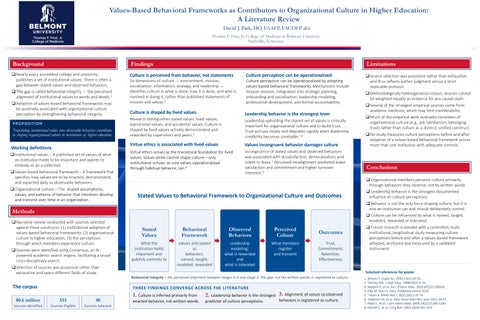
Stated Values to Behavioral Framework to Organizational Culture and Outcomes
Methods ❑ Narrative review conducted with sources selected against three constructs: (1) institutional adoption of values-based behavioral frameworks; (2) organizational culture in higher-education; (3) the perceptions through which members experience culture. ❑ Sources were identified using Consensus, an AIpowered academic search engine, facilitating a broad cross-disciplinary search. ❑ Selection of sources was purposive rather than exhaustive and spans different fields of study.
Stated Values
Behavioral Framework
Observed Behaviors
Perceived Culture
What the institution holds important and publicly commits to
Values articulated as behaviors: named, taught, modeled, rewarded
Leadership modeling: what is rewarded and what is tolerated
What members register and transmit
Outcomes Trust, Commitment, Retention, Effectiveness
THREE FINDINGS CONVERGE ACROSS THE LITERATURE
80.6 million
553
40
Sources Identified
Sources Eligible
Sources Selected
Conclusions ❑ Organizational members perceive culture primarily through behaviors they observe; not by written words ❑ Leadership behavior is the strongest documented influence on culture perceptions. ❑ Behavior is not the only force shaping culture, but it is one an institution can and should deliberately control. ❑ Culture can be influenced by what is named, taught, modeled, rewarded or tolerated. ❑ Future research is needed with a controlled, multiinstitutional, longitudinal study measuring culture perceptions before and after a values-based framework adopted, anchored and measured by a validated instrument.
Selected references for poster Behavioral integrity = the perceived alignment between stages 1–2 and stage 3. The gap, not the written words, is registered as culture.
The corpus
❑ Source selection was purposive rather than exhaustive and thus reflects author judgment versus a strict replicable protocol. ❑ Methodologically heterogeneous corpus; sources cannot be weighted equally as evidence for any causal claim. ❑ Several of the strongest empirical sources come from academic medicine, which may limit transferability. ❑ Much of the empirical work evaluates correlates of organizational culture (e.g., job satisfaction, belonging, trust) rather than culture as a distinct, unified construct. ❑ No study measures culture perceptions before and after adoption of a values-based behavioral framework across more than one institution with adequate controls.
1. Culture is inferred primarily from
2. Leadership behavior is the strongest 3. Alignment of values to observed
enacted behavior, not written words.
predictor of culture perceptions.
behaviors is registered as culture.
1. Simons T. Organ Sci. 2002;13(1):18-35. . 2. Tierney WG. J High Educ. 1988;59(1):2-21. 3. Weldon D, et al. Am J Pharm Educ. 2023;87(12):100542. 4. Pike M. Man in Educ. Published online 2026. 5. Tiwari V. NHRD Net J. 2025;18(1):70-76 6. Hakanen M, et al. Tech Innov Man Rev. June 2012:38-41 7. Pololi L, et al. J Gen Intern Med. 2009;24(12):1289-1295. 8. Ostroff C. et al. J Org Beh. 2005;26(6):591-623