The Difficulty in Defining the Construct of Perseverance 1 2 Davon W. Ferrara and Linda Jones 1Department of Chemistry and Physics, 2Department of Psychological Science and Neuroscience
College of Sciences and Mathematics, Belmont University
Introduction ●
●
●
Perseverance is generally described as continuing to work toward a goal despite setbacks or obstacles.
●
Perseverance is correlated with the Big 5 Personality Trait of Conscientiousness. (Williams, 2026)
●
Higher levels of perseverance are associated with many positive outcomes including academic achievement, entrepreneurship, sports performance, career success, economic mobility, and psychological well-being.
●
●
●
●
●
We prefer the definitions based on two groups who conducted thorough literature reviews.
●
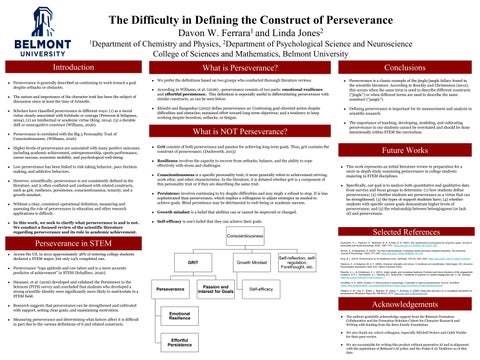
According to Williams, et al. (2026) , perseverance consists of two parts: emotional resilience and effortful persistence. This definition is especially useful in differentiating perseverance with similar constructs, as can be seen below.
●
Khindri and Rangnekar (2022) define perseverance as: Continuing goal-directed action despite difficulties and obstacles; sustained effort toward long-term objectives; and a tendency to keep working despite boredom, setbacks, or fatigue.
The nature and importance of the character trait has been the subject of discussion since at least the time of Aristotle. Scholars have classified perseverance in different ways: (1) as a moral virtue closely associated with fortitude or courage (Peterson & Seligman, 2004), (2) an intellectual or academic virtue (King, 2014), (3) a durable skill or noncognitive construct (Williams, 2026).
Low perseverance has been linked to risk-taking behavior, poor decision making, and addictive behaviors.
Conclusions
What is Perseverance?
What is NOT Perseverance?
●
●
●
●
The importance of teaching, developing, modeling, and cultivating perseverance in our students cannot be overstated and should be done intentionally within STEM the curriculum.
●
Conscientiousness is a specific personality trait; it more generally refers to achievement striving, work ethic, and other characteristics. In the literature, it is debated whether grit is a component of this personality trait or if they are describing the same trait.
This work represents an initial literature review in preparation for a more in-depth study examining perseverance in college students majoring in STEM disciplines.
●
Specifically, our goal is to analyze both quantitative and qualitative data from surveys and focus groups to determine: (1) how students define perseverance; (2) whether students see perseverance as a virtue that can be strengthened; (3) the types of support students have; (4) whether students with specific career goals demonstrate higher levels of perseverance; and (5) the relationship between belongingness (or lack of) and perseverance.
●
Without a clear, consistent operational definition, measuring and assessing the role of perseverance in education and other research applications is difficult.
●
Growth mindset is a belief that abilities can or cannot be improved or changed.
●
Self-efficacy is one’s belief that they can achieve their goals.
Future Works
Selected References
Conscientiousness
Duckworth, A. L., Peterson, C., Matthews, M. D., & Kelly, D. R. (2007). Grit: perseverance and passion for long-term goals. Journal of personality and social psychology, 92(6), 1087–1101. https://doi.org/10.1037/0022-3514.92.6.1087 Khindri, A., & Rangnekar, S. (2022). The trait of perseverance: A literature review and future research directions. The American Journal of Psychology, 135(3), 271–285. https://doi.org/10.5406/19398298.135.3.02
Across the US, in 2012 approximately 38% of entering college students declared a STEM major, but only 24% completed one.
GRIT
Growth Mindset
Perseverance “tops aptitude and raw talent and is a more accurate predictor of achievement” in STEM (Schaffner, 2020).
Measuring perseverance and determining what factors affect it is difficult in part due to the various definitions of it and related constructs.
●
Resilience involves the capacity to recover from setbacks, balance, and the ability to cope effectively with stress and challenges.
Persistence involves continuing to try despite difficulties and may imply a refusal to stop. It is less sophisticated than perseverance, which implies a willingness to adjust strategies as needed to achieve goals. Blind persistence may be detrimental to well-being or academic success.
Research suggests that perseverance can be strengthened and cultivated with support, setting clear goals, and maintaining motivation.
Defining perseverance is important for its measurement and analysis in scientific research.
●
●
Hanauer, et al. (2016) developed and validated the Persistence in the Sciences (PITS) survey and concluded that students who developed a strong scientific identity were significantly more likely to matriculate in a STEM field.
●
Grit consists of both perseverance and passion for achieving long term goals. Thus, grit contains the construct of perseverance. (Duckworth, 2013)
Perseverance in STEM ●
Perseverance is a classic example of the jingle/jangle fallacy found in the scientific literature. According to Reschly and Christenson (2012), this occurs when the same term is used to describe different constructs (“jingle”) or when different terms are used to describe the same construct (“jangle”).
●
However, scientifically, perseverance is not consistently defined in the literature, and is often conflated and confused with related constructs, such as grit, resilience, persistence, conscientiousness, tenacity, and a growth mindset.
In this work, we seek to clarify what perseverance is and is not. We conduct a focused review of the scientific literature regarding perseverance and its role in academic achievement.
●
Self-reflection, selfregulation, Forethought, etc.
King, N. L. (2014). Perseverance as an intellectual virtue. Synthese, 191(15), 3501-3523. https://doi.org/10.1007/s11229-014-0418-1 Peterson, C., & Seligman, M. E. P. (2004). Character strengths and virtues: A handbook and classification. Washington, DC: American Psychological Association; New York: Oxford University Press. Reschly, A. L., & Christenson, S. L. (2012). Jingle, jangle, and conceptual haziness: Evolution and future directions of the engagement construct. In S. L. Christenson, A. L. Reschly, & C. Wylie (Eds.), Handbook of research on student engagement (pp. 3–19). Springer. https://doi.org/10.1007/978-1-4614-2018-7_1
Perseverance
Passion and Interest for Goals
Schaffner, A. K. (2020, October 7). Perseverance in psychology: 4 activities to improve perseverance. Anna K. Schaffner. https://www.annakschaffner.com/post/perseverance-in-psychology-4-activities-to-improve-perseverance
Self-efficacy
Williams, K. M., Ling, G., Sotelo, J., Brantley, W., Wang, Y., & Kinsey, D. (2026). Keep calm and carry on: A conceptual framework for perseverance (Research Report No. RR-26-01). ETS. https://doi.org/10.64634/5qd2rx29
Acknowledgements Emotional Resilience
Effortful Persistence
●
The authors gratefully acknowledge support from the Belmont Formation Collaborative and the Formation Scholars Cohort for Character Research and Writing with funding from the Kern Family Foundation.
●
We also thank our cohort colleagues, especially Mitchell Waters and Caleb Walder for their peer review.
●
We are accountable for writing this product without generative AI and in alignment with the aspirations of Belmont’s AI policy and the Psalm 8 AI Taskforce as of this date.