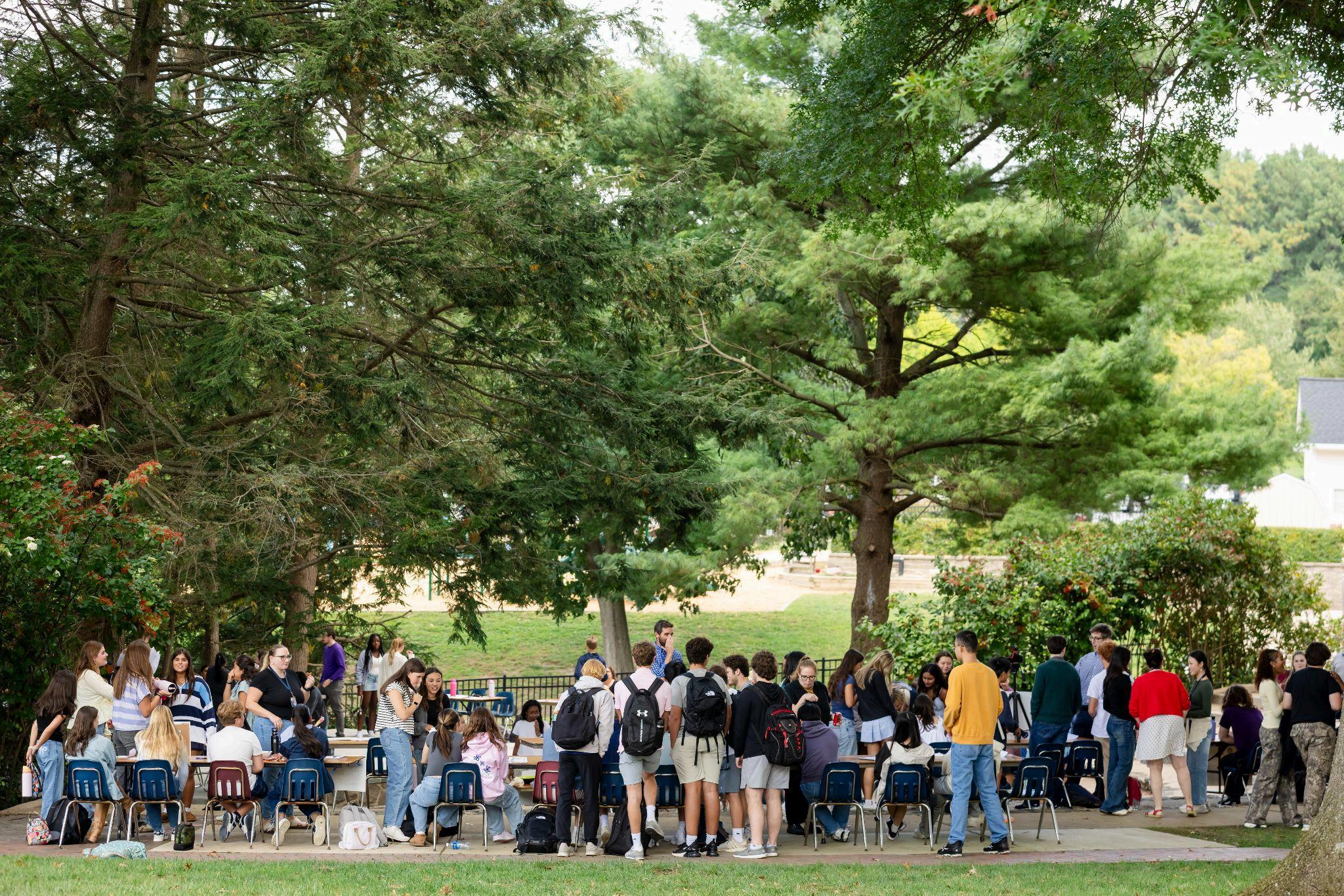
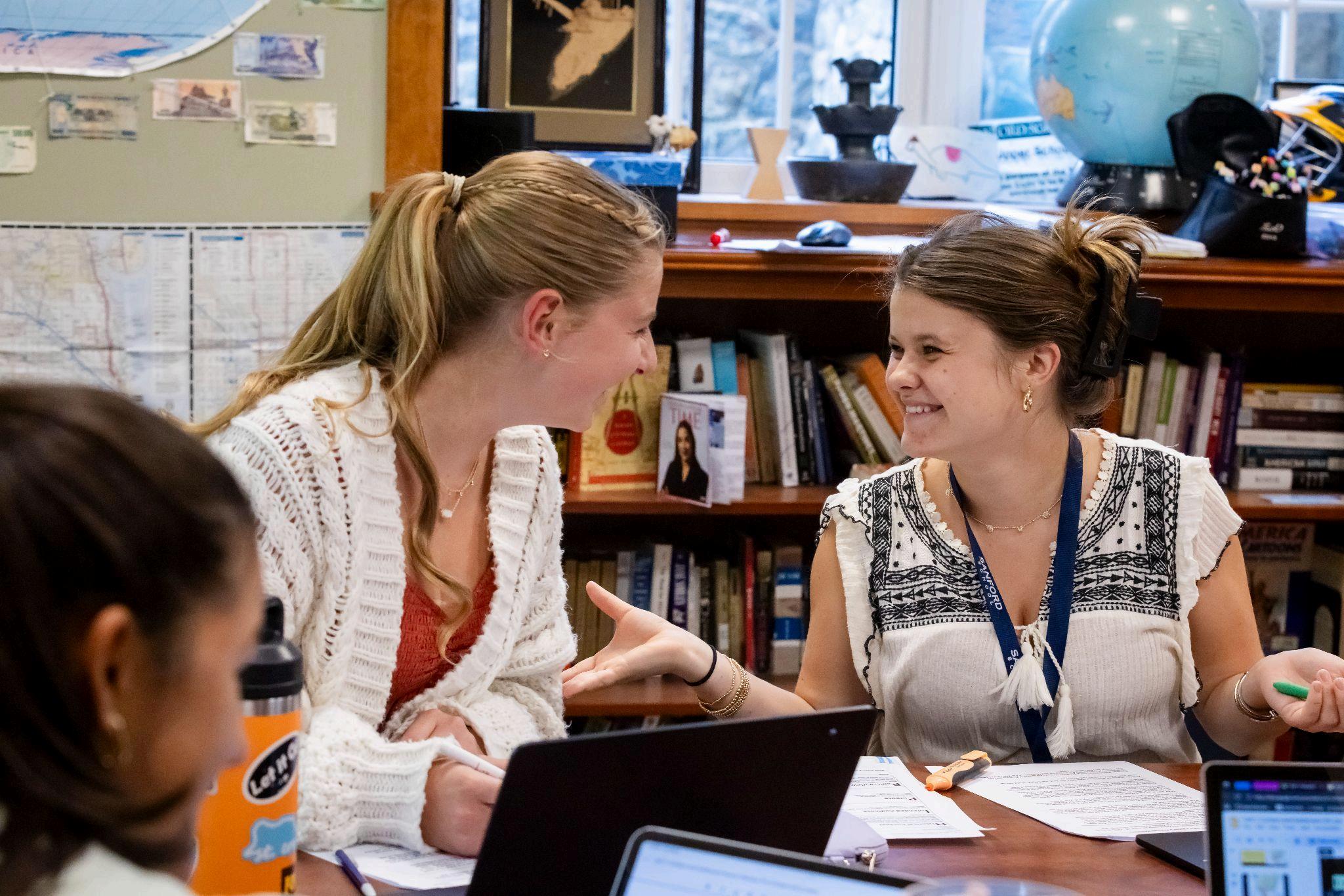
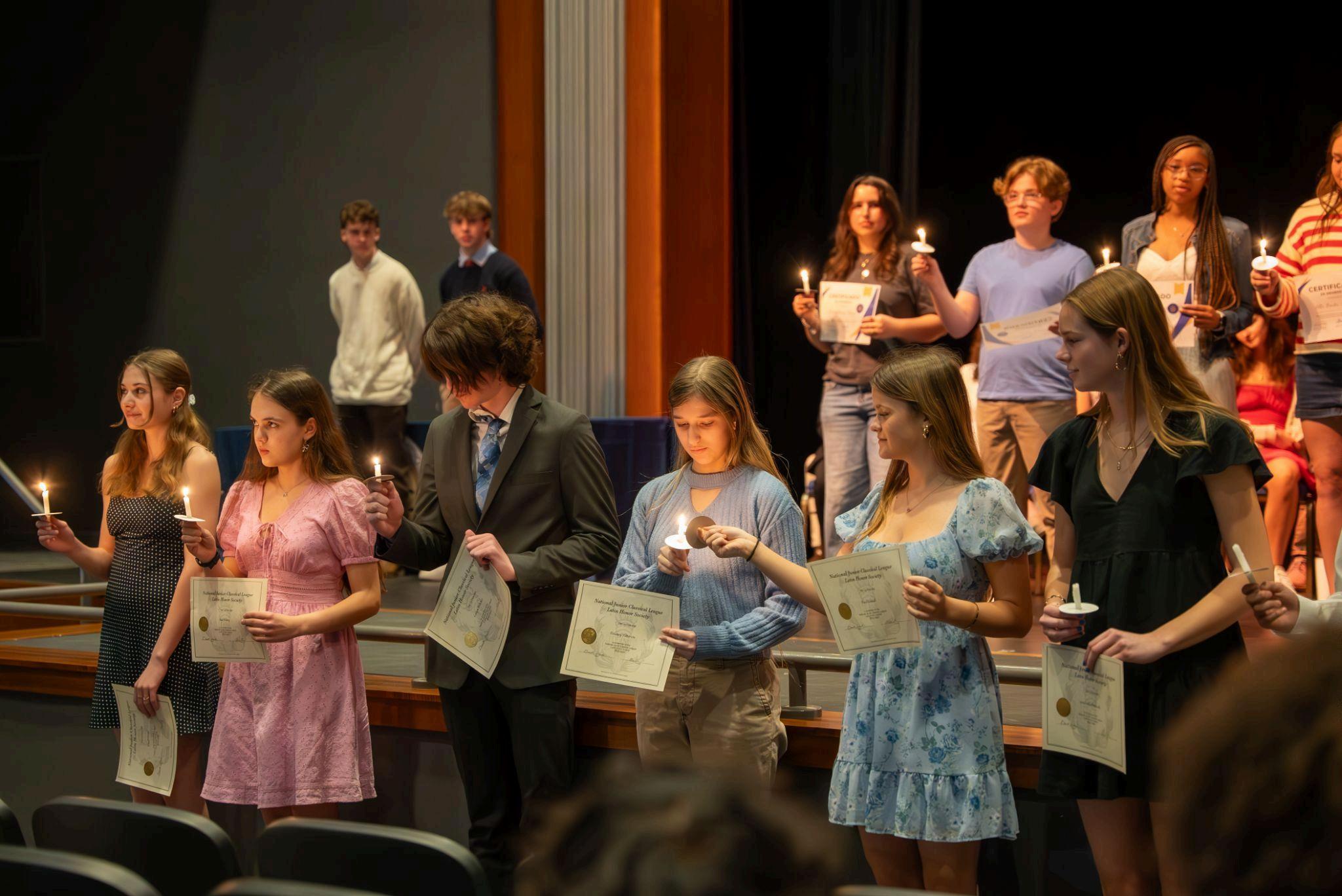
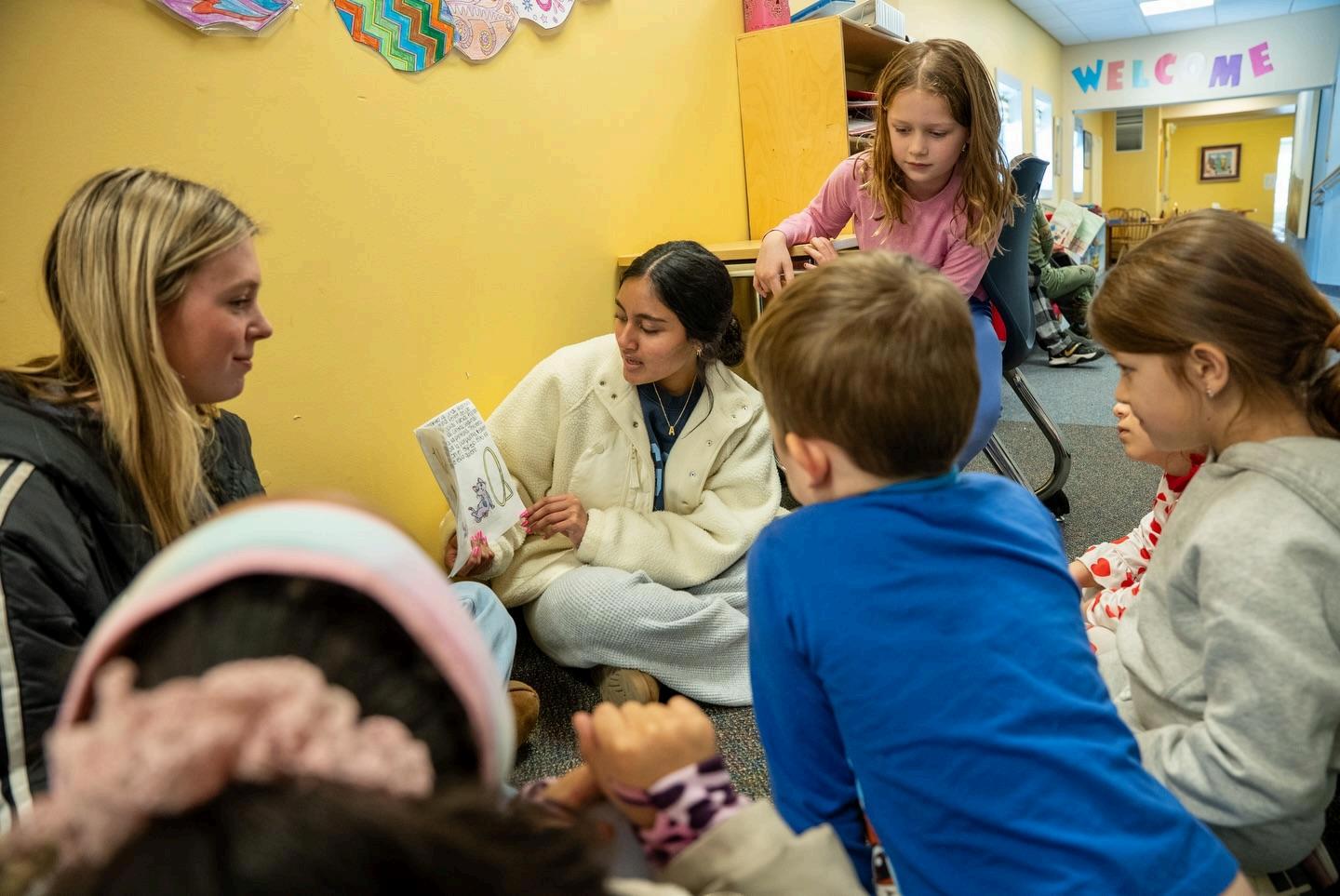
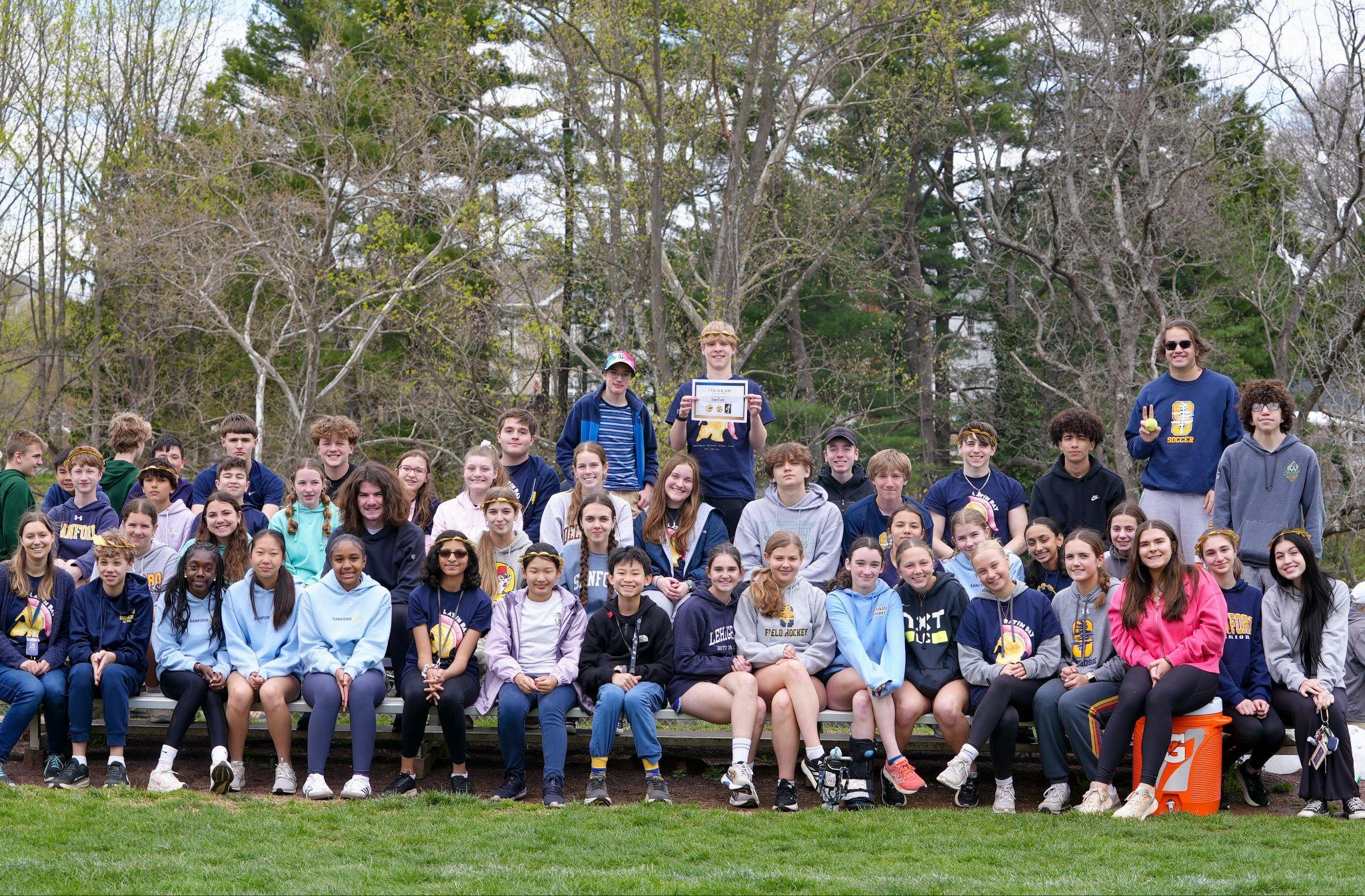
Sanford school identifies and develops the intellectual and creative talents of a diverse group of students. Within a caring and supportive college preparatory environment, students are encouraged and challenged to achieve their finest in academics, athletics, and the arts Our ultimate goal is to teach students to live humanely within the Sanford community in order to prepare them to meet the demands and responsibilities of the future in the broader world.
Graduation Requirements
Each upper school student earning a Sanford School diploma will have successfully completed a minimum of 21 academic credits in a series of required courses and electives, based on individual interests and needs. Full-year courses earn 1.0 academic credit and semester courses earn 0.5 academic credit, with the exception of full-year Performing Arts Ensembles which earn 0.5 credits. When necessary, the Head of Upper School may amend the graduation requirements. The 21 academic credits must include the following:
Required Academic Credits (21 minimum)
English (4.0 credits) Every student must be enrolled in an English course during every semester in Upper School
History and Global Studies (3.0 credits) Students take required courses in grades 9-11
Mathematics (3.0 credits) Students are strongly encouraged to enroll in a fourth year of mathematics, and many colleges require a fourth credit.
Science (3.0 credits) Students take required laboratory-based biology and chemistry courses in grades 9-10 and are strongly encouraged to take additional laboratory-based science courses.
World Languages (3.0 credits) Students must complete three consecutive years of the same language.
The Arts (1.5 credits) Students must complete 0.5 credit in Visual Arts, 0.5 credit in Performing Art, and 0.5 credit of choice in either discipline.
Health (0.5 credit) Students are encouraged to complete this requirement by the end of tenth grade.
Technology (0.5 credit) Students must take a minimum of one semester-long technology course
Additional Electives (2.5 credits) Elective courses are offered in each department, based on student interest These courses are taken in addition to the above graduation requirements
Additional Requirements
Co-Curricular Credits (8 credits): Two per year are required, and one each year must be obtained by playing on a Sanford athletic team.
Senior Capstone Project: To be completed in a senior English class
Senior Project: Successful completion during the last two weeks of senior year
Course Load: Students in grades 9-11 are expected to take six courses each semester Students in grade 12 must take a minimum of five courses, but should consider taking six courses if taking two or fewer AP/Honors Courses At least four courses should be yearlong courses (English counts as yearlong)
In certain circumstances, a student in grades 9-11 may be recommended for a reduced course load (no fewer than five courses), and this occurs with the approval of the Head of Upper School in consultation with the division administrative team
Course Selection and Scheduling
Course Selection
Students work alongside advisors and parents in the second semester of each school year to determine a challenging but reasonable course load for each student in the next year. Students receive guidance from current teachers, advisors, department chairs, and college counselors to help craft schedules which meet requirements and support student passions and success. Course requests are entered into mySANFORD HUB and should be double-checked by students and parents before the end of the school year. To request changes in course selection, students should email the Head of Upper School with the request. Such requests are easier to accommodate when made by June 1, before the schedule is created.
Recommendations
A student’s current teacher in each core academic subject makes recommendations for college preparatory, honors, and AP classes for the following year Teachers take into consideration a student’s demonstrated work ethic, passion for learning, growth over time, and current achievement when making recommendations In general, a grade of B+ or higher in a current honors/AP course is advised for a recommendation to continue with an honors/AP course To be recommended for an honors/AP course from a college preparatory level course, a grade in the solid A range is advised.
Students who would like to take a more challenging course than is recommended are asked to fill out the Going Against Recommendations form, which will guide the student through discussion and reflection to help craft a schedule that will be both challenging and successful
Honors/Advanced Placement Courses
Sanford School offers a college preparatory curriculum designed to prepare all students for success and achievement in college and university level study. Most students enroll in our college preparatory classes, and these courses are designed to support and challenge students while delivering a curriculum that provides strong preparation for college. For those students seeking additional challenge, Sanford offers several classes at the honors and Advanced Placement level, across all academic departments. Honors and AP course offerings are challenging, rigorous courses, accompanied by a heavier workload. Students with strong internal motivation, excellent study skills, well-developed communication skills, and an enjoyment of critical thinking and problem solving find success in honors/AP courses
In May, students in AP classes take their AP exams on campus All students who enroll in an AP course must take the exam in May Please note that there are additional costs to register for AP exams Parents will be billed the fee determined by the College Board, approximately $99 per exam
Scheduling
Schedulers complete the Upper School Schedule over the summer. Attention is paid to accommodating student choices, sizes of and gender balance in classes, and balance across courses with more than one section. Requests for specific sections or teachers can generally not be accommodated. Every effort is made to place students in their top chosen courses, though in some situations, choices must be made when two or more preferred courses conflict in the schedule. In addition, courses that lack the minimum student enrollment may not run, and all courses have firm caps on enrollment size. Please note that a student may not switch sections of a year-long course midyear.
Students should check and respond to emails from the schedulers over the summer about conflicts In cases of elective conflicts, students who do not properly list 2nd and 3rd alternate elective choices will be placed into an elective that fits their schedule Schedules are available on mySANFORD HUB in early August Schedule change requests should be submitted via email to the Head of Upper School; these can be made once schedules are released through the end of the Add/Drop period, which takes place during the first seven school days of the semester For full academic policies, please consult the Upper School Student Handbook
A Note on Course Designations in this Guide
All academic courses in this curriculum guide are designated as full year, or first semester and/or second semester. Courses with a necessary prerequisite, co-requisite, or qualification are listed on subsequent pages with those requirements.
Students are required to take an English course during all four years.
College Preparatory
Honors/AP 9
English 9
Honors English 9 10
English 10
Honors English 10 11
English 11 / English Seminar
AP Language and Composition 12
English 12 / English Seminar
ENGLISH 9: THE P
OWER
AND PERILS OF KNOWLEDGE (full year, 9th grade)
English 9 focuses on the theme of human nature and the path to knowledge Students will address a series of essential questions, such as, What does it mean “to know?” What different types of knowledge do we seek out as part of our human nature? How does knowledge contribute to the process of growing up? Students will read texts from a variety of perspectives and in a variety of forms and genres. English 9 also provides a comprehensive study of grammar, vocabulary, and writing skills to ensure all students have the tools they need to write effectively in all of their classes By the end of the year, students will have developed their skills with formal essays, literary analysis, and narrative responses
HONORS ENGLISH 9: THE POWER AND PERILS OF KNOWLEDGE (full year, 9th grade)
As with English 9, students will explore the nature of knowledge. In addition to the description provided for English 9, students will be asked to forge connections between texts, genres, concepts, characters, and themselves that they express through student-led discussions and well-crafted written analysis Students at the honors level proceed through texts and assignments at a faster pace and with a heavier emphasis on higher-level analysis
ENGLISH 10: EXPLORATION OF SELF AND SOCIETY
(full year, 10th grade)
English 10 focuses on the development of the self and interactions with various groups and environments. Students will address a series of essential questions that ask students to explore the concepts of individualism, community, and citizenship; to examine social prejudices and stereotypes; and to consider identity in the context of various cultures and societies Students will read texts from a variety of perspectives and in a variety of forms and genres This course will continue to emphasize vocabulary, grammar, and writing skills In particular, students will develop their composition skills with a focus on crafting and supporting arguments and literary analysis.
AP Literature and Composition
HONORS ENGLISH 10: EXPLORATION OF SELF AND SOCIETY (full year, 10th grade)
As with English 10, students will explore the relationship between the individual and society In addition to the description provided for English 10 above, they will be asked to forge connections between texts, genres, concepts, characters, and themselves that they express through student-led discussions and well-crafted written analysis. Students at the honors level proceed through texts and assignments at a faster pace and with a heavier emphasis on higher-level analysis.
ENGLISH 11: REASONING AND RHETORIC (first semester, 11th grade)
This class focuses on the ways we use language to reason, argue, persuade, and make decisions. Focusing on areas such as induction, deduction, logical fallacies, claims, evidence, and rhetorical devices, students become better producers and consumers of the information around them. The class will incorporate current issues, identifying both reasonable and unreasonable arguments from the news of the day Students will also work throughout the year to expand their vocabularies and further develop their grammar and writing skills
AP ENGLISH 11: LANGUAGE AND COMPOSITION
(full year, 11th grade)
AP Language and Composition is a college-level English course that focuses on how language works to shape meaning, purpose, and audience Students learn to analyze a wide range of texts—speeches, essays, articles, and visual media—by examining rhetorical strategies, such as diction, tone, syntax, and structure. A major emphasis of the course is developing each student’s own voice and style as a writer. Through frequent practice and revision, students refine their ability to write clearly, effectively, and with intentional rhetorical choices Students write across several rhetorical modes, including analytical essays, argumentative and persuasive writing, as well as descriptive and narrative pieces By engaging in close reading and purposeful writing, students gain the skills needed to think critically, communicate effectively, and prepare for college-level academic work and the AP examination. This course is open to students with teacher recommendation.
ENGLISH 12: ESTABLISHING CRITICAL PERSPECTIVES
(first semester, 12th grade)
In this course, students will engage with texts that deepen their understanding of the world and foster empathy while refining their sense of self As they prepare to transition beyond Sanford, they will reflect on their identities and how they want to move through the world. The course emphasizes personal writing, poetry analysis, film analysis, and research. The centerpiece of the course is the Capstone project, a research-based endeavor culminating in both a paper and a presentation. Throughout the semester, students will also strengthen their public speaking skills, expand their vocabularies, and refine their writing abilities
AP ENGLISH 12: LITERATURE AND COMPOSITION
(full year, 12th grade)
AP Literature and Composition is a college-level course designed for the exceptional student who has thrived in their preceding English courses. The focus is on mature, challenging literature and includes novels, drama, poetry, and literary criticism. The course explores the relationships between writers and their worlds as well as writers and their readers through a critical lens While the emphasis remains on long-form process writing assigned throughout the year, timed in-class essay writing is also emphasized. Students in AP Literature will complete the Capstone, a research-based project that results in a paper and a presentation. Analytical skills are honed, and students emerge prepared to tackle the most challenging levels of college work in literature studies. This course is open to students with teacher recommendation.
English Seminars: The courses below are offered in the second semester for juniors and seniors who take English 11 or English 12 in the first semester. Juniors and seniors who take AP courses, and sophomores with permission, may take these as an additional elective.
BLACK VOICES IN AMERICA
(second semester, 11th/12th grade)
In this course, we will celebrate Black voices in American culture as they explore issues of race, racism, identity, love, society, and more in the forms of poetry, television, music, movies, short stories, and novels. We will explore writing from the narratives of enslaved people to the poetry of the Harlem Renaissance to Pulitzer Prize winner Kendrick Lamar.
CREATIVE WRITING
(second semester, 11th/12th grade)
This course takes students on a dynamic journey through the creative writing process, from that first spark of inspiration to the thrill of publication. Through reading, writing, workshopping, and revising, students will sharpen their craft and find their unique voices. The workshop setting encourages lively discussions and constructive feedback, helping writers grow both on the page and in their critique skills By the end of the course, students will have a polished portfolio ready to share with the world.
FILM ADAPTATIONS (second semester, 11th/12th grade)
Have you ever been infuriated, or perhaps delighted, with a movie being different from its book original? In this course, students will explore the ways in which authors and directors create texts as well as how and why they differ in their presentation of ideas, concerns and tensions within their stories Students will evaluate the vehicle of the story, being literary and multimodal, and the ways in which meaning is made Students will also critique modern adaptations of classic literature in an attempt to evaluate changes in societal values and contemporary issues.
IMMIGRANT VOICES
(second semester, 11th/12th grade)
This course will focus on immigrant voices in works of fiction, nonfiction, film, and more, featuring voices from a variety of historical periods, cultural groups, and experiences with migration. The class examines a variety of topics considered central to the immigrant experience, from trials immigrants undergo, such as, war, oppression, and discrimination to unique aspects of immigrant cultures such as multilingualism and the richness of cultural identity. The course will ask students to consider a variety of questions, such as, How is identity transformed by migration? How and why is home remembered? How is coming of age paralleled with migration? What narrative
strategies are deployed? Students will hone skills in written and oral expression, cultivate their abilities in critical thinking, and expand their knowledge of the world.
MYTHS & LEGENDS
(second semester, 11th/12th grade)
Storytelling is a part of every culture. It’s one thing that unites our whole planet. And what’s one thing almost all of those stories have? A hero or heroine. In this course, we will explore the foundational heroic texts and some contemporary texts as well through the lens of Joseph Campbell's Hero’s Journey and Joseph Campbell’s archetypes From the Ramayana to Hercules to Star Wars to the Avengers: What makes a hero? And what kind of hero would you create?
OF MONSTERS AND MEN
(second semester, 11th/12th grade)
Monsters are more than just the things that go bump in the night and haunt our dreams They are reflections of our primal anxiety around the unknown, as well as snapshots of cultural fears of a particular era. Beyond that, monsters allow authors and their audiences to explore fears from a safe distance What makes a monster? Who gets to apply that label? Why do we return to the same types of monsters throughout history? How can these tales of terror stand as allegories for the boogeymen of a particular historical period? In this course, we will examine the monster up close and personal. We will unmask them to determine what truly lies behind the shadow of the vampire, the werewolf, the specter, and all other manner of creatures
THE END OF THE WORLD
(second semester, 11th/12th grade)
In this course, students will explore texts that question what happens when life as we know it ends. Does society radically transform itself? Does it fall apart? Or do humans abandon earth altogether? Students will read, discuss and write about apocalyptic and dystopian literature, better learning how fundamental societal shifts can reveal human character.
WAR LITERATURE (WAR, WHAT IS IT GOOD FOR?)
(second semester, 11th/12th grade)
Significant not only for the violence they unleash but also for the ways they disrupt daily life and seemingly stable social arrangements, war makes the formerly unthinkable thinkable: women working outside of the home; men caring tenderly for one another; the end of centuries of slavery. Explore literature born out of social strife as we read novels, poetry, short stories, non-fiction, music, and film that depicts what it means to be human amidst trauma and strife In times of severe crisis, societies and individuals undo themselves and are remade, thus
wars have given nations and its inhabitants opportunities to reexamine and rethink what it means to be human.
(second semester, 11th/12th grade)
Detective stories and mysteries in general are about more than finding the killer. They’re about what drives our detectives and why our villains behave as they do. They’re about understanding human nature and how people react to conflict. They’re about how writers employ various techniques to build suspense and send their readers on a quest to solve the mystery In this course, we will explore how the genre of the detective story has evolved and how we can use these stories to better understand ourselves and society
WHODUNNIT: DETECTIVE & MYSTERY STORIES
History and Global Studies
Students are required to take history courses in grades 9 through 11. Students are able to choose from a variety of electives during their senior year.
College Preparatory
9 World Civilizations I
10 World Civilizations II
11 United States History
12
Honors/AP
Honors World Civilizations I
AP World History: Modern
AP United States History
Electives: AP African American Studies, AP US Government & Politics, AP European History, History Through Film, Psychology, Sports History, War and Society
WORLD CIVILIZATIONS I (full year, 9th grade)
The 9th grade course surveys an integrated global study from the 1000s to the early 1800s. Students are exposed to similarities and differences in the development of societies in relation to geography, social organization, economics, political institutions, religion and cultural expression. Through intense reading and analyzing primary and secondary sources, students will be able to engage with others, explain their own point of view and empathize with diverse perspectives of other peoples and cultures. Students will use their historical thinking skills to understand the context and continuity and change of the historical time period they are studying. Through reading and research, students will write, present and converse to better understand the complexities of history
HONORS WORLD CIVILIZATIONS I (full year, 9th grade)
The 9th grade course surveys an integrated global study from the 400s to the late 1700s Students are exposed to similarities and differences in the development of societies in relation to geography, social organization, economics, political institutions, religion, and cultural expression. The honors class is fast-paced, featuring advanced skill development directed toward a deeper understanding of the content, the analysis of primary source material, the development of major themes, and the honing of critical thinking skills. There will also be an emphasis on historical writing, focusing on compare and contrast, change over time, and document-based questions Students who sign up for the honors course should expect material to be on a more advanced and scholarly reading level than the material in World Civilizations I.
WORLD CIVILIZATIONS II (full year, 10th grade)
The 10th grade course surveys an integrated global study from the early 19th century to the present. The course will culminate in a unit that focuses on connecting the past to current events with the lens of rights, equity, and access Through intense reading and analyzing primary and secondary sources, students will be able to engage with others, explain their own point of view and empathize with diverse perspectives of other peoples
and cultures. Students will use their historical thinking skills to understand the context and continuity and change of the historical time period they are studying Through reading and research, students will write, present and converse to better understand the complexities of history
AP WORLD HISTORY: MODERN (full year, 10th grade)
This course is offered to students who have demonstrated mastery of the World Civilizations I content and skills, a passion for history, a superior work ethic, and the ability to work independently. This course is designed to meet all of the guidelines for the College Board AP World History: Modern course while providing even more depth of content and development of skills The course integrates non-western and European/western history from approximately 1200 CE to the present, while focusing on the four chronological periods and six overarching themes Students will take the AP Exam in May after completing this course Prerequisite: Honors World Civilizations I is strongly recommended.
UNITED STATES HISTORY (full year, 11th grade)
This required eleventh grade course examines the major issues and personalities of American history The social, political, and economic histories of the developing nation are surveyed in order to help students acquire an understanding of American culture and to investigate the evolution of American democracy The major themes that have shaped the development of the present-day United States are examined through primary sources produced by a diverse set of Americans.
AP UNITED STATES HISTORY (full year, 11th grade)
This course is an in-depth study of United States history that aims to develop mature thinking and writing skills and prepare students for the Advanced Placement exam in May. Political, economic, and social histories are examined through primary and secondary sources in an attempt to understand the principal themes of the American experience. Students are expected to grasp concepts, make judgments, draw analogies, and express competent opinions after examining varying interpretations.
Expository writing in the AP style is practiced with an eye on causational relationships and supporting argumentation. Because this is an advanced course, it will be conducted on a college level. Students are expected to accept and exhibit greater individual responsibility for their work. Prerequisite: AP World History: Modern is strongly recommended.
AP AFRICAN AMERICAN STUDIES
(full year, 11th/12th grade)
This course is an interdisciplinary exploration of African American history and culture, covering topics from early African kingdoms to contemporary achievements Students can expect a rigorous and challenging curriculum that relies on strong critical thinking, research, argumentation, and discussion. Students must be comfortable engaging with college-level texts and expressing their thoughts clearly in writing, as primary source analysis is the backbone of the course Those primary sources include essays, photographs, videos, songs, speeches, poems, art and more. This course is open to students with
(full year, 11th/12th grade)
AP US Government and Politics explores the workings of government at the federal and state levels. The focus of the course is to better understand our nation’s system of representative government. Starting with the Constitution, the students will progress to topics such as current policy in elections, social welfare, economic policies, civil liberties, foreign and military policy and interest groups Multimedia, research, debates, panel discussions and other methods will be used in instruction. Strong reading comprehension, critical analysis, and effective historical writing are crucial to success in the course. Students will take the AP Examination at the end of the course. This course is open to students with teacher recommendation.
AP
E
UROPEAN HISTORY
(full year, 11th/12th grade)
This course covers the history of Europe, its people and its nations from c 1450 to the present. It is a profound exploration of key events and the political, social, economic, cultural, and intellectual developments that shaped Europe and subsequently the world. The course pace and structure are similar to AP World History: Modern, but with a narrower focus and therefore greater depth. Students can expect a fast-paced course
with an emphasis on writing, document analysis and discussion; they will prepare for the AP exam in May while also undertaking further explorations This course is open to students with teacher recommendation.
HISTORY THROUGH F
ILM (one semester, 11th/12th grade)
This class explores how movies and television shape our understanding of the past. Students will analyze historically based films and series from different eras and regions, comparing Hollywood portrayals with primary and secondary historical sources. The course emphasizes historical accuracy, bias, perspective, and the choices filmmakers make when adapting history for entertainment. Students will develop skills in historical thinking, media literacy, and critical analysis through discussions, written reflections, and creative projects
S
PORTS HISTORY (full year, 11th/12th grade)
In this class, we will look at the evolution of sports, with a focus on the United States but with some examination of the role of sport in other societies as well. Major topics will include immigration, urbanization, and the nineteenth-century development of baseball in East coast cities, the impact of wartime on professional sports, race and racism in American sports (featuring the Negro Leagues and Jackie Robinson), social protest on the field (highlighting the careers of Muhammad Ali and Colin Kaepernick, among others) and issues between labor and management that parallel the development of the labor-capital conflict. We will also look at the development of fan culture (go Birds!), seeking to better understand the place of sports in present-day American culture.
WAR AND SOCIETY (one semester,
11th/12th grade)
This course will consider experiences and analyses from a variety of participants and focus on wars from the 20th century to the present. In doing so, we will examine the root causes of war, the nature of modern warfare, and the governments that waged them. Incorporating a number of voices, we will look at how members of society participate in or challenge war efforts. We will also explore the aftereffects of war on society and the veterans who participated. Content will include, but not be limited to, primary source documents, images/depictions of war, and newspaper/media coverage
PSYCHOLOGY (full year, 11th/12th grade)
Why do people do what they do? This is the central question of Psychology, an elective that explores the bases of human behavior. The course will begin by looking at research methods, the ethics of psychological research, and the structure of the brain and nervous systems. After exploring the biochemical and genetic bases of human behavior, other major topics will include learning, perception, emotion and personality, as well as group psychology, stress, psychological disorders, treatment and therapy This class will involve a mix of discussion, role play, lecture, demonstrations, and experiments
Mathematics
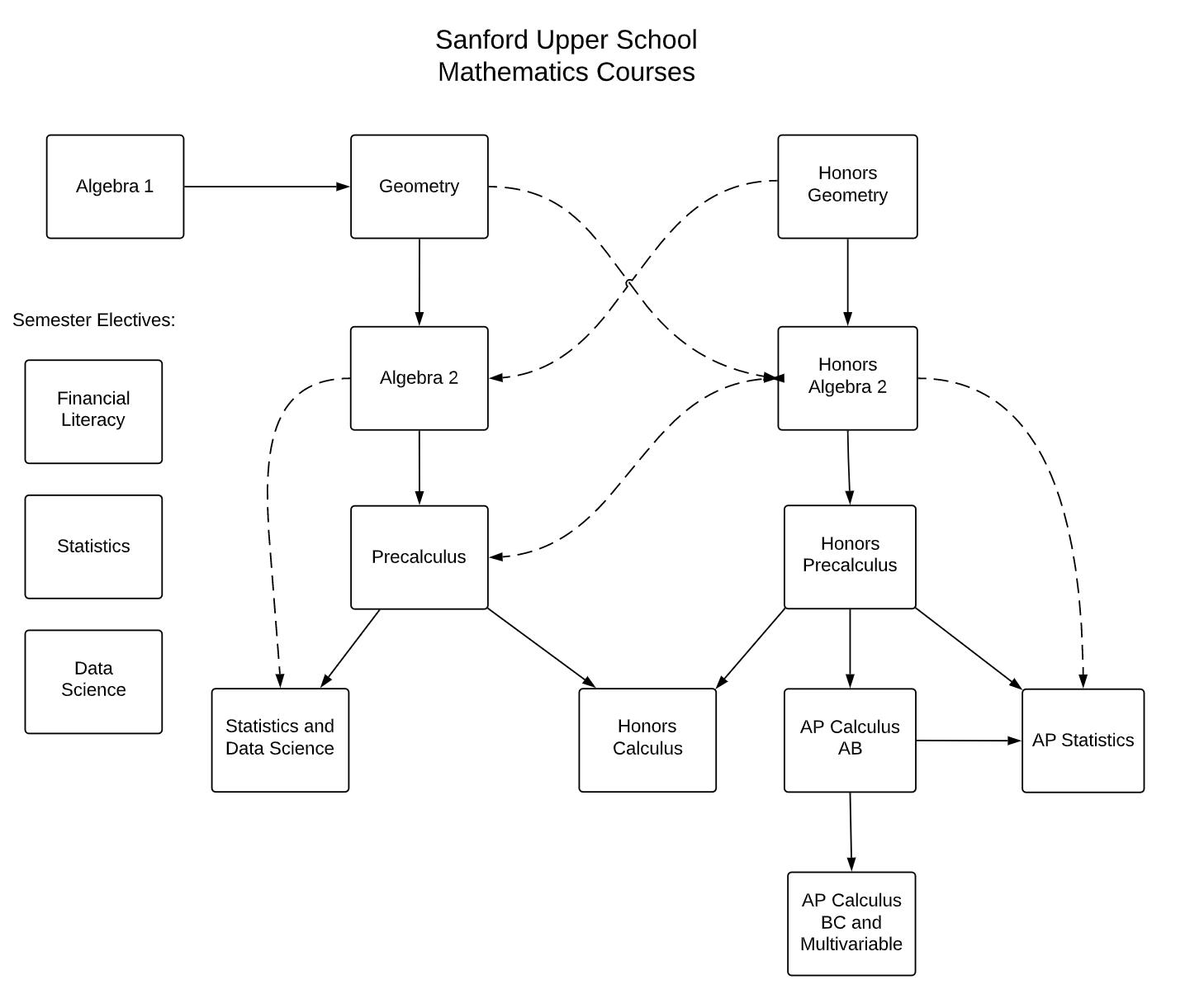
Students are required to take three years of mathematics and are strongly encouraged to take four, as many col
ALGEBRA I (full year)
This course serves as a foundation for all future mathematics courses. It includes the traditional algebra, such as solving and graphing linear equations inequalities, systems of equations and inequalities polynomials This course also introduces students exponents, simplifying radicals, and regression analysis
GEOMETRY (full year)
This college preparatory geometry course covers concepts including length, distance, and angle measurement; parallel and perpendicular lines; congruent polyg special properties of triangles and quadrilaterals develop skills in triangle congruence proofs, basic geometry, similarity, right triangle relationships Pythagorean Theorem, as well as the calculation of area, and volume The course also includes the study an introduction to trigonometry, and an introductor statistics addressing measures of center and spread. Prerequisite: Algebra I
HONORS GEOMETRY (full year)
This is an advanced course in high school geometry topics Topics explored include congruent polygons, similarity, special right triangles, trigonometry, circles, surface area, and volume Students will also complete a statistics unit, including measures of center and spread, probability, sampling, and linear regression. Strong algebra skills and mature study habits are a prerequisite for this course. In order to succeed in this advanced course, students must be able to work productively in a collaborative classroom setting and must also possess the critical thinking skills and confidence to work through challenging problems Prerequisite: Algebra I and teacher recommendation.
ALGEBRA II (full year)
Algebra II continues the study of the major concepts of algebra. Students will learn about a variety of functions and study their graphs and their transformations. Functions studied include quadratic, polynomial, radical, exponential, and logarithmic. In addition, students will study conic sections and matrices. This course prepares students for Precalculus. Prerequisite: Geometry.
HONORS ALGEBRA II (full year)
Honors Algebra II covers transformations of functions, matrices, quadratics, polynomials, rational exponents, radical functions, logarithms, exponential functions, piecewise functions, and conics, with additional units on probability and data analysis Topics are covered in depth and at a fast pace in order to complete more advanced work. Strong organizational skills and the ability to problem solve will help with success in this course. Prerequisite: Honors Geometry and teacher recommendation.
PRECALCULUS (full year)
This course follows Algebra II and emphasizes the study of trigonometry In addition to trigonometry, students will continue the exploration of functions introduced in Algebra II as well as rational functions and an introduction to limits This course prepares students for Honors Calculus. Prerequisite: Algebra II.
HONORS PRECALCULUS (full year)
This course is a foundation for AP Calculus by focusing on all aspects of functions using descriptions, data analysis, function algebraic formulas Mastery of is further enhanced by covering and their extensions within polar complex numbers, and parametric equations. course should have sound algebra skills, and solid work habits. Prerequisite: teacher recommendation.
year)
topics typically covered in a first-semester Topics include limits, differentiation, differentiation. Students will also be ration. Upon completion of this course, foundation of the skills required for a Prerequisite: Precalculus and teacher
year)
to a first-semester college calculus the College Board syllabus It builds developed in Precalculus to introduce calculus in preparation for the AP Students enrolled in this course are a strong algebraic foundation, a of functions, and consistent, effective Prerequisite: Honors Precalculus and teacher
AP CALCULUS BC & MULTIVARIABLE TOPICS (fu
This course is equivalent to the second semester calculus, following the syllabus of the Colleg curriculum. Advanced topics for differential calculus are explored, and considerable time is motion in two dimensions and determining con Beyond preparing for the AP exam, this course topics that form the foundation for Multivariable Understanding functions and vectors in three dimensions help prepare students for taking the third semester calculus in the future Students take the AP Prerequisite: AP Calculus AB and teacher recommenda
STATISTICS AND DATA SCIENCE (full year)
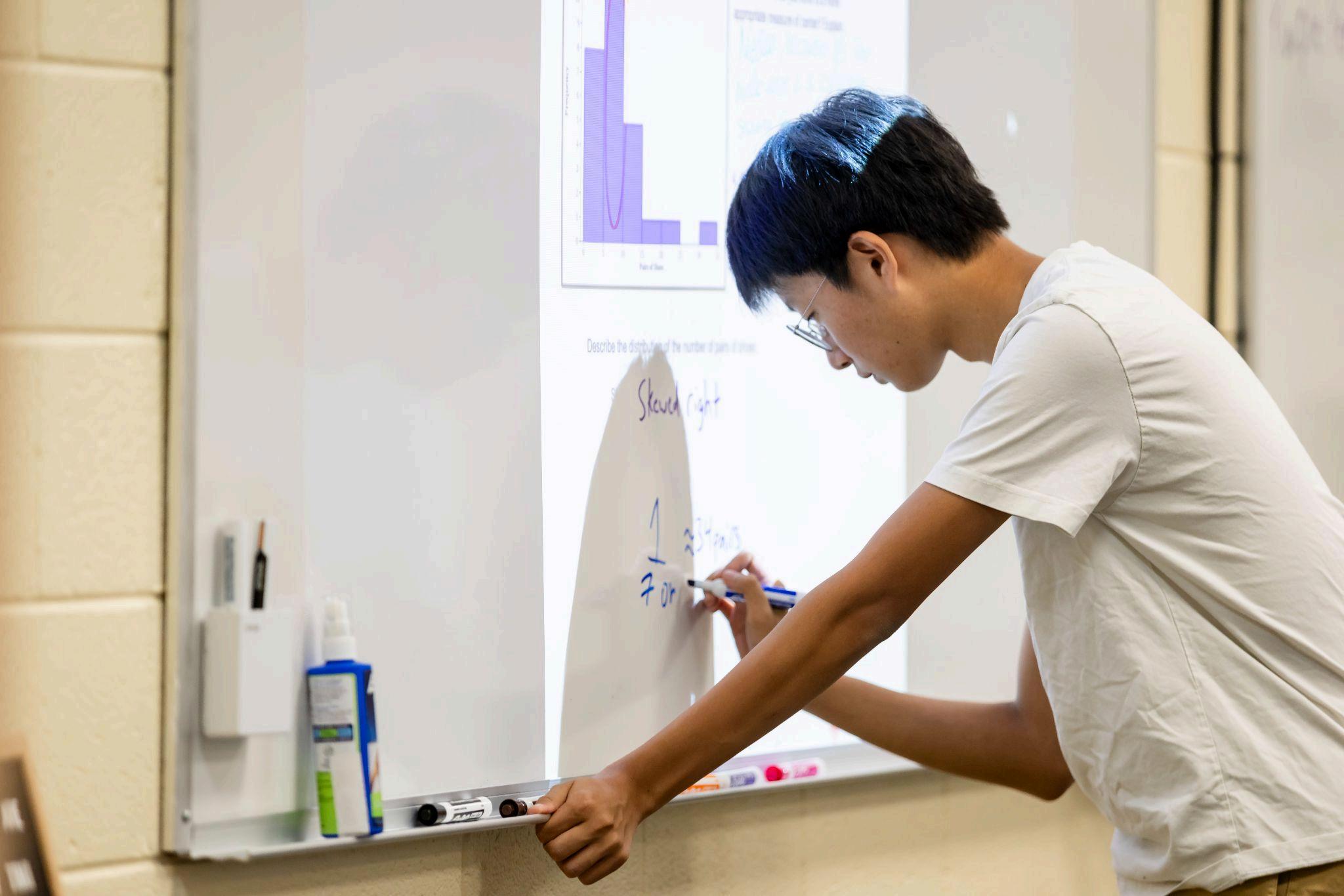
This course covers topics in probability, descripti normal distribution, regression, and experimental Students will learn to become responsible statistics in the world. Students will be introduced science and will use Google Sheets and programming to explore large, real-world data programming experience is needed for this course completion of this course, students will hav foundation to build upon in a college statistics course This course can count as a technolog
Prerequisite: Geometry.
AP STATISTICS (full year)
STATISTICS (first semester)
This course follows the syllabus of the College Board for a semester course in Statistics at the college level. It covers data analysis, experimental design, probability, and inferential statistics Students will need strong reading, writing, and math skills to analyze textbook content and real-world scenarios, interpret statistical arguments, and effectively communicate and apply statistical principles Prerequisite: Honors Algebra II or Precalculus and teacher recommendation.
FINANCIAL LITERACY
(first semester, repeats second semester)
This course is designed to enhance students’ abilities in mathematical decision-making and financial literacy Financial literacy topics will focus on banking, saving, building positive credit history, investments, vacation planning, and budgeting Students will engage in hands-on, real-world simulations to enhance their understanding of mathematics used in everyday life Emphasis is on the mathematical aspects of the topics This semester-long elective is open to juniors and seniors. Sophomores may take this course with approval. This course can count as a technology credit. Prerequisite: Algebra II.
This course covers many topics in probability, descriptive statistics, normal distribution, regression, and experimental design. Students will learn how to become responsible consumers of statistics in the world. Upon the completion of this course, students will have a statistical foundation to build upon in a college statistics course If a student takes this semester-long course, they will not be able to take the year-long Statistics and Data Science course in subsequent years Prerequisite: Geometry.
DATA SCIENCE (second semester)
Students will explore large sets of data and will be introduced to data science principles. Students will use Google Sheets and computer programming to explore real-world data sets. No programming experience is needed for this course. Through project-based learning, students will learn how to use tools for cleaning, analyzing, exploring, and visualizing data; making data-driven inferences and decisions; and effectively communicating results If a student takes this semester-long course, they will not be able to take the year-long Statistics and Data Science course in subsequent years This course can count as a technology credit. Prerequisite: Geometry
Students are required to take three years of science, and are strongly encouraged to take a laboratory-based course in their junior or senior year.
Honors Physics, Honors Anatomy & Physiology, AP Environmental Science, AP Chemistry, AP Physics C, AP Biology, AP Computer Science Principles**, AP Psychology** * 0.5 lab credits ** not a lab credit course
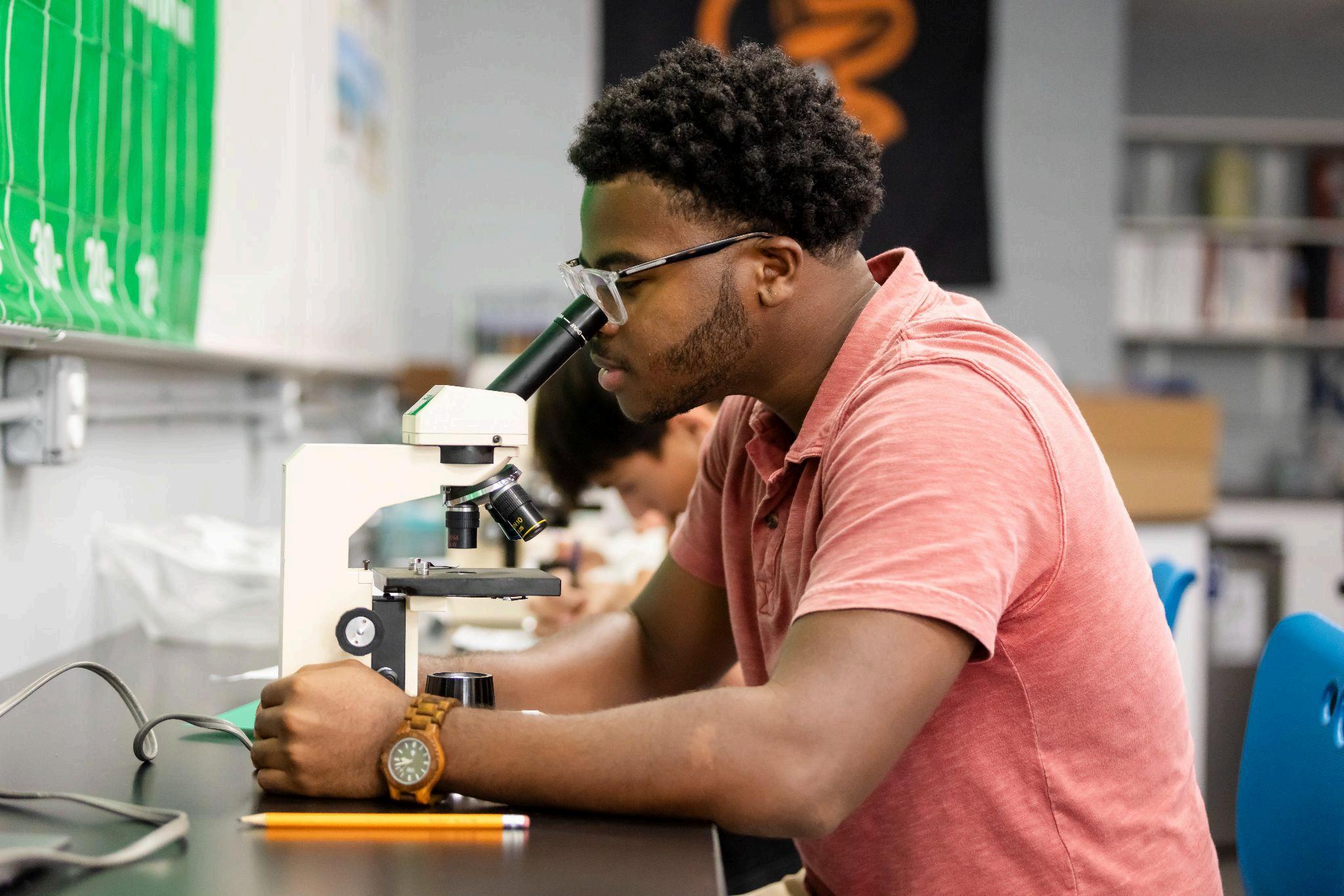
In this course, students will be introduced to a wide range of topics, including experimental design, biochemistry, cell structure, cellular respiration, photosynthesis, cell reproduction, and genetics with an emphasis on the practical application of biology to the students’ daily lives. This course is designed to help students adjust to high-school level science through a balance of laboratory activities, projects, classwork, and formal assessments
HONORS BIOLOGY (full year, 9th grade)
In this course, students will be introduced to a range of biological topics, including cellular biology, biochemistry, genetics, and evolution. Students in this course will learn
HonorsAnatomy,HonorsPhysics,APScience Courses
*checkspecificAPrequirements
current applications of biological content, conduct independent research, engage in argumentation from evidence, and develop their scientific writing skills. Collaborative and individual inquiry projects are an integral part of this course. It is designed for motivated and talented science students who are ready for a rigorous science experience. Prerequisite: Completion of or concurrent enrollment in Geometry Teacher recommendation for current Sanford students.
CHEMISTRY (full year, 10th grade)
This is a foundational course of chemical topics including laboratory safety, measurement, classification and properties of matter, atomic structure, compounds and chemical formulas, types of chemical reactions, stoichiometry, and intermolecular
forces. Students utilize modeling activities, mathematical calculations, and laboratory exercises to develop their understanding of chemical concepts
HONORS CHEMISTRY (full year, 10th grade)
Honors Chemistry explores the topics covered in Chemistr more depth, with a focus on the use of more advanced algebraic and graphical interpretations of data. Additional topics include atomic structure and chemical bonding, solution state behavior and types of reactions, investigation of phases of matter and phase changes, and an introduction thermodynamics Throughout the course, students algebraic problem-solving to answer questions about chemical reactions and engage in a deep study of stoichiometry work is highlighted, and students complete inquiry-based over the course of the year Due to the accelerated pace increased emphasis on mathematical interpretation of data, students must allow sufficient time to accomplish additional daily reading and homework assignments. Prerequisite: Completion of or concurrent enrollment in Honors Algebra II and teacher recommendation.
PHYSICS (full year, 11th-12th grade)
fing print analysis, comparison, blood spatter analysis, anthropology and crime scene analysis. Forensics is a demanding, fast-paced course.. The culmination of the course will include the analysis of a crime scene.
Physics encompasses a study of the major areas of physics: mechanics, gravity, waves and electro-magnetism. Emphasis is placed on the application of physics to everyday life as well as examining systems and the flow of energy through them. This course is taught through hands-on inquiry-based labs and concepts are solidified through engagement in scientific discussions, writing prompts, and problem-solving through conceptual explanations and mathematical practices Prerequisite: Completion of Algebra II or teacher recommendation.
HONORS PHYSICS (full year, 11th-12th grade)
This course is a thorough study of the major areas of physics: mechanics, gravity, waves and electro-magnetism. The course is taught with strong emphasis on the quantitative and problem-solving aspects of physics, including aspects of scientific writing. It is designed for motivated science students who have a strong background in mathematics Prerequisite: Completion of or concurrent enrollment in Honors Precalculus and teacher recommendation.
HONORS ANATOMY AND PHYSIOLOGY
(full year, 11th-12th grade)
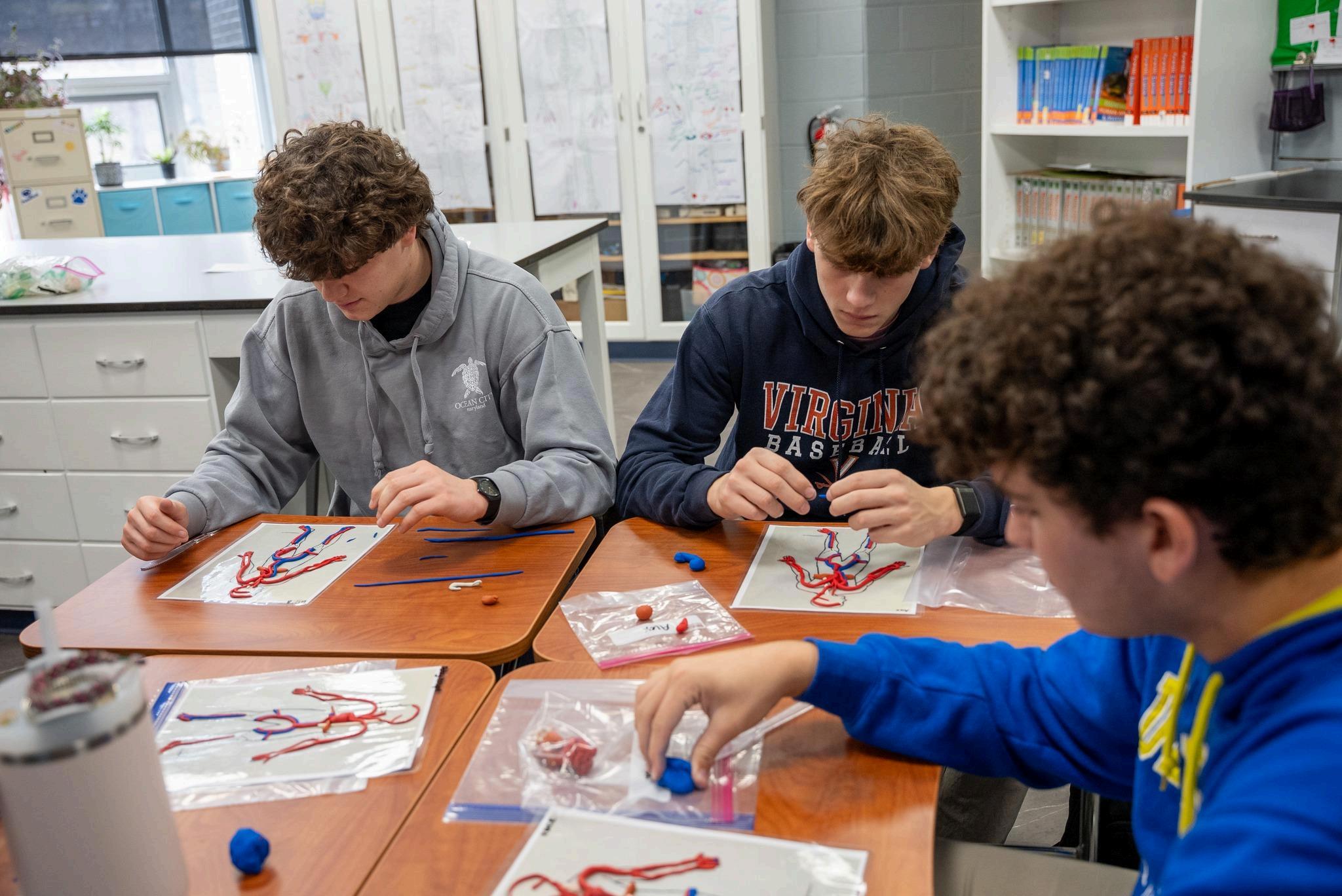
This course offers a rigorous, comprehensive study of the human body, the integration of the various systems, and the abnormal functioning of tissues and systems Students are expected to complete dissections such as the sheep’s heart and brain, cow’s eye, and fetal pig Guest speakers from the health field provide career information for students .
AP B
IOLOGY
(full year, 11th-12th grade)
AP Biology is a rigorous course designed to explore biology at a college level, covering the content of a full-year introductory college-level Biology class The volume and pace of this course will require independent study outside of class, which includes significant reading and analysis assignments. Students will continue to build upon existing critical reading, data analysis, and scientific writing skills. Topics are subdivided into eight main units: Chemistry of Life, Cell Structure and Function, Cellular Energetics, Cell Communication and Cell Cycle, Heredity, Gene Expression and Regulation, Natural Selection, and Ecology Prerequisite: Completion of Honors Biology and concurrent enrollment in Precalculus or above and teacher recommendation.
AP CHEMISTRY
(full year, 11th-12th grade)
AP Chemistry is a rigorous course covering the topics that are normally part of a full-year introductory college course. These topics include: chemical bonding, gas laws, thermodynamics of reactions, acid-base theory, reaction equilibrium, kinetics and electrochemistry AP Chemistry builds on the topics covered in Honors Chemistry and devotes significant time to laboratory exploration and data analysis Students will learn to write a formal lab report and use various computational methods of data analysis The rigor of this course will require the completion of assignments during the winter and spring vacations. Prerequisite: Completion of Honors Chemistry and concurrent enrollment in Honors Precalculus or above and teacher recommendation.
AP PHYSICS C: MECHANICS
(full year, 12th grade)
AP Physics C: Mechanics is a calculus-based, college-level physics course. This course expands on the mechanics topics covered in Honors Physics, applying calculus in order to deepen understanding of the core laws of motion.. Formal labs will allow students to demonstrate proficiency in a laboratory setting, as well as practice scientific writing The rigor of this course may require the completion of assignments during the winter and spring vacations The availability of this course is contingent upon student enrollment. Prerequisite: Completion of Honors Physics and concurrent enrollment in AP Calculus AB or above and teacher recommendation.
AP ENVIRONMENTAL SCIENCE
(full year, 11th-12th grade)
AP Environmental Science is a rigorous class that explores topics that would typically be covered at the introductory college level. Topics include: ecosystems, biodiversity, population dynamics, earth systems and resources, land and water use, energy, pollution, and climate change. An emphasis will be placed on systems thinking, multi-solving of current problems, and straightforward application of mathematical concepts such as percent change and dimensional analysis The rigor of this course will require the completion of assignments during the winter and spring vacations Prerequisite: Completion of Biology and Chemistry and teacher recommendation.
year, 11th-12th grade)
follows an introductory college-level delving into the process of scientific analysis of human behavior Students will mental processes through the lens of behavior, sensation and perception, learning ation, developmental psychology, testing abnormal behavior and social psychology. in group discussion and inquiry-based the course. Assessments range from data analysis of sleep habits, and traditional Because of the rigorous nature of this should expect to complete assignments over spring break. This course does not count as a
Prerequisite: Completion of Algebra II
CE PRINCIPLES rade)
Principles is a rigorous course designed foundations of computer science and creative college level. Through learning JavaScript hnologies, students will study computational thinking, data representation, the architecture of the internet, and the ethical implications of computing Students will design and build interactive web-based projects, culminating in the AP Create Task an original program that demonstrates their programming and problem-solving abilities Prerequisite: Completion of or concurrent enrollment in Algebra II. This course does not count as a lab credit.
ATHLETIC TRAINING
(first semester, 11th-12th grade)
This lab-based science class explores the fundamentals of emergency response and athletic injury Through a combination of classroom lessons and interactive labs—covering varied topics like the assessment of emergency situations, procedure for dealing with blood, and treatment of simple injuries. Students will be exposed to the basics of Athletic Training, exploring skills necessary to assess, prevent, and treat injuries. This course counts as a 0.5 lab credits
VETERINARY SCIENCE
(second semester, 11th-12th grade)
This Introduction to Veterinary Science course provides a foundational overview of the veterinary field, covering topics like animal anatomy and physiology, including basic understanding of different animal body systems, recognition of prevalent diseases in various animal species, preventative medicine, animal care, career paths within veterinary medicine, ethical considerations, and the history of veterinary science This course aims to equip students with a comprehensive understanding of the profession and its key principles This course counts as a 0.5 lab credits
ROBOTICS
(first semester, 9th-12th grade)
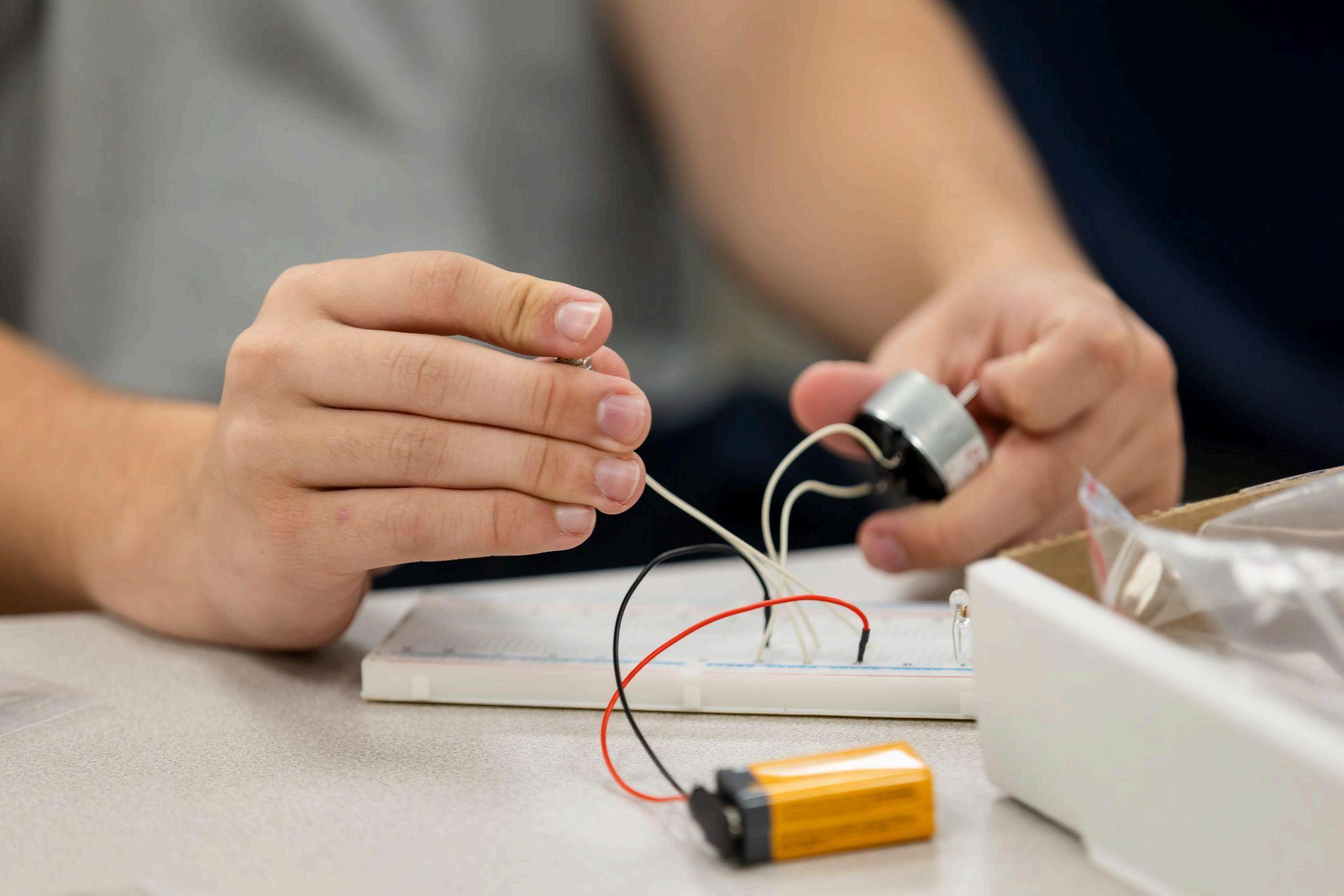
In Robotics, students are introduced to the study of logic and algorithmic processes used by computers, which will lead to use of the programming language, BASIC, to command robots to perform a series of tasks. As the students develop confidence and mastery in the use of hardware and programming, they will write their own functions to perform simple objectives. As the semester progresses, students will design more advanced programs b d i di id l bili d i i P i it
ENGINEERING
(second semester, 9th-12th grade)
Engineering introduces and engages students in the engineering design process and different forms of engineering Students will gain a conceptual understanding of the design process through design challenges Students will manufacture parts, collaboratively engineer solutions, and tackle real-world problems in order to meet the criteria and constraints posed for each design challenge. Prerequisite: Algebra I. This course does not count as a lab credit.
ASTRONOMY
(second semester, 10th-12th grade)
This semester-long elective will provide students with a broad understanding of our universe from an astrophysical perspective Students will explore the universe starting from how humanity sees the sky, through to the concepts surrounding the genesis and expansion of the universe itself. Each progressive unit will extend their view further out from our beautiful blue marble, Earth. This course will also offer opportunities for students to actively observe and explore the universe, both on their own and with more advanced instruments Prerequisite: Completion of or concurrent enrollment in Algebra II. This course does not count as a lab credit.
Technology Electives
Students must complete 0.5 credit by completing a Technology elective. Many courses are cross-listed as a technology elective from other departments and are listed below.
MULTI-MEDIA JOURNALISM
(first semester, repeats second semester)
Multi-Media Journalism is a student-driven, project-based course. Students will learn to harness digital techniques (filming, editing, and visual design) to communicate powerful stories and sensational events. Emphasis will be placed on having multiple rounds of publishing and on fostering a student's technical niche, whether that is through written, visual, or mixed media forms Students will plan to publish their work to the public for online circulation and review Students may take this course multiple times.
VIDEOGRAPHY AND VISUAL EFFECTS
(first semester, repeats second semester)
Videography covers the practical use of video equipment and software to capture events, experiences, and scenes. The creation of visual effects involves software techniques that can add and manipulate visual elements in existing film. This
course will blend both to offer a beginner’s toolkit for future, more
WOODWORKING
(first semester, repeats second semester)
Woodworking introduces students to basic woodworking practices. Students will expand their knowledge of and
experience with woodworking techniques through projects and lessons Students will learn about and safely use hand tools, power tools, and woodworking machinery Projects introduce students to simple tools and gradually progress toward more advanced tool use as well as more complex joinery and woodworking techniques The projects will allow for creativity and practice at the design process
ADULTING 101 (first
semester)
In this course, students will acquire life skills that will be of use in adulthood. Topics explored are relate related to home (cooking, cleaning, sewing, ironing, basic tools, care of basic household appliances etc), vehicles (basic car maintenance), employment (resumes, job application, interview skills, health insurance, taxes, investments), and self-care (mental health, healthy relationships, nutrition, sleep, physical health). This
CROSS-LISTED TECHNOLOGY COURSES
The courses below can serve to count towards a technology credit or for a credit in another department. Many of these electives are cross-listed with Visual and Performing Arts A course cannot fulfill two requirements at one time; for example, Music Technology can fulfill the Technology requirement or the Performing Arts requirement, but not both. Full course descriptions can be found in the corresponding departmental section of this guide.
Yearlong
AP COMPUTER PRINCIPLES (TECH/SCIENCE)
HEALTH AND WELLNESS
(first semester, repeats second semester)
This one-semester health course, which should be completed by the end of tenth grade, is required for graduation Health and Wellness empowers students to develop and apply essential health skills like decision-making, communication, and self-management, goal setting, accessing information, analyzing influences and advocacy to make informed choices and maintain lifelong healthy behaviors Topics discussed throughout the semester include: diseases, mental health, sexual education, drugs, alcohol, and e-cigarettes issues, eating disorders, nutrition, and other current health topics
class will be hands-on and will incorporate student choice on additional topics to explore Juniors and Seniors will be given priority
YEARBOOK (first semester)
This course provides students with hands-on production experience Skills in theme development, interviewing, writing, editing, design layout, and photo editing are practiced and developed. Students learn and perform all of the skills necessary to produce the school yearbook, including an introduction to communication and marketing strategies. This class can be taken multiple times. NOTE: starting in 2025-2026, Yearbook will no longer fulfill a visual arts requirement but will continue to fulfill a tech requirement.
Offered first semester, repeats second semester
ANIMATION (TECH/VISUAL ART)
MUSIC TECHNOLOGY (TECH/PERFORMING ART)
FINANCIAL LITERACY (TECH/MATH)
Offered first semester only
DIGITAL PHOTOGRAPHY I (TECH/VISUAL ART)
ROBOTICS (TECH/SCIENCE)
Offered second semester only
GRAPHIC DESIGN (TECH/VISUAL ART)
DATA SCIENCE (TECH/MATH)
ENGINEERING (TECH/SCIENCE)
Health
World Languages
Students are required to take three consecutive years of the same world language. All world language courses are year-long.
FRENCH SEQUENCE:
9
10
11
12
F
RENCH I
I or II
II or III French III
III or IV French IV
French IV or V
This is an introductory course focusing on the development of the four skills of reading, writing, listening, and speaking, with an emphasis on listening to comprehensible input by teachers, and speaking as comprehensible output. Students will be put in authentic situations and learn to develop their listening and speaking proficiency. The course implements the five goals of the national standards: the students will learn to communicate in French, understand the Francophone cultures, make connections with other disciplines, learn to compare their own language and culture with the French language and the Francophone cultures, and learn to use all of this new knowledge within the community-at-large This course will be offered only when student interest and minimum student enrollment allow
FRENCH II
Students continue to build the vocabulary and grammar concepts learned in French I and strengthen their speaking, listening, reading, and writing skills In addition to emphasis on correct oral expression and pronunciation, written expression is also stressed. Furthermore, reading comprehension skills are developed and honed as the students are introduced to short stories and comprehensible novels Students are also introduced to various aspects of Francophone culture as illustrated in the text and through videos and presentations, which may include historical, social, and cultural topics.
FRENCH III
Students expand their French vocabulary, grammar, speaking, listening, reading, and writing proficiency in this course More of the class instruction is presented to the student in the target language Students consolidate their understanding and knowledge of interculturality in the text and through videos and presentations, which may include historical, social, and cultural topics. Reading strategies such as paraphrasing, summarizing, making inferences, and determining main ideas are implemented. These strategies become critical for
French Language & Culture
transitioning from basic vocabulary and grammar to being able to combine these elements into their own writing
FRENCH IV
French is heard and spoken throughout this advanced level course, and the fine points of grammar are studied in depth. The course will further develop the ability of the students to communicate and write in French. The course alternates between the studies of the contemporary Francophone world and the history of France throughout the centuries Emphasis is placed on French syntax to prepare the students for French V
FRENCH V
This course is designed for students who would like to continue with their study of French in a manner less intense than an AP course Conducted in French, Level V focuses on moving student proficiency from intermediate-mid to intermediate-high. This course is a project-based course Students will refine accuracy in their communication skills through the study of historical, cultural, and current events along with other relevant topics in the French-speaking world. Students are expected to use French in class to converse about short stories, books, movies, articles, and other authentic texts This course will be offered when student interest and minimum student enrollment allow.
AP FRENCH LANGUAGE AND CULTURE
AP French Language and Culture is a college-level course for students in their fourth or fifth year of study The class will speak the French language exclusively and the use of the French language in real-life settings will be encouraged. The course will be organized around the six main themes: Global Challenges, Science and Technology, Contemporary Life, Personal and Public Identities, Families and Communities, and
SPANISH SEQUENCE:
9
10
11
12
SPANISH I
Spanish I or II
Spanish II or III
Spanish III or IV
Spanish IV or V
In Spanish I, students are introduced to basic Spanish, target themes, and structures, and they practice the skills of speaking, listening, reading, and writing Students will discover effective ways to interact with native speakers with a focus on interculturality Effort to use the target language in class is expected as there is an emphasis on correct oral expression and pronunciation. Through exposure to historical, social, and cultural topics, students are introduced to various aspects of Hispanic culture in Latin American countries and in Spain.
SPANISH II
In Spanish II, students continue to build the vocabulary and grammar concepts learned in Spanish I and strengthen their speaking, listening, reading, and writing skills In addition to emphasis on correct oral expression and pronunciation, written expression is also stressed. Furthermore, reading comprehension skills are developed and honed as the students are introduced to short stories and comprehensible novels. Students are also introduced to various aspects of Hispanic culture in Latin American countries and in Spain as illustrated in the text and through videos and presentations, which may include historical, social, and cultural topics.
SPANISH III
Students expand their Spanish vocabulary, grammar, speaking skills, listening, reading, and writing in this course More of the class instruction is presented to the student in the target language. Students are introduced to aspects of Hispanic culture in Latin American countries and in Spain as illustrated in the text and through videos and presentations, which may include historical, social, and cultural topics. Reading strategies such as paraphrasing, summarizing, making inferences, and determining main ideas are implemented. These strategies become critical for transitioning from basic vocabulary and grammar to being able to combine these elements into their own writing
Beauty and Aesthetics. The course will also encourage cultural awareness with an understanding of products (clothing, food, literary work, monuments, law, educational system, tangible and intangible products), practices (customs, routines, social interactions) and perspectives (values and attitudes). Prerequisite: A-range grade in French IV and teacher recommendation..
Spanish II
Spanish III
Spanish IV
AP Spanish Language & Culture
SPANISH IV
Spanish IV is designed to prepare students for either Spanish V or the AP Spanish Language and Culture course. Students are evaluated based on their performance in the following specific areas: grammar usage, vocabulary acquisition, listening and reading comprehension, oral proficiency, and writing skills Spanish and Latin American films, music, and news articles are used as tools to expose the students to the Spanish-speaking culture and provide students with the opportunity to discuss the content. Emphasis is placed on developing oral proficiency, and students are encouraged to speak only in Spanish during class.
SPANISH V
Spanish V is an intermediate language and culture course that is an option for students who have completed Spanish IV but do not wish to pursue an AP experience Emphasis will be placed on developing and expanding oral proficiency and exposing students to cultural experiences through film, music, news, art history, and literature. Students practice oral expression and pronunciation through the use of video recordings, and students are assessed in a variety of ways. Students continue to develop their writing and grammar skills through research and reflection essays with an emphasis on college prep The goal is
for students to feel comfortable navigating multicultural situations and communicating with Spanish speakers upon completion of this course This course will be offered only when student interest and minimum student enrollment allow. Students who completed the AP Spanish Language and Culture course in their Junior year may take Spanish V in their senior year to continue their language journey.
AP SPANISH LANGUAGE AND CULTURE
AP Spanish focuses on preparing students for the Advanced Placement examination. Emphasis is placed on developing the following skills: listening comprehension, reading comprehension, formal and informal writing, and oral
LATIN SEQUENCE:
College Preparatory AP
LATIN I
In this introductory course, students will learn to pronounce, read, and understand classical Latin, the source of over 80% of the words in the English language and the basis for all Romance languages The completion of this course will prepare the student to take Latin II and will enhance English skills in both vocabulary and grammar. In addition, the students will gain an appreciation for the significance of Roman history and culture This course will be offered only when minimum enr
LATIN II
A continuation of Latin I, this course will begin with a review of grammar and syntax. Following this initial review of the vocabulary, forms, and syntax of earlier study, students in Latin II will master cases in all five declensions, all verb tenses, voice in the four conjugations, and will add to their storehouses of grammatical knowledge Students will also explore the lives of the major Greek heroes.
proficiency in conversational and presentational contexts. The class is structured around the core themes of Family and Community, Science and Technology, Beauty and Aesthetics, Contemporary Life, Global Challenges, and Personal and Public Identities, allowing students to practice using grammatical concepts and vocabulary words in those contexts Students explore audio clips, newspaper articles, literature, and film to enhance the immersion experience through exposure to Spanish-speaking culture in a variety of countries. Prerequisite: A-range grade in Spanish IV and teacher recommendation.
LATIN III
Latin III is a continuation of Latin II. Latin III is the final year of grammar instruction and focuses on the subjunctive mood. Each chapter also includes a short review of previously covered grammatical constructions. Students will also be introduced to ancient Roman poetry by reading selections from Ovid's Metamorphoses in Latin. Students will practice their writing skills by writing a one-page biography of an influential Roman leader
LATIN IV
Following an initial review of forms, vocabulary and syntax, the Latin IV students will read selections of both prose and poetry from the Golden and Silver Ages of Latin literature. The emphasis is on developing reading and comprehension proficiency while discussing historical context. The students will learn about the various literary devices employed by Roman authors and how to scan Latin verse
LATIN V
This course is designed for students who wish to continue their studies after Latin IV of Latin and the ancient world, but without the intensity of the AP Latin course. Students will apply concepts learned in previous years to reading ancient texts including book 1 of Livy’s Ab Urbe Condita. Additional readings will be based on student interests but may include readings from Caesar, Pliny, Vergil, Catullus, Petronius, Horace, Martial, and Ovid. Students will also continue their studies of the history of the Mediterranean outside of Rome This course will be offered when student interest and minimum student enrollment allow
AP LATIN
The AP Latin course focuses on continued Latin language acquisition, with the inclusion of textual analysis and contextualization skills The course centers around selections from two influential works of Latin literature: Vergil’s Aeneid and Pliny the Younger’s Letters Significant time, however, is also dedicated to the reading of non-syllabus texts chosen by or with the teachers and provided by the College Board, in the form of the Course Project passages, that may extend beyond authors of the early imperial era of classical Rome. Students will
prepare and translate the readings and thus further refine their knowledge of the Latin language Students will also place these texts in a meaningful context, which will help develop their critical, historical, and literary sensitivities Throughout the course, students will consider the main ideas, effects or purposes, and points of view expressed in these works in order to gain a deeper understanding of them and the culture in which they were created. Prerequisite: A-range grade in Latin IV and teacher recommendation.
Performing Arts
Students must complete 0.5 credit in visual arts, 0.5 credit in performing arts, and an additional 0.5 credit of choice in either art. *Taking one ensemble for the whole year counts as a .5 PA credit. Taking two ensembles for the whole year counts as 1 credit*
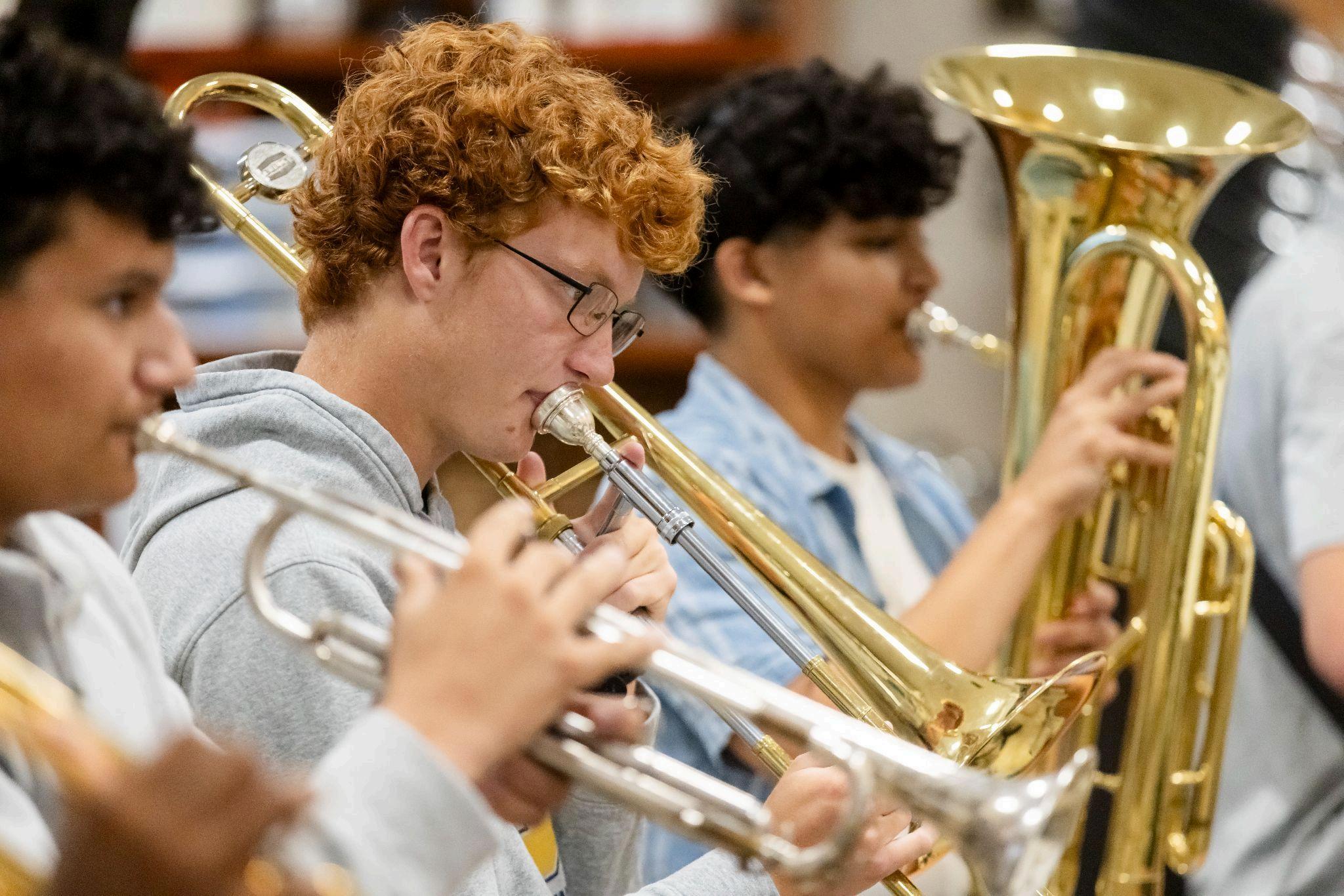
CONCERT BAND (full year)
This course is a performing ensemble open to all interested students with prior instrumental experience Students are given the opportunity to showcase their musical talents as ensemble members and potentially as featured soloists. The Concert Band performs two school concerts per year, along with the possibility for additional performances in our community. The group performs standard concert band literature and other styles including classical, showtunes, marches, contemporary, and pop/rock. Concert Band meets three (3) times per cycle in the same block as Rock Band. Please note that this is a year-long class and cannot be taken for one semester
ROCK BAND (full year)
Rock Band is a performing ensemble consisting of a rhythm section, horn section, and vocalists. Participation in Concert Band is not required, but strongly recommended for those that play Concert Band instruments. Rock Band performs two
school concerts per year, along with the possibility for additional performances in our community Repertoire performed includes rock, pop, funk, jazz, and more Rock Band meets two (2) times per cycle in the same block as Concert Band. Please note that this is a year-long class and cannot be taken for one semester.
CONCERT CHOIR (full year)
This performance group is a non-select chorus that is open to all students interested in singing The group performs standard choral literature representing all styles of music Concert Choir provides several opportunities to perform on and off campus throughout the year. Concert Choir meets three (3) times per cycle in the same block as Vocal Ensemble. Please note that this is a year-long class and cannot be taken for one semester.
VOCAL ENSEMBLE (full year)
Vocal Ensemble is a smaller group of select members Interested students will audition to join this group The Vocal Ensemble offers students an opportunity to explore jazz repertoire, including a cappella selections This is an audition-only ensemble. Vocal Ensemble meets two (2) times per cycle in the same block as Concert Choir. Please note that this is a year-long class and cannot be taken for one semester.
INTRODUCTION TO ACTING AND THEATER (first semester, repeats second semester)
This class is designed to provide an introduction into the basics of stage acting Students will gain basic skills in acting, improvisation, visualization, breathing, and relaxation, as well as a working vocabulary of theater terms Additionally,
students will learn about the aspects of backstage work (technical theater) which make the show come together No previous acting experience is required.
INTRODUCTION TO PIANO
(first semester, repeats second semester)
In this hands-on introductory class, students learn beginning piano skills and fundamentals of music literacy, including basic notation, rhythms, time signatures, and intervals. This class is designed for beginning pianists with no previous piano experience.
MUSIC TECHNOLOGY
(first semester, repeats second semester)
Students will use computer software to introduce and familiarize themselves with Garageband as a Digital Audio Workstation. Students will learn the basic concepts of music technology, including recording, editing, producing, and creating computer-based music. Other topics of study include movie music, music videos, sampling, sound effects, and the music industry This is a project-based class that encourages creativity and collaboration and encourages students to both work with the music they enjoy and expand their musical horizons
MUSIC THEORY (first semester)
This introductory course is designed for students with some background in music and requires the ability to read notation and rhythm. Throughout the course of the semester students will study basic notation, scales, key signatures, intervals, chords, cadences, form, part-writing and analysis of a score Aural dictation and ear training are also an integral part of the course, and individual creativity is nurtured through both rhythmic and melodic composition. The course takes a beginning approach to the concepts of theory and analysis, with real-world references from classical, jazz, and pop music
INTRODUCTION TO GUITAR AND UKULELE
(second semester)
In this performance-based class, students will develop skills essential to learning the basics of guitar and ukulele, including rhythm, tempo, chords, notation, tablature, and time signatures. Students will practice with and perform for the class, focusing mainly on folk and pop music styles. This class is designed for beginning guitar players with no previous guitar experience.
Visual Arts
Students must complete 0.5 credit in visual arts, 0.5 credit in performing arts, and an additional 0.5 credit of choice in either art.
HONORS ART (full year)
This is a yearlong course for sophomores through seniors who are both interested and capable in visual art. The purpose of this class is to develop art-making skills and to begin ideation for the concentration section of the AP portfolio Students will be required to submit a finished work every two to three weeks, keep a sketchbook, and participate in group critiques Students will explore different media combinations, styles, and techniques of art making with a strong emphasis on independent work.
AP ART AND DESIGN (2-D DESIGN, 3-D DESIGN, & DRAWING) (full year)
AP Art and Design is typically taken during the senior year. There is a tremendous amount of independent work, thought, and effort that goes into creating the twelve pieces of art needed for an AP portfolio Students design and develop a concentrated body of artwork based on a topic or theme of their choosing Keeping a sketchbook, visually analyzing artwork, reflecting on the process, and completing a project every two weeks are requirements of the course. Projects will be assigned during breaks and vacations. All students enrolled will submit a final portfolio to the College
Board for the AP requirements. Prerequisite: Honors Art or department approval
DIGITAL PHOTOGRAPHY I (first semester)
In this course, students will learn to use Adobe software to create unique digital images Students will explore both the technical aspects of image manipulation as well as the artistic aspects of creating images. They will gain familiarity with techniques through demonstrations, tutorials, one-on-one guidance, practice, individual exploration, projects, and the creation of a digital portfolio.
CERAMICS (first semester)
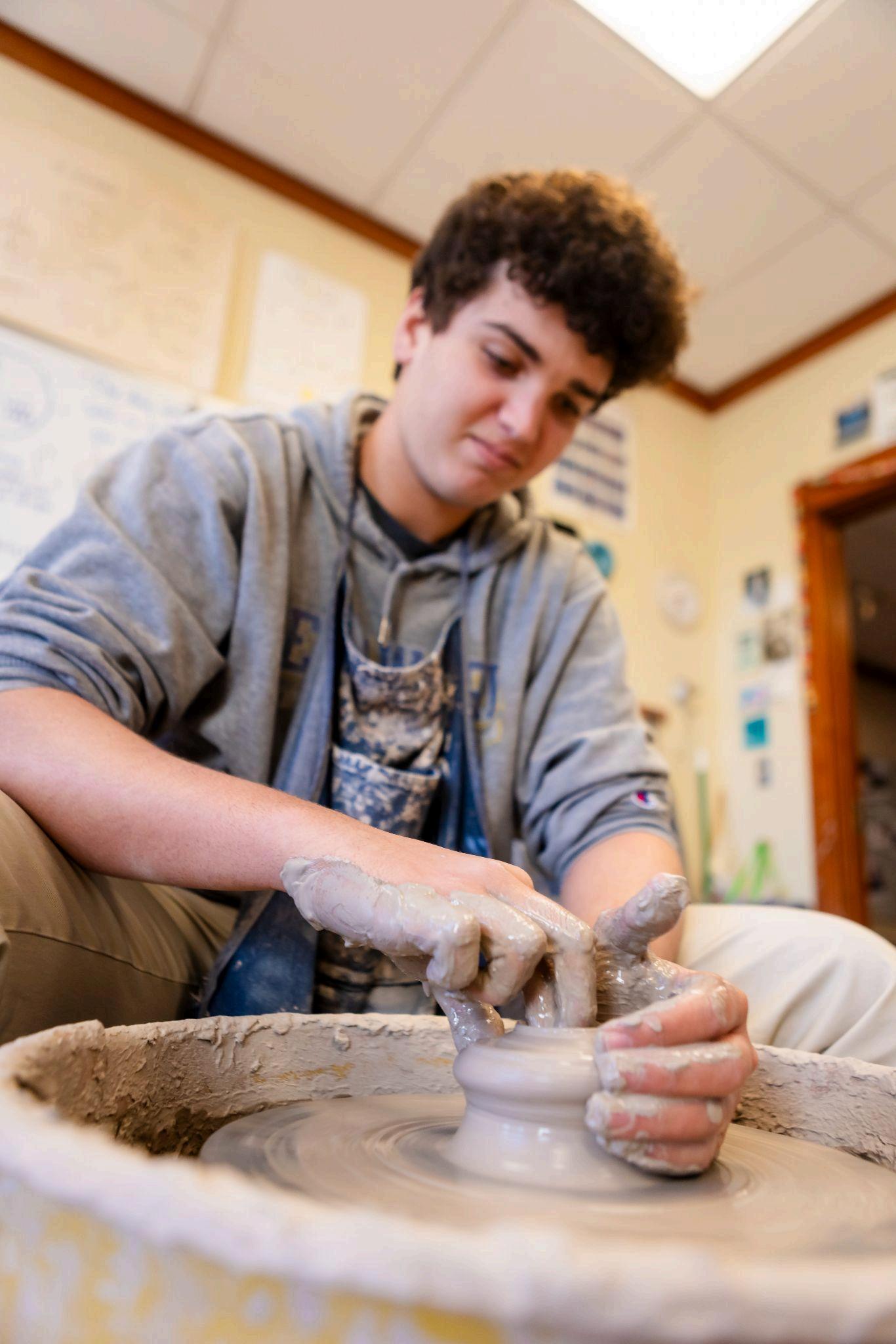
Working with clay, students will learn various techniques, such as coiling, slab making, pinching, and additive and subtractive sculpture The basics of throwing on the potter’s wheel are also introduced. As the semester progresses, experimentation with techniques will lead to more freedom and individual creativity Group critiques and demonstrations will reinforce student learning. Problem solving, designing, and creative thinking will allow for the construction of both functional and sculptural forms.
S
In this multimedia class, students will learn the fundamentals of working with 3D form and space. This course emphasizes the use of a variety of basic materials with an introduction to the woodshop. Designed to integrate the development of technical skills with critical thinking, projects will explore sculptural strategies including wood, jewelry, foam and wire fabrication.
DRAWING (first semester)
This course is designed to strengthen observational, technical, and mechanical skills as students are led through a series of exercises culminating in finished drawings The goal of this hands-on course is expression through perceptual drawing, reflecting the student’s understanding of materials, techniques, and visual experience. As students develops their individual approach to drawing and an understanding of form, they will create unique expressive forms Students will work from both life and imagination as they develop the perceptual, conceptual, and technical skills necessary to translate three dimensional forms onto a two dimensional surface
ANIMATION
(first semester, repeats second semester)
From stop-motion to video games, animation is integral to the creation of appealing and entertaining media. This animation course will educate you in the fundamentals of the craft and the technological literacy of current animation tools By the end of this course, the student will be able to 3D animate a movement sequence of their choice and learn to self-improve their own animation work for the future. The course will cover the basics of animation and with a focus on applied animation skills.
DARKROOM PHOTOGRAPHY (second semester)
While heightening visual awareness by observing and recording the world around them, students will utilize photography as a means of communication and self-expression. They will obtain an understanding of the technical aspects of photography including the operation of a 35mm camera and various darkroom techniques. A background in aesthetics will be established with regards to design, composition, statement, and intent. Weekly critiques offer the opportunity to incorporate art vocabulary to describe, analyze, interpret, and judge the work of other photographers, as well as students’ own work.
GRAPHIC DESIGN (second semester)
This course investigates the qualities of good design and composition by exploring design principles through visual problem-solving exercises Students are introduced to the basic ideas of graphic design and visual communication and develop skills in typography and conceptual thinking using both Adobe Photoshop and hand-drawn techniques for projects.
PAINTING (second semester)
In painting class, students learn to reproduce images from still life, from imagination, and from nature through their exploration and observation of light, color, and composition using a variety of media and techniques Students will have the opportunity to develop their personal style and to study the work of master artists.
WHEEL THROWING (POTTERY) (second semester)
Students will learn how to use the potter’s wheel to create functional and sculptural vessels Students will investigate different design techniques to create desired surfaces for their work. Wheel throwing takes practice, patience, and time to grasp. Planning and prioritizing studio time will be emphasized in addition to developing technical proficiency Continuing Ceramics students will be challenged to work on techniques designed to advance their ability
Additional Coursework
Independent Studies
Independent Studies are an opportunity for students to pursue specialized topics not offered within the regular curriculum Students in good academic standing may plan an independent study with a faculty member and submit a proposal for approval to the Head of Upper School. All independent studies must have the direct academic supervision of an upper school faculty member who is willing to oversee the student’s progress. Students are limited to one independent study credit per semester, and with permission, the independent study may replace a sixth course. For consideration, all proposals for first semester or full year independent studies must be submitted during course registration in the spring. Proposals for second semester independent studies must be submitted no later than the first day of December exams. Students, advisors, and faculty supervisors will be notified via email whether a student’s independent study proposal has been approved Independent studies are graded on a Pass/No Pass basis based on criteria agreed upon between student and faculty supervisor GPA credit is not awarded for Independent Studies
Summer Study
Students who receive a failing grade in one or both semesters may be required to repeat a course through summer study or during the following school year. Summer school credits from an approved summer school may be applied to placement in the next level of a subject pending a placement test and permission of the Department Chair and the Head of Upper School. Please note that Sanford offers several electives in the Summer Enrichment Program which may be used for graduation requirements. However, completing a summer course does not reduce the minimum number of classes taken during the school year
In rare cases, a student may be permitted to work with a tutor over the summer to try to bypass a level in math or world language In order for this to be approved, the student must have earned a minimum grade (varies by department) in the current class, submit an application, and earn a B+ or better on Sanford’s final bypass exam for the course taken in late August
Driver’s Education
The State of Delaware requires Delaware drivers under the ake and pass a state-run program. Students mores in order to take the class. An employee Delaware provides materials for and runs the education program. Classroom instruction he full lunch periods on four cycle days. The ion typically lasts from September through r, and students eat lunch during class. In stime instruction, students are scheduled for actice driving times with the instructor and students go through the in-vehicle driving ver’s Ed based on their study halls and when Driving sessions are scheduled during study periods Consistent with the policy of the artment of Education, Delaware residents driver education class at Sanford can take the st We recommend that out-of-state residents ir home state DMV to guarantee that this on program will be accepted if needed residents will be assessed a registration fee of $660, which will be charged to your student
University of Delaware Early College Credit Program
Sanford is pleased to be able to offer college courses through the University of Delaware's Early College Credit Program
The University of Delaware partners with a limited number of Delaware high schools to offer selected courses to high school juniors and seniors Enrollment is limited by course, high school, and eligibility guidelines from the University and Sanford School For the 2026-2027 school year, these semester-long classes are offered asynchronously online Sanford students can enroll in a maximum of one (1) class each semester, which can stand in place of a sixth (6th) class in a traditional Sanford schedule. No credit is given towards Sanford School's graduation requirements or GPA, however the student will earn college credits issued by the University of Delaware. All classes are three (3) credit hours. There is no additional cost to enroll in these courses.
FIRST SEMESTER, FALL 2026:
AFRA110172: INTRODUCTION TO AFRICAN AMERICAN STUDIES
Assess the status of Black America in the modern technological order through an examination of the major spheres of institutional life, including employment, education, politics, criminal justice, and the military.
COMM245172: MEDIA INDUSTRIES AND SOCIETY
The relationship between media and culture; how media affect culture (i.e., socialization and role modeling); and exploration of new forms of mass communication.
SECOND SEMESTER, SPRING 2027:
DIST250172: DISABILITIES STUDIES: A MULTIDISCIPLINARY APPROACH
Current and historical media processes and their impact on art, design and culture Image making and manipulation, video, audio, interactivity, and connectivity Viewing fine art and design projects, the historical aspects of design and digital media, basic media theory, and universal principles of software and digital media. Projects include writing, creating visual media, and making presentations. Unfamiliar media experienced firsthand through exhibitions, screenings, lectures, online exploration and consumer media devices.
HIST188172: THE HISTORY OF NOW
This course explores the complexities of our contemporary world through the lens of history The course grounds itself in critical questions for our current times and explores a range of
UAPP110172: CHANGING THE WORLD AND PUBLIC POLICY
“Going Green,” the haves and have nots, relevant politics - all huge contemporary issues. Can you get a job AND make a difference? Public policy addresses such issues and begins with you. Examines basic policy concepts/strategies used by citizens, government and other societal institutions.
topics and themes The semester opens with a meta-question: can the past teach? We then turn to a range of contemporary concerns related to food; political borders; leisure and play; the social self; climate change; rights for androids; the meaning of music; and what the past tells us about corporations and power.
LEAD100172: LEADERSHIP, INTEGRITY AND CHANGE
Current and historical media processes and their impact on art, design and culture Image making and manipulation, video, audio, interactivity, and connectivity Viewing fine art and design projects, the historical aspects of design and digital media, basic media theory, and universal principles of software and digital media. Projects include writing, creating visual media, and making presentations Unfamiliar media experienced firsthand through exhibitions, screenings, lectures, online exploration and consumer media devices