2026
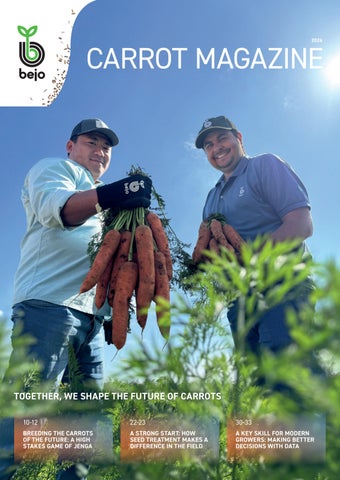
CARROT MAGAZINE
TOGETHER, WE SHAPE THE FUTURE OF CARROTS 10-12
22-23
30-33
BREEDING THE CARROTS OF THE FUTURE: A HIGH STAKES GAME OF JENGA
A STRONG START: HOW SEED TREATMENT MAKES A DIFFERENCE IN THE FIELD
A KEY SKILL FOR MODERN GROWERS: MAKING BETTER DECISIONS WITH DATA
Colophon Published by Bejo Zaden B.V. P.O. Box 50 1749 ZH Warmenhuizen The Netherlands T: +31 (0)226 396 162 E: info@bejo.com W: www.bejo.com
Mathieu Fasola
Editorial team Annika Ruijter Daniëlle Bruin Kelly Burger Lisette Alders Jelger van Weydom Photography & image editing Petra Tesselaar Design in Beeld | Visuele communicatie Design & layout Nathalie España Mieke Schilder (Studio Mieke) JEEN. Printing Koopmans’ drukkerij B.V., Zwaag We thank all Bejo colleagues and partners who contributed to this magazine, including those who provided photography and visual content. No rights may be derived from the information in this magazine. Articles, or parts thereof, may only be reproduced with the permission of Bejo Zaden B.V. and with proper acknowledgement of the source.
2
BEJO CARROT MAGAZINE
EVERY GREAT STORY IN AGRICULTURE BEGINS THE SAME WAY: WITH A SEED. A SEED IS MORE THAN THE STARTING POINT OF A CROP; IT BRINGS POTENTIAL TO LIFE. A SEED CARRIES NOT ONLY THE GENETICS OF TODAY, BUT THE PROMISE OF TOMORROW. AT BEJO, THIS BELIEF IS AT THE HEART OF EVERYTHING WE DO. Breeding is not simply about developing varieties; it’s about anticipating the future and responding to the evolving needs of the entire value chain. To do this, we must stay deeply connected - to growers, processors, retailers, and ultimately consumers. Only by understanding market trends, consumption patterns, and production realities can we develop carrot varieties that remain relevant, resilient, and valuable in the years to come.
A decade of growing complexity Over the past decade, our industry has become more complex than many anticipated. Crop protection solutions are steadily being reduced, limiting the tools available to manage pests and diseases. At the same time, climate change is no longer a distant concern - it’s a daily reality. We see hotter days followed by cooler nights, unpredictable weather patterns, and increasingly frequent heavy rainfall. These shifts directly impact crop performance, quality, and yield stability.
TOGETHER, WE SHAPE THE FUTURE OF CARROTS
Beyond the field, economic pressures are intensifying. Volatile input costs, shifting global markets, and changing regulatory environments are affecting every player in the agricultural sector. From seed companies to growers and distributors, no one is untouched. These challenges don’t stand alone. They reinforce each other, and they’re accelerating.
Facing the future together
The challenges ahead are significant, but so are the opportunities. By strengthening connections across the value chain, aligning our efforts, and committing ourselves to shared goals, we can build a more resilient, innovative, and sustainable carrot industry. It all starts with a seed. But it grows through collaboration. And together, we shape the future of carrots.
In this context, one thing becomes clear: the future cannot be shaped in isolation. Mathieu Fasola, Head of Rooted Crops at Bejo The seed is the beginning of the chain, but it’s not the entire solution. Innovation must go beyond genetics. It requires collaboration across the entire ecosystem, from breeding and agronomy to storage, processing, and market positioning. At Bejo, we believe our responsibility is twofold. First, to continue exploring nature, unlocking genetic diversity, and developing varieties that meet the demands of a changing world. Second, to actively engage with our partners to identify the most critical challenges ahead. The future of carrots won’t be defined by a single breakthrough or a single player. It will be shaped by a series of deliberate choices made collectively.
Going further, together There’s a simple truth that resonates more strongly today than ever before: alone, we go faster. Together, we go further.
BEJO CARROT MAGAZINE
3
THE JOURNEY BEHIND EVERY CARROT VARIET Y SELECTION CROP PLANNING
MARKET & CONSUMER DEMAND
SEED PRODUCTION & ENHANCEMENT
BREEDING & RESEARCH
Understanding global trends, evolving markets and consumer expectations. These insights show where demand is moving and help guide decisions across the entire chain.
6
THE GLOBAL CARROT LANDSCAPE
8
LOOKING AHEAD: GLOBAL TRENDS RESHAPING THE CARROT LANDSCAPE
Producing high-quality seed at scale to support strong crop performance. Advanced seed production methods and seed technologies ensure consistency in the field. Developing resilient varieties by anticipating future challenges. Genetic knowledge and innovation come together to create carrots that perform under changing conditions.
10 BREEDING THE
CARROTS OF THE FUTURE : A HIGH STAKES GAME OF JENGA
14 GENE EDITING
EXPLAINED: TAKING A CLEAR LOOK AT THE FUTURE OF CARROT BREEDING
4
BEJO CARROT MAGAZINE
16 UNRAVELLING THE
BLACK BOX OF CARROT SEED PRODUCTION
21 BETER SPACING
BETTER VALUE: ENCRUSTED SEED IN PRACTICE
22 A STRONG START:
HOW SEED TREATMENT MAKES A DIFFERENCE IN THE FIELD
Matching genetics with local conditions, market needs and growing strategies. Growers and experts make informed choices to optimise yield, quality and risk management.
24 FROM FIELD TO FUTURE
26 GROWING CARROTS AROUND THE WORLD
BEFORE A CARROT REACHES THE PLATE, IT PASSES THROUGH MANY STAGES. FROM UNDERSTANDING MARKET DEMAND TO CULTIVATION, PROCESSING AND PREPARATION, EACH STEP SHAPES HOW CARROTS ARE GROWN, USED AND VALUED IN THE YEARS AHEAD. THIS MAGAZINE FOLLOWS THAT JOURNEY, BRINGING EACH STAGE TO LIFE THROUGH STORIES, INSIGHTS AND PERSPECTIVES FROM ACROSS THE CHAIN. PREPAR ATION & CONSUMPTION
CULTIVATION & HARVESTING
RETAIL & FOODSERVICE
PROCESSING & PACKAGING
Applying expertise and innovation to grow strong, reliable carrots. Careful management of soil, water and crop care supports performance throughout the growing cycle.
30 A KEY SKILL FOR
MODERN GROWERS: MAKING BETTER DECISIONS WITH DATA
Positioning and selling carrots in the market. Pricing, promotion and presentation shape how carrots are sold and perceived by consumers. Preparing carrots for different markets and applications. After harvest, products are sorted, processed and tailored to meet specific requirements.
34 CARROT
HARVESTING & CULTIVATION IN LEBANON
36 THE FUTURE OF
FROZEN CARROTS
38 INNOVATION BEHIND THE SCENES
41 FROM COMMODITY TO
CONCEPT: HARVEST MOON ON THE RISE OF SNACK CARROTS
Enjoying carrots across cultures and cuisines. They play a role in everyday meals and special moments, prepared in many ways.
50 A VEGETABLE
FOR EVERYBODY: INSPIRATION AROUND THE WORLD
54 DID YOU KNOW?
CARROT FUN FACTS
44 CARROTS AT A
CROSSROADS: GLOBAL RETAIL VOICES ON VALUE, QUALITY AND WHAT COMES NEXT
48 CARROTS ON THE
SHELF: INSPIRATION FROM RETAIL AROUND THE WORLD
BEJO CARROT MAGAZINE
5
THE GLOBAL CARROT LANDSCAPE CARROT IS A GLOBAL AND VERSATILE CROP. ACROSS REGIONS, NANTES TYPES DOMINATE PRODUCTION. LOCAL CLIMATE AND PREFERENCES DRIVE DIFFERENCES IN VARIETIES AND MARKET FOCUS. GROWTH IS SUPPORTED BY POPULATION INCREASE, PROCESSING DEMAND, AND BREEDING IMPROVEMENTS.
EUROPE 150.0 0 0 H A
Wide range of Nantes types, Amsterdam types, Berlicum, Flakkee and Chantenay. Small amount of Imperators. Key varieties: Nerac, Nairobi, Mokum, Natuna, Novara
AMERICAS & OCEANIA 150.0 0 0 H A Nantes, Imperator, Berlicum, Chantenay Key varieties: Pismo, Bangor, Natuna, Berlin, Belgrado, Cordoba
6
BEJO CARROT MAGAZINE
MARKET & C O N S U M E R D E M A N D
The global key demand drivers are: u
Population growth
u
High yield per hectare, storability
u
u
Expansion of the processing industry, diversification Genetic improvements such as yield stability, disease resistance, shelf life
ASIA 450.000 HA Kuroda, Chantenay, Nantes Key varieties: Natuna, Cordoba, Cascade, Caspi, Canton
AFRICA, MIDDLE EAST 250.000 HA Continental Nantes, Chantenay, Berlicum Key varieties: Natuna, Cordoba, Cascade, Nevis Source: FAO & Bejo internal data BEJO CARROT MAGAZINE
7
LOOKING AHEAD: GLOBAL TRENDS RESHAPING THE CARROT LANDSCAPE CONVERGING FORCES ARE DRIVING THE NEED FOR CLOSER COLL ABORATION ACROSS THE VALUE CHAIN.
THE WORLD AROUND CARROTS IS CHANGING RAPIDLY, AND THE SECTOR CAN NO LONGER RELY ON STABILITY ALONE. WHAT WAS ONCE CONSIDERED A RELIABLE CROP IS INCREASINGLY INFLUENCED BY DEVELOPMENTS BEYOND THE FIELD ITSELF. WEATHER PATTERNS ARE BECOMING LESS PREDICTABLE, SUPPLY CHAINS ARE UNDER GROWING PRESSURE, AND CONSUMER EXPECTATIONS CONTINUE TO EVOLVE.
As a result, expectations across the value chain are rising. Growers, breeders, processors and retailers are all required to deliver more: consistent quality, greater resilience and stronger market value, often with fewer resources. These trends are no longer emerging, they are already shaping daily decision-making. The challenge is not only to respond, but to anticipate and stay ahead.
A world in transition A range of developments is reshaping the carrot sector simultaneously. One of the most visible drivers is health. As consumers place greater emphasis on healthy diets, vegetables such as carrots are gaining relevance. At the same time, expectations now extend beyond nutritional value alone. Convenience, taste and ease of use have become essential requirements in many markets. Production conditions are also becoming more demanding. Increasing weather variability, from heat stress to heavy rainfall, is reducing yield predictability and placing pressure on crop performance. This is further challenged by the gradual reduction in available crop protection solutions, limiting the tools available to growers. Beyond the field, economic and regulatory pressures are intensifying. Fluctuating input costs, price volatility and changing regulations are influencing decisions across the chain, from production planning to product positioning.
8
BEJO CARROT MAGAZINE
In response, technology is playing a more central role. Precision farming solutions, such as data-driven irrigation and mechanical weeding, support more targeted and informed decision-making in the field. At the same time, the carrot market continues to expand. Changing consumption patterns are driving growth in segments such as fresh-cut, snack and prepared products. This broadening of applications creates both new opportunities and higher requirements across the value chain.
From trends to reality These developments are visible at every stage of the chain, starting with the seed. In breeding, the focus is shifting towards balanced performance. Yield and uniformity remain essential but must now be combined with quality traits such as shelf life and visual appeal. Resilience has also become a key priority. Varieties need to perform under variable conditions and with fewer crop protection options, while maintaining consistent quality. Reliability under pressure is now just as important as peak performance under optimal conditions. In the field, this is reflected in more adaptive production strategies. Growers adjust planting windows, explore new production regions and invest in soil health and water management. In tropical
MARKET & C O N S U M E R D E M A N D
and subtropical regions, drought, salinity and heat constrain production potential, while in continental climates, strong day–night temperature differences affect crop development. These challenges call for new approaches to protect both yield and quality. Further along the chain, expectations remain high. Consumer demand for convenience continues to increase. The rise of snack carrots in several markets clearly illustrates the shift from carrots as a cooking ingredient to a ready-to-eat product with its own consumption moment.
Looking ahead, the carrot sector is entering a more demanding, but also more dynamic phase. By strengthening resilience, creating new product value and working in closer alignment, the sector can respond more effectively to the forces shaping its future. Carrots are no longer just a bulk crop. They are becoming a more versatile and differentiated product, firmly rooted in the field, yet increasingly shaped by developments beyond it.
Sustainability requirements are also becoming more tangible. New packaging requirements, for example, are accelerating the transition towards recyclable materials and reduced waste. This directly affects how carrots are packed, transported and presented. As a result, product development is increasingly influenced by regulatory frameworks, adding further complexity to decisionmaking.
A more connected chain Taken together, these developments are creating a more interconnected supply chain. Decisions made at earlier stages, such as variety selection, increasingly influence processing, packaging and market positioning further downstream. At the same time, information flows more rapidly across the chain, and the link between seed and shelf continues to strengthen. In this context, collaboration is becoming a key differentiator. Closer alignment between breeders, growers, processors and retailers enables more consistent performance and more targeted responses to shared challenges. It also strengthens the connection between field realities and market demands.
BEJO CARROT MAGAZINE
9
BREEDING THE CARROTS OF THE FUTURE: A HIGH STAKES GAME OF JENGA ANYONE LOOKING AT A CARROT WILL QUICKLY SEE WHAT APPEARS TO BE A SIMPLE CROP. BUT BEHIND EVERY GOOD CARROT LIES A BREEDING PROCESS THAT IS ANYTHING BUT SIMPLE. WITH CARROTS IN PARTICULAR, MANY FACTORS COME TOGETHER: GENETICS, SOIL, POLLINATION, CLIMATE AND MARKET DEMANDS. THIS REQUIRES A UNIQUE COMBINATION OF A BROAD GENE POOL, YEARS OF EXPERTISE, A GLOBAL NETWORK ACROSS ALL RELEVANT CLIMATE ZONES, CONTINUOUS INNOVATION AND A CLOSE CONNECTION TO REAL-WORLD PRACTICE. THIS COMBINATION ENABLES BEJO TO SUPPLY VARIETIES TODAY THAT PERFORM WELL IN PRACTICE AND LAY THE FOUNDATIONS FOR THE CARROTS OF TOMORROW. Our breeding experts Rudie Steentjes, Wim Zwaan and Peter A. Dekker share their insights and explain what it takes to breed the carrots of the future.
A crop that is not easily controlled From a genetic perspective, the carrot is a unique crop for breeders. “The carrot is what is known as a population crop,” Steentjes explains. “Unlike many other vegetable crops, it does not naturally tend towards uniformity. This is due to the risk of cross-pollination and biological vulnerability to inbreeding depression. On the other hand, there is a great deal of genetic variation present within the crop from the outset. Plants differ from one another in small but relevant traits such as flowering time, vigour, resistance and productivity. This variation makes carrots strong and resilient but presents an extra challenge for breeding. After all, the grower wants a variety that grows uniformly, performs consistently year after year, and has good seed availability, so that it can be sown again every year.” This is precisely the crux of the challenge: how do you achieve uniformity without losing the crop’s vigour? “Breeding carrots therefore constantly requires a balance between uniformity on the one hand, and yield potential and robustness
10
BEJO CARROT MAGAZINE
on the other,” Dekker notes. “The more uniform a line becomes, the greater the risk that yield potential and vitality will come under pressure. Furthermore, seed production is becoming increasingly difficult due to unpredictable weather conditions, reduced use of chemicals and growing insect populations that feed on the embryos of the maturing carrot seeds. This is a complex area that demands experience, patience and craftsmanship”. What’s more, the success of a carrot variety is largely determined by factors other than genetics alone. Carrots are a distinctly soil-dependent crop. “At least 50 per cent of a variety’s success is determined by the growing environment,” Dekker explains. “Soil structure, moisture supply, fertilisation, sowing density and soil life have an enormous influence on how a variety develops. A variety that performs well on one type of soil may not fare as well in another location. This means that breeding can never be viewed in isolation from practical conditions. Varieties must not only look good on paper but must also continue to perform robustly under a wide range of field conditions.” Finally, pollination makes carrot breeding complex. Carrots rely on insect pollination. Bees and other insects therefore play a direct role in seed production and in maintaining genetic purity.
BREEDING & RESE ARCH
Wim Zwaan, Rudie Steentjes and Peter A. Dekker
This makes the crop particularly sensitive to environmental influences. Wild carrots near production sites, for example, can cause unwanted cross-pollination. Anyone wishing to successfully breed carrots must therefore not only master genetics, but also understand production conditions, pollination biology and site selection in great detail.
A rolling train of knowledge and cross-breeding Requiring so much knowledge and time, continuity is invaluable in carrot breeding. “Developing a new carrot variety can easily take fifteen years,” explains Zwaan. “Breeders therefore always build on the work of colleagues who have previously worked on the same genetic lines.” It is not a process of isolated projects, but rather a moving train with countless carriages full of crosses, selections and observations. On average, 2,000 different crosses are carried out, validated, refined or discontinued each year. The combined years of service of Zwaan, Dekker and Steentjes alone represent decades of experience. This means that new breeders do not have to start from scratch but can step into a rich system of accumulated knowledge and genetic material.
DID YOU KNOW: The range of carrots is now a colourful affair: apart from the orange version, there is a choice of red, white, purple and yellow carrots. The most exciting variety for breeders is the Rainbow. A variety in which a defined breakdown of colours across the spectrum can be seen naturally: from white, yellow and pink-salmon to orange. Gregor Mendel, the founder of the science of inheritance and plant breeding, would be envious!
A broad foundation as a starting point A strong carrot programme starts at the foundation: sufficient genetic diversity to enable the targeted development of new varieties. Over the course of many decades, an enormous diversity of types, characteristics and adaptations has been built up within the carrot portfolio. Bejo’s range of 130 varieties demonstrates just how broad that palette has become: from early and late Nantes types to Berlicum, Chantenay, Imperator, Kuroda and (sub)tropical types, suitable for both conventional and organic cultivation. This broad genetic base is not a luxury, but a strategic necessity. The requirements for carrot varieties are becoming increasingly specific. One market
BEJO CARROT MAGAZINE
11
INTRODUCING OUR TEAM
PETER A. DEKKER – HEAD OF BREEDING (CARROT, ASPARAGUS, LEEK AND RADISH) u
With 24 years at Bejo, Peter has worked with many crops, but carrots have been his speciality (and perhaps his favourite?) all along. He is proud of how Bejo successfully balances practical experience with modern technology. His favourite variety is Natuna, currently the largest carrot variety on which he himself has worked, alongside his team of breeding and research colleagues.
RUDIE STEENTJES – (CARROT) BREEDING MANAGER u
With over 12 years’ service in breeding, Rudie has built up a wealth of experience. He is now manager of Bejo’s carrot breeding programme. As well as the progress made on tropical carrots, his favourite is the Chantenay variety Caspi, which he has helped to develop himself.
demands smoothness, colour and uniformity for the fresh produce market. Another market, by contrast, places high demands on processability, such as a strong carrot with fewer breaks, a high yield or excellent shelf life. Added to this are disease resistance, germination rate and flavour. Only a breeding programme with a wide range of genetic building blocks can continue to combine such traits without compromising on other aspects.
Jenga Carrot Carrot breeding can be best compared to the game of Jenga. With every step, you add a new trait to an existing variety: resistance, yield, colour, flavour, germination, storage quality, processability. But as soon as you remove a single block, the balance can be lost. In breeding, this is known as ‘stacking traits’. The trick is to add new traits without losing previous qualities. A variety that scores better on disease resistance but suddenly breaks more easily will still fall short in practice. That is precisely why modern carrot breeding requires extremely precise development of the overall package.
Close to the grower, close to practice Breeding therefore does not take place in isolation from practical reality, when with carrots, that practical reality is the ultimate test. Because soil and growing conditions have such a major influence, a breeder needs to know what is happening on the grower’s farm. By working closely with growers and trial sites, feedback from the field is received quickly. “This means we receive first-hand information about changing conditions or requirements,” says Dekker. What becomes apparent there can be directly factored into new selections and crosses.
New challenges call for new combinations
WIM ZWAAN – CARROT BREEDER u
12
BEJO CARROT MAGAZINE
Having grown up on a farm, Wim has a strong feel for what a variety needs to deliver in practice, and how to translate this into breeding objectives. After 37 years with Bejo, carrots hold few secrets for him. With his broad practical and theoretical knowledge, Wim is an experienced breeder who enjoys sharing his expertise with the next generation. His favourite varieties are Natuna and Novara—varieties that have been worked on for many years in Southern Europe and that are gradually gaining market share.
Today, the bar for carrot breeding is higher than ever before. A variety now needs to perform strongly on an increasing number of talents simultaneously. Climate change, stricter legislation, changing market demands and a shrinking range of crop protection products mean that the number of necessary traits continues to rise. An international presence across different climate zones is of great importance in this regard, as climate change is causing cultivation and production areas to shift. As a result, drought and salinisation, for example, are on the rise. Furthermore, diseases and pests are moving in tandem with the climate. This is radically altering the suitability of land. Steentjes explains: “Traits that used to be
BREEDING & RESE ARCH
particularly relevant in Southern Europe may suddenly become essential in North-Western Europe as well. Think of resistance to new viruses or pests caused by shifting insect populations. But also salt tolerance in areas where salinisation is increasing, strong foliage quality and good germination under varying conditions.” Those active in different regions are better placed to anticipate such shifts and have access to genetic material from diverse environments to create new combinations. Thanks to a broad international gene pool, Bejo’s breeders combine resistances and adaptations in varieties from different regions that are suited to new realities. Even geopolitics is playing an increasingly significant role nowadays. Discussions about country of origin, import restrictions and phytosanitary risks are making the choice of production areas more complex. Not every country accepts seed from just any region. Furthermore, new locations can in turn bring new risks, such as different disease patterns or wild carrots in the vicinity that influence pollination. It is precisely in such situations that operating globally and having experience with multiple production zones and climate scenarios is a major advantage. This not only strengthens a breeding programme but also makes it more resilient.
Organic farming as a catalyst for robustness The rise of organic farming has further intensified the breeding of robust carrot varieties. In organic systems, varieties must rely more heavily on their own genetic resilience. But this development is not only relevant to organic growers. In conventional farming too, the pressure to use fewer chemical inputs is increasing. Consequently, the importance of natural resistances and strong, resilient plants is growing for the entire sector.
Why technical innovation helps us staying ahead As the gene pool grows, so does the complexity of the choices to be made. That
is why software, data analysis and new breeding techniques are playing an increasingly important role, supporting the decision-making process. By combining data from trials, field observations, growth measurements and DNA analyses, more targeted and rapid decisions can be made about promising crosses. Modern analysis helps to recognise patterns that are difficult to see with the naked eye. Speed breeding and DNA analysis make it possible to progress through generations more quickly and identify traits at an earlier stage. In this way, the breeding process can be organised more efficiently, without compromising on rigour. Close collaboration between breeding and research departments is essential in this regard. Progress is being made at an ever-faster pace by translating the latest research techniques into practical breeding steps. Ultimately, experience remains indispensable. Carrot breeding is a long-term endeavour requiring specialist knowledge and constant judgement. Data provides direction, but interpreting signals, understanding field behaviour and making the right judgements still require the breeder’s keen eye and insight. The future therefore lies not in choosing between people and technology, but in combining the two.
BEJO CARROT MAGAZINE
13
GENE EDITING EXPLAINED: TAKING A CLEAR LOOK AT THE FUTURE OF CARROT BREEDING HOW DO YOU DEVELOP STRONGER CARROT VARIETIES IN AN ERA OF INCREASING DISEASE PRESSURE, CLIMATE CHANGE AND STRICTER REGULATIONS? ONE OF THE TECHNIQUES INCREASINGLY BEING MENTIONED IN THIS CONTEXT IS GENE EDITING. A SUBJECT THAT AROUSES CURIOSITY, BUT ALSO RAISES QUESTIONS. WHAT EXACTLY IS GENE EDITING? WHAT IS IT NOT? AND HOW CAN IT CONTRIBUTE TO THE FUTURE OF THE CARROT?
There are still many misconceptions surrounding gene editing. According to Katschnig, the most important difference is that gene editing is not genetic modification (GMO) in the traditional sense. No genes from other species are added. The modification remains within the plant’s existing DNA. In principle, what is created could also occur naturally.
For this article, we spoke to three colleagues who work on this topic every day: Diana Katschnig, Senior Researcher in Phytopathology & Content Analysis, Marcel Adriaanse, Senior Researcher in Tissue Culture & Cell Biology, and Klaas Schotanus, Senior Researcher in Trait Discovery & Genomics. Together, they provide insight into a technology that may be less exciting than it seems, but which could mean a great deal for the future.
Nor is it a ‘miracle cure’. Gene editing is not a solution for everything. Our knowledge of genetics is still limited, and many processes in plants have not yet been fully mapped. As Adriaanse points out, it is simply an extra tool in the breeder’s toolbox.
What is gene editing?
Supporting the future of breeding
Gene editing is best understood as a small, targeted modification to a plant’s DNA. It is comparable to changing a few letters in a text document. As Adriaanse aptly explains: it is as if you are correcting a single word or a single letter.
At Bejo, gene editing is primarily used to gain a better understanding of specific traits. It helps researchers to work more precisely and test more quickly, but it does not replace existing breeding processes.
Traditional breeding often works with larger genetic regions, whereas gene editing makes it possible to focus very specifically on a single trait. Consider, for example, a gene that influences resistance to a disease. It is important to understand that the process itself is not new. Changes of this kind also occur in nature, but there they happen randomly and on a large scale. Gene editing allows this process to be applied in a more targeted and efficient manner.
14
What is gene editing not?
BEJO CARROT MAGAZINE
Breeding remains a process of testing, evaluating and improving. Even with gene editing, plants must be extensively tested under various conditions. The greatest strength lies in the combination: traditional breeding, research and new techniques reinforce one another.
BREEDING & RESE ARCH
GENE EDITING: Klaas Schotanus, Diana Katschnig and Marcel Adriaanse
At present, the focus is on resistance. By making plants more resistant to diseases, the use of chemical pesticides can be reduced. This is not only beneficial for the grower, but also for the environment and the food chain.
FACTS MYTHS
As Katschnig points out, if plants are naturally stronger, fewer external interventions are needed.
Looking to the future
Gene editing works within the plant’s own DNA. No genes from other species are added.
The development of gene editing is still in its early stages. At present, little is known about carrots compared to other crops. But the outlook is clear: the more knowledge that becomes available, the more targeted our work can be.
Gene editing is the same as GMOs.
The ambition is clear. As Schotanus puts it so well, ultimately, the aim is to develop plants that are naturally robust and as independent as possible from external intervention.
It creates unnatural plants.
The changes made can also occur naturally.
It is a miracle solution.
Gene editing is a tool. Not everything about the plant has been fully mapped yet, and extensive testing remains necessary.
Or as was said during the discussion: the real work begins with understanding the ‘text’ of the DNA. And there is still much to discover there. Gene editing may sound like a huge step. In reality, it is a logical next step in a long tradition of plant breeding. A step that does not change everything, but does help us work in a more targeted way towards strong, reliable carrot varieties for the future.
BEJO CARROT MAGAZINE
15
UNRAVELLING THE BLACK BOX OF CARROT SEED PRODUCTION HOW PRACTICAL EXPERTISE, DATA-DRIVEN INNOVATION AND THE POWER OF NATURE COME TOGETHER IN CARROT SEED PRODUCTION
WITH MORE THAN 130 CARROT VARIETIES IN OUR PORTFOLIO AND NEW HYBRIDS CONTINUOUSLY UNDER DEVELOPMENT, BEJO OPERATES ONE OF THE MOST ADVANCED CARROT SEED PRODUCTION NETWORKS IN THE WORLD. EACH VARIETY HAS ITS OWN PRODUCTION CHARACTERISTICS AND REACTS DIFFERENTLY TO CLIMATE, SOIL CONDITIONS AND GROWING ENVIRONMENTS. ENSURING RELIABLE SEED QUALITY AND AVAILABILITY THEREFORE REQUIRES MUCH MORE THAN GROWING EXPERTISE OR TECHNOLOGY ALONE. OUR EXPERTS JOS DOODEMAN, YOURI DRAAIJER AND ROBBERT-JAN SEELEMAN TAKE US BEHIND THE SCENES OF CARROT SEED PRODUCTION AT BEJO AND EXPLAIN THE CHALLENGES INVOLVED.
Why carrots are such a complex crop Producing high-quality carrot seed is far from straightforward. In fact, it is one of the most challenging systems in vegetable seed production. Unlike other crops, carrots are highly sensitive to environmental conditions throughout the entire production cycle. They are grown in open fields, bloom only every two years and depend heavily on insect pollination. Temperature, moisture, soil conditions, pollination activity and flowering conditions all directly influence seed quality and yield.
From farmer’s knowledge to data-driven production That is why successful seed production starts in the field. Jos Doodeman, Bejo’s Global Seed Production Specialist, strongly believes that practical growing expertise remains one of the most important factors in production success and is traditionally built over generations. Understanding how a crop – no matter how strong the genetics - reacts to soil conditions, water availability, weather patterns
16
BEJO CARROT MAGAZINE
and pollination pressure cannot be learned from data alone. It comes from years of observing, testing and continuously improving production practices throughout the full crop cycle. This expertise also plays an important role when selecting production locations. Production fields are often established in close cooperation with experienced growers who understand local conditions and have access to the right infrastructure, machinery and cultivation knowledge. According to Doodeman, resilience starts with diversification. To reduce climate and production risks, Bejo therefore spreads carrot seed production across multiple climate zones, countries and both hemispheres. This global approach creates flexibility and helps match varieties with the environments in which they perform best. At the same time, he sees that production systems are becoming more complex. According to Doodeman, the future lies in combining both worlds: practical field knowledge supported by modern technology. Youri Draaijer, Bejo’s Global Production Research manager, couldn’t agree more.
From black box to measurable process The unpredictability of growing carrots makes it an ideal crop for applying data-driven technologies.
SEED PRODUCTION & ENHANCEMENT
Robbert-Jan Seeleman
Traditionally, many parts of seed production remained difficult to fully monitor. Crops were planted, grown and harvested successfully, but much of the biological process in between relied heavily on experience and visual observations. As growers face increasingly unpredictable weather conditions, disease pressure and changing regulations, carrots become even more vulnerable to external conditions. “With carrots you can do everything right and still get very different results,” Draaijer explains. “The better production teams understand what is happening in the field, the better they can anticipate risks and optimize decision-making.” Technology is becoming an increasingly important addition to practical expertise in seed production thanks to which the “black box” is gradually becoming more transparent. One of the recurring themes in improving seed quality and production is timing. “A lot of things go wrong simply because the right decision wasn’t made at the right moment or without enough information.” Draaijer says.
DID YOU KNOW Drone images can be used for multiple applications? Photos of young plants can both be used for off-type detection, but also for plant counting. Drones are used as a data source for advanced AI techniques, but its images can also be used in a very simple way to calculate the surface area of a planted field. Depending on the complexity of the phenotyping task, an AI model requires at least thousands of images to generate reliable insights.
This is where continuous monitoring becomes especially valuable through every step of the production process. By continuously collecting and analysing field data, production teams can detect variability earlier, improve timing and make more informed decisions throughout the growing season.
Through every step of the crop cycle Monitoring starts long before the crop reaches the field. Seed lots are genetically tested and checked for diseases and bacteria before parent lines are shipped internationally. Once production starts, detailed information about soil conditions, irrigation needs and crop development is collected throughout the entire production cycle.
BEJO CARROT MAGAZINE
17
Drones, sensors, AI-supported image analysis and field monitoring systems can support production teams with creating measurable checkpoints throughout the entire crop cycle. These technologies are thoroughly tested to help monitor: u
Plant count after sowing and winter survival
u
Flowering stages
u
Crop development
u
Pollination advice
u
Detecting weed & diseases and off-types
u
Yield expectations Optimal harvesting timing
“The real challenge is teaching the model what it isdrones actuallycapture seeing.” In pollination management, for example, detailed u
images of male and female flowers. AI models then analyse these images to determine the optimal moment YouritoDraaijer introduce pollinators into the field. In some cases, the system can already make more objective assessments than field experts working under time pressure. “Using drone-technology and data analysis does not only help making real-time adjustments. It also supports predictability in the long run’, says Robbert-Jan Seeleman, Bejo’s Global Seed Production Researcher.
Jos Doodeman
AI still depends on human expertise Despite the rapid development of AI technologies, human expertise remains indispensable. Training AI systems requires enormous amounts of high-quality field data, image labeling and expert interpretation. Thousands of images must be analysed and validated before models can reliably recognize growth stages, diseases or off-types in production fields. “Collecting the images is easy,” says Draaijer. “The real challenge is teaching the model what it is actually seeing.” It is where technology meets agricultural knowledge. Like growers, the model needs to be trained. This makes practical production knowledge even more valuable. In many ways, AI is becoming a way of digitally capturing and scaling generations of field experience. "Future resilience increasingly depends on strengthening the crop itself."
In Tasmania, some of these technologies are already being tested in practical production environments where models increasingly support real-time production decisions.
Jos Doodeman
Across production locations in North America, South Africa, Australia and New Zealand, Bejo also invests in monitoring, analysis and precision growing techniques. Plant sap analyses help production teams better understand nutrient uptake and plant resilience throughout the growing season. This knowledge supports more targeted cultivation strategies and helps reduce the need for external crop interventions where possible.
18
BEJO CARROT MAGAZINE
SEED PRODUCTION & ENHANCEMENT
Working with nature “In the end It’s about working with nature instead of controlling it,” Draaijer says. Nature remains the defining factor in carrot seed production. Healthy soils, strong genetics, balanced nutrition and effective pollination all directly influence seed quality and yield. Pollination alone requires careful management, as carrot seed production depends heavily on bees and other insects operating in open-field conditions.
MEET THE EXPERTS: JOS DOODEMAN - GLOBAL SEED PRODUCTION SPECIALIST u
Biodiversity therefore creates both opportunities and additional complexity. A healthy ecosystem supports pollinators and natural resilience, while wild carrot relatives and surrounding crops require strict isolation management to maintain varietal purity. According to Doodeman, future resilience increasingly depends on strengthening the crop itself. As regulations evolve and growers transition towards more sustainable production systems, the focus shifts towards improving natural plant resilience, soil vitality and efficient nutrient use. This change management will help us improve quality overall. This fully supports Bejo’s strategy to build sustainable growing systems with less dependence on chemical intervention.
Production research teams are increasingly studying how soil health, biodiversity, nutrient management and natural resilience influence crop performance. Initiatives such as dedicated Sustainability Farms explore how organic systems can support more stable production by improving soil life, encouraging beneficial insects and reducing dependency on external inputs. Many of these learnings are now becoming increasingly relevant for conventional production systems as well. A good example is Natuna, a reliable carrot variety suitable for both organic and conventional production systems. The variety combines high yield potential, uniformity and strong natural disease resistance, helping growers produce more stable crops while reducing production risks.
Raised in an agricultural family and with more than 30 years of experience at Bejo, Global Seed Production Specialist Jos Doodeman has spent his career working in vegetable seed production. Over the years, he has built extensive expertise in carrot seed production and supports production teams around the world. One of his favourite varieties remains Mokum — a carrot known for its proven performance, reliability and taste.
YOURI DRAAIJER - GLOBAL PRODUCTION RESEARCH MANAGER u
Learning from organic production Bejo’s long experience in organic seed production has accelerated many of these developments. For more than 30 years, Bejo has been pioneering in organic seed production, where crops must perform with very limited possibilities for external intervention. This has created valuable knowledge about soil biology, natural resilience, biodiversity and nutrient efficiency.
NWE FOTO NOG NIET ONTVANGEN
Responsible for the international coordination of seed production research, Youri Draaijer and his team work on improving Bejo’s seed production output by continuously testing, implementing and learning about agronomy, flowering development, new technologies on production, processing and research, pollination and diseases in close cooperation with various experts in different departments and countries.
ROBBERT-JAN SEELEMAN - GLOBAL SEED PRODUCTION RESEARCHER u
Robbert-Jan is our ‘airborn’ production researcher, combining practical field knowledge with advanced AI technology and drones. He monitors production fields worldwide by collecting and analysing data on climate, crop growth and crop vitality. By turning these insights into practical action, he helps to create predictive tools and support strong seed production output. His favourite carrot is the mid-early Nantes type Purple Haze. With its deep purple skin hiding a bright orange heart, this colourful variety combines striking looks with excellent flavour. It also brings back fond memories: as a child, Robbert-Jan already enjoyed growing this eye-catching carrot in his own garden.
BEJO CARROT MAGAZINE
19
IPM – INTREGRATED PEST MANAGEMENT Since 2023 Bejo’s Benelux trial fields & production team have been working towards more sustainable cultivation systems. In this approach, the focus shifts away from chemical crop protection towards natural alternatives. The goals for 2030 are clear: u
According to Doodeman, organic production has shown that resilient seed production starts from within: with strong genetics, healthy soils and growing systems that work in balance with nature.
Rethinking pollination Pollination remains one of the most critical aspects of carrot seed production. While honey bees continue to play an essential role, production teams are also exploring additional pollinators such as hoverflies. These insects can operate under different weather conditions and contribute to more resilient pollination systems in unstable climates. Diversifying pollination strategies helps reduce risks and improves production stability across different growing regions and seasons. At the same time, monitoring technologies provide new insights into pollination activity and flowering synchronization, helping teams further optimise production timing.
Building the future together The challenges in global seed production continue to grow. At the same time, these developments are also driving innovation. Close cooperation between breeding, seed production, production research and supply chain teams is essential in this process. Knowledge from each discipline contributes to developing varieties that not only perform well commercially but are also reliable and stable under increasingly challenging growing conditions. Draaijer foresees a hybrid system where drones and sensors continuously collect field data, AI models support predictions and specialists translating insights into practical production decisions. Successful carrot seed production depends on a delicate balance between strong genetics, practical field expertise, tailored production methods and perfect timing. By combining human expertise, innovation and the power of nature, Bejo continues building resilient seed production systems for the future.
20
BEJO CARROT MAGAZINE
u
u
75% reduction in the use of chemical crop protection product 100% elimination of herbicides in indoor seed production for open field crops Continuous improvement through collaboration
Natural balance as a starting point
Integrated Pest Management (IPM) is the standard approach at Bejo Benelux. IPM is a sustainable and environmentally friendly method of pest control. It combines preventive and corrective measures to effectively manage insects, while minimizing the use of chemical crop protection products and supporting ecological balance. At Bejo Benelux, we therefore focus as much as possible on the use of natural enemies. This is done preventively, before pests have the chance to develop. If a pest outbreak does occur, we first choose to increase the use of beneficial insects rather than immediately applying chemical treatments. In addition, we create conditions that allow these natural enemies to thrive, for example by providing food.
SEED PRODUCTION & ENHANCEMENT
BETTER SPACING, BETTER VALUE: ENCRUSTED SEED IN PRACTICE Ronaldo Mathias Reis & Christiano de Oliveira Veiga
GRUPO LEÓPOLIS, A LEADING CARROT PRODUCER IN SOUTH-EAST BRAZIL, HAS CONTINUOUSLY EVOLVED ITS PRODUCTION SYSTEMS TO MEET INCREASING MARKET DEMANDS FOR QUALITY AND CONSISTENCY. MANAGING AROUND 750 HECTARES OF CARROTS ANNUALLY, THE GROUP HAS INCREASINGLY FOCUSED ON ONE CRITICAL FACTOR: PRECISION IN THE FIELD. “FOR US, THE CUSTOMER DEFINES THE LEVEL OF QUALITY WE NEED TO ACHIEVE,” SAYS RONALDO MATHIAS REIS, HEAD OF CARROT PRODUCTION AT GRUPO LEÓPOLIS. “SO EVERYTHING STARTS WITH HOW WELL WE ESTABLISH THE CROP.” One of the biggest challenges historically was seed distribution. When working with uncoated seeds, even under optimal conditions, the team faced up to 15–18% double seed placement. “We had strong vigour, but we couldn’t control the spacing well enough,” Reis explains. “And that affects everything later: uniformity, grading, and final value.” The introduction of Bejo’s encrusted seed technology marked a clear shift. The most immediate improvement was in plantability, enabling a much more uniform distribution of seeds. “Today, we’ve gone from double seeds in the row to practically zero,” he says. “That gives us much more control over the crop from the start.” That precision quickly became visible in the results. Seeding rates were reduced by approximately 50,000 seeds per hectare, while crop uniformity improved
KEY RESULTS WITH ENCRUSTED SEEDS u
Double seeds in the row dropped from around 15–18% to nearly zero.
u
The sowing rate was reduced by about 50,000 seeds per hectare.
u
Field trials showed around 10% more top-grade (3A) carrots.
u
Crop stands became more uniform and easier to manage.
u
Today, most of the area is sown with encrusted seed (85–90%)
GRUPO LEÓPOLIS u u
u
u
u
Location: São Gotardo, Minas Gerais, Brazil Crops: Carrots as the main crop, alongside garlic and cereals Carrot area: 750 hectares (450 ha summer crop, 300 ha winter crop) Market: Primarily fresh market supply (wholesale and supermarket chains) Business model: Integrated production with own packing facility and direct sales
significantly. More importantly, field evaluations showed an increase of around 10% in top-grade (3A) carrots, the most valuable segment for the market. “Good distribution is what really makes the difference,” Reis notes. “It’s not just emergence, it directly impacts the quality of what you harvest.” Today, encrusted seeds account for approximately 85–90% of the Bejo carrot area within Grupo Leópolis. The transition does require adjustments. Encrusted seeds come at a higher initial cost and demand more precise planning due to a shorter shelf life. For Reis, the balance is clear. “The main advantage is the improvement in sowing quality,” he concludes. “With precise seed distribution, we have much greater certainty of achieving a high-quality, high-value final product.”
BEJO CARROT MAGAZINE
21
A STRONG START: HOW SEED TREATMENT MAKES A DIFFERENCE IN THE FIELD IN THE PERIOD AFTER SOWING, CROP UNIFORMITY AND GROWTH ARE KEY FACTORS FOR A GOOD YIELD. AT THIS STAGE, THE CROP IS VULNERABLE TO EXTERNAL INFLUENCES, SUCH AS TEMPERATURE FLUCTUATIONS, WATER STRESS AND AN UNEVEN SOIL STRUCTURE. WITH INCREASING WEATHER AND CLIMATE EXTREMES, QUICK AND UNIFORM CROP EMERGENCE IS BECOMING EVER MORE IMPORTANT. A STRONG CROP THAT DEVELOPS QUICKLY IS BETTER ABLE TO WITHSTAND STRESSFUL CONDITIONS LATER IN THE SEASON. INNOVATIVE, TARGETED SEED TREATMENTS GIVE THE SEED A HEAD START EVEN BEFORE SOWING. TO ENSURE THIS STRONG START, BEJO USES A RANGE OF SEED TREATMENT TECHNIQUES. SUCCESSFUL CARROT CULTIVATION THEREFORE BEGINS EVEN BEFORE SOWING.
NCC – Naturally Cleaned & Coated seed
Coating – a smart carrier
Priming and B-Mox® – a faster and more even start
All Bejo seeds are finished with a smooth coating before packaging. This ensures that the seed is easy to sow. At the same time, a seed coating acts as a smart carrier for valuable additives that can be incorporated into the seeds. Traditionally, these include synthetic fungicides, but alternatives to these are (bio-)fungicides and biostimulants. These active ingredients help the plant during the initial growth phase. As well as reducing dust formation and ensuring good sowability, coating also contributes to the efficient and sustainable use of additives. Because additives are applied directly to the seed, they end up exactly where they are needed. It is also important that these additives can do their job once they are in the soil. This coating has been developed in such a way that, in future, living micro-organisms will also withstand seed treatment and storage well and become active after sowing.
22
BEJO CARROT MAGAZINE
Bejo Naturally Cleaned & Coated seed (NCC) is conventionally produced seed that is treated and coated naturally, without the use of chemicals. This results in a seed treatment that forms part of a natural and more sustainable approach. NCC seed stands for healthy and vigorous seed. This approach has been in use for over 25 years and is continually being optimised. As a result, NCC is suitable for various cropping systems. In the field, this means reliably performing seed, combined with good soil management.
Priming is a technique in which seeds are prepared for germination before sowing. The germination process is already set in motion but stops before the seed actually germinates. After sowing, this process can continue immediately. B-Mox® is an optimised priming which Bejo applies as standard to primed carrot seed. In the field, this ensures faster and more uniform germination and emergence. The seeds germinate more evenly, resulting in consistent crop establishment and a more uniform end product. Crop emergence remains more reliable even under stressful conditions.
SEED PRODUCTION & ENHANCEMENT
Liesbeth van der Heijden & Gertjan van Westen
In addition, B-Mox® contributes to the development of a strong root system and greater resilience to stress during the early growth phase. For optimal results, adequate soil moisture is essential.
Encrustment – shape, weight and precision Encrustment focuses on the physical properties of the seed. By applying a thin layer of material, any irregularities on the seed’s surface are filled in. The seed becomes smoother, slightly larger and heavier, whilst its original shape remains visible. Encrusted seed is also processed more accurately by seed drills, resulting in better placement with the correct spacing and depth. In the field, this results in even plant spacing and more uniform crop development. It is important to note that at Bejo, encrustment is always combined with B-Mox®. Thanks to B-Mox® technology, the improved germination rate and uniformity are maintained. This forms the basis for a more manageable crop and more stable growth throughout the season.
LOOKING TO THE FUTURE For this article, we spoke to Gertjan van Westen, a researcher in Seed Treatment & Additives, and Liesbeth van der Heijden, a senior researcher, who together have more than 40 years’ experience in seed technology. Both work daily to improve seed quality and treatment at Bejo. Whereas growers used to be able to intervene more readily at a later stage, the focus is now shifting towards ensuring a strong start for the crop. Chemical products are becoming less readily available, meaning that biological solutions and a resilient microbiome are gaining in importance. New techniques and data insights are helping us to better understand the role of the microbiome in plant resilience and growth, and to apply this knowledge in a targeted manner. At the same time, they are looking beyond the seed alone. They view seed treatment as part of a robust system, in which the soil, plant and environment work together to ensure resilience, in line with the principles of Integrated Pest Management (IPM). This is not just about preventing pathogens, but rather about strengthening beneficial microbial groups and maintaining balance within the system. Whereas a mix of chemical products used to offer greater certainty in a sense, the focus is now on solutions that contribute to a sustainable and resilient cropping system. Biological applications contribute to a strong foundation for the crop. This gives the crop a uniform and resilient start, even before the seed touches the soil.
BEJO CARROT MAGAZINE
23
FROM FIELD TO FUTURE PRACTICAL INSIGHTS FROM DENMARK ON QUALITY, STORAGE, SEED INNOVATION, AND LONG-TERM COLL ABORATION OVER THE PAST THREE DECADES, CARROT PRODUCTION IN DENMARK HAS CHANGED BEYOND RECOGNITION. WHAT BEGAN AS A FRAGMENTED SECTOR WITH MANY SMALL GROWERS HAS DEVELOPED INTO A HIGHLY SPECIALISED, EXPORT-ORIENTED INDUSTRY FOCUSED ON CONSISTENT QUALITY, TASTE, AND EFFICIENCY. LOOKING BACK ON THIS TRANSFORMATION OFFERS VALUABLE INSIGHTS FOR CARROT GROWERS WORLDWIDE. IT SHOWS HOW LONG-TERM COOPERATION BETWEEN GROWERS AND BEJO HAS HELPED TURN PRACTICAL CHALLENGES INTO LASTING PROGRESS.
MEET THE EXPERT: KARSTEN WORSØE A carrot specialist with 33 years of experience as a salesman in vegetable seeds. Educated as an agricultural technician. Started in 1993 at L.Dæhnfeldt A/S and became co-founder of the former Bejo Nordic company, SeedCom A/S, in September 2004.
24
BEJO CARROT MAGAZINE
A sector that has fundamentally changed Karsten Worsøe, sales representative Bejo Denmark, started his career in vegetable seeds in the early 1990s. “33 years ago, there were a lot of carrot growers with around 5–15 ha,” he recalls. “Carrots were mainly sold in net bags and wooden boxes, and storage and quality standards were limited by the available technology.” Since then, consolidation has transformed the sector. The total carrot acreage in Denmark has increased with around 40% to 2.200 hectares in 2026 and fluctuated with export success, while the number of growers has declined. At the same time, yields per hectare have more than doubled over the past 25 years, driven by improvements in breeding, seed quality, and cultivation practices. According to Worsøe, the most important shift has been the move towards uniform, freshmarket carrots with a strong focus on eating quality.
Two turning points that changed quality standards Worsøe was the initiator, together with some of his colleagues, of two decisive turning points that helped raise overall carrot quality in Denmark.
VA R I E T Y S E L E C T I O N & C R O P P L A N N I N G
KEY CARROT VARIETIES IN DENMARK The first was the transition from cool storage to straw-covered field storage. Inspired by practices in the UK, Danish growers began to adopt straw covering in the 1990s. “It gave the product better overall quality and a fresher appearance in supermarkets,” Worsøe explains. The change significantly improved visual quality and shelf life, supporting the growth of export markets and more demanding retail requirements. The second turning point came years later with the early development work the Bejo Denmark team did that led to B-Mox® seed priming. Working closely with an innovative grower, Worsøe and colleagues observed how young carrot seedlings struggled under field conditions. “They were very weak in the open field and often affected by damping-off fungal attacks,” he notes. Initial steps, such as using larger primed seeds with added micronutrients, already made a difference. A major breakthrough followed through cooperation with colleagues specialising in microorganisms. “A whole new world appeared,” says Worsøe. This marked the start of B-Mox® seed priming that would later develop into standard practice for commercial carrot seed.
Responding to market demands As quality improved, snack carrots became an increasingly important segment, with eating quality taking centre stage. According to Worsøe, this shift changed both variety selection and crop management to meet demand for convenient, visually attractive products. At the same time, Danish carrot production became strongly export-oriented. A significant share of total production, especially in snack carrots, is sold outside Denmark. Germany is the largest destination, followed by other European markets. These exports require reliable volumes, uniform quality, and close alignment with packing houses and retailers. Organic also plays a major role in carrot production. Around 60% of Danish carrot acreage is organic, which has driven innovation in soil management, crop rotation, and biological solutions. According to Worsøe, knowledge from organic production has strengthened the resilience of the entire sector.
KARSTEN WORSØE
“We have always been deeply involved not only in cultivation and variety choice, but also in the development of our customers’ business.”
The development of the Danish carrot sector is closely linked to targeted variety selection. Early varieties such as Napoli, Norwich and Nanchong formed the basis of the market for many years, whilst Nairobi became a reliable standard for autumn crops and processing. The introduction of Nerac marked a significant step towards modern storage, improving both quality and supply reliability. The strong growth of the snack segment has been made possible by varieties such as Mokum, Aranka and Adana, which combine uniformity, flavour and hardiness. Together, these varieties have supported significant market shifts. More recently, new varieties such as Nagoya, Novara, Nordhorn and Bejo 3763 have been introduced to the market.
Challenges that remain Despite strong progress, challenges persist. Replacing successful varieties remains one of the most difficult tasks in carrot breeding. Other concerns relate to future availability of straw for storage and ongoing labour shortages. High labour costs have accelerated the adoption of robotics and automation in fields and packing houses. Growers are increasingly investing in weeding robots and automated packing systems to remain competitive and flexible. Climate change also brings uncertainty. While changing weather patterns can create risks, Worsøe sees opportunities as well. New conditions may suit different varieties or enable higher yields in some Scandinavian regions, provided soils remain healthy and management decisions are taken with a long-term view.
The value of long-term cooperation Throughout his career, Worsøe has consistently emphasised close cooperation with growers. “Knowledge, trials and field support have always been self-evident,” he says. “The team spends more time with growers during the growing season than during sales periods, focusing on joint evaluation and problem-solving”. This approach has shaped not only successful varieties and production systems, but also lasting relationships built on trust. As Worsøe concludes, the progress made over the past decades has never been the result of individual efforts alone. It reflects continuous collaboration across the value chain – from field observations to breeding priorities – and a shared commitment to developing the future of carrots together.
BEJO CARROT MAGAZINE
25
GROWING CARROTS AROUND THE WORLD CARROT PRODUCTION LOOKS VERY DIFFERENT AROUND THE WORLD. FROM DRY, HOT CLIMATES TO TEMPERATE REGIONS WITH STRICT MARKET DEMANDS, NO TWO PRODUCTION AREAS ARE THE SAME. WHAT UNITES GROWERS GLOBALLY IS THE NEED FOR RELIABLE VARIETIES THAT HELP MANAGE RISK AND CREATE NEW OPPORTUNITIES. IN THIS ARTICLE, WE SPEAK TO SEVEN GROWERS FROM SEVEN COUNTRIES, EACH WORKING WITH A DIFFERENT BEJO VARIETY. THEY SHARE THE LOCAL CHALLENGES THEY FACE, WHY THEY CHOSE THEIR VARIETY, AND HOW IT HELPS THEM PREPARE FOR THE FUTURE OF CARROT PRODUCTION IN THEIR MARKET.
HOLDING QUALITY THROUGH A DEMANDING HARVEST SEASON “NOVARA GIVES US THE RELIABILITY WE NEED TO MAINTAIN QUALITY AND HARVEST EFFICIENCY THROUGHOUT THE SEASON.
SOUTH AFRICA
Henk Smit u
Company: Middeltuin Boerdery
u
Location: Western Cape, South Africa
u
Crops: Carrots, onion seedlings, citrus and pears
u
Carrot area: 40 hectares
u
Bejo variety: Novara (Nantes)
The challenge At Middeltuin Boerdery, carrot production is all about consistency. The farm supplies fresh carrots daily from July to December, and that means there’s little room for variation. “We need a crop that maintains quality throughout the season and performs reliably in mechanical harvesting,” Smit says. “If either of those fails, you feel it immediately.”
The variety That’s why they work with Novara. This Nantes variety stands out for its strong top attachment, which makes a real difference during mechanical harvesting. It also delivers healthy, dark green tops and shows good tolerance to winter conditions and diseases. For Middeltuin, that combination brings stability in the field.
In practice “Novara gives us peace of mind,” Smit says. “Even when temperatures change, the crop stays strong and uniform.” The slightly later maturity also helps to keep supply going, supporting a steady harvest over time.
Looking ahead With decades of experience behind them, Middeltuin continues to focus on reliable production for prepack and export markets. Looking ahead, the priority remains clear: varieties that combine consistency in the field with efficiency at harvest.
26
BEJO CARROT MAGAZINE
VA R I E T Y S E L E C T I O N & C R O P P L A N N I N G
A RELIABLE START UNDER EXTREME CLIMATE PRESSURE “CASPI GIVES US A RELIABLE START, EVEN UNDER OUR TOUGHEST CONDITIONS.”
K AZ AKHSTAN
Natalya Dolgopolova
MAINTAINING ROOT QUALITY THROUGH SEASONAL CONTRAST “AT BOTH ENDS OF THE SEASON, BERLIN HELPS US MAINTAIN UNIFORM QUALITY.”
ARGENTINA
Alberto Estelrich
u
Company: Kseniya / Alliance farms
u
Company: Alberto Estelrich
u
Location: Pavlodar region, Kazakhstan
u
Location: Mendoza region, Argentina
u
Crops: Carrots, onions and potatoes
u
Crops: Carrots, garlic and squash
u
Carrot area: 45 hectares
u
Carrot area: 40 hectares
u
Bejo variety: Caspi (early Chantenay)
u
Bejo variety: Berlin (Berlicum)
The challenge
The challenge
At Kseniya / Alliance, a family-run farm in the Pavlodar region, carrot production is shaped by a sharply continental climate. Temperatures can swing from 17°C to 30°C within days, while cold nights and strong winds create additional stress for young crops. “We can lose a crop very quickly,” Dolgopolova says. “Wind erosion is especially severe. There have been years when even the soil and seeds were blown away.”
In Northern Mendoza, carrot production means dealing with strong seasonal contrasts. Crops are sown in winter, with temperatures dropping to -10°C, which slows development. Harvest, on the other hand, takes place in summer, when temperatures can exceed 38°C. “At both ends of the season, the crop is under pressure,” Alberto Estelrich explains. Heavy soils that tend to compact make it even harder to produce uniform, wellshaped roots.
The variety
The variety
For early production, the farm relies on Caspi. After testing multiple varieties, it proved to be the most reliable in terms of emergence and uniformity under these challenging conditions. Caspi also meets market expectations, producing smooth, well-shaped carrots with the right colour for early sales.
To manage this, Estelrich relies on Berlin. The variety performs well across different soil types and conditions, combining strong foliage with stable root development. It produces smooth, cylindrical carrots with low incidence of green shoulders and a strong internal colour. These qualities fit the demands of the fresh market well.
In practice In a competitive region where early establishment determines the entire season, Caspi consistently delivers a strong start. Even under difficult conditions, the crop establishes evenly and develops into a uniform stand. “Caspi is always the first for us,” Dolgopolova notes. “That early entry into the market really matters.”
In practice
Looking ahead
Looking ahead
With competition increasing and labour becoming more expensive, the farm is taking further steps towards mechanisation and more efficient production systems. At the same time, Dolgopolova sees strong long-term potential for carrot production in the region, supported by varieties that can handle its extreme conditions.
The Mendoza region has great production potential, but factors such as climate change, water availability and soil characteristics will require continued improvements in efficiency and technology. Estelrich notes, “Growers who adopt technology, improve processes and work with the right genetics will be in the best position going forward.”
In a recent season with high market supply, differences in quality became very visible. Fields with more variability were harder to sell. “With Berlin, we saw much more uniform roots,” Estelrich says. “The crop maintained its shape and finish, both in the field and after washing, helping to deliver a consistent product.”
BEJO CARROT MAGAZINE
27
CONSISTENCY THAT DELIVERS BEYOND THE FIELD “IF YOU WANT TO SELL CARROTS, PLANT NATUNA.”
ROMANIA
Ivan Fedot u
Company: 3 farms, a.o. Cooperative Agricola Kalinka Eco Farm SRL
“FOR OVER 30 YEARS, NERAC HAS DELIVERED RELIABLE QUALITY ACROSS HARVESTING, PROCESSING AND STORAGE.”
GERMANY
Carsten Abenhardt u
Company: Abenhardt GmbH & Co. KG
u
Location: North Rhine-Westphalia, Germany
u
Location: Dobrogea region, Romania
u
Crops: Carrots and root vegetables
u
Carrot area: 100 hectares
u
Carrot area: 900 hectares
u
Bejo variety: Natuna (continental Nantes)
u
Bejo variety: Nerac (mid-early Nantes)
u
Crops: Carrots (conventional and organic), zucchini and pumpkins
The challenge
The challenge
Having built his farm step by step, Fedot knows that growing carrots is only one part of the business. “The real challenge starts after harvest,” he says. “That’s where everything comes together: washing, grading, packaging, and meeting the demands of the retail market.” Supplying supermarkets requires managing the entire process while delivering consistent quality and volume. If production falls short, contracts still need to be fulfilled.
At Abenhardt, large-scale carrot production is increasingly shaped by unpredictable weather. “The biggest challenge is the changing weather,” says Abenhardt. “We have to deal with both drought and heavy rainfall, often within the same season, while costs and quality demands keep rising.” Balancing these factors while maintaining consistent quality and supply is central to the operation.
The variety
To manage this, the company relies on Nerac, a variety that has been part of the farm’s core production for decades. Over time, it has proven to be a stable choice, combining strong field performance, suitability for mechanical processing and good storability. As Abenhardt puts it, it “gives us reliable quality across the whole process,” making it a stable foundation in a high-volume production system, both for conventional and organic production.
Natuna plays a key role in meeting these demands. The variety delivers uniform roots, smooth skin and strong colour, qualities that make it easier to meet retail standards. Combined with strong foliage for mechanical harvesting, Natuna supports efficiency both in the field and throughout the post-harvest process.
In practice
28
MANAGING VARIABILITY WITH A PROVEN VARIETY
The variety
The Nantes variety performs not only in production, but also during grading and packing. Its uniformity reduces sorting losses and helps maintain a consistent final product. “For us, Natuna works across the whole chain,” Fedot notes. “Not just in the field, but also for the market.”
In practice
Looking ahead
Looking ahead
As retail demand continues to grow, the farm is investing in expanded washing, grading and packaging capacity. The focus is on further professionalising operations to meet increasingly strict market requirements.
Carrots will remain at the core of the business, with continued investments in automation and process optimisation. Robotics, grading technology and improved processing lines are helping to increase efficiency and reduce labour dependency in both field and processing operations.
BEJO CARROT MAGAZINE
One of Nerac’s key strengths is its flexibility. It offers a wide harvest window and maintains quality even when harvesting is delayed. This allows the team to adapt their harvest planning without compromising product quality or market supply.
VA R I E T Y S E L E C T I O N & C R O P P L A N N I N G
SECURING HARVESTS UNDER RISING COST PRESSURE “WE REFUSE TO GROW INFERIOR VARIETIES SIMPLY TO REDUCE COSTS.”
BUILDING RESILIENCE IN CHALLENGING GROWING CONDITIONS USA
Zac Beggs
“BANGOR HAS HELPED US MOVE FORWARD AND BUILD A FUTURE FOR OUR FAMILY.”
GUATEMAL A
Bonifacio Racanac Xico
u
Company: Patrykus Farms
u
Company: Verduras El Camán
u
Location: Wisconsin, USA
u
Location: Chimaltenango, Guatemala
u
Crops: Carrots
u
Crops: Carrots, lettuce, cabbage and potatoes
u
Carrot area: 525 hectares
u
Carrot area: 10 hectares
u
Bejo variety: Cupar (mid-late Chantenay)
u
Bejo variety: Bangor (Berlicum)
The challenge
The challenge
In Wisconsin, carrot production is increasingly shaped by economic pressure. “One of the biggest challenges we face in carrot production is the rising cost of inputs,” Beggs says. At the same time, the crop must perform across a wide range of conditions, from high temperatures during emergence to frost at the end of the season. Maintaining reliable production while controlling costs is central to the business.
At Verduras El Camán, carrot production is a yearround effort, supporting both the business and the family behind it. In the highlands of Guatemala, growing conditions are highly unpredictable. “One of our biggest challenges is nematodes,” says Xico. “In rainy periods, we also face problems with diseases like Alternaria.” Weather extremes, from heavy rainfall to frost, can affect crop development, while consistent supply is essential for retail partners such as Walmart.
The variety To manage this, the farm relies on varieties such as Cupar, which has proven to be a consistent performer over many years. Cupar combines high yield, strong roots and healthy tops, helping to maintain production under variable conditions. Its ability to perform well under both early-season heat stress and late-season frost makes it a valuable part of the farm’s production system.
In practice The importance of reliability becomes clear in challenging years. During a season with high disease pressure, Cupar still delivered. “While Cupar did experience some disease symptoms, its strong resistance allowed us to successfully harvest every acre,” Beggs notes. This demonstrates the importance of dependable disease tolerance in difficult growing conditions.
Looking ahead The focus will be on improving efficiency while maintaining quality. Reducing input costs remains key, while the farm continues to prioritise dependable production over short-term savings. At the same time, there is interest in varieties with improved tolerance to both early-season heat and late-season frost, helping to manage increasing climate variability.
The variety To manage these challenges, the farm relies almost entirely on Bangor, a variety it has grown for nearly twenty years. Bangor delivers good size, strong colour and reliable shelf life, ensuring a marketable product even under less favourable conditions. Its strong germination and healthy foliage help the crop establish well, providing a stable base despite pest pressure and variable weather.
In practice “When crops are under pressure, you need something you can rely on,” Xico explains. “Bangor performs consistently in the field, and its shelf life gives the farm flexibility. Even when conditions are challenging or sales are slower, the crop remains marketable.”
Looking ahead Carrot production will remain central to the farm’s future, providing stability for the business and the family. Continuous planting supports year-round income, while there is a clear ambition to grow further. Together with his children, Racanac Xico aims to gradually expand and explore opportunities beyond Guatemala.
BEJO CARROT MAGAZINE
29
A KEY SKILL FOR MODERN GROWERS: MAKING BETTER DECISIONS WITH DATA PRECISION FARMING WITH A GROWING NEED TO CONNECT DATA, TOOLS AND EXPERTISE
EVERY SEASON, CARROT GROWERS MAKE DOZENS OF DECISIONS: WHEN TO IRRIGATE, HOW TO MANAGE WEEDS AND WHERE TO ADJUST INPUTS. AS GROWING CONDITIONS BECOME LESS PREDICTABLE, THESE DECISIONS BECOME MORE COMPLEX AND MORE IMPORTANT. DATA IS INCREASINGLY HELPING GROWERS MAKE THESE CHOICES. ACCORDING TO PRECISION FARMING EXPERT CORNÉ KEMPENAAR, “WORKING WITH DATA WILL BECOME A CORE SKILL FOR THE GROWER OF THE FUTURE.”
That shift is already happening. From sensors and machine data to weather models and crop insights, growers now have more information than ever. The real challenge is no longer gathering data but knowing how to use it. In this interview, Kempenaar explains how precision farming is becoming a practical decisionmaking tool, and what this means for carrot growers around the world.
What does precision farming really mean in today’s context? “Many terms are used - precision farming, smart farming, integrated crop management and data-driven agriculture - but they all point in the same direction. It is about improving how we make decisions in the field, agronomically, economically and environmentally, leading to more efficient use of inputs, better crop performance and more sustainable production. A simple way to describe precision farming is doing the right thing, in the right place, at the right time and in the right amount. That principle has always been part of farming. What is changing now is how precisely we can apply it. We can go up to square cm level of precision.
30
BEJO CARROT MAGAZINE
Technology alone delivers little without a good understanding of crops and soils. Precision farming combines agronomy and data to support better decisions. It does not replace knowledge, but it strengthens it.”
How has precision farming developed over the years?
“In the early days, precision farming was mainly about machinery. GPS was a major step, because it helped farmers work much more accurately in the field. That can be seen as the breakthrough. Later, more data became available through sensors, satellite imagery and yield maps. This created new opportunities but also added complexity. Now we are entering a new phase. We have become very good at collecting data. In many cases, we collect more than we can actually use. The real challenge is no longer measurement, but interpretation: what does the data tell me, and what should I do differently tomorrow? At the same time, precision keeps improving. Where we once thought in fields or zones, new technologies can now work at plant level. Robots that detect and remove individual weeds are one example. This shows how decision-making is becoming more detailed, and more powerful.”
C U LT I VAT I O N & H A R V E S T I N G
What kind of decisions can data improve in practice? “In practice, data mainly helps growers manage variability. No field is uniform, and farming decisions are always made with a degree of uncertainty. Data helps reduce that uncertainty. In crop protection or fertilisation, for example, growers can move from one uniform treatment to more targeted decisions based on local field conditions. This can lower input use and make operations more efficient. In addition, a growing range of practical tools is becoming available to support day-to-day decisions. Field registration systems help growers keep track of crop protection and fertilisation, making it easier to analyse what works and adjust strategies over time. Soil analyses and plant sap measurements provide deeper insight into nutrient availability and crop uptake, supporting more precise fertilisation.
CORNÉ KEMPENAAR
“Working with data will become a core skill for the grower of the future.”
In irrigation, combining soil sensor data, soil analyses and weather forecasts helps growers time and adjust applications more accurately. This is especially important in regions where water availability is under pressure. Even relatively simple tools, such as digital crop monitoring or plant counting, can give growers a clearer view of what is happening in the field. These insights can come from sensors and cameras on modern machines, but also from more handson methods, such as manually counting plants or assessing crop development. In all cases, the goal is the same: to better understand the crop and make more informed decisions. Together, these tools help growers move from general decisions to more precise, field-specific actions.”
BEJO CARROT MAGAZINE
31
WHO IS CORNÉ KEMPENAAR? Kempenaar is a Dutch expert in precision farming and data-driven agriculture. With a background in plant sciences and many years of applied research at Wageningen University & Research, he has been closely involved in precision farming since its early development. Today, he works as Coordinator Data & Precision Farming at BO Akkerbouw trade association and knowledge centre for the Dutch arable farming sector and part time associate professor Precision farming at Aeres University of Applied Sciences. Kempenaar focuses on helping farmers unlock the value of data and strengthen collaboration across the sector.
Corné Kempenaar
If the opportunities are clear, what is still holding adoption back? “One of the main challenges is that data is still very fragmented. A grower may use data from machines, sensors, crop registration systems and external platforms, but these systems do not always connect. This makes it difficult to bring everything together into one clear overview. Without that overview, it is harder to use data in daily decision-making. Trust is another important factor. Growers want to know what happens to their data and who can access it. If this is unclear, it creates hesitation. With so many developments happening at once, it can also be difficult to decide where to start. Many growers are interested but still want to understand which steps are worthwhile, whether the investment will pay off and farmers do not want a data lock inn.”
What role does collaboration play in making precision farming work? “Collaboration is essential, especially around data. Many good tools are available, but they often work in isolation. As long as they are not connected and the data are not interoperable their value remains limited. In the Netherlands, we are working on better ways to connect and use data at sector level. This matters because data becomes most valuable when different data sources can be combined. A single dataset can tell you something, but combining information creates deeper insight. No single company can solve this alone. It requires cooperation across the sector. That is why we plan to steer this work from BO Akkerbouw.
32
BEJO CARROT MAGAZINE
C U LT I VAT I O N & H A R V E S T I N G
"The amount of data will continue to grow, and so will the need to interpret and use it well." Corné Kempenaar
A key idea is that farmers should have better access to data of their farms and be able to use it across different applications. Instead of building another platform, we focus on connecting existing systems so information can flow more easily. We are also working on agreements around data use, such as the Agrifood Code of Conduct for Data Use, so farmers have trust that data will be used in an agreed way and they still have control. Building that trust is an important step towards wider adoption of data-driven farming.”
The real opportunity is not in collecting more data, but in understanding it better and using it together. Progress happens when knowledge, technology and collaboration come together to move the sector forward. Data sovereignty and interoperability are key.
How do you see precision farming developing in the coming years? “We are still at an early stage. The amount of data will continue to grow, and so will the need to interpret and use it well. Artificial intelligence will play a larger role. Not by replacing farmers, but by helping to combine data and turn it into practical recommendations. However, I do not expect farming to become fully automated. The grower’s role remains essential. Experience, field knowledge and understanding of the crop will remain decisive. In that sense, precision farming is not about replacing people. It is about supporting them. It gives growers better tools to deal with variability and uncertainty, and to make more informed, targeted decisions.” Precision farming is changing how decisions are made in the field. For growers, this means adopting new tools and developing new skills, especially learning how to interpret data and turn it into action. At the same time, the future of precision farming depends on more than better technology. It also depends on better connections: between data sources, systems and people across the chain.
BEJO CARROT MAGAZINE
33
CARROT HARVESTING & CULTIVATION IN LEBANON GROWING DAILY FRESH CARROTS IN A TRIPLE-SEASON COUNTRY
FOR FRESH PRODUCTS, LEADING AGRICULTURAL FIRM IN THE MIDDLE EAST BASED IN LEBANON, HARVESTING FRESH CARROTS ON A NEAR-DAILY BASIS IS NOT A COINCIDENCE, BUT THE RESULT OF YEARS OF VISION, INVESTMENT AND TECHNICAL EXPERTISE. IN A COUNTRY WITH HIGHLY VARIED GROWING CONDITIONS, THE COMPANY HAS BUILT A PRODUCTION MODEL THAT ALLOWS IT TO SUPPLY THE MARKET WITH FRESH CARROTS THROUGHOUT MUCH OF THE YEAR. THIS ACHIEVEMENT REFLECTS NOT ONLY DEEP LOCAL KNOWLEDGE, BUT ALSO A CONSTANT DRIVE TO INNOVATE, IMPROVE AND PROFESSIONALISE CARROT PRODUCTION IN LEBANON.
the partners identified the most suitable genetics for different climate zones, seasons, and soil conditions, ensuring consistent performance across diverse growing environments. Quinta Group complemented this expertise with local market knowledge, technical guidance, and field support, helping maximise varietal performance and commercial success. The strategic partnership also opened access to Bejo’s international network. Participation in Open
A unique production model across multiple climate zones Lebanon offers an exceptional agricultural landscape, with distinct climate zones within a relatively small geographic area. Fresh Products has turned this natural diversity into a strategic advantage. The company cultivates 500 hectares of carrots across two key regions: Akkar, a Mediterranean-climate area near sea level and the Bekaa Valley, a continental climate zone at approximately 800 meters altitude. By rotating production between these regions seasonally, in addition to cold storage room, Fresh Products maintains a consistent supply of fresh carrots throughout the year.
Strategic partnership with Bejo & Quinta Group A key milestone in Fresh Products’ development was the strategic partnership between Fresh Products, Bejo and Quinta Group: Bejo’s trusted partner and vegetable seeds distributor in Lebanon since 2000. Beyond seed supply, Bejo and Quinta Group have supported Fresh products in advancing Lebanon's carrot industry. Leveraging Bejo's extensive carrot portfolio,
34
BEJO CARROT MAGAZINE
ABOUT FRESH PRODUCTS Fresh Products in Lebanon was established in 2011 under the leadership of Ahmad Mostafa Khodr, who has been active in agriculture since 1999. Today, the company is a leading agricultural firm in the Middle East, with a mission to produce the highestquality vegetables sustainably, harnessing advanced technology and mastering every step of the journey from seed to final product.
C U LT I VAT I O N & H A R V E S T I N G
Ahmad Mostafa Khodr
VARIETAL SELECTION & SEED INNOVATION Fresh Products makes use of a deliberate varietal strategy to optimize performance across seasons and growing environments
Days in Warmenhuizen, the Netherlands, connected Fresh Products with growers and specialists worldwide. These participations created valuable opportunities for collaboration with leading agricultural machinery and technology companies, contributing to the advancement and modernisation of agricultural practices. Today, these combined efforts result in an annual carrot production volume of around 25,000 tons.
u
u
Innovation in response to new challenges Like growers worldwide, Fresh Products faces increasing pressure from energy uncertainty, extreme weather, biodiversity loss and rising disease pressure. The company responds to these challenges in the same way it has built its business: by investing in innovation and long-term resilience. Both production sites in Akkar and Bekaa valley are equipped with advanced infrastructure supporting the full value chain. Key capabilities include:
u
GPS-guided sowing and harvesting equipment
u
Washing, processing, and packaging lines
u
Cold storage facilities
u
Solar energy systems-in the field and the facility- with battery storage
u
Advanced drip irrigation drawing from on-site wells
This integrated approach shows how Fresh Products continues to strengthen its production model in response to changing environmental conditions. It enables complete chain management from seed to finished product while reducing dependency on external energy and optimizing water use in response to increasing drought pressure.
u
Early Nantes varieties Napoli and Nagasaki serve the early market, performing reliably in both the cooler Bekaa Valley and the warmer Akkar region. Continental Nantes types Newhall and Natuna are the primary main-season varieties. Continental Nantes variety Nevis is used for soil storage, preventing regrowth during extreme heat.
As resilience increasingly relies on seed genetics rather than chemical intervention, Fresh Products has conducted successful trials with Bejo's B-Mox® primed seeds. Results demonstrate improvements in uniformity, plant robustness, and resistance to extreme weather—reinforcing the company's long-term commitment to sustainable, high-performance carrot production in Lebanon.
BEJO CARROT MAGAZINE
35
THE FUTURE OF FROZEN CARROTS
IN A CATEGORY WHERE RELIABILITY IS EVERYTHING, FROZEN CARROTS CONTINUE TO PROVE THEIR VALUE. OFFERING YEARROUND AVAILABILITY, MINIMAL WASTE AND CONSISTENT QUALITY, THEY PLAY A KEY ROLE IN BOTH RETAIL AND FOODSERVICE. YET BEHIND THIS APPARENT STABILITY LIES A SECTOR NAVIGATING SIGNIFICANT CHANGE, FROM SHIFTING CONSUMER EXPECTATIONS TO CLIMATE PRESSURE AND RISING ENERGY COSTS. Insights from Congelados Navarra, shared by Ángel Castillejo, Agronomic Director, highlight how the frozen carrot segment is evolving and what it will take to remain resilient in the years ahead.
Meeting changing consumer expectations Consumer expectations of frozen vegetables have become more specific and demanding. Convenience remains central, but today it extends beyond easy storage. “Products that are ready to use, like cut, portioned or combined, are increasingly valued,” says Castillejo, reflecting a broader shift towards time-saving meal solutions. Health and naturalness are also key drivers. Clean-label products, free from additives and with transparent nutritional profiles, are now expected as
36
BEJO CARROT MAGAZINE
standard. At the same time, consistency remains one of the strongest advantages of frozen vegetables. As Castillejo notes, consumers want predictable texture and flavour, they expect to know exactly what they are buying. Sustainability and value for money further shape purchasing decisions. Frozen vegetables are increasingly seen as an efficient option, helping reduce household waste while allowing year-round consumption of seasonal crops. In a context of economic pressure, this combination strengthens the relevance of frozen carrots.
Balancing risks and opportunities in supply Securing a stable supply of high-quality carrots is becoming more complex. According to Castillejo, two key risks stand out: the availability of quality seed and the growing impact of climate change. Both directly affect yield, product quality and supply reliability. At the same time, there are clear opportunities. The use of multiple growing regions and a wide range of varieties allow processors to spread risk and extend harvest windows. This diversity is essential to maintaining year-round supply, one of the defining strengths of the frozen segment. In this context, closer collaboration between growers, processors and seed specialists is crucial. Better alignment across the chain enables more resilient production systems and improved planning.
Reducing waste through smarter choices Improving efficiency remains a central focus, particularly when it comes to reducing raw material losses. While advances in peeling, sorting and cutting technology continue, future gains are likely to be incremental.
P R O C E S S I N G & PA C K A G I N G
Processing decisions themselves also play an important role. Smaller cuts, such as cubes, typically result in higher yields than larger formats like sticks or slices. As Castillejo explains, “the way carrots are cut has a direct impact on waste levels.” Beyond processing, plant breeding and agronomy offer important opportunities. Varieties with reduced green shoulders, improved resistance to rot and greater tolerance to damage can significantly increase usable yield. Combined with optimised growing practices, these developments can help reduce waste across the entire value chain.
Innovation beyond the commodity To strengthen market position, innovation is shifting towards differentiation. New product concepts, formats and even colours are being explored to create added value. Castillejo highlights the importance of developing “new concepts and differentiated products” that go past the traditional commodity perception of carrots. Packaging is evolving in parallel. Smaller packs and ready-to-consume options are becoming more common, in line with changing consumer habits. At the same time, packaging must balance product protection with sustainability requirements, ensuring quality while reducing environmental impact.
Managing energy and cost pressures Energy remains a critical challenge. Freezing and storage are inherently energyintensive, making processors highly sensitive to fluctuations in energy prices. As sustainability targets become more ambitious, investments in efficiency, process optimisation and cold chain management are essential, not only to control costs, but also to reduce environmental impact. These pressures underline the importance of a coordinated approach across the value chain, rather than isolated efforts at individual stages.
Collaboration as the key to future growth Looking ahead, collaboration will be vital to unlocking the full potential of frozen carrots. From seed development and cultivation to processing, packaging and market positioning, each link in the chain contributes to the final product. Castillejo emphasises the need to work together to shift perception: the opportunity lies in moving from a commodity product to one that is clearly recognised for its value. Achieving this requires alignment across the chain and closer collaboration with customers to meet evolving expectations.
A resilient future The frozen carrot sector is balancing efficiency with innovation, and cost pressures with sustainability ambitions. By combining technological progress, improved crop performance and stronger collaboration, the industry is well positioned for the future. Together, the value chain can continue to deliver consistent, high-quality carrots that meet the expectations of a changing world.
BEJO CARROT MAGAZINE
37
THE JOURNEY A CARROT TAKES FROM FIELD TO CONSUMER HAS CHANGED DRAMATICALLY IN RECENT YEARS. RETAILERS ARE SETTING HIGHER STANDARDS, CONSUMERS EXPECT CONSISTENT QUALITY, AND PROCESSORS MUST ORGANISE THEIR OPERATIONS MORE EFFICIENTLY WITH FEWER STAFF. AT THE SAME TIME, THERE IS GROWING PRESSURE TO MINIMISE WASTE AND MAKE THE BEST POSSIBLE USE OF RAW MATERIALS. Behind the scenes of the carrot supply chain, a quiet but fundamental development is therefore taking place. Whereas processing and packaging used to rely mainly on fixed, mechanical processes and human judgement, smart technology, data analysis and automation are now playing an increasingly important role. According to Ruurd Schut, Business Development Manager at JASA Packaging Solutions, a specialist in sorting, processing and packaging solutions, the key does not lie in technology itself. He focuses primarily on the way in which it is applied. “It’s about being able to do more with the same carrot and better meet market demands,” he emphasises.
38
BEJO CARROT MAGAZINE
A market that demands precision The carrot market is highly fragmented. Processors no longer supply a single standard product, but must respond to varying requirements depending on the country, retailer and application. “What a customer considers perfect depends entirely on the end use,” explains Schut. “That is precisely where the challenge lies for processors today.” What is desirable in one market may be less relevant in another. Differences in length, diameter, colour and application (from fresh consumption to convenience products) demand flexibility and precision. This diversity makes accurate sorting essential. At the same time, the availability of staff is declining, whilst costs and the pressure to improve efficiency are rising. The challenge therefore lies not only in what is technically possible, but rather in how companies can put this into practice.
From assessment to understanding One of the most significant developments is the rise of optical sorting and AI-driven quality control. Modern systems analyse every individual carrot using advanced cameras. During the process, a product is captured as many as 30 to 40 times, creating a detailed digital image. Based on this, systems can detect anomalies that are difficult for the human eye to spot. Moreover, these systems are becoming increasingly intelligent. As a result, the focus is shifting from manual assessment to data-driven insights. Whereas sorting used to be based primarily on size, it can now be tailored much more precisely to quality and specific customer requirements. Significant strides are being made in the area of quality in particular, according to Schut: “Some anomalies are difficult to spot, but do have an impact further down the supply chain. By identifying them earlier, you can prevent problems and ensure more consistent quality.”
P R O C E S S I N G & PA C K A G I N G
INNOVATION BEHIND THE SCENES Getting more value from the crop The impact of artificial intelligence extends beyond the processing hall. Smart sorting contributes directly to a higher utilisation rate of the crop. “You can determine much more accurately which product goes to which market,” explains Schut. “This allows you to extract more value from the same batch.” In practice, this means, for example, that the correct weight per packaging unit can be calculated precisely. This prevents excessive over-weight – weight for which the grower is not paid. Decisions on variety and cultivation strategy are increasingly made with the end market in mind and with an understanding of how the product will perform later in the supply chain. Here too, AI plays an essential role.
Packaging as the next step Packaging is becoming increasingly important in the way carrots find their way to the consumer. Not only as protection for the product, but also as a means of
reducing waste and better meeting specific market needs. “Packaging has long since ceased to be the final stage of the process,” says Schut. “It is an integral part of how you create value and become distinctive in the market.” Innovations are focusing, amongst other things, on more flexible packaging solutions and more sustainable materials. Think of packaging that is better suited to portion sizes or the moment of use. At the same time, there is growing attention to material use, with a clear shift towards recyclable and lighter packaging. Packaging is thus increasingly becoming a link between processing and the consumer, where quality, sustainability and market positioning converge.
BEJO CARROT MAGAZINE
39
"Data allows you to run through different scenarios before you start processing." Ruurd Schut
The rise of integrated processes Alongside quality, efficiency is playing an evergreater role. Modern processing lines are therefore increasingly automated and integrated. Whereas operators previously had to adjust settings manually, systems today operate using digital programmes. A single programme selection sets up an entire line, coordinating sorters, weighers and packaging machines. Maintenance is also becoming smarter. Machines continuously collect data on their own performance and can predict when parts require maintenance. “You prevent downtime by looking ahead,” says Schut. “That makes processes more reliable and easier to manage.” The processing environment is evolving into a datadriven environment in which processes are centrally monitored and optimised.
Data as a connecting factor Every sorted carrot generates data. Analysing this data yields insights that extend beyond the moment
40
BEJO CARROT MAGAZINE
of processing. For example, processors can better predict how a batch will behave and what yields to expect. “Data allows you to run through different scenarios before you start processing,” says Schut. “That helps you make better decisions and use raw materials more efficiently.” When these insights are linked to crop data, a clearer picture emerges of the relationship between variety, growing conditions and market value. This also offers opportunities to develop varieties that are better suited to processing and market needs.
Collaboration as a catalyst It is precisely this connection between the various links in the chain that makes collaboration increasingly important. Innovation does not arise within a single company, but at the interface between breeding, cultivation, processing and technology. For example, technology and breeding companies are working together on phenotyping and quality predictions using camera and data systems. “Real progress lies in combining knowledge,” emphasises Schut. “If you understand how genetics, cultivation and processing are interlinked, you can make much more targeted improvements.”
Looking ahead What is developing behind the scenes is increasingly determining what becomes possible at the front end of the supply chain. Not as isolated innovations, but as a way of working in which choices, processes and market demand fit together seamlessly. That is where the opportunity lies to make a difference.
R E TA I L & F O O D S E R V I C E
FROM COMMODITY TO CONCEPT: HARVEST MOON ON THE RISE OF SNACK CARROTS THE CARROT CATEGORY IS CHANGING. WHAT HAS LONG BEEN A RELIABLE, HIGH-VOLUME STAPLE IS NOW UNDER PRESSURE AND AT THE SAME TIME FULL OF OPPORTUNITY. IN THIS INTERVIEW, MARK KABLE, MANAGING DIRECTOR OF HARVEST MOON, SHARES HOW A SHIFT TOWARDS CONSUMER THINKING HELPED TRANSFORM CARROTS INTO A DIFFERENTIATED, VALUE-DRIVEN PRODUCT.
A category under pressure “Carrots have become a commodity in the last five to ten years, and we’ve been under a lot of price pressure,” says Kable. He explains that ongoing improvements in agronomy and genetics have driven yields higher every year. While this is a technical success, it has also increased supply and with it, competition. “Every year, the bar goes up and we’re simply producing more carrots worldwide. At the same time, retail dynamics have added to the pressure. Carrots are often used as a loss leader, which has really undervalued the whole category.” For growers, this creates a clear challenge: how to move beyond volume-driven production in a market where price alone no longer delivers sustainable returns.
Shifting consumer needs According to Kable, consumer behaviour is evolving rapidly. Convenience, health and ease of use are becoming decisive factors. “The whole snacking category has been growing rapidly,” he explains, pointing to the success of products such as cherry tomatoes and mini cucumbers. “It really works for families, for kids, for office workers people want something healthy and convenient.” This shift is fundamentally changing how vegetables are positioned. Carrots are no longer only seen as an ingredient for cooking they are increasingly expected to meet specific consumption occasions, such as on-the-go snacking.
Doing things differently: from grower to consumer-focused company “We could see the writing on the wall,” says Kable. “Conventional carrots were becoming just another commodity line, so we needed to differentiate.” What followed was a major shift in mindset. Traditionally focused on farming and production, Harvest Moon made a conscious decision to become more market- and consumer-driven. “For one of the first times, we didn’t just rely on our farming experience, we brought in external agencies and consultants to help us understand consumer trends and behaviour.” This included investing in market research, consumer testing and professional guidance. Specialists were involved to support branding, packaging and product positioning areas that are not typically core to a grower’s expertise. “It got us much more consumer-centric as farmers,” he reflects. “It was a time-consuming and costly process, but it was well worth it.”
BEJO CARROT MAGAZINE
41
ABOUT HARVEST MOON Harvest Moon is one of Australia’s leading integrated fresh vegetable producers, combining growing, packing and processing within a single organisation. It operates across multiple regions in Australia, including Tasmania, Queensland, New South Wales and Victoria. With more than 3,000 hectares in production and an annual volume of around 80,000 tonnes, Harvest Moon supplies a wide range of crops, including carrots, onions, broccoli and cauliflower. Carrots remain one of its core products, supported by decades of experience in both domestic and export markets. With a strong focus on eating quality, innovation and collaboration across the chain, Harvest Moon has positioned itself as a leader in transforming carrots from a commodity crop into a differentiated, consumer-driven product.
Mark Kable
The rise of Snackables® The result was the development of Snackables®, a carrot concept specifically designed for ready-to-eat consumption. From the start, Harvest Moon made a clear strategic choice: this was not to be marketed as a standard carrot. “From day one, we said: this is not a carrot. This is a snacking product!" This positioning proved crucial. When Snackables® were initially placed in the traditional carrot category, results were limited. But when retailers positioned them alongside other fresh snacks, sales increased rapidly. “When we moved it into the snacking category, it took off.” This highlights a key lesson for growers: differentiation is not only about the product itself, but also about how it is positioned and communicated to the market.
Success factors According to Kable, success is built on a combination of factors, starting with collaboration. “It’s been a team effort the whole way through,” he says. “The whole supply chain has been part of this project.” From breeders and growers to packaging specialists, machinery suppliers and retail partners, each link in the chain plays a role in delivering a consistent, highquality product.
42
BEJO CARROT MAGAZINE
R E TA I L & F O O D S E R V I C E
“From day one, we said: this is not a carrot. This is a snacking product!" Mark Kable
At the same time, he emphasises the importance of genetics. Kable first came across a Bejo variety during his visit to the Bejo Open Days in the Netherlands, proving to be exactly what Harvest Moon was wanting. From that moment the development of their snack carrot concept really began to take shape. “It’s the genetics. The eating qualities are outstanding, that’s what makes it stand out.” In today’s market, visual quality alone is no longer enough. Taste, texture and overall eating experience are becoming critical. “It’s got to be sweet, juicy, tasty and have that crunch. Eating quality is paramount.”
Looking ahead Despite current market pressures, Kable remains optimistic. The development of snack carrots is far from complete. “Production is not the problem it’s about developing the markets,” he explains. There is still significant potential to expand consumption, particularly in export markets where fresh, ready-toeat carrots are less established. This often requires education and in-store activation to introduce new eating habits. At the same time, product innovation continues. Concepts such as snack packs with dips or
partnerships with complementary products offer new ways to add value. Looking further ahead, he sees eating quality as the defining factor for success. “We need to make sure what we grow really hits the mark with the consumer every time.” For vegetable growers, the message is clear: the carrot category is moving from volume-driven to value-driven. Success increasingly depends on aligning production with defined market concepts and delivering a consistent eating experience.
BEJO CARROT MAGAZINE
43
CARROTS AT A CROSSROADS: GLOBAL RETAIL VOICES ON VALUE, QUALITY AND WHAT COMES NEXT CARROTS REMAIN A CORE CROP, BUT THE CATEGORY IS SHIFTING FAST. RISING COSTS, CHANGING CLIMATE CONDITIONS AND TIGHTER REGULATION ARE PUTTING PRESSURE ON PRODUCTION, WHILE CONSUMERS ARE BECOMING MORE SELECTIVE IN WHAT THEY BUY AND EXPECT. Across markets, carrots are no longer just a crop. They are increasingly shaped by broader trends: demand for flavour, convenience, transparency and sustainability. At the same time, price sensitivity remains a defining force in many regions. Insights from growers, retailers and supply chain partners in Germany, the United States, the United Kingdom and the Netherlands reveal a category in transition. While priorities differ, the direction is clear: carrots are moving beyond volume and price alone. The future will be defined by how well the chain balances affordability with added value and how closely partners work together to deliver it.
What will shoppers value and how will they choose? Across regions, shoppers seek a balance between affordability, quality and inspiration, but the emphasis differs sharply. In Germany, price remains decisive. A large grower and packer in North Rhine-Westphalia (NRW) expects affordability to dominate as disposable income tightens. Koller (Innoplattform.bio), who offers expertise in the field of organic carrots, adds that shoppers will look for smaller packs, regional products and trusted labels, but still at a competitive price point. In the United States, the picture shifts. Hiltner, marketing manager at Babé Farms (pioneer in specialty vegetables) sees steady demand for carrots’ core strengths, health, versatility and accessibility, combined with growing interest in speciality and colourful varieties. Here, choice is shaped not only by product quality but also by inspiration, with recipes, presentation and cross-merchandising all playing a role. The UK and Netherlands sit somewhere in between. Shields (Huntapac, supplier of among others Tesco supermarkets) points to consistent quality and nutritional value as baseline expectations, with taste becoming a stronger purchase driver. Aliradja (Crisp, Dutch online supermarket) also highlights flavour and varietal differentiation as increasingly important. The result is a split market: price-driven in some regions, experiencedriven in others, forcing the category to deliver on both.
44
BEJO CARROT MAGAZINE
R E TA I L & F O O D S E R V I C E
u
u
u
Price still dominates in Germany US consumers respond to convenience colourful carrots Traceability becomes mainstream
Risks and opportunities for quality and availability Across all regions, one factor dominates: uncertainty. German contributors highlight structural pressure. The NRW grower points to rising energy, labour and machinery costs, alongside tighter restrictions on crop protection. Koller adds that extreme weather, from hot sowing conditions to difficult harvest windows, combined with increasing disease pressure is making production less predictable. The UK faces similar challenges. Shields identifies weather volatility and reduced access to crop protection tools as major risks to consistent quality. In the US, risks remain, but opportunities are more pronounced. Hiltner highlights labour availability, costs and quality consistency as ongoing challenges, yet points to the advantage of California’s stable growing climate. This enables more reliable year-round supply and opens the door to structured programmes for speciality carrots. The takeaway is clear: resilience is becoming the defining capability, whether through climate advantage, agronomy or supply chain design.
BEJO CARROT MAGAZINE
45
Reducing waste: optimising the system
Which innovations will matter most?
Waste reduction is shifting from a production issue to a system-wide responsibility.
Innovation is not moving in a single direction; it is splitting into two distinct paths.
In Germany, the focus is on efficiency in the field. The NRW grower emphasises that net yield, not total output, is what matters. Matching the right variety to the right location is critical to reducing losses and improving what can be marketed.
In Germany, the priority is efficiency. The NRW grower expects renewed focus on robust varieties that perform reliably under pressure. Labour-intensive concepts such as snack carrots are seen as less viable in a high-cost environment.
Koller points to another lever: better use of second-quality carrots. With improved sorting and processing, these can move into convenience or frozen channels, although retail will likely remain focused on top-grade products.
In contrast, the US is pushing ahead on premiumisation. Hiltner highlights handpeeled carrots and colourful varieties as examples of products that combine convenience with a higher perceived value.
In the US, redistribution plays a role. Hiltner highlights partnerships with food banks and diversified sales channels to manage surplus and minimise waste.
Across Europe, traceability is gaining ground. Koller points to increasing demand for transparency, while Shields sees opportunities in QR codes and named varieties to communicate origin and quality.
In the UK, Shields looks to innovation, longer shelf life through packaging and more resilient varieties, to tackle waste further downstream. Across markets, the direction is consistent: reducing waste requires coordination across the entire chain, not isolated fixes.
46
BEJO CARROT MAGAZINE
In the Netherlands, Aliradja emphasises flavour improvement, traceability and the growing role of organic and regenerative systems. Together, these signals suggest a dualtrack future: one focused on production efficiency, the other on consumer connection and differentiation.
R E TA I L & F O O D S E R V I C E
Collaboration across the chain If there is one shared conclusion, it is this: no single player can solve the challenges ahead alone. Shields calls for closer alignment between breeders, growers, packers and retailers, particularly around flavour, varietal performance and consumer expectations.
Packaging of the future Packaging is becoming a visible indicator of progress, but also a source of tension.
From a retail perspective, Aliradja highlights climate-related risks to availability and the need for stronger partnerships to ensure supply, improve taste and develop future-proof varieties. Across regions, collaboration is no longer optional, it is becoming the foundation for resilience and innovation in the category.
Across markets, reducing plastic is a clear priority. Aliradja points to paperbased formats or minimalist solutions such as bands or open packaging that maintain product visibility. Koller similarly highlights smaller packs and plastic-free materials, while warning that shelf life cannot be compromised. In the UK, Shields stresses the need to balance sustainability with functionality, ensuring carrots remain fresh, visually appealing and commercially viable. Recyclability is seen as a baseline requirement. The challenge ahead is clear: packaging must do more, with less, without undermining product performance.
Conclusion The carrot category is no longer defined by simplicity. It is shaped by a growing set of trade-offs: price versus value, efficiency versus differentiation, and standardisation versus innovation. While priorities differ by region, the direction is shared. Consumers expect more. Production is becoming less predictable. And the margin for inefficiency is shrinking. The future of carrots will depend on how well the sector responds to these pressures, together. Those who can align across the chain, invest in both resilience and differentiation, and stay close to evolving consumer needs will define what the category becomes next.
BEJO CARROT MAGAZINE
47
CARROTS ON THE SHELF: INSPIRATION FROM RETAIL AROUND THE WORLD CARROTS APPEAR IN MANY FORMS ACROSS THE WORLD, FROM FRESH AND LOOSE ON THE SHELF TO READY-TO-EAT SNACKS AND PROCESSED PRODUCTS. HOW THEY ARE PRESENTED IN RETAIL VARIES WIDELY, SHAPED BY LOCAL HABITS, CONSUMER NEEDS AND LEVELS OF CONVENIENCE. ACROSS MARKETS, A FEW TRENDS STAND OUT. CONVENIENCE IS BECOMING MORE IMPORTANT, WITH GROWTH IN READY-TO-EAT AND PRE-CUT FORMATS. MIXED VEGETABLE PACKS AND READY-TO-COOK MEAL COMPONENTS, SUCH AS STIR-FRY MIXES, ARE BECOMING MORE COMMON ON THE SHELF. THIS VISUAL OVERVIEW HIGHLIGHTS DIFFERENT APPROACHES FROM AROUND THE WORLD. IN THIS WAY, IT OFFERS INSPIRATION FOR NEW PRODUCT IDEAS, FORMATS AND WAYS TO PRESENT CARROTS IN RETAIL AND FOODSERVICE.
48
BEJO CARROT MAGAZINE
PROCESSED
R E TA I L & F O O D S E R V I C E
FRESH
FRESH PROCESSED
FROZEN
BEJO CARROT MAGAZINE
49
A VEGETABLE FOR EVERYBODY CARROT IS A VEGETABLE THAT CONNECTS US IN SURPRISING WAYS. ACROSS THE WORLD, PEOPLE USE CARROTS IN THEIR OWN UNIQUE DISHES. FROM EVERYDAY MEALS TO FESTIVE SIDE DISHES AND SWEET DESSERTS. WHAT THESE RECIPES SHARE IS MORE THAN JUST AN INGREDIENT. EACH ONE TELLS A STORY OF HOME, TRADITION AND CREATIVITY.
S A L T C U R E D A N D S M O K E D C A R R O T G A J A R
K A
H A L W A
INDIA
In India, carrot is very famously eaten as “Gajar ka halwa”, a traditional sweet dish especially popular during winter. It is often prepared during family gatherings, festivals, or simply on cold winter days when fresh seasonal carrots are available. In many Indian homes, the smell of Gajar ka halwa cooking instantly feels like warmth, celebration, and home.
50
BEJO CARROT MAGAZINE
NETHERLANDS In the Netherlands, carrot is enjoyed in many familiar ways: in carrot cake, as a raw snack and, of course, in traditional ‘hutspot’. This comforting dish combines mashed potato, carrot and onion. As interest in vegetarian cooking continues to grow, people are also exploring new ways to prepare carrot and bring more variety and flavour to plant-based meals. One of these ideas is inspired by the process of curing and smoking, traditionally used for salmon. When this technique is applied to carrot, it transforms into something unexpected. The result is a dish with a beautiful texture and a rich, smoky flavour.
P R E PA R AT I O N & C O N S U M P T I O N
INSPIRATION AROUND THE WORLD Y U S H I A N G S H R E D D E D P O R K CHINA
Carrot plays a familiar role in Chinese everyday cooking and is appreciated for its versatility. It is a common ingredient used in many different dishes, from hearty stews and quick stir-fries to fresh salads and simple snacks. Carrot is often combined with other ingredients to add colour, texture and balance to a dish. In stir-fry meals, such as the well-known Yu shiang shredded pork, finely cut carrot brings a natural sweetness and a pleasant bite. This everyday use shows how carrot easily fits into different cooking styles and remains a valued ingredient across Chinese cuisine.
P A L O V K AZ AKHSTAN Palov, also known as osh, palau or pilaf, has a long history dating back to ancient times. It is believed to have originated in Central Asia. Palov is loved for its rich flavours and hearty ingredients and is often served at large gatherings. As a symbol of hospitality and an important part of the country's cultural heritage, it was inscribed on the UNESCO Representative List of the Intangible Cultural Heritage of Humanity. Traditionally, palov is best made with lamb. Its rich and savoury flavours are signature to the dish. However, many also like to use beef. The 1:1:1 ratio of meat, carrots, and rice by weight is a time-tested formula for a balanced and flavourful palov.
RECIPES
51
RECIPES
A A L U G A J A R M A T A R S A B Z I INDIA
C A R R O T , C O R N , A N D Z U C C H I N I P U D D I N G ARGENTINA In many Argentine households, a simple salad of grated carrot and hard-boiled eggs is a familiar favourite. Currently, however, a growing trend towards healthier eating incorporates carrots as a base ingredient in new recipes, often partially replacing wheat flour. Therefore, in addition to the classic salad, carrots are now being used in carrot cakes, tortillas, filled pancakes, savoury puddings, healthy muffins, vegetable rolls, and other creative, nutritious, and innovative dishes.
52
BEJO CARROT MAGAZINE
Aalu gajar matar sabzi is a traditional Indian vegetable dish with potato, carrot and peas. The name reflects the ingredients: Aalu (potato), gajar (carrot), matar (peas) and sabzi (vegetables). For many Indians living outside their home country, Aalu gajar matar sabzi is a comforting reminder of home. Its familiar flavours bring back memories of family meals, childhood and cherished traditions.
P R E PA R AT I O N & C O N S U M P T I O N
C A R R O T & K O H L R A B I N A M A S U W I T H F R E S H Y U Z U C H I C K E N A N D C A R R O T R I C E LEBANON In Lebanon, carrot is a familiar ingredient in everyday cooking. It is often used in rice dishes, stews and vegetable sides, where it adds colour, a touch of sweetness and a soft texture. Combined with rice, spices and sometimes meat, carrot helps create warm, comforting meals that are shared with family and friends.
JAPAN This colourful and fresh dish is a traditional Japanese dish that is mainly eaten around New Year. When families get together to celebrate, they enjoy eating namasu because the long, thin strips are believed to symbolise the hope for long-lasting bonds. The colours of the dish, a combination of the red/ orange of the carrot and the white of the kohlrabi, are associated with good luck in Japan. Red and white are traditional festive colours in Japan. It immediately gives a feeling of celebration. But carrots are not only used for festive dishes for their beautiful colour but are also essential in everyday meals for their rich flavour and nutritional value in Japanese cuisine.
BEJO CARROT MAGAZINE
53
FUN FACTS
DID Y O U K N O W. . .
B E T T E R
C O O K E D
Cooked carrots make it easier for your body to absorb beta-carotene, which then gets turned into vitamin A, than raw ones.
N A T U R A L T O O T H B R U S H Eating raw carrots can help clean your teeth by removing plaque as you chew.
W I N T E R S W E E T N E S S Cold weather makes carrots sweeter by turning starch into sugar.
B A B Y C A R R O T S Baby Carrots are not a separate variety, but just regular carrots that are cut and shaped.
54
BEJO CARROT MAGAZINE
P R E PA R AT I O N & C O N S U M P T I O N
T I N Y
S E E D S
Some varieties of carrot seeds are so extremely small that more than 2000 seeds can fit in one tablespoon!
G I A N T B L O O M A flowering carrot can grow up to 2 meters tall.
P U R P L E
P O W E R
In Turkey they make a vinegar-based drink called Şalgam from purple carrots.
BEJO CARROT MAGAZINE
55
SCAN TO READ THE BEJO CARROT MAGAZINE IN DIFFERENT LANGUAGES
For more information, please contact your local Bejo representative. W www.bejo.com