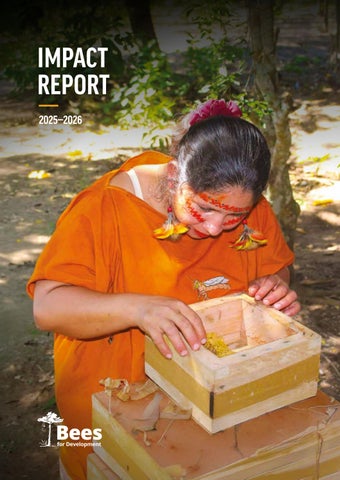
IMPACT REPORT 2025—2026
Bees for Development
A MESSAGE FROM THE CHAIR AND CEO 2025 was another year of transition. After 30 years as a founder-led organisation, moving Bees for Development to a CEO-led organisation was never going to happen in a single year. Through all of this, the team have been fantastic. They have grown stronger and, in a funding environment that is difficult for every charity, they have held our income steady while delivering transformational change for more people than the year before. The pages that follow are their work, and that of our partners. We are delighted that Dan Coppard has now joined us as CEO, bringing great experience as we start our next chapter. His arrival has also given us an opportunity to take a fresh look at Bees for Development: at what makes us distinctive, where our greatest strengths lie and how we can build on 30 years of experience without losing the values and relationships that have brought us this far. What has struck me most as Chair is the strength of the organisation's partnerships. BfD's work is rooted in the knowledge, relationships and leadership of people and organisations in the countries where we work. Our role is not to arrive with all the answers, but to bring expertise, resources and connections that can help good local ideas go further. That is an important foundation for the next stage of our development. We are ready for the next chapter. We have a strong team, trusted partnerships and over 30 years of experience to build on. We are poised to build new funding relationships and have exciting plans to reach many more people whose lives and environment can be transformed by beekeeping. There is much more that Bees for Development can achieve, and we enter this next phase with confidence and ambition.
Suzie Shaw Chair of Trustees 2
Our plans to expand our reach, influence and impact are rooted in the potential of Nature-Based Beekeeping to transform lives and deliver change far beyond the hive. In communities where opportunities to earn cash are few, such as those supported by our partners in Northern Uganda, income from beekeeping can provide capital to start other productive activities, pay school costs and secure homes for families. It can both strengthen resilience where climate is increasingly unpredictable and extreme and become a catalyst for a pathway out of poverty. And when done right, unlike other economic activities, it costs next to nothing to start! We want to put these outcomes even more firmly at the centre of our work, building the evidence to demonstrate the transformative role Nature-Based Beekeeping can play in creating resilient livelihoods and enabling people to invest in their own futures. Over the coming year, we will develop a new organisational strategy and look more deliberately at how BfD can extend its impact. Partnerships will remain central: strengthening the organisations we work with and finding new ways to combine their local knowledge, relationships and leadership with BfD's specialist expertise and experience. We will also start building connections and mechanisms for our partner organisations to work more directly with one another, moving towards a global community that can share knowledge, strengthen practice and collectively advocate for nature-based approaches. We will make more purposeful use of BfD's decades of practical knowledge and experience: strengthening our evidence, making greater use of our Resource Centre and sharing what we know more widely. This also means looking beyond the projects in which we are directly involved, working with universities, governments, extension services, NGOs and others to influence how beekeeping is supported and practised. We know Nature-Based Beekeeping can transform individual lives. Our next challenge is to make that change possible for many more people, through the projects we deliver with partners, by strengthening local organisations, and by using our knowledge and evidence to inform and influence others. That challenge matters more than ever. Poverty and insecure livelihoods, climate change and biodiversity loss increasingly reinforce one another. Nature-Based Beekeeping offers something unique: an accessible livelihood that depends upon healthy ecosystems and creates an economic incentive to protect them. With our partners, beekeepers, donors and supporters, we see enormous potential to build on that connection, improving lives while helping people and nature thrive together. Thank you for making this impact possible.
Dan Coppard CEO beesfordevelopment.org
Impact Report 25—26
2025 YEAR IN REVIEW
Honey bee foraging on flower, Ethiopia
As Head of Communications and Fundraising, I have the privilege of seeing the impact of our work from many different perspectives — from the beekeepers and communities creating change on the ground, to the supporters and partners who make that work possible. This year has shown just how powerful those connections can be.
£994,000 RAISED More than £994,000 raised through direct donor campaigns and grants. Thousands inspired and 300 people with disabilities supported to take action for bees and biodiversity. New markets opened for small-scale beekeepers. And Indigenous communities supported to build livelihoods that help protect rainforest.
Our fundraising has enabled us to extend that impact further. Through the Big Give Christmas Challenge, we are supporting people with disabilities in Uganda and Ghana to access beekeeping training and develop sustainable enterprises. For people facing significant barriers to employment, beekeeping can offer more than an income: it can provide independence, confidence and dignity. Through Earth Raise, we are supporting Indigenous communities in the Peruvian Amazon to develop sustainable stingless beekeeping enterprises. By linking livelihoods directly to forest conservation, this work helps protect rainforest while strengthening community resilience and preserving traditional knowledge. And in Ghana, Digya Forest Honey achieved Food and Drug Authority certification and entered the mainstream market — demonstrating how sustainable beekeeping can create economic opportunities while encouraging responsible management of forests.
Jacob, a beekeeper from Uganda with his woven hive
These are not simply numbers. Behind each one is an opportunity: to earn an income, build independence, protect natural resources, strengthen communities and create a more sustainable future.
None of this happens alone. Every beekeeper trained, every enterprise developed, every hectare protected and every person reached is made possible through collaboration.
300
At the RHS Chelsea Flower Show, our Making Life Better with Bees Balcony Garden brought this message to thousands of people. Winning a Silver-Gilt Medal and the People’s Choice Award gave us an extraordinary platform to demonstrate that creating space for pollinators is something everyone can do.
Thank you for being part of that change.
PEOPLE WITH DISABILITIES SUPPORTED
Together, we are turning the potential of bees into practical, lasting change — for people, communities and biodiversity.
Jenny Handley Head of Communications and Fundraising beesfordevelopment.org
3
Bees for Development
RHS CHELSEA
Award winning Balcony Garden
NBB YOUTUBE African forests are biodiverse habitats and diminishing. They are also full of honey bees, which, if sustainably manged, deliver income and create economic incentive for forest maintenance. The relationship between beekeeping and conservation is well recognised, but too many projects break this link, over-rely on beehive handouts and fail to meet expectations. We are creating 50 high-quality videos, filmed across four countries and shared on YouTube to build the capacity and capability of conservation professionals to deliver successful Nature-Based Beekeeping projects. darwininitiative.org.uk/resources/ communications-toolkit/
Our balcony garden celebrated the vital connection between bees, people and biodiversity. Inspired by our work in Africa, the garden demonstrated how even the smallest spaces can support pollinators and biodiversity. Winning a Silver-Gilt Medal and the prestigious People’s Choice Award was a wonderful recognition, but the highlight was inspiring thousands of visitors to take action for bees. The exhibit also welcomed Her Majesty The Queen, President of Bees for Development and Patron Hugh Fearnley-Whittingstall, helping share our message that everyone can make life better with bees.
2025 HIGH COMMONWEALTH VISITORS
Apimondia Congress, Copenhagen
APIMONDIA CONGRESS
Stephen Muwanguzi, TUNADO, filming for YouTube project
4
In 2025, Bees for Development joined the global beekeeping community at the Apimondia Congress in Copenhagen, bringing together friends, partners and colleagues from across the world. The event provided an invaluable opportunity to showcase our work, share learning and connect with organisations working in rural development and sustainable livelihoods. We also held our first ever Strategy Summit, bringing together our global team to reflect, collaborate and shape our future direction. Our inspiring colleagues shared their experiences and the impact of their work, demonstrating the power of bees to create positive change for people and planet.
Each year, Bees for Development hosts two to three partners or interested beekeepers from a Commonwealth country. This year we hosted Sophai from Malawi and Digna and Christopher from Tanzania. They spent six weeks working with the UK team, learning BfD's NatureBased Beekeeping approach and sharing their own country experience with beekeepers across the UK.
Christopher, Will, Digna and Sophai — our Commonwealth Visitors — visiting Hereford Catherdral
beesfordevelopment.org
Impact Report 25—26
EMPOWERING INDIGENOUS COMMUNITIES
Ashaninka women in Peru
LIGHTS
In April 2025, Bees for Development partnered with Amazon Research Internacional to support Indigenous communities in the Peruvian Amazon through sustainable stingless beekeeping. Working with Ashaninka and Kukama-kukamiria women, men and youth, the programme is protecting vital native pollinators while creating new opportunities for sustainable livelihoods. Known as Las Meliponicultoras, Indigenous beekeepers are combining ancestral knowledge with conservation practices to restore forests, strengthen cultural identity and generate income through honey and other bee products. This inspiring work demonstrates the power of Indigenous-led conservation and the role of stingless bees in protecting the future of the Amazon.
DIGYA FOREST HONEY Bees for Development Ghana’s Digya Forest Honey has achieved certification from the Food and Drug Authority (FDA) in Ghana, enabling this sustainably produced honey to reach mainstream markets. Harvested by small-scale beekeepers in the Kwahu Afram Plains, the honey represents a new source of income for rural families while helping protect Ghana’s forests. Through the local Bees for Development Ghana Honey and Beeswax Trade Centre in Donkorkrom, each batch is traceable back to the beekeeper, ensuring quality, transparency, and fair returns. Digya Forest Honey demonstrates the power of beekeeping to strengthen livelihoods, support conservation, and create lasting change.
Dr Rosa Vásquez Espinoza with stingless bees in Peru
Makerere University, Uganda
MAKERERE UNIVERSITY
Abdul Shafik Asminu, Ghana with his honey harvest
beesfordevelopment.org
Makerere, the leading university in Uganda, has a second year apiculture course. With limited practical training available, we supported field visits to beekeepers, a training apiary, and a student innovation award. These students are the next generation of extension agents, foresters, and development practitioners. They now have practical experience and are connected to Bees for Development’s Nature-Based Beekeeping resource centre. 5
Bees for Development
PROGRAMMES
IN REVIEW
Bees for Development’s programmes continuously evolve and expand as we learn from projects and partners while new beekeeping opportunities arise to support communities most in need. With 30 years of insight, we are uniquely positioned to share our experience and accelerate change for bees and communities worldwide.
MARGINALISED GROUPS
599
William Van Blyderveen Head of Projects
people from marginalised groups trained (237 people with disabilities, 362 indigenous communities). EDUCATION
895
students from primary to university level.
CAPACITY BUILDING
130,874
people reached through our resource centre with 1,310 resources downloaded 548,887 times. In 2025, we started work in Peru with Amazon Research Internacional, responding to rising demands for stingless beekeeping training and markets. Native across the tropics and subtropics, stingless bees provide a valuable livelihood connected to indigenous culture and traditional uses of honey. The Malawi Bee Products Association was officially registered in Malawi, a significant milestone. Beekeepers across Malawi have consistently called for a national platform to bring beekeepers together and support beekeeping as a livelihood activity. 6
Our core work in Ghana, Ethiopia, Uganda and Zimbabwe continued to expand. Our partnership model emphasises long-term work, ensuring partners and the communities they support receive the training and mentorship needed for lasting impact long after individual projects end. Our online resource centre continues to extend our impact well beyond our direct work, with 130,874 people accessing 1,310 resources, with 548,887 downloads.
while pursuing opportunities to expand our reach. Our core projects will continue, while we work with partners to widen their networks and work within countries, sharing NatureBased Beekeeping best practices. Thank you for continuing to support this work whether you are a donor, beekeeper, volunteer, or partner. A special thank you to all our partner organisations which deliver this important work in often difficult field situations.
In 2026, we will grow our work in Malawi and Peru, deepening impact
beesfordevelopment.org
Impact Report 25—26
BIODIVERSITY SUPPORT
1,131
trained in biodiversity support management techniques (fire management, agroforestry, FMNR) across Ethiopia, Ghana, Uganda, and Zimbabwe. BEEKEEPING TRAINING
2,233
directly trained or mentored in beekeeping.
ROUTES TO MARKET
13,786 kgs honey sold directly through BfD-developed free digital traceability systems.
PROJECT OUTCOMES 25%
31%
Between 2019 and 2025 we saw a 25% increase in vegetation health and density (based on NDVI) within a 250m radius (totalling 22,000ha) surrounding apiary sites compared to areas outside apiary sites in Ghana.
Between 2021 and 2025, we saw a 31% reduction in incidence of fire (compared to the previous five years) across the entire Afram plains in spite of the drought and drier condition. No burning occurred within 250m of apiary sites.
70% of beekeepers in Ghana reinvested earnings into livelihoods through income-generating activities and education.
beesfordevelopment.org
7
Bees for Development
PROJECT EXPENDITURE 25/26
UK 1 project £20,000
Ghana 3 projects £168,790 Peru 1 project £30,575
8
beesfordevelopment.org
Impact Report 25—26
Ethiopia 4 projects £246,516 Uganda 6 projects £133,710 Malawi 2 projects £18,286 Zimbabwe 1 project £22,413
beesfordevelopment.org
9
Bees for Development
OUR IMPACT
BEEKEEPING TRAINING FOR INCOME AND SUSTAINABILITY At the heart of our work is Nature-Based Beekeeping training. Working within communities, we teach people how to make local style beehives and establish apiaries. We show them how to encourage bees to colonise the hives and give them the skills and confidence to harvest high-quality honey and beeswax. Success in beekeeping depends on deep local knowledge: understanding when bees swarm, when flowers produce nectar and pollen and the optimal times for harvesting. This is why we always work with local trainers who teach regionally appropriate, sustainable beekeeping methods.
BEEKEEPER TRAINING SESSIONS Our training sessions teach local style hive making, which involves using freely available natural materials (such as bark, logs, bamboo and grasses) which are abundant in many tropical and sub-tropical nations where we work. Evidence from honey-producing regions in developing nations shows that harvests are highest where hives are cheapest because the barrier to participation is low, allowing more people to derive a sustainable harvest from their natural resources — trees and bees!
Project
Country
Trained
TRANSFORM
Ethiopia
40
TRANSFORM Mentorship
Ethiopia
516
Buzz Clubs
Ghana
17
Beekeepers Restore Forest Mentorship
Ghana
500
Mzuzu University practical training
Malawi
46
Indigenous stingless beekeepers
Peru
263
Beekeeping with Batwa people
Uganda
132
Including people with disabilities
Uganda
437
Women's inclusion
Uganda
182
Bees and Trees Mentorship
Zimbabwe
100
IN 2025 WE TRAINED 1,117 BEEKEEPERS AND MENTORED ANOTHER 1,116 ACROSS 6 COUNTRIES Nyirakurunzi Vanice with her woven bee hive in Uganda.
10
Impact Report 25—26
Beekeeper and son with their new bee hives in Uganda Joseph Arebi and his son Arun
BEEKEEPING SUPPORT Our work doesn’t end when the workshop does. We know that learning beekeeping is an ongoing process. Our Beekeeping Extension Agents regularly check in with new beekeepers to troubleshoot, assist and increase production. We facilitate lead beekeepers to take on the role of community-based mentors — so experience and skills are shared within the community.
IN 2025, WE TRAINED 60 BEE CHAMPIONS AND COMMUNITY BEEKEEPING TRAINERS. Students practical session at Mzuzu University
WHAT THE BEEKEEPERS SAY We never knew so much could be produced from bees. All the materials we need can be easily found in [nearby] Jinja so the business is manageable. Now we're able to take processed products to attract [a better] market. Micealea, a lead beekeeper in Peru.
beesfordevelopment.org
11
Bees for Development
OUR IMPACT
EMPOWERING MARGINALISED GROUPS Economic empowerment for women, marginalised groups and people living with disabilities is an organisational priority. We are committed to using beekeeping to break down the barriers that prevent these people from securing a sustainable income as well as making beekeeping more accessible. Whether it's installing guide ropes through apiaries for visually impaired beekeepers or designing lower hive stands for women, our team is dedicated to making beekeeping accessible to all.
WOMEN
INDIGENOUS COMMUNITIES Uganda The Batwa people of Kisoro District in Uganda face many challenges, having been forcibly removed from their ancestral forests. Learning beekeeping has become a life-changing opportunity for them as they gain independent income and respect from their neighbouring communities, whilst protecting the forests that house and feed their bees. We trained 132 people in beekeeping (99 Batwa, 33 non- Batwa landowners). Non-Batwa are included to create community connections. "Sharing knowledge [and] forest for hives has brought togetherness." Batwa beekeeper
Ashaninka beekeepers in Junin Peru
Uganda In 2025, The Uganda National Apiculture Development Organisation (TUNADO) and Bees for Development trained 97 women and 85 men in Soroti District, Uganda, using the Gender Action Learning System (GALS) approach. This brings couples together to foster discussions around joint decision-making. 11 Bee Champions were trained in GALS and how to mentor others. They will provide ongoing community training. This work was supported by a Wales and Africa grant. Zimbabwe In 2023, 100 women across three areas were trained how to construct bee hives. This work is ongoing, with continued mentorship. This year focused on fire management training and planting seedlings from community nurseries.
Women beekeepers weaving bee hives in Soroti, Uganda
12
263 MEMBERS OF THE ASHANINKA AND KUKAMA-KUKAMIRIA TRAINED Peru Indigenous communities of the Peruvian Amazon are calling for livelihood activities connected to their traditional knowledge which promote biodiversity conservation. We trained 263 stingless beekeepers across three locations, using sustainable stingless beekeeping as a tool for biodiversity conservation, cultural preservation and economic independence. Through knowledge sharing, practical training and advocacy, this work strengthened their role as environmental stewards while building a sustainable livelihood rooted in traditional ecological knowledge. beesfordevelopment.org
Impact Report 25—26
MAINSTREAMING INCLUSION Uganda We reached 216 people with a disability through beekeeping in Uganda. Our work ensures beekeeping training is accessible to everyone and includes people with disabilities in community beekeeping groups. This year we trained our partner organisations across Africa in disability inclusion with support from a Wales and Africa Grant. Visually impaired Beekeeper Francis Oloya Okello and his wife Jennifer Piloya are inspiring disability-inclusive beekeepers in northern Uganda. Together they use beekeeping to generate income, restore nature, train others with disabilities, and create brighter futures for their family and community.
Francis Oloya Okello and his wife Jennifer Piloya
Ghana We are actively connecting our global partners so they can directly support one another in building expertise. For example, Bees for Development Ghana, which trained 21 people with a disability this year, will receive specialised training from our Ugandan partner in 2026 to ensure all future projects are inclusive.
CASE STUDY KASULE MATIA Kasule Matia was trained as a beekeeper by TUNADO in Uganda. He is now an Apiary Master in Jinja. Kasule is hearing impaired and uses sign language to communicate. Kasule is hands-on and now provides practical training to others. He has a well-maintained demonstration apiary with a mix of top-bar and localstyle bee hives. Kasule is also able to bring together other deaf people in the area and has started a support group of hearing-impaired beekeepers. All members have at least three colonised bee hives. They have harvested and sold honey, earning additional income. Beekeeping has given Kasule himself independence and a social standing as people now know him as an Apiary Master and beekeeping mentor. Equally important, he says, are the benefits of belonging to a group. Before, he was isolated but now as part of a group that faces similar issues they can share experiences and learn from each other. "Before the training I had little knowledge of beekeeping and only had 16 hives. With the support from Bees for Development, I have expanded to 33 hives and now earn an income that helps provide for my family." Kasule Matia, a lead beekeeping trainer, in is his apiary.
beesfordevelopment.org
13
Bees for Development
OUR IMPACT
EDUCATION FOR IMPACT Our work in schools is the perfect complement to our work in the community — empowering students to take their knowledge home and educate their families about bees and beekeeping. At university level, students gain a solid foundation in apiculture and enterprise development, equipping them for careers in the sector and preparing them to become future leaders.
480 STUDENTS ATTENDING
BUZZ CLUBS Ghana Buzz Clubs offer the opportunity for school children in Ghana to learn about bees and other pollinators, the role of bees in food production and biodiversity conservation. The children also learn the craft of beekeeping to produce honey and other hive products, as well as developing their entrepreneurial skills at this young age. In 2025, 17 schoolteachers joined five days of intensive training to lead these clubs. They were equipped with the skills necessary to teach sustainable beekeeping with hands-on sessions on local-style hive making, lighting smokers and apiary establishment and management. There are currently 16 Buzz Clubs in Ghana with 480 students attending.
Peru Our partner in Peru is implementing new education programmes as a way to engage with local communities. This year they trained 33 teachers and 271 students in stingless beekeeping, emphasising their importance in the Amazon Rainforest. Its popularity means they will expand the project next year.
16 BUZZ CLUBS IN GHANA
Pupils at Amankwakrom R/C Basic Buzz Club in Ghana
14
beesfordevelopment.org
Impact Report 25—26
EDUCATING APICULTURE LEADERS FOR THE FUTURE Malawi We are partnering with Mzuzu University to strengthen apiculture by embedding practical training directly into the rural development curriculum. In 2025 we equipped 47 students with the advanced practical skills needed to advance the sector By providing hands on training we ensure students have essential beekeeping skills. We provide hive-making tools, protective equipment and reference materials to support their learning. At the heart of this partnership is a new campus training apiary, giving students immediate, hands-on mastery over hive management and honey harvesting. Students are also learning about the connections between beekeeping and forestry, since forests provide essential habitat and forage for bees. This partnership will create a generation of leaders committed to environmental sustainability, forest conservation and wealth creation through apiculture. Lenson Simumba, beekeeping trainer, setting up the apiary with students from Mzuzu University.
VOCATIONAL SCHOOL Uganda High demand for beekeeping supplies in Uganda, such as protective equipment, suits and smokers, creates a lucrative market for youth trained in equipment manufacturing. By producing their own gear these young entrepreneurs also gain a sharp competitive advantage: low equipment startup costs to launch their own honey enterprises. We reached a third vocational school in 2025, training 52 students and four teachers from Nancy Comprehensive school for the Deaf. Students now have the skills needed to join the beekeeping industry and earn income. Additionally, tailoring and carpentry students have learnt how to make bee suits and top-bar hives, supplying the local apiculture industry.
This experience strengthened my confidence and interest in beekeeping, and it helped me see how practical skills connect with integrated farming and forestry activities. Joyful Chitonya— student at Mzuzu University
Uganda We supported Makerere University's apiculture students by providing practical training and learning visits. This included establishing a university training apiary. In 2025, 35 students took part in the course while over 80 students benefited from the training apiary through the beekeeping club.
Makerere University students attending the student innovation award.
Moses, a hearing-impaired student who participated in TUNADO training last year at another vocational school, led the hive making training: a compelling example of past learners supporting others.
beesfordevelopment.org
15
Bees for Development
OUR IMPACT
STRENGTHENING BIODIVERSITY Create a beekeeper and you create a champion for nature! Beekeepers are the loudest advocates for the environment because they know their livelihoods depend on it. We empower them to act to protect forests, reduce fires, enrich natural habitat and prevent bees from being poisoned. From helping forest beekeepers prove their honey originates from the forests they protect to delivering the know-how to mitigate bushfires, we are creating the tools and incentives that defend and nurture biodiversity—showing that protecting habitats for honey bees allows all pollinating insects to thrive, safeguarding food security and ecosystems for everyone.
Beekeepers creating fireguards in Zimbabwe
FIRE PREVENTION Where fire is devastating for beekeepers and rural communities alike in sub-Saharan Africa, beekeepers are the unacknowledged leaders and activists in the fight against bushfire.
Zimbabwe Our partner Working for Bees has been working with local beekeeping communities to build fire breaks around apiaries and forests. The team deliver fire awareness programmes as a tool to reduce forest fires. In 2025, 10 beekeepers were trained in fire management, bringing an additional 35 ha under protection.
BEES OF MONMOUTHSHIRE RECORDING PROJECT UK In an era of climate change and increasing habitat loss, it is becoming harder for bees to find suitable nesting sites and the forage they need. To understand how these changes will impact local populations, we first need to know which species are present, a critical baseline that this project provides. Establishing this foundation, the Bees of Monmouthshire Recording Project completed its targeted fieldwork in 2025, bringing the total to 171 species recorded in the county. To share these findings, we launched the Bees of Monmouthshire website, providing a public repository of project data and a visual identification guide. Building on this research, the project actively engages the local community to inspire a new generation of wildlife recorders. Through interactive workshops, guided walks, and community talks, the project reached over 538 people, enabling them to contribute directly to tracking and protecting local bee diversity. Andrena flavipes (Yellow-legged mining bee) female
16
Fire management practice in Zimbabwe
Ghana In Ghana, beekeepers are taking measures to prevent dry-season bushfires. Having been trained by the Ghana National Fire Service they clear dry grass from their apiaries. In 2025, 110 fire management volunteers were trained. Between 2021 and 2025 these practices contributed to a 31% reduction in incidence of fire compared to the previous five years across the Afram plains, in spite of a drought and drier conditions. No burning occurred within 250m of any apiary sites. Fewer fires also meant that between 2019 and 2025 we saw a 25% increase in vegetation health and density (based on NDVI) within a 250m radius (totalling 22,000ha) surrounding apiary sites compared to areas outside this area. beesfordevelopment.org
Impact Report 2025
TRAINING IN BIODIVERSITY SUPPORT PRACTICES Ethiopia Ethiopia’s beekeepers are grappling with widespread loss of bees from pesticide use. Normal practice involves ten applications of pesticide on grass pea, popular for honey bees. We are working and learning alongside farmers to try alternatives. In 2025, 31 pesticide retailers were trained on botanical alternatives as part of our More Bees project. We also trained 23 Trainers to use the Pollinator Training Toolkit (PTT) along with 394 development agents. The PPT teaches beekeepers and farmers the importance of bees for pollination and how to best support pollinators. PTT practices are being applied by 547 farmers.
Uganda In Uganda we reached 4,000 radio listeners in Kisoro District with information about pollinators, their importance and the need for integrated pest management. Beekeepers in this agricultural area are struggling with heavy pesticide use which reduces bee hive colonisation rates. Beekeepers are often also farmers. As natural stewards of the land, they are eager to adopt practices that protect their hives. To drive this transition, we trained 282 beekeepers in agroforestry and 281 in Farmer-Managed Natural Regeneration (FMNR). "I love the forest. It is where my bees come from." Kara Wilber, Uganda
TREE PLANTING Beekeepers around the world are combating the effects of climate change by planting trees to increase shade in apiaries, by restoring local flora and by protecting natural habitats to provide bee forage. Trees planted by Bees for Development partners in 2025: 80,000 Uganda 2,000 as part of our agroforestry initiative
Ethiopia 62,000 indigenous seedlings
Zimbabwe 16,000 indigenous seedlings
Species planted include: — Cashew (Anacardium occidentale) — Dawadawa (Parkia biglobosa) — Prekese (Tetrapleura tetraptera) — Moringa (Moringa oleifera) — Mahogany (Sweitena mahagani)
— Yellow mombin (Spondas mombin) — Velvet tamarind (Dialium cochinchinense) — Becium grandiflorum — Cordia africana — Croton macrostachyus — Grevillea robusta — Augustosinima
Tree planting in Ethiopia
beesfordevelopment.org
17
Bees for Development
OUR IMPACT
BUILDING ROUTES TO MARKET We continue to work closely with the beekeepers we train to facilitate market access. In Ghana we have established a honey-buying social enterprise while in Ethiopia, projects have connected beekeepers to new buyers. Honey traceability sits at the heart of this work. It ensures transparency, accountability and fair pricing, allowing both beekeepers and buyers to trust the integrity of the supply chain. This means that honey is not only sold at a fair price but is also recognised for its quality and origin.
IN 2025, THE TRACEABILTY SYSTEM REGISTERED 13,786 KGS OF HONEY
TRACEABILITY SYSTEMS Ghana and Ethiopia BfD has refined a traceability system designed to work in remote areas with no internet connection that can provide near-live traceability data to honey buyers. In use in Ghana since 2022, the system launched in Southwest Ethiopia in 2024. In 2025 470 more beekeepers were registered with 13,786kg of traceable honey purchased. Data collected from the beekeepers is sent with the honey to the buyers, confirming the provenance and quality of the product at each step of the process. Any issues with honey quality can be immediately traced back to the source, rectified and additional training given to prevent recurrence. In addition, the quality control data that the traceability system provides to buyers has driven both demand and higher prices.
Registering beekeepers onto the traceability system — Ghana
18
beesfordevelopment.org
Impact Report 25—26
ZENABU STARTED BEEKEEPING SIX YEARS AGO
For Zenabu, beekeeping income provides an emergency fund. She is paid for honey by mobile money, which she keeps in the account for unexpected school costs or hospital visits. Mobile money enables her to easily track, manage and save income more easily.
MARKET LINKS Our work ensures beekeepers have access to markets. Whilst beekeeping training provides the ‘push’ of supply, the market provides the ‘pull’ of demand — and for many beekeepers that ‘pull’ is all they need. In some cases, this may require creating new markets directly, such as our Ghana Honey Trade Centre, while in other areas we strengthen linkages between beekeepers and existing buyers, ensuring beekeepers meet the necessary quality requirements.
Ghana Beekeepers are encouraged to register for traceability with the Honey and Beeswax Trade Centre. Payments are made using mobile money — safer and quicker than using cash. All beekeepers are trained in quality standards and are required to adhere to the Centre’s strict traceability system — which has been designed to be as simple as possible. In spite of a drought in 2025, the Honey and Beeswax Trade Centre bought 2,900 kg of honeycomb and paid out £5,890 to 42 beekeepers. Plans are underway to invest in brand development, introduce more value-added products and develop new market outlets. Stingless Bee honey, Peru
Uganda In Uganda we established four market links across our project areas, ensuring beekeepers can sell all the honey they produce and receive cash instantly. We also supported 10 beekeepers representing the Batwa community and beekeepers with disabilities to attend the National Honey Week in Kampala, showcasing their products and establishing links with buyers. Peru Stingless bee honey lacks global recognition because its properties differ from standard Apis mellifera honey, leaving buyers unfamiliar with the product. To address this, we supported Peru's first stingless bee honey market analysis, providing a roadmap to guide future market development. Selling honey and value added products, Uganda
Honey bottled and ready to sell, Ghana
beesfordevelopment.org
19
Bees for Development
OUR IMPACT
INSTITUTIONAL STRENGTHENING To scale our economic and environmental impact beyond individual projects we are committed to developing the long-term institutional strength of our local partners. Balancing technical expertise with organisational development, we strengthen the institutional capacity of local actors to help them thrive independently.
Bee Champion Shafik Asminu sharing a poster with local community, Ghana
This work is supported by our online Resource Centre, a leading global repository for Nature-Based Beekeeping that both informs and is continuously enriched by on-the-ground experience.
Stingless beekeeper reads a training poster in Peru
RESOURCE CENTRE Global Reach Our online Resource Centre is a leading global knowledge hub. Reaching 1,132 registered users with 2,809 articles on all aspects of beekeeping, most of which are unique to our site, it provides a critical resource for training, toolkits and best practice, drawing on knowledge from around the world. In 2025, we produced another four resources and updated another five with our partners. We also launched the Bees of Monmouthshire website supporting community citizen science in the UK.
New resources — Honey Traceability manual
1,132
REGISTERED USERS
2,809
ARTICLES ON BEEKEEPING
1,118
BEE BULLETIN READERS
— Keeping Africa’s smallest stingless bee — Pollinator Training Toolkit — Technical manual on Meliponiculture We circulate the digital Bee Bulletin — a digest of resources for people working in beekeeping and development. In 2025 the Bee Bulletin reached 1,118 readers.
20
130,874
UNIQUE USERS ACCESSED 1,310 RESOURCES WITH 548,887 DOWNLOADS. beesfordevelopment.org
Impact Report 25—26
SUPPORTING PARTNERS In 2025 we partnered with six specialist beekeeping organisations, providing the funding, technical expertise, and organisational support needed to embed the structures, capabilities, and capacity required to deliver Nature-Based Beekeeping. A key outcome this year was the official registration of the Malawi Bee Products Association (MBPA), supporting beekeepers across the country. With MBPA we hosted an Annual General and Stakeholder meeting in Lilongwe, bringing together 40 beekeeping organisations from across Malawi. We started a new project: Leveraging YouTube for Nature-Based Beekeeping Education in Africa, supported by the Darwin Initiative. Four partners learned how to design and film NBB content. We will produce 50 videos in 2026, sharing NBB project design, implementation and best practice. In 2025, partner organisation project managers received their first training on disability inclusion in beekeeping. Over 2026 and 2027 we will scale this initiative. In September 2025, we held our first partner-wide strategy summit at the Apimondia conference in Copenhagen. Six partners shared their perspectives on our core pillars of work to inform our new organisational strategy.
Stephen Muwanguzi, Knowledge Mgt & Communication Officer filming for NBB You Tube project
Supporting students and future beekeepers
My dream for the Malawi Bee Products Association is that it becomes a powerful, well-coordinated platform that professionalises the sector, links producers to reliable markets, and champions inclusive, climate smart practices. Rosyln Kasunda
Apimondia Congress 2025, Copenhagen, Partner-wide strategy summit
BEES FOR DEVELOPMENT JOURNAL Our Journal introduces beekeeping practices and ideas, the impact beekeeping can have on people's lives and how to inspire people to start beekeeping. We emphasise Nature-Based Beekeeping — using local bees, local resources and local beekeeping knowledge. Many of our readers are beekeepers, often new or with limited access to other beekeeping resources, so articles must be relevant and easily understood.
beesfordevelopment.org
21
Bees for Development
FINANCIAL REPORTS Thanks to the incredible generosity of our supporters, we raised £994,000 during the financial year 2025/26. Together with a planned £139,000 investment from our reserves, we were able to spend a total of £1.133 million to advance our mission and support beekeeping communities around the world. During the year £768,000 was spent delivering programmes and creating lasting change for the communities we serve. To provide our partners with vital financial visibility and confidence, we have strategically designated £450,000 of our reserves to secure program continuity and empower collaborative planning throughout 2026/27. We would like to extend our heartfelt thanks to every individual donor, trust, foundation, company, partner and supporter who contributed during the year. Your generosity makes this work possible. Every gift, large or small, has helped us reach more people, deliver more impact, and move closer to a world where bees and beekeeping contribute to sustainable livelihoods and healthy environments. We remain committed to being responsible stewards of the funds entrusted to us, maximising impact, maintaining financial sustainability, and ensuring that every contribution delivers meaningful and measurable change.
£994K RAISED
£768K SPENT ON PROJECTS
Rachael Griffiths Finance Manager
2025—2026 FINANCIAL OVERVIEW 1,200,000 1,000,000
Partnership Development £44k
800,000 600,000
Designated & Restricted £450k
400,000 200,000
RING-FENCED FOR FUTURE PROJECTS
Reserve £250k
0 Income
22
£450K
Expenditure
Reserve
beesfordevelopment.org
Impact Report 2025
Ahunim & Sititaw Dessalgen with their family and honey harvest, Ethiopia
BREAKDOWN BY INCOME
BREAKDOWN BY EXPENDITURE
Donations and legacies
Giftaid
Events
Project delivery
Courses and events
Troy Trust Transfer
Grants
Investments
Events
Salaries
Admin and overheads
*The Troy Trust is now dormant with all former charitable activities undertaken by Bees for Development. Any and all funds received by The Troy Trust continue to be transferred to Bees for Development.
beesfordevelopment.org
23
Bees for Development
OUR PEOPLE BEES FOR DEVELOPMENT PRESIDENT
TRUSTEES
BEES FOR DEVELOPMENT UK
Suzie Shaw, Chair
Dan Coppard, CEO
Megan Denver, Secretary
William Van Blyderveen, Head of Projects
Her Majesty The Queen
PATRONS
Cathy Cooper, Treasurer
Monty Don
Loic Fossiez
Hugh Fearnley-Whittingstall
Ole Hertz
Baroness Anita Gale
Mike Krefta
Kate Humble
Paul Smith
Martha Kearney CBE
Gladstone Solomon
Jenny Handley, Head of Comms and Fundraising Rachael Griffiths, Finance Manager Chris Keywood, Project Manager Gabriella Doody, Comms & Engagement Coordinator Janet Lowore, Associate Consultant
Professor Tom Seeley Sting (Gordon Sumner)
AMBASSADORS Nicola Arkell Reed
Sesi Turnbull Martin Fidler Jones Alex Hirtzel Peter Lead
BEES FOR DEVELOPMENT NORTH AMERICA Megan Denver, Founder/Director Jorik Phillips, Board Director Professor Tom Seeley, Board Director and Patron
Robbie Lyle Lady Hilary Russell Angela Sherriff Andrew Tuggey
24
beesfordevelopment.org
Impact Report 25—26
OUR PARTNER ORGANISATIONS BEES FOR DEVELOPMENT ETHIOPIA Tilahun Gebey, Director Getsh Kassa, Project Coordinator Agazhe Tsegaye, Beekeeping Project Coordinator Baye Getahun, Project Manager Wonde Sahilemariam, Honey Marketing and Livelihood Officer
THE UGANDA NATIONAL APICULTURE DEVELOPMENT ORGANISATION* Dickson Biryomumaisho, Director Phionah Birungi, Programme Manager Hope Agwang, Inclusion Officer Sauda Babirye, Finance Manager Arinanye Viira, Apiary Master
Edlegnaw Asfaw Yigzaw, Beekeeper Fieldworker Assefa Fentya, M&E Lead
Daniel Odongo, Apiary Master Stephen Muwanguzi, Knowledge Mgt & Communication Officer
Efrem Derebie, Beekeeper Trainer
BEES FOR DEVELOPMENT GHANA Kwame Aidoo, Founder Eric Nyarko - Director Isaac Mbroh, Programme Director Gideon Zege, Beekeeping Outreach and Training Manager Amanda Ampadu, Ag Finance Manager Esi Aidoo, Marketing Coordinator Rejoice Azameti, Honey and Beeswax Trade Centre Supervisor Clara Mensah, Gender and Social Inclusion Officer
Nigatu Dejene, Field Officer
KEYSTONE FOUNDATION*, INDIA
Anteneh Ayalew, Finance Lead
Pratim Roy, Director
COLLABORATION PARTNERS
Melaku Tadesse Ambaw, IPM Field worker
Shiny Rehel, Biodiversity Lead
Afram Plains Development Organisation Ghana
Welelaw Ayehualem, IPM Field worker
Justin Raj, Beekeeper
Pesticide Action Network UK Pesticide Action Nexus Ethiopia
Habtam Derebie, Cashier
WORKING FOR BEES, ZIMBABWE MALAWI BEE PRODUCTS ASSOCIATION
University of Huddersfield
Robert Mutisi, Director Makerere Univeristy Happle Mutisi, Accounts
Amon Kabuli - Secretary
Mzuzu University Morat Mutisi, Operations
Judith Chikoti - Board Chair Aubed Kang'ombezulu - Coordinator
Ethio Wetlands and Natural Resources Association (EWNRA)
AMAZON RESEARCH INTERNACIONAL, PERU
Ghana National Fire Service
Dr Rosa Vasquez Espinoza, Founder and Executive Director Miryan Delgado Lujan, Director of Programs and Projects
*These are the team members most involved with Bees for Development and not a list of the whole organisation.
beesfordevelopment.org
25
Bees for Development
THANK YOU Bees for Development sincerely thank all the people and organisations who support our work. Named here are the organisations, companies, families, beekeeping and gardening associations, charitable trusts and foundations donating towards our work, during 2025.
MAJOR DONORS 1% for the Planet
Incubeta
2BScientific
Jersey Overseas Aid
ADM Cares
Jumblebee Ltd
Alex Monroe
Koster Keunen
B J Sherriff
Monmouthshire Building Society
Beechworth Honey
Monmouth Town Council
Bees for Development North America
Neal’s Yard Remedies
Big Give British Wax Refining Co Ltd Buzz Club Stroud Candid Conwy Beekeepers Honey Fair Crafty Ladies Hereford
Northern Bee Books Rowse Honey Ltd. Silent Pool Gin Smiths Group Plc Souter Trust St. Marks Overseas Aid Trust The Bee Space
Danish Beekeepers Association (Danmarks Biavlerforening)
The Lapwing Trust
Darwin Initiative
The Lizandy Charitable Trust
Didymus Charity
The London Honey Company
Draeger Medical
The Oakdale Trust
Eddie Dinshaw Foundation
The Waterloo Foundation
E.H. Thorne (Beehives) Ltd.
Travers Cox Foundation
Ethiopiaid
Tregothnan
Euromonitor International
Tudor Trust
Flow Hive
Unbeelievable Health
Fortnum & Mason
University of Huddersfield
Girdlers Co Charitable Trust
VITA (Europe) Ltd
Grove Farm
WCVA
Healing Herbs
Welsh Government
Hive Logic
Wikiloc
Hobhouse Charitable Trust
Wye Media
Hub Cymru Africa
Wye Valley National Landscape
Hudson Valley Bee Supply
26
beesfordevelopment.org
MAKING LIFE BETTER WITH BEES
YOUR GIFT. YOUR LEGACY. YOUR IMPACT. A gift in your Will, however large or small, can create a lasting effect — supporting beekeepers, protecting bees and helping communities thrive for generations to come. We’ve partnered with the National Free Wills Network to offer our supporters a FREE Will-writing service, making it simple to plan your legacy. beesfordevelopment.org/bee-involved/leave-a-legacy Ernestina Boateng and Felicia Opoku, trainees of Bees for Development Ghana © Briana Marie Forgie with Photographers Without Borders
PLEASE HELP IF YOU CAN Please donate to Bees for Development and help us to Make Life Better With Bees.
£5 A MONTH Helps us teach beekeeping skills to young people in schools.
£10 A MONTH Helps us to plant trees to restore forests and provide nectar for bees.
£20 A MONTH Helps us to train one person for a whole year, so that beekeeping can be a sustainable livelihood.
£50 A MONTH Provides educational resources for a beekeeping trainer.
Bees for Development 1 St Mary's Street, Monmouth NP25 3DB Charity registration number: 1198116 +44 (0) 1600 614 382 info@beesfordevelopment.org beesfordevelopment.org Image: Honey bee foraging Uganda
@beesfordevelopment