B E E F M AST E R B R E E D E RS U N I T E D P R ES E N TS
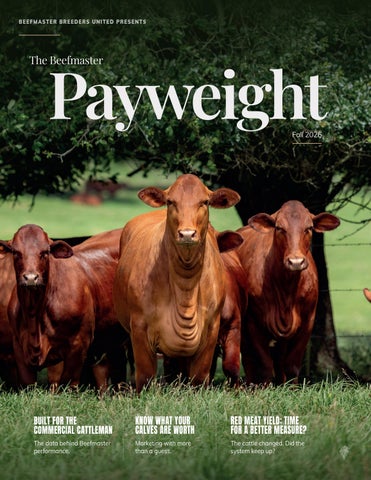
Payweight
The Beefmaster
Fall 2026
BUILT FOR THE COMMERCIAL CATTLEMAN
KNOW WHAT YOUR CALVES ARE WORTH
RED MEAT YIELD: TIME FOR A BETTER MEASURE?
The data behind Beefmaster performance.
Marketing with more than a guess.
The cattle changed. Did the system keep up?
2
PAYWEIGHT
•
FALL 2026
3
PAYWEIGHT
•
FALL 2026
TABLE OF
THE BEEFMASTER PAYWEIGHT
Contents 06
Published by Beefmaster Breeders United Executive Vice President: Dr. Lance Bauer Marketing Director / Editor: Hannah Nixon Website: beefmasters.org Publication: Fall 2026
From the Helm Beefmaster: Built for the Commercial Cattleman
Dr. Lance Bauer looks at the data, performance and real-world results behind Beefmaster’s opportunity in the commercial cattle industry.
12
The Value Proposition We’re Not Just Selling Beefmasters. We’re Selling What Beefmasters Can Do. Moving beyond breed characteristics to communicate what Beefmaster genetics mean to the commercial cattleman’s bottom line.
16
Commercial Edge Know What Your Calves Are Worth Bill Pendergrass explores seasonality, breakevens and risk management—and how understanding the market can help cattlemen make more informed marketing decisions.
20
Red Meat Yield Is It Time for a Better Measure? An adapted look at Beef Checkoff research examining whether a decades-old yield grading system still accurately measures the cattle being produced today.
4
PAYWEIGHT
•
FALL 2026
Black or Red? The industry shops by color. We focus on what keeps ranchers profitable.
So pick your color because with Beefmaster, hide may vary, but performance doesn’t.
5
PAYWEIGHT
Scan to Learn More
•
FALL 2026
FROM THE HELM
DATA. PERFORMANCE. PROFIT. A COMMERCIAL VISION FOR BEEFMASTER - Dr. Lance Bauer
" 6
PAYWEIGHT
•
Our challenge is not determining whether Beefmaster has something to offer.
"
OUR CHALLENGE IS MAKING SURE THE INDUSTRY UNDERSTANDS WHAT WE HAVE TO OFFER.
FALL 2026
FROM THE HELM | Dr. Lance Bauer, BBU EVP
Beefmaster:
BUILT FOR THE COMMERCIAL CATTLEMAN
A
s we introduce the new and revamped Beefmaster Payweight, I believe it is important to talk about where Beefmaster fits in the cattle industry today—and, more importantly, where I believe the greatest opportunity for our breed lies in the future.
"
THAT OPPORTUNITY IS THE COMMERCIAL CATTLEMAN.
"
For a long time, Beefmaster has been recognized for producing excellent females. We know the value of the Beefmaster cow. We know her fertility, longevity, adaptability and ability to raise a calf in challenging environments. Those traits are the foundation of our breed, and they will continue to be. But the commercial cattleman is looking at more than the cow. He wants to know what happens to that calf after it leaves the ranch. How fast does it gain? How efficiently does it gain? Does it stay healthy? Does it grade? And ultimately, does it make money? I believe Beefmaster has a tremendous story to tell on every one of those questions.
THE DATA BACKS IT UP One of the most important pieces of research supporting the commercial value of Beefmaster comes from the USDA Agricultural Research Service and the U.S. Meat Animal Research Center in Clay Center, Nebraska. The study, published in the Journal of Animal Science by Retallick and colleagues in 2017, evaluated 5,606 finishing steers and growing heifers representing 18 beef breeds. Individual animal average daily feed intake, average daily gain and postweaning gain were measured, with feed intake and gain data collected over periods
ranging from 62 to 148 days. The purpose was to better understand the genetic relationships between feed intake and growth and to develop ways to improve feed efficiency. The results are particularly encouraging for Beefmaster. •
•
The published data showed Beefmaster with a very strong combination of gain and intake, and the unrestricted feed-efficiency index for steers ranked Beefmaster among the best of the 18 breeds evaluated. Contemporary reporting of the USMARC evaluation also reported Beefmaster ranking second for average daily gain and dry matter intake in both steers and heifers.
Feed costs represent one of the largest expenses in cattle production. The commercial cattleman doesn't simply need cattle that eat less. He needs cattle that efficiently turn feed into pounds.
"
POUNDS ARE WHAT PAY THE BILLS. Efficiency determines how much those pounds cost. Beefmasters have demonstrated that they can compete in both areas.
HETEROSIS: ANOTHER BEEFMASTER ADVANTAGE There is another part of the Beefmaster story that I believe we need to do a better job of communicating: heterosis. A 2025 study by researchers at USDA's U.S. Meat Animal Research Center evaluated breed-specific heterosis for growth and carcass traits across 18 major U.S. beef breeds. The study included more than 28,000 animals and evaluated traits including weaning weight, postweaning gain, marbling, ribeye area, backfat and carcass weight. 7
PAYWEIGHT
•
FALL 2026
FROM THE HELM The point isn't that every Beefmaster calf will produce exactly those numbers. The point is that the genetics are capable of producing those results. That gives us something we can build on.
28,000+
WE HAVE TO TELL THE STORY
Animals evaluated
18
I believe one of the biggest opportunities for BBU is to take this information beyond the traditional Beefmaster audience.
Major U.S. beef breeds
#1
There are commercial cattlemen across this country who may know very little about Beefmaster. Some know us as a maternal breed. Some know us because their neighbors use Beefmaster bulls. Some may have never considered Beefmaster genetics at all.
estimated increase in postweaning gain among breeds with significant breed-specific heterosis estimates
#2
estimated heterotic increase in carcass weight
We need to change that. And the way we change it isn't simply by telling people that Beefmaster cattle are good.
We need to:
The results showed significant heterosis for growth and several carcass traits. Most importantly for Beefmaster, the researchers found that Beefmaster crosses had the largest estimated increase in postweaning gain among the breeds with significant breed-specific heterosis estimates, and Beefmaster was second only to Brahman for the estimated heterotic increase in carcass weight.
PROOF
show them why. talk about efficiency. talk about heterosis. talk about fertility and longevity. talk about health. talk about pounds. talk about carcass quality. Those are the things that matter to the commercial cattleman.
IN THE REAL WORLD Research is important, but cattlemen want to see what happens when the cattle actually go to work. The BEEF research program documented exceptional results in Beefmaster-sired steers.
ACROSS TWO GROUPS, THE CATTLE AVERAGED:
4.03
lbs
AVERAGE DAILY GAIN 8
PAYWEIGHT
•
FALL 2026
5.58
lbs
FEED PER LB OF GAIN
95%
CHOICE OR BETTER
+ 0
DEATHS OVER 2 YEARS
WHERE THE PAYWEIGHT COMES IN
Now we need to make sure the commercial cattleman knows about it.
That is why I am excited about the new direction of the Beefmaster Payweight. This publication gives us another opportunity to tell the Beefmaster story in a way that is relevant to the entire cattle industry.
THE OPPORTUNITY IS IN FRONT OF US
I want the Payweight to be a place where we share the data and the stories that demonstrate what Beefmaster genetics can do. We have an incredible foundation. We have the Six Essentials. We have generations of breeders who have selected cattle that work. We have USDA research demonstrating our competitive growth and feedefficiency genetics. We have contemporary research demonstrating the value of Beefmaster heterosis for postweaning gain and carcass weight. And we have real-world cattle demonstrating that Beefmaster genetics can gain, convert feed, stay healthy and produce highquality beef.
The new Beefmaster Payweight is going to be part of that effort. I believe the future of Beefmaster is incredibly bright. But that future will be built by making sure our breed remains relevant to the people who ultimately drive the cattle business—the commercial cattlemen who put bulls with cows and expect those decisions to pay off.
Dr. Lance Bauer Dr. Lance Bauer Executive Vice President Beefmaster Breeders United
Moving Forward. Together.
Beefmasters have the genetics, the data and the real-world results. Now, our opportunity is to put those genetics into more commercial herds, continue building the data behind them and tell that story beyond the traditional Beefmaster audience. Beefmasters were built for the commercial cattleman. Now it is our job to make sure everyone knows it.
Arkansas Beefmaster
9
PAYWEIGHT
•
FALL 2026 Breeders Association
NOV. 6
2026 | 1 PM
CATTLEMEN’S MARKET
OF OKEECHOBEE
OKEECHOBEE, FL
OFFERING 80+ BEEFMASTER BULLS! E V E N T S F O R SA LE WE E K! N OV. 4 B UL L S A R R I VE N OV. 5 B UL L VI E W I N G A L L DAY N OV. 6 S A L E DAY
7-1 2 BULL V IEWIN G | 12 -1 L UN C H | 1 B UL L S AL E
A L L B R E E D CO M M E R C I A L H E I F E R S A L E
WI LL STAR T AT THE CON CLU SION OF T H E BU LL SA LE
* * F R E E H A U L I N G T O C E N T R A L L O C AT I O N S * * SCA N T HE QR C ODE TO RE Q UE ST A C ATA LOG !
SALE CONSULTANT: GARRETT THOMAS (956) 714- 4591 | GARRETT@HIPOINTSALESANDMARKETING.COM
AUCTIONEER: CHAD “CRACKER” JOHNSON (352) 535-5320 | CJAUCTIONEER@GMAIL.COM
CO L SON C A NNO N | 352.345 . 3716 · LAU REN LYS SY | 2 10. 41 4.2 119 10 PAYWEIGHT
•
FALL 2026
Join us in Luling, TX for Lyssy’s OF THE HERD Production Sale
Schedule of Events Friday, October 2nd:
Cattle Available for viewing all day 6-9PM: Social Hour + Dinner 7PM: Dinner
Saturday, October 3rd:
8-10AM: Cattle Available for viewing 10:30AM: Heart of the Herd Production Sale
LOT 30
LOT 26
LOT 40
LOT 41
LOT 24
LOT 7
SALE CONSULTANT:
MIKE GREEN (979) 229-6563 3GCATTLESALES.COM
TREY SCHERER 979-203-1656 STRATEGYCATTLE.COM
AUCTIONEER:
PARA MAS INFORMACION EN ESPANOL:
(210) 862-8967 VFRUNNELS@YAHOO.COM
NOE LOPEZ USA (956) 639 3929 MEXICO (868) 312 0223, WHATS APP
LAUREN LYSSY | (210) 414-2119 LYSSYBEEFMASTERS@GMAIL.COM | LYSSYBEEFMASTERS.COM 11
PAYWEIGHT
•
FALL 2026
THE VALUE PROPOSITION
By Hannah Nixon, BBU Marketing Director
WE'RE NOT JUST SELLING BEEFMASTERS. WE'RE SELLING WHAT BEEFMASTERS CAN DO.
F
or a long time, breed marketing has centered around telling cattlemen what makes a breed great. We talk about traits. We talk about pedigrees. We talk about performance. We tell people our cattle are fertile, efficient, maternal, adaptable and productive. Those things matter. But there’s a question we have to get better at answering: What does that mean to the commercial cattleman’s bottom line? Because at the end of the day, commercial producers aren’t buying a list of breed characteristics. They’re buying cattle that have a job to do. 12 PAYWEIGHT
•
FALL 2026
They’re buying a bull because they need cows bred and calves on the ground. They’re selecting genetics because they need females that stay productive and calves that perform. They’re making breeding decisions today with the expectation that those decisions will return more dollars to their operation tomorrow. That means our job isn’t simply to tell the industry that Beefmasters are good cattle.
OUR JOB IS TO SHOW WHAT BEEFMASTERS
can do.
TURN TRAITS INTO VALUE.
TODAY’S COMMERCIAL CATTLEMAN
FERTILITY
Fertility isn’t simply a reproductive measurement. It’s getting cows bred and producing a marketable calf year after year.
HARDINESS
Hardiness isn’t just the ability to withstand difficult conditions. It’s having cattle that remain productive when heat, drought, forage conditions and other environmental pressures challenge an operation.
WEIGHT
HAS MORE INFORMATION THAN EVER BEFORE.
They research, compare and evaluate before they buy.
HAS OPTIONS.
They can choose from multiple breeds, genetics and management strategies.
EXPECTS RESULTS.
Weight isn’t just a number on a scale. It’s pounds available to market.
They need cattle that work hard, stay productive and create value in their operation.
MATERNAL ABILITY
MAKES DECISIONS WITH PURPOSE.
Maternal ability isn’t just something we talk about when evaluating females. It’s producing cows capable of raising a calf and returning to do it again.
LONGEVITY
Longevity means retaining productive females longer and potentially reducing the cost associated with developing or purchasing replacements.
HETEROSIS ADVANTAGE
Heterosis advantage isn’t simply something to put on a chart. It can translate into improvements in economically important traits throughout the cow herd.
Every breeding decision today is made with tomorrow’s return in mind. The strongest answer doesn’t come from a slogan. It comes from evidence.
THE COMMERCIAL
CATTLEMAN HAS OPTIONS.
It comes from the commercial producer who added Beefmaster genetics and saw the results in his replacement females.
Saying “Beefmasters work” isn’t enough.
It comes from a set of calves that performed.
We have to answer the next question:
WHY SHOULD THEY WORK FOR ME?
It comes from cattle that prove their value under realworld conditions.
Those are the conversations that matter.
MARKETING STARTS LONG BEFORE THE SALE.
It starts with the breeding decision. What kind of cattle are you trying to produce? Who is your customer? What matters to that customer? Can you demonstrate that your cattle can deliver it? Good marketing doesn’t manufacture value. It identifies, documents and communicates value that already exists.
It comes from reproductive records, performance data and documented outcomes.
OUR OPPORTUNITY AS A
Breed.
The beef industry is asking producers to do more with every input. Those are conversations Beefmaster breeders should be excited to have. But we need to move beyond simply promoting the breed. We need to communicate the value our genetics create for the people who depend on them every day. 13
PAYWEIGHT
•
FALL 2026
14 PAYWEIGHT
•
FALL 2026
15
PAYWEIGHT
•
FALL 2026
COMMERCIAL
KNOW WHAT YOUR CALVES
EDGE
PRACTICAL PERSPECTIVES FOR PROFITABLE DECISIONS
ARE WORTH. UNDERSTANDING SEASONALITY, BREAKEVENS AND RISK BEFORE MARKETING DAY.
- By Bill Pendergrass
I will begin this commentary with a disclaimer, I am not a professional commodity risk manager. This commentary should be interpreted for what is: the observations and practical experience of a long-time beef industry professional, who has been blessed to have career experience spanning and interconnecting all sectors of the beef industry from seedstock to the packer.
Welcome back to The Payweight!
THE MARKET HAS A RHYTHM
T
his Fall 2026 Edition lands in the midst of an incredibly bullish, optimistic feeder calf market. Many commercial cattlemen know the factors that drive feeder calf and slaughter cattle markets. However, lengthy markets sometimes lead to unrealistic expectations. When marketing feeder cattle, a few common-sense steps to ballpark estimate feeder calf values from the perspective of a cattle buyer are helpful to keep yourself grounded in management and marketing strategy. Let’s begin with seasonality trends. The vast majority of the US calf crop is born in the winter through spring months. These calves come into the feeder and ultimately slaughter cattle markets at the same time every year, that is a seasonality timestamp. This timestamp has become a marketing tool ranchers can apply to their year-round management. Building and maintaining cattle inventory with a strict timeline of marketing points will allow producers to better estimate their feeder calf value. 16 PAYWEIGHT PAYWEIGHT 16
••
FALL 2026 2026 FALL
"
Understanding how biological processes are the basis of modern cattle marketing allows producers to manage, plan and strategize every sector creating the most economically feasible beef supply in the world.
THE BIOLOGICAL CLOCK DRIVES THE MARKET
Consider the consumer buys beef products multiple times per month. In order to keep fresh product in the meat case, packers must process cattle daily. Working backward through the lifetime of a steer, the most difficult harvest slot for packers to plan around are first and second quarter kills, this equates to a high performing yearling calf typically born during the fall months. Historically the fall born calf crop is much smaller than the spring born crop but ironically the fall born calves are the bellwether for the annual feeder calf market. Historically the crop being sold in late spring, which folds in neatly with the hard-to-find, high performing first quarter harvest inventory. This leads into an easily charted seasonality, based on the life cycle of a typical steer.
2
PATHS. SEASONS.
ONE MARKET.
FALL-BORN CALF PATH BORN FALL
MARKETED LATE SPRING
Buyers, both feedyard and packers, are very aware of these historical well established recurring patterns. Accordingly, buyers account for these factors into their breakeven calculations which ultimately determine how much they pay for cattle at every marketing point. To have realistic expectations, it behooves every cattleman to perform a Breakeven Calculation on your own feeder calves. This exercise will reveal how the market works and drive home the true value of genetic and management investments at the ranch level.
THE VALUE CHAIN RANCH FEEDER
ON FEED 180-200 DAYS
HARVEST Q1 / EARLY Q2
Often falls under the April CME feeder calf contract (often the high-water mark for the feeder contract).
SPRING-BORN CALF PATH BORN MARKETED WINTER - SPRING FALL
KNOW YOUR CUSTOMER'S BREAKEVEN.
ON FEED 180-200 DAYS
HARVEST Q2
Typically creates a glut of feeder calves in the fall, with the majority of these steers harvested in the second quarter.
PACKER CONSUMER If you are unsure about how to calculate breakevens, contact your county extension office and they can connect you with beef specialists who can guide you through the formulas that drive cattle values. Ranchers who have historical feedyard and carcass data may discover that retained ownership or partnership feeding ventures may yield greater financial returns than at traditional weaning times. For ranchers who buy superior genetics, retained or partnership feeding is currently the only method to capture maximum returns on genetic investments. 17 PAYWEIGHT PAYWEIGHT 17
••
FALL 2026 2026 FALL
PROTECT WHAT
LRP AT A GLANCE AVAILABLE THROUGH
YOU'VE BUILT.
Licensed brokers in every state.
T
Up to 100%.
LRP AS A RISK MANAGEMENT TOOL
raditionally, seedstock and commercial cow-calf programs have not used risk management tools for a variety of reasons. The futures markets are complex and hard to understand. They can be very costly when the market takes unexpected swings. With the inception of USDA Livestock Risk Protection (LRP), producers now have affordable risk management tools to add price protection based on commodity and easily track futures contracts.
PRICE PROTECTION
Based on futures markets using feeder calf and live cattle contracts.
COVERAGE
UNBORN CALVES
Coverage options are also available for unborn calves.
PREMIUM
Greater coverage means a higher premium.
PAYMENT
In many cases, premium payment is delayed until after cattle are marketed.
GETTING STARTED: WHAT YOUR BROKER WILL NEED Your broker will need the following information to set up your LRP coverage:
NUMBER OF HEAD
EXPECTED MARKETING MONTH
AVG CALF WEIGHT
This may sound intimidating but your broker can answer any questions you have.
PUTTING IT ALL TOGETHER
In tying these themes together, producers can build in simple steps that return a sense of coherence to the marketing cycle. Knowing when your calves will be marketed throughout their lives allows you to look at projected marketings of your customers. Running breakevens will reveal the true value of your calves from your customer's perspective. These practices will provide insight to the value of your calf crop through the industry sectors. Once you have a good understanding of this, you can and should protect your operation with LRP. 18 PAYWEIGHT
•
FALL 2026
This information allows ranchers to effectively consider retained ownership, knowing you can apply affordable price protection without the fear of margin calls.
"
HAVING A CLEAR UNDERSTANDING OF THESE TOOLS WILL PROTECT YOUR OPERATION THROUGH CURRENT AND FUTURE MARKETING CYCLES.
SWB
ADAPTED FROM BEEF CHECKOFF RESEARCH
RED MEAT YIELD.
IS IT TIME FOR A BETTER MEASURE? Today’s cattle have changed dramatically. The system used to estimate their carcass yield largely hasn’t.
F
or decades, the beef industry has used grading systems to help describe both the quality and yield of a beef carcass. Quality grade helps answer “how good?” Yield grade was designed to help answer “how much?” Beef yield grading was introduced in 1965 to estimate the percentage of boneless, closely trimmed retail cuts produced from the round, loin, rib and chuck. The system relies on four primary measurements: 12th-rib fat depth, ribeye area, hot carcass weight and kidneypelvic-heart fat.
1965
USDA YIELD GRADE SYSTEM INTRODUCED
THE FOUR ORIGINAL FACTORS:
12th Rib Fat Depth Ribeye Area Hot carcass weight KPH
Kidney-Pelvic-Heart Fat
Those measurements have helped the industry assign value to carcasses for decades. But there’s an important catch:
THE CATTLE WE’RE MEASURING TODAY AREN’T THE CATTLE WE WERE MEASURING IN 1965. 20 PAYWEIGHT
•
FALL 2026
Genetic progress, nutrition and modern management have changed the size, composition and performance of the U.S. cattle population. That raises an important question for an industry increasingly focused on efficiency: Does our current system accurately recognize the amount of saleable product cattle actually produce?
THE EQUATION STAYED THE SAME.
THE CATTLE DIDN'T.
Quality grading has evolved repeatedly as science and the cattle population have changed. Yield grading has seen far less change. Meanwhile, cattle have. Today’s cattle are heavier and have larger ribeyes than the cattle used to develop the original yield grade equation. As cattle have changed, research indicates the ability of the current equation to predict true red meat yield has declined.
<50% OF THE VARIATION IN TRUE RED MEAT YIELD IS EXPLAINED BY THE CURRENT YIELD GRADE FORMULA IN MODERN CATTLE.
WHY IT MATTERS TO CATTLEMEN Value-based marketing is designed to reward cattle for the value they produce. Carcasses with desirable characteristics can earn premiums, while others receive discounts. For that system to work as intended, the measurements used to determine value need to accurately describe the product being produced. If yield measurements don't fully reflect true red meat yield, the signals being sent back through the beef supply chain may not fully reflect the value cattle are creating. And cattlemen make decisions based on those signals.
Which genetics should be retained? Which bulls are creating value? Which cattle are producing more saleable product with fewer inputs?
1960
2024 Carcass weights now rival the live weights of past generations - a stark reminder of how drastically animal size has increased.
Better information at harvest has the potential to create better information at the ranch.
""
For the long-term sustainability of the industry we have to be able to select cattle that can produce more saleable yield and be able to do it more efficiently." - Producer member, Red Meat Yield Round Table 21 PAYWEIGHT
•
FALL 2026
UTILIZING SCIENCE TO GUIDE INDUSTRY IMPROVEMENTS
A BETTER WAY TO MEASURE VALUE. The same technological advancements that have changed how cattle are selected and managed may also change how their carcasses are evaluated. Precision technology and big data are creating opportunities for a more accurate and adaptable approach to measuring carcass yield. Researchers are evaluating tools including 3D digital imagery, computed tomography (CT) and radar technology.
90%+
3D DIGITAL IMAGERY
Research cited by the Beef Checkoff found 3D digital imagery capable of explaining more than 90% of the variation in saleable red meat yield.
CT
COMPUTED TOMOGRAPHY
CT scanning offers extremely accurate measurement of whole-carcass composition and provides researchers another tool for understanding what a carcass actually contains.
Radar
LIVE-CATTLE POTENTIAL
Radar technology could eventually take the conversation even further, with potential applications for predicting red meat yield before cattle are harvested.
WHAT THIS COULD MEAN AT THE RANCH Ultimately, better yield measurement isn't just about creating a more accurate number on a carcass. It's about creating a better signal of value. More accurate measurements could help the beef industry better recognize cattle that produce greater amounts of saleable product—and send clearer information back through the supply chain. For cattlemen making genetic and management decisions, that information matters.
If we can more accurately identify cattle that create value at harvest, we can make better decisions about the genetics that create that value in the first place. Adapted from “Evolving the Conversation Around Red Meat Yield” by Dr. Jessica Lancaster, Senior Director of Product Quality & Safety Research for the National Cattlemen’s Beef Association, a contractor to the Beef Checkoff. Content has been condensed and adapted for the Beefmaster Payweight audience. Research and findings are credited to the original author and sources. Research coordinated by the National Cattlemen’s Beef Association, a contractor to the Beef Checkoff.
22 PAYWEIGHT
•
FALL 2026
See why cattlemen across the country choose to feed Beefmaster.
The
SUSTAINABLE CHOICE
4.4 lbs Per Day in the Yard 16% Qualified for CAB Premiums
Average Yield Grade: 3 Data derived from 2022–2023 pens of Beefmaster-influenced cattle, on feed and post-harvest.
FEED BEEFMASTER.
94% Choice or Better
FEED BETTER.
Zero Mortality, Zero Pulls
Three Programs Three Programs -- One One Standard Standard of of Excellence Excellence Three distinct breeding programs united by one goal: producing predictable, dependable, and efficient cattle with the genetics and performance to succeed in any environment. November 9-10, 2026 Brush Country Beefmaster Blowout Online Cattle & Genetics Sale
Brush Country Beefmaster partners Triple B Bill Botard 830-460-5095
Schneider Brothers Skeeter Schneider 361-474-0591
Gonzalitoz Alex Gonzalez 361-701-9048
Strategy Cattle, LLC
WHEN YOU THINK BEEFMASTER BULLS,
THINK STRATEGY.
MARKETING OVER 500 BULLS ANNUALLY AT SALES AND PRIVATE TREATY
JOIN US AT THESE UPCOMING BULL SALES GENETIC INVE$TMENT BULL SALES Fall Sale | October 9, 2026 Spring Sale | January 31, 2027 Crockett, Texas
COLLIER FARMS BULL SALES Performance Sale: November 21, 2026 Advantage Plus Sale: February 27, 2027 Brenham, Texas
NEXTGEN FLINT HILLS CLASSIC BULL SALES Fall Sale: September 25, 2026 Spring Sale: April 16, 2027 Paxico, Kansas
www.strategycattle.com A full service cattle Marketing, Media, and Management firm • sales management • genetic consulting • private treaty sales • ranch planning Trey Scherer • (979) 203-1656 • info@strategycattle.com