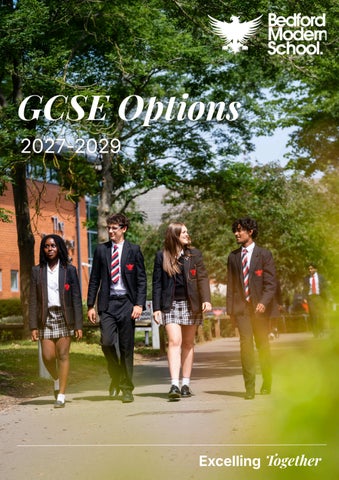
GCSE Options 2027-2029
Excelling Together
Subject Choices This booklet is designed to assist Year 9 students in choosing their GCSE subject options. We offer a highly academic curriculum which is guided by, but certainly not dictated by, the requirements placed by the Department of Education on all maintained schools. Curriculum Reform Two main changes have been made to GCSEs since 2014. The first was that all GCSE specifications were re-written, with the main aim to make them more rigorous. One impact of this is that they reduced the element of coursework in many subjects. The other major change was a new grading scale of 9-1, with 9 being the top grade and with 4 being roughly equivalent to the former grade C. This change was made to allow greater differentiation between students at the higher grades and also to help distinguish the new GCSE from legacy versions. Under the old system a good pass was a C. Now the Department of Education has distinguished between a standard pass (Grade 4) and a strong pass (Grade 5).
Compulsory Core All students are expected to follow courses in Mathematics, English Language and English Literature for the next two years. They will also study three Sciences at IGCSE. Choices Apart from these core subjects, students will choose four more subjects from the options on the next page. For the vast majority of students this will include at least one language (from French, German, Spanish or Latin) and at least one humanity (from Geography, History, Religious Studies or Classical Civilisation). We acknowledge and support the reality that every child at BMS has different strengths and aspirations. Some students may want to choose a more creative route and may choose two subjects from Art, Design Technology, Computer Science, Music, Drama and Physical Education. Others may choose more than one language and/or humanity. Notes We would suggest that students should think carefully before embarking on more than one courseworkheavy subject, which are marked in the list of option subjects with an asterisk (*). For some students, pursuing 10 GCSE subjects may not be appropriate, and any parents who feel that they would like to discuss this option should contact Mr Hewlett, Deputy Head Academic, directly.
Option Subjects Languages (students must select at least one of these) French German Spanish Latin Humanities (students must select at least one of these) Classical Civilisation Geography History* Religious Studies Other subjects Art and Design* Computer Science Design and Technology* Drama* Music* Physical Education* Leading to four choices in total.
*subject with coursework element
Excelling Together
Timeline Date
Event
w/c 09 November 2026
Assembly given by Mr Hewlett explaining the choices
w/c 16 November 2026
Provisional option choices letter sent to students
30 November 2026
Completion of provisional GCSE options via PostModern
24 February/02 March 2027
Parents’ Evening
05 March 2027
Final deadline for submission of confirmed GCSE options form
21 - 24 June 2027
End of year exams - may lead to route and subject changes
After explaining this process to students at the assembly, Mr Hewlett is available by email to speak to any parents who have any further questions. It is strongly advised that parents should encourage their children to speak to subject teachers and their tutors over the coming months to help them in making these important decisions. Students need to submit their provisional options by 30 November 2026. The final confirmation of subject choices will be submitted by 05 March 2027. It is possible that as a school we may ask you to reconsider these choices in light of end of year exam results. Mr H Hewlett Deputy Head Academic hhewlett@bedmod.co.uk
Section A of this booklet outlines the compulsory or core subjects. All students take English Language, English Literature, Mathematics and Science. They all participate in Games and non-curricular PE sessions as well as one tutorial period per cycle. Section B outlines the specification content for the options subjects on offer. The expectation is that the vast majority of students will study at least one language and at least one of the humanities subjects.
Section A GCSE compulsory subjects English Language English Literature Mathematics Biology Chemistry Physics Click on a subject to be directed to the relevant page.
Excelling Together
English Language Exam board: Edexcel IGCSE (click for further information) Head of Faculty: Dr T Foster Course Content: All candidates pursue a course leading to the award of an IGCSE 9-1 qualification at the end of Year 11. Students have one piece of English Language homework per week. This may involve reading and notemaking as well as drafting and polishing written assignments. The qualification comprises one exam worth 60% and one exam worth 40% (see below). There is also a Spoken Language assessment which is conducted internally and subject to external moderation. Overview: Paper One (non-fiction reading and transactional writing) - 60% Paper Two (poetry and prose reading and imaginative writing) - 40% Spoken Language Assessment There is no coursework element to this course. Paper One: Non-fiction texts and transactional writing - 2h 15m Section A (30%) – Reading: short and long questions on an unseen text and one of the ten texts studied from the Pearson Edexcel IGCSE English Language anthology. Section B (30%) – Transactional Writing: a choice of one from two transactional writing tasks – students might be asked to produce an article, a speech, a letter or a guide, for example. Paper Two: Poetry and prose texts and imaginative writing - 1h 30 mins Section A (20%) – Reading - one 30-mark essay question on a poetry or prose text from Part 2 of the Pearson Edexcel IGCSE English Language anthology. Section B (20%) – Imaginative Writing - one 30-mark imaginative writing task from a choice of three. Skills tested include: Comprehension, inference and comparison Language analysis and appreciation Ability to identify bias Writing with appropriate tone, structure and style for different genres and audiences. Candidates must: Use language and register appropriate to audience and context Make accurate and effective use of paragraphs, grammatical structures and sentences Punctuate and spell accurately Structure whole texts effectively.
Spoken Language Assessment Candidates present formally on a topic of their choice before listening and responding to questions designed to elicit developed responses which demonstrate the ability to discuss ideas. The presentation is conducted and assessed internally with external moderation of a recorded sample. The result is reported separately to the numerical grade for English Language. The awards for Spoken Language are Pass, Merit, Distinction or Not Classified.
Excelling Together
English Literature Exam board: Edexcel IGCSE (click for further information) Head of Faculty: Dr T Foster Course Content: All candidates pursue a course of English Literature leading to the award of an IGCSE 9-1 qualification at the end of Year 11. Students have one piece of English Literature homework per week. The qualification involves two exams (worth 60% and 40% respectively). Students study a play by Shakespeare, an anthology of poetry, some unseen poetry, a modern prose text, and a modern drama text. Component 01: Poetry and Modern Prose (60%) Section A - Unseen Poetry - one 20-mark essay question exploring the meaning and effects created in an unseen poem. The poem will be reproduced in the question paper. Section B - Anthology Poetry - one 30-mark essay question from a choice of two, comparing two poems from Part 3 of the Pearson Edexcel International GCSE English Anthology. Section C - Modern Prose - one 40-mark essay question from a choice of two on the set text. Component 02: Modern Drama and Literary Heritage Texts (40%) Section A - Modern Drama - one 30-mark essay question from a choice of two on the set text. Section B - Literary Heritage Texts - one 30-mark essay question from a choice of two on the Shakespeare set text. The aims and objectives of this qualification are to enable students to: Engage with and develop the ability to read, understand and respond to a wide range of literary texts from around the world Develop an appreciation of the ways in which writers achieve their literary effects Develop the skills needed for literary study Explore, through literature, the cultures of their own and other societies Find enjoyment in reading literature and understand its influence on individuals and societies.
Mathematics and Further Mathematics Exam board: Edexcel IGCSE and AQA Level 2 Further Maths (click for further information) Head of Subject: Miss K Adams Course Content: We follow Edexcel’s International GCSE Mathematics (Specification A, 4MA1) in Years 10 and 11, continuing the course started in Year 9. In May/June of Year 11 students take two written papers; the use of a calculator is permitted in both papers. There is no coursework element. Mathematics is allocated seven periods per cycle. Students are taught in sets across half the year group, working at a pace appropriate to their ability; students moving up from Year 9 may find that they have been placed into a different set at the start of the year, if our review of their work shows that to be appropriate and depending on their option choices. Students new to the School will be placed as carefully as possible at the start of the year. There are regular tests and sets are reviewed as necessary. It would be realistic to say that the majority of students are likely to remain in the same set for the remainder of the IGCSE course, although we will always look at individual cases carefully. All students follow the same scheme of work, and we expect almost all to sit the two Higher Tier exams (papers 1H and 2H). More able students are stretched through the use of additional, more demanding activities, including entry for the appropriate level of the National Mathematics Challenge competitions. Students are also given the opportunity (subject to meeting ability requirements) to study the AQA Level 2 Further Maths qualification. It is designed to be taken by talented mathematicians to prepare for an A Level in Further Mathematics. The qualification covers topics in algebra, enumeration, coordinate geometry, Pythagoras and trigonometry, calculus, matrices, and exponentials and logarithms. It is assessed through two 1 hour 45 mins papers. Paper 1 is a non-calculator paper. Paper 2 is a calculator paper.
Excelling Together
Science Head of Subject: Mr D Honnor Course Content: Students will all take three separate sciences leading to the award of three International GCSEs in Biology, Chemistry and Physics. Please note that these courses are three years and as such the material covered in Year 9 should be regarded as the first year of this course. Assessment is by written examination only. All examinations are untiered and are taken at the end of the course with a summary shown below:
Core content
Extension content
Biology Paper 1 2h 0m
Biology Paper 2 1h 15m
International GCSE in Biology
Chemistry Paper 1 2h 0m
Chemistry Paper 2 1h 15m
International GCSE in Chemistry
Physics Paper 1 2h 0m
Physics Paper 2 1h 15m
International GCSE in Physics
Students will have five periods per subject per academic cycle during Years 10 and 11. This equates to a total of 15 periods of Science per academic cycle, with each subject being taught by a specialist teacher. Please see the following subject pages for further details of the course content.
Biology Exam board: Edexcel IGCSE (click for further information) Head of Subject: Mr D Donoghue Course content: Please see the previous page for an overview of GCSE Science at BMS. Key features and benefits of the Biology specification are: It includes aspects of Biology appropriate for the 21st century Straightforward linear assessment in a single tier Assessment of experimental skills through the examination paper with no coursework or controlled assessment It provides a sound foundation for progression to GCE Advanced Level qualifications. Core Paper Content (2h 0m) The characteristics and variety of living organisms Structures and functions in living organisms including; levels of organisation, cell structure, biological molecules, movement of substances into and out of cells, nutrition, respiration, gas exchange, transport, excretion and coordination and response Reproduction, inheritance and gene expression Ecology and the environment, feeding relationships, cycles within ecosystems and human influences on the environment Use of biological resources including food production, selective breeding, genetic modification and cloning. Extension Paper Content (1h 15m) The extension paper covers all core content but has specific additions within the content listed above: The relationship between enzyme function and pH Support in plants Energy content of foods, balanced diet and energy requirements Respiration in plants and transport of nutrients How vaccinations work and the role of blood-clotting in the immune system The function of the eye Homeostasis Seed germination in plants and human embryo development Causes of genetic mutation The nitrogen cycle Biological consequences of water pollution Food production using bacteria Transgenic and cloned species.
Excelling Together
Chemistry Exam board: Edexcel IGCSE (click for further information) Head of Subject: Mr J Fitton Course Content: Please see above for an overview of GCSE Science at BMS. Key features and benefits of the Chemistry specification are: It includes aspects of Chemistry appropriate for the 21st century Straightforward linear assessment in a single tier Assessment of experimental skills through the examination paper with no coursework or controlled assessment It provides a sound foundation for progression to GCE Advanced Level qualifications. Core Paper Content (2h 0m) Principles of Chemistry: states of matter, atomic structure, relative formula masses and molar gas volumes, chemical formulae and equations, ionic compounds, covalent substances, metallic crystals and electrolysis Chemistry of the Elements: the Periodic Table, the elements of groups 1 and 7, oxygen and oxides, hydrogen and water, the reactivity series and tests for ions and gases Organic Chemistry: alkanes, alkenes and ethanol Physical Chemistry: acids, alkalis, salts, energetics, rates of reaction and equilibria Chemistry in Industry: extraction and uses of metals, crude oil, synthetic polymers and the industrial manufacture of chemicals. Extension Paper Content (1h 15m) The extension paper covers all core content but has specific additions within the content listed above: Calculations involving the Avogadro number Percentage yield Detailed relationship between physical properties and ionic structure Properties of diamond and graphite Experimental and quantitative electrolysis Explaining the pattern of reactivity in groups of elements Evaluation of different methods of producing ethanol based on the intended use Calculations of energy changes which accompany reactions Comparison of condensation and addition polymers Extended Organic Chemistry: carboxylic acids and esters.
Physics Exam board: Edexcel IGCSE (click for further information) Head of Subject: Mr J Pritchard Course Content: Please see above for an overview of GCSE Science at BMS. Key features and benefits of the Physics specification are: It includes aspects of Physics appropriate for the 21st century Straightforward linear assessment in a single tier Assessment of experimental skills through the examination paper with no coursework or controlled assessment It provides a sound foundation for progression to GCE Advanced Level qualifications. Core Paper Content (2h) Forces and motion: movement and position, forces, movement, shape and momentum Electricity: mains electricity, energy and voltage in circuits, electric charge Waves: properties of waves, the electromagnetic spectrum, light and sound Energy resources and energy transfers: energy transfers, work and power Solids, liquids and gases: density and pressure, ideal gas molecules Magnetism and electromagnetism: magnetism, electromagnetism, electromagnetic induction Radioactivity and particles: radioactivity, fission and fusion Astrophysics: motion in the universe, stellar evolution. Extension Paper Content (1h 15m) The extension paper covers all core content but has specific additions within the content listed above: Momentum, Newton’s third law and moments Electric charge and applications of electrostatics Sound and the use of oscilloscopes Energy resources and electricity generation Changes of state and specific heat capacity The construction of electromagnets The effect of magnetic fields on electrically charged particles Transformers The Hertzsprung-Russell diagram and cosmology.
Excelling Together
Section B GCSE option subjects At least one from: French German Spanish Latin
At least one from: Classical Civilisation Geography History Religious Studies
Free choice from: Art and Design Computer Science Design and Technology Drama Music Physical Education
Click on a subject to be directed to the relevant page.
Excelling Together
French Exam board: AQA (click for further information) Head of Subject: Mme G Amoros Course Content: The GCSE French content is engaging and relevant. It is designed to develop your language skills, build on your cultural knowledge and give you confidence to use French both in and outside the classroom. Students are required to study the following themes: Theme 1: People and Lifestyle Topic 1: Identity and relationships with others Topic 2: Healthy living and lifestyle Topic 3: Education and work Theme 2: Popular Culture Topic 4: Free time activities Topic 5: Customs, Festivals and Celebrations Topic 6: Celebrity culture Theme 3: Communication and the World Around Us Topic 7: Travel and tourism, including places of interest Topic 8: Media and technology Topic 9: The environment and where people live Assessment: Paper 1 - Listening (25%) - Foundation 35m, Higher 45m Paper 2 - Speaking (25%) - Foundation 7-9m, Higher 10-12m Paper 3 - Reading (25%) - Foundation 45m, Higher 1h 0m Paper 4 - Writing (25%) - Foundation 1h 10m, Higher 1h 15m Assessment takes place in all four skills at the end of Year 11. Students will be entered for either all Foundation tier exams (Grades 1-5) or all Higher tier exams (Grades 4-9). This decision will be taken in consultation with parents following Year 11 trial exams in January.
German Exam board: AQA (click for further information) Head of Subject: Mr A Robinson Course Content: The GCSE German content is engaging and relevant. It is designed to develop your language skills, build on your cultural knowledge and give you confidence to use German both in and outside the classroom. Students are required to study the following themes: Theme 1: People and Lifestyle Topic 1: Identity and relationships with others Topic 2: Healthy living and lifestyle Topic 3: Education and work Theme 2: Popular Culture Topic 4: Free time activities Topic 5: Customs, Festivals and Celebrations Topic 6: Celebrity culture Theme 3: Communication and the World Around Us Topic 7: Travel and tourism, including places of interest Topic 8: Media and technology Topic 9: The environment and where people live Assessment: Paper 1 - Listening (25%) - Foundation 35m, Higher 45m Paper 2 - Speaking (25%) - Foundation 7-9m, Higher 10-12m Paper 3 - Reading (25%) - Foundation 45m, Higher 1h 0m Paper 4 - Writing (25%) - Foundation 1h 10m, Higher 1h 15m Assessment takes place in all four skills at the end of Year 11. Students will be entered for either all Foundation tier exams (Grades 1-5) or all Higher tier exams (Grades 4-9). This decision will be taken in consultation with parents following Year 11 trial exams in January.
Excelling Together
Spanish Exam board: AQA (click for further information) Head of Subject: Ms S Sobrado Course Content: The GCSE Spanish content is engaging and relevant. It is designed to develop your language skills, build on your cultural knowledge and give you confidence to use Spanish both in and outside the classroom. Students are required to study the following themes: Theme 1: People and Lifestyle Topic 1: Identity and relationships with others Topic 2: Healthy living and lifestyle Topic 3: Education and work Theme 2: Popular Culture Topic 4: Free time activities Topic 5: Customs, Festivals and Celebrations Topic 6: Celebrity culture Theme 3: Communication and the World Around Us Topic 7: Travel and tourism, including places of interest Topic 8: Media and technology Topic 9: The environment and where people live Assessment: Paper 1 - Listening (25%) - Foundation 35m, Higher 45m Paper 2 - Speaking (25%) - Foundation 7-9m, Higher 10-12m Paper 3 - Reading (25%) - Foundation 45m, Higher 1h 0m Paper 4 - Writing (25%) - Foundation 1h 10m, Higher 1h 15m Assessment takes place in all four skills at the end of Year 11. Students will be entered for either all Foundation tier exams (Grades 1-5) or all Higher tier exams (Grades 4-9). This decision will be taken in consultation with parents following Year 11 trial exams in January.
Latin Exam board: Eduqas (click for further information) Head of Subject: Ms E Swallow Course Content: The Eduqas Latin GCSE, endorsed by the Cambridge Latin Course, is engaging and rewarding. It is designed to develop your language, critical thinking and analytical skills, develop your understanding of the ancient world and give you confidence in decoding complex information with precision. Component 01: Latin Language (50%) 1h 30m Students will read Latin stories detailing episodes of Roman history or mythology, practising answering comprehension questions, grammar questions and translation sections of text into English. This component is worth 50% of the overall mark, and consists of a 1h30 mins examination. Students will need to know approximately 450 Latin words and a selection of grammar features taught in Years 8-11 Latin using Books 1-4 of the Cambridge Latin Course. Component 02: Latin Literature and Sources (30%) 1h 15m In this unit, students will study a selection of extracts in Latin and images from the Roman world based on a theme, the most recent of which were ‘Magic and Superstition’, ‘Love and Marriage’ and ‘Heroes and Villains’. In the examination, students will be expected to answer short questions on the content of the stories and comment on the style of the authors. This unit is worth 30% of the overall mark and consists of a 1h 15 mins examination. Component 03: Latin Literature: Narratives (20%) 1h 0m In this unit, students study an extract from Apuleius’ Metamorphoses, detailing the tragic love story of Cupid and Psyche. In the examination, students will be expected to answer short questions on the content of the text and comment on the style of the author. This unit is worth 20% of the overall mark, and consists of a 1h examination. There is no coursework in this specification.
Excelling Together
Classical Civilisation Exam board: OCR (click for further information) Head of Subject: Ms E Swallow Course Content: The GCSE Classical Civilisation course is engaging and thought-provoking. It is designed to develop your analytical skills and broaden your understanding of the ancient world through exploring the history, artwork, literature and cultures that continue to influence society today. Component 01: Thematic Study – Myth and Religion (50%) 1h 30m In this component, students study a range of topics from Greek and Roman civilisation, including: The Olympian gods, temples, religious festivals Heroes such as Hercules, Theseus, Romulus and Aeneas Artwork and architecture glorifying famous battles or leaders such as Emperor Augustus Myths about the founding of the Olympic Games, Athens and Rome Stories such as Hades & Persephone and Orpheus & Eurydice. Component 02: Literature and Culture – The Homeric World (50%) 1h 30m In this component, we study a selection of episodes from Homer's Odyssey and the historical period in which it was written, including: Odysseus escaping the one-eyed Cyclops Polyphemus' cave Odysseus defeating the witch Circe Odysseus finally defeating the suitors vying for his kingdom and his wife Penelope The archaeological sites of ancient Mycenae, Tiryns and Troy Jewellery, weaponry, artwork and daily life of people in this historical period Each component is worth 50% of the overall mark and is assessed in a 1 hour 30 mins examination at the end of the course. Examination questions range from those that are purely factual (‘Who was the king of the Greek gods?’) to the more analytical (‘What do you think were the advantages and disadvantages of worshipping more than one god?’). There is no coursework element in this specification.
Geography Exam board: OCR (click for further information) Head of Subject: Mr B Day Course Content: The course contains three components: Our Natural World, People and Society, and Geographical Skills and Decision Making, e.g. maps, GIS, data collection and interpretation. Therefore, there is no coursework or controlled assessment but there will be fieldwork required for the skills paper. Assessment of all three units will take place in June of Year 11. Component 01: Our Natural World (35%) 1h 30m Topics: Global Hazards Changing Climate Distinctive Landscapes Sustaining Ecosystems This paper includes fieldwork and Geographical skills. The examination comprises shorter answers worth 1-4 marks and longer answers worth 6-8 marks. Component 02: People and Society (35%) 1h 30m Topics: Urban Futures Dynamic Development The UK Resource Resilience This paper includes fieldwork and Geographical skills. The examination comprises shorter answers worth 1-4 marks and longer answers worth 6-8 marks. Component 03: Geographical Skills (30%) 1h 30m This unit is based around Geographical skills and a decision making exercise. The examination comprises shorter answers worth 1-4 marks and longer answers worth up to 12 marks.
Excelling Together
History Exam board: CIE (click for further information) Head of Subject: Ms C Webb Course Content: The course contains three components: Our Natural World, People and Society, and Geographical Skills and Decision Making, e.g. maps, GIS, data collection and interpretation. Therefore, there is no coursework or controlled assessment but there will be fieldwork required for the skills paper. Assessment of all three units will take place in June of Year 11. Component 01: Written Paper (40%) 2h 0m Students answer two questions from Section A (Core Content) and one question from Section B (Depth Study). All questions are in the form of structured essays, split into three parts: (a), (b), and (c). Content: International Relations since 1919 (Core Content) Germany 1918-45 (Depth Study). Component 02: Written Paper (30%) 1h 45m Students answer five questions on one prescribed topic taken from the Core Content. There is a range of source material relating to each topic. The topic prescribed by the exam board is taken from the Core Content and changes annually. Component 03: Coursework (30%) Internally assessed. Students produce one piece of extended writing of up to 2000 words based on a task devised by the school. Questions are marked internally and externally moderated by CIE. Marks are submitted at the end of Year 11 but the tasks will be completed during the course of Year 11.
Religious Studies Exam board: Eduqas (click for further information) Head of Subject: Mr J Hooper Course Content: The Eduqas GCSE in Religious Studies is comprised of three examined components. They incorporate a general study of philosophy and ethics as well as an in depth look at Christianity and Islam. Component 01: Religious, philosophical and ethical studies in the modern world (50%) 2h 0m Theme 1: Issues of Relationships – Equality, relationships and sexual ethics Theme 2: Issues of Life and Death – Science, creation, life after death and life and death issues Theme 3: Issues of Good and Evil – Crime and punishment, suffering and forgiveness Theme 4: Issues of Human Rights – Social justice, prejudice, discrimination, wealth and poverty. Component 02: A study of Christianity (25%) 1h 0m Theme 1: Beliefs and teachings of Christianity – The nature of God and the foundations of faith Theme 2: Practices of Christianity – Worship, celebration and community. Component 03: A study of Islam (25%) 1h 0m Theme 1: Beliefs and teachings of Islam – The nature of God and the foundations of faith Theme 2: Practices of Islam – Worship, celebration and community. The course is assessed entirely by external examinations. Component 1 is assessed through a 2 hour examination worth 50% of the qualification and components 2 and 3 are each assessed through a 1 hour examination, each of which is worth 25% of the qualification. Each theme above will be reflected in one question comprising four parts, with each part increasing in difficulty.
Excelling Together
Art and Design Exam board: Eduqas (click for further information) Head of Subject: Mrs L Turner (interim) Course Content: The Edexcel GCSE qualification in Art and Design Course structure is as follows: Component 01: Personal Portfolio in Art, Craft and Design (60%) 60% of the qualification (72 marks: 18 marks for each of the four assessment objectives). Unit 1 comprises approximately 45 hours of taught lessons plus weekly homework in which students produce a unit of coursework. Students will be encouraged to develop work by undertaking the following activities: Developing their ideas and skills to grow as effective and independent learners, and as critical and reflective thinkers with enquiring minds Developing and refining ideas and proposals through experimentation with media and techniques Understanding the purposes, intentions and functions of art, craft and design in a variety of contexts Gaining an understanding of art, craft and design in historical and contemporary contexts, societies and cultures. Students must produce work covering 2D and 3D disciplines, e.g. painting, printmaking and ceramics. Visits are arranged by the Department to allow students to view work and gather primary research material through drawing and recording from life. Component 02: Externally Set Assignment (40%) 40% of the qualification (72 marks: 18 marks for each of the four assessment objectives). The exam paper with a broad theme will be published in January each year and may be given to students as soon as it is released. Unit 2 will culminate in 10 hours of sustained focus when students will work unaided to produce personal response(s) with reference to their preparatory studies, in response to the thematic starting point. Assessment will be in May of Year 11.
Computer Science Exam board: OCR (click for further information) Head of Subject: Miss E Ginns (interim) Course Content: This course will not just appeal to students who have an interest in programming, but also those with an interest in computational thinking and computing in general. It will develop practical skills in creating solutions to problems and will promote confidence and independent thinking. Python is the main language used and students will also learn how to write pseudocode. We aim to produce confidence and digital literacy in all students during the timetabled lessons, and then to provide the opportunity for those who have developed a passion for some aspects of ICT to be supported to pursue that in co-curricular sessions. GCSE Computer Science is a problem-solving subject where students embark upon an exciting journey through programming and computer systems with assignments involving students creating their own programs. Students learn the importance of computational thinking which underpins all computer systems as well as getting an appreciation for computer hardware. Assessment for the GCSE qualification takes the form of two written papers: Paper 01: Core principles of Computer Science (50%) Paper 02: Application of Computational Thinking (50%) In Paper 2 students will demonstrate their skills in coding and algorithm design. Students will also need to develop code in order to solve a given issue. Students will gain a lot of the understanding for this paper from the practical work that they will carry out over the two year course. The course is taught in a combination of theory and practical coding activities. Students will find this course a creative and interesting experience. Students opting for the course will need to work on their programming skills at home and cannot simply rely on lesson time to hone their understanding of given programming languages. Regular support sessions will run during lunchtimes and after school to support GCSE students.
Excelling Together
Design Technology Exam board: OCR (click for further information) Head of Subject: Mr A Jones Course Content: Students will follow the OCR Design Technology J310 specification. This specification offers students the opportunity to apply their learning to real-life situations and to given design problems and scenarios. It aims to relate authentic real-world awareness of iterative design practices and strategies used by the creative, engineering and manufacturing industries. Students will be required to use critical thinking leading towards invention and design innovation to design and make prototypes that solve real problems, considering their own and others’ needs, wants and values. The course enables students to develop their Key Stage 3 learning in Design Technology, furthering their critical thinking and practical skills. The skillset from this course will serve students well in the future, with A Levels, higher education or into the workplace. The qualification will give students an opportunity to engage with creativity and innovation, and enhance their skills by the application of knowledge from other subject areas across the curriculum such as Mathematics, Science, Art, Computer Science and Humanities, as well as the practical and technical knowledge and understanding they will learn from Design Technology. Component 01: Principles of Design and Technology (50%) 2h 0m he exam will focus upon ‘Core’ knowledge of Design and Technology principles and ‘In-depth’ knowledge that focuses more directly on at least one main material category, Graphics, Product Design or Design engineering. Component 02: Iterative Design Challenge (50%) Internally assessed. As an outcome of their challenge, students will produce a chronological e-portfolio and one final prototype(s). Contextual challenges will be released on 01 June each year. Students will carry out a main ‘design and make’ challenge, for which they will produce a prototype and e-portfolio showing the stages of design they went through to reach the final outcome(s). The course will focus on designing and making products that are fit for a given user problem or scenario. It will enable students to work with a range of materials which include woods, plastics and metals to create professional and marketable end products. Students will learn about specific materials and manufacturing processes in order to produce high quality products of their own. The course strikes a good balance between hands-on practical skills and the use of modern technologies when designing new products and systems. There will be opportunities for students to use Computer Aided Design (CAD) packages in the form of SOLIDWORKS and TechSoft Design. The department is well-
resourced with Computer Aided Manufacture (CAM) machinery available for students to then manufacture their final products and 3D prototypes. This includes the use of CNC milling machines, laser cutters and 3D printers.
Excelling Together
Drama Exam board: CIE (click for further information) Head of Subject: Mrs E Marabese Course Content: IGCSE Drama is a challenging and engaging academic qualification which is recognised by universities and employers throughout the world. It combines the practical exploration with theoretical study of Drama and Theatre. It is an excellent choice for those who wish to develop their analysis or evaluative skills. It develops key life skills such as confidence, presentation skills, teamwork and leadership qualities. The true purpose of Drama education is not necessarily to create more professional actors, designers or directors, it is to create more complete human beings who are critical thinkers, who have curious minds and who can lead productive lives. Component 01: Written examination (40%) 2h 0m Learners study one complete play text and learn the skills of how to move from script to performance, considering the contribution of actors, directors and designers to the interpretation and shaping of the dramatic material. Candidates answer five questions on the play they have studied: two compulsory structured questions, focused on extracts from the set play; two compulsory extended-response questions; and one extended-response question, from a choice of two questions. This is an open text exam and is externally assessed. Component 02: Coursework (60%) Internally assessed. The practical coursework consists of a group performance based on an extract from a play, an individual performance based on an extract from a play, a group performance based on an original devised piece, and a written evaluative review of their devised piece. Candidates will learn: the elements of practical drama; individual and group performance skills and how they are applied to create character and communicate meaning to an audience; how to use staging and design as part of a dramatic performance; how to work with published plays as an actor, director and designer; and how to devise, develop and structure their own original dramatic material from stimuli. The coursework is internally assessed and externally moderated.
Music Exam board: AQA (click for further information) Head of Subject: Miss D Derry Course Content: The GCSE in Music develops the three musical skills of Understanding Music, Performing and Composing. Component 01: Understanding Music (40%) The course is based on the following Areas of Study: • Western Classical Tradition (1650 – present day) • Popular music (Gaming Music/Musical Theatre/Rock and Pop) • Traditional Music (Blues/African/Caribbean/British Folk styles) This part of the course is examined through a listening exam which is made up of two sections. Students apply their knowledge of musical elements and how this relates to both familiar and unfamiliar styles. The exam structure is: Section A – Areas of Study, Dictation, and Unfamiliar Pieces (68 marks) Section B – Study Pieces (28 marks) Component 02: Performing (30%) Internally assessed Students are required to perform a solo and an ensemble for a combined total of four minutes. The performance can be in any style and students are encouraged to play to their strengths when choosing their pieces. The ensemble performance must last over one minute. Performances are recorded during Year 11. Component 03: Composing (30%) Internally assessed This non-examined assessment is completed in class time. Students learn how to develop their musical ideas through employing a range of compositional techniques that best reflect the skills, strengths and interests of the individuals. Students need to ensure that their compositions demonstrate technical control and a range of musical elements. There are excellent facilities within the faculty, facilitating the ability for students to create their own musical scores or multi-tracked compositions. Students complete two compositions. A composition to a set brief (36 marks) and a free composition (36 marks).
Excelling Together
Physical Education Exam board: OCR (click for further information) Head of Subject: Miss H Gilbert Course Content: GCSE Physical Education aims to prepare learners for the further study of PE and sport, sport science courses or for future work within the growing sports industry. The course develops an understanding of the factors which underpin physical activity and uses this knowledge to improve sports performance. GCSE Physical Education provides a clear pathway through to A Level PE and has enhanced its links with other subjects such as Biology and Psychology. The syllabus is made up of both theoretical (60%) and practical (40%) components. The theoretical element is made up of two 1 hour written examinations. The practical element consists of the student performing three practical activities and a performance analysis task. Each student must perform one individual sport, one team sport and the third can be either of these options. We expect students to be performing and representing the school in these sports where possible. Students who join the course need to be committed to these sports for the entirety of the course. With the recent reforms to GCSEs, it is now harder to achieve full marks on the practical activities; however this does not prevent the students accessing the higher marks by the end of the course. Component 01: Physical Factors Affecting Performance (30%) Applied Anatomy and Physiology and Physical Activity Within this exam, topics focus on the structure and function of the skeletal, muscular, respiratory and cardiovascular systems and the long term effects exercise has on the body. Students develop their understanding of movement analysis, including levers, planes and axes. In other topics, the students apply the principles of training and components of fitness in order to optimise performance and prevent injury. Component 02: Socio-Cultural Issues and Sports Psychology (30%) Socio-Cultural Influences, Sports Psychology and Health, Fitness and Well-Being The topics for this exam are based around participation in physical activity and sport, exploring the effects of commercialisation, and understanding the differences between sportsmanship and gameship. Students develop their understanding of the impact drugs have within sport and increase their knowledge of how mental preparation techniques can influence performance. Topics also focus on how diet and nutrition affect the body and the effects of exercise on a person’s health and well being.
Component 03: Non-Examined Assessment (40%) Practical Activity (30%) Students will be assessed in three practical activities, which must include a combination of team and individual sports with at least one being from either category. Students are required to demonstrate effective performance, the use of tactics or techniques, appropriate levels of physical fitness and the ability to observe the rules and regulations.
Analysing and Evaluating Performance (AEP) (10%) Students analyse and evaluate aspects of their own performance in their chosen activity. They are required to evaluate the strengths and weaknesses and produce an action plan which aims to improve the quality and effectiveness of a weakness of the performance. Although there is a practical element to the course, the majority of lessons are theory-based. Any practical work focuses on applying the learnt concepts to a sports setting or individual sports.
Excelling Together